

IEC 62271-4:2013
(Main)High-voltage switchgear and controlgear - Part 4: Handling procedures for sulphur hexafluoride (SF6) and its mixtures
General Information
- Abstract
IEC 62271-4:2013 applies to the procedures for handling of SF6 during installation, commissioning, normal and abnormal operations, disposal at the end of life of high voltage switchgear and controlgear. This first edition cancels and replaces the first edition of IEC/TR 62271-303 published in 2008. This first edition constitutes a technical revision. This edition includes the following significant technical changes with respect to the previous edition:
a) the description of the potential effects on health of SF6 by products (former Annex D of IEC/TR 62271-303:2008) has been replaced by the calculation methods for evaluating of the potential effects on health of SF6 by products (see Annex H);
b) information about cryogenic reclaim of SF6. Have been added (see Annex I);
c) handling procedures for the most popular SF6 mixtures have been added (see Annex J).
- Status
- Published
- Publication Date
- 25-Aug-2013
- Technical Committee
- SC 17A - Switching devices
- Current Stage
- DELPUB - Deleted Publication
- Start Date
- 22-Jul-2022
- Completion Date
- 05-Apr-2019
Overview
IEC 62271-4:2013 is an international standard published by the International Electrotechnical Commission (IEC) that specifies handling procedures for sulphur hexafluoride (SF₆) and its mixtures used in high-voltage switchgear and controlgear. This standard covers comprehensive guidance for the safe and effective management of SF₆ gas during installation, commissioning, normal and abnormal operation, maintenance, and disposal at end-of-life of electrical equipment.
This edition replaces the earlier Technical Report IEC/TR 62271-303:2008, providing updated and expanded technical requirements. Key updates include new calculation methods for evaluating health effects related to SF₆ by-products, information on cryogenic reclaim processes, and procedures for handling popular SF₆ gas mixtures.
Key Topics
- Scope and normative references: Defines the applicability of SF₆ handling procedures to high-voltage electrical equipment.
- Rules for installation and commissioning: Procedures for evacuation, filling, topping-up, and checking the quality of SF₆ gas.
- Handling during normal operation: Guidance on refilling SF₆ to maintain rated pressure and density, and on-site quality checks using portable equipment.
- Recovery and reclaim during maintenance: Methods for safely recovering SF₆ gases, including from arced gas under different service conditions.
- End-of-life disposal: Procedures for dismantling and recovering SF₆ from sealed and controlled pressure systems, minimizing environmental impact.
- SF₆ by-products evaluation: New calculation-based approach to assess potential health risks associated with SF₆ decomposition products.
- Cryogenic reclaim techniques: Additional guidance on advanced SF₆ gas recovery methods through cryogenic technology.
- Handling SF₆ mixtures: Normative annex providing specific handling instructions for commonly used SF₆ gas mixtures.
- Safety and training: Informative annexes on safety measures, first aid, staff training, certification, and equipment descriptions.
- Environmental considerations: Overview of SF₆ environmental effects and best practices to reduce global warming potential.
Applications
IEC 62271-4:2013 is essential for professionals and organizations involved in:
- Manufacturing and installation of high-voltage switchgear and controlgear using SF₆ gas insulation.
- Maintenance and service providers who perform SF₆ gas handling tasks such as filling, recovery, refilling, and quality checks in substations and electrical distribution systems.
- End-of-life management operators responsible for the safe decommissioning, dismantling, and disposal of SF₆-containing electric power equipment in compliance with environmental regulations.
- Health and safety coordinators tasked with minimizing personnel exposure to SF₆ and its by-products during electrical equipment operations.
- Environmental compliance officers aiming to reduce SF₆ emissions and implement best practices in greenhouse gas mitigation.
- Training institutions providing certification and education on SF₆ handling techniques and safety protocols.
By following this standard, users can enhance operational safety, improve SF₆ gas management, reduce environmental impact, and comply with international regulatory requirements.
Related Standards
- IEC 62271 series: Includes standards governing high-voltage switchgear and controlgear safety, design, and testing.
- ISO 14001: Environmental management systems for organizations handling SF₆ gases.
- IEC/TR 62271-303: The predecessor technical report on SF₆ handling, replaced by IEC 62271-4.
- National regulations: Local environmental and safety regulations on SF₆ gas handling and emissions.
- IEC 60480: Guidelines for checking and reusing sulphur hexafluoride gas in electrical equipment.
- IEC Electropedia: Online resource defining technical terms related to SF₆ and electrical switchgear.
Keywords: IEC 62271-4, SF6 handling procedures, high-voltage switchgear, sulphur hexafluoride safety, SF6 mixtures, gas recovery, cryogenic reclaim, electrical equipment maintenance, SF6 disposal, SF6 by-products, electrical industry standards, environmental compliance in electrical systems.
Relations
- Effective Date
- 05-Sep-2023
- Effective Date
- 05-Sep-2023
Get Certified
Connect with accredited certification bodies for this standard

IMQ S.p.A. (Certification)
Italian electrical product certification.

SLG Prüf- und Zertifizierungs GmbH
German testing and certification body.

UL Solutions
Global safety science company with testing, inspection and certification.
Sponsored listings
Frequently Asked Questions
IEC 62271-4:2013 is a standard published by the International Electrotechnical Commission (IEC). Its full title is "High-voltage switchgear and controlgear - Part 4: Handling procedures for sulphur hexafluoride (SF<sub>6</sub>) and its mixtures". This standard covers: IEC 62271-4:2013 applies to the procedures for handling of SF6 during installation, commissioning, normal and abnormal operations, disposal at the end of life of high voltage switchgear and controlgear. This first edition cancels and replaces the first edition of IEC/TR 62271-303 published in 2008. This first edition constitutes a technical revision. This edition includes the following significant technical changes with respect to the previous edition: a) the description of the potential effects on health of SF6 by products (former Annex D of IEC/TR 62271-303:2008) has been replaced by the calculation methods for evaluating of the potential effects on health of SF6 by products (see Annex H); b) information about cryogenic reclaim of SF6. Have been added (see Annex I); c) handling procedures for the most popular SF6 mixtures have been added (see Annex J).
IEC 62271-4:2013 applies to the procedures for handling of SF6 during installation, commissioning, normal and abnormal operations, disposal at the end of life of high voltage switchgear and controlgear. This first edition cancels and replaces the first edition of IEC/TR 62271-303 published in 2008. This first edition constitutes a technical revision. This edition includes the following significant technical changes with respect to the previous edition: a) the description of the potential effects on health of SF6 by products (former Annex D of IEC/TR 62271-303:2008) has been replaced by the calculation methods for evaluating of the potential effects on health of SF6 by products (see Annex H); b) information about cryogenic reclaim of SF6. Have been added (see Annex I); c) handling procedures for the most popular SF6 mixtures have been added (see Annex J).
IEC 62271-4:2013 is classified under the following ICS (International Classification for Standards) categories: 29.130.10 - High voltage switchgear and controlgear; 29.130.99 - Other switchgear and controlgear. The ICS classification helps identify the subject area and facilitates finding related standards.
IEC 62271-4:2013 has the following relationships with other standards: It is inter standard links to IEC TR 62271-303:2008, IEC 62271-4:2022. Understanding these relationships helps ensure you are using the most current and applicable version of the standard.
IEC 62271-4:2013 is available in PDF format for immediate download after purchase. The document can be added to your cart and obtained through the secure checkout process. Digital delivery ensures instant access to the complete standard document.
Standards Content (Sample)
IEC 62271-4 ®
Edition 1.0 2013-08
INTERNATIONAL
STANDARD
NORME
INTERNATIONALE
colour
inside
High-voltage switchgear and controlgear –
Part 4: Handling procedures for sulphur hexafluoride (SF ) and its mixtures
Appareillage à haute tension –
Partie 4: Utilisation et manipulation de l'hexafluorure de soufre (SF ) et des
mélanges contenant du SF
All rights reserved. Unless otherwise specified, no part of this publication may be reproduced or utilized in any form
or by any means, electronic or mechanical, including photocopying and microfilm, without permission in writing from
either IEC or IEC's member National Committee in the country of the requester.
If you have any questions about IEC copyright or have an enquiry about obtaining additional rights to this publication,
please contact the address below or your local IEC member National Committee for further information.
Droits de reproduction réservés. Sauf indication contraire, aucune partie de cette publication ne peut être reproduite ni
utilisée sous quelque forme que ce soit et par aucun procédé, électronique ou mécanique, y compris la photocopie et les
microfilms, sans l'accord écrit de la CEI ou du Comité national de la CEI du pays du demandeur.
Si vous avez des questions sur le copyright de la CEI ou si vous désirez obtenir des droits supplémentaires sur cette
publication, utilisez les coordonnées ci-après ou contactez le Comité national de la CEI de votre pays de résidence.
IEC Central Office Tel.: +41 22 919 02 11
3, rue de Varembé Fax: +41 22 919 03 00
CH-1211 Geneva 20 info@iec.ch
Switzerland www.iec.ch
About the IEC
The International Electrotechnical Commission (IEC) is the leading global organization that prepares and publishes
International Standards for all electrical, electronic and related technologies.
About IEC publications
The technical content of IEC publications is kept under constant review by the IEC. Please make sure that you have the
latest edition, a corrigenda or an amendment might have been published.
Useful links:
IEC publications search - www.iec.ch/searchpub Electropedia - www.electropedia.org
The advanced search enables you to find IEC publications The world's leading online dictionary of electronic and
by a variety of criteria (reference number, text, technical electrical terms containing more than 30 000 terms and
committee,…). definitions in English and French, with equivalent terms in
It also gives information on projects, replaced and additional languages. Also known as the International
withdrawn publications. Electrotechnical Vocabulary (IEV) on-line.
IEC Just Published - webstore.iec.ch/justpublished Customer Service Centre - webstore.iec.ch/csc
Stay up to date on all new IEC publications. Just Published If you wish to give us your feedback on this publication
details all new publications released. Available on-line and or need further assistance, please contact the
also once a month by email. Customer Service Centre: csc@iec.ch.
A propos de la CEI
La Commission Electrotechnique Internationale (CEI) est la première organisation mondiale qui élabore et publie des
Normes internationales pour tout ce qui a trait à l'électricité, à l'électronique et aux technologies apparentées.
A propos des publications CEI
Le contenu technique des publications de la CEI est constamment revu. Veuillez vous assurer que vous possédez
l’édition la plus récente, un corrigendum ou amendement peut avoir été publié.
Liens utiles:
Recherche de publications CEI - www.iec.ch/searchpub Electropedia - www.electropedia.org
La recherche avancée vous permet de trouver des Le premier dictionnaire en ligne au monde de termes
publications CEI en utilisant différents critères (numéro de électroniques et électriques. Il contient plus de 30 000
référence, texte, comité d’études,…). termes et définitions en anglais et en français, ainsi que
Elle donne aussi des informations sur les projets et les les termes équivalents dans les langues additionnelles.
publications remplacées ou retirées. Egalement appelé Vocabulaire Electrotechnique
International (VEI) en ligne.
Just Published CEI - webstore.iec.ch/justpublished
Service Clients - webstore.iec.ch/csc
Restez informé sur les nouvelles publications de la CEI.
Just Published détaille les nouvelles publications parues. Si vous désirez nous donner des commentaires sur
Disponible en ligne et aussi une fois par mois par email. cette publication ou si vous avez des questions
contactez-nous: csc@iec.ch.
IEC 62271-4 ®
Edition 1.0 2013-08
INTERNATIONAL
STANDARD
NORME
INTERNATIONALE
colour
inside
High-voltage switchgear and controlgear –
Part 4: Handling procedures for sulphur hexafluoride (SF ) and its mixtures
Appareillage à haute tension –
Partie 4: Utilisation et manipulation de l'hexafluorure de soufre (SF ) et des
mélanges contenant du SF
INTERNATIONAL
ELECTROTECHNICAL
COMMISSION
COMMISSION
ELECTROTECHNIQUE
PRICE CODE
INTERNATIONALE
CODE PRIX XC
ICS 29.130.10; 29.130.99 ISBN 978-2-8322-1042-0
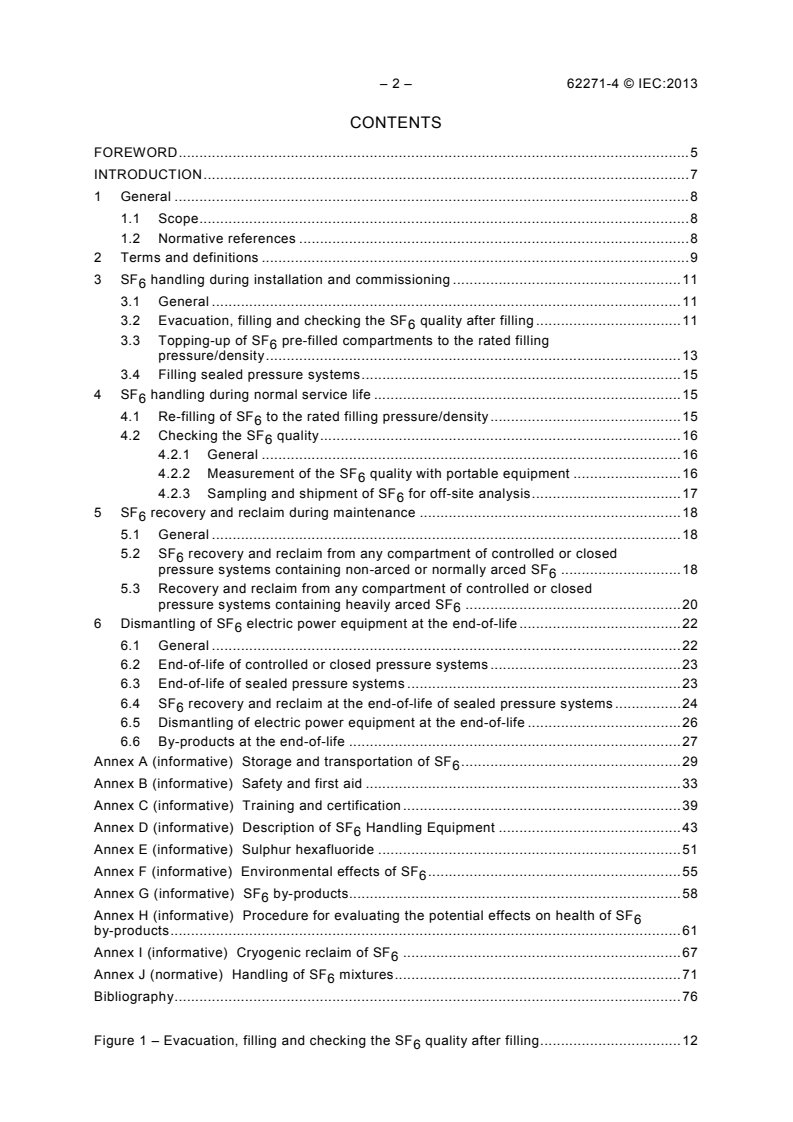
– 2 – 62271-4 © IEC:2013
CONTENTS
FOREWORD . 5
INTRODUCTION . 7
1 General . 8
1.1 Scope . 8
1.2 Normative references . 8
2 Terms and definitions . 9
3 SF handling during installation and commissioning . 11
3.1 General . 11
3.2 Evacuation, filling and checking the SF quality after filling . 11
3.3 Topping-up of SF pre-filled compartments to the rated filling
pressure/density . 13
3.4 Filling sealed pressure systems . 15
4 SF handling during normal service life . 15
4.1 Re-filling of SF to the rated filling pressure/density . 15
4.2 Checking the SF quality . 16
4.2.1 General . 16
4.2.2 Measurement of the SF quality with portable equipment . 16
4.2.3 Sampling and shipment of SF for off-site analysis . 17
5 SF recovery and reclaim during maintenance . 18
5.1 General . 18
5.2 SF recovery and reclaim from any compartment of controlled or closed
pressure systems containing non-arced or normally arced SF . 18
5.3 Recovery and reclaim from any compartment of controlled or closed
pressure systems containing heavily arced SF . 20
6 Dismantling of SF electric power equipment at the end-of-life . 22
6.1 General . 22
6.2 End-of-life of controlled or closed pressure systems . 23
6.3 End-of-life of sealed pressure systems . 23
6.4 SF recovery and reclaim at the end-of-life of sealed pressure systems . 24
6.5 Dismantling of electric power equipment at the end-of-life . 26
6.6 By-products at the end-of-life . 27
Annex A (informative) Storage and transportation of SF . 29
Annex B (informative) Safety and first aid . 33
Annex C (informative) Training and certification . 39
Annex D (informative) Description of SF Handling Equipment . 43
Annex E (informative) Sulphur hexafluoride . 51
Annex F (informative) Environmental effects of SF . 55
Annex G (informative) SF by-products. 58
Annex H (informative) Procedure for evaluating the potential effects on health of SF
by-products . 61
Annex I (informative) Cryogenic reclaim of SF . 67
Annex J (normative) Handling of SF mixtures . 71
Bibliography . 76
Figure 1 – Evacuation, filling and checking the SF quality after filling . 12
62271-4 © IEC:2013 – 3 –
Figure 2 – Topping-up of SF pre-filled compartments to the rated filling
pressure/density . 14
Figure 3 – SF re-filling to the rated filling pressure/density . 15
Figure 4 – Checking the SF quality on-site . 17
Figure 5 – SF sampling and shipment . 18
Figure 6 – Example of recovery and reclaim from any compartment of controlled or
closed pressure systems containing non-arced or normally arced SF . 19
Figure 7 – Example of recovery and reclaim from any compartment of controlled or
closed pressure systems containing heavily arced SF . 21
Figure 8 – End-of-life of controlled or closed pressure systems . 23
Figure 9 – End-of-life of sealed pressure systems . 24
Figure 10 – SF recovery and reclaim at the end-of-life of sealed pressure systems . 25
Figure 11 – Dismantling of electric power equipment . 27
Figure D.1 – General purpose reclaimer . 43
Figure D.2 – Gas mixing device . 49
Figure E.1 – Pressure/temperature/density characteristics for SF [16] . 52
Figure H.1 – Procedure for the evaluation of the potential effects on health due to
arcing . 65
Figure H.2 – Procedure for the evaluation of the potential effects on health due to low
energy discharges . 66
Figure I.1 – Saturated vapour pressure of various gases as a function of temperature . 68
Figure I.2 – Typical cryogenic reclaimer for SF recovery on site . 69
Figure I.3 – Typical cryogenic reclaimer for removing contaminants . 70
Figure J.1 – Vapour pressure of SF . 74
Figure J.2 – Maximum SF storage density to avoid SF liquefaction . 75
6 6
Table 1 – Evacuation, filling and checking the SF quality after filling . 13
Table 2 – Topping-up of SF pre-filled compartments to the rated filling
pressure/density. . 14
Table 3 – SF re-filling to the rated filling pressure/density . 16
Table 4 – Checking the SF quality on-site . 17
Table 5 – SF sampling and shipment . 18
Table 6 – Example of recovery and reclaim from any compartment of controlled or
closed pressure systems containing non-arced or normally arced SF . 20
Table 7 – Example of recovery and reclaim from any compartment of controlled or
closed pressure systems containing heavily arced SF . 22
Table 8 – SF recovery at the end-of-life of sealed pressure systems . 26
Table 9 – Expected SF characteristics and quantity of by-products . 28
Table A.1 – Methods for storage of SF . 29
Table A.2 – Container types and labelling required for storage and transportation of
SF . 30
Table A.3 – International regulations for shipment of SF . 31
Table B.1 – Measures when working with SF electric power equipment. 33
Table B.2 – Safety measures when opening or accessing gas compartments . 34
Table B.3 – Neutralising solutions . 35
Table B.4 – Additional safety measures . 37
– 4 – 62271-4 © IEC:2013
Table D.1 – Typical filter types used during SF reclaim . 44
Table D.2 – Gas measuring devices . 47
Table E.1 – Main chemical characteristics of SF [16] . 51
Table E.2 – Main physical characteristics of SF [16] . 53
Table E.3 – Main electrical characteristics of SF [16] . 53
Table H.1 – OELs for SO , HF, and S F . 63
2 2 10
Table H.2 – SOF production rate . 63
62271-4 © IEC:2013 – 5 –
INTERNATIONAL ELECTROTECHNICAL COMMISSION
____________
HIGH-VOLTAGE SWITCHGEAR AND CONTROLGEAR –
Part 4: Handling procedures for sulphur hexafluoride (SF )
and its mixtures
FOREWORD
1) The International Electrotechnical Commission (IEC) is a worldwide organization for standardization comprising
all national electrotechnical committees (IEC National Committees). The object of IEC is to promote
international co-operation on all questions concerning standardization in the electrical and electronic fields. To
this end and in addition to other activities, IEC publishes International Standards, Technical Specifications,
Technical Reports, Publicly Available Specifications (PAS) and Guides (hereafter referred to as “IEC
Publication(s)”). Their preparation is entrusted to technical committees; any IEC National Committee interested
in the subject dealt with may participate in this preparatory work. International, governmental and non-
governmental organizations liaising with the IEC also participate in this preparation. IEC collaborates closely
with the International Organization for Standardization (ISO) in accordance with conditions determined by
agreement between the two organizations.
2) The formal decisions or agreements of IEC on technical matters express, as nearly as possible, an international
consensus of opinion on the relevant subjects since each technical committee has representation from all
interested IEC National Committees.
3) IEC Publications have the form of recommendations for international use and are accepted by IEC National
Committees in that sense. While all reasonable efforts are made to ensure that the technical content of IEC
Publications is accurate, IEC cannot be held responsible for the way in which they are used or for any
misinterpretation by any end user.
4) In order to promote international uniformity, IEC National Committees undertake to apply IEC Publications
transparently to the maximum extent possible in their national and regional publications. Any divergence
between any IEC Publication and the corresponding national or regional publication shall be clearly indicated in
the latter.
5) IEC itself does not provide any attestation of conformity. Independent certification bodies provide conformity
assessment services and, in some areas, access to IEC marks of conformity. IEC is not responsible for any
services carried out by independent certification bodies.
6) All users should ensure that they have the latest edition of this publication.
7) No liability shall attach to IEC or its directors, employees, servants or agents including individual experts and
members of its technical committees and IEC National Committees for any personal injury, property damage or
other damage of any nature whatsoever, whether direct or indirect, or for costs (including legal fees) and
expenses arising out of the publication, use of, or reliance upon, this IEC Publication or any other IEC
Publications.
8) Attention is drawn to the Normative references cited in this publication. Use of the referenced publications is
indispensable for the correct application of this publication.
9) Attention is drawn to the possibility that some of the elements of this IEC Publication may be the subject of
patent rights. IEC shall not be held responsible for identifying any or all such patent rights.
International Standard IEC 62271-4 has been prepared by subcommittee 17A: High-voltage
switchgear and controlgear, of IEC technical committee 17: Switchgear and controlgear.
This first edition cancels and replaces the first edition of IEC/TR 62271-303 published in
2008.
This first edition constitutes a technical revision. This edition includes the following significant
technical changes with respect to the previous edition:
a) the description of the potential effects on health of SF by-products (former Annex D of
IEC/TR 62271-303:2008) has been replaced by the calculation methods for evaluating of
the potential effects on health of SF by-products (see Annex H);
b) information about cryogenic reclaim of SF .have been added (see Annex I);
c) handling procedures for the most popular SF mixtures have been added (see Annex J).
– 6 – 62271-4 © IEC:2013
The text of this standard is based on the following documents:
FDIS Report on voting
17A/1044/FDIS 17A/1051/RVD
Full information on the voting for the approval of this standard can be found in the report on
voting indicated in the above table.
This publication has been drafted in accordance with the ISO/IEC Directives, Part 2.
A list of all parts in the IEC 62271, published under the general title High-voltage switchgear
and controlgear, can be found on the IEC website.
The committee has decided that the contents of this publication will remain unchanged until
the stability date indicated on the IEC web site under "http://webstore.iec.ch" in the data
related to the specific publication. At this date, the publication will be
• reconfirmed,
• withdrawn,
• replaced by a revised edition, or
• amended.
IMPORTANT – The 'colour inside' logo on the cover page of this publication indicates
that it contains colours which are considered to be useful for the correct
understanding of its contents. Users should therefore print this document using a
colour printer.
62271-4 © IEC:2013 – 7 –
INTRODUCTION
As agreed with TC 10, annexes A, E, F, G, H and I will be removed from this document as
soon as the revised editions of IEC 60376 and IEC 60480 have been published.
– 8 – 62271-4 © IEC:2013
HIGH-VOLTAGE SWITCHGEAR AND CONTROLGEAR –
Part 4: Handling procedures for sulphur hexafluoride (SF )
and its mixtures
1 General
1.1 Scope
This part of IEC 62271 applies to the procedures for handling of SF during installation,
commissioning, normal and abnormal operations, disposal at the end-of-life of high-voltage
switchgear and controlgear.
These procedures are regarded as minimum requirements to ensure the safety of personnel
working with SF (see Annex B) and to minimize the SF emission to the environment.
6 6
This standard generally applies also to gas mixtures containing SF . The particularities for
their handling are covered in Annex J.
NOTE 1 Throughout this standard, use of the term High-Voltage (refer to IEC 60050-601:1985, 601-01-27) means
a rated voltage above 1 000 V. However the term Medium Voltage (refer to IEC 60050-601: 1985, 601-01-28) is
commonly used for distribution systems with voltages above 1 kV and generally applied up to and including 52 kV.
NOTE 2 Throughout this standard, the term “electric power equipment” stands for “high-voltage and
medium-voltage switchgear and controlgear”.
NOTE 3 Throughout this standard, the term “pressure” stands for “absolute pressure”.
1.2 Normative references
The following documents, in whole or in part, are normatively referenced in this document and
are indispensable for its application. For dated references, only the edition cited applies. For
undated references, the latest edition of the referenced document (including any
amendments) applies.
IEC 60050-441, International Electrotechnical Vocabulary – Chapter 441: Switchgear,
controlgear and fuses
IEC 60050-601, International Electrotechnical Vocabulary – Chapter 601: Generation,
transmission and distribution of electricity – General
IEC 60376, Specification of technical grade sulphur hexafluoride (SF ) for use in electrical
equipment
IEC 60480, Guidelines for the checking and treatment of sulphur hexafluoride (SF ) taken
from electrical equipment and specifications for its re-use
IEC 62271-1, High-voltage switchgear and controlgear – Part 1: Common specifications
EN 1089-3, Transportable gas cylinders. Gas cylinder identification (excluding LPG). Colour
coding
62271-4 © IEC:2013 – 9 –
2 Terms and definitions
For the purposes of this document, the terms and definitions given in IEC 60050-441 and
IEC 60050-601, as well as the following apply.
2.1
abnormal release of SF
release from equipment in service due to a failure in the pressure system or mistake in the
handling process
Note 1 to entry: An abnormal SF leak is usually an unwanted and continuous emission of gas at a higher rate
than the equipment designed leak rate. As soon as an abnormal SF leak is detected, appropriate measures to
locate and eliminate it should be arranged.
2.2
handling of SF
any process which might involve transfer of SF
2.3
evacuation
transfer of a gas different from SF (e.g. air or N ) which can be released into the
6 2
atmosphere. The operation is performed utilising a vacuum pump
2.4
recovery of SF
transfer of SF from the gas compartment into a reclaimer or storage container
Note 1 to entry: The operation is normally performed utilising a recovery compressor.
2.5
topping-up with SF
filling a pre-filled compartment with SF to the rated filling pressure
Note 1 to entry: Pre-filled compartments are closed pressure systems filled in the factory prior to shipment. They
contain SF at a typical pressure between 0,12 MPa to 0,15 MPa allowing for a faster and easier commissioning
on-site.
2.6
re-filling with SF
to the rated filling pressure to assure continuity of service
filling a compartment with SF
2.7
reclaim of SF
a series of SF handling procedures including recovery and minimum SF refining process
6 6
such as filtering dust, by-products, moisture, oil, etc.
Note 1 to entry: A standard reclaimer is described in Annex D; while a cryogenic reclaimer is described in
Annex I.
Note 2 to entry: Sometimes the words “reclaiming” or “reclamation” may be used with the same meaning as
“reclaim”.
2.8
gas-insulated metal-enclosed switchgear
metal-enclosed switchgear in which the insulation is obtained, at least partly, by an insulating
gas other than air at atmospheric pressure
Note 1 to entry: This term generally applies to high-voltage switchgear and controlgear.
[SOURCE: IEC 60050-441: 1984, 441-12-05]
– 10 – 62271-4 © IEC:2013
2.9
gas-filled compartment
compartment of switchgear and controlgear in which the gas pressure is maintained by one of
the following systems:
• controlled pressure system;
• closed pressure system;
• sealed pressure system
Note 1 to entry: Several gas-filled compartments may be permanently interconnected to form a common gas-
system (gas-tight assembly).
Note 2 to entry: The definition is the same as in IEC 62271-1.
2.10
controlled pressure system for gas
volume which is automatically replenished from an external compressed gas supply or internal
gas source
Note 1 to entry: Examples of controlled pressure systems are air-blast circuit-breakers or pneumatic operating
mechanisms.
Note 2 to entry: A volume may consist of several permanently connected gas-filled compartments.
Note 3 to entry: The definition is the same as in IEC 62271-1.
2.11
closed pressure system for gas
volume which is replenished only periodically by manual connection to an external gas source
Note 1 to entry: Example of closed pressure systems are SF single pressure circuit-breakers.
Note 2 to entry: The definition is the same as in IEC 62271-1.
2.12
sealed pressure system
volume for which no further gas or vacuum processing is required during its expected
operating life
Note 1 to entry: Examples of sealed pressure systems are tubes of vacuum circuit-breakers or some SF
circuit-breakers.
Note 2 to entry: Sealed pressure systems are completely assembled and tested in the factory.
Note 3 to entry: The definition is the same as in IEC 62271-1.
2.13
technical grade SF
SF gas having a very low level of impurities in accordance with IEC 60376
2.14
used SF
gas removed from an item of electrical equipment, initially filled with SF according to
IEC 60376 or IEC 60480
Note 1 to entry: If after filling, the gas is removed for any purpose during the life of the equipment, e.g. repair,
service, maintenance, the gas will be transferred and is considered as used gas.
Note 2 to entry: Annex G provides information regarding the by-products of used SF , which occur in both
gaseous and solid form.
2.15
used SF suitable for reuse on site
used SF having a maximum impurity level in accordance with IEC 60480
62271-4 © IEC:2013 – 11 –
Note 1 to entry: If necessary, service units with appropriate filters and adsorber materials should be used.
2.16
suitable for reuse at the gas manufacturer
used SF
used SF exceeding the maximum acceptable impurity level stated in IEC 60480, suitable for
reuse by the gas manufacturer
Note 1 to entry: If necessary to meet the specification, service units with appropriate filters and adsorber
materials should be used.
2.17
used SF not suitable for reuse
used SF not falling under the category defined under 2.15 or 2.16
Note 1 to entry: Used SF not suitable for reuse is disposed according to local or international regulations on
waste management.
2.18
non-arced SF
used SF having less than approximately 1 ml/l (0,1 % by volume) of gaseous by-products
Note 1 to entry: Non-arced SF is typically expected to be in any compartment after filling and prior to energising
or after insulation testing or in insulation compartments which never experienced arcing.
2.19
normally arced SF
used SF having between approximately 1 ml/l (0,1 % by volume) and approximately 10 ml/l
(1 % by volume) of gaseous by-products.
Note 1 to entry: Normally arced SF is typically expected to be in circuit breakers or switches after normal (load
or fault) operations.
Note 2 to entry: A small amount of solid by-products, mainly metal fluorides and tungsten oxifluorides, may be
present as well.
2.20
heavily arced SF
used SF having more than approximately 10 ml/l (1 % by volume.) of gaseous by-products
Note 1 to entry: Heavily arced SF is typically expected to be in any gas compartments after internal arc fault or
circuit breakers or switches after interruption failure or circuit breakers after successful interruptions of several
short circuits at high amplitude in relation with its ratings.
Note 2 to entry: A large amount of solid by-products, mainly metal fluorides and tungsten oxifluorides, is expected
as well.
2.21
SF mixture
gas mixture formed by SF and a complementary gas, typically N or CF
6 2 4
3 SF handling during installation and commissioning
3.1 General
This clause provides guidance for working with technical grade SF , according to IEC 60376
or used SF suitable for reuse on site, according to IEC 60480 i.e. when a gas compartment is
filled, after the switchgear and controlgear has been installed on site.
3.2 Evacuation, filling and checking the SF quality after filling
This subclause applies to switchgear compartments of pressure systems that currently
contain a gas different from SF (typically air or N ) at ambient pressure or slight
6 2
overpressure (typically 0,1 MPa to 0,15 MPa).
– 12 – 62271-4 © IEC:2013
The following detailed sequence of operations for air/N evacuation and SF filling in each
2 6
compartment shall be performed according to Figure 1 and Table 1, except as otherwise
specified in the handling procedure detailed by the Original Equipment Manufacturer in the
Operating Instruction Manual.
ppp
rmrmrm
99 1100 1111 1122
p
pp
p
pp
pppp
11 22
p
pp
33 v
vv
44 55 66
ttt
v
vv
t
ttt IEC 2089/13
1 Prepare SF handling equipment 9 Pressure/density sensor inspection
2 Adsorber installation 10 Tightness inspection
3 Evacuation 11 SF quality checking
4 Vacuum stabilisation phase 12 Documentation
5 Vacuum holding phase (optional step) p SF rated filling pressure
rm
6 Documentation p Initial pressure in the gas compartment
p
7 Filling with SF p
Evacuation pressure < 2 kPa
6 v
8 Documentation t
Vacuum stabilisation time ≥ 30 min
v
Figure 1 – Evacuation, filling and checking the SF quality after filling
62271-4 © IEC:2013 – 13 –
Table 1 – Evacuation, filling and checking the SF quality after filling
Step Procedure
Check that the SF handling equipment is working properly and the gas connections
Prepare SF handling
1 are clean and dry to avoid contamination. Check the validity of the calibration of
equipment
instruments subject to calibration.
Quickly insert the adsorber materials in the compartment. Start evacuation
2 Adsorber installation
immediately afterwards.
3 Evacuation Connect the vacuum pump and leave it running to reach 2 kPa.
Vacuum stabilisation Leave the vacuum pump running for at least 30 min and then disconnect the
a
phase vacuum pump by closing the valve. Read the pressure gauge.
The pressure in the compartment should remain lower than 2 kPa for the time which
Vacuum holding phase
5 may be required by the Original Equipment Manufacturer in the Operating
(optional step)
Instruction Manual].
Record at least the manufacturer, equipment type reference, serial number and
6 Documentation compartment reference to identify the gas compartment, the evacuation pressure
(i.e. the residual air content), ambient temperature and date for further reference.
Connect the SF container and fill the compartment until the SF rated filling
6 6
7 Filling with SF pressure is reached. Use a safety valve, a regulator to allow a good control of the
b c
filling process and a calibrated gauge to avoid overfilling.
Record at least the manufacturer and serial number to identify the gas
8 Documentation compartment, the final filling pressure, ambient temperature and date for further
reference.
Pressure/density Check the functionality of the pressure/density sensor. The operation can be
sensor inspection performed during the filling operation and shall not be considered as a calibration.
Check the tightness of at least all permanent connections made on site as
10 Tightness inspection requested by the Original Equipment Manufacturer in the Operating Instruction
Manual.
Wait for the time specified by the Original Equipment Manufacturer in the Operating
11 SF quality checking
d
Instruction Manual before measuring the moisture content and the SF percentage.
Record at least the manufacturer and serial number to identify the gas
12 Documentation compartment, the functionality of the pressure/density sensor, the moisture content,
the SF content, ambient temperature and date for further reference.
a
The vacuum duration can be prolonged in order to better remove moisture when for example the ambient
temperature is freezing, except as otherwise specified by the Original Equipment Manufacturer in the Operating
Instruction Manual.
b
SF to be introduced into the gas compartment may be either technical grade SF or used SF suitable for
6 6 6
reuse on site.
c
No SF check is required if the gas comes from the supplier in sealed containers, or if the gas is stored in
sealed containers with an appropriate label or certificate to guarantee the gas is suitable for reuse. In all other
cases, the SF quality may be checked prior to the filling operation (see 4.2).
d
If the gas compartment has a small volume, re-filling after SF quality checking may be required.
3.3 Topping-up of SF pre-filled compartments to the rated filling pressure/density
This subclause applies to compartments of pressure systems pre-filled in the factory prior to
at above atmospheric pressure (typically 0,12 MPa to 0,15 MPa),
shipment. They contain SF
allowing for a faster and easier commissioning on-site.
The following detailed sequence of operations for SF topping-up in each pre-filled
compartment shall be performed according to Figure 2 and Table 2, except as otherwise
specified in the handling procedure detailed by the Original Equipment Manufacturer in the
Operating Instruction Manual.
– 14 – 62271-4 © IEC:2013
ppp
rm
rmrm
44 55 66 77
pppp
p
ppp
pp
t
ttt IEC 2090/13
1 Prepare SF handling equipment 6 SF quality checking
6 6
2 Topping-up with SF 7 Documentation
3 Documentation p SF rated filling pressure
rm 6
4 Pressure/density sensor inspection p Initial SF pressure in the gas-filled
p 6
compartment
5 Tightness inspection
Figure 2 – Topping-up of SF pre-filled compartments
to the rated filling pressure/density
Table 2 – Topping-up of SF pre-filled compartments
to the rated filling pressure/density.
Step Procedure
Check that the gas connections are clean and dry, hoses are evacuated and no
Prepare SF handling
1 leaks on connection fittings exist to avoid contamination. Check the validity of the
equipment
calibration of instruments subject to calibration.
Connect the SF container and fill the compartment until the SF rated filling
6 6
2 Topping-up with SF pressure is reached. Use a safety valve, a regulator to allow a good control of the
a b
filling process and a calibrated gauge to avoid overfilling.
Record at least the manufacturer, equipment reference, serial number and
3 Documentation compartment reference to identify the gas compartment, the final filling pressure,
ambient temperature and date for further reference.
Pressure/density Check the functionality of the pressure/density sensor. The operation can be
sensor inspection performed during the filling operation and shall not be considered as a calibration.
Check the tightness of at least all permanent connections made on site as requested
5 Tightness inspection
by the Original Equipment Manufacturer in the Operating Instruction Manual.
Wait for the time specified by the Original Equipment Manufacturer in the operating
6 SF quality checking
c
instruction manual before measuring the moisture content and the SF percentage.
Record at least the manufacturer and serial number to identify the gas compartment,
7 Documentation the functionality of the pressure/density sensor, the moisture content, the SF
content, ambient temperature and date for further reference.
a
SF to be introduced into the gas compartment may be either technical grade SF or used SF suitable for
6 6 6
reuse on site.
b
No SF check is required if the gas comes from the supplier in sealed containers, or if the gas is stored in
sealed containers with an appropriate label or certificate to guarantee the gas is suitable for reuse. In all other
cases, the SF quality may be checked prior to the filling operation (see 4.2).
c
If the gas compartment has a small volume, re-filling after SF quality checking may be required.
62271-4 © IEC:2013 – 15 –
3.4 Filling sealed pressure systems
The large majority of medium-voltage switchgear and controlgear uses sealed pressure
systems, as defined in 2.12. Typically this type of equipment is filled with SF in the factory
and no further SF handling is required during its expected operating life.
Under some abnormal circumstances (e.g. in case of damage) it may be required to re-fill or
re-commission the equipment on-site. The Original Equipment Manufacturer should be
contacted for this purpose.
4 SF handling during normal service life
4.1 Re-filling of SF to the rated filling pressure/density
This subclause applies to compartments (usually indicated by the first alarm/indication of the
pressure/density monitor) of closed pressure systems to assure continuity of service. In case
of an abnormal leak, appropriate corrective measures to locate and eliminate the leak shall be
immediately arranged.
The following detailed sequence of operations for SF re-filling in each compartment shall be
performed according to Figure 3 and Table 3 except as otherwise specified in the handling
procedure detailed by the Original Equipment Manufacturer in the Operating Instruction
Manual.
ppp
rmrmrm
p
ppp
11 22
t
ttt
ppp
p
pp
IEC 2091/13
1 Identify the nature of the leak 4 Documentation
2 Prepare SF handling equipment p SF rated filling pressure
6 rm 6
3 Re-filling with SF p Initial SF pressure in the gas-filled
6 p 6
compartment
Figure 3 – SF re-filling to the rated filling pressure/density
– 16 – 62271-4 © IEC:2013
Table 3 – SF re-filling to the rated filling pressure/density
Step Procedure
Identify the nature of Check the last time the gas compartment was re-filled to understand whether the leak
the leak is abnormal.
Check that the gas connections are clean and dry, hoses are evacuated and no leaks
Prepare SF
2 on connection fittings exist to avoid contamination. Check the validity of the calibration
handling equipment
of instruments subject to calibration.
Connect the SF container and fill the compartment until the SF rated filling pressure
6 6
3 Re-filling with SF is reached. Use a safety valve, a regulator to allow a good control of the filling process
a b
and a calibrated gauge to avoid overfilling.
Record at least the manufacturer, equipment type reference, serial number and
4 Documentation compartment reference to identify the gas compartment, the final filling pressure,
ambient temperature and date for further reference.
a
SF to be introduced into the gas compartment may be either technical grade SF or used SF suitable for
6 6 6
reuse on site.
b
As the amount of SF used for re-filling is very small in comparison to the amount of SF in the related
6 6
compartment, it is not necessary to perform a SF quality check after the re-filling operation.
4.2 Checking the SF quality
4.2.1 General
The measurement of the SF quality is usually done on-site, using portable equipment.
Off-site analysis may exceptionally be performed to cross-check unsatisfactory on-site results,
by sampling the gas and sending it to a qualified chemical laboratory.
Typical SF quality checks according to IEC 60480 are moisture content (e.g. water content in
mg/kg), SF percentage, and total reactive gaseous by-products giving rise to residual acidity
content (e.g. total amount of reactive gasses in μl/l).
NOTE Adequate corrections for measurements made at other temperatures than 20 °C are specified by the
Original Equipment Manufacturer in the Operating Instruction Manual.
The total reactive gaseous by-products shall be checked first to prevent damage of other
portable equipment, if the history of the gas-filled compartment is unknown.
4.2.2 Measurement of the SF quality with portable equipment
This subclause applies to SF filled compartments of controlled and closed pressure systems
or SF filled containers to check the quality of the gas with portable equipment.
The following detailed sequence of operations for an on-site SF quality check shall be
performed according to Figure 4 and Table 4, except as otherwise specified in the handling
procedure detailed by the Original Equipment Manufacturer in the Operating Instruction
Manual.
Characteristics of portable equipment are described in Annex D.
62271-4 © IEC:2013 – 17 –
p
ppp
11 22 33 44 55
t
ttt
p
ppp
pp
IEC 2092/13
1 Prepare portable equipment 4 Disconnect the portable equipment
2 Connect the
...