


IEC 60127-8:2018
(Main)Miniature fuses - Part 8: Fuse resistors with particular overcurrent protection
General Information
- Abstract
IEC 60127-8:2018 relates to fuse resistors with particular overcurrent protection rated up to AC 500 V and/or DC 500 V for printed circuits and other substrate systems, used for the protection of electric appliances, electronic equipment and component parts thereof, normally intended to be used indoors.
It does not apply to fuse resistors with particular overcurrent protection for appliances intended to be used under special conditions, such as in a corrosive or explosive atmosphere.
The object of this part of IEC 60127 is
a) to establish uniform requirements for fuse resistors with particular overcurrent protection so as to protect appliances or parts of appliances in the most suitable way;
b) to define the performance of the fuse resistors with particular overcurrent protection, so as to give guidance to manufacturers of electrical appliances and electronic equipment and to ensure replacement of fuse resistors with particular overcurrent protection by those of similar dimensions and characteristics;
c) to establish uniform test methods for fuse resistors with particular overcurrent protection, so as to allow verification of the values (for example rated dissipation, functioning characteristic and rated breaking capacity values) specified by the manufacturer.
This part of IEC 60127 applies in addition to the requirements of IEC 60127-1.
This first edition of IEC 60127-8 cancels and replaces IEC PAS 60127-8:2014.
This international standard is to be used in conjunction with IEC 60127-1.
Keywords: Miniature Fuses, Fuse-Resistors, Overcurrent Protection
- Status
- Published
- Publication Date
- 16-Jul-2024
- Technical Committee
- SC 32C - Miniature fuses
- Drafting Committee
- WG 13 - TC 32/SC 32C/WG 13
- Current Stage
- PPUB - Publication issued
- Start Date
- 26-Jun-2018
- Completion Date
- 27-Jul-2018
Buy Documents
IEC 60127-8:2018 - Miniature fuses - Part 8: Fuse resistors with particular overcurrent protection Released:6/26/2018
IEC 60127-8:2018+AMD1:2024 CSV - Miniature fuses - Part 8: Fuse resistors with particular overcurrent protection Released:7/17/2024
IEC 60127-8:2018 - Miniature fuses - Part 8: Fuse resistors with particular overcurrent protection Released:12/13/2018
Overview
IEC 60127-8:2018 (Edition 1.1, 2018 + AMD1:2024) defines requirements and test methods for miniature fuse-resistors with particular overcurrent protection rated up to AC 500 V and/or DC 500 V. It covers devices intended for printed circuits and other substrate systems used in electrical appliances and electronic equipment (normally for indoor use). The standard clarifies that these components act primarily as resistors and only interrupt current within a limited overcurrent range - therefore they are correctly named fuse resistors with particular overcurrent protection.
Key topics and technical requirements
- Scope and application limits
- For printed-circuit and substrate-mounted fuse-resistors, indoor use; excludes special atmospheres (corrosive/explosive).
- Objectives
- Establish uniform requirements, performance criteria and test methods to ensure safe use and interchangeability.
- Construction and ratings
- Requirements for dimensions, terminations, alignment, through‑hole and surface‑mount versions, and rated dissipation.
- Electrical performance
- Verification of resistance value, functioning characteristic (including tests at specified temperatures), rated breaking capacity and insulation properties.
- Test methods
- Defined type tests and atmospheric conditions; tests include endurance, pulse tests, maximum sustained dissipation, dielectric strength and insulation resistance.
- Soldering and mechanical
- Solderability, resistance to soldering heat, soldered-joint requirements and bending tests for surface-mount devices.
- Marking and documentation
- Manufacturer markings and information to support replacement by components with similar dimensions and characteristics.
- Safety note
- Fuse-resistors can safely interrupt high short‑circuit currents but are not designed to protect against sustained overloads - an accompanying overload protection device may be required.
Applications
- Use in consumer appliances, electronic equipment and component parts where compact overcurrent protection integrated with a resistor is desired.
- Typical uses: printed‑circuit assemblies, small power supply circuits, control electronics and component-level protection where rated voltage ≤ 500 V.
- Not intended for end-user replacement; intended for manufacturer-specified assembly and service.
Who should use this standard
- Electronic and appliance manufacturers designing PCBs and substrate systems.
- Component designers and fuse‑resistor manufacturers for design, testing and certification.
- Test laboratories and compliance engineers verifying performance, safety and interchangeability.
Related standards
- IEC 60127-1 (general requirements for miniature fuses) - IEC 60127-8 applies in addition to IEC 60127-1.
- Resistor standards referenced: IEC 60115-1, IEC 60115-4-101, IEC 60115-4-102 (manufacturers are responsible for compliance with resistor-related requirements).
Keywords: Miniature Fuses, Fuse-Resistors, Overcurrent Protection, IEC 60127-8, fuse resistors, printed circuit protection.
Relations
- Effective Date
- 05-Sep-2023
- Effective Date
- 05-Sep-2023
Buy Documents
IEC 60127-8:2018 - Miniature fuses - Part 8: Fuse resistors with particular overcurrent protection Released:6/26/2018
IEC 60127-8:2018+AMD1:2024 CSV - Miniature fuses - Part 8: Fuse resistors with particular overcurrent protection Released:7/17/2024
IEC 60127-8:2018 - Miniature fuses - Part 8: Fuse resistors with particular overcurrent protection Released:12/13/2018
Get Certified
Connect with accredited certification bodies for this standard

Intertek Testing Services NA Inc.
Intertek certification services in North America.

UL Solutions
Global safety science company with testing, inspection and certification.

ANCE
Mexican certification and testing association.
Sponsored listings
Frequently Asked Questions
IEC 60127-8:2018 is a standard published by the International Electrotechnical Commission (IEC). Its full title is "Miniature fuses - Part 8: Fuse resistors with particular overcurrent protection". This standard covers: IEC 60127-8:2018 relates to fuse resistors with particular overcurrent protection rated up to AC 500 V and/or DC 500 V for printed circuits and other substrate systems, used for the protection of electric appliances, electronic equipment and component parts thereof, normally intended to be used indoors. It does not apply to fuse resistors with particular overcurrent protection for appliances intended to be used under special conditions, such as in a corrosive or explosive atmosphere. The object of this part of IEC 60127 is a) to establish uniform requirements for fuse resistors with particular overcurrent protection so as to protect appliances or parts of appliances in the most suitable way; b) to define the performance of the fuse resistors with particular overcurrent protection, so as to give guidance to manufacturers of electrical appliances and electronic equipment and to ensure replacement of fuse resistors with particular overcurrent protection by those of similar dimensions and characteristics; c) to establish uniform test methods for fuse resistors with particular overcurrent protection, so as to allow verification of the values (for example rated dissipation, functioning characteristic and rated breaking capacity values) specified by the manufacturer. This part of IEC 60127 applies in addition to the requirements of IEC 60127-1. This first edition of IEC 60127-8 cancels and replaces IEC PAS 60127-8:2014. This international standard is to be used in conjunction with IEC 60127-1. Keywords: Miniature Fuses, Fuse-Resistors, Overcurrent Protection
IEC 60127-8:2018 relates to fuse resistors with particular overcurrent protection rated up to AC 500 V and/or DC 500 V for printed circuits and other substrate systems, used for the protection of electric appliances, electronic equipment and component parts thereof, normally intended to be used indoors. It does not apply to fuse resistors with particular overcurrent protection for appliances intended to be used under special conditions, such as in a corrosive or explosive atmosphere. The object of this part of IEC 60127 is a) to establish uniform requirements for fuse resistors with particular overcurrent protection so as to protect appliances or parts of appliances in the most suitable way; b) to define the performance of the fuse resistors with particular overcurrent protection, so as to give guidance to manufacturers of electrical appliances and electronic equipment and to ensure replacement of fuse resistors with particular overcurrent protection by those of similar dimensions and characteristics; c) to establish uniform test methods for fuse resistors with particular overcurrent protection, so as to allow verification of the values (for example rated dissipation, functioning characteristic and rated breaking capacity values) specified by the manufacturer. This part of IEC 60127 applies in addition to the requirements of IEC 60127-1. This first edition of IEC 60127-8 cancels and replaces IEC PAS 60127-8:2014. This international standard is to be used in conjunction with IEC 60127-1. Keywords: Miniature Fuses, Fuse-Resistors, Overcurrent Protection
IEC 60127-8:2018 is classified under the following ICS (International Classification for Standards) categories: 29.120.50 - Fuses and other overcurrent protection devices. The ICS classification helps identify the subject area and facilitates finding related standards.
IEC 60127-8:2018 has the following relationships with other standards: It is inter standard links to IEC 60127-8:2018/AMD1:2024, IEC PAS 60127-8:2014. Understanding these relationships helps ensure you are using the most current and applicable version of the standard.
IEC 60127-8:2018 is available in PDF format for immediate download after purchase. The document can be added to your cart and obtained through the secure checkout process. Digital delivery ensures instant access to the complete standard document.
Standards Content (Sample)
IEC 60127-8 ®
Edition 1.0 2018-06
INTERNATIONAL
STANDARD
Miniature fuses –
Part 8: Fuse resistors with particular overcurrent protection
All rights reserved. Unless otherwise specified, no part of this publication may be reproduced or utilized in any form
or by any means, electronic or mechanical, including photocopying and microfilm, without permission in writing from
either IEC or IEC's member National Committee in the country of the requester. If you have any questions about IEC
copyright or have an enquiry about obtaining additional rights to this publication, please contact the address below or
your local IEC member National Committee for further information.
IEC Central Office Tel.: +41 22 919 02 11
3, rue de Varembé info@iec.ch
CH-1211 Geneva 20 www.iec.ch
Switzerland
About the IEC
The International Electrotechnical Commission (IEC) is the leading global organization that prepares and publishes
International Standards for all electrical, electronic and related technologies.
About IEC publications
The technical content of IEC publications is kept under constant review by the IEC. Please make sure that you have the
latest edition, a corrigenda or an amendment might have been published.
IEC Catalogue - webstore.iec.ch/catalogue Electropedia - www.electropedia.org
The stand-alone application for consulting the entire The world's leading online dictionary of electronic and
bibliographical information on IEC International Standards, electrical terms containing 21 000 terms and definitions in
Technical Specifications, Technical Reports and other English and French, with equivalent terms in 16 additional
documents. Available for PC, Mac OS, Android Tablets and languages. Also known as the International Electrotechnical
iPad. Vocabulary (IEV) online.
IEC publications search - webstore.iec.ch/advsearchform IEC Glossary - std.iec.ch/glossary
The advanced search enables to find IEC publications by a 67 000 electrotechnical terminology entries in English and
variety of criteria (reference number, text, technical French extracted from the Terms and Definitions clause of
committee,…). It also gives information on projects, replaced IEC publications issued since 2002. Some entries have been
and withdrawn publications. collected from earlier publications of IEC TC 37, 77, 86 and
CISPR.
IEC Just Published - webstore.iec.ch/justpublished
Stay up to date on all new IEC publications. Just Published IEC Customer Service Centre - webstore.iec.ch/csc
details all new publications released. Available online and If you wish to give us your feedback on this publication or
also once a month by email. need further assistance, please contact the Customer Service
Centre: sales@iec.ch.
IEC 60127-8 ®
Edition 1.0 2018-06
INTERNATIONAL
STANDARD
Miniature fuses –
Part 8: Fuse resistors with particular overcurrent protection
INTERNATIONAL
ELECTROTECHNICAL
COMMISSION
ICS 29.120.50 ISBN 978-2-8322-5843-9
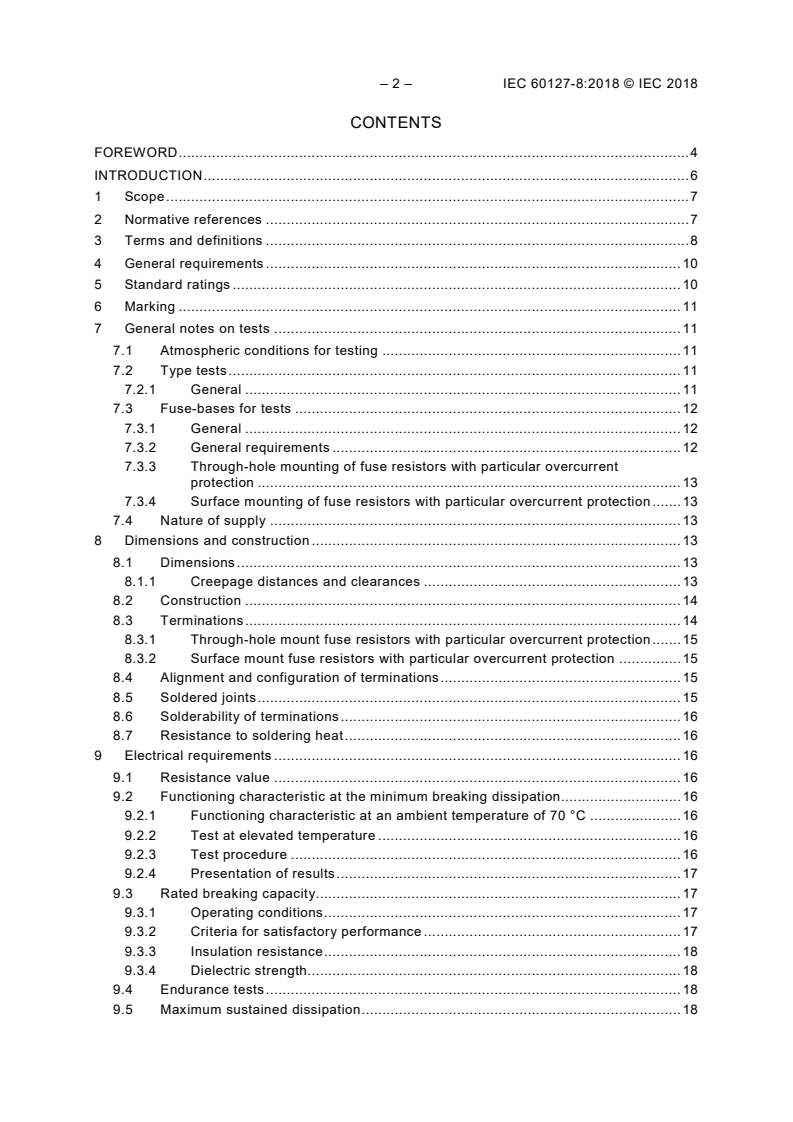
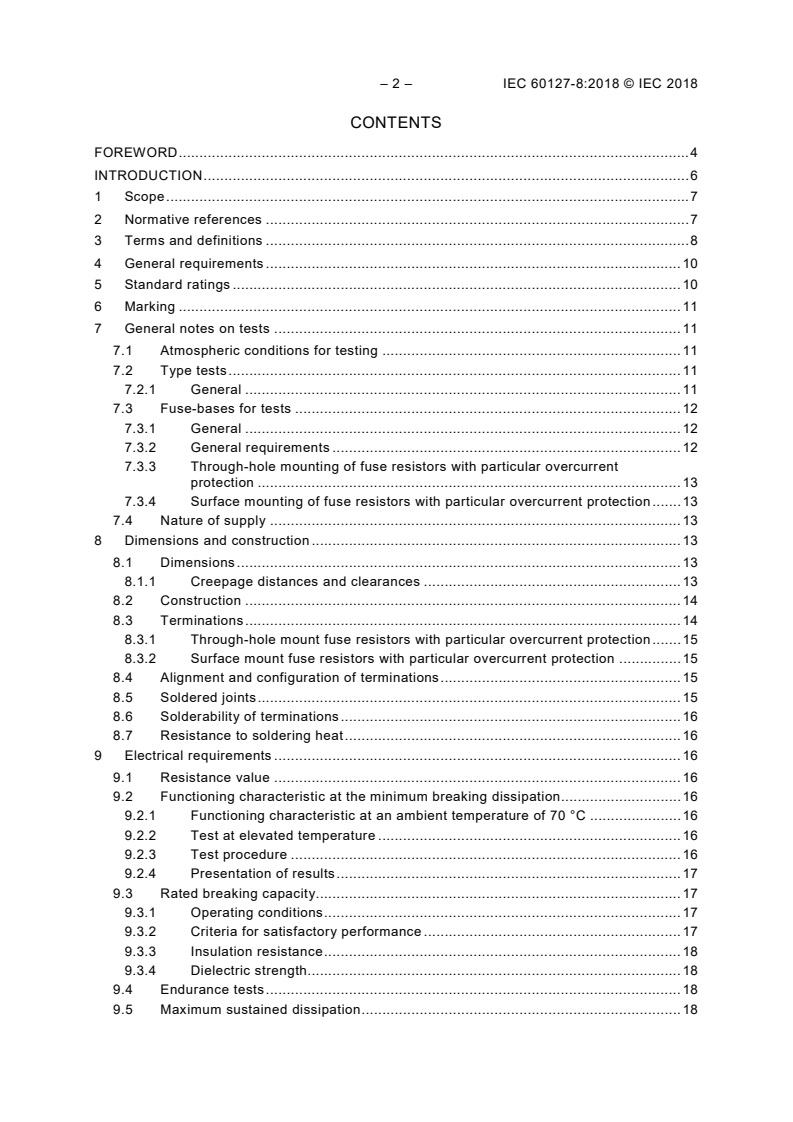
– 2 – IEC 60127-8:2018 © IEC 2018
CONTENTS
FOREWORD . 4
INTRODUCTION . 6
1 Scope . 7
2 Normative references . 7
3 Terms and definitions . 8
4 General requirements . 10
5 Standard ratings . 10
6 Marking . 11
7 General notes on tests . 11
7.1 Atmospheric conditions for testing . 11
7.2 Type tests . 11
7.2.1 General . 11
7.3 Fuse-bases for tests . 12
7.3.1 General . 12
7.3.2 General requirements . 12
7.3.3 Through-hole mounting of fuse resistors with particular overcurrent
protection . 13
7.3.4 Surface mounting of fuse resistors with particular overcurrent protection . 13
7.4 Nature of supply . 13
8 Dimensions and construction . 13
8.1 Dimensions . 13
8.1.1 Creepage distances and clearances . 13
8.2 Construction . 14
8.3 Terminations . 14
8.3.1 Through-hole mount fuse resistors with particular overcurrent protection . 15
8.3.2 Surface mount fuse resistors with particular overcurrent protection . 15
8.4 Alignment and configuration of terminations . 15
8.5 Soldered joints . 15
8.6 Solderability of terminations . 16
8.7 Resistance to soldering heat . 16
9 Electrical requirements . 16
9.1 Resistance value . 16
9.2 Functioning characteristic at the minimum breaking dissipation. 16
9.2.1 Functioning characteristic at an ambient temperature of 70 °C . 16
9.2.2 Test at elevated temperature . 16
9.2.3 Test procedure . 16
9.2.4 Presentation of results . 17
9.3 Rated breaking capacity. 17
9.3.1 Operating conditions . 17
9.3.2 Criteria for satisfactory performance . 17
9.3.3 Insulation resistance . 18
9.3.4 Dielectric strength. 18
9.4 Endurance tests . 18
9.5 Maximum sustained dissipation . 18
9.6 Pulse tests . 18
9.7 Temperature of fuse resistors with particular overcurrent protection. 18
9.8 Operating overvoltage . 19
Bibliography . 25
Figure 1 – Test board for through-hole mount fuse resistors with particular overcurrent
protection . 21
Figure 2 – Test board for surface mount fuse resistors with particular overcurrent
protection . 22
Figure 3 – Test fuse-base . 23
Figure 4 – Bending jig for surface mount fuse resistors with particular overcurrent
protection . 24
Figure 5 – Test circuit for the tests according to 9.3 . 24
Table 1 – Creepage distances and clearances (absolute minimum values) . 14
Table 2 – Test voltages for dielectric strength . 18
Table 3 – Testing schedule for individual dissipation ratings . 20
– 4 – IEC 60127-8:2018 © IEC 2018
INTERNATIONAL ELECTROTECHNICAL COMMISSION
____________
MINIATURE FUSES –
Part 8: Fuse resistors with particular
overcurrent protection
FOREWORD
1) The International Electrotechnical Commission (IEC) is a worldwide organization for standardization comprising
all national electrotechnical committees (IEC National Committees). The object of IEC is to promote
international co-operation on all questions concerning standardization in the electrical and electronic fields. To
this end and in addition to other activities, IEC publishes International Standards, Technical Specifications,
Technical Reports, Publicly Available Specifications (PAS) and Guides (hereafter referred to as “IEC
Publication(s)”). Their preparation is entrusted to technical committees; any IEC National Committee interested
in the subject dealt with may participate in this preparatory work. International, governmental and non-
governmental organizations liaising with the IEC also participate in this preparation. IEC collaborates closely
with the International Organization for Standardization (ISO) in accordance with conditions determined by
agreement between the two organizations.
2) The formal decisions or agreements of IEC on technical matters express, as nearly as possible, an international
consensus of opinion on the relevant subjects since each technical committee has representation from all
interested IEC National Committees.
3) IEC Publications have the form of recommendations for international use and are accepted by IEC National
Committees in that sense. While all reasonable efforts are made to ensure that the technical content of IEC
Publications is accurate, IEC cannot be held responsible for the way in which they are used or for any
misinterpretation by any end user.
4) In order to promote international uniformity, IEC National Committees undertake to apply IEC Publications
transparently to the maximum extent possible in their national and regional publications. Any divergence
between any IEC Publication and the corresponding national or regional publication shall be clearly indicated in
the latter.
5) IEC itself does not provide any attestation of conformity. Independent certification bodies provide conformity
assessment services and, in some areas, access to IEC marks of conformity. IEC is not responsible for any
services carried out by independent certification bodies.
6) All users should ensure that they have the latest edition of this publication.
7) No liability shall attach to IEC or its directors, employees, servants or agents including individual experts and
members of its technical committees and IEC National Committees for any personal injury, property damage or
other damage of any nature whatsoever, whether direct or indirect, or for costs (including legal fees) and
expenses arising out of the publication, use of, or reliance upon, this IEC Publication or any other IEC
Publications.
8) Attention is drawn to the Normative references cited in this publication. Use of the referenced publications is
indispensable for the correct application of this publication.
9) Attention is drawn to the possibility that some of the elements of this IEC Publication may be the subject of
patent rights. IEC shall not be held responsible for identifying any or all such patent rights.
International Standard IEC 60127-8 has been prepared by subcommittee SC 32C: Miniature
fuses, of IEC technical committee 32: Fuses
This first edition of IEC 60127-8 cancels and replaces IEC PAS 60127-8:2014.
This international standard is to be used in conjunction with IEC 60127-1.
The text of this International Standard is based on the following documents:
FDIS Report on voting
32C/542/FDIS 32C/546/RVD
Full information on the voting for the approval of this International Standard can be found in
the report on voting indicated in the above table.
This document has been drafted in accordance with the ISO/IEC Directives, Part 2.
A list of all parts in the IEC 60127 series, published under the general title Miniature fuses,
can be found on the IEC website.
The committee has decided that the contents of this document will remain unchanged until the
stability date indicated on the IEC website under "http://webstore.iec.ch" in the data related to
the specific document. At this date, the document will be
• reconfirmed,
• withdrawn,
• replaced by a revised edition, or
• amended.
A bilingual version of this publication may be issued at a later date.
– 6 – IEC 60127-8:2018 © IEC 2018
INTRODUCTION
In recent years, so-called “fuse resistors” have increasingly been used in electrical and
electronic applications. The term “fuse resistor”, however, which has become established in
the market, is misleading. The actual function of a fuse resistor is that of a resistor in an
electrical or electronic circuit. Only when an overload of multiple times the rated dissipation
occurs can fuse resistors interrupt an electric current. In a wide range between the rated
dissipation and the manufacturer’s specified breaking dissipation, fuse resistors provide poor
or no overcurrent protection. Therefore if they are incorrectly rated and improperly used in an
application, this may result in potential risk of fire.
Fuse resistors perform the function of a fuse only within a particular overcurrent range, and,
from a technical point of view, must therefore be referred to as “fuse resistors with particular
overcurrent protection”.
Fuse resistors with particular overcurrent protection can safely interrupt high short-circuit
currents, but are not capable of interrupting overload currents.
For safety reasons, they are only used in combination with an accompanying overload current
protection device, if overload currents cannot be excluded to occur in the respective
application.
MINIATURE FUSES –
Part 8: Fuse resistors with particular
overcurrent protection
1 Scope
This part of IEC 60127 relates to fuse resistors with particular overcurrent protection rated up
to AC 500 V and/or DC 500 V for printed circuits and other substrate systems, used for the
protection of electric appliances, electronic equipment and component parts thereof, normally
intended to be used indoors.
It does not apply to fuse resistors with particular overcurrent protection for appliances
intended to be used under special conditions, such as in a corrosive or explosive atmosphere.
The object of this part of IEC 60127 is
a) to establish uniform requirements for fuse resistors with particular overcurrent protection
so as to protect appliances or parts of appliances in the most suitable way;
b) to define the performance of the fuse resistors with particular overcurrent protection, so as
to give guidance to manufacturers of electrical appliances and electronic equipment and to
ensure replacement of fuse resistors with particular overcurrent protection by those of
similar dimensions and characteristics;
c) to establish uniform test methods for fuse resistors with particular overcurrent protection,
so as to allow verification of the values (for example rated dissipation, functioning
characteristic and rated breaking capacity values) specified by the manufacturer.
Manufacturers of fuse resistors with particular overcurrent protection shall ensure on their
own responsibility that their products comply with the requirements of the resistor-related
standards IEC 60115-1, IEC 60115-4-101 and IEC 60115-4-102 .
This part of IEC 60127 applies in addition to the requirements of IEC 60127-1.
2 Normative references
The following documents are referred to in the text in such a way that some or all of their
content constitutes requirements of this document. For dated references, only the edition
cited applies. For undated references, the latest edition of the referenced document (including
any amendments) applies.
IEC 60063:2015, Preferred number series for resistors and capacitors
IEC 60068-2-21:2006, Environmental testing – Part 2-21: Tests – Test U: Robustness of
terminations and integral mounting devices
IEC 60115-1:2008, Fixed resistors for use in electronic equipment – Part 1: Generic
specification
___________
This standard has been withdrawn.
– 8 – IEC 60127-8:2018 © IEC 2018
IEC 60115-4-101:1995, Fixed resistors for use in electronic equipment – Part 4: Detail
specification: Fixed power wirewound resistors with solderable axial wire leads – Stability
class 5%. Assessment level E
IEC 60115-4-102:1995, Fixed resistors for use in electronic equipment – Part 4: Detail
specification: Fixed power wirewound resistors with solderable axial wire leads – Stability
class 1 % – Assessment level E
IEC 60127-1:2006, Miniature fuses – Part 1: Definitions for miniature fuses and general
requirements for miniature fuse-links
IEC 60127-1:2006/AMD1:2011
IEC 60127-1:2006/AMD2:2015
IEC 60194:2015, Printed board design, manufacture and assembly – Terms and definitions
IEC 60664-1:2007, Insulation coordination for equipment within low-voltage systems – Part 1:
Principles, requirements and tests
IEC 60695-2-12:2010, Fire hazard testing – Part 2-12: Glowing/hot-wire based test methods –
Glow-wire flammability index (GWFI) test method for materials
IEC 60695-2-13:2010, Fire hazard testing – Part 2-13: Glowing/hot-wire based test methods –
Glow-wire ignition temperature (GWIT) test method for materials
IEC 60695-4:2012, Fire hazard testing – Part 4: Terminology concerning fire tests for
electrotechnical products
IEC 61249-2-7:2002, Materials for printed boards and other interconnecting structures –
Part 2-7: Reinforced base materials clad and unclad – Epoxide woven E-glass laminated
sheet of defined flammability (vertical burning test), copper-clad
3 Terms and definitions
For the purposes of this document, the terms and definitions given in Clause 3 of IEC 60127-
1:2006 as well as IEC 60115-1, IEC 60115-4-101 and IEC 60115-4-102 and the following
apply.
ISO and IEC maintain terminological databases for use in standardization at the following
addresses:
• IEC Electropedia: available at http://www.electropedia.org/
• ISO Online browsing platform: available at http://www.iso.org/obp
3.1
fuse resistor with particular overcurrent protection
resistor with the added function of a fuse, characterized as being capable of continuously
carrying currents up to at least the rated dissipation and of interrupting currents above a
defined multiple of the rated dissipation up to its rated breaking capacity
Note 1 to entry: Fuse resistors with particular overcurrent protection can safely interrupt high short-circuit
currents, but are not capable of interrupting overload currents. They are therefore allowed to be used only in
combination with an accompanying overload current protection device such as a miniature fuse according to parts
2, 3, 4 and 7, if overload currents cannot be excluded to occur in the respective application.
3.2
fuse resistor with particular overcurrent protection for through-hole mounting
fuse resistor with particular overcurrent protection designed for soldering directly into a
printed wiring board, with insertion of its leads in suitably designed holes
3.3
fuse resistor with particular overcurrent protection for surface mounting
fuse resistor with particular overcurrent protection designed for direct conductive attachment
by solder or other means onto the surface of a substrate, without insertion of its leads in
suitably designed holes or sockets
3.4
land
portion of a conductive pattern usually but not exclusively used for the connection and/or
attachment of components
SEE: IEC 60194
Note 1 to entry: Further definitions which may be useful in the application of surface-mount fuse resistors with
particular overcurrent protection may be found in IEC 60115-1 and IEC 60115-8.
3.5
critical resistance
resistance value at which the rated voltage is equal to the limiting element voltage
Note 1 to entry: At an ambient temperature of 70 °C, the maximum voltage which may be applied across the
terminations of a fuse resistor with particular overcurrent protection is either the calculated rated voltage, if the
resistance is less than the critical resistance, or the limiting element voltage, if the resistance is equal to or greater
than the critical resistance. At temperatures other than 70 °C, it is important that account be taken of the derating
curve and of the limiting element voltage in the calculation of any voltage to be applied
Note 2 to entry: Related terminology: Rated voltage, limiting element voltage.
3.6
limiting element voltage
U
max
maximum DC or AC r.m.s. voltage that may be continuously applied to the terminations of a
fuse resistor with particular overcurrent protection (generally dependent upon size and
manufacturing technology of the fuse resistor with particular overcurrent protection)
Note 1 to entry: Where the term "AC r.m.s. voltage" is used in this standard, the peak voltage should not exceed
1,42 times the r.m.s. value.
Note 2 to entry: This voltage can only be applied to fuse resistors with particular overcurrent protection when the
resistance value is equal to or higher than the critical resistance value.
Note 3 to entry: Related terminology: rated voltage, critical resistance.
3.7
rated resistance
resistance value for which the fuse resistor with particular overcurrent protection has been
designed, and which is generally used for denomination of the fuse resistor with particular
overcurrent protection
3.8
rated dissipation
P
maximum permissible dissipation at an ambient temperature of 70 °C under the conditions of
the respective acceptance criteria
Note 1 to entry: If the rated dissipation depends on special means supporting the abduction of the dissipation to
the environment, for example, special circuit board material, special conductor dimensions, heat-sink, such means
have to be identified whenever the rated dissipation is mentioned.
Note 2 to entry: Related terminology: rated temperature, rated voltage.
– 10 – IEC 60127-8:2018 © IEC 2018
3.9
rated temperature
maximum ambient temperature at which the rated dissipation may be applied continuously
Note 1 to entry: The rated temperature has a value of 70 °C, unless otherwise prescribed in IEC 60115-1.
Note 2 to entry: Related terminology: rated dissipation.
3.10
rated voltage
U
r
DC or AC r.m.s. voltage calculated from the square root of the product of the rated resistance
and the rated dissipation
Note 1 to entry: At high values of resistance, the rated voltage may not be applicable because of the size and the
construction of the fuse resistor with particular overcurrent protection.
Note 2 to entry: Related terminology: rated dissipation, limiting element voltage.
3.11
minimum breaking dissipation
minimum value of the breaking dissipation which is equal to a multiple of the rated dissipation
and at which the fuse resistor with particular overcurrent protection can still safely interrupt
the circuit
Note 1 to entry: In this standard the minimum breaking dissipation is specified to be 16 times the rated dissipation.
This value corresponds to the values given by most of the manufacturers.
4 General requirements
The requirements of IEC 60127-1:2006, Clause 4, are replaced as follows:
Fuse resistors with particular overcurrent protection shall be so constructed that their fuse
function is reliable and safe and they are consistent in performance at the minimum breaking
dissipation up to and including the breaking capacity rating and at any voltage up to the rated
voltage, when used within the limits of this standard.
During normal use of the fuse resistor with particular overcurrent protection and within the
conditions given in this
...
IEC 60127-8 ®
Edition 1.1 2024-07
CONSOLIDATED VERSION
INTERNATIONAL
STANDARD
colour
inside
Miniature fuses –
Part 8: Fuse resistors with particular overcurrent protection
All rights reserved. Unless otherwise specified, no part of this publication may be reproduced or utilized in any form
or by any means, electronic or mechanical, including photocopying and microfilm, without permission in writing from
either IEC or IEC's member National Committee in the country of the requester. If you have any questions about IEC
copyright or have an enquiry about obtaining additional rights to this publication, please contact the address below or
your local IEC member National Committee for further information.
IEC Secretariat Tel.: +41 22 919 02 11
3, rue de Varembé info@iec.ch
CH-1211 Geneva 20 www.iec.ch
Switzerland
About the IEC
The International Electrotechnical Commission (IEC) is the leading global organization that prepares and publishes
International Standards for all electrical, electronic and related technologies.
About IEC publications
The technical content of IEC publications is kept under constant review by the IEC. Please make sure that you have the
latest edition, a corrigendum or an amendment might have been published.
IEC publications search - webstore.iec.ch/advsearchform IEC Products & Services Portal - products.iec.ch
The advanced search enables to find IEC publications by a Discover our powerful search engine and read freely all the
variety of criteria (reference number, text, technical publications previews, graphical symbols and the glossary.
committee, …). It also gives information on projects, replaced With a subscription you will always have access to up to date
and withdrawn publications. content tailored to your needs.
IEC Just Published - webstore.iec.ch/justpublished
Electropedia - www.electropedia.org
Stay up to date on all new IEC publications. Just Published
The world's leading online dictionary on electrotechnology,
details all new publications released. Available online and once
containing more than 22 500 terminological entries in English
a month by email.
and French, with equivalent terms in 25 additional languages.
Also known as the International Electrotechnical Vocabulary
IEC Customer Service Centre - webstore.iec.ch/csc
(IEV) online.
If you wish to give us your feedback on this publication or need
further assistance, please contact the Customer Service
Centre: sales@iec.ch.
IEC 60127-8 ®
Edition 1.1 2024-07
CONSOLIDATED VERSION
INTERNATIONAL
STANDARD
colour
inside
Miniature fuses –
Part 8: Fuse resistors with particular overcurrent protection
INTERNATIONAL
ELECTROTECHNICAL
COMMISSION
ICS 29.120.50 ISBN 978-2-8322-9425-3
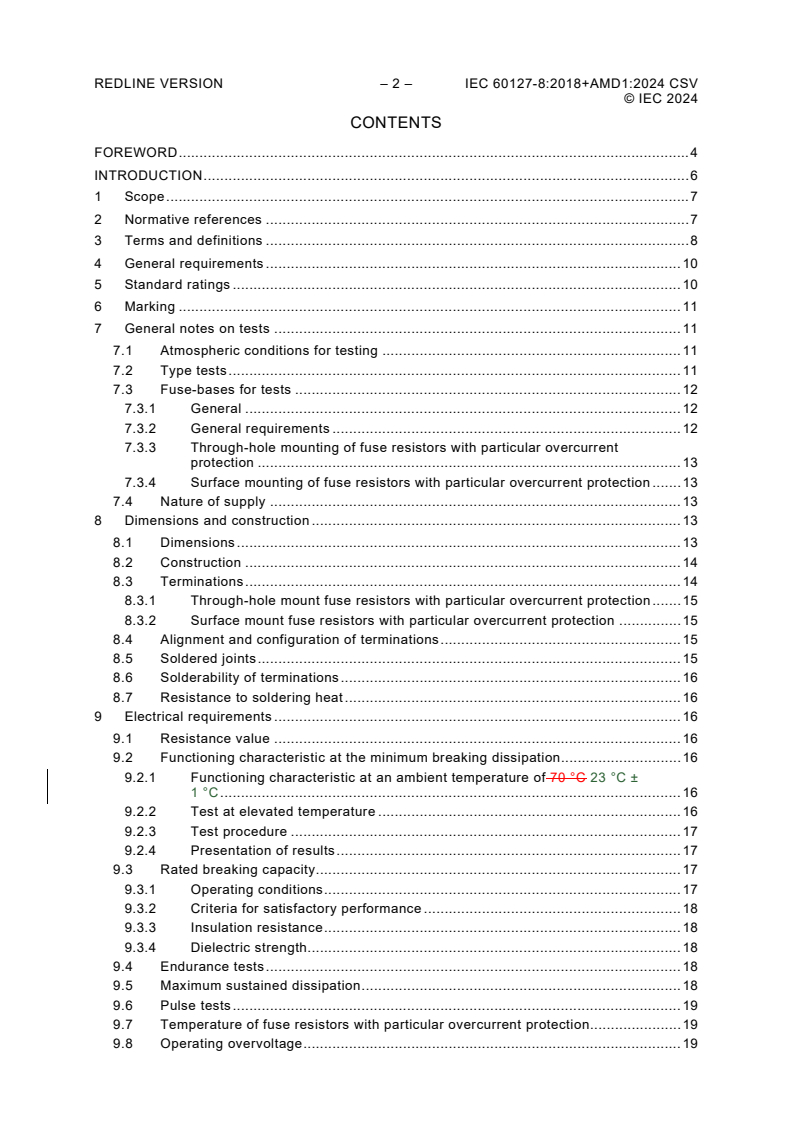
REDLINE VERSION – 2 – IEC 60127-8:2018+AMD1:2024 CSV
© IEC 2024
CONTENTS
FOREWORD . 4
INTRODUCTION . 6
1 Scope . 7
2 Normative references . 7
3 Terms and definitions . 8
4 General requirements . 10
5 Standard ratings . 10
6 Marking . 11
7 General notes on tests . 11
7.1 Atmospheric conditions for testing . 11
7.2 Type tests . 11
7.3 Fuse-bases for tests . 12
7.3.1 General . 12
7.3.2 General requirements . 12
7.3.3 Through-hole mounting of fuse resistors with particular overcurrent
protection . 13
7.3.4 Surface mounting of fuse resistors with particular overcurrent protection . 13
7.4 Nature of supply . 13
8 Dimensions and construction . 13
8.1 Dimensions . 13
8.2 Construction . 14
8.3 Terminations . 14
8.3.1 Through-hole mount fuse resistors with particular overcurrent protection . 15
8.3.2 Surface mount fuse resistors with particular overcurrent protection . 15
8.4 Alignment and configuration of terminations . 15
8.5 Soldered joints . 15
8.6 Solderability of terminations . 16
8.7 Resistance to soldering heat . 16
9 Electrical requirements . 16
9.1 Resistance value . 16
9.2 Functioning characteristic at the minimum breaking dissipation. 16
9.2.1 Functioning characteristic at an ambient temperature of 70 °C 23 °C ±
1 °C . 16
9.2.2 Test at elevated temperature . 16
9.2.3 Test procedure . 17
9.2.4 Presentation of results . 17
9.3 Rated breaking capacity. 17
9.3.1 Operating conditions . 17
9.3.2 Criteria for satisfactory performance . 18
9.3.3 Insulation resistance . 18
9.3.4 Dielectric strength. 18
9.4 Endurance tests . 18
9.5 Maximum sustained dissipation . 18
9.6 Pulse tests . 19
9.7 Temperature of fuse resistors with particular overcurrent protection. 19
9.8 Operating overvoltage . 19
© IEC 2024
Bibliography . 26
Figure 1 – Test board for through-hole mount fuse resistors with particular overcurrent
protection . 21
Figure 2 – Test board for surface mount fuse resistors with particular overcurrent
protection . 22
Figure 3 – Test fuse-base . 24
Figure 4 – Bending jig for surface mount fuse resistors with particular overcurrent
protection . 24
Figure 5 – Test circuit for the tests according to 9.3 . 25
Table 1 – Creepage distances and clearances (absolute minimum values) . 14
Table 2 – Test voltages for dielectric strength . 18
Table 3 – Testing schedule for individual dissipation ratings . 20
REDLINE VERSION – 4 – IEC 60127-8:2018+AMD1:2024 CSV
© IEC 2024
INTERNATIONAL ELECTROTECHNICAL COMMISSION
____________
MINIATURE FUSES –
Part 8: Fuse resistors with particular overcurrent protection
FOREWORD
1) The International Electrotechnical Commission (IEC) is a worldwide organization for standardization comprising
all national electrotechnical committees (IEC National Committees). The object of IEC is to promote
international co-operation on all questions concerning standardization in the electrical and electronic fields. To
this end and in addition to other activities, IEC publishes International Standards, Technical Specifications,
Technical Reports, Publicly Available Specifications (PAS) and Guides (hereafter referred to as "IEC
Publication(s)"). Their preparation is entrusted to technical committees; any IEC National Committee interested
in the subject dealt with may participate in this preparatory work. International, governmental and non-
governmental organizations liaising with the IEC also participate in this preparation. IEC collaborates closely
with the International Organization for Standardization (ISO) in accordance with conditions determined by
agreement between the two organizations.
2) The formal decisions or agreements of IEC on technical matters express, as nearly as possible, an international
consensus of opinion on the relevant subjects since each technical committee has representation from all
interested IEC National Committees.
3) IEC Publications have the form of recommendations for international use and are accepted by IEC National
Committees in that sense. While all reasonable efforts are made to ensure that the technical content of IEC
Publications is accurate, IEC cannot be held responsible for the way in which they are used or for any
misinterpretation by any end user.
4) In order to promote international uniformity, IEC National Committees undertake to apply IEC Publications
transparently to the maximum extent possible in their national and regional publications. Any divergence
between any IEC Publication and the corresponding national or regional publication shall be clearly indicated in
the latter.
5) IEC itself does not provide any attestation of conformity. Independent certification bodies provide conformity
assessment services and, in some areas, access to IEC marks of conformity. IEC is not responsible for any
services carried out by independent certification bodies.
6) All users should ensure that they have the latest edition of this publication.
7) No liability shall attach to IEC or its directors, employees, servants or agents including individual experts and
members of its technical committees and IEC National Committees for any personal injury, property damage or
other damage of any nature whatsoever, whether direct or indirect, or for costs (including legal fees) and
expenses arising out of the publication, use of, or reliance upon, this IEC Publication or any other IEC
Publications.
8) Attention is drawn to the Normative references cited in this publication. Use of the referenced publications is
indispensable for the correct application of this publication.
9) IEC draws attention to the possibility that the implementation of this document may involve the use of (a)
patent(s). IEC takes no position concerning the evidence, validity or applicability of any claimed patent rights in
respect thereof. As of the date of publication of this document, IEC had not received notice of (a) patent(s),
which may be required to implement this document. However, implementers are cautioned that this may not
represent the latest information, which may be obtained from the patent database available at
https://patents.iec.ch or www.iso.org/patents. IEC shall not be held responsible for identifying any or all such
patent rights.
This consolidated version of the official IEC Standard and its amendment has been
prepared for user convenience.
IEC 60127-8 edition 1.1 contains the first edition (2018-06) [documents 32C/542/FDIS
and 32C/546/RVD] and its amendment 1 (2024-07) [documents 32C/638/FDIS and
32C/642/RVD].
In this Redline version, a vertical line in the margin shows where the technical content
is modified by amendment 1. Additions are in green text, deletions are in strikethrough
red text. A separate Final version with all changes accepted is available in this
publication.
© IEC 2024
International Standard IEC 60127-8 has been prepared by subcommittee SC 32C: Miniature
fuses, of IEC technical committee 32: Fuses
This first edition of IEC 60127-8 cancels and replaces IEC PAS 60127-8:2014.
This international standard is to be used in conjunction with IEC 60127-1.
This document has been drafted in accordance with the ISO/IEC Directives, Part 2.
A list of all parts in the IEC 60127 series, published under the general title Miniature fuses,
can be found on the IEC website.
The committee has decided that the contents of this document and its amendment will remain
unchanged until the stability date indicated on the IEC website under webstore.iec.ch in the
data related to the specific document. At this date, the document will be
• reconfirmed,
• withdrawn, or
• revised.
IMPORTANT – The 'colour inside' logo on the cover page of this publication indicates
that it contains colours which are considered to be useful for the correct
understanding of its contents. Users should therefore print this document using a
colour printer.
REDLINE VERSION – 6 – IEC 60127-8:2018+AMD1:2024 CSV
© IEC 2024
INTRODUCTION
In recent years, so-called “fuse resistors” have increasingly been used in electrical and
electronic applications. The term “fuse resistor”, however, which has become established in
the market, is misleading. The actual function of a fuse resistor is that of a resistor in an
electrical or electronic circuit. Only when an overload of multiple times the rated dissipation
occurs can fuse resistors interrupt an electric current. In a wide range between the rated
dissipation and the manufacturer’s specified breaking dissipation, fuse resistors provide poor
or no overcurrent protection. Therefore if they are incorrectly rated and improperly used in an
application, this may result in potential risk of fire.
Fuse resistors perform the function of a fuse only within a particular overcurrent range, and,
from a technical point of view, must therefore be referred to as “fuse resistors with particular
overcurrent protection”.
Fuse resistors with particular overcurrent protection can safely interrupt high short-circuit
currents, but are not capable of interrupting overload currents.
For safety reasons, they are only used in combination with an accompanying overload current
protection device, if overload currents cannot be excluded to occur in the respective
application.
© IEC 2024
MINIATURE FUSES –
Part 8: Fuse resistors with particular overcurrent protection
1 Scope
This part of IEC 60127 relates to fuse resistors with particular overcurrent protection rated up
to AC 500 V and/or DC 500 V for printed circuits and other substrate systems, used for the
protection of electric appliances, electronic equipment and component parts thereof, normally
intended to be used indoors.
It does not apply to fuse resistors with particular overcurrent protection for appliances
intended to be used under special conditions, such as in a corrosive or explosive atmosphere.
The object of this part of IEC 60127 is
a) to establish uniform requirements for fuse resistors with particular overcurrent protection
so as to protect appliances or parts of appliances in the most suitable way;
b) to define the performance of the fuse resistors with particular overcurrent protection, so as
to give guidance to manufacturers of electrical appliances and electronic equipment and to
ensure replacement of fuse resistors with particular overcurrent protection by those of
similar dimensions and characteristics;
c) to establish uniform test methods for fuse resistors with particular overcurrent protection,
so as to allow verification of the values (for example rated dissipation, functioning
characteristic and rated breaking capacity values) specified by the manufacturer.
With exceptions of 3.5 and 3.8 of IEC 60127-1:2023, manufacturers of fuse resistors with
particular overcurrent protection shall ensure on their own responsibility that their products
comply with the requirements of the resistor-related standards IEC 60115-1, IEC 60115-4-
1 1
101 and IEC 60115-4-102 .
Fuse resistors with particular overcurrent protection are not intended to be replaced by the
end-user of an electrical / electronic appliance.
This part of IEC 60127 applies in addition to the requirements of IEC 60127-1.
2 Normative references
The following documents are referred to in the text in such a way that some or all of their
content constitutes requirements of this document. For dated references, only the edition
cited applies. For undated references, the latest edition of the referenced document (including
any amendments) applies.
IEC 60063:2015, Preferred number series for resistors and capacitors
IEC 60068-2-21:2006, Environmental testing – Part 2-21: Tests – Test U: Robustness of
terminations and integral mounting devices
IEC 60115-1:2008, Fixed resistors for use in electronic equipment – Part 1: Generic
specification
___________
IEC 60115-4-101 and IEC 60115-4-102 have been withdrawn.
REDLINE VERSION – 8 – IEC 60127-8:2018+AMD1:2024 CSV
© IEC 2024
IEC 60115-4-101:1995, Fixed resistors for use in electronic equipment – Part 4: Detail
specification: Fixed power wirewound resistors with solderable axial wire leads – Stability
class 5%. Assessment level E
IEC 60115-4-102:1995, Fixed resistors for use in electronic equipment – Part 4: Detail
specification: Fixed power wirewound resistors with solderable axial wire leads – Stability
class 1 % – Assessment level E
IEC 60127-1:2006, Miniature fuses – Part 1: Definitions for miniature fuses and general
requirements for miniature fuse-links
IEC 60127-1:2006/AMD1:2011
IEC 60127-1:2006/AMD2:2015
IEC 60194:2015, Printed board design, manufacture and assembly – Terms and definitions
IEC 60664-1:2007, Insulation coordination for equipment within low-voltage systems – Part 1:
Principles, requirements and tests
IEC 60695-2-12:2010, Fire hazard testing – Part 2-12: Glowing/hot-wire based test methods –
Glow-wire flammability index (GWFI) test method for materials
IEC 60695-2-13:2010, Fire hazard testing – Part 2-13: Glowing/hot-wire based test methods –
Glow-wire ignition temperature (GWIT) test method for materials
IEC 60695-4:2012, Fire hazard testing – Part 4: Terminology concerning fire tests for
electrotechnical products
IEC 61249-2-7:2002, Materials for printed boards and other interconnecting structures –
Part 2-7: Reinforced base materials clad and unclad – Epoxide woven E-glass laminated
sheet of defined flammability (vertical burning test), copper-clad
3 Terms and definitions
With the exceptions of 3.5 and 3.8 of IEC 60127-1:2023, for the purposes of this document,
the terms and definitions given in Clause 3 of IEC 60127-1:20062023 as well as resistor-
related standards IEC 60115-1, IEC 60115-4-101 and IEC 60115-4-102, and the following
apply.
ISO and IEC maintain terminological databases for use in standardization at the following
addresses:
• IEC Electropedia: available at http://www.electropedia.org/
• ISO Online browsing platform: available at http://www.iso.org/obp
3.1
fuse resistor with particular overcurrent protection
resistor with the added function of a fuse, characterized as being capable of continuously
carrying currents up to at least the rated dissipation and of interrupting currents above a
defined multiple of the rated dissipation up to its rated breaking capacity
Note 1 to entry: Fuse resistors with particular overcurrent protection can safely interrupt high short-circuit
currents, but are not capable of interrupting overload currents. They are therefore allowed to be used only in
combination with an accompanying overload current protection device such as a miniature fuse according to parts
IEC 60127-2, −3, −4 and −7, if overload currents cannot be excluded to occur in the respective application.
© IEC 2024
3.2
fuse resistor with particular overcurrent protection for through-hole mounting
fuse resistor with particular overcurrent protection designed for soldering directly into a
printed wiring board, with insertion of its leads in suitably designed holes
3.3
fuse resistor with particular overcurrent protection for surface mounting
fuse resistor with particular overcurrent protection designed for direct conductive attachment
by solder or other means onto the surface of a substrate, without insertion of its leads in
suitably designed holes or sockets
3.4
land
portion of a conductive pattern usually but not exclusively used for the connection and/or
attachment of components
SEE: IEC 60194
Note 1 to entry: Further definitions which may be useful in the application of surface-mount fuse resistors with
particular overcurrent protection may be found in IEC 60115-1 and IEC 60115-8.
3.5
critical resistance
resistance value at which the rated voltage is equal to the limiting element voltage
Note 1 to entry: At an ambient temperature of 70 (23±1) °C, the maximum voltage which may be applied across
the terminations of a fuse resistor with particular overcurrent protection is either the calculated rated voltage, if the
resistance is less than the critical resistance, or the limiting element voltage, if the resistance is equal to or greater
than the critical resistance. At temperatures other than 70 (23±1) °C, it is important that account be taken of the
derating curve and of the limiting element voltage in the calculation of any voltage to be applied.
Note 2 to entry: Related terminology: Rated voltage, limiting element voltage.
3.6
limiting element voltage
U
max
maximum DC or AC r.m.s. voltage that may be continuously applied to the terminations of a
fuse resistor with particular overcurrent protection (generally dependent upon size and
manufacturing technology of the fuse resistor with particular overcurrent protection)
Note 1 to entry: Where the term "AC r.m.s. voltage" is used in this standard, the peak voltage should not exceed
1,42 times the r.m.s. value.
Note 2 to entry: This voltage can only be applied to fuse resistors with particular overcurrent protection when the
resistance value is equal to or higher than the critical resistance value.
Note 3 to entry: Related terminology: rated voltage, critical resistance.
3.7
rated resistance
resistance value for which the fuse resistor with particular overcurrent protection has been
designed, and which is generally used for denomination of the fuse resistor with particular
overcurrent protection
3.8
rated dissipation
P
maximum permissible dissipation at an ambient temperature of 70 °C under the conditions of
the respective acceptance criteria
Note 1 to entry: If the rated dissipation depends on special means supporting the abduction of the dissipation to
the environment, for example, special circuit board material, special conductor dimensions, heat-sink, such means
have to be identified whenever the rated dissipation is mentioned.
REDLINE VERSION – 10 – IEC 60127-8:2018+AMD1:2024 CSV
© IEC 2024
Note 2 to entry: Related terminology: rated temperature, rated voltage.
3.9
rated temperature
maximum ambient temperature at which the rated dissipation may be applied continuously
Note 1 to entry: The rated temperature has a value of 70°C (23±1) °C, unless otherwise prescribed in IEC 60115-
1.
Note 2 to entry: Related terminology: rated dissipation.
3.10
rated voltage
U
r
DC or AC r.m.s. voltage calculated from the square root of the product of the rated resistance
and the rated dissipation
Note 1 to entry: At high values of resistance, the rated voltage may not be applicable because of the size and the
construction of the fuse resistor with particular overcurrent protection.
Note 2 to entry: Related terminology: rated dissipation, limiting element voltage.
3.11
minimum breaking dissipation
minimum value of the breaking dissipation which is equal to a multiple of the rated dissipation
and at which the fuse resistor with particular overcurrent protection can still safely interrupt
the circuit
Note 1 to entry: In this standard the minimum breaking dissipation is specified to be 16 times the rated dissipation.
This value corresponds to the values given by most of the manufacturers.
4 General requirements
The requirements of IEC 60127-1:2006, Clause 4, are replaced as follows:
Fuse resistors with particular overcurrent protection shall be so constructed that their fuse
function is reliable and safe and they are consistent in performance at the minimum breaking
dissipation up to and including the breaking capacity rating and at any voltage up to the rated
voltage, when used within the limits of this standard.
During normal use of the fuse resistor with particular overcurrent protection and within the
conditions given in this standard, no permanent arc, nor external arcing, nor any flame that
can endanger the surroundings, shall be produced. During testing and after operation, the
fuse resistor with particular overcurrent protection shall not have suffered damage and the
surroundings shall be unimpaired. Marking shall still be legible.
In general, compliance is checked by carrying out all the tests specified.
5 Standard ratings
The values of rated resistance shall be selected from the E12 or E24 series as given in
IEC 60063.
© IEC 2024
6 Marking
The requirements of IEC 60127-1:2006, Clause 6, are replaced as follows:
6.1 Each fuse resistor with particular overcurrent protection shall be marked as follows:
a) Rated resistance in ohms (abbreviation Ω or mΩ).
b) The marking of the tolerance on rated resistance shall follow and be adjacent to the
marking of the rated resistance.
c) Rated dissipation in watts (W).
d) Manufacturer's name or trade mark.
e) The symbol “F” shall precede and be adjacent to the marking of the rated resistance.
6.2 Marking shall be indelible and easily legible.
In the case of screen or pad printing, compliance is checked by inspection and by rubbing the
marking by hand for 15 s with a piece of cloth soaked in water and again for 15 s with a piece
of cloth soaked in petroleum spirit.
NOTE 1 For petroleum spirit the use of an aliphatic solvent hexane, with an aromatics content of maximum 0,1 %
volume, a kauri-butanol value of 29, initial boiling point approximately 65 °C, dry-point approximately 69 °C and
specific gravity of approximately 0,68 is recommended.
NOTE 2 For all other printing techniques, the above test is not applicable.
6.3 The marking according to 6.2 6.1 shall also be printed on the packing together with a
reference to this standard document. The marking of the rated resistance on the packing shall
include the abbreviation Ω or mΩ. In addition, the marking of the rated voltage, rated
dissipation P P and minimum breaking dissipation shall be printed on the packing.
70 23±1 °C
Compliance is checked by inspection.
6.4 For colour coding, no test or requirement is specified tests and requirements are under
consideration.
6.5 Where marking is impracticable due to space limitations, the relevant information
should appear on the smallest packing unit and in the manufacturer’s technical literature.
7 General notes on tests
7.1 Atmospheric conditions for testing
See IEC 60127-1:2006, 7.1.
7.2 Type tests
7.2.1 General
The requirements of IEC 60127-1:2006, 7.2, are replaced as follows:
7.2.2 For fuse resistors with particular overcurrent protection designed and rated both for
AC and DC, the number of fuse resistors with particular overcurrent protection required is 45.
For fuse resistors with particular overcurrent protection designed only for AC or DC, the
number of fuse resistors with particular overcurrent protection required is 36.
REDLINE VERSION – 12 – IEC 60127-8:2018+AMD1:2024 CSV
© IEC 2024
18 fuse resistors with particular overcurrent protection are kept as spares.
The fuse resistors with particular overcurrent protection shall be tested or inspected in
accordance with the following subclauses:
a) Marking (see 6.1);
b) Dimensions (see 8.1);
c) Construction (see 8.2);
d) Resistance (see 9.1);
with such additional tests as are specified in Subclauses 7.2.3 to 7.4.
7.2.3 Testing of the minimum and maximum rated resistance of the fuse resistors with
particular overcurrent protection shall then be performed according to the testing schedule
shown in Table 3.
In addition, any one rated resistance value per resistance decade shall be tested.
7.2.4
a) No failure is allowed in any of the tests covered by 8.1.1, 9.1, 9.2 and 9.3.
b) If in the test covered by Clause 6 and those tests described in 8.1 and 8.3, one failure
occurs, the test shall be repeated on twice the number of fuse resistors with particular
overcurrent protection, at the same breaking dissipation and a second failure shall be a
cause for rejection.
If two failures occur, but not both in the same test, the fuse resistors with particular
overcurrent protection shall be deemed to comply provided that there are no further
failures in repeat tests with twice the number of test samples.
If more than two failures occur, the fuse resistors with particular overcurrent protection
shall be deemed not to comply with this standard.
7.3 Fuse-bases for tests
7.3.1 General
The requirements of IEC 60127-1:2006, 7.3, are replaced as follows:
7.3.2 General requirements
The fuse resistors with particular overcurrent protection shall be mounted upon the
appropriate test board (see 7.3.3 or 7.3.4 as appropriate) by soldering.
This test board shall then be mounted on the test fuse-base (Figure 3). The test board shall
be made of epoxide woven glass fabric copper-clad laminated sheet, as defined in
IEC 61249-2-7.
• The nominal sheet thickness shall be 1,6 mm.
• The nominal thickness of copper layer shall be 0,035 mm or 0,070 mm for rated
dissipation values above 5 W for rated power dissipation below 5 W; 0,070 mm for rated
dissipation 5 W up to 10 W.
Metal parts of the fuse-base shall be made of brass with a copper content between 58 % and
70 %. Contact parts shall be silver-plated.
When two or more fuse resistors with particular overcurrent protection are tested in series,
the test fuse-bases shall be located so that there will be a spacing of not less than 50 mm
between any two fuse resistors with particular overcurrent protection. The conductor
connecting the test fuse-bases together, and connecting the test fuse-bases to the ammeter
© IEC 2024
and the source of supply shall be insulated copper wire. The length of each conductor shall be
250 mm, and the cross-sectional area of the wire shall be approximately 1 mm .
7.3.3 Through-hole mounting of fuse resistors with particular overcurrent protection
For electrical tests, the fuse resistors with particular overcurrent protection shall be mounted
on the test board as shown in Figure 1 in the pair of holes appropriate to the spacing of the
terminations.
7.3.4 Surface mounting of fuse resistors with particular overcurrent protection
For electrical tests, the fuse resistors with particular overcurrent protection shall be mounted
on the test board as shown in Figure 2.
7.4 Nature of supply
See IEC 60127-1:2006, 7.4.
8 Dimensions and construction
8.1 Dimensions
The requirements of IEC 60127-1:2006, 8.1, are replaced as follows:
• The dimensions of the fuse resistors with particular overcurrent protection shall be as
specified by the manufacturer.
• Compliance is checked by measurement of length, width and height.
For through-hole mount fuse resistors with particular overcurrent protection the termination
spacing is checked. In addition, the following applies:
• The termination shall also pass through a 1 mm hole.
• The length of the termination is not specified as this is subject to the method of packaging.
8.1.1 Creepage distances and clearances
The creepage distances and clearances between current-carrying parts (contacts together
with their terminals) and the outside of the enclosure of the fuse resistor with particular
overcurrent protection including insulated metal parts thereof, shall be not less than the
values given in Table 1. The values indicated are absolute minimum values and inclusive of
manufacturing tolerances.
These distances do not apply across the disconnection (between the open contacts) of the
fuse resistors with particular overcurrent protection.
Compliance is checked by measuring the distances concerned.
REDLINE VERSION – 14 – IEC 60127-8:2018+AMD1:2024 CSV
© IEC 2024
Table 1 – Creepage distances and clearances
(absolute minimum values)
Rated voltage, U Clearance Creepage distance
r
V mm mm
0 to 32 0,2 0,53
33 to 50 0,2 1,2
51 to 125 0,5 1,5
126 to 250 1,5 2,5
251 to 400 3,0 4,0
401 to 500 4,0 6,9
NOTE 1 The clearances/creepage distances are specified according to IEC 60664-1.
NOTE 2 The values specified are for typical applications of fuse resistors with particular overcurrent protection
assuming:
a) continuous voltage stress;
b) altitude of 2 000 m;
c) basic insulation;
d) inhomogeneous field;
e) overvoltage category II;
f) pollution degree 2;
g) material group III.
NOTE 3 If conditions are different from those specified in note 2, adjustments in clearances/creepage distances
will be necessary as per IEC 60664-1.
8.2 Construction
The requirements of IEC 60127-1:2006, 8.2, are replaced as follows:
The fuse resistor with particular overcurrent protection shall be completely enclosed.
8.2.1 The fuse resistor with particular overcurrent protection shall be resistant to fire
according to IEC 60695-2-12 and IEC 60695-2-13.
Compliance is checked by inspection. This is not applicable for fuse resistors with particular
overcurrent protection which represent small parts according to IEC 60695-4:2012, 3.78.
For fuse resistor bodies made of plastic material or of material containing organic substances,
the following minimum requirements apply:
• Glow-wire ignition temperature (GWIT) = 775 °C
• Glow-wire flammability index (GWFI) = 850 °C
NOTE 1 For the glow wire tests, the material plates with dimensions according to IEC 60695-2-12:2010, 4.2
and/or IEC 60695-2-13:2010, 4.2, are used.
NOTE 2 For materials such as glass and ceramic whose GWIT and GWFI are thought to be higher than 775 °C
and respectively 850 °C the glow-wire tests do not apply.
8.3 Terminations
The requirements of IEC 60127-1:2006, 8.3, are replaced as follows:
© IEC 2024
8.3.1 Through-hole mount fuse resistors with particular overcurrent protection
The terminations shall be firmly attached so that it is not possible to remove them without
damaging the fuse resistor with particular overcurrent protection.
Compliance is checked by carrying out the following test.
The tests are carried out in accordance with IEC 60068-2-21.
The following tests shall be applied:
• tensile test Ua , applied force 10 N;
• thrust test Ua , applied force 2 N;
• bending test Ub, applied force 5 N, number of bends: 1.
The sample size is two fuse resistors with particular overcurrent protection for each test. After
testing, the terminations shall remain firmly attached. The resistance shall be measured in
accordance with 9.1, and the change in resistance shall not exceed the value specified by the
manufacturer. Bending test Ub is omitted, if the terminations are less than 5 mm.
The samples are then mounted on the test board as shown in Figure 1.
8.3.2 Surface mount fuse resistors with particular overcurrent protection
The fuse resistors with particular overcurrent protection shall be mounted on the test board as
shown in Figure 2. The test board, with the fuse resistors with particular overcurrent
protection on the underside, shall be placed in the bending jig as shown in Figure 4. The test
board shall then be bent by 1 mm at a rate of 1 mm/s. The test board shall be allowed to
recover from the bent position, and then be removed from the test jig.
After testing, the terminations shall remain firmly attached. The resistance shall be measured
in accordance with 9.1, and the change in resistance shall not exceed the value specified by
the manufacturer.
8.4 Alignment and configuration of terminations
The termination configuration and spacing shall be as specified by the manufacturer.
NOTE 1 Through-hole mounting of fuse resistors with particular overcurrent protection
For through-hole mounting of fuse resistors with particular overcurrent protection, the dimensions specified by the
manufacturer are such as to permit installation on printed circuit boards having a grid system of holes located on
centres of distance e = 2,5 mm. Attention is drawn to the fact that in some parts of the world the value e = 2,54 mm
is still in use by printed circuit designers.
Electrical and electronic circuit designers are advised to apply the requirements of IEC 60326-3 .
NOTE 2 Surface mounting of fuse resistors with particular overcurrent protection
For surface mounting of fuse resistors with particular overcurrent protection, electrical and electronic circuit
designers are advised to design substrate land areas to receive the fuse resistor with particular overcurrent
protection with due consideration for achieving the maximum area of contact in the application, taking into account
the tolerance applied to mechanical placing of the component and the dimensions and tolerances for terminals in
this standard.
8.5 Soldered joints
No test specified.
___________
This standard has been withdrawn.
REDLINE VERSION – 16 – IEC 60127-8:2018+AMD1:2024 CSV
© IEC 2024
8.6 Solderability of terminations
No test specified.
8.7 Resistance to soldering heat
No test specified.
9 Electrical requirements
The requirements of IEC 60127-1:2006, Clause 9, are replaced as follows:
9.1 Resistance value
The samples are drawn at random and numbered consecutively (without being sorted in
descending order of resistance value). The resistance value shall be measured at the points
marked U in Figure 1 for through-hole mount fuse resistors with particular overcurrent
protection and in Figure 2 for surface mount fuse resistors with particular overcurrent
protection, using the test fuse-base shown in Figure 3 (see 7.3).
Resistance values including tolerances as specified by the manufacturer apply.
9.2 Functioning characteristic at the minimum breaking dissipation
9.2.1 Functioning characteristic at an ambient temperature of 70 °C 23 °C ± 1 °C
The breaking dissipation across the fuse resistor with particular overcurrent protection shall
be adjusted to within ± 1 % of the value required in this standard document. The breaking
dissipation stability during the test shall be maintained within ± 1 % of the adjusted value.
The accuracy of the measurement of time shall be within a tolerance of ± 5 % for times of less
than 10 s and ± 2 % for times of 10 s or more.
Compliance is checked as follows:
+0
a) The samples are exposed in the test oven to a temperature of 70 until the temperature
−5
has stabilized, shown when two consecutive readings are equal within 1 K.
a) After stabilization of the test oven at 70 °C, An initial load of 16 times the rated dissipation
is applied across the sample.
NOTE To adjust the initial load it could be necessary to use a separate resistor which is less heat-sensitive
than the test sample.
For the measurement it is necessary to apply the test load for a minimum of 50 ms.
b) The temperature rise, as measured on the terminations where they enter the test board,
shall not exceed 180 °C or 135 K 157 K taking into account the standard use of SnAgCu
or SnCu based solders.
c) In addition, the measured operating times shall not exceed the maximum values specified
by the manufacturer and shall be not more than 60 s.
d) Subsequent assessment according to 9.3.2 and testing according to 9.3.3 and 9.3.3.1
9.3.4.
9.2.2 Test at elevated temperature
None specified.
© IEC 2024
9.2.3 Test procedure
The requirements of IEC 60127-1:2006, 9.2.3, are replaced as follows:
Direct current shall be used for these tests.
NOTE Direct current is used because it is easier to control and eliminates the variation inherent with alternating
current caused by the point on the voltage wave that switching occurs.
9.2.4 Presentation of results
Not applicable.
9.3 Rated breaking capacity
9.3.1 Operating conditions
The requirements of IEC 60127-1:2006, 9.3.1, are replaced as follows:
Fuse resistors with particular overcurrent protection shall operate satisfactorily without
endangering the surroundings when breaking a prospective current of 35 A at the rated
voltage but not less than AC 250 V and/or DC 250 V.
The recovery voltage shall be between 1,02 and 1,05 times the rated voltage of the fuse
resistor with particular overcurrent
...
IEC 60127-8 ®
Edition 1.0 2018-06
INTERNATIONAL
STANDARD
NORME
INTERNATIONALE
Miniature fuses –
Part 8: Fuse resistors with particular overcurrent protection
Coupe-circuit miniatures –
Partie 8: Résistances de protection avec protection particulière contre les
surintensités
All rights reserved. Unless otherwise specified, no part of this publication may be reproduced or utilized in any form
or by any means, electronic or mechanical, including photocopying and microfilm, without permission in writing from
either IEC or IEC's member National Committee in the country of the requester. If you have any questions about IEC
copyright or have an enquiry about obtaining additional rights to this publication, please contact the address below or
your local IEC member National Committee for further information.
Droits de reproduction réservés. Sauf indication contraire, aucune partie de cette publication ne peut être reproduite
ni utilisée sous quelque forme que ce soit et par aucun procédé, électronique ou mécanique, y compris la photocopie
et les microfilms, sans l'accord écrit de l'IEC ou du Comité national de l'IEC du pays du demandeur. Si vous avez des
questions sur le copyright de l'IEC ou si vous désirez obtenir des droits supplémentaires sur cette publication, utilisez
les coordonnées ci-après ou contactez le Comité national de l'IEC de votre pays de résidence.
IEC Central Office Tel.: +41 22 919 02 11
3, rue de Varembé info@iec.ch
CH-1211 Geneva 20 www.iec.ch
Switzerland
About the IEC
The International Electrotechnical Commission (IEC) is the leading global organization that prepares and publishes
International Standards for all electrical, electronic and related technologies.
About IEC publications
The technical content of IEC publications is kept under constant review by the IEC. Please make sure that you have the
latest edition, a corrigenda or an amendment might have been published.
IEC Catalogue - webstore.iec.ch/catalogue Electropedia - www.electropedia.org
The stand-alone application for consulting the entire The world's leading online dictionary of electronic and
bibliographical information on IEC International Standards, electrical terms containing 21 000 terms and definitions in
Technical Specifications, Technical Reports and other English and French, with equivalent terms in 16 additional
documents. Available for PC, Mac OS, Android Tablets and languages. Also known as the International Electrotechnical
iPad. Vocabulary (IEV) online.
IEC publications search - webstore.iec.ch/advsearchform IEC Glossary - std.iec.ch/glossary
The advanced search enables to find IEC publications by a 67 000 electrotechnical terminology entries in English and
variety of criteria (reference number, text, technical French extracted from the Terms and Definitions clause of
committee,…). It also gives information on projects, replaced IEC publications issued since 2002. Some entries have been
and withdrawn publications. collected from earlier publications of IEC TC 37, 77, 86 and
CISPR.
IEC Just Published - webstore.iec.ch/justpublished
Stay up to date on all new IEC publications. Just Published IEC Customer Service Centre - webstore.iec.ch/csc
details all new publications released. Available online and If you wish to give us your feedback on this publication or
also once a month by email. need further assistance, please contact the Customer Service
Centre: sales@iec.ch.
A propos de l'IEC
La Commission Electrotechnique Internationale (IEC) est la première organisation mondiale qui élabore et publie des
Normes internationales pour tout ce qui a trait à l'électricité, à l'électronique et aux technologies apparentées.
A propos des publications IEC
Le contenu technique des publications IEC est constamment revu. Veuillez vous assurer que vous possédez l’édition la
plus récente, un corrigendum ou amendement peut avoir été publié.
Catalogue IEC - webstore.iec.ch/catalogue Electropedia - www.electropedia.org
Application autonome pour consulter tous les renseignements
Le premier dictionnaire en ligne de termes électroniques et
bibliographiques sur les Normes internationales,
électriques. Il contient 21 000 termes et définitions en anglais
Spécifications techniques, Rapports techniques et autres
et en français, ainsi que les termes équivalents dans 16
documents de l'IEC. Disponible pour PC, Mac OS, tablettes
langues additionnelles. Egalement appelé Vocabulaire
Android et iPad.
Electrotechnique International (IEV) en ligne.
Recherche de publications IEC -
Glossaire IEC - std.iec.ch/glossary
webstore.iec.ch/advsearchform
67 000 entrées terminologiques électrotechniques, en anglais
La recherche avancée permet de trouver des publications IEC et en français, extraites des articles Termes et Définitions des
en utilisant différents critères (numéro de référence, texte, publications IEC parues depuis 2002. Plus certaines entrées
comité d’études,…). Elle donne aussi des informations sur les antérieures extraites des publications des CE 37, 77, 86 et
projets et les publications remplacées ou retirées. CISPR de l'IEC.
IEC Just Published - webstore.iec.ch/justpublished Service Clients - webstore.iec.ch/csc
Restez informé sur les nouvelles publications IEC. Just Si vous désirez nous donner des commentaires sur cette
Published détaille les nouvelles publications parues. publication ou si vous avez des questions contactez-nous:
Disponible en ligne et aussi une fois par mois par email. sales@iec.ch.
IEC 60127-8 ®
Edition 1.0 2018-06
INTERNATIONAL
STANDARD
NORME
INTERNATIONALE
Miniature fuses –
Part 8: Fuse resistors with particular overcurrent protection
Coupe-circuit miniatures –
Partie 8: Résistances de protection avec protection particulière contre les
surintensités
INTERNATIONAL
ELECTROTECHNICAL
COMMISSION
COMMISSION
ELECTROTECHNIQUE
INTERNATIONALE
ICS 29.120.50 ISBN 978-2-8322-6238-2
– 2 – IEC 60127-8:2018 © IEC 2018
CONTENTS
FOREWORD . 4
INTRODUCTION . 6
1 Scope . 7
2 Normative references . 7
3 Terms and definitions . 8
4 General requirements . 10
5 Standard ratings . 10
6 Marking . 11
7 General notes on tests . 11
7.1 Atmospheric conditions for testing . 11
7.2 Type tests . 11
7.2.1 General . 11
7.3 Fuse-bases for tests . 12
7.3.1 General . 12
7.3.2 General requirements . 12
7.3.3 Through-hole mounting of fuse resistors with particular overcurrent
protection . 13
7.3.4 Surface mounting of fuse resistors with particular overcurrent protection . 13
7.4 Nature of supply . 13
8 Dimensions and construction . 13
8.1 Dimensions . 13
8.1.1 Creepage distances and clearances . 13
8.2 Construction . 14
8.3 Terminations . 14
8.3.1 Through-hole mount fuse resistors with particular overcurrent protection . 15
8.3.2 Surface mount fuse resistors with particular overcurrent protection . 15
8.4 Alignment and configuration of terminations . 15
8.5 Soldered joints . 15
8.6 Solderability of terminations . 16
8.7 Resistance to soldering heat . 16
9 Electrical requirements . 16
9.1 Resistance value . 16
9.2 Functioning characteristic at the minimum breaking dissipation. 16
9.2.1 Functioning characteristic at an ambient temperature of 70 °C . 16
9.2.2 Test at elevated temperature . 16
9.2.3 Test procedure . 16
9.2.4 Presentation of results . 17
9.3 Rated breaking capacity. 17
9.3.1 Operating conditions . 17
9.3.2 Criteria for satisfactory performance . 17
9.3.3 Insulation resistance . 18
9.3.4 Dielectric strength. 18
9.4 Endurance tests . 18
9.5 Maximum sustained dissipation . 18
9.6 Pulse tests . 18
9.7 Temperature of fuse resistors with particular overcurrent protection. 18
9.8 Operating overvoltage . 19
Bibliography . 25
Figure 1 – Test board for through-hole mount fuse resistors with particular overcurrent
protection . 21
Figure 2 – Test board for surface mount fuse resistors with particular overcurrent
protection . 22
Figure 3 – Test fuse-base . 23
Figure 4 – Bending jig for surface mount fuse resistors with particular overcurrent
protection . 24
Figure 5 – Test circuit for the tests according to 9.3 . 24
Table 1 – Creepage distances and clearances (absolute minimum values) . 14
Table 2 – Test voltages for dielectric strength . 18
Table 3 – Testing schedule for individual dissipation ratings . 20
– 4 – IEC 60127-8:2018 © IEC 2018
INTERNATIONAL ELECTROTECHNICAL COMMISSION
____________
MINIATURE FUSES –
Part 8: Fuse resistors with particular
overcurrent protection
FOREWORD
1) The International Electrotechnical Commission (IEC) is a worldwide organization for standardization comprising
all national electrotechnical committees (IEC National Committees). The object of IEC is to promote
international co-operation on all questions concerning standardization in the electrical and electronic fields. To
this end and in addition to other activities, IEC publishes International Standards, Technical Specifications,
Technical Reports, Publicly Available Specifications (PAS) and Guides (hereafter referred to as “IEC
Publication(s)”). Their preparation is entrusted to technical committees; any IEC National Committee interested
in the subject dealt with may participate in this preparatory work. International, governmental and non-
governmental organizations liaising with the IEC also participate in this preparation. IEC collaborates closely
with the International Organization for Standardization (ISO) in accordance with conditions determined by
agreement between the two organizations.
2) The formal decisions or agreements of IEC on technical matters express, as nearly as possible, an international
consensus of opinion on the relevant subjects since each technical committee has representation from all
interested IEC National Committees.
3) IEC Publications have the form of recommendations for international use and are accepted by IEC National
Committees in that sense. While all reasonable efforts are made to ensure that the technical content of IEC
Publications is accurate, IEC cannot be held responsible for the way in which they are used or for any
misinterpretation by any end user.
4) In order to promote international uniformity, IEC National Committees undertake to apply IEC Publications
transparently to the maximum extent possible in their national and regional publications. Any divergence
between any IEC Publication and the corresponding national or regional publication shall be clearly indicated in
the latter.
5) IEC itself does not provide any attestation of conformity. Independent certification bodies provide conformity
assessment services and, in some areas, access to IEC marks of conformity. IEC is not responsible for any
services carried out by independent certification bodies.
6) All users should ensure that they have the latest edition of this publication.
7) No liability shall attach to IEC or its directors, employees, servants or agents including individual experts and
members of its technical committees and IEC National Committees for any personal injury, property damage or
other damage of any nature whatsoever, whether direct or indirect, or for costs (including legal fees) and
expenses arising out of the publication, use of, or reliance upon, this IEC Publication or any other IEC
Publications.
8) Attention is drawn to the Normative references cited in this publication. Use of the referenced publications is
indispensable for the correct application of this publication.
9) Attention is drawn to the possibility that some of the elements of this IEC Publication may be the subject of
patent rights. IEC shall not be held responsible for identifying any or all such patent rights.
International Standard IEC 60127-8 has been prepared by subcommittee SC 32C: Miniature
fuses, of IEC technical committee 32: Fuses
This bilingual version (2018-12) corresponds to the monolingual English version, published in
2018-06.
This first edition of IEC 60127-8 cancels and replaces IEC PAS 60127-8:2014.
This international standard is to be used in conjunction with IEC 60127-1.
The text of this International Standard is based on the following documents:
FDIS Report on voting
32C/542/FDIS 32C/546/RVD
Full information on the voting for the approval of this International Standard can be found in
the report on voting indicated in the above table.
The French version of this standard has not been voted upon.
This document has been drafted in accordance with the ISO/IEC Directives, Part 2.
A list of all parts in the IEC 60127 series, published under the general title Miniature fuses,
can be found on the IEC website.
The committee has decided that the contents of this document will remain unchanged until the
stability date indicated on the IEC website under "http://webstore.iec.ch" in the data related to
the specific document. At this date, the document will be
• reconfirmed,
• withdrawn,
• replaced by a revised edition, or
• amended.
– 6 – IEC 60127-8:2018 © IEC 2018
INTRODUCTION
In recent years, so-called “fuse resistors” have increasingly been used in electrical and
electronic applications. The term “fuse resistor”, however, which has become established in
the market, is misleading. The actual function of a fuse resistor is that of a resistor in an
electrical or electronic circuit. Only when an overload of multiple times the rated dissipation
occurs can fuse resistors interrupt an electric current. In a wide range between the rated
dissipation and the manufacturer’s specified breaking dissipation, fuse resistors provide poor
or no overcurrent protection. Therefore if they are incorrectly rated and improperly used in an
application, this may result in potential risk of fire.
Fuse resistors perform the function of a fuse only within a particular overcurrent range, and,
from a technical point of view, must therefore be referred to as “fuse resistors with particular
overcurrent protection”.
Fuse resistors with particular overcurrent protection can safely interrupt high short-circuit
currents, but are not capable of interrupting overload currents.
For safety reasons, they are only used in combination with an accompanying overload current
protection device, if overload currents cannot be excluded to occur in the respective
application.
MINIATURE FUSES –
Part 8: Fuse resistors with particular
overcurrent protection
1 Scope
This part of IEC 60127 relates to fuse resistors with particular overcurrent protection rated up
to AC 500 V and/or DC 500 V for printed circuits and other substrate systems, used for the
protection of electric appliances, electronic equipment and component parts thereof, normally
intended to be used indoors.
It does not apply to fuse resistors with particular overcurrent protection for appliances
intended to be used under special conditions, such as in a corrosive or explosive atmosphere.
The object of this part of IEC 60127 is
a) to establish uniform requirements for fuse resistors with particular overcurrent protection
so as to protect appliances or parts of appliances in the most suitable way;
b) to define the performance of the fuse resistors with particular overcurrent protection, so as
to give guidance to manufacturers of electrical appliances and electronic equipment and to
ensure replacement of fuse resistors with particular overcurrent protection by those of
similar dimensions and characteristics;
c) to establish uniform test methods for fuse resistors with particular overcurrent protection,
so as to allow verification of the values (for example rated dissipation, functioning
characteristic and rated breaking capacity values) specified by the manufacturer.
Manufacturers of fuse resistors with particular overcurrent protection shall ensure on their
own responsibility that their products comply with the requirements of the resistor-related
standards IEC 60115-1, IEC 60115-4-101 and IEC 60115-4-102 .
This part of IEC 60127 applies in addition to the requirements of IEC 60127-1.
2 Normative references
The following documents are referred to in the text in such a way that some or all of their
content constitutes requirements of this document. For dated references, only the edition
cited applies. For undated references, the latest edition of the referenced document (including
any amendments) applies.
IEC 60063:2015, Preferred number series for resistors and capacitors
IEC 60068-2-21:2006, Environmental testing – Part 2-21: Tests – Test U: Robustness of
terminations and integral mounting devices
IEC 60115-1:2008, Fixed resistors for use in electronic equipment – Part 1: Generic
specification
___________
This standard has been withdrawn.
– 8 – IEC 60127-8:2018 © IEC 2018
IEC 60115-4-101:1995, Fixed resistors for use in electronic equipment – Part 4: Detail
specification: Fixed power wirewound resistors with solderable axial wire leads – Stability
class 5%. Assessment level E
IEC 60115-4-102:1995, Fixed resistors for use in electronic equipment – Part 4: Detail
specification: Fixed power wirewound resistors with solderable axial wire leads – Stability
class 1 % – Assessment level E
IEC 60127-1:2006, Miniature fuses – Part 1: Definitions for miniature fuses and general
requirements for miniature fuse-links
IEC 60127-1:2006/AMD1:2011
IEC 60127-1:2006/AMD2:2015
IEC 60194:2015, Printed board design, manufacture and assembly – Terms and definitions
IEC 60664-1:2007, Insulation coordination for equipment within low-voltage systems – Part 1:
Principles, requirements and tests
IEC 60695-2-12:2010, Fire hazard testing – Part 2-12: Glowing/hot-wire based test methods –
Glow-wire flammability index (GWFI) test method for materials
IEC 60695-2-13:2010, Fire hazard testing – Part 2-13: Glowing/hot-wire based test methods –
Glow-wire ignition temperature (GWIT) test method for materials
IEC 60695-4:2012, Fire hazard testing – Part 4: Terminology concerning fire tests for
electrotechnical products
IEC 61249-2-7:2002, Materials for printed boards and other interconnecting structures –
Part 2-7: Reinforced base materials clad and unclad – Epoxide woven E-glass laminated
sheet of defined flammability (vertical burning test), copper-clad
3 Terms and definitions
For the purposes of this document, the terms and definitions given in Clause 3 of IEC 60127-
1:2006 as well as IEC 60115-1, IEC 60115-4-101 and IEC 60115-4-102 and the following
apply.
ISO and IEC maintain terminological databases for use in standardization at the following
addresses:
• IEC Electropedia: available at http://www.electropedia.org/
• ISO Online browsing platform: available at http://www.iso.org/obp
3.1
fuse resistor with particular overcurrent protection
resistor with the added function of a fuse, characterized as being capable of continuously
carrying currents up to at least the rated dissipation and of interrupting currents above a
defined multiple of the rated dissipation up to its rated breaking capacity
Note 1 to entry: Fuse resistors with particular overcurrent protection can safely interrupt high short-circuit
currents, but are not capable of interrupting overload currents. They are therefore allowed to be used only in
combination with an accompanying overload current protection device such as a miniature fuse according to parts
2, 3, 4 and 7, if overload currents cannot be excluded to occur in the respective application.
3.2
fuse resistor with particular overcurrent protection for through-hole mounting
fuse resistor with particular overcurrent protection designed for soldering directly into a
printed wiring board, with insertion of its leads in suitably designed holes
3.3
fuse resistor with particular overcurrent protection for surface mounting
fuse resistor with particular overcurrent protection designed for direct conductive attachment
by solder or other means onto the surface of a substrate, without insertion of its leads in
suitably designed holes or sockets
3.4
land
portion of a conductive pattern usually but not exclusively used for the connection and/or
attachment of components
SEE: IEC 60194
Note 1 to entry: Further definitions which may be useful in the application of surface-mount fuse resistors with
particular overcurrent protection may be found in IEC 60115-1 and IEC 60115-8.
3.5
critical resistance
resistance value at which the rated voltage is equal to the limiting element voltage
Note 1 to entry: At an ambient temperature of 70 °C, the maximum voltage which may be applied across the
terminations of a fuse resistor with particular overcurrent protection is either the calculated rated voltage, if the
resistance is less than the critical resistance, or the limiting element voltage, if the resistance is equal to or greater
than the critical resistance. At temperatures other than 70 °C, it is important that account be taken of the derating
curve and of the limiting element voltage in the calculation of any voltage to be applied
Note 2 to entry: Related terminology: Rated voltage, limiting element voltage.
3.6
limiting element voltage
U
max
maximum DC or AC r.m.s. voltage that may be continuously applied to the terminations of a
fuse resistor with particular overcurrent protection (generally dependent upon size and
manufacturing technology of the fuse resistor with particular overcurrent protection)
Note 1 to entry: Where the term "AC r.m.s. voltage" is used in this standard, the peak voltage should not exceed
1,42 times the r.m.s. value.
Note 2 to entry: This voltage can only be applied to fuse resistors with particular overcurrent protection when the
resistance value is equal to or higher than the critical resistance value.
Note 3 to entry: Related terminology: rated voltage, critical resistance.
3.7
rated resistance
resistance value for which the fuse resistor with particular overcurrent protection has been
designed, and which is generally used for denomination of the fuse resistor with particular
overcurrent protection
3.8
rated dissipation
P
maximum permissible dissipation at an ambient temperature of 70 °C under the conditions of
the respective acceptance criteria
Note 1 to entry: If the rated dissipation depends on special means supporting the abduction of the dissipation to
the environment, for example, special circuit board material, special conductor dimensions, heat-sink, such means
have to be identified whenever the rated dissipation is mentioned.
Note 2 to entry: Related terminology: rated temperature, rated voltage.
– 10 – IEC 60127-8:2018 © IEC 2018
3.9
rated temperature
maximum ambient temperature at which the rated dissipation may be applied continuously
Note 1 to entry: The rated temperature has a value of 70 °C, unless otherwise prescribed in IEC 60115-1.
Note 2 to entry: Related terminology: rated dissipation.
3.10
rated voltage
U
r
DC or AC r.m.s. voltage calculated from the square root of the product of the rated resistance
and the rated dissipation
Note 1 to entry: At high values of resistance, the rated voltage may not be applicable because of the size and the
construction of the fuse resistor with particular overcurrent protection.
Note 2 to entry: Related terminology: rated dissipation, limiting element voltage.
3.11
minimum breaking dissipation
minimum value of the breaking dissipation which is equal to a multiple of the rated dissipation
and at which the fuse resistor with particular overcurrent protection can still safely interrupt
the circuit
Note 1 to entry: In this standard the minimum breaking dissipation is specified to be 16 times the rated dissipation.
This value corresponds to the values given by most of the manufacturers.
4 General requirements
The requirements of IEC 60127-1:2006, Clause 4, are replaced as follows:
Fuse resistors with particular overcurrent protection shall be so constructed that their fuse
function is reliable and safe and they are consistent in performance at the minimum breaking
dissipation up to and including the breaking capacity rating and at any voltage up to the rated
voltage, when used within the limits of this standard.
During normal use of the fuse resistor with particular overcurrent protection and within the
conditions given in this standard, no permanent arc, nor external arcing, nor any flame that
can endanger the surroundings, shall be produced. During testing and after operation, the
fuse resistor with particular overcurrent protection shall not have suffered damage and the
surroundings shall be unimpaired. Marking shall still be legible.
In general, compliance is checked by carrying out all the tests specified.
5 Standard ratings
The values of rated resistance shall be selected from the E12 or E24 series as given in
IEC 60063.
6 Marking
The requirements of IEC 60127-1:2006, Clause 6, are replaced as follows:
6.1 Each fuse resistor with particular overcurrent protection shall be marked as follows:
a) Rated resistance in ohms (abbreviation Ω or mΩ).
b) The marking of the tolerance on rated resistance shall follow and be adjacent to the
marking of the rated resistance.
c) Rated dissipation in watts (W).
d) Manufacturer's name or trade mark.
e) The symbol “F” shall precede and be adjacent to the marking of the rated resistance.
6.2 Marking shall be indelible and easily legible.
In the case of screen or pad printing, compliance is checked by inspection and by rubbing the
marking by hand for 15 s with a piece of cloth soaked in water and again for 15 s with a piece
of cloth soaked in petroleum spirit.
NOTE 1 For petroleum spirit the use of an aliphatic solvent hexane, with an aromatics content of maximum 0,1 %
volume, a kauri-butanol value of 29, initial boiling point approximately 65 °C, dry-point approximately 69 °C and
specific gravity of approximately 0,68 is recommended.
NOTE 2 For all other printing techniques, the above test is not applicable.
6.3 The marking according to 6.2 shall also be printed on the packing together with a
reference to this standard. The marking of the rated resistance on the packing shall include
the abbreviation Ω or mΩ. In addition, the marking of the rated voltage, rated dissipation P
and minimum breaking dissipation shall be printed on the packing.
Compliance is checked by inspection.
6.4 For colour coding, no test or requirement is specified.
6.5 Where marking is impracticable due to space limitations, the relevant information
should appear on the smallest packing unit and in the manufacturer’s technical literature.
7 General notes on tests
7.1 Atmospheric conditions for testing
See IEC 60127-1:2006, 7.1.
7.2 Type tests
7.2.1 General
The requirements of IEC 60127-1:2006, 7.2, are replaced as follows:
7.2.2 For fuse resistors with particular overcurrent protection designed and rated both for
AC and DC, the number of fuse resistors with particular overcurrent protection required is 45.
For fuse resistors with particular overcurrent protection designed only for AC or DC, the
number of fuse resistors with particular overcurrent protection required is 36.
18 fuse resistors with particular overcurrent protection are kept as spares.
– 12 – IEC 60127-8:2018 © IEC 2018
The fuse resistors with particular overcurrent protection shall be tested or inspected in
accordance with the following subclauses:
a) Marking (see 6.1);
b) Dimensions (see 8.1);
c) Construction (see 8.2);
d) Resistance (see 9.1);
with such additional tests as are specified in Subclauses 7.2.3 to 7.4.
7.2.3 Testing of the minimum and maximum rated resistance of the fuse resistors with
particular overcurrent protection shall then be performed according to the testing schedule
shown in Table 3.
In addition, any one rated resistance value per resistance decade shall be tested.
7.2.4
a) No failure is allowed in any of the tests covered by 8.1.1, 9.1, 9.2 and 9.3.
b) If in the test covered by Clause 6 and those tests described in 8.1 and 8.3, one failure
occurs, the test shall be repeated on twice the number of fuse resistors with particular
overcurrent protection, at the same breaking dissipation and a second failure shall be a
cause for rejection.
If two failures occur, but not both in the same test, the fuse resistors with particular
overcurrent protection shall be deemed to comply provided that there are no further
failures in repeat tests with twice the number of test samples.
If more than two failures occur, the fuse resistors with particular overcurrent protection
shall be deemed not to comply with this standard.
7.3 Fuse-bases for tests
7.3.1 General
The requirements of IEC 60127-1:2006, 7.3, are replaced as follows:
7.3.2 General requirements
The fuse resistors with particular overcurrent protection shall be mounted upon the
appropriate test board (see 7.3.3 or 7.3.4 as appropriate) by soldering.
This test board shall then be mounted on the test fuse-base (Figure 3). The test board shall
be made of epoxide woven glass fabric copper-clad laminated sheet, as defined in
IEC 61249-2-7.
• The nominal sheet thickness shall be 1,6 mm.
• The nominal thickness of copper layer shall be 0,035 mm or 0,070 mm for rated
dissipation values above 5 W.
Metal parts of the fuse-base shall be made of brass with a copper content between 58 % and
70 %. Contact parts shall be silver-plated.
When two or more fuse resistors with particular overcurrent protection are tested in series,
the test fuse-bases shall be located so that there will be a spacing of not less than 50 mm
between any two fuse resistors with particular overcurrent protection. The conductor
connecting the test fuse-bases together, and connecting the test fuse-bases to the ammeter
and the source of supply shall be insulated copper wire. The length of each conductor shall be
250 mm, and the cross-sectional area of the wire shall be approximately 1 mm .
7.3.3 Through-hole mounting of fuse resistors with particular overcurrent protection
For electrical tests, the fuse resistors with particular overcurrent protection shall be mounted
on the test board as shown in Figure 1 in the pair of holes appropriate to the spacing of the
terminations.
7.3.4 Surface mounting of fuse resistors with particular overcurrent protection
For electrical tests, the fuse resistors with particular overcurrent protection shall be mounted
on the test board as shown in Figure 2.
7.4 Nature of supply
See IEC 60127-1:2006, 7.4.
8 Dimensions and construction
8.1 Dimensions
The requirements of IEC 60127-1:2006, 8.1, are replaced as follows:
• The dimensions of the fuse resistors with particular overcurrent protection shall be as
specified by the manufacturer.
• Compliance is checked by measurement of length, width and height.
For through-hole mount fuse resistors with particular overcurrent protection the termination
spacing is checked. In addition, the following applies:
• The termination shall also pass through a 1 mm hole.
• The length of the termination is not specified as this is subject to the method of packaging.
8.1.1 Creepage distances and clearances
The creepage distances and clearances between current-carrying parts (contacts together
with their terminals) and the outside of the enclosure of the fuse resistor with particular
overcurrent protection including insulated metal parts thereof, shall be not less than the
values given in Table 1. The values indicated are absolute minimum values and inclusive of
manufacturing tolerances.
These distances do not apply across the disconnection (between the open contacts) of the
fuse resistors with particular overcurrent protection.
Compliance is checked by measuring the distances concerned.
– 14 – IEC 60127-8:2018 © IEC 2018
Table 1 – Creepage distances and clearances
(absolute minimum values)
Rated voltage, U Clearance Creepage distance
r
V mm mm
0 to 32 0,2 0,53
33 to 50 0,2 1,2
51 to 125 0,5 1,5
126 to 250 1,5 2,5
251 to 400 3,0 4,0
401 to 500 4,0 6,9
NOTE 1 The clearances/creepage distances are specified according to IEC 60664-1.
NOTE 2 The values specified are for typical applications of fuse resistors with particular overcurrent protection
assuming:
a) continuous voltage stress;
b) altitude of 2 000 m;
c) basic insulation;
d) inhomogeneous field;
e) overvoltage category II;
f) pollution degree 2;
g) material group III.
NOTE 3 If conditions are different from those specified in note 2, adjustments in clearances/creepage distances
will be necessary as per IEC 60664-1.
8.2 Construction
The requirements of IEC 60127-1:2006, 8.2, are replaced as follows:
The fuse resistor with particular overcurrent protection shall be completely enclosed.
8.2.1 The fuse resistor with particular overcurrent protection shall be resistant to fire
according to IEC 60695-2-12 and IEC 60695-2-13.
Compliance is checked by inspection. This is not applicable for fuse resistors with particular
overcurrent protection which represent small parts according to IEC 60695-4:2012, 3.78.
For fuse resistor bodies made of plastic material or of material containing organic substances,
the following minimum requirements apply:
• Glow-wire ignition temperature (GWIT) = 775 °C
• Glow-wire flammability index (GWFI) = 850 °C
NOTE 1 For the glow wire tests, the material plates with dimensions according to IEC 60695-2-12:2010, 4.2
and/or IEC 60695-2-13:2010, 4.2, are used.
NOTE 2 For materials such as glass and ceramic whose GWIT and GWFI are thought to be higher than 775 °C
and respectively 850 °C the glow-wire tests do not apply.
8.3 Terminations
The requirements of IEC 60127-1:2006, 8.3, are replaced as follows:
8.3.1 Through-hole mount fuse resistors with particular overcurrent protection
The terminations shall be firmly attached so that it is not possible to remove them without
damaging the fuse resistor with particular overcurrent protection.
Compliance is checked by carrying out the following test.
The tests are carried out in accordance with IEC 60068-2-21.
The following tests shall be applied:
• tensile test Ua , applied force 10 N;
• thrust test Ua , applied force 2 N;
• bending test Ub, applied force 5 N, number of bends: 1.
The sample size is two fuse resistors with particular overcurrent protection for each test. After
testing, the terminations shall remain firmly attached. The resistance shall be measured in
accordance with 9.1, and the change in resistance shall not exceed the value specified by the
manufacturer. Bending test Ub is omitted, if the terminations are less than 5 mm.
The samples are then mounted on the test board as shown in Figure 1.
8.3.2 Surface mount fuse resistors with particular overcurrent protection
The fuse resistors with particular overcurrent protection shall be mounted on the test board as
shown in Figure 2. The test board, with the fuse resistors with particular overcurrent
protection on the underside, shall be placed in the bending jig as shown in Figure 4. The test
board shall then be bent by 1 mm at a rate of 1 mm/s. The test board shall be allowed to
recover from the bent position, and then be removed from the test jig.
After testing, the terminations shall remain firmly attached. The resistance shall be measured
in accordance with 9.1, and the change in resistance shall not exceed the value specified by
the manufacturer.
8.4 Alignment and configuration of terminations
The termination configuration and spacing shall be as specified by the manufacturer.
NOTE 1 Through-hole mounting of fuse resistors with particular overcurrent protection
For through-hole mounting of fuse resistors with particular overcurrent protection, the dimensions specified by the
manufacturer are such as to permit installation on printed circuit boards having a grid system of holes located on
centres of distance e = 2,5 mm. Attention is drawn to the fact that in some parts of the world the value e = 2,54 mm
is still in use by printed circuit designers.
Electrical and electronic circuit designers are advised to apply the requirements of IEC 60326-3 .
NOTE 2 Surface mounting of fuse resistors with particular overcurrent protection
For surface mounting of fuse resistors with particular overcurrent protection, electrical and electronic circuit
designers are advised to design substrate land areas to receive the fuse resistor with particular overcurrent
protection with due consideration for achieving the maximum area of contact in the application, taking into account
the tolerance applied to mechanical placing of the component and the dimensions and tolerances for terminals in
this standard.
8.5 Soldered joints
No test specified.
___________
This standard has been withdrawn.
– 16 – IEC 60127-8:2018 © IEC 2018
8.6 Solderability of terminations
No test specified.
8.7 Resistance to soldering heat
No test specified.
9 Electrical requirements
The requirements of IEC 60127-1:2006, Clause 9, are replaced as follows:
9.1 Resistance value
The samples are drawn at random and numbered consecutively (without being sorted in
descending order of resistance value). The resistance value shall be measured at the points
marked U in Figure 1 for through-hole mount fuse resistors with particular overcurrent
protection and in Figure 2 for surface mount fuse resistors with particular overcurrent
protection, using the test fuse-base shown in Figure 3 (see 7.3).
Resistance values including tolerances as specified by the manufacturer apply.
9.2 Functioning characteristic at the minimum breaking dissipation
9.2.1 Functioning characteristic at an ambient temperature of 70 °C
The breaking dissipation across the fuse resistor with particular overcurrent protection shall
be adjusted to within ± 1 % of the value required in this standard. The breaking dissipation
stability during the test shall be maintained within ± 1 % of the adjusted value.
The accuracy of the measurement of time shall be within a tolerance of ± 5 % for times of less
than 10 s and ± 2 % for times of 10 s or more.
Compliance is checked as follows:
+0
a) The samples are exposed in the test oven to a temperature of 70 until the temperature
−5
has stabilized, shown when two consecutive readings are equal within 1 K.
b) After stabilization of the test oven at 70 °
...