

IEC TS 62844:2016
(Main)Guidelines for quality and risk assessment for nano-enabled electrotechnical products
General Information
- Abstract
IEC TS 62844:2016(E) provides a recommended methodology for identifying relevant parameters of nanomaterials as well as providing generic guidelines on implementation of quality assessment and environment/health/safety assessment for nano-enabled/nano-enhanced electrotechnical products.
- Status
- Published
- Publication Date
- 13-Dec-2016
- Technical Committee
- TC 113 - Nanotechnology for electrotechnical products and systems
- Drafting Committee
- PT 62844 - TC 113/PT 62844
- Current Stage
- PPUB - Publication issued
- Start Date
- 14-Dec-2016
- Completion Date
- 06-Jan-2017
Overview
IEC TS 62844:2016 - Guidelines for quality and risk assessment for nano-enabled electrotechnical products is a Technical Specification from IEC TC 113 that gives a recommended methodology for identifying relevant nanomaterial parameters and for implementing generic quality, environment/health/safety (EHS) and risk-assessment measures for nano-enabled or nano-enhanced electrotechnical products. It provides a high-level reference model (not detailed EHS procedures) to support industry adoption, stakeholder communication and the development of product-specific standards.
Key topics and requirements
- Scope and purpose: Recommended methodology for selecting and monitoring parameters of nanomaterials in electrotechnical products and for integrating quality and EHS assessment into product life‑cycle processes.
- Assessment model: A Performance Reference Model (PRM) linking technology measures to customer and business results; measurement indicators and their inter‑relations are emphasized.
- Quality and risk assessment structure: General requirements, assessment model, analysis methods, and risk management process adapted for nano-enabled (NE) products.
- Product-specific considerations:
- Essential performance and expected service life
- Safety and parts that contact persons
- Component-level considerations and general test requirements
- Nanomaterials EHS controls: Guidance on environment, health and safety control measures and special assessment requirements for NE products.
- Quality and risk control: General quality control and risk-control recommendations suitable for industrial mass production.
- Stakeholder documentation and tools:
- Annex B (normative): guidance for stakeholder’s declaration
- Annex C (informative): guidance on correlative indicators and use of House of Quality (HOQ) matrices
- Annex D (informative): steps for manufacturers to compile stakeholder declarations and a standards hierarchy
Applications and who uses it
- Manufacturers and design engineers: to identify critical nanomaterial parameters, establish quality controls, and document EHS considerations for product design and production.
- Quality assurance and EHS managers: to integrate nano-specific risk assessment into existing QA/EHS systems and to prioritize monitoring strategies.
- Standards developers and conformity assessors: as a framework to develop product-specific standards and conformity assessment schemes for nano-enabled electrotechnical products.
- Supply chain and regulatory stakeholders: to improve communication of special requirements and to compile stakeholder declarations for market compliance.
Related standards (if applicable)
- ISO 31000:2009 - Risk management - Principles and guidelines (referenced)
- ISO/TS 80004 series (nanotechnology terminology) and ISO 14001 (environmental management) are relevant context standards cited in the TS.
Keywords: IEC TS 62844:2016, nano-enabled electrotechnical products, nanomaterials, quality and risk assessment, EHS control, stakeholder’s declaration, Performance Reference Model, House of Quality.
Get Certified
Connect with accredited certification bodies for this standard

ANCE
Mexican certification and testing association.

Intertek Slovenia
Intertek testing, inspection, and certification services in Slovenia.

LNE (Laboratoire National de Métrologie et d'Essais)
French national laboratory for metrology and testing.
Sponsored listings
Frequently Asked Questions
IEC TS 62844:2016 is a technical specification published by the International Electrotechnical Commission (IEC). Its full title is "Guidelines for quality and risk assessment for nano-enabled electrotechnical products". This standard covers: IEC TS 62844:2016(E) provides a recommended methodology for identifying relevant parameters of nanomaterials as well as providing generic guidelines on implementation of quality assessment and environment/health/safety assessment for nano-enabled/nano-enhanced electrotechnical products.
IEC TS 62844:2016(E) provides a recommended methodology for identifying relevant parameters of nanomaterials as well as providing generic guidelines on implementation of quality assessment and environment/health/safety assessment for nano-enabled/nano-enhanced electrotechnical products.
IEC TS 62844:2016 is classified under the following ICS (International Classification for Standards) categories: 07.120 - Nanotechnologies; 33.160.40 - Video systems. The ICS classification helps identify the subject area and facilitates finding related standards.
IEC TS 62844:2016 is available in PDF format for immediate download after purchase. The document can be added to your cart and obtained through the secure checkout process. Digital delivery ensures instant access to the complete standard document.
Standards Content (Sample)
IEC TS 62844 ®
Edition 1.0 2016-12
TECHNICAL
SPECIFICATION
colour
inside
Guidelines for quality and risk assessment for nano-enabled electrotechnical
products
All rights reserved. Unless otherwise specified, no part of this publication may be reproduced or utilized in any form
or by any means, electronic or mechanical, including photocopying and microfilm, without permission in writing from
either IEC or IEC's member National Committee in the country of the requester. If you have any questions about IEC
copyright or have an enquiry about obtaining additional rights to this publication, please contact the address below or
your local IEC member National Committee for further information.
IEC Central Office Tel.: +41 22 919 02 11
3, rue de Varembé Fax: +41 22 919 03 00
CH-1211 Geneva 20 info@iec.ch
Switzerland www.iec.ch
About the IEC
The International Electrotechnical Commission (IEC) is the leading global organization that prepares and publishes
International Standards for all electrical, electronic and related technologies.
About IEC publications
The technical content of IEC publications is kept under constant review by the IEC. Please make sure that you have the
latest edition, a corrigenda or an amendment might have been published.
IEC Catalogue - webstore.iec.ch/catalogue Electropedia - www.electropedia.org
The stand-alone application for consulting the entire The world's leading online dictionary of electronic and
bibliographical information on IEC International Standards, electrical terms containing 20 000 terms and definitions in
Technical Specifications, Technical Reports and other English and French, with equivalent terms in 15 additional
documents. Available for PC, Mac OS, Android Tablets and languages. Also known as the International Electrotechnical
iPad. Vocabulary (IEV) online.
IEC publications search - www.iec.ch/searchpub IEC Glossary - std.iec.ch/glossary
The advanced search enables to find IEC publications by a 65 000 electrotechnical terminology entries in English and
variety of criteria (reference number, text, technical French extracted from the Terms and Definitions clause of
committee,…). It also gives information on projects, replaced IEC publications issued since 2002. Some entries have been
and withdrawn publications. collected from earlier publications of IEC TC 37, 77, 86 and
CISPR.
IEC Just Published - webstore.iec.ch/justpublished
Stay up to date on all new IEC publications. Just Published IEC Customer Service Centre - webstore.iec.ch/csc
details all new publications released. Available online and If you wish to give us your feedback on this publication or
also once a month by email. need further assistance, please contact the Customer Service
Centre: csc@iec.ch.
IEC TS 62844 ®
Edition 1.0 2016-12
TECHNICAL
SPECIFICATION
colour
inside
Guidelines for quality and risk assessment for nano-enabled electrotechnical
products
INTERNATIONAL
ELECTROTECHNICAL
COMMISSION
ICS 07.120 ISBN 978-2-8322-3712-0
– 2 – IEC TS 62844:2016 © IEC 2016
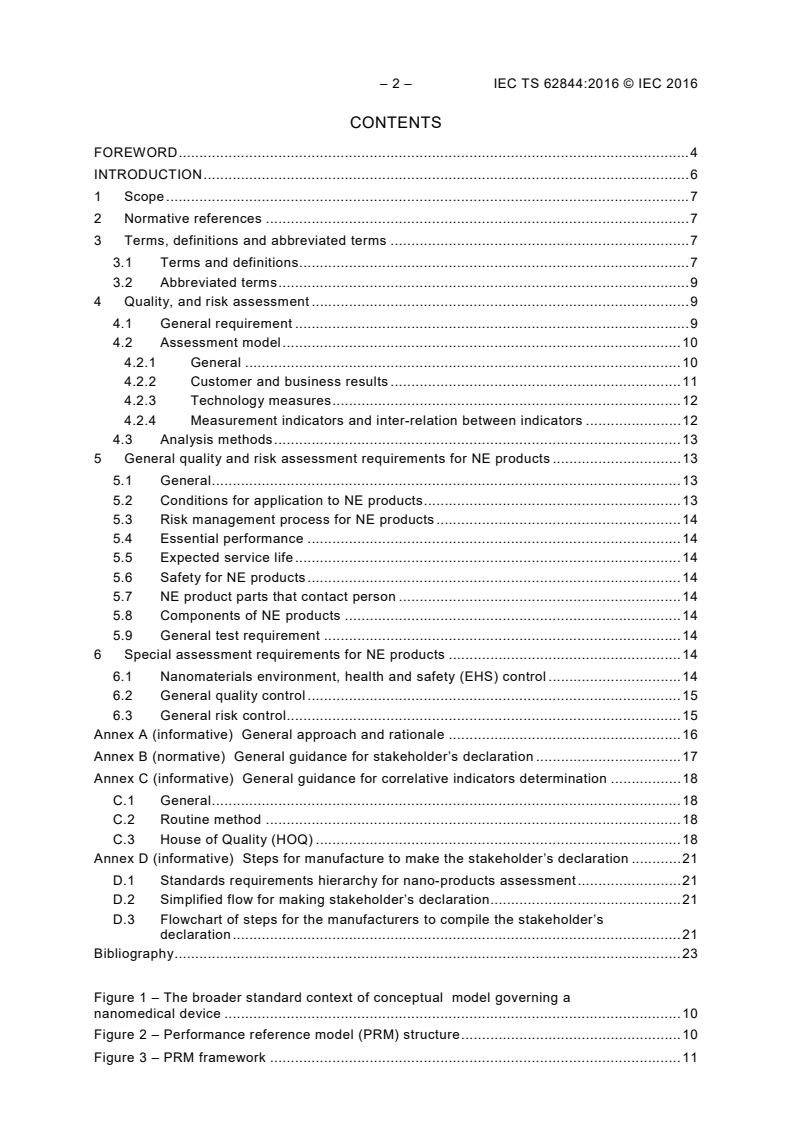
CONTENTS
FOREWORD . 4
INTRODUCTION . 6
1 Scope . 7
2 Normative references . 7
3 Terms, definitions and abbreviated terms . 7
3.1 Terms and definitions . 7
3.2 Abbreviated terms . 9
4 Quality, and risk assessment . 9
4.1 General requirement . 9
4.2 Assessment model . 10
4.2.1 General . 10
4.2.2 Customer and business results . 11
4.2.3 Technology measures . 12
4.2.4 Measurement indicators and inter-relation between indicators . 12
4.3 Analysis methods . 13
5 General quality and risk assessment requirements for NE products . 13
5.1 General . 13
5.2 Conditions for application to NE products . 13
5.3 Risk management process for NE products . 14
5.4 Essential performance . 14
5.5 Expected service life . 14
5.6 Safety for NE products . 14
5.7 NE product parts that contact person . 14
5.8 Components of NE products . 14
5.9 General test requirement . 14
6 Special assessment requirements for NE products . 14
6.1 Nanomaterials environment, health and safety (EHS) control . 14
6.2 General quality control . 15
6.3 General risk control . 15
Annex A (informative) General approach and rationale . 16
Annex B (normative) General guidance for stakeholder’s declaration . 17
Annex C (informative) General guidance for correlative indicators determination . 18
C.1 General . 18
C.2 Routine method . 18
C.3 House of Quality (HOQ) . 18
Annex D (informative) Steps for manufacture to make the stakeholder’s declaration . 21
D.1 Standards requirements hierarchy for nano-products assessment . 21
D.2 Simplified flow for making stakeholder’s declaration . 21
D.3 Flowchart of steps for the manufacturers to compile the stakeholder’s
declaration . 21
Bibliography . 23
Figure 1 – The broader standard context of conceptual model governing a
nanomedical device . 10
Figure 2 – Performance reference model (PRM) structure . 10
Figure 3 – PRM framework . 11
Figure 4 – Measurement groups for measurement categories . 11
Figure C.1 – HOQ matrix structures . 19
Figure C.2 – Cascaded HOQ . 20
Figure C.3 – HOQ structure based on the proposed PRM model . 20
Figure D.1 – Standards requirements hierarchy for nano-products assessment. 21
Figure D.2 – Simplified flow for compiling the stakeholder’s declaration . 21
Figure D.3 – Flowchart to compile the stakeholder’s declaration . 22
Table 1 – The relation between measurement indicators of customer and business
results and technology indicators . 13
Table A.1 – Rationale related to specific clauses in this document . 16
Table B.1 – Special requirements declaration form for the CNT-coated touch panel . 17
Table C.1 – Indicators relation example for CNT . 18
– 4 – IEC TS 62844:2016 © IEC 2016
INTERNATIONAL ELECTROTECHNICAL COMMISSION
____________
GUIDELINES FOR QUALITY AND RISK ASSESSMENT
FOR NANO-ENABLED ELECTROTECHNICAL PRODUCTS
FOREWORD
1) The International Electrotechnical Commission (IEC) is a worldwide organization for standardization comprising
all national electrotechnical committees (IEC National Committees). The object of IEC is to promote
international co-operation on all questions concerning standardization in the electrical and electronic fields. To
this end and in addition to other activities, IEC publishes International Standards, Technical Specifications,
Technical Reports, Publicly Available Specifications (PAS) and Guides (hereafter referred to as “IEC
Publication(s)”). Their preparation is entrusted to technical committees; any IEC National Committee interested
in the subject dealt with may participate in this preparatory work. International, governmental and non-
governmental organizations liaising with the IEC also participate in this preparation. IEC collaborates closely
with the International Organization for Standardization (ISO) in accordance with conditions determined by
agreement between the two organizations.
2) The formal decisions or agreements of IEC on technical matters express, as nearly as possible, an international
consensus of opinion on the relevant subjects since each technical committee has representation from all
interested IEC National Committees.
3) IEC Publications have the form of recommendations for international use and are accepted by IEC National
Committees in that sense. While all reasonable efforts are made to ensure that the technical content of IEC
Publications is accurate, IEC cannot be held responsible for the way in which they are used or for any
misinterpretation by any end user.
4) In order to promote international uniformity, IEC National Committees undertake to apply IEC Publications
transparently to the maximum extent possible in their national and regional publications. Any divergence
between any IEC Publication and the corresponding national or regional publication shall be clearly indicated in
the latter.
5) IEC itself does not provide any attestation of conformity. Independent certification bodies provide conformity
assessment services and, in some areas, access to IEC marks of conformity. IEC is not responsible for any
services carried out by independent certification bodies.
6) All users should ensure that they have the latest edition of this publication.
7) No liability shall attach to IEC or its directors, employees, servants or agents including individual experts and
members of its technical committees and IEC National Committees for any personal injury, property damage or
other damage of any nature whatsoever, whether direct or indirect, or for costs (including legal fees) and
expenses arising out of the publication, use of, or reliance upon, this IEC Publication or any other IEC
Publications.
8) Attention is drawn to the Normative references cited in this publication. Use of the referenced publications is
indispensable for the correct application of this publication.
9) Attention is drawn to the possibility that some of the elements of this IEC Publication may be the subject of
patent rights. IEC shall not be held responsible for identifying any or all such patent rights.
The main task of IEC technical committees is to prepare International Standards. In
exceptional circumstances, a technical committee may propose the publication of a Technical
Specification when
• the required support cannot be obtained for the publication of an International Standard,
despite repeated efforts, or
• the subject is still under technical development or where, for any other reason, there is the
future but no immediate possibility of an agreement on an International Standard.
Technical Specifications are subject to review within three years of publication to decide
whether they can be transformed into International Standards.
IEC TS 62844, which is a Technical Specification, has been prepared by IEC technical
committee 113: Nanotechnology for electrotechnical products and systems.
The text of this Technical Specification is based on the following documents:
Enquiry draft Report on voting
113/227/DTS 113/343/RVC
Full information on the voting for the approval of this Technical Specification can be found in
the report on voting indicated in the above table.
This publication has been drafted in accordance with the ISO/IEC Directives, Part 2.
The committee has decided that the contents of this publication will remain unchanged until
the stability date indicated on the IEC website under "http://webstore.iec.ch" in the data
related to the specific publication. At this date, the publication will be
• transformed into an International Standard,
• reconfirmed,
• withdrawn,
• replaced by a revised edition, or
• amended.
A bilingual version of this publication may be issued at a later date.
IMPORTANT – The 'colour inside' logo on the cover page of this publication indicates
that it contains colours which are considered to be useful for the correct
understanding of its contents. Users should therefore print this document using a
colour printer.
– 6 – IEC TS 62844:2016 © IEC 2016
INTRODUCTION
The nanoindustry is dealing with highly innovative technologies and products. For the
purposes of assuring their performance and assessing the risks, a reliable quality,
environmental, occupational health and safety management system for nanoindustrial
companies and consumers is needed. The monitoring and measuring of all relevant
parameters of nanomaterials and consequently identifying nonconformities in the products
containing them and associated hazards are not straightforward. A systematic and practical
assessment methodology for its implementation in industrial mass production is needed to
simplify the monitoring processes and ensure both the quality of the products and the
conformance of the products to health, occupational and environmental standards.
Quality needs to be defined firstly in terms of parameters or characteristics, relevant for the
application, which vary from product to product. However, it is not trivial to identify the
relevant characteristics and effectively apply these parameters for the application. The same
is true for the identification of environmental and health and safety aspects, as demanded, for
example, by ISO 14001 [1] for environmental aspects.
This document uses a reference model to provide a high level frame work, but not any details
of EHS management aspects, for the identification and development of the stakeholders’
needs, from the relationship of inputs such as technology measures, to outputs such as
customer and business results. It is intended as a nanotechnology management guideline, not
for details of EHS practices. However, it encourages users to adopt the necessary known
EHS practices, and consider special requirements for nanotechnology. It also facilitates
communication among all stakeholders. Further, it can be used to develop more specialized
standards to support specific scenarios. The goal of this document is to specify general
considerations and requirements for the assessment of quality and risk associated with nano-
enabled electrotechnical products and serve as the basis for developing particular product
specific standards.
_____________
Numbers in square brackets refer to the Bibliography.
GUIDELINES FOR QUALITY AND RISK ASSESSMENT
FOR NANO-ENABLED ELECTROTECHNICAL PRODUCTS
1 Scope
This document provides a recommended methodology for identifying relevant parameters of
nanomaterials as well as providing generic guidelines on implementation of quality
assessment and environment/health/safety assessment for nano-enabled/nano-enhanced
electrotechnical products.
2 Normative references
The following documents are referred to in the text in such a way that some or all of their
content constitutes requirements of this document. For dated references, only the edition
cited applies. For undated references, the latest edition of the referenced document (including
any amendments) applies.
ISO 31000:2009, Risk management – Principles and guidelines on implementation
3 Terms, definitions and abbreviated terms
3.1 Terms and definitions
For the purposes of this document, the following terms and definitions apply.
ISO and IEC maintain terminological databases for use in standardization at the following
addresses:
• IEC Electropedia: available at http://www.electropedia.org/
• ISO Online browsing platform: available at http://www.iso.org/obp
3.1.1
nanoscale
length range from approximately 1 nm to 100 nm
[SOURCE: ISO/TS 80004-1:2015 [2], 2.1]
3.1.2
nanomaterial
material with any external dimension in the nanoscale or having internal structure or surface
structure in the nanoscale
[SOURCE: ISO/TS 80004-1:2015, 2.4]
3.1.3
nano-object
material with one, two or three external dimensions in the nanoscale
[SOURCE: ISO/TS 27687:2008 [7], 2.2]
– 8 – IEC TS 62844:2016 © IEC 2016
3.1.4
nanostructured material
material having internal nanostructure or surface nanostructure
[SOURCE: ISO/TS 80004-1:2015, 2.7]
3.1.5
nanoparticle
nano-object with all three external dimensions in the nanoscale
[SOURCE: ISO/TS 27687:2008, 4.1]
3.1.6
nanoplate
nano-object with one external dimension in the nanoscale and the two other external
dimensions significantly larger
[SOURCE: ISO/TS 27687:2008, 4.2]
3.1.7
nanofibre
nano-object with two similar external dimensions in the nanoscale and the third dimension
significantly larger
[SOURCE: ISO/TS 27687:2008, 4.3]
3.1.8
nano-enabled
exhibiting function or performance only possible with nanotechnology
[SOURCE: ISO/TS 80004-1:2015, 2.15]
3.1.9
nano-enhanced
exhibiting function or performance intensified or improved by nanotechnology
[SOURCE: ISO/TS 80004-1:2015, 2.16]
3.1.10
organization
person or group of people that has its own functions with responsibilities, authorities and
relationships to achieve its objectives
Note 1 to entry: The concept of organization includes, but is not limited to sole-trader, company, corporation, firm,
enterprise, authority, partnership, charity or institution, or part or combination thereof, whether incorporated or not,
public or private.
[SOURCE: ISO 14001:2015, 3.1.4]
3.1.11
environment
surroundings in which an organization operates, including air, water, land, natural resources,
flora, fauna, humans, and their interrelationships
[SOURCE: ISO 14001:2015, 3.2.1]
3.1.12
environmental aspect
element of an organization’s activities or products or services that interacts or can interact
with the environment.
[SOURCE: ISO 14001:2015, 3.2.2]
3.1.13
environmental impact
change to the environment, whether adverse or beneficial, wholly or partially resulting from an
organization’s environmental aspects
[SOURCE: ISO 14001:2015, 3.2.4]
3.1.14
stakeholder
individual or group that has an interest in any decision or activity of an organization
[SOURCE: ISO 26000:2010 [4], 2.20]
3.1.15
reference model
conceptual framework for understanding significant relationships among the entities of some
environment, and for the development of consistent standards or specifications supporting
that environment
Note 1 to entry: As outlined in OASIS (Organization for the Advancement of Structured Information Standards).
https://www.oasis-open.org/committees/soa-rm/faq.php.
3.2 Abbreviated terms
CNT carbon nanotube
EHS environment, health and safety
HOQ House of Quality (method)
NE (product) nano-enabled/nano-enhanced electrotechnical (product)
PRM performance reference model
QFD quality function deployment
4 Quality, and risk assessment
4.1 General requirement
Quality and risk assessments require an appropriate framework in order to offer some
guidelines for selecting the most suitable and relevant functions and features of a particular
nano-product to be developed. A reference model, a conceptual framework which provides
high-level specification of a system architecture, is a suitable assessment model for the broad
spectrum of the potential nano-products. The proposed conceptual quality and risk
frameworks should be consistent with ISO 9001 [5] and ISO 31000. For specific product areas,
it should also be consistent with any existing product standard category. Figure 1 shows an
example of the conceptual model governing a nanomedical device. It indicates how a broader
standard context of conceptual model can be used in order to satisfy quality, risk and
performance requirements.
– 10 – IEC TS 62844:2016 © IEC 2016
Quality management
(ISO 9001)
Risk management
(ISO 31000)
Medical devices
(IEC 60601)
Reference model
for
nano-products
assessment
IEC
Figure 1 – The broader standard context of conceptual
model governing a nanomedical device
4.2 Assessment model
4.2.1 General
The proposed reference model is a simplifed performance reference model (PRM) [6].The
PRM is a framework for performance measurement providing common output measurements
for nano-products. The PRM structure is designed to clearly express the cause-and-effect
relationship between inputs and outputs. This PRM is articulated through the use of the
measurement area, category, grouping and indicator hierarchy. It reflects how value is
created as inputs (such as technology measures) and used to create outputs (such as
customer and business results). Figure 2 shows the PRM structure. Figure 3 shows the PRM
framework for NE products.
Measurement
area
Measurement
category
Measurement
grouping
Measurement
indicator
IEC
Figure 2 – Performance reference model (PRM) structure
Customer and
Measurement area
OUTPUTS: Results
business results
measured from
• Nanomaterials EHS control
customer and business
Measurement category
• General quality control
perspectives
• General risk control
Technology
Measurement area
INPUTS: Key control
measured through
• Nano-enabled performance their contribution to
Measurement category
• General performance outcomes
• Management
IEC
Figure 3 – PRM framework
The PRM in turn, is structured around measurement areas, measurement categories,
measurement groupings and measurement indicators as shown in Figure 2.
• Measurement areas – The high-level organizing framework of the PRM capturing aspects
of performance at the output levels. The PRM includes two measurement areas: customer
and business results and technology measures.
• Measurement categories – Collections within each measurement area describing the
attribute or characteristic to be measured. For example, the technology measurement area
includes three measurement categories: nano-enabled performance, general performance,
management.
• Measurement groupings – Further refinement of categories into specific types of
measurement indicators: nano-characteristics, processes, etc. Figure 4 shows the
measurement groups for measurement categories.
• Measurement indicators – The specific measures.
Technology Customer and
measures business results
Nano-enabled
General Nano-materials General quality General risk
Management
performance
performance EHS control control control
Grade of product Mitigate risks
Nano-enabled Environmental Potential hazardous
Raw materials
functionality conditions materials
Plan for
Safety Reliability
Policies
Nano- Processes emergencies
characteristics
Suppliers and
Supply chain
Machines
workers
Information and
Products
knowledge
interoperability
IEC IEC
Figure 4 – Measurement groups for measurement categories
4.2.2 Customer and business results
The customer and business results measurement area of the PRM captures the outputs that
stakeholders seek to achieve. These outputs are usually developed during the stakehoder
strategic and long-term planning process prescribed under various objectives consideration.
This measurement area identifies the extent to which those objectives are being achieved.
The customer and business results measurement area is comprised of the following
measurement categories:
– 12 – IEC TS 62844:2016 © IEC 2016
• nanomaterials EHS control;
• general quality control;
• general risk control.
4.2.3 Technology measures
The technology measurement area captures key elements of performance directly relating to
the NE products. The technology measurement categories and groupings will depend on the
stakeholder’s NE product and life-cycle development processes. However,
...