

IEC 62005-9-2:2007
(Main)Reliability of fibre optic interconnecting devices and passive optical components - Part 9-2: Reliability qualification for single fibre optic connector sets - Single mode
General Information
- Abstract
Applies to fibre optic connector sets and contains the minimum test and measurement requirements and severities which a fibre optic connector set shall satisfy in order to be qualified as meeting the requirements for reliability qualification of singlemode fibre optic connectors with single fibre cylindrical ferrule PC polished as defined in the IEC 61754 series and used in controlled and uncontrolled environments (categories C and U) as defined in IEC 61753-1.
- Status
- Published
- Publication Date
- 22-May-2007
- Technical Committee
- SC 86B - Fibre optic interconnecting devices and passive components
- Drafting Committee
- WG 5 - TC 86/SC 86B/WG 5
- Current Stage
- PPUB - Publication issued
- Start Date
- 23-May-2007
- Completion Date
- 31-Jul-2007
Buy Documents
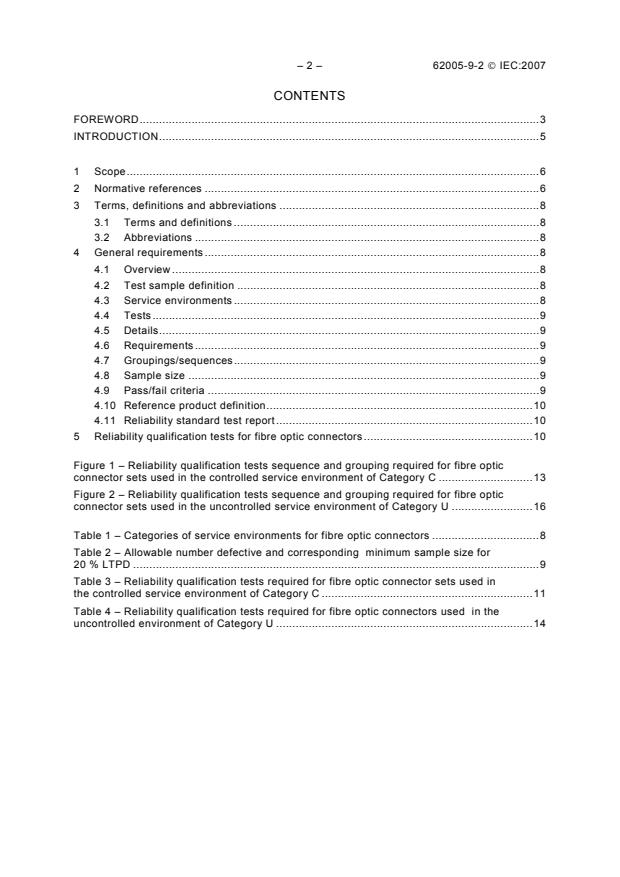
IEC 62005-9-2:2007 - Reliability of fibre optic interconnecting devices and passive optical components - Part 9-2: Reliability qualification for single fibre optic connector sets - Single mode Released:5/23/2007
Overview
IEC 62005-9-2:2007 specifies the requirements for reliability qualification of single fibre optic connector sets designed for singlemode optical fibres. This international standard, published by the International Electrotechnical Commission (IEC), establishes minimum test and measurement criteria to ensure that fibre optic connectors with single fibre cylindrical ferrule and PC polished endfaces are suitable for use in both controlled (Category C) and uncontrolled (Category U) environments. The standard’s procedures ensure consistent optical and mechanical performance under prescribed conditions, supporting quality assurance for fibre optic interconnections in demanding applications.
Key Topics
- Reliability Qualification: Outlines clear test protocols to qualify fibre optic connector sets for reliability using singlemode fibres, as defined by IEC 61754 and IEC 61753-1.
- Test Methods and Pass/Fail Criteria: Lists and describes the testing sequence, sample sizes, and performance requirements necessary for product qualification.
- Service Environment Categories: Distinguishes requirements for connectors operating in controlled environments (such as offices) and uncontrolled environments (such as outdoor or industrial settings).
- Reporting and Compliance: Details requirements for thorough test reporting, defect management, and the handling of design or process changes affecting connector reliability.
- Non-Angled PC Polished Connectors: Focuses specifically on single fibre connectors with non-angled physical contact (PC) polish, supporting industry practices for high-performance, singlemode optical connectivity.
Applications
The guidance and requirements of IEC 62005-9-2:2007 apply to single fibre optic connector sets in a variety of high-reliability singlemode optical fibre installations, including:
- Telecommunications Networks: Ensuring connectors meet reliability standards in central offices, outside plant, and other critical network infrastructure.
- Data Centers and Enterprise Cabling: Supporting the high-performance needs of data transmission in controlled indoor environments.
- Industrial Automation: Qualifying connectors for use in factories and harsh, uncontrolled environments where temperature, humidity, and physical stress are significant.
- Broadcast and Multimedia Systems: Guaranteeing consistent, low-attenuation connections across long-term service periods.
- Measurement and Laboratory Settings: Providing a standardized basis for connector interoperability, repeatability, and trustworthiness in precision test environments.
By adhering to this standard, manufacturers and system integrators can ensure that singlemode fibre optic connector sets deliver the mechanical and optical reliability necessary for critical applications, while network operators can confidently specify and deploy compliant connectors for long-term performance.
Related Standards
IEC 62005-9-2:2007 references several closely related standards and test procedures, including:
- IEC 61753-1: General guidance on environmental and performance standards for fibre optic interconnecting devices and passive optical components.
- IEC 61754 (all parts): Defines interfaces for fibre optic connectors.
- IEC 61300 Series: Basic test and measurement procedures for fibre optic interconnecting devices and passive components.
- IEC 60793-1: Optical fibres – Measurement methods and test procedures.
- IEC 62005-1: Introductory guide and definitions for reliability of fibre optic interconnecting devices.
- IEC 62005-4: Product screening requirements for fibre optic interconnecting devices.
These standards, when used in conjunction with IEC 62005-9-2, support industry-wide interoperability, performance consistency, and confidence in the long-term reliability of fibre optic connectors deployed in diverse settings.
Practical Value
Adopting IEC 62005-9-2:2007 enables manufacturers and users to:
- Standardize Product Qualification: Benefit from a clear, internationally recognized baseline for testing and qualifying connector reliability.
- Reduce Failure Risks: Minimize connector-related system failures in critical network environments through rigorous, repeatable testing.
- Enhance Quality Assurance: Streamline quality audit processes and regulatory compliance with comprehensive documentation and transparent criteria.
- Futureproof Installations: Ensure fibre optic infrastructures are robust and suitable for evolving operational requirements and environments.
For organizations seeking to deliver or specify dependable singlemode fibre optic connectivity, compliance with IEC 62005-9-2:2007 is an essential element of a robust product quality and reliability strategy.
Relations
- Effective Date
- 05-Sep-2023
Buy Documents
IEC 62005-9-2:2007 - Reliability of fibre optic interconnecting devices and passive optical components - Part 9-2: Reliability qualification for single fibre optic connector sets - Single mode Released:5/23/2007
Get Certified
Connect with accredited certification bodies for this standard

ANCE
Mexican certification and testing association.

Intertek Slovenia
Intertek testing, inspection, and certification services in Slovenia.

LNE (Laboratoire National de Métrologie et d'Essais)
French national laboratory for metrology and testing.
Sponsored listings
Frequently Asked Questions
IEC 62005-9-2:2007 is a standard published by the International Electrotechnical Commission (IEC). Its full title is "Reliability of fibre optic interconnecting devices and passive optical components - Part 9-2: Reliability qualification for single fibre optic connector sets - Single mode". This standard covers: Applies to fibre optic connector sets and contains the minimum test and measurement requirements and severities which a fibre optic connector set shall satisfy in order to be qualified as meeting the requirements for reliability qualification of singlemode fibre optic connectors with single fibre cylindrical ferrule PC polished as defined in the IEC 61754 series and used in controlled and uncontrolled environments (categories C and U) as defined in IEC 61753-1.
Applies to fibre optic connector sets and contains the minimum test and measurement requirements and severities which a fibre optic connector set shall satisfy in order to be qualified as meeting the requirements for reliability qualification of singlemode fibre optic connectors with single fibre cylindrical ferrule PC polished as defined in the IEC 61754 series and used in controlled and uncontrolled environments (categories C and U) as defined in IEC 61753-1.
IEC 62005-9-2:2007 is classified under the following ICS (International Classification for Standards) categories: 01 - GENERALITIES. TERMINOLOGY. STANDARDIZATION. DOCUMENTATION; 21.020 - Characteristics and design of machines, apparatus, equipment; 33.180.10 - Fibres and cables. The ICS classification helps identify the subject area and facilitates finding related standards.
IEC 62005-9-2:2007 has the following relationships with other standards: It is inter standard links to IEC PAS 62005-9-2:2003. Understanding these relationships helps ensure you are using the most current and applicable version of the standard.
IEC 62005-9-2:2007 is available in PDF format for immediate download after purchase. The document can be added to your cart and obtained through the secure checkout process. Digital delivery ensures instant access to the complete standard document.
Standards Content (Sample)
INTERNATIONAL IEC
STANDARD
CEI
62005-9-2
NORME
First edition
INTERNATIONALE
Première édition
2007-05
Reliability of fibre optic interconnecting devices
and passive optical components –
Part 9-2:
Reliability qualification for single fibre
optic connector sets –
Single mode
Fiabilité des dispositifs d’interconnexion et des
composants optiques passifs à fibres optiques –
Partie 9-2:
Qualification relative à la fiabilité
pour les ensembles de connecteurs
à une seule fibre optique –
Unimodal
Reference number
Numéro de référence
IEC/CEI 62005-9-2:2007
All rights reserved. Unless otherwise specified, no part of this publication may be reproduced or utilized in any form
or by any means, electronic or mechanical, including photocopying and microfilm, without permission in writing from
either IEC or IEC's member National Committee in the country of the requester.
If you have any questions about IEC copyright or have an enquiry about obtaining additional rights to this publication,
please contact the address below or your local IEC member National Committee for further information.
Droits de reproduction réservés. Sauf indication contraire, aucune partie de cette publication ne peut être reproduite
ni utilisée sous quelque forme que ce soit et par aucun procédé, électronique ou mécanique, y compris la photocopie
et les microfilms, sans l'accord écrit de la CEI ou du Comité national de la CEI du pays du demandeur.
Si vous avez des questions sur le copyright de la CEI ou si vous désirez obtenir des droits supplémentaires sur cette
publication, utilisez les coordonnées ci-après ou contactez le Comité national de la CEI de votre pays de résidence.
IEC Central Office
3, rue de Varembé
CH-1211 Geneva 20
Switzerland
Email: inmail@iec.ch
Web: www.iec.ch
About the IEC
The International Electrotechnical Commission (IEC) is the leading global organization that prepares and publishes
International Standards for all electrical, electronic and related technologies.
About IEC publications
The technical content of IEC publications is kept under constant review by the IEC. Please make sure that you have the
latest edition, a corrigenda or an amendment might have been published.
ƒ Catalogue of IEC publications: www.iec.ch/searchpub
The IEC on-line Catalogue enables you to search by a variety of criteria (reference number, text, technical committee,…).
It also gives information on projects, withdrawn and replaced publications.
ƒ IEC Just Published: www.iec.ch/online_news/justpub
Stay up to date on all new IEC publications. Just Published details twice a month all new publications released. Available
on-line and also by email.
ƒ Customer Service Centre: www.iec.ch/webstore/custserv
If you wish to give us your feedback on this publication or need further assistance, please visit the Customer Service
Centre FAQ or contact us:
Email: csc@iec.ch
Tel.: +41 22 919 02 11
Fax: +41 22 919 03 00
A propos de la CEI
La Commission Electrotechnique Internationale (CEI) est la première organisation mondiale qui élabore et publie des
normes internationales pour tout ce qui a trait à l'électricité, à l'électronique et aux technologies apparentées.
A propos des publications CEI
Le contenu technique des publications de la CEI est constamment revu. Veuillez vous assurer que vous possédez
l’édition la plus récente, un corrigendum ou amendement peut avoir été publié.
ƒ Catalogue des publications de la CEI: www.iec.ch/searchpub/cur_fut-f.htm
Le Catalogue en-ligne de la CEI vous permet d’effectuer des recherches en utilisant différents critères (numéro de
référence, texte, comité d’études,…). Il donne aussi des informations sur les projets et les publications retirées ou
remplacées.
ƒ Just Published CEI: www.iec.ch/online_news/justpub
Restez informé sur les nouvelles publications de la CEI. Just Published détaille deux fois par mois les nouvelles
publications parues. Disponible en-ligne et aussi par email.
ƒ Service Clients: www.iec.ch/webstore/custserv/custserv_entry-f.htm
Si vous désirez nous donner des commentaires sur cette publication ou si vous avez des questions, visitez le FAQ du
Service clients ou contactez-nous:
Email: csc@iec.ch
Tél.: +41 22 919 02 11
Fax: +41 22 919 03 00
INTERNATIONAL IEC
STANDARD
CEI
62005-9-2
NORME
First edition
INTERNATIONALE
Première édition
2007-05
Reliability of fibre optic interconnecting devices
and passive optical components –
Part 9-2:
Reliability qualification for single fibre
optic connector sets –
Single mode
Fiabilité des dispositifs d’interconnexion et des
composants optiques passifs à fibres optiques –
Partie 9-2:
Qualification relative à la fiabilité
pour les ensembles de connecteurs
à une seule fibre optique –
Unimodal
PRICE CODE
P
CODE PRIX
Commission Electrotechnique Internationale
International Electrotechnical Commission
МеждународнаяЭлектротехническаяКомиссия
For price, see current catalogue
Pour prix, voir catalogue en vigueur
– 2 – 62005-9-2 © IEC:2007
CONTENTS
FOREWORD.3
INTRODUCTION.5
1 Scope.6
2 Normative references .6
3 Terms, definitions and abbreviations .8
3.1 Terms and definitions .8
3.2 Abbreviations .8
4 General requirements .8
4.1 Overview .8
4.2 Test sample definition .8
4.3 Service environments .8
4.4 Tests.9
4.5 Details.9
4.6 Requirements.9
4.7 Groupings/sequences.9
4.8 Sample size .9
4.9 Pass/fail criteria .9
4.10 Reference product definition.10
4.11 Reliability standard test report.10
5 Reliability qualification tests for fibre optic connectors .10
Figure 1 – Reliability qualification tests sequence and grouping required for fibre optic
connector sets used in the controlled service environment of Category C .13
Figure 2 – Reliability qualification tests sequence and grouping required for fibre optic
connector sets used in the uncontrolled service environment of Category U .16
Table 1 – Categories of service environments for fibre optic connectors .8
Table 2 – Allowable number defective and corresponding minimum sample size for
20 % LTPD .9
Table 3 – Reliability qualification tests required for fibre optic connector sets used in
the controlled service environment of Category C .11
Table 4 – Reliability qualification tests required for fibre optic connectors used in the
uncontrolled environment of Category U .14
62005-9-2 © IEC:2007 – 3 –
INTERNATIONAL ELECTROTECHNICAL COMMISSION
____________
RELIABILITY OF FIBRE OPTIC INTERCONNECTING DEVICES
AND PASSIVE OPTICAL COMPONENTS –
Part 9-2: Reliability qualification for single fibre optic connector sets –
Single mode
FOREWORD
1) The International Electrotechnical Commission (IEC) is a worldwide organization for standardization comprising
all national electrotechnical committees (IEC National Committees). The object of IEC is to promote
international co-operation on all questions concerning standardization in the electrical and electronic fields. To
this end and in addition to other activities, IEC publishes International Standards, Technical Specifications,
Technical Reports, Publicly Available Specifications (PAS) and Guides (hereafter referred to as “IEC
Publication(s)”). Their preparation is entrusted to technical committees; any IEC National Committee interested
in the subject dealt with may participate in this preparatory work. International, governmental and non-
governmental organizations liaising with the IEC also participate in this preparation. IEC collaborates closely
with the International Organization for Standardization (ISO) in accordance with conditions determined by
agreement between the two organizations.
2) The formal decisions or agreements of IEC on technical matters express, as nearly as possible, an international
consensus of opinion on the relevant subjects since each technical committee has representation from all
interested IEC National Committees.
3) IEC Publications have the form of recommendations for international use and are accepted by IEC National
Committees in that sense. While all reasonable efforts are made to ensure that the technical content of IEC
Publications is accurate, IEC cannot be held responsible for the way in which they are used or for any
misinterpretation by any end user.
4) In order to promote international uniformity, IEC National Committees undertake to apply IEC Publications
transparently to the maximum extent possible in their national and regional publications. Any divergence
between any IEC Publication and the corresponding national or regional publication shall be clearly indicated in
the latter.
5) IEC provides no marking procedure to indicate its approval and cannot be rendered responsible for any
equipment declared to be in conformity with an IEC Publication.
6) All users should ensure that they have the latest edition of this publication.
7) No liability shall attach to IEC or its directors, employees, servants or agents including individual experts and
members of its technical committees and IEC National Committees for any personal injury, property damage or
other damage of any nature whatsoever, whether direct or indirect, or for costs (including legal fees) and
expenses arising out of the publication, use of, or reliance upon, this IEC Publication or any other IEC
Publications.
8) Attention is drawn to the Normative references cited in this publication. Use of the referenced publications is
indispensable for the correct application of this publication.
9) Attention is drawn to the possibility that some of the elements of this IEC Publication may be the subject of
patent rights. IEC shall not be held responsible for identifying any or all such patent rights.
International Standard IEC 62005-9-2 has been prepared by subcommittee 86B: Fibre optic
interconnecting devices and passive components, of IEC technical committee 86: Fibre optics.
This standard cancels and replaces IEC/PAS 62005-9-2, published in 2003. This first edition
constitutes a technical revision.
– 4 – 62005-9-2 © IEC:2007
The text of this standard is based on the following documents:
FDIS Report on voting
86B/2495/FDIS 86B/2536/RVD
Full information on the voting for the approval of this standard can be found in the report on
voting indicated in the above table.
This publication has been drafted in accordance with the ISO/IEC Directives, Part 2.
A list of all parts of the IEC 62005 series, published under the general title Reliability of fibre
optic interconnecting devices and passive optical components, can be found on the IEC
website.
The committee has decided that the contents of this publication will remain unchanged until
the maintenance result date indicated on the IEC web site under "http://webstore.iec.ch" in
the data related to the specific publication. At this date, the publication will be
• reconfirmed,
• withdrawn,
• replaced by a revised edition, or
• amended.
62005-9-2 © IEC:2007 – 5 –
INTRODUCTION
Both performance qualification standards and reliability qualification standards (RQS) define a
set of prescribed conditions and contain a series or a set of tests and measurements (which
may or may not be grouped into a specific schedule) with clearly defined conditions, severities
and pass/fail criteria. The tests are intended to be run on a ‘once-off’ basis to prove the
product’s ability to satisfy the performance or reliability requirements of a specific application,
market sector or user group.
The remaining parts of this series contain those sets of reliability criteria that have been
standardized for international use. A product that has been shown to meet all the
requirements of a reliability standard may be declared as complying with that reliability
standard.
It is recognised that component reliability qualification could be accomplished in alternative
ways. The procedures in this standard are a baseline, but other qualification methods could
prove to be more cost-effective. Alternative methods may be included in future revisions of
this standard if they are demonstrated to be effectively equivalent to the baseline procedures.
Compliance with an RQS demonstrates that a product has met its optical and mechanical
performance over the duration of the applied test programs. Consistency of manufacture
should be maintained using a recognized Quality Assurance program.
– 6 – 62005-9-2 © IEC:2007
RELIABILITY OF FIBRE OPTIC INTERCONNECTING DEVICES
AND PASSIVE OPTICAL COMPONENTS –
Part 9-2: Reliability qualification for single fibre optic connector sets –
Single mode
1 Scope
This part of IEC 62005 applies to fibre optic connector sets and contains the minimum test
and measurement requirements and severities which a fibre optic connector set shall satisfy
in order to be qualified as meeting the requirements for reliability qualification of singlemode
fibre optic connectors with single fibre cylindrical ferrule PC polished as defined in the
IEC 61754 series and used in controlled and uncontrolled environments (categories C and U)
as defined in IEC 61753-1.
2 Normative references
The following referenced documents are indispensable for the application of this document.
For dated references, only the edition cited applies. For undated references, the latest edition
of the referenced document (including any amendments) applies.
IEC 60793-1, Optical fibres – Measurement methods and test procedures –
IEC 61300 (all parts), Fibre optic interconnecting devices and passive components – Basic
test and measurement procedures
IEC 61300-2-1, Fibre optic interconnecting devices and passive components – Basic test and
measurement procedures – Part 2-1: Tests – Vibration (sinusoidal)
IEC 61300-2-2, Fibre optic interconnecting devices and passive components – Basic test and
measurement procedures – Part 2-2: Tests – Mating durability
IEC 61300-2-4, Fibre optic interconnecting devices and passive components – Basic test and
measurement procedures – Part 2-4: Tests – Fibre/cable retention
IEC 61300-2-6, Fibre optic interconnecting devices and passive components – Basic test and
measurement procedures – Part 2-6 Tests – Tensile strength of coupling mechanism
IEC 61300-2-18, Fibre optic interconnecting devices and passive components – Basic test
and measurement procedures – Part 2-18: Tests – Dry heat – High temperature endurance
IEC 61300-2-19, Fibre optic interconnecting devices and passive components – Basic test
and measurement procedures – Part 2-19: Tests – Damp heat (steady state)
62005-9-2 © IEC:2007 – 7 –
IEC 61300-2-22, Fibre optic interconnecting devices and passive components – Basic test
and measurement procedures – Part 2-22: Tests – Change of temperature
IEC 61300-3-3, Fibre optic interconnecting devices and passive components – Basic test and
measurement procedures – Part 3-3: Examinations and measurements – Active monitoring of
changes in attenuation and return loss
IEC 61300-3-4, Fibre optic interconnecting devices and passive components – Basic test and
measurement procedures – Part 3-4: Examinations and measurements – Attenuation
IEC 61300-3-6, Fibre optic interconnecting devices and passive components – Basic test and
measurement procedures – Part 3-6: Examinations and measurements – Return loss
IEC 61300-3-15, Fibre optic interconnecting devices and passive components – Basic test
and measurement procedures – Part 3-15: Measurements – Dome eccentricity of a convex
polished ferrule endface
IEC 61300-3-16, Fibre optic interconnecting devices and passive components – Basic test
and measurement procedures – Part 3-16: Examinations and measurements – Endface radius
of spherically polished ferrules
IEC 61300-3-23, Fibre optic interconnecting devices and passive components – Basic test
and measurement procedures – Part 3-23: Examinations and measurements – Fibre position
relative to ferrule endface
IEC 61300-3-34, Fibre optic interconnecting devices and passive components – Basic test
and measurement procedures Part 3-34: Examinations and measurements – Attenuation of
random mated connectors
IEC 61753-1, Fibre optic interconnecting devices and passive components performance standard –
)
Part 1: General and guidance for performance standards
IEC 61754 (all parts), Fibre optic connector interfaces
IEC 61755-1, Fibre optic connector optical interfaces – Part 1: Optical interfaces for single
mode non-dispersion shifted fibres – General and guidance
IEC 61755-3-1, Fibre optic connector optical interfaces – Part 3-1: Optical interface, 2,5 mm
and 1,25 mm diameter cylindrical full zirconia PC ferrule, single mode fibre
IEC 61755-3-5, Fibre optic connector optical interfaces – Part 3-5: Optical interface – 2,5 mm
and 1,25 mm diameter cylindrical PC composite ferrule using Cu-Ni-alloy as fibre surrounding
material, single mode fibre
IEC 61931, Fibre optic – Terminology
IEC 62005-1, Reliability of fibre optic interconnecting devices and passive components –
Part 1: Introductory guide and definitions
IEC 62005-4, Reliability of fibre optic interconnecting devices and passive optical components
– Part 4: Product screening
– 8 – 62005-9-2 © IEC:2007
3 Terms, definitions and abbreviations
3.1 Terms and definitions
For the purposes of this document, the terms and definitions contained in IEC 61931 and
IEC 62005-1 apply.
3.2 Abbreviations
LTPD: Lot tolerance percent defective
PC: Non-angled polished physical contact connector
RQS: Reliability qualification standard
4 General requirements
4.1 Overview
In the preparation of this standard, the following items were considered and instructions
pertaining to them included:
– product definition;
– service environments;
– tests;
– details;
– requirements;
– sample size;
– groupings/sequences;
– pass/fail criteria;
– reference product definition.
4.2 Test sample definition
The single fibre optic connector set product to which this standard relates is defined as a
complete set of connector components required to provide demountable coupling between
one pair of optical fibres. The length of cable (or fibre) on each side of the connector set shall
be at least 1,5 m minimum. It is recommended to test non-angled polished fibre connectors
(PC type) to allow return loss measurement requirement of 35 dB. This criteria is important to
monitor fibre movement.
The samples shall be terminated onto single mode fibres as per IEC 60793-1 Type B1.1 in
either coated fibres (primary and secondary) or reinforced cable format.
4.3 Service environments
The performance requirements for fibre optic connector sets are defined in IEC 61753-1. The
relevant service environments for this standard are as indicated in Table 1.
Table 1 – Categories of service environments for fibre optic connectors
Category Environment
C Controlled
U Uncontrolled
C = A controlled environment typically
within an office or building
62005-9-2 © IEC:2007 – 9 –
Reliability qualification testing for categories E and O are the subject of further study.
4.4 Tests
All test methods are in accordance with the IEC 61300 series.
The tests selected/combined with the severities/durations, groupings/sequencing, method
used and pass/fail criteria are indicative of a defined product location within a service
environment.
4.5 Details
The details to be considered, severities, and durations, are given for all tests and
measurements called up in this standard. These are related to the requirements specified for
a product location within a service environment that the reliability qualification standard is
intended to equate to. No ambiguity or options are allowed.
4.6 Requirements
The reliability qualification requirements that satisfy a product’s compliance to this standard
are specified for each test and/or measurement in Table 3 (for environmental category C) and
Table 4 (for environmental category U). No ambiguities are allowed.
4.7 Groupings/sequences
Grouping and sequences must be done as shown in Figure 1 (for environmental category C)
and Figure 2 (for environmental category U).
NOTE Parallel testing allows completion of reliability qualification in a shorter period of time. Sequential testing
may induce cumulative stress effects causing a specific failure mechanism during the next testing steps.
4.8 Sample size
For sequential testing, the default number of samples is 11. For parallel testing, the minimum
number of samples is 11.
All samples shall be taken from production and shall be representative of normal production
output. Normal screens (see IEC 62005-4), if any, shall be performed before beginning of
testing. Additional screening is not allowed.
4.9 Pass/fail criteria
The pass/fail criteria is stated for each test in Table 3 and Table 4. The reliability qualification
of the product passes if there are no failures in 11 samples. If a failure does occur, the test
shall be repeated in accordance with Table 2.
Table 2 – Allowable number defective and corresponding
minimum sample size for 20 % LTPD
Allowable number defective Minimum sample size
0 11
1 18
2 25
3 32
4 38
– 10 – 62005-9-2 © IEC:2007
5 45
6 51
7 57
8 63
9 69
10 75
4.10 Reference product definition
Where a reference product is called for in any of the test and measurement methods used
within this standard, the reference product shall be clearly defined. Reliability qualification by
similarity should be based on the technical justification that considers the design, processes,
applications, characterization, and degradation mechanism of these similar products.
4.11 Reliability standard test report
Conformance to this standard shall be supported by a test report.
Fully documented test reports and supporting evidence shall be prepared and be available for
inspections as evidence that the tests have been carried out in accordance with the
requirements and compliant with them.
The test report shall clearly demonstrate that the tests were carried out in accordance with
the requirements of this standard and shall provide full details of the tests together with a
pass/fail declaration.
Any product failing a particular test or sequence of tests shall be reported in the test report.
The cause of the failure shall be given and any corrective action taken shall be described. If
no significant design or process changes are made to the product, the test or test sequence
where the failure occurred shall be rerun with the results of both the tests reported.
Any significant design or process changes shall be identified in the reliability standard test
report. In this case, the full set of reliability tests must be rerun and the results reported.
5 Reliability qualification tests for fibre optic connectors
This section contains test lists and test conditions suitable to assess the reliability
qualification of fibre optic connector sets. These reflect the common practice in the industry.
NOTE References to IEC documents included in the following tables are subject to updating, to include new
documents as they are published.
Table 3 describes the tests and requirements for fibre optic connector sets used in a
controlled environment (Category C). Table 4 describes tests and requirements for
applications in an uncontrolled environment (Category U).
The optical performance is monitored during and just after each test. Conformance to this
standard requires that optical and mechanical performance both meet specifications during
and after each test.
Tests 0 and 14 are for failure analysis aims and are not presented as pass/fail criteria.
Reliability re-qualification shall be performed if significant changes are made in the product
for any reason. Significant changes should include any design and manufacturing changes
that could impact the reliability of the product.
62005-9-2 © IEC:2007 – 11 –
Table 3 – Reliability qualification tests required for fibre optic connector sets used in
the controlled service environment of Category C
Nr. Test Requirements Details
0 Endface geometry IEC 61755-3-1 and IEC 61755-3-5 IEC 61300-3-15, Apex measurement
IEC 61300-3-16, Endface radius
IEC 61300-3-23, Fibre position
1 Attenuation IEC 61755-1 IEC 61300-3-4
(1 310 ± 30) nm / (1 550 ± 30) nm
2 Return loss IEC 61755-1 IEC 61300-3-6 Method 1
(1 550 ± 30) nm
3 Fibre cable retention IEC 61300-2-4
ΔAtten. ≤ 0,2 dB
with IL/RL monitoring
50 N ± 2 N reinforced cables
RL ≥ 35 dB
Connection remains mated 5 N ± 0,2 N for coated fibres
Duration of extreme force: 2 min
4 Tensile strength of coupling IEC 61300-2-6
ΔAtten. ≤ 0,2 dB
mechanism
40 N ± 1 N
RL ≥ 35 dB
with IL/RL monitoring
Duration of extreme force: 2 min
Connection remains mated
5 High temperature storage ΔAtten. ≤ 0,5 dB IEC 61300-2-18
(Dry heat - High temperature
IEC 61300-3-3
RL ≥ 35 dB
endurance)
wilh IL/RL monitoring
Connection remains mated T = (70 ± 2) ºC
<40 % RH (uncontrolled)
Duration:2 000 h
– 12 – 62005-9-2 © IEC:2007
Table 3 (continued)
Nr. Test Requirements Details
6 Damp heat (steady state) IEC 61300-2-19
ΔAtten. ≤ 0,5 dB
with IL/RL monitoring
IEC 61300-3-3
RL ≥ 35 dB
Temperature: +(40 ± 2) °C
Connection remains mated
+2
Relative humidity: 93 % RH
−3
Duration: 2 000 h
7 Change of temperature IEC 61300-2-22
ΔAtten. ≤ 0,5 dB
with IL/RL monitoring
IEC 61300-3-3
RL ≥ 35 dB
Temperature:(–25 ± 2) °C to
Connection remains mated
(70 ± 2) °C
Rate of temperature: 1 °C/ min
Humidity: uncontrolled
Duration:500 cycles
8 Attenuation of random mated IEC 61755-1 IEC 61300-3-34
connectors
(1 310 ± 30) nm / (1 550 ± 30) nm
9 Return loss IEC 61755-1 IEC 61300-3-6, Method 1
(1 550 ± 30) nm
10 Fibre cable retention IEC 61300-2-4
ΔAtten. ≤ 0,2 dB
IEC 61300-3-3
RL ≥ 35 dB
50 N ± 2 N reinforced cables
Connection remains mated
5 N ± 0,2 N for coated fibres
Duration of extreme force: 2 min
11 Tensile strength of coupling IEC 61300-2-6
ΔAtten. ≤ 0,2 dB
mechanism
IEC 61300-3-3
RL ≥ 35 dB
40 N ± 1 N
Connection remains mated
Duration of extreme force: 2 min
12 Mating durability IEC 61300-2-2
ΔAtten. ≤ 0,2 dB
IEC 61300-3-3
RL ≥ 35 dB
IL monitoring
50 cycles
13 Vibration test ΔAtten. ≤ 0,2 dB IEC 61300-2-1
IEC 61300-3-3
RL ≥ 35 dB
10 Hz – 55 Hz
Duration 30 min
Vibration amplitude 0,75 mm -
1,52 mm
14 Endface geometry IEC 61755-3-1 and IEC 61755-3-5 IEC 61300-3-15, Apex measurement
IEC 61300-3-16, Endface radius
IEC 61300-3-23, Fibre position
NOTE 1 Tests 4 and 11 only for push-pull connectors.
NOTE 2 For Tests 3 to 7 and 10 to 13, “Atten.” stands for “Attenuation”.
62005-9-2 © IEC:2007 – 13 –
33 samples
Test 0
33 samples
Test 1
33 samples
Test 2
33 samples
Test 3
33 samples
Test 4
11 samples
Test 5 Test 6 11 samples Test 7
11 samples
33 samples
Test 8
33 samples
Test 9
33 samples
Test 10
33 samples
Test 11
33 samples
Test 12
33 samples
Test 13
33 samples
Test 14
IEC 744/07
Figure 1 – Reliability qualification tests sequence and grouping required for fibre optic
connector sets used in the controlled service environment of Category C
– 14 – 62005-9-2 © IEC:2007
Table 4 – Reliability qualification tests required for fibre optic connectors used
in the uncontrolled environment of Category U
Nr. Test Requirements Details
0 Endface geometry IEC 61755-3-1 and IEC 61755-3-5 IEC 61300-3-15, Apex measurement
IEC 61300-3-16, Endface radius
IEC 61300-3-23, Fibre position
1 Attenuation IEC 61755-1 IEC 61300-3-4
(1 310 ± 30) nm / (1 550 ± 30) nm
2 Return loss IEC 61755-1 IEC 61300-3-6, Method 1
(1 550 ± 30) nm
3 Fibre cable retention IEC 61300-2-4
ΔAtten. ≤ 0,2 dB
with IL/RL monitoring
50 N ± 2 N reinforced cables
RL ≥ 35 dB
Connection remains mated 5 N ± 0,2 N for coated fibres
Duration of extreme force: 2 min
4 Tensile strength of coupling IEC 61300-2-6
ΔAtten. ≤ 0,2 dB
mechanism
40 N ± 1 N
RL ≥ 35 dB
with IL/RL monitoring
Duration of extreme force: 2 min
Connection remains mated
5 High temperature storage ΔAtten. ≤ 0,5 dB IEC 61300-2-18
(Dry heat - High temperature
IEC 61300-3-3
RL ≥ 35 dB
endurance)
with IL/RL monitoring
Connection remains mated T = (85 ± 2) ºC
<40 % RH (uncontrolled)
Duration:2000 h
6 Damp heat (cycling) IEC 61300-2-19
ΔAtten. ≤ 0,5 dB
with IL/RL monitoring
IEC 61300-3-3
RL ≥ 35 dB
High temperature: +55 °C
Connection remains mated
Low temperature: +25 °C
Relative Humidity: 90 % to 100 % RH
Cycle: 1 d
Number of cycles: 100
7 Change of temperature IEC 61300-2-22
ΔAtten. ≤ 0,5 dB
with IL/RL monitoring
IEC 61300-3-3
RL ≥ 35 dB
Temperature:(-40 ± 2) °C to
Connection remains mated
(85 ± 2) °C
Rate of temperature: 1 °C/ min
Humidity: uncontrolled
Duration: 500 cycles
8 Attenuation of random mated IEC 61755-1 IEC 61300-3-34
connectors
(1 310 ± 30) nm / (1 550 ± 30) nm
62005-9-2 © IEC:2007 – 15 –
Table 4 (continued)
Nr. Test Requirements Details
9 Return loss IEC 61755-1 IEC 61300-3-6, Method 1
(1 550 ± 30) nm
10 Fibre cable retention ΔAtten. ≤ 0,2 dB IEC 61300-2-4
IEC 61300-3-3
RL ≥ 35 dB
Connection remains mated 50 N ± 2 N reinforced cables
5 N ± 0,2 N for coated fibres
Duration of extreme force: 2 min
11 Tensile strength of coupling ΔAtten. ≤ 0,2 dB IEC 61300-2-6
mechanism
IEC 61300-3-3
RL ≥ 35 dB
Connection remains mated 40 N ± 1 N
Duration of extreme force: 2 min
12 Mating durability IEC 61300-2-2
ΔAtten. ≤ 0,2 dB
IEC 61300-3-3
RL ≥ 35 dB
IL monitoring
50 cycles
13 Vibration test IEC 61300-2-1
ΔAtten. ≤ 0,2 dB
IEC 61300-3-3
RL ≥ 35 dB
10 Hz to 55 Hz
Duration 30 min
Vibration amplitude 0,75 mm –
1,52 mm
14 Endface geometry: IEC 61755-3-1 and IEC 61755-3-5 IEC 61300-3-15, Apex measurement
IEC 61300-3-16, Endface radius
IEC 61300-3-23, Fibre position
NOTE 1 Tests 4 and 11 only for push-pull connectors.
NOTE 2 For Tests 3 to 7 and 10 to 13, “Atten.” stands for “Attenuation”.
– 16 – 62005-9-2 © IEC:2007
33 samples
Test 0
33 samples
Test 1
33 samples
Test 2
33 samples
Test 3
33 samples
Test 4
Test 5 Test 6 11 samples Test 7
11 samples 11 samples
Test 8
33 samples
Test 9 33 samples
Test 10 33 samples
33 samples
Test 11
33 samples
Test 12
33 samples
Test 13
Test 14 33 samples
IEC 745/07
Figure 2 – Reliability qualification tests sequence and grouping required for fibre optic
connector sets used in the uncontrolled service environment of Category U
___________
– 18 – 62005-9-2 © CEI:2007
SOMMAIRE
AVANT-PROPOS.19
INTRODUCTION.21
1 Domaine d'application .22
2 Références normatives.22
3 Termes, définitions et abréviations .24
3.1 Termes et définitions .24
3.2 Abréviations .24
4 Exigences générales .24
4.1 Vue d'ensemble.24
4.2 Définition de l’échantillon d’essai.24
4.3 Environnements de service .24
4.4 Essais .25
4.5 Détails.25
4.6 Exigences .25
4.7 Regroupements/séquences .25
4.8 Nombre d’échantillons .25
4.9 Critères d’acceptation/rejet.26
4.10 Définition du produit de référence.26
4.11 Rapport des essais définis dans la norme relative à la fiabilité .26
5 Essais de qualification relatifs à la fiabilité pour les connecteurs à fibres optiques .27
Figure 1 – Séquence et groupement d’essais de qualification relatifs à la fiabilité,
requis pour les jeux de connecteurs à fibres optiques utilisés en environnement de
service contrôlé (Catégorie C) .29
Figure 2 – Séquence et groupement d’essais de qualification relatifs à la fiabilité,
requis pour les jeux de connecteurs à fibres optiques utilisés en environnement de
service non contrôlé (Catégorie U).32
Tableau 1 – Catégories d’environnements de service pour les connecteurs à fibres
optiques.25
Tableau 2 – Nombre de défauts autorisés et nombre d’échantillons minimal
correspondant pour un pourcentage de tolérance de lots défectueux de 20 % .
Tableau 3 – Essais de qualification relatifs à la fiabilité, requis pour les jeux de
connecteurs à fibres optiques utilisés en environnement de service contrôlé (Catégorie C) .27
Tableau 4 – Essais de qualification relatifs à la fiabilité, requis pour les connecteurs à
fibres optiques utilisés en environnement non contrôlé (Catégorie U) .30
62005-9-2 © CEI:2007 – 19 –
COMMISSION ÉLECTROTECHNIQUE INTERNATIONALE
____________
FIABILITÉ DES DISPOSITIFS D’INTERCONNEXION
ET DES COMPOSANTS OPTIQUES PASSIFS À FIBRES OPTIQUES –
Partie 9-2: Qualification relative à la fiabilité pour
les ensembles de connecteurs à une seule fibre optique –
Unimodal
AVANT-PROPOS
1) La Commission Electrotechnique Internationale (CEI) est une organisation mondiale de normalisation
composée de l'ensemble des comités électrotechniques nationaux (Comités nationaux de la CEI). La CEI a
pour objet de favoriser la coopération internationale pour toutes les questions de normalisation dans les
domaines de l'électricité et de l'électronique. A cet effet, la CEI – entre autres activités – publie des Normes
internationales, des Spécifications techniques, des Rapports techniques, des Spécifications accessibles au
public (PAS) et des Guides (ci-après dénommés "Publication(s) de la CEI"). Leur élaboration est confiée à des
comités d'études, aux travaux desquels tout Comité national intéressé par le sujet traité peut participer. Les
organisations internationales, gouvernementales et non gouvernementales, en liaison avec la CEI, participent
également aux travaux. La CEI collabore étroitement avec l'Organisation Internationale de Normalisation (ISO),
selon des conditions fixées par accord entre les deux organisations.
2) Les décisions ou accords officiels de la CEI concernant les questions techniques représentent, dans la mesure
du possible, un accord international sur les sujets étudiés, étant donné que les Comités nationaux de la CEI
intéressés sont représentés dans chaque comité d’études.
3) Les publications CEI se présentent sous la forme de recommandations internationales et elles sont agréées
comme telles par les Comités nationaux de la CEI. Tous les efforts raisonnables sont entrepris afin que la CEI
s'assure de l'exactitude du contenu technique de ses publications; la CEI ne peut pas être tenue responsable
de l'éventuelle mauvaise utilisation ou interprétation qui en est faite par un quelconque utilisateur final.
4) Dans le but d'encourager l'uniformité internationale, les Comités nationaux de la CEI s'engagent, dans toute la
mesure possible, à appliquer de façon transparente les Publications de la CEI dans leurs publications
nationales et régionales. Toute divergence entre toute Publication de la CEI et toute publication nationale ou
régionale correspondante doit être indiquée en termes clairs dans cette dernière.
5) La CEI n’a prévu aucune procédure de marquage valant indication d’approbation et n’engage pas sa
responsabilité pour les équipements déclarés conformes à une de ses publications.
6) Tous les utilisateurs doivent s'assurer qu'ils sont en possession de la dernière édition de cette publication.
7) Aucune responsabilité ne doit être imputée à la CEI, à ses administrateurs, employés, auxiliaires ou
mandataires, y compris ses experts particuliers et les membres de ses comités d'études et des Comités
nationaux de la CEI, pour tout préjudice causé en cas de dommages corporels et matériels, ou de tout autre
dommage de quelque nature que ce soit, directe ou indirecte, ou pour supporter les coûts (y compris les frais
de justice) et les dépenses découlant de la publication ou de l'utilisation de cette Publication de la CEI ou de
toute autre Publication de la CEI, ou au crédit qui lui est accordé.
8) L'attention est attirée sur les références normatives citées dans cette publication. L'utilisation de publications
référencées est obligatoire pour une application correcte de la présente publication.
9) L’attention est attirée sur le fait que certains des éléments de la présente publication CEI peuvent faire l’objet
de droits de propriété intellectuelle ou de droits analogues. La CEI ne saurait être tenue pour responsable de
ne pas avoir identifié de tels droits de propriété ou de ne pas avoir signalé leur existence.
La Norme internationale CEI 62005-9-2 a été établie par le sous-comité 86B: Dispositifs
d'interconnexion et composants passifs à fibres optiques, du comité d'études 86 de la CEI:
Fibres optiques.
La présente norme annule et remplace la CEI/PAS 62005-9-2 parue en 2003. Cette première
édition constitue une révision technique.
– 20 – 62005-9-2 © CEI:2007
Le texte de cette norme est issu des documents suivants:
FDIS Rapport de vote
86B/2495/FDIS 86B/2536/RVD
Le rapport de vote indiqué dans le tableau ci-dessus donne toute information sur le vote ayant
abouti à l'approbation de cette norme.
Cette publication a été rédigée selon les Directives ISO/CEI, Partie 2.
Une liste de toutes les parties de la série des CEI 62005, publiées sous le titre général
Fiabilité des dispositifs d’interconnexion et des composants optiques passifs à fibres
optiques, est disponible sur le site internet de la CEI.
Le comité a décidé que le contenu de cette publication ne sera pas modifié avant la date de
maintenance indiquée sur le site web de la CEI sous "http://webstore.iec.ch" dans les
données relatives à la publication recherchée. A cette date, la publication sera
• reconduite,
• supprimée,
• remplacée par une édition révisée, ou
• amendée.
62005-9-2 © CEI:2007 – 21 –
INTRODUCTION
Les normes de qualification relatives à la qualité de fonctionnement et les normes de
qualification relatives à la fiabilité (RQS: Reliability Qualification Standard) définissent un
ensemble d’exigences et contiennent une série ou un ensemble d’essais et de mesures (qui
peuvent ou non être groupés dans un programme spécifique) avec des conditions, des
sévérités et des critères d’acceptation/de rejet clairement définis. Les essais sont destinés à
être effectués un à un pour prouver la capacité des produits à satisfaire aux exigences de
qualité de fonctionnement ou de fiabilité dans le cadre d’une application spécifique, d'un
secteur de marché ou d'un groupe d'utilisateurs.
Les autres parties de la présente série contiennent ces ensembles de critères de fiabilité qui
ont été normalisés en vue d’une utilisation au niveau international. Un produit dont on a
prouvé qu’il satisfaisait à toutes les exigences décrites dans une norme de fiabilité peut être
déclaré conforme à cette norme de fiabilité.
Il est admis que la qualification relative à la fiabilité d’un composant peut être obtenue de
différentes façons. Les procédures de la présente norme constituent une base de référence,
mais d’autres méthodes de qualification pourraient s’avérer être plus rentables. D’autres
méthodes peuvent être incluses dans les prochaines révisions de la présente norme, s’il est
démontré qu’elles sont effectivement équivalentes aux procédures de cette base de
référence.
La conformité à une norme de qualification relative à la fiabilité (RQS) si
...