

IEC 61098:2003
(Main)Radiation protection instrumentation - Installed personnel surface contamination monitoring assemblies
General Information
- Abstract
Defines mechanical and operational characteristics, minimum performance characteristics and general test procedures for personnel monitoring equipment. Applies to contamination warning assemblies, meters and monitors used for the monitoring of radioactive contamination on the surface of personnel whether they be clothed or not.
- Status
- Published
- Publication Date
- 27-Nov-2003
- Technical Committee
- SC 45B - Radiation protection instrumentation
- Drafting Committee
- WG 7 - TC 45/SC 45B/WG 7
- Current Stage
- DELPUB - Deleted Publication
- Start Date
- 24-Feb-2023
- Completion Date
- 30-Jun-2017
Overview
IEC 61098:2003 sets the international standard for installed personnel surface contamination monitoring assemblies used in radiation protection. This standard defines the mechanical and operational characteristics, minimum performance criteria, and test procedures for contamination monitoring devices designed to detect radioactive contamination on personnel surfaces, whether clothed or unclothed. These assemblies include contamination warning systems, meters, and monitors, essential for ensuring workplace safety in environments where radioactive materials are present.
The standard aims to provide clear guidelines for the design, testing, and functionality of these instruments, ensuring reliability, accuracy, and user safety. Compliance with IEC 61098:2003 helps organizations maintain effective radiation protection protocols and meet international safety requirements.
Key Topics
Scope of Application
IEC 61098 applies to installed monitoring assemblies detecting surface contamination on personnel, focusing on various radiation types and clothing conditions.Design Requirements
Specifications include user positioning, body measurement accommodations, and facilities for monitoring hands, feet, and the whole body. It mandates clear visual displays and audible indicators for contamination alerts.Performance and Test Procedures
The standard details test methods for statistical fluctuation analysis, reference source calibration, energy response variation, and decision threshold levels (minimum detectable surface emission rates). It also covers background radiation handling and linearity of readings.Radiation Characteristics
Key performance characteristics include response variation with source position, energy dependency, and interference response from non-relevant ionizing radiations.Overload and Environmental Protection
Assemblies must include overload protection and demonstrate robustness against environmental factors such as temperature extremes, humidity, and atmospheric pressure.Power Supply and Electromagnetic Compatibility
Requirements cover voltage frequency compatibility and immunity to electromagnetic disturbances, critical for reliable operation.Documentation and Certification
The standard requires comprehensive documentation, including certificates of conformity, operation and maintenance manuals, usage instructions, and type test reports.
Applications
Radiation Protection in Nuclear Facilities
Installed monitoring assemblies compliant with IEC 61098 are crucial in nuclear power plants, research laboratories, and nuclear medicine departments to detect and control personnel contamination risks.Health Physics and Safety
These contamination monitors support health physicists in maintaining personnel safety and regulatory compliance by early identification and mitigation of contamination events.Industrial and Environmental Monitoring
Industries dealing with radioactive materials use these assemblies to ensure contamination is kept within safe limits on workers' surfaces, improving workplace safety and monitoring environmental contamination dissemination.Emergency Response
Ready-installed contamination monitoring systems assist in rapid assessment during radiological emergencies, enabling immediate contamination control procedures.
Related Standards
- IEC 60034-1 - Standard for rotating electrical machines, referenced in electrical characteristics context.
- ISO 361 - Personal protective equipment standards related to radiation protection.
- IEC 61267 - Reference radiations for medical X-ray equipment, applicable in calibration of radiation instruments.
- ISO 2919 - Specifications for sealed radioactive sources used in calibration and testing.
Compliance with IEC 61098:2003 ensures personnel surface contamination monitoring assemblies meet stringent international safety and performance requirements, facilitating the protection of workers and the environment in radiation-prone settings.
For more information on IEC 61098:2003 and access to the full standard documentation, visit the IEC official website.
Relations
- Effective Date
- 05-Sep-2023
Get Certified
Connect with accredited certification bodies for this standard

BSMI (Bureau of Standards, Metrology and Inspection)
Taiwan's standards and inspection authority.
CIS Institut d.o.o.
Personal Protective Equipment (PPE) certification body. Notified Body NB-2890 for EU Regulation 2016/425 PPE.

Kiwa BDA Testing
Building and construction product certification.
Sponsored listings
Frequently Asked Questions
IEC 61098:2003 is a standard published by the International Electrotechnical Commission (IEC). Its full title is "Radiation protection instrumentation - Installed personnel surface contamination monitoring assemblies". This standard covers: Defines mechanical and operational characteristics, minimum performance characteristics and general test procedures for personnel monitoring equipment. Applies to contamination warning assemblies, meters and monitors used for the monitoring of radioactive contamination on the surface of personnel whether they be clothed or not.
Defines mechanical and operational characteristics, minimum performance characteristics and general test procedures for personnel monitoring equipment. Applies to contamination warning assemblies, meters and monitors used for the monitoring of radioactive contamination on the surface of personnel whether they be clothed or not.
IEC 61098:2003 is classified under the following ICS (International Classification for Standards) categories: 13.280 - Radiation protection; 17.240 - Radiation measurements. The ICS classification helps identify the subject area and facilitates finding related standards.
IEC 61098:2003 has the following relationships with other standards: It is inter standard links to IEC 61098:2023. Understanding these relationships helps ensure you are using the most current and applicable version of the standard.
IEC 61098:2003 is available in PDF format for immediate download after purchase. The document can be added to your cart and obtained through the secure checkout process. Digital delivery ensures instant access to the complete standard document.
Standards Content (Sample)
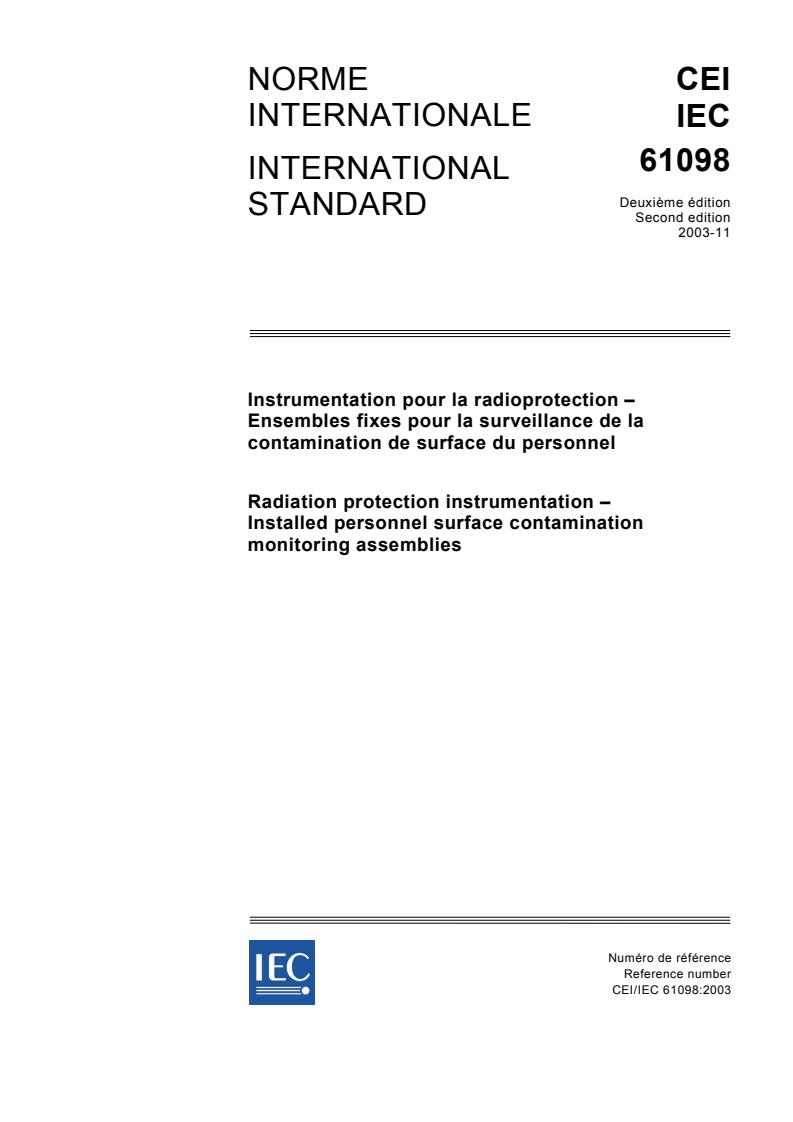
NORME CEI
INTERNATIONALE
IEC
INTERNATIONAL
Deuxième édition
STANDARD
Second edition
2003-11
Instrumentation pour la radioprotection –
Ensembles fixes pour la surveillance de la
contamination de surface du personnel
Radiation protection instrumentation –
Installed personnel surface contamination
monitoring assemblies
Numéro de référence
Reference number
CEI/IEC 61098:2003
Numérotation des publications Publication numbering
Depuis le 1er janvier 1997, les publications de la CEI As from 1 January 1997 all IEC publications are
sont numérotées à partir de 60000. Ainsi, la CEI 34-1 issued with a designation in the 60000 series. For
devient la CEI 60034-1. example, IEC 34-1 is now referred to as IEC 60034-1.
Editions consolidées Consolidated editions
Les versions consolidées de certaines publications de la The IEC is now publishing consolidated versions of its
CEI incorporant les amendements sont disponibles. Par publications. For example, edition numbers 1.0, 1.1
exemple, les numéros d’édition 1.0, 1.1 et 1.2 indiquent and 1.2 refer, respectively, to the base publication,
respectivement la publication de base, la publication de the base publication incorporating amendment 1 and
base incorporant l’amendement 1, et la publication de the base publication incorporating amendments 1
base incorporant les amendements 1 et 2. and 2.
Informations supplémentaires Further information on IEC publications
sur les publications de la CEI
Le contenu technique des publications de la CEI est The technical content of IEC publications is kept
constamment revu par la CEI afin qu'il reflète l'état under constant review by the IEC, thus ensuring that
actuel de la technique. Des renseignements relatifs à the content reflects current technology. Information
cette publication, y compris sa validité, sont dispo- relating to this publication, including its validity, is
nibles dans le Catalogue des publications de la CEI available in the IEC Catalogue of publications
(voir ci-dessous) en plus des nouvelles éditions, (see below) in addition to new editions, amendments
amendements et corrigenda. Des informations sur les and corrigenda. Information on the subjects under
sujets à l’étude et l’avancement des travaux entrepris consideration and work in progress undertaken by the
par le comité d’études qui a élaboré cette publication, technical committee which has prepared this
ainsi que la liste des publications parues, sont publication, as well as the list of publications issued,
également disponibles par l’intermédiaire de: is also available from the following:
• Site web de la CEI (www.iec.ch) • IEC Web Site (www.iec.ch)
• Catalogue des publications de la CEI • Catalogue of IEC publications
Le catalogue en ligne sur le site web de la CEI The on-line catalogue on the IEC web site
(www.iec.ch/searchpub) vous permet de faire des (www.iec.ch/searchpub) enables you to search by a
recherches en utilisant de nombreux critères, variety of criteria including text searches,
comprenant des recherches textuelles, par comité technical committees and date of publication. On-
d’études ou date de publication. Des informations en line information is also available on recently
ligne sont également disponibles sur les nouvelles issued publications, withdrawn and replaced
publications, les publications remplacées ou retirées, publications, as well as corrigenda.
ainsi que sur les corrigenda.
• IEC Just Published • IEC Just Published
Ce résumé des dernières publications parues This summary of recently issued publications
(www.iec.ch/online_news/justpub) est aussi dispo- (www.iec.ch/online_news/justpub) is also available
nible par courrier électronique. Veuillez prendre by email. Please contact the Customer Service
contact avec le Service client (voir ci-dessous) Centre (see below) for further information.
pour plus d’informations.
• Service clients • Customer Service Centre
Si vous avez des questions au sujet de cette If you have any questions regarding this
publication ou avez besoin de renseignements publication or need further assistance, please
supplémentaires, prenez contact avec le Service contact the Customer Service Centre:
clients:
Email: custserv@iec.ch Email: custserv@iec.ch
Tél: +41 22 919 02 11 Tel: +41 22 919 02 11
Fax: +41 22 919 03 00 Fax: +41 22 919 03 00
.
NORME CEI
INTERNATIONALE
IEC
INTERNATIONAL
Deuxième édition
STANDARD
Second edition
2003-11
Instrumentation pour la radioprotection –
Ensembles fixes pour la surveillance de la
contamination de surface du personnel
Radiation protection instrumentation –
Installed personnel surface contamination
monitoring assemblies
IEC 2003 Droits de reproduction réservés Copyright - all rights reserved
Aucune partie de cette publication ne peut être reproduite ni No part of this publication may be reproduced or utilized in any
utilisée sous quelque forme que ce soit et par aucun procédé, form or by any means, electronic or mechanical, including
électronique ou mécanique, y compris la photocopie et les photocopying and microfilm, without permission in writing from
microfilms, sans l'accord écrit de l'éditeur. the publisher.
International Electrotechnical Commission, 3, rue de Varembé, PO Box 131, CH-1211 Geneva 20, Switzerland
Telephone: +41 22 919 02 11 Telefax: +41 22 919 03 00 E-mail: inmail@iec.ch Web: www.iec.ch
CODE PRIX
W
PRICE CODE
Commission Electrotechnique Internationale
International Electrotechnical Commission
МеждународнаяЭлектротехническаяКомиссия
Pour prix, voir catalogue en vigueur
For price, see current catalogue
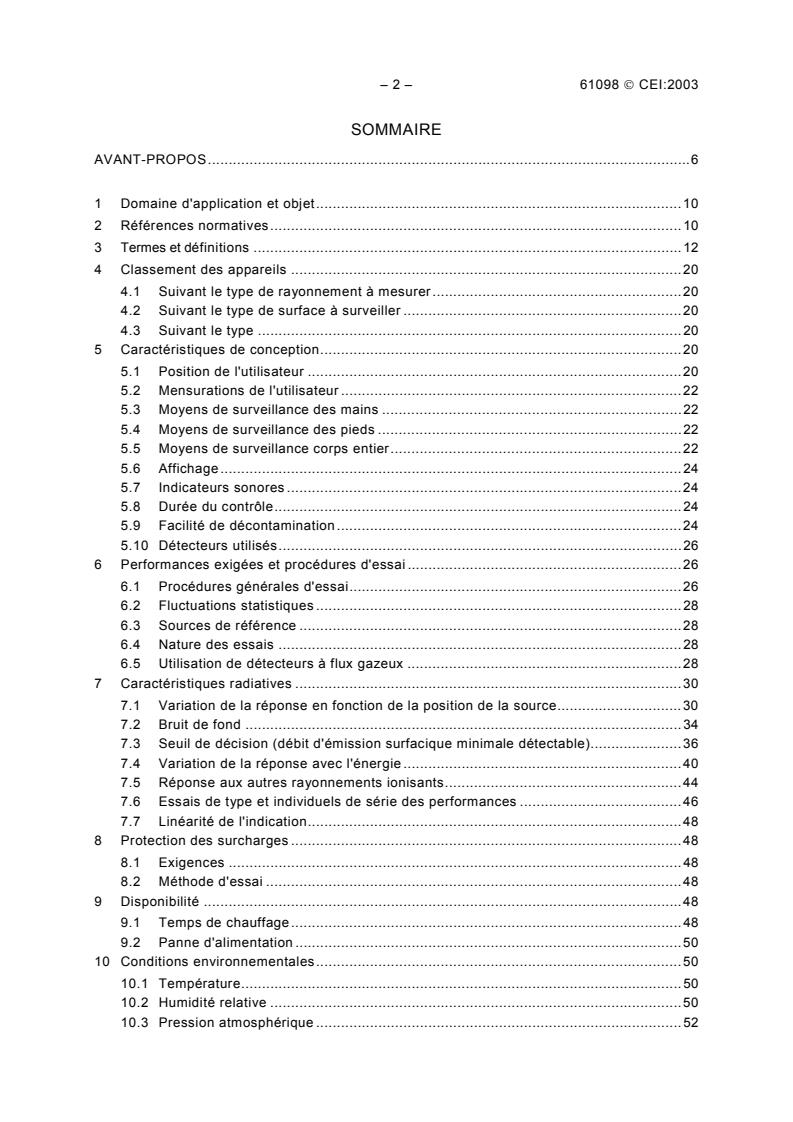
– 2 – 61098 CEI:2003
SOMMAIRE
AVANT-PROPOS.6
1 Domaine d'application et objet.10
2 Références normatives.10
3 Termes et définitions .12
4 Classement des appareils .20
4.1 Suivant le type de rayonnement à mesurer.20
4.2 Suivant le type de surface à surveiller .20
4.3 Suivant le type .20
5 Caractéristiques de conception.20
5.1 Position de l'utilisateur .20
5.2 Mensurations de l'utilisateur .22
5.3 Moyens de surveillance des mains .22
5.4 Moyens de surveillance des pieds .22
5.5 Moyens de surveillance corps entier.22
5.6 Affichage.24
5.7 Indicateurs sonores .24
5.8 Durée du contrôle.24
5.9 Facilité de décontamination.24
5.10 Détecteurs utilisés.26
6 Performances exigées et procédures d'essai .26
6.1 Procédures générales d'essai.26
6.2 Fluctuations statistiques .28
6.3 Sources de référence .28
6.4 Nature des essais .28
6.5 Utilisation de détecteurs à flux gazeux .28
7 Caractéristiques radiatives .30
7.1 Variation de la réponse en fonction de la position de la source.30
7.2 Bruit de fond .34
7.3 Seuil de décision (débit d'émission surfacique minimale détectable).36
7.4 Variation de la réponse avec l'énergie .40
7.5 Réponse aux autres rayonnements ionisants.44
7.6 Essais de type et individuels de série des performances .46
7.7 Linéarité de l'indication.48
8 Protection des surcharges .48
8.1 Exigences .48
8.2 Méthode d'essai .48
9 Disponibilité .48
9.1 Temps de chauffage.48
9.2 Panne d'alimentation .50
10 Conditions environnementales.50
10.1 Température.50
10.2 Humidité relative .50
10.3 Pression atmosphérique .52
61098 IEC:2003 – 3 –
CONTENTS
FOREWORD.7
1 Scope and object.11
2 Normative references.11
3 Terms and definitions .13
4 Classification of assemblies.21
4.1 According to type of radiation to be measured.21
4.2 According to type of surface .21
4.3 According to type.21
5 Design characteristics.21
5.1 Positioning of user.21
5.2 Size of user.23
5.3 Hand monitoring facilities .23
5.4 Foot monitoring facilities .23
5.5 Body monitoring facilities.23
5.6 Visual display.25
5.7 Audible indicators.25
5.8 Monitoring period.25
5.9 Ease of decontamination.25
5.10 Detectors used.27
6 Performance requirements and test procedures.27
6.1 General test procedure.27
6.2 Statistical fluctuations.29
6.3 Reference sources.29
6.4 Nature of tests.29
6.5 Use of gas flow detectors .29
7 Radiation characteristics.31
7.1 Variation of response with source position.31
7.2 Background.35
7.3 Decision threshold (minimum detectable surface emission rate) .37
7.4 Variation of response with energy.41
7.5 Response to other ionising radiations.45
7.6 Type and routine tests of performance .47
7.7 Linearity of indication .49
8 Overload protection.49
8.1 Requirements.49
8.2 Method of test .49
9 Availability.49
9.1 Warm-up time.49
9.2 Power failure.51
10 Environmental conditions.51
10.1 Temperature.51
10.2 Relative humidity.51
10.3 Atmospheric pressure.53
– 4 – 61098 CEI:2003
11 Alimentation .52
11.1 Tension et fréquence.52
11.2 Compatibilité électromagnétique.52
12 Stockage .56
13 Documentation .56
13.1 Certificat .56
13.2 Manuel d'utilisation et de maintenance .58
13.3 Instructions d'utilisation .58
13.4 Rapport d'essai de type.58
Annexe A (informative) Explication de la dérivation de la formule du taux d'émission
surfacique minimum détectable.72
Figure 1 – Position verticale de la source de rayonnement.64
Figure 2 – Position de la source de rayonnement autour du corps .66
Figure 3 – Détecteur pour la surveillance des mains .68
Figure 4 – Détecteur pour la surveillance des pieds.70
Tableau 1 – Conditions de référence et conditions normales d'essai.58
Tableau 2 – Essais réalisés dans les conditions normales d'essai .60
Tableau 3 – Essais réalisés avec des variations des grandeurs d'influence .62
61098 IEC:2003 – 5 –
11 Power supply.53
11.1 Voltage and frequency.53
11.2 Electromagnetic compatibility.53
12 Storage.57
13 Documentation.57
13.1 Certificate.57
13.2 Operation and maintenance manual .59
13.3 Operational instructions.59
13.4 Type test report.59
Annex A (informative) Explanation of the derivation of minimum detectable surface
emission rate formula .73
Figure 1 – Vertical position of the source of radiation.65
Figure 2 – Position of the source of the radiation around the body .67
Figure 3 – Detector for hand monitoring.69
Figure 4 – Foot monitor.71
Table 1 – Reference and standard test conditions.59
Table 2 – Tests performed under standard test conditions .61
Table 3 – Tests performed with variation of influence quantities.63
– 6 – 61098 CEI:2003
COMMISSION ELECTROTECHNIQUE INTERNATIONALE
____________
INSTRUMENTATION POUR LA RADIOPROTECTION –
Ensembles fixes pour la surveillance de
la contamination de surface du personnel
AVANT-PROPOS
1) La Commission Electrotechnique Internationale (CEI) est une organisation mondiale de normalisation
composée de l'ensemble des comités électrotechniques nationaux (Comités nationaux de la CEI). La CEI a
pour objet de favoriser la coopération internationale pour toutes les questions de normalisation dans les
domaines de l'électricité et de l'électronique. A cet effet, la CEI – entre autres activités – publie des Normes
internationales, des Spécifications techniques, des Rapports techniques, des Spécifications accessibles au
public (PAS) et des Guides (ci-après dénommés "Publication(s) de la CEI"). Leur élaboration est confiée à des
comités d'études, aux travaux desquels tout Comité national intéressé par le sujet traité peut participer. Les
organisations internationales, gouvernementales et non gouvernementales, en liaison avec la CEI, participent
également aux travaux. La CEI collabore étroitement avec l'Organisation Internationale de Normalisation (ISO),
selon des conditions fixées par accord entre les deux organisations.
2) Les décisions ou accords officiels de la CEI concernant les questions techniques représentent, dans la mesure
du possible, un accord international sur les sujets étudiés, étant donné que les Comités nationaux de la CEI
intéressés sont représentés dans chaque comité d’études.
3) Les Publications de la CEI se présentent sous la forme de recommandations internationales et sont agréées
comme telles par les Comités nationaux de la CEI. Tous les efforts raisonnables sont entrepris afin que la CEI
s'assure de l'exactitude du contenu technique de ses publications; la CEI ne peut pas être tenue responsable
de l'éventuelle mauvaise utilisation ou interprétation qui en est faite par un quelconque utilisateur final.
4) Dans le but d'encourager l'uniformité internationale, les Comités nationaux de la CEI s'engagent, dans toute la
mesure possible, à appliquer de façon transparente les Publications de la CEI dans leurs publications
nationales et régionales. Toutes divergences entre toutes Publications de la CEI et toutes publications
nationales ou régionales correspondantes doivent être indiquées en termes clairs dans ces dernières.
5) La CEI n’a prévu aucune procédure de marquage valant indication d’approbation et n'engage pas sa
responsabilité pour les équipements déclarés conformes à une de ses Publications.
6) Tous les utilisateurs doivent s'assurer qu'ils sont en possession de la dernière édition de cette publication.
7) Aucune responsabilité ne doit être imputée à la CEI, à ses administrateurs, employés, auxiliaires ou
mandataires, y compris ses experts particuliers et les membres de ses comités d'études et des Comités
nationaux de la CEI, pour tout préjudice causé en cas de dommages corporels et matériels, ou de tout autre
dommage de quelque nature que ce soit, directe ou indirecte, ou pour supporter les coûts (y compris les frais
de justice) et les dépenses découlant de la publication ou de l'utilisation de cette Publication de la CEI ou de
toute autre Publication de la CEI, ou au crédit qui lui est accordé.
8) L'attention est attirée sur les références normatives citées dans cette publication. L'utilisation de publications
référencées est obligatoire pour une application correcte de la présente publication.
9) L’attention est attirée sur le fait que certains des éléments de la présente Publication de la CEI peuvent faire
l’objet de droits de propriété intellectuelle ou de droits analogues. La CEI ne saurait être tenue pour
responsable de ne pas avoir identifié de tels droits de propriété et de ne pas avoir signalé leur existence.
La Norme internationale CEI 61098 a été établie par le sous-comité 45B, Instrumentation pour
la radioprotection, du comité d'études 45 de la CEI: Instrumentation nucléaire.
Cette deuxième édition annule et remplace la première édition parue en 1992, ainsi que la
CEI 61137 (1992). Cette édition constitue une révision technique.
Les modifications suivantes ont été apportées à cette édition de la CEI 61098:
a) L’incorporation des exigences de la norme CEI 61137.
La conception de nouveaux équipements pour la détection des contaminations alpha, bêta
et gamma a rendu cette fusion nécessaire. La norme CEI 61098 (1992) s’appliquait aux
contaminations alpha et bêta et la norme CEI 61137 (1992) aux gamma et n’étaient pas
nécessairement applicables conjointement aux équipements détectant les trois conta-
minations.
61098 IEC:2003 – 7 –
INTERNATIONAL ELECTROTECHNICAL COMMISSION
____________
RADIATION PROTECTION INSTRUMENTATION –
Installed personnel surface contamination monitoring assemblies
FOREWORD
1) The International Electrotechnical Commission (IEC) is a worldwide organization for standardization comprising
all national electrotechnical committees (IEC National Committees). The object of IEC is to promote
international co-operation on all questions concerning standardization in the electrical and electronic fields. To
this end and in addition to other activities, IEC publishes International Standards, Technical Specifications,
Technical Reports, Publicly Available Specifications (PAS) and Guides (hereafter referred to as “IEC
Publication(s)”). Their preparation is entrusted to technical committees; any IEC National Committee interested
in the subject dealt with may participate in this preparatory work. International, governmental and non-
governmental organizations liaising with the IEC also participate in this preparation. IEC collaborates closely
with the International Organization for Standardization (ISO) in accordance with conditions determined by
agreement between the two organizations.
2) The formal decisions or agreements of IEC on technical matters express, as nearly as possible, an international
consensus of opinion on the relevant subjects since each technical committee has representation from all
interested IEC National Committees.
3) IEC Publications have the form of recommendations for international use and are accepted by IEC National
Committees in that sense. While all reasonable efforts are made to ensure that the technical content of IEC
Publications is accurate, IEC cannot be held responsible for the way in which they are used or for any
misinterpretation by any end user.
4) In order to promote international uniformity, IEC National Committees undertake to apply IEC Publications
transparently to the maximum extent possible in their national and regional publications. Any divergence
between any IEC Publication and the corresponding national or regional publication shall be clearly indicated in
the latter.
5) IEC provides no marking procedure to indicate its approval and cannot be rendered responsible for any
equipment declared to be in conformity with an IEC Publication.
6) All users should ensure that they have the latest edition of this publication.
7) No liability shall attach to IEC or its directors, employees, servants or agents including individual experts and
members of its technical committees and IEC National Committees for any personal injury, property damage or
other damage of any nature whatsoever, whether direct or indirect, or for costs (including legal fees) and
expenses arising out of the publication, use of, or reliance upon, this IEC Publication or any other IEC
Publications.
8) Attention is drawn to the Normative references cited in this publication. Use of the referenced publications is
indispensable for the correct application of this publication.
9) Attention is drawn to the possibility that some of the elements of this IEC Publication may be the subject of
patent rights. IEC shall not be held responsible for identifying any or all such patent rights.
International Standard IEC 61098 has been prepared by subcommittee 45B, Radiation
protection instrumentation, of IEC technical committee 45: Nuclear instrumentation.
This second edition cancels and replaces the first edition published in 1992, as well as IEC
61137 (1992). This edition constitutes a technical revision.
The following changes have been made in this edition of IEC 61098:
a) The incorporation of the requirements of IEC 61137.
This was necessary as newer equipments are designed to detect alpha, beta and gamma
contamination. IEC 61098 (1992) was applicable to alpha and beta and IEC 61137 (1992)
to gamma and were not necessarily applicable together to equipment to detect all three.
– 8 – 61098 CEI:2003
b) Ont été également incluses les exigences concernant l’immunité aux interférences
électromagnétiques définies dans la série des normes CEI 61000.
c) Des améliorations des exigences concernant les diagnostics d’erreurs et les essais sous
rayonnement on aussi été apportées.
Le texte de cette norme est issu des documents suivants:
FDIS Rapport de vote
45B/422/FDIS 45B/432/RVD
Le rapport de vote indiqué dans le tableau ci-dessus donne toute information sur le vote ayant
abouti à l'approbation de cette norme.
Cette publication a été rédigée selon les Directives ISO/CEI, Partie 2.
Le comité a décidé que le contenu de cette publication ne sera pas modifié avant 2008.
A cette date, la publication sera
• reconduite;
• supprimée;
• remplacée par une édition révisée, ou
• amendée.
61098 IEC:2003 – 9 –
b) The requirements of electromagnetic interference immunity given in the IEC 61000 series
have also been included.
c) Improvements in fault diagnosis requirements and radiation testing have also been looked
at.
The text of this standard is based on the following documents:
FDIS Report on voting
45B/422/FDIS 45B/432/RVD
Full information on the voting for the approval of this standard can be found in the report on
voting indicated in the above table.
This publication has been drafted in accordance with the ISO/IEC Directives, Part 2.
The committee has decided that the contents of this publication will remain unchanged until
2008. At this date, the publication will be
• reconfirmed;
• withdrawn;
• replaced by a revised edition, or
• amended.
– 10 – 61098 CEI:2003
INSTRUMENTATION POUR LA RADIOPROTECTION –
Ensembles fixes pour la surveillance de
la contamination de surface du personnel
1 Domaine d'application et objet
Cette Norme Internationale s'applique aux ensembles de prévention, de mesure et de
surveillance utilisés pour la surveillance de la contamination radioactive en surface des
personnels, que ceux-ci soient habillés ou non. Cette norme ne s'applique qu'au équipements
n'imposant d'autres actions à l'utilisateur que celles qui consistent à exposer lui-même, et/ou
ses mains et ses pieds devant les détecteurs. Elle n’est pas applicable aux équipements pour
lesquels le détecteur est déplacé par l'utilisateur ou une autre personne sur la surface à
contrôler ou au cas où l'utilisateur passerait rapidement à travers le système de surveillance.
Elle ne s'applique pas non plus aux appareils annexes pouvant être associés à des
équipements particuliers comme ceux destinés au contrôle de petits objets.
Cette norme s'applique à la surveillance du corps entier (y compris le visage), des mains et
des pieds mais certaines parties de cette norme peuvent être utilisées pour des équipements
conçus uniquement pour la surveillance des mains et/ou des pieds.
Cette norme s'applique:
– aux équipements à poste fixe pour la surveillance du personnel (tous les articles sont
applicables);
– aux équipements pour la surveillance des mains (voir les Articles et Paragraphes suivants:
2, 3, 4, 5, 6, 7.1.2, 7.2, 7.3.2, 7.4.1.2 b), 7.4.2, 7.4.3.1, 7.4.3.2, 7.4.3.3 b), 7.5, 7.6, 7.7, 8,
9, 10, 11 et 12);
– aux équipements pour la surveillance des pieds (voir les Articles et Paragraphes suivants:
2, 3, 4, 5, 6, 7.1.3, 7.2, 7.3.3, 7.4.1.2 c), 7.4.2, 7.4.3.1, 7.4.3.2, 7.4.3.3 c), 7.5, 7.6, 7.7, 8,
9, 10, 11, 12 et 13);
– aux équipements pour la surveillance des mains et des pieds (voir les Articles et
Paragraphes suivants: 2, 3, 4, 5, 6, 7.1.2, 7.1.3, 7.2, 7.3.2, 7.3.3, 7.4.1.2 b), 7.4.1.2 c),
7.4.2, 7.4.3.1, 7.4.3.2, 7.4.3.3 b), 7.4.3.3 c), 7.5, 7.6, 7.7, 8, 9, 10, 11 et 12).
L'objectif de cette norme est de définir les caractéristiques mécaniques et d'utilisation, les
performances minimales et les procédures générales d'essai pour les équipements de
surveillance du personnel.
2 Références normatives
Les documents de référence suivants sont indispensables pour l'application du présent
document. Pour les références datées, seule l'édition citée s'applique. Pour les références
non datées, la dernière édition du document de référence s'applique (y compris les éventuels
amendements).
CEI 60050-151:2001, Vocabulaire Electrotechnique International (VEI) – Partie 151:
Dispositifs électriques et magnétiques
CEI 60050(393):1996, Vocabulaire Electrotechnique International (VEI) – Chapitre 393:
Instrumentation nucléaire: Phénomènes physiques et notions fondamentales
61098 IEC:2003 – 11 –
RADIATION PROTECTION INSTRUMENTATION –
Installed personnel surface contamination monitoring assemblies
1 Scope and object
This International Standard applies to contamination warning assemblies, meters and
monitors used for the monitoring of radioactive contamination on the surface of personnel
whether they be clothed or not. The standard is applicable only to that type of equipment
where the user takes no action other than to present himself and/or his hands and feet to the
detectors. It is not applicable to equipment where the user or someone else moves detectors
over the area to be monitored or the user passes quickly through the monitor. It is also not
applicable to any peripheral equipment which may be associated with a particular type of
equipment such as small article monitors.
This standard is applicable to the monitoring of the whole body (including the face), hands
and feet but parts of this standard may be used for equipment designed for the monitoring of
radioactive contamination on the hands and/or feet only.
This standard is applicable to:
– installed personnel monitoring equipment (all Clauses applicable);
– equipment for monitoring the hands (see the following Clauses and Subclauses: 2, 3, 4, 5,
6, 7.1.2, 7.2, 7.3.2, 7.4.1.2 b), 7.4.2, 7.4.3.1, 7.4.3.2, 7.4.3.3 b), 7.5, 7.6, 7.7, 8, 9, 10, 11
and 12);
– equipment for monitoring the feet (see the following Clauses and Subclauses: 2, 3, 4, 5, 6,
7.1.3, 7.2, 7.3.3, 7.4.1.2 c), 7.4.2, 7.4.3.1, 7.4.3.2, 7.4.3.3 c), 7.5, 7.6, 7.7, 8, 9, 10, 11, 12
and 13);
– equipment for monitoring the hands and feet (see the following Clauses and Subclauses 2,
3, 4, 5, 6, 7.1.2, 7.1.3, 7.2, 7.3.2, 7.3.3, 7.4.1.2 b), 7.4.1.2 c), 7.4.2, 7.4.3.1, 7.4.3.2,
7.4.3.3 b), 7.4.3.3 c), 7.5, 7.6, 7.7, 8, 9, 10, 11 and 12).
The object of this International Standard is to define mechanical and operational character-
istics, minimum performance characteristics and general test procedures for personnel
monitoring equipment.
2 Normative references
The following referenced documents are indispensable for the application of this document.
For dated references, only the edition cited applies. For undated references, the latest edition
of the referenced document (including any amendments) applies.
IEC 60050(151):2001, International Electrotechnical Vocabulary (IEV) – Chapter 151:
Electrical and magnetic devices
IEC 60050(393):1996, International Electrotechnical Vocabulary (IEV) – Chapter 393: Nuclear
instrumentation: Physical phenomena and basic concepts
– 12 – 61098 CEI:2003
CEI 60050(394):1995, Vocabulaire Electrotechnique International (VEI) – Chapitre 394:
Instrumentation nucléaire: Instruments
CEI 60777:1983, Terminologie, grandeurs et unités concernant la radioprotection
CEI 61000-4-2:1995, Compatibilité électromagnétique (CEM) – Partie 4: Techniques d'essai
et de mesure – Section 2: Essais d'immunité aux décharges électrostatiques. Publication
fondamentale en CEM
CEI 61000-4-3:2002, Compatibilité électromagnétique (CEM) – Partie 4-3: Techniques d'essai
et de mesure – Essai d'immunité aux champs électromagnétiques rayonnés aux fréquences
radioélectriques
CEI 61000-4-5:1995, Compatibilité électromagnétique (CEM) – Partie 4: Techniques d'essai
et de mesure – Section 5: Essai d'immunité aux ondes de choc
CEI 61000-4-6:2003, Compatibilité électromagnétique (CEM) – Partie 4-6: Techniques d'essai
et de mesure – Immunité aux perturbations conduites, induites par les champs
radioélectriques
CEI 61000-4-8:1993, Compatibilité électromagnétique (CEM) – Partie 4: Techniques d'essai
et de mesure – Section 8: Essai d'immunité au champ magnétique à la fréquence du réseau
CEI 61000-4-12:1995, Compatibilité électromagnétique (CEM) – Partie 4: Techniques d'essai
et de mesure – Section 12: Essai d'immunité aux ondes oscillatoires
CEI 61187:1993, Equipement de mesures électriques et électroniques – Documentation
ISO 8769:1988, Sources de référence pour l'étalonnage des moniteurs de contamination de
surface – Emetteurs bêta (énergie bêta maximale supérieure à 0,15 MeV) et émetteurs alpha
3 Termes et définitions
Pour les besoins du présent document, les termes et définitions donnés dans la CEI
60050(393) et la CEI 60050(394), ainsi que les suivants, s'appliquent.
NOTE Dans cette norme, le mot «doit» indique une exigence obligatoire; les mots «il convient de» indiquent que
l'exigence est obligatoire sauf dans certaines conditions qui doivent être précisées, et le mot «peut» indique une
méthode acceptable ou un exemple de bonne pratique.
3.1
dispositif de prévention
équipement conçu pour indiquer, par une information sonore ou visuelle ou les deux, qu'une
quantité excède une certaine valeur. Dans cette norme, il indique essentiellement une
contamination des mains, des pieds, du corps entier ou des vêtements.
3.2
taux d'émission surfacique d'une source
nombre de particules ou de photons d'un type donné et d'énergie supérieure à une énergie
donnée émergeant par unité de temps de la surface ou de la fenêtre de la source
61098 IEC:2003 – 13 –
IEC 60050(394):1995, International Electrotechnical Vocabulary (IEV) – Chapter 394: Nuclear
instrumentation: Instruments
IEC 60777:1983, Terminology, quantities and units concerning radiation protection
IEC 61000-4-2:1995, Electromagnetic compatibility (EMC) – Part 4: Testing and measurement
techniques – Section 2: Electronic discharge immunity test. Basic EMC publication
IEC 61000-4-3:2002, Electromagnetic compatibility (EMC) – Part 4-3: Testing and measure-
ment techniques – Radiated, radiofrequency, electromagnetic field immunity test
IEC 61000-4-5:1995, Electromagnetic compatibility (EMC) – Part 4: Testing and measurement
techniques – Section 5: Surge immunity test
IEC 61000-4-6:2003, Electromagnetic compatibility (EMC) – Part 4-6: Testing and measure-
ment techniques – Immunity to conducted disturbances, induced by radio-frequency fields
IEC 61000-4-8:1993, Electromagnetic compatibility (EMC) – Part 4: Testing and measuring
techniques – Section 8: Power frequency magnetic field immunity test
IEC 61000-4-12:1995, Electromagnetic compatibility (EMC) – Part 4: Testing and measuring
techniques – Section 12: Oscillatory waves immunity test
IEC 61187:1993, Electrical and electronic measuring equipment – Documentation
ISO 8769:1988, Reference sources for the calibration of surface contamination monitors –
Beta-emitters (maximum beta energy greater than 0,15 MeV) and alpha-emitters
3 Terms and definitions
For the purposes of this document, the terms and definitions given in IEC 60050(393) and IEC
60050(394), as well as the following apply.
NOTE In this standard, the word "shall" signifies a mandatory requirement, the word “should” signifies a
mandatory requirement except under certain circumstances which must be specified, and the word "may" signifies
an acceptable method or example of good practice.
3.1
warning assembly
equipment designed to indicate either visually or audibly or both that some quantity exceeds a
certain value. In this standard, it means primarily radioactive contamination on hands, feet,
body or clothing.
3.2
surface emission rate of a source
number of particles or photons of a given type above a given energy emerging per unit time
from the source or its window
– 14 – 61098 CEI:2003
3.3
réponse
R
rapport de la valeur affichée (ν) à la quantité mesurée (ou sa valeur conventionnellement
vraie) (ν )
c
R = ν/ν [1]
c
3.4
rendement d'une source (pour les émetteurs alpha et bêta)
rapport entre le taux d'émission surfacique et le nombre de particules de même type crées ou
libérées dans la source ou dans l'épaisseur de sa couche de saturation, par unité de temps
NOTE 1 D'après cette définition, l'efficacité attendue de la source devrait être inférieure à 0,5. Cependant, la
contribution des particules rétrodiffusées peut augmenter cette valeur de manière non négligeable.
NOTE 2 Cette définition s'applique aux sources alpha et bêta d'énergie maximum >150 keV.
3.5
source de haute efficacité
source dont l'efficacité pour des particules d'énergie supérieure à 0,5 keV est supérieure à
25 %, particules rétrodiffusées comprises
3.6
petite source
source de haute efficacité dont la dimension maximale de la surface active n'excède pas 1 cm
3.7
coefficient de variation
rapport de l'écart type s à la valeur de la moyenne arithmétique x d'une série de n mesures x
i
donnée par la formule suivante:
i=n
s 1 1
coefficient de variation [2]
V = = x − x
i
∑
n − 1
x x
i=1
3.8
valeur conventionnellement vraie d'une grandeur
meilleure estimation convenable de cette grandeur. Cette valeur et son incertitude doivent
être définies à partir d'un étalon secondaire ou primaire ou par un instrument de référence
étalonné au moyen d'un étalon secondaire ou primaire.
3.9
erreur sur l'indication
différence entre le taux d'émission indiqué (affiché) et le taux d'émission conventionnellement
vrai au point de mesure
3.10
bruit de fond ambiant
champ de rayonnement gamma dans lequel l'appareillage est destiné à être utilisé
comprenant le bruit de fond naturel et le rayonnement dû à des sources et/ou des installations
radioactives proches de l'instrument
———————
Voir l’ISO 8769.
61098 IEC:2003 – 15 –
3.3
response
R
ratio of the indicated value (ν) to the quantity being measured (or its conventionally true
value) (ν )
c
R = ν/ν [1]
c
3.4
source efficiency (for alpha and beta emitters)
ratio between the surface emission rate and the number of particles of the same type created
or released within the source or its saturation layer thickness per unit time
NOTE 1 Under this definition, the efficiency of a source would be expected to be not more than 0,5. However a
contribution due to backscattered particles can enhance this value considerably).
NOTE 2 This definition applies to alpha sources and beta sources with maximum energy > 150 keV.
3.5
high efficiency source
one in which the efficiency for particles with energy greater than 0,5 keV is greater than 25 %,
including backscattered particles
3.6
small source
high efficiency source whose max
...