

IEC 61643-12:2020
(Main)Low-voltage surge protective devices - Part 12: Surge protective devices connected to low-voltage power systems - Selection and application principles
General Information
- Abstract
IEC 61643-12:2020 describes the principles for the selection, operation, location and coordination of SPDs to be connected to 50/60 Hz AC power circuits, and equipment rated up to 1 000 V RMS. These devices contain at least one non-linear component and are intended to limit surge voltages and divert surge currents.
NOTE 1 Additional requirements for special applications are also applicable, If required.
NOTE 2 IEC 60364 and IEC 62305-4 are also applicable.
NOTE 3 This standard deal only with SPDs and not with surge protection components (SPC) integrated inside equipment.
This third edition cancels and replaces the second edition published in 2008. This edition constitutes a technical revision.
NOTE The following differing practice of a less permanent nature exists in the USA: In the USA, SPDs tested to Class I tests are not required. This exception applies to the entire document. This edition includes the following significant technical changes with respect to the previous edition:
a) Scope: Deleted reference to 1 500 V dc
b) Added or revised some definitions
c) Added new clause 4 on Need for protection
d) Added new information on disconnecting devices
e) Revised Characteristics of SPD
f) Revised List of parameters for SPD selection
g) Added new information on Measured Limiting Voltage
e) Added or revised some Annexes
- Status
- Published
- Publication Date
- 06-May-2020
- Technical Committee
- SC 37A - Low-voltage surge protective devices
- Drafting Committee
- WG 3 - TC 37/SC 37A/WG 3
- Current Stage
- PPUB - Publication issued
- Start Date
- 07-May-2020
- Completion Date
- 20-Mar-2020
Buy Documents

IEC 61643-12:2020 - Low-voltage surge protective devices - Part 12: Surge protective devices connected to low-voltage power systems - Selection and application principles Released:5/7/2020
Overview
IEC 61643-12:2020 - Low-voltage surge protective devices (SPDs) - Part 12: Selection and application principles - provides guidance for the selection, location, operation and coordination of SPDs installed on 50/60 Hz AC power circuits and equipment rated up to 1 000 V RMS. This third edition (technical revision of the 2008 edition) focuses on practical application principles for SPDs that contain at least one non‑linear component to limit surge voltages and divert surge currents. The edition adds new guidance on the need for protection, disconnecting devices, measured limiting voltage and SPD characteristics and selection parameters.
Key topics and technical requirements
- Scope and purpose: Principles for selecting and applying SPDs connected to low-voltage power systems (not component-level surge protection inside equipment).
- Need for protection: How to assess when SPDs are required based on environmental and system stresses (lightning, switching, temporary overvoltages).
- SPD classification and topologies: Functional roles, typical designs and modes of connection in LV systems.
- Selection parameters: List of parameters to consider (voltage protection level, impulse current capability, follow‑current rating/SCCR, rated load current, expected lifetime, and voltage coordination).
- Characteristics and testing: Guidance on interpreted test results (measured limiting voltage, surge current behavior) and how characteristics change over life and under stress.
- Coordination principles: Energy coordination between multiple SPDs, let‑through energy concepts and practical coordination techniques to protect downstream equipment.
- Auxiliary devices: Requirements for disconnecting devices, status indicators, surge/event counters and other auxiliaries for safe operation and maintenance.
- Informative annexes: Risk assessment methods, application examples (domestic, industrial, wind turbines), environment and system stress analysis, and coordination test protocols.
Applications and users
IEC 61643-12:2020 is intended for professionals involved in specifying, installing and maintaining surge protection in low-voltage power systems:
- Electrical designers and consultants selecting SPDs for buildings, industrial plants, substations and renewable-energy systems (e.g., wind turbines).
- Installers and contractors implementing SPD location, modes of protection and coordination with distribution equipment.
- Facility managers and asset owners assessing protection needs and lifecycle expectations.
- Manufacturers and test labs referencing selection parameters and characteristics when developing or verifying SPDs.
Practical uses include defining SPD location in an installation, choosing appropriate voltage protection levels (U_p), ensuring coordination between upstream and downstream devices, and verifying safe disconnection and status monitoring.
Related standards
- IEC 61643-11 - SPD product and test requirements (complements Part 12 for testing/verification).
- IEC 60364 and IEC 62305-4 - electrical installation and lightning protection guidance referenced for risk assessment and installation practice.
- Note: USA practice differs - SPDs tested to Class I tests are not always required (document exception).
Relations
- Effective Date
- 05-Sep-2023
Buy Documents
IEC 61643-12:2020 - Low-voltage surge protective devices - Part 12: Surge protective devices connected to low-voltage power systems - Selection and application principles Released:5/7/2020
Get Certified
Connect with accredited certification bodies for this standard

IMQ S.p.A. (Certification)
Italian electrical product certification.

SLG Prüf- und Zertifizierungs GmbH
German testing and certification body.

UL Solutions
Global safety science company with testing, inspection and certification.
Sponsored listings
Frequently Asked Questions
IEC 61643-12:2020 is a standard published by the International Electrotechnical Commission (IEC). Its full title is "Low-voltage surge protective devices - Part 12: Surge protective devices connected to low-voltage power systems - Selection and application principles". This standard covers: IEC 61643-12:2020 describes the principles for the selection, operation, location and coordination of SPDs to be connected to 50/60 Hz AC power circuits, and equipment rated up to 1 000 V RMS. These devices contain at least one non-linear component and are intended to limit surge voltages and divert surge currents. NOTE 1 Additional requirements for special applications are also applicable, If required. NOTE 2 IEC 60364 and IEC 62305-4 are also applicable. NOTE 3 This standard deal only with SPDs and not with surge protection components (SPC) integrated inside equipment. This third edition cancels and replaces the second edition published in 2008. This edition constitutes a technical revision. NOTE The following differing practice of a less permanent nature exists in the USA: In the USA, SPDs tested to Class I tests are not required. This exception applies to the entire document. This edition includes the following significant technical changes with respect to the previous edition: a) Scope: Deleted reference to 1 500 V dc b) Added or revised some definitions c) Added new clause 4 on Need for protection d) Added new information on disconnecting devices e) Revised Characteristics of SPD f) Revised List of parameters for SPD selection g) Added new information on Measured Limiting Voltage e) Added or revised some Annexes
IEC 61643-12:2020 describes the principles for the selection, operation, location and coordination of SPDs to be connected to 50/60 Hz AC power circuits, and equipment rated up to 1 000 V RMS. These devices contain at least one non-linear component and are intended to limit surge voltages and divert surge currents. NOTE 1 Additional requirements for special applications are also applicable, If required. NOTE 2 IEC 60364 and IEC 62305-4 are also applicable. NOTE 3 This standard deal only with SPDs and not with surge protection components (SPC) integrated inside equipment. This third edition cancels and replaces the second edition published in 2008. This edition constitutes a technical revision. NOTE The following differing practice of a less permanent nature exists in the USA: In the USA, SPDs tested to Class I tests are not required. This exception applies to the entire document. This edition includes the following significant technical changes with respect to the previous edition: a) Scope: Deleted reference to 1 500 V dc b) Added or revised some definitions c) Added new clause 4 on Need for protection d) Added new information on disconnecting devices e) Revised Characteristics of SPD f) Revised List of parameters for SPD selection g) Added new information on Measured Limiting Voltage e) Added or revised some Annexes
IEC 61643-12:2020 is classified under the following ICS (International Classification for Standards) categories: 29.240.10 - Substations. Surge arresters. The ICS classification helps identify the subject area and facilitates finding related standards.
IEC 61643-12:2020 has the following relationships with other standards: It is inter standard links to IEC 61643-12:2008. Understanding these relationships helps ensure you are using the most current and applicable version of the standard.
IEC 61643-12:2020 is available in PDF format for immediate download after purchase. The document can be added to your cart and obtained through the secure checkout process. Digital delivery ensures instant access to the complete standard document.
Standards Content (Sample)
SLOVENSKI STANDARD
01-september-2023
Nizkonapetostne naprave za zaščito pred prenapetostnimi udari - 12. del: Naprave
za zaščito pred prenapetostnimi udari za nizkonapetostne sisteme - Izbira in
načela za uporabo (IEC 61643-12:2020)
Low-voltage surge protective devices - Part 12: Surge protective devices connected to
low-voltage power systems - Selection and application principles (IEC 61643-12:2020)
Parafoudres à basse tension - Partie 12: Parafoudres connectés aux réseaux à basse
tension - Principes de choix et de mise en œuvre (IEC 61643-12:2020)
Ta slovenski standard je istoveten z: IEC 61643-12:2020
ICS:
29.240.10 Transformatorske postaje. Substations. Surge arresters
Prenapetostni odvodniki
2003-01.Slovenski inštitut za standardizacijo. Razmnoževanje celote ali delov tega standarda ni dovoljeno.
IEC 61643-12 ®
Edition 3.0 2020-05
INTERNATIONAL
STANDARD
NORME
INTERNATIONALE
colour
inside
Low-voltage surge protective devices –
Part 12: Surge protective devices connected to low-voltage power systems –
Selection and application principles
Parafoudres à basse tension –
Partie 12: Parafoudres connectés aux réseaux à basse tension –
Principes de choix et de mise en œuvre
INTERNATIONAL
ELECTROTECHNICAL
COMMISSION
COMMISSION
ELECTROTECHNIQUE
INTERNATIONALE
ICS 29.240.10 ISBN 978-2-8322-7914-4
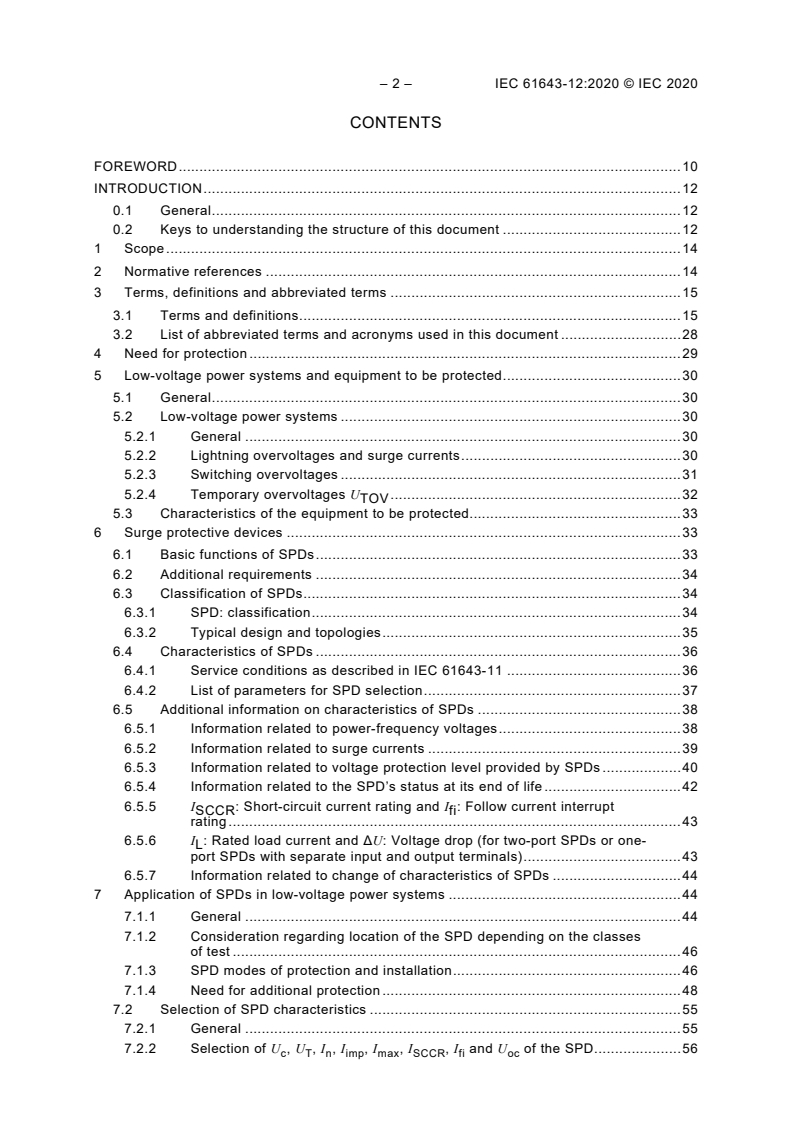
– 2 – IEC 61643-12:2020 © IEC 2020
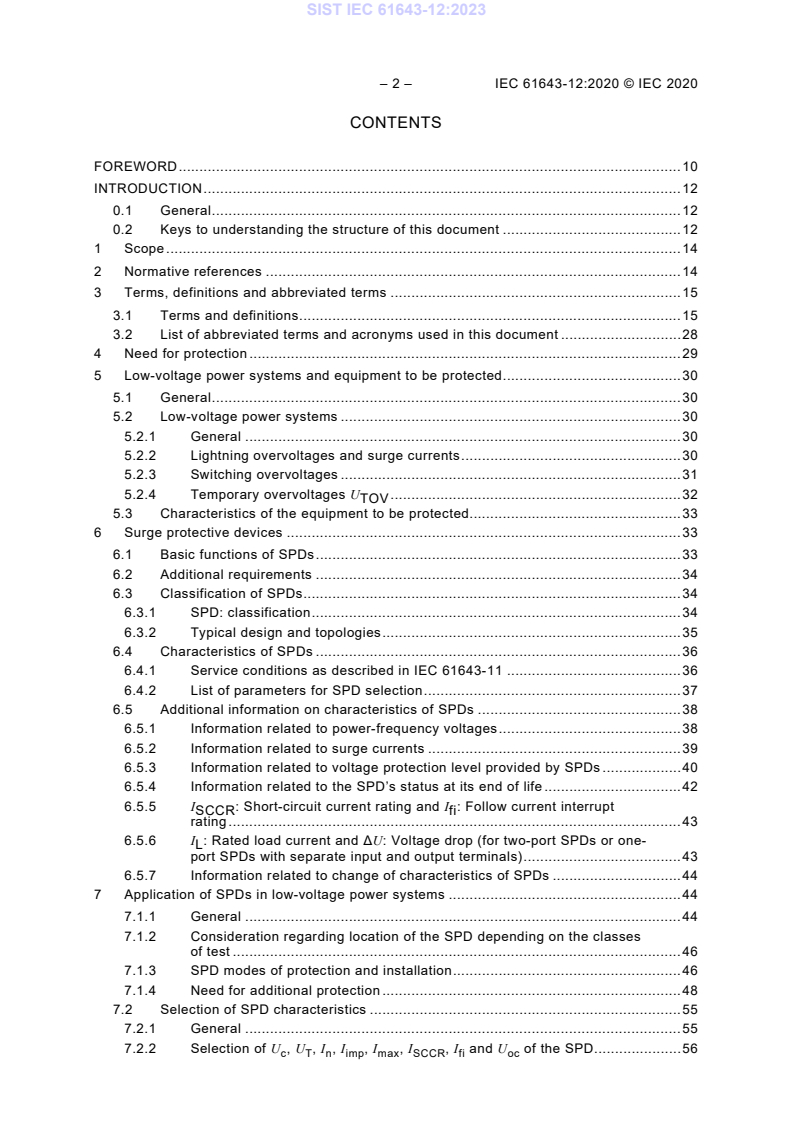
CONTENTS
FOREWORD . 10
INTRODUCTION . 12
0.1 General . 12
0.2 Keys to understanding the structure of this document . 12
1 Scope . 14
2 Normative references . 14
3 Terms, definitions and abbreviated terms . 15
3.1 Terms and definitions . 15
3.2 List of abbreviated terms and acronyms used in this document . 28
4 Need for protection . 29
5 Low-voltage power systems and equipment to be protected . 30
5.1 General . 30
5.2 Low-voltage power systems . 30
5.2.1 General . 30
5.2.2 Lightning overvoltages and surge currents . 30
5.2.3 Switching overvoltages . 31
5.2.4 Temporary overvoltages U . 32
TOV
5.3 Characteristics of the equipment to be protected. 33
6 Surge protective devices . 33
6.1 Basic functions of SPDs . 33
6.2 Additional requirements . 34
6.3 Classification of SPDs . 34
6.3.1 SPD: classification . 34
6.3.2 Typical design and topologies . 35
6.4 Characteristics of SPDs . 36
6.4.1 Service conditions as described in IEC 61643-11 . 36
6.4.2 List of parameters for SPD selection . 37
6.5 Additional information on characteristics of SPDs . 38
6.5.1 Information related to power-frequency voltages . 38
6.5.2 Information related to surge currents . 39
6.5.3 Information related to voltage protection level provided by SPDs . 40
6.5.4 Information related to the SPD’s status at its end of life . 42
6.5.5 I : Short-circuit current rating and I : Follow current interrupt
SCCR fi
rating . 43
6.5.6 I : Rated load current and ΔU: Voltage drop (for two-port SPDs or one-
L
port SPDs with separate input and output terminals) . 43
6.5.7 Information related to change of characteristics of SPDs . 44
7 Application of SPDs in low-voltage power systems . 44
7.1.1 General . 44
7.1.2 Consideration regarding location of the SPD depending on the classes
of test . 46
7.1.3 SPD modes of protection and installation . 46
7.1.4 Need for additional protection . 48
7.2 Selection of SPD characteristics . 55
7.2.1 General . 55
7.2.2 Selection of U , U , I , I , I , I , I and U of the SPD . 56
c T n imp max SCCR fi oc
7.2.3 Protective distance . 62
7.2.4 Expected lifetime . 62
7.2.5 Interaction between SPDs and other devices . 62
7.2.6 Choice of the voltage protection level U . 63
p
7.2.7 Coordination between the chosen SPD and other SPDs . 63
7.3 Characteristics of auxiliary devices . 66
7.3.1 Disconnecting devices . 66
7.3.2 Surge and event counters . 66
7.3.3 Status indicator . 67
Annex A (informative) Typical information required before selecting an SPD and
explanation of testing procedures . 68
A.1 Typical Information required before selecting an SPD . 68
A.1.1 System data . 68
A.1.2 SPD application considerations . 68
A.1.3 Characteristics of SPD . 69
A.1.4 Additional equipment and fittings . 69
A.2 Explanation of testing procedures used in IEC 61643-11 . 70
A.2.1 General Principles . 70
A.2.2 Test sequences and tests description . 70
Annex B (informative) Examples of relationship between U and nominal system voltage
c
and example of relationship between U and U for Metal oxide varistors (MOV) . 78
p c
B.1 Relationship between U and the nominal voltage of the system . 78
c
B.2 Relationship between U and U for Metal oxide varistors (MOV) . 78
p c
Annex C (informative) Environment – Surge voltages in LV systems . 80
C.1 General . 80
C.2 Lightning overvoltages . 80
C.2.1 General . 80
C.2.2 Surges transferred from MV to the LV system . 81
C.2.3 Overvoltages caused by direct flashes to LV distribution systems . 81
C.2.4 Induced overvoltages in LV distribution systems . 82
C.2.5 Overvoltages caused by flashes to a Lightning Protection System or to
a structure in close vicinity. 82
C.3 Switching overvoltages . 83
C.3.1 General . 83
C.3.2 General description . 84
C.3.3 Circuit-breaker and switch operations . 84
C.3.4 Fuse operations (current-limiting fuses) . 85
Annex D (informative) Partial lightning current calculations . 87
Annex E (informative) TOV in the low-voltage system due to faults between high-
voltage system and earth . 90
E.1 General . 90
E.2 References . 91
E.3 Symbols . 91
E.4 Overvoltages in LV-systems during a high-voltage earth fault . 91
E.5 Example of a TT-system – Calculation of the possible temporary
overvoltages . 93
E.5.1 Possible stresses on equipment in low-voltage installations due to earth
faults in a high-voltage system . 93
E.5.2 Characteristics of the high-voltage system . 94
– 4 – IEC 61643-12:2020 © IEC 2020
E.6 Temporary power-frequency overvoltages depending on different LV-
systems and different kinds of earthing configurations . 94
E.6.1 General . 94
E.6.2 Conclusion – Worst case SPDs stress current for SPDs HV-TOV
behaviour. . 96
E.6.3 Conclusion – Worst case test source for SPDs HV-TOV behaviour, if the
SPD is connected to ground between N-PE and / or L-PE: . 96
E.6.4 Examples of different LV-systems and their possible earthing
configurations . 97
E.7 Values of the temporary overvoltages for the US TN C system. 101
E.8 Values of temporary overvoltages used in IEC 61643-11 with explanations . 103
E.8.1 General . 103
E.8.2 Values of temporary overvoltages for US systems . 106
E.8.3 Values of temporary overvoltages for Japanese systems . 109
Annex F (informative) Coordination rules and principles . 114
F.1 General . 114
F.2 Energy coordination . 114
F.2.1 General . 114
F.2.2 Analytical studies: simple case of the coordination of two metal oxide
varistors (MOV) based SPDs . 114
F.2.3 Analytical study: case of coordination between a gap-based SPD and a
Metal oxide varistors (MOV) based SPD . 118
F.2.4 Analytical study: general coordination of two SPDs . 120
F.2.5 Let-through energy (LTE) method . 121
F.3 Coordination tests: energy and voltage protection coordination . 123
F.3.1 Introduction . 123
F.3.2 Coordination criteria . 124
F.3.3 Coordination techniques . 124
F.3.4 Test protocol . 124
Annex G (informative) Examples of application . 128
G.1 Domestic application . 128
G.2 Industrial application . 130
G.3 Presence of a lightning protection system . 134
G.4 Wind Turbines . 135
G.4.1 General . 135
G.4.2 Transient overvoltages in the DFIG converter circuit . 135
G.4.3 Transmission effect of the transient voltage due to a long cable . 136
G.4.4 Voltage coordination between SPD and equipment in wind turbine
systems . 137
G.4.5 Possible solutions for the case described in CLC/TR 50539-22 . 139
Annex H (informative) Risk assessment method and examples of application . 140
H.1 General . 140
H.2 Simplified method proposed for low voltage risk assessment as described in
IEC 60364-4-44 . 140
H.2.1 Overvoltage control . 140
H.2.2 Simplified risk assessment method . 140
H.2.3 Example 1 – Building in rural environment . 142
H.2.4 Example 2 – Building in rural environment powered by HV . 142
H.2.5 Example 3 – Building in urban environment . 143
H.2.6 Example 4 – Building in urban environment powered by HV . 143
H.2.7 Example 5 – electric vehicle supply equipment . 143
H.2.8 Example 6 – Chemical facility . 144
H.3 Factors to be considered during risk assessment . 146
H.3.1 Environmental . 146
H.3.2 Equipment and facilities . 147
H.3.3 Economics and service interruption . 148
H.3.4 Safety . 148
H.3.5 Cost of protection . 149
Annex I (informative) System stresses . 150
I.1 Lightning overvoltages and currents [5.2.2] . 150
I.1.1 Aspects of the power distribution system that affect the need for an
SPD . 150
I.1.2 Sharing of surge current within a structure . 150
I.2 Switching overvoltages [5.2.2] . 151
I.3 Temporary overvoltages U [5.2.3] . 151
TOV
Annex J (informative) Application of SPDs . 153
J.1 Location and protection given by SPDs [7.1] . 153
J.1.1 Possible modes of protection and installation [7.1.3] . 153
J.1.2 Influence of the oscillation phenomena on the protective distance [7.2.3] . 161
J.1.3 Protection zone concept [7.2.3.5] . 162
J.2 Selection of SPDs . 164
J.2.1 Selection of U [7.3.1] . 164
c
J.2.2 Coordination problems [7.3.6.2] . 165
J.2.3 Practical cases [7.2.6.3] . 167
J.3 Simple calculation of I for a class I SPD in case of a building protected
imp
by a LPS . 167
Annex K (informative) Immunity vs. rated impulse voltage withstand . 172
Annex L (informative) Examples of SPD installation in power distribution boards in
some countries . 178
Annex M (informative) Coordination when equipment has both signaling and power
terminals . 183
Annex N (informative) Short circuit backup protection and surge withstand . 190
N.1 General . 190
N.2 Information single shot 8/20 and 10/350 fuses withstand. 190
N.3 Fuse Influencing factors (reduction) for preconditioning and operating duty
test . 191
N.4 Operating duty withstand of fuses based on experimental data and
confirmed by calculations based on the parameters and limits specified by
the IEC 60269 series . 191
N.5 Behaviour of external disconnector technologies . 193
N.6 Additional requirement and test values for SPD external disconnectors used
in some countries . 193
Annex O (informative) Practical methods for testing system level immunity under
lightning discharge conditions . 197
O.1 General . 197
O.2 SPD discharge current test under normal service conditions . 197
O.3 Induction test due to lightning currents . 197
O.4 Recommended test classification of system level immunity test (following
IEC 61000-4-5) . 197
Annex P (informative) Guide for testing SPDs containing multiple components . 199
– 6 – IEC 61643-12:2020 © IEC 2020
P.1 General . 199
P.2 Example of a multiple spark gaps in series with ohmic/capacitive trigger
control . 199
P.3 Example of 2 spark gaps inserieswith capacitive trigger control and with a
parallel connected series connection of GDT + MOV(s) . 200
P.4 Example of a 3-electrode GDT with parallel MOV bypass/trigger control . 200
P.5 Example of a 4-electrode gap with GDT + MOV trigger control . 201
P.6 Example of a Spark Gap in parallel with a series-connected GDT and MOV . 202
P.7 Example of a 3-electrode gap with trigger transformer . 202
Annex Q (informative) Exceptions in the USA related to Class I tested SPDs . 204
Bibliography . 205
Figure 1 – Examples of one-port SPDs . 19
Figure 2 – Examples of two-port SPDs . 20
Figure 3 – Output voltage response of one-port and two-port SPDs to a combination
wave generator impulse . 21
Figure 4 – Examples of components and combinations of components . 36
Figure 5 – Typical curve of U versus I for Metal oxide varistors (MOV). 41
res
Figure 6 – Typical curve for a spark gap . 42
Figure 7 – Flowchart for SPD application . 45
Figure 8 – Example of connection Type 1 (CT1) . 47
Figure 9 – Example of connection Type 2 (CT2) . 47
Figure 10 – Influence of SPD connecting lead lengths . 51
Figure 11 – Possible installation scheme with intermediate earth bar when lead length
exceed 50 cm . 52
Figure 12 – Example of the need for additional SPDs when connected leads are less
than 50 cm long . 54
Figure 13 – Flow chart for the selection of an SPD. 55
Figure 14 – U and U . 57
T TOV
Figure 15 – SPD and external disconnector arrangement for continuity of supply . 60
Figure 16 – SPD and external disconnector arrangement for continuity of protection. . 60
Figure 17 – Selectivity between OCPD and disconnector in case of short-circuit . 61
Figure 18 – Typical use of two SPDs – Electrical drawing . 64
Figure A.1 – Test set-up for operating duty test . 71
Figure A.2 – Test timing diagram for first 15 impulses . 72
Figure A.3 – Test timing diagram for additional 5 impulses . 72
Figure D.1 – Simple calculation of the sum of partial lightning currents into the power
distribution system . 87
Figure E.1 – Representative schematic for possible connections to earth in substations
and LV-installations and resulting overvoltages in case of faults . 92
Figure E.2 – Example of a TT-system with combined earthing of the transformer
substation R with LV –midpoint earthing (earthed neutral) R . 93
E B
Figure E.3 – TN system (IEC 60364-4-44:2007, Figure 44B) . 97
Figure E.4 – TT system (IEC 60364-4-44:2007, Figure 44C) . 98
Figure E.5 – IT system, example a (IEC 60364-4-44:2007, Figure 44D) . 99
Figure E.6 – IT system, example b (IEC 60364-4-44:2007, Figure 44F) . 100
Figure E.7 – IT system, example c1 (IEC 60364-4-44:2007, Figure 44E) . 101
Figure E.8 – Temporary overvoltage resulting from a fault in the primary (4 wires MV-
system – direct earthing) of the distribution transformer in a TN-system according to
North American practice . 102
Figure E.9 – Typical TOV max p.u. RMS-voltages (V) Table 2, IEEE 1159-2009 . 107
Figure E.10 – Example of share the ground of the single phase center-tap grounded
100 / 200 V system and three phase (Delta) corner grounded 200 V system . 111
Figure E.11 – Typical power distribution networks of single phase center-tap grounded
100 / 200 V system in Japan . 112
Figure E.12 – Typical power system configuration in Japan . 113
Figure E.13 – TOV characteristic by faults in the high-voltage system in Japan . 113
Figure F.1 – Two Metal oxide varistors (MOV) with the same nominal discharge current . 115
Figure F.2 – Two Metal oxide varistors (MOV) with different nominal discharge currents. 117
Figure F.3 – Example of coordination of a gap-based SPD and a Metal oxide varistors
(MOV) based SPD . 120
Figure F.4 – LTE – Coordination method with standard pulse parameters . 121
Figure F.5 – SPDs arrangement for the coordination test . 126
Figure G.1 – Domestic installation . 129
Figure G.2 – Industrial installation . 132
Figure G.3 – Circuitry of industrial installation . 133
Figure G.4 – Example for a LPS . 135
Figure G.5 – Configuration of a DFIG wind turbine . 136
Figure G.6 – PWM voltage between the generator and the converter at the rotor circuit . 136
Figure G.7 – position of converter and generator . 137
Figure G.8 – A converter tested in laboratory and its L-PE voltage waveform . 138
Figure H.1 – Example of the individual sections of a power line . 142
Figure H.2 – Example of electric vehicle supply equipment . 144
Figure H.3 – Example of chemical facility . 145
Figure J.1 – Installation of surge protective devices in TN-systems . 154
Figure J.2 – Installation of surge protective devices in TT-systems (SPD downstream
of the RCD) . 156
Figure J.3 – Installation of surge protective devices in TT-systems (SPD upstream of
the RCD) . 157
Figure J.4 – Installation of surge protective devices in IT-systems without distributed
neutral . 158
Figure J.5 – Typical installation of SPD at the entrance of the installation in case of a
TN C-S system . 159
Figure J.6 – General way of installing one-port SPDs . 159
Figure J.7 – Examples of acceptable and unacceptable SPD installations regarding
EMC aspects . 160
Figure J.8 – Physical and electrical representations of a system where equipment
being protected is separated from the SPD giving protection . 161
Figure J.9 – Possible oscillation between a Metal oxide varistors (MOV) SPD and the
equipment to be protected . 161
Figure J.10 – Example of voltage doubling . 162
Figure J.11 – Subdivision of a building into protection zones . 163
Figure J.12 – Coordination of two Metal oxide varistors (MOV) . 166
– 8 – IEC 61643-12:2020 © IEC 2020
Figure L.1 – A wiring diagram of an SPD connected on the load side of the main incoming
isolator via a separate isolator (which could be included in the SPD enclosure) . 178
Figure L.2 – SPD connected to the nearest available outgoing MCB to the incoming
supply (TNS installation typically seen in the UK) . 179
Figure L.3 – A single line-wiring diagram of an SPD connected in shunt on the first
outgoing way of the distribution panel via a fuse (or MCB) . 180
Figure L.4 – SPD connected to the nearest available circuit breaker on the incoming
supply (US three phase 4W + G, TN-C-S installation) . 181
Figure L.5 – SPD connected to the nearest available circuit breaker on the incoming
supply (US single (split) phase 3W + G, 120/240 V system – typical for residential and
small office applications) . 182
Figure M.1 – Example of a PC with modem in a US power and communication system . 184
Figure M.2 – Schematic of circuit of Figure M.1 used for experimental test . 185
Figure M.3 – voltage recorded across reference points for the PC/modem during a
surge in the example (voltage and current vs. time in µs) . 186
Figure M.4 – Typical TT system used for simulations . 187
Figure M.5 – Voltage and current waveshapes measured during the application of a
surge when a multi-service SPD was installed in the circuit of the structure shown in of
Figure M.1 . 189
Figure N.1 – Schematic diagram for coordination of SPD internal and external
disconnectors with MOV . 195
Figure N.2 – Example of time-current characteristics of SPD disconnectors . 196
Figure O.1 – Example of a circuit used to perform discharge current tests under normal
service conditions . 198
Figure O.2 – Example circuit of an induction test due to lightning currents . 198
Figure P.1 – Example of multiple spark gaps in series with ohmic/capacitive trigger
control . 199
Figure P.2 – 2 spark gaps in serieswith capacitive trigger control . 200
Figure P.3 – 3-electrode GDT with parallel MOV bypass/trigger control . 201
Figure P.4 – 4-electrode spark gap with GDT + MOV trigger control . 201
Figure P.5 – Spark Gap in parallel with series-connected GDT and MOV . 202
Figure P.6 – 3-electrode spark gap with trigger transformer . 203
Table 1 – Maximum TOV values based on IEC 60364-4-44:2007 . 33
Table 2 – Preferred values of I . 40
imp
Table 3 – modes of protection for various LV systems . 48
Table 4 – Minimum recommended U of the SPD for various power systems . 56
c
Table B.1 – Relationship between U and nominal system voltage. 78
c
Table B.2 – Example of values of U /U for Metal oxide varistors (MOV) . 79
p c
Table E.1 – Permissible power-frequency stress voltages according to IEC 60364-4-44 . 92
Table E.2 – Power-frequency stress voltages and power-frequency fault voltage in low-
voltage-systems during a high-voltage earth fault . 95
Table E.3 – TOV test values for systems complying with IEC 60364 series . 103
Table E.4 – Reference test voltage values for systems complying with IEC 60364
series. 105
Table E.5 – TOV parameters for US systems . 107
Table E.6 – UL TOV values used to test SPDs in US systems . 108
Table E.7 – Nominal voltage and reference test voltage for Japanese system . 109
Table E.8 – TOV test parameters for Japanese system . 110
Table E.9 – The maximum value of TOV voltage at the difference earth fault points . 111
Table E.10 – Earth electrode class and maximum value of earth resistance . 112
Table F.1 – . 123
Table F.2 – . 123
Table F.3 – . 123
Table F.4 – Test procedure for coordination . 127
Table G.1 – Peak value of PWM voltage and du/dt at two terminals based on
investigation in 2011 in China . 137
Table G.2 – Example of characteristics of the generator alternator excitation circuit and
associated SPD . 138
Table G.3 – Comparison between the wind turbine system and low-voltage distribution
system . 139
Table H.1 – Calculation of CRL . 141
Table H.2 – Simplified method . 145
Table H.3 – IEC 62305-2 method . 146
Table J.1 – Determination of the value of I . 169
imp
Table J.2 – Determination of the value of Iimp for additional systems used in Japan . 170
Table J.3 – number of conductors related to usual structure of power supply . 171
Table J.4 – number of conductors related to additional systems used in Japan . 171
Table K.1 – Typical rated impulse voltages (derived from IEC 60664-1) . 173
Table K.2 – Selection of immunity test levels depending on the installation conditions . 176
Table K.3 – Immunity level for AC input . 176
Table M.1 – Simulation results . 187
Table N.1 – Examples of ratio between single shot withstand and full
preconditioning/operating duty test . 192
Table N.2 – Behaviour of external disconnector technologies . 193
Table N.3 – Examples of electrical ratings for SFD . 194
Table N.4 – Examples of tripping current for SSD . 194
– 10 – IEC 61643-12:2020 © IEC 2020
INTERNATIONAL ELECTROTECHNICAL COMMISSION
____________
LOW-VOLTAGE SURGE PROTECTIVE DEVICES –
Part 12: Surge protective devices connected to low-voltage
power systems – Selection and application principles
FOREWORD
1) The International Electrotechnical Commission (IEC) is a worldwide organization for standardization comprising
all national electrotechnical committees (IEC National Committees). The object of IEC is to promote
international co-operation on all questions concerning standardization in the electrical and electronic fields. To
this end and in addition to other activities, IEC publishes International Standards, Technical Specifications,
Technical Reports, Publicly Available Specifications (PAS) and Guides (hereafter referred to as "IEC
Publication(s)"). Their preparation is entrusted to technical committees; any IEC National Committee interested
in the subject dealt with may participate in this preparatory work. International, governmental and non-
governmental organizations liaising with the IEC also participate in this preparation. IEC collaborates closely
with the International Organization for Standardization (ISO) in accordance with conditions determined by
agreement between the two organizations.
2) The formal decisions or agreements of IEC on technical matters express, as nearly as possible, an international
consensus of opinion on the relevant subjects since each technical committee has representation from all
interested IEC National Committees.
3) IEC Publications have the form of recommendations for international use and are accepted by IEC National
Committees in that sense. While all reasonable efforts are made to ensure that the technical content of IEC
Publications is accurate, IEC cannot be held responsible for the way in which they are used or for any
misinterpretation by any end user.
4) In order to promote international uniformity, IEC National Committees undertake to apply IEC Publications
transparently to the maximum extent possible in their national and regional publications. Any divergence
between any IEC Publication and the corresponding national or regional publication shall be clearly indicated in
the latter.
5) IEC itself does not provide any attestation of conformity. Independent certification bodies provide confor
...
IEC 61643-12 ®
Edition 3.0 2020-05
INTERNATIONAL
STANDARD
NORME
INTERNATIONALE
colour
inside
Low-voltage surge protective devices –
Part 12: Surge protective devices connected to low-voltage power systems –
Selection and application principles
Parafoudres à basse tension –
Partie 12: Parafoudres connectés aux réseaux à basse tension –
Principes de choix et de mise en œuvre
All rights reserved. Unless otherwise specified, no part of this publication may be reproduced or utilized in any form
or by any means, electronic or mechanical, including photocopying and microfilm, without permission in writing from
either IEC or IEC's member National Committee in the country of the requester. If you have any questions about IEC
copyright or have an enquiry about obtaining additional rights to this publication, please contact the address below or
your local IEC member National Committee for further information.
Droits de reproduction réservés. Sauf indication contraire, aucune partie de cette publication ne peut être reproduite ni
utilisée sous quelque forme que ce soit et par aucun procédé, électronique ou mécanique, y compris la photocopie et
les microfilms, sans l'accord écrit de l'IEC ou du Comité national de l'IEC du pays du demandeur. Si vous avez des
questions sur le copyright de l'IEC ou si vous désirez obtenir des droits supplémentaires sur cette publication, utilisez
les coordonnées ci-après ou contactez le Comité national de l'IEC de votre pays de résidence.
IEC Central Office Tel.: +41 22 919 02 11
3, rue de Varembé info@iec.ch
CH-1211 Geneva 20 www.iec.ch
Switzerland
About the IEC
The International Electrotechnical Commission (IEC) is the leading global organization that prepares and publishes
International Standards for all electrical, electronic and related technologies.
About IEC publications
The technical content of IEC publications is kept under constant review by the IEC. Please make sure that you have the
latest edition, a corrigendum or an amendment might have been published.
IEC publications search - webstore.iec.ch/advsearchform Electropedia - www.electropedia.org
The advanced search enables to find IEC publications by a The world's leading online dictionary on electrotechnology,
variety of criteria (reference number, text, technical containing more than 22 000 terminological entries in English
committee,…). It also gives information on projects, replaced and French, with equivalent terms in 16 additional languages.
and withdrawn publications. Also known as the International Electrotechnical Vocabulary
(IEV) online.
IEC Just Published - webstore.iec.ch/justpublished
Stay up to date on all new IEC publications. Just Published IEC Glossary - std.iec.ch/glossary
details all new publications released. Available online and once 67 000 electrotechnical terminology entries in English and
a month by email. French extracted from the Terms and Definitions clause of IEC
publications issued since 2002. Some entries have been
IEC Customer Service Centre - webstore.iec.ch/csc collected from earlier publications of IEC TC 37, 77, 86 and
If you wish to give us your feedback on this publication or need CISPR.
further assistance, please contact the Customer Service
Centre: sales@iec.ch.
A propos de l'IEC
La Commission Electrotechnique Internationale (IEC) est la première organisation mondiale qui élabore et publie des
Normes internationales pour tout ce qui a trait à l'électricité, à l'électronique et aux technologies apparentées.
A propos des publications IEC
Le contenu technique des publications IEC est constamment revu. Veuillez vous assurer que vous possédez l’édition la
plus récente, un corrigendum ou amendement peut avoir été publié.
Recherche de publications IEC - Le premier dictionnaire d'électrotechnologie en ligne au monde,
webstore.iec.ch/advsearchform avec plus de 22 000 articles terminologiques en anglais et en
La recherche avancée permet de trouver des publications IEC français, ainsi que les termes équivalents dans 16 langues
en utilisant différents critères (numéro de référence, texte, additionnelles. Egalement appelé Vocabulaire
comité d’études,…). Elle donne aussi des informations sur les Electrotechnique International (IEV) en ligne.
projets et les publications remplacées ou retirées.
Glossaire IEC - std.iec.ch/glossary
IEC Just Published - webstore.iec.ch/justpublished 67 000 entrées terminologiques électrotechniques, en anglais
Restez informé sur les nouvelles publications IEC. Just et en français, extraites des articles Termes et Définitions des
Published détaille les nouvelles publications parues. publications IEC parues depuis 2002. Plus certaines entrées
Disponible en ligne et une fois par mois par email. antérieures extraites des publications des CE 37, 77, 86 et
CISPR de l'IEC.
Service Clients - webstore.iec.ch/csc
Si vous désirez nous donner des commentaires sur cette
publication ou si vous avez des questions contactez-nous:
sales@iec.ch.
Electropedia - www.electropedia.org
IEC 61643-12 ®
Edition 3.0 2020-05
INTERNATIONAL
STANDARD
NORME
INTERNATIONALE
colour
inside
Low-voltage surge protective devices –
Part 12: Surge protective devices connected to low-voltage power systems –
Selection and application principles
Parafoudres à basse tension –
Partie 12: Parafoudres connectés aux réseaux à basse tension –
Principes de choix et de mise en œuvre
INTERNATIONAL
ELECTROTECHNICAL
COMMISSION
COMMISSION
ELECTROTECHNIQUE
INTERNATIONALE
ICS 29.240.10 ISBN 978-2-8322-7914-4
– 2 – IEC 61643-12:2020 © IEC 2020
CONTENTS
FOREWORD . 10
INTRODUCTION . 12
0.1 General . 12
0.2 Keys to understanding the structure of this document . 12
1 Scope . 14
2 Normative references . 14
3 Terms, definitions and abbreviated terms . 15
3.1 Terms and definitions . 15
3.2 List of abbreviated terms and acronyms used in this document . 28
4 Need for protection . 29
5 Low-voltage power systems and equipment to be protected . 30
5.1 General . 30
5.2 Low-voltage power systems . 30
5.2.1 General . 30
5.2.2 Lightning overvoltages and surge currents . 30
5.2.3 Switching overvoltages . 31
5.2.4 Temporary overvoltages U . 32
TOV
5.3 Characteristics of the equipment to be protected. 33
6 Surge protective devices . 33
6.1 Basic functions of SPDs . 33
6.2 Additional requirements . 34
6.3 Classification of SPDs . 34
6.3.1 SPD: classification . 34
6.3.2 Typical design and topologies . 35
6.4 Characteristics of SPDs . 36
6.4.1 Service conditions as described in IEC 61643-11 . 36
6.4.2 List of parameters for SPD selection . 37
6.5 Additional information on characteristics of SPDs . 38
6.5.1 Information related to power-frequency voltages . 38
6.5.2 Information related to surge currents . 39
6.5.3 Information related to voltage protection level provided by SPDs . 40
6.5.4 Information related to the SPD’s status at its end of life . 42
6.5.5 I : Short-circuit current rating and I : Follow current interrupt
SCCR fi
rating . 43
6.5.6 I : Rated load current and ΔU: Voltage drop (for two-port SPDs or one-
L
port SPDs with separate input and output terminals) . 43
6.5.7 Information related to change of characteristics of SPDs . 44
7 Application of SPDs in low-voltage power systems . 44
7.1.1 General . 44
7.1.2 Consideration regarding location of the SPD depending on the classes
of test . 46
7.1.3 SPD modes of protection and installation . 46
7.1.4 Need for additional protection . 48
7.2 Selection of SPD characteristics . 55
7.2.1 General . 55
7.2.2 Selection of U , U , I , I , I , I , I and U of the SPD . 56
c T n imp max SCCR fi oc
7.2.3 Protective distance . 62
7.2.4 Expected lifetime . 62
7.2.5 Interaction between SPDs and other devices . 62
7.2.6 Choice of the voltage protection level U . 63
p
7.2.7 Coordination between the chosen SPD and other SPDs . 63
7.3 Characteristics of auxiliary devices . 66
7.3.1 Disconnecting devices . 66
7.3.2 Surge and event counters . 66
7.3.3 Status indicator . 67
Annex A (informative) Typical information required before selecting an SPD and
explanation of testing procedures . 68
A.1 Typical Information required before selecting an SPD . 68
A.1.1 System data . 68
A.1.2 SPD application considerations . 68
A.1.3 Characteristics of SPD . 69
A.1.4 Additional equipment and fittings . 69
A.2 Explanation of testing procedures used in IEC 61643-11 . 70
A.2.1 General Principles . 70
A.2.2 Test sequences and tests description . 70
Annex B (informative) Examples of relationship between U and nominal system voltage
c
and example of relationship between U and U for Metal oxide varistors (MOV) . 78
p c
B.1 Relationship between U and the nominal voltage of the system . 78
c
B.2 Relationship between U and U for Metal oxide varistors (MOV) . 78
p c
Annex C (informative) Environment – Surge voltages in LV systems . 80
C.1 General . 80
C.2 Lightning overvoltages . 80
C.2.1 General . 80
C.2.2 Surges transferred from MV to the LV system . 81
C.2.3 Overvoltages caused by direct flashes to LV distribution systems . 81
C.2.4 Induced overvoltages in LV distribution systems . 82
C.2.5 Overvoltages caused by flashes to a Lightning Protection System or to
a structure in close vicinity. 82
C.3 Switching overvoltages . 83
C.3.1 General . 83
C.3.2 General description . 84
C.3.3 Circuit-breaker and switch operations . 84
C.3.4 Fuse operations (current-limiting fuses) . 85
Annex D (informative) Partial lightning current calculations . 87
Annex E (informative) TOV in the low-voltage system due to faults between high-
voltage system and earth . 90
E.1 General . 90
E.2 References . 91
E.3 Symbols . 91
E.4 Overvoltages in LV-systems during a high-voltage earth fault . 91
E.5 Example of a TT-system – Calculation of the possible temporary
overvoltages . 93
E.5.1 Possible stresses on equipment in low-voltage installations due to earth
faults in a high-voltage system . 93
E.5.2 Characteristics of the high-voltage system . 94
– 4 – IEC 61643-12:2020 © IEC 2020
E.6 Temporary power-frequency overvoltages depending on different LV-
systems and different kinds of earthing configurations . 94
E.6.1 General . 94
E.6.2 Conclusion – Worst case SPDs stress current for SPDs HV-TOV
behaviour. . 96
E.6.3 Conclusion – Worst case test source for SPDs HV-TOV behaviour, if the
SPD is connected to ground between N-PE and / or L-PE: . 96
E.6.4 Examples of different LV-systems and their possible earthing
configurations . 97
E.7 Values of the temporary overvoltages for the US TN C system. 101
E.8 Values of temporary overvoltages used in IEC 61643-11 with explanations . 103
E.8.1 General . 103
E.8.2 Values of temporary overvoltages for US systems . 106
E.8.3 Values of temporary overvoltages for Japanese systems . 109
Annex F (informative) Coordination rules and principles . 114
F.1 General . 114
F.2 Energy coordination . 114
F.2.1 General . 114
F.2.2 Analytical studies: simple case of the coordination of two metal oxide
varistors (MOV) based SPDs . 114
F.2.3 Analytical study: case of coordination between a gap-based SPD and a
Metal oxide varistors (MOV) based SPD . 118
F.2.4 Analytical study: general coordination of two SPDs . 120
F.2.5 Let-through energy (LTE) method . 121
F.3 Coordination tests: energy and voltage protection coordination . 123
F.3.1 Introduction . 123
F.3.2 Coordination criteria . 124
F.3.3 Coordination techniques . 124
F.3.4 Test protocol . 124
Annex G (informative) Examples of application . 128
G.1 Domestic application . 128
G.2 Industrial application . 130
G.3 Presence of a lightning protection system . 134
G.4 Wind Turbines . 135
G.4.1 General . 135
G.4.2 Transient overvoltages in the DFIG converter circuit . 135
G.4.3 Transmission effect of the transient voltage due to a long cable . 136
G.4.4 Voltage coordination between SPD and equipment in wind turbine
systems . 137
G.4.5 Possible solutions for the case described in CLC/TR 50539-22 . 139
Annex H (informative) Risk assessment method and examples of application . 140
H.1 General . 140
H.2 Simplified method proposed for low voltage risk assessment as described in
IEC 60364-4-44 . 140
H.2.1 Overvoltage control . 140
H.2.2 Simplified risk assessment method . 140
H.2.3 Example 1 – Building in rural environment . 142
H.2.4 Example 2 – Building in rural environment powered by HV . 142
H.2.5 Example 3 – Building in urban environment . 143
H.2.6 Example 4 – Building in urban environment powered by HV . 143
H.2.7 Example 5 – electric vehicle supply equipment . 143
H.2.8 Example 6 – Chemical facility . 144
H.3 Factors to be considered during risk assessment . 146
H.3.1 Environmental . 146
H.3.2 Equipment and facilities . 147
H.3.3 Economics and service interruption . 148
H.3.4 Safety . 148
H.3.5 Cost of protection . 149
Annex I (informative) System stresses . 150
I.1 Lightning overvoltages and currents [5.2.2] . 150
I.1.1 Aspects of the power distribution system that affect the need for an
SPD . 150
I.1.2 Sharing of surge current within a structure . 150
I.2 Switching overvoltages [5.2.2] . 151
I.3 Temporary overvoltages U [5.2.3] . 151
TOV
Annex J (informative) Application of SPDs . 153
J.1 Location and protection given by SPDs [7.1] . 153
J.1.1 Possible modes of protection and installation [7.1.3] . 153
J.1.2 Influence of the oscillation phenomena on the protective distance [7.2.3] . 161
J.1.3 Protection zone concept [7.2.3.5] . 162
J.2 Selection of SPDs . 164
J.2.1 Selection of U [7.3.1] . 164
c
J.2.2 Coordination problems [7.3.6.2] . 165
J.2.3 Practical cases [7.2.6.3] . 167
J.3 Simple calculation of I for a class I SPD in case of a building protected
imp
by a LPS . 167
Annex K (informative) Immunity vs. rated impulse voltage withstand . 172
Annex L (informative) Examples of SPD installation in power distribution boards in
some countries . 178
Annex M (informative) Coordination when equipment has both signaling and power
terminals . 183
Annex N (informative) Short circuit backup protection and surge withstand . 190
N.1 General . 190
N.2 Information single shot 8/20 and 10/350 fuses withstand. 190
N.3 Fuse Influencing factors (reduction) for preconditioning and operating duty
test . 191
N.4 Operating duty withstand of fuses based on experimental data and
confirmed by calculations based on the parameters and limits specified by
the IEC 60269 series . 191
N.5 Behaviour of external disconnector technologies . 193
N.6 Additional requirement and test values for SPD external disconnectors used
in some countries . 193
Annex O (informative) Practical methods for testing system level immunity under
lightning discharge conditions . 197
O.1 General . 197
O.2 SPD discharge current test under normal service conditions . 197
O.3 Induction test due to lightning currents . 197
O.4 Recommended test classification of system level immunity test (following
IEC 61000-4-5) . 197
Annex P (informative) Guide for testing SPDs containing multiple components . 199
– 6 – IEC 61643-12:2020 © IEC 2020
P.1 General . 199
P.2 Example of a multiple spark gaps in series with ohmic/capacitive trigger
control . 199
P.3 Example of 2 spark gaps inserieswith capacitive trigger control and with a
parallel connected series connection of GDT + MOV(s) . 200
P.4 Example of a 3-electrode GDT with parallel MOV bypass/trigger control . 200
P.5 Example of a 4-electrode gap with GDT + MOV trigger control . 201
P.6 Example of a Spark Gap in parallel with a series-connected GDT and MOV . 202
P.7 Example of a 3-electrode gap with trigger transformer . 202
Annex Q (informative) Exceptions in the USA related to Class I tested SPDs . 204
Bibliography . 205
Figure 1 – Examples of one-port SPDs . 19
Figure 2 – Examples of two-port SPDs . 20
Figure 3 – Output voltage response of one-port and two-port SPDs to a combination
wave generator impulse . 21
Figure 4 – Examples of components and combinations of components . 36
Figure 5 – Typical curve of U versus I for Metal oxide varistors (MOV). 41
res
Figure 6 – Typical curve for a spark gap . 42
Figure 7 – Flowchart for SPD application . 45
Figure 8 – Example of connection Type 1 (CT1) . 47
Figure 9 – Example of connection Type 2 (CT2) . 47
Figure 10 – Influence of SPD connecting lead lengths . 51
Figure 11 – Possible installation scheme with intermediate earth bar when lead length
exceed 50 cm . 52
Figure 12 – Example of the need for additional SPDs when connected leads are less
than 50 cm long . 54
Figure 13 – Flow chart for the selection of an SPD. 55
Figure 14 – U and U . 57
T TOV
Figure 15 – SPD and external disconnector arrangement for continuity of supply . 60
Figure 16 – SPD and external disconnector arrangement for continuity of protection. . 60
Figure 17 – Selectivity between OCPD and disconnector in case of short-circuit . 61
Figure 18 – Typical use of two SPDs – Electrical drawing . 64
Figure A.1 – Test set-up for operating duty test . 71
Figure A.2 – Test timing diagram for first 15 impulses . 72
Figure A.3 – Test timing diagram for additional 5 impulses . 72
Figure D.1 – Simple calculation of the sum of partial lightning currents into the power
distribution system . 87
Figure E.1 – Representative schematic for possible connections to earth in substations
and LV-installations and resulting overvoltages in case of faults . 92
Figure E.2 – Example of a TT-system with combined earthing of the transformer
substation R with LV –midpoint earthing (earthed neutral) R . 93
E B
Figure E.3 – TN system (IEC 60364-4-44:2007, Figure 44B) . 97
Figure E.4 – TT system (IEC 60364-4-44:2007, Figure 44C) . 98
Figure E.5 – IT system, example a (IEC 60364-4-44:2007, Figure 44D) . 99
Figure E.6 – IT system, example b (IEC 60364-4-44:2007, Figure 44F) . 100
Figure E.7 – IT system, example c1 (IEC 60364-4-44:2007, Figure 44E) . 101
Figure E.8 – Temporary overvoltage resulting from a fault in the primary (4 wires MV-
system – direct earthing) of the distribution transformer in a TN-system according to
North American practice . 102
Figure E.9 – Typical TOV max p.u. RMS-voltages (V) Table 2, IEEE 1159-2009 . 107
Figure E.10 – Example of share the ground of the single phase center-tap grounded
100 / 200 V system and three phase (Delta) corner grounded 200 V system . 111
Figure E.11 – Typical power distribution networks of single phase center-tap grounded
100 / 200 V system in Japan . 112
Figure E.12 – Typical power system configuration in Japan . 113
Figure E.13 – TOV characteristic by faults in the high-voltage system in Japan . 113
Figure F.1 – Two Metal oxide varistors (MOV) with the same nominal discharge current . 115
Figure F.2 – Two Metal oxide varistors (MOV) with different nominal discharge currents. 117
Figure F.3 – Example of coordination of a gap-based SPD and a Metal oxide varistors
(MOV) based SPD . 120
Figure F.4 – LTE – Coordination method with standard pulse parameters . 121
Figure F.5 – SPDs arrangement for the coordination test . 126
Figure G.1 – Domestic installation . 129
Figure G.2 – Industrial installation . 132
Figure G.3 – Circuitry of industrial installation . 133
Figure G.4 – Example for a LPS . 135
Figure G.5 – Configuration of a DFIG wind turbine . 136
Figure G.6 – PWM voltage between the generator and the converter at the rotor circuit . 136
Figure G.7 – position of converter and generator . 137
Figure G.8 – A converter tested in laboratory and its L-PE voltage waveform . 138
Figure H.1 – Example of the individual sections of a power line . 142
Figure H.2 – Example of electric vehicle supply equipment . 144
Figure H.3 – Example of chemical facility . 145
Figure J.1 – Installation of surge protective devices in TN-systems . 154
Figure J.2 – Installation of surge protective devices in TT-systems (SPD downstream
of the RCD) . 156
Figure J.3 – Installation of surge protective devices in TT-systems (SPD upstream of
the RCD) . 157
Figure J.4 – Installation of surge protective devices in IT-systems without distributed
neutral . 158
Figure J.5 – Typical installation of SPD at the entrance of the installation in case of a
TN C-S system . 159
Figure J.6 – General way of installing one-port SPDs . 159
Figure J.7 – Examples of acceptable and unacceptable SPD installations regarding
EMC aspects . 160
Figure J.8 – Physical and electrical representations of a system where equipment
being protected is separated from the SPD giving protection . 161
Figure J.9 – Possible oscillation between a Metal oxide varistors (MOV) SPD and the
equipment to be protected . 161
Figure J.10 – Example of voltage doubling . 162
Figure J.11 – Subdivision of a building into protection zones . 163
Figure J.12 – Coordination of two Metal oxide varistors (MOV) . 166
– 8 – IEC 61643-12:2020 © IEC 2020
Figure L.1 – A wiring diagram of an SPD connected on the load side of the main incoming
isolator via a separate isolator (which could be included in the SPD enclosure) . 178
Figure L.2 – SPD connected to the nearest available outgoing MCB to the incoming
supply (TNS installation typically seen in the UK) . 179
Figure L.3 – A single line-wiring diagram of an SPD connected in shunt on the first
outgoing way of the distribution panel via a fuse (or MCB) . 180
Figure L.4 – SPD connected to the nearest available circuit breaker on the incoming
supply (US three phase 4W + G, TN-C-S installation) . 181
Figure L.5 – SPD connected to the nearest available circuit breaker on the incoming
supply (US single (split) phase 3W + G, 120/240 V system – typical for residential and
small office applications) . 182
Figure M.1 – Example of a PC with modem in a US power and communication system . 184
Figure M.2 – Schematic of circuit of Figure M.1 used for experimental test . 185
Figure M.3 – voltage recorded across reference points for the PC/modem during a
surge in the example (voltage and current vs. time in µs) . 186
Figure M.4 – Typical TT system used for simulations . 187
Figure M.5 – Voltage and current waveshapes measured during the application of a
surge when a multi-service SPD was installed in the circuit of the structure shown in of
Figure M.1 . 189
Figure N.1 – Schematic diagram for coordination of SPD internal and external
disconnectors with MOV . 195
Figure N.2 – Example of time-current characteristics of SPD disconnectors . 196
Figure O.1 – Example of a circuit used to perform discharge current tests under normal
service conditions . 198
Figure O.2 – Example circuit of an induction test due to lightning currents . 198
Figure P.1 – Example of multiple spark gaps in series with ohmic/capacitive trigger
control . 199
Figure P.2 – 2 spark gaps in serieswith capacitive trigger control . 200
Figure P.3 – 3-electrode GDT with parallel MOV bypass/trigger control . 201
Figure P.4 – 4-electrode spark gap with GDT + MOV trigger control . 201
Figure P.5 – Spark Gap in parallel with series-connected GDT and MOV . 202
Figure P.6 – 3-electrode spark gap with trigger transformer . 203
Table 1 – Maximum TOV values based on IEC 60364-4-44:2007 . 33
Table 2 – Preferred values of I . 40
imp
Table 3 – modes of protection for various LV systems . 48
Table 4 – Minimum recommended U of the SPD for various power systems . 56
c
Table B.1 – Relationship between U and nominal system voltage. 78
c
Table B.2 – Example of values of U /U for Metal oxide varistors (MOV) . 79
p c
Table E.1 – Permissible power-frequency stress voltages according to IEC 60364-4-44 . 92
Table E.2 – Power-frequency stress voltages and power-frequency fault voltage in low-
voltage-systems during a high-voltage earth fault . 95
Table E.3 – TOV test values for systems complying with IEC 60364 series . 103
Table E.4 – Reference test voltage values for systems complying with IEC 60364
series. 105
Table E.5 – TOV parameters for US systems . 107
Table E.6 – UL TOV values used to test SPDs in US systems . 108
Table E.7 – Nominal voltage and reference test voltage for Japanese system . 109
Table E.8 – TOV test parameters for Japanese system . 110
Table E.9 – The maximum value of TOV voltage at the difference earth fault points . 111
Table E.10 – Earth electrode class and maximum value of earth resistance . 112
Table F.1 – . 123
Table F.2 – . 123
Table F.3 – . 123
Table F.4 – Test procedure for coordination . 127
Table G.1 – Peak value of PWM voltage and du/dt at two terminals based on
investigation in 2011 in China . 137
Table G.2 – Example of characteristics of the generator alternator excitation circuit and
associated SPD . 138
Table G.3 – Comparison between the wind turbine system and low-voltage distribution
system . 139
Table H.1 – Calculation of CRL . 141
Table H.2 – Si
...