

IEC 60462:2010
(Main)Nuclear instrumentation - Photomultiplier tubes for scintillation counting - Test procedures
General Information
- Abstract
IEC 60462:2010(E) establishes test procedures for photomultiplier tubes (PMT) for scintillation and Cherenkov detectors. The tests described are supplementary to those described in IEC 60306-4. The main technical changes of this new edition with regard to the previous one are as follows:
- the requirements have been revised and the terminology,
- definitions and normative references have been brought up-to-date.
- Status
- Published
- Publication Date
- 11-Jul-2010
- Technical Committee
- TC 45 - Nuclear instrumentation
- Drafting Committee
- WG 9 - TC 45/WG 9
- Current Stage
- PPUB - Publication issued
- Start Date
- 12-Jul-2010
- Completion Date
- 31-Jul-2010
Overview - IEC 60462:2010 (Photomultiplier tube test procedures)
IEC 60462:2010 (Edition 2.0) is an International Electrotechnical Commission standard that establishes standardized test procedures for photomultiplier tubes (PMT) used with scintillation and Cherenkov detectors. It is intended to supplement the basic photomultiplier measurement methods in IEC 60306-4 by specifying additional tests and measurement conditions important for scintillation counting and related nuclear instrumentation. The 2010 edition updates requirements, terminology, definitions and normative references from the previous edition.
Key topics and technical requirements
- Scope and purpose: Test procedures specifically for PMTs intended for scintillation and Cherenkov detectors; procedures are supplementary to IEC 60306-4.
- Pulse-height characteristics: Methods for measuring pulse‑height distributions, pulse height resolution (PHR), linearity and stability of peaks (FWHM, peak shifts).
- Dark current: Test procedure for determination of PMT dark current (anode current in absence of light).
- Time characteristics: Procedures for rise time, fall time, single photo‑electron rise time and transit time spread (TTS) measurements.
- Test conditions and environment: Requirements for stabilized power supplies (high-voltage regulation typically 0.01% or better; ripple/noise ≤ 10 mVpp), light-tight enclosures (verified by photon counting), 1-hour dark storage to avoid phosphorescence, degaussing and magnetic shielding, and controlled tube temperature (recommended ±2 °C between 19 °C and 25 °C).
- Definitions, symbols and annexes: Standardized terminology and symbols; informative annexes cover recommended light sources (LED circuitry) and the PMT spectrometric constant.
Applications and who should use IEC 60462:2010
- Primary applications: Characterization and quality assessment of PMTs for scintillation and Cherenkov counting in radiation detection and analysis.
- Users:
- PMT manufacturers and test laboratories for production and acceptance testing
- Detector designers and system integrators in nuclear instrumentation
- Research laboratories and calibration facilities performing PMT performance evaluations
- Procurement and quality assurance teams specifying PMT test criteria
- The standard ensures comparability and reproducibility of PMT performance data across suppliers and users.
Related standards
- IEC 60306-4 - Measurement of photosensitive devices, Part 4: Methods of measurement for photomultipliers (normative reference and baseline measurements to be complemented by IEC 60462).
Keywords: IEC 60462:2010, photomultiplier tubes, PMT test procedures, scintillation counting, Cherenkov detectors, nuclear instrumentation, pulse height resolution, dark current, transit time spread, IEC 60306-4.
Get Certified
Connect with accredited certification bodies for this standard

DNV
DNV is an independent assurance and risk management provider.

Lloyd's Register
Lloyd's Register is a global professional services organisation specialising in engineering and technology.
DNV Energy Systems
Energy and renewable energy certification.
Sponsored listings
Frequently Asked Questions
IEC 60462:2010 is a standard published by the International Electrotechnical Commission (IEC). Its full title is "Nuclear instrumentation - Photomultiplier tubes for scintillation counting - Test procedures". This standard covers: IEC 60462:2010(E) establishes test procedures for photomultiplier tubes (PMT) for scintillation and Cherenkov detectors. The tests described are supplementary to those described in IEC 60306-4. The main technical changes of this new edition with regard to the previous one are as follows: - the requirements have been revised and the terminology, - definitions and normative references have been brought up-to-date.
IEC 60462:2010(E) establishes test procedures for photomultiplier tubes (PMT) for scintillation and Cherenkov detectors. The tests described are supplementary to those described in IEC 60306-4. The main technical changes of this new edition with regard to the previous one are as follows: - the requirements have been revised and the terminology, - definitions and normative references have been brought up-to-date.
IEC 60462:2010 is classified under the following ICS (International Classification for Standards) categories: 27.120.01 - Nuclear energy in general. The ICS classification helps identify the subject area and facilitates finding related standards.
IEC 60462:2010 is available in PDF format for immediate download after purchase. The document can be added to your cart and obtained through the secure checkout process. Digital delivery ensures instant access to the complete standard document.
Standards Content (Sample)
IEC 60462 ®
Edition 2.0 2010-07
INTERNATIONAL
STANDARD
Nuclear instrumentation – Photomultiplier tubes for scintillation counting –
Test procedures
All rights reserved. Unless otherwise specified, no part of this publication may be reproduced or utilized in any form
or by any means, electronic or mechanical, including photocopying and microfilm, without permission in writing from
either IEC or IEC's member National Committee in the country of the requester.
If you have any questions about IEC copyright or have an enquiry about obtaining additional rights to this publication,
please contact the address below or your local IEC member National Committee for further information.
IEC Central Office
3, rue de Varembé
CH-1211 Geneva 20
Switzerland
Email: inmail@iec.ch
Web: www.iec.ch
About the IEC
The International Electrotechnical Commission (IEC) is the leading global organization that prepares and publishes
International Standards for all electrical, electronic and related technologies.
About IEC publications
The technical content of IEC publications is kept under constant review by the IEC. Please make sure that you have the
latest edition, a corrigenda or an amendment might have been published.
ƒ Catalogue of IEC publications: www.iec.ch/searchpub
The IEC on-line Catalogue enables you to search by a variety of criteria (reference number, text, technical committee,…).
It also gives information on projects, withdrawn and replaced publications.
ƒ IEC Just Published: www.iec.ch/online_news/justpub
Stay up to date on all new IEC publications. Just Published details twice a month all new publications released. Available
on-line and also by email.
ƒ Electropedia: www.electropedia.org
The world's leading online dictionary of electronic and electrical terms containing more than 20 000 terms and definitions
in English and French, with equivalent terms in additional languages. Also known as the International Electrotechnical
Vocabulary online.
ƒ Customer Service Centre: www.iec.ch/webstore/custserv
If you wish to give us your feedback on this publication or need further assistance, please visit the Customer Service
Centre FAQ or contact us:
Email: csc@iec.ch
Tel.: +41 22 919 02 11
Fax: +41 22 919 03 00
IEC 60462 ®
Edition 2.0 2010-07
INTERNATIONAL
STANDARD
Nuclear instrumentation – Photomultiplier tubes for scintillation counting –
Test procedures
INTERNATIONAL
ELECTROTECHNICAL
COMMISSION
PRICE CODE
T
ICS 27.120 ISBN 978-2-88912-041-3
– 2 – 60462 © IEC:2010(E)
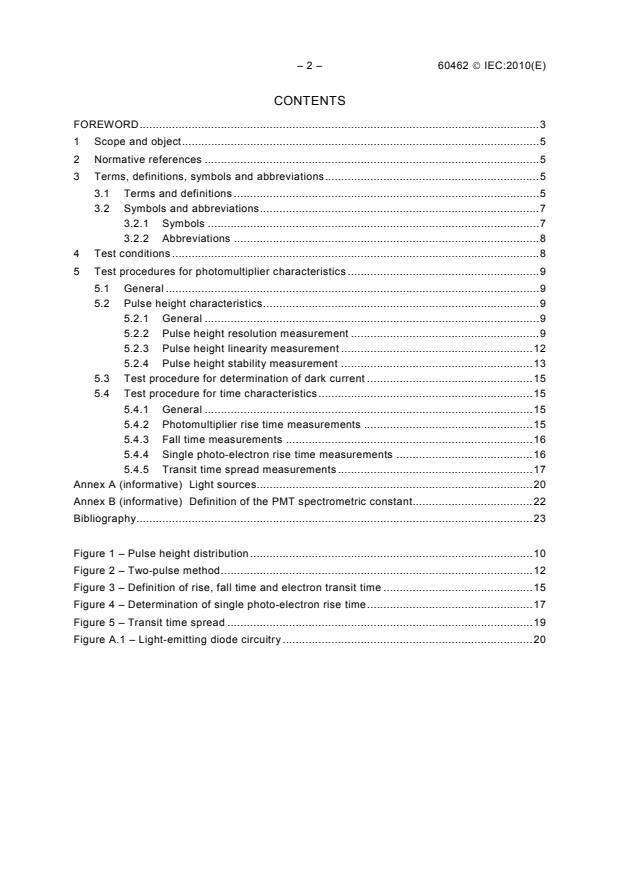
CONTENTS
FOREWORD.3
1 Scope and object.5
2 Normative references .5
3 Terms, definitions, symbols and abbreviations.5
3.1 Terms and definitions .5
3.2 Symbols and abbreviations.7
3.2.1 Symbols .7
3.2.2 Abbreviations .8
4 Test conditions .8
5 Test procedures for photomultiplier characteristics .9
5.1 General .9
5.2 Pulse height characteristics.9
5.2.1 General .9
5.2.2 Pulse height resolution measurement .9
5.2.3 Pulse height linearity measurement .12
5.2.4 Pulse height stability measurement .13
5.3 Test procedure for determination of dark current .15
5.4 Test procedure for time characteristics.15
5.4.1 General .15
5.4.2 Photomultiplier rise time measurements .15
5.4.3 Fall time measurements .16
5.4.4 Single photo-electron rise time measurements .16
5.4.5 Transit time spread measurements .17
Annex A (informative) Light sources.20
Annex B (informative) Definition of the PMT spectrometric constant.22
Bibliography.23
Figure 1 – Pulse height distribution.10
Figure 2 – Two-pulse method.12
Figure 3 – Definition of rise, fall time and electron transit time .15
Figure 4 – Determination of single photo-electron rise time.17
Figure 5 – Transit time spread .19
Figure A.1 – Light-emitting diode circuitry .20
60462 © IEC:2010(E) – 3 –
INTERNATIONAL ELECTROTECHNICAL COMMISSION
____________
NUCLEAR INSTRUMENTATION –
PHOTOMULTIPLIER TUBES FOR SCINTILLATION COUNTING –
TEST PROCEDURES
FOREWORD
1) The International Electrotechnical Commission (IEC) is a worldwide organization for standardization comprising
all national electrotechnical committees (IEC National Committees). The object of IEC is to promote
international co-operation on all questions concerning standardization in the electrical and electronic fields. To
this end and in addition to other activities, IEC publishes International Standards, Technical Specifications,
Technical Reports, Publicly Available Specifications (PAS) and Guides (hereafter referred to as “IEC
Publication(s)”). Their preparation is entrusted to technical committees; any IEC National Committee interested
in the subject dealt with may participate in this preparatory work. International, governmental and non-
governmental organizations liaising with the IEC also participate in this preparation. IEC collaborates closely
with the International Organization for Standardization (ISO) in accordance with conditions determined by
agreement between the two organizations.
2) The formal decisions or agreements of IEC on technical matters express, as nearly as possible, an international
consensus of opinion on the relevant subjects since each technical committee has representation from all
interested IEC National Committees.
3) IEC Publications have the form of recommendations for international use and are accepted by IEC National
Committees in that sense. While all reasonable efforts are made to ensure that the technical content of IEC
Publications is accurate, IEC cannot be held responsible for the way in which they are used or for any
misinterpretation by any end user.
4) In order to promote international uniformity, IEC National Committees undertake to apply IEC Publications
transparently to the maximum extent possible in their national and regional publications. Any divergence
between any IEC Publication and the corresponding national or regional publication shall be clearly indicated in
the latter.
5) IEC itself does not provide any attestation of conformity. Independent certification bodies provide conformity
assessment services and, in some areas, access to IEC marks of conformity. IEC is not responsible for any
services carried out by independent certification bodies.
6) All users should ensure that they have the latest edition of this publication.
7) No liability shall attach to IEC or its directors, employees, servants or agents including individual experts and
members of its technical committees and IEC National Committees for any personal injury, property damage or
other damage of any nature whatsoever, whether direct or indirect, or for costs (including legal fees) and
expenses arising out of the publication, use of, or reliance upon, this IEC Publication or any other IEC
Publications.
8) Attention is drawn to the Normative references cited in this publication. Use of the referenced publications is
indispensable for the correct application of this publication.
9) Attention is drawn to the possibility that some of the elements of this IEC Publication may be the subject of
patent rights. IEC shall not be held responsible for identifying any or all such patent rights.
International Standard IEC 60462 has been prepared by IEC technical committee 45: Nuclear
instrumentation.
This second edition cancels and replaces the first edition published in 1974 and constitutes a
technical revision.
The main technical changes with regard to the previous edition are as follows:
• to review the existing requirements and to update the terminology, definitions and
normative references.
The text of this standard is based on the following documents:
FDIS Report on voting
45/706/FDIS 45/711/RVD
Full information on the voting for the approval of this standard can be found in the report on
voting indicated in the above table.
– 4 – 60462 © IEC:2010(E)
This publication has been drafted in accordance with the ISO/IEC Directives, Part 2.
The committee has decided that the contents of this publication will remain unchanged until
the stability date indicated on the IEC web site under "http://webstore.iec.ch" in the data
related to the specific publication. At this date, the publication will be
• reconfirmed,
• withdrawn,
• replaced by a revised edition, or
• amended.
A bilingual version of this publication may be issued at a later date.
60462 © IEC:2010(E) – 5 –
NUCLEAR INSTRUMENTATION –
PHOTOMULTIPLIER TUBES FOR SCINTILLATION COUNTING –
TEST PROCEDURES
1 Scope and object
This International Standard establishes test procedures for photomultiplier tubes (PMT) for
scintillation and Cherenkov detectors.
This standard is applicable to photomultiplier tubes for scintillation and Cherenkov detectors.
Photomultiplier tubes are extensively used in scintillation and Cherenkov counting, both in the
detection and analysis of ionizing radiation and for other applications. For such uses, various
characteristics are of particular importance and require additional tests to those conducted to
measure the general characteristics of PMT. This has made desirable the establishment of
standard test procedures so that measurements of these specific characteristics may have the
same significance to all manufacturers and users.
The tests described in this standard for PMT to be used in scintillation detectors are
supplementary to those tests described in IEC 60306-4, which covers the basic characteristics
commonly requiring specification for photomultiplier tubes.
This recommendation is not intended to imply that all tests and procedures described herein
are mandatory for every application, but only that those tests carried out on PMT for
scintillation and Cherenkov detectors should be performed in accordance with the procedures
given in this standard.
2 Normative references
The following referenced documents are indispensable for the application of this document.
For dated references, only the edition cited applies. For undated references, the latest edition
of the referenced document (including any amendments) applies.
IEC 60306-4, Measurement of photosensitive devices – Part 4: Methods of measurement for
photomultipliers
3 Terms, definitions, symbols and abbreviations
3.1 Terms and definitions
For the purposes of this document, the following terms and definitions apply.
3.1.1
photomultiplier tube
multiplier phototube
PMT (abbreviation)
vacuum tube consisting of a photocathode and an electron multiplier intended to convert light
into an electric signal
[IEC 60050-394:2007, 394-30-12]
– 6 – 60462 © IEC:2010(E)
3.1.2
Cherenkov detector
radiation detector designed to detect relativistic particles, using a medium in which the
Cherenkov effect is produced
NOTE The medium is optically coupled to a photosensitive device, either directly or through light guides.
[IEC 60050-394:2007, 394-29-17]
3.1.3
scintillation detector
radiation detector consisting of a scintillator that is usually optically coupled to a
photosensitive device, either directly or through light guides
NOTE The scintillator consists of a scintillating material in which the ionizing particle produces a burst of
luminescence radiation along its path.
[IEC 60050-394:2007, 394-27-01]
3.1.4
light guide
optical device designed to transmit light without significant loss
NOTE It may be placed between a scintillator and a photomultiplier tube.
[IEC 60050-394:2007, 394-30-15]
3.1.5
dark current (of a photomultiplier tube)
electric current flowing from the anode circuit in the absence of light on the photocathode
[IEC 60050-394:2007, 394-38-14]
3.1.6
gain (of a photomultiplier tube)
ratio of the anode output current to the current emitted by the photocathode at stated
electrode voltages
[IEC 60050-394:2007, 394-38-15]
3.1.7
collection efficiency (of a photomultiplier tube)
ratio of the number of measurable electrons reaching the first dynode to the number of
electrons emitted by the photocathode
[IEC 60050-394:2007, 394-38-16]
3.1.8
light sensitivity (of a photomultiplier)
ratio of a photomultiplier cathode current by the corresponding incident light flux of a given
wavelength
[IEC 60050-394:2007, 394-38-62]
3.1.9
spectral sensitivity (of a photomultiplier)
light sensitivity as a function of wavelength
[IEC 60050-394:2007, 394-38-63]
60462 © IEC:2010(E) – 7 –
3.1.10
light sensitivity non-uniformity (of a photomultiplier)
variation of the light sensitivity over the photocathode surface
[IEC 60050-394:2007, 394-38-64]
3.1.11
transit time (in a photomultiplier tube)
time interval between the emission of a photo-electron and the occurrence of a stated point on
the output current pulse due to that electron
[IEC 60050-394:2007, 394-38-12]
NOTE For example, peak maximum.
3.1.12
transit time jitter (in a photomultiplier tube)
variation in the transit times corresponding to different photoelectrons
[IEC 60050-394:2007, 394-38-13]
3.2 Symbols and abbreviations
3.2.1 Symbols
A photomultiplier tube spectrometric constant;
C light output of the working standard in photon/MeV;
pho
H pulse height or peakposition without filter;
H’ pulse height or peak position with filter;
k absorption factor of the filter;
n total number of readings;
P P is the pulse height corresponding to the peak-value of the distribution;
P mean pulse height averaged over n readings;
th
P pulse height at the i reading;
i
P maximum pulse height, recorded during the 16 h test interval;
max
P minimum pulse height; recorded during the 16 h test interval;
min
P pulse height at temperature T;
T
o
P pulse height at temperature T = 20 C;
N
P pulse height when PMT stands upright;
UP
P pulse height when PMT lies along north-south direction;
NS
R pulse height resolution (PHR);
R energy resolution of the scintillation detector;
a
R intrinsic resolution of the measured housed scintillator;
d
R intrinsic resolution of the working standard;
et
t observed time;
t photomultiplier rise time;
r
t rise time of the source pulse;
s
t oscilloscope rise time;
scp
X pulse height linearity;
V value of pulse height corresponding to total absorption peak maximum of the
measured housed scintillator;
– 8 – 60462 © IEC:2010(E)
∆ mean pulse height deviation;
∆ maximum pulse height deviation, in percent;
max
∆P full-width at half-maximum (FWHM);
∆ pulse height shift, in percent;
T
∆ deviation of pulse-heights.
μ-metal
3.2.2 Abbreviations
CFTD constant fraction timing discriminator;
FWHM full-width at half-maximum;
LED light emitting diode;
MCA multichannel analyzer;
PHD pulse height distribution;
PHR pulse height resolution;
PMT photomultiplier tube;
–1
s counts per second;
SPEPHR single photo-electron pulse height resolution;
SPERT single photo-electron rise time;
TAC time-to-amplitude converter:
TTS transit-time spread.
4 Test conditions
Test conditions for photomultipliers are specified in terms of environmental conditions that
shall be met to enable accurate measurements of the photomultiplier parameters discussed in
this standard.
Power supplies should be stabilized and, in particular, high-voltage power supplies should
have regulations of 0,01 % or better, and ripple and noise should be not more than 10 mV .
pp
The test enclosure shall be free of detectable light leaks. This can be verified by half-hour
photon counting periods, with and without bright ambient light incident on the enclosure.
The PMT should be stored in darkness for 1 h prior to measurement to avoid
phosphorescence effects. Cleanliness of the PMT glass and sockets is essential in preventing
external noise effects. Any material near the photocathode should be at photocathode
potential to prevent electro-luminescence of the envelope and electrolysis or charge
accumulation of the glass. To obtain the best conditions for reproducibility of tests, it is
recommended that where feasible, a shield connected to cathode potential, be placed around
and in contact with the glass envelope of the photomultiplier.
The PMT should be degaussed before using, and a magnetic shield should be employed.
Note that even the earth's magnetic field is of sufficient strength to influence measurements.
Tube temperature should preferably be maintained constant at ± 2 °C within the limits from
19 °C to 25 °C. This is important in instances where the voltage divider may raise the
temperature of the test enclosure.
Caution should be used to avoid drifts or base line shifts in the electronic circuitry that
significantly affects the measurements.
To prevent drifts or base line shifts in potentials between dynodes resulting from the electron
multiplier current, the quiescent current drawn by the resistive voltage divider should be at
60462 © IEC:2010(E) – 9 –
least 20 times the DC anode current. Alternatively, the potentials between dynodes for the
dynodes drawing the greatest current may be individually stabilized (as with separate power
supplies).
Charge-storage capacitors may be effectively used across the dynodes or from the dynodes
to ground when the ratio of the peak anode current to the average anode current is large and
the capacitor can maintain the required dynode potentials for the duration of the pulse.
Pulse shaping methods and time constants suitable for optimum performance should be used
and should be stated.
5 Test procedures for photomultiplier characteristics
5.1 General
In addition to the specifications and test methods of IEC 60306-4, complementary or extended
specifications and tests required for photomultipliers used with scintillation and Cherenkov
detectors are:
.
a) Pulse height characteristics
b) Dark current.
c) Pulse timing characteristics.
5.2 Pulse height characteristics
5.2.1 General
Pulse height is used in counting and spectrometric applications.
5.2.2 Pulse height resolution measurement
5.2.2.1 General
In general there are four distinct PHR measurements to define the photon-and-electron
resolution of PMT and scintillator/PMT combinations. These resolutions may be used
separately or together.
5.2.2.2 Cs PHR for a scintillator/PMT combination
This PHR is a function of the photocathode quantum efficiency, collection efficiencies of the
dynodes and spatial uniformity, as well as the resolution of the scintillator.
137 137
For standard cases, measurement of Cs pulse height resolution requires a Cs source, a
Nal(Tl) scintillator of 50 mm height and approximately the same diameter as the
photocathode, a pulse height analyzer and the photomultiplier to be tested. The
photomultiplier tube is optically coupled to the scintillator - for example, with the aid of
silicone grease or viscous oil. The crystal housing should be at photocathode potential. The
source is placed at a distance from the scintillator such that less than 1 000 pulses/s are
encountered.
The PMT should be operated at a voltage such that a linear response is obtained, i.e. the
output pulse height is proportional to input light intensity. Improper anode bias, excessive gain
(and thus excessive anode current) or improper voltage divider circuits may give rise to a
compression of the output pulse distribution, yielding an incorrect (low) value of PHR.
The tube/scintillator combination should warm-up for 1 h to obtain optimum PHR.
—————————
The terms “pulse amplitude” and “pulse height” are commonly used to designate the charge associated with a
PMT output pulse.
– 10 – 60462 © IEC:2010(E)
Phosphorescence of the scintillator and the PMT window may require 12 h to decay to a
sufficiently low level to permit accurate measurements to be made. Therefore,
photomultipliers and scintillators should not be exposed to ambient light for 12 h before
measurements are made.
The test enclosure shall be designed to avoid high electric fields in the region of the
photocathode. If the PMT is operated with ground potential at the photocathode (positive high
voltage) there is little problem with external electric fields at the photocathode. If negative
high voltage is used, electric fields near the photocathode should be low. This may be
accomplished by an electrostatic shield at photocathode potential. Otherwise, excessive noise
on the output signal, followed by eventual loss of photosensitivity, may develop. As with all
PMT measurements, a magnetic shield is required.
The Cs distribution should be displayed on a pulse height analyzer and so positioned that
the upper half of the full-energy peak distribution spans at least eight channels. The total
–1
counting rate should not exceed 1 000 s and the integration and differentiation time
constants should not exceed 5 μs. At least 50 000 counts shall be contained within the
channels comprising the FWHM.
Pulse height resolution (PHR), in percent, is obtained from:
R = ∆P/P × 100 (1)
where
R pulse height resolution in percent;
∆P FWHM as shown in Figure 1;
P pulse height corresponding to the peak value of the distribution.
ΔP
P
Pulse height
IEC 1612/10
Figure 1 – Pulse height distribution
A linear interpolation should be made to determine the value ∆P. Alternatively, other curve-
fitting techniques may be used. The method employed should be described.
In the case of a computer-controlled pulse height analyzer, a different method can be
employed to determine the FWHM by assuming that the upper-part of the full energy peak
approximates a Gaussian distribution. While the observed distribution is usually slightly
skewed and not truly Gaussian, PHR values determined on the basis of a Gaussian
distribution will, in general, agree closely with values obtained from the former method.
Relative frequency
60462 © IEC:2010(E) – 11 –
5.2.2.3 Light emitting source PHR
This PHR (intrinsic photomultiplier resolution) is obtained with a light emitting source such as
a light emitting diode (LED) (see Annex A), calibrated to provide a Cs- Nal(Tl) scintillator -
equivalent signal (or stated number of photoelectrons per pulse). The light emitting source
PHR is considerably smaller than the scintillator/PMT PHR because the contribution of the
scintillator is not present.
The light emitting source PHR should be stated in terms of a Cs-equivalent flash; the light
emitting source should be adjusted in flash intensity until the resulting pulse height
distribution exhibits a peak in the same channel as a Nal(Tl) scintillator and Cs source
combination. The light emitting source shall be positioned such that it uniformly illuminates
the photocathode. PHR may be calculated from the previously discussed method (see
equation 1). The integration time of the electronic circuits shall be much longer than the
duration of the light flash and the time constant of the scintillator.
This measurement of PHR may be independently verified with another calibrated light emitting
source, and good agreement should be obtained. This type of independent measurement is
not as straightforward when Nal(TI) scintillators are used owing to variations in resolution
between different scintillators.
5.2.2.4 Fe PHR for a scintillator/PMT combination
Pulse height resolution for a Fe (5,9 keV, X-ray) source, using a Nal(Tl) scintillator coupled
to the PMT, provides a figure of merit for resolution of low-energy events.
This is the PHR
...