

IEC 63409-3:2025
(Main)Photovoltaic power generating systems connection with the grid - Testing of power conversion equipment - Part 3: Basic operations
General Information
- Abstract
IEC 63409-3:2025 specifies test procedures for confirming the basic operational characteristics of power conversion equipment (PCE) for use in photovoltaic (PV) power systems with or without energy storage. The basic operational characteristics are the capability of the PCE before any limitations due to internal settings are applied to the PCE to meet specific grid support functions or specific behaviours against abnormal changes.
This document covers the testing of the following items:
a) Steady state characteristics
Test procedures to confirm operable range of PCE at steady state condition are described. The operable ranges in apparent power, active power, reactive power, power factor, grid voltage and grid frequency are confirmed according to the test procedures.
b) Transient-response characteristics
Test procedures to confirm PCE’s response against a change of operational condition are described.
This document only considers the changes within normal (continuous) operable ranges. Therefore, the behaviours against abnormal changes and grid support functions are out of the scope and are covered in other parts of this series.
- Status
- Published
- Publication Date
- 02-Dec-2025
- Technical Committee
- TC 82 - Solar photovoltaic energy systems
- Drafting Committee
- WG 6 - TC 82/WG 6
- Current Stage
- PPUB - Publication issued
- Start Date
- 03-Dec-2025
- Completion Date
- 28-Nov-2025
Buy Documents


IEC 63409-3:2025 - Photovoltaic power generating systems connection with the grid - Testing of power conversion equipment - Part 3: Basic operations Released:12/3/2025
IEC 63409-3:2025 - Systemes de production d’énergie photovoltaique connectés au réseau - Essais des équipements de conversion de puissance - Partie 3: Opérations de base Released:12/3/2025
IEC 63409-3:2025 - Photovoltaic power generating systems connection with the grid - Testing of power conversion equipment - Part 3: Basic operations Released:12/3/2025
Overview
IEC 63409-3:2025 - Photovoltaic power generating systems connection with the grid - Testing of power conversion equipment - Part 3: Basic operations - specifies standardized test procedures to confirm the basic operational characteristics of power conversion equipment (PCE) used in photovoltaic (PV) systems, with or without energy storage. The standard defines tests that verify PCE behaviour before any manufacturer-set limits or grid-support settings are applied. It is focused on normal continuous operation; behaviours under abnormal conditions and advanced grid-support functions are covered in other parts of the IEC 63409 series.
Key topics and technical requirements
- Steady-state characteristics
- Verification of operable ranges in apparent power, active power, reactive power, power factor, grid voltage and grid frequency.
- Test procedures and reporting formats to document PCE capability curves (P–Q) and operating envelopes.
- Transient-response characteristics
- Procedures to confirm PCE response to changes within normal operating ranges (e.g., step changes in setpoints or grid conditions).
- Tests for active power control, reactive power control, grid voltage variation, phase-angle steps, voltage unbalance, and frequency variation.
- General testing framework
- Required test setup, sequence of tests, equipment conditions, firmware and MPPT considerations, and manufacturer tolerances.
- Annexes provide test item summaries, record formats, recommended test environments, settling time measurement methods, sign conventions, and guidance on PV simulator influence.
Practical applications and who uses this standard
IEC 63409-3:2025 is essential for:
- Inverter and PCE manufacturers - for type testing and documenting baseline device capabilities prior to enabling grid-support functions.
- Test laboratories and certification bodies - to perform repeatable, accredited conformity testing for grid connection requirements.
- Utilities and system integrators - to verify PCE behaviour during procurement, commissioning, and acceptance testing in PV plants (with or without energy storage).
- Regulators and standards committees - to harmonize minimum test procedures for grid interconnection and interoperability.
- R&D and product development teams - to compare transient and steady-state performance across designs.
Practical outcomes include verified P–Q capability curves, documented transient settling times, and standardized reports that simplify grid-connection compliance and performance benchmarking.
Related standards
- IEC 63409-3 is part of the IEC 63409 series. Other parts of the series address grid support functions and equipment behaviour under abnormal grid conditions (out of scope for Part 3). For full compliance testing, consult the other parts of the series and local grid codes.
Keywords: IEC 63409-3:2025, photovoltaic, power conversion equipment, PCE testing, inverter testing, steady state characteristics, transient response, grid connection testing, PV systems, energy storage.
Buy Documents
IEC 63409-3:2025 - Photovoltaic power generating systems connection with the grid - Testing of power conversion equipment - Part 3: Basic operations Released:12/3/2025
IEC 63409-3:2025 - Systemes de production d’énergie photovoltaique connectés au réseau - Essais des équipements de conversion de puissance - Partie 3: Opérations de base Released:12/3/2025
IEC 63409-3:2025 - Photovoltaic power generating systems connection with the grid - Testing of power conversion equipment - Part 3: Basic operations Released:12/3/2025
Get Certified
Connect with accredited certification bodies for this standard

DNV
DNV is an independent assurance and risk management provider.

Lloyd's Register
Lloyd's Register is a global professional services organisation specialising in engineering and technology.
DNV Energy Systems
Energy and renewable energy certification.
Sponsored listings
Frequently Asked Questions
IEC 63409-3:2025 is a standard published by the International Electrotechnical Commission (IEC). Its full title is "Photovoltaic power generating systems connection with the grid - Testing of power conversion equipment - Part 3: Basic operations". This standard covers: IEC 63409-3:2025 specifies test procedures for confirming the basic operational characteristics of power conversion equipment (PCE) for use in photovoltaic (PV) power systems with or without energy storage. The basic operational characteristics are the capability of the PCE before any limitations due to internal settings are applied to the PCE to meet specific grid support functions or specific behaviours against abnormal changes. This document covers the testing of the following items: a) Steady state characteristics Test procedures to confirm operable range of PCE at steady state condition are described. The operable ranges in apparent power, active power, reactive power, power factor, grid voltage and grid frequency are confirmed according to the test procedures. b) Transient-response characteristics Test procedures to confirm PCE’s response against a change of operational condition are described. This document only considers the changes within normal (continuous) operable ranges. Therefore, the behaviours against abnormal changes and grid support functions are out of the scope and are covered in other parts of this series.
IEC 63409-3:2025 specifies test procedures for confirming the basic operational characteristics of power conversion equipment (PCE) for use in photovoltaic (PV) power systems with or without energy storage. The basic operational characteristics are the capability of the PCE before any limitations due to internal settings are applied to the PCE to meet specific grid support functions or specific behaviours against abnormal changes. This document covers the testing of the following items: a) Steady state characteristics Test procedures to confirm operable range of PCE at steady state condition are described. The operable ranges in apparent power, active power, reactive power, power factor, grid voltage and grid frequency are confirmed according to the test procedures. b) Transient-response characteristics Test procedures to confirm PCE’s response against a change of operational condition are described. This document only considers the changes within normal (continuous) operable ranges. Therefore, the behaviours against abnormal changes and grid support functions are out of the scope and are covered in other parts of this series.
IEC 63409-3:2025 is classified under the following ICS (International Classification for Standards) categories: 27.160 - Solar energy engineering. The ICS classification helps identify the subject area and facilitates finding related standards.
IEC 63409-3:2025 is available in PDF format for immediate download after purchase. The document can be added to your cart and obtained through the secure checkout process. Digital delivery ensures instant access to the complete standard document.
Standards Content (Sample)
IEC 63409-3 ®
Edition 1.0 2025-12
INTERNATIONAL
STANDARD
Photovoltaic power generating systems connection with the grid - Testing of
power conversion equipment -
Part 3: Basic operations
ICS 27.160 ISBN 978-2-8327-0818-7
All rights reserved. Unless otherwise specified, no part of this publication may be reproduced or utilized in any form or
by any means, electronic or mechanical, including photocopying and microfilm, without permission in writing from either
IEC or IEC's member National Committee in the country of the requester. If you have any questions about IEC copyright
or have an enquiry about obtaining additional rights to this publication, please contact the address below or your local
IEC member National Committee for further information.
IEC Secretariat Tel.: +41 22 919 02 11
3, rue de Varembé info@iec.ch
CH-1211 Geneva 20 www.iec.ch
Switzerland
About the IEC
The International Electrotechnical Commission (IEC) is the leading global organization that prepares and publishes
International Standards for all electrical, electronic and related technologies.
About IEC publications
The technical content of IEC publications is kept under constant review by the IEC. Please make sure that you have the
latest edition, a corrigendum or an amendment might have been published.
IEC publications search - IEC Products & Services Portal - products.iec.ch
webstore.iec.ch/advsearchform Discover our powerful search engine and read freely all the
The advanced search enables to find IEC publications by a
publications previews, graphical symbols and the glossary.
variety of criteria (reference number, text, technical With a subscription you will always have access to up to date
committee, …). It also gives information on projects, content tailored to your needs.
replaced and withdrawn publications.
Electropedia - www.electropedia.org
IEC Just Published - webstore.iec.ch/justpublished The world's leading online dictionary on electrotechnology,
Stay up to date on all new IEC publications. Just Published containing more than 22 500 terminological entries in English
details all new publications released. Available online and and French, with equivalent terms in 25 additional languages.
once a month by email. Also known as the International Electrotechnical Vocabulary
(IEV) online.
IEC Customer Service Centre - webstore.iec.ch/csc
If you wish to give us your feedback on this publication or
need further assistance, please contact the Customer
Service Centre: sales@iec.ch.
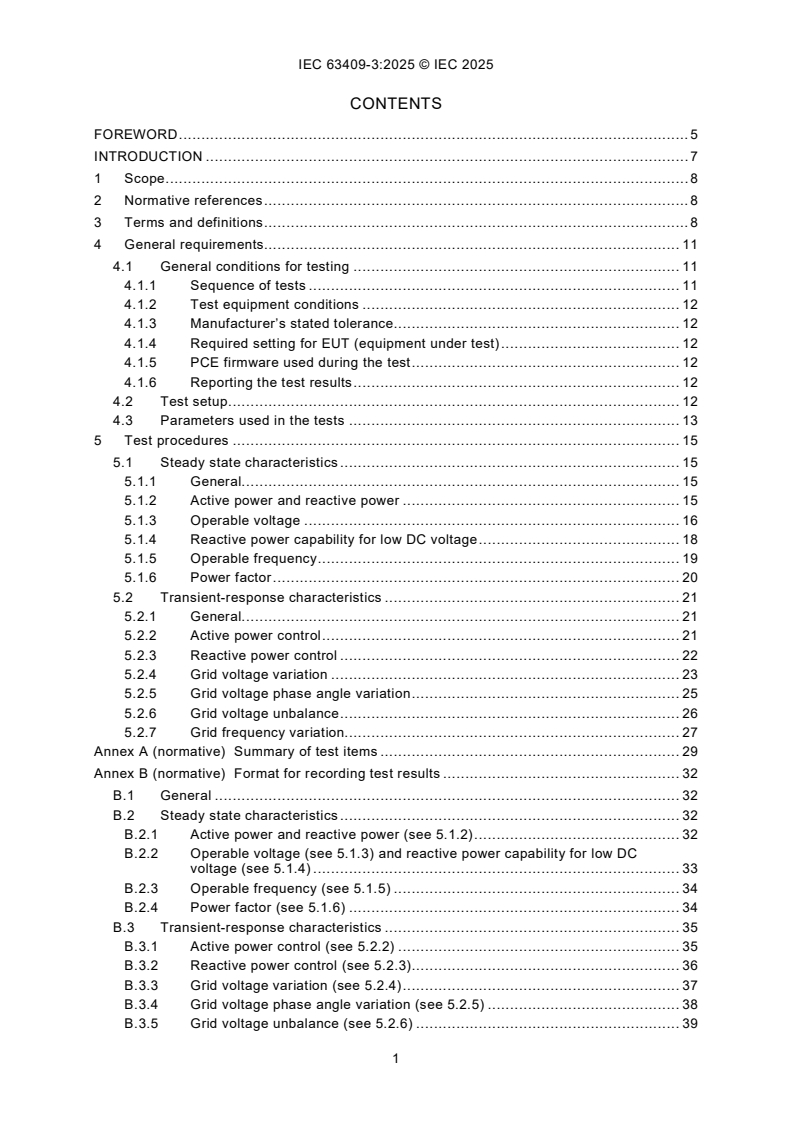
CONTENTS
FOREWORD . 5
INTRODUCTION . 7
1 Scope . 8
2 Normative references . 8
3 Terms and definitions . 8
4 General requirements. 11
4.1 General conditions for testing . 11
4.1.1 Sequence of tests . 11
4.1.2 Test equipment conditions . 12
4.1.3 Manufacturer’s stated tolerance . 12
4.1.4 Required setting for EUT (equipment under test) . 12
4.1.5 PCE firmware used during the test . 12
4.1.6 Reporting the test results . 12
4.2 Test setup . 12
4.3 Parameters used in the tests . 13
5 Test procedures . 15
5.1 Steady state characteristics . 15
5.1.1 General. 15
5.1.2 Active power and reactive power . 15
5.1.3 Operable voltage . 16
5.1.4 Reactive power capability for low DC voltage . 18
5.1.5 Operable frequency . 19
5.1.6 Power factor . 20
5.2 Transient-response characteristics . 21
5.2.1 General. 21
5.2.2 Active power control . 21
5.2.3 Reactive power control . 22
5.2.4 Grid voltage variation . 23
5.2.5 Grid voltage phase angle variation . 25
5.2.6 Grid voltage unbalance . 26
5.2.7 Grid frequency variation. 27
Annex A (normative) Summary of test items . 29
Annex B (normative) Format for recording test results . 32
B.1 General . 32
B.2 Steady state characteristics . 32
B.2.1 Active power and reactive power (see 5.1.2) . 32
B.2.2 Operable voltage (see 5.1.3) and reactive power capability for low DC
voltage (see 5.1.4) . 33
B.2.3 Operable frequency (see 5.1.5) . 34
B.2.4 Power factor (see 5.1.6) . 34
B.3 Transient-response characteristics . 35
B.3.1 Active power control (see 5.2.2) . 35
B.3.2 Reactive power control (see 5.2.3) . 36
B.3.3 Grid voltage variation (see 5.2.4) . 37
B.3.4 Grid voltage phase angle variation (see 5.2.5) . 38
B.3.5 Grid voltage unbalance (see 5.2.6) . 39
B.3.6 Grid frequency variation (see 5.2.7) . 40
Annex C (informative) Examples of testing environments . 42
C.1 General . 42
C.2 Recommended specification of power supplies . 44
C.3 Recommended specification of measuring instruments . 45
Annex D (normative) Supplemental information for settling time measurement . 47
Annex E (normative) Sign conventions for measurements of voltage, current and
power . 48
E.1 General . 48
E.2 Reference polarity and direction . 48
E.2.1 Reference polarity of voltage . 48
E.2.2 Reference direction of current . 48
E.2.3 Sign conventions for measurements of voltage, current and power . 49
E.3 Reference frame of active and reactive power . 49
E.4 Physical meanings of the power flows of generators in regional standards . 54
Annex F (normative) Grid voltage unbalance – test condition . 56
F.1 General . 56
F.2 Causes and definitions of unbalanced grid voltage . 56
F.3 Test conditions . 56
Annex G (informative) Phase angle variation of grid voltage – alternative test setup . 57
G.1 General . 57
G.2 Alternative test setup and test procedure . 57
Annex H (informative) Fundamental principle of reactive power reduction with lower
DC voltage. 58
H.1 General . 58
H.2 Controllability limit . 58
Annex I (informative) Grid support functions covered in IEC 63409 series . 62
Annex J (informative) Influence of MPPT control and PV simulator to the test results . 63
J.1 General . 63
J.2 DC power supply and MPPT control of PCE . 63
J.2.1 DC power supply. 63
J.2.2 MPPT control. 63
J.3 Influence of the PV simulator . 63
Bibliography . 66
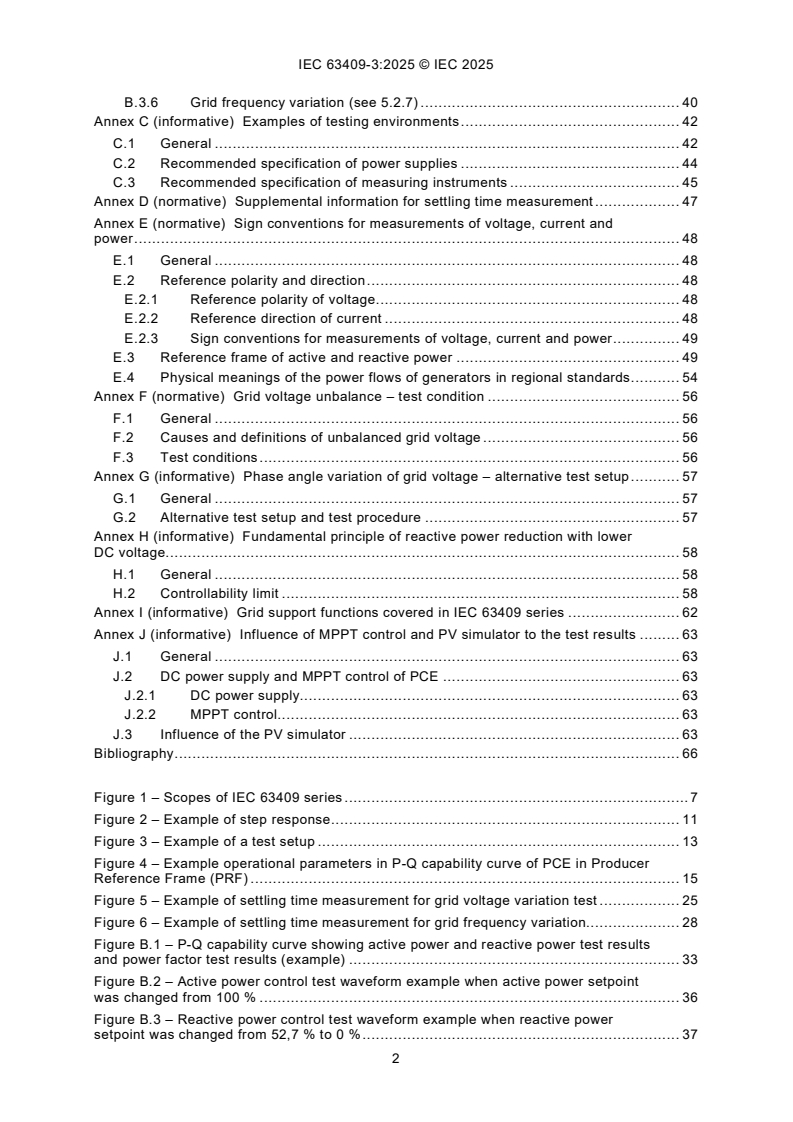
Figure 1 – Scopes of IEC 63409 series . 7
Figure 2 – Example of step response . 11
Figure 3 – Example of a test setup . 13
Figure 4 – Example operational parameters in P-Q capability curve of PCE in Producer
Reference Frame (PRF) . 15
Figure 5 – Example of settling time measurement for grid voltage variation test . 25
Figure 6 – Example of settling time measurement for grid frequency variation. 28
Figure B.1 – P-Q capability curve showing active power and reactive power test results
and power factor test results (example) . 33
Figure B.2 – Active power control test waveform example when active power setpoint
was changed from 100 % . 36
Figure B.3 – Reactive power control test waveform example when reactive power
setpoint was changed from 52,7 % to 0 % . 37
Figure B.4 – Grid voltage variation test waveform example when AC voltage was
changed from 100 % to 110 % . 38
Figure B.5 – Phase angle of grid voltage change test waveform example (10-degree
step change was applied to AC voltages for illustrative purpose) . 39
Figure B.6 – Grid voltage unbalance test waveform example when negative sequence
voltage was applied to AC voltages . 40
Figure B.7 – Grid frequency variation test waveform example when AC frequency was
changed from 50 Hz to 50,5 Hz . 41
Figure C.1 – Example of a testing environment . 42
Figure D.1 – Example of settling time measurement for grid voltage variation in case
the settled power is different from the original steady state . 47
Figure E.1 – Reference polarity of voltage. 48
Figure E.2 – Reference polarity of current . 48
Figure E.3 – Reference polarity and direction for the measurements for DER . 49
Figure E.4 – Reference polarity and direction for the measurements for load . 49
Figure E.5 – Rotating vector voltage and current for load . 50
Figure E.6 – Rotating vector voltage and current for DER . 50
Figure E.7 – Complex power for load . 52
Figure E.8 – Complex power for DER . 52
Figure E.9 – Power quadrants for load . 53
Figure E.10 – Power quadrants for DER . 53
Figure G.1 – Configuration of an alternative test setup . 57
Figure H.1 – Basic configuration of a power conversion equipment . 58
Figure H.2 – EUT voltage and current vector diagram and operating point depicted in
the PQ curve with sufficient U (over-excited) . 60
ac
Figure H.3 – EUT voltage and current vector diagram and operating point depicted in
the PQ curve with small U (over-excited) . 60
ac
Figure H.4 – EUT voltage and current vector diagram and operating point depicted in
the PQ curve with small U (under-excited) . 60
ac
Figure H.5 – EUT voltage and current vector diagram and operating point depicted in
the PQ curve during inflexion operating point (over-excited). 61
Figure J.1 – PV simulator characteristics examples . 63
Figure J.2 – Active power control test waveform with constant DC voltage source and
no MPPT . 64
Figure J.3 – Active power control test waveform with PV simulator and MPPT enabled . 65
Figure J.4 – Examples of operational point movement of a PCE during Active power
control tests . 65
Table 1 – Parameters defined for the tests . 14
Table 2 – Test conditions for operable voltage test . 18
Table 3 – Test conditions for operable frequency test . 20
Table 4 – Test cases for grid voltage unbalance . 27
Table A.1 – Test items for steady state characteristics (example) . 29
Table A.2 – Test items for transient-response characteristics (example) . 30
Table B.1 – Record of active power and reactive power test (example) . 32
Table B.2 – Record of operable voltage test (example) . 34
Table B.3 – Record of operable frequency test (example) . 34
Table B.4 – Record of power factor test (example) . 35
Table B.5 – Record of active power control test (example) . 35
Table B.6 – Record of reactive power control test (example) . 36
Table B.7 – Record of grid voltage variation test (example). 37
Table B.8 – Record of grid voltage phase angle variation test (example) . 38
Table B.9 – Record of grid voltage unbalance test (example) . 39
Table B.10 – Record of grid frequency variation test (example) . 40
Table C.1 – Required functions for power supplies . 43
Table C.2 – Electrical quantity measured with measuring instruments or devices . 43
Table C.3 – Recommended specifications for power supplies . 44
Table C.4 – Recommended specifications of power quality measurement . 45
Table C.5 – Recommended specifications of waveform monitoring and recording
device . 46
Table E.1 – Physical meanings of the power flows of loads . 53
Table E.2 – Physical meanings of the power flows of generators . 54
Table E.3 – Physical meanings of the power flows of generators in Japan . 54
Table E.4 – Physical meanings of the power flows of generators in IEEE 1547.1. 54
Table E.5 – Physical meanings of the power flows of generators in EN 50549-10 . 54
Table E.6 – Physical meanings of the power flows of generators in AS/NZS 4777.2 . 55
Table I.1 – Grid support functions covered in IEC 63409 series . 62
INTERNATIONAL ELECTROTECHNICAL COMMISSION
____________
Photovoltaic power generating systems connection with the grid -
Testing of power conversion equipment -
Part 3: Basic operations
FOREWORD
1) The International Electrotechnical Commission (IEC) is a worldwide organization for standardization comprising
all national electrotechnical committees (IEC National Committees). The object of IEC is to promote international
co-operation on all questions concerning standardization in the electrical and electronic fields. To this end and
in addition to other activities, IEC publishes International Standards, Technical Specifications, Technical Reports,
Publicly Available Specifications (PAS) and Guides (hereafter referred to as “IEC Publication(s)”). Their
preparation is entrusted to technical committees; any IEC National Committee interested in the subject dealt with
may participate in this preparatory work. International, governmental and non-governmental organizations liaising
with the IEC also participate in this preparation. IEC collaborates closely with the International Organization for
Standardization (ISO) in accordance with conditions determined by agreement between the two organizations.
2) The formal decisions or agreements of IEC on technical matters express, as nearly as possible, an international
consensus of opinion on the relevant subjects since each technical committee has representation from all
interested IEC National Committees.
3) IEC Publications have the form of recommendations for international use and are accepted by IEC National
Committees in that sense. While all reasonable efforts are made to ensure that the technical content of IEC
Publications is accurate, IEC cannot be held responsible for the way in which they are used or for any
misinterpretation by any end user.
4) In order to promote international uniformity, IEC National Committees undertake to apply IEC Publications
transparently to the maximum extent possible in their national and regional publications. Any divergence between
any IEC Publication and the corresponding national or regional publication shall be clearly indicated in the latter.
5) IEC itself does not provide any attestation of conformity. Independent certification bodies provide conformity
assessment services and, in some areas, access to IEC marks of conformity. IEC is not responsible for any
services carried out by independent certification bodies.
6) All users should ensure that they have the latest edition of this publication.
7) No liability shall attach to IEC or its directors, employees, servants or agents including individual experts and
members of its technical committees and IEC National Committees for any personal injury, property damage or
other damage of any nature whatsoever, whether direct or indirect, or for costs (including legal fees) and
expenses arising out of the publication, use of, or reliance upon, this IEC Publication or any other IEC
Publications.
8) Attention is drawn to the Normative references cited in this publication. Use of the referenced publications is
indispensable for the correct application of this publication.
9) IEC draws attention to the possibility that the implementation of this document may involve the use of (a)
patent(s). IEC takes no position concerning the evidence, validity or applicability of any claimed patent rights in
respect thereof. As of the date of publication of this document, IEC had not received notice of (a) patent(s), which
may be required to implement this document. However, implementers are cautioned that this may not represent
the latest information, which may be obtained from the patent database available at https://patents.iec.ch. IEC
shall not be held responsible for identifying any or all such patent rights.
IEC 63409-3 has been prepared by IEC technical committee 82: Solar photovoltaic energy
systems. It is an International Standard.
The text of this International Standard is based on the following documents:
Draft Report on voting
82/2456/FDIS 82/2525/RVD
Full information on the voting for its approval can be found in the report on voting indicated in
the above table.
The language used for the development of this International Standard is English.
This document was drafted in accordance with ISO/IEC Directives, Part 2, and developed in
accordance with ISO/IEC Directives, Part 1 and ISO/IEC Directives, IEC Supplement, available
at www.iec.ch/members_experts/refdocs. The main document types developed by IEC are
described in greater detail at www.iec.ch/publications.
A list of all parts in the IEC 63409 series, published under the general title Photovoltaic power
generating systems connection with the grid – Testing of power conversion equipment, can be
found on the IEC website.
The committee has decided that the contents of this document will remain unchanged until the
stability date indicated on the IEC website under webstore.iec.ch in the data related to the
specific document. At this date, the document will be
– reconfirmed,
– withdrawn, or
– revised.
INTRODUCTION
This document gives test procedures for confirming the basic operation characteristics of power
conversion equipment (PCE).
Part 3 confirms basic power conversion control of PCE at steady state condition and at transient
response. Figure 1 shows the relationships of the seven parts in the IEC 63409 series. Part 3
is focused on the control functions in PCE with respect to power conversion. Power flow control
and grid support functions will generate active and reactive power commands according to the
grid conditions. The commands are sent to power conversion control, and power conversion
control will make current or voltage references, which manipulate signals for the switching
devices.
It is important to confirm the basic control performance of the PCE as power conversion
equipment without power flow control and grid support functions, so that additional functions
such as power flow control and grid support functions can perform appropriately.
The responses of PCE against abnormal grid conditions will be covered in Part 4 (IEC 63409-4).
Power quality of the PCE output will be covered in Part 5 (IEC 63409-5).
Power flow control and grid support functions will be covered in Part 6 (IEC 63409-6).
Responses against commands through communication will be covered Part 7 (IEC 63409-7).
Figure 1 – Scopes of IEC 63409 series
1 Scope
This document specifies test procedures for confirming the basic operational characteristics of
power conversion equipment (PCE) for use in photovoltaic (PV) power systems with or without
energy storage. The basic operational characteristics are the capability of the PCE before any
limitations due to internal settings are applied to the PCE to meet specific grid support functions
or specific behaviours against abnormal changes.
This document covers the testing of the following items:
a) Steady state characteristics
Test procedures to confirm operable range of PCE at steady state condition are described.
The operable ranges in apparent power, active power, reactive power, power factor, grid
voltage and grid frequency are confirmed according to the test procedures.
b) Transient-response characteristics
Test procedures to confirm PCE’s response against a change of operational condition are
described.
Transient-response characteristics to be confirmed are response behaviours against:
• Active power set point change and reactive power set point change
• Grid voltage change, phase angle change, voltage unbalance and frequency change
This document only considers the changes within normal (continuous) operable ranges.
Therefore, the behaviours against abnormal changes and grid support functions are out of the
scope and are covered in other parts of this series.
2 Normative references
The following documents are referred to in the text in such a way that some or all of their content
constitutes requirements of this document. For dated references, only the edition cited applies.
For undated references, the latest edition of the referenced document (including any
amendments) applies.
IEC TS 61836, Solar photovoltaic energy systems - Terms, definitions and symbols
3 Terms and definitions
For the purposes of this document, the terms and definitions in IEC TS 61836 as well as the
following apply.
ISO and IEC maintain terminology databases for use in standardization at the following
addresses:
– IEC Electropedia: available at https://www.electropedia.org/
– ISO Online browsing platform: available at https://www.iso.org/obp
3.1
power conversion equipment
PCE
electrical device converting one kind of electrical power from a voltage or current source into
another kind of electrical power with respect to voltage, current and frequency
[SOURCE: IEC 62109-1:2010, 3.66, modified – the note to entry has been omitted.]
3.2
grid support functions
PCE’s functions which control either active power or reactive power, or both, according to pre-
defined characteristics or set point command to support stabilizing the power quality of the grid
the PCE is connected to
3.3
maximum power point tracking
MPPT
PCE’s control function whereby the operation of PV array or module is always at or near the
maximum power point
[SOURCE: IEC TS 61836:2016, 3.4.43.4, modified – “control strategy whereby PV array
operation” has been replaced by “PCE’s control function whereby the operation of PV array or
module”, the note to entry has been omitted.]
3.4
steady state
equilibrium state in which the relevant characteristics remain constant with time
[SOURCE: IEC 60050-103:2009, 103-05-01, modified – the original definition has been changed
to adopt usage in PCE testing: “state of a physical system” has been replaced by “equilibrium
state”, the note to entry has been omitted.]
3.5
step response time
for a step response the duration of the time interval between the instant of the step change of
an input variable and the instant when the output variable reaches for the first time a specified
percentage of the difference between the final and the initial steady-state value
Note 1 to entry: See Figure 2.
[SOURCE: IEC 60050-351:2013, 351-45-36, modified – the note to entry has been omitted.]
3.6
settling time
for a step response the duration of the time interval between the instant of the step change of
an input variable and the instant, when the difference between the step response and their
steady-state value remains smaller than the transient value tolerance
Note 1 to entry: See Figure 2.
[SOURCE: IEC 60050-351:2013, 351-45-37, modified – the note to entry has been omitted.]
3.7
overshoot
for a step response of a transfer element the maximum transient deviation from the final steady-
state value of the output variable, usually expressed in percent of the difference between the
final and the initial steady-state values and for reference-variable step response or disturbance-
variable step response of a control system the maximum transient deviation from the desired
value
Note 1 to entry: See Figure 2.
[SOURCE: IEC 60050-351:2013, 31-45-38]
3.8
dead time
duration of the time interval by which the output variable is shifted relative to the input variable
in a dead-time element
[SOURCE: IEC 60050-351:2013, 351-50-30, modified – “in a dead-time element” has been
moved from the beginning to the end of the definition, the note to entry has been omitted.]
3.9
tolerance
permitted deviation between the declared value of a quantity and the measured value
[SOURCE: IEC 60050-411:2007, 411-36-19]
3.10
tolerance band
permitted deviation range of measured signal from the defined target value
3.11
accuracy
quality which characterizes the ability of a measuring instrument
to provide an indicated value close to a true value of the measurand
[SOURCE: IEC 60050-311:2001, 311-06-08, modified – the notes to entry have been omitted.]
3.12
voltage unbalance
in a polyphase system, condition in which the r.m.s values of the phase voltages or the phase
angles between consecutive phases are not all equal
[SOURCE: IEC 60050-161:1990, 161-08-09]
a
For periodic behaviour
Key
1) For periodic behaviour
2) For aperiodic behaviour
u Input variable
U Initial value of the input variable
U Step height of the input variable
s
v Output variable
V , V Steady-state values before and after application of the step
0 ∞
v Overshoot (maximum transient deviation from the final steady-state value)
m
Tolerance band
2・Δv
s
T Step response time
sr
T Settling time
s
T Dead time
t
[SOURCE: IEC 60050-351:2013, 351-45-36]
Figure 2 – Example of step response
4 General requirements
4.1 General conditions for testing
4.1.1 Sequence of tests
The test may be performed in any order unless otherwise specified in this document. It is not
necessary to use the same sample for all tests unless otherwise specified in this document.
4.1.2 Test equipment conditions
Examples of the test equipment such as external power supplies and test instruments are
described in Annex C.
4.1.3 Manufacturer’s stated tolerance
The tolerance bands for ac voltage, frequency, active power, reactive power and the time
measurements can be subject to local regulations. If not, the manufacturer of the PCE under
evaluation shall state the tolerance.
4.1.4 Required setting for EUT (equipment under test)
All the grid support functions, some of which are listed as examples in Annex I, shall be disabled
throughout the test. If any one of the grid support functions is essential to perform the test, it is
permissible to enable it. In that case, it shall be written in the test report as remark that the
specific function was enabled during the test because it was essential to complete the test.
Maximum power point tracking (MPPT) control shall be configured as described in 4.2.
4.1.5 PCE firmware used during the test
The versions of the PCE firmware used during the test shall be recorded in the test report.
4.1.6 Reporting the test results
Test results shall be presented in the way shown in Annex B.
4.2 Test setup
During testing, the EUT’s DC and AC ports shall be connected to external DC and AC power
supplies according to EUT manufacturer’s instructions. The test circuit diagram with positions
of measurement sensors shall be recorded in the test report. Figure 3 shows the typical test
setup required for test items described in this document.
Apparent power, active power and reactive power shall be measured at AC ports of EUT. The
current measuring instruments at AC port of the EUT shall be installed so that the current
flowing from EUT to AC power supply is measured as positive. See Annex E for more detailed
definitions of sign conventions for measurements of voltage, current and power in this document.
The testing of the EUT shall not be influenced by the performance of DC power supply used for
the test. Therefore, where the EUT has the capability to disable MPPT control, it is allowed to
do so and a DC power supply that is able to provide constant voltage at any required power
levels shall be used. A PV simulator may be used provided that the test results are not
influenced by any DC instability by the PV simulator. In each case, remarks shall be written in
the test report to note the type of the DC power supply or PV simulator used in the test. See
Annex J for supplemental information regarding the influences from the PV simulator.
Figure 3 – Example of a test setup
4.3 Parameters used in the tests
The parameters in Table 1 are defined for the tests. Manufacturer shall declare the parameters
before starting the tests.
Table 1 – Parameters defined for the tests
Items Symbols Units Explanation
Minimum DC U V the minimum DC voltage for PCE to import or
dc_min
operating voltage export nominal active power continuously to
or from the grid
Nominal DC operating U V the nominal DC voltage for PCE to import or
dc_nom
DC power port voltage export nominal active power continuously to
or from the grid defined by the manufacturer
Maximum DC U V the maximum DC voltage for PCE to import or
dc_max
operating voltage export nominal active power continuously to
or from the grid
Maximum apparent S VA the maximum apparent power which flows
max
power continuously and can be controlled by the
PCE
Nominal active power P W the maximum active power which flows
nom
continuously and can be controlled by the
PCE
Maximum over- Q var the maximum over-excited (capacitive)
max,oe
excited reactive reactive power which flows continuously and
power can be controlled by the PCE
Maximum under- Q var the maximum under-excited (inductive)
max,ue
excited reactive reactive power which flows continuously and
power can be controlled by the PCE
Nominal AC voltage U V the rated AC voltage of the PCE
N
Continuous operable U V the maximum grid voltage at which the PCE
H
maximum AC voltage can operate and deliver power continuously
without tripping
Continuous operable U V the minimum grid voltage at which the PCE
AC power port
L
minimum AC voltage can operate and deliver power continuously
without tripping
Minimum over-excited PF - minimum over-excited power factor of the
min.oe
power factor at PCE where PV system can deliver maximum
maximum apparent apparent power continuously at nominal AC
power voltage
Minimum under- PF - minimum under-excited power factor of the
min.ue
excited power factor PCE where PV system can deliver maximum
at maximum apparent apparent power continuously at nominal AC
power voltage
Nominal frequency f Hz the rated AC frequency of the PCE
N
Continuous operable f Hz the maximum grid frequency at which the
H
maximum grid PCE can operate and deliver power
frequency continuously without tripping
Continuous operable f Hz the minimum grid frequency at which the PCE
L
minimum grid can operate and deliver power continuously
frequency without tripping
P-Q capability curve is used to visualize the operating area of the PCE in terms of active power
(P) and reactive power (Q). The horizontal axis is active power in watt, and the value is positive
when the PCE is producing power. The vertical axis is reactive power in var, and the value is
positive when the PCE’s reactive power is over-excited or injecting direction from Producer
Reference Frame (PRF). See Figure E.3 in Annex E for the directions of the measurements
referred to in this document.
The P-Q curve shape defines the operating area as well as nominal active power P ,
nom
maximum reactive power Q and Q , and minimum power factor PF and PF .
max,oe max,ue min.oe min.ue
An example P-Q capability curve for PCE is shown in Figure 4. In this case, all four quadrants
are used to show the PCE’s capability in both positive and negative active power direction. If a
PCE can only produce power, the curve will be drawn only using two quadrants. The parameters
shown in the curve correspond to the parameters in Table 1.
Figure 4 – Example operational parameters in P-Q capability curve of
PCE in Producer Reference Frame (PRF)
5 Test procedures
5.1 Steady state characteristics
5.1.1 General
This subclause 5.1 describes how to confirm the PCE’s rating parameters declared by the
manufacturer in terms of steady state operations.
Annex A summarizes the test items described in 5.1.
5.1.2 Active power and reactive power
5.1.2.1 General
This subclause 5.1.2 describes how to confirm the operational area of EUT in terms of apparent
power, active power and reactive power.
5.1.2.2 Test conditions
AC voltage and frequency shall be set at nominal for the EUT.
5.1.2.3 Test setup
Follow the instructions in 4.2.
5.1.2.4 Procedure
a) Connect EUT to external DC and AC power supplies according to manufacturer’s
instructions and specifications.
b) Set AC power supply’s parameters to the nominal operating voltage and frequency of the
EUT. Set the DC power supply’s voltage within EUT’s operating range.
c) Start EUT’s operation and set EUT’s active power to 100 % of rating (P ). Set reactive
nom
power command to 0 %. Hereafter at every step adjust AC power supply’s voltage if EUT’s
AC terminal voltage is not within nominal operating voltage.
d) Wait for at least 60 s to allow EUT to reach steady state and measure apparent power,
active power and reactive power.
e) Set EUT’s active power to 90 % of rating by changing active power set point. Wait for at
least 60 s to allow EUT to reach steady state and measure apparent power, active power
and reactive power.
f) Repeat step e) at 80 %, 70 %, 60 %, 50 %, 40 %, 30 %, 20 % and 10 % active power set
point.
g) Set EUT’s reactive power to the maximum over-excited (capacitive) power Q . Set
max,oe
EUT’s active power to the maximum available point while keeping the reactive power at
Q . Wait for at least 60 s to allow EUT to reach steady state and measure apparent
max,oe
power, active power and reactive power.
h) The active power measured at step g) is reduced in 10 % steps until the measured active
power is no more than 10 % of the nominal rated value. At each step-in power, wait for at
least 60 s to allow EUT to reach steady state and measure apparent power, active power
and reactive power. It is not required to test at active power levels greater than the maximum
available active power while keeping the reactive power at Q .
max,oe
i) Repeat step g) to h) with reactive power set at maximum under-excited (inductive) power
Q .
max.ue
5.1.2.5 Criteria
The measured apparent power, active power, and reactive power shall be equivalent to PCE’s
rating parameters within the specified tolerance band.
Apparent power, active power and reactive power measured at each test step shall be within
the specified tolerance band from the specified set points for each test step.
5.1.3 Operable voltage
5.1.3.1 General
This subclause 5.1.3 describes how to verify the operable range of AC voltage. The EUT’s
maximum active power at different voltage levels will be confirmed. The EUT’s maximum
reactive power at different voltage levels will be also confirmed.
5.1.3.2 Test conditions
While the EUT is operating at fixed set point of active power and reactive power, AC voltage
will be adjusted within the operable range. DC voltage will be also adjusted to confirm the
operable voltage range of EUT.
5.1.3.3 Test setup
Follow the instructions in 4.2.
5.1.3.4 Procedure
a) Connect EUT to external DC and AC power supplies according to manufacturer’s
instructions and specifications.
b) Set EUT’s voltage trip parameters to the widest range of adjustability. All the grid support
functions listed in Annex I shall be disabled.
c) Set AC power supply’s parameters to nominal operating voltage and frequency of the EUT.
Set DC voltage to EUT at maximum within the operable range (U ).
dc_max
d) Start EUT’s operation and set EUT’s active power to 100 % of nominal P . Set reactive
nom
power command to 0 %.
e) Adjust AC power supply’s voltage to U . Hereafter at every step, wait for at least 60 s after
L
the voltage change to allow EUT to reach steady state and
...
IEC 63409-3 ®
Edition 1.0 2025-12
NORME
INTERNATIONALE
Systèmes de production d’énergie photovoltaïque connectés au réseau - Essais
des équipements de conversion de puissance -
Partie 3: Opérations de base
ICS 27.160 ISBN 978-2-8327-0818-7
Droits de reproduction réservés. Sauf indication contraire, aucune partie de cette publication ne peut être reproduite ni
utilisée sous quelque forme que ce soit et par aucun procédé, électronique ou mécanique, y compris la photocopie et
les microfilms, sans l'accord écrit de l'IEC ou du Comité national de l'IEC du pays du demandeur. Si vous avez des
questions sur le copyright de l'IEC ou si vous désirez obtenir des droits supplémentaires sur cette publication, utilisez
les coordonnées ci-après ou contactez le Comité national de l'IEC de votre pays de résidence.
IEC Secretariat Tel.: +41 22 919 02 11
3, rue de Varembé info@iec.ch
CH-1211 Geneva 20 www.iec.ch
Switzerland
A propos de l'IEC
La Commission Electrotechnique Internationale (IEC) est la première organisation mondiale qui élabore et publie des
Normes internationales pour tout ce qui a trait à l'électricité, à l'électronique et aux technologies apparentées.
A propos des publications IEC
Le contenu technique des publications IEC est constamment revu. Veuillez vous assurer que vous possédez l’édition la
plus récente, un corrigendum ou amendement peut avoir été publié.
Recherche de publications IEC - IEC Products & Services Portal - products.iec.ch
webstore.iec.ch/advsearchform Découvrez notre puissant moteur de recherche et consultez
La recherche avancée permet de trouver des publications gratuitement tous les aperçus des publications, symboles
IEC en utilisant différents critères (numéro de référence, graphiques et le glossaire. Avec un abonnement, vous aurez
texte, comité d’études, …). Elle donne aussi des toujours accès à un contenu à jour adapté à vos besoins.
informations sur les projets et les publications remplacées
ou retirées. Electropedia - www.electropedia.org
Le premier dictionnaire d'électrotechnologie en ligne au
IEC Just Published - webstore.iec.ch/justpublished monde, avec plus de 22 500 articles terminologiques en
Restez informé sur les nouvelles publications IEC. Just anglais et en français, ainsi que les termes équivalents
Published détaille les nouvelles publications parues. dans 25 langues additionnelles. Egalement appelé
Disponible en ligne et une fois par mois par email. Vocabulaire Electrotechnique International (IEV) en ligne.
Service Clients - webstore.iec.ch/csc
Si vous désirez nous donner des commentaires sur cette
publication ou si vous avez des questions contactez-
nous: sales@iec.ch.
SOMMAIRE
AVANT-PROPOS . 5
INTRODUCTION . 7
1 Domaine d’application . 9
2 Références normatives . 9
3 Termes et définitions. 9
4 Prescriptions générales . 12
4.1 Conditions générales d’essai . 12
4.1.1 Séquence d’essais . 12
4.1.2 Conditions du matériel d’essai . 13
4.1.3 Tolérance déclarée par le fabricant . 13
4.1.4 Réglage requis pour l’EUT (équipement soumis à essai) . 13
4.1.5 Micrologiciel de PCE utilisé pendant l’essai . 13
4.1.6 Présentation des résultats d’essai . 13
4.2 Montage d’essai . 13
4.3 Paramètres utilisés pour les essais. 14
5 Procédures d’essai . 16
5.1 Caractéristiques en régime permanent . 16
5.1.1 Généralités . 16
5.1.2 Puissance active et puissance réactive . 16
5.1.3 Tension de service . 17
5.1.4 Capacité de puissance réactive pour une faible tension continue . 19
5.1.5 Fréquence de service . 20
5.1.6 Facteur de puissance . 22
5.2 Caractéristiques en réponse transitoire . 23
5.2.1 Généralités . 23
5.2.2 Contrôle de puissance active . 23
5.2.3 Contrôle de puissance réactive. 24
5.2.4 Variation de la tension du réseau. 25
5.2.5 Variation de l’angle de phase de la tension du réseau . 27
5.2.6 Déséquilibre de la tension du réseau . 27
5.2.7 Variation de la fréquence du réseau . 28
Annexe A (normative) Résumé des éléments d’essai. 31
Annexe B (normative) Format d’enregistrement des résultats d’essai . 34
B.1 Généralités . 34
B.2 Caractéristiques en régime permanent . 34
B.2.1 Puissance active et puissance réactive (voir 5.1.2) . 34
B.2.2 Tension de service (voir 5.1.3) et capacité de puissance réactive pour
une faible tension continue (voir 5.1.4) . 35
B.2.3 Fréquence de service (voir 5.1.5) . 36
B.2.4 Facteur de puissance (voir 5.1.6). 36
B.3 Caractéristiques en réponse transitoire . 37
B.3.1 Contrôle de puissance active (voir 5.2.2) . 37
B.3.2 Contrôle de puissance réactive (voir 5.2.3) . 38
B.3.3 Variation de la tension du réseau (voir 5.2.4) . 39
B.3.4 Variation de l’angle de phase de la tension du réseau (voir 5.2.5) . 40
B.3.5 Déséquilibre de tension du réseau (voir 5.2.6) . 41
B.3.6 Variation de fréquence du réseau (voir 5.2.7). 42
Annexe C (informative) Exemples d’environnements d’essai . 44
C.1 Généralités . 44
C.2 Spécifications recommandées pour les alimentations électriques . 46
C.3 Spécifications recommandées pour les instruments de mesure . 47
Annexe D (normative) Informations complémentaires pour le mesurage de la durée
d’établissement . 49
Annexe E (normative) Conventions de signes pour les mesurages de tension, de
courant et de puissance . 50
E.1 Généralités . 50
E.2 Polarité et direction de référence . 50
E.2.1 Polarité de référence de la tension . 50
E.2.2 Direction de référence du courant . 50
E.2.3 Conventions de signes pour les mesurages de tension, de courant et de
puissance . 51
E.3 Cadre de référence de la puissance active et réactive . 51
E.4 Significations physiques des flux de puissance des générateurs dans les
normes régionales . 56
Annexe F (normative) Déséquilibre de la tension du réseau – conditions d’essai . 58
F.1 Généralités . 58
F.2 Causes et définitions du déséquilibre de la tension du réseau . 58
F.3 Conditions d’essai . 58
Annexe G (informative) Variation de l’angle de phase de la tension du réseau –
montage d’essai alternatif . 59
G.1 Généralités . 59
G.2 Montage d’essai alternatif et procédure d’essai. 59
Annexe H (informative) Principe fondamental de réduction de la puissance réactive
avec une tension continue plus basse. 61
H.1 Généralités . 61
H.2 Limite de contrôlabilité . 61
Annexe I (informative) Fonctions de support du réseau couvertes par la série
IEC 63409 . 65
Annexe J (informative) Influence de la commande du MPPT et du simulateur PV sur
les résultats d’essai . 66
J.1 Généralités . 66
J.2 Alimentation en courant continu et commande du MPPT du PCE . 66
J.2.1 Alimentation en courant continu . 66
J.2.2 Contrôle MPPT (terre) . 66
J.3 Influence du simulateur PV . 66
Bibliographie . 69
Figure 1 – Domaines d’application de la série IEC 63409 . 8
Figure 2 – Exemple de réponse d’échelon . 12
Figure 3 – Exemple d’un montage d’essai . 14
Figure 4 – Exemple de paramètres opérationnels dans la courbe de capacité P-Q du
PCE dans le référentiel producteur (PRF) . 16
Figure 5 – Exemple de mesurage de la durée d’établissement pour l’essai de variation
de la tension du réseau . 26
Figure 6 – Exemple de mesurage de la durée d’établissement pour la variation de la
fréquence du réseau . 30
Figure B.1 – Courbe de capacité P-Q présentant les résultats de l’essai de puissance
active et réactive et les résultats de l’essai de facteur de puissance (exemple) . 35
Figure B.2 – Exemple de forme d’onde d’essai de contrôle de la puissance active
lorsque le point de consigne de puissance active a été modifié à partir de 100 % . 38
Figure B.3 – Exemple de forme d’onde d’essai de contrôle de la puissance réactive
lorsque le point de consigne de puissance réactive a été modifié de 52,7 % à 0 % . 39
Figure B.4 – Exemple de forme d’onde d’essai de variation de la tension du réseau
lorsque la tension alternative a été modifiée de 100 % à 110 %. 40
Figure B.5 – Exemple de forme d’onde d’essai de variation de l’angle de phase de la
tension du réseau (une variation par échelons de 10 degrés a été appliquée aux
tensions alternatives à titre illustratif) . 41
Figure B.6 – Exemple de forme d’onde d’essai de déséquilibre de tension du réseau
lorsqu’une tension de séquence négative a été appliquée aux tensions alternatives . 42
Figure B.7 – Exemple de forme d’onde d’essai de variation de la fréquence du réseau
lorsque la fréquence en courant alternatif a été modifiée de 50 Hz à 50,5 Hz. 43
Figure C.1 – Exemple d’environnement d’essai. 44
Figure D.1 – Exemple de mesurage de la durée d’établissement pour la variation de la
tension du réseau dans le cas où la puissance stabilisée est différente de celle du
régime permanent d’origine . 49
Figure E.1 – Polarité de référence de la tension . 50
Figure E.2 – Polarité de référence du courant. 51
Figure E.3 – Polarité et direction de référence pour les mesurages des DER . 51
Figure E.4 – Polarité et direction de référence pour les mesurages des charges . 51
Figure E.5 – Vecteur tournant de tension et de courant pour une charge . 52
Figure E.6 – Vecteur tournant de tension et de courant pour une DER . 52
Figure E.7 – Puissance complexe pour une charge . 54
Figure E.8 – Puissance complexe pour une DER . 54
Figure E.9 – Quadrants de puissance pour une charge . 55
Figure E.10 – Quadrants de puissance pour une DER . 55
Figure G.1 – Configuration d’un montage d’essai alternatif . 60
Figure H.1 – Configuration de base d’un équipement de conversion de puissance . 61
Figure H.2 – Diagramme vectoriel de tension et de courant de l’EUT et point de
fonctionnement représenté dans la courbe PQ avec une U suffisante (surexcitée) . 63
ac
Figure H.3 – Diagramme vectoriel de tension et de courant de l’EUT et point de
fonctionnement représenté dans la courbe PQ avec une faible U (sous-excitée) . 63
ac
Figure H.4 – Diagramme vectoriel de tension et de courant de l’EUT et point de
fonctionnement représenté dans la courbe PQ avec une faible U (sous-excitée) . 64
ac
Figure H.5 – Diagramme vectoriel de tension et de courant de l’EUT et point de
fonctionnement représenté dans la courbe PQ pendant le fonctionnement à inflexion
(sous-excité) . 64
Figure J.1 – Exemples de caractéristiques du simulateur PV . 67
Figure J.2 – Forme d’onde d’essai de contrôle de puissance active avec source de
tension continue constante et pas de MPPT . 67
Figure J.3 – Forme d’onde d’essai de contrôle de puissance active avec simulateur PV
et MPPT activés . 68
Figure J.4 – Exemples de mouvements de points de fonctionnement d’un PCE pendant
les essais de contrôle de puissance active . 68
Tableau 1 – Paramètres définis pour les essais . 15
Tableau 2 – Conditions d’essai pour l’essai de tension de service . 19
Tableau 3 – Conditions d’essai pour l’essai de fréquence de service . 21
Tableau 4 – Cas d’essai pour le déséquilibre de la tension du réseau . 28
Tableau A.1 – Éléments d’essai pour les caractéristiques en régime permanent
(exemple) . 31
Tableau A.2 – Éléments d’essai pour les caractéristiques en réponse transitoire
(exemple) . 32
Tableau B.1 – Enregistrement de l’essai de puissance active et réactive (exemple). 34
Tableau B.2 – Enregistrement de l’essai de tension de service (exemple) . 36
Tableau B.3 – Enregistrement de l’essai de fréquence de service (exemple) . 36
Tableau B.4 – Enregistrement de l’essai de facteur de puissance (exemple). 37
Tableau B.5 – Enregistrement de l’essai de contrôle de la puissance active (exemple) . 37
Tableau B.6 – Enregistrement de l’essai de contrôle de la puissance réactive
(exemple) . 38
Tableau B.7 – Enregistrement de l’essai de variation de la tension du réseau
(exemple) . 39
Tableau B.8 – Enregistrement de l’essai de variation de l’angle de phase de la tension
du réseau (exemple) . 40
Tableau B.9 – Enregistrement de l’essai de déséquilibre de tension du réseau
(exemple) . 41
Tableau B.10 – Enregistrement de l’essai de variation de fréquence du réseau
(exemple) . 42
Tableau C.1 – Fonctions exigées des alimentations électriques . 45
Tableau C.2 – Grandeurs électriques mesurées à l’aide d’instruments ou de dispositifs
de mesure . 45
Tableau C.3 – Spécifications recommandées pour les alimentations électriques . 46
Tableau C.4 – Spécifications recommandées pour le mesurage de la qualité de
l’alimentation . 47
Tableau C.5 – Spécifications recommandées pour les dispositifs de contrôle et
d’enregistrement des formes d’onde . 48
Tableau E.1 – Significations physiques des flux de puissance des charges . 55
Tableau E.2 – Significations physiques des flux de puissance des générateurs. 56
Tableau E.3 – Significations physiques des flux de puissance des générateurs au
Japon . 56
Tableau E.4 – Significations physiques des flux de puissance des générateurs dans
l’IEEE 1547.1 . 56
Tableau E.5 – Significations physiques des flux de puissance des générateurs dans
l’EN 50549-10 . 56
Tableau E.6 – Significations physiques des flux de puissance des générateurs dans
l’AS/NZS 4777.2 . 57
Tableau I.1 – Fonctions de support du réseau couvertes par la série IEC 63409 . 65
COMMISSION ÉLECTROTECHNIQUE INTERNATIONALE
____________
Systèmes de production d’énergie photovoltaïque connectés au réseau -
Essais des équipements de conversion de puissance -
Partie 3: Opérations de base
AVANT-PROPOS
1) La Commission Electrotechnique Internationale (IEC) est une organisation mondiale de normalisation composée
de l’ensemble des comités électrotechniques nationaux (Comités nationaux de l’IEC). L’IEC a pour objet de
favoriser la coopération internationale pour toutes les questions de normalisation dans les domaines de
l’électricité et de l’électronique. À cet effet, l’IEC – entre autres activités – publie des Normes internationales,
des Spécifications techniques, des Rapports techniques, des Spécifications accessibles au public (PAS) et des
Guides (ci-après dénommés "Publication(s) de l’IEC"). Leur élaboration est confiée à des comités d’études, aux
travaux desquels tout Comité national intéressé par le sujet traité peut participer. Les organisations
internationales, gouvernementales et non gouvernementales, en liaison avec l’IEC, participent également aux
travaux. L’IEC collabore étroitement avec l’Organisation Internationale de Normalisation (ISO), selon des
conditions fixées par accord entre les deux organisations.
2) Les décisions ou accords officiels de l’IEC concernant les questions techniques représentent, dans la mesure du
possible, un accord international sur les sujets étudiés, étant donné que les Comités nationaux de l’IEC intéressés
sont représentés dans chaque comité d’études.
3) Les Publications de l’IEC se présentent sous la forme de recommandations internationales et sont agréées
comme telles par les Comités nationaux de l’IEC. Tous les efforts raisonnables sont entrepris afin que l’IEC
s’assure de l’exactitude du contenu technique de ses publications; l’IEC ne peut pas être tenue responsable de
l’éventuelle mauvaise utilisation ou interprétation qui en est faite par un quelconque utilisateur final.
4) Dans le but d’encourager l’uniformité internationale, les Comités nationaux de l’IEC s’engagent, dans toute la
mesure possible, à appliquer de façon transparente les Publications de l’IEC dans leurs publications nationales
et régionales. Toutes divergences entre toutes Publications de l’IEC et toutes publications nationales ou
régionales correspondantes doivent être indiquées en termes clairs dans ces dernières.
5) L’IEC elle-même ne fournit aucune attestation de conformité. Des organismes de certification indépendants
fournissent des services d’évaluation de conformité et, dans certains secteurs, accèdent aux marques de
conformité de l’IEC. L’IEC n’est responsable d’aucun des services effectués par les organismes de certification
indépendants.
6) Tous les utilisateurs doivent s’assurer qu’ils sont en possession de la dernière édition de cette publication.
7) Aucune responsabilité ne doit être imputée à l’IEC, à ses administrateurs, employés, auxiliaires ou mandataires,
y compris ses experts particuliers et les membres de ses comités d’études et des Comités nationaux de l’IEC,
pour tout préjudice causé en cas de dommages corporels et matériels, ou de tout autre dommage de quelque
nature que ce soit, directe ou indirecte, ou pour supporter les coûts (y compris les frais de justice) et les dépenses
découlant de la publication ou de l’utilisation de cette Publication de l’IEC ou de toute autre Publication de l’IEC,
ou au crédit qui lui est accordé.
8) L’attention est attirée sur les références normatives citées dans cette publication. L’utilisation de publications
référencées est obligatoire pour une application correcte de la présente publication.
9) L’IEC attire l’attention sur le fait que la mise en application du présent document peut entraîner l’utilisation d’un
ou de plusieurs brevets. L’IEC ne prend pas position quant à la preuve, à la validité et à l’applicabilité de tout
droit de brevet revendiqué à cet égard. À la date de publication du présent document, l’IEC [avait/n’avait pas]
reçu notification qu’un ou plusieurs brevets pouvaient être nécessaires à sa mise en application. Toutefois, il y a
lieu d’avertir les responsables de la mise en application du présent document que des informations plus récentes
sont susceptibles de figurer dans la base de données de brevets, disponible à l’adresse https://patents.iec.ch.
L’IEC ne saurait être tenue pour responsable de ne pas avoir identifié de tels droits de brevet.
L’IEC 63409-3 a été établie par le comité d’études 82 de l’IEC: Systèmes de conversion
photovoltaïque de l’énergie solaire. Il s’agit d’une Norme internationale.
Le texte de cette Norme internationale est issu des documents suivants:
Projet Rapport de vote
82/2456/FDIS 82/2525/RVD
Le rapport de vote indiqué dans le tableau ci-dessus donne toute information sur le vote ayant
abouti à son approbation.
La langue employée pour l’élaboration de cette Norme internationale est l’anglais.
Ce document a été rédigé selon les Directives ISO/IEC, Partie 2, il a été développé selon les
Directives ISO/IEC, Partie 1 et les Directives ISO/IEC, Supplément IEC, disponibles sous
www.iec.ch/members_experts/refdocs. Les principaux types de documents développés par
l’IEC sont décrits plus en détail sous www.iec.ch/publications.
Une liste de toutes les parties de la série IEC 63409, publiées sous le titre général Systèmes
de production d’énergie photovoltaïque connectés au réseau – Essais des équipements de
conversion de puissance, se trouve sur le site Web de l’IEC.
Le comité a décidé que le contenu de ce document ne sera pas modifié avant la date de stabilité
indiquée sur le site web de l’IEC sous webstore.iec.ch dans les données relatives au document
recherché. À cette date, le document sera
– reconduit,
– supprimé, ou
– révisé.
INTRODUCTION
Le présent document fournit les modes opératoires d’essai permettant de confirmer les
caractéristiques de fonctionnement de base d’équipements de conversion de puissance (PCE).
La Partie 3 confirme le contrôle de base de la conversion de puissance des PCE en régime
permanent et en réponse transitoire. La Figure 1 représente les relations entre les sept parties
de la série de normes IEC 63409. La Partie 3 se focalise sur les fonctions de contrôle de la
conversion de puissance des PCE. Les fonctions de commande du flux d’énergie et de support
du réseau électrique génèrent des ordres de puissance active et réactive en fonction des
conditions du réseau électrique. Les ordres de commande sont envoyés à la commande de
conversion de puissance, et celle-ci établit des références de courant ou de tension, qui
manipulent des signaux pour les dispositifs de commutation.
Il est important de confirmer les performances de base des commandes du PCE en tant
qu’équipement de conversion de puissance non équipé de fonctions de commande du flux
d’énergie et de support du réseau électrique, afin que des fonctions supplémentaires telles que
les fonctions de commande du flux d’énergie et de support du réseau puissent fonctionner
correctement.
La Partie 4 (IEC 63409-4) traite des réponses du PCE aux conditions anormales du réseau
électrique.
La Partie 5 (IEC 63409-5) traite de la qualité de la puissance de sortie du PCE.
La Partie 6 (IEC 63409-6) traite des fonctions de commande du flux d’énergie et de support du
réseau électrique.
La Partie 7 (IEC 63409-7) traite des réponses aux ordres de commande par voie de
communication.
Figure 1 – Domaines d’application de la série IEC 63409
1 Domaine d’application
Le présent document spécifie les procédures d’essai permettant de confirmer les
caractéristiques opérationnelles de base des équipements de conversion de puissance (PCE)
destinés à être utilisés dans les systèmes de production d’énergie photovoltaïque (PV) avec ou
sans stockage d’énergie. Les caractéristiques opérationnelles de base correspondent aux
capacités du PCE avant que des limitations dues à des réglages internes ne lui soient
appliquées, pour satisfaire à des fonctions spécifiques de support du réseau électrique ou
adopter des comportements spécifiques face à des changements anormaux.
Le présent document couvre les essais des éléments suivants:
a) Caractéristiques en régime permanent
Les procédures d’essai permettant de confirmer la plage de service du PCE en régime
permanent font l’objet d’une description. Les plages de service de la puissance apparente,
de la puissance active, de la puissance réactive, du facteur de puissance, de la tension et
de la fréquence du réseau doivent être confirmées conformément aux procédures d’essai.
b) Caractéristiques en réponse transitoire
Les procédures d’essai permettant de confirmer la réponse du PCE à un changement des
conditions de fonctionnement font l’objet d’une description.
Les caractéristiques en réponse transitoire à confirmer sont les comportements de réponse
face au:
• changement du point de consigne de la puissance active et du point de consigne de la
puissance réactive;
• changement de tension du réseau, changement d’angle de phase, déséquilibre de tension
et changement de fréquence.
Le présent document ne prend en considération que les changements survenant dans les
plages de service normales (continues). Par conséquent, les comportements face à des
changements anormaux et les fonctions de support du réseau ne relèvent pas du domaine
d’application de la présente norme et sont traités dans d’autres parties de cette série de Normes
internationales.
2 Références normatives
Les documents suivants sont cités dans le texte de sorte qu’ils constituent, pour tout ou partie
de leur contenu, des exigences du présent document. Pour les références datées, seule
l’édition citée s’applique. Pour les références non datées, la dernière édition du document de
référence s’applique (y compris les éventuels amendements).
IEC TS 61836, Solar photovoltaic energy systems - Terms, definitions and symbols (disponible
en anglais seulement)
3 Termes et définitions
Pour les besoins du présent document, les termes et les définitions de l’IEC TS 61836 ainsi
que les suivants s’appliquent.
L’ISO et l’IEC tiennent à jour des bases de données terminologiques destinées à être utilisées
en normalisation, consultables aux adresses suivantes:
– IEC Electropedia: disponible à l’adresse https://www.electropedia.org/
– ISO Online browsing platform: disponible à l’adresse https://www.iso.org/obp
3.1
équipement de conversion de puissance
PCE
dispositif électrique assurant la conversion d’un type d’énergie électrique provenant d’une
source de tension ou de courant, en un autre type d’énergie électrique sur les critères de
tension, de courant et de fréquence
[SOURCE: IEC 62109-1:2010, 3.66, modifié – La Note à l’article a été omise.]
3.2
fonctions de support du réseau
fonctions du PCE qui commandent la puissance active ou la puissance réactive, ou les deux,
en fonction de caractéristiques prédéfinies ou d’une commande de point de consigne pour aider
à stabiliser la qualité de l’alimentation du réseau auquel le PCE est connecté
3.3
suivi du point de fonctionnement à puissance maximale
MPPT
fonction de commande du PCE dans laquelle le fonctionnement du groupe PV ou du module
PV est toujours au point de puissance maximal ou à proximité de celui-ci
[SOURCE: IEC TS 61836:2016, 3.4.43.4, modifié – "stratégie de commande par laquelle le
fonctionnement du générateur PV" a été remplacé par "fonction de commande du PCE dans
laquelle le fonctionnement du groupe PV ou du module pV", la Note à l’article a été omise.]
3.4
régime permanent
état d’équilibre dans lequel les caractéristiques pertinentes restent constantes dans le temps
[SOURCE: IEC 60050-103:2009, 103-05-01, modifié – La définition d’origine a été adaptée pour
s’appliquer aux essais de PCE: "état d’un système physique" a été remplacé par "état
d’équilibre", la Note à l’article a été omise.]
3.5
temps de réponse à un échelon
pour un temps de réponse, durée de l’intervalle de temps compris entre l’instant d’une variation
en échelon de la grandeur d’entrée et l’instant où la grandeur de sortie atteint pour la première
fois une fraction spécifiée de la différence entre les valeurs initiale et finale de régime
permanent
Note 1 à l’article: Voir Figure 2.
[SOURCE: IEC 60050-351:2013, 351-45-36, modifié — La Note à l’article a été omise.]
3.6
durée d’établissement
pour un temps de réponse, durée de l’intervalle de temps compris entre l’instant de la variation
en échelon d’une variable d’entrée et l’instant où la différence entre la réponse à un échelon et
la valeur en régime établi reste plus petite que la tolérance de la valeur transitoire
Note 1 à l’article: Voir Figure 2.
[SOURCE: IEC 60050-351:2013, 351-45-37, modifié — La Note à l’article a été omise.]
3.7
dépassement
pour une réponse à un échelon d’un élément de transfert, la déviation transitoire maximale de
la variable de sortie à partir de sa valeur de régime établi final, habituellement exprimé en
pourcentage de la différence entre les valeurs de régime établi initial et final, et pour la réponse
à un échelon de la variable de référence ou la réponse à un échelon de la variable perturbatrice
d’un système de commande, la déviation transitoire maximale à partir de la valeur désirée
Note 1 à l’article: Voir Figure 2.
[SOURCE: IEC 60050-351:2013, 31-45-38]
3.8
temps mort
durée de l’intervalle de temps selon laquelle la variable de sortie est dérivée par rapport à la
variable d’entrée dans un élément à temps mort
[SOURCE: IEC 60050-351:2013, 351-50-30, modifié – "dans un élément à temps mort" a été
déplacé du début à la fin de la définition, la Note à l’article a été omise.]
3.9
tolérance
déviation permise entre la valeur déclarée d’une quantité et la valeur mesurée
[SOURCE: IEC 60050-411:2007, 411-36-19]
3.10
plage de tolérance
plage d’écart autorisé du signal mesuré par rapport à la valeur cible définie
3.11
exactitude
qualité qui caractérise l’aptitude d’un appareil de mesure à donner
une valeur indiquée proche d’une valeur vraie du mesurande
[SOURCE: IEC 60050-311:2001, 311-06-08, modifié – Les notes à l’article ont été omises.]
3.12
déséquilibre de tension
dans un système polyphasé, état dans lequel les valeurs efficaces des tensions entre phases
ou les angles de phase entre les phases consécutives ne sont pas égaux
[SOURCE: IEC 60050-161:1990, 161-08-09]
a
Pour un comportement périodique
Légende
1) Pour un comportement périodique
2) Pour un comportement apériodique
u Variable d’entrée
U , f Valeur initiale de la variable d’entrée
U Hauteur d’échelon de la variable d’entrée
s
v Variable de sortie
V , V Valeurs de régime permanent avant et après application de l’échelon
0 ∞
v dépassement (écart transitoire maximal par rapport à la valeur finale du
m
régime permanent)
Plage de tolérance
2・Δv
s
T Temps de réponse à un échelon
sr
T Durée d’établissement
s
T Temps mort
t
[SOURCE: IEC 60050-351:2013, 351-45-36]
Figure 2 – Exemple de réponse d’échelon
4 Prescriptions générales
4.1 Conditions générales d’essai
4.1.1 Séquence d’essais
Les essais peuvent être effectués dans n’importe quel ordre, sauf spécification contraire dans
le présent document. Il n’est pas nécessaire d’utiliser le même échantillon pour tous les essais,
sauf spécification contraire dans le présent document.
4.1.2 Conditions du matériel d’essai
Les exemples de matériel d’essai, tels que les alimentations externes et les instruments d’essai,
sont décrits à l’Annexe C.
4.1.3 Tolérance déclarée par le fabricant
Les plages de tolérance pour la tension alternative, la fréquence, la puissance active, la
puissance réactive et les mesures de temps peuvent être soumises aux réglementations locales.
Si ce n’est pas le cas, le fabricant du PCE évalué doit indiquer la tolérance.
4.1.4 Réglage requis pour l’EUT (équipement soumis à essai)
Toutes les fonctions de support du réseau, dont certaines sont énumérées à titre d’exemple à
l’Annexe I, doivent être désactivées pendant toute la durée de l’essai. Lorsque l’une
quelconque des fonctions de support du réseau est indispensable à la réalisation de l’essai, il
est admis de l’activer. Dans ce cas, le rapport d’essai doit faire observer dans une note que la
fonction en question a été activée pendant l’essai parce qu’elle était essentielle pour le mener
à bien.
Le suivi du point de fonctionnement à puissance maximale (MPPT) doit être configuré comme
décrit dans en 4.2.
4.1.5 Micrologiciel de PCE utilisé pendant l’essai
Les versions du micrologiciel de PCE utilisé pendant l’essai doivent être consignées dans le
rapport d’essai.
4.1.6 Présentation des résultats d’essai
Les résultats de l’essai doivent être présentés de la manière indiquée à l’Annexe B.
4.2 Montage d’essai
Pendant l’essai, les accès en courant continu et en courant alternatif de l’EUT doivent être
raccordés à des alimentations externes en courant continu et en courant alternatif
conformément aux instructions du fabricant de l’EUT. Le schéma du circuit d’essai avec les
positions des capteurs de mesure doit être consigné dans le rapport d’essai. La Figure 3
représente le montage d’essai type exigé pour les éléments d’essai décrits dans le présent
document.
La puissance apparente, la puissance active et la puissance réactive doivent être mesurées
aux accès en courant alternatif de l’EUT. Les instruments de mesure du courant au niveau de
l’accès en courant alternatif de l’EUT doivent être installés de sorte que le courant circulant de
l’EUT vers l’alimentation en courant alternatif soit mesuré comme positif. Voir l’Annexe E pour
des définitions plus détaillées des conventions de signes relatives aux mesurages de tension,
de courant et de puissance dans le présent document.
L’essai de l’EUT ne doit pas être influencé par les performances de l’alimentation en courant
continu utilisée pour l’essai. Par conséquent, lorsque l’EUT a la capacité de désactiver la
commande du MPPT, il est autorisé de la désactiver et une alimentation en courant continu
capable de fournir une tension constante à tous les niveaux de puissance exigés doit être
utilisée. Un simulateur PV peut être utilisé à condition que les résultats d’essai ne soient pas
influencés par une instabilité en courant continu provoquée par le simulateur PV. Dans chaque
cas, des notes doivent être insérées dans le rapport d’essai pour indiquer le type d’alimentation
en courant continu ou le simulateur PV utilisé lors de l’essai. Voir l’Annexe J pour des
informations supplémentaires concernant les influences du simulateur PV.
Figure 3 – Exemple d’un montage d’essai
4.3 Paramètres utilisés pour les essais
Les paramètres du Tableau 1 sont définis pour les essais. Le fabricant doit déclarer les
paramètres avant de commencer les essais.
Tableau 1 – Paramètres définis pour les essais
Éléments Symboles Unités Explication
Tension continue U V tension continue minimale permettant au
dc_min
minimale de PCE d’importer ou d’exporter de la
fonctionnement puissance nominale active en continu vers
ou depuis le réseau
Port Tension continue U V tension continue nominale définie par le
dc_nom
d’alimentation nominale de fabricant et permettant au PCE d’importer ou
en courant fonctionnement d’exporter de la puissance nominale active
continu en continu vers ou depuis le réseau
Tension continue U V tension continue maximale permettant au
dc_max
maximale de PCE d’importer ou d’exporter de la
fonctionnement puissance nominale active en continu vers
ou depuis le réseau
Puissance apparente S VA puissance apparente maximale qui circule
max
maximale en continu et peut être contrôlée par le PCE
Puissance active P W puissance active maximale qui circule en
nom
nominale continu et peut être contrôlée par le PCE
Puissance réactive Q var puissance réactive maximale surexcitée
max,oe
maximale surexcitée (capacitive) qui circule en continu et peut
être contrôlée par le PCE
Puissance réactive Q var puissance réactive maximale sous-excitée
max,ue
maximale sous- (inductive) qui circule en continu et peut être
excitée contrôlée par le PCE
Tension alternative U V tension alternative assignée du PCE
N
nominale
Tension alternative U V tension maximale du réseau à laquelle le
H
maximale de service PCE peut fonctionner et fournir de l’énergie
en continu en continu sans se déclencher
Tension alternative U V tension minimale du réseau à laquelle le
Port
L
minimale de service PCE peut fonctionner et fournir de l’énergie
d’alimentation
en continu en continu sans se déclencher
en courant
alternatif
Facteur de puissance PF – facteur de puissance minimale surexcitée du
min.oe
minimale surexcitée à PCE auquel le système PV peut fournir en
la puissance continu la puissance apparente maximale à
apparente maximale la tension alternative nominale
Facteur de puissance PF – facteur de puissance minimale sous-excitée
min.ue
minimale sous- du PCE auquel le système PV peut fournir
excitée à la en continu la puissance apparente maximale
puissance apparente à la tension alternative nominale
maximale
Fréquence nominale f Hz fréquence en courant alternatif assignée du
N
PCE
Fréquence maximale f Hz fré
...
IEC 63409-3 ®
Edition 1.0 2025-12
INTERNATIONAL
STANDARD
NORME
INTERNATIONALE
Photovoltaic power generating systems connection with the grid - Testing of
power conversion equipment -
Part 3: Basic operations
Systèmes de production d’énergie photovoltaïque connectés au réseau - Essais
des équipements de conversion de puissance -
Partie 3: Opérations de base
ICS 27.160 ISBN 978-2-8327-0818-7
All rights reserved. Unless otherwise specified, no part of this publication may be reproduced or utilized in any form or
by any means, electronic or mechanical, including photocopying and microfilm, without permission in writing from either
IEC or IEC's member National Committee in the country of the requester. If you have any questions about IEC copyright
or have an enquiry about obtaining additional rights to this publication, please contact the address below or your local
IEC member National Committee for further information.
Droits de reproduction réservés. Sauf indication contraire, aucune partie de cette publication ne peut être reproduite ni
utilisée sous quelque forme que ce soit et par aucun procédé, électronique ou mécanique, y compris la photocopie et
les microfilms, sans l'accord écrit de l'IEC ou du Comité national de l'IEC du pays du demandeur. Si vous avez des
questions sur le copyright de l'IEC ou si vous désirez obtenir des droits supplémentaires sur cette publication, utilisez
les coordonnées ci-après ou contactez le Comité national de l'IEC de votre pays de résidence.
IEC Secretariat Tel.: +41 22 919 02 11
3, rue de Varembé info@iec.ch
CH-1211 Geneva 20 www.iec.ch
Switzerland
About the IEC
The International Electrotechnical Commission (IEC) is the leading global organization that prepares and publishes
International Standards for all electrical, electronic and related technologies.
About IEC publications
The technical content of IEC publications is kept under constant review by the IEC. Please make sure that you have the
latest edition, a corrigendum or an amendment might have been published.
IEC publications search - IEC Products & Services Portal - products.iec.ch
webstore.iec.ch/advsearchform Discover our powerful search engine and read freely all the
The advanced search enables to find IEC publications by a publications previews, graphical symbols and the glossary.
variety of criteria (reference number, text, technical With a subscription you will always have access to up to date
committee, …). It also gives information on projects, content tailored to your needs.
replaced and withdrawn publications.
Electropedia - www.electropedia.org
IEC Just Published - webstore.iec.ch/justpublished The world's leading online dictionary on electrotechnology,
Stay up to date on all new IEC publications. Just Published containing more than 22 500 terminological entries in English
details all new publications released. Available online and and French, with equivalent terms in 25 additional languages.
once a month by email. Also known as the International Electrotechnical Vocabulary
(IEV) online.
IEC Customer Service Centre - webstore.iec.ch/csc
If you wish to give us your feedback on this publication or
need further assistance, please contact the Customer
Service Centre: sales@iec.ch.
A propos de l'IEC
La Commission Electrotechnique Internationale (IEC) est la première organisation mondiale qui élabore et publie des
Normes internationales pour tout ce qui a trait à l'électricité, à l'électronique et aux technologies apparentées.
A propos des publications IEC
Le contenu technique des publications IEC est constamment revu. Veuillez vous assurer que vous possédez l’édition la
plus récente, un corrigendum ou amendement peut avoir été publié.
Recherche de publications IEC - IEC Products & Services Portal - products.iec.ch
webstore.iec.ch/advsearchform Découvrez notre puissant moteur de recherche et consultez
La recherche avancée permet de trouver des publications gratuitement tous les aperçus des publications, symboles
IEC en utilisant différents critères (numéro de référence, graphiques et le glossaire. Avec un abonnement, vous aurez
texte, comité d’études, …). Elle donne aussi des toujours accès à un contenu à jour adapté à vos besoins.
informations sur les projets et les publications remplacées
ou retirées. Electropedia - www.electropedia.org
Le premier dictionnaire d'électrotechnologie en ligne au
IEC Just Published - webstore.iec.ch/justpublished monde, avec plus de 22 500 articles terminologiques en
Restez informé sur les nouvelles publications IEC. Just anglais et en français, ainsi que les termes équivalents
Published détaille les nouvelles publications parues. dans 25 langues additionnelles. Egalement appelé
Disponible en ligne et une fois par mois par email. Vocabulaire Electrotechnique International (IEV) en ligne.
Service Clients - webstore.iec.ch/csc
Si vous désirez nous donner des commentaires sur cette
publication ou si vous avez des questions contactez-
nous: sales@iec.ch.
CONTENTS
FOREWORD . 5
INTRODUCTION . 7
1 Scope . 8
2 Normative references . 8
3 Terms and definitions . 8
4 General requirements. 11
4.1 General conditions for testing . 11
4.1.1 Sequence of tests . 11
4.1.2 Test equipment conditions . 12
4.1.3 Manufacturer’s stated tolerance . 12
4.1.4 Required setting for EUT (equipment under test) . 12
4.1.5 PCE firmware used during the test . 12
4.1.6 Reporting the test results . 12
4.2 Test setup . 12
4.3 Parameters used in the tests . 13
5 Test procedures . 15
5.1 Steady state characteristics . 15
5.1.1 General. 15
5.1.2 Active power and reactive power . 15
5.1.3 Operable voltage . 16
5.1.4 Reactive power capability for low DC voltage . 18
5.1.5 Operable frequency . 19
5.1.6 Power factor . 20
5.2 Transient-response characteristics . 21
5.2.1 General. 21
5.2.2 Active power control . 21
5.2.3 Reactive power control . 22
5.2.4 Grid voltage variation . 23
5.2.5 Grid voltage phase angle variation . 25
5.2.6 Grid voltage unbalance . 26
5.2.7 Grid frequency variation. 27
Annex A (normative) Summary of test items . 29
Annex B (normative) Format for recording test results . 32
B.1 General . 32
B.2 Steady state characteristics . 32
B.2.1 Active power and reactive power (see 5.1.2) . 32
B.2.2 Operable voltage (see 5.1.3) and reactive power capability for low DC
voltage (see 5.1.4) . 33
B.2.3 Operable frequency (see 5.1.5) . 34
B.2.4 Power factor (see 5.1.6) . 34
B.3 Transient-response characteristics . 35
B.3.1 Active power control (see 5.2.2) . 35
B.3.2 Reactive power control (see 5.2.3) . 36
B.3.3 Grid voltage variation (see 5.2.4) . 37
B.3.4 Grid voltage phase angle variation (see 5.2.5) . 38
B.3.5 Grid voltage unbalance (see 5.2.6) . 39
B.3.6 Grid frequency variation (see 5.2.7) . 40
Annex C (informative) Examples of testing environments . 42
C.1 General . 42
C.2 Recommended specification of power supplies . 44
C.3 Recommended specification of measuring instruments . 45
Annex D (normative) Supplemental information for settling time measurement . 47
Annex E (normative) Sign conventions for measurements of voltage, current and
power . 48
E.1 General . 48
E.2 Reference polarity and direction . 48
E.2.1 Reference polarity of voltage . 48
E.2.2 Reference direction of current . 48
E.2.3 Sign conventions for measurements of voltage, current and power . 49
E.3 Reference frame of active and reactive power . 49
E.4 Physical meanings of the power flows of generators in regional standards . 54
Annex F (normative) Grid voltage unbalance – test condition . 56
F.1 General . 56
F.2 Causes and definitions of unbalanced grid voltage . 56
F.3 Test conditions . 56
Annex G (informative) Phase angle variation of grid voltage – alternative test setup . 57
G.1 General . 57
G.2 Alternative test setup and test procedure . 57
Annex H (informative) Fundamental principle of reactive power reduction with lower
DC voltage. 58
H.1 General . 58
H.2 Controllability limit . 58
Annex I (informative) Grid support functions covered in IEC 63409 series . 62
Annex J (informative) Influence of MPPT control and PV simulator to the test results . 63
J.1 General . 63
J.2 DC power supply and MPPT control of PCE . 63
J.2.1 DC power supply. 63
J.2.2 MPPT control. 63
J.3 Influence of the PV simulator . 63
Bibliography . 66
Figure 1 – Scopes of IEC 63409 series . 7
Figure 2 – Example of step response . 11
Figure 3 – Example of a test setup . 13
Figure 4 – Example operational parameters in P-Q capability curve of PCE in Producer
Reference Frame (PRF) . 15
Figure 5 – Example of settling time measurement for grid voltage variation test . 25
Figure 6 – Example of settling time measurement for grid frequency variation. 28
Figure B.1 – P-Q capability curve showing active power and reactive power test results
and power factor test results (example) . 33
Figure B.2 – Active power control test waveform example when active power setpoint
was changed from 100 % . 36
Figure B.3 – Reactive power control test waveform example when reactive power
setpoint was changed from 52,7 % to 0 % . 37
Figure B.4 – Grid voltage variation test waveform example when AC voltage was
changed from 100 % to 110 % . 38
Figure B.5 – Phase angle of grid voltage change test waveform example (10-degree
step change was applied to AC voltages for illustrative purpose) . 39
Figure B.6 – Grid voltage unbalance test waveform example when negative sequence
voltage was applied to AC voltages . 40
Figure B.7 – Grid frequency variation test waveform example when AC frequency was
changed from 50 Hz to 50,5 Hz . 41
Figure C.1 – Example of a testing environment . 42
Figure D.1 – Example of settling time measurement for grid voltage variation in case
the settled power is different from the original steady state . 47
Figure E.1 – Reference polarity of voltage. 48
Figure E.2 – Reference polarity of current . 48
Figure E.3 – Reference polarity and direction for the measurements for DER . 49
Figure E.4 – Reference polarity and direction for the measurements for load . 49
Figure E.5 – Rotating vector voltage and current for load . 50
Figure E.6 – Rotating vector voltage and current for DER . 50
Figure E.7 – Complex power for load . 52
Figure E.8 – Complex power for DER . 52
Figure E.9 – Power quadrants for load . 53
Figure E.10 – Power quadrants for DER . 53
Figure G.1 – Configuration of an alternative test setup . 57
Figure H.1 – Basic configuration of a power conversion equipment . 58
Figure H.2 – EUT voltage and current vector diagram and operating point depicted in
the PQ curve with sufficient U (over-excited) . 60
ac
Figure H.3 – EUT voltage and current vector diagram and operating point depicted in
the PQ curve with small U (over-excited) . 60
ac
Figure H.4 – EUT voltage and current vector diagram and operating point depicted in
the PQ curve with small U (under-excited) . 60
ac
Figure H.5 – EUT voltage and current vector diagram and operating point depicted in
the PQ curve during inflexion operating point (over-excited). 61
Figure J.1 – PV simulator characteristics examples . 63
Figure J.2 – Active power control test waveform with constant DC voltage source and
no MPPT . 64
Figure J.3 – Active power control test waveform with PV simulator and MPPT enabled . 65
Figure J.4 – Examples of operational point movement of a PCE during Active power
control tests . 65
Table 1 – Parameters defined for the tests . 14
Table 2 – Test conditions for operable voltage test . 18
Table 3 – Test conditions for operable frequency test . 20
Table 4 – Test cases for grid voltage unbalance . 27
Table A.1 – Test items for steady state characteristics (example) . 29
Table A.2 – Test items for transient-response characteristics (example) . 30
Table B.1 – Record of active power and reactive power test (example) . 32
Table B.2 – Record of operable voltage test (example) . 34
Table B.3 – Record of operable frequency test (example) . 34
Table B.4 – Record of power factor test (example) . 35
Table B.5 – Record of active power control test (example) . 35
Table B.6 – Record of reactive power control test (example) . 36
Table B.7 – Record of grid voltage variation test (example). 37
Table B.8 – Record of grid voltage phase angle variation test (example) . 38
Table B.9 – Record of grid voltage unbalance test (example) . 39
Table B.10 – Record of grid frequency variation test (example) . 40
Table C.1 – Required functions for power supplies . 43
Table C.2 – Electrical quantity measured with measuring instruments or devices . 43
Table C.3 – Recommended specifications for power supplies . 44
Table C.4 – Recommended specifications of power quality measurement . 45
Table C.5 – Recommended specifications of waveform monitoring and recording
device . 46
Table E.1 – Physical meanings of the power flows of loads . 53
Table E.2 – Physical meanings of the power flows of generators . 54
Table E.3 – Physical meanings of the power flows of generators in Japan . 54
Table E.4 – Physical meanings of the power flows of generators in IEEE 1547.1. 54
Table E.5 – Physical meanings of the power flows of generators in EN 50549-10 . 54
Table E.6 – Physical meanings of the power flows of generators in AS/NZS 4777.2 . 55
Table I.1 – Grid support functions covered in IEC 63409 series . 62
INTERNATIONAL ELECTROTECHNICAL COMMISSION
____________
Photovoltaic power generating systems connection with the grid -
Testing of power conversion equipment -
Part 3: Basic operations
FOREWORD
1) The International Electrotechnical Commission (IEC) is a worldwide organization for standardization comprising
all national electrotechnical committees (IEC National Committees). The object of IEC is to promote international
co-operation on all questions concerning standardization in the electrical and electronic fields. To this end and
in addition to other activities, IEC publishes International Standards, Technical Specifications, Technical Reports,
Publicly Available Specifications (PAS) and Guides (hereafter referred to as “IEC Publication(s)”). Their
preparation is entrusted to technical committees; any IEC National Committee interested in the subject dealt with
may participate in this preparatory work. International, governmental and non-governmental organizations liaising
with the IEC also participate in this preparation. IEC collaborates closely with the International Organization for
Standardization (ISO) in accordance with conditions determined by agreement between the two organizations.
2) The formal decisions or agreements of IEC on technical matters express, as nearly as possible, an international
consensus of opinion on the relevant subjects since each technical committee has representation from all
interested IEC National Committees.
3) IEC Publications have the form of recommendations for international use and are accepted by IEC National
Committees in that sense. While all reasonable efforts are made to ensure that the technical content of IEC
Publications is accurate, IEC cannot be held responsible for the way in which they are used or for any
misinterpretation by any end user.
4) In order to promote international uniformity, IEC National Committees undertake to apply IEC Publications
transparently to the maximum extent possible in their national and regional publications. Any divergence between
any IEC Publication and the corresponding national or regional publication shall be clearly indicated in the latter.
5) IEC itself does not provide any attestation of conformity. Independent certification bodies provide conformity
assessment services and, in some areas, access to IEC marks of conformity. IEC is not responsible for any
services carried out by independent certification bodies.
6) All users should ensure that they have the latest edition of this publication.
7) No liability shall attach to IEC or its directors, employees, servants or agents including individual experts and
members of its technical committees and IEC National Committees for any personal injury, property damage or
other damage of any nature whatsoever, whether direct or indirect, or for costs (including legal fees) and
expenses arising out of the publication, use of, or reliance upon, this IEC Publication or any other IEC
Publications.
8) Attention is drawn to the Normative references cited in this publication. Use of the referenced publications is
indispensable for the correct application of this publication.
9) IEC draws attention to the possibility that the implementation of this document may involve the use of (a)
patent(s). IEC takes no position concerning the evidence, validity or applicability of any claimed patent rights in
respect thereof. As of the date of publication of this document, IEC had not received notice of (a) patent(s), which
may be required to implement this document. However, implementers are cautioned that this may not represent
the latest information, which may be obtained from the patent database available at https://patents.iec.ch. IEC
shall not be held responsible for identifying any or all such patent rights.
IEC 63409-3 has been prepared by IEC technical committee 82: Solar photovoltaic energy
systems. It is an International Standard.
The text of this International Standard is based on the following documents:
Draft Report on voting
82/2456/FDIS 82/2525/RVD
Full information on the voting for its approval can be found in the report on voting indicated in
the above table.
The language used for the development of this International Standard is English.
This document was drafted in accordance with ISO/IEC Directives, Part 2, and developed in
accordance with ISO/IEC Directives, Part 1 and ISO/IEC Directives, IEC Supplement, available
at www.iec.ch/members_experts/refdocs. The main document types developed by IEC are
described in greater detail at www.iec.ch/publications.
A list of all parts in the IEC 63409 series, published under the general title Photovoltaic power
generating systems connection with the grid – Testing of power conversion equipment, can be
found on the IEC website.
The committee has decided that the contents of this document will remain unchanged until the
stability date indicated on the IEC website under webstore.iec.ch in the data related to the
specific document. At this date, the document will be
– reconfirmed,
– withdrawn, or
– revised.
INTRODUCTION
This document gives test procedures for confirming the basic operation characteristics of power
conversion equipment (PCE).
Part 3 confirms basic power conversion control of PCE at steady state condition and at transient
response. Figure 1 shows the relationships of the seven parts in the IEC 63409 series. Part 3
is focused on the control functions in PCE with respect to power conversion. Power flow control
and grid support functions will generate active and reactive power commands according to the
grid conditions. The commands are sent to power conversion control, and power conversion
control will make current or voltage references, which manipulate signals for the switching
devices.
It is important to confirm the basic control performance of the PCE as power conversion
equipment without power flow control and grid support functions, so that additional functions
such as power flow control and grid support functions can perform appropriately.
The responses of PCE against abnormal grid conditions will be covered in Part 4 (IEC 63409-4).
Power quality of the PCE output will be covered in Part 5 (IEC 63409-5).
Power flow control and grid support functions will be covered in Part 6 (IEC 63409-6).
Responses against commands through communication will be covered Part 7 (IEC 63409-7).
Figure 1 – Scopes of IEC 63409 series
1 Scope
This document specifies test procedures for confirming the basic operational characteristics of
power conversion equipment (PCE) for use in photovoltaic (PV) power systems with or without
energy storage. The basic operational characteristics are the capability of the PCE before any
limitations due to internal settings are applied to the PCE to meet specific grid support functions
or specific behaviours against abnormal changes.
This document covers the testing of the following items:
a) Steady state characteristics
Test procedures to confirm operable range of PCE at steady state condition are described.
The operable ranges in apparent power, active power, reactive power, power factor, grid
voltage and grid frequency are confirmed according to the test procedures.
b) Transient-response characteristics
Test procedures to confirm PCE’s response against a change of operational condition are
described.
Transient-response characteristics to be confirmed are response behaviours against:
• Active power set point change and reactive power set point change
• Grid voltage change, phase angle change, voltage unbalance and frequency change
This document only considers the changes within normal (continuous) operable ranges.
Therefore, the behaviours against abnormal changes and grid support functions are out of the
scope and are covered in other parts of this series.
2 Normative references
The following documents are referred to in the text in such a way that some or all of their content
constitutes requirements of this document. For dated references, only the edition cited applies.
For undated references, the latest edition of the referenced document (including any
amendments) applies.
IEC TS 61836, Solar photovoltaic energy systems - Terms, definitions and symbols
3 Terms and definitions
For the purposes of this document, the terms and definitions in IEC TS 61836 as well as the
following apply.
ISO and IEC maintain terminology databases for use in standardization at the following
addresses:
– IEC Electropedia: available at https://www.electropedia.org/
– ISO Online browsing platform: available at https://www.iso.org/obp
3.1
power conversion equipment
PCE
electrical device converting one kind of electrical power from a voltage or current source into
another kind of electrical power with respect to voltage, current and frequency
[SOURCE: IEC 62109-1:2010, 3.66, modified – the note to entry has been omitted.]
3.2
grid support functions
PCE’s functions which control either active power or reactive power, or both, according to pre-
defined characteristics or set point command to support stabilizing the power quality of the grid
the PCE is connected to
3.3
maximum power point tracking
MPPT
PCE’s control function whereby the operation of PV array or module is always at or near the
maximum power point
[SOURCE: IEC TS 61836:2016, 3.4.43.4, modified – “control strategy whereby PV array
operation” has been replaced by “PCE’s control function whereby the operation of PV array or
module”, the note to entry has been omitted.]
3.4
steady state
equilibrium state in which the relevant characteristics remain constant with time
[SOURCE: IEC 60050-103:2009, 103-05-01, modified – the original definition has been changed
to adopt usage in PCE testing: “state of a physical system” has been replaced by “equilibrium
state”, the note to entry has been omitted.]
3.5
step response time
for a step response the duration of the time interval between the instant of the step change of
an input variable and the instant when the output variable reaches for the first time a specified
percentage of the difference between the final and the initial steady-state value
Note 1 to entry: See Figure 2.
[SOURCE: IEC 60050-351:2013, 351-45-36, modified – the note to entry has been omitted.]
3.6
settling time
for a step response the duration of the time interval between the instant of the step change of
an input variable and the instant, when the difference between the step response and their
steady-state value remains smaller than the transient value tolerance
Note 1 to entry: See Figure 2.
[SOURCE: IEC 60050-351:2013, 351-45-37, modified – the note to entry has been omitted.]
3.7
overshoot
for a step response of a transfer element the maximum transient deviation from the final steady-
state value of the output variable, usually expressed in percent of the difference between the
final and the initial steady-state values and for reference-variable step response or disturbance-
variable step response of a control system the maximum transient deviation from the desired
value
Note 1 to entry: See Figure 2.
[SOURCE: IEC 60050-351:2013, 31-45-38]
3.8
dead time
duration of the time interval by which the output variable is shifted relative to the input variable
in a dead-time element
[SOURCE: IEC 60050-351:2013, 351-50-30, modified – “in a dead-time element” has been
moved from the beginning to the end of the definition, the note to entry has been omitted.]
3.9
tolerance
permitted deviation between the declared value of a quantity and the measured value
[SOURCE: IEC 60050-411:2007, 411-36-19]
3.10
tolerance band
permitted deviation range of measured signal from the defined target value
3.11
accuracy
quality which characterizes the ability of a measuring instrument
to provide an indicated value close to a true value of the measurand
[SOURCE: IEC 60050-311:2001, 311-06-08, modified – the notes to entry have been omitted.]
3.12
voltage unbalance
in a polyphase system, condition in which the r.m.s values of the phase voltages or the phase
angles between consecutive phases are not all equal
[SOURCE: IEC 60050-161:1990, 161-08-09]
a
For periodic behaviour
Key
1) For periodic behaviour
2) For aperiodic behaviour
u Input variable
U Initial value of the input variable
U Step height of the input variable
s
v Output variable
V , V Steady-state values before and after application of the step
0 ∞
v Overshoot (maximum transient deviation from the final steady-state value)
m
Tolerance band
2・Δv
s
T Step response time
sr
T Settling time
s
T Dead time
t
[SOURCE: IEC 60050-351:2013, 351-45-36]
Figure 2 – Example of step response
4 General requirements
4.1 General conditions for testing
4.1.1 Sequence of tests
The test may be performed in any order unless otherwise specified in this document. It is not
necessary to use the same sample for all tests unless otherwise specified in this document.
4.1.2 Test equipment conditions
Examples of the test equipment such as external power supplies and test instruments are
described in Annex C.
4.1.3 Manufacturer’s stated tolerance
The tolerance bands for ac voltage, frequency, active power, reactive power and the time
measurements can be subject to local regulations. If not, the manufacturer of the PCE under
evaluation shall state the tolerance.
4.1.4 Required setting for EUT (equipment under test)
All the grid support functions, some of which are listed as examples in Annex I, shall be disabled
throughout the test. If any one of the grid support functions is essential to perform the test, it is
permissible to enable it. In that case, it shall be written in the test report as remark that the
specific function was enabled during the test because it was essential to complete the test.
Maximum power point tracking (MPPT) control shall be configured as described in 4.2.
4.1.5 PCE firmware used during the test
The versions of the PCE firmware used during the test shall be recorded in the test report.
4.1.6 Reporting the test results
Test results shall be presented in the way shown in Annex B.
4.2 Test setup
During testing, the EUT’s DC and AC ports shall be connected to external DC and AC power
supplies according to EUT manufacturer’s instructions. The test circuit diagram with positions
of measurement sensors shall be recorded in the test report. Figure 3 shows the typical test
setup required for test items described in this document.
Apparent power, active power and reactive power shall be measured at AC ports of EUT. The
current measuring instruments at AC port of the EUT shall be installed so that the current
flowing from EUT to AC power supply is measured as positive. See Annex E for more detailed
definitions of sign conventions for measurements of voltage, current and power in this document.
The testing of the EUT shall not be influenced by the performance of DC power supply used for
the test. Therefore, where the EUT has the capability to disable MPPT control, it is allowed to
do so and a DC power supply that is able to provide constant voltage at any required power
levels shall be used. A PV simulator may be used provided that the test results are not
influenced by any DC instability by the PV simulator. In each case, remarks shall be written in
the test report to note the type of the DC power supply or PV simulator used in the test. See
Annex J for supplemental information regarding the influences from the PV simulator.
Figure 3 – Example of a test setup
4.3 Parameters used in the tests
The parameters in Table 1 are defined for the tests. Manufacturer shall declare the parameters
before starting the tests.
Table 1 – Parameters defined for the tests
Items Symbols Units Explanation
Minimum DC U V the minimum DC voltage for PCE to import or
dc_min
operating voltage export nominal active power continuously to
or from the grid
Nominal DC operating U V the nominal DC voltage for PCE to import or
dc_nom
DC power port voltage export nominal active power continuously to
or from the grid defined by the manufacturer
Maximum DC U V the maximum DC voltage for PCE to import or
dc_max
operating voltage export nominal active power continuously to
or from the grid
Maximum apparent S VA the maximum apparent power which flows
max
power continuously and can be controlled by the
PCE
Nominal active power P W the maximum active power which flows
nom
continuously and can be controlled by the
PCE
Maximum over- Q var the maximum over-excited (capacitive)
max,oe
excited reactive reactive power which flows continuously and
power can be controlled by the PCE
Maximum under- Q var the maximum under-excited (inductive)
max,ue
excited reactive reactive power which flows continuously and
power can be controlled by the PCE
Nominal AC voltage U V the rated AC voltage of the PCE
N
Continuous operable U V the maximum grid voltage at which the PCE
H
maximum AC voltage can operate and deliver power continuously
without tripping
Continuous operable U V the minimum grid voltage at which the PCE
AC power port
L
minimum AC voltage can operate and deliver power continuously
without tripping
Minimum over-excited PF - minimum over-excited power factor of the
min.oe
power factor at PCE where PV system can deliver maximum
maximum apparent apparent power continuously at nominal AC
power voltage
Minimum under- PF - minimum under-excited power factor of the
min.ue
excited power factor PCE where PV system can deliver maximum
at maximum apparent apparent power continuously at nominal AC
power voltage
Nominal frequency f Hz the rated AC frequency of the PCE
N
Continuous operable f Hz the maximum grid frequency at which the
H
maximum grid PCE can operate and deliver power
frequency continuously without tripping
Continuous operable f Hz the minimum grid frequency at which the PCE
L
minimum grid can operate and deliver power continuously
frequency without tripping
P-Q capability curve is used to visualize the operating area of the PCE in terms of active power
(P) and reactive power (Q). The horizontal axis is active power in watt, and the value is positive
when the PCE is producing power. The vertical axis is reactive power in var, and the value is
positive when the PCE’s reactive power is over-excited or injecting direction from Producer
Reference Frame (PRF). See Figure E.3 in Annex E for the directions of the measurements
referred to in this document.
The P-Q curve shape defines the operating area as well as nominal active power P ,
nom
maximum reactive power Q and Q , and minimum power factor PF and PF .
max,oe max,ue min.oe min.ue
An example P-Q capability curve for PCE is shown in Figure 4. In this case, all four quadrants
are used to show the PCE’s capability in both positive and negative active power direction. If a
PCE can only produce power, the curve will be drawn only using two quadrants. The parameters
shown in the curve correspond to the parameters in Table 1.
Figure 4 – Example operational parameters in P-Q capability curve of
PCE in Producer Reference Frame (PRF)
5 Test procedures
5.1 Steady state characteristics
5.1.1 General
This subclause 5.1 describes how to confirm the PCE’s rating parameters declared by the
manufacturer in terms of steady state operations.
Annex A summarizes the test items described in 5.1.
5.1.2 Active power and reactive power
5.1.2.1 General
This subclause 5.1.2 describes how to confirm the operational area of EUT in terms of apparent
power, active power and reactive power.
5.1.2.2 Test conditions
AC voltage and frequency shall be set at nominal for the EUT.
5.1.2.3 Test setup
Follow the instructions in 4.2.
5.1.2.4 Procedure
a) Connect EUT to external DC and AC power supplies according to manufacturer’s
instructions and specifications.
b) Set AC power supply’s parameters to the nominal operating voltage and frequency of the
EUT. Set the DC power supply’s voltage within EUT’s operating range.
c) Start EUT’s operation and set EUT’s active power to 100 % of rating (P ). Set reactive
nom
power command to 0 %. Hereafter at every step adjust AC power supply’s voltage if EUT’s
AC terminal voltage is not within nominal operating voltage.
d) Wait for at least 60 s to allow EUT to reach steady state and measure apparent power,
active power and reactive power.
e) Set EUT’s active power to 90 % of rating by changing active power set point. Wait for at
least 60 s to allow EUT to reach steady state and measure apparent power, active power
and reactive power.
f) Repeat step e) at 80 %, 70 %, 60 %, 50 %, 40 %, 30 %, 20
...