

IEC 60793-1-41:2024
(Main)Optical fibres - Part 1-41: Measurement methods and test procedures - Bandwidth
General Information
- Abstract
IEC 60793-1-41:2024 describes three methods for determining and measuring the modal bandwidth of multimode optical fibres (see IEC 60793-2-10, IEC 60793-2-30, and the IEC 60793‑2‑40 series). The baseband frequency response is directly measured in the frequency domain by determining the fibre response to a sinusoidaly modulated light source. The baseband response can also be measured by observing the broadening of a narrow pulse of light. The calculated response is determined using differential mode delay (DMD) data. The three methods are:
Method A – Time domain (pulse distortion) measurement
Method B – Frequency-domain measurement
Method C – Overfilled launch modal bandwidth calculated from differential mode delay (OMBc)
Method A and method B can be performed using one of two launches: an overfilled launch (OFL) condition or a restricted mode launch (RML) condition. Method C is only defined for A1-OM3 to A1-OM5 multimode fibres and uses a weighted summation of DMD launch responses with the weights corresponding to an overfilled launch condition. The relevant test method and launch condition is chosen according to the type of fibre.
NOTE 1 These test methods are commonly used in production and research facilities and are not easily accomplished in the field.
NOTE 2 OFL has been used for the modal bandwidth value for LED-based applications for many years. However, no single launch condition is representative of the laser (e.g. VCSEL) sources that are used for gigabit and higher rate transmission. This fact drove the development of IEC 60793-1-49 for determining the effective modal bandwidth of laser optimized 50 µm fibres. See IEC 60793-2-10 and IEC 61280-4-1 for more information.
This fourth edition cancels and replaces the third edition published in 2010. This edition constitutes a technical revision. This edition includes the following significant technical changes with respect to the previous edition:
a) the addition of a direct reference for method A and method B.
- Status
- Published
- Publication Date
- 18-Apr-2024
- Technical Committee
- SC 86A - Fibres and cables
- Drafting Committee
- WG 1 - TC 86/SC 86A/WG 1
- Current Stage
- PPUB - Publication issued
- Start Date
- 19-Apr-2024
- Completion Date
- 08-Mar-2024
Buy Documents
IEC 60793-1-41:2024 RLV - Optical fibres - Part 1-41: Measurement methods and test procedures - Bandwidth Released:4/19/2024


IEC 60793-1-41:2024 - Optical fibres - Part 1-41: Measurement methods and test procedures - Bandwidth Released:4/19/2024
Overview
IEC 60793-1-41:2024 specifies standardized measurement methods and test procedures for determining the modal bandwidth of multimode optical fibres. The fourth edition (2024) updates the previous 2010 edition and adds a direct reference for Method A and Method B. It defines three complementary approaches-time-domain pulse distortion, frequency-domain response, and a DMD-based calculation-to evaluate the fibre baseband frequency response used in production, research and specification of multimode fibres.
Key topics and technical requirements
- Three measurement methods
- Method A - Time domain (pulse distortion): measures baseband response by observing the broadening of a narrow light pulse.
- Method B - Frequency domain: directly measures the baseband frequency response using a sinusoidally modulated light source.
- Method C - OMBc (Overfilled Modal Bandwidth calculated from DMD): uses weighted differential mode delay (DMD) data to calculate the overfilled-launch modal bandwidth; applicable to A1-OM3 to A1-OM5 multimode fibres only.
- Launch conditions
- Overfilled launch (OFL) and Restricted mode launch (RML) are specified for Methods A and B; the appropriate launch condition is chosen based on fibre type.
- Method C assumes an overfilled launch when applying DMD weighting.
- Apparatus and procedures
- Requirements cover radiation sources, launch systems (including mode scramblers), detection and recording systems, computational equipment and overall system performance.
- Annexes include normative material on mode scrambler requirements, transfer functions, DMD weighting (850 nm), and bandwidth calculation conventions (e.g., −3 dB bandwidth).
- Practical notes
- These test methods are commonly used in production and laboratory settings and are not easily performed in the field.
- OFL values historically represent LED-based applications; laser sources (e.g., VCSELs) require other considerations (see IEC 60793-1-49 and IEC 61280-4-1).
Applications - who uses this standard
- Fibre manufacturers for production test and quality control of multimode fibres.
- Component and system designers validating bandwidth performance for data-centre, LAN and short-reach network links.
- Test laboratories and R&D teams performing modal dispersion and DMD analyses.
- Standards and compliance engineers specifying bandwidth limits and test conditions for product datasheets and procurement.
Related standards
- IEC 60793-2-10, IEC 60793-2-30, IEC 60793-2-40 series - fibre category definitions and characteristics.
- IEC 60793-1-49 - methods for effective modal bandwidth of laser-optimized 50 µm fibres.
- IEC 61280-4-1 - multimode fibre test methods (laser/source-dependent considerations).
Keywords: IEC 60793-1-41, modal bandwidth, multimode optical fibre, measurement methods, Method A, Method B, Method C, overfilled launch (OFL), restricted mode launch (RML), differential mode delay (DMD), OMBc, fibre testing.
Relations
- Effective Date
- 05-Sep-2023
Buy Documents
IEC 60793-1-41:2024 RLV - Optical fibres - Part 1-41: Measurement methods and test procedures - Bandwidth Released:4/19/2024
IEC 60793-1-41:2024 - Optical fibres - Part 1-41: Measurement methods and test procedures - Bandwidth Released:4/19/2024
Get Certified
Connect with accredited certification bodies for this standard

ANCE
Mexican certification and testing association.

Intertek Slovenia
Intertek testing, inspection, and certification services in Slovenia.

LNE (Laboratoire National de Métrologie et d'Essais)
French national laboratory for metrology and testing.
Sponsored listings
Frequently Asked Questions
IEC 60793-1-41:2024 is a standard published by the International Electrotechnical Commission (IEC). Its full title is "Optical fibres - Part 1-41: Measurement methods and test procedures - Bandwidth". This standard covers: IEC 60793-1-41:2024 describes three methods for determining and measuring the modal bandwidth of multimode optical fibres (see IEC 60793-2-10, IEC 60793-2-30, and the IEC 60793‑2‑40 series). The baseband frequency response is directly measured in the frequency domain by determining the fibre response to a sinusoidaly modulated light source. The baseband response can also be measured by observing the broadening of a narrow pulse of light. The calculated response is determined using differential mode delay (DMD) data. The three methods are: Method A – Time domain (pulse distortion) measurement Method B – Frequency-domain measurement Method C – Overfilled launch modal bandwidth calculated from differential mode delay (OMBc) Method A and method B can be performed using one of two launches: an overfilled launch (OFL) condition or a restricted mode launch (RML) condition. Method C is only defined for A1-OM3 to A1-OM5 multimode fibres and uses a weighted summation of DMD launch responses with the weights corresponding to an overfilled launch condition. The relevant test method and launch condition is chosen according to the type of fibre. NOTE 1 These test methods are commonly used in production and research facilities and are not easily accomplished in the field. NOTE 2 OFL has been used for the modal bandwidth value for LED-based applications for many years. However, no single launch condition is representative of the laser (e.g. VCSEL) sources that are used for gigabit and higher rate transmission. This fact drove the development of IEC 60793-1-49 for determining the effective modal bandwidth of laser optimized 50 µm fibres. See IEC 60793-2-10 and IEC 61280-4-1 for more information. This fourth edition cancels and replaces the third edition published in 2010. This edition constitutes a technical revision. This edition includes the following significant technical changes with respect to the previous edition: a) the addition of a direct reference for method A and method B.
IEC 60793-1-41:2024 describes three methods for determining and measuring the modal bandwidth of multimode optical fibres (see IEC 60793-2-10, IEC 60793-2-30, and the IEC 60793‑2‑40 series). The baseband frequency response is directly measured in the frequency domain by determining the fibre response to a sinusoidaly modulated light source. The baseband response can also be measured by observing the broadening of a narrow pulse of light. The calculated response is determined using differential mode delay (DMD) data. The three methods are: Method A – Time domain (pulse distortion) measurement Method B – Frequency-domain measurement Method C – Overfilled launch modal bandwidth calculated from differential mode delay (OMBc) Method A and method B can be performed using one of two launches: an overfilled launch (OFL) condition or a restricted mode launch (RML) condition. Method C is only defined for A1-OM3 to A1-OM5 multimode fibres and uses a weighted summation of DMD launch responses with the weights corresponding to an overfilled launch condition. The relevant test method and launch condition is chosen according to the type of fibre. NOTE 1 These test methods are commonly used in production and research facilities and are not easily accomplished in the field. NOTE 2 OFL has been used for the modal bandwidth value for LED-based applications for many years. However, no single launch condition is representative of the laser (e.g. VCSEL) sources that are used for gigabit and higher rate transmission. This fact drove the development of IEC 60793-1-49 for determining the effective modal bandwidth of laser optimized 50 µm fibres. See IEC 60793-2-10 and IEC 61280-4-1 for more information. This fourth edition cancels and replaces the third edition published in 2010. This edition constitutes a technical revision. This edition includes the following significant technical changes with respect to the previous edition: a) the addition of a direct reference for method A and method B.
IEC 60793-1-41:2024 is classified under the following ICS (International Classification for Standards) categories: 33.180.10 - Fibres and cables. The ICS classification helps identify the subject area and facilitates finding related standards.
IEC 60793-1-41:2024 has the following relationships with other standards: It is inter standard links to IEC 60793-1-41:2010. Understanding these relationships helps ensure you are using the most current and applicable version of the standard.
IEC 60793-1-41:2024 is available in PDF format for immediate download after purchase. The document can be added to your cart and obtained through the secure checkout process. Digital delivery ensures instant access to the complete standard document.
Standards Content (Sample)
IEC 60793-1-41 ®
Edition 4.0 2024-04
REDLINE VERSION
INTERNATIONAL
STANDARD
colour
inside
Optical fibres –
Part 1-41: Measurement methods and test procedures – Bandwidth
All rights reserved. Unless otherwise specified, no part of this publication may be reproduced or utilized in any form
or by any means, electronic or mechanical, including photocopying and microfilm, without permission in writing from
either IEC or IEC's member National Committee in the country of the requester. If you have any questions about IEC
copyright or have an enquiry about obtaining additional rights to this publication, please contact the address below or
your local IEC member National Committee for further information.
IEC Secretariat Tel.: +41 22 919 02 11
3, rue de Varembé info@iec.ch
CH-1211 Geneva 20 www.iec.ch
Switzerland
About the IEC
The International Electrotechnical Commission (IEC) is the leading global organization that prepares and publishes
International Standards for all electrical, electronic and related technologies.
About IEC publications
The technical content of IEC publications is kept under constant review by the IEC. Please make sure that you have the
latest edition, a corrigendum or an amendment might have been published.
IEC publications search - webstore.iec.ch/advsearchform IEC Products & Services Portal - products.iec.ch
The advanced search enables to find IEC publications by a Discover our powerful search engine and read freely all the
variety of criteria (reference number, text, technical publications previews, graphical symbols and the glossary.
committee, …). It also gives information on projects, replaced With a subscription you will always have access to up to date
and withdrawn publications. content tailored to your needs.
IEC Just Published - webstore.iec.ch/justpublished
Electropedia - www.electropedia.org
Stay up to date on all new IEC publications. Just Published
The world's leading online dictionary on electrotechnology,
details all new publications released. Available online and once
containing more than 22 500 terminological entries in English
a month by email.
and French, with equivalent terms in 25 additional languages.
Also known as the International Electrotechnical Vocabulary
IEC Customer Service Centre - webstore.iec.ch/csc
(IEV) online.
If you wish to give us your feedback on this publication or need
further assistance, please contact the Customer Service
Centre: sales@iec.ch.
IEC 60793-1-41 ®
Edition 4.0 2024-04
REDLINE VERSION
INTERNATIONAL
STANDARD
colour
inside
Optical fibres –
Part 1-41: Measurement methods and test procedures – Bandwidth
INTERNATIONAL
ELECTROTECHNICAL
COMMISSION
ICS 33.180.10 ISBN 978-2-8322-8811-5
– 2 – IEC 60793-1-41:2024 RLV © IEC 2024
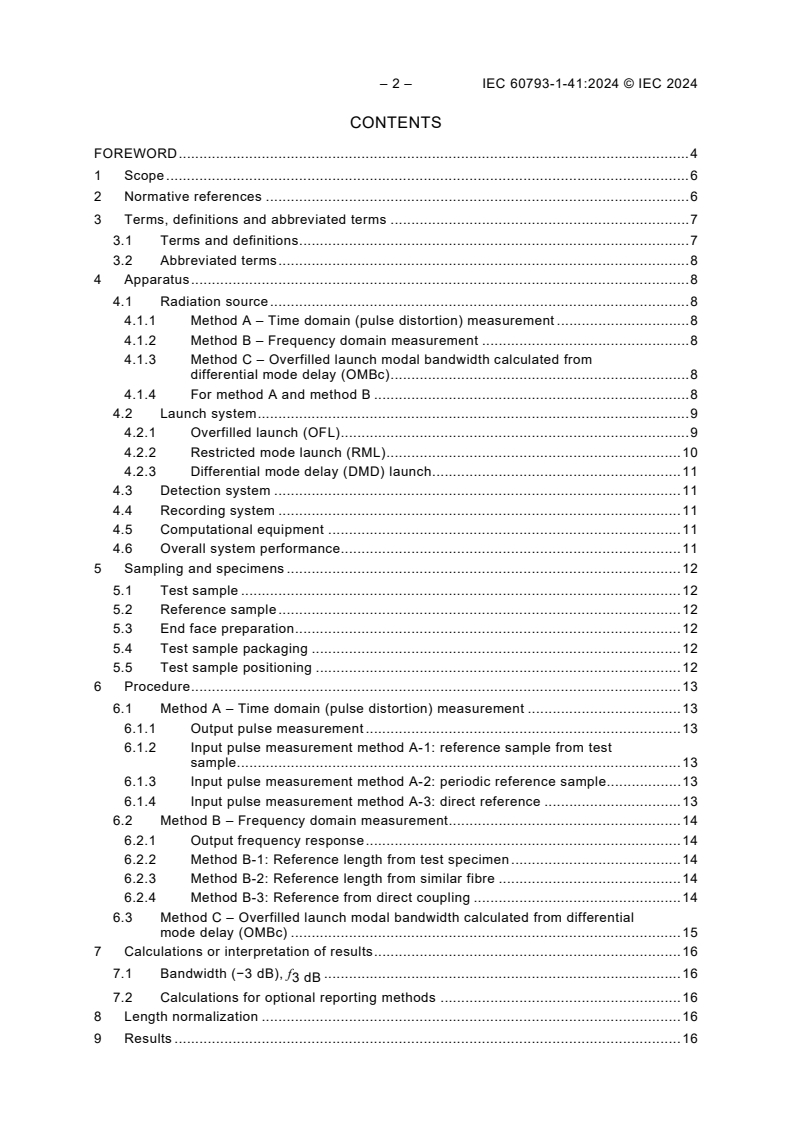
CONTENTS
FOREWORD . 4
1 Scope . 6
2 Normative references . 6
3 Terms, definitions and abbreviated terms . 7
3.1 Terms and definitions . 7
3.2 Abbreviated terms . 8
4 Apparatus . 8
4.1 Radiation source . 8
4.1.1 Method A – Time domain (pulse distortion) measurement . 8
4.1.2 Method B – Frequency domain measurement . 8
4.1.3 Method C – Overfilled launch modal bandwidth calculated from
differential mode delay (OMBc) . 8
4.1.4 For method A and method B . 8
4.2 Launch system . 9
4.2.1 Overfilled launch (OFL) . 9
4.2.2 Restricted mode launch (RML) . 10
4.2.3 Differential mode delay (DMD) launch . 11
4.3 Detection system . 11
4.4 Recording system . 11
4.5 Computational equipment . 12
4.6 Overall system performance. 12
5 Sampling and specimens . 12
5.1 Test sample . 12
5.2 Reference sample . 12
5.3 End face preparation . 13
5.4 Test sample packaging . 13
5.5 Test sample positioning . 13
6 Procedure . 13
6.1 Method A – Time domain (pulse distortion) measurement . 13
6.1.1 Output pulse measurement . 13
6.1.2 Input pulse measurement method A-1: reference sample from test
sample. 13
6.1.3 Input pulse measurement method A-2: periodic reference sample. 13
6.1.4 Input pulse measurement method A-3: direct reference . 14
6.2 Method B – Frequency domain measurement . 14
6.2.1 Output frequency response . 14
6.2.2 Method B-1: Reference length from test specimen . 14
6.2.3 Method B-2: Reference length from similar fibre . 14
6.2.4 Method B-3: Reference from direct coupling . 15
6.3 Method C – Overfilled launch modal bandwidth calculated from differential
mode delay (OMBc) . 15
7 Calculations or interpretation of results . 16
7.1 -3 dB frequency Bandwidth (−3 dB), f . 16
3 dB
7.2 Calculations for optional reporting methods . 17
8 Length normalization . 17
9 Results . 17
9.1 Information to be provided with each measurement . 17
9.2 Information available upon request . 17
10 Specification information . 18
Annex A (normative) Intramodal dispersion factor and the normalized intermodal
dispersion limit . 19
A.1 Intramodal dispersion factor, IDF . 19
A.2 Normalized intermodal dispersion limit, NIDL . 20
A.3 Derivation of the IDF . 20
Annex B (normative) Fibre transfer function, H(f), power spectrum, |H(f)|, and f . 22
3 dB
B.1 Fibre transfer function . 22
B.1.1 Method A – Time domain (pulse distortion) measurement . 22
B.1.2 Method B – Frequency-domain measurement . 22
B.2 Power spectrum . 23
B.2.1 Method A – Time domain (pulse distortion) measurement . 23
B.2.2 Method B – Frequency-domain measurement . 23
B.2.3 –3 dB Frequency Bandwidth (−3 dB), f . 23
3 dB
Annex C (normative) Calculations for other reporting methods . 24
C.1 Fibre impulse response, h(t) . 24
C.2 RMS impulse response, exact method . 24
C.3 RMS impulse response, difference of squares approximation . 25
Annex D (normative) Mode scrambler requirements for overfilled launching conditions
to multimode fibres . 26
D.1 Introduction General . 26
D.2 Apparatus . 26
D.2.1 Light source . 26
D.2.2 Mode scrambler . 26
D.2.3 Cladding mode strippers . 27
D.3 Sampling and specimens . 28
D.4 Procedure . 28
D.4.1 Qualification of mode scrambler . 28
D.4.2 Alignment of test fibre in mode scrambler output . 29
D.4.3 Measurement test . 29
D.5 Calculations or interpretation of results . 29
D.6 Results . 30
D.6.1 Information to be provided with each measurement . 30
D.6.2 Information available upon request . 30
Bibliography . 31
Figure 1 – Mandrel wrapped mode filter . 11
Figure D.1 – Two examples of optical fibre scramblers . 27
Table 1 – Abbreviated terms . 8
Table 2 – DMD weights for calculating overfilled modal bandwidth (OMBc) from DMD
data for 850 nm only . 16
Table A.1 – Highest expected dispersion for commercially available A1 fibres . 19
– 4 – IEC 60793-1-41:2024 RLV © IEC 2024
INTERNATIONAL ELECTROTECHNICAL COMMISSION
____________
OPTICAL FIBRES –
Part 1-41: Measurement methods and test procedures –
Bandwidth
FOREWORD
1) The International Electrotechnical Commission (IEC) is a worldwide organization for standardization comprising
all national electrotechnical committees (IEC National Committees). The object of IEC is to promote international
co-operation on all questions concerning standardization in the electrical and electronic fields. To this end and
in addition to other activities, IEC publishes International Standards, Technical Specifications, Technical Reports,
Publicly Available Specifications (PAS) and Guides (hereafter referred to as “IEC Publication(s)”). Their
preparation is entrusted to technical committees; any IEC National Committee interested in the subject dealt with
may participate in this preparatory work. International, governmental and non-governmental organizations liaising
with the IEC also participate in this preparation. IEC collaborates closely with the International Organization for
Standardization (ISO) in accordance with conditions determined by agreement between the two organizations.
2) The formal decisions or agreements of IEC on technical matters express, as nearly as possible, an international
consensus of opinion on the relevant subjects since each technical committee has representation from all
interested IEC National Committees.
3) IEC Publications have the form of recommendations for international use and are accepted by IEC National
Committees in that sense. While all reasonable efforts are made to ensure that the technical content of IEC
Publications is accurate, IEC cannot be held responsible for the way in which they are used or for any
misinterpretation by any end user.
4) In order to promote international uniformity, IEC National Committees undertake to apply IEC Publications
transparently to the maximum extent possible in their national and regional publications. Any divergence between
any IEC Publication and the corresponding national or regional publication shall be clearly indicated in the latter.
5) IEC itself does not provide any attestation of conformity. Independent certification bodies provide conformity
assessment services and, in some areas, access to IEC marks of conformity. IEC is not responsible for any
services carried out by independent certification bodies.
6) All users should ensure that they have the latest edition of this publication.
7) No liability shall attach to IEC or its directors, employees, servants or agents including individual experts and
members of its technical committees and IEC National Committees for any personal injury, property damage or
other damage of any nature whatsoever, whether direct or indirect, or for costs (including legal fees) and
expenses arising out of the publication, use of, or reliance upon, this IEC Publication or any other IEC
Publications.
8) Attention is drawn to the Normative references cited in this publication. Use of the referenced publications is
indispensable for the correct application of this publication.
9) IEC draws attention to the possibility that the implementation of this document may involve the use of (a)
patent(s). IEC takes no position concerning the evidence, validity or applicability of any claimed patent rights in
respect thereof. As of the date of publication of this document, IEC had not received notice of (a) patent(s), which
may be required to implement this document. However, implementers are cautioned that this may not represent
the latest information, which may be obtained from the patent database available at https://patents.iec.ch. IEC
shall not be held responsible for identifying any or all such patent rights.
This redline version of the official IEC Standard allows the user to identify the changes
made to the previous edition IEC 60793-1-41:2010. A vertical bar appears in the margin
wherever a change has been made. Additions are in green text, deletions are in
strikethrough red text.
IEC 60793-1-41 has been prepared by subcommittee 86A: Fibres and cables, of IEC technical
committee 86: Fibre optics. It is an International Standard.
This fourth edition cancels and replaces the third edition published in 2010. This edition
constitutes a technical revision.
This edition includes the following significant technical changes with respect to the previous
edition:
a) the addition of a direct reference for method A and method B.
The text of this International Standard is based on the following documents:
Draft Report on voting
86A/2302/CDV 86A/2365/RVC
Full information on the voting for its approval can be found in the report on voting indicated in
the above table.
The language used for the development of this International Standard is English.
This document was drafted in accordance with ISO/IEC Directives, Part 2, and developed in
accordance with ISO/IEC Directives, Part 1 and ISO/IEC Directives, IEC Supplement, available
at www.iec.ch/members_experts/refdocs. The main document types developed by IEC are
described in greater detail at www.iec.ch/publications.
A list of all parts of the IEC 60793 series, published under the general title Optical fibres –
Measurement methods and test procedures, can be found on the IEC website.
The committee has decided that the contents of this document will remain unchanged until the
stability date indicated on the IEC website under webstore.iec.ch in the data related to the
specific document. At this date, the document will be
• reconfirmed,
• withdrawn, or
• revised.
IMPORTANT – The "colour inside" logo on the cover page of this document indicates
that it contains colours which are considered to be useful for the correct understanding
of its contents. Users should therefore print this document using a colour printer.
– 6 – IEC 60793-1-41:2024 RLV © IEC 2024
OPTICAL FIBRES –
Part 1-41: Measurement methods and test procedures –
Bandwidth
1 Scope
This part of IEC 60793 describes three methods for determining and measuring the modal
bandwidth of multimode optical fibres (see IEC 60793-2-10, IEC 60793-30 series and
IEC 60793-40 series IEC 60793-2-30, and the IEC 60793-2-40 series). The baseband
frequency response is directly measured in the frequency domain by determining the fibre
response to a sinusoidaly modulated light source. The baseband response can also be
measured by observing the broadening of a narrow pulse of light. The calculated response is
determined using differential mode delay (DMD) data. The three methods are:
• Method A – Time domain (pulse distortion) measurement
• Method B – Frequency-domain measurement
• Method C – Overfilled launch modal bandwidth calculated from differential mode delay
(OMBc)
Method A and method B can be performed using one of two launches: an overfilled launch
(OFL) condition or a restricted mode launch (RML) condition. Method C is only defined for A1a.2
(and A1a.3 in preparation) A1-OM3 to A1-OM5 multimode fibres and uses a weighted
summation of DMD launch responses with the weights corresponding to an overfilled launch
condition. The relevant test method and launch condition should be is chosen according to the
type of fibre.
NOTE 1 These test methods are commonly used in production and research facilities and are not easily
accomplished in the field.
NOTE 2 OFL has been used for the modal bandwidth value for LED-based applications for many years. However,
no single launch condition is representative of the laser (e.g. VCSEL) sources that are used for gigabit and higher
rate transmission. This fact drove the development of IEC 60793-1-49 for determining the effective modal bandwidth
of laser optimized 50 µm fibres. See IEC 60793-2-10:2004 or later and IEC 61280-4-1:2003 or later for more
information.
2 Normative references
The following documents are referred to in the text in such a way that some or all of their content
constitutes requirements of this document. For dated references, only the edition cited applies.
For undated references, the latest edition of the referenced document (including any
amendments) applies.
IEC 60793-1-20, Optical fibres – Part 1-20: Measurement methods and test procedures – Fibre
geometry
IEC 60793-1-42, Optical fibres – Part 1-42: Measurement methods and test procedures –
Chromatic dispersion
IEC 60793-1-43, Optical fibres – Part 1-43: Measurement methods and test procedures –
Numerical aperture
IEC 60793-1-49:2006, Optical fibres – Part 1-49: Measurement methods and test procedures –
Differential mode delay
3 Terms, definitions and abbreviated terms
3.1 Terms and definitions
For the purposes of this document, the following terms and definitions apply.
ISO and IEC maintain terminology databases for use in standardization at the following
addresses:
• IEC Electropedia: available at https://www.electropedia.org/
• ISO Online browsing platform: available at https://www.iso.org/obp
3.1.1
bandwidth (–3 dB)
value numerically equal to the lowest modulation frequency at which the magnitude of the
baseband transfer function of an optical fibre decreases to a specified fraction, generally to one
half (–3 dB), of the zero frequency value
Note 1 to entry: The bandwidth is denoted in this document as f .
3 dB
Note 2 to entry: It is known that there can be various calculations, sometimes called markdowns, to avoid reporting
extremely high values associated with "plateaus". For example, the 1,5 dB frequency, multiplied by 2 is one
treatment used in IEC 60793-1-49. If such a calculation is used it should clearly be reported.
3.1.2
transfer function
discrete function of complex numbers, dependent on frequency, representing the frequency-
domain response of the fibre under test
Note 1 to entry: Method A determines the frequency response by processing time domain data through Fourier
transforms. Method B can only measure the transfer function if an instrument which measures phase as well as
amplitude is used. Method C is similar to method A as it uses Fourier transforms in a similar manner. The transfer
Function is denoted in this document as H(f).
3.1.3
power spectrum
discrete function of real numbers, dependent on frequency, representing the amplitude of the
frequency-domain response of the fibre under test
Note 1 to entry: Method A and method C determine the power spectrum from the transfer function. Method B
determines the transfer function by taking the ratio of the amplitude measured through the fibre under test and the
reference. The power spectrum is denoted in this document as |H(f)|.
3.1.4
impulse response
discrete function of real numbers, dependent on time, representing the time-domain response
of the fibre under test to a perfect impulse stimulus
Note 1 to entry: The impulse response is derived, in all methods, through the inverse Fourier transform of the
transfer function.
Note 2 to entry: The impulse response is denoted in this document as h(t).
– 8 – IEC 60793-1-41:2024 RLV © IEC 2024
3.2 Abbreviated terms
The abbreviated terms are given in Table 1.
Table 1 – Abbreviated terms
Abbreviated term Full term
CW continuous wave
DMD differential mode delay
FWHM full width half maximum
NIDL normalized intermodal dispersion limit
OFL overfilled launch
OMBc overfilled modal bandwidth
RML restricted mode launch
SSFL system stability frequency limit
4 Apparatus
4.1 Radiation source
4.1.1 Method A – Time domain (pulse distortion) measurement
Use a radiation source such as an injection laser diode that produces short duration, narrow
spectral width pulses for the purposes of the measurement. The pulse distortion measurement
method requires the capability to switch the energy of the light sources electrically or optically.
Some light sources shall be electrically triggered to produce a pulse; in this case a means shall
be provided to produce triggering pulses. An electrical function generator or equivalent can be
used for this purpose. Its output should be used to both induce pulsing in the light source and
to trigger the recording system. Other light sources may can self-trigger; in this case, means
shall be provided to synchronize the recording system with the pulses coming from the light
source. This may can be accomplished in some cases electrically; in other cases, optoelectronic
means may can be employed.
4.1.2 Method B – Frequency domain measurement
Use a radiation source such as a continuous wave (CW) injection laser diode for the purposes
of the measurement. The frequency domain measurement method requires the capability to
modulate the energy of the light sources electrically or optically. Connect the modulation output
of the tracking generator or network analyzer through any required driving amplifiers to the
modulator.
4.1.3 Method C – Overfilled launch modal bandwidth calculated from differential
mode delay (OMBc)
Use a radiation source as described in IEC 60793-1-49.
4.1.4 For method A and method B
Annex A: Use a radiation source with a centre wavelength that is known and within ±10 nm of
the nominal specified wavelength. For injection laser diodes, laser emission coupled into the
fibre shall exceed spontaneous emission by a minimum of 15 dB (optical).
Annex B: Use a source with sufficiently narrow linewidth to assure the measured bandwidth is
at least 90 % of the intermodal bandwidth. This is accomplished by calculating the normalized
intermodal dispersion limit, NIDL (refer to Annex A). For A4 fibre, the linewidth of any laser
diode is narrow enough to neglect its contribution to bandwidth measurement.
Annex C: For A1 and A3 fibres, calculate the NIDL (see Annex A) for each wavelength’s
measurement from the optical source spectral width for that wavelength as follows:
IDF
NIDL = in GHz·km
(1)
∆λ
where
∆λ is the source Full Width Half Maximum (FWHM) spectral width in nm;
IDF is the Intramodal Dispersion Factor (GHz·km·nm) from Annex A according to the
wavelength of the source
NIDL is not defined for wavelengths from 1 200 nm to 1 400 nm. The source spectral width
for these wavelengths shall be ≤10 nm, FWHM.
NOTE The acceptability of a NIDL value depends upon the specific user's test requirements. For example, a
0,5 GHz·km NIDL would be satisfactory for checking that fibres had minimum bandwidths ≥500 MHz·km, but would
not be satisfactory for checking that fibres had minimum bandwidths >500 MHz·km.
When the NIDL is found too low, a source with smaller spectral width is required.
Annex D: The radiation source shall be spectrally stable throughout the duration of a single
pulse and over the time during which the measurement is made.
4.2 Launch system
4.2.1 Overfilled launch (OFL)
4.2.1.1 OFL condition for A1 fibre
Use a mode scrambler between the light source and the test sample to produce a controlled
launch irrespective of the radiation properties of the light source. The output of the mode
scrambler shall be coupled to the input end of the test sample in accordance with Annex D. The
fibre position shall be stable for the complete duration of the measurement. A viewing system
may can be used to aid fibre alignment where optical imaging is used.
The OFL prescription in Annex D, based on the allowed variance of light intensity on the input
of the fibre under test, can result in large (>25 %) variations in the measured results for high
bandwidth (>1 500 MHz·km) A1a A1-OM3, A1-OM4 and A1-OM5 fibres. Subtle differences in
the launches of conforming equipment are a cause of these differences. Method C is introduced
as a means of obtaining an improvement.
Provide means to remove cladding light from the test sample. Often the fibre coating is sufficient
to perform this function. Otherwise, it will be necessary to use cladding mode strippers near
both ends of the test sample. The fibres may be retained on the cladding mode strippers with
small weights, but care shall be taken to avoid microbending at these sites.
NOTE Bandwidth measurements obtained by the overfilled launch (OFL) support the use of category A1 multimode
fibres, especially in LED applications at 850 nm and 1 300 nm. Some laser applications may can also be supported
with this launch but could result in reduced link lengths (at 850 nm) or restrictions on the laser sources (at 1 300
nm).
4.2.1.2 OFL condition for A3 and A4 fibres
OFL is obtained with geometrical optic launch in which the maximum theoretical numerical
aperture of the fibre is exceeded by the launching cone and in which the diameter of the
launched spot is in the order of the core diameter of the fibre. The light source shall be able to
excite both low-order and high-order modes in the fibre equally.
– 10 – IEC 60793-1-41:2024 RLV © IEC 2024
NOTE A mode scrambler excites more or less all most modes. Mode excitation is very sensitive to the source/ and
mode scrambler alignment and the interaction with any intermediary optics such as connectors or optical imaging
systems. A light source with large NA and core diameter will only excite meridional modes or LP modes.
0,m
4.2.2 Restricted mode launch (RML)
4.2.2.1 RML condition for A1b A1-OM1 fibre
The RML for bandwidth is created by filtering the overfilled launch (as defined by Annex D) with
a RML fibre. The OFL is defined by Annex D and it needs to be only large enough to overfill the
RML fibre both angularly and spatially. The RML fibre has a core diameter of 23,5 µm ± 0,1 µm,
and a numerical aperture of 0,208 ± 0,01. The fibre shall have a graded-index profile with an
alpha of approximately 2 and an OFL bandwidth greater than 700 MHz∙km at 850 nm and
1 300 nm. For convenience, the clad diameter should be 125 µm. The RML fibre should be at
least 1,5 m in length to eliminate leaky modes; and it should be <5 m in length to avoid transient
loss effects. The launch exiting the RML fibre is then coupled into the fibre under test.
Provide means to remove cladding light from the test sample. Often the fibre coating is sufficient
to perform this function. Otherwise, it will be necessary to use cladding mode strippers near
both ends of the test sample. The fibres may be retained on the cladding mode strippers with
small weights, but care shall be taken to avoid microbending at these sites.
NOTE 1 To achieve the highest accuracy, tight tolerances are required on the geometry and
profile of the RML fibre. To achieve the highest measurement reproducibility, tight alignment
tolerances are required in the connection between the launch RML fibre and the fibre under test
to ensure the RML fibre is centred to the fibre under test.
NOTE 2 Bandwidth measurements obtained by a restricted mode launch (RML) are used to support 1 Gigabit
Ethernet laser launch applications. The present launch is especially proven for 850 nm sources transported over type
A1b A1-OM1 fibres.
4.2.2.2 RML condition for A3 fibre
RML condition for A3 fibre is created with geometrical optic launch which corresponds to launch
NA = 0,3.
Spot size shall be larger or equal to the size of core.
4.2.2.3 RML condition for A4 fibre
The RML for A4 fibre shall correspond to NA = 0,3. It can be created by filtering the overfilled
launch with a mandrel wrapped mode filter, shown in Figure 1. The mode filter shall be made
with the fibre of the same category as the fibre under test. To avoid redundant loss, the length
of fibre should be 1 m. The diameter of the mandrel should shall be 20 times as large as that
of the fibre cladding and the number of coils may shall be 5. Unwound parts of fibre should be
set straight.
NOTE Do not apply any excessive stress in winding fibre on to the mandrel. The wound fibre
may be fixed to the mandrel with an adhesive.
OFL condition
Fibre under test
IEC 2012/10
Figure 1 – Mandrel wrapped mode filter
4.2.3 Differential mode delay (DMD) launch
The DMD launch shall comply with the launch requirements of IEC 60793-1-49.
4.3 Detection system
The output optical detection apparatus shall be capable of coupling all guided modes from the
test sample to the detector active area such that the detection sensitivity is not significantly
mode dependent.
A device shall be available to position the specimen output end with sufficient stability and
reproducibility to meet the conditions of 4.6.
An optical detector shall be used that is suitable for use at the test wavelength, linear in
amplitude response, spatially uniform to within 10 %, and sufficiently large to detect all emitted
power. An optical attenuator may be used to control the optical intensity on the detector. It shall
be mode independent as well.
The detection electronics as well as any signal preamplifier shall be linear in amplitude
response (nonlinearities less than 5 %) over the range of encountered signals.
The detection system for method C shall comply with the requirements of IEC 60793-1-49.
4.4 Recording system
For the time domain (pulse distortion) measurement (method A), use an oscilloscope suitably
connected to a recording device, such as a digital processor, to store the received pulse
amplitude as a function of time. For temporal measurements, data taken from the oscilloscope
display shall be considered secondary to those derived from the recorded signal.
For the frequency domain measurement (method B), use a tracking generator-electrical
spectrum analyzer combination, scalar network analyzer, vector network analyzer or an
equivalent instrument to detect, display and record the amplitude of the RF modulation signal
– 12 – IEC 60793-1-41:2024 RLV © IEC 2024
derived from the optical detector. This shall be done in such a manner as to reduce harmonic
distortion to less than 5 %.
The recording system for method C shall comply with the requirements of IEC 60793-1-49.
4.5 Computational equipment
For the time domain (pulse distortion) method (method A) and overfilled launch bandwidth
calculated from differential mode delay (method C) or if impulse response is required from
method B, computational equipment capable of performing Fourier transforms on the detected
optical pulse waveforms as recorded by the waveform recording system shall be used. This
equipment may implement any of the several fast Fourier transforms or other suitable
algorithms, and is useful for other signal conditioning functions, waveform averaging and
storage as well.
4.6 Overall system performance
NOTE 4.6 provides a means of verifying system stability for the duration of a measurement or the system calibration
period, depending on the method used (A, B or C, see 6.1, 6.2 and IEC 60793-1-49, respectively).
The measurement system stability is tested by comparing system input pulse Fourier transforms
(method B) or input frequency responses (method A) over a time interval. As shown in Annex B,
a bandwidth measurement normalizes the fibre output pulse transform by the system calibration
transform. If a reference sample is substituted for the fibre sample, the resultant response, H(f),
represents a comparison of the system to itself over the time interval. This normalized system
amplitude stability is used to determine the system stability frequency limit (SSFL).
The SSFL is the lowest frequency at which the system amplitude stability deviates from unity
by 5 %. The value of the time interval used for the SSFL determination depends on the method
used for the measurement. If method A-1 or B-1 is employed, SSFL shall be determined based
on one re-measurement at a time interval similar to that used for an actual fibre measurement.
If method A-2 or B-2 is employed, it shall be determined over substantially the same time
interval as that which is used for periodic system calibration (see 6.1.3). In this latter case, the
time interval may can influence the SSFL.
To determine the SSFL, attenuate the optical signal reaching the detector by an amount equal
to or greater than the attenuation of the test sample plus 3 dB. This may can require the
introduction of an attenuator into the optical path, if an attenuator, such as might be the one
used for signal normalization and scaling, is not already present. Also, normal deviations in the
position and amplitude of the pulse or frequency response on the display device shall be present
during the determination of the SSFL.
5 Sampling and specimens
5.1 Test sample
The test sample shall be a known length of optical fibre or optical fibre cable.
5.2 Reference sample
The reference sample shall be a short length of fibre of the same type as the test sample or cut
from the test sample. Except A4 fibre, the reference length shall be less than 1 % of the test
sample length or less than 10 m, whichever is shorter.
For A4 fibre, the reference length shall be 1 m to 2 m. In case of RML, the output of the mode
filter is the reference.
5.3 End face preparation
Prepare smooth, flat end faces, perpendicular to the fibre axis.
5.4 Test sample packaging
For A1 fibres, the deployment (spool type, wind tension, and other winding characteristics) can
affect the results by significant values. It is normal to conduct most quality control
measurements with the fibre deployed on spools in a manner that is suitable for shipment. The
reference deployment, however, is one in which the fibre is stress-free and in which
microbending is minimized. Mapping functions can be used to report the expected value that
would be obtained from a reference deployment measurement based on measurements of the
fibre as deployed on a shipping spool. The mapping function shall be developed from
measurements of a set of fibres that have been deployed both ways and which represent the
full range of bandwidth values of interest.
For A4 fibre, test sample shall be wound into coils with diameter of at least 300 mm, free from
any stress. It shall be certain that the test sample is free from both macro- and microbending
and that the energy distribution at the output of the launching system is substantially constant.
5.5 Test sample positioning
Position the input end of the test sample such that it is aligned to the output end of the launch
system to create launching conditions in accordance with 4.2.
Position the output end of the test sample such that it is aligned to the optical detector.
6 Procedure
6.1 Method A – Time domain (pulse distortion) measurement
6.1.1 Output pulse measurement
a) Inject power into the test fibre and adjust the optical attenuator or detection electronics, or
both, such that one entire optical pulse from the fibre is displayed on the calibrated
oscilloscope, including all leading and trailing edges having an amplitude ≥ 1 % or −20 dB
of the peak amplitude.
b) Record the detected amplitude and the calibrated oscilloscope sweep rate.
c) Record the fibre output pulse and calculate the Fourier transform of this pulse, per Annex B.
d) Determine the input pulse to the test sample by measuring the signal exiting the reference
sample path. This may can be accomplished by using a reference length cut from the test
sample (see 6.1.2), a reference length cut from a similar fibre (see 6.1.3) or by directly
coupling the source output to the detector (see 6.1.4).
6.1.2 Input pulse measurement method A-1: reference sample from test sample
a) Cut the test fibre near the input end according to 5.2. Create a new output end face, per
5.3, and align the end with respect to the optical detector as outlined in 6.1.1 a). Do not
disturb the input end.
b) Apply the cladding mode stripper, if used (see 5.2).
c) If an optical attenuator is used, read just for the same displayed pulse amplitude as outlined
in 6.1.1 a).
d) Record the system input pulse using the same oscilloscope sweep rate as for the test
sample and calculate the input pulse Fourier transform per Annex B.
6.1.3 Input pulse measurement method A-2: periodic reference sample
a) The following system calibration procedure employing the periodic reference sample shall
be performed over substantially the same time interval as used to determine the SSFL
– 14 – IEC 60793-1-41:2024 RLV © IEC 2024
(see 4.6). In most cases where adequate preparation of mode scrambler, laser diode, and
alignment equipment has been made, it is acceptable to use a reference sample not taken
from the test sample.
b) Prepare input and output ends per 5.3 on a reference sample of the same fibre class and
same nominal optical dimensions as the test sample.
c) Align the input and output ends as outlined in 5.5 and, if an optical attenuator is used, adjust
to obtain the correct displayed pulse amplitude.
d) Record the system input pulse using the same oscilloscope sweep rate as for the test
sample and calculate the input pulse Fourier transform per Annex B.
6.1.4 Input pulse measurement method A-3: direct reference
a) The source can be coupled to the detection apparatus, directly or via a system of lenses
and mirrors.
b) If an optical attenuator is used, readjust for the same displayed pulse amplitude as outlined
in 6.1.1 a).
c) Record the system input pulse using the same oscilloscope sweep rate as for the test
sample and calculate the input pulse Fourier transform per Annex B.
The use of the direct reference (6.1.4) requires that the input pulse Fourier transform calculated
with the direct reference (6.1.4) and the input pulse Fourier transform calculated with the
reference sample (6.1.2) are nearly identical. An acceptance criterion is to measure the system
input pulses in both a test sample (6.1.2) and with the direct reference (6.1.4), calculate the
input pulse Fourier transform per Annex B and verify that this frequency response is varying
less than ±5,0 % from unity for all frequencies up to the system stability frequency limit (defined
in 4.6).
6.2 Method B – Frequency domain measurement
6.2.1 Output frequency response
a) Sweep the modulation frequency, f, of the source from a low frequency, to provide an
adequate DC zero reference level, to high frequency in excess of the 3 dB bandwidth.
Record the relative optical power exiting the test specimen as a function of f; denote this
power as P (f). If a network analyzer and the impulse response is desired, the high
out
frequency should exceed −15 dB point and the phase φ (f) should be recorded.
out
NOTE
...
IEC 60793-1-41 ®
Edition 4.0 2024-04
INTERNATIONAL
STANDARD
NORME
INTERNATIONALE
Optical fibres –
Part 1-41: Measurement methods and test procedures – Bandwidth
Fibres optiques –
Partie 1-41: Méthodes de mesure et procédures d'essai – Largeur de bande
All rights reserved. Unless otherwise specified, no part of this publication may be reproduced or utilized in any form
or by any means, electronic or mechanical, including photocopying and microfilm, without permission in writing from
either IEC or IEC's member National Committee in the country of the requester. If you have any questions about IEC
copyright or have an enquiry about obtaining additional rights to this publication, please contact the address below or
your local IEC member National Committee for further information.
Droits de reproduction réservés. Sauf indication contraire, aucune partie de cette publication ne peut être reproduite ni
utilisée sous quelque forme que ce soit et par aucun procédé, électronique ou mécanique, y compris la photocopie et
les microfilms, sans l'accord écrit de l'IEC ou du Comité national de l'IEC du pays du demandeur. Si vous avez des
questions sur le copyright de l'IEC ou si vous désirez obtenir des droits supplémentaires sur cette publication, utilisez
les coordonnées ci-après ou contactez le Comité national de l'IEC de votre pays de résidence.
IEC Secretariat Tel.: +41 22 919 02 11
3, rue de Varembé info@iec.ch
CH-1211 Geneva 20 www.iec.ch
Switzerland
About the IEC
The International Electrotechnical Commission (IEC) is the leading global organization that prepares and publishes
International Standards for all electrical, electronic and related technologies.
About IEC publications
The technical content of IEC publications is kept under constant review by the IEC. Please make sure that you have the
latest edition, a corrigendum or an amendment might have been published.
IEC publications search - webstore.iec.ch/advsearchform IEC Products & Services Portal - products.iec.ch
The advanced search enables to find IEC publications by a Discover our powerful search engine and read freely all the
variety of criteria (reference number, text, technical publications previews, graphical symbols and the glossary.
committee, …). It also gives information on projects, replaced With a subscription you will always have access to up to date
and withdrawn publications. content tailored to your needs.
IEC Just Published - webstore.iec.ch/justpublished
Electropedia - www.electropedia.org
Stay up to date on all new IEC publications. Just Published
The world's leading online dictionary on electrotechnology,
details all new publications released. Available online and once
containing more than 22 500 terminological entries in English
a month by email.
and French, with equivalent terms in 25 additional languages.
Also known as the International Electrotechnical Vocabulary
IEC Customer Service Centre - webstore.iec.ch/csc
(IEV) online.
If you wish to give us your feedback on this publication or need
further assistance, please contact the Customer Service
Centre: sales@iec.ch.
A propos de l'IEC
La Commission Electrotechnique Internationale (IEC) est la première organisation mondiale qui élabore et publie des
Normes internationales pour tout ce qui a trait à l'électricité, à l'électronique et aux technologies apparentées.
A propos des publications IEC
Le contenu technique des publications IEC est constamment revu. Veuillez vous assurer que vous possédez l’édition la
plus récente, un corrigendum ou amendement peut avoir été publié.
Recherche de publications IEC - IEC Products & Services Portal - products.iec.ch
webstore.iec.ch/advsearchform Découvrez notre puissant moteur de recherche et consultez
La recherche avancée permet de trouver des publications IEC gratuitement tous les aperçus des publications, symboles
en utilisant différents critères (numéro de référence, texte, graphiques et le glossaire. Avec un abonnement, vous aurez
comité d’études, …). Elle donne aussi des informations sur les toujours accès à un contenu à jour adapté à vos besoins.
projets et les publications remplacées ou retirées.
Electropedia - www.electropedia.org
IEC Just Published - webstore.iec.ch/justpublished
Le premier dictionnaire d'électrotechnologie en ligne au monde,
Restez informé sur les nouvelles publications IEC. Just
avec plus de 22 500 articles terminologiques en anglais et en
Published détaille les nouvelles publications parues.
français, ainsi que les termes équivalents dans 25 langues
Disponible en ligne et une fois par mois par email.
additionnelles. Egalement appelé Vocabulaire
Electrotechnique International (IEV) en ligne.
Service Clients - webstore.iec.ch/csc
Si vous désirez nous donner des commentaires sur cette
publication ou si vous avez des questions contactez-nous:
sales@iec.ch.
IEC 60793-1-41 ®
Edition 4.0 2024-04
INTERNATIONAL
STANDARD
NORME
INTERNATIONALE
Optical fibres –
Part 1-41: Measurement methods and test procedures – Bandwidth
Fibres optiques –
Partie 1-41: Méthodes de mesure et procédures d'essai – Largeur de bande
INTERNATIONAL
ELECTROTECHNICAL
COMMISSION
COMMISSION
ELECTROTECHNIQUE
INTERNATIONALE
ICS 33.180.10 ISBN 978-2-8322-8636-4
– 2 – IEC 60793-1-41:2024 © IEC 2024
CONTENTS
FOREWORD . 4
1 Scope . 6
2 Normative references . 6
3 Terms, definitions and abbreviated terms . 7
3.1 Terms and definitions . 7
3.2 Abbreviated terms . 8
4 Apparatus . 8
4.1 Radiation source . 8
4.1.1 Method A – Time domain (pulse distortion) measurement . 8
4.1.2 Method B – Frequency domain measurement . 8
4.1.3 Method C – Overfilled launch modal bandwidth calculated from
differential mode delay (OMBc) . 8
4.1.4 For method A and method B . 8
4.2 Launch system . 9
4.2.1 Overfilled launch (OFL) . 9
4.2.2 Restricted mode launch (RML) . 10
4.2.3 Differential mode delay (DMD) launch . 11
4.3 Detection system . 11
4.4 Recording system . 11
4.5 Computational equipment . 11
4.6 Overall system performance. 11
5 Sampling and specimens . 12
5.1 Test sample . 12
5.2 Reference sample . 12
5.3 End face preparation . 12
5.4 Test sample packaging . 12
5.5 Test sample positioning . 12
6 Procedure . 13
6.1 Method A – Time domain (pulse distortion) measurement . 13
6.1.1 Output pulse measurement . 13
6.1.2 Input pulse measurement method A-1: reference sample from test
sample. 13
6.1.3 Input pulse measurement method A-2: periodic reference sample. 13
6.1.4 Input pulse measurement method A-3: direct reference . 13
6.2 Method B – Frequency domain measurement . 14
6.2.1 Output frequency response . 14
6.2.2 Method B-1: Reference length from test specimen . 14
6.2.3 Method B-2: Reference length from similar fibre . 14
6.2.4 Method B-3: Reference from direct coupling . 14
6.3 Method C – Overfilled launch modal bandwidth calculated from differential
mode delay (OMBc) . 15
7 Calculations or interpretation of results . 16
7.1 Bandwidth (−3 dB), f . 16
3 dB
7.2 Calculations for optional reporting methods . 16
8 Length normalization . 16
9 Results . 16
9.1 Information to be provided with each measurement . 16
9.2 Information available upon request . 17
10 Specification information . 17
Annex A (normative) Intramodal dispersion factor and the normalized intermodal
dispersion limit . 18
A.1 Intramodal dispersion factor, IDF . 18
A.2 Normalized intermodal dispersion limit, NIDL . 19
A.3 Derivation of the IDF . 19
Annex B (normative) Fibre transfer function, H(f), power spectrum, |H(f)|, and f . 21
3 dB
B.1 Fibre transfer function . 21
B.1.1 Method A – Time domain (pulse distortion) measurement . 21
B.1.2 Method B – Frequency-domain measurement . 21
B.2 Power spectrum . 22
B.2.1 Method A – Time domain (pulse distortion) measurement . 22
B.2.2 Method B – Frequency-domain measurement . 22
B.2.3 Bandwidth (−3 dB), f . 22
3 dB
Annex C (normative) Calculations for other reporting methods . 23
C.1 Fibre impulse response, h(t) . 23
C.2 RMS impulse response, exact method . 23
C.3 RMS impulse response, difference of squares approximation . 24
Annex D (normative) Mode scrambler requirements for overfilled launching conditions
to multimode fibres . 25
D.1 General . 25
D.2 Apparatus . 25
D.2.1 Light source . 25
D.2.2 Mode scrambler . 25
D.2.3 Cladding mode strippers . 26
D.3 Sampling and specimens . 27
D.4 Procedure . 27
D.4.1 Qualification of mode scrambler . 27
D.4.2 Alignment of test fibre in mode scrambler output . 28
D.4.3 Measurement test . 28
D.5 Calculations or interpretation of results . 28
D.6 Results . 29
D.6.1 Information to be provided with each measurement . 29
D.6.2 Information available upon request . 29
Bibliography . 30
Figure 1 – Mandrel wrapped mode filter . 10
Figure D.1 – Two examples of optical fibre scramblers . 26
Table 1 – Abbreviated terms . 8
Table 2 – DMD weights for calculating overfilled modal bandwidth (OMBc) from DMD
data for 850 nm only . 15
Table A.1 – Highest expected dispersion for commercially available A1 fibres . 18
– 4 – IEC 60793-1-41:2024 © IEC 2024
INTERNATIONAL ELECTROTECHNICAL COMMISSION
____________
OPTICAL FIBRES –
Part 1-41: Measurement methods and test procedures –
Bandwidth
FOREWORD
1) The International Electrotechnical Commission (IEC) is a worldwide organization for standardization comprising
all national electrotechnical committees (IEC National Committees). The object of IEC is to promote international
co-operation on all questions concerning standardization in the electrical and electronic fields. To this end and
in addition to other activities, IEC publishes International Standards, Technical Specifications, Technical Reports,
Publicly Available Specifications (PAS) and Guides (hereafter referred to as “IEC Publication(s)”). Their
preparation is entrusted to technical committees; any IEC National Committee interested in the subject dealt with
may participate in this preparatory work. International, governmental and non-governmental organizations liaising
with the IEC also participate in this preparation. IEC collaborates closely with the International Organization for
Standardization (ISO) in accordance with conditions determined by agreement between the two organizations.
2) The formal decisions or agreements of IEC on technical matters express, as nearly as possible, an international
consensus of opinion on the relevant subjects since each technical committee has representation from all
interested IEC National Committees.
3) IEC Publications have the form of recommendations for international use and are accepted by IEC National
Committees in that sense. While all reasonable efforts are made to ensure that the technical content of IEC
Publications is accurate, IEC cannot be held responsible for the way in which they are used or for any
misinterpretation by any end user.
4) In order to promote international uniformity, IEC National Committees undertake to apply IEC Publications
transparently to the maximum extent possible in their national and regional publications. Any divergence between
any IEC Publication and the corresponding national or regional publication shall be clearly indicated in the latter.
5) IEC itself does not provide any attestation of conformity. Independent certification bodies provide conformity
assessment services and, in some areas, access to IEC marks of conformity. IEC is not responsible for any
services carried out by independent certification bodies.
6) All users should ensure that they have the latest edition of this publication.
7) No liability shall attach to IEC or its directors, employees, servants or agents including individual experts and
members of its technical committees and IEC National Committees for any personal injury, property damage or
other damage of any nature whatsoever, whether direct or indirect, or for costs (including legal fees) and
expenses arising out of the publication, use of, or reliance upon, this IEC Publication or any other IEC
Publications.
8) Attention is drawn to the Normative references cited in this publication. Use of the referenced publications is
indispensable for the correct application of this publication.
9) IEC draws attention to the possibility that the implementation of this document may involve the use of (a)
patent(s). IEC takes no position concerning the evidence, validity or applicability of any claimed patent rights in
respect thereof. As of the date of publication of this document, IEC had not received notice of (a) patent(s), which
may be required to implement this document. However, implementers are cautioned that this may not represent
the latest information, which may be obtained from the patent database available at https://patents.iec.ch. IEC
shall not be held responsible for identifying any or all such patent rights.
IEC 60793-1-41 has been prepared by subcommittee 86A: Fibres and cables, of IEC technical
committee 86: Fibre optics. It is an International Standard.
This fourth edition cancels and replaces the third edition published in 2010. This edition
constitutes a technical revision.
This edition includes the following significant technical changes with respect to the previous
edition:
a) the addition of a direct reference for method A and method B.
The text of this International Standard is based on the following documents:
Draft Report on voting
86A/2302/CDV 86A/2365/RVC
Full information on the voting for its approval can be found in the report on voting indicated in
the above table.
The language used for the development of this International Standard is English.
This document was drafted in accordance with ISO/IEC Directives, Part 2, and developed in
accordance with ISO/IEC Directives, Part 1 and ISO/IEC Directives, IEC Supplement, available
at www.iec.ch/members_experts/refdocs. The main document types developed by IEC are
described in greater detail at www.iec.ch/publications.
A list of all parts of the IEC 60793 series, published under the general title Optical fibres –
Measurement methods and test procedures, can be found on the IEC website.
The committee has decided that the contents of this document will remain unchanged until the
stability date indicated on the IEC website under webstore.iec.ch in the data related to the
specific document. At this date, the document will be
• reconfirmed,
• withdrawn, or
• revised.
IMPORTANT – The "colour inside" logo on the cover page of this document indicates
that it contains colours which are considered to be useful for the correct understanding
of its contents. Users should therefore print this document using a colour printer.
– 6 – IEC 60793-1-41:2024 © IEC 2024
OPTICAL FIBRES –
Part 1-41: Measurement methods and test procedures –
Bandwidth
1 Scope
This part of IEC 60793 describes three methods for determining and measuring the modal
bandwidth of multimode optical fibres (see IEC 60793-2-10, IEC 60793-2-30, and the
IEC 60793-2-40 series). The baseband frequency response is directly measured in the
frequency domain by determining the fibre response to a sinusoidaly modulated light source.
The baseband response can also be measured by observing the broadening of a narrow pulse
of light. The calculated response is determined using differential mode delay (DMD) data. The
three methods are:
• Method A – Time domain (pulse distortion) measurement
• Method B – Frequency-domain measurement
• Method C – Overfilled launch modal bandwidth calculated from differential mode delay
(OMBc)
Method A and method B can be performed using one of two launches: an overfilled launch
(OFL) condition or a restricted mode launch (RML) condition. Method C is only defined for A1-
OM3 to A1-OM5 multimode fibres and uses a weighted summation of DMD launch responses
with the weights corresponding to an overfilled launch condition. The relevant test method and
launch condition is chosen according to the type of fibre.
NOTE 1 These test methods are commonly used in production and research facilities and are not easily
accomplished in the field.
NOTE 2 OFL has been used for the modal bandwidth value for LED-based applications for many years. However,
no single launch condition is representative of the laser (e.g. VCSEL) sources that are used for gigabit and higher
rate transmission. This fact drove the development of IEC 60793-1-49 for determining the effective modal bandwidth
of laser optimized 50 µm fibres. See IEC 60793-2-10 and IEC 61280-4-1 for more information.
2 Normative references
The following documents are referred to in the text in such a way that some or all of their content
constitutes requirements of this document. For dated references, only the edition cited applies.
For undated references, the latest edition of the referenced document (including any
amendments) applies.
IEC 60793-1-20, Optical fibres – Part 1-20: Measurement methods and test procedures – Fibre
geometry
IEC 60793-1-43, Optical fibres – Part 1-43: Measurement methods and test procedures –
Numerical aperture
IEC 60793-1-49, Optical fibres – Part 1-49: Measurement methods and test procedures –
Differential mode delay
3 Terms, definitions and abbreviated terms
3.1 Terms and definitions
For the purposes of this document, the following terms and definitions apply.
ISO and IEC maintain terminology databases for use in standardization at the following
addresses:
• IEC Electropedia: available at https://www.electropedia.org/
• ISO Online browsing platform: available at https://www.iso.org/obp
3.1.1
bandwidth (–3 dB)
value numerically equal to the lowest modulation frequency at which the magnitude of the
baseband transfer function of an optical fibre decreases to a specified fraction, generally to one
half (–3 dB), of the zero frequency value
Note 1 to entry: The bandwidth is denoted in this document as f .
3 dB
Note 2 to entry: It is known that there can be various calculations, sometimes called markdowns, to avoid reporting
extremely high values associated with "plateaus". For example, the 1,5 dB frequency, multiplied by 2 is one
treatment used in IEC 60793-1-49. If such a calculation is used it should clearly be reported.
3.1.2
transfer function
discrete function of complex numbers, dependent on frequency, representing the frequency-
domain response of the fibre under test
Note 1 to entry: Method A determines the frequency response by processing time domain data through Fourier
transforms. Method B can only measure the transfer function if an instrument which measures phase as well as
amplitude is used. Method C is similar to method A as it uses Fourier transforms in a similar manner. The transfer
Function is denoted in this document as H(f).
3.1.3
power spectrum
discrete function of real numbers, dependent on frequency, representing the amplitude of the
frequency-domain response of the fibre under test
Note 1 to entry: Method A and method C determine the power spectrum from the transfer function. Method B
determines the transfer function by taking the ratio of the amplitude measured through the fibre under test and the
reference. The power spectrum is denoted in this document as |H(f)|.
3.1.4
impulse response
discrete function of real numbers, dependent on time, representing the time-domain response
of the fibre under test to a perfect impulse stimulus
Note 1 to entry: The impulse response is derived, in all methods, through the inverse Fourier transform of the
transfer function.
Note 2 to entry: The impulse response is denoted in this document as h(t).
– 8 – IEC 60793-1-41:2024 © IEC 2024
3.2 Abbreviated terms
The abbreviated terms are given in Table 1.
Table 1 – Abbreviated terms
Abbreviated term Full term
CW continuous wave
DMD differential mode delay
FWHM full width half maximum
NIDL normalized intermodal dispersion limit
OFL overfilled launch
OMBc overfilled modal bandwidth
RML restricted mode launch
SSFL system stability frequency limit
4 Apparatus
4.1 Radiation source
4.1.1 Method A – Time domain (pulse distortion) measurement
Use a radiation source such as an injection laser diode that produces short duration, narrow
spectral width pulses for the purposes of the measurement. The pulse distortion measurement
method requires the capability to switch the energy of the light sources electrically or optically.
Some light sources shall be electrically triggered to produce a pulse; in this case a means shall
be provided to produce triggering pulses. An electrical function generator or equivalent can be
used for this purpose. Its output should be used to both induce pulsing in the light source and
to trigger the recording system. Other light sources can self-trigger; in this case, means shall
be provided to synchronize the recording system with the pulses coming from the light source.
This can be accomplished in some cases electrically; in other cases, optoelectronic means can
be employed.
4.1.2 Method B – Frequency domain measurement
Use a radiation source such as a continuous wave (CW) injection laser diode for the purposes
of the measurement. The frequency domain measurement method requires the capability to
modulate the energy of the light sources electrically or optically. Connect the modulation output
of the tracking generator or network analyzer through any required driving amplifiers to the
modulator.
4.1.3 Method C – Overfilled launch modal bandwidth calculated from differential
mode delay (OMBc)
Use a radiation source as described in IEC 60793-1-49.
4.1.4 For method A and method B
Annex A: Use a radiation source with a centre wavelength that is known and within ±10 nm of
the nominal specified wavelength. For injection laser diodes, laser emission coupled into the
fibre shall exceed spontaneous emission by a minimum of 15 dB (optical).
Annex B: Use a source with sufficiently narrow linewidth to assure the measured bandwidth is
at least 90 % of the intermodal bandwidth. This is accomplished by calculating the normalized
intermodal dispersion limit, NIDL (refer to Annex A). For A4 fibre, the linewidth of any laser
diode is narrow enough to neglect its contribution to bandwidth measurement.
Annex C: For A1 and A3 fibres, calculate the NIDL (see Annex A) for each wavelength’s
measurement from the optical source spectral width for that wavelength as follows:
IDF
NIDL = in GHz·km
(1)
∆λ
where
∆λ is the source Full Width Half Maximum (FWHM) spectral width in nm;
IDF is the Intramodal Dispersion Factor (GHz·km·nm) from Annex A according to the
wavelength of the source
NIDL is not defined for wavelengths from 1 200 nm to 1 400 nm. The source spectral width
for these wavelengths shall be ≤10 nm, FWHM.
NOTE The acceptability of a NIDL value depends upon the specific user's test requirements. For example, a
0,5 GHz·km NIDL would be satisfactory for checking that fibres had minimum bandwidths ≥500 MHz·km, but would
not be satisfactory for checking that fibres had minimum bandwidths >500 MHz·km.
When the NIDL is found too low, a source with smaller spectral width is required.
Annex D: The radiation source shall be spectrally stable throughout the duration of a single
pulse and over the time during which the measurement is made.
4.2 Launch system
4.2.1 Overfilled launch (OFL)
4.2.1.1 OFL condition for A1 fibre
Use a mode scrambler between the light source and the test sample to produce a controlled
launch irrespective of the radiation properties of the light source. The output of the mode
scrambler shall be coupled to the input end of the test sample in accordance with Annex D. The
fibre position shall be stable for the complete duration of the measurement. A viewing system
can be used to aid fibre alignment where optical imaging is used.
The OFL prescription in Annex D, based on the allowed variance of light intensity on the input
of the fibre under test, can result in large (>25 %) variations in the measured results for high
bandwidth (>1 500 MHz·km) A1-OM3, A1-OM4 and A1-OM5 fibres. Subtle differences in the
launches of conforming equipment are a cause of these differences. Method C is introduced as
a means of obtaining an improvement.
Provide means to remove cladding light from the test sample. Often the fibre coating is sufficient
to perform this function. Otherwise, it will be necessary to use cladding mode strippers near
both ends of the test sample. The fibres may be retained on the cladding mode strippers with
small weights, but care shall be taken to avoid microbending at these sites.
NOTE Bandwidth measurements obtained by the overfilled launch (OFL) support the use of category A1 multimode
fibres, especially in LED applications at 850 nm and 1 300 nm. Some laser applications can also be supported with
this launch but could result in reduced link lengths (at 850 nm) or restrictions on the laser sources (at 1 300 nm).
4.2.1.2 OFL condition for A3 and A4 fibres
OFL is obtained with geometrical optic launch in which the maximum theoretical numerical
aperture of the fibre is exceeded by the launching cone and in which the diameter of the
launched spot is in the order of the core diameter of the fibre. The light source shall be able to
excite both low-order and high-order modes in the fibre equally.
NOTE A mode scrambler excites most modes. Mode excitation is very sensitive to the source and mode scrambler
alignment and the interaction with any intermediary optics such as connectors or optical imaging systems. A light
source with large NA and core diameter will only excite meridional modes or LP modes.
0,m
– 10 – IEC 60793-1-41:2024 © IEC 2024
4.2.2 Restricted mode launch (RML)
4.2.2.1 RML condition for A1-OM1 fibre
The RML for bandwidth is created by filtering the overfilled launch (as defined by Annex D) with
a RML fibre. The OFL is defined by Annex D and it needs to be only large enough to overfill the
RML fibre both angularly and spatially. The RML fibre has a core diameter of 23,5 µm ± 0,1 µm,
and a numerical aperture of 0,208 ± 0,01. The fibre shall have a graded-index profile with an
alpha of approximately 2 and an OFL bandwidth greater than 700 MHz∙km at 850 nm and
1 300 nm. For convenience, the clad diameter should be 125 µm. The RML fibre should be at
least 1,5 m in length to eliminate leaky modes; and it should be <5 m in length to avoid transient
loss effects. The launch exiting the RML fibre is then coupled into the fibre under test.
Provide means to remove cladding light from the test sample. Often the fibre coating is sufficient
to perform this function. Otherwise, it will be necessary to use cladding mode strippers near
both ends of the test sample. The fibres may be retained on the cladding mode strippers with
small weights, but care shall be taken to avoid microbending at these sites.
To achieve the highest accuracy, tight tolerances are required on the geometry and profile of
the RML fibre. To achieve the highest measurement reproducibility, tight alignment tolerances
are required in the connection between the launch RML fibre and the fibre under test to ensure
the RML fibre is centred to the fibre under test.
NOTE Bandwidth measurements obtained by a restricted mode launch (RML) are used to support 1 Gigabit Ethernet
laser launch applications. The present launch is especially proven for 850 nm sources transported over type A1-OM1
fibres.
4.2.2.2 RML condition for A3 fibre
RML condition for A3 fibre is created with geometrical optic launch which corresponds to launch
NA = 0,3.
Spot size shall be larger or equal to the size of core.
4.2.2.3 RML condition for A4 fibre
The RML for A4 fibre shall correspond to NA = 0,3. It can be created by filtering the overfilled
launch with a mandrel wrapped mode filter, shown in Figure 1. The mode filter shall be made
with the fibre of the same category as the fibre under test. To avoid redundant loss, the length
of fibre should be 1 m. The diameter of the mandrel shall be 20 times as large as that of the
fibre cladding and the number of coils shall be 5. Unwound parts of fibre should be set straight.
Do not apply any excessive stress in winding fibre on to the mandrel. The wound fibre may be
fixed to the mandrel with an adhesive.
Figure 1 – Mandrel wrapped mode filter
4.2.3 Differential mode delay (DMD) launch
The DMD launch shall comply with the launch requirements of IEC 60793-1-49.
4.3 Detection system
The output optical detection apparatus shall be capable of coupling all guided modes from the
test sample to the detector active area such that the detection sensitivity is not significantly
mode dependent.
A device shall be available to position the specimen output end with sufficient stability and
reproducibility to meet the conditions of 4.6.
An optical detector shall be used that is suitable for use at the test wavelength, linear in
amplitude response, spatially uniform to within 10 %, and sufficiently large to detect all emitted
power. An optical attenuator may be used to control the optical intensity on the detector. It shall
be mode independent as well.
The detection electronics as well as any signal preamplifier shall be linear in amplitude
response (nonlinearities less than 5 %) over the range of encountered signals.
The detection system for method C shall comply with the requirements of IEC 60793-1-49.
4.4 Recording system
For the time domain (pulse distortion) measurement (method A), use an oscilloscope suitably
connected to a recording device, such as a digital processor, to store the received pulse
amplitude as a function of time. For temporal measurements, data taken from the oscilloscope
display shall be considered secondary to those derived from the recorded signal.
For the frequency domain measurement (method B), use a tracking generator-electrical
spectrum analyzer combination, scalar network analyzer, vector network analyzer or an
equivalent instrument to detect, display and record the amplitude of the RF modulation signal
derived from the optical detector. This shall be done in such a manner as to reduce harmonic
distortion to less than 5 %.
The recording system for method C shall comply with the requirements of IEC 60793-1-49.
4.5 Computational equipment
For the time domain (pulse distortion) method (method A) and overfilled launch bandwidth
calculated from differential mode delay (method C) or if impulse response is required from
method B, computational equipment capable of performing Fourier transforms on the detected
optical pulse waveforms as recorded by the waveform recording system shall be used. This
equipment may implement any of the several fast Fourier transforms or other suitable
algorithms, and is useful for other signal conditioning functions, waveform averaging and
storage as well.
4.6 Overall system performance
NOTE 4.6 provides a means of verifying system stability for the duration of a measurement or the system calibration
period, depending on the method used (A, B or C, see 6.1, 6.2 and IEC 60793-1-49, respectively).
The measurement system stability is tested by comparing system input pulse Fourier transforms
(method B) or input frequency responses (method A) over a time interval. As shown in Annex B,
a bandwidth measurement normalizes the fibre output pulse transform by the system calibration
transform. If a reference sample is substituted for the fibre sample, the resultant response, H(f),
represents a comparison of the system to itself over the time interval. This normalized system
amplitude stability is used to determine the system stability frequency limit (SSFL).
– 12 – IEC 60793-1-41:2024 © IEC 2024
The SSFL is the lowest frequency at which the system amplitude stability deviates from unity
by 5 %. The value of the time interval used for the SSFL determination depends on the method
used for the measurement. If method A-1 or B-1 is employed, SSFL shall be determined based
on one re-measurement at a time interval similar to that used for an actual fibre measurement.
If method A-2 or B-2 is employed, it shall be determined over substantially the same time
interval as that which is used for periodic system calibration (see 6.1.3). In this latter case, the
time interval can influence the SSFL.
To determine the SSFL, attenuate the optical signal reaching the detector by an amount equal
to or greater than the attenuation of the test sample plus 3 dB. This can require the introduction
of an attenuator into the optical path, if an attenuator, such as the one used for signal
normalization and scaling, is not already present. Also, normal deviations in the position and
amplitude of the pulse or frequency response on the display device shall be present during the
determination of the SSFL.
5 Sampling and specimens
5.1 Test sample
The test sample shall be a known length of optical fibre or optical fibre cable.
5.2 Reference sample
The reference sample shall be a short length of fibre of the same type as the test sample or cut
from the test sample. Except A4 fibre, the reference length shall be less than 1 % of the test
sample length or less than 10 m, whichever is shorter.
For A4 fibre, the reference length shall be 1 m to 2 m. In case of RML, the output of the mode
filter is the reference.
5.3 End face preparation
Prepare smooth, flat end faces, perpendicular to the fibre axis.
5.4 Test sample packaging
For A1 fibres, the deployment (spool type, wind tension, and other winding characteristics) can
affect the results by significant values. It is normal to conduct most quality control
measurements with the fibre deployed on spools in a manner that is suitable for shipment. The
reference deployment, however, is one in which the fibre is stress-free and in which
microbending is minimized. Mapping functions can be used to report the expected value that
would be obtained from a reference deployment measurement based on measurements of the
fibre as deployed on a shipping spool. The mapping function shall be developed from
measurements of a set of fibres that have been deployed both ways and which represent the
full range of bandwidth values of interest.
For A4 fibre, test sample shall be wound into coils with diameter of at least 300 mm, free from
any stress. It shall be certain that the test sample is free from both macro- and microbending
and that the energy distribution at the output of the launching system is substantially constant.
5.5 Test sample positioning
Position the input end of the test sample such that it is aligned to the output end of the launch
system to create launching conditions in accordance with 4.2.
Position the output end of the test sample such that it is aligned to the optical detector.
6 Procedure
6.1 Method A – Time domain (pulse distortion) measurement
6.1.1 Output pulse measurement
a) Inject power into the test fibre and adjust the optical attenuator or detection electronics, or
both, such that one entire optical pulse from the fibre is displayed on the calibrated
oscilloscope, including all leading and trailing edges having an amplitude ≥ 1 % or −20 dB
of the peak amplitude.
b) Record the detected amplitude and the calibrated oscilloscope sweep rate.
c) Record the fibre output pulse and calculate the Fourier transform of this pulse, per Annex B.
d) Determine the input pulse to the test sample by measuring the signal exiting the reference
path. This can be accomplished by using a reference length cut from the test sample (see
6.1.2), a reference length cut from a similar fibre (see 6.1.3) or by directly coupling the
source output to the detector (see 6.1.4).
6.1.2 Input pulse measurement method A-1: reference sample from test sample
a) Cut the test fibre near the input end according to 5.2. Create a new output end face, per
5.3, and align the end with respect to the optical detector as outlined in 6.1.1 a). Do not
disturb the input end.
b) Apply the cladding mode stripper, if used (see 5.2).
c) If an optical attenuator is used, read just for the same displayed pulse amplitude as outlined
in 6.1.1 a).
d) Record the system input pulse using the same oscilloscope sweep rate as for the test
sample and calculate the input pulse Fourier transform per Annex B.
6.1.3 Input pulse measurement method A-2: periodic reference sample
a) The following system calibration procedure employing the periodic reference sample shall
be performed over substantially the same time interval as used to determine the SSFL
(see 4.6). In most cases where adequate preparation of mode scrambler, laser diode, and
alignment equipment has been made, it is acceptable to use a r
...