

IEC 61230:2008
(Main)Live working - Portable equipment for earthing or earthing and short-circuiting
General Information
- Abstract
IEC 61230:2008 is applicable to portable equipment, with or without matching connection points, for temporary earthing or earthing and short-circuiting of electrically isolated or de-energized a.c. and d.c. installations, distribution and transmission networks, whether they are overhead or underground or of low or high voltage. This standard covers equipment comprising an earthing or a short-circuiting or an earthing and short-circuiting device and insulating component. The performance of equipment, devices and components covered by this standard is based on electro-dynamic and electro-thermal effects acting during short-circuit. The withstand capability of the devices and equipment is expressed by their rated values of current, time and peak factor. No rated voltage is given, but the geometrical dimensions of the equipment are also linked to the voltage of the installation. This second edition cancels and replaces the first edition published in 1993. It constitutes a technical revision. The major changes are:
- extension of the scope to cover the use of equipment on d.c. installations;
- extension of the use of aluminium to all conductive parts of the device;
- possibility of using this standard for separate components of the equipment;
- general revision of requirements and tests;
- revision of existing annexes;
- introduction of a new informative Annex D giving guidelines for determination of the equivalent r.m.s. value of a short-circuit current and of a new normative Annex F on classification of defects.
- Status
- Published
- Publication Date
- 08-Jul-2008
- Technical Committee
- TC 78 - Live working
- Drafting Committee
- WG 13 - TC 78/WG 13
- Current Stage
- PPUB - Publication issued
- Start Date
- 09-Jul-2008
- Completion Date
- 31-Jul-2008

Overview
IEC 61230:2008 is an international standard published by the International Electrotechnical Commission (IEC) concerning live working practices. It provides guidelines and technical requirements for portable equipment used for earthing or earthing and short-circuiting electrical installations. This includes apparatus for temporary grounding or grounding combined with short-circuiting of both AC and DC isolated or de-energized systems, covering distribution and transmission networks - whether overhead or underground, and applying to both low and high voltage installations.
The standard defines the performance criteria based on electro-dynamic and electro-thermal effects that occur during short-circuit events. It describes the necessary electrical ratings such as current, time, and peak factors that the equipment must withstand. Key improvements in this 2008 edition include the broadening of scope to DC installations, the use of aluminum for conductive parts, and detailed testing procedures.
Key Topics
- Scope and Application: Portable earthing and short-circuiting equipment for isolated or de-energized AC and DC systems, suitable for overhead lines, underground cables, and varying voltage levels.
- Equipment Composition: Includes earthing devices, short-circuiting devices, or combined devices with insulating components.
- Performance Requirements: Based on withstand capacity to electro-dynamic forces and thermal stresses during short-circuits.
- Cable and Clamp Selection:
- Guidelines for selecting cables compliant or non-compliant with IEC 61138.
- Specification of suitable clamps and connection types for safety and reliability.
- Safety and Insulation: Basic requirements for insulating elements to protect workers and maintain safety during live working operations.
- Marking and Instructions: Clear marking on cables, clamps, and devices for identification and proper use; comprehensive user manuals are mandated.
- Testing Procedures:
- Fatigue and humidity penetration tests for cable durability.
- Mechanical tension and short-circuit current withstand tests.
- Verification and conformity assessments for all equipment components.
- Annexes: Informative annexes provide detailed guidelines for railway systems, earthing sticks, equipment maintenance, current determination, and defect classification.
Applications
IEC 61230:2008 standard is essential for manufacturers, safety engineers, and utility companies involved in the maintenance and operation of electrical power systems. Its practical applications include:
- Safe Earthing Practices: Ensuring electrical workers can safely ground and short-circuit power systems during maintenance.
- Temporary Protective Equipment: Utilizing portable devices that meet rigorous testing to prevent electrical accidents in live working environments.
- Compatibility with Various Installations: Applicable to overhead power lines, underground cables, distribution and transmission networks, including railway electrical systems.
- Standardization in Manufacturing: Guiding producers of earthing and short-circuit devices to conform to international safety and performance standards.
- Maintenance & Quality Assurance: Supporting field inspections through defined testing and marking procedures for equipment reliability.
- Enhancing Worker Safety: Reducing risks during live work operations by mandating the use of tested and certified portable earthing equipment.
Related Standards
The IEC 61230:2008 standard complements and references several related IEC documents to ensure comprehensive safety and equipment quality:
- IEC 61138: Conductor electro-mechanical characteristics related to earthing cables.
- IEC 60947 series: Low-voltage switchgear and controlgear, providing grounding device specifications.
- IEC 60364: Electrical Installations of Buildings, for safety requirements.
- IEC 60060: High-voltage testing techniques, relevant for testing equipment performance.
- ISO/IEC Guides: General guidelines for conformity assessment and equipment testing.
This interconnected set of standards ensures that portable earthing and short-circuiting equipment effectively protects both workers and installations in diverse electrical environments.
Keywords: IEC 61230, portable earthing equipment, short-circuiting devices, live working safety, electrical grounding standards, AC/DC installations, power system safety, electrical installation maintenance, temporary earthing, short-circuit testing, IEC standards.
Relations
- Effective Date
- 05-Sep-2023
- Effective Date
- 05-Sep-2023
- Effective Date
- 05-Sep-2023
Get Certified
Connect with accredited certification bodies for this standard

IMQ S.p.A. (Certification)
Italian electrical product certification.

SLG Prüf- und Zertifizierungs GmbH
German testing and certification body.

UL Solutions
Global safety science company with testing, inspection and certification.
Sponsored listings
Frequently Asked Questions
IEC 61230:2008 is a standard published by the International Electrotechnical Commission (IEC). Its full title is "Live working - Portable equipment for earthing or earthing and short-circuiting". This standard covers: IEC 61230:2008 is applicable to portable equipment, with or without matching connection points, for temporary earthing or earthing and short-circuiting of electrically isolated or de-energized a.c. and d.c. installations, distribution and transmission networks, whether they are overhead or underground or of low or high voltage. This standard covers equipment comprising an earthing or a short-circuiting or an earthing and short-circuiting device and insulating component. The performance of equipment, devices and components covered by this standard is based on electro-dynamic and electro-thermal effects acting during short-circuit. The withstand capability of the devices and equipment is expressed by their rated values of current, time and peak factor. No rated voltage is given, but the geometrical dimensions of the equipment are also linked to the voltage of the installation. This second edition cancels and replaces the first edition published in 1993. It constitutes a technical revision. The major changes are: - extension of the scope to cover the use of equipment on d.c. installations; - extension of the use of aluminium to all conductive parts of the device; - possibility of using this standard for separate components of the equipment; - general revision of requirements and tests; - revision of existing annexes; - introduction of a new informative Annex D giving guidelines for determination of the equivalent r.m.s. value of a short-circuit current and of a new normative Annex F on classification of defects.
IEC 61230:2008 is applicable to portable equipment, with or without matching connection points, for temporary earthing or earthing and short-circuiting of electrically isolated or de-energized a.c. and d.c. installations, distribution and transmission networks, whether they are overhead or underground or of low or high voltage. This standard covers equipment comprising an earthing or a short-circuiting or an earthing and short-circuiting device and insulating component. The performance of equipment, devices and components covered by this standard is based on electro-dynamic and electro-thermal effects acting during short-circuit. The withstand capability of the devices and equipment is expressed by their rated values of current, time and peak factor. No rated voltage is given, but the geometrical dimensions of the equipment are also linked to the voltage of the installation. This second edition cancels and replaces the first edition published in 1993. It constitutes a technical revision. The major changes are: - extension of the scope to cover the use of equipment on d.c. installations; - extension of the use of aluminium to all conductive parts of the device; - possibility of using this standard for separate components of the equipment; - general revision of requirements and tests; - revision of existing annexes; - introduction of a new informative Annex D giving guidelines for determination of the equivalent r.m.s. value of a short-circuit current and of a new normative Annex F on classification of defects.
IEC 61230:2008 is classified under the following ICS (International Classification for Standards) categories: 13.260 - Protection against electric shock. Live working; 29.240.20 - Power transmission and distribution lines; 29.260.99 - Other electrical equipment for working in special conditions. The ICS classification helps identify the subject area and facilitates finding related standards.
IEC 61230:2008 has the following relationships with other standards: It is inter standard links to IEC 61230:1993/COR1:1999, IEC 61230:1993/COR3:2000, IEC 61230:1993/COR2:2000. Understanding these relationships helps ensure you are using the most current and applicable version of the standard.
IEC 61230:2008 is available in PDF format for immediate download after purchase. The document can be added to your cart and obtained through the secure checkout process. Digital delivery ensures instant access to the complete standard document.
Standards Content (Sample)
IEC 61230
Edition 2.0 2008-07
INTERNATIONAL
STANDARD
NORME
INTERNATIONALE
Live working – Portable equipment for earthing or earthing and short-circuiting
Travaux sous tension – Equipements portables de mise à la terre ou de mise à la
terre et en court-circuit
All rights reserved. Unless otherwise specified, no part of this publication may be reproduced or utilized in any form or by
any means, electronic or mechanical, including photocopying and microfilm, without permission in writing from either IEC or
IEC's member National Committee in the country of the requester.
If you have any questions about IEC copyright or have an enquiry about obtaining additional rights to this publication,
please contact the address below or your local IEC member National Committee for further information.
Droits de reproduction réservés. Sauf indication contraire, aucune partie de cette publication ne peut être reproduite
ni utilisée sous quelque forme que ce soit et par aucun procédé, électronique ou mécanique, y compris la photocopie
et les microfilms, sans l'accord écrit de la CEI ou du Comité national de la CEI du pays du demandeur.
Si vous avez des questions sur le copyright de la CEI ou si vous désirez obtenir des droits supplémentaires sur cette
publication, utilisez les coordonnées ci-après ou contactez le Comité national de la CEI de votre pays de résidence.
IEC Central Office
3, rue de Varembé
CH-1211 Geneva 20
Switzerland
Email: inmail@iec.ch
Web: www.iec.ch
About the IEC
The International Electrotechnical Commission (IEC) is the leading global organization that prepares and publishes
International Standards for all electrical, electronic and related technologies.
About IEC publications
The technical content of IEC publications is kept under constant review by the IEC. Please make sure that you have the
latest edition, a corrigenda or an amendment might have been published.
ƒ Catalogue of IEC publications: www.iec.ch/searchpub
The IEC on-line Catalogue enables you to search by a variety of criteria (reference number, text, technical committee,…).
It also gives information on projects, withdrawn and replaced publications.
ƒ IEC Just Published: www.iec.ch/online_news/justpub
Stay up to date on all new IEC publications. Just Published details twice a month all new publications released. Available
on-line and also by email.
ƒ Electropedia: www.electropedia.org
The world's leading online dictionary of electronic and electrical terms containing more than 20 000 terms and definitions
in English and French, with equivalent terms in additional languages. Also known as the International Electrotechnical
Vocabulary online.
ƒ Customer Service Centre: www.iec.ch/webstore/custserv
If you wish to give us your feedback on this publication or need further assistance, please visit the Customer Service
Centre FAQ or contact us:
Email: csc@iec.ch
Tel.: +41 22 919 02 11
Fax: +41 22 919 03 00
A propos de la CEI
La Commission Electrotechnique Internationale (CEI) est la première organisation mondiale qui élabore et publie des
normes internationales pour tout ce qui a trait à l'électricité, à l'électronique et aux technologies apparentées.
A propos des publications CEI
Le contenu technique des publications de la CEI est constamment revu. Veuillez vous assurer que vous possédez
l’édition la plus récente, un corrigendum ou amendement peut avoir été publié.
ƒ Catalogue des publications de la CEI: www.iec.ch/searchpub/cur_fut-f.htm
Le Catalogue en-ligne de la CEI vous permet d’effectuer des recherches en utilisant différents critères (numéro de référence,
texte, comité d’études,…). Il donne aussi des informations sur les projets et les publications retirées ou remplacées.
ƒ Just Published CEI: www.iec.ch/online_news/justpub
Restez informé sur les nouvelles publications de la CEI. Just Published détaille deux fois par mois les nouvelles
publications parues. Disponible en-ligne et aussi par email.
ƒ Electropedia: www.electropedia.org
Le premier dictionnaire en ligne au monde de termes électroniques et électriques. Il contient plus de 20 000 termes et
définitions en anglais et en français, ainsi que les termes équivalents dans les langues additionnelles. Egalement appelé
Vocabulaire Electrotechnique International en ligne.
ƒ Service Clients: www.iec.ch/webstore/custserv/custserv_entry-f.htm
Si vous désirez nous donner des commentaires sur cette publication ou si vous avez des questions, visitez le FAQ du
Service clients ou contactez-nous:
Email: csc@iec.ch
Tél.: +41 22 919 02 11
Fax: +41 22 919 03 00
IEC 61230
Edition 2.0 2008-07
INTERNATIONAL
STANDARD
NORME
INTERNATIONALE
Live working – Portable equipment for earthing or earthing and short-circuiting
Travaux sous tension – Equipements portables de mise à la terre ou de mise à la
terre et en court-circuit
INTERNATIONAL
ELECTROTECHNICAL
COMMISSION
COMMISSION
ELECTROTECHNIQUE
PRICE CODE
INTERNATIONALE
XB
CODE PRIX
ICS 13.260; 29.240.20; 29.260.99 ISBN 2-8318-9875-7
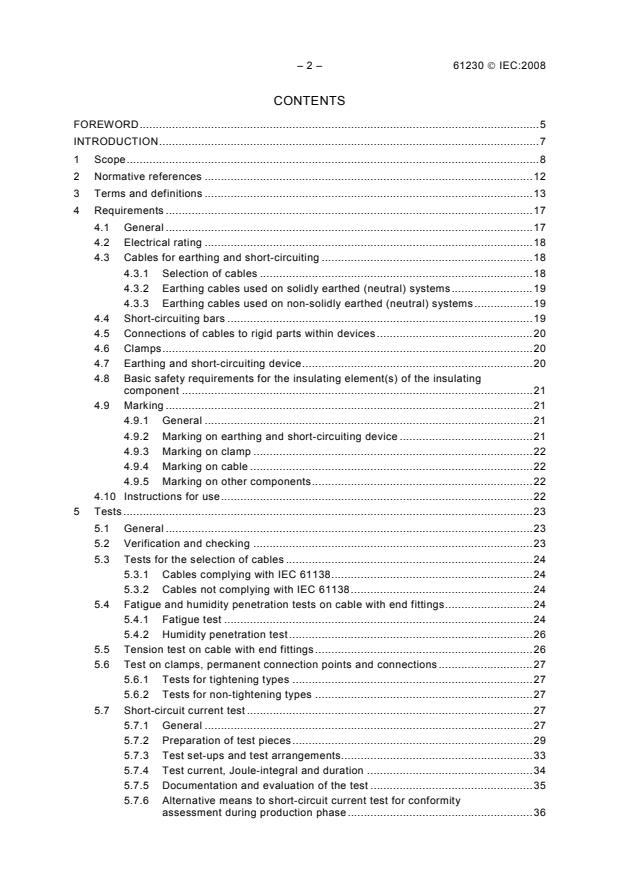
– 2 – 61230 © IEC:2008
CONTENTS
FOREWORD.5
INTRODUCTION.7
1 Scope.8
2 Normative references .12
3 Terms and definitions .13
4 Requirements .17
4.1 General .17
4.2 Electrical rating .18
4.3 Cables for earthing and short-circuiting .18
4.3.1 Selection of cables .18
4.3.2 Earthing cables used on solidly earthed (neutral) systems.19
4.3.3 Earthing cables used on non-solidly earthed (neutral) systems.19
4.4 Short-circuiting bars .19
4.5 Connections of cables to rigid parts within devices .20
4.6 Clamps.20
4.7 Earthing and short-circuiting device.20
4.8 Basic safety requirements for the insulating element(s) of the insulating
component .21
4.9 Marking .21
4.9.1 General .21
4.9.2 Marking on earthing and short-circuiting device .21
4.9.3 Marking on clamp .22
4.9.4 Marking on cable .22
4.9.5 Marking on other components.22
4.10 Instructions for use.22
5 Tests .23
5.1 General .23
5.2 Verification and checking .23
5.3 Tests for the selection of cables .24
5.3.1 Cables complying with IEC 61138.24
5.3.2 Cables not complying with IEC 61138.24
5.4 Fatigue and humidity penetration tests on cable with end fittings.24
5.4.1 Fatigue test .24
5.4.2 Humidity penetration test.26
5.5 Tension test on cable with end fittings.26
5.6 Test on clamps, permanent connection points and connections .27
5.6.1 Tests for tightening types .27
5.6.2 Tests for non-tightening types .27
5.7 Short-circuit current test .27
5.7.1 General .27
5.7.2 Preparation of test pieces.29
5.7.3 Test set-ups and test arrangements.33
5.7.4 Test current, Joule-integral and duration .34
5.7.5 Documentation and evaluation of the test .35
5.7.6 Alternative means to short-circuit current test for conformity
assessment during production phase.36
61230 © IEC:2008 – 3 –
5.8 Durability of marking .36
6 Conformity assessment .36
7 Modifications .36
Annex A (informative) Guidelines for portable equipment for earthing to be used on
railway systems .37
Annex B (informative) Guidelines for earthing sticks .41
Annex C (informative) Guidelines for selection, use and maintenance of portable
earthing or earthing and short-circuiting equipment.45
Annex D (informative) Guideline for determination of the equivalent r.m.s. value of a
short-time current during a short-circuit of a given duration.56
Annex E (normative) List of type tests.58
Annex F (normative) Classification of defects .59
Bibliography.60
Figure 1 – Examples of portable equipment and device for installations, network and
railway systems application.9
Figure 2 – Connection diagrams of single and multi-phase earthing and short-
circuiting devices for network application .11
Figure 3 – Illustration of a three-phase earthing and short-circuiting device with short-
circuiting bar and earthing cable(s) for installation and network application.12
Figure 4 – Apparatus for fatigue testing with bending and twisting .25
Figure 5 – Examples of multiple combinations of clamps accommodating different
shapes and sizes of connection points .29
Figure 6 – Test set-ups for testing multi-phase devices connected between rigid
conductors for substations .31
Figure 7 – Test set-ups for testing multi-phase short-circuiting devices for overhead
lines.32
Figure 8 – Test set-ups for testing single-phase devices for overhead lines and for
open air substations.33
Figure 9 – Shape of the short-circuit current during test.35
Figure A.1 – Test set-up for testing single phase equipment for railway systems .39
Figure B.1 – Arrangement for bending tests on earthing sticks of circular cross-section.43
Figure B.2 – Arrangement for torsion tests on earthing sticks of circular cross-section.44
Figure C.1 – Curves representing the temperature heating of different nature of
conductors related to the value of the Joule-integral J t.49
Figure C.2 – Determination of conductor temperature from heating.50
Figure C.3 – Determination of J t.51
Figure C.4 – Example of the usable region for a device .53
Figure D.1 – Determination of short-time current.57
Table 1 – Usual lengths of earthing and short-circuiting cables for different types of
installations and different voltage levels.11
Table 2 – Minimum cross-section of earthing cables related to the cross-section of the
short-circuiting cables and/or bars on non-solidly earthed (neutral) systems .19
Table 3 – Tension test force on cable with end fittings .27
Table A.1 – Short circuit values for copper cable with a maximum temperature of
450 °C .40
– 4 – 61230 © IEC:2008
Table B.1 – Maximum deflection .43
Table C.1 – Comparison of different standard values of nominal cross-sections.47
Table C.2 – Short-circuit close to generator – Short-circuit current values in kA for
copper cables with a maximum temperature of 300°C .48
Table E.1 – List of type tests referred to subclauses .58
Table F.1 – Classification of defects and associated requirements and tests .59
61230 © IEC:2008 – 5 –
INTERNATIONAL ELECTROTECHNICAL COMMISSION
____________
LIVE WORKING –
PORTABLE EQUIPMENT FOR EARTHING OR
EARTHING AND SHORT-CIRCUITING
FOREWORD
1) The International Electrotechnical Commission (IEC) is a worldwide organization for standardization comprising
all national electrotechnical committees (IEC National Committees). The object of IEC is to promote
international co-operation on all questions concerning standardization in the electrical and electronic fields. To
this end and in addition to other activities, IEC publishes International Standards, Technical Specifications,
Technical Reports, Publicly Available Specifications (PAS) and Guides (hereafter referred to as “IEC
Publication(s)”). Their preparation is entrusted to technical committees; any IEC National Committee interested
in the subject dealt with may participate in this preparatory work. International, governmental and non-
governmental organizations liaising with the IEC also participate in this preparation. IEC collaborates closely
with the International Organization for Standardization (ISO) in accordance with conditions determined by
agreement between the two organizations.
2) The formal decisions or agreements of IEC on technical matters express, as nearly as possible, an international
consensus of opinion on the relevant subjects since each technical committee has representation from all
interested IEC National Committees.
3) IEC Publications have the form of recommendations for international use and are accepted by IEC National
Committees in that sense. While all reasonable efforts are made to ensure that the technical content of IEC
Publications is accurate, IEC cannot be held responsible for the way in which they are used or for any
misinterpretation by any end user.
4) In order to promote international uniformity, IEC National Committees undertake to apply IEC Publications
transparently to the maximum extent possible in their national and regional publications. Any divergence
between any IEC Publication and the corresponding national or regional publication shall be clearly indicated in
the latter.
5) IEC provides no marking procedure to indicate its approval and cannot be rendered responsible for any
equipment declared to be in conformity with an IEC Publication.
6) All users should ensure that they have the latest edition of this publication.
7) No liability shall attach to IEC or its directors, employees, servants or agents including individual experts and
members of its technical committees and IEC National Committees for any personal injury, property damage or
other damage of any nature whatsoever, whether direct or indirect, or for costs (including legal fees) and
expenses arising out of the publication, use of, or reliance upon, this IEC Publication or any other IEC
Publications.
8) Attention is drawn to the Normative references cited in this publication. Use of the referenced publications is
indispensable for the correct application of this publication.
9) Attention is drawn to the possibility that some of the elements of this IEC Publication may be the subject of
patent rights. IEC shall not be held responsible for identifying any or all such patent rights.
International Standard IEC 61230 has been prepared by IEC technical committee 78: Live
working.
This second edition cancels and replaces the first edition published in 1993. It constitutes a
technical revision.
The major changes are:
– extension of the scope to cover the use of equipment on d.c. installations;
– extension of the use of aluminium to all conductive parts of the device;
– extension of the application to silicone rubber cables made by the revision of TC 20
document IEC 61138;
– possibility of using this standard for separate components of the equipment;
– general revision of requirements and tests;
– deletion of the marking requirement of the double triangle to clarify that the products
covered by the standard are not appropriate for performing live working;
– 6 – 61230 © IEC:2008
– clarification and modification to the procedure for short-circuit test:
• change of the number of devices submitted to test,
• change of the pre-conditioning time to 48 h,
• clarification of the test procedure for separate components,
– application of conformity assessment for products having completed the production phase,
according to IEC 61318 Ed.3;
– revision of existing annexes;
– change of normative Annexes A and C into informative Annexes C and B with a reviewed
wording;
– deletion of Annex B, not applicable according to IEC 61318 Ed.3;
– deletion of Annex D, its requirements and tests being now included in the body of the
standard;
– introduction of a new informative Annex A on railway application;
– introduction of a new informative Annex D giving guidelines for determination of the
equivalent r.m.s. value of a short-circuit current;
– revision of the list of type tests, which now appears in normative Annex E;
– introduction of a new normative Annex F on classification of defects.
The text of this standard is based on the following documents:
FDIS Report on voting
78/741/FDIS 78/748/RVD
Full information on the voting for the approval of this standard can be found in the report on
voting indicated in the above table.
This publication has been drafted in accordance with the ISO/IEC Directives, Part 2.
The committee has decided that the contents of this publication will remain unchanged until
the maintenance result date indicated on the IEC web site under "http://webstore.iec.ch" in
the data related to the specific publication. At this date, the publication will be
• reconfirmed,
• withdrawn,
• replaced by a revised edition, or
• amended.
61230 © IEC:2008 – 7 –
INTRODUCTION
This International Standard has been prepared in accordance with the requirements of
IEC 61477.
An agreement may be made between manufacturer and customer for additional requirements,
and tests. These additional requirements are prescribed in the customer's specification on the
basis of an acceptance procedure.
– 8 – 61230 © IEC:2008
LIVE WORKING –
PORTABLE EQUIPMENT FOR EARTHING OR
EARTHING AND SHORT-CIRCUITING
1 Scope
This International Standard is applicable to portable equipment, with or without matching
connection points, for temporary earthing or earthing and short-circuiting of electrically
isolated or de-energized a.c. and d.c. installations, distribution and transmission networks,
whether they are overhead or underground or of low or high voltage.
NOTE Annex A provides guidance for application to railway systems.
This standard covers equipment comprising an earthing or a short-circuiting or an earthing
and short-circuiting device and insulating component. An example is given in Figure 1a and
Figure 1b.
It also covers:
– earthing or short-circuiting or earthing and short-circuiting devices intended to be installed
with insulating means. An example of an earthing device is given in Figure 1c;
– separate components, such as conductive extension (see Figure 1b) or clamp or cable
with end fittings.
The performance of equipment, devices and components covered by this standard is based
on electro-dynamic and electro-thermal effects acting during short-circuit. The withstand
capability of the devices and equipment is expressed by their rated values of current, time
and peak factor. No rated voltage is given, but the geometrical dimensions of the equipment
are also linked to the voltage of the installation.
Examples of connection diagrams of earthing and short-circuiting devices are given in
Figures 2 and 3. Associated usual lengths of cables are given in Table 1.
Not covered in this standard are:
– insulating means, such as insulating sticks, telescopic sticks, insulating handles,
insulating gloves, aerial devices with insulating booms, insulating ropes to be used to
install the earthing and short-circuiting device;
– insulating components, except for basic safety requirements for the insulating element;
NOTE Basic safety recommendations for earthing sticks are given in Annex B.
– devices meant only for the draining of induced currents;
– relevant working procedures for using portable equipment for earthing or earthing and
short-circuiting.
NOTE The equipment complying with this standard should be used according to safe working procedures and
according to local or national regulation, such as live working or dead working procedures.
61230 © IEC:2008 – 9 –
Figure 1a – Multi-phase equipment Figure 1b – Single-phase equipment with
extension
Key
1 Earth clamp or rail clamp
2 Line clamp or contact line clamp
3 Short-circuiting cable(s)
4 Earthing cable(s)
5 Connecting cluster
6 Earth permanent connection point or rail
7 Line permanent connection point or
overhead contact line profile
8 Insulating element
9 Handle limit mark
10 Handle of earthing stick
11 Installation conductor or bar
12 Earthing system
13 End cap of stick
14 End fitting, permanent or detachable
15 Stick coupling, detachable for transport
reasons
16 Conductive extension
L
I Length of insulating element
L Length of handle
H
L Overall length of earthing stick and
O
conductive extension component
NOTE 1 The earthing and short-circuiting
device comprises components 1, 2, 3, 4, 5 and
16.
NOTE 2 The earthing stick comprises
components 8, 9, 10, 13, 14 and 15.
NOTE The same device can also be used for short-circuiting.
NOTE 3 The earthing device comprises
components 1, 2 and 4.
Figure 1c – Earthing device
Figure 1 – Examples of portable equipment and device
for installations, network and railway systems application
– 10 – 61230 © IEC:2008
Figure 2b
Figure 2a
Figure 2d
Figure 2c
Key
1 Earth clamp
2 Line clamp
3 Short-circuiting cable(s)
4 Earthing cable(s)
5 Connecting cluster
11 Installation conductor or
bar
16 Conductive extension
HVA (Y) = High voltage distribution , Y Neutral system
LV (Δ) = Low voltage, Δ Neutral system
Figure 2e
61230 © IEC:2008 – 11 –
Figure 2f Figure 2g
Figure 2 – Connection diagrams of single and multi-phase earthing
and short-circuiting devices for network application
NOTE Figure 2 shows examples only of connection arrangements. Not all are suitable for all situations. It is the
responsibility of the user to consider movement of connecting cables from magnetic forces. This has to be
considered prior to a final connection.
Table 1 – Usual lengths of earthing and short-circuiting cables
for different types of installations and different voltage levels
Classes of
Metal enclosed or
operating Overhead line Open air substation
indoor substation
voltages
Multi-phase Multi-phase
Figures 2a, 2b, 2c, 2d Figure 2c ; key 3 = 0,5 m
key 3 = 0,5 m Figure 2a ; key 3 = 0,5 m and
a key 4 = 12 m to 16 m key 4 = 1 m to 10 m
Low voltage Specific
Single-phase
Figure 2f
key 4 = 0,5 m to 10 m
Multi-phase Multi-phase Multi-phase
Figures 2a, 2b, 2c, 2d Figures 2a, 2b, 2c Figure 2a
key 3 = 2 m to 2,5 m key 3 = 7,5m to 10 m key 3 = 0,7 m
key 4 = 8 m to 10 m key 4 = 2,5 m to 3 m key 4 = 2 m
a Multi-phase + 5 m extension
Distribution
Figure 2g
key 4 = 8 m to 10 m
Single-phase Single-phase
Figure 2f Figure 2f
key 4 = 8 m to 10 m key 4 = 10 m to 12 m
Single-phase Single-phase Multi-phase
Figure 2f Figure 2f Figure 2a
key 4 = 10 m to 12 m key 3 = 3 m
key 4 = 8 m
key 4 = 3 m
a
Transmission
Single-phase + Single-phase
2 m to 5 m extension Figure 2f
Figure 2g key 4 = 3 m to 4 m
key 4 = 7 m to 8 m
a
The voltage limits for the different classes of operating voltage are conventional values and could be modified
by national regulations or national practice.
– 12 – 61230 © IEC:2008
Key
1 Earth clamp
2 Line clamp
4 Earthing cable(s)
11 Installation conductor
17 Short-circuiting bar
18 Earthing cable connection
Figure 3 – Illustration of a three-phase earthing and short-circuiting device
with short-circuiting bar and earthing cable(s) for installation and network application
2 Normative references
The following referenced documents are indispensable for the application of this document.
For dated references, only the edition cited applies. For undated references, the latest edition
of the referenced document (including any amendments) applies.
IEC 60060-1:1989 High voltage test techniques – Part 1: General definitions and test
1)
requirements
IEC 60068-2-11:1981, Environmental testing – Part 2: Tests – Test Ka: Salt mist
IEC 60068-2-42:2003, Environmental testing – Part 2-42: Tests – Test Kc: Sulphur dioxide
test for contacts and connections
IEC 60811-1-4:1985, Common test methods for insulating and sheathing materials of electric
cables – Part 1: Methods for general application – Section Four: Tests at low temperature
Amendment 1 (1993)
Amendment 2 (2001)
—————————
1)
Under revision.
61230 © IEC:2008 – 13 –
IEC 60811-2-1:1998, Insulating and sheathing materials of electric and optical cables
Common test methods – Part 2-1: Methods specific to elastomeric compounds – Ozone
resistance, hot test and mineral oil immersion tests
2)
Amendment 1 (2001)
IEC 60811-3-1:1985, Common test methods for insulating and sheathing materials of electric
cables – Part 3: Methods specific to PVC compounds – Section One – Pressure test at high
temperature – Tests for resistance to cracking
Amendment 1 (1994)
Amendment 2 (2001)
IEC 61138:2007, Cables for portable earthing and short-circuiting equipment
IEC 61318:2007, Live working – Conformity assessment applicable to tools, devices and
equipment
IEC 61477:2001, Live working – Minimum requirements for the utilization of tools, devices and
equipment
Amendment 1 (2002)
3)
Amendment 2 (2004)
3 Terms and definitions
For the purposes of this document, the terms and definitions given in IEC 61318 and the
following apply.
NOTE Further information on terminology is illustrated in Figures 1, 2 and 3.
3.1
conductive extension
rigid conductor forming an extension of an earthing or short-circuiting or earthing and short-
circuiting device
NOTE The conductive extension can be installed between the end fitting of an earthing stick and a line clamp, or
between a line clamp and connecting point.
[IEC 60743, definition 15.9, modified; IEV 651-14-11, modified]
3.2
connecting cluster
component of an earthing and short-circuiting device for connecting short-circuiting cables
either directly or through connecting links, such as cable lugs, to each other and to the
earthing cable(s) and/or the earth clamp
[IEC 60743, definition 15.5, modified; IEV 651-14-06, modified]
3.3
connecting point
part of installation or part of test set-up to which a clamp is connected
—————————
2)
There exists a consolidated edition 2.1 (2001) that includes IEC 60811-2-1:1998 and its Amendment 1.
3)
There exists a consolidated edition 1.2 (2005) that includes IEC 61447:2001 and its Amendments 1 and 2.
– 14 – 61230 © IEC:2008
3.4
connection point
part of installation specially arranged for clamp connection (for example, ball pin, cylinder
bolt, bow, hook, stirrup, stud)
[IEV 651-14-09 modified]
3.5
dead (in live working)
de-energized
at a potential equal to or not significantly different from that of earth at the worksite
NOTE In some countries, according to the dead procedures, the state dead is only considered after the earthing
and short-circuiting equipment has been properly installed.
[IEV 651-01-15 modified]
3.6
earth clamp
clamp forming part of an earthing or earthing and short-circuiting device for connecting an
earthing cable, or a connecting cluster to an earthing conductor or an earth electrode or a
reference potential
[IEC 60743, definition 15.6, modified; IEV 651-14-07, modified]
3.7
earthing and short-circuiting device
assembly of components for interconnecting conductors for earthing or short-circuiting or
earthing and short-circuiting installations and networks
NOTE 1 The earthing and short-circuiting device comprises clamps, cables or bars and possibly clusters.
NOTE 2 The earthing and short-circuiting device could be of single phase type or multi-phase type.
[IEC 60743, definition 15.2, modified; IEV 651-14-03, modified]
3.8
earthing cable
cable forming part of an earthing and short-circuiting device, which connects earth clamp to a
line clamp of the electrical installation or earth clamp to connecting cluster
[IEC 60743, definition 15.1, modified; IEV 651-14-02, modified]
3.9
earthing stick
earth application stick
insulating component equipped with a permanent or detachable end fitting for installing
clamps, short-circuiting bars or conductive extension components onto the electrical
installation
NOTE The insulating element of the earthing stick is intended to provide the adequate safety distance and
insulation to the worker.
[IEC 60743, definition 15.8, modified; IEV 651-14-10, modified]
61230 © IEC:2008 – 15 –
3.10
energized (in live working)
at a potential significantly different from that of earth at the worksite and which presents an
electrical hazard
NOTE A part is energized when it is electrically connected to a source of electric energy. It can also be energized
when it is electrically charged under the influence of an electric or magnetic field.
[IEV 651-01-14]
3.11
induced current
electric current resulting from the displacement of charges carriers due to an induced tension
or a magnetic field induction
[IEV 121-11-29 modified]
3.12
insulating element
element of an insulating component that provides adequate electrical insulation to the worker
NOTE For most of the insulating components used in the design of portable equipment for earthing or earthing
and short-circuiting, the insulating element also provides adequate safety distance to the workers.
3.13
insulating component
hand-held insulating part of a portable equipment for earthing or earthing and short-circuiting,
designed to bring and connect clamps to parts of electrical installations
NOTE An earthing stick is considered as an insulating component.
3.14
insulating means
insulating tool, equipment or device, manual or mechanical, complying with insulating
properties and used for bringing and connecting clamps of earthing and short-circuiting
devices to parts of electrical installations
NOTE An insulating glove, an insulating rope, an insulating handle, an insulating stick, an insulating telescopic
stick, an aerial device with insulating boom, are insulating means.
3.15
insulating stick
insulating tool essentially made of an insulating tube and/or rod with end fittings
[IEV 651-02-01]
3.16
isolate
to disconnect completely a device or circuit from other devices or circuits, separating it
physically, electrically and mechanically from all sources of electrical energy
NOTE Such separation may not eliminate all effects of electromagnetic or electrostatic induction.
[IEC 61328, definition 3.46, modified; IEC 61911, definition 3.39, modified]
– 16 – 61230 © IEC:2008
3.17
line clamp
clamp forming part of an earthing and short-circuiting device, which is attached to a short-
circuiting cable, a short-circuiting bar or conductive extension component, either directly or
through connecting links, and used for the connection to line (line conductors, busbars or
current-carrying conductors), or to the connection point
[IEC 60743, definition 15.7, modified; IEV 651-14-08, modified]
3.18
maintenance test
test carried out periodically on an item to verify that its performance remains within specified
limits, after having made certain adjustments, if necessary
[IEV 151-16-25]
3.19
maximum peak current
î
tm
peak value associated with the first major loop of the test short-circuit current determining the
highest electro-dynamic mechanical stresses
3.20
portable equipment for earthing or earthing and short-circuiting
equipment, which is portable and is capable to be carried by one person and manually or
mechanically connected with its insulating component to parts of an electrical installation for
earthing or short-circuiting or earthing and short-circuiting purposes
NOTE 1 The portable equipment for earthing or earthing and short-circuiting comprises the earthing and short-
circuiting device and one or more specific detachable or non-detachable insulating components.
NOTE 2 The use of insulating component is to safely connect the devices to the connecting points.
NOTE 3 The portable equipment for earthing or earthing and short-circuiting is installed temporarily on isolated
power circuits for the purposes of potential equalization and to help protect the worker by conducting a short-circuit
current for a specified duration (time).
NOTE 4 The aim of the earthing and short-circuiting of disconnected or isolated parts of installations is to provide
a control path to the short-circuit current and secondly to prevent the voltage rise in the earth circuit.
[IEV 651-14-01 modified]
3.21
rated current and rated time
r.m.s value of current and time assigned to a device, or component, determining the highest
mechanical and thermal stresses for a given peak factor
NOTE The values apply only to those parts designed to withstand short-circuit current.
[IEV 651-14-12 modified]
3.22
rated peak factor
ratio of the maximum peak current to its rated current
[IEV 101-14-57 modified]
3.23
safety distance
air clearance between the worker and a live part of the installation related to the voltage of
the installation and to the working procedures, which is determined to prevent any electrical
hazard to occur
61230 © IEC:2008 – 17 –
3.24
short-circuiting bar
rigid conductor, such as a bar or tube, forming part of an earthing and short-circuiting device
which connects together phases of the installation
[IEC 60743, definition 15.4, modified; IEV 651-14-05, modified]
3.25
short-circuiting cable
cable forming part of an earthing and short-circuiting device, which connects together clamps
to a common electrical reference point such as a line clamp to another line clamp or to a
connecting cluster
[IEC 60743, definition 15.3, modified; IEV 651-14-04, modified]
3.26
solidly earthed (neutral) system
system whose neutral point(s) is (are) earthed directly
[IEV 601-02-25]
3.27
supplier
organisation or person that provides a product
Example: Producer, distributor, retailer or vendor of a product, or provider of a service or information.
NOTE 1 A supplier can be internal or external to the organisation.
NOTE 2 In a contractual situation a supplier is sometimes called “contractor”.
[ISO 9000, definition 3.3.6]
3.28
transit current
current which flows through the cables of the earthing and short-circuiting device when the
device is completely connected to the electrical installation
NOTE 1 For HV installations or networks, the current may be a residual current (e.g. unbalanced load or induced
current).
NOTE 2 For railway d.c. systems, the current flowing from the rail to the overhead contact line when the earthing
cable is connected and when a train is running on an adjacent rail track.
4 Requirements
4.1 General
The equipment, devices and components shall be designed to contribute to the safety of the
users provided the equipment, devices and components are used by skilled persons, in
accordance with safe methods of work and the instructions for use (see 4.10).
NOTE 1 According to safe procedure, electrical installations are considered energized or live until all protective
earthing and short-circuiting equipment have been properly installed.
NOTE 2 Where applicable, national or regional regulations should be followed, such as live working or dead
working procedures.
Earthing and short-circuiting devices and their components shall be designed to withstand all
the mechanical stresses to which they are submitted during normal use.
– 18 – 61230 © IEC:2008
Devices and components shall withstand the maximum short-circuit current, time and Joule
integral for which they are rated.
NOTE Devices and components should be designed in order to also accept transit current.
Earthing and short-circuiting devices, when installed according to instructions for use, shall be
able to withstand all stresses from short-circuit currents for which they are designed without
causing electrical, mechanical, chemical or thermal danger to persons.
NOTE 1 For indoor use and enclosed space, poisonous effects should be considered (see C.2.2).
NOTE 2 Highest possible temperature rise of cables is therefore adopted to reduce weight.
The manufacturer or the end assembler of all component parts of the equipment shall be
responsible to ensure that the equipment meets all the requirements of this standard.
4.2 Electrical rating
Earthing and short-circuiting devices and their components shall be rated in terms of a short-
circuit current (I ), a time (t ) and the corresponding peak factor.
r r
For d.c. applications, the values shall be the same.
Most common values for the rated time are the following:
3 s, 2 s, 1 s, 0,75 s, 0,5 s, 0,25 s, 0,1 s
The rating of the complete device shall be expressed as rated current in kiloamperes, as rated
time in seconds and rated peak factor (see 4.9).
NOTE In order to compare different rated values see Annex C.
Separate components of the equipment shall be provided with their rated values and their
corresponding test configurations (see 4.10).
Compliance shall be verified by visual verification according to 5.2.
4.3 Cables for earthing and short-circuiting
Earthing and short-circuiting cables, whether they are made of aluminium or aluminium alloy
or made of copper, shall be designed to meet the performance requirement of their rating.
NOTE For selection of the cable cross-section according to temperature rise during a short-circuit, curves or
tables and guidance are given in Annex C.
Cables shall have adequate mechanical, chemical, environmental and electrical properties to
meet all the requirements of this standard.
NOTE 1 It may be acceptable that the insulating covering of the cable may melt or burn according to the
maximum accepted temperature rise during the flow of the short-circuit current and according to the applicable
safety rules.
NOTE 2 Guidance for selection of cables taking into account transit current is given in Annex C.
4.3.1 Selection of cables
Cables for earthing and short-circuiting purposes (see Figures 1, 2, and 3) shall be flexible.
Cables shall be insulated for mechanical protection.
61230 © IEC:2008 – 19 –
NOTE The customer may request additional resistance to mechanical shock onto a metallic structure. The cable
with PVC insulation should meet the additional requirement and clashing test of 5.4 of IEC 61138.
The selection of the nature of the insulating material shall be made to fulfil chemical,
environmental and temperature conditions met in practice.
For earthing and short-circuiting cables of a circular cross-section, electrical, mechanical and
other requirements can be met by selecting cables according to IEC 61138.
Cables not complying with IEC 61138 can be used but shall fulfil the following tests:
– the flexibility shall be in accordance with 5.3 of IEC 61138, and with 8.2 of
IEC 60811-1-4 for low temperature bending test,
– the
...