


IEC 62439-6:2010
(Main)Industrial communication networks - High availability automation networks - Part 6: Distributed Redundancy Protocol (DRP)
General Information
- Abstract
IEC 62439-6:2010 is applicable to high-availability automation networks based on the ISO/IEC 8802-3 (IEEE 802.3) (Ethernet) technology. It specifies a recovery protocol based on a ring topology, designed to react deterministically on a single failure of an inter-switch link or switch in the network. Each switch has equal management role in the network. Double rings are supported. It cancels and replaces IEC 62439 published in 2008 and constitutes a technical revision. It includes the following significant technical changes with respect to IEC 62439 (2008):
- adding a calculation method for RSTP (rapid spanning tree protocol, IEEE 802.1Q),
- adding two new redundancy protocols: HSR (High-availability Seamless Redundancy) and DRP (Distributed Redundancy Protocol),
- moving former Clauses 1 to 4 (introduction, definitions, general aspects) and the Annexes (taxonomy, availability calculation) to IEC 62439-1, which serves now as a base for the other documents,
- moving Clause 5 (MRP) to IEC 62439-2 with minor editorial changes,
- moving Clause 6 (PRP) was to IEC 62439-3 with minor editorial changes,
- moving Clause 7 (CRP) was to IEC 62439-4 with minor editorial changes, and
- moving Clause 8 (BRP) was to IEC 62439-5 with minor editorial changes,
- adding a method to calculate the maximum recovery time of RSTP in a restricted configuration (ring) to IEC 62439-1 as Clause 8,
- adding specifications of the HSR (High-availability Seamless Redundancy) protocol, which shares the principles of PRP to IEC 62439-3 as Clause 5, and
- introducing the DRP protocol as IEC 62439-6.
This publication is to be read in conjunction with IEC 62439-1:2010.
- Status
- Published
- Publication Date
- 25-Feb-2010
- Technical Committee
- SC 65C - Industrial networks
- Drafting Committee
- WG 15 - TC 65/SC 65C/WG 15
- Current Stage
- PPUB - Publication issued
- Start Date
- 26-Feb-2010
- Completion Date
- 15-Feb-2010
Buy Documents
IEC 62439-6:2010 - Industrial communication networks - High availability automation networks - Part 6: Distributed Redundancy Protocol (DRP) Released:2/26/2010
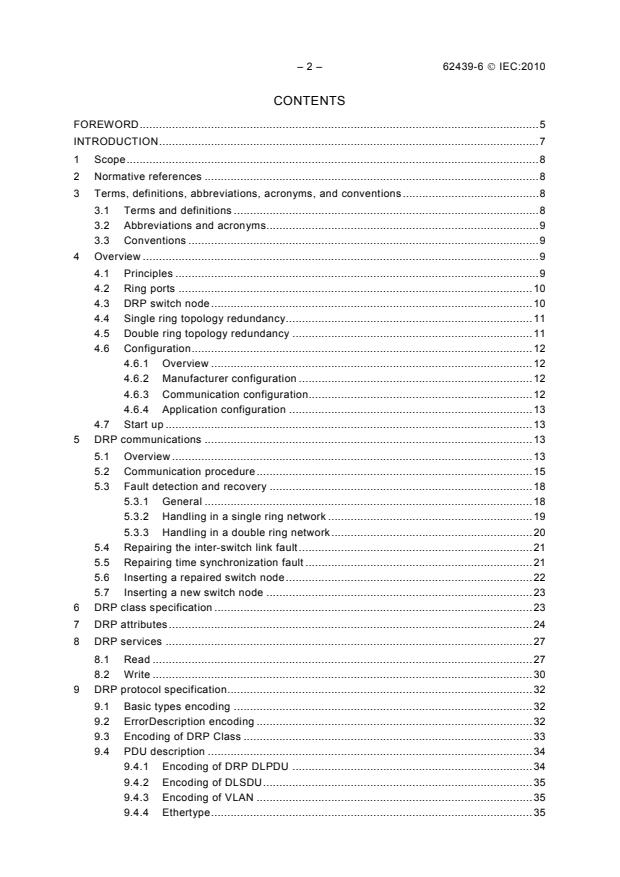
IEC 62439-6:2010 - Industrial communication networks - High availability automation networks - Part 6: Distributed Redundancy Protocol (DRP) Released:2/26/2010
Overview
IEC 62439-6:2010 - Industrial communication networks - High availability automation networks - Part 6: Distributed Redundancy Protocol (DRP) - defines a deterministic recovery protocol for Ethernet-based high-availability automation networks. The standard specifies DRP for ring and double-ring topologies built on ISO/IEC 8802-3 (IEEE 802.3) and targets networks that must react predictably to a single inter-switch link or switch failure. IEC 62439-6 is part of the IEC 62439 family and is intended to be read with IEC 62439-1:2010, which contains common definitions, taxonomy and availability calculations.
Key technical topics and requirements
- Deterministic ring-based recovery: DRP defines mechanisms for detecting and recovering from a single link or switch fault in a ring topology (single and double rings).
- Equal-switch management model: Every switch in the DRP ring has an equal management role (distributed control), avoiding single points of control.
- Support for double rings: DRP includes behaviour for dual-ring topologies for increased resilience.
- Communication procedures and PDUs: Detailed encodings for DRP PDUs (RingCheck, DeviceAnnunciation, RingChange, LinkCheck, LinkAlarm, etc.) and timing requirements.
- Fault detection and recovery logic: State machines and procedures for detecting faults, isolating failed links/switches, reinserting repaired or new nodes, and maintaining forwarding behaviour.
- Configuration and services: Manufacturer, communication and application configuration models; Read/Write services, class/attribute specifications and DRP attributes.
- Protocol state machine: Defined switch node states, transitions and functions to guarantee predictable recovery.
- Interoperability with Ethernet standards: Built on IEEE 802.3 with references to RSTP (IEEE 802.1Q) considerations and interaction with other IEC 62439 redundancy protocols (PRP, HSR).
Practical applications and users
Who uses IEC 62439-6 / DRP:
- Network architects and industrial network engineers designing high-availability Ethernet rings.
- Switch and automation equipment vendors implementing DRP-compliant devices.
- System integrators deploying resilient networks in manufacturing, process control, power substations, rail/transportation, and other mission-critical automation environments.
- Maintenance teams planning deterministic recovery SLAs and availability calculations.
Why it matters:
- Ensures predictable recovery times after single failures.
- Enables vendor implementations that interoperate in distributed ring networks.
- Supports design choices where distributed control and deterministic fault behavior are required.
Related standards
- IEC 62439-1:2010 - Common introduction, definitions, availability calculations (read in conjunction).
- IEC 62439-2 to -5 - Other redundancy protocols moved into separate parts (MRP, PRP, CRP, BRP).
- IEEE 802.3 / ISO/IEC 8802-3 - Ethernet physical and MAC layer foundation.
- IEEE 802.1Q (RSTP) - Rapid Spanning Tree considerations and recovery time calculations.
Keywords: IEC 62439-6, DRP, Distributed Redundancy Protocol, high-availability automation networks, Ethernet ring topology, industrial network redundancy, deterministic recovery.
Relations
- Effective Date
- 05-Sep-2023
Buy Documents
IEC 62439-6:2010 - Industrial communication networks - High availability automation networks - Part 6: Distributed Redundancy Protocol (DRP) Released:2/26/2010
IEC 62439-6:2010 - Industrial communication networks - High availability automation networks - Part 6: Distributed Redundancy Protocol (DRP) Released:2/26/2010
Get Certified
Connect with accredited certification bodies for this standard

BSI Group
BSI (British Standards Institution) is the business standards company that helps organizations make excellence a habit.

DVS-ZERT GmbH
German welding certification society.
CARES (UK Certification Authority for Reinforcing Steels)
UK certification for reinforcing steels and construction.
Sponsored listings
Frequently Asked Questions
IEC 62439-6:2010 is a standard published by the International Electrotechnical Commission (IEC). Its full title is "Industrial communication networks - High availability automation networks - Part 6: Distributed Redundancy Protocol (DRP)". This standard covers: IEC 62439-6:2010 is applicable to high-availability automation networks based on the ISO/IEC 8802-3 (IEEE 802.3) (Ethernet) technology. It specifies a recovery protocol based on a ring topology, designed to react deterministically on a single failure of an inter-switch link or switch in the network. Each switch has equal management role in the network. Double rings are supported. It cancels and replaces IEC 62439 published in 2008 and constitutes a technical revision. It includes the following significant technical changes with respect to IEC 62439 (2008): - adding a calculation method for RSTP (rapid spanning tree protocol, IEEE 802.1Q), - adding two new redundancy protocols: HSR (High-availability Seamless Redundancy) and DRP (Distributed Redundancy Protocol), - moving former Clauses 1 to 4 (introduction, definitions, general aspects) and the Annexes (taxonomy, availability calculation) to IEC 62439-1, which serves now as a base for the other documents, - moving Clause 5 (MRP) to IEC 62439-2 with minor editorial changes, - moving Clause 6 (PRP) was to IEC 62439-3 with minor editorial changes, - moving Clause 7 (CRP) was to IEC 62439-4 with minor editorial changes, and - moving Clause 8 (BRP) was to IEC 62439-5 with minor editorial changes, - adding a method to calculate the maximum recovery time of RSTP in a restricted configuration (ring) to IEC 62439-1 as Clause 8, - adding specifications of the HSR (High-availability Seamless Redundancy) protocol, which shares the principles of PRP to IEC 62439-3 as Clause 5, and - introducing the DRP protocol as IEC 62439-6. This publication is to be read in conjunction with IEC 62439-1:2010.
IEC 62439-6:2010 is applicable to high-availability automation networks based on the ISO/IEC 8802-3 (IEEE 802.3) (Ethernet) technology. It specifies a recovery protocol based on a ring topology, designed to react deterministically on a single failure of an inter-switch link or switch in the network. Each switch has equal management role in the network. Double rings are supported. It cancels and replaces IEC 62439 published in 2008 and constitutes a technical revision. It includes the following significant technical changes with respect to IEC 62439 (2008): - adding a calculation method for RSTP (rapid spanning tree protocol, IEEE 802.1Q), - adding two new redundancy protocols: HSR (High-availability Seamless Redundancy) and DRP (Distributed Redundancy Protocol), - moving former Clauses 1 to 4 (introduction, definitions, general aspects) and the Annexes (taxonomy, availability calculation) to IEC 62439-1, which serves now as a base for the other documents, - moving Clause 5 (MRP) to IEC 62439-2 with minor editorial changes, - moving Clause 6 (PRP) was to IEC 62439-3 with minor editorial changes, - moving Clause 7 (CRP) was to IEC 62439-4 with minor editorial changes, and - moving Clause 8 (BRP) was to IEC 62439-5 with minor editorial changes, - adding a method to calculate the maximum recovery time of RSTP in a restricted configuration (ring) to IEC 62439-1 as Clause 8, - adding specifications of the HSR (High-availability Seamless Redundancy) protocol, which shares the principles of PRP to IEC 62439-3 as Clause 5, and - introducing the DRP protocol as IEC 62439-6. This publication is to be read in conjunction with IEC 62439-1:2010.
IEC 62439-6:2010 is classified under the following ICS (International Classification for Standards) categories: 25.040.40 - Industrial process measurement and control; 35.100.05 - Multilayer applications. The ICS classification helps identify the subject area and facilitates finding related standards.
IEC 62439-6:2010 has the following relationships with other standards: It is inter standard links to IEC 62439:2008. Understanding these relationships helps ensure you are using the most current and applicable version of the standard.
IEC 62439-6:2010 is available in PDF format for immediate download after purchase. The document can be added to your cart and obtained through the secure checkout process. Digital delivery ensures instant access to the complete standard document.
Standards Content (Sample)
IEC 62439-6 ®
Edition 1.0 2010-02
INTERNATIONAL
STANDARD
colour
inside
Industrial communication networks – High availability automation networks –
Part 6: Distributed Redundancy Protocol (DRP)
All rights reserved. Unless otherwise specified, no part of this publication may be reproduced or utilized in any form
or by any means, electronic or mechanical, including photocopying and microfilm, without permission in writing from
either IEC or IEC's member National Committee in the country of the requester.
If you have any questions about IEC copyright or have an enquiry about obtaining additional rights to this publication,
please contact the address below or your local IEC member National Committee for further information.
IEC Central Office
3, rue de Varembé
CH-1211 Geneva 20
Switzerland
Email: inmail@iec.ch
Web: www.iec.ch
About the IEC
The International Electrotechnical Commission (IEC) is the leading global organization that prepares and publishes
International Standards for all electrical, electronic and related technologies.
About IEC publications
The technical content of IEC publications is kept under constant review by the IEC. Please make sure that you have the
latest edition, a corrigenda or an amendment might have been published.
ƒ Catalogue of IEC publications: www.iec.ch/searchpub
The IEC on-line Catalogue enables you to search by a variety of criteria (reference number, text, technical committee,…).
It also gives information on projects, withdrawn and replaced publications.
ƒ IEC Just Published: www.iec.ch/online_news/justpub
Stay up to date on all new IEC publications. Just Published details twice a month all new publications released. Available
on-line and also by email.
ƒ Electropedia: www.electropedia.org
The world's leading online dictionary of electronic and electrical terms containing more than 20 000 terms and definitions
in English and French, with equivalent terms in additional languages. Also known as the International Electrotechnical
Vocabulary online.
ƒ Customer Service Centre: www.iec.ch/webstore/custserv
If you wish to give us your feedback on this publication or need further assistance, please visit the Customer Service
Centre FAQ or contact us:
Email: csc@iec.ch
Tel.: +41 22 919 02 11
Fax: +41 22 919 03 00
IEC 62439-6 ®
Edition 1.0 2010-02
INTERNATIONAL
STANDARD
colour
inside
Industrial communication networks – High availability automation networks –
Part 6: Distributed Redundancy Protocol (DRP)
INTERNATIONAL
ELECTROTECHNICAL
COMMISSION
PRICE CODE
XB
ICS 25.040, 35.040 ISBN 978-2-88910-709-4
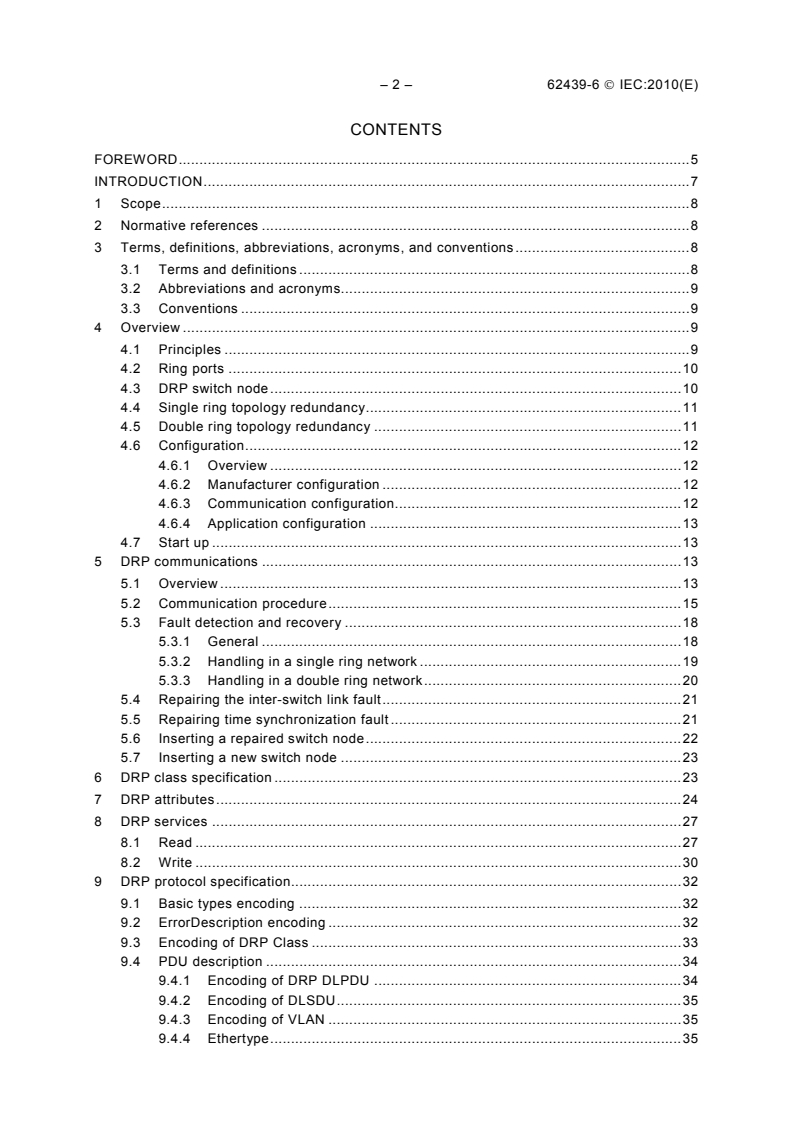
– 2 – 62439-6 © IEC:2010(E)
CONTENTS
FOREWORD.5
INTRODUCTION.7
1 Scope.8
2 Normative references .8
3 Terms, definitions, abbreviations, acronyms, and conventions.8
3.1 Terms and definitions .8
3.2 Abbreviations and acronyms.9
3.3 Conventions .9
4 Overview .9
4.1 Principles .9
4.2 Ring ports .10
4.3 DRP switch node.10
4.4 Single ring topology redundancy.11
4.5 Double ring topology redundancy .11
4.6 Configuration.12
4.6.1 Overview .12
4.6.2 Manufacturer configuration .12
4.6.3 Communication configuration.12
4.6.4 Application configuration .13
4.7 Start up .13
5 DRP communications .13
5.1 Overview .13
5.2 Communication procedure.15
5.3 Fault detection and recovery .18
5.3.1 General .18
5.3.2 Handling in a single ring network .19
5.3.3 Handling in a double ring network.20
5.4 Repairing the inter-switch link fault.21
5.5 Repairing time synchronization fault .21
5.6 Inserting a repaired switch node.22
5.7 Inserting a new switch node .23
6 DRP class specification .23
7 DRP attributes.24
8 DRP services .27
8.1 Read .27
8.2 Write .30
9 DRP protocol specification.32
9.1 Basic types encoding .32
9.2 ErrorDescription encoding .32
9.3 Encoding of DRP Class .33
9.4 PDU description .34
9.4.1 Encoding of DRP DLPDU .34
9.4.2 Encoding of DLSDU.35
9.4.3 Encoding of VLAN .35
9.4.4 Ethertype.35
62439-6 © IEC:2010(E) – 3 –
9.4.5 Encoding of DRP PDU.35
9.4.6 Encoding of DRP_DATA .36
9.4.7 Encoding of Read Service .40
9.4.8 Encoding of Write Service primitives.42
9.5 Protocol machine.44
9.5.1 Switch node states description .44
9.5.2 Protocol State Machine description.44
9.5.3 State transitions .45
9.5.4 Function descriptions.52
Bibliography.64
Figure 1 – DRP communication model .10
Figure 2 – Single ring topology redundancy .11
Figure 3 – Double ring topology redundancy .12
Figure 4 – DRP communication procedure .14
Figure 5 – Inserting a new switch node into the DRP system .14
Figure 6 – Fault detection and recovery .15
Figure 7 – Fault detection and recovery of single ring topology redundancy.19
Figure 8 – Single inter-switch link fault detection and recovery of double ring topology
redundancy.20
Figure 9 – Double inter-switch link fault detection and recovery of double ring topology
redundancy.21
Figure 10 – Inserting a repaired switch node.22
Figure 11 – DRP protocol state machine .45
Table 1 – Relationship between required recovery time and the TargetTimeSyncClass.22
Table 2 – Parameters of Read service .27
Table 3 – Parameters of Write service .30
Table 4 – Error Type definition.32
Table 5 – Error Code definition .33
Table 6 – Definition of DRP Class.33
Table 7 – DRP OUI .34
Table 8 – DRP MulticastMACAddress .35
Table 9 – Encoding of DLSDU .35
Table 10 – Encoding of DRP PDU.35
Table 11 – DRP_Type definition .35
Table 12 – Encoding of RingCheck frame .36
Table 13 – Encoding of DeviceAnnunciation frame.37
Table 14 – Encoding of RingChange frame .39
Table 15 – Encoding of LinkCheck frame .39
Table 16 – Encoding of LinkAlarm frame.40
Table 17 – Encoding of LinkChange frame.40
Table 18 – Encoding of Read Request .41
Table 19 – Encoding of Read Service Positive Response .41
Table 20 – Encoding of Read Service Negative Response .42
– 4 – 62439-6 © IEC:2010(E)
Table 21 – Encoding of Write Request .43
Table 22 – Encoding of Write Service Positive Response.43
Table 23 – Encoding of Write Service Negative Response .43
Table 24 – DRP state transitions.46
Table 25 – SetRingPortState() descriptions .52
Table 26 – LoadRingPortState() descriptions .52
Table 27 – WriteSucceed() descriptions.52
Table 28 – SynchronizationFinished() descriptions .53
Table 29 – ActivePortLinkState() descriptions.53
Table 30 – StandbyPortLinkState() descriptions.53
Table 31 – ConfigureInfo() descriptions .53
Table 32 – DRPSendTimer() descriptions .54
Table 33 – SendRingChange() descriptions .54
Table 34 – ForwardingRingCheck() descriptions .54
Table 35 – AnnunciationBlockingPort() descriptions.54
Table 36 – LocalDRPSequenceIDSmaller() descriptions .55
Table 37 – RecvAnnunciationWithinTimeLimit() descriptions.55
Table 38 – RecvLinkCheckWithinTimeLimit() descriptions.55
Table 39 – NoLocalLinkFault() descriptions .55
Table 40 – RecvLinkAlarm() descriptions .56
Table 41 – Clear_FDB() descriptions .56
Table 42 – ChangeRingState() descriptions .56
Table 43 – BlockingPortSelect() descriptions .56
Table 44 – SendLinkChange() descriptions .57
Table 45 – DRPSequenceIDCompare() descriptions .57
Table 46 – ChangePortState() descriptions.57
Table 47 – ChangeDoublePortState() descriptions .57
Table 48 – LocalSendRingCheck() descriptions .58
Table 49 – DRPKeyParaConfigure() descriptions .58
Table 50 – CheckMACAddress() descriptions .58
Table 51 – SetDRPKeyPara() descriptions.58
Table 52 – SendDeviceAnnunciation() descriptions.59
Table 53 – FaultRecvRingCheck() descriptions .59
Table 54 – RecordDeviceState() descriptions .59
Table 55 – DrpRecvMsg() descriptions .59
Table 56 – SendLinkAlarm() descriptions .60
Table 57 – TimeUnsynchronization() descriptions .60
Table 58 – PassiveMasterState() descriptions .60
Table 59 – SearchDeviceState() descriptions.60
Table A.1 – An example of parameters setting for DRP Class .62
Table A.2 – Parameters for calculation of recovery time.63
62439-6 © IEC:2010(E) – 5 –
INTERNATIONAL ELECTROTECHNICAL COMMISSION
____________
INDUSTRIAL COMMUNICATION NETWORKS –
HIGH AVAILABILITY AUTOMATION NETWORKS –
Part 6: Distributed Redundancy Protocol (DRP)
FOREWORD
1) The International Electrotechnical Commission (IEC) is a worldwide organization for standardization comprising
all national electrotechnical committees (IEC National Committees). The object of IEC is to promote
international co-operation on all questions concerning standardization in the electrical and electronic fields. To
this end and in addition to other activities, IEC publishes International Standards, Technical Specifications,
Technical Reports, Publicly Available Specifications (PAS) and Guides (hereafter referred to as “IEC
Publication(s)”). Their preparation is entrusted to technical committees; any IEC National Committee interested
in the subject dealt with may participate in this preparatory work. International, governmental and non-
governmental organizations liaising with the IEC also participate in this preparation. IEC collaborates closely
with the International Organization for Standardization (ISO) in accordance with conditions determined by
agreement between the two organizations.
2) The formal decisions or agreements of IEC on technical matters express, as nearly as possible, an international
consensus of opinion on the relevant subjects since each technical committee has representation from all
interested IEC National Committees.
3) IEC Publications have the form of recommendations for international use and are accepted by IEC National
Committees in that sense. While all reasonable efforts are made to ensure that the technical content of IEC
Publications is accurate, IEC cannot be held responsible for the way in which they are used or for any
misinterpretation by any end user.
4) In order to promote international uniformity, IEC National Committees undertake to apply IEC Publications
transparently to the maximum extent possible in their national and regional publications. Any divergence
between any IEC Publication and the corresponding national or regional publication shall be clearly indicated in
the latter.
5) IEC itself does not provide any attestation of conformity. Independent certification bodies provide conformity
assessment services and, in some areas, access to IEC marks of conformity. IEC is not responsible for any
services carried out by independent certification bodies.
6) All users should ensure that they have the latest edition of this publication.
7) No liability shall attach to IEC or its directors, employees, servants or agents including individual experts and
members of its technical committees and IEC National Committees for any personal injury, property damage or
other damage of any nature whatsoever, whether direct or indirect, or for costs (including legal fees) and
expenses arising out of the publication, use of, or reliance upon, this IEC Publication or any other IEC
Publications.
8) Attention is drawn to the Normative references cited in this publication. Use of the referenced publications is
indispensable for the correct application of this publication.
International Standard 62439-6 has been prepared by subcommittee 65C: Industrial Networks,
of IEC technical committee 65: Industrial-process measurement, control and automation.
This standard cancels and replaces IEC 62439 published in 2008. This first edition constitutes
a technical revision.
This edition includes the following significant technical changes with respect to IEC 62439
(2008):
– adding a calculation method for RSTP (rapid spanning tree protocol, IEEE 802.1Q),
– adding two new redundancy protocols: HSR (High-availability Seamless Redundancy)
and DRP (Distributed Redundancy Protocol),
– moving former Clauses 1 to 4 (introduction, definitions, general aspects) and the
Annexes (taxonomy, availability calculation) to IEC 62439-1, which serves now as a
base for the other documents,
– moving Clause 5 (MRP) to IEC 62439-2 with minor editorial changes,
– moving Clause 6 (PRP) was to IEC 62439-3 with minor editorial changes,
– 6 – 62439-6 © IEC:2010(E)
– moving Clause 7 (CRP) was to IEC 62439-4 with minor editorial changes, and
– moving Clause 8 (BRP) was to IEC 62439-5 with minor editorial changes,
– adding a method to calculate the maximum recovery time of RSTP in a restricted
configuration (ring) to IEC 62439-1 as Clause 8,
– adding specifications of the HSR (High-availability Seamless Redundancy) protocol,
which shares the principles of PRP to IEC 62439-3 as Clause 5, and
– introducing the DRP protocol as IEC 62439-6.
The text of this standard is based on the following documents:
FDIS Report on voting
65C/583/FDIS 65C/589/RVD
Full information on the voting for the approval of this standard can be found in the report on
voting indicated in the above table.
This International Standard is to be read in conjunction with IEC 62439-1:2010, Industrial
communication networks – High availability automation networks – Part 1: General concepts
and calculation methods.
A list of the IEC 62439 series can be found, under the general title Industrial communication
networks – High availability automation networks, on the IEC website.
This publication has been drafted in accordance with ISO/IEC Directives, Part 2.
The committee has decided that the contents of this amendment and the base publication will
remain unchanged until the stability date indicated on the IEC web site under
"http://webstore.iec.ch" in the data related to the specific publication. At this date, the
publication will be
• reconfirmed,
• withdrawn,
• replaced by a revised edition, or
• amended.
A bilingual version of this standard may be issued at a later date.
IMPORTANT – The “colour inside” logo on the cover page of this publication indicates
that it contains colours which are considered to be useful for the correct understanding
of its contents. Users should therefore print this publication using a colour printer.
62439-6 © IEC:2010(E) – 7 –
INTRODUCTION
The IEC 62439 series specifies relevant principles for high availability networks that meet the
requirements for industrial automation networks.
In the fault-free state of the network, the protocols of the IEC 62439 series provide
ISO/IEC 8802-3 (IEEE 802.3) compatible, reliable data communication, and preserve
determinism of real-time data communication. In cases of fault, removal, and insertion of a
component, they provide deterministic recovery times.
These protocols retain fully the typical Ethernet communication capabilities as used in the
office world, so that the software involved remains applicable.
The market is in need of several network solutions, each with different performance
characteristics and functional capabilities, matching diverse application requirements. These
solutions support different redundancy topologies and mechanisms which are introduced in
IEC 62439-1 and specified in the other Parts of the IEC 62439 series. IEC 62439-1 also
distinguishes between the different solutions, giving guidance to the user.
The IEC 62439 series follows the general structure and terms of IEC 61158 series.
The International Electrotechnical Commission (IEC) draws attention to the fact that it is
claimed that compliance with this document may involve the use of a patent concerning about
the communication procedure and fault detection and recovery for DRP given in 5.2 and 5.3.
IEC takes no position concerning the evidence, validity and scope of this patent right.
The holder of this patent right has assured the IEC that he/she is willing to negotiate licences
either free of charge or under reasonable and non-discriminatory terms and conditions with
applicants throughout the world. In this respect, the statement of the holder of this patent
right is registered with IEC. Information may be obtained from:
SUPCON Group Co., Ltd & Zhejiang University
Hangzhou
China
Beijing Kyland Technology Co. LTD
No 95 Building
Southeast Corner of Xisanqi Bridge
Haidian
Beijing
China
Attention is drawn to the possibility that some of the elements of this document may be the
subject of patent rights other than those identified above. IEC shall not be held responsible for
identifying any or all such patent rights.
ISO (www.iso.org/patents) and IEC (http://www.iec.ch/tctools/patent_decl.htm) maintain on-
line data bases of patents relevant to their standards. Users are encouraged to consult the
data bases for the most up to date information concerning patents.
– 8 – 62439-6 © IEC:2010(E)
INDUSTRIAL COMMUNICATION NETWORKS –
HIGH AVAILABILITY AUTOMATION NETWORKS –
Part 6: Distributed Redundancy Protocol (DRP)
1 Scope
The IEC 62439 series is applicable to high-availability automation networks based on the
ISO/IEC 8802-3 (IEEE 802.3) (Ethernet) technology.
This part of the IEC 62439 series specifies a recovery protocol based on a ring topology,
designed to react deterministically on a single failure of an inter-switch link or switch in the
network. Each switch has equal management role in the network. Double rings are supported.
2 Normative references
The following referenced documents are indispensable for the application of this document.
For dated references, only the edition cited applies. For undated references, the latest edition
of the referenced document (including any amendments) applies.
IEC 60050-191, International Electrotechnical Vocabulary – Chapter 191: Dependability and
quality of service
IEC 61158 (all parts), Industrial communication networks – Fieldbus specifications
IEC 61588:2009, Precision clock synchronization protocol for networked measurement and
control systems (IEEE 1588)
IEC 62439-1:2010, Industrial communication networks – High availability automation networks
– Part 1: General concepts and calculation methods
ISO/IEC/TR 8802-1, Information technology – Telecommunications and information exchange
between systems – Local and metropolitan area networks – Specific requirements – Part 1:
Overview of Local Area Network Standards Technologies de (IEEE 802.1)
ISO/IEC 8802-3:2000, Information technology – Telecommunications and information
exchange between systems – Local and metropolitan area networks – Specific requirements –
Part 3: Carrier sense multiple access with collision detection (CSMA/CD) access method and
physical layer specifications
IEEE 802.1D:2004, IEEE standard for local Local and metropolitan area networks Media
Access Control (MAC) Bridges
IEEE 802.1Q, IEEE standards for local and metropolitan area network. Virtual bridged local
area networks
3 Terms, definitions, abbreviations, acronyms, and conventions
3.1 Terms and definitions
For the purposes of this document, the terms and definitions given in IEC 60050-191, as well
as in IEC 62439-1, apply, in addition to the following.
62439-6 © IEC:2010(E) – 9 –
3.1.1
active ring port
ring port which is connected in the ring network and works in Blocking or Forwarding state
3.1.2
cycle
shortest time interval after which the communication traffic pattern repeats itself
3.1.3
standby ring port
ring port which is connected in the ring network and works in the Disabled state
3.1.4
time offset
time difference from a specially designated time
3.2 Abbreviations and acronyms
For the purposes of this document, the abbreviations and acronyms given in IEC 62439-1,
apply.
3.3 Conventions
This document follows the conventions defined in IEC 62439-1.
4 Overview
4.1 Principles
The Distributed Redundancy Protocol (DRP) defines a high availability network solution based
on ISO/IEC 8802-3 (IEEE 802.3) and the functions of ISO/IEC/TR 8802-1 (IEEE 802.1) for
communication link redundancy.
DRP provides a framework for describing the operational behaviour of the switches in a ring
topology to detect a single network failure (such as an inter-switch link failure or a ring switch
failure) and recover from it within a deterministic recovery time.
A DRP network has a ring topology with multiple switch nodes, each of which may be a switch
or a switching end node. Each node requires an integrated switch with at least two ports (ring
ports) connected to the ring, and which is able to detect and recover from failures in
accordance with the DRP protocol.
Each node has equal management role in a DRP ring network. It means that each node
observes and controls the ring topology by multicasting a ring test frame RingCheck and an
inter-switch link test frame LinkCheck cyclically, and reacts on network faults. The LinkCheck
test frame provides the mechanism to detect the failure of a switch node.
In a DRP network, each switch node is synchronized using IEC 61588 (IEEE 1588) with either
boundary clock or transparent clock according to the application.
NOTE Typically, boundary clock is used according to IEC 61588 (IEEE 1588). In larger-scale application, the
transparent clock should be used for better time synchronization.
Optionally, DRP supports double ring topology redundancy. In this case, each switch node
shall have at least two pairs of ring ports: one pair of active ring ports and one pair of standby
ring ports.
– 10 – 62439-6 © IEC:2010(E)
The DRP defines a service entity and a protocol entity, as well as a set of management
frames. The service entity specifies the externally visible services for application layer and
systems management. The communication model for DRP is shown in Figure 1.
DRP DRP
(service) (protocol)
data
link
802.1
layer
bridge
802.3 802.3
medium medium
access access
physical 802.3 802.3
layer
PHY PHY
IEC 391/10
Figure 1 – DRP communication model
4.2 Ring ports
Each switch node shall have at least two ring ports connected to the ring network.
Some switch nodes in addition to the ring ports can have one or more non ring ports including
leaf link ports. In such cases, the DRP frames (for example RingCheck, LinkCheck, LinkAlarm,
LinkChange, DeviceAnnunciation and RingChange) shall not be forwarded to non-ring ports.
The ring ports which support DRP protocol shall have three states as follows:
a) Disabled
• All frames shall be dropped.
b) Blocking
All frames shall be dropped except the following:
• DRP frames, such as RingCheck frame, LinkCheck frame, LinkAlarm frame,
LinkChange frame, DeviceAnnunciation frame, RingChange frame.
• Frames specified in IEEE 802.1D (2004) Table 7-10 to pass ports in “Discarding” state
(e.g. LLDP, IEC 61588 (IEEE 1588) PTP).
• Frames only produced or consumed by the higher layer entities of this node and never
forwarded.
c) Forwarding:
All frames shall be passed through according to the forwarding behaviour of IEEE 802.1D.
4.3 DRP switch node
The communication roles of all switch nodes are equal in the DRP ring. Each switch node may
be a switch or a switching end node.
62439-6 © IEC:2010(E) – 11 –
Each switch node has the equal right to periodically multicast ring fault detection frame
RingCheck and inter-switch link fault detection frame LinkCheck in both directions of the ring
at the scheduled time.
4.4 Single ring topology redundancy
Each switch node shall have two ring ports connected to the ring network, which are called
active ports (as shown in Figure 2).
In a DRP single ring network, only one active ring port operates in the Blocking state while all
other ring ports operate in the Forwarding state. That is, only one switch node sets one of its
active ring ports into the Blocking state, the other active ring port of this node is set into the
Forwarding state. All other switch nodes set the two active ring ports into the Forwarding state.
BFBF FFFF FFFF FFFF
FFFF FFFF FFFF FFFF
IEC 392/10
Figure 2 – Single ring topology redundancy
4.5 Double ring topology redundancy
As shown in Figure 3, each switch node shall have at least two pairs of ring ports connected
to the ring network. One pair of ring ports is active (for example the ports in Ring1) while the
other pair of ring ports is standby (for example the ports in Ring2).
– 12 – 62439-6 © IEC:2010(E)
Ring 2
D D
DD DD
D D
BF FF FF FF
Ring 1
FF FF FF FF
D
D D D D
D D D
IEC 393/10
Figure 3 – Double ring topology redundancy
In a DRP double ring network, only one switch node sets one of its active ring ports into
Blocking state, the other active ring port into the Forwarding state and the two standby ring
ports into the Disabled state.
4.6 Configuration
4.6.1 Overview
Before the switch node is connected in a DRP network, it shall be configured using
configuration software using the DRP Write service. The configuration shall include
manufacturer configuration, communication configuration, and application configuration.
4.6.2 Manufacturer configuration
Manufacturer configuration includes the preset of DeviceID, ManufacturerName, DRPVersion,
SoftwareVersion, HardwareVersion, Device MAC Address.
Manufacturer configuration information shall be downloaded in a DRP device only when it is
manufactured, and it may be uploaded using the Read service.
4.6.3 Communication configuration
Communication configuration includes the preset of states of standby ring ports, Cycle, Ring
Check SendTimeOffset, Ring Check Time Limit, Link Check SendTimeOffset, Link Check
Time Limit, SynchronizationClockType, DRPSequenceID, DRPDeviceNumber.
For a single ring network, each switch node shall initialize one active ring port in the Blocking
state, and the other ring port in the Forwarding state as described in 4. 7.
62439-6 © IEC:2010(E) – 13 –
For a double ring network, the two standby ring ports shall be set to the Disabled state.
Communication configuration information shall be written into a switch node using a Write
service. It can be read from a switch node using the Read service.
4.6.4 Application configuration
Application configuration includes the preset of DRP Domain ID, PD-Tag, VLAN ID, Ring1
Port1 ID, Ring1 Port2 ID, Ring2 Port1 ID, Ring2 Port2 ID, SynchronizationClockType.
Application configuration information shall be downloaded into the switch node using Write
service. It can be uploaded using Read service.
4.7 Start up
When powered on, each switch node shall initialize one active ring port in the Blocking state
and the other ring port in the Forwarding state. Each switch node shall be synchronized using
IEC 61588 (IEEE 1588) protocol (see 6.6 and 9.3 in IEC 61588 (IEEE 1588)).
If a switch node has not received any RingCheck frame in Ring Check Time Limit, and this
switch node is directly connected to the grandmaster clock outside of the ring as defined in
IEC 61588 (IEEE 1588), the switch node shall set the value of DRPDeviceNumber and the
value of DRPSequenceID to 0x01, and send the RingCheck frame immediately.
When the value of Cycle is 0xFFFF FFFF FFFF FFFF, the switch node shall not transmit any
DRP frames. Otherwise, it shall send the DeviceAnnunciation and the LinkCheck frames
according to the communication configuration.
When the DRP system reaches steady state, only the switch node with the smallest
DRPSequenceID will keep one ring port in the Blocking state.
5 DRP communications
5.1 Overview
In a DRP redundant network, the communication time is divided into several Cycles, marked
as Cycle as shown in Figure 4. Where t is the time offset for sending the RingCheck
RingCheck
frame while t is the time offset for sending the LinkCheck frame.
LinkCheck
– 14 – 62439-6 © IEC:2010(E)
Cycle Switch C
Cycle Switch A Cycle Switch B
D1
D2
D3
D4
D5
D6
t
t
t
LinkCheck
LinkCheck
LinkCheckTimeOffset
t
t
RingCheck
RingCheck TimeOffset RingCheck
RingCheck
LinkCheck LinkAlarm
LinkChange
RingChange
DeviceAnnunciation
IEC 394/10
Figure 4 – DRP communication procedure
Within one Cycle, only one switch node multicasts the RingCheck frame to test the ring state
at time t , while each switch node multicasts the LinkCheck frame to its two neighbour
RingCheck
switch nodes at time t to test the operation state of all inter-switch links and switch
LinkCheck
nodes (see 5. 3) .
Cycle Switch C
Cycle Switch B
Cycle Switch A
D1
D2
D3
D4
D5
D6
t
t t
LinkCheck
LinkCheck
LinkCheckTimeOffset
t
t
RingCheck TimeOffset RingCheck
RingCheck
RingCheck
LinkCheck LinkAlarm
LinkChange
RingChange
DeviceAnnunciation
IEC 395/10
Figure 5 – Inserting a new switch node into the DRP system
62439-6 © IEC:2010(E) – 15 –
As shown in Figure 5, a new switch node (D4) is inserted into the DRP system. The
DeviceAnnunciation frame is sent by this new switch node as a multicast out of the two active
ring ports. And the switch node multicasts the RingChange frame in its Cycle to all the switch
nodes in the DRP system (see 5. 7) .
Cycle Switch C
Cycle Switch B
Cycle Switch A
D1
D2
D3
D4
D5
D6
t
t
t LinkCheck
LinkCheck
LinkCheckTimeOffset
t
t
RingCheck
RingCheck TimeOffset RingCheck
RingCheck
LinkCheck LinkAlarm
LinkChange
DeviceAnnunciation RingChange
IEC 396/10
Figure 6 – Fault detection and recovery
As shown in Figure 6, fault is detected by a switch node (D3) in the DRP system. The
LinkAlarm frame is sent by this switch node as a multicast out of the two active ring ports.
And the switch node multicasts the LinkChange frame in its Cycle to all the switch nodes in
the DRP system (see 5. 3) .
5.2 Communication procedure
In a DRP network system, each switch node shall operate as follows (see also Figure 7,
Figure 8 and Figure 9):
a) When a switch node powers on, it shall initialize the states of its two active ring ports: the
state of Ring1Port1 shall be Blocking while Ring1Port2 shall be Forwarding. If this switch
node has standby ring ports, it shall set them into the Disabled state. After initialization, it
shall wait to synchronize its local current time using IEC 61588 (IEEE 1588) protocol. No
DRP frames shall be sent by this switch node before its local time is synchronized.
b) After time synchronization, the switch node shall check the configuration information.
1) The parameters DRPDeviceNumber, DRPSequenceID, Ring Check SendTimeOffset,
Link Check SendTimeOffset are defined in Clause 6. These parameters are configured
by the end user or set by the RingChange frame. If any value of DRPDeviceNumber,
DRPSequenceID or Cycle is the default value, that means, the local switch node is
unconfigured, the switch node shall set all of them to the default value. And then do
the following within the time Required Recovery Time from time synchronized.
i) if a RingCheck frame has been received, the switch node shall send the
DeviceAnnunciation frame immediately.
ii) otherwise, the switch node shall send the LinkAlarm frame to request a new
configuration.
2) otherwise, it shall take no further actions.
– 16 – 62439-6 © IEC:2010(E)
c) After the configuration check, the switch node shall calculate when to send the RingCheck
frames using the following algorithm:
If the following condition is met:
MOD (Local current time, (DRPDeviceNumber*Cycle)) ==
(DRPSequenceID-1)* Cycle+ Ring Check SendTimeOffset (1)
then it is time t to send the RingCheck frame as a multicast out of the two active
RingCheck
ring ports.
The switch which send the RingCheck frame shall do the following within the time Ring
Check Time Limit from the RingCheck sending time t ,
RingCheck
1) if the sent RingCheck frame itself has been received, it shall stop forwarding this
RingCheck frame and take no further actions;
2) otherwise, it shall send the LinkAlarm frame to record the ring fault.
d) if the following condition is met:
MOD (Local current time, Cycle) == Ring Check SendTimeOffset (2)
then it is time that one switch node shall send the LinkCheck frame. The local switch
node shall do the following within the time Ring Check Time Limit from this time if it’s not
its Cycle.
1) if a RingCheck frame has been received from one active ring port (for example
Ring1Port1), set the corresponding bit in DRPDeviceState, and check if the
communication configuration information in the RingCheck frame is equal to the local
switch node.
i) if the DRPDeviceNumber in the RingCheck frame is not equal to the local switch
node, or the DRPSequenceID in the RingCheck frame is equal to the
DRPSequenceID in the local switch node, the local switch node shall return the
communication configuration to the default values and send the
DeviceAnnunciation frame immediately.
ii) otherwise, check if the RingCheck frame was sent by a switch node with one
Blocking ring port:
• if none of the ring port states in the RingCheck frame is Blocking, it shall
take no further actions;
• otherwise, the switch node shall check the local DRPSequenceID.
– if local DRPSequenceID is smaller than that in the RingCheck
frame, the switch node shall take no further actions;
– otherwise, the switch node shall change the local Blocking ring port
state to the Forwarding state.
2) if no RingCheck frame has been received, clear the corresponding bit in
DRPDeviceState.
e) After the DeviceAnnunciation frame is received, the switch node shall check if this frame
was sent by the node itself, that is:
1) if the DeviceAnnunciation frame was sent by the node itself, the switch node shall stop
forwarding the DeviceAnnunciation frame;
2) otherwise, the switch node shall check if the DeviceAnnunciation frame is received
during its Cycle:
i) if the DeviceAnnunciation frame is not received during its Cycle, the switch node
shall take no further actions;
62439-6 © IEC
...
IEC 62439-6 ®
Edition 1.0 2010-02
INTERNATIONAL
STANDARD
NORME
INTERNATIONALE
colour
inside
Industrial communication networks – High availability automation networks –
Part 6: Distributed Redundancy Protocol (DRP)
Réseaux industriels de communication – Réseaux de haute disponibilité pour
l’automation –
Partie 6: Protocole de redondance distribuée (DRP)
All rights reserved. Unless otherwise specified, no part of this publication may be reproduced or utilized in any form
or by any means, electronic or mechanical, including photocopying and microfilm, without permission in writing from
either IEC or IEC's member National Committee in the country of the requester.
If you have any questions about IEC copyright or have an enquiry about obtaining additional rights to this publication,
please contact the address below or your local IEC member National Committee for further information.
Droits de reproduction réservés. Sauf indication contraire, aucune partie de cette publication ne peut être reproduite ni
utilisée sous quelque forme que ce soit et par aucun procédé, électronique ou mécanique, y compris la photocopie et les
microfilms, sans l'accord écrit de la CEI ou du Comité national de la CEI du pays du demandeur.
Si vous avez des questions sur le copyright de la CEI ou si vous désirez obtenir des droits supplémentaires sur cette
publication, utilisez les coordonnées ci-après ou contactez le Comité national de la CEI de votre pays de résidence.
IEC Central Office Tel.: +41 22 919 02 11
3, rue de Varembé Fax: +41 22 919 03 00
CH-1211 Geneva 20 info@iec.ch
Switzerland www.iec.ch
About the IEC
The International Electrotechnical Commission (IEC) is the leading global organization that prepares and publishes
International Standards for all electrical, electronic and related technologies.
About IEC publications
The technical content of IEC publications is kept under constant review by the IEC. Please make sure that you have the
latest edition, a corrigenda or an amendment might have been published.
Useful links:
IEC publications search - www.iec.ch/searchpub Electropedia - www.electropedia.org
The advanced search enables you to find IEC publications The world's leading online dictionary of electronic and
by a variety of criteria (reference number, text, technical electrical terms containing more than 30 000 terms and
committee,…). definitions in English and French, with equivalent terms in
It also gives information on projects, replaced and additional languages. Also known as the International
withdrawn publications. Electrotechnical Vocabulary (IEV) on-line.
IEC Just Published - webstore.iec.ch/justpublished Customer Service Centre - webstore.iec.ch/csc
Stay up to date on all new IEC publications. Just Published If you wish to give us your feedback on this publication
details all new publications released. Available on-line and or need further assistance, please contact the
also once a month by email. Customer Service Centre: csc@iec.ch.
A propos de la CEI
La Commission Electrotechnique Internationale (CEI) est la première organisation mondiale qui élabore et publie des
Normes internationales pour tout ce qui a trait à l'électricité, à l'électronique et aux technologies apparentées.
A propos des publications CEI
Le contenu technique des publications de la CEI est constamment revu. Veuillez vous assurer que vous possédez
l’édition la plus récente, un corrigendum ou amendement peut avoir été publié.
Liens utiles:
Recherche de publications CEI - www.iec.ch/searchpub Electropedia - www.electropedia.org
La recherche avancée vous permet de trouver des Le premier dictionnaire en ligne au monde de termes
publications CEI en utilisant différents critères (numéro de électroniques et électriques. Il contient plus de 30 000
référence, texte, comité d’études,…). termes et définitions en anglais et en français, ainsi que
Elle donne aussi des informations sur les projets et les les termes équivalents dans les langues additionnelles.
publications remplacées ou retirées. Egalement appelé Vocabulaire Electrotechnique
International (VEI) en ligne.
Just Published CEI - webstore.iec.ch/justpublished
Service Clients - webstore.iec.ch/csc
Restez informé sur les nouvelles publications de la CEI.
Just Published détaille les nouvelles publications parues. Si vous désirez nous donner des commentaires sur
Disponible en ligne et aussi une fois par mois par email. cette publication ou si vous avez des questions
contactez-nous: csc@iec.ch.
IEC 62439-6 ®
Edition 1.0 2010-02
INTERNATIONAL
STANDARD
NORME
INTERNATIONALE
colour
inside
Industrial communication networks – High availability automation networks –
Part 6: Distributed Redundancy Protocol (DRP)
Réseaux industriels de communication – Réseaux de haute disponibilité pour
l’automation –
Partie 6: Protocole de redondance distribuée (DRP)
INTERNATIONAL
ELECTROTECHNICAL
COMMISSION
COMMISSION
ELECTROTECHNIQUE
PRICE CODE
INTERNATIONALE
CODE PRIX XB
ICS 25.040, 35.040 ISBN 978-2-83220-533-4
– 2 – 62439-6 IEC:2010
CONTENTS
FOREWORD . 5
INTRODUCTION . 7
1 Scope . 8
2 Normative references . 8
3 Terms, definitions, abbreviations, acronyms, and conventions . 8
3.1 Terms and definitions . 8
3.2 Abbreviations and acronyms . 9
3.3 Conventions . 9
4 Overview . 9
4.1 Principles . 9
4.2 Ring ports . 10
4.3 DRP switch node . 10
4.4 Single ring topology redundancy . 11
4.5 Double ring topology redundancy . 11
4.6 Configuration . 12
4.6.1 Overview . 12
4.6.2 Manufacturer configuration . 12
4.6.3 Communication configuration. 12
4.6.4 Application configuration . 13
4.7 Start up . 13
5 DRP communications . 13
5.1 Overview . 13
5.2 Communication procedure . 15
5.3 Fault detection and recovery . 18
5.3.1 General . 18
5.3.2 Handling in a single ring network . 19
5.3.3 Handling in a double ring network . 20
5.4 Repairing the inter-switch link fault . 21
5.5 Repairing time synchronization fault . 21
5.6 Inserting a repaired switch node . 22
5.7 Inserting a new switch node . 23
6 DRP class specification . 23
7 DRP attributes . 24
8 DRP services . 27
8.1 Read . 27
8.2 Write . 30
9 DRP protocol specification. 32
9.1 Basic types encoding . 32
9.2 ErrorDescription encoding . 32
9.3 Encoding of DRP Class . 33
9.4 PDU description . 34
9.4.1 Encoding of DRP DLPDU . 34
9.4.2 Encoding of DLSDU . 35
9.4.3 Encoding of VLAN . 35
9.4.4 Ethertype . 35
62439-6 IEC:2010 – 3 –
9.4.5 Encoding of DRP PDU . 35
9.4.6 Encoding of DRP_DATA . 36
9.4.7 Encoding of Read Service . 40
9.4.8 Encoding of Write Service primitives . 42
9.5 Protocol machine. 44
9.5.1 Switch node states description . 44
9.5.2 Protocol State Machine description . 44
9.5.3 State transitions . 45
9.5.4 Function descriptions . 52
Bibliography . 64
Figure 1 – DRP communication model . 10
Figure 2 – Single ring topology redundancy . 11
Figure 3 – Double ring topology redundancy . 12
Figure 4 – DRP communication procedure . 14
Figure 5 – Inserting a new switch node into the DRP system . 14
Figure 6 – Fault detection and recovery . 15
Figure 7 – Fault detection and recovery of single ring topology redundancy . 19
Figure 8 – Single inter-switch link fault detection and recovery of double ring topology
redundancy . 20
Figure 9 – Double inter-switch link fault detection and recovery of double ring topology
redundancy . 21
Figure 10 – Inserting a repaired switch node . 22
Figure 11 – DRP protocol state machine . 45
Table 1 – Relationship between required recovery time and the TargetTimeSyncClass . 22
Table 2 – Parameters of Read service . 27
Table 3 – Parameters of Write service . 30
Table 4 – Error Type definition . 32
Table 5 – Error Code definition . 33
Table 6 – Definition of DRP Class . 33
Table 7 – DRP OUI . 34
Table 8 – DRP MulticastMACAddress . 35
Table 9 – Encoding of DLSDU . 35
Table 10 – Encoding of DRP PDU . 35
Table 11 – DRP_Type definition . 35
Table 12 – Encoding of RingCheck frame . 36
Table 13 – Encoding of DeviceAnnunciation frame. 37
Table 14 – Encoding of RingChange frame . 39
Table 15 – Encoding of LinkCheck frame . 39
Table 16 – Encoding of LinkAlarm frame . 40
Table 17 – Encoding of LinkChange frame . 40
Table 18 – Encoding of Read Request . 41
Table 19 – Encoding of Read Service Positive Response . 41
Table 20 – Encoding of Read Service Negative Response . 42
– 4 – 62439-6 IEC:2010
Table 21 – Encoding of Write Request . 43
Table 22 – Encoding of Write Service Positive Response. 43
Table 23 – Encoding of Write Service Negative Response . 43
Table 24 – DRP state transitions . 46
Table 25 – SetRingPortState() descriptions . 52
Table 26 – LoadRingPortState() descriptions . 52
Table 27 – WriteSucceed() descriptions . 52
Table 28 – SynchronizationFinished() descriptions . 53
Table 29 – ActivePortLinkState() descriptions . 53
Table 30 – StandbyPortLinkState() descriptions . 53
Table 31 – ConfigureInfo() descriptions . 53
Table 32 – DRPSendTimer() descriptions . 54
Table 33 – SendRingChange() descriptions . 54
Table 34 – ForwardingRingCheck() descriptions . 54
Table 35 – AnnunciationBlockingPort() descriptions . 54
Table 36 – LocalDRPSequenceIDSmaller() descriptions . 55
Table 37 – RecvAnnunciationWithinTimeLimit() descriptions . 55
Table 38 – RecvLinkCheckWithinTimeLimit() descriptions . 55
Table 39 – NoLocalLinkFault() descriptions . 55
Table 40 – RecvLinkAlarm() descriptions . 56
Table 41 – Clear_FDB() descriptions . 56
Table 42 – ChangeRingState() descriptions . 56
Table 43 – BlockingPortSelect() descriptions . 56
Table 44 – SendLinkChange() descriptions . 57
Table 45 – DRPSequenceIDCompare() descriptions . 57
Table 46 – ChangePortState() descriptions . 57
Table 47 – ChangeDoublePortState() descriptions . 57
Table 48 – LocalSendRingCheck() descriptions . 58
Table 49 – DRPKeyParaConfigure() descriptions . 58
Table 50 – CheckMACAddress() descriptions . 58
Table 51 – SetDRPKeyPara() descriptions . 58
Table 52 – SendDeviceAnnunciation() descriptions . 59
Table 53 – FaultRecvRingCheck() descriptions . 59
Table 54 – RecordDeviceState() descriptions . 59
Table 55 – DrpRecvMsg() descriptions . 59
Table 56 – SendLinkAlarm() descriptions . 60
Table 57 – TimeUnsynchronization() descriptions . 60
Table 58 – PassiveMasterState() descriptions . 60
Table 59 – SearchDeviceState() descriptions . 60
Table A.1 – An example of parameters setting for DRP Class . 62
Table A.2 – Parameters for calculation of recovery time . 63
62439-6 IEC:2010 – 5 –
INTERNATIONAL ELECTROTECHNICAL COMMISSION
____________
INDUSTRIAL COMMUNICATION NETWORKS –
HIGH AVAILABILITY AUTOMATION NETWORKS –
Part 6: Distributed Redundancy Protocol (DRP)
FOREWORD
1) The International Electrotechnical Commission (IEC) is a worldwide organization for standardization comprising
all national electrotechnical committees (IEC National Committees). The object of IEC is to promote
international co-operation on all questions concerning standardization in the electrical and electronic fields. To
this end and in addition to other activities, IEC publishes International Standards, Technical Specifications,
Technical Reports, Publicly Available Specifications (PAS) and Guides (hereafter referred to as “IEC
Publication(s)”). Their preparation is entrusted to technical committees; any IEC National Committee interested
in the subject dealt with may participate in this preparatory work. International, governmental and non-
governmental organizations liaising with the IEC also participate in this preparation. IEC collaborates closely
with the International Organization for Standardization (ISO) in accordance with conditions determined by
agreement between the two organizations.
2) The formal decisions or agreements of IEC on technical matters express, as nearly as possible, an international
consensus of opinion on the relevant subjects since each technical committee has representation from all
interested IEC National Committees.
3) IEC Publications have the form of recommendations for international use and are accepted by IEC National
Committees in that sense. While all reasonable efforts are made to ensure that the technical content of IEC
Publications is accurate, IEC cannot be held responsible for the way in which they are used or for any
misinterpretation by any end user.
4) In order to promote international uniformity, IEC National Committees undertake to apply IEC Publications
transparently to the maximum extent possible in their national and regional publications. Any divergence
between any IEC Publication and the corresponding national or regional publication shall be clearly indicated in
the latter.
5) IEC itself does not provide any attestation of conformity. Independent certification bodies provide conformity
assessment services and, in some areas, access to IEC marks of conformity. IEC is not responsible for any
services carried out by independent certification bodies.
6) All users should ensure that they have the latest edition of this publication.
7) No liability shall attach to IEC or its directors, employees, servants or agents including individual experts and
members of its technical committees and IEC National Committees for any personal injury, property damage or
other damage of any nature whatsoever, whether direct or indirect, or for costs (including legal fees) and
expenses arising out of the publication, use of, or reliance upon, this IEC Publication or any other IEC
Publications.
8) Attention is drawn to the Normative references cited in this publication. Use of the referenced publications is
indispensable for the correct application of this publication.
International Standard 62439-6 has been prepared by subcommittee 65C: Industrial Networks,
of IEC technical committee 65: Industrial-process measurement, control and automation.
This standard cancels and replaces IEC 62439 published in 2008. This first edition constitutes
a technical revision.
This edition includes the following significant technical changes with respect to IEC 62439
(2008):
– adding a calculation method for RSTP (rapid spanning tree protocol, IEEE 802.1Q),
– adding two new redundancy protocols: HSR (High-availability Seamless Redundancy)
and DRP (Distributed Redundancy Protocol),
– moving former Clauses 1 to 4 (introduction, definitions, general aspects) and the
Annexes (taxonomy, availability calculation) to IEC 62439-1, which serves now as a
base for the other documents,
– moving Clause 5 (MRP) to IEC 62439-2 with minor editorial changes,
– moving Clause 6 (PRP) was to IEC 62439-3 with minor editorial changes,
– 6 – 62439-6 IEC:2010
– moving Clause 7 (CRP) was to IEC 62439-4 with minor editorial changes, and
– moving Clause 8 (BRP) was to IEC 62439-5 with minor editorial changes,
– adding a method to calculate the maximum recovery time of RSTP in a restricted
configuration (ring) to IEC 62439-1 as Clause 8,
– adding specifications of the HSR (High-availability Seamless Redundancy) protocol,
which shares the principles of PRP to IEC 62439-3 as Clause 5, and
– introducing the DRP protocol as IEC 62439-6.
This bilingual version (2012-12) corresponds to the English version, published in 2010-02.
The text of this standard is based on the following documents:
FDIS Report on voting
65C/583/FDIS 65C/589/RVD
Full information on the voting for the approval of this standard can be found in the report on
voting indicated in the above table.
The French version of this standard has not been voted upon.
This International Standard is to be read in conjunction with IEC 62439-1:2010, Industrial
communication networks – High availability automation networks – Part 1: General concepts
and calculation methods.
A list of the IEC 62439 series can be found, under the general title Industrial communication
networks – High availability automation networks, on the IEC website.
This publication has been drafted in accordance with ISO/IEC Directives, Part 2.
The committee has decided that the contents of this amendment and the base publication will
remain unchanged until the stability date indicated on the IEC web site under
"http://webstore.iec.ch" in the data related to the specific publication. At this date, the
publication will be
• reconfirmed,
• withdrawn,
• replaced by a revised edition, or
• amended.
IMPORTANT – The “colour inside” logo on the cover page of this publication indicates
that it contains colours which are considered to be useful for the correct understanding
of its contents. Users should therefore print this publication using a colour printer.
62439-6 IEC:2010 – 7 –
INTRODUCTION
The IEC 62439 series specifies relevant principles for high availability networks that meet the
requirements for industrial automation networks.
In the fault-free state of the network, the protocols of the IEC 62439 series provide
ISO/IEC 8802-3 (IEEE 802.3) compatible, reliable data communication, and preserve
determinism of real-time data communication. In cases of fault, removal, and insertion of a
component, they provide deterministic recovery times.
These protocols retain fully the typical Ethernet communication capabilities as used in the
office world, so that the software involved remains applicable.
The market is in need of several network solutions, each with different performance
characteristics and functional capabilities, matching diverse application requirements. These
solutions support different redundancy topologies and mechanisms which are introduced in
IEC 62439-1 and specified in the other Parts of the IEC 62439 series. IEC 62439-1 also
distinguishes between the different solutions, giving guidance to the user.
The IEC 62439 series follows the general structure and terms of IEC 61158 series.
The International Electrotechnical Commission (IEC) draws attention to the fact that it is
claimed that compliance with this document may involve the use of a patent concerning about
the communication procedure and fault detection and recovery for DRP given in 5.2 and 5.3.
IEC takes no position concerning the evidence, validity and scope of this patent right.
The holder of this patent right has assured the IEC that he/she is willing to negotiate licences
either free of charge or under reasonable and non-discriminatory terms and conditions with
applicants throughout the world. In this respect, the statement of the holder of this patent right
is registered with IEC. Information may be obtained from:
SUPCON Group Co., Ltd & Zhejiang University
Hangzhou
China
Beijing Kyland Technology Co. LTD
No 95 Building
Southeast Corner of Xisanqi Bridge
Haidian
Beijing
China
Attention is drawn to the possibility that some of the elements of this document may be the
subject of patent rights other than those identified above. IEC shall not be held responsible for
identifying any or all such patent rights.
ISO (www.iso.org/patents) and IEC (http://www.iec.ch/tctools/patent_decl.htm) maintain on-
line data bases of patents relevant to their standards. Users are encouraged to consult the
data bases for the most up to date information concerning patents.
– 8 – 62439-6 IEC:2010
INDUSTRIAL COMMUNICATION NETWORKS –
HIGH AVAILABILITY AUTOMATION NETWORKS –
Part 6: Distributed Redundancy Protocol (DRP)
1 Scope
The IEC 62439 series is applicable to high-availability automation networks based on the
ISO/IEC 8802-3 (IEEE 802.3) (Ethernet) technology.
This part of the IEC 62439 series specifies a recovery protocol based on a ring topology,
designed to react deterministically on a single failure of an inter-switch link or switch in the
network. Each switch has equal management role in the network. Double rings are supported.
2 Normative references
The following referenced documents are indispensable for the application of this document.
For dated references, only the edition cited applies. For undated references, the latest edition
of the referenced document (including any amendments) applies.
IEC 60050-191, International Electrotechnical Vocabulary – Chapter 191: Dependability and
quality of service
IEC 61158 (all parts), Industrial communication networks – Fieldbus specifications
IEC 61588:2009, Precision clock synchronization protocol for networked measurement and
control systems (IEEE 1588)
IEC 62439-1:2010, Industrial communication networks – High availability automation networks
– Part 1: General concepts and calculation methods
ISO/IEC/TR 8802-1, Information technology – Telecommunications and information exchange
between systems – Local and metropolitan area networks – Specific requirements – Part 1:
Overview of Local Area Network Standards Technologies de (IEEE 802.1)
ISO/IEC 8802-3:2000, Information technology – Telecommunications and information
exchange between systems – Local and metropolitan area networks – Specific requirements –
Part 3: Carrier sense multiple access with collision detection (CSMA/CD) access method and
physical layer specifications
IEEE 802.1D:2004, IEEE standard for local Local and metropolitan area networks Media
Access Control (MAC) Bridges
IEEE 802.1Q, IEEE standards for local and metropolitan area network. Virtual bridged local
area networks
3 Terms, definitions, abbreviations, acronyms, and conventions
3.1 Terms and definitions
For the purposes of this document, the terms and definitions given in IEC 60050-191, as well
as in IEC 62439-1, apply, in addition to the following.
62439-6 IEC:2010 – 9 –
3.1.1
active ring port
ring port which is connected in the ring network and works in Blocking or Forwarding state
3.1.2
cycle
shortest time interval after which the communication traffic pattern repeats itself
3.1.3
standby ring port
ring port which is connected in the ring network and works in the Disabled state
3.1.4
time offset
time difference from a specially designated time
3.2 Abbreviations and acronyms
For the purposes of this document, the abbreviations and acronyms given in IEC 62439-1,
apply.
3.3 Conventions
This document follows the conventions defined in IEC 62439-1.
4 Overview
4.1 Principles
The Distributed Redundancy Protocol (DRP) defines a high availability network solution based
on ISO/IEC 8802-3 (IEEE 802.3) and the functions of ISO/IEC/TR 8802-1 (IEEE 802.1) for
communication link redundancy.
DRP provides a framework for describing the operational behaviour of the switches in a ring
topology to detect a single network failure (such as an inter-switch link failure or a ring switch
failure) and recover from it within a deterministic recovery time.
A DRP network has a ring topology with multiple switch nodes, each of which may be a switch
or a switching end node. Each node requires an integrated switch with at least two ports (ring
ports) connected to the ring, and which is able to detect and recover from failures in
accordance with the DRP protocol.
Each node has equal management role in a DRP ring network. It means that each node
observes and controls the ring topology by multicasting a ring test frame RingCheck and an
inter-switch link test frame LinkCheck cyclically, and reacts on network faults. The LinkCheck
test frame provides the mechanism to detect the failure of a switch node.
In a DRP network, each switch node is synchronized using IEC 61588 (IEEE 1588) with either
boundary clock or transparent clock according to the application.
NOTE Typically, boundary clock is used according to IEC 61588 (IEEE 1588). In larger-scale application, the
transparent clock should be used for better time synchronization.
Optionally, DRP supports double ring topology redundancy. In this case, each switch node
shall have at least two pairs of ring ports: one pair of active ring ports and one pair of standby
ring ports.
– 10 – 62439-6 IEC:2010
The DRP defines a service entity and a protocol entity, as well as a set of management
frames. The service entity specifies the externally visible services for application layer and
systems management. The communication model for DRP is shown in Figure 1.
DRP DRP
(service) (protocol)
data
link
802.1
layer
bridge
802.3 802.3
medium medium
access access
physical 802.3 802.3
layer
PHY PHY
IEC 391/10
Figure 1 – DRP communication model
4.2 Ring ports
Each switch node shall have at least two ring ports connected to the ring network.
Some switch nodes in addition to the ring ports can have one or more non ring ports including
leaf link ports. In such cases, the DRP frames (for example RingCheck, LinkCheck, LinkAlarm,
LinkChange, DeviceAnnunciation and RingChange) shall not be forwarded to non-ring ports.
The ring ports which support DRP protocol shall have three states as follows:
a) Disabled
• All frames shall be dropped.
b) Blocking
All frames shall be dropped except the following:
• DRP frames, such as RingCheck frame, LinkCheck frame, LinkAlarm frame,
LinkChange frame, DeviceAnnunciation frame, RingChange frame.
• Frames specified in IEEE 802.1D (2004) Table 7-10 to pass ports in “Discarding” state
(e.g. LLDP, IEC 61588 (IEEE 1588) PTP).
• Frames only produced or consumed by the higher layer entities of this node and never
forwarded.
c) Forwarding:
All frames shall be passed through according to the forwarding behaviour of IEEE 802.1D.
4.3 DRP switch node
The communication roles of all switch nodes are equal in the DRP ring. Each switch node may
be a switch or a switching end node.
62439-6 IEC:2010 – 11 –
Each switch node has the equal right to periodically multicast ring fault detection frame
RingCheck and inter-switch link fault detection frame LinkCheck in both directions of the ring
at the scheduled time.
4.4 Single ring topology redundancy
Each switch node shall have two ring ports connected to the ring network, which are called
active ports (as shown in Figure 2).
In a DRP single ring network, only one active ring port operates in the Blocking state while all
other ring ports operate in the Forwarding state. That is, only one switch node sets one of its
active ring ports into the Blocking state, the other active ring port of this node is set into the
Forwarding state. All other switch nodes set the two active ring ports into the Forwarding state.
BB FF FF FF FF FF FF FF
FF FF FF FF FF FF FF FF
IEC 392/10
Figure 2 – Single ring topology redundancy
4.5 Double ring topology redundancy
As shown in Figure 3, each switch node shall have at least two pairs of ring ports connected
to the ring network. One pair of ring ports is active (for example the ports in Ring1) while the
other pair of ring ports is standby (for example the ports in Ring2).
– 12 – 62439-6 IEC:2010
Ring 2
D D
D D D D
D D
B F F F F F F F
Ring 1
F F F F F F F F
D
D D D D
D D D
IEC 393/10
Figure 3 – Double ring topology redundancy
In a DRP double ring network, only one switch node sets one of its active ring ports into
Blocking state, the other active ring port into the Forwarding state and the two standby ring
ports into the Disabled state.
4.6 Configuration
4.6.1 Overview
Before the switch node is connected in a DRP network, it shall be configured using
configuration software using the DRP Write service. The configuration shall include
manufacturer configuration, communication configuration, and application configuration.
4.6.2 Manufacturer configuration
Manufacturer configuration includes the preset of DeviceID, ManufacturerName, DRPVersion,
SoftwareVersion, HardwareVersion, Device MAC Address.
Manufacturer configuration information shall be downloaded in a DRP device only when it is
manufactured, and it may be uploaded using the Read service.
4.6.3 Communication configuration
Communication configuration includes the preset of states of standby ring ports, Cycle, Ring
Check SendTimeOffset, Ring Check Time Limit, Link Check SendTimeOffset, Link Check
Time Limit, SynchronizationClockType, DRPSequenceID, DRPDeviceNumber.
For a single ring network, each switch node shall initialize one active ring port in the Blocking
state, and the other ring port in the Forwarding state as described in 4.7.
62439-6 IEC:2010 – 13 –
For a double ring network, the two standby ring ports shall be set to the Disabled state.
Communication configuration information shall be written into a switch node using a Write
service. It can be read from a switch node using the Read service.
4.6.4 Application configuration
Application configuration includes the preset of DRP Domain ID, PD-Tag, VLAN ID, Ring1
Port1 ID, Ring1 Port2 ID, Ring2 Port1 ID, Ring2 Port2 ID, SynchronizationClockType.
Application configuration information shall be downloaded into the switch node using Write
service. It can be uploaded using Read service.
4.7 Start up
When powered on, each switch node shall initialize one active ring port in the Blocking state
and the other ring port in the Forwarding state. Each switch node shall be synchronized using
IEC 61588 (IEEE 1588) protocol (see 6.6 and 9.3 in IEC 61588 (IEEE 1588)).
If a switch node has not received any RingCheck frame in Ring Check Time Limit, and this
switch node is directly connected to the grandmaster clock outside of the ring as defined in
IEC 61588 (IEEE 1588), the switch node shall set the value of DRPDeviceNumber and the
value of DRPSequenceID to 0x01, and send the RingCheck frame immediately.
When the value of Cycle is 0xFFFF FFFF FFFF FFFF, the switch node shall not transmit any
DRP frames. Otherwise, it shall send the DeviceAnnunciation and the LinkCheck frames
according to the communication configuration.
When the DRP system reaches steady state, only the switch node with the smallest
DRPSequenceID will keep one ring port in the Blocking state.
5 DRP communications
5.1 Overview
In a DRP redundant network, the communication time is divided into several Cycles, marked
as Cycle as shown in Figure 4. Where t is the time offset for sending the RingCheck
RingCheck
frame while t is the time offset for sending the LinkCheck frame.
LinkCheck
– 14 – 62439-6 IEC:2010
Cycle Switch C
Cycle Switch A Cycle Switch B
D1
D2
D3
D4
D5
D6
t t
t
LinkCheck
LinkCheck
LinkCheckTimeOffset
t
t
RingCheck
RingCheck TimeOffset
RingCheck
RingCheck
LinkCheck LinkAlarm
LinkChange
RingChange
DeviceAnnunciation
IEC 394/10
Figure 4 – DRP communication procedure
Within one Cycle, only one switch node multicasts the RingCheck frame to test the ring state
at time t , while each switch node multicasts the LinkCheck frame to its two neighbour
RingCheck
switch nodes at time t to test the operation state of all inter-switch links and switch
LinkCheck
nodes (see 5.3).
Cycle Switch C
Cycle Switch B
Cycle Switch A
D1
D2
D3
D4
D5
D6
t
t t
LinkCheck
LinkCheck
LinkCheckTimeOffset
t
t
RingCheck
RingCheck TimeOffset
RingCheck
RingCheck
LinkCheck LinkAlarm
LinkChange
RingChange
DeviceAnnunciation
IEC 395/10
Figure 5 – Inserting a new switch node into the DRP system
62439-6 IEC:2010 – 15 –
As shown in Figure 5, a new switch node (D4) is inserted into the DRP system. The
DeviceAnnunciation frame is sent by this new switch node as a multicast out of the two active
ring ports. And the switch node multicasts the RingChange frame in its Cycle to all the switch
nodes in the DRP system (see 5.7).
Cycle Switch B Cycle Switch C
Cycle Switch A
D1
D2
D3
D4
D5
D6
t
t
t
LinkCheck
LinkCheck
LinkCheckTimeOffset
t
t
RingCheck
RingCheck TimeOffset
RingCheck
RingCheck
LinkCheck LinkAlarm
LinkChange
RingChange
DeviceAnnunciation
IEC 396/10
Figure 6 – Fault detection and recovery
As shown in Figure 6, fault is detected by a switch node (D3) in the DRP system. The
LinkAlarm frame is sent by this switch node as a multicast out of the two active ring ports.
And the switch node multicasts the LinkChange frame in its Cycle to all the switch nodes in
the DRP system (see 5.3).
5.2 Communication procedure
In a DRP network system, each switch node shall operate as follows (see also Figure 7,
Figure 8 and Figure 9):
a) When a switch node powers on, it shall initialize the states of its two active ring ports: the
state of Ring1Port1 shall be Blocking while Ring1Port2 shall be Forwarding. If this switch
node has standby ring ports, it shall set them into the Disabled state. After initialization, it
shall wait to synchronize its local current time using IEC 61588 (IEEE 1588) protocol. No
DRP frames shall be sent by this switch node before its local time is synchronized.
b) After time synchronization, the switch node shall check the configuration information.
1) The parameters DRPDeviceNumber, DRPSequenceID, Ring Check SendTimeOffset,
Link Check SendTimeOffset are defined in Clause 6. These parameters are configured
by the end user or set by the RingChange frame. If any value of DRPDeviceNumber,
DRPSequenceID or Cycle is the default value, that means, the local switch node is
unconfigured, the switch node shall set all of them to the default value. And then do
the following within the time Required Recovery Time from time synchronized.
i) if a RingCheck frame has been received, the switch node shall s
...