

IEC 62642-6:2011
(Main)Alarm systems - Intrusion and hold-up systems - Part 6: Power supplies
General Information
- Abstract
IEC 62642-6:2011 specifies the requirements, performance criteria and testing procedures for power supplies (PS) to be used as part of Intrusion and Hold up Alarm Systems (I&HAS). The PS shall either be an integral part of an I&HAS component or stand-alone. The control functions of the PS may be incorporated as part of the PS device, or may be provided by another I&HAS component e.g. a control and indicating equipment.
- Status
- Published
- Publication Date
- 09-Feb-2011
- Technical Committee
- TC 79 - Alarm and electronic security systems
- Current Stage
- PPUB - Publication issued
- Start Date
- 10-Feb-2011
- Completion Date
- 28-Feb-2011



Overview
IEC 62642-6:2011 - adopted as SIST IEC 62642-6:2024 - specifies requirements, performance criteria and test procedures for power supplies used in Intrusion and Hold‑up Alarm Systems (I&HAS). It covers power supplies that are either integral to an I&HAS component or provided as stand‑alone units. Control functions related to the power supply may be built into the power supply device or implemented in other I&HAS components (for example, control and indicating equipment).
This standard is part of the IEC 62642 series for alarm systems and replaces earlier national material (e.g. SIST IEC 60839-1-2:1995 in Slovenia).
Key topics and technical requirements
The standard defines functional, electrical and environmental requirements plus detailed test procedures. Major technical topics include:
- Functional requirements for monitoring and signalling of power status
- Detection and signalling for loss of EPS, storage device (SD) low voltage and SD failure
- Low output voltage and power unit failure signalling
- Remote test capabilities
- Storage device (battery) management
- Recharging, deep discharge protection, and SD recharging tests
- Protection features
- Over‑voltage, short‑circuit, overload protection and automatic recovery behaviour
- Power performance and stability
- Output voltage stability under gradual and switched load variations
- Ripple and transient limits
- Automatic changeover to an alternate power source (APS) and APS capability
- Security and robustness
- Tamper protection/detection, environmental requirements and mechanical mounting
- Compliance and safety
- EMC requirements, electrical connections, marking and documentation
- Test methods
- Detailed test procedures, pass/fail criteria and laboratory conditions for validation
Practical applications and users
IEC 62642-6 is intended for stakeholders involved in design, manufacture, specification, installation and certification of alarm power systems:
- Power supply designers and manufacturers creating PS units for I&HAS
- Alarm system manufacturers integrating power supplies into control panels and detectors
- System integrators and installers specifying compliant power solutions for intrusion and hold‑up systems
- Testing laboratories and certification bodies conducting conformity testing against IEC requirements
- Security consultants and specifiers writing procurement and installation requirements
Using this standard ensures reliable backup power, predictable alarm signalling during power events, and improved interoperability and safety of intrusion and hold‑up alarm installations.
Related standards
- IEC 62642 series (other parts covering detectors, control equipment, signalling)
- National adoptions (e.g. SIST IEC 62642-6:2024) and earlier related standards such as IEC 60839-1-2 (superseded references)
Keywords: IEC 62642-6, alarm systems, intrusion and hold‑up systems, power supplies, I&HAS, power supply testing, backup battery, tamper detection, APS, EPS, power unit protection.
Get Certified
Connect with accredited certification bodies for this standard

CIS Institut d.o.o.
Personal Protective Equipment (PPE) certification body. Notified Body NB-2890 for EU Regulation 2016/425 PPE.

Kiwa BDA Testing
Building and construction product certification.
Kmetijski inštitut Slovenije
Agricultural Institute of Slovenia. Soil testing, plant health, agricultural product analysis.
Sponsored listings
Frequently Asked Questions
IEC 62642-6:2011 is a standard published by the International Electrotechnical Commission (IEC). Its full title is "Alarm systems - Intrusion and hold-up systems - Part 6: Power supplies". This standard covers: IEC 62642-6:2011 specifies the requirements, performance criteria and testing procedures for power supplies (PS) to be used as part of Intrusion and Hold up Alarm Systems (I&HAS). The PS shall either be an integral part of an I&HAS component or stand-alone. The control functions of the PS may be incorporated as part of the PS device, or may be provided by another I&HAS component e.g. a control and indicating equipment.
IEC 62642-6:2011 specifies the requirements, performance criteria and testing procedures for power supplies (PS) to be used as part of Intrusion and Hold up Alarm Systems (I&HAS). The PS shall either be an integral part of an I&HAS component or stand-alone. The control functions of the PS may be incorporated as part of the PS device, or may be provided by another I&HAS component e.g. a control and indicating equipment.
IEC 62642-6:2011 is classified under the following ICS (International Classification for Standards) categories: 13.320 - Alarm and warning systems. The ICS classification helps identify the subject area and facilitates finding related standards.
IEC 62642-6:2011 is available in PDF format for immediate download after purchase. The document can be added to your cart and obtained through the secure checkout process. Digital delivery ensures instant access to the complete standard document.
Standards Content (Sample)
SLOVENSKI STANDARD
01-september-2024
Nadomešča:
SIST IEC 60839-1-2:1995
Alarmni sistemi - Sistemi za javljanje vloma in ropa - 6. del: Napajalniki (IEC 62642-
6:2011)
Alarm systems - Intrusion and hold-up systems - Part 6: Power supplies
Systèmes d'alarme - Systèmes d'alarme contre l'intrusion et les hold-up - Partie 6:
Alimentation
Ta slovenski standard je istoveten z: IEC 62642-6:2011
ICS:
13.310 Varstvo pred kriminalom Protection against crime
13.320 Alarmni in opozorilni sistemi Alarm and warning systems
2003-01.Slovenski inštitut za standardizacijo. Razmnoževanje celote ali delov tega standarda ni dovoljeno.
IEC 62642-6 ®
Edition 1.0 2011-02
INTERNATIONAL
STANDARD
NORME
INTERNATIONALE
Alarm systems – Intrusion and hold-up systems –
Part 6: Power supplies
Systèmes d'alarme – Systèmes d'alarme contre l’intrusion et les hold-up –
Partie 6: Alimentation
INTERNATIONAL
ELECTROTECHNICAL
COMMISSION
COMMISSION
ELECTROTECHNIQUE
PRICE CODE
INTERNATIONALE
CODE PRIX X
ICS 13.320 ISBN 978-2-88912-356-8
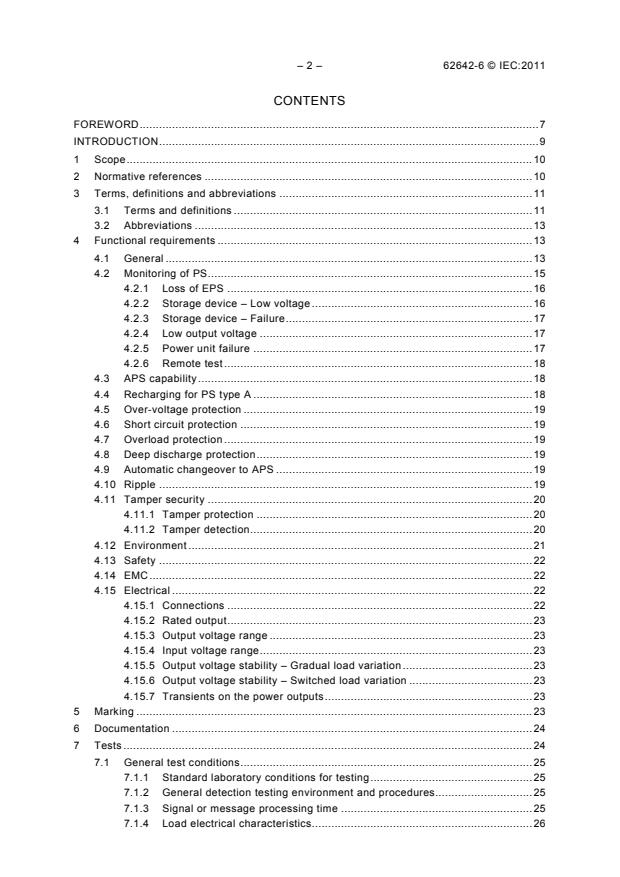
– 2 – 62642-6 © IEC:2011
CONTENTS
FOREWORD . 7
INTRODUCTION . 9
1 Scope . 10
2 Normative references . 10
3 Terms, definitions and abbreviations . 11
3.1 Terms and definitions . 11
3.2 Abbreviations . 13
4 Functional requirements . 13
4.1 General . 13
4.2 Monitoring of PS . 15
4.2.1 Loss of EPS . 16
4.2.2 Storage device – Low voltage . 16
4.2.3 Storage device – Failure . 17
4.2.4 Low output voltage . 17
4.2.5 Power unit failure . 17
4.2.6 Remote test . 18
4.3 APS capability . 18
4.4 Recharging for PS type A . 18
4.5 Over-voltage protection . 19
4.6 Short circuit protection . 19
4.7 Overload protection . 19
4.8 Deep discharge protection . 19
4.9 Automatic changeover to APS . 19
4.10 Ripple . 19
4.11 Tamper security . 20
4.11.1 Tamper protection . 20
4.11.2 Tamper detection. 20
4.12 Environment . 21
4.13 Safety . 22
4.14 EMC . 22
4.15 Electrical . 22
4.15.1 Connections . 22
4.15.2 Rated output . 23
4.15.3 Output voltage range . 23
4.15.4 Input voltage range . 23
4.15.5 Output voltage stability – Gradual load variation . 23
4.15.6 Output voltage stability – Switched load variation . 23
4.15.7 Transients on the power outputs . 23
5 Marking . 23
6 Documentation . 24
7 Tests . 24
7.1 General test conditions . 25
7.1.1 Standard laboratory conditions for testing . 25
7.1.2 General detection testing environment and procedures. 25
7.1.3 Signal or message processing time . 25
7.1.4 Load electrical characteristics. 26
62642-6 © IEC:2011 – 3 –
7.1.5 SD discharged condition . 26
7.2 Reduced functional test . 26
7.2.1 Principle . 26
7.2.2 Test conditions . 26
7.2.3 Mounting . 26
7.2.4 Procedure . 26
7.2.5 Pass/Fail criteria. 27
7.3 PS rating . 27
7.3.1 Principle . 27
7.3.2 Test conditions . 27
7.3.3 Mounting . 27
7.3.4 Procedure . 27
7.3.5 Pass/Fail criteria. 28
7.4 Output voltage stability – Gradual load variation . 28
7.4.1 Principle . 28
7.4.2 Test conditions . 28
7.4.3 Mounting . 28
7.4.4 Procedure . 28
7.4.5 Pass/Fail criteria. 28
7.5 Output voltage stability – Switched load variation . 29
7.5.1 Principle . 29
7.5.2 Test conditions . 29
7.5.3 Mounting . 29
7.5.4 Procedure . 29
7.5.5 Pass/Fail criteria. 29
7.6 Signalling: loss of EPS . 30
7.6.1 Principle . 30
7.6.2 Test conditions . 30
7.6.3 Mounting . 30
7.6.4 Procedure . 30
7.6.5 Pass/Fail criteria. 30
7.7 Signalling: storage device – Low voltage . 30
7.7.1 Principle . 30
7.7.2 Test conditions . 30
7.7.3 Mounting . 30
7.7.4 Procedure – Phase I . 31
7.7.5 Procedure – Phase II . 31
7.7.6 Pass/Fail criteria. 31
7.8 Signalling: storage device – Failure . 32
7.8.1 Principle . 32
7.8.2 Test conditions . 32
7.8.3 Mounting . 32
7.8.4 Procedure – Phase I . 32
7.8.5 Procedure – Phase II . 32
7.8.6 Pass/Fail criteria. 32
7.9 Signalling: low output voltage . 32
7.9.1 Principle . 32
7.9.2 Test conditions . 32
7.9.3 Mounting . 33
– 4 – 62642-6 © IEC:2011
7.9.4 Procedure . 33
7.9.5 Pass/Fail criteria. 33
7.10 Signalling: power unit failure . 33
7.10.1 Principle . 33
7.10.2 Test conditions . 33
7.10.3 Mounting . 33
7.10.4 Procedure . 33
7.10.5 Pass/Fail criteria. 34
7.11 Signalling: power unit failure – SD charging . 34
7.11.1 Principle . 34
7.11.2 Test conditions . 34
7.11.3 Mounting . 34
7.11.4 Procedure . 34
7.11.5 Pass/Fail criteria. 34
7.12 Remote test . 34
7.12.1 Principle . 34
7.12.2 Test conditions . 35
7.12.3 Mounting . 35
7.12.4 Procedure – Phase I . 35
7.12.5 Procedure – Phase II . 35
7.12.6 Pass/Fail criteria. 35
7.13 SD recharging . 35
7.13.1 Principle . 35
7.13.2 Test conditions . 36
7.13.3 Mounting . 36
7.13.4 Procedure . 36
7.13.5 Pass/Fail criteria. 36
7.14 Over-voltage protection . 37
7.14.1 Principle . 37
7.14.2 Test conditions . 37
7.14.3 Mounting . 37
7.14.4 Procedure . 37
7.14.5 Pass/Fail criteria. 37
7.15 Short circuit protection . 37
7.15.1 Principle . 37
7.15.2 Test conditions . 37
7.15.3 Mounting . 38
7.15.4 Procedure – Phase I . 38
7.15.5 Procedure – Phase II . 38
7.15.6 Repeat . 38
7.15.7 Pass/Fail criteria. 38
7.16 Overload protection . 38
7.16.1 Principle . 38
7.16.2 Test conditions . 39
7.16.3 Mounting . 39
7.16.4 Procedure – Phase I . 39
7.16.5 Procedure – Phase II . 39
7.16.6 Repeat . 39
7.16.7 Pass/Fail criteria. 39
62642-6 © IEC:2011 – 5 –
7.17 Deep discharge protection . 40
7.17.1 Principle . 40
7.17.2 Test conditions . 40
7.17.3 Mounting . 40
7.17.4 Procedure . 40
7.17.5 Pass/Fail criteria. 40
7.18 Automatic changeover to APS . 40
7.18.1 Principle . 40
7.18.2 Test conditions . 41
7.18.3 Mounting . 41
7.18.4 Procedure . 41
7.18.5 Pass/Fail criteria. 41
7.19 Tamper protection . 41
7.19.1 Principle . 41
7.19.2 Procedure . 41
7.19.3 Pass/Fail criteria. 41
7.20 Tamper protection – Access to the inside of the housing . 42
7.20.1 Principle . 42
7.20.2 Test conditions . 42
7.20.3 Mounting . 42
7.20.4 Procedure . 42
7.20.5 Pass/Fail criteria. 42
7.21 Tamper detection – Removal from mounting . 42
7.21.1 Principle . 42
7.21.2 Test conditions . 43
7.21.3 Mounting . 43
7.21.4 Procedure . 43
7.21.5 Pass/Fail criteria. 43
7.22 Tamper detection – Penetration of the housing . 43
7.22.1 Principle . 43
7.22.2 Test conditions . 43
7.22.3 Mounting . 43
7.22.4 Procedure . 44
7.22.5 Pass/Fail criteria. 44
7.23 Environment and EMC . 44
7.23.1 Principle . 44
7.23.2 Procedure . 44
7.23.3 Pass/Fail criteria. 44
7.24 Marking and documentation . 45
7.24.1 Principle . 45
7.24.2 Procedure . 45
7.24.3 Pass/Fail criteria. 45
Annex A (informative) Determination of storage device failure . 46
Bibliography . 47
Figure 1 – Power supply types . 14
Table 1 – Power supply functions . 15
– 6 – 62642-6 © IEC:2011
Table 2 – Power supply signalling . 16
Table 3 – Maximum time to detect and signal storage device low voltage . 17
Table 4 – Tamper detection . 20
Table 5 – Removal from mounting. 20
Table 6 – Environmental and EMC tests and severity . 22
Table 7 – Tests for PS according to type . 25
Table A.1 – Minimum load times for common storage devices in use in I&HAS . 46
62642-6 © IEC:2011 – 7 –
INTERNATIONAL ELECTROTECHNICAL COMMISSION
____________
ALARM SYSTEMS –
INTRUSION AND HOLD-UP SYSTEMS –
Part 6: Power supplies
FOREWORD
1) The International Electrotechnical Commission (IEC) is a worldwide organization for standardization comprising
all national electrotechnical committees (IEC National Committees). The object of IEC is to promote
international co-operation on all questions concerning standardization in the electrical and electronic fields. To
this end and in addition to other activities, IEC publishes International Standards, Technical Specifications,
Technical Reports, Publicly Available Specifications (PAS) and Guides (hereafter referred to as “IEC
Publication(s)”). Their preparation is entrusted to technical committees; any IEC National Committee interested
in the subject dealt with may participate in this preparatory work. International, governmental and non-
governmental organizations liaising with the IEC also participate in this preparation. IEC collaborates closely
with the International Organization for Standardization (ISO) in accordance with conditions determined by
agreement between the two organizations.
2) The formal decisions or agreements of IEC on technical matters express, as nearly as possible, an international
consensus of opinion on the relevant subjects since each technical committee has representation from all
interested IEC National Committees.
3) IEC Publications have the form of recommendations for international use and are accepted by IEC National
Committees in that sense. While all reasonable efforts are made to ensure that the technical content of IEC
Publications is accurate, IEC cannot be held responsible for the way in which they are used or for any
misinterpretation by any end user.
4) In order to promote international uniformity, IEC National Committees undertake to apply IEC Publications
transparently to the maximum extent possible in their national and regional publications. Any divergence
between any IEC Publication and the corresponding national or regional publication shall be clearly indicated in
the latter.
5) IEC itself does not provide any attestation of conformity. Independent certification bodies provide conformity
assessment services and, in some areas, access to IEC marks of conformity. IEC is not responsible for any
services carried out by independent certification bodies.
6) All users should ensure that they have the latest edition of this publication.
7) No liability shall attach to IEC or its directors, employees, servants or agents including individual experts and
members of its technical committees and IEC National Committees for any personal injury, property damage or
other damage of any nature whatsoever, whether direct or indirect, or for costs (including legal fees) and
expenses arising out of the publication, use of, or reliance upon, this IEC Publication or any other IEC
Publications.
8) Attention is drawn to the Normative references cited in this publication. Use of the referenced publications is
indispensable for the correct application of this publication.
9) Attention is drawn to the possibility that some of the elements of this IEC Publication may be the subject of
patent rights. IEC shall not be held responsible for identifying any or all such patent rights.
International Standard IEC 62642-6 has been prepared by IEC technical committee 79: Alarm
and electronic security systems.
This standard is based on EN 50131-6 (2008).
The text of this standard is based on the following documents:
FDIS Report on voting
79/326/FDIS 79/335/RVD
Full information on the voting for the approval of this standard can be found in the report on
voting indicated in the above table.
This publication has been drafted in accordance with the ISO/IEC Directives, Part 2.
– 8 – 62642-6 © IEC:2011
A list of all parts of the IEC 62642 series can be found, under the general title Alarm systems
– Intrusion and hold-up systems, on the IEC website.
The committee has decided that the contents of this publication will remain unchanged until
the stability date indicated on the IEC web site under "http://webstore.iec.ch" in the data
related to the specific publication. At this date, the publication will be
• reconfirmed,
• withdrawn,
• replaced by a revised edition, or
• amended.
62642-6 © IEC:2011 – 9 –
INTRODUCTION
This Part 6 of the IEC 62642 deals with power supplies (PS) of intrusion and hold-up alarm
systems (I&HAS) installed in buildings. It includes devices that are installed inside or outside
of the supervised premises and mounted in indoor or outdoor environments. The other parts
of this series of standards are as follows:
Part 1 System requirements
Part 2-2 Intrusion detectors – Passive infrared detectors
Part 2-3 Intrusion detectors – Microwave detectors
Part 2-4 Intrusion detectors – Combined passive infrared / microwave detectors
Part 2-5 Intrusion detectors – Combined passive infrared / ultrasonic detectors
Part 2-6 Intrusion detectors – Opening contacts (magnetic)
Part 2-71 Intrusion detectors – Glass break detectors – Acoustic
Part 2-72 Intrusion detectors – Glass break detectors – Passive
Part 2-73 Intrusion detectors – Glass break detectors – Active
Part 3 Control and indicating equipment
Part 4 Warning devices
Part 5-3 Interconnections – Requirements for equipment using radio frequency techniques
Part 6 Power supplies
Part 7 Application guidelines
Part 8 Security fog devices/systems
– 10 – 62642-6 © IEC:2011
ALARM SYSTEMS –
INTRUSION AND HOLD-UP SYSTEMS –
Part 6: Power supplies
1 Scope
This part of the IEC 62642 series specifies the requirements, performance criteria and testing
procedures for power supplies (PS) to be used as part of Intrusion and Hold up Alarm
Systems (I&HAS). The PS shall either be an integral part of an I&HAS component or stand-
alone. The control functions of the PS may be incorporated as part of the PS device, or may
be provided by another I&HAS component e.g. a control and indicating equipment (CIE).
This International Standard is not applicable when the PS requirements for I&HAS
components are included within the relevant product standard.
The requirements correspond to each of the four security grades given in the IEC 62642-1.
Requirements are also given for four environmental classes covering applications in internal
and outdoor locations.
This standard covers mandatory functions which shall be provided on all PS and optional
functions which may be provided.
Other functions associated with I&HAS not specified in this standard may be provided. Such
functions shall not affect the requirements of any mandatory or optional functions.
2 Normative references
The following referenced documents are indispensable for the application of this document.
For dated references, only the edition cited applies. For undated references, the latest edition
of the referenced document (including any amendments) applies.
IEC 60065, Audio, video and similar electronic apparatus – Safety requirements
IEC 60068-1:1988, Environmental testing – Part 1: General and guidance
IEC 60950 (all parts), Information technology equipment – Safety
IEC 61000-6-3, Electromagnetic compatibility (EMC) – Part 6-3: Generic standards – Emission
standard for residential, commercial and light-industrial environments
IEC 62599-1, Alarm systems – Part 1: Environmental test methods
IEC 62599-2, Alarm systems – Part 2: Electromagnetic compatibility – Immunity requirements
for components of fire and security alarm systems
IEC 62642-1:2010, Alarm systems – Intrusion and hold-up systems – Part 1: System
requirements
IEC 62642-3, Alarm systems – Intrusion and hold-up systems – Part 3: Control and indicating
equipment
62642-6 © IEC:2011 – 11 –
3 Terms, definitions and abbreviations
3.1 Terms and definitions
For the purposes of this document, the terms and definitions given in IEC 62642-1, as well as
the following apply.
3.1.1
alternative power source
APS
power source capable of powering the I&HAS for a predetermined time when the EPS is
unavailable
3.1.2
APS operating period
period during which the APS is supporting an I&HAS when the EPS has been lost
3.1.3
deep discharge protection
protection which avoids damage to the storage device when the level of discharge is beyond
the level specified by the storage device manufacturer
3.1.4
external power source
EPS
energy supply external to the I&HAS which may be non-continuous
NOTE 1 For types A and type B PS only.
NOTE 2 The EPS is provided by the PPS or the SPPS.
3.1.5
float charging
a condition of the SD where a charging voltage is applied to hold the SD at nominally 100 %
charge
3.1.6
independent power outputs
individual power output to the I&HAS having its own protection against short circuit and
overload. Each output may have provision for more than one connection
3.1.7
low output voltage
voltage below the minimum power output voltage
3.1.8
maximum power output voltage
maximum rated voltage of the PS at each independent power output as specified by the PS
manufacturer under normal operating conditions
3.1.9
minimum power output voltage
minimum rated voltage of the PS at each independent power output as specified by the PS
manufacturer under normal operating conditions
3.1.10
normal operating condition
conditions applying when the PS is mounted according to the PS manufacturer’s instructions,
within the range of the designated environmental class, the applied load is within the rated
– 12 – 62642-6 © IEC:2011
output, the SD has sufficient charge to maintain the minimum power output voltage and for
type A and type B, any applied and available EPS is within specified range
NOTE Normal operating condition of a PS includes APS operation.
3.1.11
open by normal means
opening of the equipment housing by the procedure defined by by the manufacturer
3.1.12
over-voltage protection
protection of the PS output against excessive high output voltage due to failure of one or
more PS components under normal operating conditions
3.1.13
power output
output of the PS that supplies energy to the I&HAS
3.1.14
power supply
PS
device that stores, provides and also modifies or isolates (electrical) power for an I&HAS or
part thereof, comprising of a PU and SD as a minimum
3.1.15
power supply failure
a condition in which a SD failure or a PU failure is present
3.1.16
power unit
PU
device that provides and also modifies or isolates (electrical) power for an I&HAS or part
thereof and for the SD if required
3.1.17
power unit failure
a condition of the PU where it cannot supply the rated power output and/or for a PS type A
cannot recharge the SD
3.1.18
prime power source
PPS
energy source capable of supporting the I&HAS for extended periods e.g. mains supply
3.1.19
rated output
the total continuous output current that can be supplied by the PS to the I&HAS through its
independent power outputs under normal operating conditions
3.1.20
ripple
oscillating voltage superimposed onto the d.c. voltage at an independent output
3.1.21
standby period
time period during which the APS is capable of supporting an I&HAS in the event of failure of
the EPS
62642-6 © IEC:2011 – 13 –
3.1.22
storage device
SD
device which stores energy e.g. a battery
3.1.23
storage device – failure
a condition of the SD where it cannot supply the rated power output of the PS at the minimum
power output voltage
3.1.24
storage device – low voltage
voltage specified by the PS manufacturer which indicates that the storage device is nearly
discharged
3.1.25
supplementary prime power source
SPPS
energy source independent of the PPS capable of supporting the I&HAS for extended periods
e.g. standby generator
3.2 Abbreviations
For the purposes of this document, the following abbreviations apply.
APS alternative power source
CIE control and indicating equipment
EPS external power source
I&HAS intruder and hold-up alarm system
PPS prime power source
PS power supply
PU power unit
SD storage device
SPPS supplementary prime power source
a.c. alternating current
d.c. direct current
4 Functional requirements
4.1 General
The PS shall supply power to the components of the I&HAS continuously.
There are three types of PS, which are independent of security grade. These types are
illustrated in Figure 1.
The PS types are defined in IEC 62642-1. Storage devices required to meet the I&HAS
standby requirements as specified in IEC 62642-1 may be distributed in more than one PS.
– 14 – 62642-6 © IEC:2011
PPS
EPS Independent
power
SPPS PU
outputs to
I&HAS
APS
components
SD
Type A
PS
PS
I&HAS
PPS
EPS Independent
power
SPPS PU
outputs to
I&HAS
APS
components
SD
Type B
PS
PS
I&HAS
Independent
power
PU
outputs to
I&HAS
Type C
PPS
components
PS
SD
PS
I&HAS
IEC 241/11
NOTE For PS types A and B, where there is no SPPS, the PPS and EPS are identical.
Figure 1 – Power supply types
62642-6 © IEC:2011 – 15 –
Depending upon the security grade and PS type, the PS shall have the functionality as
defined in Table 1. If a function is provided that is optional for a particular grade and a claim
of compliance is made, it shall meet the applicable requirements for the grade for which
compliance is claimed.
Table 1 – Power supply functions
PS Type
Function Grade
A B C
Detection of loss of EPS 1 – 4 M M n/a
Detection of storage device – Low 1 – 4 M M M
voltage
1 – 2 Op Op n/a
Detection of storage device – Failure
3 – 4 M Op n/a
1 – 2 Op Op n/a
Detection of low output voltage
3 – 4 M M n/a
1 – 2 Op Op n/a
Detection of power unit failure
3 – 4 M M n/a
1 – 2 Op Op Op
Over-voltage protection
3 – 4 M M Op
Short circuit protection 1 – 4 M M M
Overload protection 1 – 4 M M M
1 – 2 Op Op n/a
a
SD deep discharge protection
3 – 4 M M n/a
1 – 3 Op Op n/a
Remote test
4 M Op n/a
Tamper security 1 – 4 M M M
M = Mandatory
Op = Optional
n/a = Not applicable
a
Where deep discharge will damage the SD.
4.2 Monitoring of PS
The PS shall generate fault signals or messages for communication to the CIE according to
Table 2.
Monitoring signals or messages shall be fail safe such that total loss of function of the PS will
be recognised as a fault condition by the I&HAS.
– 16 – 62642-6 © IEC:2011
Table 2 – Power supply signalling
Storage device Power
EPS fault APS fault Tamper
Low voltage output fault
Condition signal or signal or signal or
signal or signal or
message message message
message message
Loss of EPS M NP n/a NP NP
Storage device – Low voltage:
NP M n/a NP NP
PS type A, B
Storage device – Low voltage:
n/a NP M NP NP
PS type C
a
Storage device – Failure NP M n/a NP NP
a
Low output voltage Op Op Op M NP
a
Power unit – Failure NP NP NP M NP
Tamper detection NP NP NP NP M
Remote self test NP Op NP NP NP
M = Mandatory
NP = Not permitted
n/a = Not applicable
Op = Optional
a
Dependent upon security grade.
4.2.1 Loss of EPS
A loss of EPS condition shall be detected within 1 s.
When the EPS has been continuously disconnected for a minimum of 1 s and a maximum of
60 s, an EPS fault signal or message shall be generated.
After a loss of EPS, when the EPS is restored the re-connection condition shall be detected
within 1 s.
When the EPS has been continuously re-connected for a minimum of 1 s and a maximum of
60 s, an EPS fault signal or message shall be removed.
4.2.2 Storage device – Low voltage
The voltage of the storage device shall be monitored to detect an SD low voltage condition.
For PS types A and B:
An APS fault signal or message shall be generated according to Table 2 and within the
maximum time periods defined in Table 3, when the voltage of the SD falls below a value
as specified by the PS manufacturer.
An APS fault signal or message shall be removed according to Table 2 and within the
maximum time periods defined in Table 3, when the voltage of the SD rises above a value
specified by the PS manufacturer.
NOTE 1 A disconnected SD is considered a special case of low voltage.
NOTE 2 For PS type A, it is not necessary to monitor for storage device low voltage when the storage device is
undergoing charging.
For PS type C:
A storage device low voltage fault signal or message shall be generated within the
maximum time periods defined in Table 3, before the SD reaches a condition such that it
is unable to provide its rated output for longer than a minimum of 30 days.
62642-6 © IEC:2011 – 17 –
A storage device low voltage fault signal or message shall be removed within 10 s
according to Table 2, when the voltage of the SD rises above the low value specified by
the PS manufacturer e.g. following replacement of the battery.
For all PS types, the PS manufacturer shall declare in his documentation the voltage of the
SD that will generate this fault signal or message.
Table 3 – Maximum time to detect and signal storage device low voltage
Type of PS Grade 1 Grade 2 Grade 3 Grade 4
A and B 5 min 5 min 5 min 5 min
a
C 240 min 120 min 120 min 120 min
a
For wirefree devices with intermittent operation e.g. wireless hold-up trigger device, it is permissible for
communication of the low voltage fault signal or message to be delayed until the first available
transmission.
4.2.3 Storage device – Failure
For PS type A, a SD failure condition shall be detected within 24 h of failure of the SD.
An APS fault signal or message shall be generated within 10 s of detection of SD failure.
Examples of methods deemed suitable to determine a storage device failure condition are
given in Annex A.
The APS fault signal or message shall be removed within 10 s of detection of a normal
storage device condition.
If the PS is designed to be connected to two or more storage devices in a parallel
configuration in accordance with the guidance of the SD manufacturer, they shall be
monitored as separate storage devices. An APS fault signal or message shall be generated
upon detection of failure for any one device. The APS fault signal or message shall be
removed only when all devices no longer show a failure condition.
These tests shall only be applied when the EPS is available.
Following disconnection and reconnection of the EPS, this test may be delayed for up to 24 h
to enable recharge of the SD.
4.2.4 Low output voltage
For PS types A and B, Grades 3 and 4, a power output fault signal or me
...
IEC 62642-6 ®
Edition 1.0 2011-02
INTERNATIONAL
STANDARD
NORME
INTERNATIONALE
Alarm systems – Intrusion and hold-up systems –
Part 6: Power supplies
Systèmes d'alarme – Systèmes d'alarme contre l’intrusion et les hold-up –
Partie 6: Alimentation
All rights reserved. Unless otherwise specified, no part of this publication may be reproduced or utilized in any form or by
any means, electronic or mechanical, including photocopying and microfilm, without permission in writing from either IEC or
IEC's member National Committee in the country of the requester.
If you have any questions about IEC copyright or have an enquiry about obtaining additional rights to this publication,
please contact the address below or your local IEC member National Committee for further information.
Droits de reproduction réservés. Sauf indication contraire, aucune partie de cette publication ne peut être reproduite
ni utilisée sous quelque forme que ce soit et par aucun procédé, électronique ou mécanique, y compris la photocopie
et les microfilms, sans l'accord écrit de la CEI ou du Comité national de la CEI du pays du demandeur.
Si vous avez des questions sur le copyright de la CEI ou si vous désirez obtenir des droits supplémentaires sur cette
publication, utilisez les coordonnées ci-après ou contactez le Comité national de la CEI de votre pays de résidence.
IEC Central Office
3, rue de Varembé
CH-1211 Geneva 20
Switzerland
Email: inmail@iec.ch
Web: www.iec.ch
About the IEC
The International Electrotechnical Commission (IEC) is the leading global organization that prepares and publishes
International Standards for all electrical, electronic and related technologies.
About IEC publications
The technical content of IEC publications is kept under constant review by the IEC. Please make sure that you have the
latest edition, a corrigenda or an amendment might have been published.
Catalogue of IEC publications: www.iec.ch/searchpub
The IEC on-line Catalogue enables you to search by a variety of criteria (reference number, text, technical committee,…).
It also gives information on projects, withdrawn and replaced publications.
IEC Just Published: www.iec.ch/online_news/justpub
Stay up to date on all new IEC publications. Just Published details twice a month all new publications released. Available
on-line and also by email.
Electropedia: www.electropedia.org
The world's leading online dictionary of electronic and electrical terms containing more than 20 000 terms and definitions
in English and French, with equivalent terms in additional languages. Also known as the International Electrotechnical
Vocabulary online.
Customer Service Centre: www.iec.ch/webstore/custserv
If you wish to give us your feedback on this publication or need further assistance, please visit the Customer Service
Centre FAQ or contact us:
Email: csc@iec.ch
Tel.: +41 22 919 02 11
Fax: +41 22 919 03 00
A propos de la CEI
La Commission Electrotechnique Internationale (CEI) est la première organisation mondiale qui élabore et publie des
normes internationales pour tout ce qui a trait à l'électricité, à l'électronique et aux technologies apparentées.
A propos des publications CEI
Le contenu technique des publications de la CEI est constamment revu. Veuillez vous assurer que vous possédez
l’édition la plus récente, un corrigendum ou amendement peut avoir été publié.
Catalogue des publications de la CEI: www.iec.ch/searchpub/cur_fut-f.htm
Le Catalogue en-ligne de la CEI vous permet d’effectuer des recherches en utilisant différents critères (numéro de référence,
texte, comité d’études,…). Il donne aussi des informations sur les projets et les publications retirées ou remplacées.
Just Published CEI: www.iec.ch/online_news/justpub
Restez informé sur les nouvelles publications de la CEI. Just Published détaille deux fois par mois les nouvelles
publications parues. Disponible en-ligne et aussi par email.
Electropedia: www.electropedia.org
Le premier dictionnaire en ligne au monde de termes électroniques et électriques. Il contient plus de 20 000 termes et
définitions en anglais et en français, ainsi que les termes équivalents dans les langues additionnelles. Egalement appelé
Vocabulaire Electrotechnique International en ligne.
Service Clients: www.iec.ch/webstore/custserv/custserv_entry-f.htm
Si vous désirez nous donner des commentaires sur cette publication ou si vous avez des questions, visitez le FAQ du
Service clients ou contactez-nous:
Email: csc@iec.ch
Tél.: +41 22 919 02 11
Fax: +41 22 919 03 00
IEC 62642-6 ®
Edition 1.0 2011-02
INTERNATIONAL
STANDARD
NORME
INTERNATIONALE
Alarm systems – Intrusion and hold-up systems –
Part 6: Power supplies
Systèmes d'alarme – Systèmes d'alarme contre l’intrusion et les hold-up –
Partie 6: Alimentation
INTERNATIONAL
ELECTROTECHNICAL
COMMISSION
COMMISSION
ELECTROTECHNIQUE
PRICE CODE
INTERNATIONALE
CODE PRIX X
ICS 13.320 ISBN 978-2-88912-356-8
– 2 – 62642-6 © IEC:2011
CONTENTS
FOREWORD . 7
INTRODUCTION . 9
1 Scope . 10
2 Normative references . 10
3 Terms, definitions and abbreviations . 11
3.1 Terms and definitions . 11
3.2 Abbreviations . 13
4 Functional requirements . 13
4.1 General . 13
4.2 Monitoring of PS . 15
4.2.1 Loss of EPS . 16
4.2.2 Storage device – Low voltage . 16
4.2.3 Storage device – Failure . 17
4.2.4 Low output voltage . 17
4.2.5 Power unit failure . 17
4.2.6 Remote test . 18
4.3 APS capability . 18
4.4 Recharging for PS type A . 18
4.5 Over-voltage protection . 19
4.6 Short circuit protection . 19
4.7 Overload protection . 19
4.8 Deep discharge protection . 19
4.9 Automatic changeover to APS . 19
4.10 Ripple . 19
4.11 Tamper security . 20
4.11.1 Tamper protection . 20
4.11.2 Tamper detection. 20
4.12 Environment . 21
4.13 Safety . 22
4.14 EMC . 22
4.15 Electrical . 22
4.15.1 Connections . 22
4.15.2 Rated output . 23
4.15.3 Output voltage range . 23
4.15.4 Input voltage range . 23
4.15.5 Output voltage stability – Gradual load variation . 23
4.15.6 Output voltage stability – Switched load variation . 23
4.15.7 Transients on the power outputs . 23
5 Marking . 23
6 Documentation . 24
7 Tests . 24
7.1 General test conditions . 25
7.1.1 Standard laboratory conditions for testing . 25
7.1.2 General detection testing environment and procedures. 25
7.1.3 Signal or message processing time . 25
7.1.4 Load electrical characteristics. 26
62642-6 © IEC:2011 – 3 –
7.1.5 SD discharged condition . 26
7.2 Reduced functional test . 26
7.2.1 Principle . 26
7.2.2 Test conditions . 26
7.2.3 Mounting . 26
7.2.4 Procedure . 26
7.2.5 Pass/Fail criteria. 27
7.3 PS rating . 27
7.3.1 Principle . 27
7.3.2 Test conditions . 27
7.3.3 Mounting . 27
7.3.4 Procedure . 27
7.3.5 Pass/Fail criteria. 28
7.4 Output voltage stability – Gradual load variation . 28
7.4.1 Principle . 28
7.4.2 Test conditions . 28
7.4.3 Mounting . 28
7.4.4 Procedure . 28
7.4.5 Pass/Fail criteria. 28
7.5 Output voltage stability – Switched load variation . 29
7.5.1 Principle . 29
7.5.2 Test conditions . 29
7.5.3 Mounting . 29
7.5.4 Procedure . 29
7.5.5 Pass/Fail criteria. 29
7.6 Signalling: loss of EPS . 30
7.6.1 Principle . 30
7.6.2 Test conditions . 30
7.6.3 Mounting . 30
7.6.4 Procedure . 30
7.6.5 Pass/Fail criteria. 30
7.7 Signalling: storage device – Low voltage . 30
7.7.1 Principle . 30
7.7.2 Test conditions . 30
7.7.3 Mounting . 30
7.7.4 Procedure – Phase I . 31
7.7.5 Procedure – Phase II . 31
7.7.6 Pass/Fail criteria. 31
7.8 Signalling: storage device – Failure . 32
7.8.1 Principle . 32
7.8.2 Test conditions . 32
7.8.3 Mounting . 32
7.8.4 Procedure – Phase I . 32
7.8.5 Procedure – Phase II . 32
7.8.6 Pass/Fail criteria. 32
7.9 Signalling: low output voltage . 32
7.9.1 Principle . 32
7.9.2 Test conditions . 32
7.9.3 Mounting . 33
– 4 – 62642-6 © IEC:2011
7.9.4 Procedure . 33
7.9.5 Pass/Fail criteria. 33
7.10 Signalling: power unit failure . 33
7.10.1 Principle . 33
7.10.2 Test conditions . 33
7.10.3 Mounting . 33
7.10.4 Procedure . 33
7.10.5 Pass/Fail criteria. 34
7.11 Signalling: power unit failure – SD charging . 34
7.11.1 Principle . 34
7.11.2 Test conditions . 34
7.11.3 Mounting . 34
7.11.4 Procedure . 34
7.11.5 Pass/Fail criteria. 34
7.12 Remote test . 34
7.12.1 Principle . 34
7.12.2 Test conditions . 35
7.12.3 Mounting . 35
7.12.4 Procedure – Phase I . 35
7.12.5 Procedure – Phase II . 35
7.12.6 Pass/Fail criteria. 35
7.13 SD recharging . 35
7.13.1 Principle . 35
7.13.2 Test conditions . 36
7.13.3 Mounting . 36
7.13.4 Procedure . 36
7.13.5 Pass/Fail criteria. 36
7.14 Over-voltage protection . 37
7.14.1 Principle . 37
7.14.2 Test conditions . 37
7.14.3 Mounting . 37
7.14.4 Procedure . 37
7.14.5 Pass/Fail criteria. 37
7.15 Short circuit protection . 37
7.15.1 Principle . 37
7.15.2 Test conditions . 37
7.15.3 Mounting . 38
7.15.4 Procedure – Phase I . 38
7.15.5 Procedure – Phase II . 38
7.15.6 Repeat . 38
7.15.7 Pass/Fail criteria. 38
7.16 Overload protection . 38
7.16.1 Principle . 38
7.16.2 Test conditions . 39
7.16.3 Mounting . 39
7.16.4 Procedure – Phase I . 39
7.16.5 Procedure – Phase II . 39
7.16.6 Repeat . 39
7.16.7 Pass/Fail criteria. 39
62642-6 © IEC:2011 – 5 –
7.17 Deep discharge protection . 40
7.17.1 Principle . 40
7.17.2 Test conditions . 40
7.17.3 Mounting . 40
7.17.4 Procedure . 40
7.17.5 Pass/Fail criteria. 40
7.18 Automatic changeover to APS . 40
7.18.1 Principle . 40
7.18.2 Test conditions . 41
7.18.3 Mounting . 41
7.18.4 Procedure . 41
7.18.5 Pass/Fail criteria. 41
7.19 Tamper protection . 41
7.19.1 Principle . 41
7.19.2 Procedure . 41
7.19.3 Pass/Fail criteria. 41
7.20 Tamper protection – Access to the inside of the housing . 42
7.20.1 Principle . 42
7.20.2 Test conditions . 42
7.20.3 Mounting . 42
7.20.4 Procedure . 42
7.20.5 Pass/Fail criteria. 42
7.21 Tamper detection – Removal from mounting . 42
7.21.1 Principle . 42
7.21.2 Test conditions . 43
7.21.3 Mounting . 43
7.21.4 Procedure . 43
7.21.5 Pass/Fail criteria. 43
7.22 Tamper detection – Penetration of the housing . 43
7.22.1 Principle . 43
7.22.2 Test conditions . 43
7.22.3 Mounting . 43
7.22.4 Procedure . 44
7.22.5 Pass/Fail criteria. 44
7.23 Environment and EMC . 44
7.23.1 Principle . 44
7.23.2 Procedure . 44
7.23.3 Pass/Fail criteria. 44
7.24 Marking and documentation . 45
7.24.1 Principle . 45
7.24.2 Procedure . 45
7.24.3 Pass/Fail criteria. 45
Annex A (informative) Determination of storage device failure . 46
Bibliography . 47
Figure 1 – Power supply types . 14
Table 1 – Power supply functions . 15
– 6 – 62642-6 © IEC:2011
Table 2 – Power supply signalling . 16
Table 3 – Maximum time to detect and signal storage device low voltage . 17
Table 4 – Tamper detection . 20
Table 5 – Removal from mounting. 20
Table 6 – Environmental and EMC tests and severity . 22
Table 7 – Tests for PS according to type . 25
Table A.1 – Minimum load times for common storage devices in use in I&HAS . 46
62642-6 © IEC:2011 – 7 –
INTERNATIONAL ELECTROTECHNICAL COMMISSION
____________
ALARM SYSTEMS –
INTRUSION AND HOLD-UP SYSTEMS –
Part 6: Power supplies
FOREWORD
1) The International Electrotechnical Commission (IEC) is a worldwide organization for standardization comprising
all national electrotechnical committees (IEC National Committees). The object of IEC is to promote
international co-operation on all questions concerning standardization in the electrical and electronic fields. To
this end and in addition to other activities, IEC publishes International Standards, Technical Specifications,
Technical Reports, Publicly Available Specifications (PAS) and Guides (hereafter referred to as “IEC
Publication(s)”). Their preparation is entrusted to technical committees; any IEC National Committee interested
in the subject dealt with may participate in this preparatory work. International, governmental and non-
governmental organizations liaising with the IEC also participate in this preparation. IEC collaborates closely
with the International Organization for Standardization (ISO) in accordance with conditions determined by
agreement between the two organizations.
2) The formal decisions or agreements of IEC on technical matters express, as nearly as possible, an international
consensus of opinion on the relevant subjects since each technical committee has representation from all
interested IEC National Committees.
3) IEC Publications have the form of recommendations for international use and are accepted by IEC National
Committees in that sense. While all reasonable efforts are made to ensure that the technical content of IEC
Publications is accurate, IEC cannot be held responsible for the way in which they are used or for any
misinterpretation by any end user.
4) In order to promote international uniformity, IEC National Committees undertake to apply IEC Publications
transparently to the maximum extent possible in their national and regional publications. Any divergence
between any IEC Publication and the corresponding national or regional publication shall be clearly indicated in
the latter.
5) IEC itself does not provide any attestation of conformity. Independent certification bodies provide conformity
assessment services and, in some areas, access to IEC marks of conformity. IEC is not responsible for any
services carried out by independent certification bodies.
6) All users should ensure that they have the latest edition of this publication.
7) No liability shall attach to IEC or its directors, employees, servants or agents including individual experts and
members of its technical committees and IEC National Committees for any personal injury, property damage or
other damage of any nature whatsoever, whether direct or indirect, or for costs (including legal fees) and
expenses arising out of the publication, use of, or reliance upon, this IEC Publication or any other IEC
Publications.
8) Attention is drawn to the Normative references cited in this publication. Use of the referenced publications is
indispensable for the correct application of this publication.
9) Attention is drawn to the possibility that some of the elements of this IEC Publication may be the subject of
patent rights. IEC shall not be held responsible for identifying any or all such patent rights.
International Standard IEC 62642-6 has been prepared by IEC technical committee 79: Alarm
and electronic security systems.
This standard is based on EN 50131-6 (2008).
The text of this standard is based on the following documents:
FDIS Report on voting
79/326/FDIS 79/335/RVD
Full information on the voting for the approval of this standard can be found in the report on
voting indicated in the above table.
This publication has been drafted in accordance with the ISO/IEC Directives, Part 2.
– 8 – 62642-6 © IEC:2011
A list of all parts of the IEC 62642 series can be found, under the general title Alarm systems
– Intrusion and hold-up systems, on the IEC website.
The committee has decided that the contents of this publication will remain unchanged until
the stability date indicated on the IEC web site under "http://webstore.iec.ch" in the data
related to the specific publication. At this date, the publication will be
• reconfirmed,
• withdrawn,
• replaced by a revised edition, or
• amended.
62642-6 © IEC:2011 – 9 –
INTRODUCTION
This Part 6 of the IEC 62642 deals with power supplies (PS) of intrusion and hold-up alarm
systems (I&HAS) installed in buildings. It includes devices that are installed inside or outside
of the supervised premises and mounted in indoor or outdoor environments. The other parts
of this series of standards are as follows:
Part 1 System requirements
Part 2-2 Intrusion detectors – Passive infrared detectors
Part 2-3 Intrusion detectors – Microwave detectors
Part 2-4 Intrusion detectors – Combined passive infrared / microwave detectors
Part 2-5 Intrusion detectors – Combined passive infrared / ultrasonic detectors
Part 2-6 Intrusion detectors – Opening contacts (magnetic)
Part 2-71 Intrusion detectors – Glass break detectors – Acoustic
Part 2-72 Intrusion detectors – Glass break detectors – Passive
Part 2-73 Intrusion detectors – Glass break detectors – Active
Part 3 Control and indicating equipment
Part 4 Warning devices
Part 5-3 Interconnections – Requirements for equipment using radio frequency techniques
Part 6 Power supplies
Part 7 Application guidelines
Part 8 Security fog devices/systems
– 10 – 62642-6 © IEC:2011
ALARM SYSTEMS –
INTRUSION AND HOLD-UP SYSTEMS –
Part 6: Power supplies
1 Scope
This part of the IEC 62642 series specifies the requirements, performance criteria and testing
procedures for power supplies (PS) to be used as part of Intrusion and Hold up Alarm
Systems (I&HAS). The PS shall either be an integral part of an I&HAS component or stand-
alone. The control functions of the PS may be incorporated as part of the PS device, or may
be provided by another I&HAS component e.g. a control and indicating equipment (CIE).
This International Standard is not applicable when the PS requirements for I&HAS
components are included within the relevant product standard.
The requirements correspond to each of the four security grades given in the IEC 62642-1.
Requirements are also given for four environmental classes covering applications in internal
and outdoor locations.
This standard covers mandatory functions which shall be provided on all PS and optional
functions which may be provided.
Other functions associated with I&HAS not specified in this standard may be provided. Such
functions shall not affect the requirements of any mandatory or optional functions.
2 Normative references
The following referenced documents are indispensable for the application of this document.
For dated references, only the edition cited applies. For undated references, the latest edition
of the referenced document (including any amendments) applies.
IEC 60065, Audio, video and similar electronic apparatus – Safety requirements
IEC 60068-1:1988, Environmental testing – Part 1: General and guidance
IEC 60950 (all parts), Information technology equipment – Safety
IEC 61000-6-3, Electromagnetic compatibility (EMC) – Part 6-3: Generic standards – Emission
standard for residential, commercial and light-industrial environments
IEC 62599-1, Alarm systems – Part 1: Environmental test methods
IEC 62599-2, Alarm systems – Part 2: Electromagnetic compatibility – Immunity requirements
for components of fire and security alarm systems
IEC 62642-1:2010, Alarm systems – Intrusion and hold-up systems – Part 1: System
requirements
IEC 62642-3, Alarm systems – Intrusion and hold-up systems – Part 3: Control and indicating
equipment
62642-6 © IEC:2011 – 11 –
3 Terms, definitions and abbreviations
3.1 Terms and definitions
For the purposes of this document, the terms and definitions given in IEC 62642-1, as well as
the following apply.
3.1.1
alternative power source
APS
power source capable of powering the I&HAS for a predetermined time when the EPS is
unavailable
3.1.2
APS operating period
period during which the APS is supporting an I&HAS when the EPS has been lost
3.1.3
deep discharge protection
protection which avoids damage to the storage device when the level of discharge is beyond
the level specified by the storage device manufacturer
3.1.4
external power source
EPS
energy supply external to the I&HAS which may be non-continuous
NOTE 1 For types A and type B PS only.
NOTE 2 The EPS is provided by the PPS or the SPPS.
3.1.5
float charging
a condition of the SD where a charging voltage is applied to hold the SD at nominally 100 %
charge
3.1.6
independent power outputs
individual power output to the I&HAS having its own protection against short circuit and
overload. Each output may have provision for more than one connection
3.1.7
low output voltage
voltage below the minimum power output voltage
3.1.8
maximum power output voltage
maximum rated voltage of the PS at each independent power output as specified by the PS
manufacturer under normal operating conditions
3.1.9
minimum power output voltage
minimum rated voltage of the PS at each independent power output as specified by the PS
manufacturer under normal operating conditions
3.1.10
normal operating condition
conditions applying when the PS is mounted according to the PS manufacturer’s instructions,
within the range of the designated environmental class, the applied load is within the rated
– 12 – 62642-6 © IEC:2011
output, the SD has sufficient charge to maintain the minimum power output voltage and for
type A and type B, any applied and available EPS is within specified range
NOTE Normal operating condition of a PS includes APS operation.
3.1.11
open by normal means
opening of the equipment housing by the procedure defined by by the manufacturer
3.1.12
over-voltage protection
protection of the PS output against excessive high output voltage due to failure of one or
more PS components under normal operating conditions
3.1.13
power output
output of the PS that supplies energy to the I&HAS
3.1.14
power supply
PS
device that stores, provides and also modifies or isolates (electrical) power for an I&HAS or
part thereof, comprising of a PU and SD as a minimum
3.1.15
power supply failure
a condition in which a SD failure or a PU failure is present
3.1.16
power unit
PU
device that provides and also modifies or isolates (electrical) power for an I&HAS or part
thereof and for the SD if required
3.1.17
power unit failure
a condition of the PU where it cannot supply the rated power output and/or for a PS type A
cannot recharge the SD
3.1.18
prime power source
PPS
energy source capable of supporting the I&HAS for extended periods e.g. mains supply
3.1.19
rated output
the total continuous output current that can be supplied by the PS to the I&HAS through its
independent power outputs under normal operating conditions
3.1.20
ripple
oscillating voltage superimposed onto the d.c. voltage at an independent output
3.1.21
standby period
time period during which the APS is capable of supporting an I&HAS in the event of failure of
the EPS
62642-6 © IEC:2011 – 13 –
3.1.22
storage device
SD
device which stores energy e.g. a battery
3.1.23
storage device – failure
a condition of the SD where it cannot supply the rated power output of the PS at the minimum
power output voltage
3.1.24
storage device – low voltage
voltage specified by the PS manufacturer which indicates that the storage device is nearly
discharged
3.1.25
supplementary prime power source
SPPS
energy source independent of the PPS capable of supporting the I&HAS for extended periods
e.g. standby generator
3.2 Abbreviations
For the purposes of this document, the following abbreviations apply.
APS alternative power source
CIE control and indicating equipment
EPS external power source
I&HAS intruder and hold-up alarm system
PPS prime power source
PS power supply
PU power unit
SD storage device
SPPS supplementary prime power source
a.c. alternating current
d.c. direct current
4 Functional requirements
4.1 General
The PS shall supply power to the components of the I&HAS continuously.
There are three types of PS, which are independent of security grade. These types are
illustrated in Figure 1.
The PS types are defined in IEC 62642-1. Storage devices required to meet the I&HAS
standby requirements as specified in IEC 62642-1 may be distributed in more than one PS.
– 14 – 62642-6 © IEC:2011
PPS
EPS Independent
power
SPPS PU
outputs to
I&HAS
APS
components
SD
Type A
PS
PS
I&HAS
PPS
EPS Independent
power
SPPS PU
outputs to
I&HAS
APS
components
SD
Type B
PS
PS
I&HAS
Independent
power
PU
outputs to
I&HAS
Type C
PPS
components
PS
SD
PS
I&HAS
IEC 241/11
NOTE For PS types A and B, where there is no SPPS, the PPS and EPS are identical.
Figure 1 – Power supply types
62642-6 © IEC:2011 – 15 –
Depending upon the security grade and PS type, the PS shall have the functionality as
defined in Table 1. If a function is provided that is optional for a particular grade and a claim
of compliance is made, it shall meet the applicable requirements for the grade for which
compliance is claimed.
Table 1 – Power supply functions
PS Type
Function Grade
A B C
Detection of loss of EPS 1 – 4 M M n/a
Detection of storage device – Low 1 – 4 M M M
voltage
1 – 2 Op Op n/a
Detection of storage device – Failure
3 – 4 M Op n/a
1 – 2 Op Op n/a
Detection of low output voltage
3 – 4 M M n/a
1 – 2 Op Op n/a
Detection of power unit failure
3 – 4 M M n/a
1 – 2 Op Op Op
Over-voltage protection
3 – 4 M M Op
Short circuit protection 1 – 4 M M M
Overload protection 1 – 4 M M M
1 – 2 Op Op n/a
a
SD deep discharge protection
3 – 4 M M n/a
1 – 3 Op Op n/a
Remote test
4 M Op n/a
Tamper security 1 – 4 M M M
M = Mandatory
Op = Optional
n/a = Not applicable
a
Where deep discharge will damage the SD.
4.2 Monitoring of PS
The PS shall generate fault signals or messages for communication to the CIE according to
Table 2.
Monitoring signals or messages shall be fail safe such that total loss of function of the PS will
be recognised as a fault condition by the I&HAS.
– 16 – 62642-6 © IEC:2011
Table 2 – Power supply signalling
Storage device Power
EPS fault APS fault Tamper
Low voltage output fault
Condition signal or signal or signal or
signal or signal or
message message message
message message
Loss of EPS M NP n/a NP NP
Storage device – Low voltage:
NP M n/a NP NP
PS type A, B
Storage device – Low voltage:
n/a NP M NP NP
PS type C
a
Storage device – Failure NP M n/a NP NP
a
Low output voltage Op Op Op M NP
a
Power unit – Failure NP NP NP M NP
Tamper detection NP NP NP NP M
Remote s
...