

IEC 61360-2:1998
(Main)Standard data element types with associated classification scheme for electric components - Part 2: EXPRESS Dictionary schema
General Information
- Abstract
Provides a common formal model for the IEC 61360-1 and ISO 13584-42 and facilitates their harmonization. Allows for the implementation of dictionary systems dealing with data delivered according to either of those standards.
- Status
- Published
- Publication Date
- 28-Apr-1998
- Technical Committee
- SC 3D - Classes, Properties and Identification of products - Common Data Dictionary (CDD)
- Drafting Committee
- WG 2 - TC 3/SC 3D/WG 2
- Current Stage
- DELPUB - Deleted Publication
- Start Date
- 16-Jan-2002
- Completion Date
- 28-Aug-2026
Overview
IEC 61360-2:1998 - Standard data element types with associated classification scheme for electric components - Part 2: EXPRESS Dictionary schema defines a formal EXPRESS-based dictionary schema used to represent standardized data element types and classification metadata for electrical components. The publication provides a common formal model to harmonize IEC 61360-1 and ISO 13584-42, enabling implementation of dictionary systems that exchange component data compliant with either standard.
Key topics and technical requirements
- Common dictionary schema: An EXPRESS schema that models dictionary content so IEC 61360-1 and ISO 13584-42 data can be represented and exchanged consistently.
- Three-level architecture: Concepts such as basic_semantic_unit, dictionary_element, and content_item define a three-tier structure for identifying and organizing data elements.
- Data Element Types (DETs): Definitions covering conditional, dependent and non-dependent DETs (e.g., property_DET, condition_DET) and classification of properties.
- Type system and domains: A comprehensive domain/type model (simple and complex types, numeric/real/int, boolean, string, class/instance types, placement types) and value domains including dic_value, value_code, units and non-SI unit support.
- Identification & extension: Rules for unique codes, naming correspondence between IEC 61360-1 and IEC 61360-2, and extension points (supplier-related and class-related BSUs).
- Language/resource schema: Multi-language support via the ISO13584_IEC61360_language_resource_schema for translated labels and texts.
- Validation functions & rules: Built-in EXPRESS functions and rules (e.g., uniqueness checks, unit string generation, reachability of class descriptions) to ensure dictionary consistency.
- Example physical file: Guidance for serializing schema instances for exchange.
Practical applications and users
IEC 61360-2 is intended for anyone needing standardized, machine-readable component data and taxonomy interoperability:
- Component manufacturers creating product attribute dictionaries and data sheets
- PLM/PDM/CAD vendors integrating standardized component libraries
- E-procurement, MRO and asset management systems requiring consistent attribute exchange
- Software vendors building parts catalogs, configurators or data translation tools
- Standards organizations and system integrators harmonizing IEC and ISO component metadata
Benefits include improved data interoperability, reduced ambiguity in component attributes, repeatable classification, and easier cross-system data exchange.
Related standards
- IEC 61360‑1 (data element types and classification scheme)
- ISO 13584‑42 (parts library / PLIB dictionary schema)
- ISO 10303‑41 (unit definitions referenced)
- IEC 60050, IEC 60027, IEC 60417, IEC 60617 (terminology and symbols)
Keywords: IEC 61360-2, EXPRESS Dictionary schema, data element types, IEC 61360-1, ISO 13584-42, electric components, classification scheme, component data exchange, semantic dictionary.
Relations
- Effective Date
- 05-Sep-2023
Frequently Asked Questions
IEC 61360-2:1998 is a standard published by the International Electrotechnical Commission (IEC). Its full title is "Standard data element types with associated classification scheme for electric components - Part 2: EXPRESS Dictionary schema". This standard covers: Provides a common formal model for the IEC 61360-1 and ISO 13584-42 and facilitates their harmonization. Allows for the implementation of dictionary systems dealing with data delivered according to either of those standards.
Provides a common formal model for the IEC 61360-1 and ISO 13584-42 and facilitates their harmonization. Allows for the implementation of dictionary systems dealing with data delivered according to either of those standards.
IEC 61360-2:1998 is classified under the following ICS (International Classification for Standards) categories: 31.020 - Electronic components in general. The ICS classification helps identify the subject area and facilitates finding related standards.
IEC 61360-2:1998 has the following relationships with other standards: It is inter standard links to IEC 61360-2:2002. Understanding these relationships helps ensure you are using the most current and applicable version of the standard.
IEC 61360-2:1998 is available in PDF format for immediate download after purchase. The document can be added to your cart and obtained through the secure checkout process. Digital delivery ensures instant access to the complete standard document.
Standards Content (Sample)
INTERNATIONAL IEC
STANDARD
61360-2
First edition
1998-04
Standard data element types
with associated classification scheme
for electric components –
Part 2:
EXPRESS Dictionary schema
Types normalisés d’éléments de données
avec plan de classification
pour composants électriques –
Partie 2:
Schéma d’un dictionnaire EXPRESS
Reference number
Numbering
As from 1 January 1997 all IEC publications are issued with a designation in the
60000 series.
Consolidated publications
Consolidated versions of some IEC publications including amendments are
available. For example, edition numbers 1.0, 1.1 and 1.2 refer, respectively, to the
base publication, the base publication incorporating amendment 1 and the base
publication incorporating amendments 1 and 2.
Validity of this publication
The technical content of IEC publications is kept under constant review by the IEC,
thus ensuring that the content reflects current technology.
Information relating to the date of the reconfirmation of the publication is available
in the IEC catalogue.
Information on the subjects under consideration and work in progress undertaken by
the technical committee which has prepared this publication, as well as the list of
publications issued, is to be found at the following IEC sources:
• IEC web site*
• Catalogue of IEC publications
Published yearly with regular updates
(On-line catalogue)*
• IEC Bulletin
Available both at the IEC web site* and as a printed periodical
Terminology, graphical and letter symbols
For general terminology, readers are referred to IEC 60050: International
Electrotechnical Vocabulary (IEV).
For graphical symbols, and letter symbols and signs approved by the IEC for
general use, readers are referred to publications IEC 60027: Letter symbols to be
used in electrical technology, IEC 60417: Graphical symbols for use on equipment.
Index, survey and compilation of the single sheets and IEC 60617: Graphical symbols
for diagrams.
* See web site address on title page.
INTERNATIONAL IEC
STANDARD
61360-2
Second edition
2002-02
Standard data element types with associated
classification scheme for electric components –
Part 2:
EXPRESS dictionary schema
Types normalisés d'éléments de données avec plan
de classification pour composants électriques –
Partie 2:
Schéma d'un dictionnaire EXPRESS
IEC 2002 Copyright - all rights reserved
No part of this publication may be reproduced or utilized in any form or by any means, electronic or
mechanical, including photocopying and microfilm, without permission in writing from the publisher.
International Electrotechnical Commission 3, rue de Varembé Geneva, Switzerland
Telefax: +41 22 919 0300 e-mail: inmail@iec.ch IEC web site http://www.iec.ch
Commission Electrotechnique Internationale
PRICE CODE
XC
International Electrotechnical Commission
For price, see current catalogue
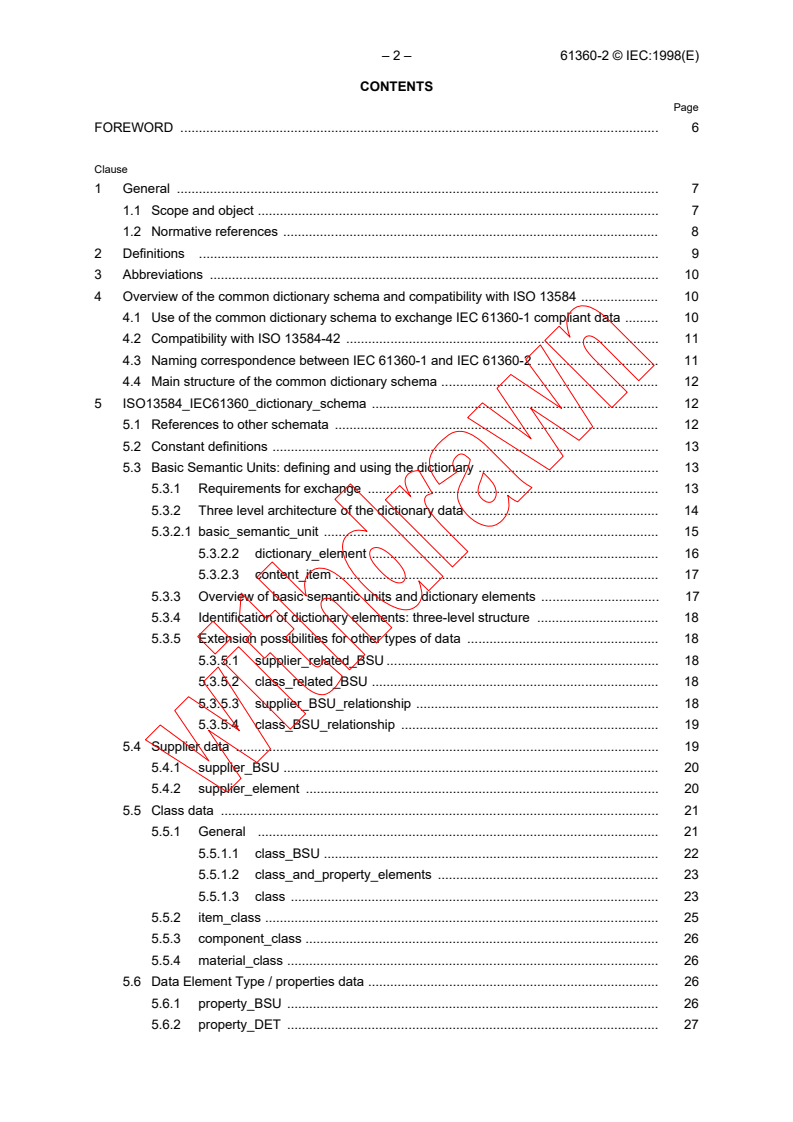
– 2 – 61360-2 © IEC:1998(E)
CONTENTS
Page
FOREWORD . 6
Clause
1 General . 7
1.1 Scope and object . 7
1.2 Normative references . 8
2 Definitions . 9
3 Abbreviations . 10
4 Overview of the common dictionary schema and compatibility with ISO 13584 . 10
4.1 Use of the common dictionary schema to exchange IEC 61360-1 compliant data . 10
4.2 Compatibility with ISO 13584-42 . 11
4.3 Naming correspondence between IEC 61360-1 and IEC 61360-2 . 11
4.4 Main structure of the common dictionary schema . 12
5 ISO13584_IEC61360_dictionary_schema . 12
5.1 References to other schemata . 12
5.2 Constant definitions . 13
5.3 Basic Semantic Units: defining and using the dictionary . 13
5.3.1 Requirements for exchange . 13
5.3.2 Three level architecture of the dictionary data . 14
5.3.2.1 basic_semantic_unit . 15
5.3.2.2 dictionary_element . 16
5.3.2.3 content_item . 17
5.3.3 Overview of basic semantic units and dictionary elements . 17
5.3.4 Identification of dictionary elements: three-level structure . 18
5.3.5 Extension possibilities for other types of data . 18
5.3.5.1 supplier_related_BSU . 18
5.3.5.2 class_related_BSU . 18
5.3.5.3 supplier_BSU_relationship . 18
5.3.5.4 class_BSU_relationship . 19
5.4 Supplier data . 19
5.4.1 supplier_BSU . 20
5.4.2 supplier_element . 20
5.5 Class data . 21
5.5.1 General . 21
5.5.1.1 class_BSU . 22
5.5.1.2 class_and_property_elements . 23
5.5.1.3 class . 23
5.5.2 item_class . 25
5.5.3 component_class . 26
5.5.4 material_class . 26
5.6 Data Element Type / properties data . 26
5.6.1 property_BSU . 26
5.6.2 property_DET . 27
61360-2 © IEC:1998(E) – 3 –
Clause Page
5.6.3 Condition, dependent and non-dependent Data Element Types . 29
5.6.3.1 condition_DET . 29
5.6.3.2 dependent_DET . 29
5.6.3.3 non-dependent_DET . 30
5.6.4 Class_valued properties . 30
5.7 Domain data: the type system . 31
5.7.1 General . 31
5.7.1.1 data_type_BSU . 31
5.7.1.2 data_type_element . 32
5.7.2 The type system . 32
5.7.2.1 data_type . 32
5.7.2.2 simple_type . 33
5.7.2.3 number_type . 33
5.7.2.4 int_type. 33
5.7.2.5 int_measure_type. 34
5.7.2.6 int_currency_type . 34
5.7.2.7 non_quantitative_int_type . 34
5.7.2.8 real_type . 35
5.7.2.9 real_measure_type . 35
5.7.2.10 real_currency_type . 35
5.7.2.11 boolean_type . 36
5.7.2.12 string_type . 36
5.7.2.13 non_quantitative_code_type . 36
5.7.2.14 complex_type . 36
5.7.2.15 level_type . 37
5.7.2.16 level . 37
5.7.2.17 class_instance_type . 37
5.7.2.18 entity_instance_type . 38
5.7.2.19 placement_type . 38
5.7.2.20 axis1_placement_type . 38
5.7.2.21 axis2_placement_2d_type . 39
5.7.2.22 axis2_placement_3d_type . 39
5.7.2.23 named_type . 39
5.7.3 Values . 40
5.7.3.1 value_domain . 40
5.7.3.2 value_code . 41
5.7.3.3 dic_value . 41
5.7.4 Extension to ISO 10303-41 unit definitions . 42
5.7.4.1 non_si_unit . 42
5.7.4.2 assert_ONEOF rule . 42
5.7.4.3 dic_unit . 42
– 4 – 61360-2 © IEC:1998(E)
Clause Page
5.8 Basic type and entity definitions. 43
5.8.1 Basic type definitions . 43
5.8.1.1 class_code_type . 43
5.8.1.2 code_type . 43
5.8.1.3 currency_code . 44
5.8.1.4 date_type . 44
5.8.1.5 definition_type . 44
5.8.1.6 DET_classification_type . 45
5.8.1.7 data_type_code_type . 45
5.8.1.8 note_type . 45
5.8.1.9 pref_name_type . 45
5.8.1.10 property_code_type . 46
5.8.1.11 remark_type . 46
5.8.1.12 revision_type . 46
5.8.1.13 short_name_type . 46
5.8.1.14 supplier_code_type . 47
5.8.1.15 syn_name_type . 47
5.8.1.16 value_code_type . 47
5.8.1.17 value_format_type . 48
5.8.1.18 version_type . 48
5.8.1.19 source_doc_type . 48
5.8.2 Basic entity definitions . 49
5.8.2.1 dates . 49
5.8.2.2 document . 49
5.8.2.3 graphics . 49
5.8.2.4 identified_document . 49
5.8.2.5 item_names . 50
5.8.2.6 label_with_language . 51
5.8.2.7 mathematical_string . 51
5.9 Function definitions . 51
5.9.1 acrylic_superclass_relationship function . 52
5.9.2 at_most_two_synonyms_per_language function . 52
5.9.3 check_syn_length function . 52
5.9.4 codes_are_unique function . 53
5.9.5 definition_available_implies function . 53
5.9.6 is_subclass function . 53
5.9.7 string_for_derived_unit function . 54
5.9.8 string_for_named_unit function . 55
5.9.9 string_for_SI_unit function . 55
5.9.10 string_for_unit function . 57
5.9.11 all_class_descriptions_reachable function . 57
5.9.12 compute_known_visible_properties function. 57
5.9.13 compute_known_visible_data_types function . 58
5.9.14 compute_known_applicable_properties function . 58
5.9.15 compute_known_applicable_data_types function . 59
5.9.16 list_to_set . 59
61360-2 © IEC:1998(E) – 5 –
Clause Page
6 IEC61360 extended dictionary schema . 60
7 ISO13584_IEC61360_language_resource_schema . 61
7.1 ISO13584_IEC61360_language_resource_schema type and entity definitions . 62
7.1.1 language_code . 62
7.1.2 global_language_assignment . 62
7.1.3 present_translations . 63
7.1.4 translatable_label . 63
7.1.5 translated_label . 63
7.1.6 translatable_text . 64
7.1.7 translated_text . 64
7.2 ISO13584_IEC61360_language_resource_schema function definitions . 64
7.2.1 check_label_length function . 65
7.2.2 check_text_length function . 65
7.3 ISO13584_IEC61360_language_resource_schema rule definition . 65
8 Example of Physical File . 66
8.1 Some example data . 66
8.1.1 Supplier data . 66
8.1.2 Root class data. 66
8.1.3 Material data. 67
8.1.4 Component data. 67
8.1.5 Electric / Electronic component data . 68
8.2 Templates derived from the EXPRESS code . 70
8.2.1 Templates for supplier data . 70
8.2.2 Templates for class data . 70
8.2.3 Templates for property_DET data . 71
8.2.4 Templates for data type data . 71
Annexes
A EXPRESS-G diagram . 73
B Bibliography . 80
– 6 – 61360-2 © IEC:1998(E)
INTERNATIONAL ELECTROTECHNICAL COMMISSION
___________
STANDARD DATA ELEMENT TYPES WITH ASSOCIATED
CLASSIFICATION SCHEME FOR ELECTRIC COMPONENTS –
Part 2: EXPRESS Dictionary schema
FOREWORD
1) The IEC (International Electrotechnical Commission) is a worldwide organization for standardization comprising all national
electrotechnical committees (IEC National Committees). The object of the IEC is to promote international co-operation on
all questions concerning standardization in the electrical and electronic fields. To this end and in addition to other activities,
the IEC publishes International Standards. Their preparation is entrusted to technical committees; any IEC National
Committee interested in the subject dealt with may participate in this preparatory work. International, governmental and
non-governmental organizations liaising with the IEC also participate in this preparation. The IEC collaborates closely with
the International Organization for Standardization (ISO) in accordance with conditions determined by agreement between
the two organizations.
2) The formal decisions or agreements of the IEC on technical matters express, as nearly as possible, an international
consensus of opinion on the relevant subjects since each technical committee has representation from all interested
National Committees.
3) The documents produced have the form of recommendations for international use and are published in the form of
standards, technical reports or guides and they are accepted by the National Committees in that sense.
4) In order to promote international unification, IEC National Committees undertake to apply IEC International Standards
transparently to the maximum extent possible in their national and regional standards. Any divergence between the IEC
Standard and the corresponding national or regional standard shall be clearly indicated in the latter.
5) The IEC provides no marking procedure to indicate its approval and cannot be rendered responsible for any equipment
declared to be in conformity with one of its standards.
6) Attention is drawn to the possibility that some of the elements of this International Standard may be the subject of patent
rights. The IEC shall not be held responsible for identifying any or all such patent rights.
International Standard IEC 61360-2 has been prepared by subcommittee 3D: Data sets for libraries, of
IEC technical committee 3: Documentation and graphical symbols.
The text of this standard is based on the following documents:
FDIS Report on voting
3D/53/FDIS 3D/58/RVD
Full information on the voting for the approval of this standard can be found in the report on voting
indicated in the above table.
IEC 61360 consists of the following parts under the general title Standard data element types with
associated classification scheme for electric components:
Part 1: Definitions - Principles and methods
Part 2: EXPRESS Dictionary schema
Part 3: Maintenance and validation procedures
Part 4: IEC reference collection of standard data element types, component classes and terms.
Annexes A and B are for information only.
61360-2 © IEC:1998(E) – 7 –
STANDARD DATA ELEMENT TYPES WITH ASSOCIATED
CLASSIFICATION SCHEME FOR ELECTRIC COMPONENTS –
Part 2: EXPRESS Dictionary schema
1 General
1.1 Scope and object
The scope of this part of IEC 61360 is the common ISO/IEC dictionary schema based on the
intersection of the scopes of the two base standards:
— IEC 61360-1, Standard data element types with associated classification scheme for electric
components - Part 1: Definitions - Principles and methods, and
— ISO 13584-42, Methodology for structuring part families
The presented EXPRESS model represents a common formal model for the two standards and
facilitates a harmonization of both.
Relevant parts of their scope clauses are cited below.
From IEC 61360-1:
" This part of IEC 61360 specifies the principles to be used for defining technical data element types
with associated classification schemes needed to describe fully electric components, including
electronic and electromechanical components and materials used in electro-technical equipment and
systems."
From ISO 13584-42:
" This part of ISO 13584 specifies:
— the attributes that shall be provided by library suppliers to describe the families and properties of
parts. These attributes are part of the content of their parts library and shall be stored in the
dictionary of the user library;
— the specifications of these attributes in the EXPRESS information model that provides for the
exchange of such dictionary data".
The object of this standard is to provide a formal model for data according to the scope as given
above, and thus to provide a means for the computer-sensible representation and exchange of such
data.
The intention is to provide a common information model for the work of both committees, thus allowing
for the implementation of dictionary systems dealing with data delivered according to either of the
standards elaborated by both committees.
Two schemas are provided in this part of IEC 61360 defining the two options that may be selected by
an implementation. Each of these options is referred to as a conformance class.
— The ISO13584_IEC61360_dictionary_schema provides for modelling and exchanging technical
data element types with associated classification scheme but without modelling the definitions of
the terms used in the data element type definitions. It constitutes conformance class 1 of this part
of IEC 61360.
— The IEC61360_extended_dictionary_schema provides for modelling and exchanging technical
data element types with associated classification scheme together with modelling definitions of
and references to the terms used in the data element type definitions. It constitutes conformance
class 2 of this part of IEC 61360.
___________
All the names that stand for items, formally defined within the EXPRESS model, are presented in bold face.
– 8 – 61360-2 © IEC:1998(E)
When used together with ISO 10303-21, each schema defines one single exchange format.
The exchange format defined by conformance class 1 is fully compatible with the ISO 13584 series.
The exchange format defined by conformance class 2 provides also for exchanging the definitions of
the terms used in the definitions of data element types and their associated classification scheme when
such an exchange is required, despite the lack of compatibility with implementations compliant with the
ISO 13584 series.
Both committees agreed NOT to change and/or modify the presented EXPRESS model independent of
each other in order to guarantee the harmonization and the reusability of the work from both
committees. Requests for amendments should therefore be sent to both committees. These requests
should be adopted by both committees before modifying the EXPRESS information model.
1.2 Normative references
The following normative documents contain provisions which, through reference in this text, constitute
provisions of this part of IEC 61360. At the time of publication, the editions indicated were valid. All
normative documents are subject to revision, and parties to agreements based on this part of IEC
61360 are encouraged to investigate the possibility of applying the most recent editions of the
normative documents indicated below. Members of IEC and ISO maintain registers of currently valid
International Standards.
IEC 61360 (all parts), Standard data element types with associated classification scheme for
electric components
IEC 61360-1: 1995, Standard data element types with associated classification scheme for
electric components - Part 1: Definitions - Principles and methods
IEC 61360-4: 1997, Standard data element types with associated classification scheme for
electric components - Part 4: IEC reference collection of standard data
element types, component classes and terms
ISO 31 (all parts), Quantities and units
ISO 639: 1988, Code for the representation of names of languages
ISO 843: 1997, Information and documentation - Conversion of Greek characters into Latin
characters
ISO 4217: 1995, Codes for the representation of currencies and funds
ISO 6093: 1985, Information processing - Representation of numerical values in character
strings for information interchange
ISO 8601: 1988, Data elements and interchange formats - Information interchange -
Representation of dates and times
ISO 8859-1: 1987, Information processing - 8-bit single-byte coded graphic character sets -
Part 1: Latin alphabet No. 1
ISO 8879: 1986, Information processing - Text and office systems - Standard Generalized
Markup Language (SGML)
ISO 9735: 1988, Electronic data interchange for administration, commerce and transport
(EDIFACT) - Application level syntax rules
61360-2 © IEC:1998(E) – 9 –
ISO 10303-11: 1994, Industrial automation systems and integration - Product data representation
and exchange - Part 11: Description methods: The EXPRESS language
reference manual
ISO 10303-21: 1994, Industrial automation systems and integration - Product data representation
and exchange - Part 21: Implementation methods: Clear text encoding of the
exchange structure
ISO 10303-41: 1994, Industrial automation systems and integration - Product data representation
and exchange - Part 41: Integrated generic resources: Fundamentals of
product description and support
ISO 10303-42: 1994, Industrial automation systems and integration - Product data representation
and exchange - Part 42: Integrated generic resources: Geometric and
topological representation
ISO 12083: 1994, Information and documentation - Electronic manuscript preparation and
markup
ISO 13584 (all parts), Industrial automation systems and integration - Parts library
ISO 13584-42:---, Industrial automation systems and integration - Parts library - Part 42:
Description methodology: Methodology for structuring part families
2 Definitions
For the purpose of this part of IEC 61360, the following definitions apply.
2.1
Basic Semantic Unit (BSU)
entity that provides an absolute and universal identification of certain objects of the application domain
(e.g. classes, data element types)
2.2
dictionary element
set of attributes that constitutes the dictionary description of certain objects of the application domain
(e.g. classes, data element types)
2.3
common dictionary schema
information model for a dictionary, using the information modelling language EXPRESS
2.4
data type
set of allowed values of a data element type
NOTE – Within IEC the data_type that is either a unit of measure or a value domain is defined separately for each data
element type.
2.5
IEC root class
class that is the superclass of all the classes defined in IEC 61360-4; its class code is ‘AAA000' and its
version is ‘001'
___________
To be published.
To be published.
– 10 – 61360-2 © IEC:1998(E)
2.6
applicable data element type
data element type that is defined for a component class and that applies to any component that
belongs to this component class
2.7
visible data element type
data element type that is defined for acomponent class and that may or may not apply to the different
components of this component class
NOTE 1 The code of the class where a data element type is defined as visible is part of the identification of this data element
type.
NOTE 2 Within IEC all data element types are defined as visible at the level of the root class, that is the superclass of both
the component class and the material class.
3 Abbreviations
In this standard the following abbreviations are used:
— BSU: Basic Semantic Unit
— DET: Data Element Type
— ICS: International Classification of Standards
— SI: International System of Units
4 Overview of the common dictionary schema and compatibility with ISO 13584
In the following subclauses the architecture of the common dictionary schema will be presented and it
will be explained how the same information model has to be used in the International Standards to
ensure their compatibility.
The common dictionary schema combines the requirements of IEC 61360 and ISO 13584. Therefore,
it contains resources to accommodate the specific requirements of both International Standards. These
resources are provided either as optional capability or as subtypes of the types defined to fulfil the
common requirements.
4.1 Use of the common dictionary schema to exchange IEC 61360-1 compliant data
a) The ISO 13584 specific extensions shall not be used for the exchange of dictionary elements
defined according to IEC 61360-1.
These extensions are present_translations, translated_label and translated_text
that provide for multilingual capabilities.
b) The fixed length of some strings is greater than the size defined in IEC 61360-1. When, however,
these strings are exchanged using the common dictionary schema, they shall be padded as
follows:
— code of a component class: the six character long IEC code shall be left justified in the
fourteen character long exchange format that shall be padded with eight underscores (‘_’);
— code of a data element type: the six character long IEC code shall be left justified in the
fourteen character long exchange format that shall be padded with eight underscores (‘_’);
— value code of the value of a data element type: the variable character length of the IEC code
shall be left justified in the eighteen character long exchange format that shall be padded with
underscores (‘_’);
— coded name of a component class: the variable character length of the IEC code shall be
left justified in the eighteen character long exchange format that shall be padded with
underscores (‘_’);
— revision number: the two character long IEC code shall be right justified and shall be
padded with one zero (‘0’).
c) If a component class has a superclass, the coded_name shall be defined as a value_code in the
domain of the classifying data element type of the superclass.
d) If a classifying data element type exists within a specific component class, for each value in its
domain a subclass and a term shall be defined.
61360-2 © IEC:1998(E) – 11 –
e) A classifying data element type, optional in conformance class 2 in the common dictionary
schema, shall always be provided for the component classes defined according to IEC 61360-1.
f) Only SI units shall be used although the common dictionary schema enables the use of many
kinds of system units. When using this schema however for the exchange of IEC 61360 compliant
data, only SI units shall be used for quantitative data element types.
4.2 Compatibility with ISO 13584-42
An implementation compliant with this part of IEC 61360 shall support all the entities, types and
associated constraints that belong to the conformance class it claims to support.
Therefore, conformity with conformance class 1 of this part of IEC 61360 requires that all the entities,
types and associated constraints defined in the common dictionary schema be supported. ISO 13584
data conforming to the common dictionary schema may thus be processed by an IEC 61360
implementation, whether it conforms to conformance class 1 or to conformance class 2 that includes all
the features of conformance class 1.
In ISO 13584, a specific conformance class is intended to contain all the entities, types and
associated constraints defined in the common dictionary schema. An ISO 13584 compliant
implementation conforming to this conformance class shall therefore be able to support IEC data that
belongs to conformance class 1 of this part of IEC 61360.
4.3 Naming correspondence between IEC 61360-1 and IEC 61360-2
Due to specific application restrictions - e.g. the EXPRESS language allows no spaces in names -, a
number of similar 'EXPRESS names' are created by replacing the blank in a name by an underscore
(e.g. preferred name is presented as preferred_name).
At other places names are used in the EXPRESS model that deviate from those used in IEC 61360-1.
This is a consequence of the effort to reach one common EXPRESS information model together with
parts libraries.
The table below offers a guide for matching the names used in the two parts of IEC 61360.
X-REFERENCE table
Naming in 61360-2 Naming in 61360-1
component_class Component class
condition_DET Condition data element type
dependent_P_DET Data element type
det_classification Data element type class
(DER)dic_identifier Identifier
dic_value Value
material_class Material class
meaning Value meaning
non_dependent_P_DET Data element type
preferred_symbol Preferred letter symbol
revision Revision number
source_doc_of_definition Source document of data element type definition
source_doc_of_definition Source document of component class definition
source_doc_of_definition Source document of term definition
synonymous_symbols Synonymous letter symbol
unit Unit of measure
value_code Value code
version Version number
___________
This conformance class is defined as conformance class 0 in ISO 13584-24.
– 12 – 61360-2 © IEC:1998(E)
4.4 Main structure of the common dictionary schema
This subclause explains the main resource constructs provided by the common dictionary schema.
— dictionary_element is any element defined in the dictionary;
— supplier_element captures the data of suppliers of dictionary elements (classes, properties, data
types);
— class models the dictionary element of classes (families) which are described by properties;
— property_DET is the dictionary element of a property;
— data_type specifies the type of a property.
These parts of the dictionary schema are presented in more detail in clause 5:
ISO13584_IEC61360_dictionary_schema.
In the presentation of the common dictionary schema, some overview diagrams are provided as
planning models (figures 1 to 11). These planning models use the EXPRESS-G graphical notation for
the EXPRESS language.
For clarification of the diagrams, some of the relationships that are defined in the EXPRESS model are
omitted. Figure 1 below outlines as a planning model the main structure of the common dictionary
schema.
Most of these figures contain overview models (or planning models) but show only that level of detail
which is appropriate at a certain place.
(ABS)dictionary_element
defined_by domain
described_by L[0:?]
supplier_element (ABS)class (ABS)property_DET (ABS)data_type
Figure 1 - Overview of the Dictionary Schema
5 ISO13584_IEC61360_dictionary_schema
This clause, which constitutes the main part of the common information model of ISO 13584-42 and
IEC 61360, contains the full EXPRESS listing of the dictionary schema, annotated with comments and
explanatory text. The order of text in this clause is determined firstly by the order imposed by the
EXPRESS language, secondly by importance.
*)
SCHEMA ISO13584_IEC61360_dictionary_schema;
(*
5.1 References to other schemata
This subclause contains references to other EXPRESS schemata which are used in the Dictionary
Schema. Their source is indicated in the respective comment.
61360-2 © IEC:1998(E) – 13 –
*)
REFERENCE FROM support_resource_schema (identifier, label, text);
(* from ISO 10303-41: STEP Part 41: "Fundamentals of Product
Description and Support" *)
REFERENCE FROM person_organization_schema (organization, address);
(* from ISO 10303-41: STEP Part 41: "Fundamentals of Product
Description and Support" *)
REFERENCE FROM measure_schema;
(* from ISO 10303-41: STEP Part 41: "Fundamentals of Product
Description and Support" *)
REFERENCE FROM ISO13584_IEC61360_language_resource_schema;
(* see clause 6 "ISO13584_IEC61360_language_resource_schema" *)
(*
5.2 Constant definitions
This subclause contains constant definitions used later in subclause 5.8 (basic type and entity
definitions).
EXPRESS specification:
*)
CONSTANT
property_code_len: INTEGER:= 14;
class_code_len: INTEGER:= 14;
data_type_code_len: INTEGER:= 14;
supplier_code_len: INTEGER:= 18;
version_len: INTEGER:= 3;
revision_len: INTEGER:= 3;
value_code_len: INTEGER:= 18;
pref_name_len: INTEGER:= 30;
short_name_len: INTEGER:= 15;
syn_name_len: INTEGER:= pref_name_len;
DET_classification_len: INTEGER:= 3;
source_doc_len: INTEGER:= 80;
value_format_len: INTEGER:= 80;
sep_cv: STRING:= '-';
sep_id: STRING:= '.';
END_CONSTANT;
(*
5.3 Basic Semantic Units: defining and using the dictionary
5.3.1 Requirements for exchange
In the exchange of dictionary and parts library data it is customary to partition the data. For example, a
dictionary could be updated with some classes that specify their superclass by a reference to a pre-
existing class, or when the content of a library is exchanged, dictionary elements are only referenced
and not included every time. It must be possible to refer unambiguously and consistently to the
dictionary data.
Thus, it is a clear requirement first, to be able to exchange pieces of data, and secondly, to have
relationships between these pieces. This is depicted in figure 2.
Every one of these pieces corresponds to a Physical File (according to ISO 10303-21). EXPRESS
(see ISO 10303-11) attributes can only contain references to data within the same Physical File. Thus
it is impossible to use EXPRESS attributes directly to implement inter-piece references.
– 16 – 61360-2 © IEC:1998(E)
definition
: a reference to the dictionary element identified by this BSU. If not present in some
exchange context, it is assumed to be present in the dictionary of the target system already.
referenced_by:
items making use of the dictionary element associated with this BSU.
5.3.2.2 dictionary_element
dictionary_element
A is a full definition of the data required to be captured in the semantic dictionary
dictionary_element
for some concepts. For every concept a separate subtype shall be used. The is
associated with a basic_semantic_unit, which serves to uniquely identify this definition in the
dictionary.
Figure 4 presents a planning model of the relationship between the basic semantic unit and the
dictionary element.
(ABS) dictionary_element
identified_by
(INV) definition S[0:1]
code
String
version
(ABS) basic_semantic_unit
String
(DER) dic_identifier
String
(INV) referenced_by S[0:1]
dictionary_definition
(ABS) content_item
Figure 4 - Relationship between basic semantic unit and dictionary element
basic_semantic_unit
By including the version attribute in the entity, it forms part of the identification of
revision time_stamps
a dictionary element (in contrast to the and attributes).
EXPRESS specification:
*)
ENTITY dictionary_element
ABSTRACT SUPERTYPE OF ( ONEOF (
supplier_element,
class_and_property_elements,
data_type_element))
...