

IEC 60529:1989
(Main)Degrees of protection provided by enclosures (IP Code)
General Information
- Abstract
IEC 60529:1989 Applies to the classification of degrees of protection provided by enclosures for electrical equipment with a rated voltage not exceeding 72,5 kV.
- Status
- Published
- Publication Date
- 10-May-2015
- Technical Committee
- TC 70 - Degrees of protection provided by enclosures
- Current Stage
- PPUB - Publication issued
- Start Date
- 31-Dec-1989
- Completion Date
- 28-Aug-2026
Buy Documents
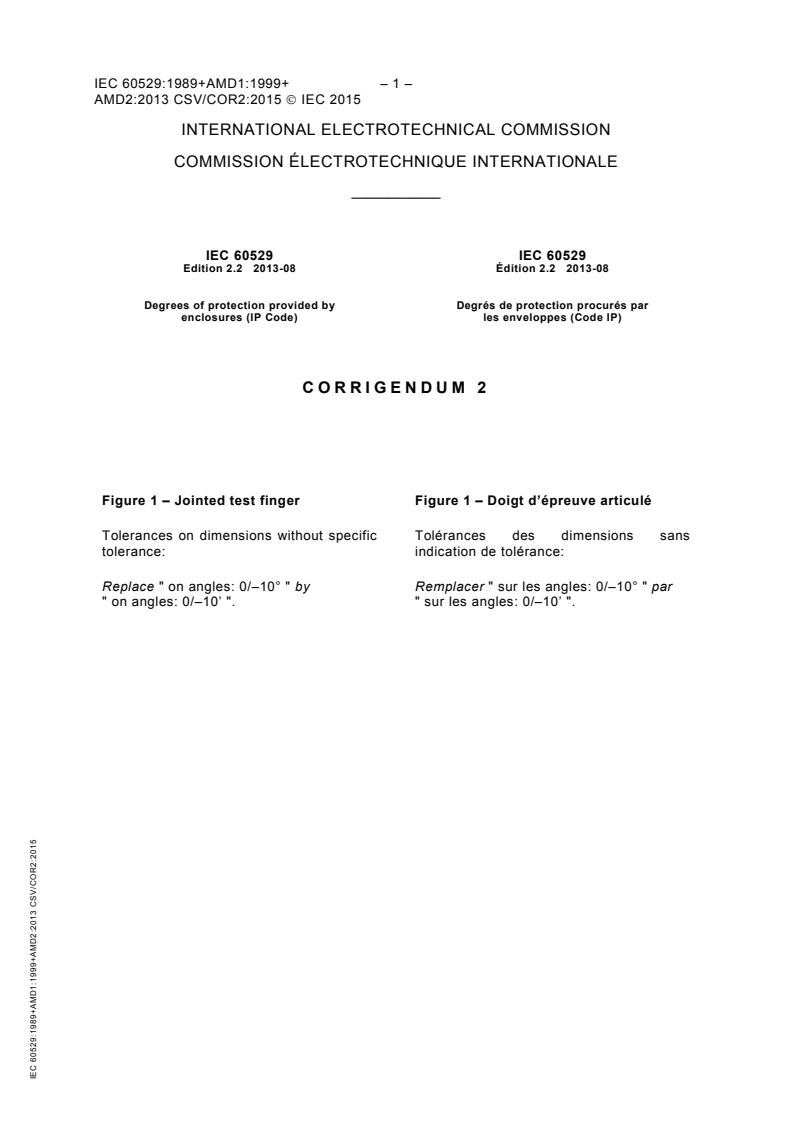


IEC 60529:1989+AMD1:1999+AMD2:2013 CSV/COR2:2015 - Corrigendum 2 - Degrees of protection provided by enclosures (IP Code) Released:5/11/2015
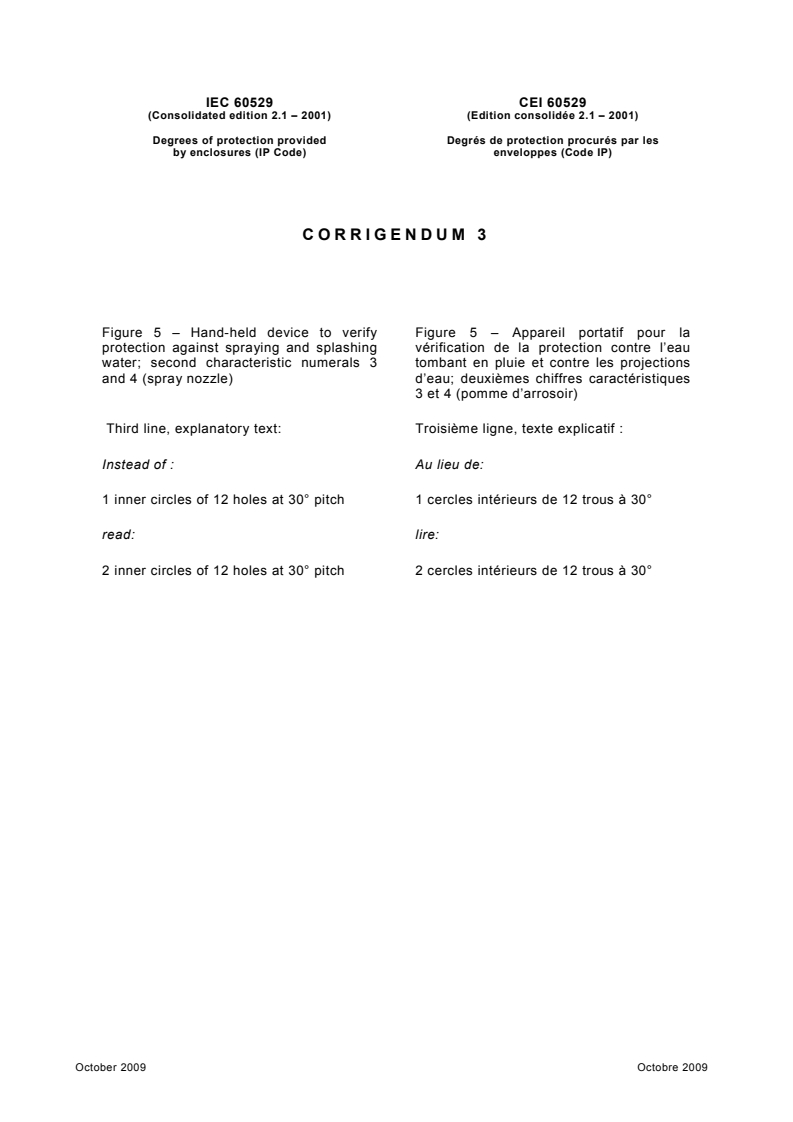


IEC 60529:1989+AMD1:1999 CSV/COR3:2009 - Corrigendum 3 - Degrees of protection provided by enclosures (IP Code) Released:10/13/2009

IEC 60529:1989+AMD1:1999 CSV - Degrees of protection provided by enclosures (IP Code) Released:2/27/2001

IEC 60529:1989+AMD1:1999+AMD2:2013 CSV - Degrees of protection provided by enclosures (IP Code) Released:8/29/2013
Overview
IEC 60529:1989, commonly known as the IP Code standard, is an internationally recognized benchmark developed by the International Electrotechnical Commission (IEC). This standard classifies and specifies the degrees of protection provided by enclosures for electrical equipment, particularly those with a rated voltage not exceeding 72.5 kV. It addresses the protection of equipment against the ingress of solid foreign objects (including body parts like hands and fingers), dust, accidental contact, and water.
The IP (Ingress Protection) Code serves as a universal performance indicator, enabling manufacturers, designers, and users of electrical enclosures to assess durability and safety against environmental influences. This consolidated version includes amendments up to 2013, ensuring up-to-date guidelines for testing and classification.
Key Topics
IP Code Structure
The IP Code consists of two characteristic numerals and optional supplementary letters:- First numeral: protection against access to hazardous parts and solid foreign objects
- Second numeral: protection against water ingress
- Additional letters: specify protection against access to hazardous parts or special environmental considerations.
Protection Levels Against Solids and Hazardous Parts
Levels range from no protection (0) to complete dust-tight enclosures (6), ensuring safety from particles and preventing accidental contact with live parts.Protection Levels Against Water
The second numeral ranges from 0 (no protection) to 9 (protection against high-pressure, high-temperature water jets). Water ingress tests include dripping, spraying, splashing, immersion, and powerful jets, simulating real-world environmental conditions.Testing Methodologies
The standard defines specific testing protocols for verifying protection levels, including the use of access probes, dust chambers, drip boxes, spray nozzles, and immersion setups. Conditions such as atmospheric parameters and test durations are standardized to ensure consistency.Marking and Documentation
Equipment must be clearly marked with the assigned IP Code to communicate protection levels to stakeholders. Detailed documentation on test conditions and acceptance criteria strengthens compliance and facilitates certification.
Applications
IEC 60529 is widely applied across diverse industries to ensure the reliability and safety of electrical enclosures, including:
Consumer Electronics
Smartphones, outdoor lighting, and household appliances use IP ratings to guarantee resistance against dust and water.Industrial Equipment
Machines and control panels in harsh environments require IP classification for dust protection and ingress prevention.Automotive and Transportation
Enclosures for onboard electronics are tested per IEC 60529 to withstand exposure to dust, moisture, and splashes.Telecommunications and Infrastructure
Protection of outdoor installations and equipment cabinets relies on the IP Code to ensure long-term operation under weather exposure.Renewable Energy Systems
Solar panel junction boxes and related equipment are designed according to IEC 60529 to endure environmental challenges.
Adherence to IEC 60529 facilitates compliance with safety regulations, enhances product lifecycle, and boosts consumer confidence by offering transparent protection information.
Related Standards
Professionals working with IEC 60529 often reference these complementary standards for comprehensive protection and system design:
IEC 60068 – Environmental testing methods, covering broader climatic and mechanical stress evaluations.
IEC 60259 – Specifies accommodation of test conditions for electrical equipment relevant to ingress protection.
ISO 20653 – Road vehicles – Degrees of protection (IP code) for electrical equipment in automotive applications.
IEC 61000 – Electromagnetic compatibility standards, which may be relevant alongside physical protection considerations.
Summary
IEC 60529:1989 provides a critical framework for classifying the protective characteristics of enclosures of electrical equipment against solids and liquids ingress. By standardizing IP Codes, it ensures that manufacturers deliver safety, durability, and performance aligned with international expectations. Whether for low-voltage household devices or high-voltage industrial applications, compliance with IEC 60529 is essential for safeguarding equipment functionality and user safety under varying environmental conditions.
Relations
- Effective Date
- 25-Aug-2026
- Effective Date
- 25-Aug-2026
- Effective Date
- 25-Aug-2026
- Referred By
EN ISO 16571:2024 - Systems for evacuation of plume generated by medical devices (ISO 16571:2024) - Effective Date
- 25-Aug-2026
- Effective Date
- 25-Aug-2026
- Effective Date
- 25-Aug-2026
- Effective Date
- 25-Aug-2026
- Effective Date
- 25-Aug-2026
- Effective Date
- 25-Aug-2026
- Effective Date
- 25-Aug-2026
- Effective Date
- 25-Aug-2026
- Effective Date
- 25-Aug-2026
- Effective Date
- 25-Aug-2026
- Effective Date
- 25-Aug-2026
- Effective Date
- 25-Aug-2026
Buy Documents
IEC 60529:1989+AMD1:1999+AMD2:2013 CSV/COR2:2015 - Corrigendum 2 - Degrees of protection provided by enclosures (IP Code) Released:5/11/2015
IEC 60529:1989+AMD1:1999 CSV/COR3:2009 - Corrigendum 3 - Degrees of protection provided by enclosures (IP Code) Released:10/13/2009
IEC 60529:1989+AMD1:1999 CSV - Degrees of protection provided by enclosures (IP Code) Released:2/27/2001
IEC 60529:1989+AMD1:1999+AMD2:2013 CSV - Degrees of protection provided by enclosures (IP Code) Released:8/29/2013
Get Certified
Connect with accredited certification bodies for this standard

IMQ S.p.A. (Certification)
Italian electrical product certification.

SLG Prüf- und Zertifizierungs GmbH
German testing and certification body.

UL Solutions
Global safety science company with testing, inspection and certification.
Sponsored listings
Frequently Asked Questions
IEC 60529:1989 is a standard published by the International Electrotechnical Commission (IEC). Its full title is "Degrees of protection provided by enclosures (IP Code)". This standard covers: IEC 60529:1989 Applies to the classification of degrees of protection provided by enclosures for electrical equipment with a rated voltage not exceeding 72,5 kV.
IEC 60529:1989 Applies to the classification of degrees of protection provided by enclosures for electrical equipment with a rated voltage not exceeding 72,5 kV.
IEC 60529:1989 is classified under the following ICS (International Classification for Standards) categories: 13.260 - Protection against electric shock. Live working; 29.020 - Electrical engineering in general. The ICS classification helps identify the subject area and facilitates finding related standards.
IEC 60529:1989 has the following relationships with other standards: It is inter standard links to EN ISO 5826:2003, EN ISO 15083:2020, EN 3660-065:2016, EN ISO 16571:2024, EN ISO 11197:2016, EN ISO 18674-1:2015, EN ISO 20342-1:2019, EN ISO 5826:2014, EN ISO 13631:2002, EN ISO 15083:2003, EN ISO 16486-3:2020, EN ISO 23553-1:2022, EN ISO 16904:2016, EN ISO 13385-2:2011, EN ISO 19014-3:2018. Understanding these relationships helps ensure you are using the most current and applicable version of the standard.
IEC 60529:1989 is available in PDF format for immediate download after purchase. The document can be added to your cart and obtained through the secure checkout process. Digital delivery ensures instant access to the complete standard document.
Standards Content (Sample)
AMD2:2013 CSV/COR2:2015 IEC 2015
INTERNATIONAL ELECTROTECHNICAL COMMISSION
COMMISSION ÉLECTROTECHNIQUE INTERNATIONALE
____________
IEC 60529 IEC 60529
Edition 2.2 2013-08 Édition 2.2 2013-08
Degrees of protection provided by Degrés de protection procurés par
enclosures (IP Code) les enveloppes (Code IP)
CO RRI G E NDUM 2
Figure 1 – Jointed
...
IEC 60529 CEI 60529
(Consolidated edition 2.1 – 2001) (Edition consolidée 2.1 – 2001)
Degrees of protection provided Degrés de protection procurés par les
by enclosures (IP Code) enveloppes (Code IP)
CORRIGENDUM 3
Figure 5 – Hand-held device to verify Figure 5 – Appareil portatif pour la
protection against spraying and splashing vérification de la protection contre l’eau
water; second characteristic numerals 3 tombant en pluie et contre les projec
...
IEC 60529 ®
Edition 2.1 2001-02
CONSOLIDATED
VERSION
VERSION
CONSOLIDÉE
colour
inside
Degrees of protection provided by enclosures (IP Code)
Degrés de protection procurés par les enveloppes (Code IP)
All rights reserved. Unless otherwise specified, no part of this publication may be reproduced or utilized in any form
or by any means, electronic or mechanical, including photocopying and microfilm, without permission in writing from
either IEC or IEC's member National Committee in the country of the requester.
If you have any questions about IEC copyright or have an enquiry about obtaining additional rights to this publication,
please contact the address below or your local IEC member National Committee for further information.
Droits de reproduction réservés. Sauf indication contraire, aucune partie de cette publication ne peut être reproduite ni
utilisée sous quelque forme que ce soit et par aucun procédé, électronique ou mécanique, y compris la photocopie et les
microfilms, sans l'accord écrit de la CEI ou du Comité national de la CEI du pays du demandeur.
Si vous avez des questions sur le copyright de la CEI ou si vous désirez obtenir des droits supplémentaires sur cette
publication, utilisez les coordonnées ci-après ou contactez le Comité national de la CEI de votre pays de résidence.
IEC Central Office Tel.: +41 22 919 02 11
3, rue de Varembé Fax: +41 22 919 03 00
CH-1211 Geneva 20 info@iec.ch
Switzerland www.iec.ch
About the IEC
The International Electrotechnical Commission (IEC) is the leading global organization that prepares and publishes
International Standards for all electrical, electronic and related technologies.
About IEC publications
The technical content of IEC publications is kept under constant review by the IEC. Please make sure that you have the
latest edition, a corrigenda or an amendment might have been published.
Useful links:
IEC publications search - www.iec.ch/searchpub Electropedia - www.electropedia.org
The advanced search enables you to find IEC publications The world's leading online dictionary of electronic and
by a variety of criteria (reference number, text, technical electrical terms containing more than 30 000 terms and
committee,…). definitions in English and French, with equivalent terms in
It also gives information on projects, replaced and additional languages. Also known as the International
withdrawn publications. Electrotechnical Vocabulary (IEV) on-line.
IEC Just Published - webstore.iec.ch/justpublished Customer Service Centre - webstore.iec.ch/csc
Stay up to date on all new IEC publications. Just Published If you wish to give us your feedback on this publication
details all new publications released. Available on-line and or need further assistance, please contact the
also once a month by email. Customer Service Centre: csc@iec.ch.
A propos de la CEI
La Commission Electrotechnique Internationale (CEI) est la première organisation mondiale qui élabore et publie des
Normes internationales pour tout ce qui a trait à l'électricité, à l'électronique et aux technologies apparentées.
A propos des publications CEI
Le contenu technique des publications de la CEI est constamment revu. Veuillez vous assurer que vous possédez
l’édition la plus récente, un corrigendum ou amendement peut avoir été publié.
Liens utiles:
Recherche de publications CEI - www.iec.ch/searchpub Electropedia - www.electropedia.org
La recherche avancée vous permet de trouver des Le premier dictionnaire en ligne au monde de termes
publications CEI en utilisant différents critères (numéro de électroniques et électriques. Il contient plus de 30 000
référence, texte, comité d’études,…). termes et définitions en anglais et en français, ainsi que
Elle donne aussi des informations sur les projets et les les termes équivalents dans les langues additionnelles.
publications remplacées ou retirées. Egalement appelé Vocabulaire Electrotechnique
International (VEI) en ligne.
Just Published CEI - webstore.iec.ch/justpublished
Service Clients - webstore.iec.ch/csc
Restez informé sur les nouvelles publications de la CEI.
Just Published détaille les nouvelles publications parues. Si vous désirez nous donner des commentaires sur
Disponible en ligne et aussi une fois par mois par email. cette publication ou si vous avez des questions
contactez-nous: csc@iec.ch.
IEC 60529 ®
Edition 2.1 2001-02
CONSOLIDATED
VERSION
VERSION
CONSOLIDÉE
colour
inside
Degrees of protection provided by enclosures (IP Code)
Degrés de protection procurés par les enveloppes (Code IP)
INTERNATIONAL
ELECTROTECHNICAL
COMMISSION
COMMISSION
ELECTROTECHNIQUE
INTERNATIONALE
ICS 13.260; 29.020 ISBN 2-8318-5588-8
IEC 60529 ®
Edition 2.1 2001-02
REDLINE VERSION
VERSION REDLINE
colour
inside
Degrees of protection provided by enclosures (IP Code)
Degrés de protection procurés par les enveloppes (Code IP)
– 2 – 60529 © IEC:1989+A1:1999
CONTENTS
FOREWORD . 5
INTRODUCTION . 7
1 Scope and object . 8
2 ObjectNormative references . 8
3 Definitions . 9
4 Designations . 11
4.1 Arrangement of the IP Code . 11
4.2 Elements of the IP Code and their meanings . 11
4.3 Examples for the use of letters in the IP Code . 12
5 Degrees of protection against access to hazardous parts and against solid foreign
objects indicated by the first characteristic numeral . 13
5.1 Protection against access to hazardous parts . 13
5.2 Protection against solid foreign objects . 14
6 Degrees of protection against ingress of water indicated by the second
characteristic numeral . 15
7 Degrees of protection against access to hazardous parts indicated
by the additional letter . 17
8 Supplementary letters . 17
9 Examples of designations with the IP Code . 18
9.1 IP Code not using optional letters: . 18
9.2 IP Code using optional letters: . 19
10 Marking . 19
11 General requirements for tests . 19
11.1 Atmospheric conditions for water or dust tests . 19
11.2 Test samples . 20
11.3 Application of test requirements and interpretation of test results . 20
11.4 Combination of test conditions for the first characteristic numeral. 20
11.5 Empty enclosures . 21
12 Tests for protection against access to hazardous parts indicated by the first
characteristic numeral . 21
12.1 Access probes . 21
12.2 Test conditions . 21
12.3 Acceptance conditions . 23
12.3.1 For low-voltage equipment (rated voltages not exceeding 1 000 V
a.c. and 1 500 V d.c.) . 23
12.3.2 For high-voltage equipment (rated voltages exceeding 1 000 V a.c.
and 1 500 V d.c.) . 23
12.3.3 For equipment with hazardous mechanical parts. 23
13 Tests for protection against solid foreign objects indicated by the first
characteristic numeral . 24
13.1 Test means . 24
13.2 Test conditions for first characteristic numerals 1, 2, 3, 4 . 24
13.3 Acceptance conditions for first characteristic numerals 1, 2, 3, 4 . 24
60529 © IEC:1989+A1:1999 – 3 –
13.4 Dust test for first characteristic numerals 5 and 6 . 24
13.5 Special conditions for first characteristic numeral 5 . 26
13.5.1 Test conditions for first characteristic numeral 5 . 26
13.5.2 Acceptance conditions for first characteristic numeral 5 . 26
13.6 Special conditions for first characteristic numeral 6 . 26
13.6.1 Test conditions for first characteristic numeral 6 . 26
13.6.2 Acceptance conditions for first characteristic numeral 6 . 26
14 Tests for protection against water indicated by the second characteristic numeral . 26
14.1 Test means . 26
14.2 Test conditions . 27
14.2.1 Test for second characteristic numeral 1 with the drip box . 28
14.2.2 Test for second characteristic numeral 2 with the drip box . 28
14.2.3 Test for second characteristic numeral 3 with oscillating tube
or spray nozzle . 28
14.2.4 Test for second characteristic numeral 4 with oscillating tube
or spray nozzle . 29
14.2.5 Test for second characteristic numeral 5 with the 6,3 mm nozzle . 30
14.2.6 Test for second characteristic numeral 6 with the 12,5 mm nozzle . 30
14.2.7 Test for second characteristic numeral 7: temporary immersion between
0,15 m and 1 m . 30
14.2.8 Test for second characteristic numeral 8: continuous immersion
subject to agreement . 31
14.3 Acceptance conditions . 31
15 Tests for protection against access to hazardous parts indicated by the additional letter . 31
15.1 Access probes . 31
15.2 Test conditions . 31
15.3 Acceptance conditions . 32
Annex A (informative) Examples of IP coding for the verification of protection
of low-voltage equipment against access to hazardous parts . 38
Annex B (informative) Summary of responsibilities of relevant technical committees . 44
Bibliography . 46
Figure 1 – Jointed test finger . 33
Figure 2 – Test device to verify protection against dust (dust chamber) . 34
Figure 3 – Test device to verify protection against vertically falling water drops (drip box) . 35
Figure 4 – Test device to verify protection against spraying and splashing water;
second characteristic numerals 3 and 4 (oscillating tube) . 36
Figure 5 – Hand-held device to verify protection against spraying and splashing water;
second characteristic numerals 3 and 4 (spray nozzle) . 37
Figure 6 – Test device to verify protection against water jets (hose nozzle) . 37
– 4 – 60529 © IEC:1989+A1:1999
Table 1 – Degrees of protection against access to hazardous parts indicated by the first
characteristic numeral . 14
Table 2 – Degrees of protection against solid foreign objects indicated by the first
characteristic numeral . 15
Table 3 – Degrees of protection against water indicated by the second
characteristic numeral . 16
Table 4 – Degrees of protection against access to hazardous parts indicated by the
additional letter . 17
Table 5 – Test conditions for degrees of protection indicated by the first
characteristic numeral . 21
Table 6 – Access probes for the tests for protection of persons against access to
hazardous parts . 22
Table 7 – Test means for the tests for protection against solid foreign objects . 24
Table 8 – Test means and main test conditions for the tests for protection against water . 27
Table 9 – Total water flow rate q under IPX3 and IPX4 test conditions –
v
Mean flow rate per hole q = 0,07 l/min . 29
vl
IP Codes of examples in annex A . 43
60529 © IEC:1989+A1:1999 – 5 –
INTERNATIONAL ELECTROTECHNICAL COMMISSION
____________
DEGREES OF PROTECTION PROVIDED
BY ENCLOSURES (IP Code)
FOREWORD
1) The International Electrotechnical Commission (IEC) is a worldwide organization for standardization comprising
all national electrotechnical committees (IEC National Committees). The object of IEC is to promote
international co-operation on all questions concerning standardization in the electrical and electronic fields. To
this end and in addition to other activities, IEC publishes International Standards, Technical Specifications,
Technical Reports, Publicly Available Specifications (PAS) and Guides (hereafter referred to as “IEC
Publication(s)”). Their preparation is entrusted to technical committees; any IEC National Committee interested
in the subject dealt with may participate in this preparatory work. International, governmental and non-
governmental organizations liaising with the IEC also participate in this preparation. IEC collaborates closely
with the International Organization for Standardization (ISO) in accordance with conditions determined by
agreement between the two organizations.
2) The formal decisions or agreements of IEC on technical matters express, as nearly as possible, an international
consensus of opinion on the relevant subjects since each technical committee has representation from all
interested IEC National Committees.
3) IEC Publications have the form of recommendations for international use and are accepted by IEC National
Committees in that sense. While all reasonable efforts are made to ensure that the technical content of IEC
Publications is accurate, IEC cannot be held responsible for the way in which they are used or for any
misinterpretation by any end user.
4) In order to promote international uniformity, IEC National Committees undertake to apply IEC Publications
transparently to the maximum extent possible in their national and regional publications. Any divergence
between any IEC Publication and the corresponding national or regional publication shall be clearly indicated in
the latter.
5) IEC itself does not provide any attestation of conformity. Independent certification bodies provide conformity
assessment services and, in some areas, access to IEC marks of conformity. IEC is not responsible for any
services carried out by independent certification bodies.
6) All users should ensure that they have the latest edition of this publication.
7) No liability shall attach to IEC or its directors, employees, servants or agents including individual experts and
members of its technical committees and IEC National Committees for any personal injury, property damage or
other damage of any nature whatsoever, whether direct or indirect, or for costs (including legal fees) and
expenses arising out of the publication, use of, or reliance upon, this IEC Publication or any other IEC
Publications.
8) Attention is drawn to the Normative references cited in this publication. Use of the referenced publications is
indispensable for the correct application of this publication.
9) Attention is drawn to the possibility that some of the elements of this IEC Publication may be the subject of
patent rights. IEC shall not be held responsible for identifying any or all such patent rights.
This Consolidated version of IEC 60529 bears the edition number 2.1. It consists of the
second edition (1989) [documents 70(CO)13 + 70(CO)15 and 70(CO)16 + 70(CO)17], its
corrigendum 1 (2003), its corrigendum 2 (2007), its corrigendum 3 (2009) and its
amendment 1 (1999) [documents 70/91/FDIS and 70/92/RVD]. The technical content is
identical to the base edition and its amendment.
In this Redline version, a vertical line in the margin shows where the technical content
is modified by amendment 1. Additions and deletions are displayed in red, with
deletions being struck through. A separate Final version with all changes accepted is
available in this publication.
This publication has been prepared for user convenience.
– 6 – 60529 © IEC:1989+A1:1999
International Standard IEC 60529 has been prepared by technical committee 70: Degrees of
protection by enclosures.
Annexes A and B are for information only.
This publication has been drafted in accordance with the ISO/IEC Directives, Part 2.
The committee has decided that the contents of the base publication and its amendment will
remain unchanged until the stability date indicated on the IEC web site under
"http://webstore.iec.ch" in the data related to the specific publication. At this date, the
publication will be
• reconfirmed,
• withdrawn,
• replaced by a revised edition, or
• amended.
IMPORTANT – The “colour inside” logo on the cover page of this publication indicates
that it contains colours which are considered to be useful for the correct understanding
of its contents. Users should therefore print this publication using a colour printer.
60529 © IEC:1989+A1:1999 – 7 –
INTRODUCTION
This standard describes a system for classifying the degrees of protection provided by the
enclosures of electrical equipment. Whilst this system is suitable for use with most types of
electrical equipment, it should not be assumed that all the listed degrees of protection are
applicable to a particular type of equipment. The manufacturer of the equipment should be
consulted to determine the degrees of protection available and the parts of equipment to
which the stated degree of protection applies.
The adoption of this classification system, wherever possible, Will promote uniformity in
methods of describing the protection provided by the enclosure and in the tests to prove the
various degrees of protection. It should also reduce the number of types of test devices
necessary to test a wide range. of products.
This second edition of IEC 60529 takes account of experiences with the first edition, and
clarifies the requirements. It provides for an optional extension of the IP Code by an additional
letter A, B, C, or D if the actual protection of persons against access to hazardous parts is
higher than that indicated by the first characteristic numeral.
In general, enclosures with an IP coding to the first edition would be eligible for the same
code according to this edition.
– 8 – 60529 © IEC:1989+A1:1999
DEGREES OF PROTECTION PROVIDED
BY ENCLOSURES (IP Code)
1 Scope and object
This standard applies to the classification of degrees of protection provided by enclosures for
electrical equipment with a rated voltage not exceeding 72,5 kV.
2 Object
The object of this standard is to give:
a) Definitions for degrees of protection provided by enclosures of electrical equipment as
regards:
1) protection of persons against access to hazardous parts inside the enclosure;
2) protection of the equipment inside the enclosure against ingress of solid foreign
objects;
3) protection of the equipment inside the enclosure against harmful effects due to the
ingress of water.
b) Designations for these degrees of protection.
c) Requirements for each designation.
d) Tests to be performed to verify that the enclosure meets the requirements of this standard.
It will remain the responsibility of individual technical committees to decide on the extent and
manner in which, the classification is used in their standards and to define “enclosure” as it
applies to their equipment. However, it is recommended that for a given classification the
tests do not differ from those specified in this standard. If necessary, complementary
requirements may be included in the relevant product standard. A guide for the details to be
specified in relevant product standards is given in annex B.
For a particular type of equipment, a technical committee may specify different requirements
provided that at least the same level of safety is ensured.
This standard deals only with enclosures that are in all other respects suitable for their
intended use as specified in the relevant product standard and which from the point of view of
materials and workmanship ensure that the claimed degrees of protection are maintained
under the normal conditions of use.
This standard is also applicable to empty enclosures provided that the general test
requirements are met and that the selected degree of protection is suitable for the type of
equipment to be protected.
Measures to protect both the enclosure and the equipment inside the enclosure against
external influences or conditions such as
– mechanical impacts
– corrosion
– corrosive solvents (for example, cutting liquids)
– fungus
– vermin
– solar radiation
– icing
– moisture (for example, produced by condensation)
– explosive atmospheres
60529 © IEC:1989+A1:1999 – 9 –
and the protection against contact with hazardous moving parts external to the enclosure
(such as fans), are matters for the relevant product standard to be protected.
Barriers external to the enclosure and not attached to it and obstacles which have been
provided solely for the safety of personnel are not considered as a part of the enclosure and
are not dealt with in this standard.
2 Normative references
The following referenced documents are indispensable for the application of this document.
For dated references, only the edition cited applies. For undated references, the latest edition
of the referenced document (including any amendments) applies.
IEC 60050-195:1998, International Electrotechnical Vocabulary (IEV) – Part 195: Earthing and
protection against electric shock
IEC 60050(826):1982, International Electrotechnical Vocabulary (IEV) – Chapter 826:
Electrical installations of buildings
IEC 60068-1:1988, Environmental testing – Part 1: General and guidance
IEC 60068-2-68:1994, Environmental testing – Part 2: Tests – Test L: Dust and sand
IEC 60071-2:1996, Insulation co-ordination – Part 2: Application guide
3 Definitions
For the purpose of this standard, the following definitions apply:
3.1
enclosure
a part providing protection of equipment against certain external influences and, in any
*
direction, protection against direct contact [IEV 826-03-12] .
NOTE This definition taken from the existing International Electrotechnical Vocabulary (IEV) needs the following
explanations under the scope of this standard:
1) Enclosures provide protection of persons or livestock against access to hazardous parts.
2) Barriers, shapes of openings or any other means – whether attached to the enclosure or formed by the
enclosed equipment – suitable to prevent or limit the penetration of the specified test probes are considered
as a part of the enclosure, except when they can be removed without the use of a key or tool.
3.2
direct contact
contact of persons or livestock with live parts [IEV 826-03-05]
NOTE This IEV definition is given for information. In this standard “direct contact” is replaced by “access to
hazardous parts”.
3.3
degree of protection
the extent of protection provided by an enclosure against access to hazardous parts, against.
ingress of solid foreign objects and/or against ingress of water and verified by standardized
test methods
––––––––
*
IEC 60050(826).
– 10 – 60529 © IEC:1989+A1:1999
3.4
IP Code
a coding system to indicate the degrees of protection provided by an enclosure against
access to hazardous parts, ingress of solid foreign objects, ingress of water and to give
additional information in connection with such protection
3.5
hazardous part
a part that is hazardous to approach or touch
3.5.1
hazardous live part
a live part which, under certain conditions of external influences, can give an electric shock
(see IEC 536, at present Document 64(CO)196 60050-195, 195-06-05)
3.5.2
hazardous mechanical part
a moving part, other than a smooth rotating shaft, that is hazardous to touch
3.6
protection provided by an enclosure against access to hazardous parts
the protection of persons against
– contact with hazardous low-voltage live parts
– contact with hazardous mechanical parts
– approach to hazardous high-voltage live parts below adequate clearance inside an enclosure
NOTE This protection may be provided
– by means of the enclosure itself,
– by means of barriers as part of the enclosure or distances inside the enclosure.
3.7
adequate clearance for protection against access to hazardous parts
a distance to prevent contact or approach of an access probe to a hazardous part
3.8
access probe
a test probe simulating in a conventional manner a part of a person or a tool, or the like, held
by a person to verify adequate clearance from hazardous parts
3.9
object probe
a test probe simulating a solid foreign object to verify the possibility of ingress into an
enclosure
3.10
opening
a gap or aperture in an enclosure which exists or may be formed by the application
of a test probe at the specified force
60529 © IEC:1989+A1:1999 – 11 –
4 Designations
The degree of protection provided by an enclosure is indicated by the IP Code in the following
way:
4.1 Arrangement of the IP Code
IP 2 3 C H
Code letters
(International Protection)
First characteristic numeral
(numerals 0 to 6, or letter X)
Second characteristic numeral
(numerals 0 to 8, or letter X)
Additional letter (optional)
(letters A, B, C, D)
Supplementary letter (optional)
(letters H, M, S, W)
Where a characteristic numeral is not required to be specified, it shall be replaced by the
letter “X” (“XX” if both numerals are omitted).
Additional letters and/or supplementary letters may be omitted without replacement.
Where more than one supplementary letter is used, the alphabetic sequence shall apply.
If an enclosure provides different degrees of protection for different intended mounting
arrangements, the relevant degrees of protection shall be indicated by the manufacturer in the
instructions related to the respective mounting arrangements.
Details for the marking of an enclosure are given in clause 10.
4.2 Elements of the IP Code and their meanings
A brief description of the IP Code elements is given in the following chart. Full details are
specified in the clauses indicated in the last column.
– 12 – 60529 © IEC:1989+A1:1999
Numerals Meaning for the protection of Meaning for the
Element or letters equipment protection of
Ref.
persons
Code letters IP – – –
First Against ingress of solid foreign Against access to Cl. 5
characteristic objects hazardous parts
numeral with
0 (non-protected) (non-protected)
1 back of hand
≥ 50 mm diameter
2 finger
≥ 12,5 mm diameter
3 tool
≥ 2,5 mm diameter
4 wire
≥ 1,0 mm diameter
5 wire
dust-protected
6 wire
dust-tight
Second Against ingress of water Cl. 6
characteristic with harmful effects
–
numeral 0 (non-protected)
1 vertically dripping
2 dripping (15° tilted)
3 spraying
4 splashing
5 jetting
6 powerful jetting
7 temporary immersion
8 continuous immersion
Additional Against access to Cl. 7
letter (optional) hazardous parts
with:
–
A back of hand
B finger
C tool
D wire
Supplementary Supplementary information Cl. 8
letter (optional) specific to:
–
H High voltage apparatus
M Motion during water test
S Stationary during water test
W Weather conditions
4.3 Examples for the use of letters in the IP Code
The following examples are to explain the use and arrangement of letters in the IP Code.
For more comprehensive examples see clause 9.
IP44 – no letters, no options;
IPX5 – omitting first characteristic numeral;
IP2X – omitting second characteristic numeral;
IP20C – using additional letter;
IPXXC – omitting both characteristic numerals, using additional letter;
IPX1C – omitting first characteristic numeral, using additional letter;
IP3XD – omitting second characteristic numeral, using additional letter;
IP23S – using supplementary letter;
IP21CM – using additional letter and supplementary letter;
60529 © IEC:1989+A1:1999 – 13 –
IPX5/IPX7 – giving two different. degrees of protection by an enclosure against both water
jets and temporary immersion for “versatile” application.
5 Degrees of protection against access to hazardous parts and against
solid foreign objects indicated by the first characteristic numeral
The designation with a first characteristic numeral implies that conditions stated in both 5.1
and 5.2 are met.
The first characteristic numeral indicates that:
– the enclosure provides protection of persons against access to hazardous parts by
preventing or limiting the ingress of a part of the human body or an object held by a
person;
and simultaneously
– the enclosure provides protection of equipment against the ingress of solid foreign objects.
An enclosure shall only be designated with a stated degree of protection indicated by the first
characteristic numeral if it also complies with all lower degrees of protection.
However, the tests establishing compliance with any one of the lower degrees of protection
need not necessarily be carried out provided that these tests would obviously be met if
applied.
5.1 Protection against access to hazardous parts
Table 1 gives brief descriptions and definitions for the degrees of protection against access to
hazardous parts.
Degrees of protection listed in this table shall be specified only by the first characteristic
numeral and not by reference to the brief description or definition.
To comply with the conditions of the first characteristic numeral, adequate clearance shall be
kept between the access probe and hazardous parts.
The tests are specified in clause 12.
– 14 – 60529 © IEC:1989+A1:1999
Table 1 – Degrees of protection against access to hazardous parts indicated
by the first characteristic numeral
First Degree of protection Test
characteristic conditions,
Brief description Definition
numeral see
0 Non-protected – –
1 Protected against access to 12.2
The access probe, sphere of 50 mm ∅,
hazardous parts with the
shall have adequate clearance from
back of a hand
hazardous parts
2 Protected against access to The jointed test finger of 12 mm ∅, 12.2
hazardous parts with a finger
80 mm length, shall have adequate
clearance form hazardous parts
3 Protected against access to 12.2
The access probe of 2,5 mm ∅ shall
hazardous parts with a tool not penetrate
4 Protected against access to 12.2
The access probe of 1,0 mm ∅ shall
hazardous parts with a wire
not penetrate
5 Protected against access to 12.2
The access probe of 1,0 mm ∅ shall
hazardous parts with a wire not penetrate
6 Protected against access to 12.2
The access probe of 1,0 mm ∅ shall
hazardous parts with a wire
not penetrate
NOTE In the case of the first characteristic numerals 3, 4, 5 and 6, protection against access to
hazardous parts is satisfied if adequate clearance is kept. The adequate clearance should be specified by
the relevant product committee in accordance with 12.3.
Due to the simultaneous requirement specified in table 2, the definition "shall not penetrate" is given in
table 1.
5.2 Protection against solid foreign objects
Table 2 gives brief descriptions and the definitions for the degrees of protection against the
penetration of solid foreign objects including dust.
Degrees of protection listed in this table shall only be specified by the first characteristic
numeral and not by reference to the brief description or definition.
The protection against the ingress of solid foreign objects implies that the object probes up
to numeral 2 in table 2 shall not fully penetrate the enclosure. This means that the full
diameter of the sphere shall not pass through an opening. in the enclosure. Object probes for
numerals 3 and 4 shall not penetrate the enclosure at all.
Dust-protected enclosures to numeral 5 allow a limited quantity of dust to penetrate under
certain conditions.
Dust-tight enclosures to numeral 6 do not allow any dust to penetrate.
NOTE Enclosures assigned a first characteristic numeral of 1 to 4 generally exclude both regularly and irregularly
shaped solid foreign objects provided that three mutually perpendicular dimensions of the object exceed the
appropriate figure in column 3 of table 2.
The tests are specified in clause 13.
60529 © IEC:1989+A1:1999 – 15 –
Table 2 – Degrees of protection against solid foreign objects indicated
by the first characteristic numeral
First Degree of protection Test
characteristic conditions,
Brief description Definition
numeral see
0 Non-protected – –
1 Protected against solid foreign 13.2
The object probe, sphere of 50 mm ∅,
1)
objects of 50 mm ∅ and
shall not fully penetrate
greater
2 Protected against solid foreign The object probe, sphere of 12,5 mm ∅, 13.2
1)
objects of 12,5 mm ∅ and
shall not fully penetrate
greater
3 Protected against solid foreign 13.2
The object probe, sphere of 2,5 mm ∅,
1)
objects of 2,5 mm ∅ and
shall not penetrate at all
greater
4 Protected against solid foreign 13.2
The object probe of 1,0 mm ∅, shall not
1)
objects of 1,0 mm ∅ and
penetrate at all
greater
5 Dust-protected Ingress of dust is not totally prevented, 13.4
but dust shall not penetrate in a quantity 13.5
to interfere with satisfactory operation of
the apparatus or to impair safety
6 Dust-tight No ingress of dust 13.4
13.56
1)
The full diameter of the object probe shall not pass through an opening of the enclosure.
6 Degrees of protection against ingress of water indicated by the second
characteristic numeral
The second characteristic numeral indicates the degree of protection provided by enclosures
with respect to harmful effects on the equipment due to the ingress of water.
The tests for the second characteristic numeral are carried out with fresh water. The actual
protection may not be satisfactory if cleaning operations with high pressure and/or solvents
are used.
Table 3 gives brief descriptions and definitions of the protection for the degrees represented
by the second characteristic numeral.
Degrees of protection listed in this table shall be specified only by the second characteristic
numeral and not by reference to the brief description or definition.
The tests are specified in clause 14.
Up to and including second characteristic numeral 6, the designation implies compliance also
with the requirements for all lower characteristic numerals. However, the tests establishing
compliance with any one of the lower degrees of protection need not necessarily be carried
out provided that these tests obviously would be met if applied.
An enclosure designated with second characteristic numeral 7 or 8 only is considered
unsuitable for exposure to water jets (designated by second characteristic numeral 5 or 6) and
need not comply with requirements for numeral 5 or 6 unless it is dual coded as follows:
– 16 – 60529 © IEC:1989+A1:1999
Enclosure passes test for:
Designation Range
water jets temporary/continuous
and of
second characteristic immersion
marking application
numeral second characteristic
numeral
5 7 IPX5/IPX7 Versatile
6 7 IPX6/IPX7 Versatile
5 8 IPX5/IPX8 Versatile
6 8 IPX6/IPX8 Versatile
– 7 IPX7 Restricted
– 8 IPX8 Restricted
Enclosures for “versatile” application indicated in the last column shall meet requirements for
exposure to both water jets and temporary or continuous immersion.
Enclosures for “restricted” application indicated in the last column are considered suitable
only for temporary or continuous immersion and unsuitable for exposure to water jets.
Table 3 – Degrees of protection against water indicated
by the second characteristic numeral
Second Degree of protection Test
characteristic conditions,
Brief description Definition
numeral see
0 Non-protected – –
1 Protected against vertically Vertically falling drops shall have no 14.2.1
falling water drops harmful effects
2 Protected against vertically Vertically falling drops shall have no 14.2.2
falling water drops when harmful effects when the enclosure is
enclosure tilted up to 15° tilted at any angle up to 15° on either
side of the vertical
3 Protected against spraying Water sprayed at an angle up to 60° on 14.2.3
water either side of the vertical shall have no
harmful effects
4 Protected against splashing Water splashed against the enclosure 14.2.4
water from any direction shall have no harmful
effects
5 Protected against water jets Water projected in jets against the 14.2.5
enclosure from any direction shall have
no harmful effects
6 Protected against powerful Water projected in powerful jets against 14.2.6
water jets the enclosure from any direction shall
have no harmful effects
7 Protected against the effects Ingress of water in quantities causing 14.2.7
of temporary immersion in harmful effects shall not be possible
water when the enclosure is temporarily
immersed in water under standardized
conditions of pressure and time
8 Protected against the effects Ingress of water in quantities causing 14.2.8
of continuous immersion in harmful effects shall not be possible
water when the enclosure is continuously
immersed in water under conditions
which shall be agreed between
manufacturer and user but which are
more severe than for numeral 7
60529 © IEC:1989+A1:1999 – 17 –
7 Degrees of protection against access to hazardous parts indicated
by the additional letter
The additional letter indicates the degree of protection of persons against access to
hazardous parts.
Additional letters are only used
– if the actual protection against access to hazardous parts is higher than that indicated by
the first characteristic numeral
– or if only the protection against access to hazardous parts is indicated, the first
characteristic numeral being then replaced by an X.
For example, such higher protection may be provided by barriers, suitable shape of openings
or distances inside the enclosure.
Table 4 gives access probes considered by convention as representative of parts of the
human body or objects held by a person and the definitions for the degrees of protection
against access to hazardous parts, indicated by additional letters.
An enclosure shall only be designated with a stated degree of protection indicated by the
additional letter if the enclosure also complies with all lower degrees of protection. However,
the tests establishing compliance with any one of the lower degrees of protection need not
necessarily be carried out provided that these tests obviously would be met if applied.
The tests are specified in clause 15.
See annex A for examples of the IP coding.
Table 4 – Degrees of protection against access to hazardous parts indicated
by the additional letter
Additional Degree of protection Test
letter conditions,
Brief description Definition
see
A Protected against access The access probe, sphere of 50 mm ∅, 15.2
with the back of the hand shall have adequate clearance from
hazardous parts
B Protected against access 15.2
The jointed test finger of 12 mm ∅,
with a finger 80 mm length, shall have adequate
clearance form hazardous par
...
IEC 60529 ®
Edition 2.2 2013-08
CONSOLIDATED VERSION
INTERNATIONAL
STANDARD
NORME
INTERNATIONALE
colour
inside
Degrees of protection provided by enclosures (IP Code)
Degrés de protection procurés par les enveloppes (Code IP)
All rights reserved. Unless otherwise specified, no part of this publication may be reproduced or utilized in any form
or by any means, electronic or mechanical, including photocopying and microfilm, without permission in writing from
either IEC or IEC's member National Committee in the country of the requester. If you have any questions about IEC
copyright or have an enquiry about obtaining additional rights to this publication, please contact the address below or
your local IEC member National Committee for further information.
Droits de reproduction réservés. Sauf indication contraire, aucune partie de cette publication ne peut être reproduite
ni utilisée sous quelque forme que ce soit et par aucun procédé, électronique ou mécanique, y compris la photocopie
et les microfilms, sans l'accord écrit de l'IEC ou du Comité national de l'IEC du pays du demandeur. Si vous avez des
questions sur le copyright de l'IEC ou si vous désirez obtenir des droits supplémentaires sur cette publication, utilisez
les coordonnées ci-après ou contactez le Comité national de l'IEC de votre pays de résidence.
IEC Central Office Tel.: +41 22 919 02 11
3, rue de Varembé info@iec.ch
CH-1211 Geneva 20 www.iec.ch
Switzerland
About the IEC
The International Electrotechnical Commission (IEC) is the leading global organization that prepares and publishes
International Standards for all electrical, electronic and related technologies.
About IEC publications
The technical content of IEC publications is kept under constant review by the IEC. Please make sure that you have the
latest edition, a corrigendum or an amendment might have been published.
IEC publications search - webstore.iec.ch/advsearchform IEC online collection - oc.iec.ch
The advanced search enables to find IEC publications by a Discover our powerful search engine and read freely all the
variety of criteria (reference number, text, technical publications previews. With a subscription you will always
committee, …). It also gives information on projects, replaced have access to up to date content tailored to your needs.
and withdrawn publications.
Electropedia - www.electropedia.org
IEC Just Published - webstore.iec.ch/justpublished
The world's leading online dictionary on electrotechnology,
Stay up to date on all new IEC publications. Just Published
containing more than 22 000 terminological entries in English
details all new publications released. Available online and
and French, with equivalent terms in 18 additional languages.
once a month by email.
Also known as the International Electrotechnical Vocabulary
(IEV) online.
IEC Customer Service Centre - webstore.iec.ch/csc
If you wish to give us your feedback on this publication or
need further assistance, please contact the Customer Service
Centre: sales@iec.ch.
A propos de l'IEC
La Commission Electrotechnique Internationale (IEC) est la première organisation mondiale qui élabore et publie des
Normes internationales pour tout ce qui a trait à l'électricité, à l'électronique et aux technologies apparentées.
A propos des publications IEC
Le contenu technique des publications IEC est constamment revu. Veuillez vous assurer que vous possédez l’édition la
plus récente, un corrigendum ou amendement peut avoir été publié.
Recherche de publications IEC - IEC online collection - oc.iec.ch
webstore.iec.ch/advsearchform Découvrez notre puissant moteur de recherche et consultez
La recherche avancée permet de trouver des publications IEC gratuitement tous les aperçus des publications. Avec un
en utilisant différents critères (numéro de référence, texte, abonnement, vous aurez toujours accès à un contenu à jour
comité d’études, …). Elle donne aussi des informations sur adapté à vos besoins.
les projets et les publications remplacées ou retirées.
Electropedia - www.electropedia.org
IEC Just Published - webstore.iec.ch/justpublished
Le premier dictionnaire d'électrotechnologie en ligne au
Restez informé sur les nouvelles publications IEC. Just
monde, avec plus de 22 000 articles terminologiques en
Published détaille les nouvelles publications parues.
anglais et en français, ainsi que les termes équivalents dans
Disponible en ligne et une fois par mois par email.
16 langues additionnelles. Egalement appelé Vocabulaire
Electrotechnique International (IEV) en ligne.
Service Clients - webstore.iec.ch/csc
Si vous désirez nous donner des commentaires sur cette
publication ou si vous avez des questions contactez-nous:
sales@iec.ch.
IEC 60529 ®
Edition 2.2 2013-08
CONSOLIDATED VERSION
INTERNATIONAL
STANDARD
NORME
INTERNATIONALE
colour
inside
Degrees of protection provided by enclosures (IP Code)
Degrés de protection procurés par les enveloppes (Code IP)
INTERNATIONAL
ELECTROTECHNICAL
COMMISSION
COMMISSION
ELECTROTECHNIQUE
INTERNATIONALE
ICS 13.260; 29.020 ISBN 978-2-8322-1086-4
IEC 60529 ®
Edition 2.2 2013-08
CONSOLIDATED VERSION
REDLINE VERSION
VERSION REDLINE
colour
inside
Degrees of protection provided by enclosures (IP Code)
Degrés de protection procurés par les enveloppes (Code IP)
– 2 – 60529 © IEC:1989+A1:1999
+A2:2013
CONTENTS
FOREWORD . 5
INTRODUCTION . 7
INTRODUCTION TO AMENDMENT 2 . 8
1 Scope and object . 9
2 ObjectNormative references . 10
3 Definitions . 10
4 Designations . 12
4.1 Arrangement of the IP Code . 12
4.2 Elements of the IP Code and their meanings . 12
4.3 Examples for the use of letters in the IP Code . 13
5 Degrees of protection against access to hazardous parts and against solid foreign
objects indicated by the first characteristic numeral . 14
5.1 Protection against access to hazardous parts . 14
5.2 Protection against solid foreign objects . 15
6 Degrees of protection against ingress of water indicated by the second
characteristic numeral . 16
7 Degrees of protection against access to hazardous parts indicated
by the additional letter . 18
8 Supplementary letters . 19
9 Examples of designations with the IP Code . 20
9.1 IP Code not using optional letters: . 20
9.2 IP Code using optional letters: . 20
10 Marking . 21
11 General requirements for tests . 21
11.1 Atmospheric conditions for water or dust tests . 21
11.2 Test samples . 21
11.3 Application of test requirements and interpretation of test results . 21
11.4 Combination of test conditions for the first characteristic numeral. 22
11.5 Empty enclosures . 22
12 Tests for protection against access to hazardous parts indicated by the first
characteristic numeral . 22
12.1 Access probes . 22
12.2 Test conditions . 22
12.3 Acceptance conditions . 24
12.3.1 For low-voltage equipment (rated voltages not exceeding 1 000 V
a.c. and 1 500 V d.c.) . 24
12.3.2 For high-voltage equipment (rated voltages exceeding 1 000 V a.c.
and 1 500 V d.c.) . 24
12.3.3 For equipment with hazardous mechanical parts. 25
13 Tests for protection against solid foreign objects indicated by the first
characteristic numeral . 25
13.1 Test means . 25
13.2 Test conditions for first characteristic numerals 1, 2, 3, 4 . 25
60529 © IEC:1989+A1:1999 – 3 –
+A2:2013
13.3 Acceptance conditions for first characteristic numerals 1, 2, 3, 4 . 25
13.4 Dust test for first characteristic numerals 5 and 6 . 25
13.5 Special conditions for first characteristic numeral 5 . 27
13.5.1 Test conditions for first characteristic numeral 5 . 27
13.5.2 Acceptance conditions for first characteristic numeral 5 . 27
13.6 Special conditions for first characteristic numeral 6 . 27
13.6.1 Test conditions for first characteristic numeral 6 . 27
13.6.2 Acceptance conditions for first characteristic numeral 6 . 27
14 Tests for protection against water indicated by the second characteristic numeral . 27
14.1 Test means . 27
14.2 Test conditions . 28
14.2.1 Test for second characteristic numeral 1 with the drip box . 29
14.2.2 Test for second characteristic numeral 2 with the drip box . 29
14.2.3 Test for second characteristic numeral 3 with oscillating tube
or spray nozzle . 30
14.2.4 Test for second characteristic numeral 4 with oscillating tube
or spray nozzle . 30
14.2.5 Test for second characteristic numeral 5 with the 6,3 mm nozzle . 31
14.2.6 Test for second characteristic numeral 6 with the 12,5 mm nozzle . 31
14.2.7 Test for second characteristic numeral 7: temporary immersion between
0,15 m and 1 m . 31
14.2.8 Test for second characteristic numeral 8: continuous immersion
subject to agreement . 32
14.2.9 Test for second characteristic numeral 9 with a spray nozzle . 32
14.3 Acceptance conditions . 32
15 Tests for protection against access to hazardous parts indicated by the additional letter . 33
15.1 Access probes . 33
15.2 Test conditions . 33
15.3 Acceptance conditions . 33
Annex A (informative) Examples of IP coding for the verification of protection
of low-voltage equipment against access to hazardous parts . 43
Annex B (informative) Summary of responsibilities of relevant technical committees . 49
Bibliography . 51
Figure 1 – Jointed test finger . 34
Figure 2 – Test device to verify protection against dust (dust chamber) . 35
Figure 3 – Test device to verify protection against vertically falling water drops (drip box) . 36
Figure 4 – Test device to verify protection against spraying and splashing water;
second characteristic numerals 3 and 4 (oscillating tube) . 37
Figure 5 – Hand-held device to verify protection against spraying and splashing water;
second characteristic numerals 3 and 4 (spray nozzle) . 38
Figure 6 – Test device to verify protection against water jets (hose nozzle) . 38
Figure 7 – Fan jet nozzle dimensions . 39
– 4 – 60529 © IEC:1989+A1:1999
+A2:2013
Figure 8 – Fan jet nozzle resulting dimensions of spraying hole for checking purpose . 39
Figure 9 – Fan jet nozzle examples. 40
Figure 10 – Set-up for measuring the impact force of the water jet for determining the
protection against high-pressure and temperature water jet, degree of protection against
ingress of water IP X9 . 41
Figure 11 – Impact force distribution . 41
Figure 12 – Test device to verify protection against high pressure and temperature water
jet for small enclosures . 42
Table 1 – Degrees of protection against access to hazardous parts indicated by the first
characteristic numeral . 15
Table 2 – Degrees of protection against solid foreign objects indicated by the first
characteristic numeral . 16
Table 3 – Degrees of protection against water indicated by the second
characteristic numeral . 18
Table 4 – Degrees of protection against access to hazardous parts indicated by the
additional letter . 19
Table 5 – Test conditions for degrees of protection indicated by the first
characteristic numeral . 22
Table 6 – Access probes for the tests for protection of persons against access to
hazardous parts . 23
Table 7 – Test means for the tests for protection against solid foreign objects . 25
Table 8 – Test means and main test conditions for the tests for protection against water . 28
Table 9 – Total water flow rate q under IPX3 and IPX4 test conditions –
v
Mean flow rate per hole q = 0,07 l/min . 31
vl
IP Codes of examples in annex A . 48
60529 © IEC:1989+A1:1999 – 5 –
+A2:2013
INTERNATIONAL ELECTROTECHNICAL COMMISSION
____________
DEGREES OF PROTECTION PROVIDED
BY ENCLOSURES (IP Code)
FOREWORD
1) The International Electrotechnical Commission (IEC) is a worldwide organization for standardization comprising
all national electrotechnical committees (IEC National Committees). The object of IEC is to promote
international co-operation on all questions concerning standardization in the electrical and electronic fields. To
this end and in addition to other activities, IEC publishes International Standards, Technical Specifications,
Technical Reports, Publicly Available Specifications (PAS) and Guides (hereafter referred to as “IEC
Publication(s)”). Their preparation is entrusted to technical committees; any IEC National Committee interested
in the subject dealt with may participate in this preparatory work. International, governmental and non-
governmental organizations liaising with the IEC also participate in this preparation. IEC collaborates closely
with the International Organization for Standardization (ISO) in accordance with conditions determined by
agreement between the two organizations.
2) The formal decisions or agreements of IEC on technical matters express, as nearly as possible, an international
consensus of opinion on the relevant subjects since each technical committee has representation from all
interested IEC National Committees.
3) IEC Publications have the form of recommendations for international use and are accepted by IEC National
Committees in that sense. While all reasonable efforts are made to ensure that the technical content of IEC
Publications is accurate, IEC cannot be held responsible for the way in which they are used or for any
misinterpretation by any end user.
4) In order to promote international uniformity, IEC National Committees undertake to apply IEC Publications
transparently to the maximum extent possible in their national and regional publications. Any divergence
between any IEC Publication and the corresponding national or regional publication shall be clearly indicated in
the latter.
5) IEC itself does not provide any attestation of conformity. Independent certification bodies provide conformity
assessment services and, in some areas, access to IEC marks of conformity. IEC is not responsible for any
services carried out by independent certification bodies.
6) All users should ensure that they have the latest edition of this publication.
7) No liability shall attach to IEC or its directors, employees, servants or agents including individual experts and
members of its technical committees and IEC National Committees for any personal injury, property damage or
other damage of any nature whatsoever, whether direct or indirect, or for costs (including legal fees) and
expenses arising out of the publication, use of, or reliance upon, this IEC Publication or any other IEC
Publications.
8) Attention is drawn to the Normative references cited in this publication. Use of the referenced publications is
indispensable for the correct application of this publication.
9) Attention is drawn to the possibility that some of the elements of this IEC Publication may be the subject of
patent rights. IEC shall not be held responsible for identifying any or all such patent rights.
This consolidated version of the official IEC Standard and its amendments has been
prepared for user convenience.
IEC 60529 edition 2.2 contains the second edition (1989) [documents 70(CO)13 +
70(CO)15 and 70(CO)16 + 70(CO)17], its corrigendum 1 (2003), its corrigendum 2 (2007),
its corrigendum 3 (2009), its amendment 1 (1999) [documents 70/91/FDIS and 70/92/RVD]
and its amendment 2 [documents 70/122/FDIS and 70/123/RVD].
In this Redline version, a vertical line in the margin shows where the technical content is
modified by amendments 1 and 2. Additions and deletions are displayed in red, with
deletions being struck through. A separate Final version with all changes accepted is
available in this publication.
– 6 – 60529 © IEC:1989+A1:1999
+A2:2013
International Standard IEC 60529 has been prepared by technical committee 70: Degrees of
protection by enclosures.
Annexes A and B are for information only.
This publication has been drafted in accordance with the ISO/IEC Directives, Part 2.
The committee has decided that the contents of the base publication and its amendments will
remain unchanged until the stability date indicated on the IEC web site under
"http://webstore.iec.ch" in the data related to the specific publication. At this date, the
publication will be
• reconfirmed,
• withdrawn,
• replaced by a revised edition, or
• amended.
The contents of the corrigenda of October 2013, May 2015 and January 2019 have been
included in this copy.
IMPORTANT – The “colour inside” logo on the cover page of this publication indicates
that it contains colours which are considered to be useful for the correct understanding
of its contents. Users should therefore print this publication using a colour printer.
60529 © IEC:1989+A1:1999 – 7 –
+A2:2013
INTRODUCTION
This standard describes a system for classifying the degrees of protection provided by the
enclosures of electrical equipment. Whilst this system is suitable for use with most types of
electrical equipment, it should not be assumed that all the listed degrees of protection are
applicable to a particular type of equipment. The manufacturer of the equipment should be
consulted to determine the degrees of protection available and the parts of equipment to
which the stated degree of protection applies.
The adoption of this classification system, wherever possible, Will promote uniformity in
methods of describing the protection provided by the enclosure and in the tests to prove the
various degrees of protection. It should also reduce the number of types of test devices
necessary to test a wide range. of products.
This second edition of IEC 60529 takes account of experiences with the first edition, and
clarifies the requirements. It provides for an optional extension of the IP Code by an additional
letter A, B, C, or D if the actual protection of persons against access to hazardous parts is
higher than that indicated by the first characteristic numeral.
In general, enclosures with an IP coding to the first edition would be eligible for the same
code according to this edition.
– 8 – 60529 © IEC:1989+A1:1999
+A2:2013
INTRODUCTION TO AMENDMENT 2
This Amendment 2 introduces a new degree of protection IP X9 whereas no modifications of
the existing degrees of protection are made.
Thus neither additional tests nor modifications of the existing certificates should be requested
in case of enclosures providing a different IP code.
60529 © IEC:1989+A1:1999 – 9 –
+A2:2013
DEGREES OF PROTECTION PROVIDED
BY ENCLOSURES (IP Code)
1 Scope and object
This standard applies to the classification of degrees of protection provided by enclosures for
electrical equipment with a rated voltage not exceeding 72,5 kV.
2 Object
The object of this standard is to give:
a) Definitions for degrees of protection provided by enclosures of electrical equipment as
regards:
1) protection of persons against access to hazardous parts inside the enclosure;
2) protection of the equipment inside the enclosure against ingress of solid foreign
objects;
3) protection of the equipment inside the enclosure against harmful effects due to the
ingress of water.
b) Designations for these degrees of protection.
c) Requirements for each designation.
d) Tests to be performed to verify that the enclosure meets the requirements of this standard.
It will remain the responsibility of individual technical committees to decide on the extent and
manner in which, the classification is used in their standards and to define “enclosure” as it
applies to their equipment. However, it is recommended that for a given classification the
tests do not differ from those specified in this standard. If necessary, complementary
requirements may be included in the relevant product standard. A guide for the details to be
specified in relevant product standards is given in annex B.
For a particular type of equipment, a technical committee may specify different requirements
provided that at least the same level of safety is ensured.
This standard deals only with enclosures that are in all other respects suitable for their
intended use as specified in the relevant product standard and which from the point of view of
materials and workmanship ensure that the claimed degrees of protection are maintained
under the normal conditions of use.
This standard is also applicable to empty enclosures provided that the general test
requirements are met and that the selected degree of protection is suitable for the type of
equipment to be protected.
Measures to protect both the enclosure and the equipment inside the enclosure against
external influences or conditions such as
– mechanical impacts
– corrosion
– corrosive solvents (for example, cutting liquids)
– fungus
– vermin
– solar radiation
– icing
– moisture (for example, produced by condensation)
– explosive atmospheres
– 10 – 60529 © IEC:1989+A1:1999
+A2:2013
and the protection against contact with hazardous moving parts external to the enclosure
(such as fans), are matters for the relevant product standard to be protected.
Barriers external to the enclosure and not attached to it and obstacles which have been
provided solely for the safety of personnel are not considered as a part of the enclosure and
are not dealt with in this standard.
2 Normative references
The following referenced documents are indispensable for the application of this document.
For dated references, only the edition cited applies. For undated references, the latest edition
of the referenced document (including any amendments) applies.
IEC 60050-195:1998, International Electrotechnical Vocabulary (IEV) – Part 195: Earthing and
protection against electric shock
IEC 60050(826):1982, International Electrotechnical Vocabulary (IEV) – Chapter 826:
Electrical installations of buildings
IEC 60068-1:1988, Environmental testing – Part 1: General and guidance
IEC 60068-2-68:1994, Environmental testing – Part 2: Tests – Test L: Dust and sand
IEC 60071-2:1996, Insulation co-ordination – Part 2: Application guide
3 Definitions
For the purpose of this standard, the following definitions apply:
3.1
enclosure
a part providing protection of equipment against certain external influences and, in any
*
direction, protection against direct contact [IEV 826-03-12] .
NOTE This definition taken from the existing International Electrotechnical Vocabulary (IEV) needs the following
explanations under the scope of this standard:
1) Enclosures provide protection of persons or livestock against access to hazardous parts.
2) Barriers, shapes of openings or any other means – whether attached to the enclosure or formed by the
enclosed equipment – suitable to prevent or limit the penetration of the specified test probes are considered
as a part of the enclosure, except when they can be removed without the use of a key or tool.
3.2
direct contact
contact of persons or livestock with live parts [IEV 826-03-05]
NOTE This IEV definition is given for information. In this standard “direct contact” is replaced by “access to
hazardous parts”.
3.3
degree of protection
the extent of protection provided by an enclosure against access to hazardous parts, against.
ingress of solid foreign objects and/or against ingress of water and verified by standardized
test methods
––––––––
*
IEC 60050(826).
60529 © IEC:1989+A1:1999 – 11 –
+A2:2013
3.4
IP Code
a coding system to indicate the degrees of protection provided by an enclosure against
access to hazardous parts, ingress of solid foreign objects, ingress of water and to give
additional information in connection with such protection
3.5
hazardous part
a part that is hazardous to approach or touch
3.5.1
hazardous live part
a live part which, under certain conditions of external influences, can give an electric shock
(see IEC 536, at present Document 64(CO)196 60050-195, 195-06-05)
3.5.2
hazardous mechanical part
a moving part, other than a smooth rotating shaft, that is hazardous to touch
3.6
protection provided by an enclosure against access to hazardous parts
the protection of persons against
– contact with hazardous low-voltage live parts
– contact with hazardous mechanical parts
– approach to hazardous high-voltage live parts below adequate clearance inside an enclosure
NOTE This protection may be provided
– by means of the enclosure itself,
– by means of barriers as part of the enclosure or distances inside the enclosure.
3.7
adequate clearance for protection against access to hazardous parts
a distance to prevent contact or approach of an access probe to a hazardous part
3.8
access probe
a test probe simulating in a conventional manner a part of a person or a tool, or the like, held
by a person to verify adequate clearance from hazardous parts
3.9
object probe
a test probe simulating a solid foreign object to verify the possibility of ingress into an
enclosure
3.10
opening
a gap or aperture in an enclosure which exists or may be formed by the application
of a test probe at the specified force
– 12 – 60529 © IEC:1989+A1:1999
+A2:2013
4 Designations
The degree of protection provided by an enclosure is indicated by the IP Code in the following
way:
4.1 Arrangement of the IP Code
IP 2 3 C H
Code letters
(International Protection)
First characteristic numeral
(numerals 0 to 6, or letter X)
Second characteristic numeral
(numerals 0 to 89, or letter X)
Additional letter (optional)
(letters A, B, C, D)
Supplementary letter (optional)
(letters H, M, S, W)
Where a characteristic numeral is not required to be specified, it shall be replaced by the
letter “X” (“XX” if both numerals are omitted).
Additional letters and/or supplementary letters may be omitted without replacement.
Where more than one supplementary letter is used, the alphabetic sequence shall apply.
If an enclosure provides different degrees of protection for different intended mounting
arrangements, the relevant degrees of protection shall be indicated by the manufacturer in the
instructions related to the respective mounting arrangements.
Details for the marking of an enclosure are given in clause 10.
4.2 Elements of the IP Code and their meanings
A brief description of the IP Code elements is given in the following chart. Full details are
specified in the clauses indicated in the last column.
60529 © IEC:1989+A1:1999 – 13 –
+A2:2013
Numerals Meaning for the protection of Meaning for the
Element or letters equipment protection of
Ref.
persons
Code letters IP – – –
First Against ingress of solid foreign Against access to Cl. 5
characteristic objects hazardous parts
numeral with
0 (non-protected) (non-protected)
1 back of hand
≥ 50 mm diameter
2 finger
≥ 12,5 mm diameter
3 tool
≥ 2,5 mm diameter
4 wire
≥ 1,0 mm diameter
5 wire
dust-protected
6 wire
dust-tight
Second Against ingress of water Cl. 6
characteristic with harmful effects
–
numeral 0 (non-protected)
1 vertically dripping
2 dripping (15° tilted)
3 spraying
4 splashing
5 jetting
6 powerful jetting
7 temporary immersion
8 continuous immersion
9 High pressure and temperature
water jet
Additional Against access to Cl. 7
letter (optional) hazardous parts
with:
–
A back of hand
B finger
C tool
D wire
Supplementary Supplementary information Cl. 8
letter (optional) specific to:
–
H High voltage apparatus
M Motion during water test
S Stationary during water test
W Weather conditions
4.3 Examples for the use of letters in the IP Code
The following examples are to explain the use and arrangement of letters in the IP Code.
For more comprehensive examples see clause 9.
IP44 – no letters, no options;
IPX5 – omitting first characteristic numeral;
IP2X – omitting second characteristic numeral;
IP20C – using additional letter;
IPXXC – omitting both characteristic numerals, using additional letter;
IPX1C – omitting first characteristic numeral, using additional letter;
IP3XD – omitting second characteristic numeral, using additional letter;
IP23S – using supplementary letter;
IP21CM – using additional letter and supplementary letter;
– 14 – 60529 © IEC:1989+A1:1999
+A2:2013
IPX5/IPX7/IPX9 – giving two three different degrees of protection by an enclosure
against both water jets, and temporary immersion and high pressure and
temperature water jet for “versatile” application.
5 Degrees of protection against access to hazardous parts and against
solid foreign objects indicated by the first characteristic numeral
The designation with a first characteristic numeral implies that conditions stated in both 5.1
and 5.2 are met.
The first characteristic numeral indicates that:
– the enclosure provides protection of persons against access to hazardous parts by
preventing or limiting the ingress of a part of the human body or an object held by a
person;
and simultaneously
– the enclosure provides protection of equipment against the ingress of solid foreign objects.
An enclosure shall only be designated with a stated degree of protection indicated by the first
characteristic numeral if it also complies with all lower degrees of protection.
However, the tests establishing compliance with any one of the lower degrees of protection
need not necessarily be carried out provided that these tests would obviously be met if
applied.
5.1 Protection against access to hazardous parts
Table 1 gives brief descriptions and definitions for the degrees of protection against access to
hazardous parts.
Degrees of protection listed in this table shall be specified only by the first characteristic
numeral and not by reference to the brief description or definition.
To comply with the conditions of the first characteristic numeral, adequate clearance shall be
kept between the access probe and hazardous parts.
The tests are specified in clause 12.
60529 © IEC:1989+A1:1999 – 15 –
+A2:2013
Table 1 – Degrees of protection against access to hazardous parts indicated
by the first characteristic numeral
First Degree of protection Test
characteristic conditions,
Brief description Definition
numeral see
0 Non-protected – –
1 Protected against access to 12.2
The access probe, sphere of 50 mm ∅,
hazardous parts with the
shall have adequate clearance from
back of a hand
hazardous parts
2 Protected against access to The jointed test finger of 12 mm ∅, 12.2
hazardous parts with a finger
80 mm length, shall have adequate
clearance form hazardous parts
3 Protected against access to 12.2
The access probe of 2,5 mm ∅ shall
hazardous parts with a tool not penetrate
4 Protected against access to 12.2
The access probe of 1,0 mm ∅ shall
hazardous parts with a wire
not penetrate
5 Protected against access to 12.2
The access probe of 1,0 mm ∅ shall
hazardous parts with a wire not penetrate
6 Protected against access to 12.2
The access probe of 1,0 mm ∅ shall
hazardous parts with a wire
not penetrate
NOTE In the case of the first characteristic numerals 3, 4, 5 and 6, protection against access to
hazardous parts is satisfied if adequate clearance is kept. The adequate clearance should be specified by
the relevant product committee in accordance with 12.3.
Due to the simultaneous requirement specified in table 2, the definition "shall not penetrate" is given in
table 1.
5.2 Protection against solid foreign objects
Table 2 gives brief descriptions and the definitions for the degrees of protection against the
penetration of solid foreign objects including dust.
Degrees of protection listed in this table shall only be specified by the first characteristic
numeral and not by reference to the brief description or definition.
The protection against the ingress of solid foreign objects implies that the object probes up
to numeral 2 in table 2 shall not fully penetrate the enclosure. This means that the full
diameter of the sphere shall not pass through an opening. in the enclosure. Object probes for
numerals 3 and 4 shall not penetrate the enclosure at all.
Dust-protected enclosures to numeral 5 allow a limited quantity of dust to penetrate under
certain conditions.
Dust-tight enclosures to numeral 6 do not allow any dust to penetrate.
NOTE Enclosures assigned a first characteristic numeral of 1 to 4 generally exclude both regularly and irregularly
shaped solid foreign objects provided that three mutually perpendicular dimensions of the object exceed the
appropriate figure in column 3 of table 2.
The tests are specified in clause 13.
– 16 – 60529 © IEC:1989+A1:1999
+A2:2013
Table 2 – Degrees of protection against solid foreign objects indicated
by the first characteristic numeral
First Degree of protection Test
characteristic conditions,
Brief description Definition
numeral see
0 Non-protected – –
1 Protected against solid foreign 13.2
The object probe, sphere of 50 mm ∅,
1)
objects of 50 mm ∅ and
shall not fully penetrate
greater
2 Protected against solid foreign The object probe, sphere of 12,5 mm ∅, 13.2
1)
objects of 12,5 mm ∅ and
shall not fully penetrate
greater
3 Protected against solid foreign The object probe, sphere of 2,5 mm ∅, 13.2
1)
objects of 2,5 mm ∅ and
shall not penetrate at all
greater
4 Protected against solid foreign 13.2
The object probe of 1,0 mm ∅, shall not
1)
objects of 1,0 mm ∅ and
penetrate at all
greater
5 Dust-protected Ingress of dust is not totally prevented, 13.4
but dust shall not penetrate in a quantity 13.5
to interfere with satisfactory operation of
the apparatus or to impair safety
6 Dust-tight No ingress of dust 13.4
13.56
1)
The full diameter of the object probe shall not pass through an opening of the enclosure.
6 Degrees of protection against ingress of water indicated by the second
characteristic numeral
The second characteristic numeral indicates the degree of protection provided by enclosures
with respect to harmful effects on the equipment due to the ingress of water.
The tests for the second characteristic numeral are carried out with fresh water. The actual
protection may not be satisfactory if cleaning operations with high pressure and temperature
water jet outside the requirements of second characteristic numeral 9 and/or solvents are
used.
Table 3 gives brief descriptions and definitions of the protection for the degrees represented
by the second characteristic numeral.
Degrees of protection listed in this table shall be specified only by the second characteristic
numeral and not by reference to the brief description or definition.
The tests are specified in clause 14.
Up to and including second characteristic numeral 6, the designation implies compliance also
with the requirements for all lower characteristic numerals. However, the tests establishing
compliance with any one of the lower degrees of protection need not necessarily be carried
out provided that these tests obviously would be met if applied.
An enclosure designated with second characteristic numeral 7 or 8 only is considered
unsuitable for exposure to water jets (designated by second characteristic numeral 5 or 6) and
need not comply with requirements for numeral 5 or 6 unless it is dual coded as follows:
multiple coded. An enclosure designated with second characteristic numeral 9 only is
considered unsuitable for exposure to water jets (designated by second characteristic
60529 © IEC:1989+A1:1999 – 17 –
+A2:2013
numeral 5 or 6) and immersion in water (designated by second characteristic numeral 7 or 8)
and need not comply with requirements for numeral 5, 6, 7 or 8 unless it is multiple coded as
follows:
Enclosure passes test for:
Designation Range
water jets temporary/continuous
and of
second characteristic immersion
marking application
numeral second characteristic
numeral
5 7 IPX5/IPX7 Versatile
65 78 IPX65/IPX78 Versatile
56 87 IPX56/IPX87 Versatile
6 8 IPX6/IPX8 Versatile
–9 7 IPX7/IPX9 Restricted Versatile
–9 8 IPX8/IPX9 Restricted Versatile
5 and 9 7 IPX5/IPX7/IPX9 Versatile
5 and 9 8 IPX5/IPX8/IPX9 Versatile
6 and 9 7 IPX6/IPX7/IPX9 Versatile
6 and 9 8 IPX6/IPX8/IPX9 Versatile
– 7 IPX7 Restricted
– 8 IPX8 Restricted
9 – IPX9 Restricted
5 and 9 – IPX5/IPX9 Versatile
6 and 9 – IPX6/IPX9 Versatile
Enclosures for “versatile” application indicated in the last column shall meet requirements for
exposure to both water jets and temporary or continuous immersion.
Enclosures for “restricted” application indicated in the last column are considered suitable
only for temporary or continuous immersion and unsuitable for exposure to water jets the
conditions to which they were tested.
– 18 – 60529 © IEC:1989+A1:1999
+A2:2013
Table 3 – Degrees of protection against water indicated
by the second characteristic numeral
Second Degree of protection Test
characteristic conditions,
Brief description Definition
numeral see
0 Non-protected – –
1 Protected against vertically Ver
...