

IEC 60623:2017
(Main)Secondary cells and batteries containing alkaline or other non-acid electrolytes - Vented nickel-cadmium prismatic rechargeable single cells
General Information
- Abstract
IEC 60623:2017 specifies marking, designation, dimensions, tests and requirements for vented nickel-cadmium prismatic secondary single cells. When there exists an IEC standard specifying test conditions and requirements for cells used in special applications and which is in conflict with this document, the former takes precedence.
This edition includes the following significant technical changes with respect to the previous edition:
- optional characterization of cells designed for performances at very low and/or very high temperature;
- optional characterization of cells tested with CCCV charge;
- optional characterization of cells designed for rapid charge;
- optional characterization of cells designed for high cycling.
- Status
- Published
- Publication Date
- 22-Jan-2017
- Technical Committee
- SC 21A - Secondary cells and batteries containing alkaline or other non-acid electrolytes
- Drafting Committee
- WG 1 - TC 21/SC 21A/WG 1
- Current Stage
- PPUB - Publication issued
- Start Date
- 23-Jan-2017
- Completion Date
- 18-Jan-2017
Buy Documents
IEC 60623:2017 RLV - Secondary cells and batteries containing alkaline or other non-acid electrolytes - Vented nickel-cadmium prismatic rechargeable single cells Released:1/23/2017
IEC 60623:2017 - Secondary cells and batteries containing alkaline or other non-acid electrolytes - Vented nickel-cadmium prismatic rechargeable single cells Released:1/23/2017
Overview
IEC 60623:2017 is the International Electrotechnical Commission (IEC) standard for vented nickel‑cadmium (Ni‑Cd) prismatic rechargeable single cells. It defines mandatory requirements for marking, designation, dimensions, tests and acceptance criteria for prismatic secondary cells using alkaline or other non‑acid electrolytes. This fifth edition (2017) is a technical revision that adds optional characterizations for extreme temperature performance, CCCV charging, rapid charge and high‑cycling designs. When a specific IEC standard for special applications conflicts with IEC 60623, the specific standard takes precedence.
Key Topics and Requirements
The standard covers practical and testable requirements that ensure performance, safety and interchangeability:
- Cell designation and marking: mandatory and optional marking details, terminal and lug identification, safety recommendations.
- Dimensions: standardized sizes and measurement tolerances for prismatic cells in steel and plastic containers to support mechanical interchangeability.
- Electrical tests:
- Charging procedures for test purposes (constant current, constant voltage/CCCV and rapid charge where applicable).
- Discharge performance at multiple temperatures (including +20 °C, +5 °C, −18 °C and optional very low/high temperature characterizations).
- High‑rate current testing, charge retention and charge acceptance tests.
- Endurance/cycle life and overcharge tests including optional high‑cycling characterization.
- Safety and reliability tests:
- Vent plug operation verification.
- Electrolyte retention (leakage) tests and physical appearance checks.
- Storage and mechanical tests.
- Conformity and acceptance:
- Type approval and batch acceptance procedures, recommended test sequences and acceptance criteria.
Applications and Who Uses It
IEC 60623 is used by professionals and organizations involved with Ni‑Cd prismatic cells:
- Battery manufacturers - for product design, production testing, marking and dimensional conformity.
- Test laboratories and certification bodies - to perform IEC‑compliant electrical, mechanical and safety tests for type approval and batch acceptance.
- Equipment designers and OEMs - to select compliant cells for industrial, medical, aerospace, railway and standby applications where vented Ni‑Cd prismatic cells are specified.
- Procurement/specification writers and regulators - to define technical requirements and ensure interoperability and safety.
Related Standards
- IEC 61434 (current designation method for test currents) - referenced in the standard for current designation methodology.
- IEC 60050‑482 - vocabulary references for primary and secondary cells.
Note: consult any IEC standard specific to a special application where that standard may override IEC 60623 requirements.
Keywords: IEC 60623, vented nickel‑cadmium prismatic cells, Ni‑Cd standard, battery testing, prismatic rechargeable cells, CCCV charging, rapid charge, endurance testing.
Relations
- Effective Date
- 28-Jun-2024
- Effective Date
- 05-Sep-2023
Buy Documents
IEC 60623:2017 RLV - Secondary cells and batteries containing alkaline or other non-acid electrolytes - Vented nickel-cadmium prismatic rechargeable single cells Released:1/23/2017
IEC 60623:2017 - Secondary cells and batteries containing alkaline or other non-acid electrolytes - Vented nickel-cadmium prismatic rechargeable single cells Released:1/23/2017
Get Certified
Connect with accredited certification bodies for this standard

IMQ S.p.A. (Certification)
Italian electrical product certification.

SLG Prüf- und Zertifizierungs GmbH
German testing and certification body.

UL Solutions
Global safety science company with testing, inspection and certification.
Sponsored listings
Frequently Asked Questions
IEC 60623:2017 is a standard published by the International Electrotechnical Commission (IEC). Its full title is "Secondary cells and batteries containing alkaline or other non-acid electrolytes - Vented nickel-cadmium prismatic rechargeable single cells". This standard covers: IEC 60623:2017 specifies marking, designation, dimensions, tests and requirements for vented nickel-cadmium prismatic secondary single cells. When there exists an IEC standard specifying test conditions and requirements for cells used in special applications and which is in conflict with this document, the former takes precedence. This edition includes the following significant technical changes with respect to the previous edition: - optional characterization of cells designed for performances at very low and/or very high temperature; - optional characterization of cells tested with CCCV charge; - optional characterization of cells designed for rapid charge; - optional characterization of cells designed for high cycling.
IEC 60623:2017 specifies marking, designation, dimensions, tests and requirements for vented nickel-cadmium prismatic secondary single cells. When there exists an IEC standard specifying test conditions and requirements for cells used in special applications and which is in conflict with this document, the former takes precedence. This edition includes the following significant technical changes with respect to the previous edition: - optional characterization of cells designed for performances at very low and/or very high temperature; - optional characterization of cells tested with CCCV charge; - optional characterization of cells designed for rapid charge; - optional characterization of cells designed for high cycling.
IEC 60623:2017 is classified under the following ICS (International Classification for Standards) categories: 29.220.99 - Other cells and batteries. The ICS classification helps identify the subject area and facilitates finding related standards.
IEC 60623:2017 has the following relationships with other standards: It is inter standard links to IEC 60623:2026, IEC 60623:2001. Understanding these relationships helps ensure you are using the most current and applicable version of the standard.
IEC 60623:2017 is available in PDF format for immediate download after purchase. The document can be added to your cart and obtained through the secure checkout process. Digital delivery ensures instant access to the complete standard document.
Standards Content (Sample)
IEC 60623 ®
Edition 5.0 2017-01
REDLINE VERSION
INTERNATIONAL
STANDARD
colour
inside
Secondary cells and batteries containing alkaline or other non-acid
electrolytes – Vented nickel-cadmium prismatic rechargeable single cells
All rights reserved. Unless otherwise specified, no part of this publication may be reproduced or utilized in any form
or by any means, electronic or mechanical, including photocopying and microfilm, without permission in writing from
either IEC or IEC's member National Committee in the country of the requester. If you have any questions about IEC
copyright or have an enquiry about obtaining additional rights to this publication, please contact the address below or
your local IEC member National Committee for further information.
IEC Central Office Tel.: +41 22 919 02 11
3, rue de Varembé Fax: +41 22 919 03 00
CH-1211 Geneva 20 info@iec.ch
Switzerland www.iec.ch
About the IEC
The International Electrotechnical Commission (IEC) is the leading global organization that prepares and publishes
International Standards for all electrical, electronic and related technologies.
About IEC publications
The technical content of IEC publications is kept under constant review by the IEC. Please make sure that you have the
latest edition, a corrigenda or an amendment might have been published.
IEC Catalogue - webstore.iec.ch/catalogue Electropedia - www.electropedia.org
The stand-alone application for consulting the entire The world's leading online dictionary of electronic and
bibliographical information on IEC International Standards, electrical terms containing 20 000 terms and definitions in
Technical Specifications, Technical Reports and other English and French, with equivalent terms in 16 additional
documents. Available for PC, Mac OS, Android Tablets and languages. Also known as the International Electrotechnical
iPad. Vocabulary (IEV) online.
IEC publications search - www.iec.ch/searchpub IEC Glossary - std.iec.ch/glossary
The advanced search enables to find IEC publications by a 65 000 electrotechnical terminology entries in English and
variety of criteria (reference number, text, technical French extracted from the Terms and Definitions clause of
committee,…). It also gives information on projects, replaced IEC publications issued since 2002. Some entries have been
and withdrawn publications. collected from earlier publications of IEC TC 37, 77, 86 and
CISPR.
IEC Just Published - webstore.iec.ch/justpublished
Stay up to date on all new IEC publications. Just Published IEC Customer Service Centre - webstore.iec.ch/csc
details all new publications released. Available online and If you wish to give us your feedback on this publication or
also once a month by email. need further assistance, please contact the Customer Service
Centre: csc@iec.ch.
IEC 60623 ®
Edition 5.0 2017-01
REDLINE VERSION
INTERNATIONAL
STANDARD
colour
inside
Secondary cells and batteries containing alkaline or other non-acid
electrolytes – Vented nickel-cadmium prismatic rechargeable single cells
INTERNATIONAL
ELECTROTECHNICAL
COMMISSION
ICS 29.220.99 ISBN 978-2-8322-3872-1
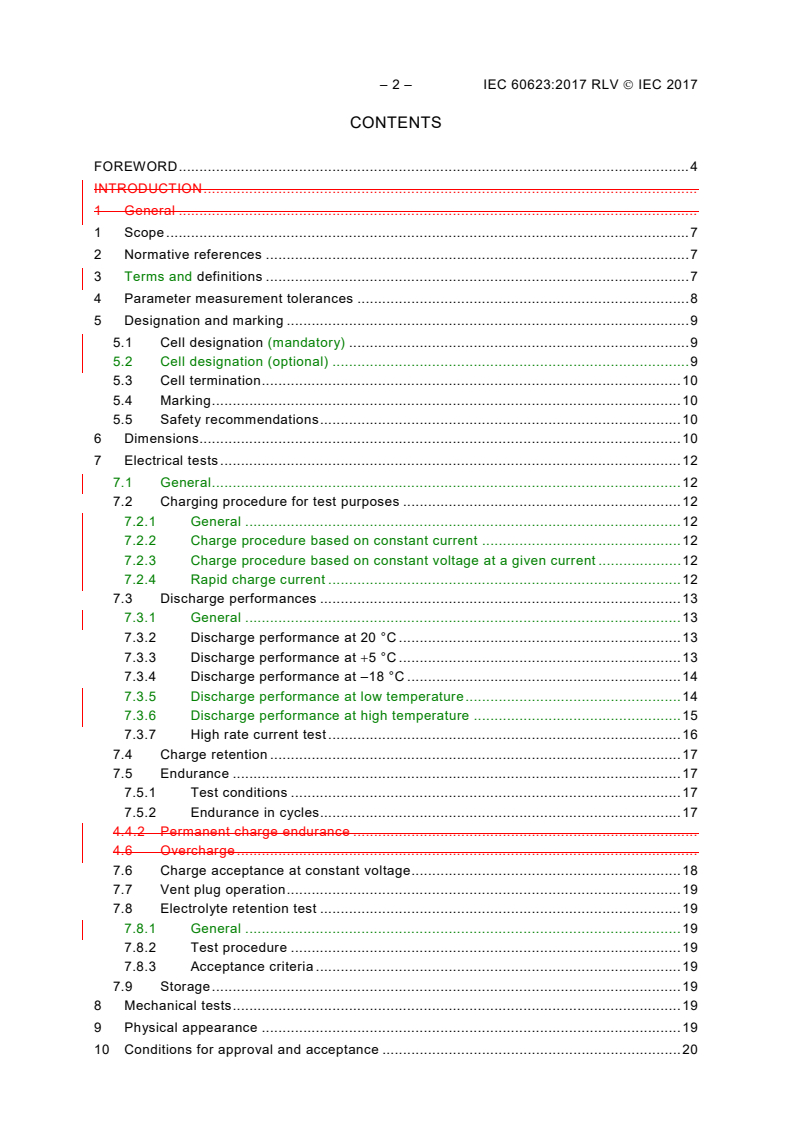
– 2 – IEC 60623:2017 RLV IEC 2017
CONTENTS
FOREWORD . 4
INTRODUCTION .
1 General .
1 Scope . 7
2 Normative references . 7
3 Terms and definitions . 7
4 Parameter measurement tolerances . 8
5 Designation and marking . 9
5.1 Cell designation (mandatory) . 9
5.2 Cell designation (optional) . 9
5.3 Cell termination . 10
5.4 Marking . 10
5.5 Safety recommendations . 10
6 Dimensions. 10
7 Electrical tests . 12
7.1 General . 12
7.2 Charging procedure for test purposes . 12
7.2.1 General . 12
7.2.2 Charge procedure based on constant current . 12
7.2.3 Charge procedure based on constant voltage at a given current . 12
7.2.4 Rapid charge current . 12
7.3 Discharge performances . 13
7.3.1 General . 13
7.3.2 Discharge performance at 20 °C . 13
7.3.3 Discharge performance at +5 °C . 13
7.3.4 Discharge performance at –18 °C . 14
7.3.5 Discharge performance at low temperature . 14
7.3.6 Discharge performance at high temperature . 15
7.3.7 High rate current test . 16
7.4 Charge retention . 17
7.5 Endurance . 17
7.5.1 Test conditions . 17
7.5.2 Endurance in cycles. 17
4.4.2 Permanent charge endurance .
4.6 Overcharge .
7.6 Charge acceptance at constant voltage . 18
7.7 Vent plug operation . 19
7.8 Electrolyte retention test . 19
7.8.1 General . 19
7.8.2 Test procedure . 19
7.8.3 Acceptance criteria . 19
7.9 Storage . 19
8 Mechanical tests . 19
9 Physical appearance . 19
10 Conditions for approval and acceptance . 20
10.1 Type approval . 20
10.2 Batch acceptance . 20
Annex A (normative) CCCV charge methodology . 22
Bibliography . 25
Figure 1 – Example of a vented prismatic cell in steel container with two terminals and
four lugs . 10
Figure A.1 – Overview of charging characteristic of Ni-Cd . 23
Table 1 – Dimensions for vented nickel-cadmium prismatic cells in steel containers . 11
Table 2 – Dimensions for vented nickel-cadmium prismatic cells in plastic containers . 11
Table 3 – Measurement tolerances in millimetres (valid for widths and lengths) . 11
Table 4 – Maximum values for rapid charge current R . 12
Table 5 – Discharge performance at 20 °C . 13
Table 6 – Discharge performance at +5 °C . 14
Table 7 – Discharge performance at –18 °C . 14
Table 8 – Discharge performance at low temperature . 15
Table 9 – Discharge performance at high temperature . 16
Table 10 – High currents values . 16
Table 11 – Endurance in cycles . 17
Table 12 – Constant voltage charging conditions . 18
Table 13 – Charge time. 18
Table 14 – Sequence of tests for type approval . 20
Table 15 – Recommended test sequence for batch acceptance . 21
Table A.1 – Ni-Cd batteries charging characteristics . 23
– 4 – IEC 60623:2017 RLV IEC 2017
INTERNATIONAL ELECTROTECHNICAL COMMISSION
____________
SECONDARY CELLS AND BATTERIES CONTAINING
ALKALINE OR OTHER NON-ACID ELECTROLYTES –
VENTED NICKEL-CADMIUM PRISMATIC RECHARGEABLE SINGLE CELLS
FOREWORD
1) The International Electrotechnical Commission (IEC) is a worldwide organization for standardization comprising
all national electrotechnical committees (IEC National Committees). The object of IEC is to promote
international co-operation on all questions concerning standardization in the electrical and electronic fields. To
this end and in addition to other activities, IEC publishes International Standards, Technical Specifications,
Technical Reports, Publicly Available Specifications (PAS) and Guides (hereafter referred to as “IEC
Publication(s)”). Their preparation is entrusted to technical committees; any IEC National Committee interested
in the subject dealt with may participate in this preparatory work. International, governmental and non-
governmental organizations liaising with the IEC also participate in this preparation. IEC collaborates closely
with the International Organization for Standardization (ISO) in accordance with conditions determined by
agreement between the two organizations.
2) The formal decisions or agreements of IEC on technical matters express, as nearly as possible, an international
consensus of opinion on the relevant subjects since each technical committee has representation from all
interested IEC National Committees.
3) IEC Publications have the form of recommendations for international use and are accepted by IEC National
Committees in that sense. While all reasonable efforts are made to ensure that the technical content of IEC
Publications is accurate, IEC cannot be held responsible for the way in which they are used or for any
misinterpretation by any end user.
4) In order to promote international uniformity, IEC National Committees undertake to apply IEC Publications
transparently to the maximum extent possible in their national and regional publications. Any divergence
between any IEC Publication and the corresponding national or regional publication shall be clearly indicated in
the latter.
5) IEC itself does not provide any attestation of conformity. Independent certification bodies provide conformity
assessment services and, in some areas, access to IEC marks of conformity. IEC is not responsible for any
services carried out by independent certification bodies.
6) All users should ensure that they have the latest edition of this publication.
7) No liability shall attach to IEC or its directors, employees, servants or agents including individual experts and
members of its technical committees and IEC National Committees for any personal injury, property damage or
other damage of any nature whatsoever, whether direct or indirect, or for costs (including legal fees) and
expenses arising out of the publication, use of, or reliance upon, this IEC Publication or any other IEC
Publications.
8) Attention is drawn to the Normative references cited in this publication. Use of the referenced publications is
indispensable for the correct application of this publication.
9) Attention is drawn to the possibility that some of the elements of this IEC Publication may be the subject of
patent rights. IEC shall not be held responsible for identifying any or all such patent rights.
This redline version of the official IEC Standard allows the user to identify the changes
made to the previous edition. A vertical bar appears in the margin wherever a change
has been made. Additions are in green text, deletions are in strikethrough red text.
International Standard IEC 60623 has been prepared by subcommittee 21A: Secondary cells
and batteries containing alkaline or other non-acid electrolytes, of IEC technical committee
21: Secondary cells and batteries.
This fifth edition cancels and replaces the fourth edition published in 2001 and constitutes a
technical revision.
This edition includes the following significant technical changes with respect to the previous
edition:
– optional characterization of cells designed for performances at very low and/or very high
temperature;
– optional characterization of cells tested with CCCV charge;
– optional characterization of cells designed for rapid charge;
– optional characterization of cells designed for high cycling.
The text of this standard is based on the following documents:
FDIS Report on voting
21A/610/FDIS 21A/621/RVD
Full information on the voting for the approval of this standard can be found in the report on
voting indicated in the above table.
This publication has been drafted in accordance with the ISO/IEC Directives, Part 2.
The committee has decided that the contents of this publication will remain unchanged until
the stability date indicated on the IEC website under "http://webstore.iec.ch" in the data
related to the specific publication. At this date, the publication will be
• reconfirmed,
• withdrawn,
• replaced by a revised edition, or
• amended.
IMPORTANT – The 'colour inside' logo on the cover page of this publication indicates
that it contains colours which are considered to be useful for the correct
understanding of its contents. Users should therefore print this document using a
colour printer.
– 6 – IEC 60623:2017 RLV IEC 2017
INTRODUCTION
Traditionally the manufacturers and users of alkaline secondary cells and batteries have
expressed the current used to charge and discharge these cells and batteries as a multiple of
the capacity. For example, a current of 20 A used to charge a cell with a rated capacity (C Ah)
of 100 Ah would be expressed as C/5 A or 0,2 C A. This method of current designation has
been used in earlier standards relating to alkaline secondary cells and batteries.
Comments have been made, however, that this method of current designation is
dimensionally incorrect, in that a multiple of the capacity (ampere-hours) will be in ampere-
hours and not, as required for current, in amperes. As a result of these comments, the method
described in IEC 61434 has been used in this standard.
In brief, the method states that the reference test current (I ) is expressed as:
t
C Ah
n
I A =
t
1 h
where
C is the rated capacity declared by the manufacturer in ampere-hours (Ah), and
n
n is the time base in hours (h) for which the rated capacity is declared.
SECONDARY CELLS AND BATTERIES CONTAINING
ALKALINE OR OTHER NON-ACID ELECTROLYTES –
VENTED NICKEL-CADMIUM PRISMATIC RECHARGEABLE SINGLE CELLS
1 General
1 Scope
IEC 60623 specifies marking, designation, dimensions, tests and requirements for vented
nickel-cadmium prismatic secondary single cells.
NOTE In this context, "prismatic" refers to cells having rectangular sides and base.
When there exists an IEC standard specifying test conditions and requirements for cells used
in special applications and which is in conflict with this document, the former shall takes
precedence.
2 Normative references
The following documents are referred to in the text in such a way that some or all of their
content constitutes requirements of this document. For dated references, only the edition
cited applies. For undated references, the latest edition of the referenced document (including
any amendments) applies.
IEC 60050-482:2004, International Electrotechnical Vocabulary – Part 482: Primary and
secondary cells and batteries
IEC 60050(486), International Electrotechnical Vocabulary – Chapter 486: Secondary cells
and batteries
IEC 60051 (all parts), Direct acting indicating analogue electrical measuring instruments and
their accessories
IEC 60410, Sampling plans and procedures for inspection by attributes
IEC 60417 (all parts), Graphical symbols for use on equipment (available from:
http://www.graphical-symbols.info/equipment)
IEC 60485, Digital electronic d.c. voltmeters and d.c. electronic analogue-to-digital converters
IEC 61438, Possible safety and health hazards in the use of alkaline secondary cells and
batteries – Guide to equipment manufacturers and users
3 Terms and definitions
For the purposes of this document, the terms and definitions contained in IEC 60050(486)
given in IEC 60050-482 and the following apply.
ISO and IEC maintain terminological databases for use in standardization at the following
addresses:
• IEC Electropedia: available at http://www.electropedia.org/
– 8 – IEC 60623:2017 RLV IEC 2017
• ISO Online browsing platform: available at http://www.iso.org/obp
3.1
vented cell
secondary cell having a cover provided with an opening through which gaseous products may
of electrolysis and evaporation are allowed to escape freely from the cell to the atmosphere
Note 1 to entry: The opening may be fitted with a venting system.
3.2
nominal voltage
suitable approximate value of the voltage used to designate or identify a cell or a battery
Note 1 to entry: The nominal voltage of a vented nickel-cadmium rechargeable single cell is 1,2 V.
Note 2 to entry: The nominal voltage of a battery of n series connected cells is equal to n times the nominal
voltage of a single cell.
[SOURCE: IEC 60050-482:2004, 482-03-31, modified – Replacement of the words "a battery
or an electrochemincal system" by" "or a battery" and addition of Notes 1 and 2 to entry.]
3.3
discharge voltage
closed circuit voltage
DEPRECATED: on load voltage
voltage between the terminals of a cell or battery when being discharged
[SOURCE: IEC 60050-482:2004, 482-03-28]
3.4
rated capacity
quantity of electricity C Ah (ampere-hours) declared by the manufacturer which a single cell
can deliver when discharged at the reference test current of 0,2 I A to a final voltage of 1,0 V
t
at +20 °C after charging, storing and discharging under the conditions specified in clause 4
capacity value of a cell or battery determined under specified conditions and declared by the
manufacturer
Note 1 to entry: The rated capacity is the quantity of electricity C Ah (ampere-hours) declared by the
manufacturer which a single cell can deliver during a 5 h period when charging, storing and discharging under the
conditions specified in 7.3.2.
[SOURCE: IEC 60050-482:2004, 482-03-15, modified – Addition of the words "a cell or" in the
definition, and of Note 1 to entry.]
3.5
CCCV charge
method of charge consisting in a charge at Constant Current followed by a charge at Constant
Voltage
4 Parameter measurement tolerances
The overall accuracy of controlled or measured values, relative to the specified or actual
values, shall be within these tolerances:
a) ±1 % for voltage;
b) ±1 % for current;
c) ±2 °C for temperature;
d) ±0,1 % for time;
e) ±1 % for capacity.
These tolerances comprise the combined accuracy of the measuring instruments, the
measurement techniques used, and all other sources of error in the test procedure.
For assistance in selecting instrumentation see IEC 60051 for analogue instruments and
IEC 60485 for digital instruments. The details of the instrumentation used shall be provided in
any report of results.
5 Designation and marking
5.1 Cell designation (mandatory)
Vented nickel-cadmium prismatic secondary single cells shall be designated by the letter "K"
followed by a letter L, M, H or X which signifies:
– low rate of discharge (L);
– medium rate of discharge (M);
– high rate of discharge (H);
– very high rate of discharge (X).
NOTE 1 These types of cells are typically but not exclusively used for the following discharge rates:
– L up to 0,5 I A;
t
– M up to 3,5 I A;
t
– H up to 7,0 I A;
t
– X up to and above 7,0 I A.
t
NOTE 2 These currents are expressed as multiples of I A, where I A = C Ah/1 h (see IEC 61434).
t t
This group of two letters shall be followed by a group of figures indicative of the rated
capacity of the cell in ampere-hours. Cells that have been tested at 20 °C and 5 °C but not
at –18 °C shall carry an additional marking of T5: for example: KH 185 or KH 185 T5.
Cells in cases of plastic material shall be designated by the letter "P" after the figures: for
example: KH 185 P.
5.2 Cell designation (optional)
The additional marking shall be added to the mandatory marking. When the marking would
exceed the available space on the cell, this information may be omitted on the cell but shall
be provided in the documentation corresponding to the cell and in the type test report.
If there is no mention concerning the marking for temperature, the cells shall have been
tested at: –18 °C, 5 °C and 20 °C. Cells tested at other temperatures shall carry an additional
marking of T followed by tested temperatures. In case the cell is characterized with both low
and high temperature, they shall be indicated in increasing order with a solidus separating
them: for example: KH 185 P T-35/+45.
Cells tested with CCCV charges shall carry the marking of CCCV: for example,
KH 185 P CCCV.
Cells tested at rapid charge shall carry the marking R and the value of the tested rapid charge
current, expressed in multiple of I A: for example, KH 185 P R1.
t
High grade cycling cells shall carry an additional marking C followed by the number of cycles:
for example, KH 185 P C1500.
– 10 – IEC 60623:2017 RLV IEC 2017
Cells having been tested with multiple types of tests shall carry the marking for the various
tests performed: for example KH 185 P T-35/+45 CCCV R1 C1500.
5.3 Cell termination
This document does not specify cell termination.
5.4 Marking
Each cell or monobloc shall carry durable markings giving the following minimum information:
• type of cell (designation as specified in 5.1 and 5.2; in addition, it is permissible for a
manufacturer to use his own type designation);
• name or identification of manufacturer or supplier;
• positive terminal: either a red washer or an indented or raised symbol (see graphical
symbol IEC 60417-5005:2002-10).
5.5 Safety recommendations
The manufacturer shall provide recommendations for the safe handling of the cell. See also
IEC TR 61438.
6 Dimensions
Dimensions of cells, shown in Figure 1, are given in Tables 1 and 2.
Lug
b d
IEC
NOTE 1 Cells in steel container may can have two or more terminals and four or more lugs.
NOTE 2 Cells in plastic container may can have two or more terminals and no lugs.
Figure 1 – Example of a vented prismatic cell in steel container
with two terminals and four lugs
h
Table 1 – Dimensions for vented nickel-cadmium
prismatic cells in steel containers
Width, b Maximum height, h Lengths, d
mm mm mm
81 291 83
105 350 91, 130
131 409 36, 50, 56, 66, 78, 94
148 409 52, 76, 100
157 409 66, 84, 95, 116, 134, 143, 147, 166, 200, 225, 242, 410
188 409 128
Table 2 – Dimensions for vented nickel-cadmium
prismatic cells in plastic containers
Width, b Maximum height, h Lengths, d
mm mm mm
62 178 28
78 285 50
81 241 28, 36, 43, 48
87 273 47, 86
123 273 28, 40, 50, 61
138 406 48, 55, 61, 70, 77, 85, 105, 115, 265
147 285 53, 78, 102
165 406 42, 66, 75, 105, 110, 130, 160
173 375 122, 197, 287, 392, 517
195 406 29, 34, 40, 50, 64, 80, 94, 115
NOTE 1 The dimensions given in Tables 1 and 2 represent preferred values. For cells with deviating size,
dimensions as per Figure 1 are indicated.
NOTE 2 The widths relate to the overall width dimension of the cell excluding the thickness of the lug flanges.
The values for widths and lengths given in Tables 1 and 2 are maximum values; their negative tolerances are given
in Table 3.
NOTE 3 The values for height given in Tables 1 and 2 relate to the maximum height over the terminals or the
closed cell vent, whichever is the greater. No lower limits are stated.
NOTE 4 The dimensions shown in Tables 1 and 2 are not associated to particular cell capacities. They apply to all
kinds of vented nickel-cadmium prismatic cells, i.e. L, M, H and X types.
Table 3 – Measurement tolerances in millimetres
(valid for widths and lengths)
Up to and including 60 mm 0 to –2
Above 60 mm, up to and including 120 mm 0 to –3
Above 120 mm 0 to –4
– 12 – IEC 60623:2017 RLV IEC 2017
7 Electrical tests
7.1 General
Charge and discharge currents for the tests in accordance with 7.1 to 7.9 inclusive shall be
based on the value of the rated capacity (C Ah). These currents are expressed as multiples
of I A, where I A = C Ah/1 h.
t t 5
7.2 Charging procedure for test purposes
7.2.1 General
Prior to charging, the cells shall have been discharged at 20 °C ± 5 °C, at a constant current
of 0,2 I A, down to a final voltage of 1,0 V.
t
Two charging methods are possible, to be selected by the cell manufacturers, in order to
define their cells characteristics:
– charge based on constant current;
– charge based on constant voltage, with a value of possible charging current (CCCV).
7.2.2 Charge procedure based on constant current
Unless otherwise specified in this standard, the charge preceding the various discharge tests
scheduled, shall be carried out in an ambient temperature of 20 °C ± 5 °C and at a constant
current of 0,2 I A. The duration of the charge shall be 7 h to 8 h.
t
7.2.3 Charge procedure based on constant voltage at a given current
This charge method is based on a constant current followed by constant voltage procedure
(CCCV). The choice for the charge methodology for performance determination shall be
defined before the start of the tests, and kept throughout all the testing procedures where
indicated.
For such charging methodology, two parameters are adjustable: current and voltage. They
shall be clearly identified by the cell manufacturer in the description of the cell characteristics,
as well as in the cell marking: for example KH 185 P CCCV R1.
The charging methodology CCCV is described in Annex A.
7.2.4 Rapid charge current
The charging current value for performance determination shall be selected before the start of
the tests, and kept throughout all the tests where indicated.
The design charge current value shall be indicated in the manufacturer’s documentation
attached to the cell (e.g. 0,5 I A or 1 I A) which will be referred to as R in this standard, as
t t
well as in the approval documentation. This current is a maximum value. Table 4 shows
preferred values for the rapid charge current:
Table 4 – Maximum values for rapid charge current R
Charge current for CCCV 0,5 I A 1,0 I A 2,0 I A 3,0 I A
t t t t
In case no rapid charge current is defined, it shall be taken at 0,2 I A. Otherwise, the rapid
t
charge current rate selected shall be clearly indicated in the report of test.
7.3 Discharge performances
7.3.1 General
The following discharge tests shall be carried out in the sequence given.
All cells shall be tested at 20 °C as well as at +5 °C and/or –18 °C.
7.3.2 Discharge performance at 20 °C
7.3.2.1 Test method
The cell shall have been charged in accordance with 7.2.2. After charging, the cell shall be
stored, in an ambient temperature of 20 °C ± 5 °C, for not less than 1 h and not more
than 4 h.
It shall then be discharged in the same ambient temperature and as specified in Table 5.
7.3.2.2 Acceptance criteria
The duration of discharge shall be not less than the minimum specified in Table 5.
The 0,2 I A discharge test is performed in order to verify the declared rated capacity of
t
the cell.
Table 5 – Discharge performance at 20 °C
Discharge conditions Minimum discharge duration
Rate of Final voltage Cell designation
constant
current
A V L M H X
a
0,2 I 1,0 5 h 5 h 5 h 5 h
t
1,0 I 1,0 – 40 min 50 min 55 min
t
b
5,0 I 0,8 – – 4 min 7 min
t
b
10,0 I 0,8 – – – 2 min
t
a
Five cycles are permitted for this test which shall, however, be terminated at the end of the first cycle which
meets the requirement.
b
Before the 5 I A and the 10 I A discharge tests, a conditioning cycle may be included if necessary. This cycle
t t
shall consist of charging and discharging at 0,2 I A in accordance with 7.2.1 and 7.2.2.
t
7.3.3 Discharge performance at +5 °C
7.3.3.1 Test method
The cell shall have been charged in accordance with 7.2.2. After charging, the cell shall be
stored, in an ambient temperature of +5 °C ± 2 °C, for 24 h. Means shall be provided to
ensure that the electrolyte temperature has reached +5 °C ± 2 °C within 24 h.
It shall then be discharged in the same ambient temperature and as specified in Table 6.
7.3.3.2 Acceptance criteria
The duration of discharge shall be not less than the minimum specified in Table 6.
– 14 – IEC 60623:2017 RLV IEC 2017
Table 6 – Discharge performance at +5 °C
Discharge conditions Minimum discharge duration
Rate of Final voltage Cell designation
constant
current
A V L M H X
0,2 I 1,0 4 h 15 min 4 h 25 min 4 h 35 min 4 h 45 min
t
1,0 I 1,0 – 31 min 43 min 52 min
t
a
2,0 I
1,0 – – 12 min 22 min
t
a
5,0 I 0,8 – – – 5 min 30 s
t
a
Before the 2 I A and 5 I A tests, a conditioning cycle may be included if necessary. This cycle shall consist of
t t
charging and discharging at 0,2 I A, in an ambient temperature of 20 °C ± 5 °C, according to 7.2.1and 7.2.2.
t
7.3.4 Discharge performance at –18 °C
7.3.4.1 Test method
The cell shall have been charged in accordance with 7.2.2. After charging, the cell shall be
stored in an ambient temperature of –18 °C ± 2 °C, for 24 h. Means shall be provided to
ensure that the electrolyte temperature has reached –18 °C ± 2 °C within 24 h.
It shall then be discharged in the same ambient temperature and as specified in Table 7.
7.3.4.2 Acceptance criteria
The duration of discharge shall be not less than the minimum specified in Table 7.
Table 7 – Discharge performance at –18 °C
Discharge conditions Minimum discharge duration
Rate of Final voltage Cell designation
constant
current
A V L M H X
0,2 I 1,0 2 h 30 min 3 h 3 h 30 min 4 h
t
1,0 I
0,9 – 15 min 25 min 35 min
t
a
2,0 I 0,9 – – 7 min 30 s 12 min
t
a
5,0 I 0,8 – – – 3 min 30 s
t
a
Before the 2 I A and 5 I A discharge tests, a conditioning cycle may be included if necessary. This cycle
t
t
shall consist of charging and discharging at 0,2 I A, in an ambient temperature of 20 °C ± 5 °C, according to
t
7.2.1 and 7.2.2.
7.3.5 Discharge performance at low temperature
7.3.5.1 General
This test is optional. This test is performed in order to identify the rated low temperature T
L
and the level of performance of the cell at this temperature.
7.3.5.2 Test method
The temperature should be expressed at 5 °C intervals, such as –25 °C, –30 °C, –35 °C,
–40 °C, referred to as T in the following. The test shall be done at the targeted low
L
temperature T (no need for intermediate temperatures) to verify the discharge performance
L
as specified in Table 8.
Table 8 – Discharge performance at low temperature
Discharge conditions Minimum discharge duration
Rate of Final voltage Cell designation
constant
current
A V L M H X
0,2 I 1 2 h 30 min 3 h 3 h 3 h
t
1,0 I 0,9 – 15 min 20 min 30 min
t
2,0 I 0,9 – – 5 min 10 min
t
a
Before the 1 I A and 2 I A discharge tests, a conditioning cycle may be included if necessary. This cycle
t t
shall consist of charging and discharging at 0,2 I A, in an ambient temperature of 20 °C ± 5 °C, according to
t
7.2.1 and 7.2.2.
Capacity shall be measured in accordance with the following steps.
Step 1 The cell shall be fully charged using the method in accordance with 7.2.2, 7.2.3 or
7.2.4 at 20 °C (whatever constant current or constant current followed by constant
voltage).
Step 2 The cell shall be stored at an ambient temperature T for not less than 16 h and
L
not more than 24 h
Step 3 The cell shall then be discharged at T and as specified in Table 8 to the
L
corresponding final voltage.
7.3.5.3 Acceptance criteria
The capacity (Ah), delivered during step 3 shall be not less than specified for this
characteristic at any discharge current. Then the cell low temperature discharge performance
shall be declared as the T grade.
L
7.3.6 Discharge performance at high temperature
7.3.6.1 General
This test is optional. This test applies to cell designed for permanent operation at a
temperature higher than +30 °C. This test is performed in order to identify the rated high
temperature T , and the level of performance of the cell at this temperature.
H
7.3.6.2 Test method
The temperature should be expressed at 5 °C intervals, such as +30 °C, +35 °C, +40 °C,
referred to as T in the following. The test shall be done at the targeted high temperature T
H H
(no need for intermediate temperatures) to verify the discharge performance as specified in
Table 9.
– 16 – IEC 60623:2017 RLV IEC 2017
Table 9 – Discharge performance at high temperature
Discharge conditions Minimum discharge duration
Rate of Final voltage Cell designation
constant
current
A V L M H X
a
0,2 I 1,0 5 h 5 h 5 h 5 h
t
1,0 I 1,0 – 40 min 50 min 55 min
t
b
5,0 I 0,8 – – 4 min 7 min
t
b
10,0 I
0,8 – – – 2 min
t
a
Five cycles are permitted for this test (a conditioning cycle may be included between if necessary) which
shall, however, be terminated at the end of the first cycle which meets the requirement.
b
Before the 1 I A , 5 I A and the 10 I A discharge tests, a conditioning cycle may be included if necessary.
t
t t
This cycle shall consist of charging and discharging at 0,2 I A in accordance with 7.2.1 and 7.2.2.
t
Capacity shall be measured in accordance with the following steps.
Step 1 The cell shall be fully charged using the method in accordance with 7.2.2, 7.2.3 or
7.2.4 at T (whatever CC or CCCV, in accordance with the cell designation).
H
Step 2 The cell shall be kept for not more than 4 h at an ambient temperature T . It is
H
allowed to have the charger still connected in its normal function mode.
Step 3 The cell shall then be discharged at T and as specified in Table 9 to the
H
corresponding final voltage.
7.3.6.3 Acceptance criteria
The capacity (Ah), delivered during step 3 shall be not less than specified for this
characteristic at any discharge current. Then the cell high temperature discharge performance
shall be declared as T grade.
H
7.3.7 High rate current test
7.3.7.1 General
This test is to evaluate the ability of a cell to withstand high currents.
7.3.7.2 Test method
The cell shall have been charged in accordance with 7.2.2. After charging, the cell shall be
stored, in an ambient temperature of 20 °C ± 5 °C, for not less than 1 h and not more
than 4 h. It shall then be discharged for 5 s in the same ambient temperature and at the
currents given in Table 10. During the discharge, the terminal voltage shall be recorded.
Table 10 – High currents values
Cell type Rate of constant current
L 6 I A
t
M 10 I A
t
15 I A
H
t
X 20 I A
t
7.3.7.3 Acceptance criteria
No fusing, no deformation of cell case, no deformation of internal cell components shall be
observed. In addition, the cell voltage during the discharge should show no discontinuity.
7.4 Charge retention
The charge retention shall be verified by the following test.
After charging in accordance with 7.2.2, the cell shall be stored on open circuit for 28 days.
The average ambient temperature shall be 20 °C ± 2 °C. The temperature may be allowed to
vary within the range of 20 °C ± 5 °C for short periods during the storage.
The cell shall then be discharged under the conditions specified in 7.3.2 at a rate of 0,2 I A.
t
The duration of the discharge shall be not less than 4 h.
7.5 Endurance
7.5.1 Test conditions
The endurance test shall be carried out in an ambient temperature of 20 °C ± 5 °C.
Precautions shall be taken to prevent the electrolyte temperature from rising above +40 °C
during the test, for example by providing a forced air draught if necessary. The electrolyte
may be topped up during the test with deionized or distilled water to the level recommended
by the manufacturer. The electrolyte may be changed if at any time its characteristics no
longer comply with the manufacturer's recommendation.
The cell shall be prepared in accordance with 7.2.2.
7.5.2 Endurance in cycles
7.5.2.1 Cycles 1 to 50
The cycling shall be carried out under the conditions specified in Table 11. Charge and
discharge shall be carried out at constant current throughout. Cycling shall be continuous,
except that it is permissible to allow the cell to stand for a short period at the end of discharge
th th
of each 49 and 50 cycle in order to start the next 50-cycle sequence at a convenient time.
Table 11 – Endurance in cycles
Cycle number Charge Discharge
0,25 I A for 6 h for CC charge
t
1 0,25 I A for 2 h 30 min
a
t
Charge for R I A for 1/R h + 0,25 I A for 2 h
t t
0,25 I A for 3 h 30 min
t
2 to 48 0,25 I A for 2 h 30 min
a
t
Charge for R I A for 0,6/R h + 0,25 I A for 1 h
t t
0,25 I A for 3 h 30 min
t
49 0,2 I A to 1,0 V
a
t
Charge for R I A for 0,6/R h + 0,25 I A for 1 h
t t
50 0,2 I A for 7 h to 8 h 0,2 I A to 1,0 V
t t
a
For rapid charge cells, value for R is defined in 7.2.4.
7.5.2.2 Acceptance criterion
th
Cycles 1 to 50 shall be repeated until the discharge duration on any 50 cycle becomes less
than 3 h 30 min. At this stage, a further cycle shall be carried out in accordance with 7.3.2 at
a rate of 0,2 I A.
t
– 18 – IEC 60623:2017 RLV IEC 2017
The endurance test is considered complete when two such successive cycles give discharge
duration less than 3 h 30 min.
The number of cycles obtained when the test is completed shall be not less than 500.
Some cells can be specifically designed in order to provide a higher number of cycles than
500.
As an option, such cell can be marked by "C" as "High grade cycling endurance cells"
according to 5.2. The marking shall be less than the number of cycles obtained in this test.
The number of cycles shall be truncated to the lowest multiple of 100 (e.g. 800, 1 500). It shall
be indicated in the report of tests.
4.4.2 Permanent charge endurance
This standard does not specify a permanent charge endurance test.
7.6 Charge acceptance at constant voltage
The cell shall have been discharged in accordance with 7.2.1.
The cell shall then be charged at a constant voltage as specified in Table 12 for cells having
performances compliant with CC charge methodology (with a maximum charge duration of
24 h), or as specified in 7.2.3 for CCCV marked cells.
Table 12 – Constant voltage charging conditions
Cell type Charge voltage
V
KX 1,425 ± 0,005
KM and KH
1,455 ± 0,005
KL
1,495 ± 0,005
The charging current shall be limited to 0,2 R I A and the ambient temperature shall
t
be 20 °C ± 5 °C. The duration of the charge shall be 24 h as described in Table 13.
Table 13 – Charge time
Charge current Maximum charge time
R I A associated
t
0,05 I A 30 h
t
0,1 I A 24 h
t
0,2 I A 24 h
t
0,5 I A 12 h
t
1,0 I A
6 h
t
2,0 I A 6 h
t
3,0 I A 6 h
t
After charging, the cell shall be stored, in an ambient temperature of 20 °C ± 5 °C, for not less
than 1 h and not more than 4 h. It shall then be discharged under the conditions specified in
A.
7.3.2 at a rate of 0,2 I
t
The duration of discharge shall be not less than 4 h.
4.6 Overcharge
This standard does not specify an overcharge test.
7.7 Vent plug operation
This docum
...
IEC 60623 ®
Edition 5.0 2017-01
INTERNATIONAL
STANDARD
NORME
INTERNATIONALE
Secondary cells and batteries containing alkaline or other non-acid
electrolytes – Vented nickel-cadmium prismatic rechargeable single cells
Accumulateurs alcalins ou autres accumulateurs à électrolyte non acide –
Éléments individuels parallélépipédiques rechargeables ouverts au nickel-
cadmium
All rights reserved. Unless otherwise specified, no part of this publication may be reproduced or utilized in any form
or by any means, electronic or mechanical, including photocopying and microfilm, without permission in writing from
either IEC or IEC's member National Committee in the country of the requester. If you have any questions about IEC
copyright or have an enquiry about obtaining additional rights to this publication, please contact the address below or
your local IEC member National Committee for further information.
Droits de reproduction réservés. Sauf indication contraire, aucune partie de cette publication ne peut être reproduite
ni utilisée sous quelque forme que ce soit et par aucun procédé, électronique ou mécanique, y compris la photocopie
et les microfilms, sans l'accord écrit de l'IEC ou du Comité national de l'IEC du pays du demandeur. Si vous avez des
questions sur le copyright de l'IEC ou si vous désirez obtenir des droits supplémentaires sur cette publication, utilisez
les coordonnées ci-après ou contactez le Comité national de l'IEC de votre pays de résidence.
IEC Central Office Tel.: +41 22 919 02 11
3, rue de Varembé Fax: +41 22 919 03 00
CH-1211 Geneva 20 info@iec.ch
Switzerland www.iec.ch
About the IEC
The International Electrotechnical Commission (IEC) is the leading global organization that prepares and publishes
International Standards for all electrical, electronic and related technologies.
About IEC publications
The technical content of IEC publications is kept under constant review by the IEC. Please make sure that you have the
latest edition, a corrigenda or an amendment might have been published.
IEC Catalogue - webstore.iec.ch/catalogue Electropedia - www.electropedia.org
The stand-alone application for consulting the entire The world's leading online dictionary of electronic and
bibliographical information on IEC International Standards, electrical terms containing 20 000 terms and definitions in
Technical Specifications, Technical Reports and other English and French, with equivalent terms in 16 additional
documents. Available for PC, Mac OS, Android Tablets and languages. Also known as the International Electrotechnical
iPad. Vocabulary (IEV) online.
IEC publications search - www.iec.ch/searchpub IEC Glossary - std.iec.ch/glossary
The advanced search enables to find IEC publications by a 65 000 electrotechnical terminology entries in English and
variety of criteria (reference number, text, technical French extracted from the Terms and Definitions clause of
committee,…). It also gives information on projects, replaced IEC publications issued since 2002. Some entries have been
and withdrawn publications. collected from earlier publications of IEC TC 37, 77, 86 and
CISPR.
IEC Just Published - webstore.iec.ch/justpublished
Stay up to date on all new IEC publications. Just Published IEC Customer Service Centre - webstore.iec.ch/csc
details all new publications released. Available online and If you wish to give us your feedback on this publication or
also once a month by email. need further assistance, please contact the Customer Service
Centre: csc@iec.ch.
A propos de l'IEC
La Commission Electrotechnique Internationale (IEC) est la première organisation mondiale qui élabore et publie des
Normes internationales pour tout ce qui a trait à l'électricité, à l'électronique et aux technologies apparentées.
A propos des publications IEC
Le contenu technique des publications IEC est constamment revu. Veuillez vous assurer que vous possédez l’édition la
plus récente, un corrigendum ou amendement peut avoir été publié.
Catalogue IEC - webstore.iec.ch/catalogue Electropedia - www.electropedia.org
Application autonome pour consulter tous les renseignements
Le premier dictionnaire en ligne de termes électroniques et
bibliographiques sur les Normes internationales,
électriques. Il contient 20 000 termes et définitions en anglais
Spécifications techniques, Rapports techniques et autres
et en français, ainsi que les termes équivalents dans 16
documents de l'IEC. Disponible pour PC, Mac OS, tablettes
langues additionnelles. Egalement appelé Vocabulaire
Android et iPad.
Electrotechnique International (IEV) en ligne.
Recherche de publications IEC - www.iec.ch/searchpub
Glossaire IEC - std.iec.ch/glossary
65 000 entrées terminologiques électrotechniques, en anglais
La recherche avancée permet de trouver des publications IEC
en utilisant différents critères (numéro de référence, texte, et en français, extraites des articles Termes et Définitions des
comité d’études,…). Elle donne aussi des informations sur les publications IEC parues depuis 2002. Plus certaines entrées
projets et les publications remplacées ou retirées. antérieures extraites des publications des CE 37, 77, 86 et
CISPR de l'IEC.
IEC Just Published - webstore.iec.ch/justpublished
Service Clients - webstore.iec.ch/csc
Restez informé sur les nouvelles publications IEC. Just
Published détaille les nouvelles publications parues. Si vous désirez nous donner des commentaires sur cette
Disponible en ligne et aussi une fois par mois par email. publication ou si vous avez des questions contactez-nous:
csc@iec.ch.
IEC 60623 ®
Edition 5.0 2017-01
INTERNATIONAL
STANDARD
NORME
INTERNATIONALE
Secondary cells and batteries containing alkaline or other non-acid
electrolytes – Vented nickel-cadmium prismatic rechargeable single cells
Accumulateurs alcalins ou autres accumulateurs à électrolyte non acide –
Éléments individuels parallélépipédiques rechargeables ouverts au nickel-
cadmium
INTERNATIONAL
ELECTROTECHNICAL
COMMISSION
COMMISSION
ELECTROTECHNIQUE
INTERNATIONALE
ICS 29.220.99 ISBN 978-2-8322-3788-5
– 2 – IEC 60623:2017 IEC 2017
CONTENTS
FOREWORD . 4
1 Scope . 6
2 Normative references . 6
3 Terms and definitions . 6
4 Parameter measurement tolerances . 7
5 Designation and marking . 7
5.1 Cell designation (mandatory) . 7
5.2 Cell designation (optional) . 8
5.3 Cell termination . 8
5.4 Marking . 8
5.5 Safety recommendations . 8
6 Dimensions. 9
7 Electrical tests . 10
7.1 General . 10
7.2 Charging procedure for test purposes . 10
7.2.1 General . 10
7.2.2 Charge procedure based on constant current . 11
7.2.3 Charge procedure based on constant voltage at a given current . 11
7.2.4 Rapid charge current . 11
7.3 Discharge performances . 11
7.3.1 General . 11
7.3.2 Discharge performance at 20 °C . 11
7.3.3 Discharge performance at +5 °C . 12
7.3.4 Discharge performance at –18 °C . 13
7.3.5 Discharge performance at low temperature . 13
7.3.6 Discharge performance at high temperature . 14
7.3.7 High rate current test . 15
7.4 Charge retention . 16
7.5 Endurance . 16
7.5.1 Test conditions . 16
7.5.2 Endurance in cycles. 16
7.6 Charge acceptance at constant voltage . 17
7.7 Vent plug operation . 18
7.8 Electrolyte retention test . 18
7.8.1 General . 18
7.8.2 Test procedure . 18
7.8.3 Acceptance criteria . 18
7.9 Storage . 18
8 Mechanical tests . 18
9 Physical appearance . 18
10 Conditions for approval and acceptance . 19
10.1 Type approval . 19
10.2 Batch acceptance . 19
Annex A (normative) CCCV charge methodology . 21
Bibliography . 24
Figure 1 – Example of a vented prismatic cell in steel container with two terminals
and four lugs . 9
Figure A.1 – Overview of charging characteristic of Ni-Cd . 22
Table 1 – Dimensions for vented nickel-cadmium prismatic cells in steel containers . 9
Table 2 – Dimensions for vented nickel-cadmium prismatic cells in plastic containers . 10
Table 3 – Measurement tolerances in millimetres (valid for widths and lengths) . 10
Table 4 – Maximum values for rapid charge current R . 11
Table 5 – Discharge performance at 20 °C . 12
Table 6 – Discharge performance at +5 °C . 12
Table 7 – Discharge performance at –18 °C . 13
Table 8 – Discharge performance at low temperature . 14
Table 9 – Discharge performance at high temperature . 15
Table 10 – High currents values . 15
Table 11 – Endurance in cycles . 16
Table 12 – Constant voltage charging conditions . 17
Table 13 – Charge time. 17
Table 14 – Sequence of tests for type approval . 19
Table 15 – Recommended test sequence for batch acceptance . 20
Table A.1 – Ni-Cd batteries charging characteristics . 22
– 4 – IEC 60623:2017 IEC 2017
INTERNATIONAL ELECTROTECHNICAL COMMISSION
____________
SECONDARY CELLS AND BATTERIES CONTAINING
ALKALINE OR OTHER NON-ACID ELECTROLYTES –
VENTED NICKEL-CADMIUM PRISMATIC RECHARGEABLE SINGLE CELLS
FOREWORD
1) The International Electrotechnical Commission (IEC) is a worldwide organization for standardization comprising
all national electrotechnical committees (IEC National Committees). The object of IEC is to promote
international co-operation on all questions concerning standardization in the electrical and electronic fields. To
this end and in addition to other activities, IEC publishes International Standards, Technical Specifications,
Technical Reports, Publicly Available Specifications (PAS) and Guides (hereafter referred to as “IEC
Publication(s)”). Their preparation is entrusted to technical committees; any IEC National Committee interested
in the subject dealt with may participate in this preparatory work. International, governmental and non-
governmental organizations liaising with the IEC also participate in this preparation. IEC collaborates closely
with the International Organization for Standardization (ISO) in accordance with conditions determined by
agreement between the two organizations.
2) The formal decisions or agreements of IEC on technical matters express, as nearly as possible, an international
consensus of opinion on the relevant subjects since each technical committee has representation from all
interested IEC National Committees.
3) IEC Publications have the form of recommendations for international use and are accepted by IEC National
Committees in that sense. While all reasonable efforts are made to ensure that the technical content of IEC
Publications is accurate, IEC cannot be held responsible for the way in which they are used or for any
misinterpretation by any end user.
4) In order to promote international uniformity, IEC National Committees undertake to apply IEC Publications
transparently to the maximum extent possible in their national and regional publications. Any divergence
between any IEC Publication and the corresponding national or regional publication shall be clearly indicated in
the latter.
5) IEC itself does not provide any attestation of conformity. Independent certification bodies provide conformity
assessment services and, in some areas, access to IEC marks of conformity. IEC is not responsible for any
services carried out by independent certification bodies.
6) All users should ensure that they have the latest edition of this publication.
7) No liability shall attach to IEC or its directors, employees, servants or agents including individual experts and
members of its technical committees and IEC National Committees for any personal injury, property damage or
other damage of any nature whatsoever, whether direct or indirect, or for costs (including legal fees) and
expenses arising out of the publication, use of, or reliance upon, this IEC Publication or any other IEC
Publications.
8) Attention is drawn to the Normative references cited in this publication. Use of the referenced publications is
indispensable for the correct application of this publication.
9) Attention is drawn to the possibility that some of the elements of this IEC Publication may be the subject of
patent rights. IEC shall not be held responsible for identifying any or all such patent rights.
International Standard IEC 60623 has been prepared by subcommittee 21A: Secondary cells
and batteries containing alkaline or other non-acid electrolytes, of IEC technical committee
21: Secondary cells and batteries.
This fifth edition cancels and replaces the fourth edition published in 2001 and constitutes a
technical revision.
This edition includes the following significant technical changes with respect to the previous
edition:
– optional characterization of cells designed for performances at very low and/or very high
temperature;
– optional characterization of cells tested with CCCV charge;
– optional characterization of cells designed for rapid charge;
– optional characterization of cells designed for high cycling.
The text of this standard is based on the following documents:
FDIS Report on voting
21A/610/FDIS 21A/621/RVD
Full information on the voting for the approval of this standard can be found in the report on
voting indicated in the above table.
This publication has been drafted in accordance with the ISO/IEC Directives, Part 2.
The committee has decided that the contents of this publication will remain unchanged until
the stability date indicated on the IEC website under "http://webstore.iec.ch" in the data
related to the specific publication. At this date, the publication will be
• reconfirmed,
• withdrawn,
• replaced by a revised edition, or
• amended.
– 6 – IEC 60623:2017 IEC 2017
SECONDARY CELLS AND BATTERIES CONTAINING
ALKALINE OR OTHER NON-ACID ELECTROLYTES –
VENTED NICKEL-CADMIUM PRISMATIC RECHARGEABLE SINGLE CELLS
1 Scope
IEC 60623 specifies marking, designation, dimensions, tests and requirements for vented
nickel-cadmium prismatic secondary single cells.
NOTE In this context, "prismatic" refers to cells having rectangular sides and base.
When there exists an IEC standard specifying test conditions and requirements for cells used
in special applications and which is in conflict with this document, the former takes
precedence.
2 Normative references
The following documents are referred to in the text in such a way that some or all of their
content constitutes requirements of this document. For dated references, only the edition
cited applies. For undated references, the latest edition of the referenced document (including
any amendments) applies.
IEC 60050-482:2004, International Electrotechnical Vocabulary – Part 482: Primary and
secondary cells and batteries
IEC 60417, Graphical symbols for use on equipment (available from: http://www.graphical-
symbols.info/equipment)
3 Terms and definitions
For the purposes of this document, the terms and definitions given in IEC 60050-482 and the
following apply.
ISO and IEC maintain terminological databases for use in standardization at the following
addresses:
• IEC Electropedia: available at http://www.electropedia.org/
• ISO Online browsing platform: available at http://www.iso.org/obp
3.1
vented cell
secondary cell having a cover provided with an opening through which products of electrolysis
and evaporation are allowed to escape freely from the cell to the atmosphere
Note 1 to entry: The opening may be fitted with a venting system.
3.2
nominal voltage
suitable approximate value of the voltage used to designate or identify a cell or a battery
Note 1 to entry: The nominal voltage of a vented nickel-cadmium rechargeable single cell is 1,2 V.
Note 2 to entry: The nominal voltage of a battery of n series connected cells is equal to n times the nominal
voltage of a single cell.
[SOURCE: IEC 60050-482:2004, 482-03-31, modified – Replacement of the words "a battery
or an electrochemincal system" by" "or a battery" and addition of Notes 1 and 2 to entry.]
3.3
discharge voltage
closed circuit voltage
DEPRECATED: on load voltage
voltage between the terminals of a cell or battery when being discharged
[SOURCE: IEC 60050-482:2004, 482-03-28]
3.4
rated capacity
capacity value of a cell or battery determined under specified conditions and declared by the
manufacturer
Note 1 to entry: The rated capacity is the quantity of electricity C Ah (ampere-hours) declared by the
manufacturer which a single cell can deliver during a 5 h period when charging, storing and discharging under the
conditions specified in 7.3.2.
[SOURCE: IEC 60050-482:2004, 482-03-15, modified – Addition of the words "a cell or" in the
definition, and of Note 1 to entry.]
3.5
CCCV charge
method of charge consisting in a charge at Constant Current followed by a charge at Constant
Voltage
4 Parameter measurement tolerances
The overall accuracy of controlled or measured values, relative to the specified or actual
values, shall be within these tolerances:
a) ±1 % for voltage;
b) ±1 % for current;
c) ±2 °C for temperature;
d) ±0,1 % for time;
e) ±1 % for capacity.
These tolerances comprise the combined accuracy of the measuring instruments, the
measurement techniques used, and all other sources of error in the test procedure.
The details of the instrumentation used shall be provided in any report of results.
5 Designation and marking
5.1 Cell designation (mandatory)
Vented nickel-cadmium prismatic secondary single cells shall be designated by the letter "K"
followed by a letter L, M, H or X which signifies:
– low rate of discharge (L);
– medium rate of discharge (M);
– high rate of discharge (H);
– very high rate of discharge (X).
– 8 – IEC 60623:2017 IEC 2017
NOTE 1 These types of cells are typically but not exclusively used for the following discharge rates:
– L up to 0,5 I A;
t
– M up to 3,5 I A;
t
– H up to 7,0 I A;
t
– X up to and above 7,0 I A.
t
NOTE 2 These currents are expressed as multiples of I A, where I A = C Ah/1 h (see IEC 61434).
t t
This group of two letters shall be followed by a group of figures indicative of the rated
capacity of the cell in ampere-hours. Cells that have been tested at 20 °C and 5 °C but not
at –18 °C shall carry an additional marking of T5: for example: KH 185 or KH 185 T5.
Cells in cases of plastic material shall be designated by the letter "P" after the figures: for
example: KH 185 P.
5.2 Cell designation (optional)
The additional marking shall be added to the mandatory marking. When the marking would
exceed the available space on the cell, this information may be omitted on the cell but shall
be provided in the documentation corresponding to the cell and in the type test report.
If there is no mention concerning the marking for temperature, the cells shall have been
tested at: –18 °C, 5 °C and 20 °C. Cells tested at other temperatures shall carry an additional
marking of T followed by tested temperatures. In case the cell is characterized with both low
and high temperature, they shall be indicated in increasing order with a solidus separating
them: for example: KH 185 P T-35/+45.
Cells tested with CCCV charges shall carry the marking of CCCV: for example,
KH 185 P CCCV.
Cells tested at rapid charge shall carry the marking R and the value of the tested rapid charge
A: for example, KH 185 P R1.
current, expressed in multiple of I
t
High grade cycling cells shall carry an additional marking C followed by the number of cycles:
for example, KH 185 P C1500.
Cells having been tested with multiple types of tests shall carry the marking for the various
tests performed: for example KH 185 P T-35/+45 CCCV R1 C1500.
5.3 Cell termination
This document does not specify cell termination.
5.4 Marking
Each cell or monobloc shall carry durable markings giving the following minimum information:
• type of cell (designation as specified in 5.1 and 5.2; in addition, it is permissible for a
manufacturer to use his own type designation);
• name or identification of manufacturer or supplier;
• positive terminal: either a red washer or an indented or raised symbol (see graphical
symbol IEC 60417-5005:2002-10).
5.5 Safety recommendations
The manufacturer shall provide recommendations for the safe handling of the cell. See also
IEC TR 61438.
6 Dimensions
Dimensions of cells, shown in Figure 1, are given in Tables 1 and 2.
Lug
b d
IEC
NOTE 1 Cells in steel container can have two or more terminals and four or more lugs.
NOTE 2 Cells in plastic container can have two or more terminals and no lugs.
Figure 1 – Example of a vented prismatic cell in steel container
with two terminals and four lugs
Table 1 – Dimensions for vented nickel-cadmium
prismatic cells in steel containers
Width, b Maximum height, h Lengths, d
mm mm mm
81 291 83
105 350 91, 130
131 409 36, 50, 56, 66, 78, 94
148 409 52, 76, 100
157 409 66, 84, 95, 116, 134, 143, 147, 166, 200, 225, 242, 410
188 409 128
h
– 10 – IEC 60623:2017 IEC 2017
Table 2 – Dimensions for vented nickel-cadmium
prismatic cells in plastic containers
Width, b Maximum height, h Lengths, d
mm mm mm
62 178 28
78 285 50
81 241 28, 36, 43, 48
87 273 47, 86
123 273 28, 40, 50, 61
138 406 48, 55, 61, 70, 77, 85, 105, 115, 265
147 285 53, 78, 102
165 406 42, 66, 75, 105, 110, 130, 160
173 375 122, 197, 287, 392, 517
195 406 29, 34, 40, 50, 64, 80, 94, 115
NOTE 1 The dimensions given in Tables 1 and 2 represent preferred values. For cells with deviating size,
dimensions as per Figure 1 are indicated.
NOTE 2 The widths relate to the overall width dimension of the cell excluding the thickness of the lug flanges.
The values for widths and lengths given in Tables 1 and 2 are maximum values; their negative tolerances are given
in Table 3.
NOTE 3 The values for height given in Tables 1 and 2 relate to the maximum height over the terminals or the
closed cell vent, whichever is the greater. No lower limits are stated.
NOTE 4 The dimensions shown in Tables 1 and 2 are not associated to particular cell capacities. They apply to all
kinds of vented nickel-cadmium prismatic cells, i.e. L, M, H and X types.
Table 3 – Measurement tolerances in millimetres
(valid for widths and lengths)
Up to and including 60 mm 0 to –2
Above 60 mm, up to and including 120 mm 0 to –3
Above 120 mm 0 to –4
7 Electrical tests
7.1 General
Charge and discharge currents for the tests in accordance with 7.1 to 7.9 inclusive shall be
based on the value of the rated capacity (C Ah). These currents are expressed as multiples
of I A, where I A = C Ah/1 h.
t t 5
7.2 Charging procedure for test purposes
7.2.1 General
Prior to charging, the cells shall have been discharged at 20 °C ± 5 °C, at a constant current
of 0,2 I A, down to a final voltage of 1,0 V.
t
Two charging methods are possible, to be selected by the cell manufacturers, in order to
define their cells characteristics:
– charge based on constant current;
– charge based on constant voltage, with a value of possible charging current (CCCV).
7.2.2 Charge procedure based on constant current
Unless otherwise specified in this standard, the charge preceding the various discharge tests
scheduled, shall be carried out in an ambient temperature of 20 °C ± 5 °C and at a constant
A. The duration of the charge shall be 7 h to 8 h.
current of 0,2 I
t
7.2.3 Charge procedure based on constant voltage at a given current
This charge method is based on a constant current followed by constant voltage procedure
(CCCV). The choice for the charge methodology for performance determination shall be
defined before the start of the tests, and kept throughout all the testing procedures where
indicated.
For such charging methodology, two parameters are adjustable: current and voltage. They
shall be clearly identified by the cell manufacturer in the description of the cell characteristics,
as well as in the cell marking: for example KH 185 P CCCV R1.
The charging methodology CCCV is described in Annex A.
7.2.4 Rapid charge current
The charging current value for performance determination shall be selected before the start of
the tests, and kept throughout all the tests where indicated.
The design charge current value shall be indicated in the manufacturer’s documentation
attached to the cell (e.g. 0,5 I A or 1 I A) which will be referred to as R in this standard, as
t t
well as in the approval documentation. This current is a maximum value. Table 4 shows
preferred values for the rapid charge current:
Table 4 – Maximum values for rapid charge current R
Charge current for CCCV 0,5 I A 1,0 I A 2,0 I A 3,0 I A
t t t t
In case no rapid charge current is defined, it shall be taken at 0,2 I A. Otherwise, the rapid
t
charge current rate selected shall be clearly indicated in the report of test.
7.3 Discharge performances
7.3.1 General
The following discharge tests shall be carried out in the sequence given.
All cells shall be tested at 20 °C as well as at +5 °C and/or –18 °C.
7.3.2 Discharge performance at 20 °C
7.3.2.1 Test method
The cell shall have been charged in accordance with 7.2.2. After charging, the cell shall be
stored, in an ambient temperature of 20 °C ± 5 °C, for not less than 1 h and not more
than 4 h.
It shall then be discharged in the same ambient temperature and as specified in Table 5.
– 12 – IEC 60623:2017 IEC 2017
7.3.2.2 Acceptance criteria
The duration of discharge shall be not less than the minimum specified in Table 5.
The 0,2 I A discharge test is performed in order to verify the declared rated capacity of
t
the cell.
Table 5 – Discharge performance at 20 °C
Discharge conditions Minimum discharge duration
Rate of Final voltage Cell designation
constant
current
A V L M H X
a
0,2 I 1,0 5 h 5 h 5 h 5 h
t
1,0 I 1,0 – 40 min 50 min 55 min
t
b
5,0 I 0,8 – – 4 min 7 min
t
b
10,0 I 0,8 – – – 2 min
t
a
Five cycles are permitted for this test which shall, however, be terminated at the end of the first cycle which
meets the requirement.
b
Before the 5 I A and the 10 I A discharge tests, a conditioning cycle may be included if necessary. This cycle
t t
shall consist of charging and discharging at 0,2 I A in accordance with 7.2.1 and 7.2.2.
t
7.3.3 Discharge performance at +5 °C
7.3.3.1 Test method
The cell shall have been charged in accordance with 7.2.2. After charging, the cell shall be
stored, in an ambient temperature of +5 °C ± 2 °C, for 24 h. Means shall be provided to
ensure that the electrolyte temperature has reached +5 °C ± 2 °C within 24 h.
It shall then be discharged in the same ambient temperature and as specified in Table 6.
7.3.3.2 Acceptance criteria
The duration of discharge shall be not less than the minimum specified in Table 6.
Table 6 – Discharge performance at +5 °C
Discharge conditions Minimum discharge duration
Rate of Final voltage Cell designation
constant
current
A V L M H X
0,2 I 1,0 4 h 15 min 4 h 25 min 4 h 35 min 4 h 45 min
t
1,0 I 1,0 – 31 min 43 min 52 min
t
a
2,0 I 1,0 – – 12 min 22 min
t
a
5,0 I 0,8 – – – 5 min 30 s
t
a
Before the 2 I A and 5 I A tests, a conditioning cycle may be included if necessary. This cycle shall consist of
t t
charging and discharging at 0,2 I A, in an ambient temperature of 20 °C ± 5 °C, according to 7.2.1and 7.2.2.
t
7.3.4 Discharge performance at –18 °C
7.3.4.1 Test method
The cell shall have been charged in accordance with 7.2.2. After charging, the cell shall be
stored in an ambient temperature of –18 °C ± 2 °C, for 24 h. Means shall be provided to
ensure that the electrolyte temperature has reached –18 °C ± 2 °C within 24 h.
It shall then be discharged in the same ambient temperature and as specified in Table 7.
7.3.4.2 Acceptance criteria
The duration of discharge shall be not less than the minimum specified in Table 7.
Table 7 – Discharge performance at –18 °C
Discharge conditions Minimum discharge duration
Rate of Final voltage Cell designation
constant
current
A V L M H X
0,2 I 1,0 2 h 30 min 3 h 3 h 30 min 4 h
t
1,0 I 0,9 – 15 min 25 min 35 min
t
a
2,0 I 0,9 – – 7 min 30 s 12 min
t
a
5,0 I 0,8 – – – 3 min 30 s
t
a
Before the 2 I A and 5 I A discharge tests, a conditioning cycle may be included if necessary. This cycle
t
t
shall consist of charging and discharging at 0,2 I A, in an ambient temperature of 20 °C ± 5 °C, according to
t
7.2.1 and 7.2.2.
7.3.5 Discharge performance at low temperature
7.3.5.1 General
This test is optional. This test is performed in order to identify the rated low temperature T
L
and the level of performance of the cell at this temperature.
7.3.5.2 Test method
The temperature should be expressed at 5 °C intervals, such as –25 °C, –30 °C, –35 °C,
–40 °C, referred to as T in the following. The test shall be done at the targeted low
L
temperature T (no need for intermediate temperatures) to verify the discharge performance
L
as specified in Table 8.
– 14 – IEC 60623:2017 IEC 2017
Table 8 – Discharge performance at low temperature
Discharge conditions Minimum discharge duration
Rate of Final voltage Cell designation
constant
current
A V L M H X
0,2 I 1 2 h 30 min 3 h 3 h 3 h
t
1,0 I 0,9 – 15 min 20 min 30 min
t
2,0 I 0,9 – – 5 min 10 min
t
a
Before the 1 I A and 2 I A discharge tests, a conditioning cycle may be included if necessary. This cycle
t t
shall consist of charging and discharging at 0,2 I A, in an ambient temperature of 20 °C ± 5 °C, according to
t
7.2.1 and 7.2.2.
Capacity shall be measured in accordance with the following steps.
Step 1 The cell shall be fully charged using the method in accordance with 7.2.2, 7.2.3 or
7.2.4 at 20 °C (whatever constant current or constant current followed by constant
voltage).
Step 2 The cell shall be stored at an ambient temperature T for not less than 16 h and
L
not more than 24 h
Step 3 The cell shall then be discharged at T and as specified in Table 8 to the
L
corresponding final voltage.
7.3.5.3 Acceptance criteria
The capacity (Ah), delivered during step 3 shall be not less than specified for this
characteristic at any discharge current. Then the cell low temperature discharge performance
shall be declared as the T grade.
L
7.3.6 Discharge performance at high temperature
7.3.6.1 General
This test is optional. This test applies to cell designed for permanent operation at a
temperature higher than +30 °C. This test is performed in order to identify the rated high
temperature T , and the level of performance of the cell at this temperature.
H
7.3.6.2 Test method
The temperature should be expressed at 5 °C intervals, such as +30 °C, +35 °C, +40 °C,
in the following. The test shall be done at the targeted high temperature T
referred to as T
H H
(no need for intermediate temperatures) to verify the discharge performance as specified in
Table 9.
Table 9 – Discharge performance at high temperature
Discharge conditions Minimum discharge duration
Rate of Final voltage Cell designation
constant
current
A V L M H X
a
0,2 I 1,0 5 h 5 h 5 h 5 h
t
1,0 I 1,0 – 40 min 50 min 55 min
t
b
5,0 I 0,8 – – 4 min 7 min
t
b
10,0 I
0,8 – – – 2 min
t
a
Five cycles are permitted for this test (a conditioning cycle may be included between if necessary) which
shall, however, be terminated at the end of the first cycle which meets the requirement.
b
Before the 1 I A , 5 I A and the 10 I A discharge tests, a conditioning cycle may be included if necessary.
t
t t
This cycle shall consist of charging and discharging at 0,2 I A in accordance with 7.2.1 and 7.2.2.
t
Capacity shall be measured in accordance with the following steps.
Step 1 The cell shall be fully charged using the method in accordance with 7.2.2, 7.2.3 or
7.2.4 at T (whatever CC or CCCV, in accordance with the cell designation).
H
Step 2 The cell shall be kept for not more than 4 h at an ambient temperature T . It is
H
allowed to have the charger still connected in its normal function mode.
Step 3 The cell shall then be discharged at T and as specified in Table 9 to the
H
corresponding final voltage.
7.3.6.3 Acceptance criteria
The capacity (Ah), delivered during step 3 shall be not less than specified for this
characteristic at any discharge current. Then the cell high temperature discharge performance
shall be declared as T grade.
H
7.3.7 High rate current test
7.3.7.1 General
This test is to evaluate the ability of a cell to withstand high currents.
7.3.7.2 Test method
The cell shall have been charged in accordance with 7.2.2. After charging, the cell shall be
stored, in an ambient temperature of 20 °C ± 5 °C, for not less than 1 h and not more
than 4 h. It shall then be discharged for 5 s in the same ambient temperature and at the
currents given in Table 10. During the discharge, the terminal voltage shall be recorded.
Table 10 – High currents values
Cell type Rate of constant current
L 6 I A
t
M 10 I A
t
15 I A
H
t
X 20 I A
t
– 16 – IEC 60623:2017 IEC 2017
7.3.7.3 Acceptance criteria
No fusing, no deformation of cell case, no deformation of internal cell components shall be
observed. In addition, the cell voltage during the discharge should show no discontinuity.
7.4 Charge retention
The charge retention shall be verified by the following test.
After charging in accordance with 7.2.2, the cell shall be stored on open circuit for 28 days.
The average ambient temperature shall be 20 °C ± 2 °C. The temperature may be allowed to
vary within the range of 20 °C ± 5 °C for short periods during the storage.
The cell shall then be discharged under the conditions specified in 7.3.2 at a rate of 0,2 I A.
t
The duration of the discharge shall be not less than 4 h.
7.5 Endurance
7.5.1 Test conditions
The endurance test shall be carried out in an ambient temperature of 20 °C ± 5 °C.
Precautions shall be taken to prevent the electrolyte temperature from rising above +40 °C
during the test, for example by providing a forced air draught if necessary. The electrolyte
may be topped up during the test with deionized or distilled water to the level recommended
by the manufacturer. The electrolyte may be changed if at any time its characteristics no
longer comply with the manufacturer's recommendation.
The cell shall be prepared in accordance with 7.2.2.
7.5.2 Endurance in cycles
7.5.2.1 Cycles 1 to 50
The cycling shall be carried out under the conditions specified in Table 11. Charge and
discharge shall be carried out at constant current throughout. Cycling shall be continuous,
except that it is permissible to allow the cell to stand for a short period at the end of discharge
th th
of each 49 and 50 cycle in order to start the next 50-cycle sequence at a convenient time.
Table 11 – Endurance in cycles
Cycle number Charge Discharge
0,25 I A for 6 h for CC charge
t
1 0,25 I A for 2 h 30 min
a
t
Charge for R I A for 1/R h + 0,25 I A for 2 h
t t
0,25 I A for 3 h 30 min
t
2 to 48 0,25 I A for 2 h 30 min
a
t
Charge for R I A for 0,6/R h + 0,25 I A for 1 h
t t
0,25 I A for 3 h 30 min
t
49 0,2 I A to 1,0 V
a
t
Charge for R I A for 0,6/R h + 0,25 I A for 1 h
t t
50 0,2 I A for 7 h to 8 h 0,2 I A to 1,0 V
t t
a
For rapid charge cells, value for R is defined in 7.2.4.
7.5.2.2 Acceptance criterion
th
Cycles 1 to 50 shall be repeated until the discharge duration on any 50 cycle becomes less
than 3 h 30 min. At this stage, a further cycle shall be carried out in accordance with 7.3.2 at
a rate of 0,2 I A.
t
The endurance test is considered complete when two such successive cycles give discharge
duration less than 3 h 30 min.
The number of cycles obtained when the test is completed shall be not less than 500.
Some cells can be specifically designed in order to provide a higher number of cycles than
500.
As an option, such cell can be marked by "C" as "High grade cycling endurance cells"
according to 5.2. The marking shall be less than the number of cycles obtained in this test.
The number of cycles shall be truncated to the lowest multiple of 100 (e.g. 800, 1 500). It shall
be indicated in the report of tests.
7.6 Charge acceptance at constant voltage
The cell shall have been discharged in accordance with 7.2.1.
The cell shall then be charged at a constant voltage as specified in Table 12 for cells having
performances compliant with CC charge methodology (with a maximum charge duration of
24 h), or as specified in 7.2.3 for CCCV marked cells.
Table 12 – Constant voltage charging conditions
Cell type Charge voltage
V
KX 1,425 ± 0,005
KM and KH 1,455 ± 0,005
KL
1,495 ± 0,005
The charging current shall be limited to R I A and the ambient temperature shall
t
be 20 °C ± 5 °C. The duration of the charge shall be as described in Table 13.
Table 13 – Charge time
Charge current Maximum charge time
R I A associated
t
0,05 I A 30 h
t
0,1 I A 24 h
t
0,2 I A
24 h
t
0,5 I A 12 h
t
1,0 I A 6 h
t
2,0 I A 6 h
t
3,0 I A
6 h
t
After charging, the cell shall be stored, in an ambient temperature of 20 °C ± 5 °C, for not less
than 1 h and not more than 4 h. It shall then be discharged under the conditions specified in
7.3.2 at a rate of 0,2 I A.
t
The duration of discharge shall be not less than 4 h.
– 18 – IEC 60623:2017 IEC 2017
7.7 Vent plug operation
This document does not specify a vent plug operation test.
7.8 Electrolyte retention test
7.8.1 General
During charge, gases are generated within the cell, and electrolyte will be carried in a fine
spray in this gas flow resulting in loss of electrolyte to the atmosphere. To prevent these
losses, baffles are inserted within the cell or within
...