

IEC 61158-4-2:2010
(Main)Industrial communication networks - Fieldbus specifications - Part 4-2: Application layer protocol specification - Type 2 elements
General Information
- Abstract
IEC 61158-4-2:2010 provides communication opportunities to all participating data-link entities, sequentially and in a cyclic synchronous manner. Foreground scheduled access is available for time-critical activities together with background unscheduled access for less critical activities. It provides means to maintain clock synchronization across an extended link with a precision better than 10 ms. This protocol optimizes each access opportunity by concatenating multiple DLSDUs and associated DLPCI into a single DLPDU, thereby improving data transfer efficiency for data-link entities that actively source multiple streams of data. This second edition cancels and replaces the first edition published in 2007 and constitutes a technical revision. The main changes with respect to the previous edition are:
- update of normative and bibliographic references;
- update of abbreviations;
- updates of the Ethernet Link object;
- new DLR and QoS objects;
- new DLR protocol. This bilingual version (2012-07) corresponds to the monolingual English version, published in 2010-08.
- Status
- Published
- Publication Date
- 05-Aug-2010
- Technical Committee
- SC 65C - Industrial networks
- Drafting Committee
- WG 9 - TC 65/SC 65C/WG 9
- Current Stage
- DELPUB - Deleted Publication
- Start Date
- 14-Aug-2014
- Completion Date
- 28-Aug-2026
Buy Documents
IEC 61158-4-2:2010 - Industrial communication networks - Fieldbus specifications - Part 4-2: Application layer protocol specification - Type 2 elements Released:8/6/2010
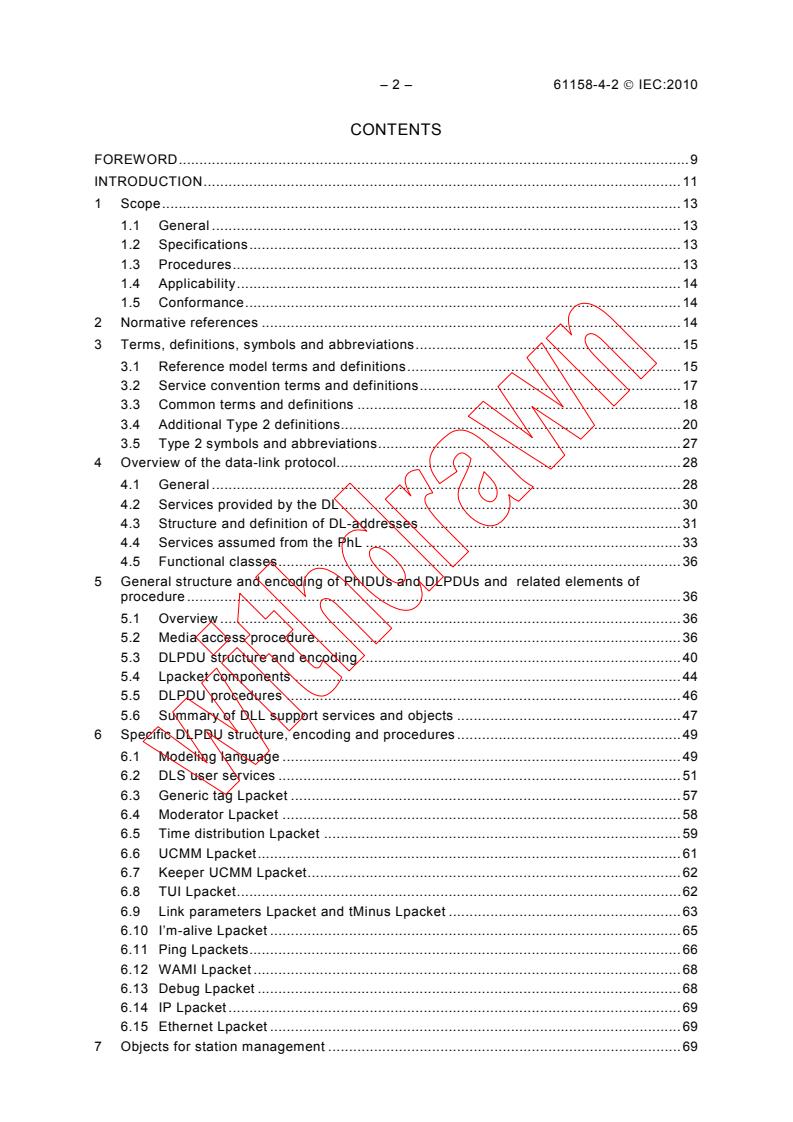
IEC 61158-4-2:2010 - Industrial communication networks - Fieldbus specifications - Part 4-2: Application layer protocol specification - Type 2 elements Released:8/6/2010
Overview
IEC 61158-4-2:2010 is part of the IEC 61158 fieldbus family and defines the data‑link layer protocol specification - Type 2 elements for industrial communication networks. This second edition (2010) supersedes the 2007 edition and introduces technical revisions including updates to normative references, abbreviations, the Ethernet Link object, and new DLR (Device Level Ring) and QoS objects and protocol behavior. The standard enables cyclic, synchronous media access with foreground scheduled access for time‑critical traffic and background unscheduled access for less critical exchanges. It also specifies clock synchronization across extended links with precision better than 10 ms.
Key Topics
- Media access model: Sequential, cyclic synchronous access opportunities for all participating data‑link entities, with distinct scheduled (foreground) and unscheduled (background) access periods.
- Efficiency mechanisms: Concatenation of multiple DLSDUs and associated DLPCI into a single DLPDU to optimize transfer efficiency for devices that source multiple data streams.
- Clock synchronization: Distributed time distribution mechanisms to maintain network-wide timing precision (< 10 ms).
- DLR (Device Level Ring): New DLR object and protocol for ring topologies, including topology support, message types, state machines and reconfiguration behavior.
- Quality of Service (QoS): New QoS object to manage traffic priorities and predictable delivery for industrial control.
- Ethernet Link object: Updates to support Ethernet-based links and related encapsulation/objects.
- DLPDUs and Lpackets: Detailed formats, encoding rules, FCS considerations and procedures for PhIDUs/DLPDUs and Lpacket types.
- Station management objects: Keeper, Scheduling, TCP/IP Interface, Connection Configuration and other objects supporting device and network management.
Applications
IEC 61158-4-2 is practical for organizations involved in industrial automation and real‑time control networks, including:
- Device manufacturers implementing data‑link layer firmware for field devices, PLCs and I/O modules.
- Network architects & system integrators designing deterministic fieldbus and Ethernet-based control networks that require scheduled access and redundancy.
- Automation engineers who need predictable timing, clock synchronization and QoS for safety‑critical or time‑sensitive control loops.
- Tooling and test vendors building conformance test benches and diagnostics for DLR, QoS and scheduling behavior.
Keywords: IEC 61158-4-2, industrial communication networks, fieldbus, data‑link layer, DLR, QoS, clock synchronization, scheduled access, real‑time communication, Ethernet Link.
Related Standards
- IEC 61158 series (Fieldbus specifications) - Part 4 is the data‑link layer element set within the broader fieldbus standard family.
Relations
- Effective Date
- 05-Sep-2023
- Effective Date
- 05-Sep-2023
Buy Documents
IEC 61158-4-2:2010 - Industrial communication networks - Fieldbus specifications - Part 4-2: Application layer protocol specification - Type 2 elements Released:8/6/2010
IEC 61158-4-2:2010 - Industrial communication networks - Fieldbus specifications - Part 4-2: Application layer protocol specification - Type 2 elements Released:8/6/2010
Get Certified
Connect with accredited certification bodies for this standard

BSI Group
BSI (British Standards Institution) is the business standards company that helps organizations make excellence a habit.

DVS-ZERT GmbH
German welding certification society.
CARES (UK Certification Authority for Reinforcing Steels)
UK certification for reinforcing steels and construction.
Sponsored listings
Frequently Asked Questions
IEC 61158-4-2:2010 is a standard published by the International Electrotechnical Commission (IEC). Its full title is "Industrial communication networks - Fieldbus specifications - Part 4-2: Application layer protocol specification - Type 2 elements". This standard covers: IEC 61158-4-2:2010 provides communication opportunities to all participating data-link entities, sequentially and in a cyclic synchronous manner. Foreground scheduled access is available for time-critical activities together with background unscheduled access for less critical activities. It provides means to maintain clock synchronization across an extended link with a precision better than 10 ms. This protocol optimizes each access opportunity by concatenating multiple DLSDUs and associated DLPCI into a single DLPDU, thereby improving data transfer efficiency for data-link entities that actively source multiple streams of data. This second edition cancels and replaces the first edition published in 2007 and constitutes a technical revision. The main changes with respect to the previous edition are: - update of normative and bibliographic references; - update of abbreviations; - updates of the Ethernet Link object; - new DLR and QoS objects; - new DLR protocol. This bilingual version (2012-07) corresponds to the monolingual English version, published in 2010-08.
IEC 61158-4-2:2010 provides communication opportunities to all participating data-link entities, sequentially and in a cyclic synchronous manner. Foreground scheduled access is available for time-critical activities together with background unscheduled access for less critical activities. It provides means to maintain clock synchronization across an extended link with a precision better than 10 ms. This protocol optimizes each access opportunity by concatenating multiple DLSDUs and associated DLPCI into a single DLPDU, thereby improving data transfer efficiency for data-link entities that actively source multiple streams of data. This second edition cancels and replaces the first edition published in 2007 and constitutes a technical revision. The main changes with respect to the previous edition are: - update of normative and bibliographic references; - update of abbreviations; - updates of the Ethernet Link object; - new DLR and QoS objects; - new DLR protocol. This bilingual version (2012-07) corresponds to the monolingual English version, published in 2010-08.
IEC 61158-4-2:2010 is classified under the following ICS (International Classification for Standards) categories: 25.040.40 - Industrial process measurement and control; 35.100.20 - Data link layer; 35.110 - Networking. The ICS classification helps identify the subject area and facilitates finding related standards.
IEC 61158-4-2:2010 has the following relationships with other standards: It is inter standard links to IEC 61158-4-2:2007, IEC 61158-4-2:2014. Understanding these relationships helps ensure you are using the most current and applicable version of the standard.
IEC 61158-4-2:2010 is available in PDF format for immediate download after purchase. The document can be added to your cart and obtained through the secure checkout process. Digital delivery ensures instant access to the complete standard document.
Standards Content (Sample)
IEC 61158-4-2 ®
Edition 2.0 2010-08
INTERNATIONAL
STANDARD
colour
inside
Industrial communication networks – Fieldbus specifications –
Part 4-2: Data-link layer protocol specification – Type 2 elements
All rights reserved. Unless otherwise specified, no part of this publication may be reproduced or utilized in any form
or by any means, electronic or mechanical, including photocopying and microfilm, without permission in writing from
either IEC or IEC's member National Committee in the country of the requester.
If you have any questions about IEC copyright or have an enquiry about obtaining additional rights to this publication,
please contact the address below or your local IEC member National Committee for further information.
IEC Central Office
3, rue de Varembé
CH-1211 Geneva 20
Switzerland
Email: inmail@iec.ch
Web: www.iec.ch
About the IEC
The International Electrotechnical Commission (IEC) is the leading global organization that prepares and publishes
International Standards for all electrical, electronic and related technologies.
About IEC publications
The technical content of IEC publications is kept under constant review by the IEC. Please make sure that you have the
latest edition, a corrigenda or an amendment might have been published.
ƒ Catalogue of IEC publications: www.iec.ch/searchpub
The IEC on-line Catalogue enables you to search by a variety of criteria (reference number, text, technical committee,…).
It also gives information on projects, withdrawn and replaced publications.
ƒ IEC Just Published: www.iec.ch/online_news/justpub
Stay up to date on all new IEC publications. Just Published details twice a month all new publications released. Available
on-line and also by email.
ƒ Electropedia: www.electropedia.org
The world's leading online dictionary of electronic and electrical terms containing more than 20 000 terms and definitions
in English and French, with equivalent terms in additional languages. Also known as the International Electrotechnical
Vocabulary online.
ƒ Customer Service Centre: www.iec.ch/webstore/custserv
If you wish to give us your feedback on this publication or need further assistance, please visit the Customer Service
Centre FAQ or contact us:
Email: csc@iec.ch
Tel.: +41 22 919 02 11
Fax: +41 22 919 03 00
IEC 61158-4-2 ®
Edition 2.0 2010-08
INTERNATIONAL
STANDARD
colour
inside
Industrial communication networks – Fieldbus specifications –
Part 4-2: Data-link layer protocol specification – Type 2 elements
INTERNATIONAL
ELECTROTECHNICAL
COMMISSION
PRICE CODE
XH
ICS 25.04.40; 35.100.20; 35.110 ISBN 978-2-88912-084-0
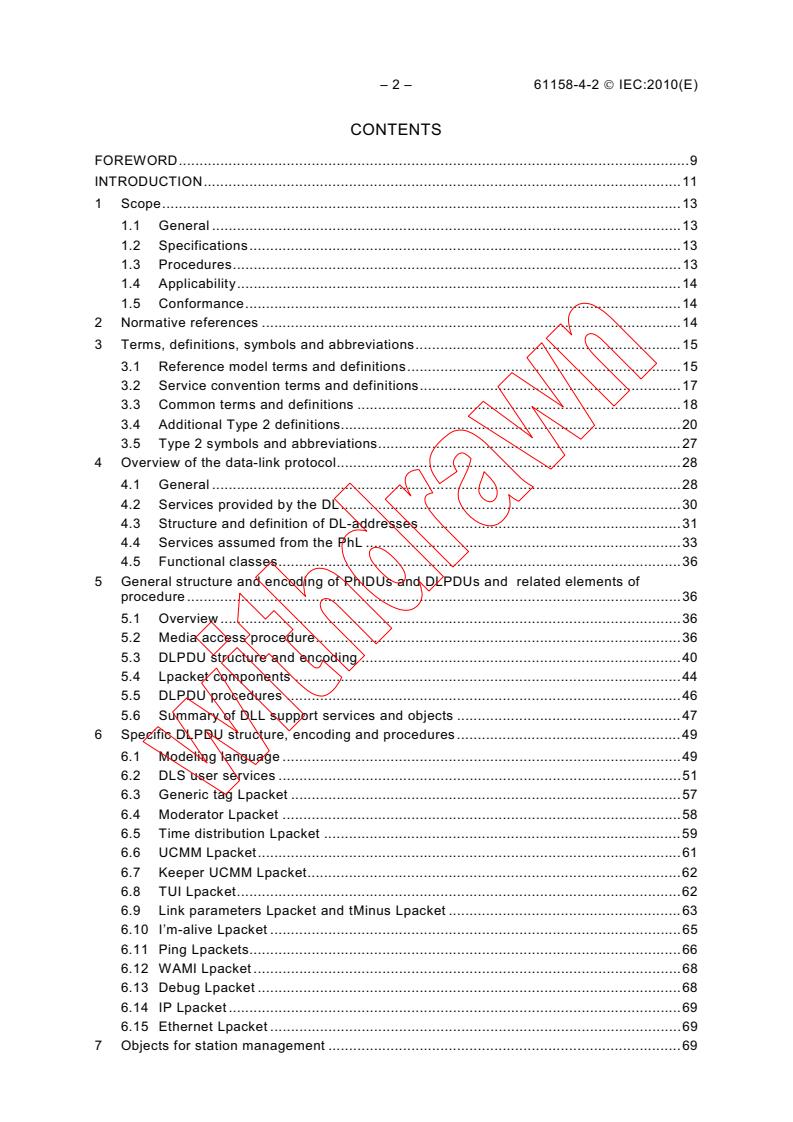
– 2 – 61158-4-2 © IEC:2010(E)
CONTENTS
FOREWORD.9
INTRODUCTION.11
1 Scope.13
1.1 General .13
1.2 Specifications.13
1.3 Procedures.13
1.4 Applicability.14
1.5 Conformance.14
2 Normative references .14
3 Terms, definitions, symbols and abbreviations.15
3.1 Reference model terms and definitions.15
3.2 Service convention terms and definitions.17
3.3 Common terms and definitions .18
3.4 Additional Type 2 definitions.20
3.5 Type 2 symbols and abbreviations.27
4 Overview of the data-link protocol.28
4.1 General .28
4.2 Services provided by the DL.30
4.3 Structure and definition of DL-addresses.31
4.4 Services assumed from the PhL .33
4.5 Functional classes.36
5 General structure and encoding of PhIDUs and DLPDUs and related elements of
procedure.36
5.1 Overview .36
5.2 Media access procedure.36
5.3 DLPDU structure and encoding .40
5.4 Lpacket components .44
5.5 DLPDU procedures .46
5.6 Summary of DLL support services and objects .47
6 Specific DLPDU structure, encoding and procedures .49
6.1 Modeling language .49
6.2 DLS user services .51
6.3 Generic tag Lpacket .57
6.4 Moderator Lpacket .58
6.5 Time distribution Lpacket .59
6.6 UCMM Lpacket.61
6.7 Keeper UCMM Lpacket.62
6.8 TUI Lpacket.62
6.9 Link parameters Lpacket and tMinus Lpacket .63
6.10 I’m-alive Lpacket .65
6.11 Ping Lpackets.66
6.12 WAMI Lpacket .68
6.13 Debug Lpacket .68
6.14 IP Lpacket .69
6.15 Ethernet Lpacket .69
7 Objects for station management .69
61158-4-2 © IEC:2010(E) – 3 –
7.1 General .69
7.2 ControlNet object .70
7.3 Keeper object.80
7.4 Scheduling object.102
7.5 TCP/IP Interface object .113
7.6 Ethernet link object.122
7.7 DeviceNet object .130
7.8 Connection configuration object (CCO).139
7.9 DLR object .160
7.10 QoS object .169
8 Other DLE elements of procedure. 171
8.1 Network attachment monitor (NAM) .171
8.2 Calculating link parameters .178
9 Detailed specification of DL components .186
9.1 General .186
9.2 Access control machine (ACM).186
9.3 TxLLC .203
9.4 RxLLC .207
9.5 Transmit machine (TxM).210
9.6 Receive machine (RxM) .213
9.7 Serializer.219
9.8 Deserializer .220
9.9 DLL management .221
10 Device Level Ring (DLR) protocol.223
10.1 General .223
10.2 Supported topologies .223
10.3 Overview of DLR operation.225
10.4 Classes of DLR implementation.227
10.5 DLR behavior .228
10.6 Implementation requirements .233
10.7 Using non-DLR nodes in the ring network.235
10.8 DLR messages .238
10.9 State diagrams and state-event-action matrices . 243
10.10 Performance analysis .264
Annex A (normative) Indicators and switches.268
Bibliography.281
Figure 1 – Relationships of DLSAPs, DLSAP-addresses and group DL-addresses .19
Figure 2 – Data-link layer internal architecture.29
Figure 3 – Basic structure of a MAC ID address.31
Figure 4 – Basic structure of a generic tag address .32
Figure 5 – Basic structure of a fixed tag address .32
Figure 6 – M_symbols and Manchester encoding at 5 MHz .34
Figure 7 – NUT structure .37
Figure 8 – Media access during scheduled time.38
Figure 9 – Media access during unscheduled time .39
Figure 10 – DLPDU format.40
– 4 – 61158-4-2 © IEC:2010(E)
Figure 11 – Aborting a DLPDU during transmission .43
Figure 12 – Lpacket format .44
Figure 13 – Generic tag Lpacket format .45
Figure 14 – Fixed tag Lpacket format.46
Figure 15 – Goodness parameter of TimeDist_Lpacket .60
Figure 16 – Example I’m alive processing algorithm.66
Figure 17 – Keeper CRC algorithm .87
Figure 18 – Keeper object power-up state diagram .98
Figure 19 – Keeper object operating state diagram .99
Figure 20 – Synchronized network change processing .102
Figure 21 – State transition diagram for TCP/IP Interface object .122
Figure 22 – Connection configuration object edit flowchart. 160
Figure 23 – NAM state machine .172
Figure 24 – DLR rings connected to switches.224
Figure 25 – Normal operation of a DLR network.225
Figure 26 – Beacon and Announce frames.225
Figure 27 – Link failure .226
Figure 28 – Network reconfiguration after link failure .227
Figure 29 – Neighbor Check process .233
Figure 30 – Unsupported topology – example 1 .237
Figure 31 – Unsupported topology – example 2 .237
Figure 32 – State transition diagram for Beacon frame based non-supervisor ring node.243
Figure 33 – State transition diagram for Announce frame based non-supervisor ring
node .248
Figure 34 – State transition diagram for ring supervisor .251
Figure A.1 – Non redundant network status indicator labeling .272
Figure A.2 – Redundant network status indicator labeling .273
Table 1 – Data-link layer components .29
Table 2 – MAC ID addresses allocation .32
Table 3 – Fixed tag service definitions .33
Table 4 – Data encoding rules .34
Table 5 – M Data symbols .35
Table 6 – Truth table for ph_status_indication.35
Table 7 – FCS length, polynomials and constants .41
Table 8 – DLL support services and objects.48
Table 9 – Elementary data types.51
Table 10 – DLL events.55
Table 11 – Time distribution priority .60
Table 12 – Format of the TUI Lpacket .63
Table 13 – ControlNet object class attributes .71
Table 14 – ControlNet object instance attributes .71
Table 15 – TUI status flag bits .75
61158-4-2 © IEC:2010(E) – 5 –
Table 16 – Channel state bits .76
Table 17 – ControlNet object common services.78
Table 18 – ControlNet object class specific services .79
Table 19 – Keeper object revision history .81
Table 20 – Keeper object class attributes .81
Table 21 – Keeper object instance attributes .82
Table 22 – Keeper operating state definitions .84
Table 23 – Port status flag bit definitions .85
Table 24 – TUI status flag bits .86
Table 25 – Keeper attributes.88
Table 26 – Memory requirements (in octets) for the Keeper attributes.89
Table 27 – Keeper object common services .89
Table 28 – Keeper object class specific services .90
Table 29 – Service error codes .91
Table 30 – Wire order format of the TUI Lpacket.95
Table 31 – Service error codes .96
Table 32 – Keeper object operating states .96
Table 33 – Keeper object state event matrix .100
Table 34 – Scheduling object class attributes .103
Table 35 – Scheduling object instance attributes .104
Table 36 – Scheduling object common services .104
Table 37 – Status error descriptions for Create.105
Table 38 – Status error descriptions for Delete and Kick_Timer .106
Table 39 – Scheduling object class specific services .106
Table 40 – Status error descriptions for Read .108
Table 41 – Status error descriptions for Conditional_Write.109
Table 42 – Status error descriptions for Forced_Write .109
Table 43 – Status error descriptions for Change_Start .110
Table 44 – Status error descriptions for Break_Connections .110
Table 45 – Status error descriptions for Change_Complete. 111
Table 46 – Status error descriptions for Restart_Connections .112
Table 47 – TCP/IP Interface object class attributes.113
Table 48 – TCP/IP Interface object instance attributes.114
Table 49 – Status bits .116
Table 50 – Configuration capability bits .116
Table 51 – Configuration control bits.117
Table 52 – Example path .117
Table 53 – Interface configuration components .118
Table 54 – Alloc control values .119
Table 55 – TCP/IP Interface object common services .120
Table 56 – Get_Attribute_All reply format .120
Table 57 – Ethernet link object revision history .122
Table 58 – Ethernet link object class attributes .123
– 6 – 61158-4-2 © IEC:2010(E)
Table 59 – Ethernet link object instance attributes . 124
Table 60 – Interface flags bits.127
Table 61 – Control bits.128
Table 62 – Interface type .128
Table 63 – Interface state .129
Table 64 – Admin state .129
Table 65 – Ethernet Link object common services.129
Table 66 – Ethernet Link object class specific services .130
Table 67 – DeviceNet object revision history.131
Table 68 – DeviceNet object class attributes.131
Table 69 – DeviceNet object instance attributes.132
Table 70 – Bit rate attribute values .134
Table 71 – BOI attribute values.135
Table 72 – Diagnostic counters bit description .136
Table 73 – DeviceNet object common services .137
Table 74 – Reset service parameter .138
Table 75 – Reset service parameter values .138
Table 76 – DeviceNet object class specific services. 139
Table 77 – Connection configuration object revision history .140
Table 78 – Connection configuration object class attributes . 141
Table 79 – Format number values.142
Table 80 – Connection configuration object instance attributes . 143
Table 81 – Originator connection status values.145
Table 82 – Target connection status values .146
Table 83 – Connection flags .146
Table 84 – I/O mapping formats .148
Table 85 – Connection configuration object common services. 149
Table 86 – Get_Attribute_All error codes .149
Table 87 – Get_Attribute_All response.150
Table 88 – Set_Attribute_All error codes.151
Table 89 – Set_Attribute_All request.152
Table 90 – Create request parameters.153
Table 91 – Create error codes .154
Table 92 – Delete error codes.154
Table 93 – Restore error codes.154
Table 94 – Connection configuration object class specific services . 155
Table 95 – Kick_Timer error codes .155
Table 96 – Open_Connection error codes .156
Table 97 – Close_Connection error codes .156
Table 98 – Stop_Connection error codes .156
Table 99 – Change_Start error codes .157
Table 100 – Get_Status service parameter .157
Table 101 – Get_Status service response.157
61158-4-2 © IEC:2010(E) – 7 –
Table 102 – Get_Status service error codes .158
Table 103 – Change_Complete service parameter .158
Table 104 – Change_Complete service error codes .158
Table 105 – Audit_Changes service parameter .159
Table 106 – Audit_Changes service error codes .159
Table 107 – Class attributes .161
Table 108 –Instance attributes.161
Table 109 – Network Status values.163
Table 110 – Ring Supervisor Status values.164
Table 111 – DLR object common services .167
Table 112 – Get_Attributes_All Response – non supervisor device . 167
Table 113 – Get_Attributes_All Response – supervisor-capable device . 167
Table 114 – DLR object class specific services.168
Table 115 – QoS object revision history.169
Table 116 – QoS object class attributes .169
Table 117 – QoS object instance attributes.170
Table 118 – Default DCSP values and usages .171
Table 119 – Common services.171
Table 120 – NAM states.172
Table 121 – Default link parameters.173
Table 122 – PhL timing characteristics.179
Table 123 – DLR variables.228
Table 124 – MAC addresses for DLR messages .239
Table 125 – IEEE 802.1Q frame format.239
Table 126 – Common fields in DLR messages .239
Table 127 – Format of the Beacon frame .240
Table 128 – Ring State values .240
Table 129 – Format of the Neighbor_Check request .241
Table 130 – Format of the Neighbor_Check response.241
Table 131 – Format of the Link_Status/Neighbor_Status frame. 241
Table 132 – Link/Neighbor status values.242
Table 133 – Format of the Announce frame .242
Table 134 – Format of the Sign_On frame .242
Table 135 – Parameter values for Beacon frame based non-supervisor ring node. 243
Table 136 – State-event-action matrix for Beacon frame based non-supervisor ring
node .244
Table 137 – Parameter values for Announce frame based non-supervisor ring node.248
Table 138 – State-event-action matrix for Announce frame based non-supervisor ring
node .249
Table 139 – Parameter values for ring supervisor node .252
Table 140 – State-event-action matrix for ring supervisor node. 253
Table 141 – Parameters/assumptions for example performance calculations .264
Table 142 – Example ring configuration parameters and performance . 267
– 8 – 61158-4-2 © IEC:2010(E)
Table A.1 – Module status indicator .269
Table A.2 – Network status indicators .270
Table A.3 – Network status indicator.274
Table A.4 – Network status indicator.276
Table A.5 – Combined module/network status indicator .277
Table A.6 – I/O status indicator.278
Table A.7 – Bit rate switch encoding .280
61158-4-2 © IEC:2010(E) – 9 –
INTERNATIONAL ELECTROTECHNICAL COMMISSION
____________
INDUSTRIAL COMMUNICATION NETWORKS –
FIELDBUS SPECIFICATIONS –
Part 4-2: Data-link layer protocol specification –
Type 2 elements
FOREWORD
1) The International Electrotechnical Commission (IEC) is a worldwide organization for standardization comprising
all national electrotechnical committees (IEC National Committees). The object of IEC is to promote
international co-operation on all questions concerning standardization in the electrical and electronic fields. To
this end and in addition to other activities, IEC publishes International Standards, Technical Specifications,
Technical Reports, Publicly Available Specifications (PAS) and Guides (hereafter referred to as “IEC
Publication(s)”). Their preparation is entrusted to technical committees; any IEC National Committee interested
in the subject dealt with may participate in this preparatory work. International, governmental and non-
governmental organizations liaising with the IEC also participate in this preparation. IEC collaborates closely
with the International Organization for Standardization (ISO) in accordance with conditions determined by
agreement between the two organizations.
2) The formal decisions or agreements of IEC on technical matters express, as nearly as possible, an international
consensus of opinion on the relevant subjects since each technical committee has representation from all
interested IEC National Committees.
3) IEC Publications have the form of recommendations for international use and are accepted by IEC National
Committees in that sense. While all reasonable efforts are made to ensure that the technical content of IEC
Publications is accurate, IEC cannot be held responsible for the way in which they are used or for any
misinterpretation by any end user.
4) In order to promote international uniformity, IEC National Committees undertake to apply IEC Publications
transparently to the maximum extent possible in their national and regional publications. Any divergence
between any IEC Publication and the corresponding national or regional publication shall be clearly indicated in
the latter.
5) IEC itself does not provide any attestation of conformity. Independent certification bodies provide conformity
assessment services and, in some areas, access to IEC marks of conformity. IEC is not responsible for any
services carried out by independent certification bodies.
6) All users should ensure that they have the latest edition of this publication.
7) No liability shall attach to IEC or its directors, employees, servants or agents including individual experts and
members of its technical committees and IEC National Committees for any personal injury, property damage or
other damage of any nature whatsoever, whether direct or indirect, or for costs (including legal fees) and
expenses arising out of the publication, use of, or reliance upon, this IEC Publication or any other IEC
Publications.
8) Attention is drawn to the Normative references cited in this publication. Use of the referenced publications is
indispensable for the correct application of this publication.
International Standard IEC 61158-4-2 has been prepared by subcommittee 65C: Industrial
networks, of IEC technical committee 65: Industrial process measurement, control and
automation.
This second edition cancels and replaces the first edition published in 2007. This edition
constitutes a technical revision.
The main changes with respect to the previous edition are listed below.
• Clause 2 and Bibliography: update of normative and bibliographic references;
• subclause 3.5: update of abbreviations;
• subclause 7.6: updates of the Ethernet Link object;
• subclause 7.7: minor update of the Devicenet object (additional attribute);
• new subclauses 7.9 and 7.10: new DLR and QoS objects;
• new Clause 10: new DLR protocol.
– 10 – 61158-4-2 © IEC:2010(E)
The text of this standard is based on the following documents:
FDIS Report on voting
65C/605/FDIS 65C/619/RVD
Full information on the voting for the approval of this standard can be found in the report on
voting indicated in the above table.
This publication has been drafted in accordance with ISO/IEC Directives, Part 2.
A list of all parts of the IEC 61158 series, published under the general title Industrial
communication networks – Fieldbus specifications, can be found on the IEC web site.
The committee has decided that the contents of this publication will remain unchanged until
the stability date indicated on the IEC web site under "http://webstore.iec.ch" in the data
related to the specific publication. At this date, the publication will be
• reconfirmed;
• withdrawn;
• replaced by a revised edition, or
• amended.
NOTE The revision of this standard will be synchronized with the other parts of the IEC 61158 series.
IMPORTANT – The 'colour inside' logo on the cover page of this publication indicates
that it contains colours which are considered to be useful for the correct
understanding of its contents. Users should therefore print this document using a
colour printer.
61158-4-2 © IEC:2010(E) – 11 –
INTRODUCTION
This part of IEC 61158 is one of a series produced to facilitate the interconnection of
automation system components. It is related to other standards in the set as defined by the
“three-layer” fieldbus reference model described in IEC/TR 61158-1:2010.
The data-link protocol provides the data-link service by making use of the services available
from the physical layer. The primary aim of this standard is to provide a set of rules for
communication expressed in terms of the procedures to be carried out by peer data-link
entities (DLEs) at the time of communication. These rules for communication are intended to
provide a sound basis for development in order to serve a variety of purposes:
a) as a guide for implementers and designers;
b) for use in the testing and procurement of equipment;
c) as part of an agreement for the admittance of systems into the open systems environment;
d) as a refinement to the understanding of time-critical communications within OSI.
This standard is concerned, in particular, with the communication and interworking of sensors,
effectors and other automation devices. By using this standard together with other standards
positioned within the OSI or fieldbus reference models, otherwise incompatible systems may
work together in any combination.
NOTE Use of some of the associated protocol types is restricted by their intellectual-property-right holders. In all
cases, the commitment to limited release of intellectual-property-rights made by the holders of those rights permits
a particular data-link layer protocol type to be used with physical layer and application layer protocols in Type
combinations as specified explicitly in the IEC 61784 series. Use of the various protocol types in other
combinations may require permission from their respective intellectual-property-right holders.
The International Electrotechnical Commission (IEC) draws attention to the fact that it is
claimed that compliance with this document may involve the use of patents given in several
subclauses as indicated in the table below. These patents are held by their respective
inventors under license to ODVA, Inc:
US 5,400,331 [ODVA] Communication network interface with screeners
for incoming messages
US 5,471,461 [ODVA] Digital communication network with a moderator
station election process
US 5,491,531 [ODVA] Media access controller with a shared class
message delivery capability
Subclause
3.4, Clauses 4
US 5,493,571 [ODVA] Apparatus and method for digital communications
to 9
with improved delimiter detection
US 5,537,549 [ODVA] Communication network with time coordinated
station activity by time slot and periodic interval
number
US 5,553,095 [ODVA] Method and apparatus for exchanging different
classes of data during different time intervals
US 12/493,838 [ODVA] Industrial controller employing the network ring Clause 10
topology
IEC takes no position concerning the evidence, validity and scope of these patent rights.
– 12 – 61158-4-2 © IEC:2010(E)
ODVA and the holders of these patent rights have assured the IEC that ODVA is willing to
negotiate licences under reasonable and non-discriminatory terms and conditions with
applicants throughout the world. In this respect, the statement of ODVA and the holders of
these patent rights is registered with IEC. Information may be obtained from:
[ODVA] ODVA, Inc.
2370 East Stadium Boulevard #1000
Ann Arbor, Michigan 48104
USA
Attention: Office of the Executive Director
e-mail: odva@odva.org
Attention is drawn to the possibility that some of the elements of this document may be the
subject of patent rights other than those identified above. IEC shall not be held responsible for
identifying any or all such patent rights.
ISO (www.iso.org/patents) and IEC (http://www.iec.ch/tctools/patent_de
...
IEC 61158-4-2 ®
Edition 2.0 2010-08
INTERNATIONAL
STANDARD
NORME
INTERNATIONALE
colour
inside
Industrial communication networks – Fieldbus specifications –
Part 4-2: Data-link layer protocol specification – Type 2 elements
Réseaux de communication industriels – Spécifications de bus de terrain –
Partie 4-2: Spécification du protocole de la couche de liaison de données –
Éléments de Type 2
All rights reserved. Unless otherwise specified, no part of this publication may be reproduced or utilized in any form
or by any means, electronic or mechanical, including photocopying and microfilm, without permission in writing from
either IEC or IEC's member National Committee in the country of the requester.
If you have any questions about IEC copyright or have an enquiry about obtaining additional rights to this publication,
please contact the address below or your local IEC member National Committee for further information.
Droits de reproduction réservés. Sauf indication contraire, aucune partie de cette publication ne peut être reproduite ni
utilisée sous quelque forme que ce soit et par aucun procédé, électronique ou mécanique, y compris la photocopie et les
microfilms, sans l'accord écrit de la CEI ou du Comité national de la CEI du pays du demandeur.
Si vous avez des questions sur le copyright de la CEI ou si vous désirez obtenir des droits supplémentaires sur cette
publication, utilisez les coordonnées ci-après ou contactez le Comité national de la CEI de votre pays de résidence.
IEC Central Office Tel.: +41 22 919 02 11
3, rue de Varembé Fax: +41 22 919 03 00
CH-1211 Geneva 20 info@iec.ch
Switzerland www.iec.ch
About the IEC
The International Electrotechnical Commission (IEC) is the leading global organization that prepares and publishes
International Standards for all electrical, electronic and related technologies.
About IEC publications
The technical content of IEC publications is kept under constant review by the IEC. Please make sure that you have the
latest edition, a corrigenda or an amendment might have been published.
Useful links:
IEC publications search - www.iec.ch/searchpub Electropedia - www.electropedia.org
The advanced search enables you to find IEC publications The world's leading online dictionary of electronic and
by a variety of criteria (reference number, text, technical electrical terms containing more than 30 000 terms and
committee,…). definitions in English and French, with equivalent terms in
It also gives information on projects, replaced and additional languages. Also known as the International
withdrawn publications. Electrotechnical Vocabulary (IEV) on-line.
IEC Just Published - webstore.iec.ch/justpublished Customer Service Centre - webstore.iec.ch/csc
Stay up to date on all new IEC publications. Just Published If you wish to give us your feedback on this publication
details all new publications released. Available on-line and or need further assistance, please contact the
also once a month by email. Customer Service Centre: csc@iec.ch.
A propos de la CEI
La Commission Electrotechnique Internationale (CEI) est la première organisation mondiale qui élabore et publie des
Normes internationales pour tout ce qui a trait à l'électricité, à l'électronique et aux technologies apparentées.
A propos des publications CEI
Le contenu technique des publications de la CEI est constamment revu. Veuillez vous assurer que vous possédez
l’édition la plus récente, un corrigendum ou amendement peut avoir été publié.
Liens utiles:
Recherche de publications CEI - www.iec.ch/searchpub Electropedia - www.electropedia.org
La recherche avancée vous permet de trouver des Le premier dictionnaire en ligne au monde de termes
publications CEI en utilisant différents critères (numéro de électroniques et électriques. Il contient plus de 30 000
référence, texte, comité d’études,…). termes et définitions en anglais et en français, ainsi que
Elle donne aussi des informations sur les projets et les les termes équivalents dans les langues additionnelles.
publications remplacées ou retirées. Egalement appelé Vocabulaire Electrotechnique
International (VEI) en ligne.
Just Published CEI - webstore.iec.ch/justpublished
Service Clients - webstore.iec.ch/csc
Restez informé sur les nouvelles publications de la CEI.
Just Published détaille les nouvelles publications parues. Si vous désirez nous donner des commentaires sur
Disponible en ligne et aussi une fois par mois par email. cette publication ou si vous avez des questions
contactez-nous: csc@iec.ch.
IEC 61158-4-2 ®
Edition 2.0 2010-08
INTERNATIONAL
STANDARD
NORME
INTERNATIONALE
colour
inside
Industrial communication networks – Fieldbus specifications –
Part 4-2: Application layer protocol specification – Type 2 elements
Réseaux de communication industriels – Spécifications des bus de terrain –
Partie 4-2: Spécification de protocole de la couche application – Eléments de
Type 2
INTERNATIONAL
ELECTROTECHNICAL
COMMISSION
COMMISSION
ELECTROTECHNIQUE
PRICE CODE
INTERNATIONALE
XH
CODE PRIX
ICS 25.040.40; 35.100.20; 35.110 ISBN 978-2-83220-126-8
– 2 – 61158-4-2 IEC:2010
CONTENTS
FOREWORD . 9
INTRODUCTION . 11
1 Scope . 13
1.1 General . 13
1.2 Specifications . 13
1.3 Procedures . 13
1.4 Applicability . 14
1.5 Conformance . 14
2 Normative references . 14
3 Terms, definitions, symbols and abbreviations . 15
3.1 Reference model terms and definitions . 15
3.2 Service convention terms and definitions . 17
3.3 Common terms and definitions . 18
3.4 Additional Type 2 definitions. 20
3.5 Type 2 symbols and abbreviations . 27
4 Overview of the data-link protocol. 28
4.1 General . 28
4.2 Services provided by the DL . 30
4.3 Structure and definition of DL-addresses . 31
4.4 Services assumed from the PhL . 33
4.5 Functional classes . 36
5 General structure and encoding of PhIDUs and DLPDUs and related elements of
procedure . 36
5.1 Overview . 36
5.2 Media access procedure . 36
5.3 DLPDU structure and encoding . 40
5.4 Lpacket components . 44
5.5 DLPDU procedures . 46
5.6 Summary of DLL support services and objects . 47
6 Specific DLPDU structure, encoding and procedures . 49
6.1 Modeling language . 49
6.2 DLS user services . 51
6.3 Generic tag Lpacket . 57
6.4 Moderator Lpacket . 58
6.5 Time distribution Lpacket . 59
6.6 UCMM Lpacket . 61
6.7 Keeper UCMM Lpacket . 62
6.8 TUI Lpacket . 62
6.9 Link parameters Lpacket and tMinus Lpacket . 63
6.10 I’m-alive Lpacket . 65
6.11 Ping Lpackets. 66
6.12 WAMI Lpacket . 68
6.13 Debug Lpacket . 68
6.14 IP Lpacket . 69
6.15 Ethernet Lpacket . 69
7 Objects for station management . 69
61158-4-2 IEC:2010 – 3 –
7.1 General . 69
7.2 ControlNet object . 70
7.3 Keeper object . 80
7.4 Scheduling object . 102
7.5 TCP/IP Interface object . 113
7.6 Ethernet link object. 122
7.7 DeviceNet object . 130
7.8 Connection configuration object (CCO). 139
7.9 DLR object . 159
7.10 QoS object . 168
8 Other DLE elements of procedure. 170
8.1 Network attachment monitor (NAM) . 170
8.2 Calculating link parameters . 177
9 Detailed specification of DL components . 185
9.1 General . 185
9.2 Access control machine (ACM) . 185
9.3 TxLLC . 202
9.4 RxLLC . 206
9.5 Transmit machine (TxM) . 209
9.6 Receive machine (RxM) . 212
9.7 Serializer . 218
9.8 Deserializer . 219
9.9 DLL management . 220
10 Device Level Ring (DLR) protocol . 222
10.1 General . 222
10.2 Supported topologies . 222
10.3 Overview of DLR operation . 224
10.4 Classes of DLR implementation . 226
10.5 DLR behavior . 227
10.6 Implementation requirements . 232
10.7 Using non-DLR nodes in the ring network . 234
10.8 DLR messages . 237
10.9 State diagrams and state-event-action matrices . 241
10.10 Performance analysis . 262
Annex A (normative) Indicators and switches . 267
Bibliography . 280
Figure 1 – Relationships of DLSAPs, DLSAP-addresses and group DL-addresses . 19
Figure 2 – Data-link layer internal architecture . 29
Figure 3 – Basic structure of a MAC ID address . 31
Figure 4 – Basic structure of a generic tag address . 32
Figure 5 – Basic structure of a fixed tag address . 32
Figure 6 – M_symbols and Manchester encoding at 5 MHz . 34
Figure 7 – NUT structure . 37
Figure 8 – Media access during scheduled time . 38
Figure 9 – Media access during unscheduled time . 39
Figure 10 – DLPDU format . 40
– 4 – 61158-4-2 IEC:2010
Figure 11 – Aborting a DLPDU during transmission . 43
Figure 12 – Lpacket format . 44
Figure 13 – Generic tag Lpacket format . 45
Figure 14 – Fixed tag Lpacket format . 45
Figure 15 – Goodness parameter of TimeDist_Lpacket . 60
Figure 16 – Example I’m alive processing algorithm . 66
Figure 17 – Keeper CRC algorithm . 87
Figure 18 – Keeper object power-up state diagram . 98
Figure 19 – Keeper object operating state diagram . 99
Figure 20 – Synchronized network change processing . 102
Figure 21 – State transition diagram for TCP/IP Interface object . 122
Figure 22 – Connection configuration object edit flowchart . 159
Figure 23 – NAM state machine . 171
Figure 24 – DLR rings connected to switches. 223
Figure 25 – Normal operation of a DLR network . 224
Figure 26 – Beacon and Announce frames . 224
Figure 27 – Link failure . 225
Figure 28 – Network reconfiguration after link failure . 226
Figure 29 – Neighbor Check process . 232
Figure 30 – Unsupported topology – example 1 . 236
Figure 31 – Unsupported topology – example 2 . 236
Figure 32 – State transition diagram for Beacon frame based non-supervisor ring node . 242
Figure 33 – State transition diagram for Announce frame based non-supervisor ring
node . 247
Figure 34 – State transition diagram for ring supervisor . 250
Figure A.1 – Non redundant network status indicator labeling . 271
Figure A.2 – Redundant network status indicator labeling . 272
Table 1 – Data-link layer components . 29
Table 2 – MAC ID addresses allocation . 32
Table 3 – Fixed tag service definitions . 33
Table 4 – Data encoding rules . 34
Table 5 – M Data symbols . 35
Table 6 – Truth table for ph_status_indication . 35
Table 7 – FCS length, polynomials and constants . 41
Table 8 – DLL support services and objects . 48
Table 9 – Elementary data types . 51
Table 10 – DLL events . 55
Table 11 – Time distribution priority . 60
Table 12 – Format of the TUI Lpacket . 63
Table 13 – ControlNet object class attributes . 71
Table 14 – ControlNet object instance attributes . 71
Table 15 – TUI status flag bits . 75
61158-4-2 IEC:2010 – 5 –
Table 16 – Channel state bits . 76
Table 17 – ControlNet object common services. 78
Table 18 – ControlNet object class specific services . 79
Table 19 – Keeper object revision history . 81
Table 20 – Keeper object class attributes . 81
Table 21 – Keeper object instance attributes . 82
Table 22 – Keeper operating state definitions . 84
Table 23 – Port status flag bit definitions . 85
Table 24 – TUI status flag bits . 86
Table 25 – Keeper attributes . 88
Table 26 – Memory requirements (in octets) for the Keeper attributes . 89
Table 27 – Keeper object common services . 89
Table 28 – Keeper object class specific services . 90
Table 29 – Service error codes . 91
Table 30 – Wire order format of the TUI Lpacket . 95
Table 31 – Service error codes . 96
Table 32 – Keeper object operating states . 96
Table 33 – Keeper object state event matrix . 100
Table 34 – Scheduling object class attributes . 103
Table 35 – Scheduling object instance attributes . 104
Table 36 – Scheduling object common services . 104
Table 37 – Status error descriptions for Create . 105
Table 38 – Status error descriptions for Delete and Kick_Timer . 106
Table 39 – Scheduling object class specific services . 106
Table 40 – Status error descriptions for Read . 108
Table 41 – Status error descriptions for Conditional_Write . 109
Table 42 – Status error descriptions for Forced_Write . 109
Table 43 – Status error descriptions for Change_Start . 110
Table 44 – Status error descriptions for Break_Connections . 110
Table 45 – Status error descriptions for Change_Complete . 111
Table 46 – Status error descriptions for Restart_Connections . 112
Table 47 – TCP/IP Interface object class attributes . 113
Table 48 – TCP/IP Interface object instance attributes . 114
Table 49 – Status bits . 116
Table 50 – Configuration capability bits . 116
Table 51 – Configuration control bits . 117
Table 52 – Example path . 117
Table 53 – Interface configuration components . 118
Table 54 – Alloc control values . 119
Table 55 – TCP/IP Interface object common services . 120
Table 56 – Get_Attribute_All reply format . 120
Table 57 – Ethernet link object revision history . 122
Table 58 – Ethernet link object class attributes . 123
– 6 – 61158-4-2 IEC:2010
Table 59 – Ethernet link object instance attributes . 124
Table 60 – Interface flags bits . 127
Table 61 – Control bits . 128
Table 62 – Interface type . 128
Table 63 – Interface state . 129
Table 64 – Admin state . 129
Table 65 – Ethernet Link object common services . 129
Table 66 – Ethernet Link object class specific services . 130
Table 67 – DeviceNet object revision history . 131
Table 68 – DeviceNet object class attributes . 131
Table 69 – DeviceNet object instance attributes . 132
Table 70 – Bit rate attribute values . 134
Table 71 – BOI attribute values . 135
Table 72 – Diagnostic counters bit description . 136
Table 73 – DeviceNet object common services . 137
Table 74 – Reset service parameter . 138
Table 75 – Reset service parameter values . 138
Table 76 – DeviceNet object class specific services . 138
Table 77 – Connection configuration object revision history . 139
Table 78 – Connection configuration object class attributes . 140
Table 79 – Format number values . 141
Table 80 – Connection configuration object instance attributes . 142
Table 81 – Originator connection status values . 144
Table 82 – Target connection status values . 145
Table 83 – Connection flags . 145
Table 84 – I/O mapping formats . 147
Table 85 – Connection configuration object common services . 148
Table 86 – Get_Attribute_All error codes . 148
Table 87 – Get_Attribute_All response . 149
Table 88 – Set_Attribute_All error codes . 150
Table 89 – Set_Attribute_All request . 151
Table 90 – Create request parameters . 152
Table 91 – Create error codes . 153
Table 92 – Delete error codes . 153
Table 93 – Restore error codes . 153
Table 94 – Connection configuration object class specific services . 154
Table 95 – Kick_Timer error codes . 154
Table 96 – Open_Connection error codes . 155
Table 97 – Close_Connection error codes . 155
Table 98 – Stop_Connection error codes . 155
Table 99 – Change_Start error codes . 156
Table 100 – Get_Status service parameter . 156
Table 101 – Get_Status service response . 156
61158-4-2 IEC:2010 – 7 –
Table 102 – Get_Status service error codes . 157
Table 103 – Change_Complete service parameter . 157
Table 104 – Change_Complete service error codes . 157
Table 105 – Audit_Changes service parameter . 158
Table 106 – Audit_Changes service error codes . 158
Table 107 – Class attributes . 160
Table 108 –Instance attributes . 160
Table 109 – Network Status values . 162
Table 110 – Ring Supervisor Status values . 163
Table 111 – DLR object common services . 166
Table 112 – Get_Attributes_All Response – non supervisor device . 166
Table 113 – Get_Attributes_All Response – supervisor-capable device . 166
Table 114 – DLR object class specific services . 167
Table 115 – QoS object revision history . 168
Table 116 – QoS object class attributes . 168
Table 117 – QoS object instance attributes . 169
Table 118 – Default DCSP values and usages . 170
Table 119 – Common services . 170
Table 120 – NAM states . 171
Table 121 – Default link parameters. 172
Table 122 – PhL timing characteristics . 178
Table 123 – DLR variables . 227
Table 124 – MAC addresses for DLR messages . 238
Table 125 – IEEE 802.1Q frame format . 238
Table 126 – Common fields in DLR messages . 238
Table 127 – Format of the Beacon frame . 239
Table 128 – Ring State values . 239
Table 129 – Format of the Neighbor_Check request . 239
Table 130 – Format of the Neighbor_Check response . 240
Table 131 – Format of the Link_Status/Neighbor_Status frame . 240
Table 132 – Link/Neighbor status values . 240
Table 133 – Format of the Announce frame . 241
Table 134 – Format of the Sign_On frame . 241
Table 135 – Parameter values for Beacon frame based non-supervisor ring node . 242
Table 136 – State-event-action matrix for Beacon frame based non-supervisor ring
node . 243
Table 137 – Parameter values for Announce frame based non-supervisor ring node . 247
Table 138 – State-event-action matrix for Announce frame based non-supervisor ring
node . 248
Table 139 – Parameter values for ring supervisor node . 251
Table 140 – State-event-action matrix for ring supervisor node . 252
Table 141 – Parameters/assumptions for example performance calculations . 263
Table 142 – Example ring configuration parameters and performance . 266
– 8 – 61158-4-2 IEC:2010
Table A.1 – Module status indicator . 268
Table A.2 – Network status indicators . 269
Table A.3 – Network status indicator . 273
Table A.4 – Network status indicator . 275
Table A.5 – Combined module/network status indicator . 276
Table A.6 – I/O status indicator . 277
Table A.7 – Bit rate switch encoding . 279
61158-4-2 IEC:2010 – 9 –
INTERNATIONAL ELECTROTECHNICAL COMMISSION
____________
INDUSTRIAL COMMUNICATION NETWORKS –
FIELDBUS SPECIFICATIONS –
Part 4-2: Data-link layer protocol specification –
Type 2 elements
FOREWORD
1) The International Electrotechnical Commission (IEC) is a worldwide organization for standardization comprising
all national electrotechnical committees (IEC National Committees). The object of IEC is to promote
international co-operation on all questions concerning standardization in the electrical and electronic fields. To
this end and in addition to other activities, IEC publishes International Standards, Technical Specifications,
Technical Reports, Publicly Available Specifications (PAS) and Guides (hereafter referred to as “IEC
Publication(s)”). Their preparation is entrusted to technical committees; any IEC National Committee interested
in the subject dealt with may participate in this preparatory work. International, governmental and non-
governmental organizations liaising with the IEC also participate in this preparation. IEC collaborates closely
with the International Organization for Standardization (ISO) in accordance with conditions determined by
agreement between the two organizations.
2) The formal decisions or agreements of IEC on technical matters express, as nearly as possible, an international
consensus of opinion on the relevant subjects since each technical committee has representation from all
interested IEC National Committees.
3) IEC Publications have the form of recommendations for international use and are accepted by IEC National
Committees in that sense. While all reasonable efforts are made to ensure that the technical content of IEC
Publications is accurate, IEC cannot be held responsible for the way in which they are used or for any
misinterpretation by any end user.
4) In order to promote international uniformity, IEC National Committees undertake to apply IEC Publications
transparently to the maximum extent possible in their national and regional publications. Any divergence
between any IEC Publication and the corresponding national or regional publication shall be clearly indicated in
the latter.
5) IEC itself does not provide any attestation of conformity. Independent certification bodies provide conformity
assessment services and, in some areas, access to IEC marks of conformity. IEC is not responsible for any
services carried out by independent certification bodies.
6) All users should ensure that they have the latest edition of this publication.
7) No liability shall attach to IEC or its directors, employees, servants or agents including individual experts and
members of its technical committees and IEC National Committees for any personal injury, property damage or
other damage of any nature whatsoever, whether direct or indirect, or for costs (including legal fees) and
expenses arising out of the publication, use of, or reliance upon, this IEC Publication or any other IEC
Publications.
8) Attention is drawn to the Normative references cited in this publication. Use of the referenced publications is
indispensable for the correct application of this publication.
International Standard IEC 61158-4-2 has been prepared by subcommittee 65C: Industrial
networks, of IEC technical committee 65: Industrial process measurement, control and
automation.
This second edition cancels and replaces the first edition published in 2007. This edition
constitutes a technical revision.
The main changes with respect to the previous edition are listed below.
• Clause 2 and Bibliography: update of normative and bibliographic references;
• subclause 3.5: update of abbreviations;
• subclause 7.6: updates of the Ethernet Link object;
• subclause 7.7: minor update of the Devicenet object (additional attribute);
• new subclauses 7.9 and 7.10: new DLR and QoS objects;
• new Clause 10: new DLR protocol.
– 10 – 61158-4-2 IEC:2010
This bilingual version (2012-07) corresponds to the monolingual English version, published in
2010-08.
The text of this standard is based on the following documents:
FDIS Report on voting
65C/605/FDIS 65C/619/RVD
Full information on the voting for the approval of this standard can be found in the report on
voting indicated in the above table.
The French version has not been voted upon.
This publication has been drafted in accordance with ISO/IEC Directives, Part 2.
A list of all parts of the IEC 61158 series, published under the general title Industrial
communication networks – Fieldbus specifications, can be found on the IEC web site.
The committee has decided that the contents of this publication will remain unchanged until
the stability date indicated on the IEC web site under "http://webstore.iec.ch" in the data
related to the specific publication. At this date, the publication will be
• reconfirmed;
• withdrawn;
• replaced by a revised edition, or
• amended.
NOTE The revision of this standard will be synchronized with the other parts of the IEC 61158 series.
IMPORTANT – The 'colour inside' logo on the cover page of this publication indicates
that it contains colours which are considered to be useful for the correct
understanding of its contents. Users should therefore print this document using a
colour printer.
61158-4-2 IEC:2010 – 11 –
INTRODUCTION
This part of IEC 61158 is one of a series produced to facilitate the interconnection of
automation system components. It is related to other standards in the set as defined by the
“three-layer” fieldbus reference model described in IEC/TR 61158-1:2010.
The data-link
...