

IEC TR 61375-2-7:2014
(Main)Electronic railway equipment - Train communication network (TCN) - Part 2-7: Wireless Train Backbone (WLTB)
General Information
- Abstract
IEC TR 61375-2-7:2014 describes the protocols stack of a radio based wireless train backbone which is used in distributed power freight trains. This part provides information on the physical layer, the data link layer, the application layer and distributed power application.
- Status
- Published
- Publication Date
- 09-Apr-2014
- Technical Committee
- TC 9 - Electrical equipment and systems for railways
- Current Stage
- PPUB - Publication issued
- Start Date
- 10-Apr-2014
- Completion Date
- 15-Jul-2014

Overview
IEC TR 61375-2-7:2014 - "Electronic railway equipment - Train Communication Network (TCN) - Part 2-7: Wireless Train Backbone (WLTB)" is a Technical Report from the IEC that documents a radio-based Wireless Train Backbone (WLTB) for distributed power freight trains. It describes the protocol stack (physical, data link, application layers) and the distributed power application, plus commissioning (“inauguration”) procedures and datasets. This TR is part of the broader IEC 61375 TCN family and provides a state-of-the-art reference rather than a prescriptive international standard.
Key topics and technical coverage
The report provides structured, practical information on the WLTB, including:
- Architecture and framework for train communication backbones and distributed-power train compositions (figures illustrate node roles and communication flows).
- Physical layer considerations: transmission power, channel/frequency planning, modulation options, antenna and feeder specifications (tables list channel/frequency and antenna parameters).
- Data link layer functionality**: protocol structure and procedures required for reliable radio link operation.
- Application layer and PDUs: communication schedules, addressing schemes, PDU structure and message flows (command/data/status), and network security considerations.
- WLTB inauguration (commissioning): parameters, step-by-step procedures, and detailed user datasets for inauguration messages (InaugInfoCheck, InaugTest, InaugCompletion).
- Process data communication: definitions for Local Traction Vehicle (LTV) and Global Traction Vehicle (GTV) datasets and their use in control and monitoring.
- Distributed power operation application: operating conditions, functional models (remote control), function definitions (train composition, traction, braking, pneumatics, emergency procedures), handling of communication loss and data verification.
- Annexes and supporting tables (nation code, dataset tables, flow charts, and logic diagrams).
Practical applications and who uses it
IEC TR 61375-2-7 is directly applicable to:
- Rolling-stock manufacturers and system integrators implementing radio-based train backbones for distributed locomotives.
- Communication equipment vendors designing WLTB transceivers, antennas and protocol stacks.
- Railway signaling and control engineers specifying remote control and distributed power operation.
- Commissioning teams and maintenance staff using the inauguration procedures and user datasets.
- Railway operators and research organisations assessing interoperability and safety implications of wireless TCN architectures.
Related standards and context
- Part of the IEC 61375 TCN series (Train Communication Network). Users should consult other IEC 61375 parts for wired backbones, conformance and complementary specifications.
- As a Technical Report, IEC TR 61375-2-7 is intended as a technical reference to support design, implementation and testing of WLTB solutions rather than as mandatory normative requirements.
Keywords: IEC TR 61375-2-7, Wireless Train Backbone, WLTB, Train Communication Network, TCN, distributed power, railway communication protocols, physical layer, data link layer, inauguration, PDU, remote control.
Get Certified
Connect with accredited certification bodies for this standard

IRIS Certification (UNIFE)
International Railway Industry Standard certification.

TÜV SÜD Rail GmbH
TÜV SÜD railway certification services.

Bureau Veritas Railway Certification
Railway and transportation certification.
Sponsored listings
Frequently Asked Questions
IEC TR 61375-2-7:2014 is a technical report published by the International Electrotechnical Commission (IEC). Its full title is "Electronic railway equipment - Train communication network (TCN) - Part 2-7: Wireless Train Backbone (WLTB)". This standard covers: IEC TR 61375-2-7:2014 describes the protocols stack of a radio based wireless train backbone which is used in distributed power freight trains. This part provides information on the physical layer, the data link layer, the application layer and distributed power application.
IEC TR 61375-2-7:2014 describes the protocols stack of a radio based wireless train backbone which is used in distributed power freight trains. This part provides information on the physical layer, the data link layer, the application layer and distributed power application.
IEC TR 61375-2-7:2014 is classified under the following ICS (International Classification for Standards) categories: 01 - GENERALITIES. TERMINOLOGY. STANDARDIZATION. DOCUMENTATION; 45.060.01 - Railway rolling stock in general. The ICS classification helps identify the subject area and facilitates finding related standards.
IEC TR 61375-2-7:2014 is available in PDF format for immediate download after purchase. The document can be added to your cart and obtained through the secure checkout process. Digital delivery ensures instant access to the complete standard document.
Standards Content (Sample)
IEC TR 61375-2-7 ®
Edition 1.0 2014-04
TECHNICAL
REPORT
colour
inside
Electronic railway equipment – Train communication network (TCN) –
Part 2-7: Wireless Train Backbone (WLTB)
All rights reserved. Unless otherwise specified, no part of this publication may be reproduced or utilized in any form
or by any means, electronic or mechanical, including photocopying and microfilm, without permission in writing from
either IEC or IEC's member National Committee in the country of the requester. If you have any questions about IEC
copyright or have an enquiry about obtaining additional rights to this publication, please contact the address below or
your local IEC member National Committee for further information.
IEC Central Office Tel.: +41 22 919 02 11
3, rue de Varembé Fax: +41 22 919 03 00
CH-1211 Geneva 20 info@iec.ch
Switzerland www.iec.ch
About the IEC
The International Electrotechnical Commission (IEC) is the leading global organization that prepares and publishes
International Standards for all electrical, electronic and related technologies.
About IEC publications
The technical content of IEC publications is kept under constant review by the IEC. Please make sure that you have the
latest edition, a corrigenda or an amendment might have been published.
IEC Catalogue - webstore.iec.ch/catalogue Electropedia - www.electropedia.org
The stand-alone application for consulting the entire The world's leading online dictionary of electronic and
bibliographical information on IEC International Standards, electrical terms containing more than 30 000 terms and
Technical Specifications, Technical Reports and other definitions in English and French, with equivalent terms in 14
documents. Available for PC, Mac OS, Android Tablets and additional languages. Also known as the International
iPad. Electrotechnical Vocabulary (IEV) online.
IEC publications search - www.iec.ch/searchpub IEC Glossary - std.iec.ch/glossary
The advanced search enables to find IEC publications by a More than 55 000 electrotechnical terminology entries in
variety of criteria (reference number, text, technical English and French extracted from the Terms and Definitions
committee,…). It also gives information on projects, replaced clause of IEC publications issued since 2002. Some entries
and withdrawn publications. have been collected from earlier publications of IEC TC 37,
77, 86 and CISPR.
IEC Just Published - webstore.iec.ch/justpublished
Stay up to date on all new IEC publications. Just Published IEC Customer Service Centre - webstore.iec.ch/csc
details all new publications released. Available online and If you wish to give us your feedback on this publication or
also once a month by email. need further assistance, please contact the Customer Service
Centre: csc@iec.ch.
IEC TR 61375-2-7 ®
Edition 1.0 2014-04
TECHNICAL
REPORT
colour
inside
Electronic railway equipment – Train communication network (TCN) –
Part 2-7: Wireless Train Backbone (WLTB)
INTERNATIONAL
ELECTROTECHNICAL
COMMISSION
PRICE CODE
V
ICS 45.060 ISBN 978-2-8322-1518-0
– 2 – IEC TR 61375-2-7:2014 © IEC 2014
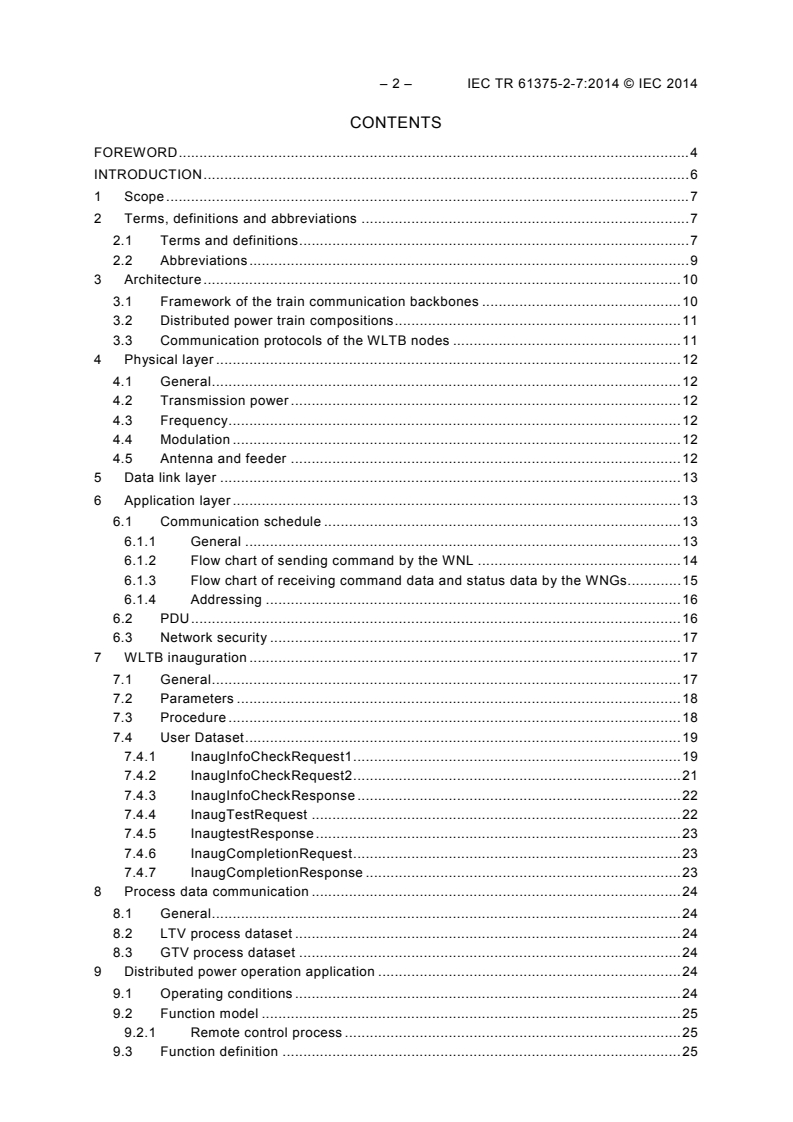
CONTENTS
FOREWORD . 4
INTRODUCTION . 6
1 Scope . 7
2 Terms, definitions and abbreviations . 7
2.1 Terms and definitions . 7
2.2 Abbreviations . 9
3 Architecture . 10
3.1 Framework of the train communication backbones . 10
3.2 Distributed power train compositions . 11
3.3 Communication protocols of the WLTB nodes . 11
4 Physical layer . 12
4.1 General . 12
4.2 Transmission power . 12
4.3 Frequency . 12
4.4 Modulation . 12
4.5 Antenna and feeder . 12
5 Data link layer . 13
6 Application layer . 13
6.1 Communication schedule . 13
6.1.1 General . 13
6.1.2 Flow chart of sending command by the WNL . 14
6.1.3 Flow chart of receiving command data and status data by the WNGs. 15
6.1.4 Addressing . 16
6.2 PDU . 16
6.3 Network security . 17
7 WLTB inauguration . 17
7.1 General . 17
7.2 Parameters . 18
7.3 Procedure . 18
7.4 User Dataset . 19
7.4.1 InaugInfoCheckRequest1 . 19
7.4.2 InaugInfoCheckRequest2 . 21
7.4.3 InaugInfoCheckResponse . 22
7.4.4 InaugTestRequest . 22
7.4.5 InaugtestResponse . 23
7.4.6 InaugCompletionRequest . 23
7.4.7 InaugCompletionResponse . 23
8 Process data communication . 24
8.1 General . 24
8.2 LTV process dataset . 24
8.3 GTV process dataset . 24
9 Distributed power operation application . 24
9.1 Operating conditions . 24
9.2 Function model . 25
9.2.1 Remote control process . 25
9.3 Function definition . 25
9.3.1 General . 25
9.3.2 Train composition . 25
9.3.3 Operation direction . 26
9.3.4 Primary energy . 26
9.3.5 Main switch . 26
9.3.6 Air and pneumatics . 27
9.3.7 Traction and dynamic brake . 27
9.3.8 Emergency brake . 28
9.3.9 Equipment protection . 28
9.3.10 Handling of communication loss . 28
9.3.11 Data verification . 28
Annex A (informative) Nation code specification . 29
Bibliography . 31
Figure 1 – Framework of the Train Communication Backbones . 10
Figure 2 – WLTB in a distributed power train composed of 3 traction vehicles . 11
Figure 3 – OSI-ISO model and structure of WLTB communication protocols . 11
Figure 4 – Example of communication in a train composed of 4 traction vehicles . 14
Figure 5 – Flow chart of sending command data by the WNL . 15
Figure 6 – Flow chart of the GTV . 16
Figure 7 – Structure of PDU . 17
Figure 8 – Procedure of inauguration . 19
Figure 9 – Logic diagram of the remote control process . 25
Figure 10 – Train composition cases . 25
Table 1 – Channels and frequencies of the radio . 12
Table 2 – Specifications of the antenna and feeder . 13
Table 3 – Segments of the address for the WLTB node . 16
Table 4 – PDU for the inauguration . 17
Table 5 – InaugInfoCheckRequest1 user dataset . 20
Table 6 – InaugInfoCheckRequest2 user dataset . 21
Table 7 – InaugInfoCheckResponse user dataset . 22
Table 8 – InaugTestRequest user dataset . 22
Table 9 – InaugTestResponse user dataset . 23
Table 10 – InaugCompletionRequest user dataset . 23
Table 11 – InaugCompletionResponse user dataset . 23
Table 12 – LTV process dataset. 24
Table 13 – GTV process dataset . 24
Table A.1 – Nation identification code . 29
– 4 – IEC TR 61375-2-7:2014 © IEC 2014
INTERNATIONAL ELECTROTECHNICAL COMMISSION
____________
ELECTRONIC RAILWAY EQUIPMENT –
TRAIN COMMUNICATION NETWORK (TCN) –
Part 2-7: Wireless Train Backbone (WLTB)
FOREWORD
1) The International Electrotechnical Commission (IEC) is a worldwide organization for standardization comprising
all national electrotechnical committees (IEC National Committees). The object of IEC is to promote
international co-operation on all questions concerning standardization in the electrical and electronic fields. To
this end and in addition to other activities, IEC publishes International Standards, Technical Specifications,
Technical Reports, Publicly Available Specifications (PAS) and Guides (hereafter referred to as “IEC
Publication(s)”). Their preparation is entrusted to technical committees; any IEC National Committee interested
in the subject dealt with may participate in this preparatory work. International, governmental and non-
governmental organizations liaising with the IEC also participate in this preparation. IEC collaborates closely
with the International Organization for Standardization (ISO) in accordance with conditions determined by
agreement between the two organizations.
2) The formal decisions or agreements of IEC on technical matters express, as nearly as possible, an international
consensus of opinion on the relevant subjects since each technical committee has representation from all
interested IEC National Committees.
3) IEC Publications have the form of recommendations for international use and are accepted by IEC National
Committees in that sense. While all reasonable efforts are made to ensure that the technical content of IEC
Publications is accurate, IEC cannot be held responsible for the way in which they are used or for any
misinterpretation by any end user.
4) In order to promote international uniformity, IEC National Committees undertake to apply IEC Publications
transparently to the maximum extent possible in their national and regional publications. Any divergence
between any IEC Publication and the corresponding national or regional publication shall be clearly indicated in
the latter.
5) IEC itself does not provide any attestation of conformity. Independent certification bodies provide conformity
assessment services and, in some areas, access to IEC marks of conformity. IEC is not responsible for any
services carried out by independent certification bodies.
6) All users should ensure that they have the latest edition of this publication.
7) No liability shall attach to IEC or its directors, employees, servants or agents including individual experts and
members of its technical committees and IEC National Committees for any personal injury, property damage or
other damage of any nature whatsoever, whether direct or indirect, or for costs (including legal fees) and
expenses arising out of the publication, use of, or reliance upon, this IEC Publication or any other IEC
Publications.
8) Attention is drawn to the Normative references cited in this publication. Use of the referenced publications is
indispensable for the correct application of this publication.
9) Attention is drawn to the possibility that some of the elements of this IEC Publication may be the subject of
patent rights. IEC shall not be held responsible for identifying any or all such patent rights.
The main task of IEC technical committees is to prepare International Standards. However, a
technical committee may propose the publication of a technical report when it has collected
data of a different kind from that which is normally published as an International Standard, for
example "state of the art".
IEC TR 61375-2-7, which is a technical report, has been prepared by IEC technical
committee 9: Electrical equipment and systems for railways.
The text of this technical report is based on the following documents:
Enquiry draft Report on voting
9/1768/DTR 9/1797A/RVC
Full information on the voting for the approval of this technical report can be found in the
report on voting indicated in the above table.
This publication has been drafted in accordance with the ISO/IEC Directives, Part 2.
A list of all parts of IEC 61375 series, under the general title Electronic railway equipment –
Train Communication Network (TCN), can be found on the IEC website.
The committee has decided that the contents of this publication will remain unchanged until
the stability date indicated on the IEC web site under "http://webstore.iec.ch" in the data
related to the specific publication. At this date, the publication will be
• reconfirmed,
• withdrawn,
• replaced by a revised edition, or
• amended.
A bilingual version of this publication may be issued at a later date.
IMPORTANT – The 'colour inside' logo on the cover page of this publication indicates
that it contains colours which are considered to be useful for the correct
understanding of its contents. Users should therefore print this document using a
colour printer.
– 6 – IEC TR 61375-2-7:2014 © IEC 2014
INTRODUCTION
IEC TR 61375-2-7 has been prepared by IEC technical committee 9: Electrical equipment and
systems for railways, in the frame of the IEC 61375 series.
Considering that:
a) inauguration is not automatic;
b) some parameters are configured manually in the guided traction vehicle;
c) the parameters required in the leading traction vehicle depend on the application;
d) inauguration verification is manual and based on checking pressure in the train pipe;
IEC technical committee 9 decided to consider the result of the preparation work not suitable
for being an international standard within the IEC 61375 series, nevertheless decided to
publish the result of the work as a technical report which can offer to the reader the status of
the technology used for the implementation of a radio based train communication network.
ELECTRONIC RAILWAY EQUIPMENT –
TRAIN COMMUNICATION NETWORK (TCN) –
Part 2-7: Wireless Train Backbone (WLTB)
1 Scope
This part of IEC 61375 describes the protocols stack of a radio based Wireless Train
Backbone which is used in distributed power freight trains. This part provides information on
the physical layer, the data link layer, the application layer and distributed power application.
The automatic inauguration of the radio based Wireless Train Backbone is not considered in
this technical report.
2 Terms, definitions and abbreviations
For the purposes of this document, the following terms, definitions and abbreviations apply.
2.1 Terms and definitions
2.1.1
application layer
upper layer in the OSI model, interfacing directly to the application
2.1.2
application process
element within a real open system which performs the information processing for a particular
application
2.1.3
broadcast
nearly simultaneous transmission of the same information to several destinations
2.1.4
bus
communication medium which broadcasts the same information to all attached participants at
nearly the same time, allowing all devices to obtain the same sight of its state, at least for the
purpose of arbitration
2.1.5
communication devices
devices connected to consist network or train backbone with the ability to source and sink
data.
2.1.6
composition
number and characteristics of the vehicles forming a train
2.1.7
configuration
definition of the topology of a network, the devices connected to it, their capabilities and the
traffic they produce; by extension, the operation of loading the devices with the configuration
information before going to regular operation
– 8 – IEC TR 61375-2-7:2014 © IEC 2014
2.1.8
consist
single vehicle or a group of vehicles which are not separated during normal operation
Note 1 to entry: A consist contains no, one or several consist networks.
2.1.9
consist network
communication network interconnecting communication devices in one consist
2.1.10
function
application process which exchanges messages with another application process
2.1.11
gateway
connection between different communication technologies
2.1.12
inauguration
operation executed in case of composition change, which gives all nodes of the train
backbone their train backbone address, their orientation and information about all named
nodes on the same backbone
2.1.13
leading traction vehicle
the traction vehicle at the extremity towards the operation direction
2.1.14
medium
physical carrier of the signal: electrical wires, optical fibre, wireless, etc.
2.1.15
medium access control
sub-layer of the data link layer, which controls the access to the medium
2.1.16
message
data item transmitted in one or several packets
2.1.17
multi-hop relay communication
communication with each other through the relay function of the other devices for the devices
not able to communicate directly
2.1.18
network address
address which identifies a communication device on network layer
2.1.19
network layer
layer in the OSI model responsible for routing between different busses
2.1.20
node
device on the train backbone, which may act as a gateway between train backbone and
consist network
2.1.21
operation direction
travelling direction for a train along railway line from one station to another station, normally
designated as two directions, i.e. up and down
2.1.22
operator
enterprise or organization which is operating trains
2.1.23
packet
unit of a message (information, acknowledgement or control) transmitted by protocols on
network or transport layer
2.1.24
guided traction vehicle
the traction vehicles except the leading traction vehicle of the train
2.1.25
train communication network
data communication network for connecting programmable electronic equipment on-board rail
vehicles
2.1.26
transport layer
layer of the OSI model responsible for end-to-end flow control and error recovery
2.1.27
wireless train backbone
a wireless train communication network for connecting the vehicles of a train
2.1.28
wireless train backbone node
device connected to the wireless train backbone for connecting end devices or consist
networks to the wireless train backbone
2.2 Abbreviations
CAN Control Area Network
CN Consist Network
ECN Ethernet Consist Network
ETB Ethernet Train Backbone
GTV Guided Traction Vehicle
ISO International Standardization Organization
LTV Leading Traction Vehicle
MAC Medium Access Control
MVB Multi-function Vehicle Bus
OSI Open System Interconnect
PD Process Data
PDU Protocol Data Unit
TCP/IP Transport Control Protocol /Internet Protocol
UDP User Datagram Protocol
VCU Vehicle Control Unit
– 10 – IEC TR 61375-2-7:2014 © IEC 2014
VSWR Voltage Standing Wave Ratio
WLTB Wireless Train Backbone
WLTBN Wireless Train Backbone Node
WNG Wireless train backbone Node of Guided traction vehicle
WNL Wireless train backbone Node of Leading traction vehicle
WTB Wire Train Bus
3 Architecture
3.1 Framework of the train communication backbones
The radio based WLTB is one of the several train backbones of the IEC 61375 series. WLTB
is used for coupling the traction vehicles of a distributed power freight train. Figure 1
describes the framework of the train communication backbones within the IEC 61375 series.
IEC 1253/14
Figure 1 – Framework of the Train Communication Backbones
The WTB is a widely used train backbone. The communication protocols of the process data,
message data and the WTB inauguration are specified by IEC 61375-2-1 and the information
transmission over WTB is specified by UIC 556. The applications, in the field of traction,
brakes, diagnosis, are specified by a series of the UIC documents, such as UIC 647, UIC 541
and UIC 557, respectively.
The ETB is a wide bandwidth train backbone. The physical layer to the application layer of the
ETB, including the data link, IP, TCP, UDP and the ETB inauguration protocols are specified
by future IEC 61375-2-5. The communication profile, including the train real-time data
protocol, the universal recourse identity addressing and the safety communication are
specified in future IEC 61375-2-3. The detailed data for the control and status of a specific
device is specified by the application profile in future IEC 61375-2-4.
The following considerations apply:
• wiring along the freight cars is typically not available;
• retrofit of cables may be non-economic;
• total distance between the traction vehicles in the composition may exceed the maximum
transmission length of the WTB/ETB.
WLTB, which is based on the wireless communication between the traction vehicles, is a
proper solution for the transmission of the commands and status data is needed for the
distributed power train.
The WLTB is a radio based backbone for trains with distributed power traction.
The protocols of the WLTB, including the physical layer, data link layer, the manual
inauguration and the data transmission over the WLTB are described in this technical report.
3.2 Distributed power train compositions
The distributed power freight train is composed of at least 2 traction vehicles and a number of
freight cars with the traction vehicles distributed among the train. The train pipe is connected
through all the train and the communication between the different traction vehicles is used for
managing the distributed power.
Figure 2 gives an example of the WLTB for a distributed power train composed of 3 traction
vehicles.
IEC 1254/14
Figure 2 – WLTB in a distributed power train composed of 3 traction vehicles
In the distributed power train, one traction vehicle in the train is selected as the LTV, others
are GTVs. The driver in the LTV controls the traction and braking of the LTV by manipulating
the control panel on the driver’s desk. The GTVs receive commands from the LTV for traction
and braking control and transmit their status to the LTV via the WLTB.
3.3 Communication protocols of the WLTB nodes
The OSI-ISO model and the communication protocols of the WLTB node are shown
in Figure 3.
IEC 1255/14
Figure 3 – OSI-ISO model and structure of WLTB communication protocols
– 12 – IEC TR 61375-2-7:2014 © IEC 2014
Comparing with the OSI-ISO model, the WLTB protocol stack includes the radio physical layer,
data link layer and application layer. The communication schedule, structure of PDUs, manual
inauguration and related dataset, and the process data transmission are within the application
layer.
4 Physical layer
4.1 General
The physical layer is based on the Chinese standard “Technical specification of the end of the
train with 800 MHz radio and the train safety pre-alarm system”, which specifies the
management of the end of the train by radio communication.
4.2 Transmission power
The transmission power of the radio is dependent on the distributed power application
requirement and the local regulations. According to the distance between the neighbour
traction vehicles, the transmission power may be adjusted, providing that the values
requested to obey the local regulations are not exceeded.
4.3 Frequency
In order to avoid interference between different trains along the railway lines, the WLTB
nodes provide several alternative radio frequencies. Table 1 lists the 8 channels and
frequencies used by WLTB. In case that the frequencies are conflicting with the regulations of
the radio administration authority, the operator applies for alternative frequencies compliant
with such regulations.
Table 1 – Channels and frequencies of the radio
Channel number Frequency
MHz
1 822,237 5
2 822,737 5
3 823,237 5
4 823,737 5
5 867,237 5
6 867,737 5
7 868,237 5
8 868,737 5
4.4 Modulation
The modulation of the radio is continuous-phase frequency shift keying.
4.5 Antenna and feeder
In order to guarantee the communication performances, the specifications of the antenna and
feeder are shown in Table 2.
Table 2 – Specifications of the antenna and feeder
Parameters Value
Frequency 815 MHz to 875 MHz
Gain of antenna
>4 dB
Attenuation of the feeder <1,5 dB
Impedance
50 Ω
VSWR
...