

IEC 61406-2:2024
(Main)Identification link - Part 2: Types/models, lots/batches, items and characteristics
General Information
- Abstract
IEC 61406-2:2024 complements IEC 61406-1 by providing additional requirements for those cases where data elements are encoded within the Structured Identification Link string with standardized syntax and semantics.
In addition, this document covers cases where the uniqueness relates to product types/models or lots/batches. The default assumption is that the Identification Link identifies unique objects such as unique serialized products, assets, persons or packages, unless otherwise identified.
- Status
- Published
- Publication Date
- 07-May-2024
- Technical Committee
- SC 65E - Devices and integration in enterprise systems
- Drafting Committee
- WG 2 - TC 65/SC 65E/WG 2
- Current Stage
- PPUB - Publication issued
- Start Date
- 08-May-2024
- Completion Date
- 31-May-2024
Overview
IEC 61406-2:2024, titled Identification Link - Part 2: Types/models, lots/batches, items and characteristics, is an international standard issued by the International Electrotechnical Commission (IEC). It complements IEC 61406-1 by specifying additional requirements for encoding data elements within Structured Identification Link strings using standardized syntax and semantics. The standard specifically addresses uniqueness scenarios related to product types, models, and manufacturing lots or batches.
This standard is essential for organizations and industries that require consistent and precise identification and traceability of products, assets, persons, or packages. By defining robust methods for linking types, models, and batch information within Identification Links, IEC 61406-2 helps ensure interoperability, data integrity, and efficient management of object identity in digital ecosystems.
Key Topics
- Structured Identification Links: The standard defines how to encode data elements as URL parameters within Identification Links, each representing attributes such as product type, model, lot, batch, or serialized item.
- Data Identifier Standards: Requirements are set for parameter value conformity according to established Data Identifier specifications to ensure uniformity.
- Uniqueness Rules: IEC 61406-2 emphasizes the uniqueness of Identification Links within defined domains to inhibit ambiguity in object identification.
- Traceability and Serialization: Specific rules cover traceability numbers, license plates, and serialization practices to support supply chain transparency and product lifecycle management.
- Identification Link Frame: The document outlines framing mechanisms for Identification Links corresponding to product types, models, lots, or batches.
- Use Cases and Examples: Informative annexes provide practical illustrations with serialized and non-serialized items, humans, storage locations, and other object types.
- Digital Signature and Authentication: The standard includes guidance on embedding digital signatures conforming to ISO/IEC 20248, enhancing Identification Link security.
- Compatibility: Integrates with other standards like TM IEEE 802.1AR for embedding Identification Links into device identifiers (DevIDs).
Applications
IEC 61406-2:2024 is highly valuable in various professional and industrial contexts, including:
- Product Identification and Traceability: Enables manufacturers and distributors to assign consistent, globally recognized identifiers to types, models, and production batches for improved quality control and recall management.
- Supply Chain Management: Facilitates accurate tracking of lots and batches throughout supply chains, supporting anti-counterfeiting efforts and inventory transparency.
- Asset Management: Assists in uniquely identifying physical assets in complex environments such as manufacturing plants, warehouses, or logistics operations.
- Digital Product Passports: Supports initiatives that require detailed digital records of product characteristics, origins, and lifecycle events.
- Regulatory Compliance: Helps organizations meet regulatory demands for standardized identification of goods and components within electrical, electronic, and related technologies.
- Data Interoperability: Ensures systems exchanging identification data can interpret and validate encoded information reliably, fostering seamless integration across platforms.
Related Standards
To maximize the benefits of IEC 61406-2, familiarity with the following related standards and specifications is recommended:
- IEC 61406-1: The foundational part of the Identification Link series focusing on the basic structure and principles.
- ISO/IEC 20248: Specifies digital signatures for supporting authentication of Identification Links.
- TM IEEE 802.1AR-2018: Defines Device Identity (DevID) concepts and frame structures compatible with Identification Link embedding.
- Global Data Identifier (GDI) Standards: Provide rules and semantics for parameter values in Identification Links.
- Other IEC and ISO traceability and serialization standards: Complement IEC 61406-2 by covering specific industry requirements and terminologies for identification systems.
Keywords: IEC 61406-2, Identification Link, product types, models, lots, batches, serialization, traceability, digital product passports, ISO/IEC 20248, unique identifiers, supply chain management, asset identification, standardized syntax, data identifiers, IEC standards.
Get Certified
Connect with accredited certification bodies for this standard

BSI Group
BSI (British Standards Institution) is the business standards company that helps organizations make excellence a habit.

NYCE
Mexican standards and certification body.
Sponsored listings
Frequently Asked Questions
IEC 61406-2:2024 is a standard published by the International Electrotechnical Commission (IEC). Its full title is "Identification link - Part 2: Types/models, lots/batches, items and characteristics". This standard covers: IEC 61406-2:2024 complements IEC 61406-1 by providing additional requirements for those cases where data elements are encoded within the Structured Identification Link string with standardized syntax and semantics. In addition, this document covers cases where the uniqueness relates to product types/models or lots/batches. The default assumption is that the Identification Link identifies unique objects such as unique serialized products, assets, persons or packages, unless otherwise identified.
IEC 61406-2:2024 complements IEC 61406-1 by providing additional requirements for those cases where data elements are encoded within the Structured Identification Link string with standardized syntax and semantics. In addition, this document covers cases where the uniqueness relates to product types/models or lots/batches. The default assumption is that the Identification Link identifies unique objects such as unique serialized products, assets, persons or packages, unless otherwise identified.
IEC 61406-2:2024 is classified under the following ICS (International Classification for Standards) categories: 35.040.50 - Automatic identification and data capture techniques; 35.240.15 - Identification cards. Chip cards. Biometrics. The ICS classification helps identify the subject area and facilitates finding related standards.
IEC 61406-2:2024 is available in PDF format for immediate download after purchase. The document can be added to your cart and obtained through the secure checkout process. Digital delivery ensures instant access to the complete standard document.
Standards Content (Sample)
IEC 61406-2 ®
Edition 1.0 2024-05
INTERNATIONAL
STANDARD
NORME
INTERNATIONALE
Identification link –
Part 2: Types/models, lots/batches, items and characteristics
Lien d’identification –
Partie 2: Types/modèles, lots/lots unitaires, éléments et caractéristiques
All rights reserved. Unless otherwise specified, no part of this publication may be reproduced or utilized in any form
or by any means, electronic or mechanical, including photocopying and microfilm, without permission in writing from
either IEC or IEC's member National Committee in the country of the requester. If you have any questions about IEC
copyright or have an enquiry about obtaining additional rights to this publication, please contact the address below or
your local IEC member National Committee for further information.
Droits de reproduction réservés. Sauf indication contraire, aucune partie de cette publication ne peut être reproduite ni
utilisée sous quelque forme que ce soit et par aucun procédé, électronique ou mécanique, y compris la photocopie et
les microfilms, sans l'accord écrit de l'IEC ou du Comité national de l'IEC du pays du demandeur. Si vous avez des
questions sur le copyright de l'IEC ou si vous désirez obtenir des droits supplémentaires sur cette publication, utilisez
les coordonnées ci-après ou contactez le Comité national de l'IEC de votre pays de résidence.
IEC Secretariat Tel.: +41 22 919 02 11
3, rue de Varembé info@iec.ch
CH-1211 Geneva 20 www.iec.ch
Switzerland
About the IEC
The International Electrotechnical Commission (IEC) is the leading global organization that prepares and publishes
International Standards for all electrical, electronic and related technologies.
About IEC publications
The technical content of IEC publications is kept under constant review by the IEC. Please make sure that you have the
latest edition, a corrigendum or an amendment might have been published.
IEC publications search - webstore.iec.ch/advsearchform IEC Products & Services Portal - products.iec.ch
The advanced search enables to find IEC publications by a Discover our powerful search engine and read freely all the
variety of criteria (reference number, text, technical publications previews, graphical symbols and the glossary.
committee, …). It also gives information on projects, replaced With a subscription you will always have access to up to date
and withdrawn publications. content tailored to your needs.
IEC Just Published - webstore.iec.ch/justpublished
Electropedia - www.electropedia.org
Stay up to date on all new IEC publications. Just Published
The world's leading online dictionary on electrotechnology,
details all new publications released. Available online and once
containing more than 22 500 terminological entries in English
a month by email.
and French, with equivalent terms in 25 additional languages.
Also known as the International Electrotechnical Vocabulary
IEC Customer Service Centre - webstore.iec.ch/csc
(IEV) online.
If you wish to give us your feedback on this publication or need
further assistance, please contact the Customer Service
Centre: sales@iec.ch.
A propos de l'IEC
La Commission Electrotechnique Internationale (IEC) est la première organisation mondiale qui élabore et publie des
Normes internationales pour tout ce qui a trait à l'électricité, à l'électronique et aux technologies apparentées.
A propos des publications IEC
Le contenu technique des publications IEC est constamment revu. Veuillez vous assurer que vous possédez l’édition la
plus récente, un corrigendum ou amendement peut avoir été publié.
Recherche de publications IEC - IEC Products & Services Portal - products.iec.ch
webstore.iec.ch/advsearchform Découvrez notre puissant moteur de recherche et consultez
La recherche avancée permet de trouver des publications IEC gratuitement tous les aperçus des publications, symboles
en utilisant différents critères (numéro de référence, texte, graphiques et le glossaire. Avec un abonnement, vous aurez
comité d’études, …). Elle donne aussi des informations sur les toujours accès à un contenu à jour adapté à vos besoins.
projets et les publications remplacées ou retirées.
Electropedia - www.electropedia.org
IEC Just Published - webstore.iec.ch/justpublished
Le premier dictionnaire d'électrotechnologie en ligne au monde,
Restez informé sur les nouvelles publications IEC. Just
avec plus de 22 500 articles terminologiques en anglais et en
Published détaille les nouvelles publications parues.
français, ainsi que les termes équivalents dans 25 langues
Disponible en ligne et une fois par mois par email.
additionnelles. Egalement appelé Vocabulaire
Electrotechnique International (IEV) en ligne.
Service Clients - webstore.iec.ch/csc
Si vous désirez nous donner des commentaires sur cette
publication ou si vous avez des questions contactez-nous:
sales@iec.ch.
IEC 61406-2 ®
Edition 1.0 2024-05
INTERNATIONAL
STANDARD
NORME
INTERNATIONALE
Identification link –
Part 2: Types/models, lots/batches, items and characteristics
Lien d’identification –
Partie 2: Types/modèles, lots/lots unitaires, éléments et caractéristiques
INTERNATIONAL
ELECTROTECHNICAL
COMMISSION
COMMISSION
ELECTROTECHNIQUE
INTERNATIONALE
ICS 35.040.50, 35.240.15 ISBN 978-2-8322-8886-3
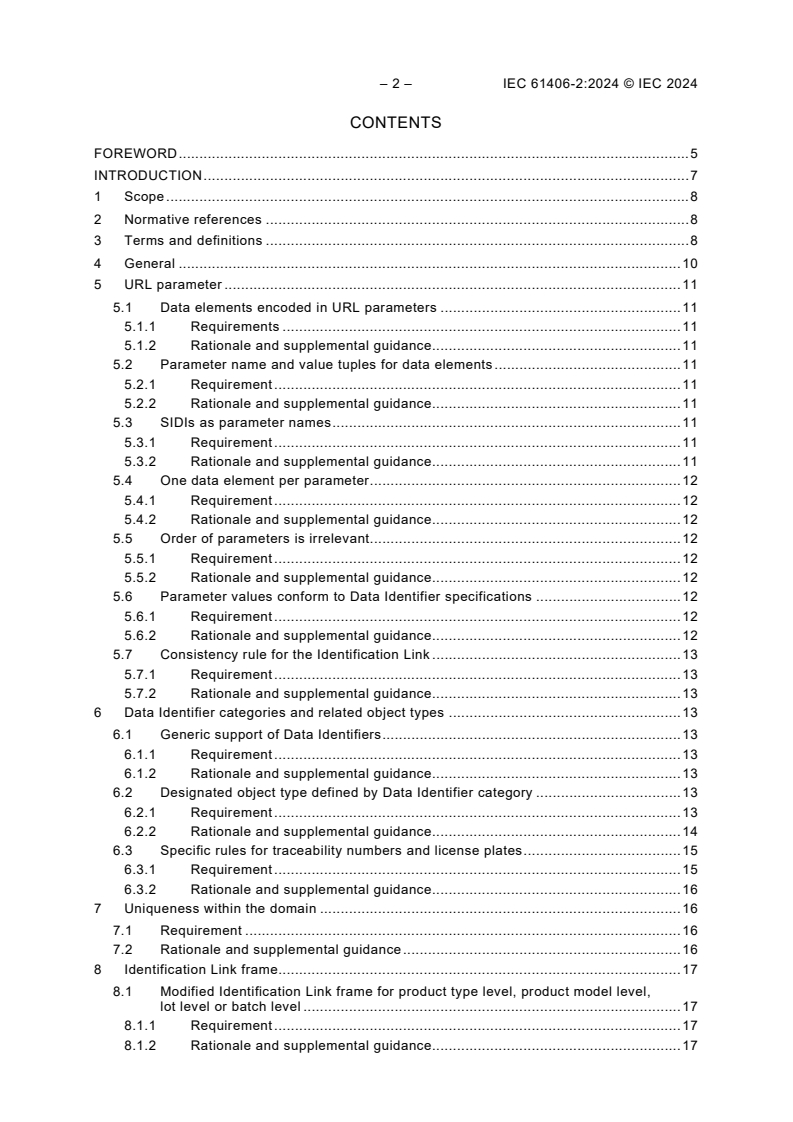
– 2 – IEC 61406-2:2024 © IEC 2024
CONTENTS
FOREWORD . 5
INTRODUCTION . 7
1 Scope . 8
2 Normative references . 8
3 Terms and definitions . 8
4 General . 10
5 URL parameter . 11
5.1 Data elements encoded in URL parameters . 11
5.1.1 Requirements . 11
5.1.2 Rationale and supplemental guidance. 11
5.2 Parameter name and value tuples for data elements . 11
5.2.1 Requirement . 11
5.2.2 Rationale and supplemental guidance. 11
5.3 SIDIs as parameter names . 11
5.3.1 Requirement . 11
5.3.2 Rationale and supplemental guidance. 11
5.4 One data element per parameter . 12
5.4.1 Requirement . 12
5.4.2 Rationale and supplemental guidance. 12
5.5 Order of parameters is irrelevant. 12
5.5.1 Requirement . 12
5.5.2 Rationale and supplemental guidance. 12
5.6 Parameter values conform to Data Identifier specifications . 12
5.6.1 Requirement . 12
5.6.2 Rationale and supplemental guidance. 12
5.7 Consistency rule for the Identification Link . 13
5.7.1 Requirement . 13
5.7.2 Rationale and supplemental guidance. 13
6 Data Identifier categories and related object types . 13
6.1 Generic support of Data Identifiers . 13
6.1.1 Requirement . 13
6.1.2 Rationale and supplemental guidance. 13
6.2 Designated object type defined by Data Identifier category . 13
6.2.1 Requirement . 13
6.2.2 Rationale and supplemental guidance. 14
6.3 Specific rules for traceability numbers and license plates . 15
6.3.1 Requirement . 15
6.3.2 Rationale and supplemental guidance. 16
7 Uniqueness within the domain . 16
7.1 Requirement . 16
7.2 Rationale and supplemental guidance . 16
8 Identification Link frame. 17
8.1 Modified Identification Link frame for product type level, product model level,
lot level or batch level . 17
8.1.1 Requirement . 17
8.1.2 Rationale and supplemental guidance. 17
8.2 Identification Link frames only for physical objects . 18
8.2.1 Requirement . 18
8.2.2 Rationale and supplemental guidance. 18
Annex A (informative) Example of process flow for parsing . 19
Annex B (informative) Examples of Structured Identification Link strings . 20
B.1 Serialized item . 20
B.1.1 General . 20
B.1.2 Example of a serialized item without product code . 20
B.1.3 Example of a serialized item without product code and scheme . 20
B.1.4 Example of a serialized item without product code, scheme and www . 21
B.1.5 Example of a serialized item with special top-level domain . 21
B.1.6 Example of a serialized item with product code in own data element. 22
B.1.7 Example of a serialized item with DUNS number as company code,
product code and serial number . 23
B.1.8 Example of a serialized item with product code, serial number,
production date, weight and capacity . 23
B.2 Non-serialized item . 24
B.2.1 General . 24
B.2.2 Example of a non-serialized item with product code and lot code . 25
B.2.3 Example of a non-serialized item with product code only . 25
B.2.4 Example of a non-serialized item with GTIN only . 26
B.2.5 Example of a product code and company code . 26
B.3 Cases other than items . 27
B.3.1 General . 27
B.3.2 Example of a human . 27
B.3.3 Example of a storage location . 27
Annex C (informative) Considerations for the use case of Identification Links in Digital
Product Passports . 29
Annex D (informative) Identification Link authentication: Inclusion of a digital signature
conforming to ISO/IEC 20248 . 30
Annex E (informative) Default hostname derived from IL string . 32
Annex F (informative) Embedding of IL Strings into DevIDs according to
TM
IEEE 802.1AR -2018 . 33
Bibliography . 35
Figure 1 – Identification Link frame with bevelled corner . 17
Figure A.1 – Example of process flow for parsing . 19
Table 1 – Kinds of objects and related Data Identifier categories . 14
Table 2 – Traceability numbers and license plates for products and packages . 15
Table B.1 – Structure of example of a serialized item without recognizable product
code . 20
Table B.2 – Structure of example of a serialized item without product code and scheme . 21
Table B.3 – Structure of example of a serialized item without product code, scheme
and www . 21
Table B.4 – Structure of example of a serialized item with special top-level domain . 22
Table B.5 – Structure of example of a serialized item with product code in own data
element. 22
– 4 – IEC 61406-2:2024 © IEC 2024
Table B.6 – Structure of example serialized item with DUNS number, product code and
serial number . 23
Table B.7 – Structure of example of a serialized item with product code in own data
element. 24
Table B.8 – Structure of example with product code and lot code. 25
Table B.9 – Structure of example with product code only . 25
Table B.10 – Structure of example with product code only . 26
Table B.11 – Structure of example with product code only . 26
Table B.12 – Structure of example of a human . 27
Table B.13 – Structure of example for a storage location . 28
Table D.1 – Readmethods . 30
Table E.1 – Example 1 for derived default hostname from IL string . 32
Table E.2 – Example 2 for derived default hostname from IL string . 32
Table F.1 – Additional ABNF Core Rules . 33
Table F.2 – ABNF Description for a DevID URI . 33
INTERNATIONAL ELECTROTECHNICAL COMMISSION
____________
IDENTIFICATION LINK –
Part 2: Types/models, lots/batches, items and characteristics
FOREWORD
1) The International Electrotechnical Commission (IEC) is a worldwide organization for standardization comprising
all national electrotechnical committees (IEC National Committees). The object of IEC is to promote international
co-operation on all questions concerning standardization in the electrical and electronic fields. To this end and
in addition to other activities, IEC publishes International Standards, Technical Specifications, Technical Reports,
Publicly Available Specifications (PAS) and Guides (hereafter referred to as "IEC Publication(s)"). Their
preparation is entrusted to technical committees; any IEC National Committee interested in the subject dealt with
may participate in this preparatory work. International, governmental and non-governmental organizations liaising
with the IEC also participate in this preparation. IEC collaborates closely with the International Organization for
Standardization (ISO) in accordance with conditions determined by agreement between the two organizations.
2) The formal decisions or agreements of IEC on technical matters express, as nearly as possible, an international
consensus of opinion on the relevant subjects since each technical committee has representation from all
interested IEC National Committees.
3) IEC Publications have the form of recommendations for international use and are accepted by IEC National
Committees in that sense. While all reasonable efforts are made to ensure that the technical content of IEC
Publications is accurate, IEC cannot be held responsible for the way in which they are used or for any
misinterpretation by any end user.
4) In order to promote international uniformity, IEC National Committees undertake to apply IEC Publications
transparently to the maximum extent possible in their national and regional publications. Any divergence between
any IEC Publication and the corresponding national or regional publication shall be clearly indicated in the latter.
5) IEC itself does not provide any attestation of conformity. Independent certification bodies provide conformity
assessment services and, in some areas, access to IEC marks of conformity. IEC is not responsible for any
services carried out by independent certification bodies.
6) All users should ensure that they have the latest edition of this publication.
7) No liability shall attach to IEC or its directors, employees, servants or agents including individual experts and
members of its technical committees and IEC National Committees for any personal injury, property damage or
other damage of any nature whatsoever, whether direct or indirect, or for costs (including legal fees) and
expenses arising out of the publication, use of, or reliance upon, this IEC Publication or any other IEC
Publications.
8) Attention is drawn to the Normative references cited in this publication. Use of the referenced publications is
indispensable for the correct application of this publication.
9) IEC draws attention to the possibility that the implementation of this document may involve the use of (a)
patent(s). IEC takes no position concerning the evidence, validity or applicability of any claimed patent rights in
respect thereof. As of the date of publication of this document, IEC had not received notice of (a) patent(s), which
may be required to implement this document. However, implementers are cautioned that this may not represent
the latest information, which may be obtained from the patent database available at https://patents.iec.ch. IEC
shall not be held responsible for identifying any or all such patent rights.
IEC 61406-2 has been prepared by subcommittee 65E: Devices and integration in enterprise
systems, of IEC technical committee 65: Industrial-process measurement, control and
automation. It is an International Standard.
The text of this International Standard is based on the following documents:
Draft Report on voting
65E/1075/FDIS 65E/1081/RVD
Full information on the voting for its approval can be found in the report on voting indicated in
the above table.
The language used for the development of this International Standard is English.
– 6 – IEC 61406-2:2024 © IEC 2024
This document was drafted in accordance with ISO/IEC Directives, Part 2, and developed in
accordance with ISO/IEC Directives, Part 1 and ISO/IEC Directives, IEC Supplement, available
at www.iec.ch/members_experts/refdocs. The main document types developed by IEC are
described in greater detail at www.iec.ch/publications.
A list of all parts in the IEC 61406 series, published under the general title Identification Link,
can be found on the IEC website.
The committee has decided that the contents of this document will remain unchanged until the
stability date indicated on the IEC website under webstore.iec.ch in the data related to the
specific document. At this date, the document will be
• reconfirmed,
• withdrawn, or
• revised.
INTRODUCTION
For the encoded Identification Link (IL) string in IEC 61406-1 basic assumptions are:
• the Identification Link designates and links to exactly one individual physical object;
• the Identification Link does not require any additional syntactical or semantical intelligence
to use it.
In practice, these two assumptions do not always apply. IEC 61406-2 closes these gaps by
specifying additional requirements for cases where:
– data elements with standardized syntax and semantics are encoded in the Structured
Identification Link, which gives further information about the kind of identified object, for
example product, person, location or document. It can contain additional data elements or
classifications;
– for products, the Structured Identification Link can designate and link to the unique
information of lots/batches or product codes, and is not limited to the uniqueness of
individual items.
– 8 – IEC 61406-2:2024 © IEC 2024
IDENTIFICATION LINK –
Part 2: Types/models, lots/batches, items and characteristics
1 Scope
The part of IEC 61406 complements IEC 61406-1 by providing additional requirements for those
cases where data elements are encoded within the Structured Identification Link string with
standardized syntax and semantics.
In addition, this document covers cases where the uniqueness relates to product types/models
or lots/batches. The default assumption is that the Identification Link identifies unique objects
such as unique serialized products, assets, persons or packages, unless otherwise identified.
2 Normative references
The following documents are referred to in the text in such a way that some or all of their content
constitutes requirements of this document. For dated references, only the edition cited applies.
For undated references, the latest edition of the referenced document (including any
amendments) applies.
IEC 60050-351, International Electrotechnical Vocabulary (IEV) – Part 351: Control technology
(available at www.electropedia.org)
IEC 61406-1:2022, Identification Link – Part 1: General requirements
ISO/IEC 15418, Information technology – Automatic identification and data capture techniques
– GS1 Application Identifiers and ASC MH10 Data Identifiers and maintenance
ISO/IEC 19762:2016, Information technology – Automatic identification and data capture (AIDC)
techniques – Harmonized vocabulary
ANSI MH10.8.2, Data Identifier
IETF RFC 3986:2005, Uniform Resource Identifier (URI): Generic Syntax
3 Terms and definitions
For the purposes of this document, the terms, definitions and abbreviations given in
IEC 60050-351, ISO/IEC 19762, IEC 61406-1 and the following apply.
ISO and IEC maintain terminology databases for use in standardization at the following
addresses:
• IEC Electropedia: available at https://www.electropedia.org/
• ISO Online browsing platform: available at https://www.iso.org/obp
3.1
data carrier
device or medium used to store data as a relay mechanism in an AIDC system
Note 1 to entry: Bar code, OCR character string and RF tag are examples of data carriers.
[SOURCE: ISO/IEC 19762:2016, 01.01.59]
3.2
physical object
technical equipment such as vessels, units, machines, electronic devices and components,
assemblies, batteries, components, spare parts, etc.
3.3
product type
result of a specific development process for a range of products belonging to the same product
class
[SOURCE: IEC 62569-1:2017, 3.1.11]
3.4
lot
definite quantity of some commodity manufactured or produced under conditions that are
presumed uniform
Note 1 to entry: Lot is primarily a commercial term.
[SOURCE: ISO 15270:2008, 3.19]
3.5
batch
quantity of material regarded as a single unit, and having a unique reference
Note 1 to entry: Batch is primarily a processing term.
[SOURCE: ISO 15270:2008, 3.3]
3.6
Structured Identification Link
combination of 2D symbol or NFC tag and contained Structured Identification Link string
3.7
Structured Identification Link string
structured data string in URL syntax which is used for globally unique identification and which
points to related information on the internet
3.8
System Identifier Data Identifier
SIDI
combination of a dot "." as system identifier and an ISO/IEC 15418 conformant Data Identifier
EXAMPLE ".1P", ".S", ".18V", ".16D"
– 10 – IEC 61406-2:2024 © IEC 2024
4 General
This document provides:
• instructions on how to encode data elements in the Structured Identification Link string;
• instructions on how to distinguish Structured Identification Link strings conforming to
IEC 61406-2 from other URLs, including from generic Identification Link strings conforming
to IEC 61406-1;
• instructions on how to implicitly encode the level of uniqueness in data elements in the
Structured Identification Link string;
• instructions on how to alter the Structured Identification Link frame when the encoded
Structured Identification Link string does relate to unique lots/batches or product codes;
• rationale and additional information behind the requirements to aid understanding by the
user.
To ensure that the Structured Identification Link string can be easily and consistently processed
and interpreted by the various parties and that the existing markings are affected as little as
possible, this document reuses existing standards where possible. The syntax for data elements
conforms with IETF RFC 3986 and its method of encoding parameters in URLs. The semantics
are taken from ISO/IEC 15148 and ANSI MH10.8.2 because these require only a few additional
characters and are widely used in automatic identification.
An Identification Link complying with this document is designated as a "Structured Identification
Link".
EXAMPLE https://www.bestmanufacturer.com/asdf?.1P=A1B2C3&.S=123X45 shows a Structured Identification
Link for a manufacturer identified by the domain "bestmanufacturer.com" with the manufacturer-assigned product
code "A1B2C3" and the manufacturer-assigned serial number "123X45".
NOTE 1 In this document product type and product model are used as synonyms.
NOTE 2 In this document product lot and product batch are used as synonyms.
The informative Annex A provides an example of a process flow to parse Identification Link
strings.
The informative Annex B provides examples of Structured Identification Link strings.
The informative Annex C provides considerations for the use case of Identification Links in
Digital Product Passports.
The informative Annex D provides information on how to include a digital signature conforming
to ISO/IEC 20248 in the Structured Identification Link.
The informative Annex E provides information on how a default hostname can be derived from
an Identification Link string.
The informative Annex F provides information on how Identification Link Strings can be
TM
-2018.
embedded into DevIDs according to IEEE 802.1AR
5 URL parameter
5.1 Data elements encoded in URL parameters
5.1.1 Requirements
All data elements for product types or lot or batch identification, or characteristics, shall be
encoded as parameters in the query string according to IETF RFC 3986.
The manufacturer may include additional data elements elsewhere in the URL, for example in
the path or further parameters without the SIDI syntax. Such data elements are not expected to
be relevant for users other than the manufacturer.
5.1.2 Rationale and supplemental guidance
By using the existing URL syntax for parameters, the generic and widely established logic to
parse URLs can be used for extracting the data elements from the Structured Identification Link
string.
By having all structured information contained in URL parameters, and not within the other URL
components (host, path, fragment) of the URL there is no additional need to parse the path.
This reduces the complexity of the parsing and facilitates grouping or redirecting with the path.
EXAMPLE For redirecting: www.domain-abc.com/oldportal?.1P=1A2B3C&.S=54321
can be redirected to www.domain-abc.com/newportal?.1P=1A2B3C&.S=54321
5.2 Parameter name and value tuples for data elements
5.2.1 Requirement
The parameter name shall be the data element name and the parameter value shall be the data
element value.
5.2.2 Rationale and supplemental guidance
By using the existing URL syntax for parameters, the generic and widely established logic to
parse URLs can be used for extracting the data elements out of the URL in tuples of names and
values.
NOTE Parameter name and parameter value are separated by an equal sign "=".
5.3 SIDIs as parameter names
5.3.1 Requirement
The parameter name shall start with a dot "." as System Identifier and be followed by Data
Identifiers in conformance with ISO/IEC 15418.
Only parameters that have Data Identifiers in conformance with ISO/IEC 15418 shall start with
a dot ".".
5.3.2 Rationale and supplemental guidance
This concatenation of the System Identifier dot "." and a Data Identifier is abbreviated as "SIDI".
It has the format of a dot "." followed by zero to three digits and one uppercase alphabetic
character, i.e. a maximum number of four characters.
The dot "." as prefix for the Data Identifier serves as System Identifier to indicate that a data
element with an ISO/IEC 15418 Data Identifier follows.
– 12 – IEC 61406-2:2024 © IEC 2024
Parameters other than SIDIs are allowed but can be ignored when parsing the Structured
Identification Link string.
NOTE 1 ISO/IEC 15418 refers to ANSI MH 10.8.2 for the definitions of Data Identifiers.
NOTE 2 In ANSI MH 10.8.2 System Identifiers are designated as "flag characters".
NOTE 3 The dot "." has the code 46 in the ASCII table.
EXAMPLE ".1P", ".S", ".18V", ".16D"
5.4 One data element per parameter
5.4.1 Requirement
There shall be only one data element encoded per parameter.
5.4.2 Rationale and supplemental guidance
If more than one data element has to be encoded in the Structured Identification Link string,
the standard URL parsing logic can be used by taking a single parameter for each data element.
This does not preclude the use of the data structures and semantics defined in ISO/IEC 15418
or ANSI MH 10.8.2 for specific data identifiers. Multiple pieces of information can be combined
in the data element value.
Parameter names can be repeated in the Structured Identification Link string, for example when
several lots are included in one package.
5.5 Order of parameters is irrelevant
5.5.1 Requirement
There shall be no logic encoded in the order of the parameters in the string.
5.5.2 Rationale and supplemental guidance
The order of parameters can easily be lost during processing in databases. Requirements on
the order of the parameters would add complexity in subsequent processing and are not
necessary because of the standardized semantics of the Data Identifiers.
5.6 Parameter values conform to Data Identifier specifications
5.6.1 Requirement
Parameter values associated with SIDIs used as parameter names shall conform in syntax and
semantics to the specifications of ISO/IEC 15418 and ANSI MH 10.8.2 Data Identifiers.
5.6.2 Rationale and supplemental guidance
ISO/IEC 15418 points to ANSI MH 10.8.2 for the definitions of the Data Identifiers and the
associated syntax and semantics. Data Identifiers have been standardized for decades and are
well-established in barcode applications. This encoding requires only a few characters, which
is an important aspect of the 2D-code size.
The Structured Identification Link string can also include parameters that do not use SIDIs, for
example for internal data of the manufacturer that is not expected to be processed and
interpreted by others.
NOTE 1 ISO/IEC 15418 Data Identifiers have the structure of zero to three integers followed by one uppercase
alphabetic character.
NOTE 2 New Data Identifiers can be requested from the Data Identifier Maintenance Committee (DIMC).
NOTE 3 Some Data Identifiers can be based on intellectual properties or require membership fees, for example for
third-party codes or classifications.
5.7 Consistency rule for the Identification Link
5.7.1 Requirement
If there is one or more parameter names in the format of a SIDI, then the Identification Link
shall conform to all applicable rules from IEC 61406-1 and IEC 61406-2.
5.7.2 Rationale and supplemental guidance
The existence of one or more parameter names in the format of a SIDI is the criterion for
determining whether the IL string is a Structured Identification Link string conforming to this
document.
If there is no SIDI parameter in the IL string, then this means it is an IL string conforming only
to IEC 61406-1, for a product unique at the item level and with no data elements encoded for
processing by users other than the manufacturer.
6 Data Identifier categories and related object types
6.1 Generic support of Data Identifiers
6.1.1 Requirement
All SIDIs from all categories of ISO/IEC 15418 Data Identifiers are allowed in the data structures
of Structured Identification Links, but application specific requirements, standards or
agreements can determine that a specific subset of SIDIs shall be used.
6.1.2 Rationale and supplemental guidance
The potential usage of Structured Identification Links is not limited to individual physical objects,
product types, lots or batches but may also be used for other kinds of objects.
Some categories such as dates or measurements are not restricted to specific object types.
Different applications can require different categories of Data Identifiers and different Data
Identifiers within categories.
EXAMPLE Where a Structured Identification Link is used for purposes other than for individual physical objects,
product types, lots or batches:
".L" Storage Location, in category Location Reference
".5H" Last Name, in category Human Resources
".J" Unique license plate number, in category License Plate
NOTE The complete and latest specifications of Data Identifiers, their categories and explanations are in ANSI MH
10.8.2 Data Identifier.
6.2 Designated object type defined by Data Identifier category
6.2.1 Requirement
The Data Identifier category of the SIDI used shall specify the type of object identified by the
Structured Identification Link as shown in Table 1.
– 14 – IEC 61406-2:2024 © IEC 2024
Table 1 – Kinds of objects and related Data Identifier categories
Kind of object ANSI MH 10.8.2 ANSI MH 10.8.2 Combined Notes and
category name category with exceptions
alphabetic
character
Product on individual item Item information P S
level
Product on lot/batch code Item information P "T" and no
level "S" present
Traceability T
number for
groups of entities
Product on product code Item information P No "S" and
no "T"
level
present
Product on individual item Traceability S Code specific for
level number for an either product on
or individual package entity individual item level
or individual package
See specific rules for
category "traceability
number for an entity"
Package License plate J J and 1J to 6J:
package
otherwise code
specific
Container Container B
Information
Human Human resources H
Location Location L Identification Link
reference frame shall not be
used as it is reserved
for physical objects
Organization Party to the V
Transaction
Depending on specific Data Industry assigned N Code The category alone
Identifier codes specific does not give a hint
about the kind of
object which is
identified. The
concrete Data
Identifier shall be
interpreted.
6.2.2 Rationale and supplemental guidance
The object type is indicated by the associated SIDIs. Where no SIDIs are used, the product is
identified by the individual item level.
Some categories such as for dates or measurements are typically not suited for the
determination of the kind of object.
When there is no entry in column “Combined with” this is to be interpreted as “further categories
are not relevant and can be ignored”.
Mixing several Data Identifier categories in one Structured Identification Link can lead to
challenges to determine the associated kind of object. This should be avoided when possible.
Further rules may be specified in application standards.
6.3 Specific rules for traceability numbers and license plates
6.3.1 Requirement
When SIDIs with Data Identifiers from the categories "traceability number for an entity" or
"license plate" are used and indicate whether the Structured Identification Link relates to a
product or to a package, then only the Data Identifiers from Table 2 shall be used.
Table 2 – Traceability numbers and license plates for products and packages
Data Explanation in ANSI MH 10.8.2 Relates to Relates to
Identifier product package
S Serial Number or Code Assigned by the Supplier to an Entity yes no
for its Lifetime, (e.g., computer serial number, traceability
number, contract tool identification).
1S Additional Code Assigned by the Supplier to an Entity for its yes no
Lifetime (e.g., traceability number, computer serial number).
10S Machine, Cell, or Tool ID Code. yes no
11S Fixed Asset ID Code. yes no
15S Serial Number Assigned by the Vendor Entity, that can only yes no
be used in conjunction with "13V".
18S CAGE Code & Serial Number Unique Within CAGE. yes no
20S Traceability Code for an Entity Assigned by the Customer. yes no
21S Tire Identification Number as defined by the U.S. Department yes no
of Transportation (D.O.T) under U.S. Code 49 CFR 574.5.
25S Identification of a party to a transaction assigned by a holder yes no
of a Company Identification Number (CIN) and including the
related Issuing Agency Code (IAC) in accordance with
ISO/IEC 15459 and its registry, structured as a sequence of 3
concatenated data elements: IAC, followed by CIN, followed
by the supplier assign serial number that is unique within the
CIN holder's domain.
26S Equipment Identifier yes no
(see ANSI MH 10.8.2 for full explanation)
27S Item Number Within Batch yes no
(see ANSI MH 10.8.2 for full explanation)
28S Batch-and-Item Number yes no
(see ANSI MH 10.8.2 for full explanation)
30S Additional Traceability Code For An Entity Assigned by the yes no
Supplier in addition to or different from the traceability code(s)
provided by "S" or "1S".
3S Unique Package Identification Assigned by Supplier (lowest no yes
level of packaging which has a package ID code; shall contain
like items).
8S Supplier ID/Unique Container ID presented in the data format no yes
specified by the GS1 SSCC-18.
2020 Update: Refer to the GS1 General Specifications
pertaining to the most recent version of SSCC.
J Unique license plate number no yes
(see ANSI MH 10.8.2 for full explanation)
1J Unique license plate number assigned to a transport unit no yes
which is the lowest level of packaging, the unbreakable unit
(see ANSI MH 10.8.2 for full explanation)
2J Unique license plate number assigned to a transport unit no yes
which contains multiple packages
(see ANSI MH 10.8.2 for full explanation)
– 16 – IEC 61406-2:2024 © IEC 2024
Data Explanation in ANSI MH 10.8.2 Relates to Relates to
Identifier product package
3J to 6J Unique license plate number… no yes
(see ANSI MH 10.8.2 for full explanation)
NOTE The explanations are cited from ANSI MH 10.8.2. See the latest version of ANSI MH 10.8.2 for full
explanations.
6.3.2 Rationale and supplemental guidance
The category traceability number for an entity includes Data Identifiers which relate to items
and other identifiers which relate to packages. To distinguish between items and packages the
SIDI should be correctly set and evaluated.
Further rules may be specified in application standards.
7 Uniqueness within the domain
7.1 Requirement
Data strings used to identify physical objects (for example serial numbers, batch numbers) shall
be unique within the domain used for the Identification Link.
7.2 Rationale and supplemental guidance
Many business processes require global uniqueness of the identification to exclude overlapping
codes and to ensure unambiguity. Examples are product codes from different suppliers which
must be distinguishable in retail stores when they are used by the retailer and for example are
linked to prices and processes.
When data elements from Structured Identification Links are processed with their defined
semantics, then it is not enough that the Structured Identification Link string as a whole is
unique, but uniqueness is in addition required when the data elements are processed separately
from the whole Struc
...