

IEC 61097-3:2017
(Main)Global maritime distress and safety system (GMDSS) - Part 3: Digital selective calling (DSC) equipment - Operational and performance requirements, methods of testing and required test results
General Information
- Abstract
IEC 61097-3:2017 specifies the performance requirements, technical characteristics, operational requirements and methods of testing of shipborne DSC equipment for use with MF, MF/HF and VHF installations in the GMDSS, including those required by Chapter IV of the 1974 International Convention for Safety of Life at Sea (SOLAS) as amended, and is associated with IEC 60945 (Shipborne radio equipment forming part of the global maritime distress and safety system and marine navigational equipment).
This document incorporates applicable parts of the performance standards of IMO Resolutions A.803(19), A.804(19) and A.806(19) (DSC facilities for VHF, MF and MF/HF radio installations), IMO MSC/Circ.862 (describing the operation of the distress button), the provisions of the ITU Radio Regulations, the technical characteristics of DSC equipment and the operational procedures for its use contained in Recommendations ITU-R M.493, M.541, M.689, M.821 and M.1082, and takes into account the general requirements contained in IMO Resolution A.694(17).
This edition includes the following significant technical changes with respect to the previous edition:
a) changes in the operation of DSC which have been developed by IMO and ITU since the first edition was published;
b) compliance with bridge alert management (BAM);
c) optional addition of remote operation of the DSC functionality. This facility can also used for type approval testing of the performance of the DSC equipment;
d) incorporation of the radio frequency test methods for MF, MF/HF and VHF transceivers and watch receivers for convenience of testing.
- Status
- Published
- Publication Date
- 18-Oct-2017
- Technical Committee
- TC 80 - Maritime navigation and radiocommunication equipment and systems
- Drafting Committee
- MT 19 - TC 80/MT 19
- Current Stage
- PPUB - Publication issued
- Start Date
- 19-Oct-2017
- Completion Date
- 10-Nov-2017
Buy Documents
IEC 61097-3:2017 - Global maritime distress and safety system (GMDSS) - Part 3: Digital selective calling (DSC) equipment - Operational and performance requirements, methods of testing and required test results Released:10/19/2017
Overview - IEC 61097-3:2017 (GMDSS Part 3: DSC equipment)
IEC 61097-3:2017 defines the operational and performance requirements, testing methods and required test results for shipborne Digital Selective Calling (DSC) equipment used in the Global Maritime Distress and Safety System (GMDSS). The standard applies to DSC for MF, MF/HF and VHF installations and supports SOLAS Chapter IV carriage requirements. It integrates pertinent IMO resolutions, ITU Radio Regulations and ITU‑R Recommendations to ensure DSC devices meet international safety, interoperability and regulatory expectations.
Key elements:
- Standard reference: IEC 61097-3:2017 (Edition 2.0)
- Scope: DSC equipment for GMDSS, including operational procedures, technical characteristics and type‑approval test methods
- Linked with IEC 60945 for broader shipborne radio and navigational equipment requirements
Key Topics and Requirements
- Performance requirements & technical characteristics: Frequency behaviour, calling sensitivity, modulation and message format requirements for DSC calls.
- Operational requirements: User interface, categories of calls (distress, urgency, safety, routine), memory, audio/data interfaces and watch/scanning functions.
- Methods of testing and required results: Environmental tests, RF test methods for MF/MF‑HF/VHF transceivers and watch receivers, measurement uncertainty and pass/fail criteria.
- Automated procedures and interfaces: Standards for automated distress/non‑distress procedures, message composition, data interfaces and remote control of DSC functions.
- Bridge Alert Management (BAM): Compliance and alert classification/reporting integration with bridge systems.
- Software/firmware maintenance: Requirements and test methods for software integrity, updates and version control.
- Safety and protection: Antenna input protection, transmitter safeguards, compass safe distances and safety precautions.
Significant technical changes in this 2017 edition include updated DSC operation per IMO/ITU developments, BAM compliance, optional remote operation capability (supporting type‑approval testing) and consolidated RF test methods for convenient testing.
Applications - Who uses IEC 61097-3:2017
- Marine radio equipment manufacturers – design, verify and type‑approve GMDSS DSC transceivers and watch receivers.
- Test laboratories & certification bodies – perform conformity tests, environmental and RF measurements to IEC test methods and produce type‑approval reports.
- Shipbuilders & system integrators – integrate compliant DSC units into ship radio installations and bridge systems (BAM integration).
- Flag administrations, classification societies & maritime authorities – enforce SOLAS Chapter IV carriage requirements and certify equipment.
- Ship operators & safety officers – understand equipment capabilities for distress alerting, watchkeeping and automated procedures.
Related Standards (if applicable)
- IEC 60945 - Shipborne radio equipment and marine navigational equipment (general requirements)
- IMO Resolutions: A.803(19), A.804(19), A.806(19), A.694(17) - DSC facility and GMDSS guidance
- IMO MSC/Circ.862 - Distress button operation
- ITU Radio Regulations and ITU‑R Recommendations: M.493, M.541, M.689, M.821, M.1082
IEC 61097-3:2017 is essential for ensuring DSC equipment interoperability, SOLAS compliance and reliable maritime distress and safety communications. Keywords: IEC 61097-3:2017, GMDSS, DSC equipment, MF/HF, VHF, SOLAS, IMO, ITU, bridge alert management, type approval, RF test methods.
Buy Documents
IEC 61097-3:2017 - Global maritime distress and safety system (GMDSS) - Part 3: Digital selective calling (DSC) equipment - Operational and performance requirements, methods of testing and required test results Released:10/19/2017
Get Certified
Connect with accredited certification bodies for this standard

DNV
DNV is an independent assurance and risk management provider.

Lloyd's Register
Lloyd's Register is a global professional services organisation specialising in engineering and technology.

FSC International
Forest Stewardship Council certification.
Sponsored listings
Frequently Asked Questions
IEC 61097-3:2017 is a standard published by the International Electrotechnical Commission (IEC). Its full title is "Global maritime distress and safety system (GMDSS) - Part 3: Digital selective calling (DSC) equipment - Operational and performance requirements, methods of testing and required test results". This standard covers: IEC 61097-3:2017 specifies the performance requirements, technical characteristics, operational requirements and methods of testing of shipborne DSC equipment for use with MF, MF/HF and VHF installations in the GMDSS, including those required by Chapter IV of the 1974 International Convention for Safety of Life at Sea (SOLAS) as amended, and is associated with IEC 60945 (Shipborne radio equipment forming part of the global maritime distress and safety system and marine navigational equipment). This document incorporates applicable parts of the performance standards of IMO Resolutions A.803(19), A.804(19) and A.806(19) (DSC facilities for VHF, MF and MF/HF radio installations), IMO MSC/Circ.862 (describing the operation of the distress button), the provisions of the ITU Radio Regulations, the technical characteristics of DSC equipment and the operational procedures for its use contained in Recommendations ITU-R M.493, M.541, M.689, M.821 and M.1082, and takes into account the general requirements contained in IMO Resolution A.694(17). This edition includes the following significant technical changes with respect to the previous edition: a) changes in the operation of DSC which have been developed by IMO and ITU since the first edition was published; b) compliance with bridge alert management (BAM); c) optional addition of remote operation of the DSC functionality. This facility can also used for type approval testing of the performance of the DSC equipment; d) incorporation of the radio frequency test methods for MF, MF/HF and VHF transceivers and watch receivers for convenience of testing.
IEC 61097-3:2017 specifies the performance requirements, technical characteristics, operational requirements and methods of testing of shipborne DSC equipment for use with MF, MF/HF and VHF installations in the GMDSS, including those required by Chapter IV of the 1974 International Convention for Safety of Life at Sea (SOLAS) as amended, and is associated with IEC 60945 (Shipborne radio equipment forming part of the global maritime distress and safety system and marine navigational equipment). This document incorporates applicable parts of the performance standards of IMO Resolutions A.803(19), A.804(19) and A.806(19) (DSC facilities for VHF, MF and MF/HF radio installations), IMO MSC/Circ.862 (describing the operation of the distress button), the provisions of the ITU Radio Regulations, the technical characteristics of DSC equipment and the operational procedures for its use contained in Recommendations ITU-R M.493, M.541, M.689, M.821 and M.1082, and takes into account the general requirements contained in IMO Resolution A.694(17). This edition includes the following significant technical changes with respect to the previous edition: a) changes in the operation of DSC which have been developed by IMO and ITU since the first edition was published; b) compliance with bridge alert management (BAM); c) optional addition of remote operation of the DSC functionality. This facility can also used for type approval testing of the performance of the DSC equipment; d) incorporation of the radio frequency test methods for MF, MF/HF and VHF transceivers and watch receivers for convenience of testing.
IEC 61097-3:2017 is classified under the following ICS (International Classification for Standards) categories: 01 - GENERALITIES. TERMINOLOGY. STANDARDIZATION. DOCUMENTATION; 33.060.20 - Receiving and transmitting equipment; 47.020.70 - Navigation and control equipment. The ICS classification helps identify the subject area and facilitates finding related standards.
IEC 61097-3:2017 is available in PDF format for immediate download after purchase. The document can be added to your cart and obtained through the secure checkout process. Digital delivery ensures instant access to the complete standard document.
Standards Content (Sample)
IEC 61097-3 ®
Edition 2.0 2017-10
INTERNATIONAL
STANDARD
Global maritime distress and safety system (GMDSS) –
Part 3: Digital selective calling (DSC) equipment – Operational and performance
requirements, methods of testing and required testing results
All rights reserved. Unless otherwise specified, no part of this publication may be reproduced or utilized in any form
or by any means, electronic or mechanical, including photocopying and microfilm, without permission in writing from
either IEC or IEC's member National Committee in the country of the requester. If you have any questions about IEC
copyright or have an enquiry about obtaining additional rights to this publication, please contact the address below or
your local IEC member National Committee for further information.
IEC Central Office Tel.: +41 22 919 02 11
3, rue de Varembé Fax: +41 22 919 03 00
CH-1211 Geneva 20 info@iec.ch
Switzerland www.iec.ch
About the IEC
The International Electrotechnical Commission (IEC) is the leading global organization that prepares and publishes
International Standards for all electrical, electronic and related technologies.
About IEC publications
The technical content of IEC publications is kept under constant review by the IEC. Please make sure that you have the
latest edition, a corrigenda or an amendment might have been published.
IEC Catalogue - webstore.iec.ch/catalogue Electropedia - www.electropedia.org
The stand-alone application for consulting the entire The world's leading online dictionary of electronic and
bibliographical information on IEC International Standards, electrical terms containing 20 000 terms and definitions in
Technical Specifications, Technical Reports and other English and French, with equivalent terms in 16 additional
documents. Available for PC, Mac OS, Android Tablets and languages. Also known as the International Electrotechnical
iPad. Vocabulary (IEV) online.
IEC publications search - www.iec.ch/searchpub IEC Glossary - std.iec.ch/glossary
The advanced search enables to find IEC publications by a 65 000 electrotechnical terminology entries in English and
variety of criteria (reference number, text, technical French extracted from the Terms and Definitions clause of
committee,…). It also gives information on projects, replaced IEC publications issued since 2002. Some entries have been
and withdrawn publications. collected from earlier publications of IEC TC 37, 77, 86 and
CISPR.
IEC Just Published - webstore.iec.ch/justpublished
Stay up to date on all new IEC publications. Just Published IEC Customer Service Centre - webstore.iec.ch/csc
details all new publications released. Available online and If you wish to give us your feedback on this publication or
also once a month by email. need further assistance, please contact the Customer Service
Centre: csc@iec.ch.
IEC 61097-3 ®
Edition 2.0 2017-10
INTERNATIONAL
STANDARD
Global maritime distress and safety system (GMDSS) –
Part 3: Digital selective calling (DSC) equipment – Operational and performance
requirements, methods of testing and required testing results
INTERNATIONAL
ELECTROTECHNICAL
COMMISSION
ICS 33.060.20; 47.020.70 ISBN 978-2-8322-4901-7
– 2 – IEC 61097-3:2017 © IEC 2017
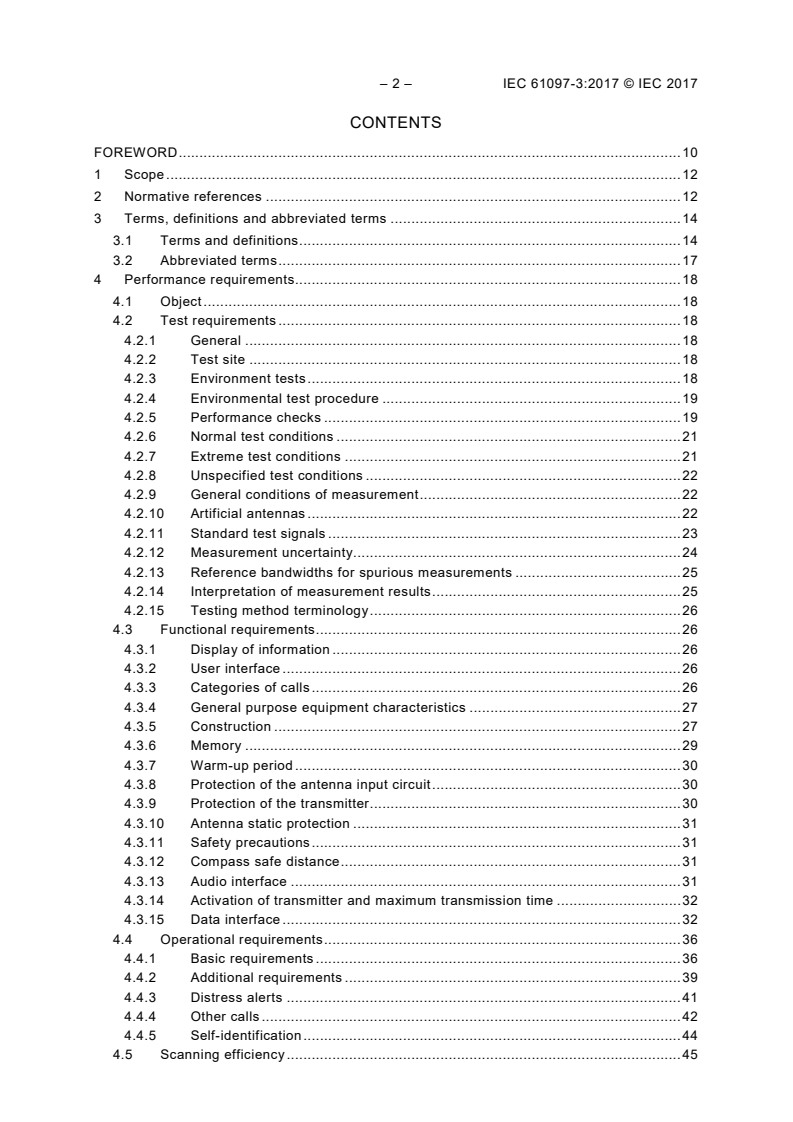
CONTENTS
FOREWORD . 10
1 Scope . 12
2 Normative references . 12
3 Terms, definitions and abbreviated terms . 14
3.1 Terms and definitions . 14
3.2 Abbreviated terms . 17
4 Performance requirements. 18
4.1 Object . 18
4.2 Test requirements . 18
4.2.1 General . 18
4.2.2 Test site . 18
4.2.3 Environment tests . 18
4.2.4 Environmental test procedure . 19
4.2.5 Performance checks . 19
4.2.6 Normal test conditions . 21
4.2.7 Extreme test conditions . 21
4.2.8 Unspecified test conditions . 22
4.2.9 General conditions of measurement . 22
4.2.10 Artificial antennas . 22
4.2.11 Standard test signals . 23
4.2.12 Measurement uncertainty. 24
4.2.13 Reference bandwidths for spurious measurements . 25
4.2.14 Interpretation of measurement results . 25
4.2.15 Testing method terminology . 26
4.3 Functional requirements . 26
4.3.1 Display of information . 26
4.3.2 User interface . 26
4.3.3 Categories of calls . 26
4.3.4 General purpose equipment characteristics . 27
4.3.5 Construction . 27
4.3.6 Memory . 29
4.3.7 Warm-up period . 30
4.3.8 Protection of the antenna input circuit . 30
4.3.9 Protection of the transmitter . 30
4.3.10 Antenna static protection . 31
4.3.11 Safety precautions . 31
4.3.12 Compass safe distance . 31
4.3.13 Audio interface . 31
4.3.14 Activation of transmitter and maximum transmission time . 32
4.3.15 Data interface . 32
4.4 Operational requirements . 36
4.4.1 Basic requirements . 36
4.4.2 Additional requirements . 39
4.4.3 Distress alerts . 41
4.4.4 Other calls . 42
4.4.5 Self-identification . 44
4.5 Scanning efficiency . 45
4.5.1 Requirements . 45
4.5.2 Method of test and required results . 45
4.6 Watch and scanning facilities . 45
4.6.1 Requirements . 45
4.6.2 Method of test and required results . 46
4.7 Bridge alert management (BAM) . 47
4.7.1 Classification of BAM alerts . 47
4.7.2 Alert management . 48
4.8 Alert source identification and reporting in ALF sentence . 49
4.8.1 General requirements . 49
4.8.2 Receipt of distress or urgency call . 50
4.8.3 Receipt of calls other than distress or urgency . 52
4.8.4 No position data received by equipment . 53
4.9 Software and firmware maintenance . 55
4.9.1 Requirements . 55
4.9.2 Methods of testing and required test results. 55
5 Technical characteristics . 56
5.1 General . 56
5.1.1 Frequency . 56
5.1.2 Calling sensitivity . 57
5.1.3 Nominal modulation rate . 57
5.1.4 Residual modulation . 57
5.2 Technical format of a call sequence . 57
5.2.1 Requirements . 57
5.2.2 Method of test and required results . 58
5.3 Expansion sequence . 58
5.3.1 Requirements . 58
5.3.2 Methods of test and required results . 58
5.4 Equipment for the automatic/semi-automatic service . 58
5.4.1 Requirements . 58
5.4.2 Methods of test and required results . 59
Annex A (informative) Digital interface sentence to parameter group number
equivalence . 60
Annex B (informative) DSC remote control communication . 61
B.1 General . 61
B.2 Use of AUC . 61
B.3 Use of AUQ. 61
B.4 Use of AUS . 61
B.5 Use of CUL . 62
B.6 Use of OCC . 62
B.7 Use of EPV . 62
B.8 Methods of testing and required results . 63
B.8.1 General . 63
B.8.2 Standby information test . 63
B.8.3 Creating sending distress automated procedure test . 64
B.8.4 Receiving distress automated procedure test . 65
B.8.5 Create sending non-distress automated procedure test . 67
B.8.6 Receive non-distress automated procedure tests . 68
B.8.7 Communication automated procedure test . 69
– 4 – IEC 61097-3:2017 © IEC 2017
B.8.8 Multiple automated procedures test . 70
Annex C (normative) Interface and automation requirements, methods of testing and
required test results . 71
C.1 General . 71
C.2 Naming convention of DSC message types . 71
C.3 Test setup . 71
C.3.1 General . 71
C.3.2 Test methods . 73
C.4 Non automated features . 73
C.4.1 Non automated features requirements . 73
C.4.2 Non automated features tests . 77
C.5 Standby . 92
C.5.1 Standby requirements . 92
C.5.2 Standby tests . 94
C.6 Sending distress automated procedure . 95
C.6.1 Sending distress automated procedure requirements . 95
C.6.2 Sending distress automated procedure tests . 101
C.7 Receiving distress automated procedure . 109
C.7.1 Receiving distress automated procedure requirements . 109
C.7.2 Receiving distress automated procedure tests . 114
C.8 Sending non-distress automated procedure . 123
C.8.1 Sending non-distress automated procedure requirements . 123
C.8.2 Sending non-distress automated procedure tests . 127
C.9 Receiving non-distress automated procedure . 131
C.9.1 Receiving non-distress automated procedure requirements . 131
C.9.2 Receiving non-distress automated procedure tests . 135
C.10 Communications automated procedure . 139
C.10.1 Communications automated procedure requirements . 139
C.10.2 Communications automated procedure tests . 140
C.11 Multiple automated procedures and parallel event handling . 141
C.11.1 Multiple automated procedures and parallel event handling
requirements . 141
C.11.2 Multiple automated procedures and parallel event handling tests . 142
C.12 Error handling in the automated procedures . 152
C.12.1 Error handling requirements . 152
C.12.2 Error handling tests . 154
Annex D (normative) DSC message composition . 158
D.1 Default values . 158
D.2 The default DROBOSE. 160
D.3 Allowable non-distress DSC message parameters . 160
Annex E (normative) Radius-centre point conversion and rounding algorithm . 161
E.1 Radius-centre point conversion . 161
E.2 Rounding . 162
E.3 Special cases for either form of area data entry . 162
Annex F (normative) Automated non-distress channel/frequency selection algorithm . 163
F.1 General . 163
F.2 VHF . 163
F.3 HF . 163
Annex G (normative) DSC message detection and decoding . 164
Annex H (normative) Audible annunciation and BAM alert signalling . 166
H.1 Aural alert specifications . 166
H.2 Alerting with critical errors . 167
H.3 Default aural alert sounds . 167
Annex I (normative) Shipborne watchkeeping receivers . 169
I.1 General and operational requirements . 169
I.1.1 General . 169
I.1.2 Construction . 169
I.2 Technical requirements . 169
I.2.1 Frequency bands and channels . 169
I.3 MF and MF/HF watchkeeping receiver . 171
I.3.1 Maximum usable sensitivity . 171
I.3.2 Adjacent channel selectivity . 172
I.3.3 Co-channel rejection . 172
I.3.4 RF intermodulation response . 173
I.3.5 Spurious response rejection . 173
I.3.6 Blocking immunity . 174
I.3.7 Dynamic range . 175
I.3.8 Conducted spurious emissions into the antenna . 175
I.3.9 Protection of receiver antenna input circuits . 176
I.3.10 Stop/start of scanning efficiency . 176
I.4 VHF watchkeeping receiver . 177
I.4.1 Maximum usable sensitivity . 177
I.4.2 Adjacent channel selectivity . 177
I.4.3 Co-channel rejection ratio . 178
I.4.4 Intermodulation response . 178
I.4.5 Spurious response rejection . 179
I.4.6 Blocking immunity . 180
I.4.7 Dynamic range . 180
I.4.8 Conducted spurious emissions conveyed to the antenna . 181
Annex J (normative) Shipborne VHF radiotelephone transmitter and receiver . 182
J.1 General and operational requirements . 182
J.1.1 General . 182
J.1.2 Composition . 182
J.1.3 Frequency bands . 182
J.1.4 Multiple watch facilities . 182
J.2 Switching time . 183
J.2.1 Requirement . 183
J.2.2 Method of measurement . 183
J.2.3 Results required . 183
J.3 Transmitter . 184
J.3.1 General . 184
J.3.2 Frequency error . 184
J.3.3 Carrier power . 184
J.3.4 Frequency deviation . 185
J.3.5 Limitation characteristics of the modulator . 186
J.3.6 Sensitivity of modulator, including microphone . 186
J.3.7 Audio frequency response . 186
J.3.8 Audio frequency harmonic distortion of the emission. 187
– 6 – IEC 61097-3:2017 © IEC 2017
J.3.9 Adjacent channel power . 188
J.3.10 Conducted spurious emissions conveyed to the antenna . 189
J.3.11 Residual modulation of the transmitter . 189
J.3.12 Transient frequency behaviour of the transmitter . 190
J.3.13 Antenna VSWR integrity behaviour and monitor . 191
J.4 Transmitter with integrated DSC encoder . 191
J.4.1 Frequency error (carrier). 191
J.4.2 Frequency error (demodulated signal) . 192
J.4.3 Carrier power . 192
J.4.4 Modulation index . 193
J.4.5 Modulation rate . 193
J.4.6 Residual modulation . 193
J.4.7 Modulator attack time . 194
J.4.8 Adjacent channel power . 194
J.5 Receiver . 195
J.5.1 General . 195
J.5.2 Harmonic distortion and rated audio frequency output power . 195
J.5.3 Audio frequency response . 196
J.5.4 Maximum usable sensitivity . 197
J.5.5 Amplitude response of the receiver limiter . 198
J.5.6 Co-channel rejection ratio . 198
J.5.7 Adjacent channel selectivity . 199
J.5.8 Spurious response rejection . 199
J.5.9 Intermodulation response . 201
J.5.10 Blocking immunity . 201
J.5.11 Conducted spurious emissions conveyed to the antenna . 202
J.5.12 Receiver hum and noise level . 202
J.5.13 Squelch operation . 203
J.5.14 Squelch hysteresis . 203
J.5.15 Scanning characteristics of multiple watch facilities . 204
J.6 Receiver with integrated DSC decoder . 204
J.7 Duplex operation . 205
J.7.1 General . 205
J.7.2 Acoustic feedback . 205
J.7.3 Receiver desensitization with simultaneous transmission and reception
(full-duplex operation) . 205
J.7.4 Receiver spurious response rejection . 206
J.8 Electromagnetic compatibility . 206
J.8.1 Conducted spurious emission . 206
J.8.2 Radiated spurious emission . 206
J.8.3 Immunity to electromagnetic environment . 206
J.9 Power measuring receiver specification . 206
J.9.1 IF filter . 206
J.9.2 Attenuation indicator . 208
J.9.3 RMS value indicator. 208
J.9.4 Oscillator and amplifier . 208
Annex K (normative) Shipborne MF and HF transmitters and receivers . 209
K.1 General and operational requirements . 209
K.1.1 General . 209
K.1.2 Composition . 209
K.1.3 Frequency indication . 209
K.1.4 Control panel priority . 209
K.1.5 Labels . 210
K.1.6 Classes of emission . 210
K.1.7 Frequency bands . 210
K.2 Transmitter . 211
K.2.1 General . 211
K.2.2 Frequency error for SSB telephony . 211
K.2.3 Output power and intermodulation products for SSB telephony . 211
K.2.4 Unwanted frequency modulation . 213
K.2.5 Sensitivity of the microphone . 213
K.2.6 Sensitivity of the 600 Ω line input for SSB telephony . 214
K.2.7 Automatic level control and/or limiter for SSB telephony . 214
K.2.8 Audio frequency response using SSB telephony . 215
K.2.9 Power of out-of-band emissions of SSB telephony . 216
K.2.10 Power of conducted spurious emissions of SSB telephony . 217
K.2.11 Residual hum and noise power for SSB telephony . 218
K.2.12 Carrier suppression . 218
K.2.13 Continuous operation on SSB telephony . 219
K.3 Transmitter with DSC encoder and NBDP . 220
K.3.1 Frequency error . 220
K.3.2 Output power . 220
K.3.3 Power of out-of-band emission of DSC . 221
K.3.4 Power of conducted spurious emission of DSC . 222
K.3.5 Residual frequency modulation of DSC . 223
K.3.6 Modulation rate of DSC . 224
K.3.7 Switching time for NBDP . 224
K.4 Receiver . 225
K.4.1 Audio frequency output levels . 225
K.4.2 Frequency error for SSB telephony . 225
K.4.3 Unwanted frequency modulation . 226
K.4.4 Audio frequency pass band . 226
K.4.5 Maximum usable sensitivity (MUS) . 227
K.4.6 Harmonic content in output . 228
K.4.7 Adjacent signal selectivity for J3E class of emission . 228
K.4.8 Blocking for J3E class of emission . 229
K.4.9 Intermodulation for J3E class of emission . 230
K.4.10 Reciprocal mixing . 231
K.4.11 Spurious response rejection ratio . 231
K.4.12 Audio frequency intermodulation . 233
K.4.13 Conducted spurious emissions into the antenna . 233
K.4.14 Internally generated spurious signals . 234
K.4.15 AGC efficiency . 234
K.4.16 AGC time constants (attack and recovery time) . 235
K.4.17 Switching time for NBDP . 236
K.4.18 Protection of input circuits . 236
K.5 Receiver with DSC decoder . 237
K.5.1 Maximum usable sensitivity . 237
– 8 – IEC 61097-3:2017 © IEC 2017
K.5.2 Adjacent signal selectivity . 237
K.5.3 Co-channel rejection . 238
K.5.4 Intermodulation response . 239
K.5.5 Spurious response rejection . 239
K.5.6 Blocking immunity . 241
K.5.7 Dynamic range . 241
Annex L (informative) Relationship between bit error rate (BER) input and symbols
error rate (SER) output . 243
L.1 General . 243
L.2 Measurement of the relationship between BER at the input of a DSC
decoder and the symbol error rate at the output of the decoder . 243
L.3 Conclusion . 244
Annex M (informative) Delays in equipment and its effect on narrow band direct
printing (NBDP) . 247
M.1 General . 247
M.2 Short distance . 247
M.3 Long distance . 247
Annex N (informative) Sentence to support DSC remote control. 249
N.1 General . 249
N.2 AUC – Automated procedure control . 249
N.3 AUQ – Automatic procedure query . 251
N.4 AUS – Automated procedure status . 252
N.5 CUL – Cyclic procedure list . 256
N.6 ECI – Enhanced selective calling information . 256
N.7 FSS – Frequency selection set. 258
N.8 OCC – Occupation control . 260
Bibliography . 261
Figure 1 – Interfaces of a DSC . 33
Figure 2 – DSC Interface overview . 36
Figure C.1 – Sending distress procedure . 96
Figure C.2 – Receiving distress procedure . 110
Figure C.3 – Sending non-distress automated procedure . 124
Figure C.4 – Receiving non-distress procedure . 132
Figure D.1 – Loading DSC defaults . 159
Figure E.1 – Circle-radius to lat-lon box . 161
Figure G.1 – Tests and error checks . 165
Figure J.1 – Modulation pre-emphasis curve (for a modulation index of 3, +1 dB –3 dB) . 187
Figure J.2 – Transient frequency behaviour test configuration . 191
Figure J.3 – Modulator attack time test configuration . 194
Figure J.4 – Receiver audio frequency response . 197
Figure J.5 – IF filter specification . 207
Figure K.1 – Limits for automatic level control . 215
Figure K.2 – Limits for audio frequency response. 216
Figure K.3 – Limits for unwanted emission (MF/HF transmitter) . 222
Figure L.1 – Symbol error rate (%) versus bit error rate (%) – Individual call . 244
Figure L.2 – Symbol error rate (%) versus bit error rate (%) – Distress call . 245
Figure L.3 – Symbol error rate (%) versus bit error rate (%) – All ship call . 246
Figure L.4 – Symbol error rate (%) versus transmitted calls – Distress call – EUT 1 . 246
Table 1 – Reference bandwidths applicable for spurious measurement . 25
Table 2 – IEC 61162-1 sentences received by the DSC equipment for position
information . 34
Table 3 – IEC 61162-1 sentences transmitted by the DSC equipment . 34
Table 4 – IEC 61162-1 sentences received by the DSC equipment . 35
Table 5 – IEC 61162-1 sentences transmitted by the DSC equipment for BNWAS . 35
Table 6 – IEC 61162-1 sentences transmitted by the DSC equipment for BAM . 35
Table 7 – IEC 61162-1 sentences received by the DSC equipment for BAM . 35
Table 8 – Classification of GMDSS equipment alerts for alert management purposes . 48
Table 9 – Alert text in ALF sentence for cause Distress . 51
Table 10 – Alert text in ALF sentence for cause Urgency . 52
Table 11 – Alert text in ALF sentence for received calls other than Distress and
Urgency . 52
Table 12 – Alert text in ALF sentence for cause No position data received by
equipment . 53
Table 13 – Alert text in ALF sentence for cause Antenna or Antenna tuner failure . 54
Table 14 – Alert text in ALF sentence for cause Tra
...