

IEC 61174:2015
(Main)Maritime navigation and radiocommunication equipment and systems - Electronic chart display and information system (ECDIS) - Operational and performance requirements, methods of testing and required test results
General Information
- Abstract
IEC 61174:2015 specifies the performance requirements, methods of testing and required test results of equipment conforming to performance standards not inferior to those adopted by the IMO in resolution MSC.232(82). This standard is based upon the performance standards of IMO resolution MSC.232(82), and is also associated with IMO resolution A.694(17) and IEC 60945. Reference is made, where appropriate, to IMO resolution MSC.232(82), and all subclauses whose wording is identical to that in the resolution are printed in italics. The requirements of this standard are not intended to prevent the use of new techniques in equipment and systems, provided the facilities offered are not inferior to those stated. This edition includes the following significant technical changes with respect to the previous edition:
- updated references are provided to IHO publications and test methods are updated to IHO test data sets;
- requirements have been added for display of radar and AIS information;
- new interface requirements have been added for BNWAS, VDR, BAM, MSI, INS and route transfer;
- a requirement for an anchor watch has been added;
- additional test methods are specified for operation of ECDIS beyond the normal range between 85 degrees South latitude and 85 degrees North latitude.
- Status
- Published
- Publication Date
- 18-Aug-2015
- Technical Committee
- TC 80 - Maritime navigation and radiocommunication equipment and systems
- Drafting Committee
- MT 7 - TC 80/MT 7
- Current Stage
- PPUB - Publication issued
- Start Date
- 19-Aug-2015
- Completion Date
- 15-Aug-2015
Buy Documents
IEC 61174:2015 - Maritime navigation and radiocommunication equipment and systems - Electronic chart display and information system (ECDIS) - Operational and performance requirements, methods of testing and required test results Released:8/19/2015
IEC 61174:2015 RLV - Maritime navigation and radiocommunication equipment and systems - Electronic chart display and information system (ECDIS) - Operational and performance requirements, methods of testing and required test results Released:8/19/2015


IEC 61174:2015 - Maritime navigation and radiocommunication equipment and systems - Electronic chart display and information system (ECDIS) - Operational and performance requirements, methods of testing and required test results Released:8/19/2015
Overview
IEC 61174:2015 specifies operational and performance requirements, methods of testing, and required test results for Electronic Chart Display and Information Systems (ECDIS). The standard is based on IMO performance standards (MSC.232(82)) and references IMO A.694(17) and IEC 60945, and it aligns testing with IHO publications and test data sets. IEC 61174:2015 ensures ECDIS equipment provides reliable chart presentation, route planning/monitoring and integration with other shipboard systems while allowing adoption of new techniques provided they are not inferior to stated requirements.
Key technical topics and requirements
- Performance requirements & test methods: Procedures to verify that an ECDIS meets the declared operational performance and provides required test results.
- Chart data handling (SENC/ENC): Display of SENC information, verification, updates, information content, display scale and presentation library use consistent with IHO documents.
- Display & presentation: Categories of display, safety contour and safety depth handling, symbol/color requirements, redraw and resolution performance.
- Route planning, monitoring & voyage recording: Functional requirements for route creation, monitoring, position integration, LOP fixes and voyage log recording.
- Integration with other equipment (interfaces): New and updated interface requirements for radar, AIS, BNWAS, VDR, BAM, MSI, INS, and route transfer between systems. Includes AIS target display, CPA/TCPA alarms and lost-target warnings.
- Radar and AIS overlay: Requirements for safe and effective display of radar and AIS information on the ECDIS.
- Operational extensions: Tests and requirements for anchor watch and operation beyond the normal range between 85°S and 85°N.
- System reliability & maintenance: Back-up arrangements, power supply, software maintenance, malfunction alarms, and quality management requirements.
- Updated IHO test data: Adoption of IHO test data sets and presentation library references for consistent testing and evaluation.
Practical applications and users
- ECDIS and maritime navigation equipment manufacturers: design and validate products to meet IEC 61174 performance and testing requirements.
- Testing laboratories and certification bodies: perform conformity testing and type approval using the methods and required test results.
- Shipowners, ship operators and integrators: verify system capability, interface compatibility (AIS, radar, VDR, INS), and operational functions such as route planning, anchor watch and updates.
- Classification societies and flag administrations: assess compliance with IMO-based performance criteria.
- Maritime software developers: ensure ENC presentation library, chart update handling and user interface meet ergonomic and technical expectations.
Related standards
- IMO resolution MSC.232(82) (ECDIS performance standards)
- IMO resolution A.694(17)
- IEC 60945 (general maritime navigation equipment requirements)
- IHO publications and ENC test data sets
Keywords: IEC 61174, ECDIS standard, ECDIS testing, IMO MSC.232(82), ENC, SENC, IHO, AIS, radar, route planning, maritime navigation equipment.
Relations
- Effective Date
- 05-Sep-2023
Buy Documents
IEC 61174:2015 - Maritime navigation and radiocommunication equipment and systems - Electronic chart display and information system (ECDIS) - Operational and performance requirements, methods of testing and required test results Released:8/19/2015
IEC 61174:2015 RLV - Maritime navigation and radiocommunication equipment and systems - Electronic chart display and information system (ECDIS) - Operational and performance requirements, methods of testing and required test results Released:8/19/2015
IEC 61174:2015 - Maritime navigation and radiocommunication equipment and systems - Electronic chart display and information system (ECDIS) - Operational and performance requirements, methods of testing and required test results Released:8/19/2015
Get Certified
Connect with accredited certification bodies for this standard

DNV
DNV is an independent assurance and risk management provider.

Lloyd's Register
Lloyd's Register is a global professional services organisation specialising in engineering and technology.

FSC International
Forest Stewardship Council certification.
Sponsored listings
Frequently Asked Questions
IEC 61174:2015 is a standard published by the International Electrotechnical Commission (IEC). Its full title is "Maritime navigation and radiocommunication equipment and systems - Electronic chart display and information system (ECDIS) - Operational and performance requirements, methods of testing and required test results". This standard covers: IEC 61174:2015 specifies the performance requirements, methods of testing and required test results of equipment conforming to performance standards not inferior to those adopted by the IMO in resolution MSC.232(82). This standard is based upon the performance standards of IMO resolution MSC.232(82), and is also associated with IMO resolution A.694(17) and IEC 60945. Reference is made, where appropriate, to IMO resolution MSC.232(82), and all subclauses whose wording is identical to that in the resolution are printed in italics. The requirements of this standard are not intended to prevent the use of new techniques in equipment and systems, provided the facilities offered are not inferior to those stated. This edition includes the following significant technical changes with respect to the previous edition: - updated references are provided to IHO publications and test methods are updated to IHO test data sets; - requirements have been added for display of radar and AIS information; - new interface requirements have been added for BNWAS, VDR, BAM, MSI, INS and route transfer; - a requirement for an anchor watch has been added; - additional test methods are specified for operation of ECDIS beyond the normal range between 85 degrees South latitude and 85 degrees North latitude.
IEC 61174:2015 specifies the performance requirements, methods of testing and required test results of equipment conforming to performance standards not inferior to those adopted by the IMO in resolution MSC.232(82). This standard is based upon the performance standards of IMO resolution MSC.232(82), and is also associated with IMO resolution A.694(17) and IEC 60945. Reference is made, where appropriate, to IMO resolution MSC.232(82), and all subclauses whose wording is identical to that in the resolution are printed in italics. The requirements of this standard are not intended to prevent the use of new techniques in equipment and systems, provided the facilities offered are not inferior to those stated. This edition includes the following significant technical changes with respect to the previous edition: - updated references are provided to IHO publications and test methods are updated to IHO test data sets; - requirements have been added for display of radar and AIS information; - new interface requirements have been added for BNWAS, VDR, BAM, MSI, INS and route transfer; - a requirement for an anchor watch has been added; - additional test methods are specified for operation of ECDIS beyond the normal range between 85 degrees South latitude and 85 degrees North latitude.
IEC 61174:2015 is classified under the following ICS (International Classification for Standards) categories: 47.020.70 - Navigation and control equipment. The ICS classification helps identify the subject area and facilitates finding related standards.
IEC 61174:2015 has the following relationships with other standards: It is inter standard links to IEC 61174:2008. Understanding these relationships helps ensure you are using the most current and applicable version of the standard.
IEC 61174:2015 is available in PDF format for immediate download after purchase. The document can be added to your cart and obtained through the secure checkout process. Digital delivery ensures instant access to the complete standard document.
Standards Content (Sample)
IEC 61174 ®
Edition 4.0 2015-08
INTERNATIONAL
STANDARD
colour
inside
Maritime navigation and radiocommunication equipment and systems –
Electronic chart display and information system (ECDIS) – Operational and
performance requirements, methods of testing and required test results
All rights reserved. Unless otherwise specified, no part of this publication may be reproduced or utilized in any form
or by any means, electronic or mechanical, including photocopying and microfilm, without permission in writing from
either IEC or IEC's member National Committee in the country of the requester. If you have any questions about IEC
copyright or have an enquiry about obtaining additional rights to this publication, please contact the address below or
your local IEC member National Committee for further information.
IEC Central Office Tel.: +41 22 919 02 11
3, rue de Varembé Fax: +41 22 919 03 00
CH-1211 Geneva 20 info@iec.ch
Switzerland www.iec.ch
About the IEC
The International Electrotechnical Commission (IEC) is the leading global organization that prepares and publishes
International Standards for all electrical, electronic and related technologies.
About IEC publications
The technical content of IEC publications is kept under constant review by the IEC. Please make sure that you have the
latest edition, a corrigenda or an amendment might have been published.
IEC Catalogue - webstore.iec.ch/catalogue Electropedia - www.electropedia.org
The stand-alone application for consulting the entire The world's leading online dictionary of electronic and
bibliographical information on IEC International Standards, electrical terms containing more than 30 000 terms and
Technical Specifications, Technical Reports and other definitions in English and French, with equivalent terms in 15
documents. Available for PC, Mac OS, Android Tablets and additional languages. Also known as the International
iPad. Electrotechnical Vocabulary (IEV) online.
IEC publications search - www.iec.ch/searchpub IEC Glossary - std.iec.ch/glossary
The advanced search enables to find IEC publications by a More than 60 000 electrotechnical terminology entries in
variety of criteria (reference number, text, technical English and French extracted from the Terms and Definitions
committee,…). It also gives information on projects, replaced clause of IEC publications issued since 2002. Some entries
and withdrawn publications. have been collected from earlier publications of IEC TC 37,
77, 86 and CISPR.
IEC Just Published - webstore.iec.ch/justpublished
Stay up to date on all new IEC publications. Just Published IEC Customer Service Centre - webstore.iec.ch/csc
details all new publications released. Available online and If you wish to give us your feedback on this publication or
also once a month by email. need further assistance, please contact the Customer Service
Centre: csc@iec.ch.
IEC 61174 ®
Edition 4.0 2015-08
INTERNATIONAL
STANDARD
colour
inside
Maritime navigation and radiocommunication equipment and systems –
Electronic chart display and information system (ECDIS) – Operational and
performance requirements, methods of testing and required test results
INTERNATIONAL
ELECTROTECHNICAL
COMMISSION
ICS 47.020.70 ISBN 978-2-8322-2822-7
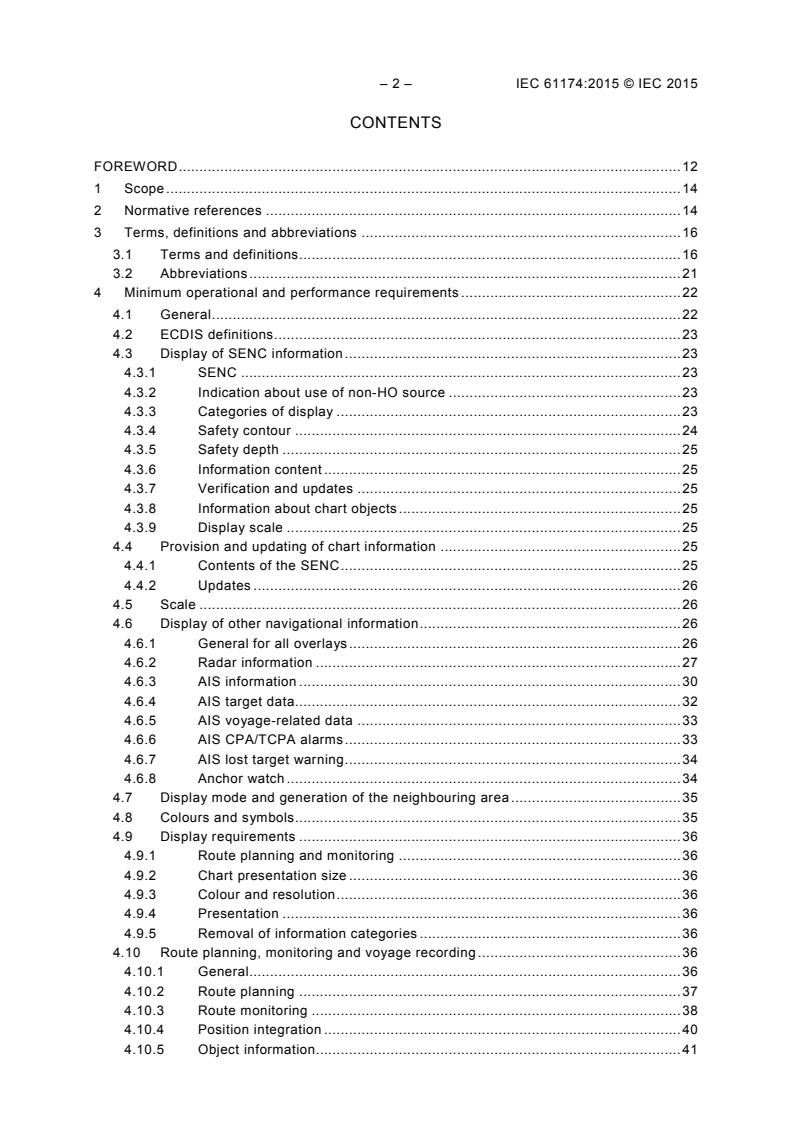
– 2 – IEC 61174:2015 © IEC 2015
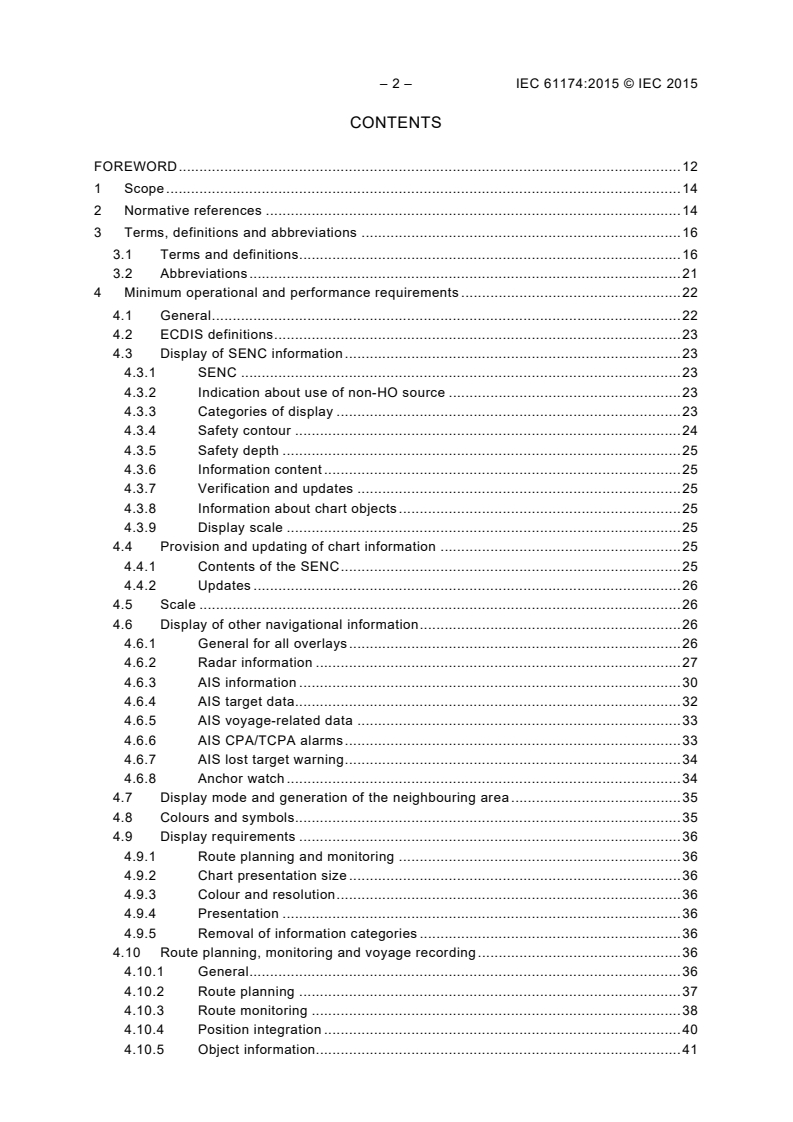
CONTENTS
FOREWORD . 12
1 Scope . 14
2 Normative references . 14
3 Terms, definitions and abbreviations . 16
3.1 Terms and definitions . 16
3.2 Abbreviations . 21
4 Minimum operational and performance requirements . 22
4.1 General . 22
4.2 ECDIS definitions . 23
4.3 Display of SENC information . 23
4.3.1 SENC . 23
4.3.2 Indication about use of non-HO source . 23
4.3.3 Categories of display . 23
4.3.4 Safety contour . 24
4.3.5 Safety depth . 25
4.3.6 Information content . 25
4.3.7 Verification and updates . 25
4.3.8 Information about chart objects . 25
4.3.9 Display scale . 25
4.4 Provision and updating of chart information . 25
4.4.1 Contents of the SENC . 25
4.4.2 Updates . 26
4.5 Scale . 26
4.6 Display of other navigational information . 26
4.6.1 General for all overlays . 26
4.6.2 Radar information . 27
4.6.3 AIS information . 30
4.6.4 AIS target data. 32
4.6.5 AIS voyage-related data . 33
4.6.6 AIS CPA/TCPA alarms . 33
4.6.7 AIS lost target warning . 34
4.6.8 Anchor watch . 34
4.7 Display mode and generation of the neighbouring area . 35
4.8 Colours and symbols. 35
4.9 Display requirements . 36
4.9.1 Route planning and monitoring . 36
4.9.2 Chart presentation size . 36
4.9.3 Colour and resolution . 36
4.9.4 Presentation . 36
4.9.5 Removal of information categories . 36
4.10 Route planning, monitoring and voyage recording . 36
4.10.1 General. 36
4.10.2 Route planning . 37
4.10.3 Route monitoring . 38
4.10.4 Position integration . 40
4.10.5 Object information. 41
4.10.6 LOP position fix . 41
4.10.7 Voyage recording . 41
4.11 Calculations and accuracy . 42
4.12 Connections with other equipment (interfaces) . 42
4.12.1 Connection with navigation equipment . 42
4.12.2 Connection with BAM . 42
4.12.3 Connection with VDR . 43
4.12.4 Connection with BNWAS . 44
4.12.5 Connection for SENC information . 44
4.12.6 Connection with NAVTEX or SafetyNET for MSI . 44
4.12.7 Connection for transfer of route information . 45
4.12.8 Connection with INS . 46
4.13 Performance tests, malfunction alerts and indications . 46
4.14 Back-up arrangements . 46
4.15 Power supply . 46
4.16 Software maintenance . 46
4.17 Quality management requirements . 47
4.18 Default control setting and saved user control settings . 47
5 Requirements contained in IHO publications . 49
5.1 Priority of chart display . 49
5.2 Display of chart information . 50
5.2.1 Scale and navigation purpose . 50
5.2.2 Units and legend . 50
5.2.3 Terminology . 51
5.3 Display functions . 51
5.3.1 Cursor pick . 51
5.3.2 Navigational information . 51
5.3.3 Date-dependant ENC objects . 52
5.4 Supplementary display functions . 52
5.4.1 Additional mariner’s information . 52
5.4.2 Additional non-HO information . 52
5.4.3 Tidal adjustment . 53
5.5 Use of the presentation library . 53
5.5.1 Presentation library . 53
5.5.2 Test diagrams . 53
5.6 Display characteristics . 53
5.7 Performance requirements . 54
5.7.1 Redraw . 54
5.7.2 Resolution . 54
5.7.3 Symbols . 54
5.7.4 Number of colours . 55
5.7.5 Brightness and contrast . 55
5.8 Ergonomic requirements . 55
5.8.1 Mode and orientation . 55
5.8.2 Windows . 55
5.9 Update of chart information . 56
5.9.1 General. 56
5.9.2 Manual update . 57
5.9.3 Semi-automatic update . 58
– 4 – IEC 61174:2015 © IEC 2015
5.9.4 Reception of updates . 58
5.9.5 Sequence check . 58
5.9.6 Consistency check . 59
5.9.7 Geographic applicability . 59
5.9.8 Summary report . 59
5.9.9 Review of ENC updates . 59
5.9.10 Modification of updates . 59
5.10 Operational area . 59
5.11 External removable media . 60
6 Methods of testing and required test results . 60
6.1 EUT installation, technical documentation, and test requirements . 60
6.2 Interfaces . 60
6.2.1 General. 60
6.2.2 BAM interface . 61
6.2.3 VDR interface . 62
6.2.4 BNWAS interface . 63
6.3 General requirements and presentation requirements . 63
6.3.1 General requirements . 63
6.3.2 Presentation requirements . 63
6.4 Preparation . 63
6.4.1 Power-up . 63
6.4.2 Initial ship parameters. 64
6.4.3 Required test items . 64
6.5 Requirements related to ENC chart . 64
6.5.1 General. 64
6.5.2 Presentation library . 65
6.5.3 ENC . 65
6.5.4 Encrypted ENC . 65
6.6 Accuracy . 65
6.7 Visual requirements . 65
6.7.1 Symbols . 65
6.7.2 Terminology, units and legend . 65
6.7.3 Colour table . 65
6.7.4 Resolution . 66
6.7.5 Display characteristics . 66
6.8 Functional requirements . 66
6.8.1 Methods of testing . 66
6.8.2 Standard display . 66
6.8.3 Display base . 66
6.8.4 All other information . 67
6.8.5 Viewing group layers and text group layers . 67
6.8.6 Display priorities . 67
6.8.7 Additional display functions . 67
6.8.8 Scale and navigation purpose . 67
6.8.9 Mode and orientation . 68
6.8.10 Safety contour . 68
6.8.11 Safety depth . 68
6.8.12 Cursor pick . 68
6.8.13 Navigation related functions . 68
6.8.14 Position integration . 69
6.8.15 Radar and other navigational information . 69
6.8.16 Loading of corrupted data . 72
6.8.17 Automatic updates . 72
6.8.18 Manual updates . 73
6.8.19 Self-tests of major functions . 73
6.8.20 Operational area . 73
6.8.21 External removable media. 74
6.9 Operational requirements . 74
6.9.1 Ergonomic principles. 74
6.9.2 Route planning . 74
6.9.3 Route monitoring . 76
6.9.4 Twelve hour log . 78
6.9.5 Voyage record . 78
6.9.6 Power supply . 78
6.9.7 LOP position fix . 78
6.10 Software maintenance . 79
6.11 Quality management . 79
6.12 Default control setting and saved operator control settings . 80
6.13 AIS information and AIS target data . 80
6.13.1 General. 80
6.13.2 AIS targets and data report capacity . 80
6.13.3 AIS target filtering . 80
6.13.4 Activation and deactivation of AIS targets . 81
6.13.5 AIS functionality and presentation . 81
6.13.6 AIS target data. 82
6.13.7 AIS CPA/TCPA alarm. 83
6.13.8 AIS lost target warning . 83
6.14 AIS Voyage-related data . 84
6.15 Anchor watch . 84
6.16 NAVTEX and SafetyNET for MSI . 85
6.17 Interface for transfer of route information . 85
6.18 Interface with INS . 86
Annex A (normative) SENC information to be displayed during route planning and
route monitoring . 87
Annex B (normative) Navigational elements and parameters . 88
Annex C (normative) Areas for which special conditions exist . 89
Annex D (normative) Alerts and indications . 90
Annex E (normative) Mandatory terminology and abbreviations . 92
Annex F (normative) Back-up arrangements . 98
F.1 Overview. 98
F.2 Purpose . 98
F.3 Functional requirements . 98
F.3.1 Required functions and their availability . 98
F.3.2 Reliability and accuracy . 102
F.3.3 Malfunctions, warnings, alerts and indications . 102
F.4 Operational requirements . 102
F.4.1 Ergonomics . 102
– 6 – IEC 61174:2015 © IEC 2015
F.4.2 Presentation of information . 102
F.5 Power supply . 103
F.6 Other requirement . 103
F.6.1 Connection with other systems . 103
F.6.2 Route transfer interface . 104
F.6.3 Radar as back-up system. 104
F.6.4 Operational area . 104
F.6.5 Software maintenance . 104
F.6.6 Quality management . 104
F.6.7 Default Control Settings and Saved User Control Settings . 104
F.6.8 External removable media. 104
F.7 Methods of testing and required test results . 105
F.7.1 EUT installation and technical documentation . 105
F.7.2 Interfaces . 105
F.7.3 General requirements and presentation requirements . 105
F.7.4 Preparation . 105
F.7.5 Initial data tests – Chart . 106
F.7.6 Accuracy . 106
F.7.7 Visual requirements . 106
F.7.8 Functional requirements . 106
F.7.9 Operational requirements . 108
Annex G (normative) ECDIS in the RCDS mode of operation . 111
G.1 Overview. 111
G.2 RCDS definitions . 111
G.3 Display of SRNC information . 112
G.3.1 SRNC . 112
G.3.2 Categories of display . 112
G.3.3 Power failure . 112
G.3.4 Information content . 112
G.3.5 Verification and updates . 112
G.3.6 Indication . 113
G.4 Provision and updating of chart information . 113
G.4.1 Contents of the RNC . 113
G.4.2 Updates . 113
G.5 Scale . 114
G.6 Display of other navigational information . 114
G.6.1 General for all overlays . 114
G.6.2 Radar information . 114
G.6.3 AS information . 115
G.6.4 AIS Target Data . 115
G.6.5 AIS Voyage Related Data . 115
G.6.6 AIS CPA/TCPA alarms . 115
G.6.7 AIS lost target warning . 115
G.6.8 Anchor watch . 115
G.7 Display mode and generation of the neighbouring area . 115
G.8 Colours and symbols. 116
G.9 Display requirements . 116
G.9.1 Route planning and monitoring . 116
G.9.2 Display characteristics . 116
G.9.3 Chart notes . 117
G.10 Route planning, monitoring and voyage recording . 117
G.10.1 General. 117
G.10.2 Route planning . 117
G.10.3 Route monitoring . 117
G.10.4 Position integration . 118
G.10.5 Object information. 119
G.10.6 LOP position fix . 119
G.10.7 Voyage recording . 119
G.11 Calculations and accuracy . 120
G.12 Connections with other equipment (interfaces) . 120
G.13 Performance tests, malfunction alerts and indications . 121
G.14 Back-up arrangements for RCDS mode of operation . 121
G.15 Power supply for RCDS mode of operation . 121
G.16 Requirements contained in IHO publications . 122
G.16.1 Structure of RNC data . 122
G.16.2 RNC data resolution and accuracy . 122
G.16.3 RNC meta-data . 122
G.16.4 RNC colours . 122
G.16.5 RNC notes, diagrams, etc . 123
G.16.6 Operational area . 123
G.16.7 External removable media. 123
G.17 Methods of testing and required test results . 123
G.17.1 Preparation – Required test items . 123
G.17.2 Initial data tests . 124
G.17.3 Accuracy . 124
G.17.4 Visual requirements . 125
G.17.5 Functional requirements . 126
G.17.6 Operational requirement . 131
G.18 RNC test data set . 134
Annex H (normative) Alerts and indications in the RCDS mode of operation . 135
Annex I (normative) Scenario definitions and plots . 136
I.1 Overview. 136
I.2 Scenario 1: . 137
I.3 Scenario 2: . 138
I.4 Scenario 3: . 140
I.5 Scenario 4: . 141
Annex J (informative) Guidance on geodetic calculations . 144
J.1 Overview. 144
J.2 Distance deviations between Great Circle (orthodrome) and Rhumb Line
(loxodrome) . 144
J.3 Bearing deviations at start point between Great Circle (orthodrome) and
Rhumb Line (loxodrome) . 145
Annex K (informative) Guidance for testing . 147
K.1 Methods of test derived from ISO 9241-12 . 147
K.2 Observation . 147
K.3 Inspection of documented evidence . 147
K.4 Measurement . 147
K.5 Analytical evaluation . 148
– 8 – IEC 61174:2015 © IEC 2015
Annex L (informative) Examples of ENC Update Status Report . 149
L.1 Overview. 149
L.2 ENC Update Status Report − Summary . 149
L.3 ENC Update Status Report − Full . 150
L.4 ENC Management Report – Route Filtered . 152
Annex M (normative) Elements of an electronic chart database . 153
M.1 General . 153
M.2 ECDIS implementation . 153
M.3 Display base category . 154
M.3.1 Coastline layer . 154
M.3.2 Safety contour layer . 155
M.3.3 Isolated underwater dangers layer . 155
M.3.4 Isolated above-water dangers layer . 155
M.4 Standard display category . 156
M.4.1 Display base layer . 156
M.4.2 Additional aids to navigation and fixed structures layer . 156
M.4.3 Fairways layer . 156
M.4.4 Conspicuous features layer . 156
M.4.5 Prohibited and restricted areas layer . 157
M.4.6 Ferry routes layer . 157
M.4.7 Archipelagic sea lanes layer . 157
M.4.8 Buoys and beacons layer . 157
M.4.9 Traffic routeing layer . 157
M.5 All other information category . 158
M.5.1 Information about the chart display layer . 158
M.5.2 Natural and man-made features, Port features layer . 158
M.5.3 Depth, currents, etc. layer . 159
M.5.4 Seabed, obstructions, pipelines layer . 160
M.5.5 Traffic routes layer . 160
M.5.6 Special areas layer . 160
M.5.7 Service and small craft facilities layer . 161
M.6 Text grouping . 161
M.6.1 Important Text group layer . 161
M.6.2 Other Text group layer . 161
Annex N (informative) Use cases for safety contour and safety depth . 163
Annex O (informative) Guidelines on use of electronic chart systems in polar waters . 165
O.1 Projection and coordinate system . 165
O.2 Consistency . 166
Annex P (normative) Scenarios for polar areas above 85° North . 167
Annex Q (normative) IEC 61162 interfaces . 173
Q.1 General . 173
Q.2 VDR interface . 176
Q.3 AIS interface and interrogation . 176
Q.4 Route transfer interface . 177
Q.5 BAM interface . 177
Annex R (informative) Conversion between IEC 61162-1 sentences and IEC 61162-3
parameter group numbers . 181
Annex S (normative) Route plan exchange format – RTZ . 183
S.1 General . 183
S.2 RTP Data container . 184
S.3 High-level description of the RTZ format . 185
S.4 Adaptation to third-party extensions . 185
S.4.1 Generic idea . 185
S.4.2 Unique identification of a waypoint . 185
S.4.3 Creation of new waypoints . 186
S.4.4 Change of geographic data for a waypoint . 186
S.4.5 Waypoint removal . 186
S.5 Detailed RTZ format description . 186
S.5.1 File components .
...
IEC 61174 ®
Edition 4.0 2015-08
REDLINE VERSION
INTERNATIONAL
STANDARD
colour
inside
Maritime navigation and radiocommunication equipment and systems –
Electronic chart display and information system (ECDIS) – Operational and
performance requirements, methods of testing and required test results
All rights reserved. Unless otherwise specified, no part of this publication may be reproduced or utilized in any form
or by any means, electronic or mechanical, including photocopying and microfilm, without permission in writing from
either IEC or IEC's member National Committee in the country of the requester. If you have any questions about IEC
copyright or have an enquiry about obtaining additional rights to this publication, please contact the address below or
your local IEC member National Committee for further information.
IEC Central Office Tel.: +41 22 919 02 11
3, rue de Varembé Fax: +41 22 919 03 00
CH-1211 Geneva 20 info@iec.ch
Switzerland www.iec.ch
About the IEC
The International Electrotechnical Commission (IEC) is the leading global organization that prepares and publishes
International Standards for all electrical, electronic and related technologies.
About IEC publications
The technical content of IEC publications is kept under constant review by the IEC. Please make sure that you have the
latest edition, a corrigenda or an amendment might have been published.
IEC Catalogue - webstore.iec.ch/catalogue Electropedia - www.electropedia.org
The stand-alone application for consulting the entire The world's leading online dictionary of electronic and
bibliographical information on IEC International Standards, electrical terms containing more than 30 000 terms and
Technical Specifications, Technical Reports and other definitions in English and French, with equivalent terms in 15
documents. Available for PC, Mac OS, Android Tablets and additional languages. Also known as the International
iPad. Electrotechnical Vocabulary (IEV) online.
IEC publications search - www.iec.ch/searchpub IEC Glossary - std.iec.ch/glossary
The advanced search enables to find IEC publications by a More than 60 000 electrotechnical terminology entries in
variety of criteria (reference number, text, technical English and French extracted from the Terms and Definitions
committee,…). It also gives information on projects, replaced clause of IEC publications issued since 2002. Some entries
and withdrawn publications. have been collected from earlier publications of IEC TC 37,
77, 86 and CISPR.
IEC Just Published - webstore.iec.ch/justpublished
Stay up to date on all new IEC publications. Just Published IEC Customer Service Centre - webstore.iec.ch/csc
details all new publications released. Available online and If you wish to give us your feedback on this publication or
also once a month by email. need further assistance, please contact the Customer Service
Centre: csc@iec.ch.
IEC 61174 ®
Edition 4.0 2015-08
REDLINE VERSION
INTERNATIONAL
STANDARD
colour
inside
Maritime navigation and radiocommunication equipment and systems –
Electronic chart display and information system (ECDIS) – Operational and
performance requirements, methods of testing and required test results
INTERNATIONAL
ELECTROTECHNICAL
COMMISSION
ICS 47.020.70 ISBN 978-2-8322-2865-4
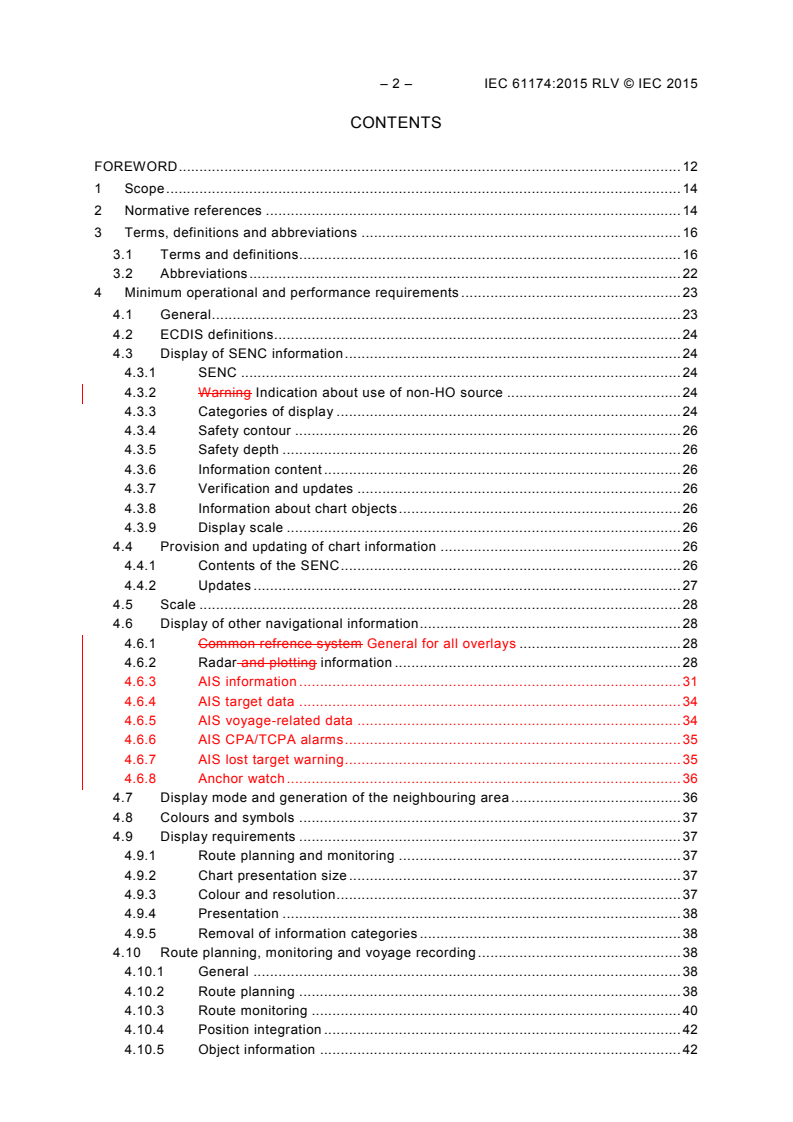
– 2 – IEC 61174:2015 RLV © IEC 2015
CONTENTS
FOREWORD . 12
1 Scope . 14
2 Normative references . 14
3 Terms, definitions and abbreviations . 16
3.1 Terms and definitions. 16
3.2 Abbreviations . 22
4 Minimum operational and performance requirements . 23
4.1 General . 23
4.2 ECDIS definitions . 24
4.3 Display of SENC information . 24
4.3.1 SENC . 24
4.3.2 Warning Indication about use of non-HO source . 24
4.3.3 Categories of display . 24
4.3.4 Safety contour . 26
4.3.5 Safety depth . 26
4.3.6 Information content . 26
4.3.7 Verification and updates . 26
4.3.8 Information about chart objects . 26
4.3.9 Display scale . 26
4.4 Provision and updating of chart information . 26
4.4.1 Contents of the SENC . 26
4.4.2 Updates . 27
4.5 Scale . 28
4.6 Display of other navigational information . 28
4.6.1 Common refrence system General for all overlays . 28
4.6.2 Radar and plotting information . 28
4.6.3 AIS information . 31
4.6.4 AIS target data . 34
4.6.5 AIS voyage-related data . 34
4.6.6 AIS CPA/TCPA alarms . 35
4.6.7 AIS lost target warning . 35
4.6.8 Anchor watch . 36
4.7 Display mode and generation of the neighbouring area . 36
4.8 Colours and symbols . 37
4.9 Display requirements . 37
4.9.1 Route planning and monitoring . 37
4.9.2 Chart presentation size . 37
4.9.3 Colour and resolution . 37
4.9.4 Presentation . 38
4.9.5 Removal of information categories . 38
4.10 Route planning, monitoring and voyage recording . 38
4.10.1 General . 38
4.10.2 Route planning . 38
4.10.3 Route monitoring . 40
4.10.4 Position integration . 42
4.10.5 Object information . 42
4.10.6 LOP position fix . 42
4.10.7 Voyage recording . 43
4.11 Calculations and accuracy . 43
4.12 Connections with other equipment (interfaces) . 44
4.12.1 Connection with navigation equipment . 44
4.12.2 Connection with BAM . 44
4.12.3 Connection with VDR . 45
4.12.4 Connection with BNWAS . 46
4.12.5 Connection for SENC information . 46
4.12.6 Connection with NAVTEX or SafetyNET for MSI . 46
4.12.7 Connection for transfer of route information . 47
4.12.8 Connection with INS . 47
4.13 Performance tests, malfunction alarms alerts and indications . 47
4.14 Back-up arrangements . 48
4.15 Power supply . 48
4.16 Software maintenance . 48
4.17 Quality management requirements . 48
4.18 Default control setting and saved user control settings . 49
5 Requirements contained in IHO special publications . 52
5.1 Content and structure of chart data .
5.1 Priority of chart display . 52
5.2 Display of chart information . 52
5.2.1 Scale and navigation purpose . 52
5.2.2 Text .
5.2.2 Units and legend . 53
5.2.3 Terminology . 54
5.3 Display functions . 54
5.3.1 Object information Cursor pick . 54
5.3.2 Navigational information . 55
5.3.2 Safety contour .
5.3.3 Navigational calculations .
5.3.3 Date-dependant ENC objects . 55
5.4 Supplementary display functions . 56
5.4.1 Additional mariner’s information . 56
5.4.2 Additional non-HO information . 56
5.4.3 Tidal adjustment . 57
5.5 Use of the presentation library . 57
5.5.1 Presentation library . 57
5.5.2 Test diagrams . 58
5.6 Display characteristics . 58
5.6.1 Display base .
5.6.2 Navigators notes .
5.7 Performance requirements . 58
5.7.1 Redraw . 58
5.7.2 Resolution . 59
5.7.3 Symbols . 59
5.7.4 Number of colours . 59
5.7.5 Brightness and contrast . 59
5.8 Ergonomic requirements . 60
– 4 – IEC 61174:2015 RLV © IEC 2015
5.8.1 Mode and orientation . 60
5.8.2 Windows . 60
5.8.3 Mariner’s information panel .
5.9 Update of chart information . 60
5.9.1 General . 60
5.9.2 Manual update . 62
5.9.3 Semi-automatic update . 63
5.9.4 Reception of updates . 63
5.9.5 Sequence check . 63
5.9.6 Consistency check . 63
5.9.7 Geographic applicability . 64
5.9.8 Summary report . 64
5.9.9 Review of ENC updates . 64
5.9.10 Modification of updates . 64
5.10 Operational area . 64
5.11 External removable media . 65
6 Methods of testing and required test results . 65
6.1 EUT installation, technical documentation, and test requirements . 65
6.2 Interfaces. 65
6.2.1 General . 65
6.2.2 BAM interface . 66
6.2.3 VDR interface . 67
6.2.4 BNWAS interface . 68
6.3 General requirements and presentation requirements . 68
6.3.1 General requirements . 68
6.3.2 Presentation requirements . 68
6.4 Preparation . 69
6.4.1 Power-up . 69
6.4.2 Initial ship parameters . 69
6.4.3 Required test items . 69
6.5 Initial data tests Requirements related to ENC chart . 70
6.5.1 General . 70
6.5.2 Presentation library . 71
6.5.3 ENC . 71
6.5.4 Encrypted ENC . 71
6.6 Accuracy . 72
6.7 Visual requirements . 72
6.7.1 Symbols . 72
6.7.2 Terminology, units and legend . 73
6.7.3 Colour table . 73
6.7.4 Resolution . 74
6.7.5 Display characteristics . 74
6.8 Functional requirements. 74
6.8.1 Methods of testing . 74
6.8.2 Standard display . 75
6.8.3 Display base . 75
6.8.4 All other information . 75
6.8.5 Viewing group layers and text group layers . 75
6.8.6 Display priorities . 76
6.8.7 Additional display functions. 76
6.8.8 Scale and navigation purpose . 77
6.8.9 Mode and orientation . 77
6.8.10 Safety contour . 78
6.8.11 Safety depth . 78
6.8.12 Object information Cursor pick . 80
6.8.13 Navigation related functions . 81
6.8.14 Position integration . 81
6.8.15 Radar and plotting other navigational information . 81
6.8.16 Loading of corrupted data . 84
6.8.17 Automatic updates . 84
6.8.18 Manual updates . 86
6.8.19 Self-tests of major functions. 86
6.8.20 Operational area . 87
6.8.21 External removable media . 88
6.9 Operational requirements . 88
6.9.1 Ergonomic principles . 88
6.9.2 Route planning . 88
6.9.3 Route monitoring . 90
6.9.4 Twelve-hour log . 91
6.9.5 Voyage record . 92
6.9.6 Power supply . 92
6.9.7 LOP position fix . 92
6.10 Software maintenance . 93
6.11 Quality management . 93
6.12 Default control setting and saved operator control settings . 93
6.13 AIS information and AIS target data . 94
6.13.1 General . 94
6.13.2 AIS targets and data report capacity . 94
6.13.3 AIS target filtering . 94
6.13.4 Activation and deactivation of AIS targets . 95
6.13.5 AIS functionality and presentation . 95
6.13.6 AIS target data . 96
6.13.7 AIS CPA/TCPA alarm . 97
6.13.8 AIS lost target warning . 97
6.14 AIS Voyage-related data . 98
6.15 Anchor watch . 98
6.16 NAVTEX and SafetyNET for MSI . 98
6.17 Interface for transfer of route information . 99
6.18 Interface with INS . 100
Annex A (normative) SENC information to be displayed during route planning and
route monitoring . 101
Annex B (normative) Navigational elements and parameters . 102
Annex C (normative) Areas for which special conditions exist . 103
Annex D (normative) Alarms and indicators Alerts and indications . 104
Annex E (normative) ENC test data set Mandatory terminology and abbreviations . 109
Annex F (normative) Back-up arrangements . 115
F.1 Introduction Overview . 115
– 6 – IEC 61174:2015 RLV © IEC 2015
F.2 Purpose . 115
F.3 Functional requirements. 115
F.3.1 Required functions and their availability . 115
F.3.2 Reliability and accuracy . 119
F.3.3 Malfunctions, warnings, alarms alerts and indications . 119
F.4 Operational requirements . 119
F.4.1 Ergonomics . 119
F.4.2 Presentation of information . 119
F.5 Power supply . 120
F.6 Connections with other equipment Other requirement . 120
F.6.1 Back-up Connection with other systems . 120
F.6.2 Route transfer interface . 121
F.6.3 Radar as back-up system . 121
F.6.4 Operational area . 121
F.6.5 Software maintenance . 122
F.6.6 Quality management . 122
F.6.7 Default Control Settings and Saved User Control Settings . 122
F.6.8 External removable media . 122
F.7 Methods of testing and required test results . 122
F.7.1 EUT installation and technical documentation . 122
F.7.2 Interfaces . 122
F.7.3 General requirements and presentation requirements . 122
F.7.4 Preparation . 122
F.7.5 Initial data tests – Chart . 123
F.7.6 Accuracy . 123
F.7.7 Visual requirements . 124
F.7.8 Functional requirements . 124
F.7.9 Operational requirements . 126
Annex G (normative) ECDIS in the RCDS mode of operation . 130
G.1 Introduction Overview . 130
G.2 RCDS definitions . 130
G.3 Display of SRNC information . 131
G.3.1 SRNC . 131
G.3.2 Categories of display . 131
G.3.3 Power failure . 131
G.3.4 Information content . 131
G.3.5 Verification and updates . 131
G.3.6 Indication . 132
G.4 Provision and updating of chart information . 132
G.4.1 Contents of the RNC . 132
G.4.2 Updates . 132
G.5 Scale . 133
G.6 Display of other navigational information . 133
G.6.1 Common reference system General for all overlays . 133
G.6.2 Radar and plotting information . 133
G.6.3 AS information . 134
G.6.4 AIS Target Data . 134
G.6.5 AIS Voyage Related Data . 134
G.6.6 AIS CPA/TCPA alarms . 134
G.6.7 AIS lost target warning . 134
G.6.8 Anchor watch . 134
G.7 Display mode and generation of the neighbouring area . 134
G.8 Colours and symbols . 135
G.9 Display requirements . 135
G.9.1 Route planning and monitoring . 135
G.9.2 Display characteristics . 135
G.9.3 Chart notes . 136
G.10 Route planning, monitoring and voyage recording . 136
G.10.1 General . 136
G.10.2 Route planning . 136
G.10.3 Route monitoring . 136
G.10.4 Position integration . 137
G.10.5 Object information . 138
G.10.6 LOP position fix . 138
G.10.7 Voyage recording . 139
G.11 Calculations and accuracy . 139
G.12 Connections with other equipment (interfaces) . 139
G.13 Performance tests, malfunction alarms alerts and indications . 140
G.14 Back-up arrangements for RCDS mode of operation . 140
G.15 Power supply for RCDS mode of operation . 140
G.16 Requirements contained in IHO special publications . 141
G.16.1 Structure of RNC data . 141
G.16.2 RNC data resolution and accuracy . 141
G.16.3 RNC meta-data . 141
G.16.4 RNC colours . 141
G.16.5 RNC notes, diagrams, etc . 142
G.16.6 Operational area . 142
G.16.7 External removable media . 142
G.17 Methods of testing and required test results . 142
G.17.1 Preparation– Required test items . 142
G.17.2 Initial data tests . 143
G.17.3 Accuracy . 144
G.17.4 Visual requirements . 144
G.17.5 Functional requirements . 145
G.17.6 Operational requirement . 151
G.18 RNC test data set . 154
Annex H (normative) Alarms ans indicators Alerts and indications in the RCDS mode
of operation . 155
Annex I (normative) Scenario definitions and plots . 156
I.1 Overview . 156
I.2 Scenario 1: . 157
I.3 Scenario 2: . 160
I.4 Scenario 3: . 163
I.5 Scenario 4: . 166
Annex J (informative) Tests required for encrypted ENC .
Annex J (informative) Guidance on geodetic calculations . 172
J.1 Overview . 172
– 8 – IEC 61174:2015 RLV © IEC 2015
J.2 Distance deviations between Great Circle (orthodrome) and Rhumb Line
(loxodrome) . 172
J.3 Bearing deviations at start point between Great Circle (orthodrome) and
Rhumb Line (loxodrome) . 173
Annex K (informative) Guidance for testing . 175
K.1 Methods of test derived from ISO 9241-12 . 175
K.2 Observation . 175
K.3 Inspection of documented evidence . 175
K.4 Measurement . 175
K.5 Analytical evaluation . 176
Annex L (normative) Testing for colours and intensity .
Annex L (informative) Examples of ENC Update Status Report . 180
L.1 Overview . 180
L.2 ENC Update Status Report − Summary . 180
L.3 ENC Update Status Report − Full . 181
L.4 ENC Management Report – Route Filtered . 183
Annex M (informative normative) Elements of an electronic chart database . 184
M.1 General . 184
M.2 ECDIS implementation . 184
M.3 Display base category . 185
M.3.1 Coastline layer . 185
M.3.2 Safety contour layer . 186
M.3.3 Isolated underwater dangers layer . 186
M.3.4 Isolated above-water dangers layer . 186
M.4 Standard display category . 187
M.4.1 Display base layer . 187
M.4.2 Additional aids to navigation and fixed structures layer . 187
M.4.3 Fairways layer . 188
M.4.4 Conspicuous features layer . 188
M.4.5 Prohibited and restricted areas layer . 188
M.4.6 Ferry routes layer . 188
M.4.7 Archipelagic sea lanes layer . 188
M.4.8 Buoys and beacons layer . 188
M.4.9 Traffic routeing layer . 189
M.5 All other information category . 189
M.5.1 Information about the chart display layer. 189
M.5.2 Natural and man-made features, Port features layer . 189
M.5.3 Depth, currents, etc. layer . 191
M.5.4 Seabed, obstructions, pipelines layer . 191
M.5.5 Traffic routes layer . 192
M.5.6 Special areas layer . 192
M.5.7 Service and small craft facilities layer . 192
M.6 Text grouping . 192
M.6.1 Important Text group layer . 192
M.6.2 Other Text group layer . 192
Annex N (informative) Cross-references between IEC 61174 editions and
MSC.232(82) .
Annex N (informative) Use cases for safety contour and safety depth . 196
Annex O (informative) Guidelines on use of electronic chart systems in polar waters . 198
O.1 Projection and coordinate system . 198
O.2 Consistency . 199
Annex P (normative) Scenarios for polar areas above 85° North . 200
Annex Q (normative) IEC 61162 interfaces . 206
Q.1 General . 206
Q.2 VDR interface . 208
Q.3 AIS interface and interrogation . 209
Q.4 Route transfer interface . 209
Q.5 BAM interface . 209
Annex R (informative) Conversion between IEC 61162-1 sentences and IEC 61162-3
parameter group numbers. 214
Annex S (normative)
...
IEC 61174 ®
Edition 4.0 2015-08
INTERNATIONAL
STANDARD
NORME
INTERNATIONALE
colour
inside
Maritime navigation and radiocommunication equipment and systems –
Electronic chart display and information system (ECDIS) – Operational and
performance requirements, methods of testing and required test results
Matériels et systèmes de navigation et de radiocommunication maritimes –
Système de visualisation des cartes électroniques et d'information (ECDIS) –
Exigences opérationnelles et de fonctionnement, méthodes d'essai et résultats
d'essai exigés
All rights reserved. Unless otherwise specified, no part of this publication may be reproduced or utilized in any form
or by any means, electronic or mechanical, including photocopying and microfilm, without permission in writing from
either IEC or IEC's member National Committee in the country of the requester. If you have any questions about IEC
copyright or have an enquiry about obtaining additional rights to this publication, please contact the address below or
your local IEC member National Committee for further information.
Droits de reproduction réservés. Sauf indication contraire, aucune partie de cette publication ne peut être reproduite
ni utilisée sous quelque forme que ce soit et par aucun procédé, électronique ou mécanique, y compris la photocopie
et les microfilms, sans l'accord écrit de l'IEC ou du Comité national de l'IEC du pays du demandeur. Si vous avez des
questions sur le copyright de l'IEC ou si vous désirez obtenir des droits supplémentaires sur cette publication, utilisez
les coordonnées ci-après ou contactez le Comité national de l'IEC de votre pays de résidence.
IEC Central Office Tel.: +41 22 919 02 11
3, rue de Varembé info@iec.ch
CH-1211 Geneva 20 www.iec.ch
Switzerland
About the IEC
The International Electrotechnical Commission (IEC) is the leading global organization that prepares and publishes
International Standards for all electrical, electronic and related technologies.
About IEC publications
The technical content of IEC publications is kept under constant review by the IEC. Please make sure that you have the
latest edition, a corrigendum or an amendment might have been published.
IEC publications search - webstore.iec.ch/advsearchform IEC online collection - oc.iec.ch
The advanced search enables to find IEC publications by a Discover our powerful search engine and read freely all the
variety of criteria (reference number, text, technical publications previews. With a subscription you will always
committee, …). It also gives information on projects, replaced have access to up to date content tailored to your needs.
and withdrawn publications.
Electropedia - www.electropedia.org
IEC Just Published - webstore.iec.ch/justpublished
The world's leading online dictionary on electrotechnology,
Stay up to date on all new IEC publications. Just Published
containing more than 22 000 terminological entries in English
details all new publications released. Available online and
and French, with equivalent terms in 18 additional languages.
once a month by email.
Also known as the International Electrotechnical Vocabulary
(IEV) online.
IEC Customer Service Centre - webstore.iec.ch/csc
If you wish to give us your feedback on this publication or
need further assistance, please contact the Customer Service
Centre: sales@iec.ch.
A propos de l'IEC
La Commission Electrotechnique Internationale (IEC) est la première organisation mondiale qui élabore et publie des
Normes internationales pour tout ce qui a trait à l'électricité, à l'électronique et aux technologies apparentées.
A propos des publications IEC
Le contenu technique des publications IEC est constamment revu. Veuillez vous assurer que vous possédez l’édition la
plus récente, un corrigendum ou amendement peut avoir été publié.
Recherche de publications IEC - IEC online collection - oc.iec.ch
webstore.iec.ch/advsearchform Découvrez notre puissant moteur de recherche et consultez
La recherche avancée permet de trouver des publications IEC gratuitement tous les aperçus des publications. Avec un
en utilisant différents critères (numéro de référence, texte, abonnement, vous aurez toujours accès à un contenu à jour
comité d’études, …). Elle donne aussi des informations sur adapté à vos besoins.
les projets et les publications remplacées ou retirées.
Electropedia - www.electropedia.org
IEC Just Published - webstore.iec.ch/justpublished
Le premier dictionnaire d'électrotechnologie en ligne au
Restez informé sur les nouvelles publications IEC. Just
monde, avec plus de 22 000 articles terminologiques en
Published détaille les nouvelles publications parues.
anglais et en français, ainsi que les termes équivalents dans
Disponible en ligne et une fois par mois par email.
16 langues additionnelles. Egalement appelé Vocabulaire
Electrotechnique International (IEV) en ligne.
Service Clients - webstore.iec.ch/csc
Si vous désirez nous donner des commentaires sur cette
publication ou si vous avez des questions contactez-nous:
sales@iec.ch.
IEC 61174 ®
Edition 4.0 2015-08
INTERNATIONAL
STANDARD
NORME
INTERNATIONALE
colour
inside
Maritime navigation and radiocommunication equipment and systems –
Electronic chart display and information system (ECDIS) – Operational and
performance requirements, methods of testing and required test results
Matériels et systèmes de navigation et de radiocommunication maritimes –
Système de visualisation des cartes électroniques et d'information (ECDIS) –
Exigences opérationnelles et de fonctionnement, méthodes d'essai et résultats
d'essai exigés
INTERNATIONAL
ELECTROTECHNICAL
COMMISSION
COMMISSION
ELECTROTECHNIQUE
INTERNATIONALE
ICS 47.020.70 ISBN 978-2-8322-9454-3
– 2 – IEC 61174:2015 © IEC 2015
CONTENTS
FOREWORD . 12
1 Scope . 14
2 Normative references . 14
3 Terms, definitions and abbreviations . 16
3.1 Terms and definitions . 16
3.2 Abbreviations . 21
4 Minimum operational and performance requirements . 22
4.1 General . 22
4.2 ECDIS definitions . 23
4.3 Display of SENC information . 23
4.3.1 SENC . 23
4.3.2 Indication about use of non-HO source . 23
4.3.3 Categories of display . 23
4.3.4 Safety contour . 24
4.3.5 Safety depth . 25
4.3.6 Information content . 25
4.3.7 Verification and updates . 25
4.3.8 Information about chart objects . 25
4.3.9 Display scale . 25
4.4 Provision and updating of chart information . 25
4.4.1 Contents of the SENC . 25
4.4.2 Updates . 26
4.5 Scale . 26
4.6 Display of other navigational information . 26
4.6.1 General for all overlays . 26
4.6.2 Radar information . 27
4.6.3 AIS information . 30
4.6.4 AIS target data. 32
4.6.5 AIS voyage-related data . 33
4.6.6 AIS CPA/TCPA alarms . 33
4.6.7 AIS lost target warning . 34
4.6.8 Anchor watch . 34
4.7 Display mode and generation of the neighbouring area . 35
4.8 Colours and symbols. 35
4.9 Display requirements . 36
4.9.1 Route planning and monitoring . 36
4.9.2 Chart presentation size . 36
4.9.3 Colour and resolution . 36
4.9.4 Presentation . 36
4.9.5 Removal of information categories . 36
4.10 Route planning, monitoring and voyage recording . 36
4.10.1 General. 36
4.10.2 Route planning . 37
4.10.3 Route monitoring . 38
4.10.4 Position integration . 40
4.10.5 Object information. 41
4.10.6 LOP position fix . 41
4.10.7 Voyage recording . 41
4.11 Calculations and accuracy . 42
4.12 Connections with other equipment (interfaces) . 42
4.12.1 Connection with navigation equipment . 42
4.12.2 Connection with BAM . 42
4.12.3 Connection with VDR . 43
4.12.4 Connection with BNWAS . 44
4.12.5 Connection for SENC information . 44
4.12.6 Connection with NAVTEX or SafetyNET for MSI . 44
4.12.7 Connection for transfer of route information . 45
4.12.8 Connection with INS . 46
4.13 Performance tests, malfunction alerts and indications . 46
4.14 Back-up arrangements . 46
4.15 Power supply . 46
4.16 Software maintenance . 46
4.17 Quality management requirements . 47
4.18 Default control setting and saved user control settings . 47
5 Requirements contained in IHO publications . 49
5.1 Priority of chart display . 49
5.2 Display of chart information . 50
5.2.1 Scale and navigation purpose . 50
5.2.2 Units and legend . 50
5.2.3 Terminology . 51
5.3 Display functions . 51
5.3.1 Cursor pick . 51
5.3.2 Navigational information . 51
5.3.3 Date-dependant ENC objects . 52
5.4 Supplementary display functions . 52
5.4.1 Additional mariner’s information . 52
5.4.2 Additional non-HO information . 52
5.4.3 Tidal adjustment . 53
5.5 Use of the presentation library . 53
5.5.1 Presentation library . 53
5.5.2 Test diagrams . 53
5.6 Display characteristics . 53
5.7 Performance requirements . 54
5.7.1 Redraw . 54
5.7.2 Resolution . 54
5.7.3 Symbols . 54
5.7.4 Number of colours . 55
5.7.5 Brightness and contrast . 55
5.8 Ergonomic requirements . 55
5.8.1 Mode and orientation . 55
5.8.2 Windows . 55
5.9 Update of chart information . 56
5.9.1 General. 56
5.9.2 Manual update . 57
5.9.3 Semi-automatic update . 58
– 4 – IEC 61174:2015 © IEC 2015
5.9.4 Reception of updates . 58
5.9.5 Sequence check . 58
5.9.6 Consistency check . 59
5.9.7 Geographic applicability . 59
5.9.8 Summary report . 59
5.9.9 Review of ENC updates . 59
5.9.10 Modification of updates . 59
5.10 Operational area . 59
5.11 External removable media . 60
6 Methods of testing and required test results . 60
6.1 EUT installation, technical documentation, and test requirements . 60
6.2 Interfaces . 60
6.2.1 General. 60
6.2.2 BAM interface . 61
6.2.3 VDR interface . 62
6.2.4 BNWAS interface . 63
6.3 General requirements and presentation requirements . 63
6.3.1 General requirements . 63
6.3.2 Presentation requirements . 63
6.4 Preparation . 63
6.4.1 Power-up . 63
6.4.2 Initial ship parameters. 64
6.4.3 Required test items . 64
6.5 Requirements related to ENC chart . 64
6.5.1 General. 64
6.5.2 Presentation library . 65
6.5.3 ENC . 65
6.5.4 Encrypted ENC . 65
6.6 Accuracy . 65
6.7 Visual requirements . 65
6.7.1 Symbols . 65
6.7.2 Terminology, units and legend . 65
6.7.3 Colour table . 65
6.7.4 Resolution . 66
6.7.5 Display characteristics . 66
6.8 Functional requirements . 66
6.8.1 Methods of testing . 66
6.8.2 Standard display . 66
6.8.3 Display base . 66
6.8.4 All other information . 66
6.8.5 Viewing group layers and text group layers . 67
6.8.6 Display priorities . 67
6.8.7 Additional display functions . 67
6.8.8 Scale and navigation purpose . 67
6.8.9 Mode and orientation . 67
6.8.10 Safety contour . 68
6.8.11 Safety depth . 68
6.8.12 Cursor pick . 68
6.8.13 Navigation related functions . 68
6.8.14 Position integration . 69
6.8.15 Radar and other navigational information . 69
6.8.16 Loading of corrupted data . 72
6.8.17 Automatic updates . 72
6.8.18 Manual updates . 73
6.8.19 Self-tests of major functions . 73
6.8.20 Operational area . 73
6.8.21 External removable media. 74
6.9 Operational requirements . 74
6.9.1 Ergonomic principles. 74
6.9.2 Route planning . 74
6.9.3 Route monitoring . 76
6.9.4 Twelve hour log . 78
6.9.5 Voyage record . 78
6.9.6 Power supply . 78
6.9.7 LOP position fix . 78
6.10 Software maintenance . 79
6.11 Quality management . 79
6.12 Default control setting and saved operator control settings . 80
6.13 AIS information and AIS target data . 80
6.13.1 General. 80
6.13.2 AIS targets and data report capacity . 80
6.13.3 AIS target filtering . 80
6.13.4 Activation and deactivation of AIS targets . 81
6.13.5 AIS functionality and presentation . 81
6.13.6 AIS target data. 82
6.13.7 AIS CPA/TCPA alarm. 83
6.13.8 AIS lost target warning . 83
6.14 AIS Voyage-related data . 84
6.15 Anchor watch . 84
6.16 NAVTEX and SafetyNET for MSI . 85
6.17 Interface for transfer of route information . 85
6.18 Interface with INS . 86
Annex A (normative) SENC information to be displayed during route planning and
route monitoring . 87
Annex B (normative) Navigational elements and parameters . 88
Annex C (normative) Areas for which special conditions exist . 89
Annex D (normative) Alerts and indications . 90
Annex E (normative) Mandatory terminology and abbreviations . 92
Annex F (normative) Back-up arrangements . 98
F.1 Overview. 98
F.2 Purpose . 98
F.3 Functional requirements . 98
F.3.1 Required functions and their availability . 98
F.3.2 Reliability and accuracy . 102
F.3.3 Malfunctions, warnings, alerts and indications . 102
F.4 Operational requirements . 102
F.4.1 Ergonomics . 102
– 6 – IEC 61174:2015 © IEC 2015
F.4.2 Presentation of information . 102
F.5 Power supply . 103
F.6 Other requirement . 103
F.6.1 Connection with other systems . 103
F.6.2 Route transfer interface . 104
F.6.3 Radar as back-up system. 104
F.6.4 Operational area . 104
F.6.5 Software maintenance . 104
F.6.6 Quality management . 104
F.6.7 Default Control Settings and Saved User Control Settings . 104
F.6.8 External removable media. 104
F.7 Methods of testing and required test results . 105
F.7.1 EUT installation and technical documentation . 105
F.7.2 Interfaces . 105
F.7.3 General requirements and presentation requirements . 105
F.7.4 Preparation . 105
F.7.5 Initial data tests – Chart . 106
F.7.6 Accuracy . 106
F.7.7 Visual requirements . 106
F.7.8 Functional requirements . 106
F.7.9 Operational requirements . 108
Annex G (normative) ECDIS in the RCDS mode of operation . 111
G.1 Overview. 111
G.2 RCDS definitions . 111
G.3 Display of SRNC information . 112
G.3.1 SRNC . 112
G.3.2 Categories of display . 112
G.3.3 Power failure . 112
G.3.4 Information content . 112
G.3.5 Verification and updates . 112
G.3.6 Indication . 113
G.4 Provision and updating of chart information . 113
G.4.1 Contents of the RNC . 113
G.4.2 Updates . 113
G.5 Scale . 114
G.6 Display of other navigational information . 114
G.6.1 General for all overlays . 114
G.6.2 Radar information . 114
G.6.3 AS information . 115
G.6.4 AIS Target Data . 115
G.6.5 AIS Voyage Related Data . 115
G.6.6 AIS CPA/TCPA alarms . 115
G.6.7 AIS lost target warning . 115
G.6.8 Anchor watch . 115
G.7 Display mode and generation of the neighbouring area . 115
G.8 Colours and symbols. 116
G.9 Display requirements . 116
G.9.1 Route planning and monitoring . 116
G.9.2 Display characteristics . 116
G.9.3 Chart notes . 117
G.10 Route planning, monitoring and voyage recording . 117
G.10.1 General. 117
G.10.2 Route planning . 117
G.10.3 Route monitoring . 117
G.10.4 Position integration . 118
G.10.5 Object information. 119
G.10.6 LOP position fix . 119
G.10.7 Voyage recording . 119
G.11 Calculations and accuracy . 120
G.12 Connections with other equipment (interfaces) . 120
G.13 Performance tests, malfunction alerts and indications . 121
G.14 Back-up arrangements for RCDS mode of operation . 121
G.15 Power supply for RCDS mode of operation . 121
G.16 Requirements contained in IHO publications . 122
G.16.1 Structure of RNC data . 122
G.16.2 RNC data resolution and accuracy . 122
G.16.3 RNC meta-data . 122
G.16.4 RNC colours . 122
G.16.5 RNC notes, diagrams, etc . 123
G.16.6 Operational area . 123
G.16.7 External removable media. 123
G.17 Methods of testing and required test results . 123
G.17.1 Preparation – Required test items . 123
G.17.2 Initial data tests . 124
G.17.3 Accuracy . 124
G.17.4 Visual requirements . 125
G.17.5 Functional requirements . 126
G.17.6 Operational requirement . 131
G.18 RNC test data set . 134
Annex H (normative) Alerts and indications in the RCDS mode of operation . 135
Annex I (normative) Scenario definitions and plots . 136
I.1 Overview. 136
I.2 Scenario 1: . 137
I.3 Scenario 2: . 138
I.4 Scenario 3: . 140
I.5 Scenario 4: . 141
Annex J (informative) Guidance on geodetic calculations . 144
J.1 Overview. 144
J.2 Distance deviations between Great Circle (orthodrome) and Rhumb Line
(loxodrome) . 144
J.3 Bearing deviations at start point between Great Circle (orthodrome) and
Rhumb Line (loxodrome) . 145
Annex K (informative) Guidance for testing . 147
K.1 Methods of test derived from ISO 9241-12 . 147
K.2 Observation . 147
K.3 Inspection of documented evidence . 147
K.4 Measurement . 147
K.5 Analytical evaluation . 148
– 8 – IEC 61174:2015 © IEC 2015
Annex L (informative) Examples of ENC Update Status Report . 149
L.1 Overview. 149
L.2 ENC Update Status Report − Summary . 149
L.3 ENC Update Status Report − Full . 150
L.4 ENC Management Report – Route Filtered . 152
Annex M (normative) Elements of an electronic chart database . 153
M.1 General . 153
M.2 ECDIS implementation . 153
M.3 Display base category . 154
M.3.1 Coastline layer . 154
M.3.2 Safety contour layer . 155
M.3.3 Isolated underwater dangers layer . 155
M.3.4 Isolated above-water dangers layer . 155
M.4 Standard display category . 156
M.4.1 Display base layer . 156
M.4.2 Additional aids to navigation and fixed structures layer . 156
M.4.3 Fairways layer . 156
M.4.4 Conspicuous features layer . 156
M.4.5 Prohibited and restricted areas layer . 157
M.4.6 Ferry routes layer . 157
M.4.7 Archipelagic sea lanes layer . 157
M.4.8 Buoys and beacons layer . 157
M.4.9 Traffic routeing layer . 157
M.5 All other information category . 158
M.5.1 Information about the chart display layer . 158
M.5.2 Natural and man-made features, Port features layer . 158
M.5.3 Depth, currents, etc. layer . 159
M.5.4 Seabed, obstructions, pipelines layer . 160
M.5.5 Traffic routes layer . 160
M.5.6 Special areas layer . 160
M.5.7 Service and small craft facilities layer . 161
M.6 Text grouping . 161
M.6.1 Important Text group layer . 161
M.6.2 Other Text group layer . 161
Annex N (informative) Use cases for safety contour and safety depth . 163
Annex O (informative) Guidelines on use of electronic chart systems in polar waters . 165
O.1 Projection and coordinate syste
...