

IEC 61400-11:2012
(Main)Wind turbines - Part 11: Acoustic noise measurement techniques
General Information
- Abstract
IEC 61400-11:2012 presents measurement procedures that enable noise emissions of a wind turbine to be characterised. This involves using measurement methods appropriate to noise emission assessment at locations close to the machine, in order to avoid errors due to sound propagation, but far away enough to allow for the finite source size. The procedures described are different in some respects from those that would be adopted for noise assessment in community noise studies. They are intended to facilitate characterisation of wind turbine noise with respect to a range of wind speeds and directions. Standardisation of measurement procedures will also facilitate comparisons between different wind turbines. This new edition constitutes a technical revision, introducing new principles for data reduction procedures.
- Status
- Published
- Publication Date
- 14-Jun-2018
- Technical Committee
- TC 88 - Wind energy generation systems
- Drafting Committee
- MT 11 - TC 88/MT 11
- Current Stage
- PPUB - Publication issued
- Start Date
- 07-Nov-2012
- Completion Date
- 15-Dec-2012
Buy Documents



IEC 61400-11:2012 - Wind turbines - Part 11: Acoustic noise measurement techniques Released:11/7/2012



IEC 61400-11:2012+AMD1:2018 CSV - Wind turbines - Part 11: Acoustic noise measurement techniques Released:6/15/2018


IEC 61400-11:2012 - Wind turbines - Part 11: Acoustic noise measurement techniques Released:11/7/2012
Overview
IEC 61400-11:2012 (consolidated edition 3.1, 2018) - "Wind turbines - Part 11: Acoustic noise measurement techniques" is the International Electrotechnical Commission (IEC) standard that defines standardized procedures for measuring and characterizing acoustic noise from wind turbines. The standard specifies measurement positions, instrumentation, data collection and data reduction procedures to derive comparable noise metrics (e.g., A‑weighted levels, 1/3‑octave spectra, narrow band spectra and apparent sound power). It is intended to avoid sound‑propagation errors by prescribing measurements close to the machine but far enough to account for the turbine’s finite source size. The 3.1 edition introduces revised principles for data reduction and uncertainty treatment.
Key technical topics and requirements
- Measurement geometry and microphone positions: standard pattern for microphone placement to ensure representative capture of turbine emission while limiting propagation effects.
- Instrumentation and calibration: requirements for acoustic instruments (microphones, windscreens, calibrators), non‑acoustic sensors (anemometers, power transducers), and traceable calibration.
- Acoustic metrics: procedures to obtain A‑weighted equivalent continuous sound pressure level (LAeq), A‑weighted 1/3‑octave band spectra, and narrow‑band spectra.
- Data reduction and uncertainty: new data reduction methodology for averaging, binning by wind speed and direction, calculation of apparent sound power, and quantification of measurement uncertainty.
- Tonality and audibility: methods to detect and quantify tonal components in spectra and determine tonal audibility.
- Operational and environmental measurements: wind speed measurement practices (including reference to 10 m height), rotor speed, pitch, atmospheric conditions and handling of background noise.
- Reporting: mandatory content for test reports - turbine characterization, site conditions, instrumentation, acoustic and non‑acoustic data, and uncertainty estimates.
Practical applications and typical users
- Wind turbine manufacturers: type testing and product development to quantify and reduce noise emissions.
- Test laboratories and certification bodies: standardized test protocols for conformity assessment and certification within the IEC 61400 series.
- Acoustic consultants and environmental planners: baseline measurements, comparative assessments between turbine models, and input to planning/permit decisions.
- Researchers and R&D teams: analysing tonal issues, aeroacoustic performance and validating noise‑reduction measures.
- Regulators: setting or verifying compliance with environmental noise requirements using comparable, repeatable methods.
Related standards
- Other parts of the IEC 61400 series addressing design, performance and site assessment.
- Community noise and environmental noise guidance (for broader immission studies), which the standard distinguishes from turbine‑centric emission measurement methods.
Keywords: IEC 61400-11, wind turbine noise, acoustic noise measurement, A‑weighted, 1/3‑octave, apparent sound power, tonality, data reduction, measurement uncertainty.
Relations
- Effective Date
- 05-Sep-2023
- Revises
IEC 61400-11:2002 - Wind turbine generator systems - Part 11: Acoustic noise measurement techniques - Effective Date
- 05-Sep-2023
- Effective Date
- 05-Sep-2023
Buy Documents
IEC 61400-11:2012 - Wind turbines - Part 11: Acoustic noise measurement techniques Released:11/7/2012
IEC 61400-11:2012+AMD1:2018 CSV - Wind turbines - Part 11: Acoustic noise measurement techniques Released:6/15/2018
IEC 61400-11:2012 - Wind turbines - Part 11: Acoustic noise measurement techniques Released:11/7/2012
Get Certified
Connect with accredited certification bodies for this standard

DNV
DNV is an independent assurance and risk management provider.

Lloyd's Register
Lloyd's Register is a global professional services organisation specialising in engineering and technology.
DNV Energy Systems
Energy and renewable energy certification.
Sponsored listings
Frequently Asked Questions
IEC 61400-11:2012 is a standard published by the International Electrotechnical Commission (IEC). Its full title is "Wind turbines - Part 11: Acoustic noise measurement techniques". This standard covers: IEC 61400-11:2012 presents measurement procedures that enable noise emissions of a wind turbine to be characterised. This involves using measurement methods appropriate to noise emission assessment at locations close to the machine, in order to avoid errors due to sound propagation, but far away enough to allow for the finite source size. The procedures described are different in some respects from those that would be adopted for noise assessment in community noise studies. They are intended to facilitate characterisation of wind turbine noise with respect to a range of wind speeds and directions. Standardisation of measurement procedures will also facilitate comparisons between different wind turbines. This new edition constitutes a technical revision, introducing new principles for data reduction procedures.
IEC 61400-11:2012 presents measurement procedures that enable noise emissions of a wind turbine to be characterised. This involves using measurement methods appropriate to noise emission assessment at locations close to the machine, in order to avoid errors due to sound propagation, but far away enough to allow for the finite source size. The procedures described are different in some respects from those that would be adopted for noise assessment in community noise studies. They are intended to facilitate characterisation of wind turbine noise with respect to a range of wind speeds and directions. Standardisation of measurement procedures will also facilitate comparisons between different wind turbines. This new edition constitutes a technical revision, introducing new principles for data reduction procedures.
IEC 61400-11:2012 is classified under the following ICS (International Classification for Standards) categories: 27.180 - Wind turbine energy systems. The ICS classification helps identify the subject area and facilitates finding related standards.
IEC 61400-11:2012 has the following relationships with other standards: It is inter standard links to IEC 61400-11:2012/AMD1:2018, IEC 61400-11:2002, IEC 61400-11:2002/AMD1:2006. Understanding these relationships helps ensure you are using the most current and applicable version of the standard.
IEC 61400-11:2012 is available in PDF format for immediate download after purchase. The document can be added to your cart and obtained through the secure checkout process. Digital delivery ensures instant access to the complete standard document.
Standards Content (Sample)
IEC 61400-11 ®
Edition 3.0 2012-11
INTERNATIONAL
STANDARD
colour
inside
Wind turbines –
Part 11: Acoustic noise measurement techniques
All rights reserved. Unless otherwise specified, no part of this publication may be reproduced or utilized in any form
or by any means, electronic or mechanical, including photocopying and microfilm, without permission in writing from
either IEC or IEC's member National Committee in the country of the requester.
If you have any questions about IEC copyright or have an enquiry about obtaining additional rights to this publication,
please contact the address below or your local IEC member National Committee for further information.
IEC Central Office Tel.: +41 22 919 02 11
3, rue de Varembé Fax: +41 22 919 03 00
CH-1211 Geneva 20 info@iec.ch
Switzerland www.iec.ch
About the IEC
The International Electrotechnical Commission (IEC) is the leading global organization that prepares and publishes
International Standards for all electrical, electronic and related technologies.
About IEC publications
The technical content of IEC publications is kept under constant review by the IEC. Please make sure that you have the
latest edition, a corrigenda or an amendment might have been published.
Useful links:
IEC publications search - www.iec.ch/searchpub Electropedia - www.electropedia.org
The advanced search enables you to find IEC publications The world's leading online dictionary of electronic and
by a variety of criteria (reference number, text, technical electrical terms containing more than 30 000 terms and
committee,…). definitions in English and French, with equivalent terms in
It also gives information on projects, replaced and additional languages. Also known as the International
withdrawn publications. Electrotechnical Vocabulary (IEV) on-line.
IEC Just Published - webstore.iec.ch/justpublished Customer Service Centre - webstore.iec.ch/csc
Stay up to date on all new IEC publications. Just Published If you wish to give us your feedback on this publication
details all new publications released. Available on-line and or need further assistance, please contact the
also once a month by email. Customer Service Centre: csc@iec.ch.
IEC 61400-11 ®
Edition 3.0 2012-11
INTERNATIONAL
STANDARD
colour
inside
Wind turbines –
Part 11: Acoustic noise measurement techniques
INTERNATIONAL
ELECTROTECHNICAL
COMMISSION
PRICE CODE
XA
ICS 27.180 ISBN 978-2-83220-463-4
– 2 – 61400-11 © IEC:2012(E)
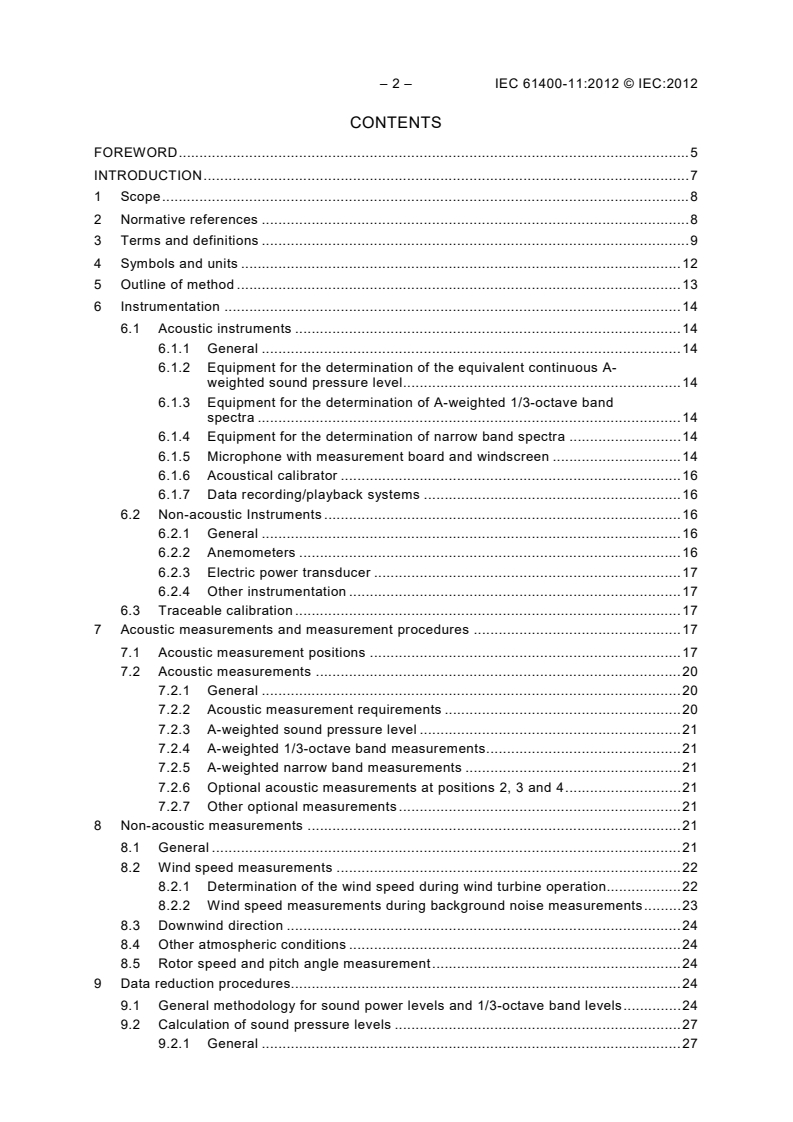
CONTENTS
FOREWORD . 5
INTRODUCTION . 7
1 Scope . 8
2 Normative references . 8
3 Terms and definitions . 9
4 Symbols and units . 12
5 Outline of method . 13
6 Instrumentation . 14
6.1 Acoustic instruments . 14
6.1.1 General . 14
6.1.2 Equipment for the determination of the equivalent continuous A-
weighted sound pressure level. 14
6.1.3 Equipment for the determination of A-weighted 1/3-octave band
spectra . 14
6.1.4 Equipment for the determination of narrow band spectra . 14
6.1.5 Microphone with measurement board and windscreen . 14
6.1.6 Acoustical calibrator . 16
6.1.7 Data recording/playback systems . 16
6.2 Non-acoustic Instruments . 16
6.2.1 General . 16
6.2.2 Anemometers . 16
6.2.3 Electric power transducer . 17
6.2.4 Other instrumentation . 17
6.3 Traceable calibration . 17
7 Acoustic measurements and measurement procedures . 17
7.1 Acoustic measurement positions . 17
7.2 Acoustic measurements . 20
7.2.1 General . 20
7.2.2 Acoustic measurement requirements . 20
7.2.3 A-weighted sound pressure level . 21
7.2.4 A-weighted 1/3-octave band measurements . 21
7.2.5 A-weighted narrow band measurements . 21
7.2.6 Optional acoustic measurements at positions 2, 3 and 4 . 21
7.2.7 Other optional measurements . 21
8 Non-acoustic measurements . 21
8.1 General . 21
8.2 Wind speed measurements . 22
8.2.1 Determination of the wind speed during wind turbine operation. 22
8.2.2 Wind speed measurements during background noise measurements . 23
8.3 Downwind direction . 24
8.4 Other atmospheric conditions . 24
8.5 Rotor speed and pitch angle measurement . 24
9 Data reduction procedures. 24
9.1 General methodology for sound power levels and 1/3-octave band levels . 24
9.2 Calculation of sound pressure levels . 27
61400-11 © IEC:2012(E) – 3 –
9.2.1 General . 27
9.2.2 Calculation of average sound spectra and uncertainty per bin . 27
9.2.3 Calculation of average wind speed and uncertainty per bin . 29
9.2.4 Calculation of noise levels at bin centres including uncertainty . 30
9.3 Apparent sound power levels . 31
9.4 Apparent sound power levels with reference to wind speed in 10 m height . 32
9.5 Tonal audibility . 33
9.5.1 General methodology for tonality . 33
9.5.2 Identifying possible tones . 34
9.5.3 Classification of spectral lines within the critical band . 34
9.5.4 Identified tone . 37
9.5.5 Determination of the tone level . 37
9.5.6 Determination of the masking noise level . 37
9.5.7 Determination of tonality . 37
9.5.8 Determination of audibility . 38
9.5.9 Background noise . 38
10 Information to be reported . 39
10.1 General . 39
10.2 Characterisation of the wind turbine . 39
10.3 Physical environment . 39
10.4 Instrumentation . 40
10.5 Acoustic data . 40
10.6 Non-acoustic data . 41
10.7 Uncertainty . 41
Annex A (informative) Other possible characteristics of wind turbine noise emission
and their quantification . 42
Annex B (informative) Assessment of turbulence intensity . 44
Annex C (informative) Assessment of measurement uncertainty . 45
Annex D (informative) Apparent roughness length . 47
Annex E (informative) Characterization of a secondary wind screen. 49
Annex F (normative) Small wind turbines . 53
Annex G (informative) Air absorption . 57
Bibliography . 58
Figure 1 – Mounting of the microphone . 15
Figure 2 – Picture of microphone and measurement board . 16
Figure 3 – Standard pattern for microphone measurement positions (plan view) . 18
Figure 4 – Illustration of the definitions of R and slant distance R . 19
0 1
Figure 5 – Acceptable meteorological mast position (hatched area) . 22
Figure 6 – Flowchart showing the data reduction procedure . 26
Figure 7 – Flowchart for determining tonal audibility for each wind speed bin . 33
Figure 8 – Illustration of L level in the critical band . 35
70 %
Figure 9 – Illustration of lines below the L + 6 dB criterion . 36
70 %
Figure 10 – Illustration of L level and lines classified as masking. 36
pn,avg
Figure 11 – Illustration of classifying all spectral lines . 37
Figure E.1 – Example 1 of a secondary wind screen . 50
– 4 – 61400-11 © IEC:2012(E)
Figure E.2 – Example 2 of secondary wind screen . 51
Figure E.3 – Example on insertion loss from Table E.1 . 52
Figure F.1 – Allowable region for meteorological mast position as a function of β –
Plan view . 54
Figure F.2 – Example immission noise map . 56
Figure G.1 – Example of 1/3-octave spectrum . 57
Table C.1 – Examples of possible values of type B uncertainty components relevant
for apparent sound power spectra . 46
Table C.2 – Examples of possible values of type B uncertainty components for wind
speed determination relevant for apparent sound power spectra . 46
Table D.1 – Roughness length . 47
Table E.1 – Example on reporting of insertion loss. 51
61400-11 © IEC:2012(E) – 5 –
INTERNATIONAL ELECTROTECHNICAL COMMISSION
____________
WIND TURBINES –
Part 11: Acoustic noise measurement techniques
FOREWORD
1) The International Electrotechnical Commission (IEC) is a worldwide organization for standardization comprising
all national electrotechnical committees (IEC National Committees). The object of IEC is to promote
international co-operation on all questions concerning standardization in the electrical and electronic fields. To
this end and in addition to other activities, IEC publishes International Standards, Technical Specifications,
Technical Reports, Publicly Available Specifications (PAS) and Guides (hereafter referred to as “IEC
Publication(s)”). Their preparation is entrusted to technical committees; any IEC National Committee interested
in the subject dealt with may participate in this preparatory work. International, governmental and non-
governmental organizations liaising with the IEC also participate in this preparation. IEC collaborates closely
with the International Organization for Standardization (ISO) in accordance with conditions determined by
agreement between the two organizations.
2) The formal decisions or agreements of IEC on technical matters express, as nearly as possible, an international
consensus of opinion on the relevant subjects since each technical committee has representation from all
interested IEC National Committees.
3) IEC Publications have the form of recommendations for international use and are accepted by IEC National
Committees in that sense. While all reasonable efforts are made to ensure that the technical content of IEC
Publications is accurate, IEC cannot be held responsible for the way in which they are used or for any
misinterpretation by any end user.
4) In order to promote international uniformity, IEC National Committees undertake to apply IEC Publications
transparently to the maximum extent possible in their national and regional publications. Any divergence
between any IEC Publication and the corresponding national or regional publication shall be clearly indicated in
the latter.
5) IEC itself does not provide any attestation of conformity. Independent certification bodies provide conformity
assessment services and, in some areas, access to IEC marks of conformity. IEC is not responsible for any
services carried out by independent certification bodies.
6) All users should ensure that they have the latest edition of this publication.
7) No liability shall attach to IEC or its directors, employees, servants or agents including individual experts and
members of its technical committees and IEC National Committees for any personal injury, property damage or
other damage of any nature whatsoever, whether direct or indirect, or for costs (including legal fees) and
expenses arising out of the publication, use of, or reliance upon, this IEC Publication or any other IEC
Publications.
8) Attention is drawn to the Normative references cited in this publication. Use of the referenced publications is
indispensable for the correct application of this publication.
9) Attention is drawn to the possibility that some of the elements of this IEC Publication may be the subject of
patent rights. IEC shall not be held responsible for identifying any or all such patent rights.
International Standard IEC 61400-11 has been prepared by IEC technical committee 88: Wind
turbines.
This third edition of IEC 61400-11 cancels and replaces the second edition published in 2002
and its Amendment 1 (2006). It constitutes a technical revision, introducing new principles for
data reduction procedures.
The text of this standard is based on the following documents:
FDIS Report on voting
88/436/FDIS 88/440/RVD
Full information on the voting for the approval of this standard can be found in the report on
voting indicated in the above table.
– 6 – 61400-11 © IEC:2012(E)
This publication has been drafted in accordance with the ISO/IEC Directives, Part 2.
A list of all parts of the IEC 61400 series, under the general title Wind turbines, can be found
on the IEC website.
The committee has decided that the contents of this publication will remain unchanged until
the stability date indicated on the IEC web site under "http://webstore.iec.ch" in the data
related to the specific publication. At this date, the publication will be
• reconfirmed,
• withdrawn,
• replaced by a revised edition, or
• amended.
A bilingual edition of this document may be issued at a later date.
IMPORTANT – The 'colour inside' logo on the cover page of this publication indicates
that it contains colours which are considered to be useful for the correct
understanding of its contents. Users should therefore print this document using a
colour printer.
61400-11 © IEC:2012(E) – 7 –
INTRODUCTION
The purpose of this part of IEC 61400 is to provide a uniform methodology that will ensure
consistency and accuracy in the measurement and analysis of acoustical emissions by wind
turbine generator systems. This International Standard has been prepared with the
anticipation that it would be applied by:
• wind turbine manufacturers striving to meet well defined acoustic emission performance
requirements and/or a possible declaration system (e.g. IEC/TS 61400-14);
• wind turbine purchasers for specifying performance requirements;
• wind turbine operators who may be required to verify that stated, or required, acoustic
performance specifications are met for new or refurbished units;
• wind turbine planners or regulators who must be able to accurately and fairly define
acoustical emission characteristics of a wind turbine in response to environmental
regulations or permit requirements for new or modified installations.
This standard provides guidance in the measurement, analysis and reporting of complex
acoustic emissions from wind turbine generator systems. The standard will benefit those
parties involved in the manufacture, installation, planning and permitting, operation,
utilization, and regulation of wind turbines. The measurement and analysis techniques
recommended in this document should be applied by all parties to ensure that continuing
development and operation of wind turbines is carried out in an atmosphere of consistent and
accurate communication relative to environmental concerns. This standard presents
measurement and reporting procedures expected to provide accurate results that can be
replicated by others.
– 8 – 61400-11 © IEC:2012(E)
WIND TURBINES –
Part 11: Acoustic noise measurement techniques
1 Scope
This part of IEC 61400 presents measurement procedures that enable noise emissions of a
wind turbine to be characterised. This involves using measurement methods appropriate to
noise emission assessment at locations close to the machine, in order to avoid errors due to
sound propagation, but far away enough to allow for the finite source size. The procedures
described are different in some respects from those that would be adopted for noise
assessment in community noise studies. They are intended to facilitate characterisation of
wind turbine noise with respect to a range of wind speeds and directions. Standardisation of
measurement procedures will also facilitate comparisons between different wind turbines.
The procedures present methodologies that will enable the noise emissions of a single wind
turbine to be characterised in a consistent and accurate manner. These procedures include
the following:
• location of acoustic measurement positions;
• requirements for the acquisition of acoustic, meteorological, and associated wind turbine
operational data;
• analysis of the data obtained and the content for the data report; and
• definition of specific acoustic emission parameters, and associated descriptors which are
used for making environmental assessments.
This International Standard is not restricted to wind turbines of a particular size or type. The
procedures described in this standard allow for the thorough description of the noise emission
from a wind turbine. A method for small wind turbines is described in Annex F.
2 Normative references
The following documents, in whole or in part, are normatively referenced in this document and
are indispensable for its application. For dated references, only the edition cited applies. For
undated references, the latest edition of the referenced document (including any
amendments) applies.
IEC 60688, Electrical measuring transducers for converting a.c. electrical quantities to
analogue or digital signals
IEC 60942:2003, Electroacoustics – Sound calibrators
IEC 61260:1995, Electroacoustics – Octave-band and fractional-octave-band filters
IEC 61400-12-1:2005, Wind turbines – Part 12-1: Power performance measurements of
electricity producing wind turbines
IEC 61400-12-2, Wind turbines – Part 12-2: Power performance verification of electricity
producing wind turbines
____________
To be published.
61400-11 © IEC:2012(E) – 9 –
IEC 61672 (all parts), Electroacoustics – Sound level meters
ISO/IEC Guide 98-3, Uncertainty of measurement – Part 3: Guide to the expression of
uncertainty in measurement (GUM:1995)
3 Terms and definitions
For the purposes of this standard, the following terms and definitions apply.
3.1
apparent sound power level
L
WA
A-weighted sound power level re. 1 pW of a point source at the rotor centre with the same
emission in the downwind direction as the wind turbine being measured, L is determined at
WA
bin centre wind speeds at hub height
Note 1 to entry: Apparent sound power level is expressed in dB re. 1 pW.
3.2
apparent sound power level with reference to wind speed at 10 m height
L
WA,10m
A-weighted sound power level re. 1 pW of a point source at the rotor centre with the same
emission in the downwind direction as the wind turbine being measured, L are
WA,10m
determined at bin centre wind speeds at 10 m height within the measured wind speed range
Note 1 to entry: Apparent sound power level with reference to wind speed at 10 m height is expressed in dB re.
1 pW.
3.3
audibility criterion
L
a
frequency dependent criterion curve determined from listening tests, and reflecting the
subjective response of a “typical” listener to tones of different frequencies
Note 1 to entry: Audibility criterion is expressed in dB re. 20 µPa.
3.4 sound pressure levels
3.4.1 A-weighted sound pressure levels
L
A
sound pressure levels measured with the A frequency weighting networks specified in
IEC 61672
Note 1 to entry: A-weighted sound pressure levels are expressed in dB re. 20 µPa.
3.4.2 C-weighted sound pressure levels
L
C
sound pressure levels measured with the C frequency weighting networks specified in
IEC 61672
Note 1 to entry: C-weighted sound pressure levels are expressed in dB re. 20 µPa.
3.5
bin centre
centre value of a wind speed bin
– 10 – 61400-11 © IEC:2012(E)
3.6
inclination angle
φ
angle between the plane of the measurement board and a line from the microphone to the
rotor centre
Note 1 to entry: Inclination angle is expressed in °.
3.7
maximum power
maximum value of the binned power curve for the power optimised mode of operation
Note 1 to entry: Maximum power is expressed in kW.
3.8
measured wind speed at height Z
V
Z,m
wind speed measured at height Z with a mast mounted anemometer
Note 1 to entry: Measured wind speed at height Z is expressed in m/s.
3.9
measured nacelle wind speed at hub height
V
nac,m
wind speed measured at hub height with a nacelle anemometer
Note 1 to entry: Measured nacelle wind speed at hub height is expressed in m/s.
3.10
normalised nacelle wind speed at hub height
V
nac,n
normalised wind speed measured at hub height with a nacelle anemometer corrected to
standard meteorological conditions
Note 1 to entry: Normalised nacelle wind speed at hub height is expressed in m/s.
3.11
normalised wind speed derived from power curve
V
P,n
normalised wind speed derived from power curve under standard meteorological conditions
Note 1 to entry: Normalised wind speed derived from power curve is expressed in m/s.
3.12
normalised wind speed at hub height during background noise measurements
V
B,n
normalised wind speed at hub height from anemometer
Note 1 to entry: Normalised wind speed at hub height during background noise measurements is expressed in
m/s.
3.13
normalised wind speed at hub height
V
H,n
normalised wind speed at hub height
Note 1 to entry: Normalised wind speed at hub height is expressed in m/s.
3.14
normalised wind speed at height Z
V
Z,n
normalised wind speed at height Z from mast mounted anemometer
61400-11 © IEC:2012(E) – 11 –
Note 1 to entry: Normalised wind speed at height Z is expressed in m/s.
3.15
reference distance
R
nominal horizontal distance from the centre of the base of the wind turbine to each of the
prescribed microphone positions
Note 1 to entry: Reference distance is expressed in m.
3.16
reference roughness length
z
0ref
roughness length of 0,05 m used for converting wind speed to meteorological reference
conditions
Note 1 to entry: Reference roughness length is expressed in m.
3.17
sound pressure level
L
p
10 times the log of the ratio of the square mean sound pressure to the square of the
reference sound pressure of 20 µPa
Note 1 to entry: Sound pressure level is expressed in dB re. 20 µPa.
3.18
tonal audibility
∆L
a,k
difference between the tonality and the audibility criterion in each wind speed bin, where k is
the centre value of the wind speed bin
Note 1 to entry: Tonal audibility is expressed in dB.
3.19
tonality
ΔL
k
difference between the tone level and the level of the masking noise in the critical band
around the tone in each wind speed bin where k is the centre value of the wind speed bin
Note 1 to entry: Tonality is expressed in dB.
3.20
wind speed bin
wind speed interval, 0,5 m/s wide, centred around integer and half-integer wind speeds open
at the low end, and closed at the high end
3.21
wind speed at 10 m height
V
wind speed at 10 m height for reporting apparent sound power levels and spectra with
reference to 10 m height
Note 1 to entry: Wind speed at 10 m height is expressed in m/s.
– 12 – 61400-11 © IEC:2012(E)
4 Symbols and units
D rotor diameter (horizontal axis turbine) or equatorial diameter (m)
(vertical axis turbine)
H height of rotor centre (horizontal axis turbine) or height of rotor (m)
equatorial plane (vertical axis turbine) above local ground near
the wind turbine
L or L A or C-weighted sound pressure level (dB)
A C
L equivalent continuous A-weighted sound pressure level (dB)
Aeq
L sound pressure level of masking noise within a critical band in the (dB)
pn,j,k
th th
“j ” spectra at the “k ” wind speed bin
L average of analysis bandwidth sound pressure levels of masking (dB)
pn,avg,j,k
th th
noise in the “j ” spectra at the “k ” wind speed bin
th
L sound pressure level of the tone or tones in the “j ” spectra at the (dB)
pt,j,k
th
” wind speed bin
“k
L apparent sound power level, where k is a wind speed bin centre (dB)
WA,k
value
log logarithm to base 10
P
measured electric power (kW)
m
P normalised electric power (kW)
n
R
slant distance, from rotor centre to actual measurement position (m)
R reference distance (m)
S reference area, S = 1 m
(m )
0 0
T air temperature (°C)
C
T
absolute air temperature (K)
K
U type A uncertainty (-)
A
U
type B uncertainty (-)
B
V wind speed at hub height, H (m/s)
H
V derived wind speed from power curve (m/s)
P
V wind speed at height, z (m/s)
z
V wind speed from nacelle anemometer (m/s)
nac
f frequency of the tone (Hz)
f centre frequency of critical band (Hz)
c
p atmospheric pressure (kPa)
z roughness length (m)
z reference roughness length, 0,05 m (m)
0ref
61400-11 © IEC:2012(E) – 13 –
z anemometer height (m)
ratio of normalised wind speed and measured wind speed (-)
κ
th th
tonality of the “j ” spectra at “k ” wind speed
∆L (dB)
tn,j,k
inclination angle (°)
φ
5 Outline of method
This part of IEC 61400 defines the procedures to be used in the measurement, analysis and
reporting of acoustic emissions of a wind turbine. Instrumentation and calibration
requirements are specified to ensure accuracy and consistency of acoustic and non-acoustic
measurements. Non-acoustic measurements required defining the atmospheric conditions
relevant to determining the acoustic emissions are also specified. All parameters to be
measured and reported are identified, as are the data reduction methods required for
obtaining these parameters.
Application of the method described in this International Standard provides the apparent
A-weighted sound power levels, spectra, and tonal audibility at bin centre wind speeds at hub
height and 10 m height of an individual wind turbine. The tonal audibility is included to give
information on the presence of tones in the noise. The tonality determined is not giving
information on the tonality at other distances. Optionally, measurements can be made in
supplementary positions to give information on the directional characteristics.
The method applies to all wind speeds. The wind speed range for documentation is related to
the specific wind turbine. As a minimum it is defined as the hub height wind speed from 0,8 to
1,3 times the wind speed at 85 % of maximum power rounded to bin centres. Indicatively, this
is a wind speed range of approximately 6 to 10 m/s at 10 m height, depending on the turbine
type. The wind speed range may be expanded for instance to comply with national
requirements.
The measurements are made at locations close to the turbine in order to minimise the
influence of terrain effects, atmospheric conditions or wind-induced noise. To account for the
size of the wind turbine under test, a reference distance R based on the wind turbine
dimensions is used.
Measurements are taken with a microphone positioned on a measurement board placed on
the ground to reduce the wind noise generated at the microphone and to minimise the
influence of different ground types.
Measurements of sound pressure levels, sound pressure spectra, wind speeds, electrical
power, rotor rotational speed and, if measured, pitch angle are made simultaneously over
short periods of time and over a wide range of hub height wind speeds. The sound pressure
levels and spectra at bin centre wind speeds are determined and used for calculating the
apparent A-weighted sound power spectra and levels.
Annexes are included that cover:
– other possible characteristics of wind turbine noise emission and their quantification
(Annex A informative);
– assessment of turbulence intensity (Annex B informative);
– assessment of measurement uncertainty (Annex C informative);
– apparent roughness length (Annex D informative);
– classification of a secondary wind screen (Annex E informative);
– small wind turbines (Annex F normative);
– 14 – 61400-11 © IEC:2012(E)
– air absorption (Annex G informative).
6 Instrumentation
6.1 Acoustic instruments
6.1.1 General
The following equipment is necessary to perform the acoustic measurements as set forth in
this standard.
6.1.2 Equipment for the determination of the equivalent continuous A-weighted
sound pressure level
The equipment shall meet the requirements of an IEC 61672 class 1 sound level meter.
The diameter of the microphone diaphragm shall be no greater than 13 mm.
6.1.3 Equipment for the determination of A-weighted 1/3-octave band spectra
In addition to the requirements given for class 1 sound level meters, the equipment shall have
a constant frequency response over at least the frequency range given by the 1/3-octave
bands with centre frequencies from 20 Hz to 10 kHz. The filters shall meet the requirements
of IEC 61260 for class 1 filters.
The equivalent A-weighted continuous sound pressure levels in 1/3-octave bands with centre
frequencies from 20 Hz to 10 kHz shall be determined simultaneously.
6.1.4 Equipment for the determination of narrow band spectra
The equipment shall fulfil the relevant requirements for IEC 61672 series class 1
instrumentation in the 20 Hz to 11 200 Hz frequency range.
6.1.5 Microphone with measurement board and windscreen
The microphone shall be mounted at the centre of a flat hard board with the diaphragm of the
microphone in a plane normal to the board and with the axis of the microphone pointing
towards the wind turbine, as in Figure 1 and Figure 2. The measurement board shall be
circular with a diameter of at least 1,0 m and made from material that is acoustically hard,
such as plywood or hard chip-board with a thickness of at least 12,0 mm or metal with a
thickness of at least 2,5 mm. In the exceptional case that the board is split (i.e. not in one
piece) there are considerations; the pieces shall be level within the same plane, the gap less
than 1 mm, and the split shall be off the centre line and parallel with the microphone axis as
shown in Figure 1a.
The windscreen to be used with the ground-mounted microphone shall consist of a primary
and, where necessary, a secondary windscreen. The primary windscreen shall consist of one
half of an open cell foam sphere with a diameter of approximately 90 mm, which is centred
around the diaphragm of the microphone, as in Figure 2.
The secondary windscreen may be used when it is necessary to obtain an adequate signal-to-
noise ratio at low frequencies in high winds.
If the secondary windscreen is used, the influence of the secondary windscreen on the
frequency response shall be documented and corrected for in 1/3-octave bands. A procedure
for calibration of the secondary windscreen can be found in Annex E together with
suggestions for design and demands on the insertion loss.
61400-11 © IEC:2012(E) – 15 –
Figure 1a – Mounting of the microphone – Plan view
Figure 1b – Mounting of the microphone – Vertical cross-section
Figure 1 – Mounting of the microphone
– 16 – 61400-11 © IEC:2012(E)
IEC 2092/12
Figure 2 – Picture of microphone and measurement board
6.1.6 Acoustical calibrator
The complete sound measurement system, including any recording, data logging or computing
systems, shall be calibrated immediately before and after the measurement session at one or
more frequencies using an acoustical calibrator on the microphone. The calibrator shall fulfil
the requirements of IEC 60942:2003 class 1, and shall be used within its specified
environmental conditions.
6.1.7 Data recording/playback systems
A data recording/playback system is a required part of the measurement instrumentation. If
used for analysis (other than re-listening), the entire chain of measurement instruments shall
fulfil the relevant requirements of IEC 61672 series, for class 1 instrumentation.
6.2 Non-acoustic Instruments
6.2.1 General
The following equipment is necessary to perform the non-acoustic measurements set forth in
this standard.
6.2.2 Anemometers
The mast mounted anemometer and its signal processing equipment shall have a maximum
deviation from the calibration value of ±0,2 m/s in the wind speed range from 4 m/s to 12 m/s.
It shall be capable of measuring the average wind speed over time intervals synchronized with
the acoustic measurements.
61400-11 © IEC:2012(E) – 17 –
Because the nacelle anemometer is calibrated in-situ (8.2.1.2) during measurements, the
demand for calibration does not apply to the nacelle anemometer. The measurements from
the nacelle anemometer may be supplied from the wind turbine control system. The nacelle
anemometer shall not be used for background noise measurements.
6.2.3 Electric power transducer
The electric power transducer, including current and voltage transformers, shall meet the
accuracy requirements of IEC 60688 class 1. If a calibrated system is not available for the
power signal, an additional uncertainty of the electrical power shall be included. The power
signal may be supplied by the manufacturer if the uncertainty of the measurement chain can
be documented by a detailed description of the entire power measurement chain and the
corresponding uncertainty components.
6.2.4 Other instrumentation
A camera and instruments to measure distance are required. The temperature shall be
measured with an accuracy of ±1 °C. The atmospheric pressure shall be measured with an
accuracy of ±1 kPa.
6.3 Traceable calibration
The following equipment shall be checked regularly and be calibrated with traceability to a
national or primary standards laboratory. The maximum time from the last calibration shall be
as stated for each item of equipment:
• acoustic calibrator (12 months);
• microphone (24 months);
• integrating sound level meter (24 months);
• spectrum analyzer (36 months);
• data recording/playback system (24 months), if used for analysis;
• anemometer (24 months);
• electric power transducer (24 months);
• temperature transducer (24 months);
• atmospheric pressure transducer (24 months).
Where temperature and atmospheric pressure measurements are made only to give general
information about the meteorological conditions during the measurement, an internal
verification of the instrument is sufficient.
An instrument shall always be recalibrated if it has been repaired or is suspected of fault or
damage.
7 Acoustic measurements and measurement procedures
7.1 Acoustic measurement positions
To fully characterize the noise emission of a wind turbine, the following measurement
positions are required.
One, and optionally another three, microphone positions are to be used. The positions shall
be laid out in a pattern around the vertical centreline of the wind turbine tower as indicated in
the plan view shown in Figure 3. The required downwind measurement position is identified
as the reference position, as shown in Figure 3. The direction of the positions shall be within
±15° relative to the downwind direction of the wind turbine at the time of measurement. The
– 18 – 61400-11 © IEC:2012(E)
downwind direction can be derived from the yaw position. The horizontal distance R from the
wind turbine tower vertical centreline to each microphone position shall be as shown in
Figure 3, with a tolerance of ±20 %, maximum ±30 m, and shall be measured with an
accuracy of ±2 %.
Figure 3 – Standard pattern for microphone measurement positions (plan view)
As shown in Figure 4a, the reference distance R for horizontal axis turbines is given by:
D
R = H + (1)
where
H is the vertical distance from the ground to the rotor centre; and
D is the diameter of the rotor.
61400-11 © IEC:2012(E) – 19 –
As shown in Figure 4b, the reference distance R for vertical axis wind turbines is given by:
R = H + D (2)
where
H is the vertical distance from the ground to the rotor equatorial plane; and
D is the equatorial diameter.
D
H
R
φ
D
R = H +
IEC 2094/12
Figure 4a – Horizontal axis turbine
D
H
R
φ
R = H + D
IEC 2095/12
Figure 4b – Vertical axis turbine
Figure 4 – Illustration of the definitions of R and slant distance R
0 1
– 20 – 61400-11 © IEC:2012(E)
To minimize influence due to the edges of the measurement board on the measurement
results, it shall be ensured that the board is positioned flat on the ground. Any edges or gaps
under the board should be levelled out by means of soil. The inclination angle φ, as shown in
Figure 4, shall be between 25° and 40°. This may require adjustment of the measurement
position within the tolerances stated above. Additional considerations shall be made for
measurements in complex terrain to avoid influence such as screening or reflections from
obstructions or terrain.
The measurement position shall be chosen so that the calculated influence from any reflecting
structures, such as buildings or walls, shall be less than 0,2 dB.
7.2 Acoustic measurements
7.2.1 General
The acoustic measurements shall permit the following information to be determined about the
noise emission from the wind turbine at bin centre wind speeds:
– the A-weighted apparent sound power level;
– the A-weighted 1/3-octave band levels;
– the tonal audibility.
Optional measurements may include directivity, infrasound, low-frequency noise and
impulsivity.
7.2.2 Acoustic measurement requirements
For all acoustic measurements, the following requirements are valid:
• The complete measurement chain shall be calibrated at least at one frequency before and
after the measurements, or if the microphones are dis- and reconnected during the
measurements.
• All acoustical signals shall be recorded and stored for later inspection.
• Periods with intruding intermittent background noise (as from aircraft) shall be omitted.
• The wind speed range is related to the specific wind turbine. As a minimum it is defined as
the hub height wind speed from 0,8 to 1,3 times the wind speed a
...
IEC 61400-11 ®
Edition 3.1 2018-06
CONSOLIDATED VERSION
INTERNATIONAL
STANDARD
colour
inside
Wind turbines –
Part 11: Acoustic noise measurement techniques
All rights reserved. Unless otherwise specified, no part of this publication may be reproduced or utilized in any form
or by any means, electronic or mechanical, including photocopying and microfilm, without permission in writing from
either IEC or IEC's member National Committee in the country of the requester. If you have any questions about IEC
copyright or have an enquiry about obtaining additional rights to this publication, please contact the address below or
your local IEC member National Committee for further information.
IEC Central Office Tel.: +41 22 919 02 11
3, rue de Varembé info@iec.ch
CH-1211 Geneva 20 www.iec.ch
Switzerland
About the IEC
The International Electrotechnical Commission (IEC) is the leading global organization that prepares and publishes
International Standards for all electrical, electronic and related technologies.
About IEC publications
The technical content of IEC publications is kept under constant review by the IEC. Please make sure that you have the
latest edition, a corrigenda or an amendment might have been published.
IEC Catalogue - webstore.iec.ch/catalogue Electropedia - www.electropedia.org
The stand-alone application for consulting the entire The world's leading online dictionary of electronic and
bibliographical information on IEC International Standards, electrical terms containing 21 000 terms and definitions in
Technical Specifications, Technical Reports and other English and French, with equivalent terms in 16 additional
documents. Available for PC, Mac OS, Android Tablets and languages. Also known as the International Electrotechnical
iPad. Vocabulary (IEV) online.
IEC publications search - webstore.iec.ch/advsearchform IEC Glossary - std.iec.ch/glossary
The advanced search enables to find IEC publications by a 67 000 electrotechnical terminology entries in English and
variety of criteria (reference number, text, technical French extracted from the Terms and Definitions clause of
committee,…). It also gives information on projects, replaced IEC publications issued since 2002. Some entries have been
and withdrawn publications. collected from earlier publications of IEC TC 37, 77, 86 and
CISPR.
IEC Just Published - webstore.iec.ch/justpublished
Stay up to date on all new IEC publications. Just Published IEC Customer Service Centre - webstore.iec.ch/csc
details all new publications released. Available online and If you wish to give us your feedback on this publication or
also once a month by email. need further assistance, please contact the Customer Service
Centre: sales@iec.ch.
IEC 61400-11 ®
Edition 3.1 2018-06
CONSOLIDATED VERSION
INTERNATIONAL
STANDARD
colour
inside
Wind turbines –
Part 11: Acoustic noise measurement techniques
INTERNATIONAL
ELECTROTECHNICAL
COMMISSION
ICS 27.180 ISBN 978-2-8322-5826-2
IEC 61400-11 ®
Edition 3.1 2018-06
CONSOLIDATED VERSION
REDLINE VERSION
colour
inside
Wind turbines –
Part 11: Acoustic noise measurement techniques
– 2 – IEC 61400-11:2012+AMD1:2018 CSV
© IEC 2018
CONTENTS
FOREWORD . 5
INTRODUCTION . 7
INTRODUCTION to the Amendment . 7
1 Scope . 8
2 Normative references . 8
3 Terms and definitions . 9
4 Symbols and units . 12
5 Outline of method . 13
6 Instrumentation . 14
6.1 Acoustic instruments . 14
6.1.1 General . 14
6.1.2 Equipment for the determination of the equivalent continuous A-
weighted sound pressure level. 14
6.1.3 Equipment for the determination of A-weighted 1/3-octave band
spectra . 14
6.1.4 Equipment for the determination of narrow band spectra . 14
6.1.5 Microphone with measurement board and windscreen . 14
6.1.6 Acoustical calibrator . 16
6.1.7 Data recording/playback systems . 16
6.2 Non-acoustic Instruments . 16
6.2.1 General . 16
6.2.2 Anemometers . 16
6.2.3 Electric power transducer . 17
6.2.4 Other instrumentation . 17
6.3 Traceable calibration . 17
7 Acoustic measurements and measurement procedures . 17
7.1 Acoustic measurement positions . 17
7.2 Acoustic measurements . 20
7.2.1 General . 20
7.2.2 Acoustic measurement requirements . 20
7.2.3 A-weighted sound pressure level . 21
7.2.4 A-weighted 1/3-octave band measurements . 21
7.2.5 A-weighted narrow band measurements . 21
7.2.6 Optional acoustic measurements at positions 2, 3 and 4 . 21
7.2.7 Other optional measurements . 22
7.2.8 Combining measurement series . 22
8 Non-acoustic measurements . 22
8.1 General . 22
8.2 Wind speed measurements . 22
8.2.1 Determination of the wind speed during wind turbine operation. 23
8.2.2 Wind speed measurements during background noise measurements . 24
8.3 Downwind direction . 24
8.4 Other atmospheric conditions . 25
8.5 Rotor speed and pitch angle measurement . 25
9 Data reduction procedures. 25
© IEC 2018
9.1 General methodology for sound power levels and 1/3-octave band levels . 25
9.2 Calculation of sound pressure levels . 28
9.2.1 General . 28
9.2.2 Calculation of average sound spectra and uncertainty per bin . 28
9.2.3 Calculation of average wind speed and uncertainty per bin . 30
9.2.4 Calculation of noise levels at bin centres including uncertainty . 31
9.3 Apparent sound power levels . 32
9.4 Apparent sound power levels with reference to wind speed in 10 m height . 33
9.5 Tonal audibility . 34
9.5.1 General methodology for tonality . 34
9.5.2 Identifying possible tones . 37
9.5.3 Classification of spectral lines within the critical band . 37
9.5.4 Identified tone . 40
9.5.5 Determination of the tone level . 40
9.5.6 Determination of the masking noise level . 40
9.5.7 Determination of tonality . 40
9.5.8 Determination of audibility . 41
9.5.9 Background noise . 41
10 Information to be reported . 42
10.1 General . 42
10.2 Characterisation of the wind turbine . 42
10.3 Physical environment . 42
10.4 Instrumentation . 43
10.5 Acoustic data . 43
10.6 Non-acoustic data . 44
10.7 Uncertainty . 44
Annex A (informative) Other possible characteristics of wind turbine noise emission
and their quantification . 45
Annex B (informative) Assessment of turbulence intensity . 47
Annex C (informative) Assessment of measurement uncertainty . 48
Annex D (informative) Apparent roughness length . 50
Annex E (informative) Characterization of a secondary wind screen. 52
Annex F (normative) Small wind turbines . 56
Annex G (informative) Air absorption . 60
Annex H (normative) Data treatment for measurement series on different days or with
substantially different conditions . 61
Bibliography . 62
Figure 1 – Mounting of the microphone . 15
Figure 2 – Picture of microphone and measurement board . 16
Figure 3 – Standard pattern for microphone measurement positions (plan view) . 18
Figure 4 – Illustration of the definitions of R and slant distance R . 20
0 1
Figure 5 – Acceptable meteorological mast position (hatched area) . 23
Figure 6 – Flowchart showing the data reduction procedure . 27
Figure 7 – Flowchart for determining tonal audibility for each wind speed bin . 36
Figure 8 – Illustration of L level in the critical band . 38
70 %
– 4 – IEC 61400-11:2012+AMD1:2018 CSV
© IEC 2018
Figure 9 – Illustration of lines below the L + 6 dB criterion . 39
70 %
Figure 10 – Illustration of L level and lines classified as masking. 39
pn,avg
Figure 11 – Illustration of classifying all spectral lines . 40
Figure E.1 – Example 1 of a secondary wind screen . 53
Figure E.2 – Example 2 of secondary wind screen . 54
Figure E.3 – Example on insertion loss from Table E.1 . 55
Figure F.1 – Allowable region for meteorological mast position as a function of β –
Plan view . 57
Figure F.2 – Example immission noise map . 59
Figure G.1 – Example of 1/3-octave spectrum . 60
Table C.1 – Examples of possible values of type B uncertainty components relevant
for apparent sound power spectra . 49
Table C.2 – Examples of possible values of type B uncertainty components for wind
speed determination relevant for apparent sound power spectra . 49
Table D.1 – Roughness length . 50
Table E.1 – Example on reporting of insertion loss. 54
© IEC 2018
INTERNATIONAL ELECTROTECHNICAL COMMISSION
____________
WIND TURBINES –
Part 11: Acoustic noise measurement techniques
FOREWORD
1) The International Electrotechnical Commission (IEC) is a worldwide organization for standardization comprising
all national electrotechnical committees (IEC National Committees). The object of IEC is to promote
international co-operation on all questions concerning standardization in the electrical and electronic fields. To
this end and in addition to other activities, IEC publishes International Standards, Technical Specifications,
Technical Reports, Publicly Available Specifications (PAS) and Guides (hereafter referred to as “IEC
Publication(s)”). Their preparation is entrusted to technical committees; any IEC National Committee interested
in the subject dealt with may participate in this preparatory work. International, governmental and non-
governmental organizations liaising with the IEC also participate in this preparation. IEC collaborates closely
with the International Organization for Standardization (ISO) in accordance with conditions determined by
agreement between the two organizations.
2) The formal decisions or agreements of IEC on technical matters express, as nearly as possible, an international
consensus of opinion on the relevant subjects since each technical committee has representation from all
interested IEC National Committees.
3) IEC Publications have the form of recommendations for international use and are accepted by IEC National
Committees in that sense. While all reasonable efforts are made to ensure that the technical content of IEC
Publications is accurate, IEC cannot be held responsible for the way in which they are used or for any
misinterpretation by any end user.
4) In order to promote international uniformity, IEC National Committees undertake to apply IEC Publications
transparently to the maximum extent possible in their national and regional publications. Any divergence
between any IEC Publication and the corresponding national or regional publication shall be clearly indicated in
the latter.
5) IEC itself does not provide any attestation of conformity. Independent certification bodies provide conformity
assessment services and, in some areas, access to IEC marks of conformity. IEC is not responsible for any
services carried out by independent certification bodies.
6) All users should ensure that they have the latest edition of this publication.
7) No liability shall attach to IEC or its directors, employees, servants or agents including individual experts and
members of its technical committees and IEC National Committees for any personal injury, property damage or
other damage of any nature whatsoever, whether direct or indirect, or for costs (including legal fees) and
expenses arising out of the publication, use of, or reliance upon, this IEC Publication or any other IEC
Publications.
8) Attention is drawn to the Normative references cited in this publication. Use of the referenced publications is
indispensable for the correct application of this publication.
9) Attention is drawn to the possibility that some of the elements of this IEC Publication may be the subject of
patent rights. IEC shall not be held responsible for identifying any or all such patent rights.
This consolidated version of the official IEC Standard and its amendment has been prepared
for user convenience.
IEC 61400-11 edition 3.1 contains the third edition (2012-11) [documents 88/436/FDIS and
88/440/RVD], its amendment 1 (2018-06) [documents 88/615/CDV and 88/644A/RVC] and its
corrigendum (2019-10).
In this Redline version, a vertical line in the margin shows where the technical content is
modified by amendment 1. Additions are in green text, deletions are in strikethrough red text.
A separate Final version with all changes accepted is available in this publication.
– 6 – IEC 61400-11:2012+AMD1:2018 CSV
© IEC 2018
International Standard IEC 61400-11 has been prepared by IEC technical committee 88: Wind
turbines.
This third edition constitutes a technical revision, introducing new principles for data reduction
procedures.
This publication has been drafted in accordance with the ISO/IEC Directives, Part 2.
A list of all parts of the IEC 61400 series, under the general title Wind turbines, can be found
on the IEC website.
The committee has decided that the contents of the base publication and its amendment will
remain unchanged until the stability date indicated on the IEC web site under
"http://webstore.iec.ch" in the data related to the specific publication. At this date, the
publication will be
• reconfirmed,
• withdrawn,
• replaced by a revised edition, or
• amended.
IMPORTANT – The 'colour inside' logo on the cover page of this publication indicates
that it contains colours which are considered to be useful for the correct
understanding of its contents. Users should therefore print this document using a
colour printer.
© IEC 2018
INTRODUCTION
The purpose of this part of IEC 61400 is to provide a uniform methodology that will ensure
consistency and accuracy in the measurement and analysis of acoustical emissions by wind
turbine generator systems. This International Standard has been prepared with the
anticipation that it would be applied by:
• wind turbine manufacturers striving to meet well defined acoustic emission performance
requirements and/or a possible declaration system (e.g. IEC/TS 61400-14);
• wind turbine purchasers for specifying performance requirements;
• wind turbine operators who may be required to verify that stated, or required, acoustic
performance specifications are met for new or refurbished units;
• wind turbine planners or regulators who must be able to accurately and fairly define
acoustical emission characteristics of a wind turbine in response to environmental
regulations or permit requirements for new or modified installations.
This standard provides guidance in the measurement, analysis and reporting of complex
acoustic emissions from wind turbine generator systems. The standard will benefit those
parties involved in the manufacture, installation, planning and permitting, operation,
utilization, and regulation of wind turbines. The measurement and analysis techniques
recommended in this document should be applied by all parties to ensure that continuing
development and operation of wind turbines is carried out in an atmosphere of consistent and
accurate communication relative to environmental concerns. This standard presents
measurement and reporting procedures expected to provide accurate results that can be
replicated by others.
INTRODUCTION to the Amendment
This amendment to IEC 61400-11:2012 addresses the situation where a measurement
consists of measurements series on different days or with substantially different conditions.
Furthermore, clarifications have been introduced on tonality analysis and reporting. Editorial
changes have been made.
– 8 – IEC 61400-11:2012+AMD1:2018 CSV
© IEC 2018
WIND TURBINES –
Part 11: Acoustic noise measurement techniques
1 Scope
This part of IEC 61400 presents measurement procedures that enable noise emissions of a
wind turbine to be characterised. This involves using measurement methods appropriate to
noise emission assessment at locations close to the machine, in order to avoid errors due to
sound propagation, but far away enough to allow for the finite source size. The procedures
described are different in some respects from those that would be adopted for noise
assessment in community noise studies. They are intended to facilitate characterisation of
wind turbine noise with respect to a range of wind speeds and directions. Standardisation of
measurement procedures will also facilitate comparisons between different wind turbines.
The procedures present methodologies that will enable the noise emissions of a single wind
turbine to be characterised in a consistent and accurate manner. These procedures include
the following:
• location of acoustic measurement positions;
• requirements for the acquisition of acoustic, meteorological, and associated wind turbine
operational data;
• analysis of the data obtained and the content for the data report; and
• definition of specific acoustic emission parameters, and associated descriptors which are
used for making environmental assessments.
This International Standard is not restricted to wind turbines of a particular size or type. The
procedures described in this standard allow for the thorough description of the noise emission
from a wind turbine. A method for small wind turbines is described in Annex F.
2 Normative references
The following documents, in whole or in part, are normatively referenced in this document and
are indispensable for its application. For dated references, only the edition cited applies. For
undated references, the latest edition of the referenced document (including any
amendments) applies.
IEC 60688, Electrical measuring transducers for converting a.c. electrical quantities to
analogue or digital signals
IEC 60942:2003, Electroacoustics – Sound calibrators
IEC 61260:1995, Electroacoustics – Octave-band and fractional-octave-band filters
IEC 61400-12-1:2005, Wind turbines – Part 12-1: Power performance measurements of
electricity producing wind turbines
IEC 61400-12-2, Wind turbines – Part 12-2: Power performance verification of electricity
producing wind turbines
____________
To be published.
© IEC 2018
IEC 61672 (all parts), Electroacoustics – Sound level meters
ISO/IEC Guide 98-3, Uncertainty of measurement – Part 3: Guide to the expression of
uncertainty in measurement (GUM:1995)
3 Terms and definitions
For the purposes of this standard, the following terms and definitions apply.
3.1
apparent sound power level
L
WA
A-weighted sound power level re. 1 pW of a point source at the rotor centre with the same
emission in the downwind direction as the wind turbine being measured, L is determined at
WA
bin centre wind speeds at hub height
Note 1 to entry: Apparent sound power level is expressed in dB re. 1 pW.
3.2
apparent sound power level with reference to wind speed at 10 m height
L
WA,10m
A-weighted sound power level re. 1 pW of a point source at the rotor centre with the same
emission in the downwind direction as the wind turbine being measured, L are
WA,10m
determined at bin centre wind speeds at 10 m height within the measured wind speed range
Note 1 to entry: Apparent sound power level with reference to wind speed at 10 m height is expressed in dB re.
1 pW.
3.3
audibility criterion
L
a
frequency dependent criterion curve determined from listening tests, and reflecting the
subjective response of a “typical” listener to tones of different frequencies
Note 1 to entry: Audibility criterion is expressed in dB re. 20 µPa.
3.4 sound pressure levels
3.4.1 A-weighted sound pressure levels
L
A
sound pressure levels measured with the A frequency weighting networks specified in
IEC 61672
Note 1 to entry: A-weighted sound pressure levels are expressed in dB re. 20 µPa.
3.4.2 C-weighted sound pressure levels
L
C
sound pressure levels measured with the C frequency weighting networks specified in
IEC 61672
Note 1 to entry: C-weighted sound pressure levels are expressed in dB re. 20 µPa.
3.5
bin centre
centre value of a wind speed bin
– 10 – IEC 61400-11:2012+AMD1:2018 CSV
© IEC 2018
3.6
inclination angle
φ
angle between the plane of the measurement board and a line from the microphone to the
rotor centre
Note 1 to entry: Inclination angle is expressed in °.
3.7
maximum power
maximum value of the binned power curve for the power optimised mode of operation
Note 1 to entry: Maximum power is expressed in kW.
3.8
measured wind speed at height Z
V
Z,m
wind speed measured at height Z with a mast mounted anemometer
Note 1 to entry: Measured wind speed at height Z is expressed in m/s.
3.9
measured nacelle wind speed at hub height
V
nac,m
wind speed measured at hub height with a nacelle anemometer
Note 1 to entry: Measured nacelle wind speed at hub height is expressed in m/s.
3.10
normalised nacelle wind speed at hub height
V
nac,n
normalised wind speed measured at hub height with a nacelle anemometer corrected to
standard meteorological conditions
Note 1 to entry: Normalised nacelle wind speed at hub height is expressed in m/s.
3.11
normalised wind speed derived from power curve
V
P,n
normalised wind speed derived from power curve under standard meteorological conditions
Note 1 to entry: Normalised wind speed derived from power curve is expressed in m/s.
3.12
normalised wind speed at hub height during background noise measurements
V
B,n
normalised wind speed at hub height from anemometer
Note 1 to entry: Normalised wind speed at hub height during background noise measurements is expressed in
m/s.
3.13
normalised wind speed at hub height
V
H,n
normalised wind speed at hub height
Note 1 to entry: Normalised wind speed at hub height is expressed in m/s.
3.14
normalised wind speed at height Z
V
Z,n
normalised wind speed at height Z from mast mounted anemometer
© IEC 2018
Note 1 to entry: Normalised wind speed at height Z is expressed in m/s.
3.15
reference distance
R
nominal horizontal distance from the centre of the base of the wind turbine to each of the
prescribed microphone positions
Note 1 to entry: Reference distance is expressed in m.
3.16
reference roughness length
z
0ref
roughness length of 0,05 m used for converting wind speed to meteorological reference
conditions
Note 1 to entry: Reference roughness length is expressed in m.
3.17
sound pressure level
L
p
10 times the log10 of the ratio of the square mean sound pressure to the square of the
reference sound pressure of 20 µPa
Note 1 to entry: Sound pressure level is expressed in dB re. 20 µPa.
3.18
tonal audibility
∆L
a,k
difference between the tonality and the audibility criterion in each wind speed bin, where k is
the centre value of the wind speed bin
Note 1 to entry: Tonal audibility is expressed in dB.
3.19
tonality
ΔL
k
difference between the tone level and the level of the masking noise in the critical band
around the tone in each wind speed bin where k is the centre value of the wind speed bin
Note 1 to entry: Tonality is expressed in dB.
3.20
wind speed bin
wind speed interval, 0,5 m/s wide, centred around integer and half-integer wind speeds open
at the low end, and closed at the high end
3.21
wind speed at 10 m height
V
wind speed at 10 m height for reporting apparent sound power levels and spectra with
reference to 10 m height
Note 1 to entry: Wind speed at 10 m height is expressed in m/s.
– 12 – IEC 61400-11:2012+AMD1:2018 CSV
© IEC 2018
4 Symbols and units
D rotor diameter (horizontal axis turbine) or equatorial diameter (m)
(vertical axis turbine)
height of rotor centre (horizontal axis turbine) or height of rotor
H (m)
equatorial plane (vertical axis turbine) above local ground near
the wind turbine
L or L A or C-weighted sound pressure level (dB)
A C
L equivalent continuous A-weighted sound pressure level (dB)
Aeq
L sound pressure level of masking noise within a critical band in the (dB)
pn,j,k
th th
“j ” spectra at the “k ” wind speed bin
L average of analysis bandwidth sound pressure levels of masking (dB)
pn,avg,j,k
th th
noise in the “j ” spectra at the “k ” wind speed bin
th
L sound pressure level of the tone or tones in the “j ” spectra at the (dB)
pt,j,k
th
“k ” wind speed bin
L apparent sound power level, where k is a wind speed bin centre (dB)
WA,k
value
log logarithm to base 10
P measured electric power (kW)
m
P normalised electric power (kW)
n
R slant distance, from rotor centre to actual measurement position (m)
R reference distance (m)
2 2
S reference area, S = 1 m (m )
0 0
T air temperature (°C)
C
T absolute air temperature (K)
K
U type A uncertainty (-)
A
U type B uncertainty (-)
B
V wind speed at hub height, H (m/s)
H
V derived wind speed from power curve (m/s)
P
V wind speed at height, z (m/s)
z
V wind speed from nacelle anemometer (m/s)
nac
f frequency of the tone (Hz)
f centre frequency of critical band (Hz)
c
p atmospheric pressure (kPa)
z roughness length (m)
z reference roughness length, 0,05 m (m)
0ref
© IEC 2018
z anemometer height (m)
ratio of normalised wind speed and measured wind speed (-)
κ
th th
∆L tonality of the “j ” spectra at “k ” wind speed (dB)
tn,j,k
inclination angle (°)
φ
5 Outline of method
This part of IEC 61400 defines the procedures to be used in the measurement, analysis and
reporting of acoustic emissions of a wind turbine. Instrumentation and calibration
requirements are specified to ensure accuracy and consistency of acoustic and non-acoustic
measurements. Non-acoustic measurements required defining the atmospheric conditions
relevant to determining the acoustic emissions are also specified. All parameters to be
measured and reported are identified, as are the data reduction methods required for
obtaining these parameters.
Application of the method described in this International Standard provides the apparent
A-weighted sound power levels, spectra, and tonal audibility at bin centre wind speeds at hub
height and 10 m height of an individual wind turbine. The tonal audibility is included to give
information on the presence of tones in the noise. The tonality determined is not giving
information on the tonality at other distances. Optionally, measurements can be made in
supplementary positions to give information on the directional characteristics.
The method applies to all wind speeds. The wind speed range for documentation is related to
the specific wind turbine. As a minimum it is defined as the hub height wind speed from 0,8 to
1,3 times the wind speed at 85 % of maximum power rounded to bin centres. Indicatively, this
is a wind speed range of approximately 6 to 10 m/s at 10 m height, depending on the turbine
type. The wind speed range may be expanded for instance to comply with national
requirements.
The measurements are made at locations close to the turbine in order to minimise the
influence of terrain effects, atmospheric conditions or wind-induced noise. To account for the
size of the wind turbine under test, a reference distance R based on the wind turbine
dimensions is used.
Measurements are taken with a microphone positioned on a measurement board placed on
the ground to reduce the wind noise generated at the microphone and to minimise the
influence of different ground types.
Measurements of sound pressure levels, sound pressure spectra, wind speeds, electrical
power, rotor rotational speed and, if measured, pitch angle are made simultaneously over
short periods of time and over a wide range of hub height wind speeds. The sound pressure
levels and spectra at bin centre wind speeds are determined and used for calculating the
apparent A-weighted sound power spectra and levels.
Annexes are included that cover:
– other possible characteristics of wind turbine noise emission and their quantification
(Annex A informative);
– assessment of turbulence intensity (Annex B informative);
– assessment of measurement uncertainty (Annex C informative);
– apparent roughness length (Annex D informative);
– classification of a secondary wind screen (Annex E informative);
– small wind turbines (Annex F normative);
– 14 – IEC 61400-11:2012+AMD1:2018 CSV
© IEC 2018
– air absorption (Annex G informative).
6 Instrumentation
6.1 Acoustic instruments
6.1.1 General
The following equipment is necessary to perform the acoustic measurements as set forth in
this standard.
6.1.2 Equipment for the determination of the equivalent continuous A-weighted sound
pressure level
The equipment shall meet the requirements relevant to this document of an IEC 61672 class 1
sound level meter. The diameter of the microphone diaphragm shall be no greater than
13 mm.
6.1.3 Equipment for the determination of A-weighted 1/3-octave band spectra
In addition to the requirements given for class 1 sound level meters, the equipment shall have
a constant frequency response over at least the frequency range given by the 1/3-octave
bands with centre frequencies from 20 Hz to 10 kHz. The filters shall meet the requirements
relevant to this document of IEC 61260 for class 1 filters.
The equivalent A-weighted continuous sound pressure levels in 1/3-octave bands with centre
frequencies from 20 Hz to 10 kHz shall be determined simultaneously.
6.1.4 Equipment for the determination of narrow band spectra
The equipment shall fulfil the relevant requirements for IEC 61672 series class 1
instrumentation in the 20 Hz to 11 200 Hz frequency range.
6.1.5 Microphone with measurement board and windscreen
The microphone shall be mounted at the centre of a flat hard board with the diaphragm of the
microphone in a plane normal to the board and with the axis of the microphone pointing
towards the wind turbine, as in Figure 1 and Figure 2. The measurement board shall be
circular with a diameter of at least 1,0 m and made from material that is acoustically hard,
such as plywood or hard chip-board with a thickness of at least 12,0 mm or metal with a
thickness of at least 2,5 mm. In the exceptional case that the board is split (i.e. not in one
piece) there are considerations; the pieces shall be level within the same plane, the gap less
than 1 mm, and the split shall be off the centre line and parallel with the microphone axis as
shown in Figure 1a.
The windscreen to be used with the ground-mounted microphone shall consist of a primary
and, where necessary, a secondary windscreen. The primary windscreen shall consist of one
half of an open cell foam sphere with a diameter of approximately 90 mm, which is centred
around the diaphragm of the microphone, as in Figure 2.
The secondary windscreen may be used when it is necessary to obtain an adequate signal-to-
noise ratio at low frequencies in high winds.
If the secondary windscreen is used, the influence of the secondary windscreen on the
frequency response shall be documented and corrected for in 1/3-octave bands. A procedure
for calibration of the secondary windscreen can be found in Annex E together with
suggestions for design and demands on the insertion loss.
© IEC 2018
Figure 1a – Mounting of the microphone – Plan view
Figure 1b – Mounting of the microphone – Vertical cross-section
Figure 1 – Mounting of the microphone
– 16 – IEC 61400-11:2012+AMD1:2018 CSV
© IEC 2018
IEC 2092/12
Figure 2 – Picture of microphone and measurement board
6.1.6 Acoustical calibrator
The complete sound measurement system, including any recording, data logging or computing
systems, shall be calibrated immediately before and after the measurement session at one or
more frequencies using an acoustical calibrator on the microphone. The calibrator shall fulfil
the requirements of IEC 60942:2003 class 1, and shall be used within its specified
environmental conditions.
6.1.7 Data recording/playback systems
A data recording/playback system is a required part of the measurement instrumentation. If
used for analysis (other than re-listening), the entire chain of measurement instruments shall
fulfil the relevant requirements of IEC 61672 series, for class 1 instrumentation.
6.2 Non-acoustic Instruments
6.2.1 General
The following equipment is necessary to perform the non-acoustic measurements set forth in
this standard.
6.2.2 Anemometers
The mast mounted anemometer and its signal processing equipment shall have a maximum
deviation from the calibration value of ±0,2 m/s in the wind speed range from 4 m/s to 12 m/s.
It shall be capable of measuring the average wind speed over time intervals synchronized with
the acoustic measurements.
© IEC 2018
Because the nacelle anemometer is calibrated in-situ (8.2.1.2) during measurements, the
demand for calibration does not apply to the nacelle anemometer. The measurements from
the nacelle anemometer may be supplied from the wind turbine control system. The nacelle
anemometer shall not be used for background noise measurements.
6.2.3 Electric power transducer
The electric power transducer, including current and voltage transformers, shall meet the
accuracy requirements of IEC 60688 class 1. If a calibrated system is not available for the
power signal, an additional uncertainty of the electrical power shall be included. The power
signal may be supplied by the manufacturer if the uncertainty of the measurement chain can
be documented by a detailed description of the entire power measurement chain and the
corresponding uncertainty components.
6.2.4 Other instrumentation
A camera and instruments to measure distance are required. The temperature shall be
measured with an accuracy of ±1 °C. The atmospheric pressure shall be measured with an
accuracy of ±1 kPa.
6.3 Traceable calibration
The following equipment shall be checked regularly and be calibrated with traceability to a
national or primary standards laboratory. The maximum time from the last calibration shall be
as stated for each item of equipment:
• acoustic calibrator (12 months);
• microphone (24 months);
• integrating sound level meter (24 months);
• spectrum analyzer (36 months);
• data recording/playback system (24 months), if used for analysis;
• anemometer (24 months);
• electric power transducer (24 months);
• temperature transducer (24 months);
• atmospheric pressure transducer (24 months).
Where temperature and atmospheric pressure measurements are made only to give general
information about the meteorological conditions during the measurement, an internal
verification of the instrument is sufficient.
An instrument shall always be recalibrated if it has been repaired or is suspected of fault or
damage.
7 Acoustic measurements and measurement procedures
7.1 Acoustic measurement positions
To fully characterize the noise emission of a wind turbine, the following measurement
positions are required.
One, and optionally another three, microphone positions are to be used. The positions shall
be laid out in a pattern around the vertical centreline of the wind turbine tower as indicated in
the plan view shown in Figure 3. The required downwind measurement position is identified
as the reference position, as shown in Figure 3. The direction of the positions shall be within
±15° relative to the downwind direction of the wind turbine at the time of measurement. The
– 18 – IEC 61400-11:2012+AMD1:2018 CSV
© IEC 2018
downwind direction can be derived from the yaw position. The horizontal distance R from the
wind turbine tower vertical centreline to each microphone position shall be as shown in
Figure 3, with a tolerance of ±20 %, maximum ±30 m, and shall be measured with an
accuracy of ±2 %. The measurement distance shall be as close as possible to R . The allowed
tolerance should only be used where it is essential to obtain valid data and, where this is
done, clear evidence shall be reported to justify the decision made.
Figure 3 – Standard pattern for microphone measurement positions (plan view)
for horizontal axis turbines is given by:
As shown in Figure 4a, the reference distance R
D
R = H + (1)
where
...
IEC 61400-11 ®
Edition 3.0 2012-11
INTERNATIONAL
STANDARD
NORME
INTERNATIONALE
colour
inside
Wind turbines –
Part 11: Acoustic noise measurement techniques
Éoliennes –
Partie 11: Techniques de mesure du bruit acoustique
All rights reserved. Unless otherwise specified, no part of this publication may be reproduced or utilized in any form
or by any means, electronic or mechanical, including photocopying and microfilm, without permission in writing from
either IEC or IEC's member National Committee in the country of the requester. If you have any questions about IEC
copyright or have an enquiry about obtaining additional rights to this publication, please contact the address below or
your local IEC member National Committee for further information.
Droits de reproduction réservés. Sauf indication contraire, aucune partie de cette publication ne peut être reproduite
ni utilisée sous quelque forme que ce soit et par aucun procédé, électronique ou mécanique, y compris la photocopie
et les microfilms, sans l'accord écrit de l'IEC ou du Comité national de l'IEC du pays du demandeur. Si vous avez des
questions sur le copyright de l'IEC ou si vous désirez obtenir des droits supplémentaires sur cette publication, utilisez
les coordonnées ci-après ou contactez le Comité national de l'IEC de votre pays de résidence.
IEC Central Office Tel.: +41 22 919 02 11
3, rue de Varembé info@iec.ch
CH-1211 Geneva 20 www.iec.ch
Switzerland
About the IEC
The International Electrotechnical Commission (IEC) is the leading global organization that prepares and publishes
International Standards for all electrical, electronic and related technologies.
About IEC publications
The technical content of IEC publications is kept under constant review by the IEC. Please make sure that you have the
latest edition, a corrigenda or an amendment might have been published.
IEC Catalogue - webstore.iec.ch/catalogue Electropedia - www.electropedia.org
The stand-alone application for consulting the entire The world's leading online dictionary of electronic and
bibliographical information on IEC International Standards, electrical terms containing 21 000 terms and definitions in
Technical Specifications, Technical Reports and other English and French, with equivalent terms in 16 additional
documents. Available for PC, Mac OS, Android Tablets and languages. Also known as the International Electrotechnical
iPad. Vocabulary (IEV) online.
IEC publications search - webstore.iec.ch/advsearchform IEC Glossary - std.iec.ch/glossary
The advanced search enables to find IEC publications by a 67 000 electrotechnical terminology entries in English and
variety of criteria (reference number, text, technical French extracted from the Terms and Definitions clause of
committee,…). It also gives information on projects, replaced IEC publications issued since 2002. Some entries have been
and withdrawn publications. collected from earlier publications of IEC TC 37, 77, 86 and
CISPR.
IEC Just Published - webstore.iec.ch/justpublished
Stay up to date on all new IEC publications. Just Published IEC Customer Service Centre - webstore.iec.ch/csc
details all new publications released. Available online and If you wish to give us your feedback on this publication or
also once a month by email. need further assistance, please contact the Customer Service
Centre: sales@iec.ch.
A propos de l'IEC
La Commission Electrotechnique Internationale (IEC) est la première organisation mondiale qui élabore et publie des
Normes internationales pour tout ce qui a trait à l'électricité, à l'électronique et aux technologies apparentées.
A propos des publications IEC
Le contenu technique des publications IEC est constamment revu. Veuillez vous assurer que vous possédez l’édition la
plus récente, un corrigendum ou amendement peut avoir été publié.
Catalogue IEC - webstore.iec.ch/catalogue Electropedia - www.electropedia.org
Application autonome pour consulter tous les renseignements
Le premier dictionnaire en ligne de termes électroniques et
bibliographiques sur les Normes internationales,
électriques. Il contient 21 000 termes et définitions en anglais
Spécifications techniques, Rapports techniques et autres
et en français, ainsi que les termes équivalents dans 16
documents de l'IEC. Disponible pour PC, Mac OS, tablettes
langues additionnelles. Egalement appelé Vocabulaire
Android et iPad.
Electrotechnique International (IEV) en ligne.
Recherche de publications IEC -
Glossaire IEC - std.iec.ch/glossary
webstore.iec.ch/advsearchform
67 000 entrées terminologiques électrotechniques, en anglais
La recherche avancée permet de trouver des publications IEC et en français, extraites des articles Termes et Définitions des
en utilisant différents critères (numéro de référence, texte, publications IEC parues depuis 2002. Plus certaines entrées
comité d’études,…). Elle donne aussi des informations sur les antérieures extraites des publications des CE 37, 77, 86 et
projets et les publications remplacées ou retirées. CISPR de l'IEC.
IEC Just Published - webstore.iec.ch/justpublished Service Clients - webstore.iec.ch/csc
Restez informé sur les nouvelles publications IEC. Just Si vous désirez nous donner des commentaires sur cette
Published détaille les nouvelles publications parues. publication ou si vous avez des questions contactez-nous:
Disponible en ligne et aussi une fois par mois par email. sales@iec.ch.
IEC 61400-11 ®
Edition 3.0 2012-11
INTERNATIONAL
STANDARD
NORME
INTERNATIONALE
colour
inside
Wind turbines –
Part 11: Acoustic noise measurement techniques
Éoliennes –
Partie 11: Techniques de mesure du bruit acoustique
INTERNATIONAL
ELECTROTECHNICAL
COMMISSION
COMMISSION
ELECTROTECHNIQUE
INTERNATIONALE
ICS 27.180 ISBN 978-2-8322-6321-1
– 2 – IEC 61400-11:2012 © IEC:2012
CONTENTS
FOREWORD . 5
INTRODUCTION . 7
1 Scope . 8
2 Normative references . 8
3 Terms and definitions . 9
4 Symbols and units . 12
5 Outline of method . 13
6 Instrumentation . 14
6.1 Acoustic instruments . 14
6.1.1 General . 14
6.1.2 Equipment for the determination of the equivalent continuous A-
weighted sound pressure level. 14
6.1.3 Equipment for the determination of A-weighted 1/3-octave band
spectra . 14
6.1.4 Equipment for the determination of narrow band spectra . 14
6.1.5 Microphone with measurement board and windscreen . 14
6.1.6 Acoustical calibrator . 16
6.1.7 Data recording/playback systems . 16
6.2 Non-acoustic Instruments . 16
6.2.1 General . 16
6.2.2 Anemometers . 16
6.2.3 Electric power transducer . 17
6.2.4 Other instrumentation . 17
6.3 Traceable calibration . 17
7 Acoustic measurements and measurement procedures . 17
7.1 Acoustic measurement positions . 17
7.2 Acoustic measurements . 20
7.2.1 General . 20
7.2.2 Acoustic measurement requirements . 20
7.2.3 A-weighted sound pressure level . 21
7.2.4 A-weighted 1/3-octave band measurements . 21
7.2.5 A-weighted narrow band measurements . 21
7.2.6 Optional acoustic measurements at positions 2, 3 and 4 . 21
7.2.7 Other optional measurements . 21
8 Non-acoustic measurements . 21
8.1 General . 21
8.2 Wind speed measurements . 22
8.2.1 Determination of the wind speed during wind turbine operation. 22
8.2.2 Wind speed measurements during background noise measurements . 23
8.3 Downwind direction . 24
8.4 Other atmospheric conditions . 24
8.5 Rotor speed and pitch angle measurement . 24
9 Data reduction procedures. 24
9.1 General methodology for sound power levels and 1/3-octave band levels . 24
9.2 Calculation of sound pressure levels . 27
9.2.1 General . 27
9.2.2 Calculation of average sound spectra and uncertainty per bin . 27
9.2.3 Calculation of average wind speed and uncertainty per bin . 29
9.2.4 Calculation of noise levels at bin centres including uncertainty . 30
9.3 Apparent sound power levels . 31
9.4 Apparent sound power levels with reference to wind speed in 10 m height . 32
9.5 Tonal audibility . 33
9.5.1 General methodology for tonality . 33
9.5.2 Identifying possible tones . 34
9.5.3 Classification of spectral lines within the critical band . 34
9.5.4 Identified tone . 37
9.5.5 Determination of the tone level . 37
9.5.6 Determination of the masking noise level . 37
9.5.7 Determination of tonality . 37
9.5.8 Determination of audibility . 38
9.5.9 Background noise . 38
10 Information to be reported . 39
10.1 General . 39
10.2 Characterisation of the wind turbine . 39
10.3 Physical environment . 39
10.4 Instrumentation . 40
10.5 Acoustic data . 40
10.6 Non-acoustic data . 41
10.7 Uncertainty . 41
Annex A (informative) Other possible characteristics of wind turbine noise emission
and their quantification . 42
Annex B (informative) Assessment of turbulence intensity . 44
Annex C (informative) Assessment of measurement uncertainty . 45
Annex D (informative) Apparent roughness length . 47
Annex E (informative) Characterization of a secondary wind screen. 49
Annex F (normative) Small wind turbines . 53
Annex G (informative) Air absorption . 57
Bibliography . 58
Figure 1 – Mounting of the microphone . 15
Figure 2 – Picture of microphone and measurement board . 16
Figure 3 – Standard pattern for microphone measurement positions (plan view) . 18
Figure 4 – Illustration of the definitions of R and slant distance R . 19
0 1
Figure 5 – Acceptable meteorological mast position (hatched area) . 22
Figure 6 – Flowchart showing the data reduction procedure . 26
Figure 7 – Flowchart for determining tonal audibility for each wind speed bin . 33
Figure 8 – Illustration of L level in the critical band . 35
70 %
Figure 9 – Illustration of lines below the L + 6 dB criterion . 36
70 %
Figure 10 – Illustration of L level and lines classified as masking. 36
pn,avg
Figure 11 – Illustration of classifying all spectral lines . 37
Figure E.1 – Example 1 of a secondary wind screen . 50
Figure E.2 – Example 2 of secondary wind screen . 51
– 4 – IEC 61400-11:2012 © IEC:2012
Figure E.3 – Example on insertion loss from Table E.1 . 52
Figure F.1 – Allowable region for meteorological mast position as a function of β –
Plan view . 54
Figure F.2 – Example immission noise map . 56
Figure G.1 – Example of 1/3-octave spectrum . 57
Table C.1 – Examples of possible values of type B uncertainty components relevant
for apparent sound power spectra . 46
Table C.2 – Examples of possible values of type B uncertainty components for wind
speed determination relevant for apparent sound power spectra . 46
Table D.1 – Roughness length . 47
Table E.1 – Example on reporting of insertion loss. 51
INTERNATIONAL ELECTROTECHNICAL COMMISSION
____________
WIND TURBINES –
Part 11: Acoustic noise measurement techniques
FOREWORD
1) The International Electrotechnical Commission (IEC) is a worldwide organization for standardization comprising
all national electrotechnical committees (IEC National Committees). The object of IEC is to promote
international co-operation on all questions concerning standardization in the electrical and electronic fields. To
this end and in addition to other activities, IEC publishes International Standards, Technical Specifications,
Technical Reports, Publicly Available Specifications (PAS) and Guides (hereafter referred to as “IEC
Publication(s)”). Their preparation is entrusted to technical committees; any IEC National Committee interested
in the subject dealt with may participate in this preparatory work. International, governmental and non-
governmental organizations liaising with the IEC also participate in this preparation. IEC collaborates closely
with the International Organization for Standardization (ISO) in accordance with conditions determined by
agreement between the two organizations.
2) The formal decisions or agreements of IEC on technical matters express, as nearly as possible, an international
consensus of opinion on the relevant subjects since each technical committee has representation from all
interested IEC National Committees.
3) IEC Publications have the form of recommendations for international use and are accepted by IEC National
Committees in that sense. While all reasonable efforts are made to ensure that the technical content of IEC
Publications is accurate, IEC cannot be held responsible for the way in which they are used or for any
misinterpretation by any end user.
4) In order to promote international uniformity, IEC National Committees undertake to apply IEC Publications
transparently to the maximum extent possible in their national and regional publications. Any divergence
between any IEC Publication and the corresponding national or regional publication shall be clearly indicated in
the latter.
5) IEC itself does not provide any attestation of conformity. Independent certification bodies provide conformity
assessment services and, in some areas, access to IEC marks of conformity. IEC is not responsible for any
services carried out by independent certification bodies.
6) All users should ensure that they have the latest edition of this publication.
7) No liability shall attach to IEC or its directors, employees, servants or agents including individual experts and
members of its technical committees and IEC National Committees for any personal injury, property damage or
other damage of any nature whatsoever, whether direct or indirect, or for costs (including legal fees) and
expenses arising out of the publication, use of, or reliance upon, this IEC Publication or any other IEC
Publications.
8) Attention is drawn to the Normative references cited in this publication. Use of the referenced publications is
indispensable for the correct application of this publication.
9) Attention is drawn to the possibility that some of the elements of this IEC Publication may be the subject of
patent rights. IEC shall not be held responsible for identifying any or all such patent rights.
International Standard IEC 61400-11 has been prepared by IEC technical committee 88: Wind
turbines.
This third edition of IEC 61400-11 cancels and replaces the second edition published in 2002
and its Amendment 1 (2006). It constitutes a technical revision, introducing new principles for
data reduction procedures.
This bilingual version (2019-01) corresponds to the monolingual English version, published in
2012-11.
The text of this standard is based on the following documents:
FDIS Report on voting
88/436/FDIS 88/440/RVD
Full information on the voting for the approval of this standard can be found in the report on
voting indicated in the above table.
– 6 – IEC 61400-11:2012 © IEC:2012
The French version of this standard has not been voted upon.
This publication has been drafted in accordance with the ISO/IEC Directives, Part 2.
A list of all parts of the IEC 61400 series, under the general title Wind turbines, can be found
on the IEC website.
The committee has decided that the contents of this publication will remain unchanged until
the stability date indicated on the IEC web site under "http://webstore.iec.ch" in the data
related to the specific publication. At this date, the publication will be
• reconfirmed,
• withdrawn,
• replaced by a revised edition, or
• amended.
IMPORTANT – The 'colour inside' logo on the cover page of this publication indicates
that it contains colours which are considered to be useful for the correct
understanding of its contents. Users should therefore print this document using a
colour printer.
INTRODUCTION
The purpose of this part of IEC 61400 is to provide a uniform methodology that will ensure
consistency and accuracy in the measurement and analysis of acoustical emissions by wind
turbine generator systems. This International Standard has been prepared with the
anticipation that it would be applied by:
• wind turbine manufacturers striving to meet well defined acoustic emission performance
requirements and/or a possible declaration system (e.g. IEC/TS 61400-14);
• wind turbine purchasers for specifying performance requirements;
• wind turbine operators who may be required to verify that stated, or required, acoustic
performance specifications are met for new or refurbished units;
• wind turbine planners or regulators who must be able to accurately and fairly define
acoustical emission characteristics of a wind turbine in response to environmental
regulations or permit requirements for new or modified installations.
This standard provides guidance in the measurement, analysis and reporting of complex
acoustic emissions from wind turbine generator systems. The standard will benefit those
parties involved in the manufacture, installation, planning and permitting, operation,
utilization, and regulation of wind turbines. The measurement and analysis techniques
recommended in this document should be applied by all parties to ensure that continuing
development and operation of wind turbines is carried out in an atmosphere of consistent and
accurate communication relative to environmental concerns. This standard presents
measurement and reporting procedures expected to provide accurate results that can be
replicated by others.
– 8 – IEC 61400-11:2012 © IEC:2012
WIND TURBINES –
Part 11: Acoustic noise measurement techniques
1 Scope
This part of IEC 61400 presents measurement procedures that enable noise emissions of a
wind turbine to be characterised. This involves using measurement methods appropriate to
noise emission assessment at locations close to the machine, in order to avoid errors due to
sound propagation, but far away enough to allow for the finite source size. The procedures
described are different in some respects from those that would be adopted for noise
assessment in community noise studies. They are intended to facilitate characterisation of
wind turbine noise with respect to a range of wind speeds and directions. Standardisation of
measurement procedures will also facilitate comparisons between different wind turbines.
The procedures present methodologies that will enable the noise emissions of a single wind
turbine to be characterised in a consistent and accurate manner. These procedures include
the following:
• location of acoustic measurement positions;
• requirements for the acquisition of acoustic, meteorological, and associated wind turbine
operational data;
• analysis of the data obtained and the content for the data report; and
• definition of specific acoustic emission parameters, and associated descriptors which are
used for making environmental assessments.
This International Standard is not restricted to wind turbines of a particular size or type. The
procedures described in this standard allow for the thorough description of the noise emission
from a wind turbine. A method for small wind turbines is described in Annex F.
2 Normative references
The following documents, in whole or in part, are normatively referenced in this document and
are indispensable for its application. For dated references, only the edition cited applies. For
undated references, the latest edition of the referenced document (including any
amendments) applies.
IEC 60688, Electrical measuring transducers for converting a.c. electrical quantities to
analogue or digital signals
IEC 60942:2003, Electroacoustics – Sound calibrators
IEC 61260:1995, Electroacoustics – Octave-band and fractional-octave-band filters
IEC 61400-12-1:2005, Wind turbines – Part 12-1: Power performance measurements of
electricity producing wind turbines
IEC 61400-12-2, Wind turbines – Part 12-2: Power performance verification of electricity
producing wind turbines
____________
To be published.
IEC 61672 (all parts), Electroacoustics – Sound level meters
ISO/IEC Guide 98-3, Uncertainty of measurement – Part 3: Guide to the expression of
uncertainty in measurement (GUM:1995)
3 Terms and definitions
For the purposes of this standard, the following terms and definitions apply.
3.1
apparent sound power level
L
WA
A-weighted sound power level re. 1 pW of a point source at the rotor centre with the same
emission in the downwind direction as the wind turbine being measured, L is determined at
WA
bin centre wind speeds at hub height
Note 1 to entry: Apparent sound power level is expressed in dB re. 1 pW.
3.2
apparent sound power level with reference to wind speed at 10 m height
L
WA,10m
A-weighted sound power level re. 1 pW of a point source at the rotor centre with the same
emission in the downwind direction as the wind turbine being measured, L are
WA,10m
determined at bin centre wind speeds at 10 m height within the measured wind speed range
Note 1 to entry: Apparent sound power level with reference to wind speed at 10 m height is expressed in dB re.
1 pW.
3.3
audibility criterion
L
a
frequency dependent criterion curve determined from listening tests, and reflecting the
subjective response of a “typical” listener to tones of different frequencies
Note 1 to entry: Audibility criterion is expressed in dB re. 20 µPa.
3.4 sound pressure levels
3.4.1 A-weighted sound pressure levels
L
A
sound pressure levels measured with the A frequency weighting networks specified in
IEC 61672
Note 1 to entry: A-weighted sound pressure levels are expressed in dB re. 20 µPa.
3.4.2 C-weighted sound pressure levels
L
C
sound pressure levels measured with the C frequency weighting networks specified in
IEC 61672
Note 1 to entry: C-weighted sound pressure levels are expressed in dB re. 20 µPa.
3.5
bin centre
centre value of a wind speed bin
– 10 – IEC 61400-11:2012 © IEC:2012
3.6
inclination angle
φ
angle between the plane of the measurement board and a line from the microphone to the
rotor centre
Note 1 to entry: Inclination angle is expressed in °.
3.7
maximum power
maximum value of the binned power curve for the power optimised mode of operation
Note 1 to entry: Maximum power is expressed in kW.
3.8
measured wind speed at height Z
V
Z,m
wind speed measured at height Z with a mast mounted anemometer
Note 1 to entry: Measured wind speed at height Z is expressed in m/s.
3.9
measured nacelle wind speed at hub height
V
nac,m
wind speed measured at hub height with a nacelle anemometer
Note 1 to entry: Measured nacelle wind speed at hub height is expressed in m/s.
3.10
normalised nacelle wind speed at hub height
V
nac,n
normalised wind speed measured at hub height with a nacelle anemometer corrected to
standard meteorological conditions
Note 1 to entry: Normalised nacelle wind speed at hub height is expressed in m/s.
3.11
normalised wind speed derived from power curve
V
P,n
normalised wind speed derived from power curve under standard meteorological conditions
Note 1 to entry: Normalised wind speed derived from power curve is expressed in m/s.
3.12
normalised wind speed at hub height during background noise measurements
V
B,n
normalised wind speed at hub height from anemometer
Note 1 to entry: Normalised wind speed at hub height during background noise measurements is expressed in
m/s.
3.13
normalised wind speed at hub height
V
H,n
normalised wind speed at hub height
Note 1 to entry: Normalised wind speed at hub height is expressed in m/s.
3.14
normalised wind speed at height Z
V
Z,n
normalised wind speed at height Z from mast mounted anemometer
Note 1 to entry: Normalised wind speed at height Z is expressed in m/s.
3.15
reference distance
R
nominal horizontal distance from the centre of the base of the wind turbine to each of the
prescribed microphone positions
Note 1 to entry: Reference distance is expressed in m.
3.16
reference roughness length
z
0ref
roughness length of 0,05 m used for converting wind speed to meteorological reference
conditions
Note 1 to entry: Reference roughness length is expressed in m.
3.17
sound pressure level
L
p
10 times the log10 of the ratio of the square mean sound pressure to the square of the
reference sound pressure of 20 µPa
Note 1 to entry: Sound pressure level is expressed in dB re. 20 µPa.
3.18
tonal audibility
∆L
a,k
difference between the tonality and the audibility criterion in each wind speed bin, where k is
the centre value of the wind speed bin
Note 1 to entry: Tonal audibility is expressed in dB.
3.19
tonality
ΔL
k
difference between the tone level and the level of the masking noise in the critical band
around the tone in each wind speed bin where k is the centre value of the wind speed bin
Note 1 to entry: Tonality is expressed in dB.
3.20
wind speed bin
wind speed interval, 0,5 m/s wide, centred around integer and half-integer wind speeds open
at the low end, and closed at the high end
3.21
wind speed at 10 m height
V
wind speed at 10 m height for reporting apparent sound power levels and spectra with
reference to 10 m height
Note 1 to entry: Wind speed at 10 m height is expressed in m/s.
– 12 – IEC 61400-11:2012 © IEC:2012
4 Symbols and units
D rotor diameter (horizontal axis turbine) or equatorial diameter (m)
(vertical axis turbine)
height of rotor centre (horizontal axis turbine) or height of rotor
H (m)
equatorial plane (vertical axis turbine) above local ground near
the wind turbine
L or L A or C-weighted sound pressure level (dB)
A C
L equivalent continuous A-weighted sound pressure level (dB)
Aeq
L sound pressure level of masking noise within a critical band in the (dB)
pn,j,k
th th
“j ” spectra at the “k ” wind speed bin
L average of analysis bandwidth sound pressure levels of masking (dB)
pn,avg,j,k
th th
noise in the “j ” spectra at the “k ” wind speed bin
th
L sound pressure level of the tone or tones in the “j ” spectra at the (dB)
pt,j,k
th
“k ” wind speed bin
L apparent sound power level, where k is a wind speed bin centre (dB)
WA,k
value
log logarithm to base 10
P measured electric power (kW)
m
P normalised electric power (kW)
n
R slant distance, from rotor centre to actual measurement position (m)
R reference distance (m)
2 2
S reference area, S = 1 m (m )
0 0
T air temperature (°C)
C
T absolute air temperature (K)
K
U type A uncertainty (-)
A
U type B uncertainty (-)
B
V wind speed at hub height, H (m/s)
H
V derived wind speed from power curve (m/s)
P
V wind speed at height, z (m/s)
z
V wind speed from nacelle anemometer (m/s)
nac
f frequency of the tone (Hz)
f centre frequency of critical band (Hz)
c
p atmospheric pressure (kPa)
z roughness length (m)
z reference roughness length, 0,05 m (m)
0ref
z anemometer height (m)
ratio of normalised wind speed and measured wind speed (-)
κ
th th
∆L tonality of the “j ” spectra at “k ” wind speed (dB)
tn,j,k
inclination angle (°)
φ
5 Outline of method
This part of IEC 61400 defines the procedures to be used in the measurement, analysis and
reporting of acoustic emissions of a wind turbine. Instrumentation and calibration
requirements are specified to ensure accuracy and consistency of acoustic and non-acoustic
measurements. Non-acoustic measurements required defining the atmospheric conditions
relevant to determining the acoustic emissions are also specified. All parameters to be
measured and reported are identified, as are the data reduction methods required for
obtaining these parameters.
Application of the method described in this International Standard provides the apparent
A-weighted sound power levels, spectra, and tonal audibility at bin centre wind speeds at hub
height and 10 m height of an individual wind turbine. The tonal audibility is included to give
information on the presence of tones in the noise. The tonality determined is not giving
information on the tonality at other distances. Optionally, measurements can be made in
supplementary positions to give information on the directional characteristics.
The method applies to all wind speeds. The wind speed range for documentation is related to
the specific wind turbine. As a minimum it is defined as the hub height wind speed from 0,8 to
1,3 times the wind speed at 85 % of maximum power rounded to bin centres. Indicatively, this
is a wind speed range of approximately 6 to 10 m/s at 10 m height, depending on the turbine
type. The wind speed range may be expanded for instance to comply with national
requirements.
The measurements are made at locations close to the turbine in order to minimise the
influence of terrain effects, atmospheric conditions or wind-induced noise. To account for the
size of the wind turbine under test, a reference distance R based on the wind turbine
dimensions is used.
Measurements are taken with a microphone positioned on a measurement board placed on
the ground to reduce the wind noise generated at the microphone and to minimise the
influence of different ground types.
Measurements of sound pressure levels, sound pressure spectra, wind speeds, electrical
power, rotor rotational speed and, if measured, pitch angle are made simultaneously over
short periods of time and over a wide range of hub height wind speeds. The sound pressure
levels and spectra at bin centre wind speeds are determined and used for calculating the
apparent A-weighted sound power spectra and levels.
Annexes are included that cover:
– other possible characteristics of wind turbine noise emission and their quantification
(Annex A informative);
– assessment of turbulence intensity (Annex B informative);
– assessment of measurement uncertainty (Annex C informative);
– apparent roughness length (Annex D informative);
– classification of a secondary wind screen (Annex E informative);
– small wind turbines (Annex F normative);
– 14 – IEC 61400-11:2012 © IEC:2012
– air absorption (Annex G informative).
6 Instrumentation
6.1 Acoustic instruments
6.1.1 General
The following equipment is necessary to perform the acoustic measurements as set forth in
this standard.
6.1.2 Equipment for the determination of the equivalent continuous A-weighted
sound pressure level
The equipment shall meet the requirements of an IEC 61672 class 1 sound level meter.
The diameter of the microphone diaphragm shall be no greater than 13 mm.
6.1.3 Equipment for the determination of A-weighted 1/3-octave band spectra
In addition to the requirements given for class 1 sound level meters, the equipment shall have
a constant frequency response over at least the frequency range given by the 1/3-octave
bands with centre frequencies from 20 Hz to 10 kHz. The filters shall meet the requirements
of IEC 61260 for class 1 filters.
The equivalent A-weighted continuous sound pressure levels in 1/3-octave bands with centre
frequencies from 20 Hz to 10 kHz shall be determined simultaneously.
6.1.4 Equipment for the determination of narrow band spectra
The equipment shall fulfil the relevant requirements for IEC 61672 series class 1
instrumentation in the 20 Hz to 11 200 Hz frequency range.
6.1.5 Microphone with measurement board and windscreen
The microphone shall be mounted at the centre of a flat hard board with the diaphragm of the
microphone in a plane normal to the board and with the axis of the microphone pointing
towards the wind turbine, as in Figure 1 and Figure 2. The measurement board shall be
circular with a diameter of at least 1,0 m and made from material that is acoustically hard,
such as plywood or hard chip-board with a thickness of at least 12,0 mm or metal with a
thickness of at least 2,5 mm. In the exceptional case that the board is split (i.e. not in one
piece) there are considerations; the pieces shall be level within the same plane, the gap less
than 1 mm, and the split shall be off the centre line and parallel with the microphone axis as
shown in Figure 1a.
The windscreen to be used with the ground-mounted microphone shall consist of a primary
and, where necessary, a secondary windscreen. The primary windscreen shall consist of one
half of an open cell foam sphere with a diameter of approximately 90 mm, which is centred
around the diaphragm of the microphone, as in Figure 2.
The secondary windscreen may be used when it is necessary to obtain an adequate signal-to-
noise ratio at low frequencies in high winds.
If the secondary windscreen is used, the influence of the secondary windscreen on the
frequency response shall be documented and corrected for in 1/3-octave bands. A procedure
for calibration of the secondary windscreen can be found in Annex E together with
suggestions for design and demands on the insertion loss.
Figure 1a – Mounting of the microphone – Plan view
Figure 1b – Mounting of the microphone – Vertical cross-section
Figure 1 – Mounting of the microphone
– 16 – IEC 61400-11:2012 © IEC:2012
Figure 2 – Picture of microphone and measurement board
6.1.6 Acoustical calibrator
The complete sound measurement system, including any recording, data logging or computing
systems, shall be calibrated immediately before and after the measurement session at one or
more frequencies using an acoustical calibrator on the microphone. The calibrator shall fulfil
the requirements of IEC 60942:2003 class 1, and shall be used within its specified
environmental conditions.
6.1.7 Data recording/playback systems
A data recording/playback system is a required part of the measurement instrumentation. If
used for analysis (other than re-listening), the entire chain of measurement instruments shall
fulfil the relevant requirements of IEC 61672 series, for class 1 instrumentation.
6.2 Non-acoustic Instruments
6.2.1 General
The following equipment is necessary to perform the non-acoustic measurements set forth in
this standard.
6.2.2 Anemometers
The mast mounted anemometer and its signal processing equipment shall have a maximum
deviation from the calibration value of ±0,2 m/s in the wind speed range from 4 m/s to 12 m/s.
It shall be capable of measuring the average wind speed over time intervals synchronized with
the acoustic measurements.
Because the nacelle anemometer is calibrated in-situ (8.2.1.2) during measurements, the
demand for calibration does not apply to the nacelle anemometer. The measurements from
the nacelle anemometer may be supplied from the wind turbine control system. The nacelle
anemometer shall not be used for background noise measurements.
6.2.3 Electric power transducer
The electric power transducer, including current and voltage transformers, shall meet the
accuracy requirements of IEC 60688 class 1. If a calibrated system is not available for the
power signal, an additional uncertainty of the electrical power shall be included. The power
signal may be supplied by the manufacturer if the uncertainty of the measurement chain can
be documented by a detailed description of the entire power measurement chain and the
corresponding uncertainty components.
6.2.4 Other instrumentation
A camera and instruments to measure distance are required. The temperature shall be
measured with an accuracy of ±1 °C. The atmospheric pressure shall be measured with an
accuracy of ±1 kPa.
6.3 Traceable calibration
The following equipment shall be checked regularly and be calibrated with traceability to a
national or primary standards laboratory. The maximum time from the last calibration shall be
as stated for each item of equipment:
• acoustic calibrator (12 months);
• microphone (24 months);
• integrating sound level meter (24 months);
• spectrum analyzer (36 months);
• data recording/playback system (24 months), if used for analysis;
• anemometer (24 months);
• electric power transducer (24 months);
• temperature transducer (24 months);
• atmospheric pressure transducer (24 months).
Where temperature and atmospheric pressure measurements are made only to give general
information about the meteorological conditions during the measurement, an internal
verification of the instrument is sufficient.
An instrument shall always be recalibrated if it has been repaired or is suspected of fault or
damage.
7 Acoustic measurements and measurement proc
...