

IEC 60990:2016
(Main)Methods of measurement of touch current and protective conductor current
General Information
- Abstract
IEC 60990:2016 defines measurement methods for d.c. or a.c. current of sinusoidal or non-sinusoidal waveform, which could flow through the human body, and current flowing through a protective conductor. The measuring methods recommended for TOUCH CURRENT are based upon the possible effects of current flowing through a human body. In this standard, measurements of current through networks representing the impedance of the human body are referred to as measurements of TOUCH CURRENT. These networks are not necessarily valid for the bodies of animals. The specification or implication of specific limit values is not within the scope of this standard. IEC TS 60479 series provides information regarding the effects of current passing through the human body from which limit values may be derived. This standard is applicable to all classes of EQUIPMENT, according to IEC 61140. The methods of measurement in this standard are not intended to be used for TOUCH CURRENTS having less than 1 s duration, patient currents as defined in IEC 60601-1, a.c. at frequencies below 15 Hz, and currents above those chosen for ELECTRIC BURN limits. This third edition cancels and replaces the second edition published in 1999. It constitutes a technical revision. The principal changes in this edition as compared with the second edition are as follows:
- the effects names have been updated to reflect increased understanding of the range of effects and is in concert with present usage;
- the conditions of use invoking a GRIPPABLE PART have been reduced in the application of the requirements based upon the current understanding of this effect;
- the references to ISO 10012-1, which has been replaced by management standard of the same number, have been replaced with explanatory text, where needed to maintain the sense of the document;
- former informative Annex H (GRIPPABLE PART) has been deleted from this update as it does not properly represent the full set of conditions under which immobilization can occur. A new informative Annex H (Analysis of frequency filtered touch current circuits measurement) has been added and the Bibliography (formerly Annex M) has been updated with additional references for completeness.
This basic safety publication is primarily intended for use by technical committees in the preparation of standards in accordance with IEC Guide 104 and ISO/IEC Guide 51. It is not intended for use by manufacturers or certification bodies independent of product standards.
It has the status of a Basic Safety Publication in accordance with IEC Guide 104.
Key words: Touch Current, Protective Conductor Current, Current Flow
- Status
- Published
- Publication Date
- 29-May-2016
- Technical Committee
- TC 108 - Safety of electronic equipment within the field of audio/video, information technology and communication technology
- Drafting Committee
- WG 5 - TC 108/WG 5
- Current Stage
- PPUB - Publication issued
- Start Date
- 30-May-2016
- Completion Date
- 15-Mar-2016
Buy Documents
IEC 60990:2016 RLV - Methods of measurement of touch current and protective conductor current Released:5/30/2016
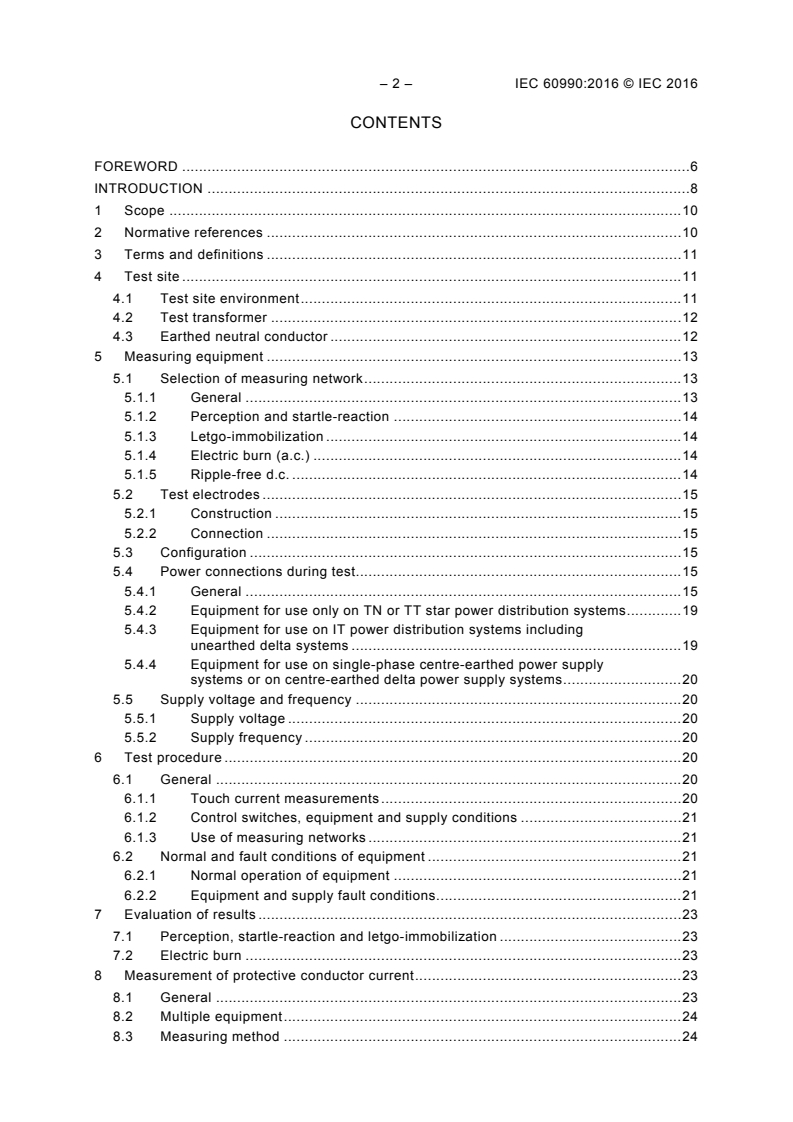
IEC 60990:2016 - Methods of measurement of touch current and protective conductor current Released:5/30/2016
Overview
IEC 60990:2016 - Methods of measurement of touch current and protective conductor current - specifies standardized measurement methods for d.c. and a.c. currents (sinusoidal and non‑sinusoidal) that could flow through the human body or a protective conductor. The standard defines how to measure currents using networks that represent human‑body impedance and describes test site, instrument, and configuration requirements. It is a Basic Safety Publication intended primarily for technical committees preparing product standards in accordance with IEC Guide 104 and ISO/IEC Guide 51.
Key topics and technical requirements
- Scope and applicability
- Applies to all classes of equipment per IEC 61140.
- Not intended for currents of <1 s duration, patient currents (IEC 60601‑1), a.c. below 15 Hz, or currents exceeding electric‑burn thresholds.
- Measurement concepts
- Use of body‑impedance measuring networks to record touch current; networks model human perception and physiological effects.
- Separate network weightings for perception / startle‑reaction, let‑go / immobilization, and electric burn effects.
- Test environment and configurations
- Requirements for test site, transformers/isolation, earthed‑neutral arrangements and power distribution types (TN, TT, IT, centre‑earthed and unearthed delta).
- Configurations for single‑phase and three‑phase equipment, and for incidental connections.
- Measuring equipment and calibration
- Instrumentation selection, construction considerations, voltmeter requirements, performance, calibration and confirmation systems (normative and informative annexes).
- Protective conductor current
- Methods for measuring currents flowing in protective conductors including multiple‑equipment scenarios and evaluation of results.
- Documentation and annexes
- Normative annexes for equipment, use of a conductive plane, network performance and calibration; informative annexes cover network examples, limitations, grippable-part analysis, and bibliography.
Practical applications and users
- Who uses IEC 60990:2016:
- Standards and technical committees drafting product‑specific safety standards.
- Test laboratories and compliance engineers designing and conducting touch‑current and protective‑conductor current tests where specified by product standards.
- Safety assessors and regulatory bodies when referenced by product standards.
- Typical use cases:
- Defining measurement procedures for consumer electronics, industrial equipment and appliances where touch current assessment is required.
- Establishing test configurations for different power distribution systems (TN/TT/IT).
- Setting up calibration and confirmation systems for touch‑current instruments.
Related standards
- IEC TS 60479 series - provides information on effects of current through the human body (used to derive limit values).
- IEC 61140 - protection against electric shock (equipment classes).
- IEC 60601‑1 - patient safety (patient currents excluded from IEC 60990 scope).
- IEC Guide 104 and ISO/IEC Guide 51 - guidance for preparing safety standards.
Keywords: IEC 60990:2016, touch current, protective conductor current, measurement methods, body impedance network, electrical safety testing.
Relations
- Effective Date
- 05-Sep-2023
Buy Documents
IEC 60990:2016 RLV - Methods of measurement of touch current and protective conductor current Released:5/30/2016
IEC 60990:2016 - Methods of measurement of touch current and protective conductor current Released:5/30/2016
Get Certified
Connect with accredited certification bodies for this standard

BSI Group
BSI (British Standards Institution) is the business standards company that helps organizations make excellence a habit.

BSMI (Bureau of Standards, Metrology and Inspection)
Taiwan's standards and inspection authority.

NYCE
Mexican standards and certification body.
Sponsored listings
Frequently Asked Questions
IEC 60990:2016 is a standard published by the International Electrotechnical Commission (IEC). Its full title is "Methods of measurement of touch current and protective conductor current". This standard covers: IEC 60990:2016 defines measurement methods for d.c. or a.c. current of sinusoidal or non-sinusoidal waveform, which could flow through the human body, and current flowing through a protective conductor. The measuring methods recommended for TOUCH CURRENT are based upon the possible effects of current flowing through a human body. In this standard, measurements of current through networks representing the impedance of the human body are referred to as measurements of TOUCH CURRENT. These networks are not necessarily valid for the bodies of animals. The specification or implication of specific limit values is not within the scope of this standard. IEC TS 60479 series provides information regarding the effects of current passing through the human body from which limit values may be derived. This standard is applicable to all classes of EQUIPMENT, according to IEC 61140. The methods of measurement in this standard are not intended to be used for TOUCH CURRENTS having less than 1 s duration, patient currents as defined in IEC 60601-1, a.c. at frequencies below 15 Hz, and currents above those chosen for ELECTRIC BURN limits. This third edition cancels and replaces the second edition published in 1999. It constitutes a technical revision. The principal changes in this edition as compared with the second edition are as follows: - the effects names have been updated to reflect increased understanding of the range of effects and is in concert with present usage; - the conditions of use invoking a GRIPPABLE PART have been reduced in the application of the requirements based upon the current understanding of this effect; - the references to ISO 10012-1, which has been replaced by management standard of the same number, have been replaced with explanatory text, where needed to maintain the sense of the document; - former informative Annex H (GRIPPABLE PART) has been deleted from this update as it does not properly represent the full set of conditions under which immobilization can occur. A new informative Annex H (Analysis of frequency filtered touch current circuits measurement) has been added and the Bibliography (formerly Annex M) has been updated with additional references for completeness. This basic safety publication is primarily intended for use by technical committees in the preparation of standards in accordance with IEC Guide 104 and ISO/IEC Guide 51. It is not intended for use by manufacturers or certification bodies independent of product standards. It has the status of a Basic Safety Publication in accordance with IEC Guide 104. Key words: Touch Current, Protective Conductor Current, Current Flow
IEC 60990:2016 defines measurement methods for d.c. or a.c. current of sinusoidal or non-sinusoidal waveform, which could flow through the human body, and current flowing through a protective conductor. The measuring methods recommended for TOUCH CURRENT are based upon the possible effects of current flowing through a human body. In this standard, measurements of current through networks representing the impedance of the human body are referred to as measurements of TOUCH CURRENT. These networks are not necessarily valid for the bodies of animals. The specification or implication of specific limit values is not within the scope of this standard. IEC TS 60479 series provides information regarding the effects of current passing through the human body from which limit values may be derived. This standard is applicable to all classes of EQUIPMENT, according to IEC 61140. The methods of measurement in this standard are not intended to be used for TOUCH CURRENTS having less than 1 s duration, patient currents as defined in IEC 60601-1, a.c. at frequencies below 15 Hz, and currents above those chosen for ELECTRIC BURN limits. This third edition cancels and replaces the second edition published in 1999. It constitutes a technical revision. The principal changes in this edition as compared with the second edition are as follows: - the effects names have been updated to reflect increased understanding of the range of effects and is in concert with present usage; - the conditions of use invoking a GRIPPABLE PART have been reduced in the application of the requirements based upon the current understanding of this effect; - the references to ISO 10012-1, which has been replaced by management standard of the same number, have been replaced with explanatory text, where needed to maintain the sense of the document; - former informative Annex H (GRIPPABLE PART) has been deleted from this update as it does not properly represent the full set of conditions under which immobilization can occur. A new informative Annex H (Analysis of frequency filtered touch current circuits measurement) has been added and the Bibliography (formerly Annex M) has been updated with additional references for completeness. This basic safety publication is primarily intended for use by technical committees in the preparation of standards in accordance with IEC Guide 104 and ISO/IEC Guide 51. It is not intended for use by manufacturers or certification bodies independent of product standards. It has the status of a Basic Safety Publication in accordance with IEC Guide 104. Key words: Touch Current, Protective Conductor Current, Current Flow
IEC 60990:2016 is classified under the following ICS (International Classification for Standards) categories: 01 - GENERALITIES. TERMINOLOGY. STANDARDIZATION. DOCUMENTATION; 17.220.99 - Other standards related to electricity and magnetism; 31.180 - Printed circuits and boards; 35.020 - Information technology (IT) in general. The ICS classification helps identify the subject area and facilitates finding related standards.
IEC 60990:2016 has the following relationships with other standards: It is inter standard links to IEC 60990:1999. Understanding these relationships helps ensure you are using the most current and applicable version of the standard.
IEC 60990:2016 is available in PDF format for immediate download after purchase. The document can be added to your cart and obtained through the secure checkout process. Digital delivery ensures instant access to the complete standard document.
Standards Content (Sample)
IEC 60990 ®
Edition 3.0 2016-05
REDLINE VERSION
INTERNATIONAL
STANDARD
colour
inside
BASIC SAFETY PUBLICATION
Methods of measurement of touch current and protective conductor current
All rights reserved. Unless otherwise specified, no part of this publication may be reproduced or utilized in any form
or by any means, electronic or mechanical, including photocopying and microfilm, without permission in writing from
either IEC or IEC's member National Committee in the country of the requester. If you have any questions about IEC
copyright or have an enquiry about obtaining additional rights to this publication, please contact the address below or
your local IEC member National Committee for further information.
IEC Central Office Tel.: +41 22 919 02 11
3, rue de Varembé Fax: +41 22 919 03 00
CH-1211 Geneva 20 info@iec.ch
Switzerland www.iec.ch
About the IEC
The International Electrotechnical Commission (IEC) is the leading global organization that prepares and publishes
International Standards for all electrical, electronic and related technologies.
About IEC publications
The technical content of IEC publications is kept under constant review by the IEC. Please make sure that you have the
latest edition, a corrigenda or an amendment might have been published.
IEC Catalogue - webstore.iec.ch/catalogue Electropedia - www.electropedia.org
The stand-alone application for consulting the entire The world's leading online dictionary of electronic and
bibliographical information on IEC International Standards, electrical terms containing 20 000 terms and definitions in
Technical Specifications, Technical Reports and other English and French, with equivalent terms in 15 additional
documents. Available for PC, Mac OS, Android Tablets and languages. Also known as the International Electrotechnical
iPad. Vocabulary (IEV) online.
IEC publications search - www.iec.ch/searchpub IEC Glossary - std.iec.ch/glossary
The advanced search enables to find IEC publications by a 65 000 electrotechnical terminology entries in English and
variety of criteria (reference number, text, technical French extracted from the Terms and Definitions clause of
committee,…). It also gives information on projects, replaced IEC publications issued since 2002. Some entries have been
and withdrawn publications. collected from earlier publications of IEC TC 37, 77, 86 and
CISPR.
IEC Just Published - webstore.iec.ch/justpublished
Stay up to date on all new IEC publications. Just Published IEC Customer Service Centre - webstore.iec.ch/csc
details all new publications released. Available online and If you wish to give us your feedback on this publication or
also once a month by email. need further assistance, please contact the Customer Service
Centre: csc@iec.ch.
IEC 60990 ®
Edition 3.0 2016-05
REDLINE VERSION
INTERNATIONAL
STANDARD
colour
inside
BASIC SAFETY PUBLICATION
Methods of measurement of touch current and protective conductor current
INTERNATIONAL
ELECTROTECHNICAL
COMMISSION
ICS 17.220, 35.020 ISBN 978-2-8322-3449-5
– 2 – IEC 60990:2016 RLV © IEC 2016
CONTENTS
FOREWORD . 6
INTRODUCTION . 8
1 Scope . 11
2 Normative references . 11
3 Terms and definitions. 12
4 Test site . 13
4.1 Test site environment . 13
4.2 Test transformer . 13
4.3 Earthed neutral conductor . 13
5 Measuring equipment . 14
5.1 Selection of measuring network . 14
5.1.1 General . 14
5.1.2 Perception and startle-reaction (a.c.) . 16
5.1.3 Letgo-immobilization (a.c.) . 16
5.1.4 Electric burn (a.c.) . 16
5.1.5 Ripple-free d.c. . 16
5.2 Test electrodes . 17
5.2.1 Construction . 17
5.2.2 Connection . 17
5.3 Configuration . 17
5.4 Power connections during test . 17
5.4.1 General . 17
5.4.2 Equipment for use only on TN or TT star power distribution systems . 22
5.4.3 Equipment for use on IT power distribution systems including unearthed
delta systems . 22
5.4.4 Equipment for use on single-phase centre-earthed power supply systems
or on centre-earthed delta power supply systems . 22
5.5 Supply voltage and frequency . 22
5.5.1 Supply voltage . 22
5.5.2 Supply frequency . 23
6 Test procedure . 23
6.1 General . 23
6.1.1 Touch current measurements . 23
6.1.2 Control switches, equipment and supply conditions . 23
6.1.3 Use of measuring networks . 24
6.2 Normal and fault conditions of equipment . 24
6.2.1 Normal operation of equipment . 24
6.2.2 Equipment and supply fault conditions . 24
7 Evaluation of results . 26
7.1 Perception, startle-reaction and letgo-immobilization . 26
7.2 Electric burn . 26
8 Measurement of protective conductor current . 26
8.1 General . 26
8.2 Multiple equipment . 26
8.3 Measuring method . 27
Annex A (normative) Equipment . 28
Annex B (normative) Use of a conductive plane . 29
Annex C (normative) Incidentally connected parts . 30
Annex D (informative) Choice of current limits . 31
D.1 General . 31
D.2 Limit examples . 31
D.2.1 Ventricular fibrillation . 31
D.2.2 Inability to letgo-immobilization . 31
D.2.3 Startle-reaction . 31
D.2.4 Perception threshold . 31
D.2.5 Special applications . 31
D.3 Choice of limits . 32
D.4 Electric burn effects of touch current . 33
Annex E (informative) Networks for use in measurement of touch current . 34
E.1 General . 34
E.2 Body impedance network – Figure 3 . 34
E.3 Perception, Startle-reaction (and body impedance) network – Figure 4 . 34
E.4 Letgo-immobilization (and body impedance) network – Figure 5 . 35
Annex F (informative) Measuring network limitations and construction . 36
Annex G (informative) Construction and application of touch current measuring
instruments . 38
G.1 Considerations for selection of components . 38
G.1.1 General . 38
G.1.2 Power rating and inductance for R and R . 38
S B
G.1.3 Capacitor C . 38
S
G.1.4 Resistors R1, R2 and R3 . 39
G.1.5 Capacitors C1, C2 and C3 . 39
G.2 Voltmeter . 39
G.3 Accuracy . 39
G.4 Calibration and application of measuring instruments . 40
G.5 Records . 40
G.6 Confirmation systems . 41
Annex H (informative) Grippable part .
Annex H (informative) Analysis of frequency filtered touch current circuit measurements . 44
Annex I (informative) AC power distribution systems (see 5.4) . 52
I.1 Introduction General . 52
I.2 TN power systems . 53
I.3 TT power systems . 56
I.4 IT power systems . 57
Annex J (informative) Routine and periodic touch current tests, and tests after repair
or modification of mains operated equipment . 59
Annex K (normative) Network performance and calibration . 60
K.1 Network or instrument performance and initial calibration . 60
K.2 Calibration in a confirmation system . 62
K.2.1 General . 62
K.2.2 Measurement of input resistance . 62
K.2.3 Measurement of instrument performance . 62
– 4 – IEC 60990:2016 RLV © IEC 2016
Annex M (informative) Bibliography . 65
Figure 1 – Example of earthed neutral, direct supply . 14
Figure 2 – Example of earthed neutral, with transformer for isolation . 14
Figure 3 – Measuring network, unweighted touch current . 15
Figure 4 – Measuring network, touch current weighted for perception or startle-reaction . 15
Figure 5 – Measuring network, touch current weighted for letgo-immobilization . 16
Figure 6 –Test configuration: Single-phase equipment on star TN or TT system . 18
Figure 7 – Test configuration: Single-phase equipment on centre-earthed TN or TT
system . 18
Figure 8 – Test configuration: Single-phase equipment connected line-to-line on star TN
or TT system . 19
Figure 9 – Test configuration: Single-phase equipment connected line-to-neutral on star
IT system . 19
Figure 10 – Test configuration: Single-phase equipment connected line-to-line on star IT
system . 20
Figure 11 – Test configuration: Three-phase equipment on star TN or TT system . 20
Figure 12 – Test configuration: Three-phase equipment on star IT system . 21
Figure 13 – Test configuration: Unearthed delta system . 21
Figure 14 – Test configuration: Three-phase equipment on centre-earthed delta system . 22
Figure A.1 – Equipment . 28
Figure B.1 – Equipment platform . 29
Figure F.1 – Frequency factor for electric burn . 36
Figure F.2 – Frequency factor for perception or startle-reaction . 37
Figure F.3 – Frequency factor for letgo-immobilization . 37
Figure H.1 – Grippable part test device .
Figure H.1 – Triangular waveform touch current, startle-reaction . 45
Figure H.3 – 1 ms rise time pulse response, startle-reaction . 46
Figure H.4 – 1 ms rise time pulse response, letgo-immobilization . 46
Figure H.5 – Touch current vs. rise time plot, 20 ms square wave . 47
Figure H.6 – PFC SMPS touch current waveform . 47
Figure H.7 – 50 Hz square wave, 0,1 ms rise time, startle-reaction . 48
Figure H.8 – 50 Hz square wave, 0,1 ms rise time, letgo-immobilization . 48
Figure H.9 – IEC TS 60479-2 let-go threshold for AC and DC combinations augmented
by additional data, mA each axis . 49
Figure H.10 – Ex1 case: showing r.m.s. window . 50
Figure H.11 – Waveform ex2 case: showing r.m.s. window . 50
Figure I.1 – Examples of TN-S power system . 54
Figure I.2 – Example of TN-C-S power system. 55
Figure I.3 – Example of TN-C power system . 55
Figure I.4 – Example of single-phase, 3-wire TN-C power system . 56
Figure I.5 – Example of 3-line and neutral TT power system . 56
Figure I.6 – Example of 3-line TT power system . 57
Figure I.7 – Example of 3-line (and neutral) IT power system . 57
Figure I.8 – Example of 3-line IT power system. 58
Table H.1 – Triangular waveform response comparison . 45
Table H.2 – Square wave touch current response . 46
Table H.3 – Square wave monopolar touch current response . 48
Table H.4 – Mixed ACnDC waveform evaluation, ex1 . 50
Table H.5 – Mixed ACnDC waveform evaluation, ex2 . 51
Table K.1 – Calculated input impedance and transfer impedance for unweighted touch
current measuring network (Figure 3) . 60
Table K.2 – Calculated input impedance and transfer impedance for perception or
startle-reaction touch current measuring network (Figure 4) . 61
Table K.3 – Calculated input impedance and transfer impedance for letgo-
immobilization current measuring network (Figure 5) . 61
Table K.4 – Output voltage to input voltage ratios for unweighted touch current
measuring network (Figure 3) . 63
Table K.5 – Output voltage to input voltage ratios for startle-reaction measuring network
(Figure 4) . 63
Table K.6 – Output voltage to input voltage ratios for letgo-immobilization measuring
network (Figure 5) . 64
– 6 – IEC 60990:2016 RLV © IEC 2016
INTERNATIONAL ELECTROTECHNICAL COMMISSION
____________
METHODS OF MEASUREMENT OF TOUCH CURRENT
AND PROTECTIVE CONDUCTOR CURRENT
FOREWORD
1) The International Electrotechnical Commission (IEC) is a worldwide organization for standardization comprising
all national electrotechnical committees (IEC National Committees). The object of IEC is to promote
international co-operation on all questions concerning standardization in the electrical and electronic fields. To
this end and in addition to other activities, IEC publishes International Standards, Technical Specifications,
Technical Reports, Publicly Available Specifications (PAS) and Guides (hereafter referred to as “IEC
Publication(s)”). Their preparation is entrusted to technical committees; any IEC National Committee interested
in the subject dealt with may participate in this preparatory work. International, governmental and non-
governmental organizations liaising with the IEC also participate in this preparation. IEC collaborates closely
with the International Organization for Standardization (ISO) in accordance with conditions determined by
agreement between the two organizations.
2) The formal decisions or agreements of IEC on technical matters express, as nearly as possible, an international
consensus of opinion on the relevant subjects since each technical committee has representation from all
interested IEC National Committees.
3) IEC Publications have the form of recommendations for international use and are accepted by IEC National
Committees in that sense. While all reasonable efforts are made to ensure that the technical content of IEC
Publications is accurate, IEC cannot be held responsible for the way in which they are used or for any
misinterpretation by any end user.
4) In order to promote international uniformity, IEC National Committees undertake to apply IEC Publications
transparently to the maximum extent possible in their national and regional publications. Any divergence
between any IEC Publication and the corresponding national or regional publication shall be clearly indicated in
the latter.
5) IEC itself does not provide any attestation of conformity. Independent certification bodies provide conformity
assessment services and, in some areas, access to IEC marks of conformity. IEC is not responsible for any
services carried out by independent certification bodies.
6) All users should ensure that they have the latest edition of this publication.
7) No liability shall attach to IEC or its directors, employees, servants or agents including individual experts and
members of its technical committees and IEC National Committees for any personal injury, property damage or
other damage of any nature whatsoever, whether direct or indirect, or for costs (including legal fees) and
expenses arising out of the publication, use of, or reliance upon, this IEC Publication or any other IEC
Publications.
8) Attention is drawn to the Normative references cited in this publication. Use of the referenced publications is
indispensable for the correct application of this publication.
9) Attention is drawn to the possibility that some of the elements of this IEC Publication may be the subject of
patent rights. IEC shall not be held responsible for identifying any or all such patent rights.
This redline version of the official IEC Standard allows the user to identify the changes
made to the previous edition. A vertical bar appears in the margin wherever a change
has been made. Additions are in green text, deletions are in strikethrough red text.
������������������������������������ �
�������������� ��������� ���������� ��������� �����������������������������������������
���������� ������� ���� ������ ��� ������������� ������������ ����������� ���� ��������������
������������
�����������������������������������������������������������������������������������������������
���������������������
������������������������������������������������������������������������������������������
�� ���������������������������������������������������������������������������������������
�����������������������������������������������
�� ����������������������������������������������������� ���������������������������������������
�������������������������������������������������������������������
�� �������������������������������������������������������������������������������������
������������������������������������������������������������������������������������
�������������������������
�� ����������������������������������������������������� ������������������������������������
������������������������������������������������������������������������������������������
���� ������������ �������� �������������������� ���������������������������� ������ �
������������������������������
�� ���������������������������������������������������������������������������� ��������
���������������
�����������������������������������������������������������������������������������
���������������������������������������������������������������
����� �����������������
������������� ������������
�
�����������������������������������������������������������������������������������������������
�������������������������������������
�������������������������������������������������������������������������������������
�����������������������������������������������������������������
�� ����������������������������������������������������������
�� ���������������������in italic�������� type�� ������������������
�� ����������������������������������������������� ��
�������������������������������������������������������������
�� ������������������������������������� ������
������������������������������������������������������������������������������������������������
������������������������������������������������������������������������������������������������
��������������������������������������������������������� �������������������
�������������
�����������
����������������������������������
���������
�������������������������������������������������������������������������������������
�����������������������������������������������������������������������������������������
������������������������������������������������������������������������������������
�
– 8 – IEC 60990:2016 RLV © IEC 2016
INTRODUCTION
This International Standard was developed as a response to concerns arising from the advent
of electronic switching techniques being broadly applied to power systems and within
*
EQUIPMENT , giving rise to high-frequency harmonic voltages and currents.
This standard is intended for the guidance of EQUIPMENT committees in preparing or
amending the test specifications in their standards for measurement of leakage current.
However the term "leakage current" is not used for reasons explained below.
This standard was initially prepared under the basic safety pilot function assigned to TC 74
(now TC 108), as follows:
Methods of measuring leakage current
This includes, for various types of EQUIPMENT, all aspects of what is referred to as "leakage
current", including methods of measurement of current with regard to physiological effects
and for installation purposes, under normal conditions and under certain fault conditions.
The methods of measurement of leakage current described herein result from the review of
IEC TS 60479-1 and other publications, including descriptions of earlier methods of
measurement.
The following conclusions were derived from a review of the effects of leakage current:
– the primary concern for safety involves possible flow of harmful current through the
human body (this current is not necessarily equal to the current flowing through a
protective conductor);
– the effect of electric current on a human body is found to be somewhat more complex
than was assumed during the development of earlier standards in that there are several
body responses which should be considered. The most significant responses for setting
limits for continuous waveforms are
• perception,
• startle-reaction,
• letgo-immobilization, and
• ELECTRIC BURN.
Each of these four body responses has a unique threshold level. There are also significant
differences in the manner in which some of these thresholds vary with frequency.
Two types of current have been identified as needing separate measuring methods: TOUCH
CURRENT and PROTECTIVE CONDUCTOR CURRENT.
TOUCH CURRENT only exists when a human body or a body model is a current pathway.
It was also noted that the term "leakage current" has already been applied to several different
concerns: TOUCH CURRENT, PROTECTIVE CONDUCTOR CURRENT, insulation properties, etc.
Therefore, in this standard, the term "leakage current" is not used.
Measurement of TOUCH CURRENT
In the past, EQUIPMENT standards have used two traditional techniques for measurement of
leakage current. Either the actual current in the protective conductor was measured, or a
___________
*
Terms in small capitals are defined in clause 3.
simple resistor-capacitor network (representing a simple body model) was used, the leakage
current being defined as the current through the resistor.
This standard provides measuring methods for the four body responses to the electric current
noted above, using a more representative body model.
This body model was chosen for most common cases of electric shock in the general sense.
With respect to the path of current flow and conditions of contact, a body model
approximating full hand-to-hand or hand-to-foot contact in normal conditions is used. For
small areas of contact (for example, one small, finger contact), a different model may be
appropriate but is not covered here.
Of the four responses, perception startle-reaction and letgo-immobilization are related to the
peak value of TOUCH CURRENT and vary with frequency. Traditionally, concerns for electric
shock have dealt with sinusoidal waveforms, for which r.m.s. measurements are most
convenient. Peak measurements are more appropriate for non-sinusoidal waveforms where
significant values of TOUCH CURRENT are expected, but are equally suitable for sinusoidal
waveforms. The networks specified for the measurement of perception startle-reaction and
let-go currents letgo-immobilization are frequency-responsive and are so weighted that single
limit power-frequency values can be specified and referenced.
ELECTRIC BURNS, however, are related to the r.m.s. value of TOUCH CURRENT, and are relatively
independent of frequency. For EQUIPMENT where ELECTRIC BURNS may be of concern (see
7.2), two separate measurements are required made, one in peak value for electric shock
and a second in r.m.s. value for ELECTRIC BURNS each using the appropriate test circuit.
EQUIPMENT committees should decide which physiological effects are acceptable and which
are not, and then decide on limit values of current. Committees for certain types of EQUIPMENT
may adopt simplified procedures based upon this standard. A discussion of limit values,
based upon earlier work by various IEC EQUIPMENT committees, is provided in Annex D.
Measurement of PROTECTIVE CONDUCTOR CURRENT
In certain cases, measurement of the PROTECTIVE CONDUCTOR CURRENT of EQUIPMENT under
normal operating conditions is required. Such cases include:
– selection of a residual current protection device,
– compliance with 471.3.3 of IEC 60364-7-707.
– determination when a high integrity protective earth circuit is required,
– prevent excessive PROTECTIVE CONDUCTOR CURRENT overload in the electrical installation.
The PROTECTIVE CONDUCTOR CURRENT is measured by inserting an ammeter of negligible
impedance in series with the EQUIPMENT protective earthing conductor.
A bibliography of related documents is given in annex M.
This second edition has been prepared on the basis of comments provided by users of the
first edition.
Principal changes include the following:
– provision of an earthing alternative for testing, in order to accommodate some test
situations;
– provision of a more detailed description of the design and calibration of the measurement
network, thus allowing deletion of component tolerances from the network diagrams;
– 10 – IEC 60990:2016 RLV © IEC 2016
– a minor inaccuracy in one measurement method has been corrected by the inclusion of an
additional calculation;
– the discussion of the physiological effects has been clarified.
METHODS OF MEASUREMENT OF TOUCH CURRENT
AND PROTECTIVE CONDUCTOR CURRENT
1 Scope
This International Standard defines measurement methods for
– d.c. or a.c. current of sinusoidal or non-sinusoidal waveform, which could flow through the
human body, and
– current flowing through a protective conductor.
The measuring methods recommended for TOUCH CURRENT are based upon the possible
effects of current flowing through a human body. In this standard, measurements of current
through networks representing the impedance of the human body are referred to as
measurements of TOUCH CURRENT. These networks are not necessarily valid for the bodies of
animals.
The specification or implication of specific limit values is not within the scope of this standard.
IEC TS 60479-1 series provides information regarding the effects of current passing through
the human body from which limit values may be derived.
This standard is applicable to all classes of EQUIPMENT, according to IEC 60536 61140.
The methods of measurement in this standard are not intended to be used for
– TOUCH CURRENTS having less than 1 s duration,
– patient currents as defined in IEC 60601-1,
– a.c. at frequencies below 15 Hz, and
– a.c. in combination with d.c. The use of a single network for a composite indication of the
effects of combined a.c. and d.c. has not been investigated,
– currents above those chosen for ELECTRIC BURN limits.
This basic safety publication is primarily intended for use by technical committees in the
preparation of standards in accordance with the principles laid down in IEC Guide 104 and
ISO/IEC Guide 51. It is not intended for use by manufacturers or certification bodies
independent of product standards.
One of the responsibilities of a technical committee is, wherever applicable, to make use of
basic safety publications in the preparation of its publications. The requirements, test
methods or test conditions of this basic safety publication will not only apply, unless when
specifically referred to or included in the relevant publications.
2 Normative references
The following documents, in whole or in part, are normatively referenced in this document
and are indispensable for its application. For dated references, only the edition cited applies.
For undated references, the latest edition of the referenced document (including any
amendments) applies.
Members of IEC and ISO maintain registers of currently valid International Standards.
– 12 – IEC 60990:2016 RLV © IEC 2016
IEC 60050(195): International Electrotechnical Vocabulary (IEV) – Chapter 195: Earthing and
protection against electric shock
IEC 60050(604): International Electrotechnical Vocabulary (IEV) – Chapter 604: Generation,
transmission and distribution of electricity – Operation
IEC 60309-1:1997, Plugs, socket-outlets and couplers for industrial purposes – Part 1:
General requirements
IEC 60364-4-41:1992, Electrical installations of buildings – Part 4: Protection for safety –
Chapter 41: Protection against electric shock
IEC 60364-7-707:1984, Electrical installations of buildings – Part 7: Requirements for special
installations or locations – Section 707: Earthing requirements for the installation of data
processing equipment
IEC TS 60479-1:1994 2005, Effects of current on human beings and livestock – Part 1:
General aspects
IEC TS 60479-2:2007, Effects of current on human beings and livestock – Part 2: Special
aspects
IEC 60536:1976, Classification of electrical and electronic equipment with regard to
protection against electric shock
IEC 60536-2:1992, Classification of electrical and electronic equipment with regard to
protection against electric shock – Part 2: Guidelines to requirements for protection against
electric shock
IEC 61140:1997, Protection against electric shock – Common aspects for installation and
equipment
ISO/IEC Guide 51:1990 2014, Safety aspects – Guidelines for their inclusion in standards
IEC Guide 104:1997, Guide to the drafting of safety standards and the role of committees
with safety pilot functions and safety group functions
IEC Guide 104:2010, The preparation of safety publications and the use of basic safety
publications and group safety publications
3 Terms and definitions
For the purposes of this document, the following terms and definitions apply.
3.1
TOUCH CURRENT
electric current through a human body or through an animal body when it touches one or
more accessible parts of an installation or of EQUIPMENT
[SOURCE: IEC 60050-195:1998, 195-05-21]
3.2
PROTECTIVE CONDUCTOR CURRENT
current which flows in a protective conductor
3.3
EQUIPMENT
as defined in the relevant equipment standard. If not defined in the relevant equipment
standard, see annex A
organized collection of electromechanical component parts and features to accomplish a
defined task (as specified in the relevant product standard).
Note 1 to entry: If not specified in the relevant standard, see Annex A.
3.4
GRIPPABLE PART
part of the EQUIPMENT which could supply current through the human hand to cause muscular
contraction around the part and an inability to let go
Note 1 to entry: Parts which are intended to be gripped with the entire hand are assumed to be grippable without
further investigation (see annex H).
3.5
ELECTRIC BURN
burning of the skin or of an organ, caused by passing an electric current across or through
the surface
[SOURCE: IEC 60050-604:1987, 604-04-18]
4 Test site
4.1 Test site environment
Test site environmental requirements shall be as specified in the EQUIPMENT standard. If limit
values of less than 70 µA r.m.s. or 100 µA peak are specified, or if the EQUIPMENT contains
large shields which may be driven by high-frequency signals, product committees shall refer
to Annex B.
4.2 Test transformer
The use of a test transformer for isolation is optional. For maximum safety, a test transformer
for isolation (T2 in Figure 2, T in Figure 6 to Figure 14) shall be used and the main protective
earthing terminal of the EQUIPMENT under test (EUT) earthed. Any capacitive leakage in the
transformer must shall then be taken into account. As an alternative to earthing the EUT, the
test transformer secondary and the EUT shall be left floating (not earthed), in which case the
capacitive leakage in the test transformer need not be taken into account.
If transformer T is not used, the EUT shall be mounted on an insulating stand and appropriate
safety precautions taken, in view of the possibility of the body of the EUT being at hazardous
voltage.
4.3 Earthed neutral conductor
EQUIPMENT intended for connection to a TT or TN power distribution system shall be tested
with minimum voltage between neutral and earth.
NOTE Descriptions of various power distribution systems are given in Annex I.
The protective conductor and the earthed neutral conductor for the EUT should have a
voltage difference of less than 1 % of line-to-line voltage (see example in Figure 1).
A local transformer, see 4.2, will achieve this requirement.
– 14 – IEC 60990:2016 RLV © IEC 2016
Alternatively, if the voltage difference is 1 % or more, the following are examples of methods
which, in some cases, will avoid measurement errors due to this voltage:
– connecting the terminal B electrode of the measuring instrument network to the neutral
terminal of the EUT instead of the protective earthing conductor (see 6.1.2) of the supply;
– connecting the earthing terminal of the EUT to the neutral conductor, instead of the
protective earthing conductor, of the supply.
EC
Figure 1 – Example of earthed neutral, direct supply
IEC
Figure 2 – Example of earthed neutral, with transformer for isolation
5 Measuring equipment
5.1 Selection of measuring network
5.1.1 General
Measurements shall be made with one of the networks of Figure 3, Figure 4 and Figure 5.
NOTE See Annexes E, F and G for further explanation of the three networks.
IEC
R 1 500 Ω
S
R 500 Ω
B
C 0,22 µF
S
Figure 3 – Measuring network, unweighted touch current
IEC
R 1 500 Ω R 10 000 Ω
S 1
R 500 Ω C 0,022 µF
B 1
C 0,22 µF
S
Figure 4 – Measuring network, touch current weighted for perception or startle-reaction
– 16 – IEC 60990:2016 RLV © IEC 2016
IEC
R 1 500 Ω R 20 000 Ω
S 3
R 500 Ω C 0,006 2 µF
B 2
C 0,22 µF C 0,009 1 µF
S 3
R 10 000 Ω
NOTE For special conditions on the use of this network, see 5.1.2.
Figure 5 – Measuring network, touch current weighted for letgo-immobilization
5.1.2 Perception and startle-reaction (a.c.)
The network of Figure 4 shall be used for low level electric shock limits. This circuit is to be
applied where the a.c. limit value in the product standard is up to 2 mA r.m.s. or 2,8 mA peak.
5.1.3 Letgo-immobilization (a.c.)
The network of figure 5 shall be used, but only if inability to let go is a significant
consideration, i.e. if all of the following conditions are met:
– the available current is a.c. and the limit value in the product standard is more than
2,0 mA r.m.s. or 2,8 mA peak;
– the EQUIPMENT has a GRIPPABLE PART;
– it is anticipated that it would be difficult to let go of the GRIPPABLE PART due to current flow
through the hand and the arm (see E.3 and annex H for further information).
Otherwise, the network of figure 4 shall be used.
The network of Figure 5 shall be used for higher level electric shock limits. This circuit is to
be applied where the a.c. limit value in the product standard is more than 2 mA r.m.s. or
2,8 mA peak.
5.1.4 Electric burn (a.c.)
The unweighted TOUCH CURRENT network of Figure 3 shall be used.
5.1.5 Ripple-free d.c.
Any one of the three networks shall be used. Unless otherwise specified in the EQUIPMENT
standard, ripple-free d.c. means less than 10 %
...
IEC 60990 ®
Edition 3.0 2016-05
INTERNATIONAL
STANDARD
NORME
INTERNATIONALE
colour
inside
BASIC SAFETY PUBLICATION
PUBLICATION FONDAMENTALE DE SÉCURITÉ
Methods of measurement of touch current and protective conductor current
Méthodes de mesure du courant de contact et du courant dans le conducteur de
protection
All rights reserved. Unless otherwise specified, no part of this publication may be reproduced or utilized in any form
or by any means, electronic or mechanical, including photocopying and microfilm, without permission in writing from
either IEC or IEC's member National Committee in the country of the requester. If you have any questions about IEC
copyright or have an enquiry about obtaining additional rights to this publication, please contact the address below or
your local IEC member National Committee for further information.
Droits de reproduction réservés. Sauf indication contraire, aucune partie de cette publication ne peut être reproduite
ni utilisée sous quelque forme que ce soit et par aucun procédé, électronique ou mécanique, y compris la photocopie
et les microfilms, sans l'accord écrit de l'IEC ou du Comité national de l'IEC du pays du demandeur. Si vous avez des
questions sur le copyright de l'IEC ou si vous désirez obtenir des droits supplémentaires sur cette publication, utilisez
les coordonnées ci-après ou contactez le Comité national de l'IEC de votre pays de résidence.
IEC Central Office Tel.: +41 22 919 02 11
3, rue de Varembé Fax: +41 22 919 03 00
CH-1211 Geneva 20 info@iec.ch
Switzerland www.iec.ch
About the IEC
The International Electrotechnical Commission (IEC) is the leading global organization that prepares and publishes
International Standards for all electrical, electronic and related technologies.
About IEC publications
The technical content of IEC publications is kept under constant review by the IEC. Please make sure that you have the
latest edition, a corrigenda or an amendment might have been published.
IEC Catalogue - webstore.iec.ch/catalogue Electropedia - www.electropedia.org
The stand-alone application for consulting the entire The world's leading online dictionary of electronic and
bibliographical information on IEC International Standards, electrical terms containing 20 000 terms and definitions in
Technical Specifications, Technical Reports and other English and French, with equivalent terms in 15 additional
documents. Available for PC, Mac OS, Android Tablets and languages. Also known as the International Electrotechnical
iPad. Vocabulary (IEV) online.
IEC publications search - www.iec.ch/searchpub IEC Glossary - std.iec.ch/glossary
The advanced search enables to find IEC publications by a 65 000 electrotechnical terminology entries in English and
variety of criteria (reference number, text, technical French extracted from the Terms and Definitions clause of
committee,…). It also gives information on projects, replaced IEC publications issued since 2002. Some entries have been
and withdrawn publications. collected from earlier publications of IEC TC 37, 77, 86 and
CISPR.
IEC Just Published - webstore.iec.ch/justpublished
Stay up to date on all new IEC publications. Just Published IEC Customer Service Centre - webstore.iec.ch/csc
details all new publications released. Available online and If you wish to give us your feedback on this publication or
also once a month by email. need further assistance, please contact the Customer Service
Centre: csc@iec.ch.
A propos de l'IEC
La Commission Electrotechnique Internationale (IEC) est la première organisation mondiale qui élabore et publie des
Normes internationales pour tout ce qui a trait à l'électricité, à l'électronique et aux technologies apparentées.
A propos des publications IEC
Le contenu technique des publications IEC est constamment revu. Veuillez vous assurer que vous possédez l’édition la
plus récente, un corrigendum ou amendement peut avoir été publié.
Catalogue IEC - webstore.iec.ch/catalogue Electropedia - www.electropedia.org
Application autonome pour consulter tous les renseignements
Le premier dictionnaire en ligne de termes électroniques et
bibliographiques sur les Normes internationales,
électriques. Il contient 20 000 termes et définitions en anglais
Spécifications techniques, Rapports techniques et autres
et en français, ainsi que les termes équivalents dans 15
documents de l'IEC. Disponible pour PC, Mac OS, tablettes
langues additionnelles. Egalement appelé Vocabulaire
Android et iPad.
Electrotechnique International (IEV) en ligne.
Recherche de publications IEC - www.iec.ch/searchpub
Glossaire IEC - std.iec.ch/glossary
65 000 entrées terminologiques électrotechniques, en anglais
La recherche avancée permet de trouver des publications IEC
en utilisant différents critères (numéro de référence, texte, et en français, extraites des articles Termes et Définitions des
comité d’études,…). Elle donne aussi des informations sur les publications IEC parues depuis 2002. Plus certaines entrées
projets et les publications remplacées ou retirées. antérieures extraites des publications des CE 37, 77, 86 et
CISPR de l'IEC.
IEC Just Published - webstore.iec.ch/justpublished
Service Clients - webstore.iec.ch/csc
Restez informé sur les nouvelles publications IEC. Just
Published détaille les nouvelles publications parues. Si vous désirez nous donner des commentaires sur cette
Disponible en ligne et aussi une fois par mois par email. publication ou si vous avez des questions contactez-nous:
csc@iec.ch.
IEC 60990 ®
Edition 3.0 2016-05
INTERNATIONAL
STANDARD
NORME
INTERNATIONALE
colour
inside
BASIC SAFETY PUBLICATION
PUBLICATION FONDAMENTALE DE SÉCURITÉ
Methods of measurement of touch current and protective conductor current
Méthodes de mesure du courant de contact et du courant dans le conducteur de
protection
INTERNATIONAL
ELECTROTECHNICAL
COMMISSION
COMMISSION
ELECTROTECHNIQUE
INTERNATIONALE
ICS 17.220, 35.020 ISBN 978-2-8322-3420-4
– 2 – IEC 60990:2016 © IEC 2016
CONTENTS
FOREWORD .6
INTRODUCTION .8
1 Scope . 10
2 Normative references . 10
3 Terms and definitions . 11
4 Test site . 11
4.1 Test site environment . 11
4.2 Test transformer . 12
4.3 Earthed neutral conductor . 12
5 Measuring equipment . 13
5.1 Selection of measuring network . 13
5.1.1 General . 13
5.1.2 Perception and startle-reaction . 14
5.1.3 Letgo-immobilization . 14
5.1.4 Electric burn (a.c.) . 14
5.1.5 Ripple-free d.c. . 14
5.2 Test electrodes . 15
5.2.1 Construction . 15
5.2.2 Connection . 15
5.3 Configuration . 15
5.4 Power connections during test . 15
5.4.1 General . 15
5.4.2 Equipment for use only on TN or TT star power distribution systems . 19
5.4.3 Equipment for use on IT power distribution systems including
unearthed delta systems . 19
5.4.4 Equipment for use on single-phase centre-earthed power supply
systems or on centre-earthed delta power supply systems . 20
5.5 Supply voltage and frequency . 20
5.5.1 Supply voltage . 20
5.5.2 Supply frequency . 20
6 Test procedure . 20
6.1 General . 20
6.1.1 Touch current measurements . 20
6.1.2 Control switches, equipment and supply conditions . 21
6.1.3 Use of measuring networks . 21
6.2 Normal and fault conditions of equipment . 21
6.2.1 Normal operation of equipment . 21
6.2.2 Equipment and supply fault conditions . 21
7 Evaluation of results . 23
7.1 Perception, startle-reaction and letgo-immobilization . 23
7.2 Electric burn . 23
8 Measurement of protective conductor current . 23
8.1 General . 23
8.2 Multiple equipment . 24
8.3 Measuring method . 24
Annex A (normative) Equipment . 25
Annex B (normative) Use of a conductive plane . 26
Annex C (normative) Incidentally connected parts . 27
Annex D (informative) Choice of current limits . 28
D.1 General . 28
D.2 Limit examples . 28
D.2.1 Ventricular fibrillation . 28
D.2.2 Inability to letgo-immobilization . 28
D.2.3 Startle-reaction . 28
D.2.4 Perception threshold . 28
D.2.5 Special applications . 28
D.3 Choice of limits . 29
D.4 Electric burn effects of touch current . 30
Annex E (informative) Networks for use in measurement of touch current . 31
E.1 General . 31
E.2 Body impedance network – Figure 3 . 31
E.3 Startle-reaction (and body impedance) network – Figure 4 . 31
E.4 Letgo-immobilization (and body impedance) network – Figure 5 . 32
Annex F (informative) Measuring network limitations and construction . 33
Annex G (informative) Construction and application of touch current measuring
instruments . 35
G.1 Considerations for selection of components . 35
G.1.1 General . 35
G.1.2 Power rating and inductance for R and R . 35
S B
G.1.3 Capacitor C . 35
S
G.1.4 Resistors R1, R2 and R3 . 36
G.1.5 Capacitors C1, C2 and C3. 36
G.2 Voltmeter . 36
G.3 Accuracy . 36
G.4 Calibration and application of measuring instruments . 37
G.5 Records . 37
G.6 Confirmation systems . 37
Annex H (informative) Analysis of frequency filtered touch current circuit
measurements . 39
Annex I (informative) AC power distribution systems (see 5.4) . 47
I.1 General . 47
I.2 TN power systems . 48
I.3 TT power systems . 50
I.4 IT power systems . 51
Annex J (informative) Routine and periodic touch current tests, and tests after repair
or modification of mains operated equipment . 53
Annex K (normative) Network performance and calibration . 54
K.1 Network or instrument performance and initial calibration . 54
K.2 Calibration in a confirmation system . 56
K.2.1 General . 56
K.2.2 Measurement of input resistance . 56
K.2.3 Measurement of instrument performance . 56
Bibliography . 59
– 4 – IEC 60990:2016 © IEC 2016
Figure 1 – Example of earthed neutral, direct supply . 12
Figure 2 – Example of earthed neutral, with transformer for isolation . 13
Figure 3 – Measuring network, unweighted touch current . 13
Figure 4 – Measuring network, touch current weighted for perception or startle-
reaction . 14
Figure 5 – Measuring network, touch current weighted for letgo-immobilization . 14
Figure 6 – Single-phase equipment on star TN or TT system . 16
Figure 7 – Single-phase equipment on centre-earthed TN or TT system . 16
Figure 8 – Single-phase equipment connected line-to-line on star TN or TT system . 17
Figure 9 – Single-phase equipment connected line-to-neutral on star IT system . 17
Figure 10 – Single-phase equipment connected line-to-line on star IT system . 17
Figure 11 – Three-phase equipment on star TN or TT system . 18
Figure 12 – Three-phase equipment on star IT system . 18
Figure 13 – Unearthed delta system . 19
Figure 14 – Three-phase equipment on centre-earthed delta system . 19
Figure A.1 – Equipment . 25
Figure B.1 – Equipment platform . 26
Figure F.1 – Frequency factor for electric burn . 33
Figure F.2 – Frequency factor for perception or startle-reaction . 33
Figure F.3 – Frequency factor for letgo-immobilization . 34
Figure H.1 – Triangular waveform touch current, startle-reaction . 40
Figure H.3 – 1 ms rise time pulse response, startle-reaction . 41
Figure H.4 – 1 ms rise time pulse response, letgo-immobilization . 41
Figure H.5 – Touch current vs. rise time plot, 20 ms square wave . 42
Figure H.6 – PFC SMPS touch current waveform . 42
Figure H.7 – 50 Hz square wave, 0,1 ms rise time, startle-reaction . 43
Figure H.8 – 50 Hz square wave, 0,1 ms rise time, letgo-immobilization . 43
Figure H.9 – IEC TS 60479-2 let-go threshold for AC and DC combinations
augmented by additional data, mA each axis . 44
Figure H.10 – Ex1 case: showing r.m.s. window . 45
Figure H.11 – Waveform ex2 case: showing r.m.s. window . 45
Figure I.1 – Examples of TN-S power system . 48
Figure I.2 – Example of TN-C-S power system . 49
Figure I.3 – Example of TN-C power system . 49
Figure I.4 – Example of single-phase, 3-wire TN-C power system . 50
Figure I.5 – Example of 3-line and neutral TT power system . 50
Figure I.6 – Example of 3-line TT power system . 51
Figure I.7 – Example of 3-line (and neutral) IT power system . 51
Figure I.8 – Example of 3-line IT power system . 52
Table H.1 – Triangular waveform response comparison . 40
Table H.2 – Square wave touch current response . 41
Table H.3 – Square wave monopolar touch current response . 43
Table H.4 – Mixed ACnDC waveform evaluation, ex1 . 45
Table H.5 – Mixed ACnDC waveform evaluation, ex2 . 46
Table K.1 – Calculated input impedance and transfer impedance for unweighted touch
current measuring network (Figure 3) . 54
Table K.2 – Calculated input impedance and transfer impedance for startle-reaction
touch current measuring network (Figure 4) . 55
Table K.3 – Calculated input impedance and transfer impedance for letgo-
immobilization current measuring network (Figure 5) . 55
Table K.4 – Output voltage to input voltage ratios for unweighted touch current
measuring network (Figure 3) . 57
Table K.5 – Output voltage to input voltage ratios for startle-reaction measuring
network (Figure 4) . 57
Table K.6 – Output voltage to input voltage ratios for letgo-immobilization measuring
network (Figure 5) . 58
– 6 – IEC 60990:2016 © IEC 2016
INTERNATIONAL ELECTROTECHNICAL COMMISSION
____________
METHODS OF MEASUREMENT OF TOUCH CURRENT
AND PROTECTIVE CONDUCTOR CURRENT
FOREWORD
1) The International Electrotechnical Commission (IEC) is a worldwide organization for standardization comprising
all national electrotechnical committees (IEC National Committees). The object of IEC is to promote
international co-operation on all questions concerning standardization in the electrical and electronic fields. To
this end and in addition to other activities, IEC publishes International Standards, Technical Specifications,
Technical Reports, Publicly Available Specifications (PAS) and Guides (hereafter referred to as “IEC
Publication(s)”). Their preparation is entrusted to technical committees; any IEC National Committee interested
in the subject dealt with may participate in this preparatory work. International, governmental and non-
governmental organizations liaising with the IEC also participate in this preparation. IEC collaborates closely
with the International Organization for Standardization (ISO) in accordance with conditions determined by
agreement between the two organizations.
2) The formal decisions or agreements of IEC on technical matters express, as nearly as possible, an
international consensus of opinion on the relevant subjects since each technical committee has representation
from all interested IEC National Committees.
3) IEC Publications have the form of recommendations for international use and are accepted by IEC National
Committees in that sense. While all reasonable efforts are made to ensure that the technical content of IEC
Publications is accurate, IEC cannot be held responsible for the way in which they are used or for any
misinterpretation by any end user.
4) In order to promote international uniformity, IEC National Committees undertake to apply IEC Publications
transparently to the maximum extent possible in their national and regional publications. Any divergence
between any IEC Publication and the corresponding national or regional publication shall be clearly indicated in
the latter.
5) IEC itself does not provide any attestation of conformity. Independent certification bodies provide conformity
assessment services and, in some areas, access to IEC marks of conformity. IEC is not responsible for any
services carried out by independent certification bodies.
6) All users should ensure that they have the latest edition of this publication.
7) No liability shall attach to IEC or its directors, employees, servants or agents including individual experts and
members of its technical committees and IEC National Committees for any personal injury, property damage or
other damage of any nature whatsoever, whether direct or indirect, or for costs (including legal fees) and
expenses arising out of the publication, use of, or reliance upon, this IEC Publication or any other IEC
Publications.
8) Attention is drawn to the Normative references cited in this publication. Use of the referenced publications is
indispensable for the correct application of this publication.
9) Attention is drawn to the possibility that some of the elements of this IEC Publication may be the subject of
patent rights. IEC shall not be held responsible for identifying any or all such patent rights.
International Standard IEC 60990 has been prepared by TC 108: Safety of electronic
equipment within the field of audio/video, information technology and communication
technology.
This third edition cancels and replaces the second edition published in 1999. It constitutes a
technical revision.
The principal changes in this edition as compared with the second edition are as follows:
– the effects names have been updated to reflect increased understanding of the range of
effects and is in concert with present usage;
– the conditions of use invoking a GRIPPABLE PART have been reduced in the application of
the requirements based upon the current understanding of this effect;
– the references to ISO 10012-1, which has been replaced by management standard of the
same number, have been replaced with explanatory text, where needed to maintain the
sense of the document;
– former informative Annex H (GRIPPABLE PART) has been deleted from this update as it does
not properly represent the full set of conditions under which immobilization can occur. A
new informative Annex H (Analysis of frequency filtered touch current circuits
measurement) has been added;
– the Bibliography (formerly Annex M) has been updated with additional references for
completeness.
It has the status of a basic safety publication in accordance with IEC Guide 104.
The text of this standard is based on the following documents:
FDIS Report on voting
108/630/FDIS 108/640/RVD
Full information on the voting for the approval of this standard can be found in the report on
voting indicated in the above table.
This publication has been drafted in accordance with the ISO/IEC Directives, Part 2.
In this standard, the following print types or formats are used:
– requirements proper and normative annexes: in roman type;
– compliance statements and test specifications: in italic type;
– notes/explanatory matter: in smaller roman type;
– normative conditions within tables: in smaller roman type;
– terms defined in Clause 3: SMALL CAPITALS.
The committee has decided that the contents of this publication will remain unchanged until the
maintenance result date indicated on the IEC website under "http://webstore.iec.ch" in the data
related to the specific publication. At this date, the publication will be
reconfirmed,
withdrawn,
replaced by a revised edition, or
amended.
IMPORTANT – The 'colour inside' logo on the cover page of this publication indicates
that it contains colours which are considered to be useful for the correct understanding
of its contents. Users should therefore print this document using a colour printer.
– 8 – IEC 60990:2016 © IEC 2016
INTRODUCTION
This International Standard was developed as a response to concerns arising from the advent
of electronic switching techniques being broadly applied to power systems and within
EQUIPMENT, giving rise to high-frequency harmonic voltages and currents.
This standard is intended for the guidance of EQUIPMENT committees in preparing or
amending the test specifications in their standards for measurement of leakage current.
However the term "leakage current" is not used for reasons explained below.
This standard was initially prepared under the basic safety function assigned to TC 74 (now
TC 108), as follows:
Methods of measuring leakage current
This includes, for various types of EQUIPMENT, all aspects of what is referred to as "leakage
current", including methods of measurement of current with regard to physiological effects
and for installation purposes, under normal conditions and under certain fault conditions.
The methods of measurement of leakage current described herein result from the review of
IEC TS 60479-1 and other publications, including descriptions of earlier methods of
measurement.
The following conclusions were derived from a review of the effects of leakage current:
– the primary concern for safety involves possible flow of harmful current through the
human body (this current is not necessarily equal to the current flowing through a
protective conductor);
– the effect of electric current on a human body is found to be somewhat more complex
than was assumed during the development of earlier standards in that there are several
body responses which should be considered. The most significant responses for setting
limits for continuous waveforms are
• perception,
• startle-reaction,
• letgo-immobilization, and
• ELECTRIC BURN.
Each of these four body responses has a unique threshold level. There are also significant
differences in the manner in which some of these thresholds vary with frequency.
Two types of current have been identified as needing separate measuring methods: TOUCH
CURRENT and PROTECTIVE CONDUCTOR CURRENT.
TOUCH CURRENT only exists when a human body or a body model is a current pathway.
It was also noted that the term "leakage current" has already been applied to several different
concerns: TOUCH CURRENT, PROTECTIVE CONDUCTOR CURRENT, insulation properties, etc.
Therefore, in this standard, the term "leakage current" is not used.
Measurement of TOUCH CURRENT
In the past, EQUIPMENT standards have used two traditional techniques for measurement of
leakage current. Either the actual current in the protective conductor was measured, or a
simple resistor-capacitor network (representing a simple body model) was used, the leakage
current being defined as the current through the resistor.
This standard provides measuring methods for the four body responses to the electric current
noted above, using a more representative body model.
This body model was chosen for most common cases of electric shock in the general sense.
With respect to the path of current flow and conditions of contact, a body model
approximating full hand-to-hand or hand-to-foot contact in normal conditions is used. For
small areas of contact (for example, small, finger contact), a different model may be
appropriate but is not covered here.
Of the four responses, startle-reaction and letgo-immobilization are related to the peak value
of TOUCH CURRENT and vary with frequency. Traditionally, concerns for electric shock have
dealt with sinusoidal waveforms, for which r.m.s. measurements are most convenient. Peak
measurements are more appropriate for non-sinusoidal waveforms where significant values
of TOUCH CURRENT are expected, but are equally suitable for sinusoidal waveforms. The
networks specified for the measurement of startle-reaction and letgo-immobilization are
frequency-responsive and are so weighted that single limit power-frequency values can be
specified and referenced.
ELECTRIC BURNS, however, are related to the r.m.s. value of TOUCH CURRENT, and are relatively
independent of frequency. For EQUIPMENT where ELECTRIC BURNS may be of concern (see
7.2), two separate measurements are made, one in peak value for electric shock and a
second in r.m.s. value for ELECTRIC BURNS each using the appropriate test circuit.
EQUIPMENT committees should decide which physiological effects are acceptable and which
are not, and then decide on limit values of current. Committees for certain types of EQUIPMENT
may adopt simplified procedures based upon this standard. A discussion of limit values,
based upon earlier work by various IEC EQUIPMENT committees, is provided in Annex D.
Measurement of PROTECTIVE CONDUCTOR CURRENT
In certain cases, measurement of the PROTECTIVE CONDUCTOR CURRENT of EQUIPMENT under
normal operating conditions is required. Such cases include:
– selection of a residual current protection device,
– determination when a high integrity protective earth circuit is required,
– prevent excessive PROTECTIVE CONDUCTOR CURRENT overload in the electrical installation.
The PROTECTIVE CONDUCTOR CURRENT is measured by inserting an ammeter of negligible
impedance in series with the EQUIPMENT protective earthing conductor.
– 10 – IEC 60990:2016 © IEC 2016
METHODS OF MEASUREMENT OF TOUCH CURRENT
AND PROTECTIVE CONDUCTOR CURRENT
1 Scope
This International Standard defines measurement methods for
– d.c. or a.c. current of sinusoidal or non-sinusoidal waveform, which could flow through the
human body, and
– current flowing through a protective conductor.
The measuring methods recommended for TOUCH CURRENT are based upon the possible
effects of current flowing through a human body. In this standard, measurements of current
through networks representing the impedance of the human body are referred to as
measurements of TOUCH CURRENT. These networks are not necessarily valid for the bodies of
animals.
The specification or implication of specific limit values is not within the scope of this standard.
IEC TS 60479 series provides information regarding the effects of current passing through
the human body from which limit values may be derived.
This standard is applicable to all classes of EQUIPMENT, according to IEC 61140.
The methods of measurement in this standard are not intended to be used for
– TOUCH CURRENTS having less than 1 s duration,
– patient currents as defined in IEC 60601-1,
– a.c. at frequencies below 15 Hz, and
– currents above those chosen for ELECTRIC BURN limits.
This basic safety publication is primarily intended for use by technical committees in the
preparation of standards in accordance with the principles laid down in IEC Guide 104 and
ISO/IEC Guide 51. It is not intended for use by manufacturers or certification bodies
independent of product standards.
One of the responsibilities of a technical committee is, wherever applicable, to make use of
basic safety publications in the preparation of its publications. The requirements, test
methods or test conditions of this basic safety publication only apply when specifically
referred to or included in the relevant publications.
2 Normative references
The following documents, in whole or in part, are normatively referenced in this document
and are indispensable for its application. For dated references, only the edition cited applies.
For undated references, the latest edition of the referenced document (including any
amendments) applies.
IEC TS 60479-1:2005, Effects of current on human beings and livestock – Part 1: General
aspects
IEC TS 60479-2:2007, Effects of current on human beings and livestock – Part 2: Special
aspects
IEC 61140, Protection against electric shock – Common aspects for installation and
equipment
ISO/IEC Guide 51:2014, Safety aspects – Guidelines for their inclusion in standards
IEC Guide 104:2010, The preparation of safety publications and the use of basic safety
publications and group safety publications
3 Terms and definitions
For the purposes of this document, the following terms and definitions apply.
3.1
TOUCH CURRENT
electric current through a human body or through an animal body when it touches one or
more accessible parts of an installation or of EQUIPMENT
[SOURCE: IEC 60050-195:1998, 195-05-21]
3.2
PROTECTIVE CONDUCTOR CURRENT
current which flows in a protective conductor
3.3
EQUIPMENT
organized collection of electromechanical component parts and features to accomplish a
defined task (as specified in the relevant product standard).
Note 1 to entry: If not specified in the relevant standard, see Annex A.
3.4
GRIPPABLE PART
part of the EQUIPMENT which could supply current through the human hand to cause muscular
contraction around the part and an inability to let go
Note 1 to entry: Parts which are intended to be gripped with the entire hand are assumed to be grippable without
further investigation.
3.5
ELECTRIC BURN
burning of the skin or of an organ, caused by passing an electric current across or through
the surface
[SOURCE: IEC 60050-604:1987, 604-04-18]
4 Test site
4.1 Test site environment
Test site environmental requirements shall be as specified in the EQUIPMENT standard. If limit
values of less than 70 µA r.m.s. or 100 µA peak are specified, or if the EQUIPMENT contains
large shields which may be driven by high-frequency signals, product committees shall refer
to Annex B.
– 12 – IEC 60990:2016 © IEC 2016
4.2 Test transformer
The use of a test transformer for isolation is optional. For maximum safety, a test transformer
for isolation (T2 in Figure 2, T in Figure 6 to Figure 14) shall be used and the main protective
earthing terminal of the EQUIPMENT under test (EUT) earthed. Any capacitive leakage in the
transformer shall then be taken into account. As an alternative to earthing the EUT, the test
transformer secondary and the EUT shall be left floating (not earthed), in which case the
capacitive leakage in the test transformer need not be taken into account.
If transformer T is not used, the EUT shall be mounted on an insulating stand and appropriate
safety precautions taken, in view of the possibility of the body of the EUT being at hazardous
voltage.
4.3 Earthed neutral conductor
EQUIPMENT intended for connection to a TT or TN power distribution system shall be tested
with minimum voltage between neutral and earth.
NOTE Descriptions of various power distribution systems are given in Annex I.
The protective conductor and the earthed neutral conductor for the EUT should have a
voltage difference of less than 1 % of line-to-line voltage (see example in Figure 1).
A local transformer, see 4.2, will achieve this requirement.
Alternatively, if the voltage difference is 1 % or more, the following are examples of methods
which, in some cases, will avoid measurement errors due to this voltage:
– connecting the terminal B electrode of the measuring instrument network to the neutral
terminal of the EUT instead of the protective earthing conductor (see 6.1.2) of the supply;
– connecting the earthing terminal of the EUT to the neutral conductor, instead of the
protective earthing conductor, of the supply.
IEC
Figure 1 – Example of earthed neutral, direct supply
IEC
Figure 2 – Example of earthed neutral, with transformer for isolation
5 Measuring equipment
5.1 Selection of measuring network
5.1.1 General
Measurements shall be made with one of the networks of Figure 3, Figure 4 and Figure 5.
NOTE See Annexes E, F and G for further explanation of the three networks.
IEC
R 1 500 Ω
S
R 500 Ω
B
C 0,22 µF
S
Figure 3 – Measuring network, unweighted touch current
– 14 – IEC 60990:2016 © IEC 2016
IEC
R 1 500 Ω R 10 000 Ω
S 1
R 500 Ω C 0,022 µF
B 1
C 0,22 µF
S
Figure 4 – Measuring network, touch current weighted for perception or startle-reaction
IEC
R 1 500 Ω R 20 000 Ω
S 3
R 500 Ω C 0,006 2 µF
B 2
C 0,22 µF C 0,009 1 µF
S 3
R 10 000 Ω
NOTE For special conditions on the use of this network, see 5.1.2.
Figure 5 – Measuring network, touch current weighted for letgo-immobilization
5.1.2 Perception and startle-reaction
The network of Figure 4 shall be used for low level electric shock limits. This circuit is to be
applied where the a.c. limit value in the product standard is up to 2 mA r.m.s. or 2,8 mA peak.
5.1.3 Letgo-immobilization
The network of Figure 5 shall be used for higher level electric shock limits. This circuit is to
be applied where the a.c. limit value in the product standard is more than 2 mA r.m.s. or
2,8 mA peak.
5.1.4 Electric burn (a.c.)
The unweighted TOUCH CURRENT network of Figure 3 shall be used.
5.1.5 Ripple-free d.c.
Any one of the three networks shall be used. Unless otherwise specified in the EQUIPMENT
standard, ripple-free d.c. means less than 10 % peak-to-peak ripple.
5.2 Test electrodes
5.2.1 Construction
Unless otherwise specified in the EQUIPMENT standard, the test electrodes shall be
– a test clip, or
– a 10 cm × 20 cm metal foil to represent the human hand. Where adhesive metal foil is
used, the adhesive shall be conductive.
5.2.2 Connection
Test electrodes shall be connected to test terminals A and B of the measuring network.
5.3 Configuration
The EQUIPMENT under test (EUT) shall be fully assembled and ready for use in the maximum
configuration; it shall be connected to external signal voltages where applicable, as specified
by the manufacturer for a single EQUIPMENT.
EQUIPMENT which is designed for multiple power sources, only one of which is required at a
time (for example, for backup), shall be tested with only one source connected.
EQUIPMENT requiring power simultaneously from two or more power sources shall be tested
with all power sources connected but with not more than one connection to protective earth.
5.4 Power connections during test
5.4.1 General
NOTE Examples of power distribution systems are given in Annex I.
EQUIPMENT shall be connected in a test configuration as shown in Figure 6 to Fi
...