

IEC 62052-21:2004
(Main)Electricity metering equipment (a.c.) - General requirements, tests and test conditions - Part 21: Tariff and load control equipment
General Information
- Abstract
IEC 62052-21:2004 specifies general requirements for the type test of newly manufactured indoor tariff and load control equipment, like electronic ripple control receivers and time switches that are used to control electrical loads, multi-tariff registers and maximum demand indicator devices. This bilingual version (2016-07) corresponds to monolingual version published in 2004-05.
- Status
- Published
- Publication Date
- 22-Nov-2016
- Technical Committee
- TC 13 - Electrical energy measurement and control
- Drafting Committee
- WG 11 - TC 13/WG 11
- Current Stage
- PPUB - Publication issued
- Start Date
- 18-May-2004
- Completion Date
- 30-Sep-2004
Buy Documents
IEC 62052-21:2004 - Electricity metering equipment (a.c.) - General requirements, tests and test conditions - Part 21: Tariff and load control equipment Released:5/18/2004
IEC 62052-21:2004 - Electricity metering equipment (a.c.) - General requirements, tests and test conditions - Part 21: Tariff and load control equipment Released:5/18/2004

IEC 62052-21:2004+AMD1:2016 CSV - Electricity metering equipment (a.c.) - General requirements, tests and test conditions - Part 21: Tariff and load control equipment Released:11/23/2016
Overview
IEC 62052-21:2004 - Electricity metering equipment (a.c.) - General requirements, tests and test conditions - Part 21: Tariff and load control equipment - defines the general type-test requirements for newly manufactured indoor tariff and load control devices. This includes electronic ripple control receivers, time switches, multi‑tariff registers and maximum demand indicator devices or when tariff/load control functions are integrated into multifunction meters. A bilingual edition (2016-07) corresponds to the original 2004 publication.
Key topics and technical requirements
The standard sets out mandatory test categories and technical subjects to verify safe, reliable operation of tariff and load control equipment:
- Scope and definitions - clear terminology for ripple-control, time switches, output and mechanical elements.
- Mechanical requirements and tests - enclosure, windows, terminals, creepage and clearance, marking, protection against dust/water and fire resistance; separation for protective class I and II equipment.
- Climatic tests - temperature range, relative humidity and environmental influence tests (see Annex A/B).
- Electrical tests - supply voltage ranges, heating, insulation, rated breaking voltages/currents, output element verification and functional testing.
- Electromagnetic compatibility (EMC) and radio interference - immunity and emission requirements and test set-ups (Annex D).
- Test conditions and type test procedures - type test schedules, examples of acceptance tests (informative Annex F) and dependability considerations referenced to IEC 62059 series.
- Normative and informative annexes - reference values for influence quantities, electromagnet for magnetic-field testing, EMC arrangements and test schedules.
Applications and users
IEC 62052-21 is primarily intended for:
- Manufacturers of tariff/load control devices and multifunction electricity meters - to design and verify compliance during type testing.
- Test laboratories and certification bodies - to run standardized mechanical, climatic, electrical and EMC tests.
- Utilities and system integrators - to specify equipment acceptance criteria for load‑control and multi‑tariff billing deployments.
- Design and compliance engineers - for product development, risk mitigation and regulatory conformity.
Practical benefits include improved reliability, safety, interoperability in demand-response and tariff-management systems, and reduced field failures.
Related standards
- IEC 62054-11 - particular requirements for electronic ripple control receivers
- IEC 62054-21 - particular requirements for time switches
- IEC 62059 series - dependability (reliability and field data)
These documents should be used together with IEC 62052-21 when specifying, testing or certifying tariff and load control equipment.
Keywords: IEC 62052-21, tariff and load control equipment, electricity metering, electronic ripple control receivers, time switches, type test, EMC, multi-tariff registers.
Relations
- Effective Date
- 05-Sep-2023
- Effective Date
- 05-Sep-2023
- Effective Date
- 05-Sep-2023
- Effective Date
- 05-Sep-2023
- Effective Date
- 05-Sep-2023
Buy Documents
IEC 62052-21:2004 - Electricity metering equipment (a.c.) - General requirements, tests and test conditions - Part 21: Tariff and load control equipment Released:5/18/2004
IEC 62052-21:2004 - Electricity metering equipment (a.c.) - General requirements, tests and test conditions - Part 21: Tariff and load control equipment Released:5/18/2004
IEC 62052-21:2004+AMD1:2016 CSV - Electricity metering equipment (a.c.) - General requirements, tests and test conditions - Part 21: Tariff and load control equipment Released:11/23/2016
Get Certified
Connect with accredited certification bodies for this standard

DIBt (Deutsches Institut für Bautechnik)
German Institute for Building Technology.
DIN CERTCO
DIN Group product certification.

Aboma Certification B.V.
Specialized in construction, metal, and transport sectors.
Sponsored listings
Frequently Asked Questions
IEC 62052-21:2004 is a standard published by the International Electrotechnical Commission (IEC). Its full title is "Electricity metering equipment (a.c.) - General requirements, tests and test conditions - Part 21: Tariff and load control equipment". This standard covers: IEC 62052-21:2004 specifies general requirements for the type test of newly manufactured indoor tariff and load control equipment, like electronic ripple control receivers and time switches that are used to control electrical loads, multi-tariff registers and maximum demand indicator devices. This bilingual version (2016-07) corresponds to monolingual version published in 2004-05.
IEC 62052-21:2004 specifies general requirements for the type test of newly manufactured indoor tariff and load control equipment, like electronic ripple control receivers and time switches that are used to control electrical loads, multi-tariff registers and maximum demand indicator devices. This bilingual version (2016-07) corresponds to monolingual version published in 2004-05.
IEC 62052-21:2004 is classified under the following ICS (International Classification for Standards) categories: 91.140.50 - Electricity supply systems. The ICS classification helps identify the subject area and facilitates finding related standards.
IEC 62052-21:2004 has the following relationships with other standards: It is inter standard links to IEC 61037:1990/AMD2:1998, IEC 61037:1990, IEC 61038:1990/AMD2:1998, IEC 61038:1990, IEC 62052-21:2004/AMD1:2016. Understanding these relationships helps ensure you are using the most current and applicable version of the standard.
IEC 62052-21:2004 is available in PDF format for immediate download after purchase. The document can be added to your cart and obtained through the secure checkout process. Digital delivery ensures instant access to the complete standard document.
Standards Content (Sample)
INTERNATIONAL IEC
STANDARD 62052-21
First edition
2004-05
Electricity metering equipment (a.c.) –
General requirements, tests and test conditions –
Part 21:
Tariff and load control equipment
Reference number
Publication numbering
As from 1 January 1997 all IEC publications are issued with a designation in the
60000 series. For example, IEC 34-1 is now referred to as IEC 60034-1.
Consolidated editions
The IEC is now publishing consolidated versions of its publications. For example,
edition numbers 1.0, 1.1 and 1.2 refer, respectively, to the base publication, the
base publication incorporating amendment 1 and the base publication incorporating
amendments 1 and 2.
Further information on IEC publications
The technical content of IEC publications is kept under constant review by the IEC,
thus ensuring that the content reflects current technology. Information relating to
this publication, including its validity, is available in the IEC Catalogue of
publications (see below) in addition to new editions, amendments and corrigenda.
Information on the subjects under consideration and work in progress undertaken
by the technical committee which has prepared this publication, as well as the list
of publications issued, is also available from the following:
• IEC Web Site (www.iec.ch)
• Catalogue of IEC publications
The on-line catalogue on the IEC web site (www.iec.ch/searchpub) enables you to
search by a variety of criteria including text searches, technical committees
and date of publication. On-line information is also available on recently issued
publications, withdrawn and replaced publications, as well as corrigenda.
• IEC Just Published
This summary of recently issued publications (www.iec.ch/online_news/ justpub)
is also available by email. Please contact the Customer Service Centre (see
below) for further information.
• Customer Service Centre
If you have any questions regarding this publication or need further assistance,
please contact the Customer Service Centre:
Email: custserv@iec.ch
Tel: +41 22 919 02 11
Fax: +41 22 919 03 00
INTERNATIONAL IEC
STANDARD 62052-21
First edition
2004-05
Electricity metering equipment (a.c.) –
General requirements, tests and test conditions –
Part 21:
Tariff and load control equipment
IEC 2004 Copyright - all rights reserved
No part of this publication may be reproduced or utilized in any form or by any means, electronic or
mechanical, including photocopying and microfilm, without permission in writing from the publisher.
International Electrotechnical Commission, 3, rue de Varembé, PO Box 131, CH-1211 Geneva 20, Switzerland
Telephone: +41 22 919 02 11 Telefax: +41 22 919 03 00 E-mail: inmail@iec.ch Web: www.iec.ch
PRICE CODE
Commission Electrotechnique Internationale X
International Electrotechnical Commission
МеждународнаяЭлектротехническаяКомиссия
For price, see current catalogue
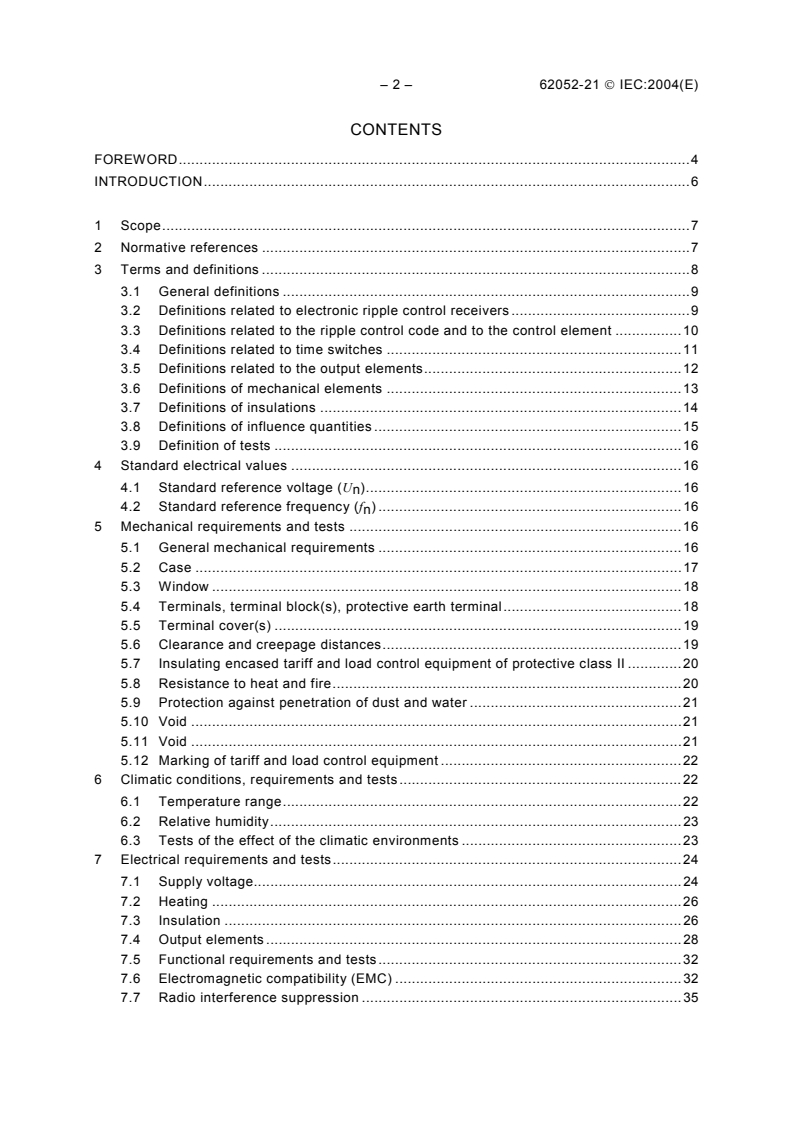
– 2 – 62052-21 IEC:2004(E)
CONTENTS
FOREWORD.4
INTRODUCTION.6
1 Scope.7
2 Normative references.7
3 Terms and definitions .8
3.1 General definitions.9
3.2 Definitions related to electronic ripple control receivers .9
3.3 Definitions related to the ripple control code and to the control element .10
3.4 Definitions related to time switches .11
3.5 Definitions related to the output elements.12
3.6 Definitions of mechanical elements .13
3.7 Definitions of insulations .14
3.8 Definitions of influence quantities .15
3.9 Definition of tests.16
4 Standard electrical values .16
4.1 Standard reference voltage (U ).16
n
4.2 Standard reference frequency (f ) .16
n
5 Mechanical requirements and tests .16
5.1 General mechanical requirements .16
5.2 Case.17
5.3 Window.18
5.4 Terminals, terminal block(s), protective earth terminal.18
5.5 Terminal cover(s).19
5.6 Clearance and creepage distances.19
5.7 Insulating encased tariff and load control equipment of protective class II .20
5.8 Resistance to heat and fire.20
5.9 Protection against penetration of dust and water .21
5.10 Void.21
5.11 Void.21
5.12 Marking of tariff and load control equipment .22
6 Climatic conditions, requirements and tests.22
6.1 Temperature range.22
6.2 Relative humidity.23
6.3 Tests of the effect of the climatic environments .23
7 Electrical requirements and tests.24
7.1 Supply voltage.24
7.2 Heating.26
7.3 Insulation.26
7.4 Output elements.28
7.5 Functional requirements and tests.32
7.6 Electromagnetic compatibility (EMC) .32
7.7 Radio interference suppression.35
62052-21 IEC:2004(E) – 3 –
8 Test conditions and type test .35
8.1 Test conditions.35
8.2 Type test.35
Annex A (normative) Relationship between ambient air temperature and relative
humidity.36
Annex B (normative) Reference and limiting values of the influence quantities.37
Annex C (normative) Electromagnet for testing the influence of externally produced
magnetic fields .38
Annex D (informative) Test set-up for EMC tests.39
Annex E (informative) Test schedule.40
Annex F (informative) Acceptance tests .42
Bibliographie.44
Figure A.1 – Relationship between ambient air temperature and relative humidity .36
Figure C.1 – Electromagnet for testing the influence of externally produced magnetic fields .38
Figure D.1 – Test set-up for the test of immunity to electromagnetic RF fields .39
Figure D.2 – Test set-up for fast transient burst test .39
Table 1 – Clearances and creepage distances for insulating encased tariff and load
control equipment of protective class I .20
Table 2 – Clearances and creepage distances for insulating encased tariff and load
control equipment of protective class II .20
Table 3 – Temperature range.23
Table 4 – Relative humidity.23
Table 5 – Voltage range.24
Table 6 – Power consumption .25
Table 7 – Rated breaking voltages.28
Table 8 – Rated breaking currents .29
Table B.1 – Reference and limiting values .37
Table E.1 – Test schedule .40
Table F.1 − Single sample plan.43
Table F.2 − Double sample plan.43
– 4 – 62052-21 IEC:2004(E)
INTERNATIONAL ELECTROTECHNICAL COMMISSION
___________
ELECTRICITY METERING EQUIPMENT (AC) –
GENERAL REQUIREMENTS, TESTS AND TEST CONDITIONS –
Part 21: Tariff and load control equipment
FOREWORD
1) The International Electrotechnical Commission (IEC) is a worldwide organization for standardization comprising
all national electrotechnical committees (IEC National Committees). The object of IEC is to promote
international co-operation on all questions concerning standardization in the electrical and electronic fields. To
this end and in addition to other activities, IEC publishes International Standards, Technical Specifications,
Technical Reports, Publicly Available Specifications (PAS) and Guides (hereafter referred to as “IEC
Publication(s)”). Their preparation is entrusted to technical committees; any IEC National Committee interested
in the subject dealt with may participate in this preparatory work. International, governmental and non-
governmental organizations liaising with the IEC also participate in this preparation. IEC collaborates closely
with the International Organization for Standardization (ISO) in accordance with conditions determined by
agreement between the two organizations.
2) The formal decisions or agreements of IEC on technical matters express, as nearly as possible, an international
consensus of opinion on the relevant subjects since each technical committee has representation from all
interested IEC National Committees.
3) IEC Publications have the form of recommendations for international use and are accepted by IEC National
Committees in that sense. While all reasonable efforts are made to ensure that the technical content of IEC
Publications is accurate, IEC cannot be held responsible for the way in which they are used or for any
misinterpretation by any end user.
4) In order to promote international uniformity, IEC National Committees undertake to apply IEC Publications
transparently to the maximum extent possible in their national and regional publications. Any divergence
between any IEC Publication and the corresponding national or regional publication shall be clearly indicated in
the latter.
5) IEC provides no marking procedure to indicate its approval and cannot be rendered responsible for any
equipment declared to be in conformity with an IEC Publication.
6) All users should ensure that they have the latest edition of this publication.
7) No liability shall attach to IEC or its directors, employees, servants or agents including individual experts and
members of its technical committees and IEC National Committees for any personal injury, property damage or
other damage of any nature whatsoever, whether direct or indirect, or for costs (including legal fees) and
expenses arising out of the publication, use of, or reliance upon, this IEC Publication or any other IEC
Publications.
8) Attention is drawn to the Normative references cited in this publication. Use of the referenced publications is
indispensable for the correct application of this publication.
9) Attention is drawn to the possibility that some of the elements of this IEC Publication may be the subject of
patent rights. IEC shall not be held responsible for identifying any or all such patent rights.
International Standard IEC 62052-21 has been prepared by IEC technical committee 13:
Equipment for electrical energy measurement and load control.
This standard, in conjunction with IEC 62054-11 and IEC 62054-21, cancels and replaces
IEC 61038:1990, Electricity metering – Tariff and load control – Particular requirements for
time switches and all amendments.This standard is to be used in conjunction with the relevant
parts of the IEC 62054 and the IEC 62059 series.
The text of this standard is based on the following documents:
FDIS Report on voting
13/1307/FDIS 13/1316/RVD
Full information on the voting for the approval of this standard can be found in the report on
voting indicated in the above table.
62052-21 IEC:2004(E) – 5 –
This publication has been drafted in accordance with the ISO/IEC Directives, Part 2.
The committee has decided that the contents of this publication will remain unchanged until
2013. At this date, the publication will be
• reconfirmed;
• withdrawn;
• replaced by a revised edition, or
• amended.
A bilingual version of this standard may be issued at a later date.
– 6 – 62052-21 IEC:2004(E)
INTRODUCTION
This standard distinguishes between protective class I and protective class II tariff and load
control equipment.
The test levels are regarded as minimum values to guarantee the proper functioning of the
equipment under normal working conditions. For special application, other test levels might be
necessary and should be agreed on between the user and the manufacturer.
For information, the relevant parts of IEC 62052, IEC 62054 and IEC 62059 are listed:
IEC 62052-21 Electricity metering (a.c.) – General requirements, tests and test conditions –
Part 21: Tariff and load control equipment
(Replaces the general requirements of IEC 61037 and IEC 61038.)
IEC 62054-11 Electricity metering (a.c.) – Tariff and load control – Part 11: Particular
requirements for electronic ripple control receivers
(Replaces the particular requirements of IEC 61037.)
IEC 62054-21 Electricity metering (a.c.) – Tariff and load control – Part 21: Particular
requirements for time switches
(Replaces the particular requirements of IEC 61038.)
IEC 62059-11 Electricity metering equipment (a.c.) – Dependability – Part 11: General concepts
IEC 62059-21 Electricity metering equipment (a.c.) – Dependability – Part 21: Collection of
meter dependability data from the field
IEC 62059-41 Electricity metering equipment (a.c.) – Dependability – Part 41: Reliability
prediction
———————
To be published.
To be published.
62052-21 IEC:2004(E) – 7 –
ELECTRICITY METERING EQUIPMENT (AC) –
GENERAL REQUIREMENTS, TESTS AND TEST CONDITIONS –
Part 21: Tariff and load control equipment
1 Scope
This part of IEC 62052 specifies general requirements for the type test of newly manufactured
indoor tariff and load control equipment, like electronic ripple control receivers and time
switches that are used to control electrical loads, multi-tariff registers and maximum demand
indicator devices.
This standard gives no requirements for constructional details internal to the tariff and load
control equipment.
In the case where tariff and load control functionality is integrated into multifunction electricity
metering equipment, the relevant parts of this standard apply.
This standard does not cover the acceptance tests and the conformity tests. Nevertheless, an
example of what could be an acceptance test is given in Annex F.
The dependability aspect is covered by the documents of the IEC 62059 series.
2 Normative references
The following referenced documents are indispensable for the application of this document.
For dated references, only the edition cited applies. For undated references, the latest edition
of the referenced document (including any amendments) applies.
IEC 60050-300:2001 International Electrotechnical Vocabulary (IEV) – Electrical and
electronic measurements and measuring instruments – Part 311: General terms relating to
measurements – Part 312: General terms relating to electrical measurements – Part 313: Types
of electrical measuring instruments – Part 314: Specific terms according to the type of
instrument
IEC 60060-1:1989, High-voltage test techniques – Part 1: General definitions and test
requirements
IEC 60068-2-1:1990, Environmental testing – Part 2: Tests – Tests A: Cold
IEC 60068-2-2:1974, Environmental testing – Part 2: Tests – Tests B: Dry heat
IEC 60068-2-6:1995, Environmental testing – Part 2: Tests – Test Fc: Vibration (sinusoidal)
IEC 60068-2-27:1987, Environmental testing – Part 2: Tests – Test Ea and guidance: Shock
IEC 60068-2-30:1980, Environmental testing – Part 2: Tests – Test Db and guidance: Damp
heat, cyclic (12 + 12-hour cycle)
IEC 60068-2-75:1997, Environmental testing – Part 2-75: Tests – Test Eh: Hammer test
IEC 60085:1984, Thermal evaluation and classification of electrical insulation
– 8 – 62052-21 IEC:2004(E)
IEC 60269-3-1:1994, Low-voltage fuses – Part 3-1: Supplementary requirements for fuses for
use by unskilled persons (fuses mainly for household and similar applications) – Sections I to IV
IEC 60417-2:1998, Graphical symbols for use on equipment – Part 2: Symbol originals
Amendment 1(2000)
IEC 60529:1989, Degrees of protection provided by enclosures (IP Code)
IEC 60695-2-10:2000, Fire Hazard testing – Part 2-10: Glowing/hot-wire based test methods –
Glow-wire apparatus and common test procedures
IEC 60695-2-11:2000, Fire hazard testing – Part 2-11: Glowing/hot-wire based test methods –
Glow-wire flammability test method for end-products
IEC 60721-3-3:1994, Classification of environmental conditions – Part 3: Classification of
groups of environmental parameters and their severities – Section 3: Stationary use at
weather protected locations
IEC 61000-4-2:1995, Electromagnetic compatibility (EMC) – Part 4-2: Testing and measure-
ment techniques – Electrostatic discharge immunity test. Basic EMC publication
IEC 61000-4-3:2002, Electromagnetic compatibility (EMC) – Part 4-3: Testing and measure-
ment techniques – Radiated, radio-frequency, electromagnetic field immunity test
IEC 61000-4-4:1995, Electromagnetic compatibility (EMC) – Part 4: Testing and measurement
techniques – Section 4: Electrical fast transient/burst immunity test. Basic EMC publication
IEC 61000-4-5:1995, Electromagnetic compatibility (EMC) – Part 4-5: Testing and measure-
ment techniques – Surge immunity test
IEC 61000-4-6:1996, Electromagnetic compatibility (EMC) – Part 4-6: Testing and measure-
ment techniques – Immunity to conducted disturbances, induced by radio-frequency fields
IEC 62054-11, Electricity metering (a.c.) – Tariff and load control equipment – Part 11:
Particular requirements for electronic ripple control tariff and load control equipment
IEC 62054-21, Electricity metering (a.c.)– Tariff and load control equipment – Part 21:
Particular requirements for time switches
CISPR 22:1997, Information technology equipment – Radio disturbance characteristics –
Limits and methods of measurement
ISO 75-2:1993, Plastics – Determination of temperature of deflection under load – Part 2:
Plastics and ebonite
3 Terms and definitions
For the purposes of this document, the following definitions, together with those of IEC 60050-
300, apply.
Where there is a difference between the definitions in the glossary and those contained in
product standards produced by TC 13 then the latter shall take precedence in applications of
the relevant standard.
———————
To be published.
62052-21 IEC:2004(E) – 9 –
3.1 General definitions
3.1.1
tariff and load control equipment
device intended to make or break or change over circuits controlling tariff devices of electricity
meters or controlling electrical loads, based on a pre-determined time schedule and/or
commands received from a control centre over suitable media and using suitable protocols
3.1.2
control element
functional element controlling the display and/or the operation indicator and the output
element. In the case of ripple control receivers, it comprises the decoding element and may
contain a timing element. In the case of time switches, it comprises the time-keeping element
and the element comparing the actual date and time with the schedule stored in the time
switch
3.1.3
reference voltage
U
n
value of the supply voltage in accordance with which the relevant performance of the tariff
and load control equipment is fixed
3.1.4
reference frequency
f
n
value of the frequency of the supply voltage in accordance with which the relevant
performance of the tariff and load control equipment is fixed
3.1.5
type
term used to define a particular design of tariff and load control equipment, manufactured by
one manufacturer, having the same uniform construction of parts determining the functional,
and, when applicable, the metrological properties. The type may have several values of
reference voltage and frequency. Tariff and load control equipment are designated by the
manufacturer by one or more groups of letters or numbers, or a combination of letters and
numbers. Each type has one designation only
NOTE The type is represented by the sample tariff and load control equipment intended for type tests, whose
characteristics are chosen from the values given in the tables proposed by the manufacturer.
3.2 Definitions related to electronic ripple control receivers
3.2.1
electronic ripple control receiver
device with an input and decoder circuit for the reception and interpretation of pulses of a
single audio frequency superimposed on the voltage of an electricity distribution network and
for the execution of the corresponding operations
3.2.2
standard receiver
receiver for mounting on equipment board, a meter board or an instrument rail (or which is a
part of the meter)
3.2.3
special receiver
receiver intended for particular applications, for example, street lighting receivers
– 10 – 62052-21 IEC:2004(E)
3.2.4
input element
functional element that separates the control signals from the supply voltage and transmits
them to the decoding element
3.2.4.1
control voltage
U
s
audio-frequency voltage superimposed on the supply system voltage. Throughout this
standard, its steady r.m.s. value is used and is expressed as a percentage of the rated supply
voltage U of the receiver
n
3.2.4.2
reference control voltage
U
ns
value of the control voltage U in accordance with which the relevant performance of the
s
ripple control receiver is fixed
3.2.4.3
operate voltage
U
f
minimum value of the control voltage that, under prescribed conditions, is sufficient to ensure
correct operation of the receivers, the message being coded according to the system
considered
3.2.4.4
non-operate voltage
U
nf
maximum value of the control voltage for which, under prescribed conditions, the receivers do
not operate, the message being coded according to the system considered
3.2.4.5
maximum control voltage
U
max
maximum value of the control voltage that, under prescribed conditions, ensures correct
operation of the receivers receiving a message coded according to the system considered
3.2.4.6
reference control frequency
f
s
value of the control frequency in accordance with which the relevant performance of the ripple
control receiver is fixed
3.3 Definitions related to the ripple control code and to the control element
3.3.1
code
sequence of a given number of pulse positions having a specified cycle duration
NOTE 1 Examples of time diagrams for ripple control codes are given in Annex E of IEC 62054-11.
NOTE 2 Each pulse position is designated by a number.
3.3.2
decoding element
part of the control element that identifies from the signals received from the input element
those corresponding to the commands for which it is programmed. For this purpose, the
decoding element checks the presence and, possibly, the absence of information pulses at
the positions for which it is programmed and passes on the information to the control element
62052-21 IEC:2004(E) – 11 –
3.3.3
timing element
part of the control element that, together with the decoding element, affects the operation of
the output element based on the value of internal timers. The presence of a timing element
allows the ripple control receiver to execute periodic or delayed switching operations even
without the reception of ripple control messages
3.3.4
pulse position
position in the ripple control message where an information pulse may be present or absent
3.3.5
starting pulse
first pulse of the message, which is intended to start the decoding operation of the receiver
NOTE It is generally designated by the number 0.
3.3.6
information pulse
pulse present at one of the positions in the message after the starting pulse. It is designated
by the number of its position
3.3.7
pulse interval
interval of time between the beginning of an information pulse and the beginning of the
following information pulse in the ripple control message
NOTE A pulse interval comprises a pulse of a length according to the coding system, plus, possibly, an
associated pause.
3.3.8
message
combination of the starting pulse and a certain number of information pulses representing one
or more commands
3.3.9
command
instruction to those receivers programmed to that command to carry out a certain operation
on the output element
NOTE It is generally characterized by the presence or absence of one or more information pulses.
3.3.10
cycle duration
interval of time between the beginning of the start pulse and the normal return of the receiver
to its quiescent state
3.4 Definitions related to time switches
3.4.1
time switch
device which may be set to make or break or change over circuits at pre-determined times
3.4.2
synchronous time switch
time switch having as its main time base the network frequency
3.4.3
crystal-controlled time switch
time switch having as its main time base a crystal-controlled oscillator
– 12 – 62052-21 IEC:2004(E)
3.4.4
time-based element
that part of the time switch which produces an output corresponding to the passing of the time
3.4.4.1
time-indication discrepancy
difference between the time displayed by the time switch and the actual time or, in the case of
synchronous time switches, the difference between the time displayed by the time switch and
the time determined by the network frequency
NOTE The actual time may be obtained using a reference clock.
3.4.4.2
time-keeping accuracy
increase or decrease in the time indication discrepancy within a specified time interval
3.4.4.3
variation of time-keeping accuracy due to an influence quantity
difference in time-keeping accuracy of a time switch when only one influence quantity
assumes successively two specified values, one of them being the reference value
3.4.4.4
operation reserve
maximum period of time after switching off the power-supply voltage during which the time
switch is capable to maintain correct time with a specified, relaxed time-keeping accuracy
3.4.4.5
reserve restoration time
period of time required for restoring the full operation reserve from the point where the
operation reserve has been completely exhausted
3.4.5
setting and display elements
3.4.5.1
dial
analogue mechanical device for facilitating the setting and observation of the settings of the
time switch and for the display of indicated time. The dials are designated according to their
period of rotation (for example, the day dial has a period of rotation of 1 day)
3.4.5.2
digital display
electronic device for facilitating the setting and observation of the settings of the time switch
and for the display of indicated time and possibly the status of the output elements
3.5 Definitions related to the output elements
3.5.1
output element
element comprising one or more electromechanical or static switches controlled according to
the information provided by the control element of the tariff and load control equipment
3.5.2
load switch
part of the output element comprising the contacts, or their electronic equivalent, for switching
loads, together with the parts directly operating the contacts
62052-21 IEC:2004(E) – 13 –
3.5.3
tariff register switch
part of the output element comprising the contacts, or their electronic equivalent, for switching
tariff registers, together with the parts directly operating the contacts
3.5.4
maximum demand indicator switch
part of the output element comprising the contacts, or their electronic equivalent, for switching
maximum demand indicators, together with the parts directly operating the contacts
3.5.5
low rating d.c. switch
part of the output element comprising the contacts, or their electronic equivalent, for switching
low power d.c. circuits, together with the parts directly operating the contacts
3.5.6
rated breaking voltage
U
c
value of the voltage for which a switch is designed
3.5.7
rated breaking current
I
c
value of current for which a switch is designed and which it can close, carry continuously and
break under specified conditions
3.5.8
maximum total current
I
tot
value of total current that all the output switches of a tariff and load control equipment can
carry continuously at the same time under specified conditions
3.5.9
operation
pair of changes of state of an output element, closure followed by opening or vice versa
3.6 Definitions of mechanical elements
3.6.1
indoor tariff and load control equipment
tariff and load control equipment, which can only be used in areas offering additional
protection against environmental influences (i.e. in a house or in a cabinet)
[IEV 314-07-20 modified]
3.6.2
base
back of the tariff and load control equipment by which it is generally fixed and to which are
attached the electronic board(s), the output element(s), the terminals or the terminal block
and the cover
[IEV 314-07-14 modified]
3.6.3
cover
enclosure on the front of the tariff and load control equipment, made either wholly of
transparent or of opaque material provided with (a) window(s) through which the dial and/or
display can be read
[IEV 314-07-16 modified]
– 14 – 62052-21 IEC:2004(E)
3.6.4
case
set that comprises the base and the cover
[IEV 314-07-17]
3.6.5
accessible conductive part
conductive part, which can be touched by the standard test finger when the tariff and load
control equipment is installed and ready for use
3.6.6
protective earth terminal
terminal connected to accessible conductive parts of the tariff and load control equipment for
safety purposes
3.6.7
terminal block
support made of insulating material on which all or some of the terminals of the tariff and load
control equipment are grouped together
[IEV 314-07-18 modified]
3.6.8
terminal cover
cover, which covers the tariff and load control equipment terminals and, generally, the ends of
the external wires or cables connected to the terminals
[IEV 314-07-19 modified]
3.6.9
clearance
shortest distance measured in air between two conductive parts
3.6.10
creepage distance
shortest distance measured over the surface of insulation between two conductive parts
3.7 Definitions of insulations
3.7.1
basic insulation
insulation applied to live parts to provide basic protection against electric shock
NOTE Basic insulation does not necessarily include insulation used exclusively for functional purposes.
3.7.2
supplementary insulation
independent insulation applied in addition to the basic insulation, in order to provide
protection against electric shock in the event of a failure of the basic insulation
3.7.3
double insulation
insulation comprising both basic insulation and supplementary insulation
3.7.4
reinforced insulation
single insulation system applied to live parts, which provides a degree of protection against
electric shock equivalent to double insulation
NOTE The term "insulation system" does not imply that the insulation should be one homogeneous piece. It may
comprise several layers, which cannot be tested singly as supplementary or basic insulation.
62052-21 IEC:2004(E) – 15 –
3.7.5
insulating encased tariff and load control equipment of protective class I
tariff and load control equipment in which protection against electric shock does not rely on
basic insulation only but which includes an additional safety precaution in that accessible
conductive parts are connected to the protective earthing conductor in the fixed wiring of the
installation in such a way that accessible conductive parts cannot become live in the event of
a failure of the basic insulation
NOTE This provision includes a protective earth terminal.
3.7.6
insulating encased tariff and load control equipment of protective class II
tariff and load control equipment with a case of insulating material, in which protection against
electric shock does not rely on basic insulation onl but in which additional safety precautions,
such as double insulation or reinforced insulation, are provided, there being no provision for
protective earthing or reliance upon installation conditions
3.8 Definitions of influence quantities
3.8.1
influence quantity
any quantity, generally external to the tariff and load control equipment, which may affect its
working performances
3.8.2
reference conditions
appropriate set of specified values and/or ranges of values of influence quantities under which
the working performances are specified
[IEV 311-06-02 modified]
3.8.3
electromagnetic disturbance
conducted or radiated electromagnetic interference or static discharge which may affect
functionally or metrologically the operation of the tariff and load control equipment
3.8.4
reference temperature
ambient temperature specified for reference conditions
3.8.5
rated operating conditions
set of specified ranges for performance characteristics and specified operating ranges for
influence quantities, within which the variations or working performances of a tariff and load
control equipment are specified and determined
3.8.6
specified operating range
range of values of a single influence quantity, which forms a part of the rated operating
conditions
3.8.7
extended operating range
extreme conditions which an operating tariff and load control equipment can withstand without
damage and without degradation of its characteristics when it is subsequently operated under
its rated operating conditions. For this range, relaxed accuracy and operational requirements
may be specified
– 16 – 62052-21 IEC:2004(E)
3.8.8
limit range of operation
extreme conditions which an operating tariff and load control equipment can withstand without
damage and without degradation of its characteristics when it is subsequently operated under
its rated operating conditions
3.8.9
storage and transport conditions
extreme conditions which a non-operating tariff and load control equipment can withstand
without damage and without degradation of its characteristics when it is subsequently
operated under its rated operating conditions
3.8.10
normal working position
position of the tariff and load control equipment defined by the manufacturer for normal
service
3.9 Definition of tests
type test
procedure according to which the series of tests is carried out on one tariff and load control
equipment or on a small number of tariff and load control equipment of the same type having
identical characteristics, selected by the manufacturer, to verify that the respective type of
tariff and load control equipment complies with all the requirements of this standard
4 Standard electrical values
4.1 Standard reference voltage (U )
n
Standard values for U are 120 V and 230 V.
n
NOTE These values apply only to stand-alone equipment.
4.2 Standard reference frequency (f )
n
Standard values for f are 50 Hz and 60 Hz.
n
5 Mechanical requirements and tests
5.1 General mechanical requirements
Tariff and load control equipment shall be designed and constructed in such a way as to avoid
introducing any danger in normal use and under normal conditions, so as to ensure especially
– personal safety against electric shock;
– personal safety against effects of excessive temperature;
– protection against spread of fire;
– protection against penetration of solid objects, dust and water.
All parts, which are subject to corrosion under normal working conditions shall be effectively
protected. Any protective coating shall not be liable to damage by ordinary handling, or
damage due to exposure to air, under normal working conditions.
Tariff and load control equipment shall have adequate mechanical strength and shall
withstand the elevated temperature which is likely to occur in normal working conditions.
The components shall be reliably fastened and secured against loosening.
62052-21 IEC:2004(E) – 17 –
The construction of tariff and load control equipment shall be such as to minimize the risks of
short-circuiting of the insulation between live parts and accessible conducting parts due to
accidental loosening or unscrewing of the wiring, screws, etc.
NOTE For tariff and load control equipment for special use in corrosive atmospheres, additional requirements
shall be fixed in the purchase contract (for example, salt mist test according to IEC 60068-2-11).
5.2 Case
5.2.1 Requirements
Tariff and load control equipment shall have a case which can be sealed in such a way that
the internal parts of the equipment are accessible only after breaking the seal.
The case shall be designed according to protective class I or II.
The cover shall not be removable without the use of a tool.
The case shall be so constructed and arranged that any non-permanent deformation cannot
prevent the satisfactory operation of the tariff and load control equipment.
Unless otherwise specified, tariff and load control equipment intended to be connected to a
supply mains where the voltage under reference conditions exceeds 250 V to earth, and
whose case is wholly or partially made of metal, shall be provided with a protective earth
terminal.
5.2.2 Mechanical tests
The case shall be subjected to the following tests.
NOTE The back-up power supply, if any, shall remain connected.
5.2.2.1 Spring hammer test
The mechanical strength of the tariff and load control equipment case shall be tested with a
spring hammer (test Ehb, see IEC 60068-2-75).
The tariff and load control equipment shall be mounted in its normal working position and the
hammer shall act on the outer surfaces of the tariff and load control equipment cover and on
the terminal cover with a kinetic energy of 0,2 J ± 0,02 J.
The result of the test is satisfactory if the tariff and load control equipment case and terminal
cover do not sustain damage, which could affect its function and if it is not possible to touch
live parts. Slight damage, which does not impair the protection against indirect contact or the
penetration of solid objects, dust and water is acceptable.
5.2.2.2 Shock test
The test shall be carried out according to IEC 60068-2-27, under the following conditions:
– tariff and load control equipment in non-operating condition, without the packing;
– half-sine pulse;
– peak acceleration: 30 g ; (300 m/s );
n
– duration of the pulse: 18 ms.
After the test, the tariff and load control equipment shall show no damage or change of
information and shall operate correctly in accordance with the requirements of the relevant
standard.
– 18 – 62052-21 IEC:2004(E)
5.2.2.3 Vibration test
The test shall be carried out according to IEC 60068-2-6, under the following conditions:
– tariff and load control equipment in non-operating condition, without the packing;
– frequency range: 10 Hz to 150 Hz;
– transition frequency: 60 Hz;
– f < 60 Hz constant amplitude of movement ±0,075 mm;
– f > 60 Hz constant acceleration 9,8 m/s (1 g);
– single point control;
– number of sweep cycles per axis: 10.
NOTE Ten sweep cycles = 75 min.
After the test, the tariff and load control equipment shall show no damage or change of
information and shall operate correctly in accordance with the requirements of the relevant
standard.
5.3 Window
If the cover is not transparent, one or more windows shall be provided for reading the display
and observation of the operation indicators if fitted. These windows shall be of transparent
material, which cannot be removed without breaking the seals.
5.4 Terminals, terminal block(s), protective earth terminal
Terminals may be grouped in (a) terminal block(s) havi
...
IEC 62052-21 ®
Edition 1.0 2004-05
INTERNATIONAL
STANDARD
NORME
INTERNATIONALE
Electricity metering equipment (a.c.) – General requirements, tests and test
conditions –
Part 21: Tariff and load control equipment
Équipement de comptage d’électricité (c.a.) – Prescriptions générales, essais et
conditions d’essai –
Partie 21: Equipement de tarification et de contrôle de charge
All rights reserved. Unless otherwise specified, no part of this publication may be reproduced or utilized in any form
or by any means, electronic or mechanical, including photocopying and microfilm, without permission in writing from
either IEC or IEC's member National Committee in the country of the requester. If you have any questions about IEC
copyright or have an enquiry about obtaining additional rights to this publication, please contact the address below or
your local IEC member National Committee for further information.
Droits de reproduction réservés. Sauf indication contraire, aucune partie de cette publication ne peut être reproduite
ni utilisée sous quelque forme que ce soit et par aucun procédé, électronique ou mécanique, y compris la photocopie
et les microfilms, sans l'accord écrit de l'IEC ou du Comité national de l'IEC du pays du demandeur. Si vous avez des
questions sur le copyright de l'IEC ou si vous désirez obtenir des droits supplémentaires sur cette publication, utilisez
les coordonnées ci-après ou contactez le Comité national de l'IEC de votre pays de résidence.
IEC Central Office Tel.: +41 22 919 02 11
3, rue de Varembé Fax: +41 22 919 03 00
CH-1211 Geneva 20 info@iec.ch
Switzerland www.iec.ch
About the IEC
The International Electrotechnical Commission (IEC) is the leading global organization that prepares and publishes
International Standards for all electrical, electronic and related technologies.
About IEC publications
The technical content of IEC publications is kept under constant review by the IEC. Please make sure that you have the
latest edition, a corrigenda or an amendment might have been published.
IEC Catalogue - webstore.iec.ch/catalogue Electropedia - www.electropedia.org
The stand-alone application for consulting the entire The world's leading online dictionary of electronic and
bibliographical information on IEC International Standards, electrical terms containing more than 30 000 terms and
Technical Specifications, Technical Reports and other definitions in English and French, with equivalent terms in 15
documents. Available for PC, Mac OS, Android Tablets and additional languages. Also known as the International
iPad. Electrotechnical Vocabulary (IEV) online.
IEC publications search - www.iec.ch/searchpub IEC Glossary - std.iec.ch/glossary
The advanced search enables to find IEC publications by a More than 60 000 electrotechnical terminology entries in
variety of criteria (reference number, text, technical English and French extracted from the Terms and Definitions
committee,…). It also gives information on projects, replaced clause of IEC publications issued since 2002. Some entries
and withdrawn publications. have been collected from earlier publications of IEC TC 37,
77, 86 and CISPR.
IEC Just Published - webstore.iec.ch/justpublished
Stay up to date on all new IEC publications. Just Published IEC Customer Service Centre - webstore.iec.ch/csc
details all new publications released. Available online and If you wish to give us your feedback on this publication or
also once a month by email. need further assistance, please contact the Customer Service
Centre: csc@iec.ch.
A propos de l'IEC
La Commission Electrotechnique Internationale (IEC) est la première organisation mondiale qui élabore et publie des
Normes internationales pour tout ce qui a trait à l'électricité, à l'électronique et aux technologies apparentées.
A propos des publications IEC
Le contenu technique des publications IEC est constamment revu. Veuillez vous assurer que vous possédez l’édition la
plus récente, un corrigendum ou amendement peut avoir été publié.
Catalogue IEC - webstore.iec.ch/catalogue Electropedia - www.electropedia.org
Application autonome pour consulter tous les renseignements
Le premier dictionnaire en ligne de termes électroniques et
bibliographiques sur les Normes internationales,
électriques. Il contient plus de 30 000 termes et définitions en
Spécifications techniques, Rapports techniques et autres
anglais et en français, ainsi que les termes équivalents dans
documents de l'IEC. Disponible pour PC, Mac OS, tablettes
15 langues additionnelles. Egalement appelé Vocabulaire
Android et iPad.
Electrotechnique International (IEV) en ligne.
Recherche de publications IEC - www.iec.ch/searchpub
Glossaire IEC - std.iec.ch/glossary
La recherche avancée permet de trouver des publications IEC Plus de 60 000 entrées terminologiques électrotechniques, en
en utilisant différents critères (numéro de référence, texte, anglais et en français, extraites des articles Termes et
comité d’études,…). Elle donne aussi des informations sur les Définitions des publications IEC parues depuis 2002. Plus
projets et les publications remplacées ou retirées. certaines entrées antérieures extraites des publications des
CE 37, 77, 86 et CISPR de l'IEC.
IEC Just Published - webstore.iec.ch/justpublished
Service Clients - webstore.iec.ch/csc
Restez informé sur les nouvelles publications IEC. Just
Published détaille les nouvelles publications parues. Si vous désirez nous donner des commentaires sur cette
Disponible en ligne et aussi une fois par mois par email. publication ou si vous avez des questions contactez-nous:
csc@iec.ch.
IEC 62052-21 ®
Edition 1.0 2004-05
INTERNATIONAL
STANDARD
NORME
INTERNATIONALE
Electricity metering equipment (a.c.) – General requirements, tests and test
conditions –
Part 21: Tariff and load control equipment
Équipement de comptage d’électricité (c.a.) – Prescriptions générales, essais et
conditions d’essai –
Partie 21: Equipement de tarification et de contrôle de charge
INTERNATIONAL
ELECTROTECHNICAL
COMMISSION
COMMISSION
ELECTROTECHNIQUE
INTERNATIONALE
ICS 91.140.50 ISBN 978-2-8322-3039-8
– 2 – IEC 62052-21:2004 IEC 2004
CONTENTS
1 Scope . 6
2 Normative references . 6
3 Terms and definitions . 7
4 Standard electrical values . 15
5 Mechanical requirements and tests . 15
6 Climatic conditions, requirements and tests . 21
7 Electrical requirements and tests . 23
8 Test conditions and type test . 34
Annex A (normative) Relationship between ambient air temperature and relative
humidity . 35
Annex B (normative) Reference and limiting values of the influence quantities . 36
Annex C (normative) Electromagnet for testing the influence of externally produced
magnetic fields . 37
Annex D (informative) Test set-up for EMC tests . 38
Annex E (informative) Test schedule . 39
Annex F (informative) Acceptance tests . 41
Figure A.1 – Relationship between ambient air temperature and relative humidity . 35
Figure C.1 – Electromagnet for testing the influence of externally produced magnetic
fields . 37
Figure D.1 – Test set-up for the test of immunity to electromagnetic r.f. fields . 38
Figure D.2 – Test set-up for fast transient burst test . 38
Table 1 – Clearances and creepage distances for insulating encased tariff and load
control equipment of protective class I. 19
Table 2 – Clearances and creepage distances for insulating encased tariff and load
control equipment of protective class II. 19
Table 3 – Temperature range . 22
Table 4 – Relative humidity . 22
Table 5 – Voltage range . 23
Table 6 – Power consumption . 24
Table 7 – Rated breaking voltages . 27
Table 8 – Rated breaking currents. 28
Table B.1 – Reference and limiting values . 36
Table E.1 – Test schedule . 39
Table F.1 − Single sample plan . 42
Table F.2 − Double sample plan . 42
INTERNATIONAL ELECTROTECHNICAL COMMISSION
___________
ELECTRICITY METERING EQUIPMENT (A.C.) –
GENERAL REQUIREMENTS, TESTS AND TEST CONDITIONS –
Part 21: Tariff and load control equipment
FOREWORD
1) The International Electrotechnical Commission (IEC) is a worldwide organization for standardization comprising
all national electrotechnical committees (IEC National Committees). The object of IEC is to promote
international co-operation on all questions concerning standardization in the electrical and electronic fields. To
this end and in addition to other activities, IEC publishes International Standards, Technical Specifications,
Technical Reports, Publicly Available Specifications (PAS) and Guides (hereafter referred to as “IEC
Publication(s)”). Their preparation is entrusted to technical committees; any IEC National Committee interested
in the subject dealt with may participate in this preparatory work. International, governmental and non-
governmental organizations liaising with the IEC also participate in this preparation. IEC collaborates closely
with the International Organization for Standardization (ISO) in accordance with conditions determined by
agreement between the two organizations.
2) The formal decisions or agreements of IEC on technical matters express, as nearly as possible, an international
consensus of opinion on the relevant subjects since each technical committee has representation from all
interested IEC National Committees.
3) IEC Publications have the form of recommendations for international use and are accepted by IEC National
Committees in that sense. While all reasonable efforts are made to ensure that the technical content of IEC
Publications is accurate, IEC cannot be held responsible for the way in which they are used or for any
misinterpretation by any end user.
4) In order to promote international uniformity, IEC National Committees undertake to apply IEC Publications
transparently to the maximum extent possible in their national and regional publications. Any divergence
between any IEC Publication and the corresponding national or regional publication shall be clearly indicated in
the latter.
5) IEC provides no marking procedure to indicate its approval and cannot be rendered responsible for any
equipment declared to be in conformity with an IEC Publication.
6) All users should ensure that they have the latest edition of this publication.
7) No liability shall attach to IEC or its directors, employees, servants or agents including individual experts and
members of its technical committees and IEC National Committees for any personal injury, property damage or
other damage of any nature whatsoever, whether direct or indirect, or for costs (including legal fees) and
expenses arising out of the publication, use of, or reliance upon, this IEC Publication or any other IEC
Publications.
8) Attention is drawn to the Normative references cited in this publication. Use of the referenced publications is
indispensable for the correct application of this publication.
9) Attention is drawn to the possibility that some of the elements of this IEC Publication may be the subject of
patent rights. IEC shall not be held responsible for identifying any or all such patent rights.
International Standard IEC 62052-21 has been prepared by IEC technical committee 13:
Equipment for electrical energy measurement and load control.
This standard, in conjunction with IEC 62054-11 and IEC 62054-21, cancels and replaces
IEC 61038:1990, Electricity metering – Tariff and load control – Particular requirements for
time switches and all amendments. This standard is to be used in conjunction with the
relevant parts of the IEC 62054 and the IEC 62059 series.
This bilingual version (2016-07) corresponds to monolingual version published in 2004-05.
The text of this standard is based on the following documents:
FDIS Report on voting
13/1307/FDIS 13/1316/RVD
– 4 – IEC 62052-21:2004 IEC 2004
Full information on the voting for the approval of this standard can be found in the report on
voting indicated in the above table.
This publication has been drafted in accordance with the ISO/IEC Directives, Part 2.
The committee has decided that the contents of this publication will remain unchanged until
2013. At this date, the publication will be
• reconfirmed;
• withdrawn;
• replaced by a revised edition, or
• amended.
INTRODUCTION
This standard distinguishes between protective class I and protective class II tariff and load
control equipment.
The test levels are regarded as minimum values to guarantee the proper functioning of the
equipment under normal working conditions. For special application, other test levels might be
necessary and should be agreed on between the user and the manufacturer.
For information, the relevant parts of IEC 62052, IEC 62054 and IEC 62059 are listed:
IEC 62052-21 Electricity metering (a.c.) – General requirements, tests and test conditions –
Part 21: Tariff and load control equipment
(Replaces the general requirements of IEC 61037 and IEC 61038.)
IEC 62054-11 Electricity metering (a.c.) – Tariff and load control – Part 11: Particular
requirements for electronic ripple control receivers
(Replaces the particular requirements of IEC 61037.)
IEC 62054-21 Electricity metering (a.c.) – Tariff and load control – Part 21: Particular
requirements for time switches
(Replaces the particular requirements of IEC 61038.)
IEC 62059-11 Electricity metering equipment (a.c.) – Dependability – Part 11: General concepts
IEC 62059-21 Electricity metering equipment (a.c.) – Dependability – Part 21: Collection of
meter dependability data from the field
IEC 62059-41 Electricity metering equipment (a.c.) – Dependability – Part 41: Reliability
prediction
———————
To be published.
– 6 – IEC 62052-21:2004 IEC 2004
ELECTRICITY METERING EQUIPMENT (A.C.) –
GENERAL REQUIREMENTS, TESTS AND TEST CONDITIONS –
Part 21: Tariff and load control equipment
1 Scope
This part of IEC 62052 specifies general requirements for the type test of newly manufactured
indoor tariff and load control equipment, like electronic ripple control receivers and time
switches that are used to control electrical loads, multi-tariff registers and maximum demand
indicator devices.
This standard gives no requirements for constructional details internal to the tariff and load
control equipment.
In the case where tariff and load control functionality is integrated into multifunction electricity
metering equipment, the relevant parts of this standard apply.
This standard does not cover the acceptance tests and the conformity tests. Nevertheless, an
example of what could be an acceptance test is given in Annex F.
The dependability aspect is covered by the documents of the IEC 62059 series.
2 Normative references
The following referenced documents are indispensable for the application of this document.
For dated references, only the edition cited applies. For undated references, the latest edition
of the referenced document (including any amendments) applies.
IEC 60050-300:2001, International Electrotechnical Vocabulary (IEV) – Electrical and
electronic measurements and measuring instruments – Part 311: General terms relating to
measurements – Part 312: General terms relating to electrical measurements – Part 313:
Types of electrical measuring instruments – Part 314: Specific terms according to the type of
instrument
IEC 60060-1:1989, High-voltage test techniques – Part 1: General definitions and test
requirements
IEC 60068-2-1:1990, Environmental testing – Part 2: Tests – Tests A: Cold
IEC 60068-2-2:1974, Environmental testing – Part 2: Tests – Tests B: Dry heat
IEC 60068-2-6:1995, Environmental testing – Part 2: Tests – Test Fc: Vibration (sinusoidal)
IEC 60068-2-27:1987, Environmental testing – Part 2: Tests – Test Ea and guidance: Shock
IEC 60068-2-30:1980, Environmental testing – Part 2: Tests – Test Db and guidance: Damp
heat, cyclic (12 + 12-hour cycle)
IEC 60068-2-75:1997, Environmental testing – Part 2-75: Tests – Test Eh: Hammer test
IEC 60085:1984, Thermal evaluation and classification of electrical insulation
IEC 60269-3-1:1994, Low-voltage fuses – Part 3-1: Supplementary requirements for fuses for
use by unskilled persons (fuses mainly for household and similar applications) – Sections I to
IV
IEC 60417-2:1998, Graphical symbols for use on equipment – Part 2: Symbol originals
Amendment 1 (2000)
IEC 60529:1989, Degrees of protection provided by enclosures (IP Code)
IEC 60695-2-10:2000, Fire Hazard testing – Part 2-10: Glowing/hot-wire based test methods –
Glow-wire apparatus and common test procedures
IEC 60695-2-11:2000, Fire hazard testing – Part 2-11: Glowing/hot-wire based test methods –
Glow-wire flammability test method for end-products
IEC 60721-3-3:1994, Classification of environmental conditions – Part 3: Classification of
groups of environmental parameters and their severities – Section 3: Stationary use at
weather protected locations
IEC 61000-4-2:1995, Electromagnetic compatibility (EMC) – Part 4-2: Testing and measure-
ment techniques – Electrostatic discharge immunity test. Basic EMC publication
IEC 61000-4-3:2002, Electromagnetic compatibility (EMC) – Part 4-3: Testing and measure-
ment techniques – Radiated, radio-frequency, electromagnetic field immunity test
IEC 61000-4-4:1995, Electromagnetic compatibility (EMC) – Part 4: Testing and measurement
techniques – Section 4: Electrical fast transient/burst immunity test. Basic EMC publication
IEC 61000-4-5:1995, Electromagnetic compatibility (EMC) – Part 4-5: Testing and measure-
ment techniques – Surge immunity test
IEC 61000-4-6:1996, Electromagnetic compatibility (EMC) – Part 4-6: Testing and measure-
ment techniques – Immunity to conducted disturbances, induced by radio-frequency fields
IEC 62054-11, Electricity metering (a.c.) – Tariff and load control equipment – Part 11:
Particular requirements for electronic ripple control tariff and load control equipment
IEC 62054-21, Electricity metering (a.c.)– Tariff and load control equipment – Part 21:
Particular requirements for time switches
CISPR 22:1997, Information technology equipment – Radio disturbance characteristics –
Limits and methods of measurement
ISO 75-2:1993, Plastics – Determination of temperature of deflection under load – Part 2:
Plastics and ebonite
3 Terms and definitions
For the purposes of this document, the following definitions, together with those of IEC 60050-
300, apply.
Where there is a difference between the definitions in the glossary and those contained in
product standards produced by TC 13 then the latter shall take precedence in applications of
the relevant standard.
———————
To be published.
– 8 – IEC 62052-21:2004 IEC 2004
3.1 General definitions
3.1.1
tariff and load control equipment
device intended to make or break or change over circuits controlling tariff devices of electricity
meters or controlling electrical loads, based on a pre-determined time schedule and/or
commands received from a control centre over suitable media and using suitable protocols
3.1.2
control element
functional element controlling the display and/or the operation indicator and the output
element. In the case of ripple control receivers, it comprises the decoding element and may
contain a timing element. In the case of time switches, it comprises the time-keeping element
and the element comparing the actual date and time with the schedule stored in the time
switch
3.1.3
reference voltage
U
n
value of the supply voltage in accordance with which the relevant performance of the tariff
and load control equipment is fixed
3.1.4
reference frequency
f
n
value of the frequency of the supply voltage in accordance with which the relevant
performance of the tariff and load control equipment is fixed
3.1.5
type
term used to define a particular design of tariff and load control equipment, manufactured by
one manufacturer, having the same uniform construction of parts determining the functional,
and, when applicable, the metrological properties. The type may have several values of
reference voltage and frequency. Tariff and load control equipment are designated by the
manufacturer by one or more groups of letters or numbers, or a combination of letters and
numbers. Each type has one designation only
Note 1 to entry: The type is represented by the sample tariff and load control equipment intended for type tests,
whose characteristics are chosen from the values given in the tables proposed by the manufacturer.
3.2 Definitions related to electronic ripple control receivers
3.2.1
electronic ripple control receiver
device with an input and decoder circuit for the reception and interpretation of pulses of a
single audio frequency superimposed on the voltage of an electricity distribution network and
for the execution of the corresponding operations
3.2.2
standard receiver
receiver for mounting on equipment board, a meter board or an instrument rail (or which is a
part of the meter)
3.2.3
special receiver
receiver intended for particular applications, for example, street lighting receivers
3.2.4
input element
functional element that separates the control signals from the supply voltage and transmits
them to the decoding element
3.2.4.1
control voltage
U
s
audio-frequency voltage superimposed on the supply system voltage. Throughout this
standard, its steady r.m.s. value is used and is expressed as a percentage of the rated supply
voltage U of the receiver
n
3.2.4.2
reference control voltage
U
ns
value of the control voltage U in accordance with which the relevant performance of the
s
ripple control receiver is fixed
3.2.4.3
operate voltage
U
f
minimum value of the control voltage that, under prescribed conditions, is sufficient to ensure
correct operation of the receivers, the message being coded according to the system
considered
3.2.4.4
non-operate voltage
U
nf
maximum value of the control voltage for which, under prescribed conditions, the receivers do
not operate, the message being coded according to the system considered
3.2.4.5
maximum control voltage
U
max
maximum value of the control voltage that, under prescribed conditions, ensures correct
operation of the receivers receiving a message coded according to the system considered
3.2.4.6
reference control frequency
f
s
value of the control frequency in accordance with which the relevant performance of the ripple
control receiver is fixed
3.3 Definitions related to the ripple control code and to the control element
3.3.1
code
sequence of a given number of pulse positions having a specified cycle duration
Note 1 to entry: Examples of time diagrams for ripple control codes are given in Annex E of IEC 62054-11.
Note 2 to entry: Each pulse position is designated by a number.
3.3.2
decoding element
part of the control element that identifies from the signals received from the input element
those corresponding to the commands for which it is programmed. For this purpose, the
decoding element checks the presence and, possibly, the absence of information pulses at
the positions for which it is programmed and passes on the information to the control element
– 10 – IEC 62052-21:2004 IEC 2004
3.3.3
timing element
part of the control element that, together with the decoding element, affects the operation of
the output element based on the value of internal timers. The presence of a timing element
allows the ripple control receiver to execute periodic or delayed switching operations even
without the reception of ripple control messages
3.3.4
pulse position
position in the ripple control message where an information pulse may be present or absent
3.3.5
starting pulse
first pulse of the message, which is intended to start the decoding operation of the receiver
Note 1 to entry: It is generally designated by the number 0.
3.3.6
information pulse
pulse present at one of the positions in the message after the starting pulse. It is designated
by the number of its position
3.3.7
pulse interval
interval of time between the beginning of an information pulse and the beginning of the
following information pulse in the ripple control message
Note 1 to entry: A pulse interval comprises a pulse of a length according to the coding system, plus, possibly, an
associated pause.
3.3.8
message
combination of the starting pulse and a certain number of information pulses representing one
or more commands
3.3.9
command
instruction to those receivers programmed to that command to carry out a certain operation
on the output element
Note 1 to entry: It is generally characterized by the presence or absence of one or more information pulses.
3.3.10
cycle duration
interval of time between the beginning of the start pulse and the normal return of the receiver
to its quiescent state
3.4 Definitions related to time switches
3.4.1
time switch
device which may be set to make or break or change over circuits at pre-determined times
3.4.2
synchronous time switch
time switch having as its main time base the network frequency
3.4.3
crystal-controlled time switch
time switch having as its main time base a crystal-controlled oscillator
3.4.4
time-based element
that part of the time switch which produces an output corresponding to the passing of the time
3.4.4.1
time-indication discrepancy
difference between the time displayed by the time switch and the actual time or, in the case of
synchronous time switches, the difference between the time displayed by the time switch and
the time determined by the network frequency
Note 1 to entry: The actual time may be obtained using a reference clock.
3.4.4.2
time-keeping accuracy
increase or decrease in the time indication discrepancy within a specified time interval
3.4.4.3
variation of time-keeping accuracy due to an influence quantity
difference in time-keeping accuracy of a time switch when only one influence quantity
assumes successively two specified values, one of them being the reference value
3.4.4.4
operation reserve
maximum period of time after switching off the power-supply voltage during which the time
switch is capable to maintain correct time with a specified, relaxed time-keeping accuracy
3.4.4.5
reserve restoration time
period of time required for restoring the full operation reserve from the point where the
operation reserve has been completely exhausted
3.4.5
setting and display elements
3.4.5.1
dial
analogue mechanical device for facilitating the setting and observation of the settings of the
time switch and for the display of indicated time. The dials are designated according to their
period of rotation (for example, the day dial has a period of rotation of 1 day)
3.4.5.2
digital display
electronic device for facilitating the setting and observation of the settings of the time switch
and for the display of indicated time and possibly the status of the output elements
3.5 Definitions related to the output elements
3.5.1
output element
element comprising one or more electromechanical or static switches controlled according to
the information provided by the control element of the tariff and load control equipment
3.5.2
load switch
part of the output element comprising the contacts, or their electronic equivalent, for switching
loads, together with the parts directly operating the contacts
– 12 – IEC 62052-21:2004 IEC 2004
3.5.3
tariff register switch
part of the output element comprising the contacts, or their electronic equivalent, for switching
tariff registers, together with the parts directly operating the contacts
3.5.4
maximum demand indicator switch
part of the output element comprising the contacts, or their electronic equivalent, for switching
maximum demand indicators, together with the parts directly operating the contacts
3.5.5
low rating d.c. switch
part of the output element comprising the contacts, or their electronic equivalent, for switching
low power d.c. circuits, together with the parts directly operating the contacts
3.5.6
rated breaking voltage
U
c
value of the voltage for which a switch is designed
3.5.7
rated breaking current
I
c
value of current for which a switch is designed and which it can close, carry continuously and
break under specified conditions
3.5.8
maximum total current
I
tot
value of total current that all the output switches of a tariff and load control equipment can
carry continuously at the same time under specified conditions
3.5.9
operation
pair of changes of state of an output element, closure followed by opening or vice versa
3.6 Definitions of mechanical elements
3.6.1
indoor tariff and load control equipment
tariff and load control equipment, which can only be used in areas offering additional
protection against environmental influences (i.e. in a house or in a cabinet)
[SOURCE:IEV 314-07-20 modified]
3.6.2
base
back of the tariff and load control equipment by which it is generally fixed and to which are
attached the electronic board(s), the output element(s), the terminals or the terminal block
and the cover
[SOURCE:IEV 314-07-14 modified]
3.6.3
cover
enclosure on the front of the tariff and load control equipment, made either wholly of
transparent or of opaque material provided with (a) window(s) through which the dial and/or
display can be read
[SOURCE:IEV 314-07-16 modified]
3.6.4
case
set that comprises the base and the cover
[SOURCE:IEV 314-07-17]
3.6.5
accessible conductive part
conductive part, which can be touched by the standard test finger when the tariff and load
control equipment is installed and ready for use
3.6.6
protective earth terminal
terminal connected to accessible conductive parts of the tariff and load control equipment for
safety purposes
3.6.7
terminal block
support made of insulating material on which all or some of the terminals of the tariff and load
control equipment are grouped together
[SOURCE:IEV 314-07-18 modified]
3.6.8
terminal cover
cover, which covers the tariff and load control equipment terminals and, generally, the ends of
the external wires or cables connected to the terminals
[SOURCE:IEV 314-07-19 modified]
3.6.9
clearance
shortest distance measured in air between two conductive parts
3.6.10
creepage distance
shortest distance measured over the surface of insulation between two conductive parts
3.7 Definitions of insulations
3.7.1
basic insulation
insulation applied to live parts to provide basic protection against electric shock
Note 1 to entry: Basic insulation does not necessarily include insulation used exclusively for functional
purposes.
3.7.2
supplementary insulation
independent insulation applied in addition to the basic insulation, in order to provide
protection against electric shock in the event of a failure of the basic insulation
3.7.3
double insulation
insulation comprising both basic insulation and supplementary insulation
– 14 – IEC 62052-21:2004 IEC 2004
3.7.4
reinforced insulation
single insulation system applied to live parts, which provides a degree of protection against
electric shock equivalent to double insulation
Note 1 to entry: The term "insulation system" does not imply that the insulation should be one homogeneous
piece. It may comprise several layers, which cannot be tested singly as supplementary or basic insulation.
3.7.5
insulating encased tariff and load control equipment of protective class I
tariff and load control equipment in which protection against electric shock does not rely on
basic insulation only but which includes an additional safety precaution in that accessible
conductive parts are connected to the protective earthing conductor in the fixed wiring of the
installation in such a way that accessible conductive parts cannot become live in the event of
a failure of the basic insulation
NOTE This provision includes a protective earth terminal.
3.7.6
insulating encased tariff and load control equipment of protective class II
tariff and load control equipment with a case of insulating material, in which protection against
electric shock does not rely on basic insulation onl but in which additional safety precautions,
such as double insulation or reinforced insulation, are provided, there being no provision for
protective earthing or reliance upon installation conditions
3.8 Definitions of influence quantities
3.8.1
influence quantity
any quantity, generally external to the tariff and load control equipment, which may affect its
working performances
3.8.2
reference conditions
appropriate set of specified values and/or ranges of values of influence quantities under which
the working performances are specified
[SOURCE:IEV 311-06-02 modified]
3.8.3
electromagnetic disturbance
conducted or radiated electromagnetic interference or static discharge which may affect
functionally or metrologically the operation of the tariff and load control equipment
3.8.4
reference temperature
ambient temperature specified for reference conditions
3.8.5
rated operating conditions
set of specified ranges for performance characteristics and specified operating ranges for
influence quantities, within which the variations or working performances of a tariff and load
control equipment are specified and determined
3.8.6
specified operating range
range of values of a single influence quantity, which forms a part of the rated operating
conditions
3.8.7
extended operating range
extreme conditions which an operating tariff and load control equipment can withstand without
damage and without degradation of its characteristics when it is subsequently operated under
its rated operating conditions. For this range, relaxed accuracy and operational requirements
may be specified
3.8.8
limit range of operation
extreme conditions which an operating tariff and load control equipment can withstand without
damage and without degradation of its characteristics when it is subsequently operated under
its rated operating conditions
3.8.9
storage and transport conditions
extreme conditions which a non-operating tariff and load control equipment can withstand
without damage and without degradation of its characteristics when it is subsequently
operated under its rated operating conditions
3.8.10
normal working position
position of the tariff and load control equipment defined by the manufacturer for normal
service
3.9 Definition of tests
type test
procedure according to which the series of tests is carried out on one tariff and load control
equipment or on a small number of tariff and load control equipment of the same type having
identical characteristics, selected by the manufacturer, to verify that the respective type of
tariff and load control equipment complies with all the requirements of this standard
4 Standard electrical values
4.1 Standard reference voltage (U )
n
Standard values for U are 120 V and 230 V.
n
NOTE These values apply only to stand-alone equipment.
4.2 Standard reference frequency (f )
n
Standard values for f are 50 Hz and 60 Hz.
n
5 Mechanical requirements and tests
5.1 General mechanical requirements
Tariff and load control equipment shall be designed and constructed in such a way as to avoid
introducing any danger in normal use and under normal conditions, so as to ensure especially
– personal safety against electric shock;
– personal safety against effects of excessive temperature;
– protection against spread of fire;
– protection against penetration of solid objects, dust and water.
– 16 – IEC 62052-21:2004 IEC 2004
All parts, which are subject to corrosion under normal working conditions shall be effectively
protected. Any protective coating shall not be liable to damage by ordinary handling, or
damage due to exposure to air, under normal working conditions.
Tariff and load control equipment shall have adequate mechanical strength and shall
withstand the elevated temperature which is likely to occur in normal working conditions.
The components shall be reliably fastened and secured against loosening.
The construction of tariff and load control equipment shall be such as to minimize the risks of
short-circuiting of the insulation between live parts and accessible conducting parts due to
accidental loosening or unscrewing of the wiring, screws, etc.
NOTE For tariff and load control equipment for special use in corrosive atmospheres, additional requirements
shall be fixed in the purchase contract (for example, salt mist test according to IEC 60068-2-11).
5.2 Case
5.2.1 Requirements
Tariff and load control equipment shall have a case which can be sealed in such a way that
the internal parts of the equipment are accessible only after breaking the seal.
The case shall be designed according to protective class I or II.
The cover shall not be removable without the use of a tool.
The case shall be so constructed and arranged that any non-permanent deformation cannot
prevent the satisfactory operation of the tariff and load control equipment.
Unless otherwise specified, tariff and load control equipment intended to be connected to a
supply mains where the voltage under reference conditions exceeds 250 V to earth, and
whose case is wholly or partially made of metal, shall be provided with a protective earth
terminal.
5.2.2 Mechanical tests
The case shall be subjected to the following tests.
NOTE The back-up power supply, if any, shall remain connected.
5.2.2.1 Spring hammer test
The mechanical strength of the tariff and load control equipment case shall be tested with a
spring hammer (test Ehb, see IEC 60068-2-75).
The tariff and load control equipment shall be mounted in its normal working position and the
hammer shall act on the outer surfaces of the tariff and load control equipment cover and on
the terminal cover with a kinetic energy of 0,2 J ± 0,02 J.
The result of the test is satisfactory if the tariff and load control equipment case and terminal
cover do not sustain damage, which could affect its function and if it is not possible to touch
live parts. Slight damage, which does not impair the protection against indirect contact or the
penetration of solid objects, dust and water is acceptable.
5.2.2.2 Shock test
The test shall be carried out according to IEC 60068-2-27, under the following conditions:
– tariff and load control equipment in non-operating condition, without the packing;
– half-sine pulse;
– peak acceleration: 30 g ; (300 m/s );
n
– duration of the pulse: 18 ms.
After the test, the tariff and load control equipment shall show no damage or change of
information and shall operate correctly in accordance with the requirements of the relevant
standard.
5.2.2.3 Vibration test
The test shall be carried out according to IEC 60068-2-6, under the following conditions:
– tariff and load control equipment in non-operating condition, without the packing;
– frequency range: 10 Hz to 150 Hz;
– transition frequency: 60 Hz;
– f < 60 Hz constant amplitude of movement ±0,075 mm;
– f > 60 Hz constant acceleration 9,8 m/s (1 g);
– single point control;
– number of sweep cycles per axis: 10.
NOTE Ten sweep cycles = 75 min.
After the test, the tariff and load control equipment shall show no damage or change of
information and shall operate correctly in accordance with the requirements of the relevant
standard.
5.3 Window
If the cover is not transparent, one or more windows shall be provided for reading the display
and observation of the operation indicators if fitted. These windows shall be of transparent
material, which cannot be removed without breaking the seals.
5.4 Terminals, terminal block(s), protective earth terminal
Terminals may be grouped in (a) terminal block(s) having adequate insulating properties and
mechanical strength. In order to satisfy such requirements when choosing insulating materials
for the terminal block(s), adequate testing of materials should be taken into account.
The terminal block shall be so constructed that the tariff and load control equipment during
any deformation caused by rated operating conditions shall comply with the insulation
requirements and the
...
IEC 62052-21 ®
Edition 1.1 2016-11
CONSOLIDATED VERSION
INTERNATIONAL
STANDARD
NORME
INTERNATIONALE
colour
inside
Electricity metering equipment (a.c.) – General requirements, tests and test
conditions –
Part 21: Tariff and load control equipment
Équipement de comptage d’électricité (c.a.) – Prescriptions générales, essais
et conditions d’essai –
Partie 21: Equipement de tarification et de contrôle de charge
All rights reserved. Unless otherwise specified, no part of this publication may be reproduced or utilized in any form
or by any means, electronic or mechanical, including photocopying and microfilm, without permission in writing from
either IEC or IEC's member National Committee in the country of the requester. If you have any questions about IEC
copyright or have an enquiry about obtaining additional rights to this publication, please contact the address below or
your local IEC member National Committee for further information.
Droits de reproduction réservés. Sauf indication contraire, aucune partie de cette publication ne peut être reproduite
ni utilisée sous quelque forme que ce soit et par aucun procédé, électronique ou mécanique, y compris la photocopie
et les microfilms, sans l'accord écrit de l'IEC ou du Comité national de l'IEC du pays du demandeur. Si vous avez des
questions sur le copyright de l'IEC ou si vous désirez obtenir des droits supplémentaires sur cette publication, utilisez
les coordonnées ci-après ou contactez le Comité national de l'IEC de votre pays de résidence.
IEC Central Office Tel.: +41 22 919 02 11
3, rue de Varembé Fax: +41 22 919 03 00
CH-1211 Geneva 20 info@iec.ch
Switzerland www.iec.ch
About the IEC
The International Electrotechnical Commission (IEC) is the leading global organization that prepares and publishes
International Standards for all electrical, electronic and related technologies.
About IEC publications
The technical content of IEC publications is kept under constant review by the IEC. Please make sure that you have the
latest edition, a corrigenda or an amendment might have been published.
IEC Catalogue - webstore.iec.ch/catalogue Electropedia - www.electropedia.org
The stand-alone application for consulting the entire The world's leading online dictionary of electronic and
bibliographical information on IEC International Standards, electrical terms containing 20 000 terms and definitions in
Technical Specifications, Technical Reports and other English and French, with equivalent terms in 15 additional
documents. Available for PC, Mac OS, Android Tablets and languages. Also known as the International Electrotechnical
iPad. Vocabulary (IEV) online.
IEC publications search - www.iec.ch/searchpub IEC Glossary - std.iec.ch/glossary
The advanced search enables to find IEC publications by a 65 000 electrotechnical terminology entries in English and
variety of criteria (reference number, text, technical French extracted from the Terms and Definitions clause of
committee,…). It also gives information on projects, replaced IEC publications issued since 2002. Some entries have been
and withdrawn publications. collected from earlier publications of IEC TC 37, 77, 86 and
CISPR.
IEC Just Published - webstore.iec.ch/justpublished
Stay up to date on all new IEC publications. Just Published IEC Customer Service Centre - webstore.iec.ch/csc
details all new publications released. Available online and If you wish to give us your feedback on this publication or
also once a month by email. need further assistance, please contact the Customer Service
Centre: csc@iec.ch.
A propos de l'IEC
La Commission Electrotechnique Internationale (IEC) est la première organisation mondiale qui élabore et publie des
Normes internationales pour tout ce qui a trait à l'électricité, à l'électronique et aux technologies apparentées.
A propos des publications IEC
Le contenu technique des publications IEC est constamment revu. Veuillez vous assurer que vous possédez l’édition la
plus récente, un corrigendum ou amendement peut avoir été publié.
Catalogue IEC - webstore.iec.ch/catalogue Electropedia - www.electropedia.org
Application autonome pour consulter tous les renseignements
Le premier dictionnaire en ligne de termes électroniques et
bibliographiques sur les Normes internationales,
électriques. Il contient 20 000 termes et définitions en anglais
Spécifications techniques, Rapports techniques et autres
et en français, ainsi que les termes équivalents dans 15
documents de l'IEC. Disponible pour PC, Mac OS, tablettes
langues additionnelles. Egalement appelé Vocabulaire
Android et iPad.
Electrotechnique International (IEV) en ligne.
Recherche de publications IEC - www.iec.ch/searchpub
Glossaire IEC - std.iec.ch/glossary
La recherche avancée permet de trouver des publications IEC
65 000 entrées terminologiques électrotechniques, en anglais
en utilisant différents critères (numéro de référence, texte,
et en français, extraites des articles Termes et Définitions des
comité d’études,…). Elle donne aussi des informations sur les
publications IEC parues depuis 2002. Plus certaines entrées
projets et les publications remplacées ou retirées.
antérieures extraites des publications des CE 37, 77, 86 et
CISPR de l'IEC.
IEC Just Published - webstore.iec.ch/justpublished
Restez informé sur les nouvelles publications IEC. Just Service Clients - webstore.iec.ch/csc
Published détaille les nouvelles publications parues. Si vous désirez nous donner des commentaires sur cette
Disponible en ligne et aussi une fois par mois par email. publication ou si vous avez des questions contactez-nous:
csc@iec.ch.
IEC 62052-21 ®
Edition 1.1 2016-11
CONSOLIDATED VERSION
INTERNATIONAL
STANDARD
NORME
INTERNATIONALE
colour
inside
Electricity metering equipment (a.c.) – General requirements, tests and test
conditions –
Part 21: Tariff and load control equipment
Équipement de comptage d’électricité (c.a.) – Prescriptions générales, essais
et conditions d’essai –
Partie 21: Equipement de tarification et de contrôle de charge
INTERNATIONAL
ELECTROTECHNICAL
COMMISSION
COMMISSION
ELECTROTECHNIQUE
INTERNATIONALE
ICS 91.140.50 ISBN 978-2-8322-3646-8
IEC 62052-21 ®
Edition 1.1 2016-11
CONSOLIDATED VERSION
REDLINE VERSION
VERSION REDLINE
colour
inside
Electricity metering equipment (a.c.) – General requirements, tests and test
conditions –
Part 21: Tariff and load control equipment
Équipement de comptage d’électricité (c.a.) – Prescriptions générales, essais
et conditions d’essai –
Partie 21: Equipement de tarification et de contrôle de charge
– 2 – IEC 62052-21:2004+AMD1:2016 CSV
IEC 2016
CONTENTS
FOREWORD . 3
INTRODUCTION . 5
INTRODUCTION TO AMENDMENT 1 . 5
1 Scope . 6
2 Normative references . 6
3 Terms and definitions . 7
4 Standard electrical values . 16
5 Mechanical requirements and tests . 16
6 Climatic conditions, requirements and tests . 23
7 Electrical requirements and tests . 24
8 Test conditions and type test . 35
Annex A (normative) Relationship between ambient air temperatureand relative
humidity . 37
Annex B (normative) Reference and limiting values of the influence quantities . 38
Annex C (normative) Electromagnet for testing the influence of externally produced
magnetic fields . 39
Annex D (informative) Test set-up for EMC tests. 40
Annex E (informative) Test schedule . 41
Annex F (informative) Acceptance tests . 43
Bibliography . 45
Figure A.1 – Relationship between ambient air temperature and relative humidity .
Figure C.1 – Electromagnet for testing the influence of externally produced magnetic
fields. 39
Figure D.1 – Test set-up for the test of immunity to electromagnetic r.f. fields . 40
Figure D.2 – Test set-up for fast transient burst test . 40
Table 1 – Clearances and creepage distances for insulating encased tariff and load
control equipment of protective class I .
Table 2 – Clearances and creepage distances for insulating encased tariff and load
control equipment of protective class II .
Table 3 – Temperature range . 23
Table 4 – Relative humidity .
Table 5 – Voltage range . 24
Table 6 – Power consumption . 25
Table 7 – Rated breaking voltages .
Table 8 – Rated breaking currents .
Table B.1 – Reference and limiting values . 38
Table E.1 – Test schedule . 41
Table F.1 − Single sample plan .
Table F.2 − Double sample plan.
IEC 2016
INTERNATIONAL ELECTROTECHNICAL COMMISSION
___________
ELECTRICITY METERING EQUIPMENT (A.C.) –
GENERAL REQUIREMENTS, TESTS AND TEST CONDITIONS –
Part 21: Tariff and load control equipment
FOREWORD
1) The International Electrotechnical Commission (IEC) is a worldwide organization for standardization comprising
all national electrotechnical committees (IEC National Committees). The object of IEC is to promote
international co-operation on all questions concerning standardization in the electrical and electronic fields. To
this end and in addition to other activities, IEC publishes International Standards, Technical Specifications,
Technical Reports, Publicly Available Specifications (PAS) and Guides (hereafter referred to as “IEC
Publication(s)”). Their preparation is entrusted to technical committees; any IEC National Committee interested
in the subject dealt with may participate in this preparatory work. International, governmental and non-
governmental organizations liaising with the IEC also participate in this preparation. IEC collaborates closely
with the International Organization for Standardization (ISO) in accordance with conditions determined by
agreement between the two organizations.
2) The formal decisions or agreements of IEC on technical matters express, as nearly as possible, an international
consensus of opinion on the relevant subjects since each technical committee has representation from all
interested IEC National Committees.
3) IEC Publications have the form of recommendations for international use and are accepted by IEC National
Committees in that sense. While all reasonable efforts are made to ensure that the technical content of IEC
Publications is accurate, IEC cannot be held responsible for the way in which they are used or for any
misinterpretation by any end user.
4) In order to promote international uniformity, IEC National Committees undertake to apply IEC Publications
transparently to the maximum extent possible in their national and regional publications. Any divergence
between any IEC Publication and the corresponding national or regional publication shall be clearly indicated in
the latter.
5) IEC itself does not provide any attestation of conformity. Independent certification bodies provide conformity
assessment services and, in some areas, access to IEC marks of conformity. IEC is not responsible for any
services carried out by independent certification bodies.
6) All users should ensure that they have the latest edition of this publication.
7) No liability shall attach to IEC or its directors, employees, servants or agents including individual experts and
members of its technical committees and IEC National Committees for any personal injury, property damage or
other damage of any nature whatsoever, whether direct or indirect, or for costs (including legal fees) and
expenses arising out of the publication, use of, or reliance upon, this IEC Publication or any other IEC
Publications.
8) Attention is drawn to the Normative references cited in this publication. Use of the referenced publications is
indispensable for the correct application of this publication.
9) Attention is drawn to the possibility that some of the elements of this IEC Publication may be the subject of
patent rights. IEC shall not be held responsible for identifying any or all such patent rights.
This consolidated version of the official IEC Standard and its amendment has been prepared
for user convenience.
IEC 62052-21 edition 1.1 contains the first edition (2004-05) [documents 13/1307/FDIS and
13/1316/RVD] and its amendment 1 (2016-11) [documents 13/1702/FDIS and 13/1716/RVD].
In this Redline version, a vertical line in the margin shows where the technical content is
modified by amendment 1. Additions are in green text, deletions are in strikethrough red text. A
separate Final version with all changes accepted is available in this publication.
– 4 – IEC 62052-21:2004+AMD1:2016 CSV
© IEC 2016
International Standard IEC 62052-21 has been prepared by IEC technical committee 13:
Equipment for electrical energy measurement and load control.
This standard is to be used in conjunction with the relevant parts of the IEC 62054 and the
IEC 62059 series.
This publication has been drafted in accordance with the ISO/IEC Directives, Part 2.
The committee has decided that the contents of the base publication and its amendment
will remain unchanged until the stability date indicated on the IEC web site
under "http://webstore.iec.ch" in the data related to the specific publication. At this
date, the publication will be
• reconfirmed,
• withdrawn,
• replaced by a revised edition, or
• amended.
NOTE The attention of National Committees is drawn to the fact that equipment manufacturers and testing
organizations may need a transitional period following publication of a new, amended or revised IEC publication in
which to make products in accordance with the new requirements and to equip themselves for conducting new or
revised tests.
It is the recommendation of the committee that the content of this publication be adopted for implementation
nationally not earlier than 4 years from the date of publication.
The contents of the corrigendum of March 2018 have been included in this copy.
IMPORTANT – The 'colour inside' logo on the cover page of this publication indicates
that it contains colours which are considered to be useful for the correct
understanding of its contents. Users should therefore print this document using a
colour printer.
IEC 2016
INTRODUCTION
This standard distinguishes between protective class I and protective class II tariff and load
control equipment.
The test levels are regarded as minimum values to guarantee the proper functioning of the
equipment under normal working conditions. For special application, other test levels might be
necessary and should be agreed on between the user and the manufacturer.
For information, the relevant parts of IEC 62052, IEC 62054 and IEC 62059 are listed:
IEC 62052-21, Electricity metering (a.c.) – General requirements, tests and test conditions –
Part 21: Tariff and load control equipment (Replaces the general requirements of IEC 61037
and IEC 61038.)
IEC 62052-31:2015, Electricity metering equipment (AC) – General requirements, tests and
test conditions – Part 31: Product safety requirements and tests
IEC 62054-11, Electricity metering (a.c.) – Tariff and load control – Part 11: Particular
requirements for electronic ripple control receivers (Replaces the particular requirements of
IEC 61037.)
IEC 62054-21, Electricity metering (a.c.) – Tariff and load control – Part 21: Particular
requirements for time switches (Replaces the particular requirements of IEC 61038.)
IEC 62059-11, Electricity metering equipment (a.c.) – Dependability – Part 11: General
concepts
IEC 62059-21, Electricity metering equipment (a.c.) – Dependability – Part 21: Collection of
meter dependability data from the field
IEC 62059-41, Electricity metering equipment (a.c.) – Dependability – Part 41: Reliability
prediction
INTRODUCTION TO AMENDMENT 1
The purpose of this amendment is to identify and remove all safety related requirements and
tests of IEC 62052-21:2004 that are replaced and extended by the complete set of
requirements and tests in IEC 62052-31:2015.
In addition, Annex F has been amended to refer to IEC 62058-11:2008 instead of IEC 60410
which has been withdrawn.
———————
To be published.
– 6 – IEC 62052-21:2004+AMD1:2016 CSV
IEC 2016
ELECTRICITY METERING EQUIPMENT (A.C.) –
GENERAL REQUIREMENTS, TESTS AND TEST CONDITIONS –
Part 21: Tariff and load control equipment
1 Scope
This part of IEC 62052 specifies general requirements for the type test of newly manufactured
indoor tariff and load control equipment, like electronic ripple control receivers and time
switches that are used to control electrical loads, multi-tariff registers and maximum demand
indicator devices.
This standard gives no requirements for constructional details internal to the tariff and load
control equipment.
In the case where tariff and load control functionality is integrated into multifunction electricity
metering equipment, the relevant parts of this standard apply.
This standard does not cover the acceptance tests and the conformity tests. Nevertheless, an
example of what could be an acceptance test is given in Annex F.
The safety aspect is covered by IEC 62052-31:2015.
The dependability aspect is covered by the documents of the IEC 62059 series.
2 Normative references
The following referenced documents are indispensable for the application of this document.
For dated references, only the edition cited applies. For undated references, the latest edition
of the referenced document (including any amendments) applies.
IEC 60050-300:2001, International Electrotechnical Vocabulary (IEV) – Electrical and
electronic measurements and measuring instruments – Part 311: General terms relating to
measurements – Part 312: General terms relating to electrical measurements – Part 313:
Types of electrical measuring instruments – Part 314: Specific terms according to the type of
instrument
IEC 60060-1:1989, High-voltage test techniques – Part 1: General definitions and test
requirements
IEC 60068-2-1:1990, Environmental testing – Part 2: Tests – Tests A: Cold
IEC 60068-2-2:1974, Environmental testing – Part 2: Tests – Tests B: Dry heat
IEC 60068-2-6:1995, Environmental testing – Part 2: Tests – Test Fc: Vibration (sinusoidal)
IEC 60068-2-27:1987, Environmental testing – Part 2: Tests – Test Ea and guidance: Shock
IEC 60068-2-30:1980, Environmental testing – Part 2: Tests – Test Db and guidance: Damp
heat, cyclic (12 + 12-hour cycle)
IEC 60068-2-75:1997, Environmental testing – Part 2-75: Tests – Test Eh: Hammer test
IEC 2016
IEC 60085:1984, Thermal evaluation and classification of electrical insulation
IEC 60269-3-1:1994, Low-voltage fuses – Part 3-1: Supplementary requirements for fuses for
use by unskilled persons (fuses mainly for household and similar applications) – Sections I to
IV
IEC 60417-2:1998, Graphical symbols for use on equipment – Part 2: Symbol originals
Amendment 1 (2000)
IEC 60529:1989, Degrees of protection provided by enclosures (IP Code)
IEC 60695-2-10:2000, Fire Hazard testing – Part 2-10: Glowing/hot-wire based test methods –
Glow-wire apparatus and common test procedures
IEC 60695-2-11:2000, Fire hazard testing – Part 2-11: Glowing/hot-wire based test methods –
Glow-wire flammability test method for end-products
IEC 60721-3-3:1994, Classification of environmental conditions – Part 3: Classification of
groups of environmental parameters and their severities – Section 3: Stationary use at
weather protected locations
IEC 61000-4-2:1995, Electromagnetic compatibility (EMC) – Part 4-2: Testing and measure-
ment techniques – Electrostatic discharge immunity test. Basic EMC publication
IEC 61000-4-3:2002, Electromagnetic compatibility (EMC) – Part 4-3: Testing and measure-
ment techniques – Radiated, radio-frequency, electromagnetic field immunity test
IEC 61000-4-4:1995, Electromagnetic compatibility (EMC) – Part 4: Testing and measurement
techniques – Section 4: Electrical fast transient/burst immunity test. Basic EMC publication
IEC 61000-4-5:1995, Electromagnetic compatibility (EMC) – Part 4-5: Testing and measure-
ment techniques – Surge immunity test
IEC 61000-4-6:1996, Electromagnetic compatibility (EMC) – Part 4-6: Testing and measure-
ment techniques – Immunity to conducted disturbances, induced by radio-frequency fields
IEC 62052-31:2015, Electricity metering equipment (AC) – General requirements, tests and
test conditions – Part 31: Product safety requirements and tests
IEC 62054-11, Electricity metering (a.c.) – Tariff and load control equipment – Part 11:
Particular requirements for electronic ripple control tariff and load control equipment
IEC 62054-21, Electricity metering (a.c.)– Tariff and load control equipment – Part 21:
Particular requirements for time switches
CISPR 22:1997, Information technology equipment – Radio disturbance characteristics –
Limits and methods of measurement
ISO 75-2:1993, Plastics – Determination of temperature of deflection under load – Part 2:
Plastics and ebonite
NOTE Some standards referenced in IEC 62052-11:2003 have been revised or replaced, but these changes will
be considered in the full revision of this standard.
3 Terms and definitions
For the purposes of this document, the following definitions, together with those of IEC 60050-
300, apply.
———————
To be published.
– 8 – IEC 62052-21:2004+AMD1:2016 CSV
IEC 2016
Where there is a difference between the definitions in the glossary and those contained in
product standards produced by TC 13 then the latter shall take precedence in applications of
the relevant standard.
3.1 General definitions
3.1.1
tariff and load control equipment
device intended to make or break or change over circuits controlling tariff devices of electricity
meters or controlling electrical loads, based on a pre-determined time schedule and/or
commands received from a control centre over suitable media and using suitable protocols
3.1.2
control element
functional element controlling the display and/or the operation indicator and the output
element. In the case of ripple control receivers, it comprises the decoding element and may
contain a timing element. In the case of time switches, it comprises the time-keeping element
and the element comparing the actual date and time with the schedule stored in the time
switch
3.1.3
reference voltage
U
n
value of the supply voltage in accordance with which the relevant performance of the tariff
and load control equipment is fixed
3.1.4
reference frequency
f
n
value of the frequency of the supply voltage in accordance with which the relevant
performance of the tariff and load control equipment is fixed
3.1.5
type
term used to define a particular design of tariff and load control equipment, manufactured by
one manufacturer, having the same uniform construction of parts determining the functional,
and, when applicable, the metrological properties. The type may have several values of
reference voltage and frequency. Tariff and load control equipment are designated by the
manufacturer by one or more groups of letters or numbers, or a combination of letters and
numbers. Each type has one designation only
Note 1 to entry: The type is represented by the sample tariff and load control equipment intended for type tests,
whose characteristics are chosen from the values given in the tables proposed by the manufacturer.
3.2 Definitions related to electronic ripple control receivers
3.2.1
electronic ripple control receiver
device with an input and decoder circuit for the reception and interpretation of pulses of a
single audio frequency superimposed on the voltage of an electricity distribution network and
for the execution of the corresponding operations
3.2.2
standard receiver
receiver for mounting on equipment board, a meter board or an instrument rail (or which is a
part of the meter)
3.2.3
special receiver
receiver intended for particular applications, for example, street lighting receivers
IEC 2016
3.2.4
input element
functional element that separates the control signals from the supply voltage and transmits
them to the decoding element
3.2.4.1
control voltage
U
s
audio-frequency voltage superimposed on the supply system voltage. Throughout this
standard, its steady r.m.s. value is used and is expressed as a percentage of the rated supply
voltage U of the receiver
n
3.2.4.2
reference control voltage
U
ns
value of the control voltage U in accordance with which the relevant performance of the
s
ripple control receiver is fixed
3.2.4.3
operate voltage
U
f
minimum value of the control voltage that, under prescribed conditions, is sufficient to ensure
correct operation of the receivers, the message being coded according to the system
considered
3.2.4.4
non-operate voltage
U
nf
maximum value of the control voltage for which, under prescribed conditions, the receivers do
not operate, the message being coded according to the system considered
3.2.4.5
maximum control voltage
U
max
maximum value of the control voltage that, under prescribed conditions, ensures correct
operation of the receivers receiving a message coded according to the system considered
3.2.4.6
reference control frequency
f
s
value of the control frequency in accordance with which the relevant performance of the ripple
control receiver is fixed
3.3 Definitions related to the ripple control code and to the control element
3.3.1
code
sequence of a given number of pulse positions having a specified cycle duration
Note 1 to entry: Examples of time diagrams for ripple control codes are given in Annex E of IEC 62054-11.
Note 2 to entry: Each pulse position is designated by a number.
3.3.2
decoding element
part of the control element that identifies from the signals received from the input element
those corresponding to the commands for which it is programmed. For this purpose, the
decoding element checks the presence and, possibly, the absence of information pulses at
the positions for which it is programmed and passes on the information to the control element
– 10 – IEC 62052-21:2004+AMD1:2016 CSV
IEC 2016
3.3.3
timing element
part of the control element that, together with the decoding element, affects the operation of
the output element based on the value of internal timers. The presence of a timing element
allows the ripple control receiver to execute periodic or delayed switching operations even
without the reception of ripple control messages
3.3.4
pulse position
position in the ripple control message where an information pulse may be present or absent
3.3.5
starting pulse
first pulse of the message, which is intended to start the decoding operation of the receiver
Note 1 to entry: It is generally designated by the number 0.
3.3.6
information pulse
pulse present at one of the positions in the message after the starting pulse. It is designated
by the number of its position
3.3.7
pulse interval
interval of time between the beginning of an information pulse and the beginning of the
following information pulse in the ripple control message
Note 1 to entry: A pulse interval comprises a pulse of a length according to the coding system, plus, possibly, an
associated pause.
3.3.8
message
combination of the starting pulse and a certain number of information pulses representing one
or more commands
3.3.9
command
instruction to those receivers programmed to that command to carry out a certain operation
on the output element
Note 1 to entry: It is generally characterized by the presence or absence of one or more information pulses.
3.3.10
cycle duration
interval of time between the beginning of the start pulse and the normal return of the receiver
to its quiescent state
3.4 Definitions related to time switches
3.4.1
time switch
device which may be set to make or break or change over circuits at pre-determined times
3.4.2
synchronous time switch
time switch having as its main time base the network frequency
3.4.3
crystal-controlled time switch
time switch having as its main time base a crystal-controlled oscillator
IEC 2016
3.4.4
time-based element
that part of the time switch which produces an output corresponding to the passing of the time
3.4.4.1
time-indication discrepancy
difference between the time displayed by the time switch and the actual time or, in the case of
synchronous time switches, the difference between the time displayed by the time switch and
the time determined by the network frequency
Note 1 to entry: The actual time may be obtained using a reference clock.
3.4.4.2
time-keeping accuracy
increase or decrease in the time indication discrepancy within a specified time interval
3.4.4.3
variation of time-keeping accuracy due to an influence quantity
difference in time-keeping accuracy of a time switch when only one influence quantity
assumes successively two specified values, one of them being the reference value
3.4.4.4
operation reserve
maximum period of time after switching off the power-supply voltage during which the time
switch is capable to maintain correct time with a specified, relaxed time-keeping accuracy
3.4.4.5
reserve restoration time
period of time required for restoring the full operation reserve from the point where the
operation reserve has been completely exhausted
3.4.5
setting and display elements
3.4.5.1
dial
analogue mechanical device for facilitating the setting and observation of the settings of the
time switch and for the display of indicated time. The dials are designated according to their
period of rotation (for example, the day dial has a period of rotation of 1 day)
3.4.5.2
digital display
electronic device for facilitating the setting and observation of the settings of the time switch
and for the display of indicated time and possibly the status of the output elements
3.5 Definitions related to the output elements
3.5.1
output element
element comprising one or more electromechanical or static switches controlled according to
the information provided by the control element of the tariff and load control equipment
3.5.2
load switch
part of the output element comprising the contacts, or their electronic equivalent, for switching
loads, together with the parts directly operating the contacts
– 12 – IEC 62052-21:2004+AMD1:2016 CSV
IEC 2016
3.5.3
tariff register switch
part of the output element comprising the contacts, or their electronic equivalent, for switching
tariff registers, together with the parts directly operating the contacts
3.5.4
maximum demand indicator switch
part of the output element comprising the contacts, or their electronic equivalent, for switching
maximum demand indicators, together with the parts directly operating the contacts
3.5.5
low rating d.c. switch
part of the output element comprising the contacts, or their electronic equivalent, for switching
low power d.c. circuits, together with the parts directly operating the contacts
3.5.6
rated breaking voltage
U
c
value of the voltage for which a switch is designed
See IEC 62052-31:2015, 6.9.8.2.2.
3.5.7
rated breaking current
I
c
value of current for which a switch is designed and which it can close, carry continuously and
break under specified conditions
See IEC 62052-31:2015, 3.7.8, (breaking current) and 3.7.9, (breaking capacity).
3.5.8
maximum total current
I
tot
value of total current that all the output switches of a tariff and load control equipment can
carry continuously at the same time under specified conditions
See IEC 62052-31:2015, 3.7.5.
3.5.9
operation
pair of changes of state of an output element, closure followed by opening or vice versa
3.6 Definitions of mechanical elements
3.6.1
indoor tariff and load control equipment
tariff and load control equipment, which can only be used in areas offering additional
protection against environmental influences (i.e. in a house or in a cabinet)
[SOURCE:IEV 314-07-20 modified]
3.6.2
base
back of the tariff and load control equipment by which it is generally fixed and to which are
attached the electronic board(s), the output element(s), the terminals or the terminal block
and the cover
[SOURCE:IEV 314-07-14 modified]
IEC 2016
3.6.3
cover
enclosure on the front of the tariff and load control equipment, made either wholly of
transparent or of opaque material provided with (a) window(s) through which the dial and/or
display can be read
[SOURCE:IEV 314-07-16 modified]
3.6.4
case
set that comprises the base and the cover
[SOURCE:IEV 314-07-17]
See IEC 62052-31:2015, 3.2.5.
3.6.5
accessible conductive part
conductive part, which can be touched by the standard test finger when the tariff and load
control equipment is installed and ready for use
See IEC 62052-31:2015, 3.5.1.
3.6.6
protective earth terminal
terminal connected to accessible conductive parts of the tariff and load control equipment for
safety purposes
See IEC 62052-31:2015, 3.2.8 (protective conductor terminal).
3.6.7
terminal block
support made of insulating material on which all or some of the terminals of the tariff and load
control equipment are grouped together
[SOURCE:IEV 314-07-18 modified]
3.6.8
terminal cover
cover, which covers the tariff and load control equipment terminals and, generally, the ends of
the external wires or cables connected to the terminals
[SOURCE:IEV 314-07-19 modified]
See IEC 62052-31:2015, 3.2.6.
3.6.9
clearance
shortest distance measured in air between two conductive parts
3.6.10
creepage distance
shortest distance measured over the surface of insulation between two conductive parts
– 14 – IEC 62052-21:2004+AMD1:2016 CSV
IEC 2016
3.7 Definitions of insulations
3.7.1
basic insulation
insulation applied to live parts to provide basic protection against electric shock
Note 1 to entry: Basic insulation does not necessarily include insulation used exclusively for functional
purposes.
See IEC 62052-31:2015, 3.6.
3.7.2
supplementary insulation
independent insulation applied in addition to the basic insulation, in order to provide
protection against electric shock in the event of a failure of the basic insulation
See IEC 62052-31:2015, 3.6.
3.7.3
double insulation
insulation comprising both basic insulation and supplementary insulation
See IEC 62052-31:2015, 3.6.
3.7.4
reinforced insulation
single insulation system applied to live parts, which provides a degree of protection against
electric shock equivalent to double insulation
Note 1 to entry: The term "insulation system" does not imply that the insulation should be one homogeneous
piece. It may comprise several layers, which cannot be tested singly as supplementary or basic insulation.
See IEC 62052-31:2015, 3.6.
3.7.5
insulating encased tariff and load control equipment of protective class I
tariff and load control equipment in which protection against electric shock does not rely on
basic insulation only but which includes an additional safety precaution in that accessible
conductive parts are connected to the protective earthing conductor in the fixed wiring of the
installation in such a way that accessible conductive parts cannot become live in the event of
a failure of the basic insulation
NOTE This provision includes a protective earth terminal.
See IEC 62052-31:2015, 3.6.
3.7.6
insulating encased tariff and load control equipment of protective class II
tariff and load control equipment with a case of insulating material, in which protection against
electric shock does not rely on basic insulation onl but in which additional safety precautions,
such as double insulation or reinforced insulation, are provided, there being no provision for
protective earthing or reliance upon installation conditions
See IEC 62052-31:2015, 3.6.
IEC 2016
3.8 Definitions of influence quantities
3.8.1
influence quantity
any quantity, generally external to the tariff and load control equipment, which may affect its
working performances
3.8.2
reference conditions
appropriate set of specified values and/or ranges of values of influence quantities under which
the working performances are specified
[SOURCE:IEV 311-06-02 modified]
3.8.3
electromagnetic disturbance
conducted or radiated electromagnetic interference or static discharge which may affect
functionally or metrologically the operation of the tariff and load control equipment
3.8.4
reference temperature
ambient temperature specified for reference conditions
3.8.5
rated operating conditions
set of specified ranges for performance characteristics and specified operating ranges for
influence quantities, within which the variations or working performances of a tariff and load
control equipment are specified and determined
3.8.6
specified operating range
range of values of a single influence quantity, which forms a part of the rated operating
conditions
3.8.7
extended operating range
extreme conditions which an operating tariff and load control equipment can withstand without
damage and without degradation of its characteristics when it is subsequently operated under
its rated operating conditions. For this range, relaxed accuracy and operational requirements
may be specified
3.8.8
limit range of operation
extreme conditions which an operating tariff and load control equipment can withstand without
damage and without degradation of its characteristics when it is subsequently operated under
its rated operating conditions
3.8.9
storage and transport conditions
extreme conditions which a non-operating tariff and load control equipment can withstand
without damage and without degradation of its characteristics when it is subsequently
operated under its rated operating conditions
3.8.10
normal working position
position of the tariff and load control equipment defined by the manufacturer for normal
service
– 16 – IEC 62052-21:2004+AMD1:2016 CSV
IEC 2016
3.9 Definition of tests
type test
procedure according to which the series of tests is carried out on one tariff and load control
equipment or on a small number of tariff and load control equipment of the same type having
identical characteristics, selected by the manufacturer, to verify that the respective type of
tariff and load control equipment complies with all the requirements of this standard
See also IEC 62052-31:2015, 3.4.1.
4 Standard electrical values
4.1 Standard reference voltage (U )
n
Standard values for U are 120 V and 230 V.
n
NOTE These values apply only to stand-alone equipment.
4.2 Standard reference frequency (f )
n
Standard values for f are 50 Hz and 60 Hz.
n
5 Mechanical requirements and tests
5.1 General mechanical requirements
Tariff and load control equipment shall be designed and constructed in such a way as to avoid
introducing any danger in normal use and under normal conditions, so as to ensure especially
• personal safety protection against electrical shock, see IEC 62052-31:2015, Clause 6;
• protection against mechanical hazards and stresses, see IEC 62052-31:2015, Clauses 7
and 8;
• protection against spread of fire, see IEC 62052-31:2015, Clause 9;
• personal safety against effects of excessive temperature, see IEC 62052-31:2015,
Clause 10;
• protection against penetration of solid objects, dust and water, see IEC 62052-31:2015,
Clause 11;
• protection against liberated gases and substances, explosion and implosion, see
IEC 62052-31:2015, Clause 12.
All parts, which are subject to corrosion under normal working conditions shall be effectively
protected. Any protective coating shall not be liable to damage by ordinary handling, or
damage due to exposure to air, under normal working conditions.
Tariff and load control equipment shall have adequate mechanical strength and shall
withstand the elevated temperature which is likely to occur in normal working conditions.
The compon
...