

IEC 61993-2:2001
(Main)Maritime navigation and radiocommunication equipment and systems - Automatic identification systems (AIS) - Part 2: Class A shipborne equipment of the universal automatic identification system (AIS) - Operational and performance requirements, methods of test and required test results
General Information
- Abstract
Specifies the minimum operational and performance requirements, methods of testing and required test results conforming to performance standards adopted by the IMO in resolution MSC.74(69), Annex 3, Universal Shipborne Automatic Identification System. Incorporates the technical characteristics of Class A shipborne equipment included in Recommendation ITU-R M1371-1 and takes into account the ITU Radio Regulations where applicable.
- Status
- Published
- Publication Date
- 16-Dec-2001
- Technical Committee
- TC 80 - Maritime navigation and radiocommunication equipment and systems
- Drafting Committee
- WG 8A - TC 80/WG 8A
- Current Stage
- DELPUB - Deleted Publication
- Start Date
- 19-Oct-2012
- Completion Date
- 28-Aug-2026
Buy Documents
IEC 61993-2:2001 - Maritime navigation and radiocommunication equipment and systems - Automatic identification systems (AIS) - Part 2: Class A shipborne equipment of the universal automatic identification system (AIS) - Operational and performance requirements, methods of test and required test results Released:12/17/2001
Overview
IEC 61993-2:2001, issued by the International Electrotechnical Commission (IEC), defines the operational and performance requirements for Class A shipborne equipment of the Universal Automatic Identification System (AIS). This important maritime standard also details required methods of test and expected test results, ensuring equipment aligns with the International Maritime Organization (IMO) performance standards outlined in MSC.74(69) Annex 3. Further, it incorporates the technical characteristics stipulated in ITU-R Recommendation M.1371-1 and aligns with applicable ITU Radio Regulations.
AIS has become a cornerstone technology for maritime safety, security, and operational efficiency, enabling ships and authorities to automatically and accurately exchange navigational data. IEC 61993-2 serves as the benchmark for manufacturers, testing bodies, and authorities to ensure globally consistent AIS Class A equipment performance.
Key Topics
Performance and Operational Requirements
- Sets minimum operational and performance criteria for AIS Class A shipborne equipment.
- Outlines required functions, including ship-to-ship collision avoidance, traffic management supporting Vessel Traffic Services (VTS), and environmental protection.
Testing Methodologies
- Specifies detailed methods for conducting tests that verify compliance.
- Covers electrical, environmental, safety, and interface-related testing.
Technical and Interface Characteristics
- References and integrates relevant standards for interfacing (e.g., IEC 61162 series for digital communication).
- Addresses requirements for processing positional information, including GNSS compatibility and data accuracy.
Quality Assurance and Marking
- Mandates robust quality control measures to be verified by competent authorities.
- Details marking and identification requirements for AIS units, including power supply details and maintenance information.
Applications
IEC 61993-2:2001 applies broadly across the maritime sector. Practical applications include:
Commercial and International Shipping
- Ensures that SOLAS-compliant (Safety of Life at Sea) vessels are equipped with AIS that meets performance and interoperability requirements.
- Facilitates real-time identification and tracking to enhance navigational safety and collision avoidance.
Vessel Traffic Services (VTS)
- Supports port authorities and traffic management systems by enabling accurate vessel information exchange and advanced traffic control.
Regulatory Compliance
- Serves as a critical reference for manufacturers, maritime authorities, and auditing bodies during type-approval, installation, and inspection of AIS equipment.
System Integration
- Enables smooth data exchange between AIS and other navigation or communication systems such as ECDIS (Electronic Chart Display and Information Systems) and GMDSS (Global Maritime Distress and Safety System).
Related Standards
IEC 61993-2:2001 is closely linked with a suite of relevant international standards and organizational resolutions essential for full equipment compliance:
- IEC 60945: General requirements, methods of testing, and required test results for maritime navigation and radiocommunication equipment.
- IEC 61108 Series: Global navigation satellite system (GNSS) receiver performance and test methods.
- IEC 61162 Series: Digital interfaces for maritime communication (including high-speed options).
- IEC 61993-1: AIS installation and VHF digital selective calling (DSC) techniques.
- IMO MSC.74(69) Annex 3: Performance standards for universal shipborne AIS.
- ITU-R M.1371-1: Technical characteristics for AIS using VHF maritime mobile bands.
By adhering to IEC 61993-2 and its associated standards, maritime stakeholders ensure their AIS Class A equipment is reliable, interoperable, and supportive of global maritime safety initiatives.
Relations
- Effective Date
- 05-Sep-2023
Buy Documents
IEC 61993-2:2001 - Maritime navigation and radiocommunication equipment and systems - Automatic identification systems (AIS) - Part 2: Class A shipborne equipment of the universal automatic identification system (AIS) - Operational and performance requirements, methods of test and required test results Released:12/17/2001
Get Certified
Connect with accredited certification bodies for this standard

DNV
DNV is an independent assurance and risk management provider.

Lloyd's Register
Lloyd's Register is a global professional services organisation specialising in engineering and technology.

FSC International
Forest Stewardship Council certification.
Sponsored listings
Frequently Asked Questions
IEC 61993-2:2001 is a standard published by the International Electrotechnical Commission (IEC). Its full title is "Maritime navigation and radiocommunication equipment and systems - Automatic identification systems (AIS) - Part 2: Class A shipborne equipment of the universal automatic identification system (AIS) - Operational and performance requirements, methods of test and required test results". This standard covers: Specifies the minimum operational and performance requirements, methods of testing and required test results conforming to performance standards adopted by the IMO in resolution MSC.74(69), Annex 3, Universal Shipborne Automatic Identification System. Incorporates the technical characteristics of Class A shipborne equipment included in Recommendation ITU-R M1371-1 and takes into account the ITU Radio Regulations where applicable.
Specifies the minimum operational and performance requirements, methods of testing and required test results conforming to performance standards adopted by the IMO in resolution MSC.74(69), Annex 3, Universal Shipborne Automatic Identification System. Incorporates the technical characteristics of Class A shipborne equipment included in Recommendation ITU-R M1371-1 and takes into account the ITU Radio Regulations where applicable.
IEC 61993-2:2001 is classified under the following ICS (International Classification for Standards) categories: 47.020.70 - Navigation and control equipment. The ICS classification helps identify the subject area and facilitates finding related standards.
IEC 61993-2:2001 has the following relationships with other standards: It is inter standard links to IEC 61993-2:2012. Understanding these relationships helps ensure you are using the most current and applicable version of the standard.
IEC 61993-2:2001 is available in PDF format for immediate download after purchase. The document can be added to your cart and obtained through the secure checkout process. Digital delivery ensures instant access to the complete standard document.
Standards Content (Sample)
INTERNATIONAL IEC
STANDARD
61993-2
First edition
2001-12
Maritime navigation and radiocommunication
equipment and systems –
Automatic identification systems (AIS) –
Part 2:
Class A shipborne equipment of the universal
automatic identification system (AIS) –
Operational and performance requirements,
methods of test and required test results
Reference number
Publication numbering
As from 1 January 1997 all IEC publications are issued with a designation in the
60000 series. For example, IEC 34-1 is now referred to as IEC 60034-1.
Consolidated editions
The IEC is now publishing consolidated versions of its publications. For example,
edition numbers 1.0, 1.1 and 1.2 refer, respectively, to the base publication, the
base publication incorporating amendment 1 and the base publication incorporating
amendments 1 and 2.
Further information on IEC publications
The technical content of IEC publications is kept under constant review by the IEC,
thus ensuring that the content reflects current technology. Information relating to
this publication, including its validity, is available in the IEC Catalogue of
publications (see below) in addition to new editions, amendments and corrigenda.
Information on the subjects under consideration and work in progress undertaken
by the technical committee which has prepared this publication, as well as the list
of publications issued, is also available from the following:
• IEC Web Site (www.iec.ch)
• Catalogue of IEC publications
The on-line catalogue on the IEC web site (www.iec.ch/catlg-e.htm) enables
you to search by a variety of criteria including text searches, technical
committees and date of publication. On-line information is also available on
recently issued publications, withdrawn and replaced publications, as well as
corrigenda.
• IEC Just Published
This summary of recently issued publications (www.iec.ch/JP.htm) is also
available by email. Please contact the Customer Service Centre (see below) for
further information.
• Customer Service Centre
If you have any questions regarding this publication or need further assistance,
please contact the Customer Service Centre:
Email: custserv@iec.ch
Tel: +41 22 919 02 11
Fax: +41 22 919 03 00
INTERNATIONAL IEC
STANDARD
61993-2
First edition
2001-12
Maritime navigation and radiocommunication
equipment and systems –
Automatic identification systems (AIS) –
Part 2:
Class A shipborne equipment of the universal
automatic identification system (AIS) –
Operational and performance requirements,
methods of test and required test results
IEC 2001 Copyright - all rights reserved
No part of this publication may be reproduced or utilized in any form or by any means, electronic or
mechanical, including photocopying and microfilm, without permission in writing from the publisher.
International Electrotechnical Commission 3, rue de Varembé Geneva, Switzerland
Telefax: +41 22 919 0300 e-mail: inmail@iec.ch IEC web site http://www.iec.ch
Commission Electrotechnique Internationale
PRICE CODE
XE
International Electrotechnical Commission
For price, see current catalogue
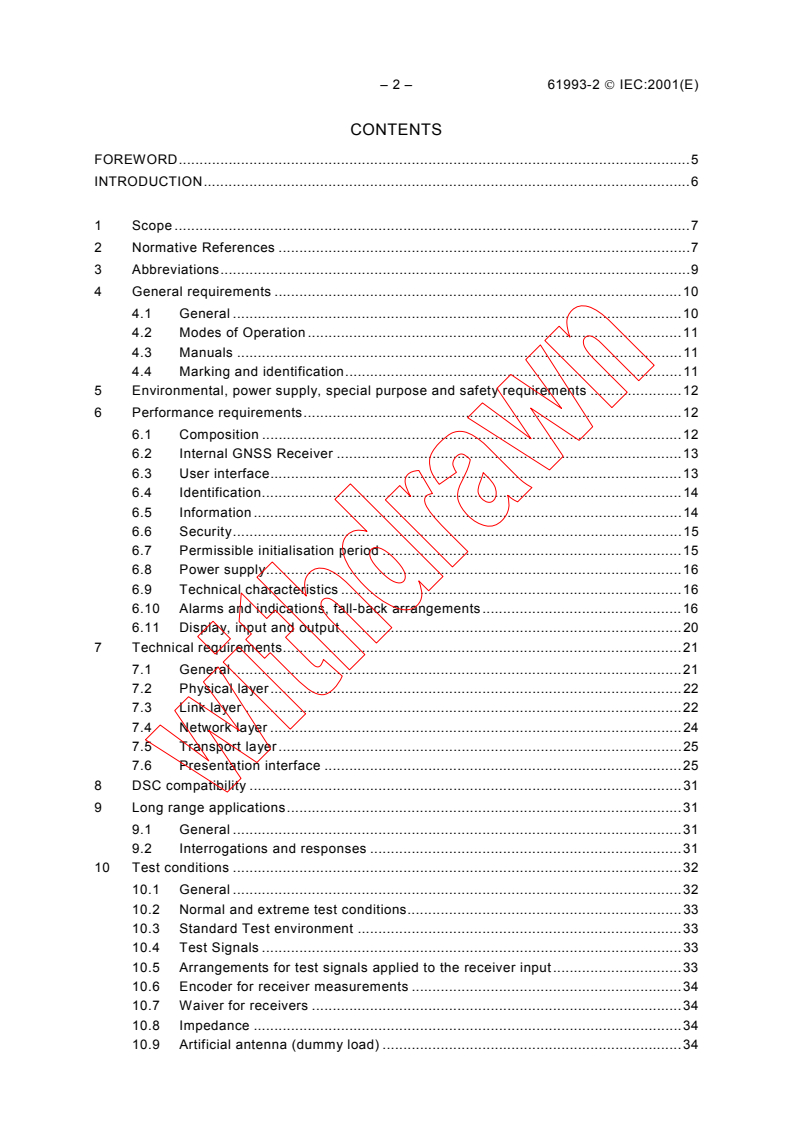
– 2 – 61993-2 IEC:2001(E)
CONTENTS
FOREWORD.5
INTRODUCTION.6
1 Scope .7
2 Normative References .7
3 Abbreviations.9
4 General requirements .10
4.1 General .10
4.2 Modes of Operation.11
4.3 Manuals .11
4.4 Marking and identification.11
5 Environmental, power supply, special purpose and safety requirements .12
6 Performance requirements.12
6.1 Composition .12
6.2 Internal GNSS Receiver .13
6.3 User interface.13
6.4 Identification.14
6.5 Information.14
6.6 Security.15
6.7 Permissible initialisation period .15
6.8 Power supply.16
6.9 Technical characteristics .16
6.10 Alarms and indications, fall-back arrangements.16
6.11 Display, input and output.20
7 Technical requirements.21
7.1 General .21
7.2 Physical layer.22
7.3 Link layer .22
7.4 Network layer .24
7.5 Transport layer.25
7.6 Presentation interface .25
8 DSC compatibility .31
9 Long range applications.31
9.1 General .31
9.2 Interrogations and responses .31
10 Test conditions .32
10.1 General .32
10.2 Normal and extreme test conditions.33
10.3 Standard Test environment .33
10.4 Test Signals .33
10.5 Arrangements for test signals applied to the receiver input.33
10.6 Encoder for receiver measurements .34
10.7 Waiver for receivers .34
10.8 Impedance .34
10.9 Artificial antenna (dummy load) .34
61993-2 IEC:2001(E) – 3 –
10.10 Facilities for access.34
10.11 Modes of operation of the transmitter .34
10.12 Measurement uncertainties .35
11 Power supply, special purpose and safety tests .35
12 Environmental tests .35
13 E M C tests.36
14 Operational tests .36
14.1 Operating modes/Capability.36
14.2 Multiple slot messages .38
14.3 Information content .39
14.4 Reporting rates.39
14.5 Security.41
14.6 Initialisation period .41
14.7 Channel selection.41
14.8 Transceiver protection.41
14.9 Alarms and indicators, fall-back arrangements .42
14.10 Display and control.45
15 Physical Tests .46
15.1 TDMA Transmitter .46
15.2 DSC Transmissions.51
15.3 TDMA Receivers .52
15.4 DSC Receiver.62
15.5 Conducted Spurious Emissions conveyed to the antenna .65
16 Specific tests of Link Layer .66
16.1 TDMA Synchronisation .66
16.2 Time division (Frame format).67
16.3 Synchronisation jitter.67
16.4 Data encoding (bit stuffing) .68
16.5 Frame check sequence .68
16.6 Slot allocation (Channel access protocols) .68
16.7 Message Formats.70
17 Specific tests of Network Layer.71
17.1 Dual channel operation.71
17.2 regional area designation by VDL message .71
17.3 regional area designation by serial message .72
17.4 Power setting .72
17.5 Message priority handling.73
17.6 Slot reuse (link congestion) .73
17.7 Management of received regional operating settings .73
17.8 Continuation of autonomous mode reporting rate.76
18 Specific tests of Transport Layer.76
18.1 Addressed messages .76
18.2 Interrogation responses.77
18.3 Other non periodic messages .77
– 4 – 61993-2 IEC:2001(E)
19 Specific Presentation Interface Tests.77
19.1 General .77
19.2 Check of the manufacturer's documentation .78
19.3 Electrical test .78
19.4 Test of input sensor interface performance.78
19.5 Test of sensor input.79
19.6 Test of high speed output .79
19.7 High speed output Interface performance .79
19.8 Test of high speed input .79
20 DSC functionality tests.80
20.1 General .80
20.2 Regional area designation .80
20.3 Scheduling .80
20.4 Polling.80
21 Long Range functionality tests .81
21.1 LR interrogation.81
21.2 LR ”all ships” interrogation .81
21.3 Consecutive LR ”all ships” interrogations.82
Annex A (informative) Block diagram of AIS.83
Annex B (informative) New IEC 61162-1 sentences due to AIS .84
Annex C (informative) Long range application.113
Annex D (normative) AIS Interface Overview .114
Annex E (informative) Block diagram of AIS test system .115
61993-2 IEC:2001(E) – 5 –
INTERNATIONAL ELECTROTECHNICAL COMMISSION
____________
MARITIME NAVIGATION AND RADIOCOMMUNICATION
EQUIPMENT AND SYSTEMS –
AUTOMATIC IDENTIFICATION SYSTEMS (AIS)
Part 2: Class A shipborne equipment of the
universal automatic identification system (AIS) –
Operational and performance requirements,
methods of test and required test results
FOREWORD
1) The IEC (International Electrotechnical Commission) is a worldwide organization for standardization comprising
all national electrotechnical committees (IEC National Committees). The object of the IEC is to promote
international co-operation on all questions concerning standardization in the electrical and electronic fields. To
this end and in addition to other activities, the IEC publishes International Standards. Their preparation is
entrusted to technical committees; any IEC National Committee interested in the subject dealt with may
participate in this preparatory work. International, governmental and non-governmental organizations liaising
with the IEC also participate in this preparation. The IEC collaborates closely with the International
Organization for Standardization (ISO) in accordance with conditions determined by agreement between the
two organizations.
2) The formal decisions or agreements of the IEC on technical matters express, as nearly as possible, an
international consensus of opinion on the relevant subjects since each technical committee has representation
from all interested National Committees.
3) The documents produced have the form of recommendations for international use and are published in the form
of standards, technical specifications, technical reports or guides and they are accepted by the National
Committees in that sense.
4) In order to promote international unification, IEC National Committees undertake to apply IEC International
Standards transparently to the maximum extent possible in their national and regional standards. Any
divergence between the IEC Standard and the corresponding national or regional standard shall be clearly
indicated in the latter.
5) The IEC provides no marking procedure to indicate its approval and cannot be rendered responsible for any
equipment declared to be in conformity with one of its standards.
6) Attention is drawn to the possibility that some of the elements of this International Standard may be the subject
of patent rights. The IEC shall not be held responsible for identifying any or all such patent rights.
International Standard IEC 61993-2 has been prepared by IEC technical committee 80:
Maritime navigation and radiocommunication equipment and systems.
The text of this standard is based on the following documents:
FDIS Report on voting
80/315/FDIS 80/328/RVD
Full information on the voting for the approval of this standard can be found in the report on
voting indicated in the above table.
This publication has been drafted in accordance with the ISO/IEC Directives, Part 3.
The committee has decided that the contents of this publication will remain unchanged until
2006-07. At this date, the publication will be
• reconfirmed;
• withdrawn;
• replaced by a revised edition, or
• amended.
– 6 – 61993-2 IEC:2001(E)
INTRODUCTION
Following the adoption by the International Maritime Organisation (IMO) of Resolution
MSC.74(69) Annex 3, Performance Standard for a Universal Shipborne Automatic Identifica-
tion System, TC 80 established Working Group 8A to develop IEC 61993-2. Technical
requirements were provided in ITU-R M.1371 "Technical characteristics for a universal
shipborne Automatic Identification System (AIS) using TDMA (Self-Organising Time Division
Multiple Access) in the VHF maritime mobile band". Carriage requirements for SOLAS ships
have been adopted by IMO for entry into force starting on July 1st 2002.
It was brought to the attention of WG8A that patents and patents pending pertaining to AIS
have been made freely available. TC 80 WG8A considers the technical implementation
specified by this International Standard to be in full accordance with the requirements of
Recommendation ITU-R M.1371-1 and as such to be free from claims of intellectual property
rights.
The provision of a high-speed network connection IEC 61162-3 is optional. It may become a
requirement in a later revision of this standard, when the relevant standard (IEC 61162-3) has
been adopted.
The IMO Resolution MSC.74(69) Annex 3, Performance Standard for an Universal Shipborne
Automatic Identification System, requires that the AIS has a means of processing data from
an electronic position fixing system that provides a resolution of one ten-thousandth of a
minute of arc and uses the WGS 84 datum. Resolution A.815(19) requires an accuracy of
position information better than 10 m in confined waters. This does not require but implies
that if the ship is not equipped with a DGNSS, the GNSS sensor internal to the AIS should be
a DGNSS and should be used as source of position information.
Moreover, Resolution MSC.74(69) Annex 3 does not include any requirement for backup
arrangements of the position information. However, a GNSS sensor is included in the AIS
equipment as the source of UTC. It is felt by IEC TC 80 that this GNSS sensor also can be
used as a back-up arrangement for the position information obtained from the ships DGNSS.
This would ensure the availability of the AIS system in case of failure of the ship’s EPFS.
Therefore, IEC TC 80 strongly recommends that manufacturers of AIS equipment implement
such an arrangement in accordance with table 4 of this International Standard.
Note that an IEC standard detailing class B AIS is being prepared as IEC 62287.
61993-2 IEC:2001(E) – 7 –
MARITIME NAVIGATION AND RADIOCOMMUNICATION
EQUIPMENT AND SYSTEMS –
AUTOMATIC IDENTIFICATION SYSTEMS (AIS)
Part 2: Class A shipborne equipment of the
universal automatic identification system (AIS) –
Operational and performance requirements,
methods of test and required test results
1 Scope
This International Standard specifies the minimum operational and performance requirements,
methods of testing and required test results conforming to performance standards adopted by
the IMO in resolution MSC.74(69), Annex 3, Universal Shipborne Automatic Identification
System. This standard incorporates the technical characteristics of Class A shipborne
equipment included in Recommendation ITU-R M1371-1 and takes into account the ITU Radio
Regulations where applicable. In addition it takes account of IMO resolution A.694(17) to
which IEC 60945 is associated.
This International Standard also specifies the minimum requirements both for the means to
input and display data and for the interfaces to other equipment suitable to be used as means
of input and display data.
NOTE All text of this standard, that is identical to that in IMO resolution MSC.74(69), Annex 3 and IMO resolution
A.694(17) or to that in ITU-R M.1371-1 is printed in italics and the resolution (abbreviated to – A3 or – A694
respectively) or the recommendation (abbreviated to – M.1371-1) and paragraph numbers are indicated in
parentheses i.e. (A3/3.3) or (M.1371-1/3.3) respectively.
2 Normative references
The following referenced documents are indispensable for the application of this document.
For dated references, only the edition cited applies. For undated references, the latest edition
of the referenced document (including any amendments) applies.
IEC 60945, Maritime navigation and radiocommunication equipment and systems – General
requirements – Methods of testing and required test results
IEC 61108-1, Maritime navigation and radiocommunication equipment and systems – Global
navigation satellite systems (GNSS) – Part 1: Global positioning system (GPS) – Receiver
equipment – Performance standards, methods of testing and required test results.
IEC 61108-2, Maritime navigation and radiocommunication equipment and systems – Global
navigation satellite systems (GNSS) – Part 2: Global navigation satellite system (GLONASS)
– Receiver equipment – Performance standards, methods of testing and required test results
, Maritime navigation and radiocommunication equipment and systems – Global
IEC 61108-4
navigation satellite systems (GNSS) – Part 4: Shipborne DGPS and DGLONASS maritime
radio beacon receiver equipment
IEC 61162-1, Maritime navigation and radiocommunication equipment and systems – Digital
interfaces – Part 1: Single talker and multiple listeners
———————
To be printed.
– 8 – 61993-2 IEC:2001(E)
IEC 61162-2, Maritime navigation and radiocommunication equipment and systems – Digital
interfaces – Part 2: Single talker and multiple listeners, high-speed transmission
IEC 61162-3 : Maritime navigation and radiocommunication equipment and systems – Digital
interfaces – Part 3: Multiple Talker and multiple listeners – High speed network bus
IEC 61993-1, Maritime navigation and radiocommunication equipment and systems – Part 1:
Shipborne automatic transponder system installation using VHF digital selective calling (DSC)
techniques – Operational and performance requirements, methods of testing and required test
results
ISO/IEC 3309, Information technology – Telecommunications and information exchange
between systems – High-level data link control (HDLC) procedures – Frame structure
IMO Resolution A.694(17):1991, General requirements for shipborne radio equipment forming
part of the Global Maritime Distress and Safety System (GMDSS) and for electronic
navigational aids
IMO Resolution A.815(19):1995, Worldwide radionavigation system
IMO Resolution A.851(20):1997, General principles for ship reporting systems and ship
reporting requirements, including guidelines for reporting incidents involving dangerous
goods, harmful substances and/or marine pollutants
IMO Resolution MSC.43(64), as amended by MSC.111(73), Guidelines and Criteria for Ship
Reporting Systems.
IMO Resolution MSC.74(69), Annex 3, Recommendation on performance standards for AIS
IMO Guidelines on the operational use of AIS (provisional)
ITU-R Recommendation M.489-2, Technical characteristics of VHF radiotelephone equipment
operating in the maritime mobile service in channels spaced by 25 kHz
ITU-R Recommendation M.825-3, Characteristics of a transponder system using digital
selective calling techniques for use with vessel traffic services and ship-to-ship identification
ITU-R Recommendation M.1084-4, Interim solutions for improved efficiency in the use of the
band 156-174 MHz by stations in the maritime mobile service
NOTE ITU-R M.1371-1 references ITU-R M.1084-3, Annex 3. A Draft Revision of Recommendation ITU-R M.1084-3,
consequentially leading to ITU-R M.1084-4, has been approved in parallel to the approval of ITU-R M.1371-1.
ITU-R Recommendation M.1371-1, Technical characteristics for a universal shipborne
automatic identification system using time division multiple access in the VHF maritime mobile
band
IALA Technical clarifications to recommendation ITU-R M.1371-1
———————
To be printed.
61993-2 IEC:2001(E) – 9 –
3 Abbreviations
AIS universal shipborne automatic identification system
BIIT built-in integrity tests
COG course over ground
ECDIS electronic chart display and information system
EPFS electronic position-fixing systems
ETA estimated time of arrival
EUT equipment under test
GBS see IEC 61162-1, table 5
GGA see IEC 61162-1, table 5
GLL see IEC 61162-1, table 5
HDG heading
HDTWPL see IEC 61162-1, table 5
HSC high speed craft
IHO International Hydrographic Office
IMO International Maritime Organization
LR long range
MAC medium access control
MKD minimum keyboard and display
MMSI maritime mobile service identity
NUC not under command
OSD see IEC 61162-1, table 5
PER packet error rate
PI presentation interface
RAIM receiver autonomous integrity monitoring
RMC see IEC 61162-1, table 5
SOG speed over ground
UTC universal time co-ordinated
VBW see IEC 61162-1, table 5
VDL VHF data link
VDM serial output message containing VDL information (IEC 61162-1)
VSWR voltage standing wave ratio
VTG see IEC 61162-1, table 5
Rx receive
Tx transmit
msg message
NOTE Abbreviations related to IEC 61162 series are not included in the above list. For their meaning, refer to that
International Standard.
– 10 – 61993-2 IEC:2001(E)
4 General requirements
Requirements contained in this clause 4 are requirements not taken up in other clauses and
which cannot be verified by repeatable methods of measurement. These requirements include
the applicable general and operational requirements of IEC 60945, as detailed in clause 6
(Operational checks), clause 13 (Maintenance), clause 14 (Equipment manuals) and clause 15
(Marking and Identification) of that International Standard.
The manufacturer shall declare compliance with these requirements and shall provide
relevant documentation. The declarations, documentation and where necessary, the EUT
shall be checked or verified by inspection.
The manufacturer shall also declare the composition of the EUT and the category for
durability and resistance to environmental conditions for each unit of the EUT as specified in
IEC 60945.
4.1 General
(A3/1)
4.1.1 General requirements
4.1.1.1 (A3/1.1) This standard specifies the requirements for the universal AIS.
4.1.1.2 (A3/1.2) The AIS shall improve the safety of navigation by assisting in the efficient
navigation of ships, protection of the environment, and operation of Vessel Traffic Services
(VTS), by satisfying the following functional requirements:
– in a ship-to-ship mode for collision avoidance;
– as a means for littoral States to obtain information about a ship and its cargo; and
– as a VTS tool, i.e. ship-to-shore (traffic management).
4.1.2 Capabilities of the AIS
(A3/1.3) The AIS shall be capable of providing to ships and to competent authorities,
information from the ship, automatically and with the required accuracy and frequency, to
facilitate accurate tracking. Transmission of the data shall be with the minimum involvement
of ship's personnel and with a high level of availability.
4.1.3 Additional requirements
(A3/1.4) The installation, in addition to meeting the requirements of the Radio Regulations,
applicable ITU-R Recommendations and the general requirements as set out in resolution
A.694 (17), shall comply with the following performance standards, as contained in the
following clauses.
4.1.4 Transmitter shutdown procedure
(M.1371-1/A2-2.14)
(M.1371-1 A2/2.14.1) An automatic transmitter hardware shutdown procedure and indication
shall be provided in case a transmitter does not discontinue its transmission within 1,0 s of
the end of its transmission slot.
61993-2 IEC:2001(E) – 11 –
4.1.5 Quality assurance
3 4
The Administration shall require that the manufacturers have a quality control system
audited by a competent authority to ensure continuous compliance with the type approval
conditions. Alternatively, the Administration may use final product verification procedures
where a competent authority verifies compliance with the type approval certificate before the
product is installed on board ships.
4.2 Modes of operation
(A3/2)
4.2.1 General
(A3/2.1) The system shall be capable of operating in a number of modes:
4.2.1.1 an "autonomous and continuous" mode for operation in all areas. This mode shall be
capable of being switched to/from one of the following alternate modes by a competent
authority;
Autonomous and continuous operation shall be as described in 3.3.5 of Annex 2 of
Recommendation ITU-R M.1371-1;
4.2.1.2 an "assigned" mode for operation in an area subject to a competent authority
responsible for traffic monitoring such that the data transmission interval and/or time slots
may be set remotely by that authority;
Assigned operation shall be as described in 3.3.6 of Annex 2 of Recommendation ITU-R
M.1371-1;
4.2.1.3 a "polling" or controlled mode where the data transfer occurs in response to
interrogation from a ship or competent authority.
Polling operation shall be as described in 3.3.2 of Annex 2 of ITU-R M.1371-1 and in Annex 1 of
Recommendation ITU-R M.825-3 – for DSC compatibility.
4.2.2 Criteria for reporting
(A3/6.3) To protect the unauthorised dissemination of data, the IMO guidelines (Guidelines
and Criteria for Ship Reporting Systems Resolution MSC.43(64)) shall be followed.
4.3 Manuals
In addition to the requirements of IEC 60945 clause 14, the manuals shall include:
– the type of external connector required for connection of the external display as referred to
in 7.6.3.2;
– the needed information for correct siting of the antennas; and
– the requirements for external illumination, as appropriate.
4.4 Marking and identification
In addition to the requirements of IEC 60945, clause 15, the markings shall include:
———————
See SOLAS 1974 as amended Ch. V 18.5
ISO 9000 series, as applicable, meets this requirement.
– 12 – 61993-2 IEC:2001(E)
a) details of the power supply from which the equipment is intended to be operated; and if
applicable,
b) the date by which batteries need to be replaced.
5 Environmental, power supply, special purpose and safety requirements
The AIS shall be tested for compliance with the environmental, power supply, special-purpose
and safety requirements of IMO A.694(17) as detailed in IEC 60945. The required tests, for
which a repeatable method of measurement has been defined, are given in clauses 11, 12
and 13 of this standard. The declaration of category to IEC 60945 required in clause 4, shall
define the relevant tests to be applied as follows:
– AIS equipment declared for protected installation shall meet the requirements described in
table 3 column "protected" of IEC 60945.
– Exposed AIS equipment shall meet the requirements described in table 3, column
"exposed" of IEC 60945.
– Portable AIS equipment shall meet the requirements of table 3 of IEC 60945 "protected" or
"exposed" as appropriate.
6 Performance requirements
6.1 Composition
(A3/3)
6.1.1 (A3/3.1) The AIS shall comprise:
6.1.1.1 a communication processor, capable of operating over a range of maritime
frequencies, with an appropriate channel selecting and switching method, in support of both
short (VHF) and long (beyond VHF) range applications. For long range applications the AIS
shall provide a two-way interface which complies with IEC 61162;
6.1.1.2 at least one transmitter, two TDMA receivers and one dedicated DSC receiver tuned
to channel 70;
6.1.1.3 a means of processing data from an electronic position-fixing system which provides
a resolution of one ten thousandth of a minute of arc and uses the WGS 84 datum.
An interface (IEC 61162) shall be provided to input the position used for navigation. Position
information, if available from other EPFS, shall be used only as a back up and the user shall
be informed of this (see 6.10).
6.1.1.4 a means to automatically input data from other sensors meeting the provisions as
specified in paragraph 6.5.1.2; A means, external to the AIS, to comply with this requirement
shall be tested to the applicable requirements of IEC 60945.
6.1.1.5 a means to input and retrieve data manually. The possibility of manual input and
retrieval as described in 6.11 shall be demonstrated based on the manufacturer’s
documentation
6.1.1.6 a means of error checking the transmitted and received data (see 7); and
6.1.1.7 built-in test equipment as specified in 6.10.1.
61993-2 IEC:2001(E) – 13 –
6.1.2 (A3/3.2) The AIS shall be capable of:
6.1.2.1 providing information automatically and continuously to a competent authority and
other ships, without involvement of ship's personnel;
6.1.2.2 receiving and processing information from other sources, including that from a
competent authority and from other ships;
6.1.2.3 responding to high priority and safety related calls with a minimum of delay (refer to
Recommendation ITU-R M.1371-1, Annex 2, Chapter 3.3.8.1 and Chapter 4.2.3); and
6.1.2.4 providing positional and manoeuvring information at a data rate adequate to facilitate
accurate tracking by a competent authority and other ships. (See 6.5.2).
6.2 Internal GNSS receiver
6.2.1 UTC source
(M.1371-1-A1/3.1)
Since UTC is required for synchronisation purposes, an internal GNSS receiver shall be used
to determine the UTC.
6.2.2 Source for AIS position reporting
When the external position is unavailable, the internal GNSS receiver may be used as a
source for AIS position reporting.
When the internal GNSS receiver is performing as a source for position reporting,
– an appropriate BIIT indication shall be output on the Presentation Interface (see 6.10.1),
– the position data shall be available on the minimum display,
– the internal GNSS receiver shall be capable of being differential corrected, at least by
evaluation of msg 17.
In this case the internal GNSS receiver shall meet the following requirements of IEC 61108
series: position accuracy, COG/SOG, acquisition, re-acquisition, receiver sensitivity, RF
dynamic range, interference susceptibility, position update, failure warnings, status indications
and integrity flag.
NOTE Resolution MSC.74(69), Annex 3 requires the AIS to have a means of processing data from an electronic position
fixing system that provides a resolution of one ten-thousandth of a minute of arc and uses the WGS 84 datum (see
6.1.1.3).
Considering:
– SOLAS Ch.5 does not require a ship to carry an EPFS fulfilling this specification,
– Resolution MSC.74(69), Annex 3 does not specify details of position sensor,
– Resolution A.815(19) requires an accuracy of position information better than 10 m in confined waters,
it is recommended that the manufacturers use a DGNSS receiver as the internal source for the AIS position.
6.3 User interface
(A3/4)
To enable a user to access, select and display the information on a separate system, the AIS
shall be provided with an interface conforming to an appropriate international marine interface
standard. All interfacing shall be made via the system interface as described in 7.6 (called
presentation interface). Where a suitable IEC 61162 interface standard is available, it shall be
used.
– 14 – 61993-2 IEC:2001(E)
If no suitable IEC 61162 interface standard is available, an alternative appropriate interface
may be used.
6.4 Identification
(A3/5)
For the purpose of ship and message identification, the appropriate Maritime Mobile Service
Identity (MMSI) number shall be used.
6.5 Information
(A3/6)
6.5.1 Information provided by the AIS
(A3/6.1)
The information provided by the AIS shall include:
6.5.1.1 Static
– IMO number (where available)
– Call sign & name
– Length and beam
– Type of ship
– Location of the in-use position-fixing antenna on the ship (aft of bow and port or starboard
of centreline)
6.5.1.2 Dynamic
– Ship's position referenced to WGS 84 datum with accuracy indication and integrity status
– Time in UTC
– Course over ground (COG).
– Speed over ground (SOG).
– Heading.
– Navigational status (e.g. not under command (NUC), at anchor, etc.- manual input)
– Rate of turn (where available)
6.5.1.3 Voyage related:
– Ship's draught
– Hazardous cargo (type; as required by a competent authority).
– Destination and estimated time of arrival (ETA) (at master's discretion)
6.5.1.4 Short safety-related messages
– Short safety-related messages
6.5.2 Information update rates
(A3/6.2; M.1371-1-A1/4.2.1)
The different information types are valid for a different time period and thus need a different
update rate.
———————
5 Date to be established by receiving equipment.
61993-2 IEC:2001(E) – 15 –
Static information: Every 6 min, when data has been amended, and on request.
Dynamic Information: Dependent on speed and course alteration according to table 1
Voyage-related information: Every 6 min, when data has been amended, and on request
Safety-related message: As required
Table 1 – Information update rates for autonomous mode
Type of Ship Reporting interval
Ship at anchor or moored and not moving faster than 3 knots 3min
Ship at anchor or moored and moving faster than 3 knots 10 s
ship with a speed of between 0 – 14 knots 10 s
ship with a speed of between 0 – 14 knots and changing course 3 1/3 s
ship with a speed of between 14 –23 knots 6 s
ship with a speed of between 14 – 23 knots and changing course 2 s
ship with a speed of greater than 23 knots 2 s
ship with a speed of greater than 23 knots and changing course 2 s
NOTE The reporting rate shall increase to once per 2 s in accordance with Recommendation ITU-R M.1371-1,
Annex 1, Chapter 4.2.1, Footnote (1), when the station determines that it is the semaphore.
If the autonomous mode requires a higher rate than the assigned mode, the AIS shall use the
autonomous mode.
6.5.3 Ship reporting capacity
(A3/6.2; M.1371-1-A1/4.5.2)
The system shall be able to handle a minimum of 2 000 reports per minute, to adequately
provide for all operational scenarios envisioned and is capable of handling up to 4 500 reports
per minute on two channels.
6.6 Security
(A3/6.3)
A security mechanism shall be provided to detect disabling of the AIS and to prevent
unauthorised alteration of input or transmitted data. To protect the unauthorised dissemination
of data, the IMO guidelines (Guidelines for Ship Reporting Systems) shall be followed.
Means shall be provided to automatically record all periods when the AIS installation is non-
functioning. It shall not be possible for the user to alter any information recorded by this
device.
The last 10 times when the equipment was non-functioning for more than 15 min shall be
recorded, in UTC time and duration, in a non-volatile memory. Means shall be provided to
recover this data.
6.7 Permissible initialisation period
(A3/7)
The installation shall be operational within 2 min of switching on.
NOTE Sensors used with the AIS shall meet the requirements of their individual product standards (for example –
IEC 61108-1 for GPS which permits 30 min to operation when there is no valid almanac data available, or
IEC 61108-2 for GLONASS).
– 16 – 61993-2 IEC:2001(E)
6.8 Power supply
(A3/8)
The AIS and associated sensors shall be powered from the ship's main source of electrical
energy. In addition, it shall be possible to operate the AIS and associated sensors from an
alternative source of electrical energy.
6.9 Technical characteristics
(A3/9)
The technical characteristics of the AIS such as variable transmitter output power, operating
frequencies (dedicated internationally and selected regionally), modulation, and antenna
system shall comply with the appropriate ITU-R Recommendations.
6.10 Alarms and indications, fall-back arrangements
The AIS shall be equipped with BIIT. These tests shall run continuously or at appropriate
intervals simultaneously with the standard functions of the equipment.
6.10.1 Built-in test equipment
If any failure or malfunction is detected that will significantly reduce integrity or stop operation
of the AIS, an alarm is initiated. In this case:
• the alarm shall be displayed on the minimum display
• the alarm relay shall be set "active"
• an appropriate alarm message shall be output via the Presentation Interface upon
occurrence and repeated every 30 s.
If a change of a relevant system status as described below is detected, an indication is given
to the user. In this case,
• the indication shall be accessible on the minimum display
• an appropriate ala
...