

IEC 62386-216:2018
(Main)Digital addressable lighting interface - Part 216: Particular requirements for control gear - Load referencing (device type 15)
General Information
- Abstract
IEC 62386-216:2018 specifies a bus system for control by digital signals of electronic lighting equipment which is in line with the requirements of IEC 61347 (all parts), with the addition of DC supplies.
- Status
- Published
- Publication Date
- 22-Apr-2018
- Technical Committee
- SC 34C - Auxiliaries for lamps
- Drafting Committee
- WG 11 - TC 34/WG 11
- Current Stage
- PPUB - Publication issued
- Start Date
- 23-Apr-2018
- Completion Date
- 04-May-2018
Overview
IEC 62386-216:2018 is an international standard developed by the International Electrotechnical Commission (IEC) that defines the Digital Addressable Lighting Interface (DALI) requirements for control gear related to load referencing (device type 15). This standard specifies a bus system for the digital control of electronic lighting equipment compatible with the overarching requirements of IEC 61347, including support for DC power supplies.
The document is part of the broader IEC 62386 series, which addresses the standardization of digital lighting control interfaces, facilitating interoperability and compatibility among lighting control components - such as control gear and control devices. IEC 62386-216 is intended for use in conjunction with IEC 62386-101 (system components) and IEC 62386-102 (control gear).
Load referencing under this specification enables more accurate control and monitoring of electronic lighting ballast or gear, contributing to improved lighting system performance, reliability, and diagnostics.
Key Topics
- Load Referencing Functionality: Defines methods for measuring reference load values and monitoring load deviations in electronic lighting control gear, enabling precise adjustment and fault detection.
- Bus System Architecture: Specifications for digital signal transmission on the DALI bus tailored to load referencing devices, ensuring reliable communication.
- Electrical and Interface Specifications: Compliance with IEC 61347 for electronic control gear, with extensions to support DC power supply scenarios.
- Transmission Protocol and Timing: Detailed structure for data exchange, timing mechanisms, and command operations between control devices and load referencing gear.
- Control Commands: Comprehensive command set including general, extended application, and special instructions for device configuration, load referencing operations, and failure status reporting.
- Failure Status and Diagnostics: Defined methods for reporting load-related faults or deviations, supporting predictive maintenance and rapid troubleshooting.
- Variable Declaration and Data Handling: Standardized variables and data formats for seamless integration with lighting management systems.
Applications
IEC 62386-216:2018 is essential for manufacturers and integrators designing and deploying digital lighting control systems in commercial and industrial environments that require:
- Advanced Load Monitoring: Accurate measurement and referencing of lighting loads improves system efficiency and operational safety.
- Energy Management: Enables fine-tuned control of lighting components to optimize energy consumption.
- Fault Detection and Maintenance: Load deviation and failure status functions help in early detection of control gear issues, reducing downtime.
- Interoperable Lighting Ecosystems: Standardized communication ensures multiple devices from different vendors work harmoniously within a DALI network.
- Control Gear with DC Supply Support: Extends applicability to lighting systems powered by both AC and DC, such as modern LED installations and renewable energy-powered systems.
Typical scenarios include automated office lighting, architectural lighting with remote diagnostics, and smart building environments where precise control and monitoring of lighting equipment is crucial.
Related Standards
- IEC 62386-101: General requirements for system components within the DALI ecosystem.
- IEC 62386-102: General requirements for electronic control gear applicable to lighting devices.
- IEC 61347: Series covering lamp control gear requirements, which IEC 62386-216 complements by adding digital control and load referencing features.
- IEC 62386-103: General requirements for control devices that interact with control gear.
- IEC 62386 Series (Other parts): Including device-specific and control interface standards facilitating the expandable and modular nature of DALI systems.
By adhering to IEC 62386-216:2018, lighting manufacturers and system integrators ensure compliance with internationally accepted guidelines, promoting interoperability, safety, and enhanced control features in digital lighting installations.
Get Certified
Connect with accredited certification bodies for this standard

IMQ S.p.A. (Certification)
Italian electrical product certification.

SLG Prüf- und Zertifizierungs GmbH
German testing and certification body.

UL Solutions
Global safety science company with testing, inspection and certification.
Sponsored listings
Frequently Asked Questions
IEC 62386-216:2018 is a standard published by the International Electrotechnical Commission (IEC). Its full title is "Digital addressable lighting interface - Part 216: Particular requirements for control gear - Load referencing (device type 15)". This standard covers: IEC 62386-216:2018 specifies a bus system for control by digital signals of electronic lighting equipment which is in line with the requirements of IEC 61347 (all parts), with the addition of DC supplies.
IEC 62386-216:2018 specifies a bus system for control by digital signals of electronic lighting equipment which is in line with the requirements of IEC 61347 (all parts), with the addition of DC supplies.
IEC 62386-216:2018 is classified under the following ICS (International Classification for Standards) categories: 29.140.50 - Lighting installation systems; 29.140.99 - Other standards related to lamps. The ICS classification helps identify the subject area and facilitates finding related standards.
IEC 62386-216:2018 is available in PDF format for immediate download after purchase. The document can be added to your cart and obtained through the secure checkout process. Digital delivery ensures instant access to the complete standard document.
Standards Content (Sample)
IEC 62386-216 ®
Edition 1.0 2018-04
INTERNATIONAL
STANDARD
NORME
INTERNATIONALE
colour
inside
Digital addressable lighting interface –
Part 216: Particular requirements for control gear – Load referencing
(device type 15)
Interface d’éclairage adressable numérique –
Partie 216: Exigences particulières pour les appareillages de commande –
Référence de charge (dispositifs de type 15)
All rights reserved. Unless otherwise specified, no part of this publication may be reproduced or utilized in any form
or by any means, electronic or mechanical, including photocopying and microfilm, without permission in writing from
either IEC or IEC's member National Committee in the country of the requester. If you have any questions about IEC
copyright or have an enquiry about obtaining additional rights to this publication, please contact the address below or
your local IEC member National Committee for further information.
Droits de reproduction réservés. Sauf indication contraire, aucune partie de cette publication ne peut être reproduite
ni utilisée sous quelque forme que ce soit et par aucun procédé, électronique ou mécanique, y compris la photocopie
et les microfilms, sans l'accord écrit de l'IEC ou du Comité national de l'IEC du pays du demandeur. Si vous avez des
questions sur le copyright de l'IEC ou si vous désirez obtenir des droits supplémentaires sur cette publication, utilisez
les coordonnées ci-après ou contactez le Comité national de l'IEC de votre pays de résidence.
IEC Central Office Tel.: +41 22 919 02 11
3, rue de Varembé info@iec.ch
CH-1211 Geneva 20 www.iec.ch
Switzerland
About the IEC
The International Electrotechnical Commission (IEC) is the leading global organization that prepares and publishes
International Standards for all electrical, electronic and related technologies.
About IEC publications
The technical content of IEC publications is kept under constant review by the IEC. Please make sure that you have the
latest edition, a corrigenda or an amendment might have been published.
IEC Catalogue - webstore.iec.ch/catalogue Electropedia - www.electropedia.org
The stand-alone application for consulting the entire The world's leading online dictionary of electronic and
bibliographical information on IEC International Standards, electrical terms containing 21 000 terms and definitions in
Technical Specifications, Technical Reports and other English and French, with equivalent terms in 16 additional
documents. Available for PC, Mac OS, Android Tablets and languages. Also known as the International Electrotechnical
iPad. Vocabulary (IEV) online.
IEC publications search - webstore.iec.ch/advsearchform IEC Glossary - std.iec.ch/glossary
The advanced search enables to find IEC publications by a 67 000 electrotechnical terminology entries in English and
variety of criteria (reference number, text, technical French extracted from the Terms and Definitions clause of
committee,…). It also gives information on projects, replaced IEC publications issued since 2002. Some entries have been
and withdrawn publications. collected from earlier publications of IEC TC 37, 77, 86 and
CISPR.
IEC Just Published - webstore.iec.ch/justpublished
Stay up to date on all new IEC publications. Just Published IEC Customer Service Centre - webstore.iec.ch/csc
details all new publications released. Available online and If you wish to give us your feedback on this publication or
also once a month by email. need further assistance, please contact the Customer Service
Centre: sales@iec.ch.
A propos de l'IEC
La Commission Electrotechnique Internationale (IEC) est la première organisation mondiale qui élabore et publie des
Normes internationales pour tout ce qui a trait à l'électricité, à l'électronique et aux technologies apparentées.
A propos des publications IEC
Le contenu technique des publications IEC est constamment revu. Veuillez vous assurer que vous possédez l’édition la
plus récente, un corrigendum ou amendement peut avoir été publié.
Catalogue IEC - webstore.iec.ch/catalogue Electropedia - www.electropedia.org
Application autonome pour consulter tous les renseignements
Le premier dictionnaire en ligne de termes électroniques et
bibliographiques sur les Normes internationales,
électriques. Il contient 21 000 termes et définitions en anglais
Spécifications techniques, Rapports techniques et autres
et en français, ainsi que les termes équivalents dans 16
documents de l'IEC. Disponible pour PC, Mac OS, tablettes
langues additionnelles. Egalement appelé Vocabulaire
Android et iPad.
Electrotechnique International (IEV) en ligne.
Recherche de publications IEC -
Glossaire IEC - std.iec.ch/glossary
webstore.iec.ch/advsearchform
67 000 entrées terminologiques électrotechniques, en anglais
La recherche avancée permet de trouver des publications IEC et en français, extraites des articles Termes et Définitions des
en utilisant différents critères (numéro de référence, texte, publications IEC parues depuis 2002. Plus certaines entrées
comité d’études,…). Elle donne aussi des informations sur les antérieures extraites des publications des CE 37, 77, 86 et
projets et les publications remplacées ou retirées. CISPR de l'IEC.
IEC Just Published - webstore.iec.ch/justpublished Service Clients - webstore.iec.ch/csc
Restez informé sur les nouvelles publications IEC. Just Si vous désirez nous donner des commentaires sur cette
Published détaille les nouvelles publications parues. publication ou si vous avez des questions contactez-nous:
Disponible en ligne et aussi une fois par mois par email. sales@iec.ch.
IEC 62386-216 ®
Edition 1.0 2018-04
INTERNATIONAL
STANDARD
NORME
INTERNATIONALE
colour
inside
Digital addressable lighting interface –
Part 216: Particular requirements for control gear – Load referencing
(device type 15)
Interface d’éclairage adressable numérique –
Partie 216: Exigences particulières pour les appareillages de commande –
Référence de charge (dispositifs de type 15)
INTERNATIONAL
ELECTROTECHNICAL
COMMISSION
COMMISSION
ELECTROTECHNIQUE
INTERNATIONALE
ICS 29.140.50; 29.140.99 ISBN 978-2-8322-5613-8
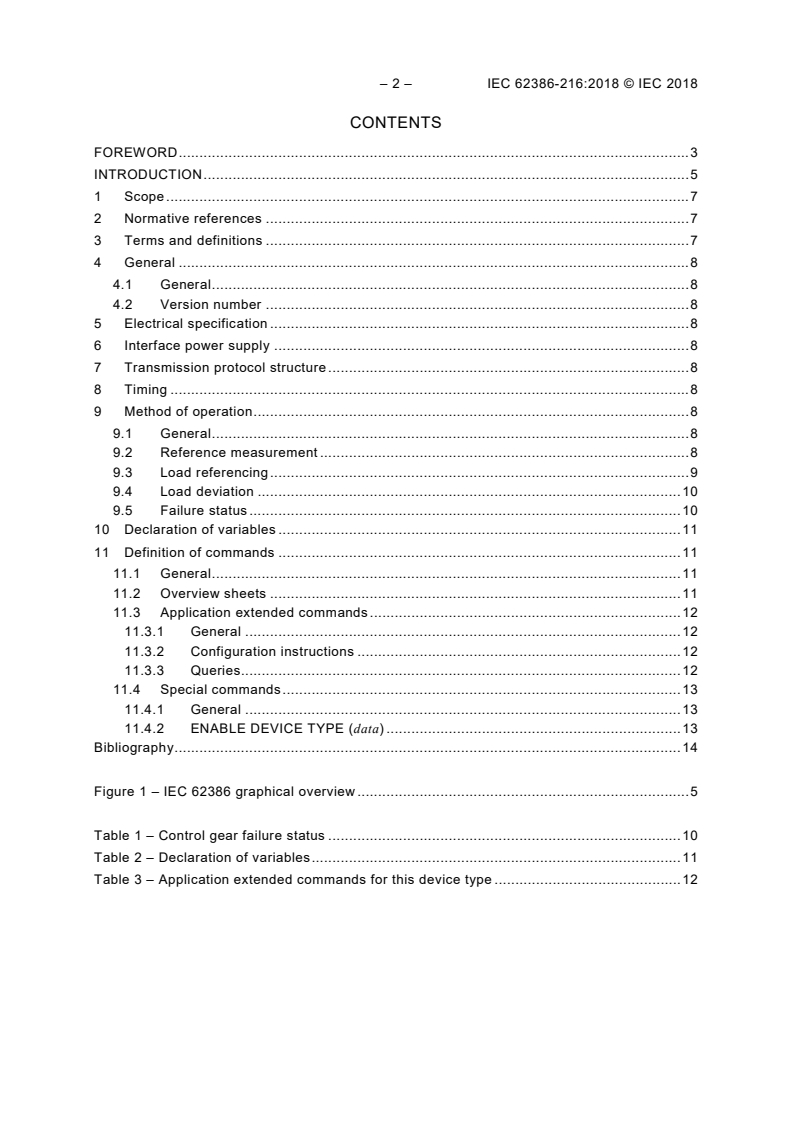
– 2 – IEC 62386-216:2018 © IEC 2018
CONTENTS
FOREWORD . 3
INTRODUCTION . 5
1 Scope . 7
2 Normative references . 7
3 Terms and definitions . 7
4 General . 8
4.1 General . 8
4.2 Version number . 8
5 Electrical specification . 8
6 Interface power supply . 8
7 Transmission protocol structure . 8
8 Timing . 8
9 Method of operation . 8
9.1 General . 8
9.2 Reference measurement . 8
9.3 Load referencing . 9
9.4 Load deviation . 10
9.5 Failure status . 10
10 Declaration of variables . 11
11 Definition of commands . 11
11.1 General . 11
11.2 Overview sheets . 11
11.3 Application extended commands . 12
11.3.1 General . 12
11.3.2 Configuration instructions . 12
11.3.3 Queries. 12
11.4 Special commands . 13
11.4.1 General . 13
11.4.2 ENABLE DEVICE TYPE (data) . 13
Bibliography . 14
Figure 1 – IEC 62386 graphical overview . 5
Table 1 – Control gear failure status . 10
Table 2 – Declaration of variables . 11
Table 3 – Application extended commands for this device type . 12
INTERNATIONAL ELECTROTECHNICAL COMMISSION
____________
DIGITAL ADDRESSABLE LIGHTING INTERFACE –
Part 216: Particular requirements for control gear –
Load referencing (device type 15)
FOREWORD
1) The International Electrotechnical Commission (IEC) is a worldwide organization for standardization comprising
all national electrotechnical committees (IEC National Committees). The object of IEC is to promote
international co-operation on all questions concerning standardization in the electrical and electronic fields. To
this end and in addition to other activities, IEC publishes International Standards, Technical Specifications,
Technical Reports, Publicly Available Specifications (PAS) and Guides (hereafter referred to as “IEC
Publication(s)”). Their preparation is entrusted to technical committees; any IEC National Committee interested
in the subject dealt with may participate in this preparatory work. International, governmental and non-
governmental organizations liaising with the IEC also participate in this preparation. IEC collaborates closely
with the International Organization for Standardization (ISO) in accordance with conditions determined by
agreement between the two organizations.
2) The formal decisions or agreements of IEC on technical matters express, as nearly as possible, an international
consensus of opinion on the relevant subjects since each technical committee has representation from all
interested IEC National Committees.
3) IEC Publications have the form of recommendations for international use and are accepted by IEC National
Committees in that sense. While all reasonable efforts are made to ensure that the technical content of IEC
Publications is accurate, IEC cannot be held responsible for the way in which they are used or for any
misinterpretation by any end user.
4) In order to promote international uniformity, IEC National Committees undertake to apply IEC Publications
transparently to the maximum extent possible in their national and regional publications. Any divergence
between any IEC Publication and the corresponding national or regional publication shall be clearly indicated in
the latter.
5) IEC itself does not provide any attestation of conformity. Independent certification bodies provide conformity
assessment services and, in some areas, access to IEC marks of conformity. IEC is not responsible for any
services carried out by independent certification bodies.
6) All users should ensure that they have the latest edition of this publication.
7) No liability shall attach to IEC or its directors, employees, servants or agents including individual experts and
members of its technical committees and IEC National Committees for any personal injury, property damage or
other damage of any nature whatsoever, whether direct or indirect, or for costs (including legal fees) and
expenses arising out of the publication, use of, or reliance upon, this IEC Publication or any other IEC
Publications.
8) Attention is drawn to the Normative references cited in this publication. Use of the referenced publications is
indispensable for the correct application of this publication.
9) Attention is drawn to the possibility that some of the elements of this IEC Publication may be the subject of
patent rights. IEC shall not be held responsible for identifying any or all such patent rights.
International Standard IEC 62386-216 has been prepared by IEC technical committee 34:
Lamps and related equipment.
The text of this International Standard is based on the following documents:
FDIS Report on voting
34/491/FDIS 34/513/RVD
Full information on the voting for the approval of this International Standard can be found in
the report on voting indicated in the above table.
This document has been drafted in accordance with the ISO/IEC Directives, Part 2.
– 4 – IEC 62386-216:2018 © IEC 2018
This Part 216 of IEC 62386 is intended to be used in conjunction with:
• Part 101, which contains general requirements for system components;
• Part 102, which contains general requirements for control gear.
A list of all parts in the IEC 62386 series, published under the general title: Digital
addressable lighting interface, can be found on the IEC website.
The committee has decided that the contents of this document will remain unchanged until the
stability date indicated on the IEC web site under "http://webstore.iec.ch" in the data related
to the specific document. At this date, the document will be
• reconfirmed,
• withdrawn,
• replaced by a revised edition, or
• amended.
IMPORTANT – The 'colour inside' logo on the cover page of this document indicates
that it contains colours which are considered to be useful for the correct
understanding of its contents. Users should therefore print this document using a
colour printer.
INTRODUCTION
IEC 62386 contains several parts, referred to as series. The 1xx series includes the basic
specifications. Part 101 contains general requirements for system components, Part 102
extends this information with general requirements for control gear and Part 103 extends it
further with general requirements for control devices.
The 2xx parts extend the general requirements for control gear with lamp specific extensions
(mainly for backward compatibility with Edition 1 of IEC 62386) and with control gear specific
features.
The 3xx parts extend the general requirements for control devices with input device specific
extensions describing the instance types as well as some common features that can be
combined with multiple instance types.
This first edition of IEC 62386-216 is intended to be used in conjunction with
IEC 62386-101:2014, IEC 62386-101:2014/AMD1:—, IEC 62386-102:2014 and
IEC 62386-102:2014/AMD1:—. The division into separately published parts provides for ease
of future amendments and revisions. Additional requirements will be added as and when a
need for them is recognized.
The setup of the standards is graphically represented in Figure 1 below.
2xx 2xx 2xx 2xx 2xx 3xx 3xx 3xx 3xx 3xx
102 General requirements - 103 General requirements -
Control gear Control devices
101 General requirements -
System components
IEC
Figure 1 – IEC 62386 graphical overview
This document, and the other parts that make up the IEC 62386-200 series, in referring to any
of the clauses of IEC 62386-1XX, specifies the extent to which such a clause is applicable;
the parts also include additional requirements, as necessary.
Where the requirements of any of the clauses of IEC 62386-1XX are referred to in this
document by the sentence “The requirements of IEC 62386-1XX, Clause “n” apply”, this
sentence is to be interpreted as meaning that all requirements of the clause in question of
Part 1XX apply, except any which are clearly inapplicable.
The standardization of the control interface for control gear is intended to achieve compatible
co-existence between electronic control gear and lighting control devices, below the level of
building management systems. This document describes a method of implementing control
gear.
– 6 – IEC 62386-216:2018 © IEC 2018
All numbers used in this document are decimal numbers unless otherwise noted. Hexadecimal
numbers are given in the format 0xVV, where VV is the value. Binary numbers are given in
the format XXXXXXXXb or in the format XXXX XXXX, where X is 0 or 1; “x” in binary numbers
means “don't care”.
The following typographic expressions are used:
Variables: “variableName” or “variableName[3:0]”, giving only bits 3 to 0 of “variableName”.
Range of values: [lowest, highest]
Command: “COMMAND NAME”
DIGITAL ADDRESSABLE LIGHTING INTERFACE –
Part 216: Particular requirements for control gear –
Load referencing (device type 15)
1 Scope
This part of IEC 62386 specifies a bus system for control by digital signals of electronic
lighting equipment which is in line with the requirements of IEC 61347 (all parts), with the
addition of DC supplies.
This document is only applicable to IEC 62386-102:2014 and IEC 62386-102:2014/AMD1:—
control gear that implements load referencing.
NOTE Requirements for testing individual products during production are not included.
2 Normative references
The following documents are referred to in the text in such a way that some or all of their
content constitutes requirements of this document. For dated references, only the edition
cited applies. For undated references, the latest edition of the referenced document (including
any amendments) applies.
IEC 62386-101:2014, Digital addressable lighting interface – Part 101: General requirements
– System components
IEC 62386-101:2014/AMD1:—
IEC 62386-102:2014, Digital addressable lighting interface – Part 102: General requirements
– Control gear
IEC 62386-102:2014/AMD1:—
3 Terms and definitions
For the purposes of this document, the terms and definitions given in IEC 62386-102 and the
following apply.
ISO and IEC maintain terminological databases for use in standardization at the following
addresses:
• IEC Electropedia: available at http://www.electropedia.org/
• ISO Online browsing platform: available at http://www.iso.org/obp
3.1
reference measurement
measurement of the output load at a specific light level with a specific light source, stored in
persistent memory
_______________
Under preparation. Stage at the time of publication: IEC CCDV 62386-101/AMD1:2018.
Under preparation. Stage at the time of publication: IEC CCDV 62386-102/AMD1:2018.
– 8 – IEC 62386-216:2018 © IEC 2018
3.2
load deviation
condition in which the actual load leaves the normal operating range
3.3
load referencing
series of reference measurements
4 General
4.1 General
The requirements of IEC 62386-102:2014 and IEC 62386-102:2014/AMD1:—, Clause 4 apply,
with the restrictions, changes and additions identified below.
4.2 Version number
In 4.2 of IEC 62386-102:2014 and IEC 62386-102:2014/AMD1:—, 102 shall be replaced by
“216”, “version number” shall be replaced by “extended version number” and “versionNumber”
shall be replaced by “extendedVersionNumber”.
5 Electrical specification
The requirements of IEC 62386-102:2014 and IEC 62386-102:2014/AMD1:—, Clause 5 apply.
6 Interface power supply
The requirements of IEC 62386-102:2014 and IEC 62386-102:2014/AMD1:—, Clause 6 apply.
7 Transmission protocol structure
The requirements of IEC 62386-102:2014 and IEC 62386-102:2014/AMD1:—, Clause 7 apply.
8 Timing
The requirements of IEC 62386-102:2014 and IEC 62386-102:2014/AMD1:—, Clause 8 apply.
9 Method of operation
9.1 General
The requirements of IEC 62386-102:2014 and IEC 62386-102:2014/AMD1:—, Clause 9 apply
with the following additions.
9.2 Reference measurement
For each reference measurement R (n = 1, ., N, with 1 ≤ N < 255) the manufacturer specifies
n
(e.g. as percentage of the reference measurement R ) the maximum limit R and/or the
n nMax
minimum limit R of the output load operating range. These limits shall verify:
nMin
R ≤ R ≤ R
nMin n nMax
where R and R are calculated based on the measured R .
nMin nMax n
These limits are manufacturer specific. The manual/documentation shall state the following:
• output levels used for reference measurement (reference levels), and
• minimum and maximum levels considered not to be a load deviation or the calculation
method for minimum and maximum levels based on the reference level.
These levels shall be used for testing purposes.
9.3 Load referencing
Load referencing is a manufacturer specific method to determine the normal operating range
of the currently connected load in order to detect and notify load deviations.
In order to perform load referencing, a series of reference measurements (R ) are done at
n
different output levels (L ). The reference measurement can be done on load current, voltage
n
or on any other derived physical quantity (e.g. power). The measurements shall be stored in
NVM. After successful reference measurements have been done, load deviation can be
detected.
Execution of command “REFERENCE SYSTEM POWER” shall:
• stop a running fade;
• start or prolong load referencing;
• when starting the load referencing: set “referenceMeasurementFailed” to TRUE to disable
the load deviation detection, then set “loadDeviation” and “lampFailure” to FALSE.
During load referencing:
• the answer to query “QUERY REFERENCE RUNNING” shall be YES;
• “loadDeviation” status shall not be changed;
• the light output may be at any level between off and 100 %, “minLevel” and “maxLevel” as
well as “actualLevel” being temporarily ignored. After the load referencing is finished or
aborted the light output shall be adjusted as quickly as possible to reflect “actualLevel”;
• lamp failure detection may be temporary inactive until the first reference measurement is
completed.
Load referencing shall be active for at least 500 ms.
The load referencing shall be aborted if one of the following conditions occur:
• 15 min ± 1,5 min elapsed since the last “REFERENCE SYSTEM POWER” command was
executed;
• an external power cycle is applied;
• command “TERMINATE” is executed;
• “controlGearFailure” becomes TRUE;
• “lampFailure” becomes TRUE.
Command “REFERENCE SYSTEM POWER” shall be ignored if:
• “controlGearFailure” is TRUE, or
• “initialisationState” is not DISABLED.
When load referencing cannot be started or an ongoing load referencing is aborted, the
control gear shall set “referenceMeasurementFailed” to TRUE. In that case “loadDeviation” shall
not be changed.
– 10 – IEC 62386-216:2018 © IEC 2018
When load referencing has been successfully done, the control gear shall set
“referenceMeasurementFailed” to FALSE.
Any instruction received during the load referencing shall be ignored except “TERMINATE”,
“REFERENCE SYSTEM POWER”, “ENABLE DEVICE TYPE(data)” with data=”deviceType”,
“DTR0”, “DTR1”, “DTR2”.
Reference measurements are related to a specific light source. If the light source is replaced
a new load referencing is recommended, otherwise unexpected lamp failures might be
indicated.
9.4 Load deviation
The control gear shall detect a load deviation only when successful load referencing has been
executed and given a certain output level L , the measured output R is outside the R
n actual nMin
and R boundaries:
nMax
R < R or R > R
actual nMin actual nMax
where R is the reference measurement related to L .
n n
Load deviation shall be detected and indicated latest after 30s.
When a load deviation is detected the control gear shall:
• set “loadDeviation” to TRUE;
• set “lampFailure” to TRUE.
The control gear may switch and keep the lamp off when a load deviation is detected. In this
case the control gear shall set “lampOn” to FALSE. Detection and improvement of the load
deviation shall be treated as the lamp failure, as given in IEC 62386-102:2014 and
IEC 62386-102:2014/AMD1:—, Clause 9. This implies load deviation shall be verified with the
load switched on at least whenever “targetLevel” changes from 0x00 to a greater value. If the
load deviation is no longer detected, “loadDeviation” shall be set to FALSE. Any additional
criteria including switching the load on shall be stated in the manual/documentation.
9.5 Failure status
Failures are notified in the failure status byte. The failure status byte shall be updated as soon
as possible by the control gear and shall reflect the actual situation without delay unless
explicitly stated otherwise. The failure status byte can be queried with
“QUERY FAILURE STATUS”. See Table 1.
Table 1 – Control gear failure status
Bit Description Value
0 Reserved -
1 Reserved -
2 “loadDeviation” “1” = Yes
3 Reserved -
4 Reserved -
5 Reserved -
6 Reserved -
“referenceMeasurementFailed”
7 “1” = Yes
10 Declaration of variables
The requirements of IEC 62386-102:2014 and IEC 62386-102:2014/AMD1:—, Clause 10
apply, with the following additional variables for this device type, as indicated in Table 2.
Table 2 – Declaration of variables
Variable Default value Reset value Power on value Range of validity Memory
(factory) type
a b
c
“failureStatus” 0 0,4,128,132 RAM
a
c c
“loadDeviation” FALSE FALSE [TRUE, FALSE] RAM
d
“referenceMeasurementFailed” no change no change [TRUE, FALSE] NVM
e e
“referenceMeasurementValue” no change no change NVM
“extendedVersionNumber” 2.0 no change no change 00001000b ROM
“deviceType” 15 no change no change 15 ROM
a
Not applicable.
b
The value could change as a consequence of the RESET command execution.
c
The value should reflect the actual situation as soon as possible.
d
If the manufacturer provides a preconfigured device, he may set this bit to FALSE. If no initial reference
measurement is provided by the manufacturer this shall be set to TRUE.
e
Manufacturer specific.
11 Definition of commands
11.1 General
The requirements of IEC 62386-102:2014 and IEC 62386-102:2014/AMD1:—, Clause 11,
apply with the following additions.
11.2 Overview sheets
Table 3 gives an overview of the application extended commands for this device type.
Unused opcodes of application extended commands shall be reserved for future needs.
– 12 – IEC 62386-216:2018 © IEC 2018
Table 3 – Application extended commands for this device type
Command name Address Opcod References Command
byte e reference
byte
See
IEC 62386-
102, 7.2.2
REFERENCE SYSTEM POWER Device 1 0xE0 9.3 11.3.2.2
QUERY FAILURE STATUS Device 1 0xF1 9.3, 9.4, 9.5 11.3.3.1
QUERY LOAD DEVIATION Device 1 0xF4 9.4 11.3.3.2
QUERY REFERENCE RUNNING Device 1 0xF9 9.3 11.3.3.3
QUERY REFERENCE MEASUREME
Device 1 0xFA 9.3 11.3.3.4
NT FAILED
QUERY EXTENDED VERSION NUM
Device 1 0xFF 4.2 11.3.3.5
BER
ENABLE DEVICE TYPE (data) 0xC1 0x0F 11.4.2
11.3 Application extended commands
11.3.1 General
Application extended commands as defined in this document shall be preceded by
“ENABLE DEVICE TYPE (data)” where data equals “deviceType”. For device types other than
“deviceType” these commands may be used in a different way.
11.3.2 Configuration instructions
11.3.2.1 General
The requirements of IEC
...