

IEC 62474:2012
(Main)Material declaration for products of and for the electrotechnical industry
General Information
- Abstract
IEC 62474:2012 specifies the procedure, content, and form relating to material declarations for products of companies operating in and supplying the electrotechnical industry. Process chemicals and emissions during product use are not in the scope of this International Standard. It provides data to downstream manufacturers that:
- allows them to assess products against substance restriction compliance requirements;
- they can use in their environmentally conscious design process and across all product life cycle phases. A database associated with this document is available at http://std.iec.ch/iec62474. It contains the list of:
- Declarable substance groups and declarable substances;
- Reference Substances;
- Material classes;
- XML schema for data format and exchange and the accompanying developer table.
- Status
- Published
- Publication Date
- 21-Mar-2012
- Technical Committee
- TC 111 - Environmental standardization for electrical and electronic products and systems
- Drafting Committee
- WG 1 - TC 111/WG 1
- Current Stage
- DELPUB - Deleted Publication
- Start Date
- 30-Nov-2018
- Completion Date
- 28-Aug-2026
Overview
IEC 62474:2012 is an international standard published by the International Electrotechnical Commission (IEC) that defines the material declaration requirements for products in the electrotechnical industry. It establishes a harmonized process, specifying the content and format for declaring materials and substances used in electrical and electronic products. This standard primarily supports companies operating within or supplying the electrotechnical industry by providing clear rules on how to report materials to ensure compliance with substance restrictions and facilitate environmentally conscious product design.
By adhering to IEC 62474, organizations can promote transparent supply chains, improve environmental responsibility, and streamline communication of material data throughout all phases of a product’s lifecycle. The standard does not cover process chemicals or emissions during product use.
A key resource accompanying IEC 62474 is a dedicated online database (http://std.iec.ch/iec62474) which contains:
- Declarable substance groups and individual substances
- Reference substances for identification
- Material classes applicable to electrotechnical products
- An XML schema to support standardized data format and exchange
Key Topics
Material Declaration Requirements
IEC 62474 provides comprehensive guidelines on the mandatory and optional data that must be declared. This includes:
- Identification of products and product parts
- Substance groups and substances with reporting obligations
- Material classes and their criteria
- Threshold levels for declarable substances to be reported
Data Format and Exchange
The standard defines a common XML format for data exchanges between supply chain partners, enabling seamless integration and automated reporting processes. It supports both one-way and two-way data exchanges and includes a developer table to assist implementation.
Compliance and Environmental Impact
Material declarations documented under IEC 62474 support organizations in:
- Assessing compliance with substance restriction regulations (e.g., RoHS, REACH)
- Integrating material data into eco-design processes
- Managing product lifecycle environmental impacts effectively
Database Management
The IEC 62474 database is regularly maintained and updated through a structured process, including:
- Adding or reclassifying substances
- Removing obsolete substances
- Maintaining data format standards for interoperability
Applications
IEC 62474 is essential for companies involved in the design, manufacturing, distribution, and supply of electrotechnical products, including:
- Electrical equipment manufacturers
- Electronic component suppliers
- Environmental compliance and regulatory bodies
- Supply chain managers seeking transparency on the use of restricted substances
- Product designers implementing eco-friendly materials management and sustainable design methodologies
Applying IEC 62474 ensures:
- Streamlined material transparency in global supply chains
- Facilitation of regulatory compliance audits and support for certification procedures
- Enhancement of product sustainability, contributing to corporate social responsibility goals
- Reduction of risks associated with hazardous materials and associated environmental liabilities
Related Standards
IEC 62474 interfaces with other standards and regulations such as:
- RoHS (Restriction of Hazardous Substances Directive) which restricts certain hazardous materials in electrical and electronic equipment
- REACH (Registration, Evaluation, Authorization, and Restriction of Chemicals), an EU regulation controlling chemical usage and disclosure
- ISO 14000 series for environmental management, supporting eco-design and lifecycle assessment
- Other IEC standards that pertain to environmental aspects of electrical and electronic products
Adopting IEC 62474 serves as a foundation for fulfilling increasingly stringent international material and environmental regulations.
By adopting IEC 62474:2012, electrotechnical industry players can enhance their material declaration processes, achieve regulatory alignment, and support environmental sustainability through better material data management and transparency. For more information and to access the latest database and schema resources, visit the official IEC website at http://std.iec.ch/iec62474.
Relations
- Effective Date
- 05-Sep-2023
- Effective Date
- 05-Sep-2023
- Effective Date
- 05-Sep-2023
Get Certified
Connect with accredited certification bodies for this standard

BSI Group
BSI (British Standards Institution) is the business standards company that helps organizations make excellence a habit.

Bureau Veritas
Bureau Veritas is a world leader in laboratory testing, inspection and certification services.

DNV
DNV is an independent assurance and risk management provider.
Sponsored listings
Frequently Asked Questions
IEC 62474:2012 is a standard published by the International Electrotechnical Commission (IEC). Its full title is "Material declaration for products of and for the electrotechnical industry". This standard covers: IEC 62474:2012 specifies the procedure, content, and form relating to material declarations for products of companies operating in and supplying the electrotechnical industry. Process chemicals and emissions during product use are not in the scope of this International Standard. It provides data to downstream manufacturers that: - allows them to assess products against substance restriction compliance requirements; - they can use in their environmentally conscious design process and across all product life cycle phases. A database associated with this document is available at http://std.iec.ch/iec62474. It contains the list of: - Declarable substance groups and declarable substances; - Reference Substances; - Material classes; - XML schema for data format and exchange and the accompanying developer table.
IEC 62474:2012 specifies the procedure, content, and form relating to material declarations for products of companies operating in and supplying the electrotechnical industry. Process chemicals and emissions during product use are not in the scope of this International Standard. It provides data to downstream manufacturers that: - allows them to assess products against substance restriction compliance requirements; - they can use in their environmentally conscious design process and across all product life cycle phases. A database associated with this document is available at http://std.iec.ch/iec62474. It contains the list of: - Declarable substance groups and declarable substances; - Reference Substances; - Material classes; - XML schema for data format and exchange and the accompanying developer table.
IEC 62474:2012 is classified under the following ICS (International Classification for Standards) categories: 01.110 - Technical product documentation; 13.020.01 - Environment and environmental protection in general; 29.100 - Components for electrical equipment. The ICS classification helps identify the subject area and facilitates finding related standards.
IEC 62474:2012 has the following relationships with other standards: It is inter standard links to IEC PAS 61906:2005, IEC GUIDE 113:2000, IEC 62474:2018. Understanding these relationships helps ensure you are using the most current and applicable version of the standard.
IEC 62474:2012 is available in PDF format for immediate download after purchase. The document can be added to your cart and obtained through the secure checkout process. Digital delivery ensures instant access to the complete standard document.
Standards Content (Sample)
IEC 62474 ®
Edition 1.0 2012-03
INTERNATIONAL
STANDARD
NORME
INTERNATIONALE
colour
inside
Material declaration for products of and for the electrotechnical industry
Déclaration de matière pour des produits de et pour l’industrie électrotechnique
All rights reserved. Unless otherwise specified, no part of this publication may be reproduced or utilized in any form
or by any means, electronic or mechanical, including photocopying and microfilm, without permission in writing from
either IEC or IEC's member National Committee in the country of the requester.
If you have any questions about IEC copyright or have an enquiry about obtaining additional rights to this publication,
please contact the address below or your local IEC member National Committee for further information.
Droits de reproduction réservés. Sauf indication contraire, aucune partie de cette publication ne peut être reproduite ni
utilisée sous quelque forme que ce soit et par aucun procédé, électronique ou mécanique, y compris la photocopie et les
microfilms, sans l'accord écrit de la CEI ou du Comité national de la CEI du pays du demandeur.
Si vous avez des questions sur le copyright de la CEI ou si vous désirez obtenir des droits supplémentaires sur cette
publication, utilisez les coordonnées ci-après ou contactez le Comité national de la CEI de votre pays de résidence.
IEC Central Office Tel.: +41 22 919 02 11
3, rue de Varembé Fax: +41 22 919 03 00
CH-1211 Geneva 20 info@iec.ch
Switzerland www.iec.ch
About the IEC
The International Electrotechnical Commission (IEC) is the leading global organization that prepares and publishes
International Standards for all electrical, electronic and related technologies.
About IEC publications
The technical content of IEC publications is kept under constant review by the IEC. Please make sure that you have the
latest edition, a corrigenda or an amendment might have been published.
Useful links:
IEC publications search - www.iec.ch/searchpub Electropedia - www.electropedia.org
The advanced search enables you to find IEC publications The world's leading online dictionary of electronic and
by a variety of criteria (reference number, text, technical electrical terms containing more than 30 000 terms and
committee,…). definitions in English and French, with equivalent terms in
It also gives information on projects, replaced and additional languages. Also known as the International
withdrawn publications. Electrotechnical Vocabulary (IEV) on-line.
IEC Just Published - webstore.iec.ch/justpublished Customer Service Centre - webstore.iec.ch/csc
Stay up to date on all new IEC publications. Just Published If you wish to give us your feedback on this publication
details all new publications released. Available on-line and or need further assistance, please contact the
also once a month by email. Customer Service Centre: csc@iec.ch.
A propos de la CEI
La Commission Electrotechnique Internationale (CEI) est la première organisation mondiale qui élabore et publie des
Normes internationales pour tout ce qui a trait à l'électricité, à l'électronique et aux technologies apparentées.
A propos des publications CEI
Le contenu technique des publications de la CEI est constamment revu. Veuillez vous assurer que vous possédez
l’édition la plus récente, un corrigendum ou amendement peut avoir été publié.
Liens utiles:
Recherche de publications CEI - www.iec.ch/searchpub Electropedia - www.electropedia.org
La recherche avancée vous permet de trouver des Le premier dictionnaire en ligne au monde de termes
publications CEI en utilisant différents critères (numéro de électroniques et électriques. Il contient plus de 30 000
référence, texte, comité d’études,…). termes et définitions en anglais et en français, ainsi que
Elle donne aussi des informations sur les projets et les les termes équivalents dans les langues additionnelles.
publications remplacées ou retirées. Egalement appelé Vocabulaire Electrotechnique
International (VEI) en ligne.
Just Published CEI - webstore.iec.ch/justpublished
Service Clients - webstore.iec.ch/csc
Restez informé sur les nouvelles publications de la CEI.
Just Published détaille les nouvelles publications parues. Si vous désirez nous donner des commentaires sur
Disponible en ligne et aussi une fois par mois par email. cette publication ou si vous avez des questions
contactez-nous: csc@iec.ch.
IEC 62474 ®
Edition 1.0 2012-03
INTERNATIONAL
STANDARD
NORME
INTERNATIONALE
colour
inside
Material declaration for products of and for the electrotechnical industry
Déclaration de matière pour des produits de et pour l’industrie électrotechnique
INTERNATIONAL
ELECTROTECHNICAL
COMMISSION
COMMISSION
ELECTROTECHNIQUE
PRICE CODE
INTERNATIONALE
CODE PRIX XA
ICS 01.110; 13.020; 29.100; 31.020 ISBN 978-2-88912-971-3
– 2 – 62474 IEC:2012
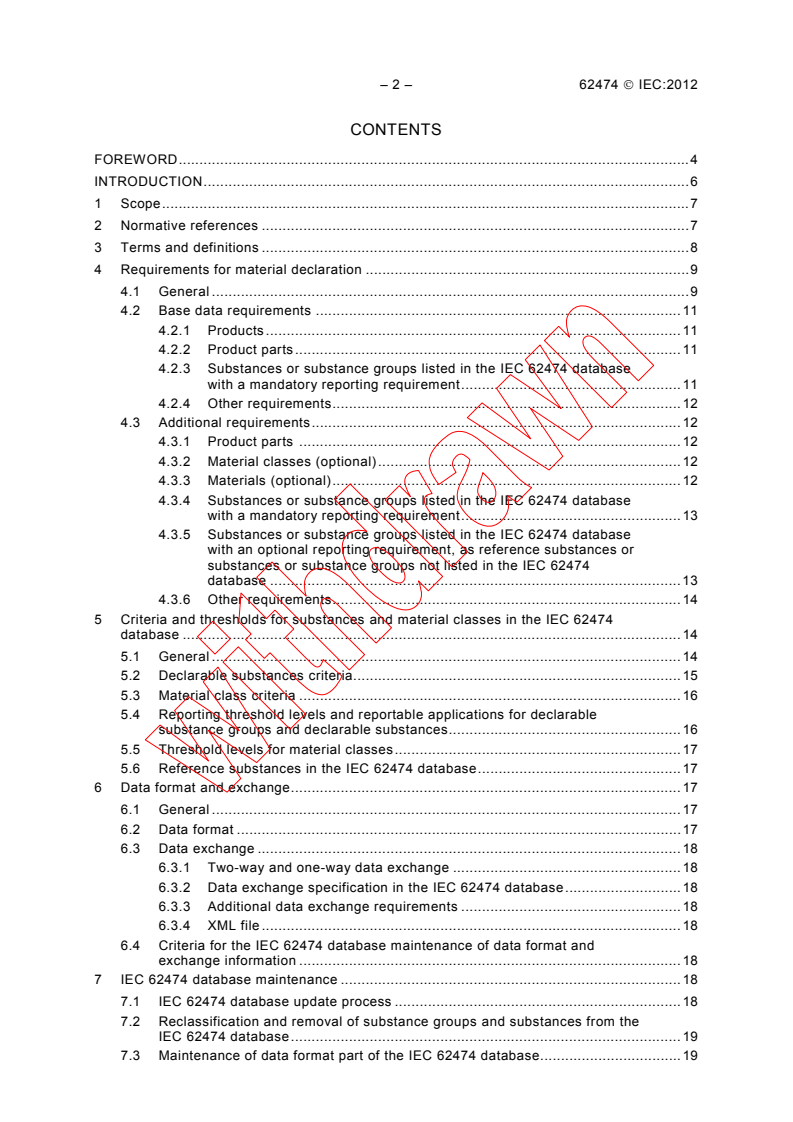
CONTENTS
FOREWORD . 4
INTRODUCTION . 6
1 Scope . 7
2 Normative references . 7
3 Terms and definitions . 8
4 Requirements for material declaration . 9
4.1 General . 9
4.2 Base data requirements . 11
4.2.1 Products . 11
4.2.2 Product parts . 11
4.2.3 Substances or substance groups listed in the IEC 62474 database
with a mandatory reporting requirement . 11
4.2.4 Other requirements . 12
4.3 Additional requirements . 12
4.3.1 Product parts . 12
4.3.2 Material classes (optional) . 12
4.3.3 Materials (optional) . 12
4.3.4 Substances or substance groups listed in the IEC 62474 database
with a mandatory reporting requirement . 13
4.3.5 Substances or substance groups listed in the IEC 62474 database
with an optional reporting requirement, as reference substances or
substances or substance groups not listed in the IEC 62474
database . 13
4.3.6 Other requirements . 14
5 Criteria and thresholds for substances and material classes in the IEC 62474
database . 14
5.1 General . 14
5.2 Declarable substances criteria. 15
5.3 Material class criteria . 16
5.4 Reporting threshold levels and reportable applications for declarable
substance groups and declarable substances . 16
5.5 Threshold levels for material classes . 17
5.6 Reference substances in the IEC 62474 database . 17
6 Data format and exchange . 17
6.1 General . 17
6.2 Data format . 17
6.3 Data exchange . 18
6.3.1 Two-way and one-way data exchange . 18
6.3.2 Data exchange specification in the IEC 62474 database . 18
6.3.3 Additional data exchange requirements . 18
6.3.4 XML file . 18
6.4 Criteria for the IEC 62474 database maintenance of data format and
exchange information . 18
7 IEC 62474 database maintenance . 18
7.1 IEC 62474 database update process . 18
7.2 Reclassification and removal of substance groups and substances from the
IEC 62474 database . 19
7.3 Maintenance of data format part of the IEC 62474 database . 19
62474 IEC:2012 – 3 –
Annex A (informative) Examples corresponding to Clause 4 – Requirements for
material declaration . 20
Annex B (informative) Examples corresponding to Clause 6 – Data format and
exchange . 31
Annex C (informative) Examples corresponding to Clause 7 – IEC 62474 database
management . 38
Annex D (informative) Additional information . 47
Annex E (informative) Declaration examples as XML files . 49
Bibliography . 52
Figure 1 – Conceptual diagram for base requirements . 10
Figure 2 – Conceptual diagram for additional requirements . 10
Figure A.1 – Schematic representation of products versus product parts along the
supply chain . 29
Figure C.1 – Guidance to validation team on C-1 substance/ substance group change
request review . 45
Table 1 – Declarable substances criteria . 15
Table A.1 – Base data requirements – Business information . 21
Table A.2 – Example 1 – base data requirements – Substance/substance group
information. 21
Table A.3 – Additional requirements – Business information . 21
Table A.4 – Additional requirements – Product part/material/substance
group/substance information . 22
Table A.5 – Additional requirements – Material class information . 23
Table A.6 – Base data requirements – Business information . 24
Table A.7 – Example 2 – Base data requirements – Substance/substance group
information. 24
Table A.8 – Additional requirements – Business information . 24
Table A.9 – Additional requirements – Product part/material/substance
group/substance information . 25
Table A.10 – Additional Requirements – Material class information . 26
Table A.11 – Additional requirements – Business information . 26
Table A.12 – Additional requirements – Product part/material/substance
group/substance information . 27
Table A.13 – Additional requirements – material class information . 28
Table B.1 – Data element types of a material declaration . 32
Table D.1 – Comparison of IEC 62474 material classes to automotive industry material
classes . 47
– 4 – 62474 IEC:2012
INTERNATIONAL ELECTROTECHNICAL COMMISSION
______________
MATERIAL DECLARATION FOR PRODUCTS OF AND FOR
THE ELECTROTECHNICAL INDUSTRY
FOREWORD
1) The International Electrotechnical Commission (IEC) is a worldwide organization for standardization comprising
all national electrotechnical committees (IEC National Committees). The object of IEC is to promote
international co-operation on all questions concerning standardization in the electrical and electronic fields. To
this end and in addition to other activities, IEC publishes International Standards, Technical Specifications,
Technical Reports, Publicly Available Specifications (PAS) and Guides (hereafter referred to as “IEC
Publication(s)”). Their preparation is entrusted to technical committees; any IEC National Committee interested
in the subject dealt with may participate in this preparatory work. International, governmental and non-
governmental organizations liaising with the IEC also participate in this preparation. IEC collaborates closely
with the International Organization for Standardization (ISO) in accordance with conditions determined by
agreement between the two organizations.
2) The formal decisions or agreements of IEC on technical matters express, as nearly as possible, an international
consensus of opinion on the relevant subjects since each technical committee has representation from all
interested IEC National Committees.
3) IEC Publications have the form of recommendations for international use and are accepted by IEC National
Committees in that sense. While all reasonable efforts are made to ensure that the technical content of IEC
Publications is accurate, IEC cannot be held responsible for the way in which they are used or for any
misinterpretation by any end user.
4) In order to promote international uniformity, IEC National Committees undertake to apply IEC Publications
transparently to the maximum extent possible in their national and regional publications. Any divergence
between any IEC Publication and the corresponding national or regional publication shall be clearly indicated in
the latter.
5) IEC itself does not provide any attestation of conformity. Independent certification bodies provide conformity
assessment services and, in some areas, access to IEC marks of conformity. IEC is not responsible for any
services carried out by independent certification bodies.
6) All users should ensure that they have the latest edition of this publication.
7) No liability shall attach to IEC or its directors, employees, servants or agents including individual experts and
members of its technical committees and IEC National Committees for any personal injury, property damage or
other damage of any nature whatsoever, whether direct or indirect, or for costs (including legal fees) and
expenses arising out of the publication, use of, or reliance upon, this IEC Publication or any other IEC
Publications.
8) Attention is drawn to the Normative references cited in this publication. Use of the referenced publications is
indispensable for the correct application of this publication.
9) Attention is drawn to the possibility that some of the elements of this IEC Publication may be the subject of
patent rights. IEC shall not be held responsible for identifying any or all such patent rights.
International Standard IEC 62474 has been prepared by IEC Technical Committee 111:
Environmental standardization for electrical and electronic products and systems.
A database associated with this document is available at: http://std.iec.ch/iec62474. It
contains the list of
• Declarable substance groups and declarable substances
• Reference Substances
• Material classes
• XML schema for data format and exchange and the accompanying developer table
62474 IEC:2012 – 5 –
The text of this standard is based on the following documents:
FDIS Report on voting
111/243/FDIS 111/245/RVD
Full information on the voting for the approval of this standard can be found in the report on
voting indicated in the above table.
This publication has been drafted in accordance with the ISO/IEC Directives, Part 2.
The committee has decided that the contents of this publication will remain unchanged until
the stability date indicated on the IEC web site under "http://webstore.iec.ch" in the data
related to the specific publication. At this date, the publication will be
• reconfirmed,
• withdrawn,
• replaced by a revised edition, or
• amended.
IMPORTANT – The 'colour inside' logo on the cover page of this publication indicates
that it contains colours which are considered to be useful for the correct
understanding of its contents. Users should therefore print this document using a
colour printer.
– 6 – 62474 IEC:2012
INTRODUCTION
The electrotechnical industry tracks and declares specific information about the material
composition of its products for compliance and environmentally conscious design
requirements. The electrotechnical industry needs to gather information about the composition
of products and product parts that are purchased from suppliers for incorporation into their
products. Currently material declarations are driven by individual product manufacturer’s
specifications and there is no internationally accepted standardization. This results in
economic inefficiencies. To simplify requirements across the supply chain and to improve
economic efficiencies, it is necessary to standardize the exchange of material composition
data and provide requirements for material declarations.
This International Standard benefits the electrotechnical industry by establishing requirements
for reporting of substances and materials, standardizing protocols, and facilitating transfer
and processing of data.
62474 IEC:2012 – 7 –
MATERIAL DECLARATION FOR PRODUCTS OF AND FOR
THE ELECTROTECHNICAL INDUSTRY
1 Scope
This International Standard specifies the procedure, content, and form relating to material
declarations for products of companies operating in and supplying the electrotechnical
industry. Process chemicals and emissions during product use are not in the scope of this
International Standard.
The main intended use of this International Standard is to provide data to downstream
manufacturers that:
• allows them to assess products against substance restriction compliance requirements
• they can use in their environmentally conscious design process and across all product
life cycle phases
Clause 4 specifies requirements for a material declaration.
Clause 5 specifies the criteria for declarable substances and material classes in the
IEC 62474 database associated with this standard.
Clause 6 specifies the data format and exchange requirements to be included in the
IEC 62474 database.
Clause 7 specifies the process to regularly update and maintain the IEC 62474 database.
Although this International Standard specifies base requirements, it offers flexibility to product
manufacturers and suppliers in the selection of additional requirements or information.
This International Standard does not provide any specific method to capture material
composition data. Organizations have the flexibility to determine the most appropriate method
to capture material composition data without compromising data utility and quality. This
International Standard is intended to allow reporting based on engineering judgment, supplier
material declarations, or on sampling and testing.
2 Normative references
The following documents, in whole or in part, are normatively referenced in this document and
are indispensable for its application. For dated references, only the edition cited applies. For
undated references, the latest edition of the referenced document (including any
amendments) applies.
IEC 61360-1, Standard data element types with associated classification scheme for electric
items – Part 1: Definitions – Principles and methods
IEC 61360-2, Standard data element types with associated classification scheme for electric
components – Part 2: EXPRESS dictionary schema
IEC 61360-5, Standard data element types with associated classification scheme for electric
components – Part 5: Extensions to the EXPRESS dictionary schema
ISO/IEC Directives Supplement: 2011, Procedures Specific to IEC
– 8 – 62474 IEC:2012
3 Terms and definitions
For the purposes of this document, the following terms and definitions apply.
3.1
absence declaration
negative declaration
statement that materials, substances or substance groups are not present in the product
above their respective, specified threshold
3.2
declarable substance and declarable substance group
substance and substance group that meet the criteria stated in this International Standard and
are specified in the IEC 62474 database
Note 1 to entry Such substances and substance groups are listed in the IEC 62474 database with either a
mandatory or optional reporting requirement above the specified threshold in the IEC 62474 database.
3.3
homogeneous material
one material of uniform composition throughout or a material, consisting of a combination of
materials, that cannot be disjointed or separated into different materials by mechanical
actions, such as unscrewing, cutting, crushing, grinding and abrasive processes
3.4
material
substance or mixture within a product or product part
3.5
material class
defined classification of materials that are established in referenced IEC 62474 database for
purposes of inventorying aspects of a product, such that no two classes contain the same
materials
3.6
mixture
preparation
mixture or solution composed of two or more substances in which they do not react
Note 1 to entry An alloy is treated as a mixture.
3.7
product
any goods or service
Note 1 to entry This general definition of product is in the context of this International Standard limited to any
product of the product category “hardware” according to ISO 9000:2005 No. 3.4.2 of and for the electrotechnical
and electronic industry (E&E).
3.8
product family
group of products each of which contains the same substances or material at a similar
concentration level
Note 1 to entry A common case would be an electrical component supplier having many products of the same
substance content that have different electrical values, such as a capacitor, resistor, inductor or an integrated
circuit.
3.9
product part
sub-unit of a product or another (product) part
62474 IEC:2012 – 9 –
Note 1 to entry This is a recursive definition.
3.10
reference substance
individual substance designated as “reference” in the IEC 62474 database
3.11
reportable application
intended use of a substance which determines its relevance to a given scope and the
threshold for disclosure
Note 1 to entry This use is defined in the scope of the underlying law or industry standard. Examples are batteries,
textiles and wood.
3.12
reporting threshold level
concentration limit at or above which the presence of a substance in a material or product is
declared if declaration of the substance is mandatory according to the IEC 62474 database,
or if it is agreed on to be declared
3.13
substance
a chemical element and its compounds in the natural state or obtained by any manufacturing
process, including any additive necessary to preserve its stability and any impurity deriving
from the process used, but excluding any solvent which may be separated without affecting
the stability of the substance or changing its composition
[SOURCE: Globally Harmonized System of Classification and Labelling (GHS):2003, Chapter
1.2, Definitions and Abbreviations]
3.14
substance group
one or more substances, where in the case of multiple substances they share at least one
chemical sub-structure, or chemical or physical property under a generic name
3.15
validation team
permanent, “executive”, group of experts appointed by and acting as delegates on behalf of
their National Committees to validate proposed items and vote for their release as part of a
database standard
Note 1 to entry All P-members have the right and duty to appoint their own member of the team. The validation
team evaluates proposals and votes, using the normal database procedure, on items on behalf of their National
Committees. The validation team reports to the technical committee or subcommittee.
Note 2 to entry The described procedure asks for very short response times from the validation team members.
For this reason, the National Committees should appoint one or more deputies that can take over the task when the
designated person, for any reason, is absent (travel, business, etc.).
Note 3 to entry It is up to the National Committee to decide for how long time a member should be appointed, and
also to organize the possible supporting network of experts on National level.
Note 4 to entry The secretariat manages the validation team.
[SOURCE:ISO/IEC Directives Supplement:2011, Annex J]
4 Requirements for material declaration
4.1 General
This clause describes the base requirements and additional requirements for a material
declaration. Subclause 4.2 describes the base data requirements and Subclause 4.3
– 10 – 62474 IEC:2012
describes additional requirements, should the manufacturer and supplier agree to declare
more.
Clause 4 is organized in the order of the conceptual diagrams (see Figures 1 and 2) for ease
of understanding. Required information is shown with solid boxes and arrows. Options are
shown within dotted boxes. Product, substance groups or substances with a mandatory
reporting requirement in the IEC 62474 database are mandatory objects in this approach.
Product parts, material classes, materials, and substance groups or substances without a
mandatory reporting requirement in the IEC 62474 database are optional objects in this
approach. Substance groups and substances not listed in the IEC 62474 database are also
optional objects. Further mandatory requirements apply without being displayed in the
diagrams (e.g. mass or mass percent).
See informative Annex A for examples related to requirements for material declaration.
Substance
with mandatory reporting
requirement in IEC DB62474
Product And/Or
Substance
Substance group
with mandatory reporting
with mandatory reporting
requirement in IEC DB62474
requirement in IEC DB62474
IEC 235/12
Figure 1 – Conceptual diagram for base requirements
Substance
Substance group
Substance
with mandatory reporting
requirement in IEC DB62474
Product
Material
Product And/Or
part
requirement in IEC DB62474
Substance
Substance group
with mandatory reporting
Substance
requirement in IEC DB62474
with mandatory reporting
requirement in IEC DB62474
Material class
IEC 236/12
NOTE The arrow around the product part indicates that any product part could be broken down into further
product parts and thus it indicates that the product assembly is not just limited to two levels (product – product part)
as displayed in this conceptual diagram.
Figure 2 – Conceptual diagram for additional requirements
62474 IEC:2012 – 11 –
4.2 Base data requirements
4.2.1 Products
The following requirements shall apply to products:
a) A material declaration shall be provided for a product or product family.
NOTE 1 Only the supplier is likely to know the appropriate product family groupings for material declaration
purposes based on their technical knowledge of product material content.
b) The product shall have an identification and a mass assigned. In the case of a product
family, the identification and mass of each product within the product family shall be
specified.
NOTE 2 When each product in the product family has the same mass, it is sufficient to provide this mass just
once.
4.2.2 Product parts
Product parts shall be declared if a substance group or substance in the IEC 62474 database
refers to this part in the reporting threshold level and its reporting threshold level is exceeded.
NOTE Examples for such product parts are when batteries are incorporated into a printed circuit board assembly.
If such product parts need to be declared, the following shall apply:
a) Product parts shall be assigned to the product;
b) Product parts shall have an identification assigned;
c) Product parts shall have a mass or percentage of the product mass assigned.
4.2.3 Substances or substance groups listed in the IEC 62474 database with a
mandatory reporting requirement
Substances or substance groups listed in the IEC 62474 database with a mandatory reporting
requirement shall be declared if they are present in the product at or above the reporting
threshold level given in the IEC 62474 database and if the reportable application as listed in
the IEC 62474 database is applicable for that substance or substance group.
NOTE 1 When such substances or substance groups are not declared in a material declaration, they are not
present over the specified threshold, but could be present below this threshold or the reportable application as
listed in the IEC 62474 database is not applicable.
If such substances or substance groups are present above the reporting threshold level given
in the IEC 62474 database and if the reportable application as provided in the IEC 62474
database is applicable, the following requirements shall apply:
a) Such substance groups shall be assigned to the product part (if 4.2.2 applies) or
otherwise to the product. Such substances shall be assigned to the substance group (if
the substance group has a mandatory reporting requirement) or otherwise to the product
part (if 4.2.2 applies) or otherwise to the product.
b) Such substances or substance groups shall be named as given in the IEC 62474 database.
c) In general, such substance groups or substances shall have a mass or percentage of the
product part mass (if 4.2.2 applies) or otherwise a percentage of the product mass
assigned. If such substance groups or substances have reporting threshold levels
specified in the IEC 62474 database, referring to the material, they shall have a material
mass percent assigned.
NOTE 2 The IEC 62474 database lists some substance groups that require reporting as percentage of the
material mass.
NOTE 3 The reporting requirement as percentage of the material mass can differ e.g. the numerator for this
percentage can be the sum of the masses of all substances belonging to this substance group present or just the
mass of a specific element. Details are given in the IEC 62474 database.
– 12 – 62474 IEC:2012
d) Such substance groups and substances with a reporting threshold level in the IEC 62474
database at the material or the product part level shall be declared separately for each
occurrence in the product exceeding the threshold.
4.2.4 Other requirements
The following requirements shall apply to material declarations:
a) Business information that is needed to exchange material declarations shall be provided
(see the IEC 62474 database).
b) In the case that the product manufacturer requests more than base requirements as
specified in this International Standard and the IEC 62474 database, the contracting
parties shall agree to details, such as safeguards protecting supplier trade secrets at the
request of the supplier.
c) The International System of Units (SI) shall be used.
NOTE For the purpose of presentations and communications among computers, the SI units together with
relevant SI prefixes are preferred. For example, small product parts could be best represented in grams rather than
kilograms.
d) If the supplier is uncertain on the applicability of the reportable application to their
product, then the presence of the substance shall be declared if it exceeds the reporting
threshold in the supplied product.
4.3 Additional requirements
4.3.1 Product parts
The following requirements apply to product parts when they are declared:
a) Product parts shall be assigned to another product part (if a higher level product part is
declared) or otherwise to the product.
b) Product parts shall have an identification assigned.
c) Product parts shall have a mass or otherwise the percentage of another product part mass
(if a higher level product part is declared) or otherwise the percentage of the product mass
assigned.
d) For identical product parts occurring multiple times, the information may be given only
once. In this case, the number of identical product parts shall be provided.
4.3.2 Material classes (optional)
The following requirements apply to material classes when declared:
a) Material classes shall be assigned to the product.
b) Material classes shall be named according to the IEC 62474 database.
c) Material classes shall have a mass or percentage of the product mass assigned.
d) The sum of the mass of the declared material classes should represent at least 95 % of
the product mass.
4.3.3 Materials (optional)
The following requirements apply to materials when declared:
a) Materials shall be assigned to a product part (if product part is declared) or otherwise to
the product.
b) Materials should be characterized by names as defined in a standard (e.g., ISO 1043,
parts 1 through 4 for plastics) or by internationally recognized names.
c) Materials shall have a mass or percentage of the product part mass (if product part is
declared) or otherwise percentage of product mass assigned.
d) Materials shall be allocated to material classes as specified in the IEC 62474 database.
62474 IEC:2012 – 13 –
NOTE 1 The definitions to use when determining the material class applicable to a specific material are
contained in the IEC 62474 database.
NOTE 2 When allocating a material to a material class, this does not trigger the conditions of 4.3.2(d)
4.3.4 Substances or substance groups listed in the IEC 62474 database with a
mandatory reporting requirement
Substances or substance groups listed in the IEC 62474 database with a mandatory reporting
requirement shall be declared if they are present in the product at or above the threshold level
given in the IEC 62474 database and if the reportable application as listed in the IEC 62474
database is applicable for that substance or substance group. Substances and substance
groups with a mandatory reporting requirement in the IEC 62474 database may be declared if
they are present in the product below the threshold level given in the IEC 62474 database or
if the reportable application as listed in the IEC 62474 database is not applicable for that
substance or substance group.
NOTE 1 When such substances or substance groups are not declared in a material declaration, they are not
present over the specified threshold, but could be present below this threshold or the reportable application as
listed in the IEC 62474 database is not applicable.
The following requirements apply to such substances or substance groups when declared:
a) Such substance groups shall be assigned to the material (if material is declared), to the
product part (if product part is declared) or otherwise to the product. Such substances
shall be assigned to the substance group (if substance group is declared) or to the
material (if material is declared) or to the product part (if product part is declared) or
otherwise to the product.
b) Such substances or substance groups shall be named as given in the IEC 62474 database.
c) In general, such substance groups or substances shall have a mass or percentage of the
material mass (if material is declared) or a percentage of the product part mass (if product
part is declared) or otherwise a percentage of the product mass assigned. If such
substance groups or substances have reporting threshold levels specified in the
IEC 62474 database, referring to the material they shall have a material mass percent
assigned.
NOTE 2 The IEC 62474 database lists some substance groups that require reporting as percentage of the
material mass.
NOTE 3 The reporting requirement as a percentage of the material mass can differ e.g. the numerator for
this percentage can be the sum of the masses of all substances belonging to this substance group present or
just the mass of a specific element. Details are given in the IEC 62474 database.
d) Such substance groups and substances with a reporting threshold level in the IEC 62474
database at the material or the product part level shall be declared separately for each
occurrence in the product exceeding the threshold.
e) Such substance groups and substances may have information on the reportable
application. If such information is provided, it shall be named as in the IEC 62474
database.
NOTE 4 Reportable applications for all declarable substance groups and substances are listed in the
IEC 62474 database.
NOTE 5 For those substances groups or substances with more than one reportable application, this
information supports the downstream manufacturer in the assessment against substance restriction
compliance requirements.
f) Such substances or substance groups may have information on applicable exemptions
pertaining to the allowed use. If such information is provided, it shall be carried through
the supply chain.
4.3.5 Substances or substance groups listed in the IEC 62474 database with an
optional reporting requirement, as reference substances or substances or
substance groups not listed in the IEC 62474 database
Substances or substance groups listed in the IEC 62474 database with an optional reporting
requirement should be declared if they are present in the product at or above the reporting
threshold level given in the IEC 62474 database and if the reportable application as listed in
– 14 – 62474 IEC:2012
the IEC 62474 database is applicable for that substance or substance group. Substances and
substance groups with an optional reporting requirement in the IEC 62474 database may be
declared if they are present in the product below the reporting threshold level given in the
IEC 62474 database or if the reportable application as listed in the IEC 62474 database is not
applicable for that substance or substance group. Substances listed in the IEC 62474
database as reference substances or substances or substance groups not listed in the
IEC 62474 database may be declared.
The following requirements apply to such substances or substance groups when declared:
a) Such substance groups shall be assigned to the material (if material is declared) or to the
product part (if product part is declared) or otherwise to the product.
Such substances shall be assigned to the substance group (if substance group is
declared), to the material (if material is declared) or to the product part (if product part is
declared) or otherwise to the product.
b) Substances or substance groups with an optional reporting requirement in the IEC 62474
database shall be named as given in the IEC 62474 database. Substances not listed in
the IEC 62474 database shall be identified by an internationally recognized name (e.g.
IUPAC name) and preferably also identified with CAS Registry Number, EC Commission
Number etc. when these are available.
NOTE 1 IUPAC Name: name assigned to a chemical compound according to recommendations by IUPAC
Nomenclature of Organic (or Inorganic) Chemistry. IUPAC is the abbreviation for the International Union of
Pure and Applied Chemistry.
NOTE 2 CAS Registry Number (also referred to as CAS Number): unique numeric identifier assigned by the
Chemical Abstracts Service, a division of the American Chemical Society.
NOTE 3 European Commission Number (also referred to as EC Number, EC-No and EC#): unique numeric
identifier assigned by the Commission of the European Union to chemical substances that are commercially
available within the European Union.
c) Such substance groups or substances shall have a mass or percentage of the material
mass (if material is declared) or percentage of the product part mass (if product part is
declared) or otherwise percentage of the product mass assigned.
d) Such substance groups and substances may have information on the reportable
application. If such information is provided, it shall be named as in the IEC 62474
database.
NOTE 4 Reportable applications for all declarable substance groups and declarable substances are listed in
the IEC 62474 database.
NOTE 5 For those substances groups or substances with more than one reportable application, this
information supports the downstream manufacturer in the assessment again
...