

IEC 61097-6:2005
(Main)Global maritime distress and safety system (GMDSS) - Part 6: Narrowband direct-printing telegraph equipment for the reception of navigational and meteorological warnings and urgent information to ships (NAVTEX)
General Information
- Abstract
Specifies the minimum performance requirements, technical characteristics and type-testing requirements for narrowband telegraph equipment for the reception of navigational and meteorological information as required by the International Convention for Safety of Life at Sea (SOLAS), and which is associated with IEC 60945. Also incorporates the performance standards of the relevant IMO resolutions and conforms with the ITU-R regulations where applicable.
- Status
- Published
- Publication Date
- 09-Jul-2019
- Technical Committee
- TC 80 - Maritime navigation and radiocommunication equipment and systems
- Drafting Committee
- WG 8 - TC 80/WG 8
- Current Stage
- PPUB - Publication issued
- Start Date
- 07-Dec-2005
- Completion Date
- 30-Apr-2006
Buy Documents
IEC 61097-6:2005 - Global maritime distress and safety system (GMDSS) - Part 6: Narrowband direct-printing telegraph equipment for the reception of navigational and meteorological warnings and urgent information to ships (NAVTEX) Released:12/7/2005

IEC 61097-6:2005+AMD1:2011+AMD2:2019 CSV - Global maritime distress and safety system (GMDSS) - Part 6: Narrowband direct-printing telegraph equipment for the reception of navigational and meteorological warnings and urgent information to ships (NAVTEX) Released:7/10/2019
IEC 61097-6:2005+AMD1:2011 CSV - Global maritime distress and safety system (GMDSS) - Part 6: Narrowband direct-printing telegraph equipment for the reception of navigational and meteorological warnings and urgent information to ships (NAVTEX) Released:1/30/2012
Overview
IEC 61097-6:2005 is an international standard from the International Electrotechnical Commission (IEC) that specifies requirements for narrowband direct-printing telegraph equipment, known as NAVTEX, used within the Global Maritime Distress and Safety System (GMDSS). NAVTEX systems are essential for the automatic receipt of navigational and meteorological warnings and urgent information on ships, as mandated by the International Convention for the Safety of Life at Sea (SOLAS). This standard sets the minimum performance, technical, and type-testing requirements to ensure maritime safety and reliable reception of critical information at sea.
By integrating requirements from SOLAS, IMO resolutions, and ITU-R regulations, IEC 61097-6 guarantees global consistency for marine communication equipment and helps ensure that ships everywhere can receive vital maritime safety information.
Key Topics
- Minimum performance requirements: Defines the baseline operational capability that all NAVTEX receivers must meet, covering aspects such as sensitivity, message memory, display and printing features, and alerting functions.
- Technical characteristics: Outlines the expected technical behavior, including frequency, signal processing, interfaces, power supply specifications, and environmental considerations.
- Type-testing requirements: Details the methods for laboratory and operational testing, including receiver sensitivity, interference rejection, memory functions, and alarm functions.
- Equipment categories: Supports different receiver configurations, including integrated printers, display devices, and interfaces for integration into ship navigation systems.
- Compliance with international regulations: Aligns with IMO standards for GMDSS equipment, ITU-R technical recommendations, and incorporates the relevant requirements of IEC 60945 for marine navigation and radiocommunication.
- Amendments and updates: Incorporates amendments that address developments in alert interface management and support for modern display technology on vessels.
Applications
IEC 61097-6 applies to the design, testing, and approval of NAVTEX equipment for marine vessels and is relevant for:
- Ship operators and shipbuilders: Ensuring onboard equipment meets international safety-of-life-at-sea regulations by installing compliant NAVTEX receivers.
- Equipment manufacturers: Designing and producing NAVTEX systems that meet both performance and test requirements, gaining access to the global maritime market.
- Marine equipment testing laboratories: Conducting type-approval and conformity assessment in line with standardized testing protocols.
- Maritime authorities and regulators: Verifying compliance of shipborne navigational and radiocommunication equipment as part of flag state inspections.
- Integration with bridge alert management (BAM): Supporting vessel integration by connecting NAVTEX receivers with bridge alert management systems for efficient dissemination of warning information.
Adopting IEC 61097-6:2005 ensures more reliable dissemination of navigational and meteorological information, enhances GMDSS functionality, and improves maritime safety through standardized alerting and message-handling features.
Related Standards
- IEC 60945 – Marine navigation and radiocommunication equipment - General requirements, methods of testing, and required test results
- IEC 61162 series – Digital interfaces for maritime navigation and radiocommunication systems
- IEC 62923-1 / IEC 62923-2 – Bridge alert management: operational requirements, testing methods, and alert identifiers
- IMO Resolution MSC.148(77) – Revised performance standards for NAVTEX equipment
- ITU-R Recommendation M.540 – Operational and technical characteristics for automated NAVTEX
- SOLAS (1974 and amendments) – International Convention for the Safety of Life at Sea provisions relating to GMDSS
Adhering to IEC 61097-6 and related standards is essential for global interoperability and the safety of maritime operations, ensuring continuity in maritime distress and safety communication worldwide.
Relations
- Effective Date
- 05-Sep-2023
- Effective Date
- 05-Sep-2023
Buy Documents
IEC 61097-6:2005 - Global maritime distress and safety system (GMDSS) - Part 6: Narrowband direct-printing telegraph equipment for the reception of navigational and meteorological warnings and urgent information to ships (NAVTEX) Released:12/7/2005
IEC 61097-6:2005+AMD1:2011+AMD2:2019 CSV - Global maritime distress and safety system (GMDSS) - Part 6: Narrowband direct-printing telegraph equipment for the reception of navigational and meteorological warnings and urgent information to ships (NAVTEX) Released:7/10/2019
IEC 61097-6:2005+AMD1:2011 CSV - Global maritime distress and safety system (GMDSS) - Part 6: Narrowband direct-printing telegraph equipment for the reception of navigational and meteorological warnings and urgent information to ships (NAVTEX) Released:1/30/2012
Get Certified
Connect with accredited certification bodies for this standard

DNV
DNV is an independent assurance and risk management provider.

Lloyd's Register
Lloyd's Register is a global professional services organisation specialising in engineering and technology.

FSC International
Forest Stewardship Council certification.
Sponsored listings
Frequently Asked Questions
IEC 61097-6:2005 is a standard published by the International Electrotechnical Commission (IEC). Its full title is "Global maritime distress and safety system (GMDSS) - Part 6: Narrowband direct-printing telegraph equipment for the reception of navigational and meteorological warnings and urgent information to ships (NAVTEX)". This standard covers: Specifies the minimum performance requirements, technical characteristics and type-testing requirements for narrowband telegraph equipment for the reception of navigational and meteorological information as required by the International Convention for Safety of Life at Sea (SOLAS), and which is associated with IEC 60945. Also incorporates the performance standards of the relevant IMO resolutions and conforms with the ITU-R regulations where applicable.
Specifies the minimum performance requirements, technical characteristics and type-testing requirements for narrowband telegraph equipment for the reception of navigational and meteorological information as required by the International Convention for Safety of Life at Sea (SOLAS), and which is associated with IEC 60945. Also incorporates the performance standards of the relevant IMO resolutions and conforms with the ITU-R regulations where applicable.
IEC 61097-6:2005 is classified under the following ICS (International Classification for Standards) categories: 47.020.70 - Navigation and control equipment. The ICS classification helps identify the subject area and facilitates finding related standards.
IEC 61097-6:2005 has the following relationships with other standards: It is inter standard links to IEC 61097-6:2005/AMD1:2011, IEC 61097-6:2005/AMD2:2019. Understanding these relationships helps ensure you are using the most current and applicable version of the standard.
IEC 61097-6:2005 is available in PDF format for immediate download after purchase. The document can be added to your cart and obtained through the secure checkout process. Digital delivery ensures instant access to the complete standard document.
Standards Content (Sample)
INTERNATIONAL IEC
STANDARD 61097-6
Second edition
2005-12
Global maritime distress and
safety system (GMDSS) –
Part 6:
Narrowband direct-printing telegraph equipment
for the reception of navigational and
meteorological warnings and urgent
information to ships (NAVTEX)
Reference number
Publication numbering
As from 1 January 1997 all IEC publications are issued with a designation in the
60000 series. For example, IEC 34-1 is now referred to as IEC 60034-1.
Consolidated editions
The IEC is now publishing consolidated versions of its publications. For example,
edition numbers 1.0, 1.1 and 1.2 refer, respectively, to the base publication, the
base publication incorporating amendment 1 and the base publication incorporating
amendments 1 and 2.
Further information on IEC publications
The technical content of IEC publications is kept under constant review by the IEC,
thus ensuring that the content reflects current technology. Information relating to
this publication, including its validity, is available in the IEC Catalogue of
publications (see below) in addition to new editions, amendments and corrigenda.
Information on the subjects under consideration and work in progress undertaken
by the technical committee which has prepared this publication, as well as the list
of publications issued, is also available from the following:
• IEC Web Site (www.iec.ch)
• Catalogue of IEC publications
The on-line catalogue on the IEC web site (www.iec.ch/searchpub) enables you to
search by a variety of criteria including text searches, technical committees
and date of publication. On-line information is also available on recently issued
publications, withdrawn and replaced publications, as well as corrigenda.
• IEC Just Published
This summary of recently issued publications (www.iec.ch/online_news/ justpub)
is also available by email. Please contact the Customer Service Centre (see
below) for further information.
• Customer Service Centre
If you have any questions regarding this publication or need further assistance,
please contact the Customer Service Centre:
Email: custserv@iec.ch
Tel: +41 22 919 02 11
Fax: +41 22 919 03 00
INTERNATIONAL IEC
STANDARD 61097-6
Second edition
2005-12
Global maritime distress and
safety system (GMDSS) –
Part 6:
Narrowband direct-printing telegraph equipment
for the reception of navigational and
meteorological warnings and urgent
information to ships (NAVTEX)
IEC 2005 Copyright - all rights reserved
No part of this publication may be reproduced or utilized in any form or by any means, electronic or
mechanical, including photocopying and microfilm, without permission in writing from the publisher.
International Electrotechnical Commission, 3, rue de Varembé, PO Box 131, CH-1211 Geneva 20, Switzerland
Telephone: +41 22 919 02 11 Telefax: +41 22 919 03 00 E-mail: inmail@iec.ch Web: www.iec.ch
PRICE CODE
Commission Electrotechnique Internationale X
International Electrotechnical Commission
МеждународнаяЭлектротехническаяКомиссия
For price, see current catalogue
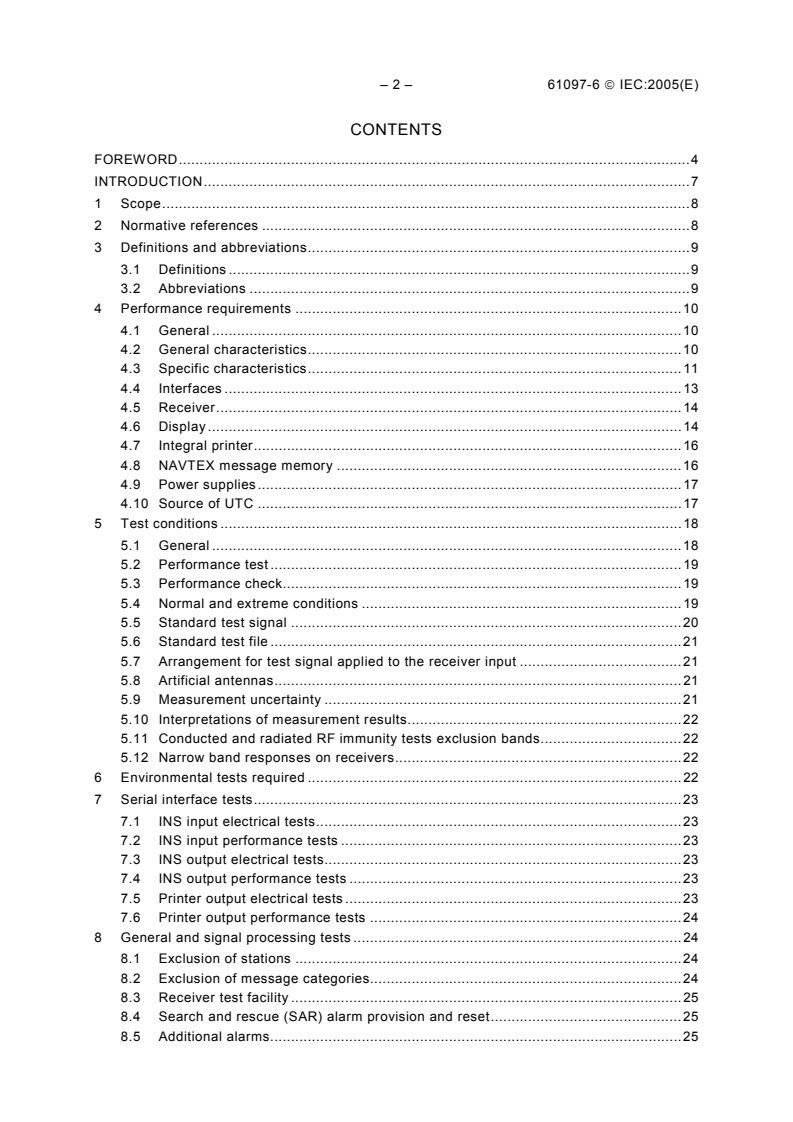
– 2 – 61097-6 IEC:2005(E)
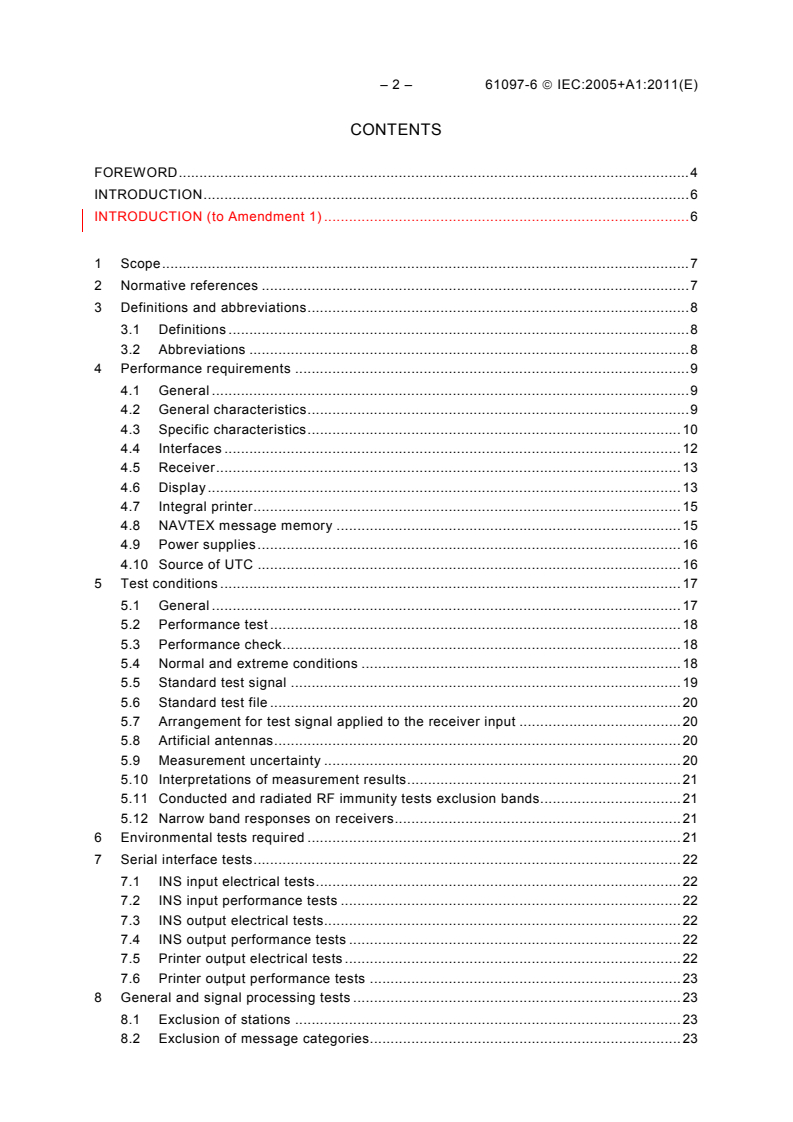
CONTENTS
FOREWORD.4
INTRODUCTION.7
1 Scope.8
2 Normative references .8
3 Definitions and abbreviations.9
3.1 Definitions .9
3.2 Abbreviations .9
4 Performance requirements .10
4.1 General .10
4.2 General characteristics.10
4.3 Specific characteristics.11
4.4 Interfaces .13
4.5 Receiver.14
4.6 Display.14
4.7 Integral printer.16
4.8 NAVTEX message memory .16
4.9 Power supplies.17
4.10 Source of UTC .17
5 Test conditions .18
5.1 General .18
5.2 Performance test.19
5.3 Performance check.19
5.4 Normal and extreme conditions .19
5.5 Standard test signal .20
5.6 Standard test file .21
5.7 Arrangement for test signal applied to the receiver input .21
5.8 Artificial antennas.21
5.9 Measurement uncertainty .21
5.10 Interpretations of measurement results.22
5.11 Conducted and radiated RF immunity tests exclusion bands.22
5.12 Narrow band responses on receivers.22
6 Environmental tests required .22
7 Serial interface tests.23
7.1 INS input electrical tests.23
7.2 INS input performance tests .23
7.3 INS output electrical tests.23
7.4 INS output performance tests .23
7.5 Printer output electrical tests .23
7.6 Printer output performance tests .24
8 General and signal processing tests .24
8.1 Exclusion of stations .24
8.2 Exclusion of message categories.24
8.3 Receiver test facility .25
8.4 Search and rescue (SAR) alarm provision and reset.25
8.5 Additional alarms.25
61097-6 IEC:2005(E) – 3 –
9 Receiver tests .25
9.1 Call sensitivity .26
9.2 Interference rejection and blocking immunity .26
9.3 Co-channel rejection .27
9.4 Intermodulation .27
9.5 Off-frequency transmitter.28
9.6 Simultaneous operation on several receive frequencies.28
9.7 Protection of input circuits .28
10 Printer tests.29
10.1 Basic requirements.29
10.2 Paper roll end alarm and storage inhibition.29
10.3 Automatic line feed indication and paper feed .29
10.4 Mutilated character indication.30
10.5 Tests of technical characteristics (ITU-R Recommendation M.540).30
11 Memory tests.31
11.1 Internal storage, message tagging and erasure of oldest message
identifications .31
11.2 Erasure of message identifications/storage time.32
11.3 Storage of message identifications .33
11.4 Reception of messages with character errors .33
11.5 Unsatisfactory reception.34
11.6 Power-off check .34
11.7 Brown-out test.35
11.8 UTC handling check .35
12 Miscellaneous tests .36
12.1 Spurious emissions .36
12.2 Equipment manuals – checks of the manufacturer's documentation.36
12.3 Marking and identification.36
Annex A (informative) Block diagrams of NAVTEX systems .37
Annex B (normative) Definition of satisfactory reception of a message.39
Annex C (informative) IEC 61162 sentences for NAVTEX operation.40
Annex D (normative) Manufacturer’s declarations/equipment manual.43
Figure A.1 – EUT with an integral printing device.37
Figure A.2 – EUT with an integral display device .37
Figure A.3 – EUT black box receiver.38
Table 1 – Alarm conditions signaled using the ALR sentence formatter.13
Table 2 – Extreme power supply variation.19
Table 3 – Unwanted signal levels.26
Table 4 – Intermodulation frequency pairs .27
– 4 – 61097-6 IEC:2005(E)
INTERNATIONAL ELECTROTECHNICAL COMMISSION
____________
GLOBAL MARITIME DISTRESS AND
SAFETY SYSTEM (GMDSS) –
Part 6: Narrowband direct-printing telegraph equipment
for the reception of navigational and meteorological warnings
and urgent information to ships (NAVTEX)
FOREWORD
1) The International Electrotechnical Commission (IEC) is a worldwide organization for standardization comprising
all national electrotechnical committees (IEC National Committees). The object of IEC is to promote international
co-operation on all questions concerning standardization in the electrical and electronic fields. To this end and in
addition to other activities, IEC publishes International Standards, Technical Specifications, Technical Reports,
Publicly Available Specifications (PAS) and Guides (hereafter referred to as “IEC Publication(s)”). Their
preparation is entrusted to technical committees; any IEC National Committee interested in the subject dealt with
may participate in this preparatory work. International, governmental and non-governmental organizations liaising
with the IEC also participate in this preparation. IEC collaborates closely with the International Organization for
Standardization (ISO) in accordance with conditions determined by agreement between the two organizations.
2) The formal decisions or agreements of IEC on technical matters express, as nearly as possible, an international
consensus of opinion on the relevant subjects since each technical committee has representation from all
interested IEC National Committees.
3) IEC Publications have the form of recommendations for international use and are accepted by IEC National
Committees in that sense. While all reasonable efforts are made to ensure that the technical content of IEC
Publications is accurate, IEC cannot be held responsible for the way in which they are used or for any
misinterpretation by any end user.
4) In order to promote international uniformity, IEC National Committees undertake to apply IEC Publications
transparently to the maximum extent possible in their national and regional publications. Any divergence between
any IEC Publication and the corresponding national or regional publication shall be clearly indicated in the latter.
5) IEC provides no marking procedure to indicate its approval and cannot be rendered responsible for any equipment
declared to be in conformity with an IEC Publication.
6) All users should ensure that they have the latest edition of this publication.
7) No liability shall attach to IEC or its directors, employees, servants or agents including individual experts and
members of its technical committees and IEC National Committees for any personal injury, property damage or
other damage of any nature whatsoever, whether direct or indirect, or for costs (including legal fees) and expenses
arising out of the publication, use of, or reliance upon, this IEC Publication or any other IEC Publications.
8) Attention is drawn to the Normative references cited in this publication. Use of the referenced publications is
indispensable for the correct application of this publication.
9) Attention is drawn to the possibility that some of the elements of this IEC Publication may be the subject of patent
rights. IEC shall not be held responsible for identifying any or all such patent rights.
International Standard IEC 61097-6 has been prepared by IEC technical committee 80: Maritime
navigation and radiocommunication equipment and systems.
This second edition cancels and replaces the first edition published in 1995. This edition
constitutes a technical revision. This edition includes the following significant technical changes
with respect to the previous edition:
– insertion of requirements and tests for memory within the NAVTEX;
– insertion of requirements and test for interfaces;
– improved receiver performance.
61097-6 IEC:2005(E) – 5 –
The text of this standard is based on the following documents:
FDIS Report on voting
80/419/FDIS 80/424/RVD
Full information on the voting for the approval of this standard can be found in the report on
voting indicated in the above table.
This publication has been drafted in accordance with the ISO/IEC Directives, Part 2.
IEC 61097 consists of the following parts under the general title Global maritime distress and
safety system (GMDSS):
Part 1: Radar transponder – Marine search and rescue (SART) – Operational and
performance requirements, methods of testing and required test results
Part 2: COSPAS-SARSAT EPIRB – Satellite emergency position indicating radio beacon
operating on 406 MHz – Operational and performance requirements, methods of
testing and required test results
Part 3: Digital selective calling (DSC) equipment – Operational and performance
requirements, methods of testing and required testing results
Part 4: INMARSAT-C ship earth station and INMARSAT enhanced group call (EGC)
equipment – Operational and performance requirements, methods of testing and
required test results
Part 5: Inmarsat-E – Emergency position indicating radio beacon (EPIRB) operating
through the Inmarsat system – Operational and performance requirements, methods
of testing and required test results
Part 6: Narrowband direct-printing telegraph equipment for the reception of navigational
and meteorological warnings and urgent information to ships (NAVTEX)
Part 7: Shipborne VHF radiotelephone transmitter and receiver – Operational and
performance requirements, methods of testing and required test results
Part 8: Shipborne watchkeeping receivers for the reception of digital selective calling (DSC)
in the maritime MF, MF/HF and VHF bands – Operational and performance
requirements, methods of testing and required test results
Part 9: Shipborne transmitters and receivers for use in the MF and HF bands suitable for
telephony, digital selective calling (DSC) and narrow band direct printing (NBDP) –
Operational and performance requirements, methods of testing and required test
results
Part 10: Inmarsat-B ship earth station equipment – Operational and performance
requirements, methods of testing and required test results
Part 12: Survival craft portable two-way VHF radiotelephone apparatus – Operational and
performance requirements, methods of testing and required test results
Part 13: Inmarsat F77 ship earth station equipment – Operational and performance
requirements, methods of testing and required test results
– 6 – 61097-6 IEC:2005(E)
The committee has decided that the contents of this publication will remain unchanged until the
maintenance result date indicated on the IEC web site under "http://webstore.iec.ch" in the data
related to the specific publication. At this date, the publication will be either
• reconfirmed,
• withdrawn,
• replaced by a revised edition, or
• amended.
A bilingual version of this standard may be issued at a later date.
61097-6 IEC:2005(E) – 7 –
INTRODUCTION
NAVTEX provides shipping with navigational and meteorological warnings and urgent
information by automatic display and/or print out from a dedicated receiver.
NAVTEX is a component of the IMO/IHO World-Wide Navigational Warning Service (WWNWS)
defined by IMO Assembly Resolution A.706(17), as amended, and the WMO Manual on Marine
Meteorological Services, Part Ibis, Provision of warnings and weather and sea bulletins
(GMDSS application). It has been included as an element of the Global Maritime Distress and
Safety System (GMDSS).
The original NAVTEX specification allowed for equipment with integral printers and precluded
the fitting of equipment which relied on other ways of recording and displaying NAVTEX data.
The use of Liquid Crystal Displays and other Visual Display Units is now ubiquitous on ships’
bridges and this revision of the specification allows for their use in displaying NAVTEX data.
As a result of the final cessation of the distresss watch on 500 kHz in 1999 the frequency
490 kHz became available for use as a national NAVTEX channel and this has now been widely
implemented around the world. This NAVTEX specification therefore requires simultaneous
operation on an additional channel to the international channel of 518 kHz.
IMO Resolution MSC.148(77) states that the equipment should comprise radio receivers, a
signal processor and:
a) an integrated printing device; or
b) a dedicated display device, printer output port and a non-volatile message memory; or
c) a connection to an integrated navigation system and a non-volatile message memory.
– 8 – 61097-6 IEC:2005(E)
GLOBAL MARITIME DISTRESS AND
SAFETY SYSTEM (GMDSS) –
Part 6: Narrowband direct-printing telegraph equipment
for the reception of navigational and meteorological warnings
and urgent information to ships (NAVTEX)
1 Scope
This part of IEC 61097 specifies the minimum performance requirements, technical character-
istics and type-testing requirements for narrowband telegraph equipment for the reception of
navigational and meteorological information as required by Regulation IV/7.1.4 of the 1988
amendments to the 1974 International Convention for Safety of Life at Sea (SOLAS), and which
is associated with IEC 60945. When a requirement in this standard is different from IEC 60945,
the requirement in this standard takes precedence.
This standard incorporates the performance standards of IMO Resolution MSC.148(77), the
technical characteristics of ITU-R Recommendation M.540, takes account of the IMO Resolution
A.694(17) and conforms with the ITU Radio Regulations where applicable.
All text of this standard, whose meaning is identical to that in IMO Resolution MSC.148(77) and
ITU-R Recommendation M.540 will be printed in italics and the Resolution/Recommendation
and paragraph number indicated between brackets.
2 Normative references
The following referenced documents are indispensable for the application of this document. For
dated references, only the edition cited applies. For undated references, the latest edition of the
referenced document (including any amendments) applies.
IEC 60945, Marine navigation and radio communication equipment – General requirements –
Methods of testing and required test results
IEC 61162-1, Maritime navigation and radiocommunication equipment and systems – Digital
interfaces – Part 1: Single talker and multiple listeners
IEC 61162-2; Maritime navigation and radiocommunication equipment and systems – Digital
interfaces – Part 2: Single talker and multiple listeners, high-speed transmission
IMO Safety of Life at Sea (SOLAS) Convention (1974), as amended (GMDSS)
IMO Resolution A.694(17) (1991) General requirements for shipborne radio equipment forming
part of the global maritime distress and safety system (GMDSS) and for electronic navigational
aids
IMO Resolution MSC.148(77) (2003) Revised performance standards for narrow-band
direct-printing telegraph equipment for the reception of navigational and meteorological
warnings and urgent information to ships (NAVTEX)
IMO Publication – NAVTEX Manual
IMO Resolution MSC/Circ.1122 Adoption of the revised NAVTEX manual
61097-6 IEC:2005(E) – 9 –
ITU-R Recommendation M.540-2:1990, Operational and technical characteristics for an
automated direct printing telegraph system for promulgation of navigational and meteorological
warnings and urgent information to ships
ITU-R Recommendation M.625-3:1995, Direct-printing telegraph equipment employing
automatic identification in the maritime mobile service
3 Definitions and abbreviations
For the purposes of this document, the following definitions and abbreviations apply.
3.1 Definitions
3.1.1
LORAN-C
long range radio-navigation system operating on an assigned frequency of 100 kHz
3.1.2
NAVTEX
system for the broadcast and automatic reception of maritime safety information by means of
narrow-band telegraphy
3.1.3
Test script
text file containing a number of NAVTEX messages formatted as defined in 5.5. The STF is a
particular example of a test script
3.2 Abbreviations
ASCII American Standard Code for Information Interchange
CER character error rate
EMC electromagnetic compatibility
EUT equipment under test
HMI human-machine interface
INS integrated navigation system
IMO International Maritime Organization
ITU International Telecommunication Union
PC performance check
PT performance test
RTC real time clock
SAR search and rescue
STF standard test file
STS standard test signal
USB Universal Serial Bus
UTC Co-ordinated Universal Time
– 10 – 61097-6 IEC:2005(E)
4 Performance requirements
4.1 General
(148/A.1.1) The equipment, in addition to meeting the requirements of the Radio Regulations,
the provisions of Recommendation ITU-R M.540 applicable to shipborne equipment and the
general requirements set out in resolution A.694(17), and specified in IEC 60945 shall comply
with the revised IMO performance standards for NAVTEX equipment Resolution MSC 148(77).
(148/A.2.1) The equipment shall comprise radio receivers, a signal processor and: either
a) an integrated printing device; or
b) a dedicated display device, printer output port and a non-volatile message memory; or
NOTE Where there is no printer, the dedicated display device shall be able to be located in the position from which
the ship is normally navigated.
c) a connection to an integrated navigation system (INS) and a non-volatile message memory.
Examples of NAVTEX systems are given in Annex A.
4.2 General characteristics
(540/AII.2) The equipment shall be capable of receiving messages in the collective B-mode of
the direct printing system specified in ITU-R Recommendation M.625, Annex I,4.
(540/AII.3) The technical format of the transmission shall be in accordance with ITU-R
Recommendation M.540, Annex II,3 as follows:
Carriage
Carriage
return
Phasing One
return
+
ZCZC B B B B Message NNNN
1 2 3 4
signal space
+
2 line
≥10 s
line feed
feeds
End of
Carriage
emissions
Phasing One Carriage
return +
idle signal
Message NNNN
ZCZC B’1B’2B’3B’4
signal space return &
2 line
⋅α ⋅α . α
line feed
feeds
≥5 s
≥2 s
where
ZCZC defines the end of the phasing period
B character is a letter (A-Z) identifying the transmitter coverage area.
B character is a letter (A-Z) for each type of message as follows:
A navigational warning
B meteorological warning
C ice report
D search and rescue information/piracy and armed robbery
E meteorological forecast
F pilot message
61097-6 IEC:2005(E) – 11 –
G AIS
H LORAN-C message
I reserved presently not used
J SATNAV message
K other electronic navigational aid system message
L navigational warning (additional)
M to Y reserved presently not used
Z QRU (no message on hand)
B B characters are the serial number of the message between 01 and 99.
3 4
4.3 Specific characteristics
4.3.1 B and B characters
1 2
(540/AII.2.1) The B characters identifying the different transmitter coverage areas and the B
1 2
characters identifying the different types of messages are defined by IMO and chosen from table
I of ITU-R Recommendation M.625, combination numbers 1-26.
a) Ship equipment shall be capable of automatically rejecting unwanted information using
character B .
b) Ship equipment shall be capable of disabling print-out, transmission to the INS port or
display of selected types of messages using character B with the exception of messages
with B characters A, B, D and L.
c) If any facility is rejected (transmitter coverage area) or disabled (type of message) the extent
of any such limitation shall be clearly indicated to the user (see 4.3.7).
4.3.2 B and B characters
3 4
(540/AII.2.2) B B is a two-character serial number for each B , starting with 01 except in
3 4 2
special cases where the serial number 00 is used (see 4.3.5).
4.3.3 Preamble
(540/AII.3) The printer or message store shall only be activated if the preamble B B B B is
1 2 3 4
received without errors.
4.3.4 Repetition of printing/display
(540/AII.4) Facilities shall be provided to avoid printing, storage or display of the same
message several times on the same ship, when such a message has already been satisfactorily
received.
(540/AII.5) The necessary information for these measures shall be deduced from the sequence
B B B B .
1 2 3 4
4.3.5 Mandatory printing/display
(540/AII.6) A message shall always be printed, stored and displayed if B B = 00 and if it is
3 4
transmitted by a coast station that the equipment is programmed to select.
(540/AII.2.3) The characters ZCZC B B B B need not be printed/displayed.
1 2 3 4
– 12 – 61097-6 IEC:2005(E)
4.3.6 Reception of messages with character errors
4.3.6.1 Messages with character error rate of >4 % and ≤33 %
The EUT shall store the message (non-printing EUTs) or message identification (printing EUTs)
but shall allow the stored message/message identification to be replaced if it is subsequently
received with lower error rate.
An EUT with an integral printer shall print the messages indicating a character error rate of
≤33 %.
An EUT with an integral display shall display the messages indicating a character error rate of
≤33 %.
4.3.6.2 Messages with character error rate of >33 %
The EUT shall not store or print messages if the received character error rate >33 %. See
Annex B.
4.3.7 Controls and indicators
(148/A.3.1) Details of the coverage areas and message categories which have been excluded
by the operator from reception and or display shall be readily available.
It shall be possible to exclude at least four different message categories. It shall not be possible
to exclude message categories A, B, D and L.
4.3.8 Programmable control memories
(148/A.6.3) Information for location (B ) and message (B ) designators in programmable
1 2
memories shall be permanently stored in non-volatile memory and shall not be erased by
interruptions in the power supply of less than 6 h.
Default programmable settings shall be, for the location (B ) designators set to all characters
and for the message (B ) designators set to characters ABCDEFHJKLVZ.
NOTE Location (B ) and message (B ) designators are described in 4.2.
1 2
4.3.9 Alarms
4.3.9.1 Generation of alarms
(148/A.7) The receipt of search and rescue information (B = ‘D’) shall give an alarm at the
position from which the ship is normally navigated. It shall only be possible to reset this alarm
manually.
The EUT may either contain an integral alarm sounder or a pair of relay contacts for the
provision of an external sounder.
If an additional alarm is provided at the equipment to indicate, for example, the reception of
navigational and/or meteorological warnings, it shall be capable of being suppressed.
If an additional alarm is provided it shall be distinguishable from a search and rescue alarm.
The audible volume of the alarm shall be 75 dBA to 85 dBA.
If a pair of relay contacts is provided to switch an external sounder on for an alarm condition then
the relay contacts shall be free of earth.
The alarm condition shall be reported via an ALR command on the INS serial port.
61097-6 IEC:2005(E) – 13 –
4.3.9.2 Using the ALR formatter
An ALR command shall be used to report the reception of a search and rescue alarm,
navigational or meteorological warnings or to indicate a failure or malfunction that will reduce
the integrity of the NAVTEX receiver.
Alarm messages shall be IEC 61162-1 compliant “$--ALR” sentences and shall contain the local
alarm numbers and alarm text shown in the following table:
Table 1 – Alarm conditions signaled using the ALR sentence formatter
Alarm number Alarm text
001 “NAVTEX: Navigational warning”
002 “NAVTEX: Meteorological warning”
003 “NAVTEX: Search and rescue information”
a
004 “NAVTEX: Receiver malfunction”
b
005 “NAVTEX: Built in self test failure”
006 “NAVTEX: General failure”
a
The text may be extended to indicate which receiver has the
malfunction
b
The text may be extended to indicate the nature of the test failure
Additional numbers may be used by the manufacturers for other purposes but shall be in the
range 051-099.
4.3.9.3 Repetition of alarm conditions
Whilst any alarm conditions persist, the NAVTEX receiver shall repeat the appropriate ALR
sentences once every 30 s until acknowledged.
When all the alarm conditions are acknowledged (but still active), the NAVTEX receiver shall
stop the output of any audible alarm indication (whether by integral sounder or by relay contacts)
but shall continue to repeat the ALR sentences once every 30 s.
When the alarm condition has returned to “healthy”, an ALR sentence with the status set to “V”
shall be sent out at one minute intervals.
When there are no active alarms, the NAVTEX receiver may send out a single ALR sentence
with alarm number 006 and a status of “V” once every minute as an indication that all is well.
4.3.10 Test facilities
(148/A.8) The equipment shall be provided with a facility to test that the radio receiver, the
display device/printer and non-volatile message memory are functioning correctly.
Equipment with a dedicated display shall include a visual or aural alert if a malfunction or
general failure occurs.
4.4 Interfaces
(148/A.9.1) The equipment shall include at least one interface for the transfer of received data to
other navigation or communication equipment.
(148/A.9.2) All interfaces provided for communication with other navigation or communication
equipment shall comply with IEC 61162 series of standards.
– 14 – 61097-6 IEC:2005(E)
As a minimum the equipment shall be capable of communicating with the sentences ACK, ALR,
NRM and NRX with the electrical signal characteristics given in IEC 61162-1. The equipment
shall also be capable of responding to query sentences as defined in IEC 61162-1 for the NRM
and NRX sentences.
NOTE New IEC 61162 sentences used to interface the EUT to an INS are described in Annex C.
(148/A.9.3) If there is no integrated printer, the equipment shall include a standard printer
interface (for example an RS232, Centronics, USB interface for an FX80 type printer, or other
serial protocols and support for other printer types).
4.5 Receiver
4.5.1 Number of receivers
(148/A.4.1) The equipment shall contain one receiver operating on the frequency prescribed
by the Radio Regulations for the international NAVTEX system (518 kHz). The equipment shall
contain at least a second receiver capable of working at the same time as the first one on at least
two other frequencies recognised for the transmission of NAVTEX information. The first receiver
shall have priority in the display or printing of received information. Printing or displaying of
messages from one receiver shall not prevent reception by the other receiver.
4.5.2 Receive frequencies
The recognised receive frequencies shall be 490 kHz, 518 kHz and 4209,5 kHz.
Where the second receiver can be switched between operating frequencies, this shall be done
both manually and via the INS port.
4.5.3 Sensitivity
(148/A.4.2) The receiver sensitivity shall be such that for a source with an e.m.f. of 2 µV in
series with a non-reactive impedance of 50 Ω (equivalent to –107 dBm), the character error rate
is below 4 %.
4.6 Display
4.6.1 General
If a display is included as part of the EUT then the following requirements shall be met.
4.6.1.1 User interface
There shall be a display mode that clearly shows the user which transmitter coverage area (B )
and message types (B ) are currently selected for each receiver.
There shall be controls for adjusting the display illumination and contrast settings.
There shall be an indication of which receiver(s) are currently receiving.
New search and rescue (SAR) messages shall be displayed immediately that they are received
and stored, and shall cause an alarm to be set. SAR messages shall be displayed until they are
acknowledged by the cancellation of the alarm.
The reception and storage of new messages other than SAR messages shall be clearly indicated
to the user by a method declared by the manufacturer.
61097-6 IEC:2005(E) – 15 –
It shall be possible to select transmitter coverage area (B ) and message types (B )
1 2
independently for message storage to non-volatile memory, for message output to the INS port
and for message output to the printer port.
4.6.1.2 Number of characters displayed per line
(148/A.5.1) The display device shall be able to display a minimum of 32 characters per line.
NOTE Designers of displays should note that some NAVTEX messages have lines with 40 characters or more.
4.6.1.3 Number of lines displayed
(148/A.5.3) The display device shall be able to display at least 16 lines of message text.
4.6.1.4 Display requirements
(148/A.5.2) If a dedicated display device is used, the following requirements shall be met:
a) an indication of newly received selected messages shall be immediately displayed until
acknowledged or until 24 h after receipt;
b) newly received selected messages shall also be capable of being displayed; and
c) stored messages shall be capable of being displayed and searchable by location (station)
designators and type of message designators.
4.6.1.5 Visibility of display
(148/A.5.4) The design and size of the display device shall be such that displayed information
is easily read under all conditions by observers at normal working distances and viewing angles.
This requirement shall apply for all displayed information received from any of the receivers,
whether in English or in any other national language or any other supported alphabet.
4.6.1.6 Automatic line feed
(148/A5.5) If automatic line feed entails division of a word, this shall be indicated in the
displayed text.
4.6.1.7 End of message display
(148/A.5.6) When displaying received messages on a display device, a clear indication of the
end of a message shall be given by automatically adding line feeds after the message or
including some other form of delineation.
4.6.1.8 Corrupt characters
(148/A.5.7) The equipment shall display an asterisk if the character is received corrupted.
4.6.1.9 Printer interface message selection requirements
(148/A.5.8) Where the printer is not integrated, it shall be possible to select the following data
to be output to the printer interface:
a) all messages as they are received;
b) all messages stored in the message memory;
c) all messages received on specified frequencies, from specified locations or having specified
message designators;
d) all messages currently displayed; and
e) individual messages selected from those appearing on the display.
– 16 – 61097-6 IEC:2005(E)
4.7 Integral printer
4.7.1 General
If a printer is included as part of the EUT then the following requirements shall be met.
4.7.1.1 Number of characters printed per line
(148/A.5.1) The printer shall be able to print a minimum of 32 characters per line.
4.7.1.2 Automatic line feed
(148/A5.5) If automatic line feed entails division of a word, this shall be indicated in the printed
text.
4.7.1.3 End of message display
(148/A.5.6) The printer or printer output shall automatically insert line feeds after completing
print of the received message.
4.7.1.4 Corrupt characters
(148/A.5.7) The equipment shall print an asterisk if the character is received corrupted.
4.7.1.5 Printer requirements
The integral printer:
a) shall print easily legible signs and produce a level of acoustic noise <60 dBA;
b) shall print the message received on paper. Changing the paper or printing mechanism, if
required, shall be a simple operation. The paper and printing capacity shall be sufficient to
enable at least 200 000 characters to be printed;
c) shall be provided with an alarm to indicate that the paper has nearly run out or has run out;
d) shall provide temporary storage for partially printed messages. If any message is
incompletely printed because the paper has run out or the printer is out of order, the
message shall be stored in the memory and printed once new paper has been loaded.
Memory storage of further new message identifications shall be inhibited if there is no paper
available in the printing device.
4.7.1.6 Printer message selection requirements
It shall be possible to select the following data to be output to the integral printer:
a) all messages as they are received;
b) all messages received on specified frequencies, from specified transmitter coverage areas
or having specified message type designators.
4.8 NAVTEX message memory
4.8.1 Equipment without integral printers
These requirements shall apply to equipment that does not contain an integral printer such as
devices incorporating an integral display.
61097-6 IEC:2005(E) – 17 –
4.8.1.1 Number of messages
(148/A.6.1.1) For each receiver fitted it shall be possible to record at least 200 messages of
average length 500 characters (printable and non-printable) in non-volatile message memory. It
shall not be possible for the user to erase messages from memory. When the memory is full, the
oldest messages shall be overwritten by new messages.
It shall be possible to record individual messages up to 8000 characters in length.
4.8.1.2 Message tagging
(148/A.6.1.2) The user shall be able to tag individual messages for permanent retention.
These messages may occupy up to 25 % of the available memory (i.e. up to 50 of the required
minimum of 200 x 500 character message slots) and shall not be overwritten by new messages.
When no longer required, the user shall be able to remove the tag on these messages which may
then be overwritten in normal course.
The message tagging function does not need to be supported on a NAVTEX receiver which does
not have a dedicated display device.
4.8.1.3 Automatic erasure
(148/A.6.2.2) After between 60 h and 72 h, a message and message identification shall
automatically be erased from the store (unless tagged for permanent retention). If the number of
received messages exceeds the capacity of the store, the oldest message and message
identification shall be erased.
4.8.2 Equipment with integral printer
These requirements shall apply only to equipment that contains an integral printer.
4.8.2.1 Number of messages
(148/A.6.2.1) The equipment shall be capable of internally storing at least 200 message
identi
...
IEC 61097-6 ®
Edition 2.2 2019-07
CONSOLIDATED VERSION
INTERNATIONAL
STANDARD
colour
inside
Global maritime distress and safety system (GMDSS) –
Part 6: Narrowband direct-printing telegraph equipment for the reception
of navigational and meteorological warnings and urgent information to ships
(NAVTEX)
All rights reserved. Unless otherwise specified, no part of this publication may be reproduced or utilized in any form
or by any means, electronic or mechanical, including photocopying and microfilm, without permission in writing from
either IEC or IEC's member National Committee in the country of the requester. If you have any questions about IEC
copyright or have an enquiry about obtaining additional rights to this publication, please contact the address below or
your local IEC member National Committee for further information.
IEC Central Office Tel.: +41 22 919 02 11
3, rue de Varembé info@iec.ch
CH-1211 Geneva 20 www.iec.ch
Switzerland
About the IEC
The International Electrotechnical Commission (IEC) is the leading global organization that prepares and publishes
International Standards for all electrical, electronic and related technologies.
About IEC publications
The technical content of IEC publications is kept under constant review by the IEC. Please make sure that you have the
latest edition, a corrigendum or an amendment might have been published.
IEC publications search - webstore.iec.ch/advsearchform Electropedia - www.electropedia.org
The advanced search enables to find IEC publications by a The world's leading online dictionary on electrotechnology,
variety of criteria (reference number, text, technical containing more than 22 000 terminological entries in English
committee,…). It also gives information on projects, replaced and French, with equivalent terms in 16 additional languages.
and withdrawn publications. Also known as the International Electrotechnical Vocabulary
(IEV) online.
IEC Just Published - webstore.iec.ch/justpublished
Stay up to date on all new IEC publications. Just Published IEC Glossary - std.iec.ch/glossary
details all new publications released. Available online and 67 000 electrotechnical terminology entries in English and
once a month by email. French extracted from the Terms and Definitions clause of
IEC publications issued since 2002. Some entries have been
IEC Customer Service Centre - webstore.iec.ch/csc collected from earlier publications of IEC TC 37, 77, 86 and
If you wish to give us your feedback on this publication or CISPR.
need further assistance, please contact the Customer Service
Centre: sales@iec.ch.
IEC 61097-6 ®
Edition 2.2 2019-07
CONSOLIDATED VERSION
INTERNATIONAL
STANDARD
colour
inside
Global maritime distress and safety system (GMDSS) –
Part 6: Narrowband direct-printing telegraph equipment for the reception
of navigational and meteorological warnings and urgent information to ships
(NAVTEX)
INTERNATIONAL
ELECTROTECHNICAL
COMMISSION
ICS 47.020.70 ISBN 978-2-8322-7177-3
IEC 61097-6 ®
Edition 2.2 2019-07
CONSOLIDATED VERSION
REDLINE VERSION
colour
inside
Global maritime distress and safety system (GMDSS) –
Part 6: Narrowband direct-printing telegraph equipment for the reception
of navigational and meteorological warnings and urgent information to ships
(NAVTEX)
– 2 – IEC 61097-6:2005+AMD1:2011
+AMD2:2019 CSV IEC 2019
CONTENTS
FOREWORD . 6
INTRODUCTION . 8
INTRODUCTION to Amendment 1 . 8
INTRODUCTION to Amendment 2 . 8
1 Scope . 9
2 Normative references . 9
3 Definitions and abbreviations . 10
3.1 Definitions . 10
3.2 Abbreviations . 10
4 Performance requirements . 11
4.1 General . 11
4.2 General characteristics . 11
4.3 Specific characteristics . 12
4.3.1 B and B characters . 12
1 2
4.3.2 B and B characters . 12
3 4
4.3.3 Preamble . 12
4.3.4 Repetition of printing/display . 12
4.3.5 Mandatory printing/display . 13
4.3.6 Reception of messages with character errors . 13
4.3.7 Controls and indicators . 13
4.3.8 Programmable control memories . 13
4.3.9 Alarms . 13
4.3.10 Test facilities . 14
4.4 Interfaces . 15
4.5 Receiver . 15
4.5.1 Number of receivers . 15
4.5.2 Receive frequencies . 15
4.5.3 Sensitivity . 16
4.6 Display . 16
4.6.1 General . 16
4.7 Integral printer . 17
4.7.1 General . 17
4.8 NAVTEX message memory . 18
4.8.1 Equipment without integral printers . 18
4.8.2 Equipment with integral printer . 18
4.9 Power supplies . 19
4.10 Source of UTC . 19
5 Test conditions . 19
5.1 General . 19
5.2 Performance test . 20
5.3 Performance check. 20
5.4 Normal and extreme conditions . 20
5.4.1 Normal test conditions . 20
5.4.2 Extreme test conditions . 20
5.4.3 Excessive test conditions. 21
+AMD2:2019 CSV IEC 2019
5.5 Standard test signal . 21
5.6 Standard test file . 22
5.7 Arrangement for test signal applied to the receiver input . 22
5.8 Artificial antennas . 22
5.9 Measurement uncertainty . 23
5.10 Interpretations of measurement results . 23
5.11 Conducted and radiated RF immunity tests exclusion bands . 23
5.11.1 Exclusion bands for receivers . 23
5.12 Narrow band responses on receivers . 23
6 Environmental tests required . 24
7 Serial interface tests . 24
7.1 INS input electrical tests . 24
7.1.1 Method of test . 24
7.1.2 Required results . 24
7.2 INS input performance tests . 24
7.2.1 Method of measurement . 24
7.2.2 Required results . 24
7.3 INS output electrical tests. 24
7.3.1 Method of test . 24
7.3.2 Required results . 24
7.4 INS output performance tests . 24
7.4.1 Method of measurement . 24
7.4.2 Required results . 25
7.5 Printer output electrical tests . 25
7.5.1 Method of test . 25
7.5.2 Required results . 25
7.6 Printer output performance tests . 25
7.6.1 Method of measurement . 25
7.6.2 Required results . 25
7.7 BAM interface performance tests . 25
7.7.1 Method of measurement . 25
7.7.2 Required results . 25
8 General and signal processing tests . 26
8.1 Exclusion of stations . 26
8.1.1 Method of measurement . 26
8.1.2 Results required . 26
8.2 Exclusion of message categories. 26
8.2.1 Method of measurement . 26
8.2.2 Results required . 26
8.3 Receiver test facility . 26
8.3.1 Method of measurement . 26
8.3.2 Results required . 26
8.4 Search and rescue (SAR) alarm provision and reset . 26
8.4.1 Method of measurement . 26
8.4.2 Results required . 27
8.5 Additional alarms . 27
8.5.1 Method of measurement . 27
8.5.2 Results required . 27
– 4 – IEC 61097-6:2005+AMD1:2011
+AMD2:2019 CSV IEC 2019
9 Receiver tests . 27
9.1 Call sensitivity . 27
9.1.1 Definition . 27
9.1.2 Method of measurement . 27
9.1.3 Results required . 27
9.2 Interference rejection and blocking immunity . 27
9.2.1 Definition . 27
9.2.2 Method of measurement . 28
9.2.3 Results required . 28
9.3 Co-channel rejection . 28
9.3.1 Definition . 28
9.3.2 Method of measurement . 28
9.3.3 Results required . 28
9.4 Intermodulation . 28
9.4.1 Definition . 28
9.4.2 Method of measurement . 29
9.4.3 Results required . 29
9.5 Off-frequency transmitter . 29
9.5.1 Definition . 29
9.5.2 Method of measurement . 29
9.5.3 Results required . 29
9.6 Simultaneous operation on several receive frequencies. 29
9.6.1 Definition . 29
9.6.2 Method of measurement . 30
9.6.3 Results required . 30
9.7 Protection of input circuits . 30
9.7.1 Method of measurement . 30
9.7.2 Results required . 30
10 Printer tests . 30
10.1 Basic requirements . 30
10.1.1 Method of measurement . 30
10.1.2 Results required . 30
10.2 Paper roll end alarm and storage inhibition . 30
10.2.1 Method of measurement . 30
10.2.2 Results required . 31
10.3 Automatic line feed indication and paper feed . 31
10.3.1 Method of measurement . 31
10.3.2 Results required . 31
10.4 Mutilated character indication . 31
10.4.1 Method of measurement . 31
10.4.2 Results required . 31
10.5 Tests of technical characteristics (ITU-R Recommendation M.540) . 31
10.5.1 B /B characters selection . 31
1 2
10.5.2 Printer activation/error-free preamble B -B . 31
1 4
10.5.3 Non-repetitive printing of a message . 32
10.5.4 Message with B B = 00 . 32
3 4
11 Memory tests . 32
11.1 Internal storage, message tagging and erasure of oldest message
identifications . 32
+AMD2:2019 CSV IEC 2019
11.1.1 Method of measurement . 32
11.1.2 Results required . 33
11.2 Erasure of message identifications/storage time . 34
11.2.1 Method of measurement . 34
11.2.2 Results required . 34
11.3 Storage of message identifications . 34
11.3.1 Method of measurement . 34
11.3.2 Results required . 35
11.4 Reception of messages with character errors . 35
11.4.1 Method of measurement . 35
11.4.2 Results required . 35
11.5 Unsatisfactory reception . 35
11.5.1 Method of measurement . 35
11.5.2 Results required . 35
11.6 Power-off check . 36
11.6.1 Method of measurement . 36
11.6.2 Results required . 36
11.7 Brown-out test . 36
11.7.1 Method of measurement . 36
11.7.2 Results required . 36
11.8 UTC handling check . 36
11.8.1 Method of measurement . 37
11.8.2 Results required . 37
12 Miscellaneous tests . 37
12.1 Spurious emissions . 37
12.1.1 Method of measurement . 37
12.1.2 Results required . 37
12.2 Equipment manuals – checks of the manufacturer's documentation . 37
12.3 Marking and identification . 37
Annex A (informative) Block diagrams of NAVTEX systems . 39
Annex B (normative) Definition of satisfactory reception of a message . 41
Annex C (informative) IEC 61162 sentences for NAVTEX operation . 42
Annex D (normative) Manufacturer’s declarations/equipment manual . 45
Figure A.1 – EUT with an integral printing device . 39
Figure A.2 – EUT with an integral display device . 39
Figure A.3 – EUT black box receiver . 40
Table 1 – Alarm conditions signaled using the ALR sentence formatter . 14
Table 2 – Extreme power supply variation . 21
Table 3 – Unwanted signal levels . 28
Table 4 – Intermodulation frequency pairs . 29
– 6 – IEC 61097-6:2005+AMD1:2011
+AMD2:2019 CSV IEC 2019
INTERNATIONAL ELECTROTECHNICAL COMMISSION
____________
GLOBAL MARITIME DISTRESS AND
SAFETY SYSTEM (GMDSS) –
Part 6: Narrowband direct-printing telegraph equipment
for the reception of navigational and meteorological warnings
and urgent information to ships (NAVTEX)
FOREWORD
1) The International Electrotechnical Commission (IEC) is a worldwide organization for standardization comprising
all national electrotechnical committees (IEC National Committees). The object of IEC is to promote international
co-operation on all questions concerning standardization in the electrical and electronic fields. To this end and in
addition to other activities, IEC publishes International Standards, Technical Specifications, Technical Reports,
Publicly Available Specifications (PAS) and Guides (hereafter referred to as “IEC Publication(s)”). Their
preparation is entrusted to technical committees; any IEC National Committee interested in the subject dealt with
may participate in this preparatory work. International, governmental and non-governmental organizations liaising
with the IEC also participate in this preparation. IEC collaborates closely with the International Organization for
Standardization (ISO) in accordance with conditions determined by agreement between the two organizations.
2) The formal decisions or agreements of IEC on technical matters express, as nearly as possible, an international
consensus of opinion on the relevant subjects since each technical committee has representation from all
interested IEC National Committees.
3) IEC Publications have the form of recommendations for international use and are accepted by IEC National
Committees in that sense. While all reasonable efforts are made to ensure that the technical content of IEC
Publications is accurate, IEC cannot be held responsible for the way in which they are used or for any
misinterpretation by any end user.
4) In order to promote international uniformity, IEC National Committees undertake to apply IEC Publications
transparently to the maximum extent possible in their national and regional publications. Any divergence between
any IEC Publication and the corresponding national or regional publication shall be clearly indicated in the latter.
5) IEC itself does not provide any attestation of conformity. Independent certification bodies provide conformity
assessment services and, in some areas, access to IEC marks of conformity. IEC is not responsible for any
services carried out by independent certification bodies.
6) All users should ensure that they have the latest edition of this publication.
7) No liability shall attach to IEC or its directors, employees, servants or agents including individual experts and
members of its technical committees and IEC National Committees for any personal injury, property damage or
other damage of any nature whatsoever, whether direct or indirect, or for costs (including legal fees) and expenses
arising out of the publication, use of, or reliance upon, this IEC Publication or any other IEC Publications.
8) Attention is drawn to the Normative references cited in this publication. Use of the referenced publications is
indispensable for the correct application of this publication.
9) Attention is drawn to the possibility that some of the elements of this IEC Publication may be the subject of patent
rights. IEC shall not be held responsible for identifying any or all such patent rights.
This consolidated version of the official IEC Standard and its amendments has been
prepared for user convenience.
IEC 61097-6 edition 2.2 contains the second edition (2005-12) [documents 80/419/FDIS
and 80/424/RVD], its amendment 1 (2011-12) [documents 80/619/CDV and 80/648/RVC]
and its amendment 2 (2019-07) [documents 80/927/FDIS and 80/931/RVD].
In this Redline version, a vertical line in the margin shows where the technical content is
modified by amendments 1 and 2. Additions are in green text, deletions are in
strikethrough red text. A separate Final version with all changes accepted is available in
this publication.
+AMD2:2019 CSV IEC 2019
International Standard IEC 61097-6 has been prepared by IEC technical committee 80: Maritime
navigation and radiocommunication equipment and systems.
This publication has been drafted in accordance with the ISO/IEC Directives, Part 2.
IEC 61097 consists of the following parts under the general title Global maritime distress and
safety system (GMDSS):
Part 1: Radar transponder – Marine search and rescue (SART) – Operational and
performance requirements, methods of testing and required test results
Part 2: COSPAS-SARSAT EPIRB – Satellite emergency position indicating radio beacon
operating on 406 MHz – Operational and performance requirements, methods of
testing and required test results
Part 3: Digital selective calling (DSC) equipment – Operational and performance
requirements, methods of testing and required testing results
Part 4: INMARSAT-C ship earth station and INMARSAT enhanced group call (EGC)
equipment – Operational and performance requirements, methods of testing and
required test results
Part 5: Inmarsat-E – Emergency position indicating radio beacon (EPIRB) operating
through the Inmarsat system – Operational and performance requirements, methods
of testing and required test results
Part 6: Narrowband direct-printing telegraph equipment for the reception of navigational
and meteorological warnings and urgent information to ships (NAVTEX)
Part 7: Shipborne VHF radiotelephone transmitter and receiver – Operational and
performance requirements, methods of testing and required test results
Part 8: Shipborne watchkeeping receivers for the reception of digital selective calling (DSC)
in the maritime MF, MF/HF and VHF bands – Operational and performance
requirements, methods of testing and required test results
Part 9: Shipborne transmitters and receivers for use in the MF and HF bands suitable for
telephony, digital selective calling (DSC) and narrow band direct printing (NBDP) –
Operational and performance requirements, methods of testing and required test
results
Part 10: Inmarsat-B ship earth station equipment – Operational and performance
requirements, methods of testing and required test results
Part 12: Survival craft portable two-way VHF radiotelephone apparatus – Operational and
performance requirements, methods of testing and required test results
Part 13: Inmarsat F77 ship earth station equipment – Operational and performance
requirements, methods of testing and required test results
The committee has decided that the contents of the base publication and its amendments will
remain unchanged until the stability date indicated on the IEC web site under
"http://webstore.iec.ch" in the data related to the specific publication. At this date, the
publication will be
• reconfirmed,
• withdrawn,
• replaced by a revised edition, or
• amended.
A bilingual version of this standard may be issued at a later date.
IMPORTANT – The “colour inside” logo on the cover page of this publication indicates
that it contains colours which are considered to be useful for the correct understanding
of its contents. Users should therefore print this publication using a colour printer.
– 8 – IEC 61097-6:2005+AMD1:2011
+AMD2:2019 CSV IEC 2019
INTRODUCTION
NAVTEX provides shipping with navigational and meteorological warnings and urgent
information by automatic display and/or print out from a dedicated receiver.
NAVTEX is a component of the IMO/IHO World-Wide Navigational Warning Service (WWNWS)
defined by IMO Assembly Resolution A.706(17), as amended, and the WMO Manual on Marine
Meteorological Services, Part Ibis, Provision of warnings and weather and sea bulletins
(GMDSS application). It has been included as an element of the Global Maritime Distress and
Safety System (GMDSS).
The original NAVTEX specification allowed for equipment with integral printers and precluded
the fitting of equipment which relied on other ways of recording and displaying NAVTEX data.
The use of Liquid Crystal Displays and other Visual Display Units is now ubiquitous on ships’
bridges and this revision of the specification allows for their use in displaying NAVTEX data.
As a result of the final cessation of the distresss watch on 500 kHz in 1999 the frequency
490 kHz became available for use as a national NAVTEX channel and this has now been widely
implemented around the world. This NAVTEX specification therefore requires simultaneous
operation on an additional channel to the international channel of 518 kHz.
IMO Resolution MSC.148(77) states that the equipment should comprise radio receivers, a
signal processor and:
a) an integrated printing device; or
b) a dedicated display device, printer output port and a non-volatile message memory; or
c) a connection to an integrated navigation system and a non-volatile message memory.
INTRODUCTION to Amendment 1
The amendment removes the description in Annex C of the sentences NRX and NRM. These
sentences are now described in IEC 61162-1 (see NOTE below).
NOTE Applies as of edition 4 (2010).
INTRODUCTION to Amendment 2
This amendment adds a requirement to include an interface for alert management. This results
from amendments to the performance standards for NAVTEX agreed by the International
Maritime Organization in resolution MSC.430(98) in 2017.
+AMD2:2019 CSV IEC 2019
GLOBAL MARITIME DISTRESS AND
SAFETY SYSTEM (GMDSS) –
Part 6: Narrowband direct-printing telegraph equipment
for the reception of navigational and meteorological warnings
and urgent information to ships (NAVTEX)
1 Scope
This part of IEC 61097 specifies the minimum performance requirements, technical character-
istics and type-testing requirements for narrowband telegraph equipment for the reception of
navigational and meteorological information as required by Regulation IV/7.1.4 of the 1988
amendments to the 1974 International Convention for Safety of Life at Sea (SOLAS), and which
is associated with IEC 60945. When a requirement in this standard is different from IEC 60945,
the requirement in this standard takes precedence.
This standard incorporates the performance standards of IMO Resolution MSC.148(77), the
technical characteristics of ITU-R Recommendation M.540, takes account of the IMO Resolution
A.694(17) and conforms with the ITU Radio Regulations where applicable.
All text of this standard, whose meaning is identical to that in IMO Resolution MSC.148(77) and
ITU-R Recommendation M.540 will be printed in italics and the Resolution/Recommendation
and paragraph number indicated between brackets.
2 Normative references
The following referenced documents are indispensable for the application of this document. For
dated references, only the edition cited applies. For undated references, the latest edition of the
referenced document (including any amendments) applies.
IEC 60945, Marine navigation and radio communication equipment – General requirements –
Methods of testing and required test results
IEC 61162-1, Maritime navigation and radiocommunication equipment and systems – Digital
interfaces – Part 1: Single talker and multiple listeners
IEC 61162-2; Maritime navigation and radiocommunication equipment and systems – Digital
interfaces – Part 2: Single talker and multiple listeners, high-speed transmission
IEC 62923-1, Maritime navigation and radiocommunication equipment and systems – Bridge
alert management – Part 1: Operational and performance requirements, methods of testing and
required test results
IEC 62923-2, Maritime navigation and radiocommunication equipment and systems – Bridge
alert management – Part 2: Alert and cluster identifiers and other additional features
IMO Safety of Life at Sea (SOLAS) Convention (1974), as amended (GMDSS)
IMO Resolution A.694(17) (1991) General requirements for shipborne radio equipment forming
part of the global maritime distress and safety system (GMDSS) and for electronic navigational
aids
– 10 – IEC 61097-6:2005+AMD1:2011
+AMD2:2019 CSV IEC 2019
IMO Resolution MSC.148(77) (2003) Revised performance standards for narrow-band
direct-printing telegraph equipment for the reception of navigational and meteorological
warnings and urgent information to ships (NAVTEX)
IMO Publication – NAVTEX Manual
IMO Resolution MSC/Circ.1122 Adoption of the revised NAVTEX manual
IMO Resolution MSC.302(87) (2010), Performance standards for bridge alert management
ITU-R Recommendation M.540-2:1990, Operational and technical characteristics for an
automated direct printing telegraph system for promulgation of navigational and meteorological
warnings and urgent information to ships
ITU-R Recommendation M.625-3:1995, Direct-printing telegraph equipment employing
automatic identification in the maritime mobile service
3 Definitions and abbreviations
For the purposes of this document, the following definitions and abbreviations apply.
3.1 Definitions
3.1.1
LORAN-C
long range radio-navigation system operating on an assigned frequency of 100 kHz
3.1.2
NAVTEX
system for the broadcast and automatic reception of maritime safety information by means of
narrow-band telegraphy
3.1.3
Test script
text file containing a number of NAVTEX messages formatted as defined in 5.5. The STF is a
particular example of a test script
3.2 Abbreviations
ASCII American Standard Code for Information Interchange
BAM bridge alert management
CER character error rate
EMC electromagnetic compatibility
EUT equipment under test
HMI human-machine interface
INS integrated navigation system
IMO International Maritime Organization
ITU International Telecommunication Union
PC performance check
PT performance test
RTC real time clock
SAR search and rescue
+AMD2:2019 CSV IEC 2019
STF standard test file
STS standard test signal
USB Universal Serial Bus
UTC Co-ordinated Universal Time
4 Performance requirements
4.1 General
(148/A.1.1) The equipment, in addition to meeting the requirements of the Radio Regulations,
the provisions of Recommendation ITU-R M.540 applicable to shipborne equipment and the
general requirements set out in resolution A.694(17), and specified in IEC 60945 shall comply
with the revised IMO performance standards for NAVTEX equipment Resolution MSC 148(77).
(148/A.2.1) The equipment shall comprise radio receivers, a signal processor and: either
a) an integrated printing device; or
b) a dedicated display device, printer output port and a non-volatile message memory; or
NOTE Where there is no printer, the dedicated display device shall be able to be located in the position from which
the ship is normally navigated.
c) a connection to an integrated navigation system (INS) and a non-volatile message memory.
Examples of NAVTEX systems are given in Annex A.
4.2 General characteristics
(540/AII.2) The equipment shall be capable of receiving messages in the collective B-mode of
the direct printing system specified in ITU-R Recommendation M.625, Annex I,4.
(540/AII.3) The technical format of the transmission shall be in accordance with ITU-R
Recommendation M.540, Annex II,3 as follows:
Carriage
Carriage
return
Phasing One
return
+
ZCZC B B B B Message NNNN
1 2 3 4
signal space
+
2 line
≥10 s
line feed
feeds
End of
Carriage
emissions
Phasing One Carriage
return +
idle signal
ZCZC B’ B’ B’ B’ Message NNNN
1 2 3 4
signal space return &
2 line
⋅α ⋅α . α
line feed
≥5 s
feeds
≥2 s
where
ZCZC defines the end of the phasing period
B character is a letter (A-Z) identifying the transmitter coverage area.
B character is a letter (A-Z) for each type of message as follows:
A navigational warning
– 12 – IEC 61097-6:2005+AMD1:2011
+AMD2:2019 CSV IEC 2019
B meteorological warning
C ice report
D search and rescue information/piracy and armed robbery
E meteorological forecast
F pilot message
G AIS
H LORAN-C message
I reserved presently not used
J SATNAV message
K other electronic navigational aid system message
L navigational warning (additional)
M to Y reserved presently not used
Z QRU (no message on hand)
B characters are the serial number of the message between 01 and 99.
B
3 4
4.3 Specific characteristics
4.3.1 B and B characters
1 2
(540/AII.2.1) The B characters identifying the different transmitter coverage areas and the B
1 2
characters identifying the different types of messages are defined by IMO and chosen from table
I of ITU-R Recommendation M.625, combination numbers 1-26.
a) Ship equipment shall be capable of automatically rejecting unwanted information using
.
character B
b) Ship equipment shall be capable of disabling print-out, transmission to the INS port or
display of selected types of messages using character B with the exception of messages
with B characters A, B, D and L.
c) If any facility is rejected (transmitter coverage area) or disabled (type of message) the extent
of any such limitation shall be clearly indicated to the user (see 4.3.7).
and B characters
4.3.2 B
3 4
(540/AII.2.2) B B is a two-character serial number for each B , starting with 01 except in
3 4 2
special cases where the serial number 00 is used (see 4.3.5).
4.3.3 Preamble
(540/AII.3) The printer or message store shall only be activated if the preamble B B B B is
1 2 3 4
received without errors.
4.3.4 Repetition of printing/display
(540/AII.4) Facilities shall be provided to avoid printing, storage or display of the same
message several times on the same ship, when such a message has already been satisfactorily
received.
(540/AII.5) The necessary information for these measures shall be deduced from the sequence
B B B B .
1 2 3 4
+AMD2:2019 CSV IEC 2019
4.3.5 Mandatory printing/display
(540/AII.6) A message shall always be printed, stored and displayed if B B = 00 and if it is
3 4
transmitted by a coast station that the equipment is programmed to select.
(540/AII.2.3) The characters ZCZC B B B B need not be printed/displayed.
1 2 3 4
4.3.6 Reception of messages with character errors
4.3.6.1 Messages with character error rate of >4 % and ≤33 %
The EUT shall store the message (non-printing EUTs) or message identification (printing EUTs)
...
IEC 61097-6 ®
Edition 2.1 2012-01
INTERNATIONAL
STANDARD
colour
inside
Global maritime distress and safety system (GMDSS) –
Part 6: Narrowband direct-printing telegraph equipment for the reception of
navigational and meteorological warnings and urgent information to ships
(NAVTEX)
All rights reserved. Unless otherwise specified, no part of this publication may be reproduced or utilized in any form
or by any means, electronic or mechanical, including photocopying and microfilm, without permission in writing from
either IEC or IEC's member National Committee in the country of the requester.
If you have any questions about IEC copyright or have an enquiry about obtaining additional rights to this publication,
please contact the address below or your local IEC member National Committee for further information.
IEC Central Office Tel.: +41 22 919 02 11
3, rue de Varembé Fax: +41 22 919 03 00
CH-1211 Geneva 20 info@iec.ch
Switzerland www.iec.ch
About the IEC
The International Electrotechnical Commission (IEC) is the leading global organization that prepares and publishes
International Standards for all electrical, electronic and related technologies.
About IEC publications
The technical content of IEC publications is kept under constant review by the IEC. Please make sure that you have the
latest edition, a corrigenda or an amendment might have been published.
Useful links:
IEC publications search - www.iec.ch/searchpub Electropedia - www.electropedia.org
The advanced search enables you to find IEC publications The world's leading online dictionary of electronic and
by a variety of criteria (reference number, text, technical electrical terms containing more than 30 000 terms and
committee,…). definitions in English and French, with equivalent terms in
It also gives information on projects, replaced and additional languages. Also known as the International
withdrawn publications. Electrotechnical Vocabulary (IEV) on-line.
IEC Just Published - webstore.iec.ch/justpublished Customer Service Centre - webstore.iec.ch/csc
Stay up to date on all new IEC publications. Just Published If you wish to give us your feedback on this publication
details all new publications released. Available on-line and or need further assistance, please contact the
also once a month by email. Customer Service Centre: csc@iec.ch.
IEC 61097-6 ®
Edition 2.1 2012-01
INTERNATIONAL
STANDARD
colour
inside
Global maritime distress and safety system (GMDSS) –
Part 6: Narrowband direct-printing telegraph equipment for the reception of
navigational and meteorological warnings and urgent information to ships
(NAVTEX)
INTERNATIONAL
ELECTROTECHNICAL
COMMISSION
PRICE CODE
CN
ICS 47.020.70 ISBN 978-2-88912-905-8
– 2 – 61097-6 IEC:2005+A1:2011(E)
CONTENTS
FOREWORD . 4
INTRODUCTION . 6
INTRODUCTION (to Amendment 1) . 6
1 Scope . 7
2 Normative references . 7
3 Definitions and abbreviations . 8
3.1 Definitions . 8
3.2 Abbreviations . 8
4 Performance requirements . 9
4.1 General . 9
4.2 General characteristics . 9
4.3 Specific characteristics . 10
4.4 Interfaces . 12
4.5 Receiver . 13
4.6 Display . 13
4.7 Integral printer . 15
4.8 NAVTEX message memory . 15
4.9 Power supplies . 16
4.10 Source of UTC . 16
5 Test conditions . 17
5.1 General . 17
5.2 Performance test . 18
5.3 Performance check. 18
5.4 Normal and extreme conditions . 18
5.5 Standard test signal . 19
5.6 Standard test file . 20
5.7 Arrangement for test signal applied to the receiver input . 20
5.8 Artificial antennas . 20
5.9 Measurement uncertainty . 20
5.10 Interpretations of measurement results . 21
5.11 Conducted and radiated RF immunity tests exclusion bands . 21
5.12 Narrow band responses on receivers . 21
6 Environmental tests required . 21
7 Serial interface tests . 22
7.1 INS input electrical tests . 22
7.2 INS input performance tests . 22
7.3 INS output electrical tests. 22
7.4 INS output performance tests . 22
7.5 Printer output electrical tests . 22
7.6 Printer output performance tests . 23
8 General and signal processing tests . 23
8.1 Exclusion of stations . 23
8.2 Exclusion of message categories. 23
61097-6 IEC:2005+A1:2011(E) – 3 –
8.3 Receiver test facility . 24
8.4 Search and rescue (SAR) alarm provision and reset . 24
8.5 Additional alarms . 24
9 Receiver tests . 24
9.1 Call sensitivity . 25
9.2 Interference rejection and blocking immunity . 25
9.3 Co-channel rejection . 26
9.4 Intermodulation . 26
9.5 Off-frequency transmitter . 27
9.6 Simultaneous operation on several receive frequencies. 27
9.7 Protection of input circuits . 27
10 Printer tests . 28
10.1 Basic requirements . 28
10.2 Paper roll end alarm and storage inhibition . 28
10.3 Automatic line feed indication and paper feed . 28
10.4 Mutilated character indication . 29
10.5 Tests of technical characteristics (ITU-R Recommendation M.540) . 29
11 Memory tests . 30
11.1 Internal storage, message tagging and erasure of oldest message
identifications . 30
11.2 Erasure of message identifications/storage time . 31
11.3 Storage of message identifications . 32
11.4 Reception of messages with character errors . 32
11.5 Unsatisfactory reception . 33
11.6 Power-off check . 33
11.7 Brown-out test . 34
11.8 UTC handling check . 34
12 Miscellaneous tests . 35
12.1 Spurious emissions . 35
12.2 Equipment manuals – checks of the manufacturer's documentation . 35
12.3 Marking and identification . 35
Annex A (informative) Block diagrams of NAVTEX systems . 36
Annex B (normative) Definition of satisfactory reception of a message . 38
Annex C (informative) IEC 61162 sentences for NAVTEX operation . 39
Annex D (normative) Manufacturer’s declarations/equipment manual . 42
Figure A.1 – EUT with an integral printing device . 36
Figure A.2 – EUT with an integral display device . 36
Figure A.3 – EUT black box receiver . 37
Table 1 – Alarm conditions signaled using the ALR sentence formatter . 12
Table 2 – Extreme power supply variation . 18
Table 3 – Unwanted signal levels . 25
Table 4 – Intermodulation frequency pairs . 26
– 4 – 61097-6 IEC:2005+A1:2011(E)
INTERNATIONAL ELECTROTECHNICAL COMMISSION
____________
GLOBAL MARITIME DISTRESS AND
SAFETY SYSTEM (GMDSS) –
Part 6: Narrowband direct-printing telegraph equipment
for the reception of navigational and meteorological warnings
and urgent information to ships (NAVTEX)
FOREWORD
1) The International Electrotechnical Commission (IEC) is a worldwide organization for standardization comprising
all national electrotechnical committees (IEC National Committees). The object of IEC is to promote international
co-operation on all questions concerning standardization in the electrical and electronic fields. To this end and in
addition to other activities, IEC publishes International Standards, Technical Specifications, Technical Reports,
Publicly Available Specifications (PAS) and Guides (hereafter referred to as “IEC Publication(s)”). Their
preparation is entrusted to technical committees; any IEC National Committee interested in the subject dealt with
may participate in this preparatory work. International, governmental and non-governmental organizations liaising
with the IEC also participate in this preparation. IEC collaborates closely with the International Organization for
Standardization (ISO) in accordance with conditions determined by agreement between the two organizations.
2) The formal decisions or agreements of IEC on technical matters express, as nearly as possible, an international
consensus of opinion on the relevant subjects since each technical committee has representation from all
interested IEC National Committees.
3) IEC Publications have the form of recommendations for international use and are accepted by IEC National
Committees in that sense. While all reasonable efforts are made to ensure that the technical content of IEC
Publications is accurate, IEC cannot be held responsible for the way in which they are used or for any
misinterpretation by any end user.
4) In order to promote international uniformity, IEC National Committees undertake to apply IEC Publications
transparently to the maximum extent possible in their national and regional publications. Any divergence between
any IEC Publication and the corresponding national or regional publication shall be clearly indicated in the latter.
5) IEC itself does not provide any attestation of conformity. Independent certification bodies provide conformity
assessment services and, in some areas, access to IEC marks of conformity. IEC is not responsible for any
services carried out by independent certification bodies.
6) All users should ensure that they have the latest edition of this publication.
7) No liability shall attach to IEC or its directors, employees, servants or agents including individual experts and
members of its technical committees and IEC National Committees for any personal injury, property damage or
other damage of any nature whatsoever, whether direct or indirect, or for costs (including legal fees) and expenses
arising out of the publication, use of, or reliance upon, this IEC Publication or any other IEC Publications.
8) Attention is drawn to the Normative references cited in this publication. Use of the referenced publications is
indispensable for the correct application of this publication.
9) Attention is drawn to the possibility that some of the elements of this IEC Publication may be the subject of patent
rights. IEC shall not be held responsible for identifying any or all such patent rights.
This consolidated version of IEC 61097-6 consists of the second edition (2005)
[documents 80/419/FDIS and 80/424/RVD] and its amendment 1 (2011) [documents
80/619/CDV and 80/648/RVC]. It bears the edition number 2.1.
The technical content is therefore identical to the base edition and its amendment and
has been prepared for user convenience. A vertical line in the margin shows where the
base publication has been modified by amendment 1. Additions and deletions are
displayed in red, with deletions being struck through.
61097-6 IEC:2005+A1:2011(E) – 5 –
International Standard IEC 61097-6 has been prepared by IEC technical committee 80: Maritime
navigation and radiocommunication equipment and systems.
This publication has been drafted in accordance with the ISO/IEC Directives, Part 2.
IEC 61097 consists of the following parts under the general title Global maritime distress and
safety system (GMDSS):
Part 1: Radar transponder – Marine search and rescue (SART) – Operational and
performance requirements, methods of testing and required test results
Part 2: COSPAS-SARSAT EPIRB – Satellite emergency position indicating radio beacon
operating on 406 MHz – Operational and performance requirements, methods of
testing and required test results
Part 3: Digital selective calling (DSC) equipment – Operational and performance
requirements, methods of testing and required testing results
Part 4: INMARSAT-C ship earth station and INMARSAT enhanced group call (EGC)
equipment – Operational and performance requirements, methods of testing and
required test results
Part 5: Inmarsat-E – Emergency position indicating radio beacon (EPIRB) operating
through the Inmarsat system – Operational and performance requirements, methods
of testing and required test results
Part 6: Narrowband direct-printing telegraph equipment for the reception of navigational
and meteorological warnings and urgent information to ships (NAVTEX)
Part 7: Shipborne VHF radiotelephone transmitter and receiver – Operational and
performance requirements, methods of testing and required test results
Part 8: Shipborne watchkeeping receivers for the reception of digital selective calling (DSC)
in the maritime MF, MF/HF and VHF bands – Operational and performance
requirements, methods of testing and required test results
Part 9: Shipborne transmitters and receivers for use in the MF and HF bands suitable for
telephony, digital selective calling (DSC) and narrow band direct printing (NBDP) –
Operational and performance requirements, methods of testing and required test
results
Part 10: Inmarsat-B ship earth station equipment – Operational and performance
requirements, methods of testing and required test results
Part 12: Survival craft portable two-way VHF radiotelephone apparatus – Operational and
performance requirements, methods of testing and required test results
Part 13: Inmarsat F77 ship earth station equipment – Operational and performance
requirements, methods of testing and required test results
The committee has decided that the contents of the base publication and its amendments will
remain unchanged until the stability date indicated on the IEC web site under
"http://webstore.iec.ch" in the data related to the specific publication. At this date, the
publication will be
• reconfirmed,
• withdrawn,
• replaced by a revised edition, or
• amended.
A bilingual version of this standard may be issued at a later date.
IMPORTANT – The “colour inside” logo on the cover page of this publication indicates
that it contains colours which are considered to be useful for the correct understanding
of its contents. Users should therefore print this publication using a colour printer.
– 6 – 61097-6 IEC:2005+A1:2011(E)
INTRODUCTION
NAVTEX provides shipping with navigational and meteorological warnings and urgent
information by automatic display and/or print out from a dedicated receiver.
NAVTEX is a component of the IMO/IHO World-Wide Navigational Warning Service (WWNWS)
defined by IMO Assembly Resolution A.706(17), as amended, and the WMO Manual on Marine
Meteorological Services, Part Ibis, Provision of warnings and weather and sea bulletins
(GMDSS application). It has been included as an element of the Global Maritime Distress and
Safety System (GMDSS).
The original NAVTEX specification allowed for equipment with integral printers and precluded
the fitting of equipment which relied on other ways of recording and displaying NAVTEX data.
The use of Liquid Crystal Displays and other Visual Display Units is now ubiquitous on ships’
bridges and this revision of the specification allows for their use in displaying NAVTEX data.
As a result of the final cessation of the distresss watch on 500 kHz in 1999 the frequency
490 kHz became available for use as a national NAVTEX channel and this has now been widely
implemented around the world. This NAVTEX specification therefore requires simultaneous
operation on an additional channel to the international channel of 518 kHz.
IMO Resolution MSC.148(77) states that the equipment should comprise radio receivers, a
signal processor and:
a) an integrated printing device; or
b) a dedicated display device, printer output port and a non-volatile message memory; or
c) a connection to an integrated navigation system and a non-volatile message memory.
INTRODUCTION
(to Amendment 1)
The amendment removes the description in Annex C of the sentences NRX and NRM. These
sentences are now described in IEC 61162-1 (see NOTE below).
NOTE Applies as of edition 4 (2010).
61097-6 IEC:2005+A1:2011(E) – 7 –
GLOBAL MARITIME DISTRESS AND
SAFETY SYSTEM (GMDSS) –
Part 6: Narrowband direct-printing telegraph equipment
for the reception of navigational and meteorological warnings
and urgent information to ships (NAVTEX)
1 Scope
This part of IEC 61097 specifies the minimum performance requirements, technical character-
istics and type-testing requirements for narrowband telegraph equipment for the reception of
navigational and meteorological information as required by Regulation IV/7.1.4 of the 1988
amendments to the 1974 International Convention for Safety of Life at Sea (SOLAS), and which
is associated with IEC 60945. When a requirement in this standard is different from IEC 60945,
the requirement in this standard takes precedence.
This standard incorporates the performance standards of IMO Resolution MSC.148(77), the
technical characteristics of ITU-R Recommendation M.540, takes account of the IMO Resolution
A.694(17) and conforms with the ITU Radio Regulations where applicable.
All text of this standard, whose meaning is identical to that in IMO Resolution MSC.148(77) and
ITU-R Recommendation M.540 will be printed in italics and the Resolution/Recommendation
and paragraph number indicated between brackets.
2 Normative references
The following referenced documents are indispensable for the application of this document. For
dated references, only the edition cited applies. For undated references, the latest edition of the
referenced document (including any amendments) applies.
IEC 60945, Marine navigation and radio communication equipment – General requirements –
Methods of testing and required test results
IEC 61162-1, Maritime navigation and radiocommunication equipment and systems – Digital
interfaces – Part 1: Single talker and multiple listeners
IEC 61162-2; Maritime navigation and radiocommunication equipment and systems – Digital
interfaces – Part 2: Single talker and multiple listeners, high-speed transmission
IMO Safety of Life at Sea (SOLAS) Convention (1974), as amended (GMDSS)
IMO Resolution A.694(17) (1991) General requirements for shipborne radio equipment forming
part of the global maritime distress and safety system (GMDSS) and for electronic navigational
aids
IMO Resolution MSC.148(77) (2003) Revised performance standards for narrow-band
direct-printing telegraph equipment for the reception of navigational and meteorological
warnings and urgent information to ships (NAVTEX)
IMO Publication – NAVTEX Manual
IMO Resolution MSC/Circ.1122 Adoption of the revised NAVTEX manual
– 8 – 61097-6 IEC:2005+A1:2011(E)
ITU-R Recommendation M.540-2:1990, Operational and technical characteristics for an
automated direct printing telegraph system for promulgation of navigational and meteorological
warnings and urgent information to ships
ITU-R Recommendation M.625-3:1995, Direct-printing telegraph equipment employing
automatic identification in the maritime mobile service
3 Definitions and abbreviations
For the purposes of this document, the following definitions and abbreviations apply.
3.1 Definitions
3.1.1
LORAN-C
long range radio-navigation system operating on an assigned frequency of 100 kHz
3.1.2
NAVTEX
system for the broadcast and automatic reception of maritime safety information by means of
narrow-band telegraphy
3.1.3
Test script
text file containing a number of NAVTEX messages formatted as defined in 5.5. The STF is a
particular example of a test script
3.2 Abbreviations
ASCII American Standard Code for Information Interchange
CER character error rate
EMC electromagnetic compatibility
EUT equipment under test
HMI human-machine interface
INS integrated navigation system
IMO International Maritime Organization
ITU International Telecommunication Union
PC performance check
PT performance test
RTC real time clock
SAR search and rescue
STF standard test file
STS standard test signal
USB Universal Serial Bus
UTC Co-ordinated Universal Time
61097-6 IEC:2005+A1:2011(E) – 9 –
4 Performance requirements
4.1 General
(148/A.1.1) The equipment, in addition to meeting the requirements of the Radio Regulations,
the provisions of Recommendation ITU-R M.540 applicable to shipborne equipment and the
general requirements set out in resolution A.694(17), and specified in IEC 60945 shall comply
with the revised IMO performance standards for NAVTEX equipment Resolution MSC 148(77).
(148/A.2.1) The equipment shall comprise radio receivers, a signal processor and: either
a) an integrated printing device; or
b) a dedicated display device, printer output port and a non-volatile message memory; or
NOTE Where there is no printer, the dedicated display device shall be able to be located in the position from which
the ship is normally navigated.
c) a connection to an integrated navigation system (INS) and a non-volatile message memory.
Examples of NAVTEX systems are given in Annex A.
4.2 General characteristics
(540/AII.2) The equipment shall be capable of receiving messages in the collective B-mode of
the direct printing system specified in ITU-R Recommendation M.625, Annex I,4.
(540/AII.3) The technical format of the transmission shall be in accordance with ITU-R
Recommendation M.540, Annex II,3 as follows:
Carriage
Carriage
return
Phasing One
return
+
ZCZC B B B B Message NNNN
1 2 3 4
signal space
+
2 line
≥10 s
line feed
feeds
End of
Carriage
emissions
Phasing One Carriage
return +
idle signal
Message NNNN
ZCZC B’ B’ B’ B’
1 2 3 4
signal space return &
2 line
⋅α ⋅α . α
line feed
feeds
≥5 s
≥2 s
where
ZCZC defines the end of the phasing period
B character is a letter (A-Z) identifying the transmitter coverage area.
B character is a letter (A-Z) for each type of message as follows:
A navigational warning
B meteorological warning
C ice report
D search and rescue information/piracy and armed robbery
E meteorological forecast
– 10 – 61097-6 IEC:2005+A1:2011(E)
F pilot message
G AIS
H LORAN-C message
I reserved presently not used
J SATNAV message
K other electronic navigational aid system message
L navigational warning (additional)
M to Y reserved presently not used
Z QRU (no message on hand)
B B characters are the serial number of the message between 01 and 99.
3 4
4.3 Specific characteristics
4.3.1 B and B characters
1 2
(540/AII.2.1) The B characters identifying the different transmitter coverage areas and the B
1 2
characters identifying the different types of messages are defined by IMO and chosen from table
I of ITU-R Recommendation M.625, combination numbers 1-26.
a) Ship equipment shall be capable of automatically rejecting unwanted information using
character B .
b) Ship equipment shall be capable of disabling print-out, transmission to the INS port or
display of selected types of messages using character B with the exception of messages
with B characters A, B, D and L.
c) If any facility is rejected (transmitter coverage area) or disabled (type of message) the extent
of any such limitation shall be clearly indicated to the user (see 4.3.7).
4.3.2 B and B characters
3 4
(540/AII.2.2) B B is a two-character serial number for each B , starting with 01 except in
3 4 2
special cases where the serial number 00 is used (see 4.3.5).
4.3.3 Preamble
(540/AII.3) The printer or message store shall only be activated if the preamble B B B B is
1 2 3 4
received without errors.
4.3.4 Repetition of printing/display
(540/AII.4) Facilities shall be provided to avoid printing, storage or display of the same
message several times on the same ship, when such a message has already been satisfactorily
received.
(540/AII.5) The necessary information for these measures shall be deduced from the sequence
B B B B .
1 2 3 4
4.3.5 Mandatory printing/display
(540/AII.6) A message shall always be printed, stored and displayed if B B = 00 and if it is
3 4
transmitted by a coast station that the equipment is programmed to select.
(540/AII.2.3) The characters ZCZC B B B B need not be printed/displayed.
1 2 3 4
61097-6 IEC:2005+A1:2011(E) – 11 –
4.3.6 Reception of messages with character errors
4.3.6.1 Messages with character error rate of >4 % and ≤33 %
The EUT shall store the message (non-printing EUTs) or message identification (printing EUTs)
but shall allow the stored message/message identification to be replaced if it is subsequently
received with lower error rate.
An EUT with an integral printer shall print the messages indicating a character error rate of
≤33 %.
An EUT with an integral display shall display the messages indicating a character error rate of
≤33 %.
4.3.6.2 Messages with character error rate of >33 %
The EUT shall not store or print messages if the received character error rate >33 %. See
Annex B.
4.3.7 Controls and indicators
(148/A.3.1) Details of the coverage areas and message categories which have been excluded
by the operator from reception and or display shall be readily available.
It shall be possible to exclude at least four different message categories. It shall not be possible
to exclude message categories A, B, D and L.
4.3.8 Programmable control memories
(148/A.6.3) Information for location (B ) and message (B ) designators in programmable
1 2
memories shall be permanently stored in non-volatile memory and shall not be erased by
interruptions in the power supply of less than 6 h.
Default programmable settings shall be, for the location (B ) designators set to all characters
and for the message (B ) designators set to characters ABCDEFHJKLVZ.
NOTE Location (B ) and message (B ) designators are described in 4.2.
1 2
4.3.9 Alarms
4.3.9.1 Generation of alarms
(148/A.7) The receipt of search and rescue information (B = ‘D’) shall give an alarm at the
position from which the ship is normally navigated. It shall only be possible to reset this alarm
manually.
The EUT may either contain an integral alarm sounder or a pair of relay contacts for the
provision of an external sounder.
If an additional alarm is provided at the equipment to indicate, for example, the reception of
navigational and/or meteorological warnings, it shall be capable of being suppressed.
If an additional alarm is provided it shall be distinguishable from a search and rescue alarm.
The audible volume of the alarm shall be 75 dBA to 85 dBA.
If a pair of relay contacts is provided to switch an external sounder on for an alarm condition then
the relay contacts shall be free of earth.
The alarm condition shall be reported via an ALR command on the INS serial port.
– 12 – 61097-6 IEC:2005+A1:2011(E)
4.3.9.2 Using the ALR formatter
An ALR command shall be used to report the reception of a search and rescue alarm,
navigational or meteorological warnings or to indicate a failure or malfunction that will reduce
the integrity of the NAVTEX receiver.
Alarm messages shall be IEC 61162-1 compliant “$--ALR” sentences and shall contain the local
alarm numbers and alarm text shown in the following table:
Table 1 – Alarm conditions signaled using the ALR sentence formatter
Alarm number Alarm text
001 “NAVTEX: Navigational warning”
002 “NAVTEX: Meteorological warning”
003 “NAVTEX: Search and rescue information”
a
004 “NAVTEX: Receiver malfunction”
b
005 “NAVTEX: Built in self test failure”
006 “NAVTEX: General failure”
a
The text may be extended to indicate which receiver has the
malfunction
b
The text may be extended to indicate the nature of the test failure
Additional numbers may be used by the manufacturers for other purposes but shall be in the
range 051-099.
4.3.9.3 Repetition of alarm conditions
Whilst any alarm conditions persist, the NAVTEX receiver shall repeat the appropriate ALR
sentences once every 30 s until acknowledged.
When all the alarm conditions are acknowledged (but still active), the NAVTEX receiver shall
stop the output of any audible alarm indication (whether by integral sounder or by relay contacts)
but shall continue to repeat the ALR sentences once every 30 s.
When the alarm condition has returned to “healthy”, an ALR sentence with the status set to “V”
shall be sent out at one minute intervals.
When there are no active alarms, the NAVTEX receiver may send out a single ALR sentence
with alarm number 006 and a status of “V” once every minute as an indication that all is well.
4.3.10 Test facilities
(148/A.8) The equipment shall be provided with a facility to test that the radio receiver, the
display device/printer and non-volatile message memory are functioning correctly.
Equipment with a dedicated display shall include a visual or aural alert if a malfunction or
general failure occurs.
4.4 Interfaces
(148/A.9.1) The equipment shall include at least one interface for the transfer of received data to
other navigation or communication equipment.
(148/A.9.2) All interfaces provided for communication with other navigation or communication
equipment shall comply with IEC 61162 series of standards.
61097-6 IEC:2005+A1:2011(E) – 13 –
As a minimum the equipment shall be capable of communicating with the sentences ACK, ALR,
NRM and NRX with the electrical signal characteristics given in IEC 61162-1. The equipment
shall also be capable of responding to query sentences as defined in IEC 61162-1 for the NRM
and NRX sentences.
NOTE New IEC 61162 sentences used to interface the EUT to an INS are described in Annex C.
(148/A.9.3) If there is no integrated printer, the equipment shall include a standard printer
interface (for example an RS232, Centronics, USB interface for an FX80 type printer, or other
serial protocols and support for other printer types).
4.5 Receiver
4.5.1 Number of receivers
(148/A.4.1) The equipment shall contain one receiver operating on the frequency prescribed
by the Radio Regulations for the international NAVTEX system (518 kHz). The equipment shall
contain at least a second receiver capable of working at the same time as the first one on at least
two other frequencies recognised for the transmission of NAVTEX information. The first receiver
shall have priority in the display or printing of received information. Printing or displaying of
messages from one receiver shall not prevent reception by the other receiver.
4.5.2 Receive frequencies
The recognised receive frequencies shall be 490 kHz, 518 kHz and 4209,5 kHz.
Where the second receiver can be switched between operating frequencies, this shall be done
both manually and via the INS port.
4.5.3 Sensitivity
(148/A.4.2) The receiver sensitivity shall be such that for a source with an e.m.f. of 2 μV in
series with a non-reactive impedance of 50 Ω (equivalent to –107 dBm), the character error rate
is below 4 %.
4.6 Display
4.6.1 General
If a display is included as part of the EUT then the following requirements shall be met.
4.6.1.1 User interface
There shall be a display mode that clearly shows the user which transmitter coverage area (B )
and message types (B ) are currently selected for each receiver.
There shall be controls for adjusting the display illumination and contrast settings.
There shall be an indication of which receiver(s) are currently receiving.
New search and rescue (SAR) messages shall be displayed immediately that they are received
and stored, and shall cause an alarm to be set. SAR messages shall be displayed until they are
acknowledged by the cancellation of the alarm.
The reception and storage of new messages other than SAR messages shall be clearly indicated
to the user by a method declared by the manufacturer.
– 14 – 61097-6 IEC:2005+A1:2011(E)
It shall be possible to select transmitter coverage area (B ) and message types (B )
1 2
independently for message storage to non-volatile memory, for message output to the INS port
and for message output to the printer port.
4.6.1.2 Number of characters displayed per line
(148/A.5.1) The display device shall be able to display a minimum of 32 characters per line.
NOTE Designers of displays should note that some NAVTEX messages have lines with 40 characters or more.
4.6.1.3 Number of lines displayed
(148/A.5.3) The display device shall be able to display at least 16 lines of message text.
4.6.1.4 Display requirements
(148/A.5.2) If a dedicated display device is used, the following requirements shall be met:
a) an indication of newly received selected messages shall be immediately displayed until
acknowledged or until 24 h after receipt;
b) newly received selected messages shall also be capable of being displayed; and
c) stored messages shall be capable of being displayed and searchable by location (station)
designators and type of message designators.
4.6.1.5 Visibility of display
(148/A.5.4) The design and size of the display device shall be such that displayed information
is easily read under all conditions by observers at normal working distances and viewing angles.
This requirement shall apply for all displayed information received from any of the receivers,
whether in English or in any other national language or any other supported alphabet.
4.6.1.6 Automatic line feed
(148/A5.5) If automatic line feed entails division of a word, this shall be indicated in the
displayed text.
4.6.1.7 End of message display
(148/A.5.6) When displaying received messages on a display device, a clear indication of the
end of a message shall be given by automatically adding line feeds after the message or
including some other form of delineation.
4.6.1.8 Corrupt characters
(148/A.5.7) The equipment shall display an asterisk if the character is received corrupted.
4.6.1.9 Printer interface message selection requirements
(148/A.5.8) Where the printer is not integrated, it shall be possible to select the following data
to be output to the printer interface:
a) all messages as they are received;
b) all messages stored in the message memory;
c) all messages received on specified frequencies, from specified locations or having specified
message designators;
d) all messages currently displayed; and
e) individual messages selected from those appearing on the display.
61097-6 IEC:2005+A1:2011(E) – 15 –
4.7 Integral printer
4.7.1 General
If a printer is included as part of the EUT then the following requirements shall be met.
4.7.1.1 Number of characters printed per line
(148/A.5.1) The printer shall be able to print a minimum of 32 characters per line.
4.7.1.2 Automatic line feed
(148/A5.5) If automatic line feed entails division of a word, this shall be indicated in the printed
text.
4.7.1.3 End of message display
(148/A.5.6) The printer or printer output shall automatically insert line feeds after completing
print of the received message.
4.7.1.4 Corrupt characters
(148/A.5.7) The equipment shall print an asterisk if the character is received corrupted.
4.7.1.5 Printer requirements
The integral printer:
a) shall print easily legible signs and produce a level of acoustic noise <60 dBA;
b) shall print the message received on paper. Changing the paper or printing mechanism, if
required, shall be a simple operation. The paper and printing capacity shall be sufficient to
enable at least 200 000 characters to be printed;
c) shall be provided with an alarm to indicate that the paper has nearly run out or has run out;
d) shall provide temporary storage for partially printed messages. If any message is
incompletely printed because the paper has run out or the printer is out of order, the
message shall be stored in the memory and printed once new paper has been loaded.
Memory storage of further new message identifications shall be inhibited if there is no paper
available in the printing device.
4.7.1.6 Printer message selection requirements
It shall be possible to select the following data to be output to the integral printer:
a) all messages as they are received;
b) all messages received on specified frequencies, from specified transmitter coverage areas
or having specified message type designators.
4.8 NAVTEX message memory
4.8.1 Equipment without integral printers
These requirements shall apply to equipment that does not contain an integral printer such as
devices incorporating an integral display.
– 16 – 61097-6 IEC:2005+A1:2011(E)
4.8.1.1 Number of messages
(148/A.6.1.1) For each receiver fitted it shall be possible to record at least 200 messages of
average length 500 characters (printable and non-printable) in non-volatile message memory. It
shall not be possible for the user to erase messages from memory. When the memory is full, the
oldest messages shall be overwritten by new messages.
It shall be possible to record individual messages up to 8000 characters in length.
4.8.1.2 Message tagging
(148/A.6.1.2) The user shall be able to tag individual messages for permanent retention.
These messages may occupy up to 25 % of the available memory (i.e. up to 50 of the required
minimum of 200 x 500 character message slots) and shall not be overwritten by new messages.
...