

IEC 60519-4:2013
(Main)Safety in electroheating installations - Part 4: Particular requirements for arc furnace installations
General Information
- Abstract
IEC 60519-4:2013 provides particular safety requirements for electric arc furnace installations and its operating and maintenance personnel. These safety provisions concern the protection of persons and the environment against dangers of electrical origin and also against certain dangers of non-electrical origin. This fourth edition cancels and replaces the third edition published in 2006. This edition constitutes a technical revision. This edition includes the following significant technical changes with respect to the previous edition:
- The structure has been amended and adjusted to IEC 60519-1:2010;
- The classification (Clause 4) has been adapted to details with respect to secondary voltage in electric arc furnace installations;
- All provisions have been redrafted and the text is more concise with respect to EAF;
- Annexes AA, BB and CC have been restructured, with respect to details concerning high voltage designs and non-electrical issues, however to be aware of in those installations.
This publication is to be read in conjunction with IEC 60519-1:2010.
- Status
- Published
- Publication Date
- 18-Jun-2013
- Technical Committee
- TC 27 - Industrial electroheating and electromagnetic processing
- Drafting Committee
- MT 21 - TC 27/MT 21
- Current Stage
- DELPUB - Deleted Publication
- Start Date
- 15-Dec-2021
- Completion Date
- 30-Mar-2018
Overview
IEC 60519-4:2013 is an international standard developed by the International Electrotechnical Commission (IEC). It provides specific safety requirements for electric arc furnace (EAF) installations, focusing on protecting operating and maintenance personnel as well as the environment from hazards originating from electrical and certain non-electrical aspects. This is the fourth edition of the standard, which revises and supersedes the 2006 third edition to align with the general framework of IEC 60519-1:2010. The scope includes arc furnaces using both alternating current (EAFac) and direct current (EAFdc), as well as submerged arc furnaces (SAF) and ladle furnaces (LF).
Key Topics
This standard addresses crucial aspects of safety for arc furnace installations, structured to give both general and specialized requirements:
Classification and Terminology
Defines various types of arc furnaces and provides detailed classifications in accordance with updated electrical voltage considerations in arc furnace secondary circuits.Electric Shock Protection
Comprehensive measures to protect personnel from electric shock risks, including equipotential bonding, isolation, switching, and control functions designed specifically for EAF environments.Installation Safety
Detailed requirements for connections to electrical supply networks and internal wiring with a focus on the unique hazards posed by arc furnaces.Thermal and Other Hazards
Guidelines to mitigate risks arising from thermal influences and other non-electrical dangers that may impact personnel safety or environmental protection.Marking, Documentation, and Operation
Specifies proper marking and labelling, providing essential technical documentation for safe commissioning, inspection, operation, and maintenance.Additional Normative Annexes
- Annex AA: Systems that improve safety for personnel near live electrodes and high voltage components.
- Annex BB: Safety measures related to non-electrical components of furnace installations.
- Annex CC: High voltage design considerations and general installation safety best practices.
Applications
IEC 60519-4:2013 is critical for manufacturers, operators, and maintenance teams involved with industrial electroheating equipment, particularly electric arc furnaces used in steelmaking and metallurgical processes. It helps ensure:
- Safe design and installation of arc furnace electrical systems
- Compliance with international safety standards for high-risk industrial environments
- Protection of workers and the environment by mitigating electric shock hazards and other process-related dangers
- Consistent safety protocols for both alternating and direct current arc furnace installations
- Enhanced safety during furnace operation, maintenance, and modifications
This standard also supports regulatory adherence and promotes improved risk management in high-current electrothermal processes.
Related Standards
IEC 60519-4:2013 should be used in conjunction with other standards in the IEC 60519 series and complementary publications:
- IEC 60519-1:2010 – General requirements for safety in electroheating installations, forming the baseline for Part 4.
- IEC/TS 60479-1 – Effects of current on human beings and livestock, critical for understanding electrical shock thresholds.
- IEC 60676 – Test methods for direct arc furnaces, useful for performance and safety verification.
- IEC 60683 – Test methods for submerged arc furnaces, supporting the evaluation of specific furnace types.
These related standards collectively enhance safety, testing, and operational guidelines for electroheating installations worldwide.
Keywords: IEC 60519-4:2013, arc furnace safety standards, electric arc furnace safety, electroheating installations, EAF safety requirements, electric shock protection, furnace maintenance safety, industrial electroheating, high voltage furnace design, IEC electroheating standards.
Relations
- Effective Date
- 05-Sep-2023
- Effective Date
- 05-Sep-2023
- Effective Date
- 05-Sep-2023
Get Certified
Connect with accredited certification bodies for this standard

DVS-ZERT GmbH
German welding certification society.
CARES (UK Certification Authority for Reinforcing Steels)
UK certification for reinforcing steels and construction.
EWF/IIW (European/International Welding Federation)
International welding personnel certification.
Sponsored listings
Frequently Asked Questions
IEC 60519-4:2013 is a standard published by the International Electrotechnical Commission (IEC). Its full title is "Safety in electroheating installations - Part 4: Particular requirements for arc furnace installations". This standard covers: IEC 60519-4:2013 provides particular safety requirements for electric arc furnace installations and its operating and maintenance personnel. These safety provisions concern the protection of persons and the environment against dangers of electrical origin and also against certain dangers of non-electrical origin. This fourth edition cancels and replaces the third edition published in 2006. This edition constitutes a technical revision. This edition includes the following significant technical changes with respect to the previous edition: - The structure has been amended and adjusted to IEC 60519-1:2010; - The classification (Clause 4) has been adapted to details with respect to secondary voltage in electric arc furnace installations; - All provisions have been redrafted and the text is more concise with respect to EAF; - Annexes AA, BB and CC have been restructured, with respect to details concerning high voltage designs and non-electrical issues, however to be aware of in those installations. This publication is to be read in conjunction with IEC 60519-1:2010.
IEC 60519-4:2013 provides particular safety requirements for electric arc furnace installations and its operating and maintenance personnel. These safety provisions concern the protection of persons and the environment against dangers of electrical origin and also against certain dangers of non-electrical origin. This fourth edition cancels and replaces the third edition published in 2006. This edition constitutes a technical revision. This edition includes the following significant technical changes with respect to the previous edition: - The structure has been amended and adjusted to IEC 60519-1:2010; - The classification (Clause 4) has been adapted to details with respect to secondary voltage in electric arc furnace installations; - All provisions have been redrafted and the text is more concise with respect to EAF; - Annexes AA, BB and CC have been restructured, with respect to details concerning high voltage designs and non-electrical issues, however to be aware of in those installations. This publication is to be read in conjunction with IEC 60519-1:2010.
IEC 60519-4:2013 is classified under the following ICS (International Classification for Standards) categories: 25.180.10 - Electric furnaces. The ICS classification helps identify the subject area and facilitates finding related standards.
IEC 60519-4:2013 has the following relationships with other standards: It is inter standard links to IEC 60519-4:2006/COR1:2008, IEC 60519-4:2021, IEC 60519-4:2006. Understanding these relationships helps ensure you are using the most current and applicable version of the standard.
IEC 60519-4:2013 is available in PDF format for immediate download after purchase. The document can be added to your cart and obtained through the secure checkout process. Digital delivery ensures instant access to the complete standard document.
Standards Content (Sample)
IEC 60519-4 ®
Edition 4.0 2013-06
INTERNATIONAL
STANDARD
NORME
INTERNATIONALE
Safety in electroheating installations –
Part 4: Particular requirements for arc furnace installations
Sécurité dans les installations électrothermiques –
Partie 4: Exigences particulières pour les installations de fours à arc
All rights reserved. Unless otherwise specified, no part of this publication may be reproduced or utilized in any form
or by any means, electronic or mechanical, including photocopying and microfilm, without permission in writing from
either IEC or IEC's member National Committee in the country of the requester.
If you have any questions about IEC copyright or have an enquiry about obtaining additional rights to this publication,
please contact the address below or your local IEC member National Committee for further information.
Droits de reproduction réservés. Sauf indication contraire, aucune partie de cette publication ne peut être reproduite ni
utilisée sous quelque forme que ce soit et par aucun procédé, électronique ou mécanique, y compris la photocopie et les
microfilms, sans l'accord écrit de la CEI ou du Comité national de la CEI du pays du demandeur.
Si vous avez des questions sur le copyright de la CEI ou si vous désirez obtenir des droits supplémentaires sur cette
publication, utilisez les coordonnées ci-après ou contactez le Comité national de la CEI de votre pays de résidence.
IEC Central Office Tel.: +41 22 919 02 11
3, rue de Varembé Fax: +41 22 919 03 00
CH-1211 Geneva 20 info@iec.ch
Switzerland www.iec.ch
About the IEC
The International Electrotechnical Commission (IEC) is the leading global organization that prepares and publishes
International Standards for all electrical, electronic and related technologies.
About IEC publications
The technical content of IEC publications is kept under constant review by the IEC. Please make sure that you have the
latest edition, a corrigenda or an amendment might have been published.
Useful links:
IEC publications search - www.iec.ch/searchpub Electropedia - www.electropedia.org
The advanced search enables you to find IEC publications The world's leading online dictionary of electronic and
by a variety of criteria (reference number, text, technical electrical terms containing more than 30 000 terms and
committee,…). definitions in English and French, with equivalent terms in
It also gives information on projects, replaced and additional languages. Also known as the International
withdrawn publications. Electrotechnical Vocabulary (IEV) on-line.
IEC Just Published - webstore.iec.ch/justpublished Customer Service Centre - webstore.iec.ch/csc
Stay up to date on all new IEC publications. Just Published If you wish to give us your feedback on this publication
details all new publications released. Available on-line and or need further assistance, please contact the
also once a month by email. Customer Service Centre: csc@iec.ch.
A propos de la CEI
La Commission Electrotechnique Internationale (CEI) est la première organisation mondiale qui élabore et publie des
Normes internationales pour tout ce qui a trait à l'électricité, à l'électronique et aux technologies apparentées.
A propos des publications CEI
Le contenu technique des publications de la CEI est constamment revu. Veuillez vous assurer que vous possédez
l’édition la plus récente, un corrigendum ou amendement peut avoir été publié.
Liens utiles:
Recherche de publications CEI - www.iec.ch/searchpub Electropedia - www.electropedia.org
La recherche avancée vous permet de trouver des Le premier dictionnaire en ligne au monde de termes
publications CEI en utilisant différents critères (numéro de électroniques et électriques. Il contient plus de 30 000
référence, texte, comité d’études,…). termes et définitions en anglais et en français, ainsi que
Elle donne aussi des informations sur les projets et les les termes équivalents dans les langues additionnelles.
publications remplacées ou retirées. Egalement appelé Vocabulaire Electrotechnique
International (VEI) en ligne.
Just Published CEI - webstore.iec.ch/justpublished
Service Clients - webstore.iec.ch/csc
Restez informé sur les nouvelles publications de la CEI.
Just Published détaille les nouvelles publications parues. Si vous désirez nous donner des commentaires sur
Disponible en ligne et aussi une fois par mois par email. cette publication ou si vous avez des questions
contactez-nous: csc@iec.ch.
IEC 60519-4 ®
Edition 4.0 2013-06
INTERNATIONAL
STANDARD
NORME
INTERNATIONALE
Safety in electroheating installations –
Part 4: Particular requirements for arc furnace installations
Sécurité dans les installations électrothermiques –
Partie 4: Exigences particulières pour les installations de fours à arc
INTERNATIONAL
ELECTROTECHNICAL
COMMISSION
COMMISSION
ELECTROTECHNIQUE
PRICE CODE
INTERNATIONALE
CODE PRIX T
ICS 25.180.10 ISBN 978-2-83220-873-1
– 2 – 60519-4 © IEC:2013
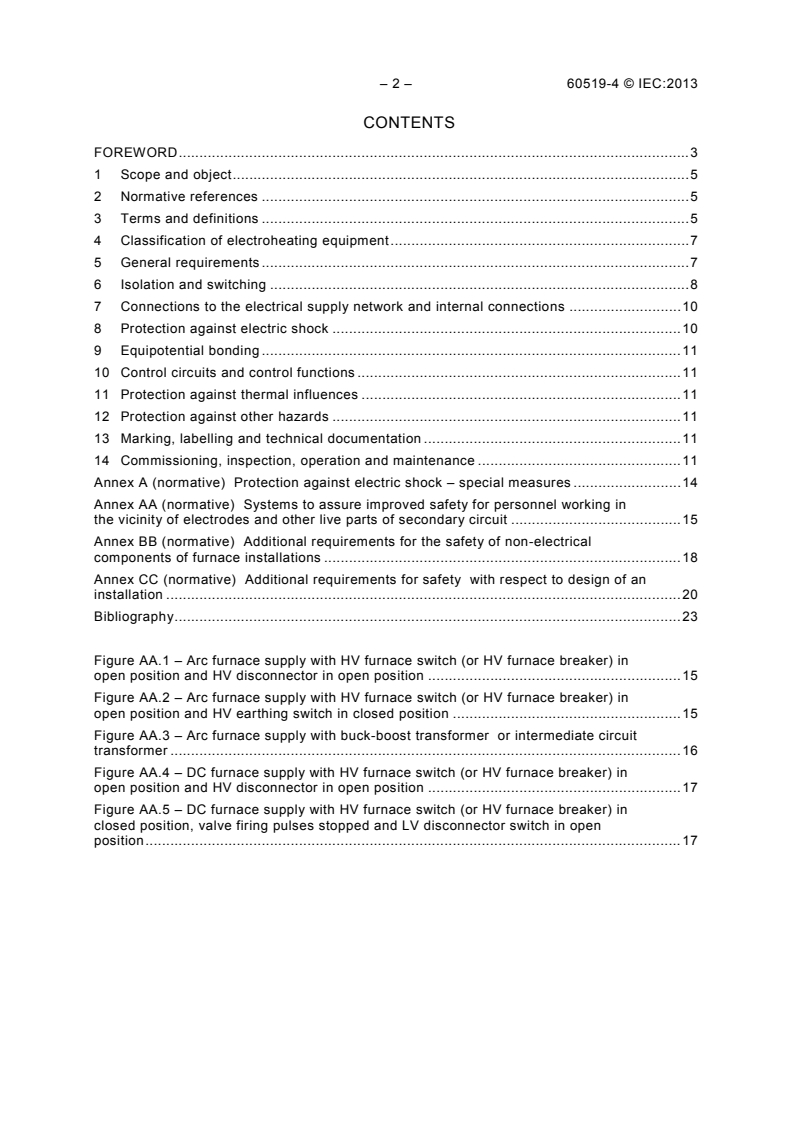
CONTENTS
FOREWORD . 3
1 Scope and object . 5
2 Normative references . 5
3 Terms and definitions . 5
4 Classification of electroheating equipment . 7
5 General requirements . 7
6 Isolation and switching . 8
7 Connections to the electrical supply network and internal connections . 10
8 Protection against electric shock . 10
9 Equipotential bonding . 11
10 Control circuits and control functions . 11
11 Protection against thermal influences . 11
12 Protection against other hazards . 11
13 Marking, labelling and technical documentation . 11
14 Commissioning, inspection, operation and maintenance . 11
Annex A (normative) Protection against electric shock – special measures . 14
Annex AA (normative) Systems to assure improved safety for personnel working in
the vicinity of electrodes and other live parts of secondary circuit . 15
Annex BB (normative) Additional requirements for the safety of non-electrical
components of furnace installations . 18
Annex CC (normative) Additional requirements for safety with respect to design of an
installation . 20
Bibliography . 23
Figure AA.1 – Arc furnace supply with HV furnace switch (or HV furnace breaker) in
open position and HV disconnector in open position . 15
Figure AA.2 – Arc furnace supply with HV furnace switch (or HV furnace breaker) in
open position and HV earthing switch in closed position . 15
Figure AA.3 – Arc furnace supply with buck-boost transformer or intermediate circuit
transformer . 16
Figure AA.4 – DC furnace supply with HV furnace switch (or HV furnace breaker) in
open position and HV disconnector in open position . 17
Figure AA.5 – DC furnace supply with HV furnace switch (or HV furnace breaker) in
closed position, valve firing pulses stopped and LV disconnector switch in open
position . 17
60519-4 © IEC:2013 – 3 –
INTERNATIONAL ELECTROTECHNICAL COMMISSION
____________
SAFETY IN ELECTROHEATING INSTALLATIONS –
Part 4: Particular requirements for arc furnace installations
FOREWORD
1) The International Electrotechnical Commission (IEC) is a worldwide organization for standardization comprising
all national electrotechnical committees (IEC National Committees). The object of IEC is to promote
international co-operation on all questions concerning standardization in the electrical and electronic fields. To
this end and in addition to other activities, IEC publishes International Standards, Technical Specifications,
Technical Reports, Publicly Available Specifications (PAS) and Guides (hereafter referred to as “IEC
Publication(s)”). Their preparation is entrusted to technical committees; any IEC National Committee interested
in the subject dealt with may participate in this preparatory work. International, governmental and non-
governmental organizations liaising with the IEC also participate in this preparation. IEC collaborates closely
with the International Organization for Standardization (ISO) in accordance with conditions determined by
agreement between the two organizations.
2) The formal decisions or agreements of IEC on technical matters express, as nearly as possible, an international
consensus of opinion on the relevant subjects since each technical committee has representation from all
interested IEC National Committees.
3) IEC Publications have the form of recommendations for international use and are accepted by IEC National
Committees in that sense. While all reasonable efforts are made to ensure that the technical content of IEC
Publications is accurate, IEC cannot be held responsible for the way in which they are used or for any
misinterpretation by any end user.
4) In order to promote international uniformity, IEC National Committees undertake to apply IEC Publications
transparently to the maximum extent possible in their national and regional publications. Any divergence
between any IEC Publication and the corresponding national or regional publication shall be clearly indicated in
the latter.
5) IEC itself does not provide any attestation of conformity. Independent certification bodies provide conformity
assessment services and, in some areas, access to IEC marks of conformity. IEC is not responsible for any
services carried out by independent certification bodies.
6) All users should ensure that they have the latest edition of this publication.
7) No liability shall attach to IEC or its directors, employees, servants or agents including individual experts and
members of its technical committees and IEC National Committees for any personal injury, property damage or
other damage of any nature whatsoever, whether direct or indirect, or for costs (including legal fees) and
expenses arising out of the publication, use of, or reliance upon, this IEC Publication or any other IEC
Publications.
8) Attention is drawn to the Normative references cited in this publication. Use of the referenced publications is
indispensable for the correct application of this publication.
9) Attention is drawn to the possibility that some of the elements of this IEC Publication may be the subject of
patent rights. IEC shall not be held responsible for identifying any or all such patent rights.
International Standard IEC 60519-4 has been prepared by IEC technical committee 27:
Industrial electroheating and electromagnetic processing.
This fourth edition cancels and replaces the third edition published in 2006. This edition
constitutes a technical revision.
This edition includes the following significant technical changes with respect to the previous
edition:
– The structure has been amended and adjusted to IEC 60519-1:2010;
– The classification (Clause 4) has been adapted to details with respect to secondary
voltage in electric arc furnace installations;
– All provisions have been redrafted and the text is more concise with respect to EAF;
– Annexes AA, BB and CC have been restructured, with respect to details concerning high
voltage designs and non-electrical issues, however to be aware of in those installations.
– 4 – 60519-4 © IEC:2013
The text of this standard is based on the following documents:
FDIS Report on voting
27/904/FDIS 27/928/RVD
Full information on the voting for the approval of this standard can be found in the report on
voting indicated in the above table.
This publication has been drafted in accordance with the ISO/IEC Directives, Part 2.
A list of all the parts of IEC 60519 series, under the general title Safety in electroheating
installations, can be found on the IEC website.
The clauses of parts of the IEC 60519 series (hereinafter called Particular Requirements)
supplement or modify the corresponding clauses of IEC 60519-1:2010 (General requirements
hereinafter called Part 1).
This part of IEC 60519 is to be read in conjunction with Part 1. It supplements or modifies the
corresponding clauses of Part 1. Where the text indicates an "addition" to or a "replacement"
of the relevant provision of Part 1, these changes are made to the relevant text of Part 1.
Where no change is necessary, the words "This clause of Part 1 is applicable" are used.
When a particular subclause of Part 1 is not mentioned in this part, that subclause applies as
far as is reasonable.
Additional specific provisions to those in Part 1, given as individual clauses or subclauses, are
numbered starting from 101.
NOTE The following numbering system is used:
– subclauses, tables and figures that are numbered starting from 101 are additional to those in Part 1;
– unless notes are in a new subclause or involve notes in Part 1, they are numbered starting from 101, including
those in a replaced clause or subclause;
– additional annexes are lettered AA, BB, etc.
The committee has decided that the contents of this publication will remain unchanged until
the stability date indicated on the IEC web site under "http://webstore.iec.ch" in the data
related to the specific publication. At this date, the publication will be
• reconfirmed,
• withdrawn,
• replaced by a revised edition, or
• amended.
60519-4 © IEC:2013 – 5 –
SAFETY IN ELECTROHEATING INSTALLATIONS –
Part 4: Particular requirements for arc furnace installations
1 Scope and object
This clause of Part 1 is replaced by the following.
Replacement:
This part of IEC 60519 provides particular safety requirements for electric arc furnace
installations and its operating and maintenance personnel.
These safety provisions concern the protection of persons and the environment against
dangers of electrical origin and also against certain dangers of non-electrical origin.
This standard is applicable to electroheating installations such as:
a) Furnaces for direct arc heating, forming arcs between the electrode and metal such as the
electric arc furnace using alternating current (EAFac) or direct current (EAFdc), and ladle
furnace (LF);
b) Furnaces for arc-resistance heating forming arcs between the electrode and the charge
material or heating the charge material by the Joule effect, such as the submerged arc
furnace using alternating current (SAFac), or direct current (SAFdc).
NOTE For purposes of this document abbreviation EAF is used for all kinds of electric arc furnace installations.
2 Normative references
This clause of Part 1 is applicable with the following additions.
Additions:
IEC 60519-1:2010, Safety in electroheating installations – Part 1: General requirements
IEC/TS 60479-1, Effects of current on human beings and livestock – Part 1: General aspects
IEC 60676, Industrial electroheating equipment – Test methods for direct arc furnaces
IEC 60683, Industrial electroheating equipment – Test methods for submerged-arc furnaces
3 Terms and definitions
This clause of Part 1 is applicable with the following additions.
Additions:
NOTE 101 General definitions can be found in the IEC 60050 series, International Electrotechnical Vocabulary.
Terms relating to industrial electroheat are defined in IEC 60050-841. Terms relating to EAF and SAF are also
defined in IEC 60676 and IEC 60683.
– 6 – 60519-4 © IEC:2013
3.101
arc furnace
furnace with a vessel, in which a metallic charge is heated mainly by electric arc using
alternating current (EAFac) or direct current (EAFdc)
[SOURCE: IEC 60050-841:2004, 841-26-05, modified – the definition has been modified and
abbreviations have been added]
3.102
arc furnace transformer
transformer changing medium/high voltage electrical supply to low voltage and high current
for an EAF
[SOURCE: IEC 60050-841:2004, 841-26-55, modified – the definition has been modified]
3.103
electric arc furnace using alternating current
EAFac
furnace, in which electric arcs between the electrodes and the process material are formed,
using three-phase alternating current
Note 1 to entry: Ladle furnace (LF) is operated under the same conditions.
Note 2 to entry: This note only applies to the French language.
[SOURCE: IEC 60050-841:2004, 841-26-07, modified – the term “alternating current arc
furnace” has been replaced by “electric arc furnace using alternating current”, the definition
has been modified, and an abbreviation and Notes 1 and 2 have been added]
3.104
electric arc furnace using direct current
EAFdc
furnace, in which the direct current is induced via a bottom electrode (anode) to the material
to be processed, forming arcs between the material and the electrode from top (cathode)
[SOURCE: IEC 60050-841:2004, 841-26-06, modified – the term “direct current arc furnace”
has been replaced by “electric arc furnace using direct current”, the definition has been
modified and an abbreviation has been added]
3.105
EAF electrode
part produced from high density graphite to transfer the electrical energy forming arcs
between tip and charge material
Note 1 to entry: In EAFdc, a bottom electrode (anode) is metallic or conductive material in the bottom of an EAF
and arcs are formed between the charge material and the graphite electrode from top (cathode).
[SOURCE: IEC 60050-841:2004, 841-26-38, modified – the term “arc furnace electrode” has
been replaced by “EAF electrode”, the definition has been modified and Note 1 has been
added]
3.106
electrode clamp
metallic, water cooled equipment to hold the electrode and supply current for arcing to the
electrode
[SOURCE: IEC 60050-841:2004, 841-26-39, modified – the definition has been editorially
improved]
60519-4 © IEC:2013 – 7 –
3.107
rectifier for direct current
device by means of which alternating current is transferred into direct current for EAFdc
3.108
shell
body of EAF made from steel and covered by a roof
[SOURCE: IEC 60050-841:2004, 841-26-20, modified – the term “arc furnace shell” has
been replaced by “shell” and the definition has been modified]
3.109
submerged arc furnace
SAF
vessel in which a combined arc / resistance heating is used to melt the charged material
[SOURCE: IEC 60050-841:2004, 841-26-12, modified – the term “submerged arc-resistance
furnace” has been replaced and the definition has been modified]
4 Classification of electroheating equipment
This clause of Part 1 is applicable, except as follows:
4.2 Classification of electroheating equipment according to process frequency
4.2.1 Direct current equipment
Addition:
EAFdc and SAFdc are classified as zero (0) frequency. It creates electromagnetic
disturbances.
4.2.101 Secondary voltage
Arc furnaces can be operated with a secondary voltage above 1 000 V a.c. (1 500 V d.c.)
under preconditions as follows:
a) the EAF is switched-on on the primary side of the transformer, since there is no possibility
to switch the installation on the secondary side (except installations shown in
Figures AA.3 and AA.5);
b) the insulation of the high current conductors to ground follows the minimum relevant
standard IEC 60071-1 for secondary voltages above 1 000 V a.c.
5 General requirements
This clause of Part 1 is applicable, except as follows:
5.1 General
Additions:
5.1.101 All high voltage equipment on the furnace transformer primary side is designed,
constructed and enclosed during any operation in accordance with IEC 61936-1:
a) For arc furnaces with secondary voltage up to 1 000 V a.c. or up to 1 500 V d.c. the
minimum relevant standard IEC 60664-1 applies;
b) standard furnace operation according to the conditions, mentioned in 6.101;
– 8 – 60519-4 © IEC:2013
c) visible information is given in the control room with respect to the status of the high
voltage switchgear.
5.2 Electroheating equipment
Additions:
5.2.101 Furnace installations exceeding 1 000 V a.c. shall take into account ionization
phenomena due to metallic vapour and pollution at high temperatures which may occur.
Insulation and distance between the electric phases shall be considered respectively.
5.2.102 Devices necessary for the operation (i.e. local control facilities, valve stands, lances
and manipulators) of the furnace shall be arranged within easy reach of the operator and
sufficient protection against live parts.
5.2.103 Devices for operation shall be designed and placed to prevent their unintended
activation. Devices for operation with plug connections shall be mechanically locked and shall
be designed different to other network connector.
5.2.104 Electrical equipment installed near components with high temperatures during
operation shall have sufficient thermal strength and protection.
5.2.105 Precautions shall be taken to avoid any hazard to persons due to transient voltages
which might occur during normal operation in circuits comprising transformers, inductors,
capacitors and rectifiers for direct current. Equipment shall be designed to suppress and/or
withstand high voltages (above 1 000 V) which are normal in the operation of an arc furnace.
5.2.106 Electrical equipment shall be arranged in such way, that it does not deteriorate
during normal operation due to physical and chemical effects, including heat load close to the
furnace and pollution or electromagnetic forces, created by the current during operation. In
case it is necessary, suitable measures shall be taken, i.e. gutters or protective channels.
5.6 Electromagnetic compatibility
5.6.1
Addition:
In case of EAFdc, measures shall be taken to avoid the strong magnetic field on electrical
devices, i.e. video displays, control units, valves, sensors; the magnetization of parts made
from steel shall be considered.
6 Isolation and switching
This clause of Part 1 is applicable, except as follows:
6.1 General
Addition:
In case of EAF, LF and SAF Emergency-Stop devices shall interrupt electrical power supply to
the furnace and stop all movements. Regarding EAF, the shell and electrodes shall be
brought into safe position in case it is required. Furnace cooling systems shall be kept in
function.
Additional subclauses:
60519-4 © IEC:2013 – 9 –
6.101 Switching-off
The system shall be switched-off and earthed as shown in Annex AA prior any access is
allowed to the roof of an arc furnace or before working in the vicinity of the electrodes,
including the bottom electrodes of an EAFdc. Means shall be provided to prevent any
unexpected connection of the system. Visual inspection of open circuit breaker or
disconnector is necessary (e.g. by CCTV- Closed Circuit Television). Any equipment under
power in the vicinity shall be shielded effectively (for exceptions, see 8.2.102.)
During the status: “furnace breaker OFF”, all jobs, which are defined under EAF operation
conditions, can be carried out, as long as safety measures, see 14.3.106, are considered.
Normal EAF operation conditions are:
– slag level measurement;
– slipping and changing of EAF electrodes;
– refining;
– temperature measuring and sampling;
– tapping;
– deslagging;
– charging of scrap or other material etc.;
– small repair work at refractory (patching);
– maintenance of tapping hole and
– all comparable work related to exposure of the personnel.
Corresponding to IEC 61936-1 means to protect the persons working on electrical installations
shall be valid.
6.102 Buck-boost supply systems
Buck-boost supply systems (see Figure AA.3) need special care in case the operator has to
work on the electrodes. Prior to any contact with the electrodes, the furnace shall be
switched-off and all low-voltage connectors shall be earthed safely and solidly.
6.103 Special relays
Special relays for current and voltage shall trip the high-voltage circuit-breaker at any fault of
the system during the condition “Furnace-OFF” to ensure that the current-time-function C1
according to IEC/TS 60479-1 will not be exceeded.
6.104 Protection against overcurrent
6.104.1 Relevant, protective measures against overcurrent shall be provided in accordance
with IEC 60364-4-43 and IEC 60204-1.
Protective measures against overcurrent (overloads and short circuits) shall be provided,
even if in excess of the scope specified in these standards.
NOTE IEC 60364-4-43 refers to the protection of cables and wiring up to 1 000 V.
6.104.2 The circuit breaker used to connect the electroheating installation to the power
supply shall be capable to switch-off safely all current, which may occur, including fault
current.
When two switches are arranged in series or parallel, they shall be capable of carrying and
switching-off all current safely which may arise, including fault currents.
– 10 – 60519-4 © IEC:2013
7 Connections to the electrical supply network and internal connections
This clause of Part 1 is applicable.
8 Protection against electric shock
This clause of Part 1 is applicable, except as follows:
8.2 Direct contact – special measures
Replacement:
8.2.101 General
Direct contact with live parts shall not be permitted. However, using special equipment and
tools designed for this purpose, certain operational procedures may allow contact with live
parts, which shall be agreed with local authorities.
8.2.102 Special conditions for SAF
In case of SAFac or SAFdc, in continuous operation, the inspection of the electrode paste
level, electrode additions or welding of electrode casings will be permitted on live parts at
voltages above 1 000 V a.c. or 1 500 V smooth d.c. under the following conditions, to be
fulfilled simultaneously:
– the rated voltage of the installation does not exceed 2 400 V a.c. or 3 000 V smooth d.c.;
– redundant insulation between support structure of electrode working platform and ground
(steel structure);
– wooden working platform;
– redundant insulation of crane for electrodes to ground;
– separation of working platform to ground;
– separation walls shall exceed live electrodes by at least 300 mm;
– only instructed and authorized personnel is able to access to the working platform
(restricted by lockable doors);
– ladders of non-conductive material shall be used;
– tools (e.g. welding machine, grinding machine) shall be insulated to ground;
– information signs to be installed according to IEC 60519-1:2010, 13.2.
8.3 Indirect contact – special measures
Replacement:
General
8.3.101
All accessible metal parts at the arc furnace, which are liable to become accidentally live in
the event of an insulation fault, shall be electrically connected to an earth terminal or to an
earth contact of the connector plug by the shortest possible path, as safely and solidly as
possible.
8.3.102 Protection against overvoltage
Special precautions shall be taken to avoid excessive overvoltages on the primary side and
on the secondary side of the arc furnace transformer, which could damage the installation.
60519-4 © IEC:2013 – 11 –
9 Equipotential bonding
This clause of Part 1 is applicable, except as follows:
9.4 Prohibition of the use of earth as part of an active circuit
Addition:
9.4.101 Tilt tracks shall not be used as return circuit.
10 Control circuits and control functions
This clause of Part 1 is applicable.
11 Protection against thermal influences
This clause of Part 1 is applicable.
12 Protection against other hazards
This clause of Part 1 is applicable.
13 Marking, labelling and technical documentation
This clause of Part 1 is applicable, except as follows:
13.1 Marking
13.1.1 Addition:
aa) identification of the principal connections (i.e. reference number of a drawing showing the
principal circuit of the furnace).
Addition:
13.1.101 The preferred location of the nameplate is on the main furnace control panel. In
case of significant changes in the installation, the nameplate shall be updated.
14 Commissioning, inspection, operation and maintenance
This clause of Part 1 is applicable, except as follows:
14.1 General requirements
Addition:
14.1.101 Additional requirements concerning the electrical isolation shall be issued by the
manufacturer in separate instructions to be posted in the switching area and/or instructions to
be given to the trained personnel, for which acknowledgment shall be given.
14.2 Commissioning and inspection
Addition:
– 12 – 60519-4 © IEC:2013
Tests shall be carried out for EAF/LF according to IEC 60676 and for SAF according to
IEC 60683.
14.3 Safety instructions for operation
Additions:
14.3.101 Personnel shall wear appropriate Personal Protective Equipment (PPE) suitable for
working at the furnace.
14.3.102 Access to current-carrying parts of the furnace, including the bottom electrode
system of an EAFdc, shall be permitted for trained personnel only.
14.3.103 Personnel shall be warned of possible hazards associated with the furnace. In
addition, they shall be warned of any hazardous area underneath the furnace and the area of
current carrying conductors by warning signs. Access to the hazardous areas shall be
prevented by barriers as far as practicable.
14.3.104 Changing and jointing of electrodes including work on electrode accessories shall
not be carried out unless protective measures, stated in 6.101 have been ensured. This also
applies for automatic electrode jointing.
14.3.105 Deviation from the requirements in 14.3.104 is permitted, in case safety of the
personnel is fully ensured by other suitable precautions (for example, insulation of the
operator’s place, safe distance, use of insulated tools and contact with only one electrode).
14.3.106 Tools, lances (for oxygen, bath temperature) and other metallic devices to be used
at a furnace during operation shall be earthed effectively. Their accessible metal parts shall
be insulated or only be used by personnel insulated against earth (e.g. standing on an
insulated platform). Where practicable, the length of any device, including car charger arms,
shall be such that any approach to the electrode is prevented. In case this is not possible,
proper operating procedures shall be defined in the operation manual by the manufacturer
and practised (i.e. electrodes are raised and held raised during operation). In case of an
automatic lance, it shall be earthed adequately and angled so that it is dipped into the metal
well away from the electrodes.
The above requirements do not necessarily apply to EAFdc where alternative adequate
precautions shall be taken to avoid any voltage hazardous to personnel.
14.4 Instructions for maintenance work
Additions:
14.4.101 Suitable safety precautions shall be taken servicing the furnace from inside to
prevent the electrodes, electrode pieces or scrap dropping into the furnace, especially in case
residual hot metal and liquid slag is inside the furnace.
14.4.102 The following precautions shall be taken during welding on the cooling system
inside the hot furnace:
a) Relevant cooling components shall be shut-off and drained of any liquid.
b) All drives of moveable components of the furnace, which are hazardous, shall be
switched-off and blocked if necessary.
c) If any material is used to cover the hot parts of the furnace bottom and/or the hot heel, it
should not produce dangerous gases with increasing temperature.
60519-4 © IEC:2013 – 13 –
d) For heat protection of personnel doing the welding, a basket with thermal insulation is
recommended. The basket shall be built and maintained in accordance with national
standards.
e) The welding machines and other electric tools used for maintenance inside the furnace
shall be suitable and in accordance with national standards.
14.4.103 During maintenance on the secondary current conductors or near to them using
auxiliary voltages, access to all transformer terminals and windings shall be prevented, unless
those windings are short-circuited and earthed, since dangerous voltages may be produced in
the other electrical windings.
Same precautions apply to instruments and control devices connected to the secondary side.
No maintenance on the tap changer and its components, no electrical welding and no working
on the secondary side of the transformer is permitted unless the high voltage windings of the
transformer are earthed adequately.
NOTE See also Annex AA and 9.4 of IEC 60519-1:2010.
– 14 – 60519-4 © IEC:2013
Annex A
(normative)
Protection against electric shock – special measures
Annex A of Part 1 is not applicable.
60519-4 © IEC:2013 – 15 –
Annex AA
(normative)
Systems to assure improved safety for personnel working in
the vicinity of electrodes and other live parts of secondary circuit
In view of increased voltages and/or new switching techniques, one of the following design
arrangements are required to safeguard the personnel:
a) high-voltage furnace switch and high-voltage furnace breaker in open position and high-
voltage disconnector in open position (see Figure AA.1);
b) high-voltage furnace switch or high-voltage furnace breaker in open position and high-
voltage earthing switch in closed position (see Figure AA.2);
c) for buck-boost (intermediate circuit) transformer: intermediate circuit switch in open
position and low-voltage earthing and short-circuiting devices in closed position (see
Figure AA.3);
d) high-voltage furnace switch or high-voltage furnace breaker in open position and high-
voltage disconnector switch in open position. Firing pulses are stopped (see Figure AA.4);
e) high-voltage furnace switch or high-voltage furnace breaker in closed position and low-
voltage disconnector switch in open position. Firing pulses are stopped (see Figure AA.5).
In case of Figures AA.1, AA.2, AA.4 and AA.5, no protection is provided against any
accidental energizing on the secondary side. To maintain the potential on the secondary side
of the transformer near to earth, additional means shall be provided.
IEC 1495/06
IEC 1495/06
Figure AA.1 – Arc furnace supply with HV Figure AA.2 – Arc furnace supply with HV
furnace switch (or HV furnace breaker) in furnace switch (or HV furnace breaker) in
open position and HV disconnector in open position and HV earthing switch in
open position closed position
– 16 – 60519-4 © IEC:2013
IEC 1497/06
Special indicators are provided to trip the HV circuit-breaker at any fault during the condition furnace off.
*
Figure AA.3 – Arc furnace supply with buck-boost transformer
or intermediate circuit transformer
60519-4 © IEC:2013 – 17 –
IEC 1495/06 IEC 1495/06
Figure AA.4 – DC furnace supply with HV Figure AA.5 – DC furnace supply with HV
furnace switch (or HV furnace breaker) in furnace switch (or HV furnace breaker) in
open position and HV disconnector in closed position, valve firing pulses
open position stopped and LV disconnector switch in
open position
Key to Figures AA.1 to AA.5
HV circuit breaker closed
HV disconnect switch open
HV furnace switch or HV furnace breaker open
or intermediate circuit switch open
HV earthing switch closed in accordance with fault level
LV short-circuiting and earthing devices closed to keep the potential near zero
NOTE Symbols shown indicate the required position of the switchgear to permit electrode handling and
associated operations to take place.
– 18 – 60519-4 © IEC:2013
Annex BB
(normative)
Additional requirements for the safety of non-electrical
components of furnace installations
NOTE The following safety requirements are minimum requirements.
BB.1 Water cooling system for shell and roof
BB.1.1 In addition to the requirements given in IEC 60519-1:2010, 5.8, for the electrical
systems, the following requirements apply.
BB.1.2 The cooling system shall be divided into a number of separately controlled and
monitored circuits. The flow rate and, where necessary, the outlet temperature, of each group
of parallel components shall be monitored. Any inadmissible deviation of the measured values
from the specified rated figures shall be considered as fault indication.
BB.1.3 Overpressure valves shall be provided for each closed cooling system. Adequate
means are necessary to ensure that no inadmissible overpressure occurs during
maintenance.
BB.1.4 Overpressure valves, hoist couplings and other outlets shall be, as far as
practicable, located outside the working area of the furnace.
BB.2 Evaporation cooling for shell and roof
BB.2.1 With evaporation cooling, the cooling system for the shell and roof shall be divided
into a number of separate circuits.
BB.2.2 In the individual circuits, the supply flow rates shall be monitored. Any inadmissible
deviation of the measured values from the specified rated figures shall be considered as fault
indication.
Each circuit shall be equipped with means of adjustment for the supply.
Moreover, it shall be possible to cut off each circuit separately by means of a non-return valve
and/or a manually operated valve.
BB.2.3 For all common components of the cooling system, such as the steam collecting
drum and pumps, the relevant national safety regulations apply.
BB.3 Tapping alternatives
BB.3.1 Bottom tapping (centric)
In the case water cool flanges are needed underneath the furnace, the water flow rate and
temperature in the return line shall be measured.
BB.3.2 Eccentric bottom tapping
See BB.3.1. The tapping procedure shall be supervised with the use of a tilt angle indicator.
60519-4 © IEC:2013 – 19 –
BB.4 Burners (supplementary burners)
At the burners, each supply shall be monitored adequately.
By suitable instructions and/or interlocks, it shall be ensured that the burners, which are not
provided with an ignition system, are only used in case the furnace is hot and the electric arcs
are ignited.
In case burners are also used to heat the charge during a shutdown period of the furnace, the
burners shall be equipped with a positive ignition device (i.e. a pilot flame).
– 20 – 60519-4 © IEC:2013
Annex CC
(normative)
Additional requirements for safety
with respect to design of an installation
CC.1 General
The philosophy of safety is always important; in case the safety cannot be strictly applied due
to technological developments, the following requirements are still to be met:
a) the risk of loss of insulation between the electrodes and the roof and furnace frame shall
be totally eliminated by adequate engineering measures;
b) all parts of the furnace, which are accessible to the operator, shall be earthed. In case
earthing is impossible or hazardous, special measures shall be taken to impede the
presence of persons in zones of risk;
c) in case the furnace tilting device fails during normal operation, adequate safety measures
are necessary;
d) any risk of electrical shocks, to which the crane operator may be exposed, shall be taken
into account in the furnace installations.
CC.2 Electrodes and their auxiliaries
CC.2.1 The electrode holding structure (gantry) (electrode positioning mechanism) shall be
insulated from the drive mechanism and from the furnace frame. Drive mechanism and frame
of the furnace shall be earthed adequately.
CC.2.2 Each electrode moving system shall be provided with two limit switches or
comparable devices. At the first limit switch, the movement of the electrode into top position
shall be stopped. The second switch or device is intended to detect any overshot (see also
CC.4.4).
NOTE A second limit switch is not necessary if end-of-travel stoppage is inherent in the design of the electrode
moving system.
CC.2.3 In case of self-baking electrodes (Söderberg electrodes), care shall be taken that the
upper clamp of the electrode is firmly closed prior the lower electrode clamp is opened. For
pneumatic type slipping systems, the air supply shall be backed-up by a pressurized air tank
of sufficient capacity.
CC.2.4 Mechanical locking, means to enable safe servicing, shall be provided, to prevent
any uncontrolled movement of the electrode mast.
CC.2.5 All motions of electrode moving systems shall be controlled by suitable interlocks or
similar devices to prevent any damage of the components.
CC.3 Water-cooled electrodes
CC.3.1 Combination electrodes
On water-cooled electrodes the flow rate and temperature of the non-conductive cooling water
is necessary and a leakage monitoring system shall be provided which interrupts the energy
supply to the furnace, shuts-off the water supply (supply and return lines) and lifts the
electrode.
60519-4 © IEC:2013 – 21 –
CC.3.2 Spray cooling
Electrodes cooled by spray water, shall be equipped with means to adjust the water supply
that the water evaporates totally on the surface of the electrode during operation including
tapping.
Adequate means are necessary to shut-off the spray cooling (possibly after temporizing) when
the furnace is switched-off.
CC.4 Furnace shell and roof
CC.4.1 Each type of furnace shell shall be earthed either directly or by connecting it to the
metallic shell-to-foundation assembly, which shall be earthed.
NOTE 1 The roof of a submerged arc furnace can be insulated from earth.
NOTE 2 The shell of a rotating submerged arc furnace can be earthed via a current-limiting res
...