

IEC 63136:2019
(Main)Electric dishwashers for commercial use - Test methods for measuring the performance
General Information
- Abstract
IEC 63136:2019 applies to manually loaded under-counter one-tank and one-tank hood-type electrically heated dishwashing machines for washing plates, dishes, glassware, cutlery and similar articles.
These machines are used in commercial kitchens, such as restaurants, canteens, hospitals and in businesses such as bakeries, butchers' shops, etc.
This document does not apply to commercial dishwashers with transport systems (flight-type and rack conveyor dishwashers) and utensil washers.
This document does not apply to undercounter water-change dishwashers.
This document does not apply to appliances designed exclusively for industrial purposes.
The object is to state and define the principal performance characteristics of electric dishwashers for commercial use and to describe the standard methods of measuring these characteristics.
The characteristics are measured by washing plates.
This document is concerned neither with safety nor with minimum performance requirements.
The contents of the corrigendum of March 2021 have been included in this copy.
- Status
- Published
- Publication Date
- 18-Sep-2019
- Technical Committee
- SC 59A - Electric dishwashers
- Drafting Committee
- PT 63136 - TC 59/SC 59A/PT 63136
- Current Stage
- PPUB - Publication issued
- Start Date
- 19-Sep-2019
- Completion Date
- 15-Oct-2019
Overview
IEC 63136:2019 is an international standard developed by the International Electrotechnical Commission (IEC) that specifies test methods for measuring the performance of electric dishwashers intended for commercial use. This standard focuses on manually loaded under-counter one-tank and one-tank hood-type electrically heated dishwashing machines used primarily in commercial kitchens, including restaurants, canteens, hospitals, bakeries, and butchers' shops.
The primary goal of IEC 63136:2019 is to define the principal performance characteristics of these commercial electric dishwashers and establish standardized methods for testing their cleaning effectiveness, energy consumption, water usage, and operating time. The performance tests involve washing plates and similar articles under controlled conditions in laboratory environments.
Importantly, this standard excludes commercial dishwashers with transport systems (such as flight-type and rack conveyor dishwashers), utensil washers, undercounter water-change dishwashers, and appliances designed exclusively for industrial purposes. It does not address safety considerations or minimum performance requirements; its sole focus is on test methodology and performance measurement.
Key Topics
Scope and Application: Covers under-counter one-tank and one-tank hood-type electrically heated dishwashers manually loaded in commercial environments.
Test Procedures: Defines detailed, repeatable test sequences for:
- Cleaning and resoiling performance using standardized soils on plates.
- Measurements of energy consumption during different cycle phases.
- Water consumption measurement and rinse aid evaluation.
- Program cycle and cleaning times under specified conditions.
Test Conditions:
- Water supply characteristics including temperature, hardness, and pressure.
- Electrical supply and ambient conditions during testing.
- Use of standard detergents and rinse aids for consistent test results.
- Conditioning of machines prior to testing.
Performance Indicators:
- Cleaning efficiency assessed by removal of standardized soil patterns from plates.
- Quantification of energy and water used per cleaning cycle.
- Timing measurement for operational cycles and ready-to-use modes.
Documentation and Reporting:
- Guidelines for recording laboratory data, machine parameters, test results, and evaluation sheets for cleaning performance.
Applications
IEC 63136:2019 provides significant practical value for stakeholders involved in the design, manufacturing, marketing, and compliance testing of commercial electric dishwashers. Applications include:
Product Development: Manufacturers can use the standardized test methods to benchmark dishwasher cleaning effectiveness and optimize energy and water efficiency.
Quality Control: Independent testing laboratories and certification bodies can apply IEC 63136 to verify dishwasher performance claims under consistent and internationally recognized conditions.
Purchasing Decisions: Commercial kitchen operators and facility managers can compare dishwasher models based on test results derived using this standard to inform purchase and usage strategies.
Regulatory Compliance: While the standard itself does not specify performance requirements, it supports regulatory frameworks by providing reliable and reproducible test methods needed to enforce energy and water consumption regulations.
Sustainability Initiatives: Accurate measurement of energy and water use supports organizations aiming to reduce environmental impact through efficient dishwasher operation.
Related Standards
Relevant standards and documents closely associated with IEC 63136 include:
EN 50593:2017 – This European standard served as a foundational reference during the development of IEC 63136 and shares similar test methodologies for commercial dishwashers.
IEC 60335 series – Safety standards for household and similar electrical appliances, including dishwashers, though IEC 63136 focuses exclusively on performance measurement, not safety.
ISO/IEC Directives, Part 2 – Provides guidelines on drafting international standards, which underpin the structure and format of IEC 63136.
IEC 63136 Corrigendum March 2021 – The latest corrigendum updates have been incorporated in this edition, ensuring accurate and current test procedures.
By adhering to IEC 63136:2019, manufacturers, laboratories, and end users can ensure reliable, comparable, and internationally recognized assessment of commercial electric dishwashers' cleaning performance, energy efficiency, and water consumption, promoting enhanced product quality and operational sustainability.
Relations
- Effective Date
- 05-Sep-2023
Frequently Asked Questions
IEC 63136:2019 is a standard published by the International Electrotechnical Commission (IEC). Its full title is "Electric dishwashers for commercial use - Test methods for measuring the performance". This standard covers: IEC 63136:2019 applies to manually loaded under-counter one-tank and one-tank hood-type electrically heated dishwashing machines for washing plates, dishes, glassware, cutlery and similar articles. These machines are used in commercial kitchens, such as restaurants, canteens, hospitals and in businesses such as bakeries, butchers' shops, etc. This document does not apply to commercial dishwashers with transport systems (flight-type and rack conveyor dishwashers) and utensil washers. This document does not apply to undercounter water-change dishwashers. This document does not apply to appliances designed exclusively for industrial purposes. The object is to state and define the principal performance characteristics of electric dishwashers for commercial use and to describe the standard methods of measuring these characteristics. The characteristics are measured by washing plates. This document is concerned neither with safety nor with minimum performance requirements. The contents of the corrigendum of March 2021 have been included in this copy.
IEC 63136:2019 applies to manually loaded under-counter one-tank and one-tank hood-type electrically heated dishwashing machines for washing plates, dishes, glassware, cutlery and similar articles. These machines are used in commercial kitchens, such as restaurants, canteens, hospitals and in businesses such as bakeries, butchers' shops, etc. This document does not apply to commercial dishwashers with transport systems (flight-type and rack conveyor dishwashers) and utensil washers. This document does not apply to undercounter water-change dishwashers. This document does not apply to appliances designed exclusively for industrial purposes. The object is to state and define the principal performance characteristics of electric dishwashers for commercial use and to describe the standard methods of measuring these characteristics. The characteristics are measured by washing plates. This document is concerned neither with safety nor with minimum performance requirements. The contents of the corrigendum of March 2021 have been included in this copy.
IEC 63136:2019 is classified under the following ICS (International Classification for Standards) categories: 97.040.40 - Dishwashers. The ICS classification helps identify the subject area and facilitates finding related standards.
IEC 63136:2019 has the following relationships with other standards: It is inter standard links to IEC 63136:2019/COR1:2021. Understanding these relationships helps ensure you are using the most current and applicable version of the standard.
IEC 63136:2019 is available in PDF format for immediate download after purchase. The document can be added to your cart and obtained through the secure checkout process. Digital delivery ensures instant access to the complete standard document.
Standards Content (Sample)
IEC 63136 ®
Edition 1.0 2019-09
INTERNATIONAL
STANDARD
NORME
INTERNATIONALE
colour
inside
Electric dishwasher for commercial use – Test methods for measuring the
performance
Lave-vaisselle électriques à usage collectif – Méthodes d'essai et de mesure de
l'aptitude à la fonction
All rights reserved. Unless otherwise specified, no part of this publication may be reproduced or utilized in any form
or by any means, electronic or mechanical, including photocopying and microfilm, without permission in writing from
either IEC or IEC's member National Committee in the country of the requester. If you have any questions about IEC
copyright or have an enquiry about obtaining additional rights to this publication, please contact the address below or
your local IEC member National Committee for further information.
Droits de reproduction réservés. Sauf indication contraire, aucune partie de cette publication ne peut être reproduite
ni utilisée sous quelque forme que ce soit et par aucun procédé, électronique ou mécanique, y compris la photocopie
et les microfilms, sans l'accord écrit de l'IEC ou du Comité national de l'IEC du pays du demandeur. Si vous avez des
questions sur le copyright de l'IEC ou si vous désirez obtenir des droits supplémentaires sur cette publication, utilisez
les coordonnées ci-après ou contactez le Comité national de l'IEC de votre pays de résidence.
IEC Central Office Tel.: +41 22 919 02 11
3, rue de Varembé info@iec.ch
CH-1211 Geneva 20 www.iec.ch
Switzerland
About the IEC
The International Electrotechnical Commission (IEC) is the leading global organization that prepares and publishes
International Standards for all electrical, electronic and related technologies.
About IEC publications
The technical content of IEC publications is kept under constant review by the IEC. Please make sure that you have the
latest edition, a corrigendum or an amendment might have been published.
IEC publications search - webstore.iec.ch/advsearchform Electropedia - www.electropedia.org
The advanced search enables to find IEC publications by a The world's leading online dictionary on electrotechnology,
variety of criteria (reference number, text, technical containing more than 22 000 terminological entries in English
committee,…). It also gives information on projects, replaced and French, with equivalent terms in 16 additional languages.
and withdrawn publications. Also known as the International Electrotechnical Vocabulary
(IEV) online.
IEC Just Published - webstore.iec.ch/justpublished
Stay up to date on all new IEC publications. Just Published IEC Glossary - std.iec.ch/glossary
details all new publications released. Available online and 67 000 electrotechnical terminology entries in English and
once a month by email. French extracted from the Terms and Definitions clause of
IEC publications issued since 2002. Some entries have been
IEC Customer Service Centre - webstore.iec.ch/csc collected from earlier publications of IEC TC 37, 77, 86 and
If you wish to give us your feedback on this publication or CISPR.
need further assistance, please contact the Customer Service
Centre: sales@iec.ch.
A propos de l'IEC
La Commission Electrotechnique Internationale (IEC) est la première organisation mondiale qui élabore et publie des
Normes internationales pour tout ce qui a trait à l'électricité, à l'électronique et aux technologies apparentées.
A propos des publications IEC
Le contenu technique des publications IEC est constamment revu. Veuillez vous assurer que vous possédez l’édition la
plus récente, un corrigendum ou amendement peut avoir été publié.
Recherche de publications IEC - Electropedia - www.electropedia.org
webstore.iec.ch/advsearchform Le premier dictionnaire d'électrotechnologie en ligne au
La recherche avancée permet de trouver des publications IEC monde, avec plus de 22 000 articles terminologiques en
en utilisant différents critères (numéro de référence, texte, anglais et en français, ainsi que les termes équivalents dans
comité d’études,…). Elle donne aussi des informations sur les 16 langues additionnelles. Egalement appelé Vocabulaire
projets et les publications remplacées ou retirées. Electrotechnique International (IEV) en ligne.
IEC Just Published - webstore.iec.ch/justpublished Glossaire IEC - std.iec.ch/glossary
Restez informé sur les nouvelles publications IEC. Just 67 000 entrées terminologiques électrotechniques, en anglais
Published détaille les nouvelles publications parues. et en français, extraites des articles Termes et Définitions des
Disponible en ligne et une fois par mois par email. publications IEC parues depuis 2002. Plus certaines entrées
antérieures extraites des publications des CE 37, 77, 86 et
Service Clients - webstore.iec.ch/csc CISPR de l'IEC.
Si vous désirez nous donner des commentaires sur cette
publication ou si vous avez des questions contactez-nous:
sales@iec.ch.
IEC 63136 ®
Edition 1.0 2019-09
INTERNATIONAL
STANDARD
NORME
INTERNATIONALE
colour
inside
Electric dishwasher for commercial use – Test methods for measuring the
performance
Lave-vaisselle électriques à usage collectif – Méthodes d'essai et de mesure de
l'aptitude à la fonction
INTERNATIONAL
ELECTROTECHNICAL
COMMISSION
COMMISSION
ELECTROTECHNIQUE
INTERNATIONALE
ICS 97.040.40 ISBN 978-2-8322-7409-5
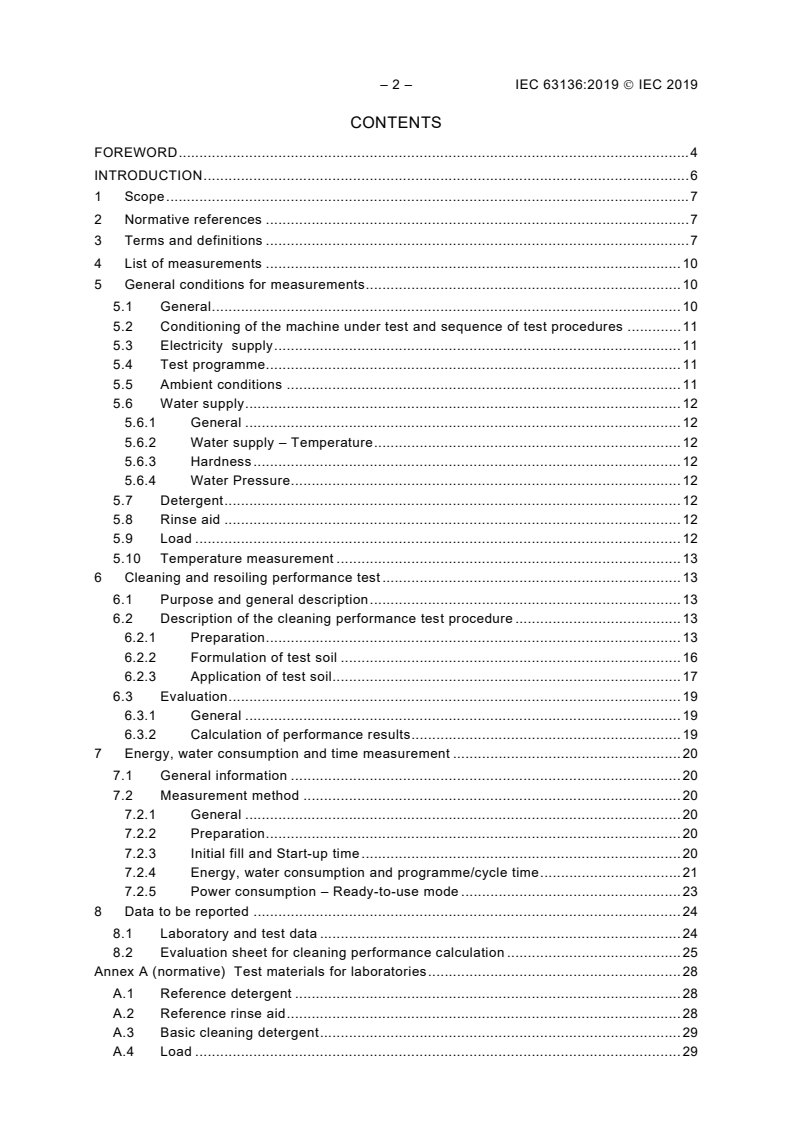
– 2 – IEC 63136:2019 IEC 2019
CONTENTS
FOREWORD . 4
INTRODUCTION . 6
1 Scope . 7
2 Normative references . 7
3 Terms and definitions . 7
4 List of measurements . 10
5 General conditions for measurements . 10
5.1 General . 10
5.2 Conditioning of the machine under test and sequence of test procedures . 11
5.3 Electricity supply . 11
5.4 Test programme . 11
5.5 Ambient conditions . 11
5.6 Water supply . 12
5.6.1 General . 12
5.6.2 Water supply – Temperature . 12
5.6.3 Hardness . 12
5.6.4 Water Pressure. 12
5.7 Detergent . 12
5.8 Rinse aid . 12
5.9 Load . 12
5.10 Temperature measurement . 13
6 Cleaning and resoiling performance test . 13
6.1 Purpose and general description . 13
6.2 Description of the cleaning performance test procedure . 13
6.2.1 Preparation . 13
6.2.2 Formulation of test soil . 16
6.2.3 Application of test soil. 17
6.3 Evaluation . 19
6.3.1 General . 19
6.3.2 Calculation of performance results . 19
7 Energy, water consumption and time measurement . 20
7.1 General information . 20
7.2 Measurement method . 20
7.2.1 General . 20
7.2.2 Preparation . 20
7.2.3 Initial fill and Start-up time . 20
7.2.4 Energy, water consumption and programme/cycle time . 21
7.2.5 Power consumption – Ready-to-use mode . 23
8 Data to be reported . 24
8.1 Laboratory and test data . 24
8.2 Evaluation sheet for cleaning performance calculation . 25
Annex A (normative) Test materials for laboratories . 28
A.1 Reference detergent . 28
A.2 Reference rinse aid . 28
A.3 Basic cleaning detergent . 29
A.4 Load . 29
A.5 Test pipette/dispenser. 30
A.6 Stainless steel holder and support . 31
A.7 Sesame seeds . 33
Annex B (informative) Flowchart – Test sequence . 34
Bibliography . 35
Figure 1 – Template with dot test pattern . 15
Figure 2 – Template – 3D view . 15
Figure 3 – Coarse Nigrosin kernels are ground in a chemical mortar . 17
Figure 4 – Mixed test soil . 17
Figure 5 – Plate with 33 dots after drying . 18
Figure 6 – Time schedule for test procedure . 18
Figure 7 – Evaluation example . 27
Figure A.1 – Pipette . 30
Figure A.2 – VWR Dispenser tip 1,25ml . 31
Figure A.3 – Holder for stainless steel support . 32
Figure A.4 – Stainless steel support . 33
Figure A.5 – Temperature probe positioning . 33
Figure B.1 – Flowchart for test sequence . 34
Table 1 – Laboratory data . 24
Table 2 – Dishwasher data . 24
Table 3 – Measured data . 25
Table 4 – Evaluation sheet. 26
Table A.1 – Detergent . 28
Table A.2 – Rinse aid . 29
Table A.3 – Basic cleaning detergent . 29
– 4 – IEC 63136:2019 IEC 2019
INTERNATIONAL ELECTROTECHNICAL COMMISSION
____________
ELECTRIC DISHWASHER FOR COMMERCIAL USE –
TEST METHODS FOR MEASURING THE PERFORMANCE
FOREWORD
1) The International Electrotechnical Commission (IEC) is a worldwide organization for standardization comprising
all national electrotechnical committees (IEC National Committees). The object of IEC is to promote
international co-operation on all questions concerning standardization in the electrical and electronic fields. To
this end and in addition to other activities, IEC publishes International Standards, Technical Specifications,
Technical Reports, Publicly Available Specifications (PAS) and Guides (hereafter referred to as "IEC
Publication(s)"). Their preparation is entrusted to technical committees; any IEC National Committee interested
in the subject dealt with may participate in this preparatory work. International, governmental and non-
governmental organizations liaising with the IEC also participate in this preparation. IEC collaborates closely
with the International Organization for Standardization (ISO) in accordance with conditions determined by
agreement between the two organizations.
2) The formal decisions or agreements of IEC on technical matters express, as nearly as possible, an international
consensus of opinion on the relevant subjects since each technical committee has representation from all
interested IEC National Committees.
3) IEC Publications have the form of recommendations for international use and are accepted by IEC National
Committees in that sense. While all reasonable efforts are made to ensure that the technical content of IEC
Publications is accurate, IEC cannot be held responsible for the way in which they are used or for any
misinterpretation by any end user.
4) In order to promote international uniformity, IEC National Committees undertake to apply IEC Publications
transparently to the maximum extent possible in their national and regional publications. Any divergence
between any IEC Publication and the corresponding national or regional publication shall be clearly indicated in
the latter.
5) IEC itself does not provide any attestation of conformity. Independent certification bodies provide conformity
assessment services and, in some areas, access to IEC marks of conformity. IEC is not responsible for any
services carried out by independent certification bodies.
6) All users should ensure that they have the latest edition of this publication.
7) No liability shall attach to IEC or its directors, employees, servants or agents including individual experts and
members of its technical committees and IEC National Committees for any personal injury, property damage or
other damage of any nature whatsoever, whether direct or indirect, or for costs (including legal fees) and
expenses arising out of the publication, use of, or reliance upon, this IEC Publication or any other IEC
Publications.
8) Attention is drawn to the Normative references cited in this publication. Use of the referenced publications is
indispensable for the correct application of this publication.
9) Attention is drawn to the possibility that some of the elements of this IEC Publication may be the subject of
patent rights. IEC shall not be held responsible for identifying any or all such patent rights.
International Standard IEC 63136 has been prepared by subcommittee 59A: Electric
dishwashers, of IEC technical committee 59: Performance of household and similar electrical
appliances.
EN 50593:2017 has served as a basis for the elaboration of this standard.
The text of this International Standard is based on the following documents:
CDV Report on voting
59A/223/CDV 59A/226/RVC
Full information on the voting for the approval of this International Standard can be found in
the report on voting indicated in the above table.
This document has been drafted in accordance with the ISO/IEC Directives, Part 2.
In this standard, the following print types are used:
• terms used throughout this standard which have been defined in Clause 3: in bold type
The committee has decided that the contents of this document will remain unchanged until the
stability date indicated on the IEC website under "http://webstore.iec.ch" in the data related to
the specific document. At this date, the document will be
• reconfirmed,
• withdrawn,
• replaced by a revised edition, or
• amended.
IMPORTANT – The 'colour inside' logo on the cover page of this publication indicates
that it contains colours which are considered to be useful for the correct
understanding of its contents. Users should therefore print this document using a
colour printer.
– 6 – IEC 63136:2019 IEC 2019
INTRODUCTION
This first edition has been developed to provide a globally applicable and agreed method to
test the performance of electric dishwashers for commercial use.
ELECTRIC DISHWASHER FOR COMMERCIAL USE –
TEST METHODS FOR MEASURING THE PERFORMANCE
1 Scope
This document applies to manually loaded under-counter one-tank and one-tank hood-type
electrically heated dishwashing machines for washing plates, dishes, glassware, cutlery and
similar articles.
These machines are used in commercial kitchens, such as restaurants, canteens, hospitals
and in businesses such as bakeries, butchers' shops, etc.
This document does not apply to commercial dishwashers with transport systems (flight-type
and rack conveyor dishwashers) and utensil washers.
This document does not apply to undercounter water-change dishwashers.
This document does not apply to appliances designed exclusively for industrial purposes.
The object is to state and define the principal performance characteristics of electric
dishwashers for commercial use and to describe the standard methods of measuring these
characteristics.
The characteristics are measured by washing plates.
This document is concerned neither with safety nor with minimum performance requirements.
2 Normative references
The following documents are referred to in the text in such a way that some or all of their
content constitutes requirements of this document. For dated references, only the edition
cited applies. For undated references, the latest edition of the referenced document (including
any amendments) applies.
ISO 15510, Stainless steels – Chemical composition
3 Terms and definitions
For the purposes of this document, the following terms and definitions apply.
ISO and IEC maintain terminological databases for use in standardization at the following
addresses:
• IEC Electropedia: available at http://www.electropedia.org/
• ISO Online browsing platform: available at http://www.iso.org/obp
3.1
commercial dishwasher
electric dishwasher that is specially designed for use in commercial environments and that
cleans and rinses dishes, glasses, cutlery, and, in some cases, cooking utensils by chemical,
mechanical, thermal and electrical treatment
– 8 – IEC 63136:2019 IEC 2019
Note 1 to entry: Commercial dishwashers evaluated with a specific drying operation at the end of the programme
should be declared as such in the test report.
3.1.1
under-counter one-tank dishwasher
manually loaded, programmable, undercounter front loader with typically one detergent-
circulating zone and a fresh-water rinsing process
Note 1 to entry: The washware is cleaned using a detergent solution that is regenerated. The technical equipment
is geared to the performance that is required in the specific application.
3.1.2
hood-type dishwasher
manually loaded, programmable, hood-type, pass-through machine with typically one
detergent-circulating zone and a fresh-water rinsing process
3.2
operation
event that occurs during the dishwasher's programme, such as cleaning, rinsing or drying
3.3
programme
series of operations that are pre-defined within the dishwasher and that are declared by the
manufacturer as suitable for cleaning certain washware
3.4
cycle
complete cleaning process, as defined by the programme selected, consisting of a series of
operations (washing, rinsing, drying, etc.) and including any operations that occur after the
completion of the programme
Note 1 to entry: Examples of operations that can occur after the completion of the programme are refilling of the
boiler, heating, operation of pumps and fans.
3.5
programme time
time that is measured from the initiation of the programme (excluding any user-programmed
delay) until an end of programme indicator is showing the end of the programme
Note 1 to entry: If there is no end of programme indicator, the programme time is equal to the cycle time.
3.6
cycle time
time that is measured from the initiation of the programme (excluding any user-programmed
delay) until all activity ceases (i.e. the end of the cycle)
3.7
automatic dispenser
device activated automatically that injects or dispenses detergent or rinse agent one or more
times into the dishwasher at predetermined points in the dishwasher cycle
3.8
ready-to-use mode
mode after which the dishwasher has been filled with water, the water has been heated (ready
for operation) and the machine is ready to start the cycle as indicated in the instructions for
use
3.9
rack
removable support for holding washware in the dishwasher
3.10
energy-consuming element
electrical consumer (e.g. heaters, fans, pumps) in the dishwasher
Note 1 to entry: The control system is not considered as an energy-consuming element.
3.11
washware
materials and utensils that come into contact with foodstuffs and re-usable crates/containers
that are cleaned in a commercial dishwasher
Note 1 to entry: Examples of washware are plates, crockery, cutlery, kitchen equipment, glasses, pots, containers,
crates and trays made of materials such as porcelain, plastic, glass, stainless steel and silver as well as coated
materials.
3.12
treating agents
chemical products used to clean or rinse, as rinse aids or descalers, when treating washware
in dishwashers
3.12.1
detergent
chemical product used to remove soiling from washware, and which counteracts resoiling from
the detergent solution
3.12.2
detergent solution
water mixed with detergent in the detergent circulation tank
3.12.3
rinse aid
chemical agent added to the water in the final rinsing operation, which decreases the
interfacial tension of the rinse aid solution
Note 1 to entry: It improves the drying effect and reduces water marks.
3.12.4
rinse aid solution
supply water mixed with rinse aid used for fresh-water rinsing
3.13
pre-cleaning
removal of loose waste and leftover food on the washware and the emptying of hollow vessels
Note 1 to entry: Pre-cleaning is generally implemented by pushing the residue into waste containers and, if
possible, by rinsing the washware with water. Pre-cleaning reduces the soiling of the dishwasher and improves the
cleaning result.
3.14
ballast soil
artificial soil for testing certain machine characteristics
3.15
fresh-water rinsing
process after cleaning during which the washware is sprayed with a rinse aid solution to
remove residues of detergent solution, dissolved and undissolved dirt particles
3.16
drying
process in which the moisture drips, vaporises or evaporates from the surface of the
washware
– 10 – IEC 63136:2019 IEC 2019
3.17
cleaning
removal of soiling
3.18
re-soiling
soiling of the washware (e.g. on the rear side of the washware) by the cleaning process,
which causes a deterioration of the cleaning result
3.19
cleaning process
process including at least one washing process and one fresh-water rinsing process
3.20
operating time
period during which the dishwasher is operational
3.21
spray system
sum of all pipelines, jets and spray pipes required to circulate and spray detergent and rinse
aid solutions
3.22
water softener
device which reduces the hardness of water
3.23
start-up time
time needed for the initial fill
3.24
initial fill
first water filling process between activation of the machine and reaching the ready-to-use
mode
4 List of measurements
The performance and consumption characteristics are determined as follows:
– cleaning and resoiling performance test in accordance with Clause 6;
– energy, water consumption and time measurement in accordance with Clause 7.
5 General conditions for measurements
5.1 General
The dishwasher manufacturer’s instructions regarding installation and use of the commercial
dishwasher shall be followed, except if they stand in conflict. In this case, this document shall
prevail.
The cleaning and resoiling performance test in accordance with Clause 6 and the energy
and water consumption and time measurement in accordance with Clause 7 are done together.
Deactivate the automatic start for appliances with automatic start cycle when the door/hood is
closed.
No chemical agents other than the ones mentioned in 5.7 and 5.8 shall be used.
All testing shall be performed on the same machine.
Before commencing measurements, the commercial dishwasher shall be checked to ensure
that it is operating properly.
All tests shall be started with the appliances at the ambient conditions in accordance with 5.5.
For all tests, the appliance shall be free-standing in the room without any excess coverage
other than originally equipped. All protective surface cover foils shall be removed.
Test materials for laboratories are specified in Annex A.
5.2 Conditioning of the machine under test and sequence of test procedures
Before conducting the performance tests, the dishwasher shall be initially filled and dosed
with reference detergent (specified in 5.7) and reference rinse aid (specified in 5.8). No
additional cycles shall be carried out on the machine under test between the consecutive
steps of the procedures specified in Clauses 6 and 7. All parts of the machine shall be
inspected, and any residues shall be removed.
5.3 Electricity supply
The appliance is supplied at rated voltage ±2 % and shall be maintained at the appliance's
terminal throughout the test.
If the appliance has a rated voltage range, the tests are carried out at the nominal voltage of
the country where the appliance is intended to be used.
The supply frequency shall be at the rated frequency ±1 %
If a frequency range is indicated, then the test frequency shall be the nominal frequency of
the country in which the appliance is intended to be used.
The voltage and frequency shall be measured and recorded during the test.
5.4 Test programme
The programme to be tested shall be the one that cleans normally soiled washware
(standard cleaning cycle).
The manufacturer shall declare the programme to be used for testing.
5.5 Ambient conditions
The following ambient conditions shall be maintained throughout the measurements.
– ambient temperature of the room: (23 ± 2) °C;
– relative humidity: (55 ± 5) % RH;
– air velocity max: 1 m/s.
The limit value for the air velocity shall only apply to the room area where the drying of the
soiled plates is carried out (see 6.2.3).
The ambient temperature and the relative humidity shall be measured and recorded during the
test.
– 12 – IEC 63136:2019 IEC 2019
5.6 Water supply
5.6.1 General
The actual water temperature and pressure maintained during the tests shall be measured
and recorded. The maintained water hardness shall be measured.
5.6.2 Water supply – Temperature
The temperature of the supply water shall be (15 ± 2) °C.
5.6.3 Hardness
If the dishwasher is fitted with an integrated water softening unit, it shall be deactivated (set
to soft water supply). During testing, soft water shall have a total hardness of
2+ 2+
(Ca + Mg ) < 0,54 mmol/l .
NOTE Procedures to reach a defined hardness of water are described, for example, in IEC 60734.
5.6.4 Water Pressure
The flow pressure of the water supply shall be set to 240 kPa and shall be maintained within
the range ±20 kPa. If it is not possible to maintain the pressure within this range, a flow rate
of (15 ± 2) l/min shall be maintained.
5.7 Detergent
For the tests, solely the reference detergent shall be used (see Clause A.1).
The concentration shall be (3 ± 0,3) g/l for the tests.
The amount of detergent shall be calculated by the given concentration and the measured
water consumption of the previous operation.
The detergent shall be added by hand directly into the wash chamber.
Detergent from the same batch shall be used for the dishwasher under test.
The detergent manufacturer's specifications regarding storage and handling shall be observed.
5.8 Rinse aid
For the tests solely the reference rinse aid shall be used (see Clause A.2).
The dosing is done in accordance with the manufacturer’s instructions.
The concentration shall be set in accordance with the manufacturer’s instructions.
Rinse aid from the same batch shall be used for the dishwasher under test.
The rinse aid manufacturer's specifications regarding storage and handling shall be observed.
5.9 Load
The load is a rack for the appliance under test defined in Clause A.4.
The rack is loaded in accordance with the manufacturer’s instructions. The washware used
for test purposes is defined in Clause A.4.
Only washware with no visible damage on the surface, e.g. scratches or similar damage, and
free of any residues shall be used.
5.10 Temperature measurement
The temperature shall be measured every second and recorded during the cycle and reported.
The last rack used in the conditioning cycles with ballast soil (7.2.4) is equipped with a
temperature probe (with an accuracy of ±2 K) positioned in the centre of the upper surface of
the stainless-steel support fixed on the holder (see Clause A.6), whose exact position is the
first row on the left-hand side, at the front of the rack.
6 Cleaning and resoiling performance test
6.1 Purpose and general description
The purpose of this test is to evaluate the cleaning and resoiling performance and is
performed together with the energy and water consumption and time measurement, as
described in 7.2.4.
The procedure consists of the removal of the test soiling, applied in the form of 33 soil dots
per plate. After the dots are applied, the plates are air-dried under ambient conditions as
defined in 5.5.
To evaluate performance degradation during continuous operation, particles in accordance
with 6.2.2.3 are added directly into the wash tank before the machine cycle starts. For
statistical plausibility, in total five cycles shall be done in the preconditioned dishwasher
using the described cleaning solution and the standard settings of the dishwasher
manufacturer. The plates are evaluated by visual inspection at the end of the procedure. The
number of not completely removed soil dots, as well as the number of remaining sesame seed
particles on the plates, are counted and statistically analysed as described in the procedure
specified in 6.2.
If more than one rack is cleaned in one cycle, parameters referring to the number of racks
involved shall be considered accordingly.
6.2 Description of the cleaning performance test procedure
6.2.1 Preparation
6.2.1.1 Basic cleaning of plates
If new plates are used, follow the procedure in 6.2.1.2.
Before each test, all plates need to be pre-treated with the basic cleaning procedure. Plates
are pre-soaked using the basic cleaning detergent (see Clause A.3) with a dosage of
300 g ± 15 g per 10 l of fresh water at a temperature of 50 °C to 65 °C. The plates shall be
pre-soaked for at least 20 min followed by manual pre-scrapping, if needed, so that the soil or
other residues are completely removed from the plates' surfaces. In order to ensure a
complete removal of the basic detergent after basic plate cleaning, all plates shall be rinsed
with fresh water and washed in a dishwasher for two cycles. Only demineralized water with
conductivity < 80 µS (no chemicals) shall be used for the dishwasher to avoid any residuals
on the plates' surfaces.
After basic cleaning, the plates need to be completely air-dried and cooled down to ambient
temperature.
An alternative procedure can be applied if the same result is obtained (see 6.2.3).
– 14 – IEC 63136:2019 IEC 2019
Only completely dry plates at ambient conditions shall be used for the test.
6.2.1.2 Basic cleaning of new plates
If new plates are used for the test, the following procedure shall be applied. The basic
cleaning detergent (see Clause A.3) with a dosage of 300 g ± 15 g per 10 l tank volume shall
be used. The detergent is directly added into the wash tank. The new plates shall then be
washed for 10 subsequent cycles in the dishwasher with a wash temperature of 60 °C to
65°C and a rinse temperature of 80 °C to 85 °C. Load the rack with new plates, put it into the
dishwasher and start the subsequent cycles. When the 10 cycles are finished, drain the
dishwasher and refill it with fresh demineralized water. In order to remove any detergent
residues, the dishwasher shall then be run for one complete cycle with a cycle time ≥ 180 s
without the use of any chemicals.
6.2.1.3 Dishwasher
The dishwasher shall be preconditioned in accordance with the standard measuring procedure
described in 7.2.4.
6.2.1.4 Template for dot application
Figure 1 and Figure 2 show the template for the application of the dots.
Dimensions in millimetres
Figure 1 – Template with dot test pattern
Figure 2 – Template – 3D view
The thickness of the template should be between 1 mm and 3 mm.
The maximum diameter of the holes shall be 12 mm.
– 16 – IEC 63136:2019 IEC 2019
Recommended materials are stainless steel or rubber. A centralized position of the template
on the plate shall be ensured.
If a stiff material is used for the template, the flaps shall be bent upwards to allow the
template to hover at a maximum of 5 mm above the surface of the plate. The template shall
not come in contact with the test soil. One template should be sufficient for the preparation of
all plates.
6.2.1.5 Pipette/dispenser used for dot application
For application of the dots to the plate's surface, a repeater pipette with the required accuracy
shall be used (see Clause A.5).
6.2.2 Formulation of test soil
6.2.2.1 Ingredients
290 g cow's milk (3,5 % fat, pasteurized, homogenized)
0,2 g Nigrosin (CAS number 101357–32–8) (C.I. 50420)
80 g white and yellow egg mixed
NOTE 1 Example of egg: class M according to European egg labelling.
80 g white (granulated) table sugar
210 g wheat flour for pastry with 0,5 % mineral content in dry form
NOTE 2 Examples of white flour: in Germany, Type 405, Austria: Type 480; in Switzerland, "Weissmehl"; in Italy,
Tipo 00.
Use eggs of good quality with a mass of 50 g to 65 g at ambient condition. The eggs shall be
at least 7 days old, but not having passed their best before or use-by date. The eggs shall be
kept refrigerated until use. At least 3 eggs shall be used for the whisked egg.
The egg white and the egg yolk are mixed with a stick blender for 10 s in a bowl.
Any U.H.T. milk with 3,5 % fat content may be used. U.H.T. milk shall have a use-by or expiry
date of at least 1,5 months from the date of the test. U.H.T milk shall be refrigerated after
opening and shall be used within 2 days of opening.
6.2.2.2 Formulation
The coarse Nigrosin kernels are ground in a chemical mortar to a fine powder (Figure 3).
180 g of cow milk is poured into an 800 ml beaker.
The milk shall be added at a temperature of 6 °C to 8 °C.
The ingredients 0,2 g of Nigrosin, 80 g of sugar, 80 g of egg and 210 g of wheat flour are
added to the 180 g of cow's milk.
Blend together with a stick blender for 2 min. After completion, 110 g of additional cow's milk
is added. The mixture is manually stirred with a whisk or spatula to suspend residual
ingredients from the beaker walls. Afterwards the mixture is blended for another 2 min and set
aside for 30 min to remove air enclosures (Figure 4).
The created test soil can be used for a maximum of 3 h. If the test soiling is not used for a
while, plastic foil shall be used as a cover to minimize film build-up due to dehydration. If a
thin film exists, it can be mixed under to rehydrate the film fragments.
Figure 3 – Coarse Nigrosin kernels are ground in a chemical mortar
Figure 4 – Mixed test soil
6.2.2.3 Particles
To each rack, 10 g of white sesame seeds (see Clause A.7) are added directly into the
machine chamber/on top of the wash tank.
The sesame seeds are added immediately before the insertion of the rack containing the
soiled plates. The sesame seeds are prepared by sieving, using an upper mesh size of 2 mm
and a lower mesh size of 1 mm.
6.2.3 Application of test soil
The application and the drying process shall occur at ambient conditions as defined in 5.5.
The test soiling dots are applied on the front side of the plates only.
Centre the template in the middle of the plate. Use the repeater pipette to apply the 33 dots in
the middle of the given areas. Each dot shall have a weight between 0,024 g and 0,030 g,
corresponding to an average volume of about 25 µl. The total soil amount per plate shall be
0,9 g ± 0,1 g. Total drying time per rack shall be 2h and 20 min from commencing the soiling
process (application of the first dot). The soiling process per rack shall not exceed 20 min.
– 18 – IEC 63136:2019 IEC 2019
After application, the plates shall be stored in their serving orientation to dry, not covered or
stacked.
At the end of the 2 h drying period, the dots have dehydrated to dot sizes of
6,75 mm ± 1,00 mm. A soiled plate is shown in Figure 5.
Figure 5 – Plate with 33 dots after drying
If the specified sizes of the dots are not reached, the basic cleaning process of the plate
surface was not successful and thus there are still remaining residues on the plate surface, or
other parameters were not in range. This leads to altered cleaning performance behaviour
and therefore shall be avoided.
In total, 5 racks with soiled plates shall be prepared in series as described in Figure 6. At the
end of the 2 h drying time, the first rack is ready for the cleaning and resoiling performance
test, which is combined with the energy and water consumption and time measurement. The
test sequence defined under 7.2.4 and shown in the flow chart in Annex B shall be followed.
To each machine cycle, 10 g of sesame seeds are added directly into the machine
chamber/on top of the wash tank before a new rack is loaded.
A water meter complying with 7.2.1 shall be installed in the feed line of the dishwasher in
order to measure the water consumption.
Time schedule for test procedure is shown in Figure 6.
Figure 6 – Time schedule for test procedure
In order to calculate average cleaning results, each test consists of five repetitions. The
supply water volume refilled by the machine during the cycle shall be measured in order to
compensate for tank water discharge. In accordance with this volume, the detergent (3 g/l) is
manually added after each cycle in order to ensure a constant detergent concentration.
6.3 Evaluation
6.3.1 General
After each cycle, the rack containing the plates is immediately removed from the machine.
After the plates are dried, all plates are visually inspected for remaining dot soil residues and
sesame seed particles. The remaining dots and particles per plate are counted.
A remaining dot is counted if there are any traces visible after the cycle. Any remaining
sesame seed particles or fractions thereof are counted.
The evaluation time per plate is 10 s.
For the evaluation, the light conditions shall be as follows:
– colour temperature of 3 500 K to 4 500 K ("daylight" or "cool white" lamp);
– intensity of illumination measured at the position of evaluation shall be 1 000 lx to 1 500 lx.
For dot evaluation purposes, only the front side of the plate is considered.
For the evaluation of sesame seed particles, both the front and rear sides of the plate are
considered.
The found total numbers of sesame seed particles from both sides of the plate are added. See
Table 4.
6.3.2 Calculation of performance results
For statistical plausibility, the average results of the five cycles are considered to generate
the final result.
The cleaning performance is calculated using Formula (1):
T
NRD
X ⋅100 in % (1)
c
T
NAD
where:
T total number of remaining dots
NRD
T total number of applied dots
NAD
The resoiling performance is calculated using Formula (2):
T
NPF
X =
...