

IEC 60034-18-42:2017
(Main)Rotating electrical machines - Part 18-42: Partial discharge resistant electrical insulation systems (Type II) used in rotating electrical machines fed from voltage converters - Qualification tests
General Information
- Abstract
IEC 60034-18-42:2017 defines criteria for assessing the insulation system of stator/rotor windings of single or polyphase AC machines which are subjected to repetitive impulse voltages, such as those generated by pulse width modulation (PWM) converters, and are expected to experience and withstand partial discharge activity during service. It specifies electrical qualification tests on representative specimens to verify fitness for operation with voltage-source converters. It also describes an additional classification system which defines the limits of reliable performance under converter-fed conditions.
- Status
- Published
- Publication Date
- 17-Aug-2020
- Technical Committee
- TC 2 - Rotating machinery
- Drafting Committee
- MT 10 - TC 2/MT 10
- Current Stage
- PPUB - Publication issued
- Start Date
- 07-Feb-2017
- Completion Date
- 04-Feb-2017
Buy Documents
IEC 60034-18-42:2017 - Rotating electrical machines - Part 18-42: Partial discharge resistant electrical insulation systems (Type II) used in rotating electrical machines fed from voltage converters - Qualification tests Released:2/7/2017

IEC 60034-18-42:2017+AMD1:2020 CSV - Rotating electrical machines - Part 18-42: Partial discharge resistant electrical insulation systems (Type II) used in rotating electrical machines fed from voltage converters - Qualification tests Released:8/18/2020
Overview
IEC 60034-18-42:2017 is a key international standard published by the International Electrotechnical Commission (IEC) focusing on the qualification tests for partial discharge resistant electrical insulation systems (Type II) used in rotating electrical machines. These machines, including single and polyphase AC machines, are fed from voltage converters such as those operating with pulse width modulation (PWM). The document establishes essential criteria and test methods to ensure that insulation systems in stator and rotor windings can withstand repetitive impulse voltages and prevent partial discharge activity, thereby ensuring reliability and longevity under converter-fed conditions.
Key Topics
Partial Discharge Resistant Insulation Systems (Type II): The standard defines insulation systems specifically designed to resist the effects of partial discharges caused by repetitive impulse voltages generated by voltage source converters.
Voltage Stresses in Machine Windings: Detailed analysis of voltages stressing insulation at various points, including phase-to-phase, phase-to-ground, and turn-to-turn, tailored to both random-wound and form-wound winding designs.
Electrical Qualification Tests: Specifies standardized electrical tests for mainwall insulation, turn insulation, and stress control systems using impulse voltage simulations reflecting converter operation conditions.
Lifetime and Aging Assessment: Provides methodologies to evaluate and predict insulation system lifespan under converter-induced stress, including use of 50 Hz or 60 Hz life data to forecast performance in converter-fed scenarios.
Impulse Voltage Insulation Classes (IVIC): Introduction of a classification system outlining reliability limits of insulation performance during service with converter drives.
Test Specimen Preparation and Criteria: Defines requirements for specimen sampling, preparation, and pass/fail criteria for qualification to ensure consistency and repeatability in evaluating insulation systems.
Applications
IEC 60034-18-42:2017 is essential for manufacturers, designers, and testing laboratories involved in:
Design and manufacturing of converter-fed rotating electrical machines: Including industrial motors, generators, and variable speed drives requiring enhanced insulation resistance to partial discharge.
Qualification and verification of electrical insulating materials: Ensuring that insulation systems meet rigorous performance standards to prevent premature failure due to voltage impulses.
Quality assurance in electric motor production: Providing benchmark tests to certify insulation systems against converter-induced electrical stresses in diverse operating environments.
Research and development in insulation technology: Offering a structured testing framework to develop next-generation insulation systems with improved durability and reliability.
Industrial sectors utilizing high-performance electric drives: Such as renewable energy, transportation (electric vehicles, trains), and automation, where converter-fed machines are prevalent.
Related Standards
Professionals working with IEC 60034-18-42:2017 should also consider the following standards to complement their understanding and implementation:
IEC 60034 series: The broader set of standards covering rotating electrical machines, their performance, testing, and insulation systems.
IEC 60034-18-31: Pertains to electrical insulation systems resistant to partial discharge under converter supply, focusing on different insulation types.
IEC 60034-1: General requirements for rotating electrical machines, including ratings and testing protocols.
IEC 61800 series: Standards covering adjustable speed electrical power drive systems, providing context for converter-fed machine applications.
IEC 60243 and IEC 60664: Standards relating to electrical insulation coordination and testing methods for insulation in electrical equipment.
Keywords: IEC 60034-18-42, partial discharge resistant insulation, Type II insulation system, rotating electrical machines, voltage converters, pulse width modulation (PWM), electrical qualification tests, stator insulation, rotor insulation, impulse voltage, converter-fed machines, insulation lifetime, electrical stress testing, impulse voltage insulation class (IVIC).
Relations
- Effective Date
- 05-Sep-2023
- Effective Date
- 05-Sep-2023
Buy Documents
IEC 60034-18-42:2017 - Rotating electrical machines - Part 18-42: Partial discharge resistant electrical insulation systems (Type II) used in rotating electrical machines fed from voltage converters - Qualification tests Released:2/7/2017
IEC 60034-18-42:2017+AMD1:2020 CSV - Rotating electrical machines - Part 18-42: Partial discharge resistant electrical insulation systems (Type II) used in rotating electrical machines fed from voltage converters - Qualification tests Released:8/18/2020
Get Certified
Connect with accredited certification bodies for this standard

IMQ S.p.A. (Certification)
Italian electrical product certification.

SLG Prüf- und Zertifizierungs GmbH
German testing and certification body.

UL Solutions
Global safety science company with testing, inspection and certification.
Sponsored listings
Frequently Asked Questions
IEC 60034-18-42:2017 is a standard published by the International Electrotechnical Commission (IEC). Its full title is "Rotating electrical machines - Part 18-42: Partial discharge resistant electrical insulation systems (Type II) used in rotating electrical machines fed from voltage converters - Qualification tests". This standard covers: IEC 60034-18-42:2017 defines criteria for assessing the insulation system of stator/rotor windings of single or polyphase AC machines which are subjected to repetitive impulse voltages, such as those generated by pulse width modulation (PWM) converters, and are expected to experience and withstand partial discharge activity during service. It specifies electrical qualification tests on representative specimens to verify fitness for operation with voltage-source converters. It also describes an additional classification system which defines the limits of reliable performance under converter-fed conditions.
IEC 60034-18-42:2017 defines criteria for assessing the insulation system of stator/rotor windings of single or polyphase AC machines which are subjected to repetitive impulse voltages, such as those generated by pulse width modulation (PWM) converters, and are expected to experience and withstand partial discharge activity during service. It specifies electrical qualification tests on representative specimens to verify fitness for operation with voltage-source converters. It also describes an additional classification system which defines the limits of reliable performance under converter-fed conditions.
IEC 60034-18-42:2017 is classified under the following ICS (International Classification for Standards) categories: 01 - GENERALITIES. TERMINOLOGY. STANDARDIZATION. DOCUMENTATION; 29.160.01 - Rotating machinery in general; 33.120.30 - RF connectors. The ICS classification helps identify the subject area and facilitates finding related standards.
IEC 60034-18-42:2017 has the following relationships with other standards: It is inter standard links to IEC TS 60034-18-42:2008, IEC 60034-18-42:2017/AMD1:2020. Understanding these relationships helps ensure you are using the most current and applicable version of the standard.
IEC 60034-18-42:2017 is available in PDF format for immediate download after purchase. The document can be added to your cart and obtained through the secure checkout process. Digital delivery ensures instant access to the complete standard document.
Standards Content (Sample)
IEC 60034-18-42 ®
Edition 1.0 2017-02
INTERNATIONAL
STANDARD
NORME
INTERNATIONALE
colour
inside
Rotating electrical machines –
Part 18-42: Partial discharge resistant electrical insulation systems (Type II)
used in rotating electrical machines fed from voltage converters – Qualification
tests
Machines électriques tournantes –
Partie 18-42: Systèmes d’isolation électrique résistants aux décharges partielles
(Type II) utilisés dans des machines électriques tournantes alimentées par
convertisseurs de tension – Essais de qualification
All rights reserved. Unless otherwise specified, no part of this publication may be reproduced or utilized in any form
or by any means, electronic or mechanical, including photocopying and microfilm, without permission in writing from
either IEC or IEC's member National Committee in the country of the requester. If you have any questions about IEC
copyright or have an enquiry about obtaining additional rights to this publication, please contact the address below or
your local IEC member National Committee for further information.
Droits de reproduction réservés. Sauf indication contraire, aucune partie de cette publication ne peut être reproduite
ni utilisée sous quelque forme que ce soit et par aucun procédé, électronique ou mécanique, y compris la photocopie
et les microfilms, sans l'accord écrit de l'IEC ou du Comité national de l'IEC du pays du demandeur. Si vous avez des
questions sur le copyright de l'IEC ou si vous désirez obtenir des droits supplémentaires sur cette publication, utilisez
les coordonnées ci-après ou contactez le Comité national de l'IEC de votre pays de résidence.
IEC Central Office Tel.: +41 22 919 02 11
3, rue de Varembé Fax: +41 22 919 03 00
CH-1211 Geneva 20 info@iec.ch
Switzerland www.iec.ch
About the IEC
The International Electrotechnical Commission (IEC) is the leading global organization that prepares and publishes
International Standards for all electrical, electronic and related technologies.
About IEC publications
The technical content of IEC publications is kept under constant review by the IEC. Please make sure that you have the
latest edition, a corrigenda or an amendment might have been published.
IEC Catalogue - webstore.iec.ch/catalogue Electropedia - www.electropedia.org
The stand-alone application for consulting the entire The world's leading online dictionary of electronic and
bibliographical information on IEC International Standards, electrical terms containing 20 000 terms and definitions in
Technical Specifications, Technical Reports and other English and French, with equivalent terms in 16 additional
documents. Available for PC, Mac OS, Android Tablets and languages. Also known as the International Electrotechnical
iPad. Vocabulary (IEV) online.
IEC publications search - www.iec.ch/searchpub IEC Glossary - std.iec.ch/glossary
The advanced search enables to find IEC publications by a 65 000 electrotechnical terminology entries in English and
variety of criteria (reference number, text, technical French extracted from the Terms and Definitions clause of
committee,…). It also gives information on projects, replaced IEC publications issued since 2002. Some entries have been
and withdrawn publications. collected from earlier publications of IEC TC 37, 77, 86 and
CISPR.
IEC Just Published - webstore.iec.ch/justpublished
Stay up to date on all new IEC publications. Just Published IEC Customer Service Centre - webstore.iec.ch/csc
details all new publications released. Available online and If you wish to give us your feedback on this publication or
also once a month by email. need further assistance, please contact the Customer Service
Centre: csc@iec.ch.
A propos de l'IEC
La Commission Electrotechnique Internationale (IEC) est la première organisation mondiale qui élabore et publie des
Normes internationales pour tout ce qui a trait à l'électricité, à l'électronique et aux technologies apparentées.
A propos des publications IEC
Le contenu technique des publications IEC est constamment revu. Veuillez vous assurer que vous possédez l’édition la
plus récente, un corrigendum ou amendement peut avoir été publié.
Catalogue IEC - webstore.iec.ch/catalogue Electropedia - www.electropedia.org
Application autonome pour consulter tous les renseignements
Le premier dictionnaire en ligne de termes électroniques et
bibliographiques sur les Normes internationales,
électriques. Il contient 20 000 termes et définitions en anglais
Spécifications techniques, Rapports techniques et autres
et en français, ainsi que les termes équivalents dans 16
documents de l'IEC. Disponible pour PC, Mac OS, tablettes
langues additionnelles. Egalement appelé Vocabulaire
Android et iPad.
Electrotechnique International (IEV) en ligne.
Recherche de publications IEC - www.iec.ch/searchpub
Glossaire IEC - std.iec.ch/glossary
65 000 entrées terminologiques électrotechniques, en anglais
La recherche avancée permet de trouver des publications IEC
en utilisant différents critères (numéro de référence, texte, et en français, extraites des articles Termes et Définitions des
comité d’études,…). Elle donne aussi des informations sur les publications IEC parues depuis 2002. Plus certaines entrées
projets et les publications remplacées ou retirées. antérieures extraites des publications des CE 37, 77, 86 et
CISPR de l'IEC.
IEC Just Published - webstore.iec.ch/justpublished
Service Clients - webstore.iec.ch/csc
Restez informé sur les nouvelles publications IEC. Just
Published détaille les nouvelles publications parues. Si vous désirez nous donner des commentaires sur cette
Disponible en ligne et aussi une fois par mois par email. publication ou si vous avez des questions contactez-nous:
csc@iec.ch.
IEC 60034-18-42 ®
Edition 1.0 2017-02
INTERNATIONAL
STANDARD
NORME
INTERNATIONALE
colour
inside
Rotating electrical machines –
Part 18-42: Partial discharge resistant electrical insulation systems (Type II)
used in rotating electrical machines fed from voltage converters – Qualification
tests
Machines électriques tournantes –
Partie 18-42: Systèmes d’isolation électrique résistants aux décharges partielles
(Type II) utilisés dans des machines électriques tournantes alimentées par
convertisseurs de tension – Essais de qualification
INTERNATIONAL
ELECTROTECHNICAL
COMMISSION
COMMISSION
ELECTROTECHNIQUE
INTERNATIONALE
ICS 29.160.01 ISBN 978-2-8322-3822-6
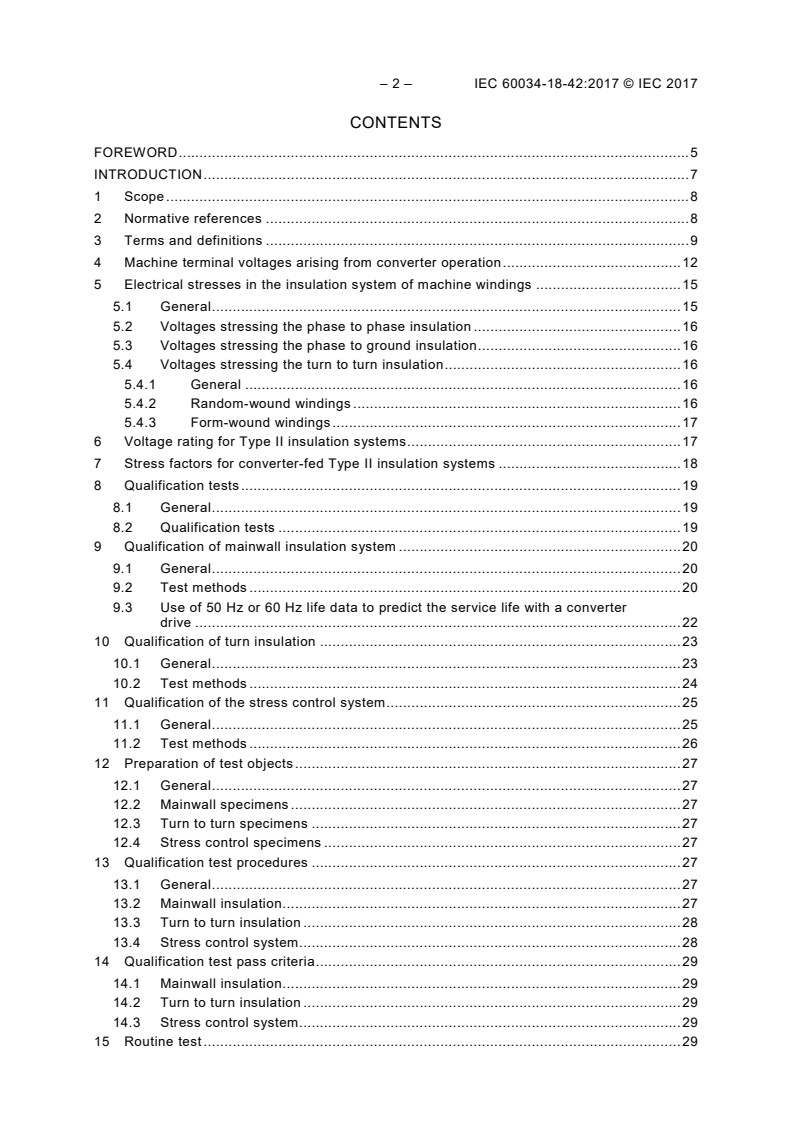
– 2 – IEC 60034-18-42:2017 © IEC 2017
CONTENTS
FOREWORD . 5
INTRODUCTION . 7
1 Scope . 8
2 Normative references . 8
3 Terms and definitions . 9
4 Machine terminal voltages arising from converter operation . 12
5 Electrical stresses in the insulation system of machine windings . 15
5.1 General . 15
5.2 Voltages stressing the phase to phase insulation . 16
5.3 Voltages stressing the phase to ground insulation . 16
5.4 Voltages stressing the turn to turn insulation . 16
5.4.1 General . 16
5.4.2 Random-wound windings . 16
5.4.3 Form-wound windings . 17
6 Voltage rating for Type II insulation systems . 17
7 Stress factors for converter-fed Type II insulation systems . 18
8 Qualification tests . 19
8.1 General . 19
8.2 Qualification tests . 19
9 Qualification of mainwall insulation system . 20
9.1 General . 20
9.2 Test methods . 20
9.3 Use of 50 Hz or 60 Hz life data to predict the service life with a converter
drive . 22
10 Qualification of turn insulation . 23
10.1 General . 23
10.2 Test methods . 24
11 Qualification of the stress control system . 25
11.1 General . 25
11.2 Test methods . 26
12 Preparation of test objects . 27
12.1 General . 27
12.2 Mainwall specimens . 27
12.3 Turn to turn specimens . 27
12.4 Stress control specimens . 27
13 Qualification test procedures . 27
13.1 General . 27
13.2 Mainwall insulation . 27
13.3 Turn to turn insulation . 28
13.4 Stress control system . 28
14 Qualification test pass criteria . 29
14.1 Mainwall insulation . 29
14.2 Turn to turn insulation . 29
14.3 Stress control system . 29
15 Routine test . 29
16 Optional screening tests . 30
17 Analysis, reporting and classification . 30
Annex A (informative) Contributions to ageing of the mainwall insulation . 31
A.1 Life time consumption of the mainwall insulation . 31
A.2 Calculation of the contributions to ageing from a 3-level converter drive . 31
A.3 Calculation to derive an equivalent voltage amplitude and frequency . 32
Annex B (informative) Examples of circuits for impulse testing . 34
B.1 Impulse test circuit using a semiconducting switch . 34
B.2 Typical waveform generated from the impulse generator . 34
B.3 Alternative impulse test circuit using a semiconducting switch . 35
Annex C (informative) Derivation of the short term endurance test voltage . 37
Annex D (informative) Derivation of the impulse voltage insulation class for the
machine insulation . 38
Annex E (normative) Derivation of an IVIC in the absence of a manufacturer’s
reference life line . 40
E.1 Derivation of an IVIC from endurance tests . 40
E.1.1 Mainwall insulation . 40
E.1.2 Turn insulation . 41
E.1.3 Stress control system . 41
E.2 Derivation of the IVIC X on the basis of satisfactory service experience . 41
E.3 Derivation of an IVIC S on the basis of satisfactory service experience . 41
Annex F (informative) Optional screening tests . 42
F.1 General . 42
F.2 Short term endurance test on the mainwall insulation . 42
F.3 Voltage withstand test . 42
Bibliography . 43
Figure 1 – Voltage impulse waveshape parameters . 12
Figure 2 – Waveform representing one complete cycle of the phase to phase voltage
at the terminals of a machine fed from a 3-level converter . 13
Figure 3 – Jump voltage (U ) at the terminals of a machine fed from a converter drive . 14
j
Figure 4 – Maximum voltage enhancement at the machine terminals at infinite
impedance as a function of cable length for various impulse rise times . 15
Figure 5 – Example of a random-wound design . 16
Figure 6 – Example of a form-wound design . 16
Figure 7 – Worst case voltage stressing the turn to turn insulation in a variety of
random-wound stators as a function of the rise time of the impulse . 17
Figure 8 – Example of a life curve for a Type II mainwall insulation system . 23
Figure 9 – Example of a life curve for turn insulation . 25
Figure A.1 – Representation of the phase to ground voltage at the terminals of a
machine fed from a 3-level converter . 31
Figure A.2 – Ratio of the life time consumption (y-axis) of impulse voltage (U ) to
pk/pk
fundamental voltage (U’ ) expressed as a percentage for various
pk/pk
impulse/fundamental frequency ratios (n=10) . 33
Figure B.1 – Example of a simple converter voltage simulation circuit . 34
Figure B.2 – Typical waveform generated from the impulse generator . 35
Figure B.3 – Example of a simple converter voltage simulation circuit . 36
– 4 – IEC 60034-18-42:2017 © IEC 2017
Figure B.4 – Typical waveform generated from the impulse generator . 36
Figure E.1 – Reference life line for mainwall insulation . 40
Table 1 – Examples of the values of characteristics of the terminal voltages for two
converter-fed machines. 13
Table 2 – Influence of features of the converter drive voltage on acceleration of
ageing of components of Type II insulation systems . 18
Table A.1 – Contribution to electrical ageing by 1 kHz impulses from a 3-level
converter as a percentage of the ageing from the 50 Hz fundamental voltage
(endurance coefficient of 10). 32
Table D.1 – Phase to ground test voltages according to IVIC for Type II insulation
systems . 38
Table D.2 – Impulse voltage insulation classes (IVIC) . 39
INTERNATIONAL ELECTROTECHNICAL COMMISSION
____________
ROTATING ELECTRICAL MACHINES –
Part 18-42: Partial discharge resistant electrical insulation systems
(Type II) used in rotating electrical machines fed from voltage
converters – Qualification tests
FOREWORD
1) The International Electrotechnical Commission (IEC) is a worldwide organization for standardization comprising
all national electrotechnical committees (IEC National Committees). The object of IEC is to promote
international co-operation on all questions concerning standardization in the electrical and electronic fields. To
this end and in addition to other activities, IEC publishes International Standards, Technical Specifications,
Technical Reports, Publicly Available Specifications (PAS) and Guides (hereafter referred to as “IEC
Publication(s)”). Their preparation is entrusted to technical committees; any IEC National Committee interested
in the subject dealt with may participate in this preparatory work. International, governmental and non-
governmental organizations liaising with the IEC also participate in this preparation. IEC collaborates closely
with the International Organization for Standardization (ISO) in accordance with conditions determined by
agreement between the two organizations.
2) The formal decisions or agreements of IEC on technical matters express, as nearly as possible, an international
consensus of opinion on the relevant subjects since each technical committee has representation from all
interested IEC National Committees.
3) IEC Publications have the form of recommendations for international use and are accepted by IEC National
Committees in that sense. While all reasonable efforts are made to ensure that the technical content of IEC
Publications is accurate, IEC cannot be held responsible for the way in which they are used or for any
misinterpretation by any end user.
4) In order to promote international uniformity, IEC National Committees undertake to apply IEC Publications
transparently to the maximum extent possible in their national and regional publications. Any divergence
between any IEC Publication and the corresponding national or regional publication shall be clearly indicated in
the latter.
5) IEC itself does not provide any attestation of conformity. Independent certification bodies provide conformity
assessment services and, in some areas, access to IEC marks of conformity. IEC is not responsible for any
services carried out by independent certification bodies.
6) All users should ensure that they have the latest edition of this publication.
7) No liability shall attach to IEC or its directors, employees, servants or agents including individual experts and
members of its technical committees and IEC National Committees for any personal injury, property damage or
other damage of any nature whatsoever, whether direct or indirect, or for costs (including legal fees) and
expenses arising out of the publication, use of, or reliance upon, this IEC Publication or any other IEC
Publications.
8) Attention is drawn to the Normative references cited in this publication. Use of the referenced publications is
indispensable for the correct application of this publication.
9) Attention is drawn to the possibility that some of the elements of this IEC Publication may be the subject of
patent rights. IEC shall not be held responsible for identifying any or all such patent rights.
International Standard IEC 60034-18-42 has been prepared by IEC Technical Committee 2:
Rotating machinery.
IEC 60034-18-42 cancels and replaces IEC TS 60034-18-42 (2008).
The text of this standard is based on the following documents:
FDIS Report on voting
2/1854/FDIS 2/1856/RVD
Full information on the voting for the approval of this International Standard can be found in
the report on voting indicated in the above table.
– 6 – IEC 60034-18-42:2017 © IEC 2017
This document has been drafted in accordance with the ISO/IEC Directives, Part 2.
NOTE A table of cross-references of all TC 2 publications can be found on the IEC TC 2 dashboard on the IEC
website.
The committee has decided that the contents of this document will remain unchanged until the
stability date indicated on the IEC website under "http://webstore.iec.ch" in the data related to
the specific document. At this date, the document will be
• reconfirmed,
• withdrawn,
• replaced by a revised edition, or
• amended.
IMPORTANT – The 'colour inside' logo on the cover page of this publication indicates
that it contains colours which are considered to be useful for the correct
understanding of its contents. Users should therefore print this document using a
colour printer.
INTRODUCTION
The approval of electrical insulation systems for use in rotating electrical machines fed from
voltage converters is set out in two International Standards. These standards separate the
systems into those which are not expected to experience partial discharge activity within
specified conditions in their service lives (Type I) and those which are expected to experience
and withstand partial discharge activity in any part of the insulation system throughout their
service lives (Type II). For both Type I and Type II insulation systems, the power drive system
integrator (the person responsible for co-ordinating the electrical performance of the entire
power drive system) shall inform the machine manufacturer what voltage will appear at the
machine terminals in service. The machine manufacturer will then decide upon the severity of
the tests appropriate for qualifying the insulation system. For insulation systems which have
been qualified through IEC 60034-18-41 or IEC 60034-18-42 for use in converter-fed
applications, an impulse voltage insulation class may be derived. This indicates the ability of
the insulation to withstand the electric stresses resulting from converter operation. For Type I
systems, the severity is based on the impulse rise time and the peak to peak voltage. For
Type II systems, the severity is additionally affected by the impulse voltage repetition rate and
the fundamental voltage characteristics. After installation of the converter/machine system, it
is recommended that the system integrator measures the phase to phase and phase to
ground voltages between the terminals and ground to check for compliance.
IEC 60034-18-41
Type I insulation systems are dealt with in IEC 60034-18-41. These systems are generally
used in rotating machines with rated voltage less than 700 V r.m.s. and tend to have random-
wound coils. In IEC 60034-18-41, the necessary normative references and definitions are
given together with a review of the effects arising from converter operation. Having
established the technical basis for the evaluation procedure, the conceptual approach and
test programmes are then described.
IEC 60034-18-42
In IEC 60034-18-42, tests are described for qualification of Type II insulation systems. These
insulation systems are generally used in rotating machines which have form-wound windings,
mostly rated above 700 V r.m.s. The qualification procedure is completely different from that
used for Type I insulation systems and involves destructive ageing of test objects under
accelerated conditions. The manufacturer requires a life curve (as described in IEC 60034-18-
32) for the insulation system that can be interpreted by use of appropriate calculations and/or
experimental procedures to provide an estimate of life under the service conditions with
converter drive. Great importance is attached to the qualification of any stress control system
that is used and testing here should be performed under sinusoidal and repetitive impulse
conditions applied separately. If the insulation system can be shown to provide an acceptable
life under the specified ageing conditions, it is qualified for use.
– 8 – IEC 60034-18-42:2017 © IEC 2017
ROTATING ELECTRICAL MACHINES –
Part 18-42: Partial discharge resistant electrical insulation systems
(Type II) used in rotating electrical machines fed from voltage
converters – Qualification tests
1 Scope
This part of IEC 60034 defines criteria for assessing the insulation system of stator/rotor
windings of single or polyphase AC machines which are subjected to repetitive impulse
voltages, such as those generated by pulse width modulation (PWM) converters, and are
expected to experience and withstand partial discharge activity during service. It specifies
electrical qualification tests on representative specimens to verify fitness for operation with
voltage-source converters. It also describes an additional classification system which defines
the limits of reliable performance under converter-fed conditions.
Although this document deals with voltage converters, it is recognised that there are other
types of converters that can create repetitive impulse voltages. For these converters, a similar
approach to testing can be used.
Qualification of insulation systems may not be required for rotating machines which are only
fed from voltage converters for starting and so they are excluded from this document.
2 Normative references
The following documents are referred to in the text in such a way that some or all of their
content constitutes requirements of this document. For dated references, only the edition
cited applies. For undated references, the latest edition of the referenced document (including
any amendments) applies.
IEC 60034-1:2010, Rotating electrical machines – Part 1: Rating and performance
IEC 60034-18-1:2010, Rotating electrical machines – Part 18-1: Functional evaluation of
insulation systems. General guidelines
IEC 60034-18-31, Rotating electrical machines – Part 18-31: Functional evaluation of
insulation systems – Test procedures for form-wound windings – Thermal evaluation and
classification of insulation systems used in rotating machines
IEC 60034-18-32, Rotating electrical machines – Part 18-32: Functional evaluation of
insulation systems – Test procedures for form-wound windings – Evaluation by electrical
endurance
IEC 60034-18-41:2014, Rotating electrical machines – Part 18-41: Partial discharge free
(Type I) electrical insulation systems used in rotating electrical machines fed from voltage
converters – Qualification and quality control tests
IEC TS 60034-27, Rotating electrical machines – Part 27: Off-line partial discharge
measurements on the stator winding insulation of rotating electrical machines
IEC TS 61934, Electrical insulating materials and systems – Electrical measurement of partial
discharges (PD) under short rise time and repetitive voltage impulses
IEC 62539, Guide for the statistical analysis of electrical insulation breakdown data
3 Terms and definitions
For the purposes of this document, the following terms and definitions apply.
ISO and IEC maintain terminological databases for use in standardization at the following
addresses:
• IEC Electropedia: available at http://www.electropedia.org/
• ISO Online browsing platform: available at http://www.iso.org/obp
3.1
partial discharge
PD
electric discharge that only partially bridges the insulation between electrical conductors
Note 1 to entry: It may occur inside or outside the insulation or adjacent to an electrical conductor.
3.2
partial discharge inception voltage
PDIV
lowest voltage at which partial discharges are initiated in the test arrangement when the
voltage applied to the test object is gradually increased from a lower value at which no such
discharges are observed
Note 1 to entry: With sinusoidal applied voltage, the PDIV is defined as the r.m.s. value of the voltage. With
impulse voltages, the PDIV is defined as the peak to peak voltage.
3.3
repetitive partial discharge inception voltage
RPDIV
minimum peak to peak impulse voltage at which more than five PD pulses occur on ten
voltage impulses of the same polarity
Note 1 to entry: This is a mean value for the specified test time and a test arrangement where the voltage applied
to the test object is gradually increased from a value at which no partial discharges can be detected.
3.4
peak (impulse) voltage
U
p
maximum numerical value of voltage reached during a unipolar voltage impulse (e.g. U in
p
Figure 1)
Note 1 to entry: For bipolar voltage impulses, it is half the peak to peak voltage.
3.5
steady state impulse voltage magnitude
U
a
final magnitude of the voltage impulse
SEE: Figure 1.
3.6
voltage overshoot
U
b
magnitude of the peak voltage in excess of the steady state impulse voltage
SEE: Figure 1.
– 10 – IEC 60034-18-42:2017 © IEC 2017
3.7
peak to peak impulse voltage
U’
pk/pk
peak to peak voltage at the impulse voltage repetition rate
SEE: Figure 2.
3.8
peak to peak voltage
U
pk/pk
peak to peak phase to phase voltage at the fundamental frequency
SEE: Figure 2.
Note 1 to entry: The definition of peak to peak voltage is clarified in Clause 4.
3.9
unipolar voltage impulse
voltage impulse, the polarity of which is either positive or negative
Note 1 to entry: The term impulse is used to describe the transient stressing voltage applied to the test object and
the term pulse is used to describe the partial discharge signal.
3.10
bipolar voltage impulse
voltage impulse, the polarity of which changes alternately from positive to negative or vice
versa
3.11
impulse voltage repetition rate
f
inverse of the average time between two successive impulses of the same polarity, whether
unipolar or bipolar
3.12
impulse rise time
t
r
time for the voltage to rise from 10 % to 90 % of its final value
SEE: Figure 1.
3.13
electrical insulation system
insulating structure containing one or more electrical insulating materials together with
associated conducting parts employed in an electrotechnical device
3.14
motorette
special test model used for the evaluation of the electrical insulation system for random-
wound windings
3.15
formette
special test model used for the evaluation of the electrical insulation system for form-wound
windings
3.16
electric stress
electric field in V/mm
3.17
rated voltage
U
N
voltage assigned by the manufacturer for a specified power frequency operating condition of a
machine and indicated on its rating plate
3.18
impulse voltage insulation class
IVIC
limits of the applied voltage for operation of a Type I or Type II converter-fed machine
Note 1 to entry: The limits are shown as severity levels for which the machine has been qualified.
Note 2 to entry: The severity levels are to be shown in the documentation for the machine.
3.19
fundamental frequency
first frequency, in the spectrum obtained from a Fourier transform of a periodic time function,
to which all the frequencies of the spectrum are referred
Note 1 to entry: For the purposes of this document, the fundamental frequency of the machine terminal voltage is
the one defining the speed of the converter-fed machine.
Note 2 to entry: It is calculated as the reciprocal of the time taken for one complete cycle of the applied voltage
(Figure 2).
3.20
impulse duration
interval of time between the first and last instants at which the instantaneous value of an
impulse reaches a specified fraction of its impulse magnitude or a specified threshold
3.21
jump voltage
U
j
change in voltage at the terminals of the machine occurring at the start of each impulse when
fed from a converter
SEE: Figure 3.
3.22
dc bus voltage
U
dc
voltage of the intermediate circuit of the voltage converter (dc-link-circuit)
Note 1 to entry: For a 2-level converter U is equal to U in Figure 1.
dc a
Note 2 to entry: For a multilevel converter, U is equal to ½ U minus the overshoot in Figure 2.
dc pk/pk
3.23
power drive system
PDS
complete drive module and rotating machine together with the connecting cable if necessary
3.24
voltage endurance coefficient
n
exponent of the inverse power model or exponential model on which the relationship between
life and stressing voltage amplitude for a specific insulation system depends
3.25
life
time to failure
– 12 – IEC 60034-18-42:2017 © IEC 2017
3.26
conductive slot coating
conductive paint or tape layer in intimate contact with the mainwall insulation in the slot
portion of the coil side, often called semi-conductive coating
Note 1 to entry: The purpose of the coating is to prevent slot discharges from occurring.
3.27
stress control coating
paint or tape on the surface of the mainwall insulation that extends beyond the conductive slot
coating in high-voltage stator bars and coils
Note 1 to entry: The purpose of the coating is to grade the surface electric stress.
3.28
stress control system
generic name for the combination of the conductive slot coating and stress control coating in
high-voltage stator bars and coils
3.29
maximum allowable peak to peak phase to ground voltage
U
IVIC
maximum allowable peak to peak phase to ground voltage in service
4 Machine terminal voltages arising from converter operation
The voltage appearing at the terminals of a converter-fed machine may be estimated using
IEC TS 61800-8 [1] and depends upon several characteristics of the PDS. In order to apply
this standard to the qualification and testing of the insulation system of a winding, it is
necessary to specify the required parameters of the voltage appearing at the machine
terminals (Clause 7).
U
p
0,9 U
p
0,1 U
p
t
r
t t
t
10 90
IEC
Key
U voltage
t time
Figure 1 – Voltage impulse waveshape parameters
The amplitude and rise time of the voltage at the machine terminals depend upon the
grounding system, various design aspects of the cable, the machine surge impedance and the
___________
Numbers in square brackets refer to the Bibliography.
U
U
b
U
a
presence of any filters that increase the impulse rise time. Examples of characteristics of
converter impulses at the machine terminals of two motors are given in Table 1.
Table 1 – Examples of the values of characteristics
of the terminal voltages for two converter-fed machines
Machine rating 3,3 kV 6,6 kV
Peak to peak voltage on the phase to ground insulation 5,4 kV 10,8 kV
Fundamental frequency 50/60 Hz 50/60 Hz
Number of levels for the converter voltage 5 3
Overshoot of the impulse voltage 60 % 60 %
Nominal voltage per step 650 V 3 kV
Impulse rise time at the motor terminals 1 µs 3 µs
Impulse repetition rate 1 kHz 900 Hz
IVIC required to qualify the insulation for this service (see Table D.2) 3 3
In the case of 2-level or other voltage converters, the impulses generate voltage overshoots
at the machine terminals, depending on the rise time of the voltage impulse at the converter
output and on the cable length and machine impedance. This voltage overshoot is created by
reflected waves at the interface between cable and machine or converter terminals due to
impedance mismatch. The voltage appearing at the machine terminals when fed from a 3-
level converter is shown in Figure 2. The figure shows one cycle at the fundamental
frequency.
The maximum change in voltage or jump voltage (U ) at the impulse repetition rate is shown in
j
Figure 3. This parameter is important in defining the voltage enhancement that can occur
across the first or last coil in the winding. A double jump transition (Figure 3) is possible but it
is the duty of the PDS integrator to ensure that the software controlling the PDS minimises its
occurrence. When the double jump transition occurs in multilevel converter voltages, its effect
is insignificant.
t
IEC
Figure 2 – Waveform representing one complete cycle of the phase to
phase voltage at the terminals of a machine fed from a 3-level converter
U
U′
pk/pk
U
pk/pk
– 14 – IEC 60034-18-42:2017 © IEC 2017
t
IEC
Figure 3 – Jump voltage (U ) at the terminals of a machine fed from a converter drive
j
Examples of the enhancements that are produced for various rise times and cable lengths are
given in Figure 4, where the worst case is shown, arising from an infinite impedance load. In
this case, the enhancement to the voltage for an impulse rise time of 1,0 µs is insignificant
below about 15 m and only exceeds a factor of 1,2 when the cable length is greater than
about 50 m.
Voltages above 2U can be produced at the terminals of the machine by converter drive
dc
double transitions and by a converter-fed drive algorithm that does not allow a minimum time
between successive pulses. Double transition occurs, for example, when one phase switches
from minus to plus dc bus voltage at the same instant that another phase switches from plus
to minus. This generates a 2U voltage wave which travels to the machine and can then
dc
increase in magnitude when reflected at the machine terminals. If there is no minimum
impulse time control in the converter drive and if the time between two impulses is matched
with the time constant of the cable between the converter and the machine, an over voltage
>2U can be generated at the machine terminals. The reflection can be reduced or prevented
dc
by using a filter in the converter, at the machine terminals or both.
In the event of an earth fault on one of the phases, further damage is avoided by protective
systems in the converter that switch it off.
U
U
j
2,1
2,0
1,9
1,8
1,7
1,6
1,5
1,4
1,3
1,2
1,1
1,0
1 10 100
l (m)
IEC
Key
● t 0,05 µs
r
○ t 0,1 µs
r
▼ t 0,2 µs
r
∇ t 1,0 µs
r
l cable length
Figure 4 – Maximum voltage enhancement at the machine terminals at infinite
impedance as a function of cable length for various impulse rise times
5 Electrical stresses in the insulation system of machine windings
5.1 General
If a winding experiences short rise time voltage impulses with significant magnitude, high
voltage stresses will be created in the following locations (Figures 5 and 6):
• between conductors in different phases
• between a conductor and ground
• between adjacent turns, generally in the line-end coil
• in the area of the stress control coating
Due to space and surface charge creation within the insulation components, the electric
stress is not only defined by the instantaneous voltage itself but also by the voltages that
have been stressing the insulation previously. Generally, it has been shown by experience
that, within certain limits valid for converter drive systems, the most significant stressing
parameter is the peak to peak voltage. This is also the reason why a unipolar voltage
produces the same stress as a bipolar voltage having a peak to peak voltage of the same
value.
U /U
p a
– 16 – IEC 60034-18-42:2017 © IEC 2017
a
b
1 1
d
a
b
e
c
c
IEC IEC
Key
a phase insulation/endwinding insulation 1 phase to phase
b mainwall insulation 2 phase to ground
c turn insulation 3 turn to turn
d conductive slot coating
e stress control coating
Figure 5 – Example of a Figure 6 – Example of a
random-wound design form-wound design
5.2 Voltages stressing the phase to phase insulation
The maximum voltage stress on the phase to phase insulation is determined by the design of
the winding and by the characteristics of the phase to phase voltage.
5.3 Voltages stressing the phase to ground insulation
The maximum voltage stress on the phase to ground insulation is determined by the design of
the winding and by the characteristics of the phase to ground voltage.
5.4 Voltages stressing the turn to turn insulation
5.4.1 General
The voltage stressing the turn insulation is determined by the jump values of the phase to
ground voltage (amplitude and rise time) and by the type of winding, number of coils and the
number and length of the turns. The distribution of the transient voltage depends upon the
relative position of the individual turns in the slots. Short rise time impulses result in the
voltage being unevenly distributed throughout the coils, with high levels of stress present
across the first two turns or last two turns, depending upon the winding design. The jump
voltage occurs at both the rising and falling edges of the phase to ground voltage. The turn to
turn voltage exhibits the same effect at each edge where there is either a positive or a
negative peak. If the distribution of voltage stressing the turn to turn insulation in a particular
design of rotating machine is known, the manufacturer may use this information to calculate
the fraction of j
...
IEC 60034-18-42 ®
Edition 1.1 2020-08
CONSOLIDATED VERSION
INTERNATIONAL
STANDARD
NORME
INTERNATIONALE
colour
inside
Rotating electrical machines –
Part 18-42: Partial discharge resistant electrical insulation systems (Type II)
used in rotating electrical machines fed from voltage converters – Qualification
tests
Machines électriques tournantes –
Partie 18-42: Systèmes d’isolation électrique résistants aux décharges partielles
(Type II) utilisés dans des machines électriques tournantes alimentées par
convertisseurs de tension – Essais de qualification
All rights reserved. Unless otherwise specified, no part of this publication may be reproduced or utilized in any form
or by any means, electronic or mechanical, including photocopying and microfilm, without permission in writing from
either IEC or IEC's member National Committee in the country of the requester. If you have any questions about IEC
copyright or have an enquiry about obtaining additional rights to this publication, please contact the address below or
your local IEC member National Committee for further information.
Droits de reproduction réservés. Sauf indication contraire, aucune partie de cette publication ne peut être reproduite
ni utilisée sous quelque forme que ce soit et par aucun procédé, électronique ou mécanique, y compris la photocopie
et les microfilms, sans l'accord écrit de l'IEC ou du Comité national de l'IEC du pays du demandeur. Si vous avez des
questions sur le copyright de l'IEC ou si vous désirez obtenir des droits supplémentaires sur cette publication, utilisez
les coordonnées ci-après ou contactez le Comité national de l'IEC de votre pays de résidence.
IEC Central Office Tel.: +41 22 919 02 11
3, rue de Varembé info@iec.ch
CH-1211 Geneva 20 www.iec.ch
Switzerland
About the IEC
The International Electrotechnical Commission (IEC) is the leading global organization that prepares and publishes
International Standards for all electrical, electronic and related technologies.
About IEC publications
The technical content of IEC publications is kept under constant review by the IEC. Please make sure that you have the
latest edition, a corrigendum or an amendment might have been published.
IEC publications search - webstore.iec.ch/advsearchform Electropedia - www.electropedia.org
The advanced search enables to find IEC publications by a The world's leading online dictionary on electrotechnology,
variety of criteria (reference number, text, technical containing more than 22 000 terminological entries in English
committee,…). It also gives information on projects, replaced and French, with equivalent terms in 16 additional languages.
and withdrawn publications. Also known as the International Electrotechnical Vocabulary
(IEV) online.
IEC Just Published - webstore.iec.ch/justpublished
Stay up to date on all new IEC publications. Just Published IEC Glossary - std.iec.ch/glossary
details all new publications released. Available online and 67 000 electrotechnical terminology entries in English and
once a month by email. French extracted from the Terms and definitions clause of
IEC publications issued between 2002 and 2015. Some
IEC Customer Service Centre - webstore.iec.ch/csc entries have been collected from earlier publications of IEC
If you wish to give us your feedback on this publication or TC 37, 77, 86 and CISPR.
need further assistance, please contact the Customer Service
Centre: sales@iec.ch.
A propos de l'IEC
La Commission Electrotechnique Internationale (IEC) est la première organisation mondiale qui élabore et publie des
Normes internationales pour tout ce qui a trait à l'électricité, à l'électronique et aux technologies apparentées.
A propos des publications IEC
Le contenu technique des publications IEC est constamment revu. Veuillez vous assurer que vous possédez l’édition la
plus récente, un corrigendum ou amendement peut avoir été publié.
Recherche de publications IEC - Electropedia - www.electropedia.org
webstore.iec.ch/advsearchform Le premier dictionnaire d'électrotechnologie en ligne au
La recherche avancée permet de trouver des publications IEC monde, avec plus de 22 000 articles terminologiques en
en utilisant différents critères (numéro de référence, texte, anglais et en français, ainsi que les termes équivalents dans
comité d’études,…). Elle donne aussi des informations sur les 16 langues additionnelles. Egalement appelé Vocabulaire
projets et les publications remplacées ou retirées. Electrotechnique International (IEV) en ligne.
IEC Just Published - webstore.iec.ch/justpublished Glossaire IEC - std.iec.ch/glossary
Restez informé sur les nouvelles publications IEC. Just 67 000 entrées terminologiques électrotechniques, en anglais
Published détaille les nouvelles publications parues. et en français, extraites des articles Termes et définitions des
Disponible en ligne et une fois par mois par email. publications IEC parues entre 2002 et 2015. Plus certaines
entrées antérieures extraites des publications des CE 37, 77,
Service Clients - webstore.iec.ch/csc 86 et CISPR de l'IEC.
Si vous désirez nous donner des commentaires sur cette
publication ou si vous avez des questions contactez-nous:
sales@iec.ch.
IEC 60034-18-42 ®
Edition 1.1 2020-08
CONSOLIDATED VERSION
INTERNATIONAL
STANDARD
NORME
INTERNATIONALE
colour
inside
Rotating electrical machines –
Part 18-42: Partial discharge resistant electrical insulation systems (Type II)
used in rotating electrical machines fed from voltage converters – Qualification
tests
Machines électriques tournantes –
Partie 18-42: Systèmes d’isolation électrique résistants aux décharges partielles
(Type II) utilisés dans des machines électriques tournantes alimentées par
convertisseurs de tension – Essais de qualification
INTERNATIONAL
ELECTROTECHNICAL
COMMISSION
COMMISSION
ELECTROTECHNIQUE
INTERNATIONALE
ICS 29.160.01 ISBN 978-2-8322-8795-8
IEC 60034-18-42 ®
Edition 1.1 2020-08
CONSOLIDATED VERSION
REDLINE VERSION
VERSION REDLINE
colourcolour
insinsiidede
Rotating electrical machines –
Part 18-42: Partial discharge resistant electrical insulation systems (Type II)
used in rotating electrical machines fed from voltage converters – Qualification
tests
Machines électriques tournantes –
Partie 18-42: Systèmes d’isolation électrique résistants aux décharges partielles
(Type II) utilisés dans des machines électriques tournantes alimentées par
convertisseurs de tension – Essais de qualification
– 2 – IEC 60034-18-42:2017+AMD1:2020 CSV
© IEC 2020
CONTENTS
FOREWORD . 5
INTRODUCTION . 7
1 Scope . 8
2 Normative references . 8
3 Terms and definitions . 9
4 Machine terminal voltages arising from converter operation . 12
5 Electrical stresses in the insulation system of machine windings . 16
5.1 General . 16
5.2 Voltages stressing the phase to phase insulation . 17
5.3 Voltages stressing the phase to ground insulation . 17
5.4 Voltages stressing the turn to turn insulation . 17
5.4.1 General . 17
5.4.2 Random-wound windings . 18
5.4.3 Form-wound windings . 18
6 Voltage rating for Type II insulation systems . 18
7 Stress factors for converter-fed Type II insulation systems . 19
8 Qualification tests . 21
8.1 General . 21
8.2 Qualification tests . 21
9 Qualification of mainwall insulation system . 22
9.1 General . 22
9.2 Test methods . 22
9.3 Use of 50 Hz or 60 Hz life data to predict the service life with a converter
drive . 23
10 Qualification of turn insulation . 24
10.1 General . 24
10.2 Test methods . 25
11 Qualification of the stress control system . 26
11.1 General . 26
11.2 Test methods . 27
12 Preparation of test objects . 28
12.1 General . 28
12.2 Mainwall specimens . 28
12.3 Turn to turn specimens . 28
12.4 Stress control specimens . 28
13 Qualification test procedures . 28
13.1 General . 28
13.2 Mainwall insulation . 29
13.3 Turn to turn insulation . 29
13.4 Stress control system . 29
14 Qualification test pass criteria . 30
14.1 Mainwall insulation . 30
14.2 Turn to turn insulation . 30
14.3 Stress control system . 30
15 Routine test . 31
© IEC 2020
16 Optional screening tests . 31
17 Analysis, reporting and classification . 31
Annex A (informative) Contributions to ageing of the mainwall insulation . 32
A.1 Life time consumption of the mainwall insulation . 32
A.2 Calculation of the contributions to ageing from a 3-level converter drive . 32
A.3 Calculation to derive an equivalent voltage amplitude and frequency . 33
Annex B (informative) Examples of circuits for impulse testing . 35
B.1 Impulse test circuit using a semiconducting switch . 35
B.2 Typical waveform generated from the impulse generator . 35
B.3 Alternative impulse test circuit using a semiconducting switch . 36
Annex C (informative) Derivation of the short term endurance test voltage . 38
Annex D (informative) Derivation of the impulse voltage insulation class for the
machine insulation . 39
Annex E (normative) Derivation of an IVIC in the absence of a manufacturer’s
reference life line . 43
E.1 Derivation of an IVIC from endurance tests . 43
E.1.1 Mainwall insulation . 43
E.1.2 Turn insulation . 44
E.1.3 Stress control system . 44
E.2 Derivation of the IVIC X on the basis of satisfactory service experience . 44
E.3 Derivation of an IVIC S on the basis of satisfactory service experience . 44
Annex F (informative) Optional screening tests . 45
F.1 General . 45
F.2 Short term endurance test on the mainwall insulation . 45
F.3 Voltage withstand test .
Bibliography . 46
Figure 1 – Voltage impulse waveshape parameters . 13
Figure 2 – Waveform representing one complete cycle of the phase to phase voltage
at the terminals of a machine fed from a 3-level converter . 14
Figure 3 – Jump voltage (U or U ) at the terminals of a machine fed from a
j j max
converter drive . 15
Figure 4 – Maximum voltage enhancement at the machine terminals at infinite
impedance as a function of cable length for various impulse rise times . 16
Figure 5 – Example of a random-wound design . 17
Figure 6 – Example of a form-wound design . 17
Figure 7 – Worst case voltage stressing the turn to turn insulation in a variety of
random-wound stators as a function of the rise time of the impulse . 18
Figure 8 – Example of a life curve for a Type II mainwall insulation system . 24
Figure 9 – Example of a life curve for turn insulation . 26
Figure A.1 – Representation of the phase to ground voltage at the terminals of a
machine fed from a 3-level converter . 32
Figure A.2 – Ratio of the life time consumption (y-axis) of impulse voltage (U ) to
pk/pk
fundamental voltage (U’ ) expressed as a percentage for various
pk/pk
impulse/fundamental frequency ratios (n=10) . 34
Figure B.1 – Example of a simple converter voltage simulation circuit . 35
Figure B.2 – Typical waveform generated from the impulse generator . 36
Figure B.3 – Example of a simple converter voltage simulation circuit . 37
– 4 – IEC 60034-18-42:2017+AMD1:2020 CSV
© IEC 2020
Figure B.4 – Typical waveform generated from the impulse generator . 37
Figure E.1 – Reference life line for mainwall insulation . 43
Table 1 – Examples of the measured values of characteristics of the terminal voltages
for two converter-fed machines . 13
Table 2 – Influence of features of the converter drive voltage on acceleration of
ageing of components of Type II insulation systems . 20
Table A.1 – Contribution to electrical ageing by 1 kHz impulses from a 3-level
converter as a percentage of the ageing from the 50 Hz fundamental voltage
(endurance coefficient of 10). 33
Table D.1 – Phase to ground test voltages according to IVIC for Type II insulation
systems .
Table D.1 – IVIC- and test voltage factor definition for Type II insulation systems . 40
Table D.12 – Impulse voltage insulation classes (IVIC) . 41
© IEC 2020
INTERNATIONAL ELECTROTECHNICAL COMMISSION
____________
ROTATING ELECTRICAL MACHINES –
Part 18-42: Partial discharge resistant electrical insulation systems
(Type II) used in rotating electrical machines fed from voltage
converters – Qualification tests
FOREWORD
1) The International Electrotechnical Commission (IEC) is a worldwide organization for standardization comprising
all national electrotechnical committees (IEC National Committees). The object of IEC is to promote
international co-operation on all questions concerning standardization in the electrical and electronic fields. To
this end and in addition to other activities, IEC publishes International Standards, Technical Specifications,
Technical Reports, Publicly Available Specifications (PAS) and Guides (hereafter referred to as “IEC
Publication(s)”). Their preparation is entrusted to technical committees; any IEC National Committee interested
in the subject dealt with may participate in this preparatory work. International, governmental and non-
governmental organizations liaising with the IEC also participate in this preparation. IEC collaborates closely
with the International Organization for Standardization (ISO) in accordance with conditions determined by
agreement between the two organizations.
2) The formal decisions or agreements of IEC on technical matters express, as nearly as possible, an international
consensus of opinion on the relevant subjects since each technical committee has representation from all
interested IEC National Committees.
3) IEC Publications have the form of recommendations for international use and are accepted by IEC National
Committees in that sense. While all reasonable efforts are made to ensure that the technical content of IEC
Publications is accurate, IEC cannot be held responsible for the way in which they are used or for any
misinterpretation by any end user.
4) In order to promote international uniformity, IEC National Committees undertake to apply IEC Publications
transparently to the maximum extent possible in their national and regional publications. Any divergence
between any IEC Publication and the corresponding national or regional publication shall be clearly indicated in
the latter.
5) IEC itself does not provide any attestation of conformity. Independent certification bodies provide conformity
assessment services and, in some areas, access to IEC marks of conformity. IEC is not responsible for any
services carried out by independent certification bodies.
6) All users should ensure that they have the latest edition of this publication.
7) No liability shall attach to IEC or its directors, employees, servants or agents including individual experts and
members of its technical committees and IEC National Committees for any personal injury, property damage or
other damage of any nature whatsoever, whether direct or indirect, or for costs (including legal fees) and
expenses arising out of the publication, use of, or reliance upon, this IEC Publication or any other IEC
Publications.
8) Attention is drawn to the Normative references cited in this publication. Use of the referenced publications is
indispensable for the correct application of this publication.
9) Attention is drawn to the possibility that some of the elements of this IEC Publication may be the subject of
patent rights. IEC shall not be held responsible for identifying any or all such patent rights.
This consolidated version of the official IEC Standard and its amendment has been
prepared for user convenience.
IEC 60034-18-42 edition 1.1 contains the first edition (2017-02) [documents 2/1854/FDIS
and 2/1856/RVD] and its amendment 1 (2020-08) [documents 2/1998/FDIS and
2/2008/RVD].
In this Redline version, a vertical line in the margin shows where the technical content
is modified by amendment 1. Additions are in green text, deletions are in strikethrough
red text. A separate Final version with all changes accepted is available in this
publication.
– 6 – IEC 60034-18-42:2017+AMD1:2020 CSV
© IEC 2020
International Standard IEC 60034-18-42 has been prepared by IEC Technical Committee 2:
Rotating machinery.
This document has been drafted in accordance with the ISO/IEC Directives, Part 2.
NOTE A table of cross-references of all TC 2 publications can be found on the IEC TC 2 dashboard on the IEC
website.
The committee has decided that the contents of the base publication and its amendment will
remain unchanged until the stability date indicated on the IEC web site under
"http://webstore.iec.ch" in the data related to the specific publication. At this date, the
publication will be
• reconfirmed,
• withdrawn,
• replaced by a revised edition, or
• amended.
IMPORTANT – The 'colour inside' logo on the cover page of this publication indicates
that it contains colours which are considered to be useful for the correct
understanding of its contents. Users should therefore print this document using a
colour printer.
© IEC 2020
INTRODUCTION
The approval of electrical insulation systems for use in rotating electrical machines fed from
voltage converters is set out in two International Standards. These standards separate the
systems into those which are not expected to experience partial discharge activity within
specified conditions in their service lives (Type I) and those which are expected to experience
and withstand partial discharge activity in any part of the insulation system throughout their
service lives (Type II). For both Type I and Type II insulation systems, the power drive system
integrator (the person responsible for co-ordinating the electrical performance of the entire
power drive system) shall inform the machine manufacturer what voltage will appear at the
machine terminals in service. The machine manufacturer will then decide upon the severity of
the tests appropriate for qualifying the insulation system. For insulation systems which have
been qualified through IEC 60034-18-41 or IEC 60034-18-42 for use in converter-fed
applications, an impulse voltage insulation class may be derived. This indicates the ability of
the insulation to withstand the electric stresses resulting from converter operation. For Type I
systems, the severity is based on the impulse rise time and the peak to peak voltage. For
Type II systems, the severity is additionally affected by the impulse voltage repetition rate and
the fundamental voltage characteristics. After installation of the converter/machine system, it
is recommended that the system integrator measures the phase to phase and phase to
ground voltages between the terminals and ground to check for compliance.
IEC 60034-18-41
Type I insulation systems are dealt with in IEC 60034-18-41. These systems are generally
used in rotating machines with rated voltage less than 700 V r.m.s. and tend to have random-
wound coils. In IEC 60034-18-41, the necessary normative references and definitions are
given together with a review of the effects arising from converter operation. Having
established the technical basis for the evaluation procedure, the conceptual approach and
test programmes are then described.
IEC 60034-18-42
In IEC 60034-18-42, tests are described for qualification of Type II insulation systems. These
insulation systems are generally used in rotating machines which have form-wound windings,
mostly rated above 700 V r.m.s. The qualification procedure is completely different from that
used for Type I insulation systems and involves destructive ageing of test objects under
accelerated conditions. The manufacturer requires a life curve (as described in IEC 60034-18-
32) for the insulation system that can be interpreted by use of appropriate calculations and/or
experimental procedures to provide an estimate of life under the service conditions with
converter drive. Great importance is attached to the qualification of any stress control system
that is used and testing here should be performed under sinusoidal and repetitive impulse
conditions applied separately. If the insulation system can be shown to provide an acceptable
life under the specified ageing conditions, it is qualified for use.
– 8 – IEC 60034-18-42:2017+AMD1:2020 CSV
© IEC 2020
ROTATING ELECTRICAL MACHINES –
Part 18-42: Partial discharge resistant electrical insulation systems
(Type II) used in rotating electrical machines fed from voltage
converters – Qualification tests
1 Scope
This part of IEC 60034 defines criteria for assessing the insulation system of stator/rotor
windings of single or polyphase AC machines which are subjected to repetitive impulse
voltages, such as those generated by pulse width modulation (PWM) converters, and are
expected to experience and withstand partial discharge activity during service. It specifies
electrical qualification tests on representative specimens to verify fitness for operation with
voltage-source converters. It also describes an additional classification system which defines
the limits of reliable performance under converter-fed conditions.
Although this document deals with voltage converters, it is recognised that there are other
types of converters that can create repetitive impulse voltages. For these converters, a similar
approach to testing can be used.
Qualification of insulation systems may not be required for rotating machines which are only
fed from voltage converters for starting and so they are excluded from this document.
2 Normative references
The following documents are referred to in the text in such a way that some or all of their
content constitutes requirements of this document. For dated references, only the edition
cited applies. For undated references, the latest edition of the referenced document (including
any amendments) applies.
IEC 60034-1:2010, Rotating electrical machines – Part 1: Rating and performance
IEC 60034-18-1:2010, Rotating electrical machines – Part 18-1: Functional evaluation of
insulation systems. General guidelines
IEC 60034-18-31, Rotating electrical machines – Part 18-31: Functional evaluation of
insulation systems – Test procedures for form-wound windings – Thermal evaluation and
classification of insulation systems used in rotating machines
IEC 60034-18-32, Rotating electrical machines – Part 18-32: Functional evaluation of
insulation systems – Test procedures for form-wound windings – Evaluation by electrical
endurance
IEC 60034-18-41:2014, Rotating electrical machines – Part 18-41: Partial discharge free
(Type I) electrical insulation systems used in rotating electrical machines fed from voltage
converters – Qualification and quality control tests
IEC TS 60034-27, Rotating electrical machines – Part 27: Off-line partial discharge
measurements on the stator winding insulation of rotating electrical machines
IEC TS 61934, Electrical insulating materials and systems – Electrical measurement of partial
discharges (PD) under short rise time and repetitive voltage impulses
© IEC 2020
IEC 62539, Guide for the statistical analysis of electrical insulation breakdown data
3 Terms and definitions
For the purposes of this document, the following terms and definitions apply.
ISO and IEC maintain terminological databases for use in standardization at the following
addresses:
• IEC Electropedia: available at http://www.electropedia.org/
• ISO Online browsing platform: available at http://www.iso.org/obp
3.1
partial discharge
PD
electric discharge that only partially bridges the insulation between electrical conductors
Note 1 to entry: It may occur inside or outside the insulation or adjacent to an electrical conductor.
3.2
partial discharge inception voltage
PDIV
lowest voltage at which partial discharges are initiated in the test arrangement when the
voltage applied to the test object is gradually increased from a lower value at which no such
discharges are observed
Note 1 to entry: With sinusoidal applied voltage, the PDIV is defined as the r.m.s. value of the voltage. With
impulse voltages, the PDIV is defined as the peak to peak voltage.
3.3
repetitive partial discharge inception voltage
RPDIV
minimum peak to peak impulse voltage at which more than five PD pulses occur on ten
voltage impulses of the same polarity
Note 1 to entry: This is a mean value for the specified test time and a test arrangement where the voltage applied
to the test object is gradually increased from a value at which no partial discharges can be detected.
3.4
peak (impulse) voltage
U
p
maximum numerical value of voltage reached during a unipolar voltage impulse (e.g. U in
p
Figure 1)
Note 1 to entry: For bipolar voltage impulses, it is half the peak to peak voltage.
3.5
steady state impulse voltage magnitude
U
a
final magnitude of the voltage impulse
SEE: Figure 1.
3.6
voltage overshoot
U
b
magnitude of the peak voltage in excess of the steady state impulse voltage
SEE: Figure 1.
– 10 – IEC 60034-18-42:2017+AMD1:2020 CSV
© IEC 2020
3.7
peak to peak impulse voltage
U’
pk/pk
peak to peak voltage at the impulse voltage repetition rate
SEE: Figure 2.
3.8
peak to peak voltage
U
pk/pk
peak to peak phase to phase voltage at the fundamental frequency
SEE: Figure 2.
Note 1 to entry: The definition of peak to peak voltage is clarified in Clause 4.
3.9
unipolar voltage impulse
voltage impulse, the polarity of which is either positive or negative
Note 1 to entry: The term impulse is used to describe the transient stressing voltage applied to the test object and
the term pulse is used to describe the partial discharge signal.
3.10
bipolar voltage impulse
voltage impulse, the polarity of which changes alternately from positive to negative or vice
versa
3.11
impulse voltage repetition rate
f
inverse of the average average of the inverse of time between two successive impulses of the
same polarity, whether unipolar or bipolar, in a considered set of pulses, for example for one
period
3.12
impulse rise time
t
r
time for the voltage to rise from 10 % to 90 % of its final value
SEE: Figure 1.
3.13
electrical insulation system
insulating structure containing one or more electrical insulating materials together with
associated conducting parts employed in an electrotechnical device
3.14
motorette
special test model used for the evaluation of the electrical insulation system for random-
wound windings
3.15
formette
special test model used for the evaluation of the electrical insulation system for form-wound
windings
3.16
electric stress
electric field in V/mm
© IEC 2020
3.17
rated voltage
U
N
voltage assigned by the manufacturer for a specified power frequency operating condition of a
machine and indicated on its rating plate
3.18
impulse voltage insulation class for Type II insulation systems
IVIC
limits of the applied voltage for operation of a Type I or Type II converter-fed machine
peak to peak voltage classes 1, 2, 3, 4, 5, 6, 7, S including certain time parameters for
reliable operation, assigned by the manufacturer in relation to the rated voltage for a specified
converter-driven machine and indicated in its documentation and, if applicable, on its rating
plate
Note 1 to entry: The limits are shown as severity levels for which the machine has been qualified.
Note 2 to entry: The severity levels are to be shown in the documentation for the machine.
3.19
fundamental frequency
first frequency, in the spectrum obtained from a Fourier transform of a periodic time function,
to which all the frequencies of the spectrum are referred
Note 1 to entry: For the purposes of this document, the fundamental frequency of the machine terminal voltage is
the one defining the speed of the converter-fed machine.
Note 2 to entry: It is calculated as the reciprocal of the time taken for one complete cycle of the applied voltage
(Figure 2).
3.20
impulse duration
interval of time between the first and last instants at which the instantaneous value of an
impulse reaches a specified fraction of its impulse magnitude or a specified threshold
3.21
jump voltage
U
j
change in voltage at the terminals of the machine occurring at the start of each impulse when
fed from a converter
SEE: Figure 3.
3.22
dc bus voltage
U
dc
voltage of the intermediate circuit of the voltage converter (dc-link-circuit)
Note 1 to entry: For a 2-level converter U is equal to U in Figure 1.
dc a
Note 2 to entry: For a multilevel converter, U is equal to ½ U minus the overshoot in Figure 2.
dc pk/pk
3.23
power drive system
PDS
complete drive module and rotating machine together with the connecting cable if necessary
3.24
voltage endurance coefficient
n
– 12 – IEC 60034-18-42:2017+AMD1:2020 CSV
© IEC 2020
exponent of the inverse power model or exponential model on which the relationship between
life and stressing voltage amplitude for a specific insulation system depends
3.25
life
time to failure
3.26
conductive slot coating
conductive paint or tape layer in intimate contact with the mainwall insulation in the slot
portion of the coil side, often called semi-conductive coating
Note 1 to entry: The purpose of the coating is to prevent slot discharges from occurring.
3.27
stress control coating
paint or tape on the surface of the mainwall insulation that extends beyond the conductive slot
coating in high-voltage stator bars and coils
Note 1 to entry: The purpose of the coating is to grade the surface electric stress.
3.28
stress control system
generic name for the combination of the conductive slot coating and stress control coating in
high-voltage stator bars and coils
3.29
maximum allowable peak to peak phase to ground voltage
U
IVIC
maximum allowable peak to peak phase to ground voltage in service, according to the IVIC-
specification
3.30
test voltage factor
TVF
maximum allowable peak to peak operating phase-ground-voltages in units of U , divided by
N
2√2
4 Machine terminal voltages arising from converter operation
The voltage appearing at the terminals of a converter-fed machine may be estimated using
IEC TS 61800-8 [1] and depends upon several characteristics of the PDS. In order to apply
this standard to the qualification and testing of the insulation system of a winding, it is
necessary to specify the required parameters of the voltage appearing at the machine
terminals (Clause 7).
___________
Numbers in square brackets refer to the Bibliography.
© IEC 2020
U
p
0,9 U
p
0,1 U
p t
r
t t
t
10 90
IEC
Key
U voltage
t time
Figure 1 – Voltage impulse waveshape parameters
The amplitude and rise time of the voltage at the machine terminals depend upon the
grounding system, various design aspects of the cable, the machine surge impedance and the
presence of any filters that increase the impulse rise time. Examples of characteristics of
converter impulses at the machine terminals of two motors are given in Table 1.
Table 1 – Examples of the measured values of characteristics
of the terminal voltages for two converter-fed machines
Machine rating 3,3 kV 6,6 kV
Peak to peak voltage on the phase to ground insulation 5,4 kV 10,8 kV
Measured peak to peak voltage on the phase to ground insulation 7,9 kV 13,9 kV
Fundamental frequency 50/60 Hz 50/60 Hz
Number of levels for the converter voltage 5 3
Overshoot of the impulse voltage 60 % 60 %
Nominal voltage per step 650 V 3 kV
Impulse rise time at the motor terminals 1 µs 3 µs
Impulse repetition rate 1 kHz 900 Hz
IVIC required to qualify the insulation for this service (see Table D.2, 3 3 2
column 2)
In the case of 2-level or other voltage converters, the impulses generate voltage overshoots
at the machine terminals, depending on the rise time of the voltage impulse at the converter
output and on the cable length and machine impedance. This voltage overshoot is created by
reflected waves at the interface between cable and machine or converter terminals due to
impedance mismatch. The voltage appearing at the machine terminals when fed from a 3-
level converter is shown in Figure 2. The figure shows one cycle at the fundamental
frequency.
The maximum change in voltage or jump voltage (U ) at the impulse repetition rate is shown in
j
Figure 3. This parameter is important in defining the voltage enhancement that can occur
across the first or last coil in the winding. A double jump transition (Figure 3) is possible but it
is the duty of the PDS integrator to ensure that the software controlling the PDS minimises its
occurrence. When the double jump transition occurs in multilevel converter voltages, its effect
U
U
b
U
a
– 14 – IEC 60034-18-42:2017+AMD1:2020 CSV
© IEC 2020
is insignificant. A fundamental frequent double jump transition (Figure 3, U )) is possible
j max
and needs to be considered accordingly.
t
IEC
Figure 2 – Waveform representing one complete cycle of the phase to
phase voltage at the terminals of a machine fed from a 3-level converter
U
U′
pk/p
k
U
pk/pk
© IEC 2020
t
IEC
Figure 3 – Jump voltage (U or U ) at the terminals of a machine fed from a
j j max
converter drive
Examples of the enhancements that are produced for various rise times and cable lengths are
given in Figure 4, where the worst case is shown, arising from an infinite impedance load. In
this case, the enhancement to the voltage for an impulse rise time of 1,0 µs is insignificant
below about 15 m and only exceeds a factor of 1,2 when the cable length is greater than
about 50 m.
Voltages above 2U can be produced at the terminals of the machine by converter drive
dc
double transitions and by a converter-fed drive algorithm that does not allow a minimum time
between successive pulses. Double transition occurs, for example, when one phase switches
from minus to plus dc bus voltage at the same instant that another phase switches from plus
to minus. This generates a 2U voltage wave which travels to the machine and can then
dc
increase in magnitude when reflected at the machine terminals. If there is no minimum
impulse time control in the converter drive and if the time between two impulses is matched
U
U
j
– 16 – IEC 60034-18-42:2017+AMD1:2020 CSV
© IEC 2020
with the time constant of the cable between the converter and the machine, an over voltage
>2U can be generated at the machine terminals. The reflection can be reduced or prevented
dc
by using a filter in the converter, at the machine terminals or both.
In the event of an earth fault on one of the phases, further damage is avoided by protective
systems in the converter that switch it off.
2,1
2,0
1,9
1,8
1,7
1,6
1,5
1,4
1,3
1,2
1,1
1,0
1 10 100
l (m)
IEC
Key
● t 0,05 µs
r
○ t 0,1 µs
r
▼ t 0,2 µs
r
∇ t 1,0 µs
r
l cable length
Figure 4 – Maximum voltage enhancement at the machine terminals at infinite
impedance as a function of cable length for various impulse rise times
5 Electrical stresses in the insulation system of machine windings
5.1 General
If a winding experiences short rise time voltage impulses with significant magnitude, high
voltage stresses will be created in the following locations (Figures 5 and 6):
• between conductors in different phases
• between a conductor and ground
• between adjacent turns, generally in the line-end coil
• in the area of the stress control coating
Due to space and surface charge creation within the insulation components, the electric
stress is not only defined by the instantaneous voltage itself but also by the voltages that
have been stressing the insulation previously. Generally, it has been shown by experience
U /U
p a
© IEC 2020
that, within certain limits valid for converter drive systems, the most significant stressing
parameter is the peak to peak voltage. This is also the reason why a unipolar voltage
produces the same stress as a bipolar volt
...