

IEC 60335-1:2001
(Main)Household and similar electrical appliances - Safety - Part 1: General requirements
General Information
- Abstract
Deals with the safety of electrical appliances for household and similar purposes. It deals with the common hazards presented by appliances that are encountered by all persons in and around the home. It also covers appliances used by laymen in shops, in light industry and on farms (such as catering equipment, and industrial and commercial cleaning appliances). The rated voltage of the appliances are not more than 250 V for single-phase appliances and 480 V for other appliances.
- Status
- Published
- Publication Date
- 20-Sep-2006
- Technical Committee
- TC 61 - Safety of household and similar electrical appliances
- Current Stage
- DELPUB - Deleted Publication
- Start Date
- 12-May-2010
- Completion Date
- 28-Aug-2026
Buy Documents
IEC 60335-1:2001+AMD1:2004 CSV - Household and similar electrical appliances - Safety - Part 1: General requirements Released:7/7/2004
IEC 60335-1:2001+AMD1:2004 CSV - Appareils électrodomestiques et analogues - Sécurité - Partie 1: Prescriptions générales Released:7/7/2004
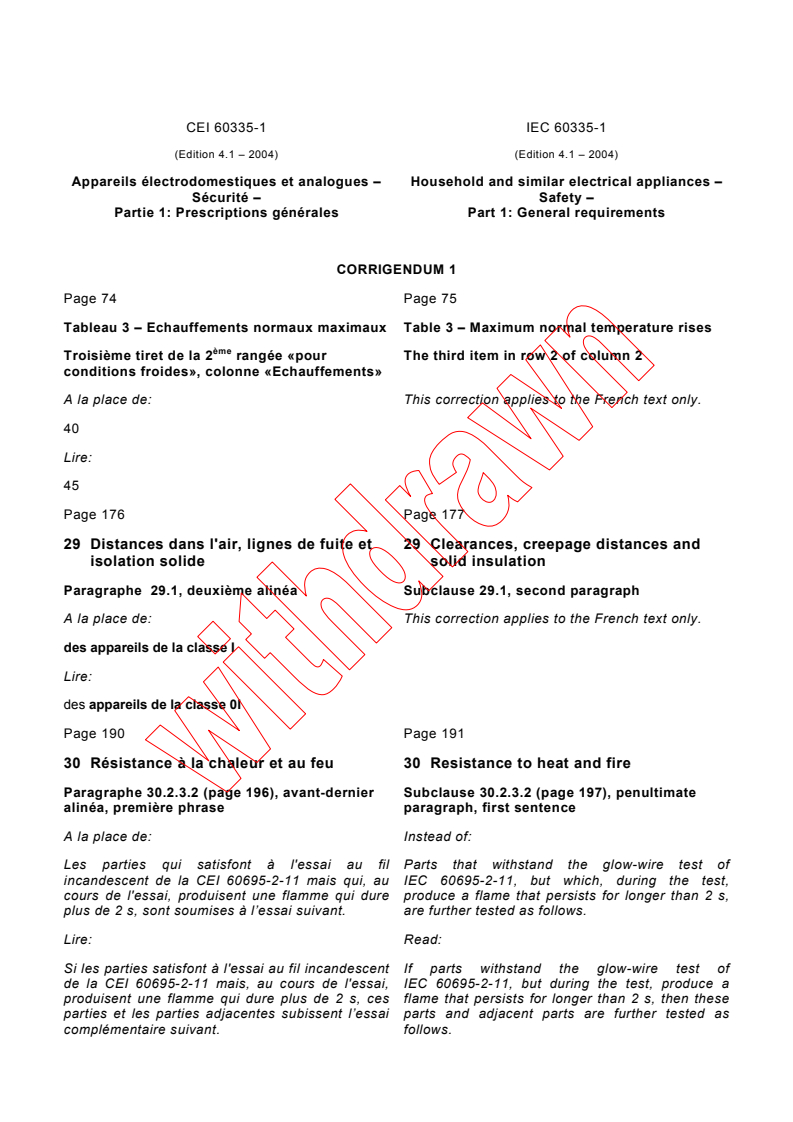


IEC 60335-1:2001+AMD1:2004 CSV/COR1:2005 - Corrigendum 1 - Household and similar electrical appliances - Safety - Part 1: General requirements Released:12/16/2005
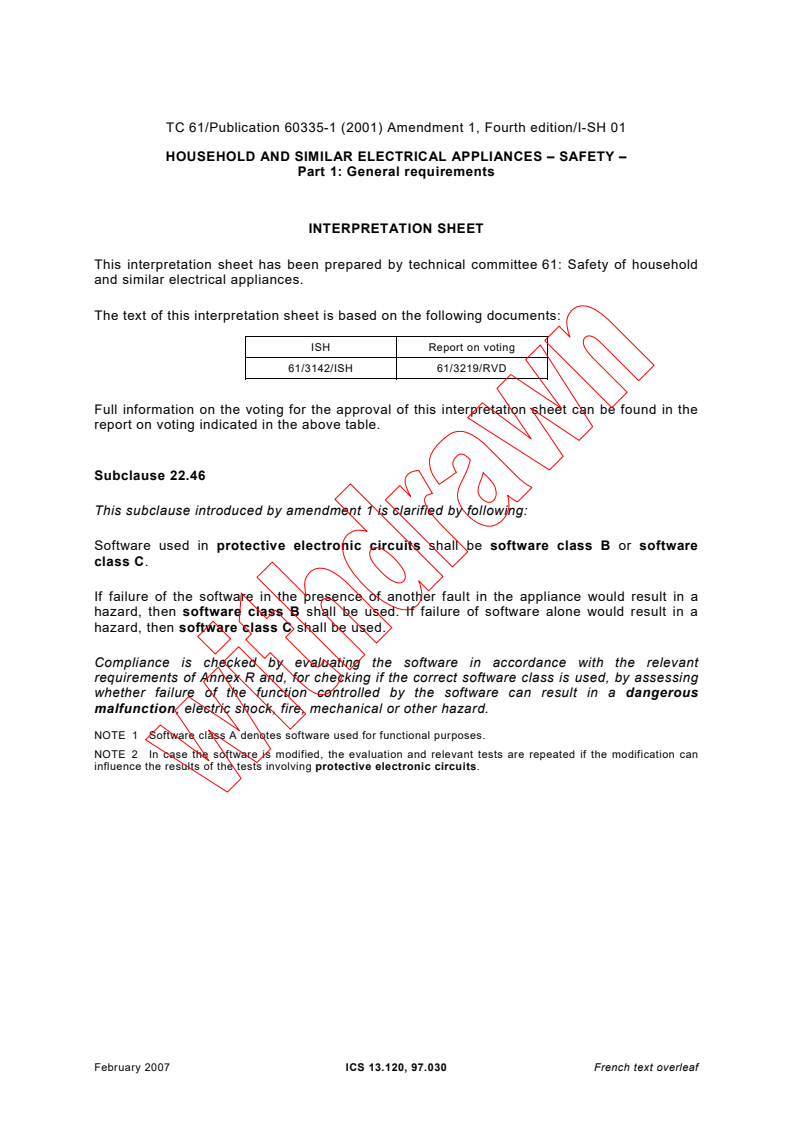


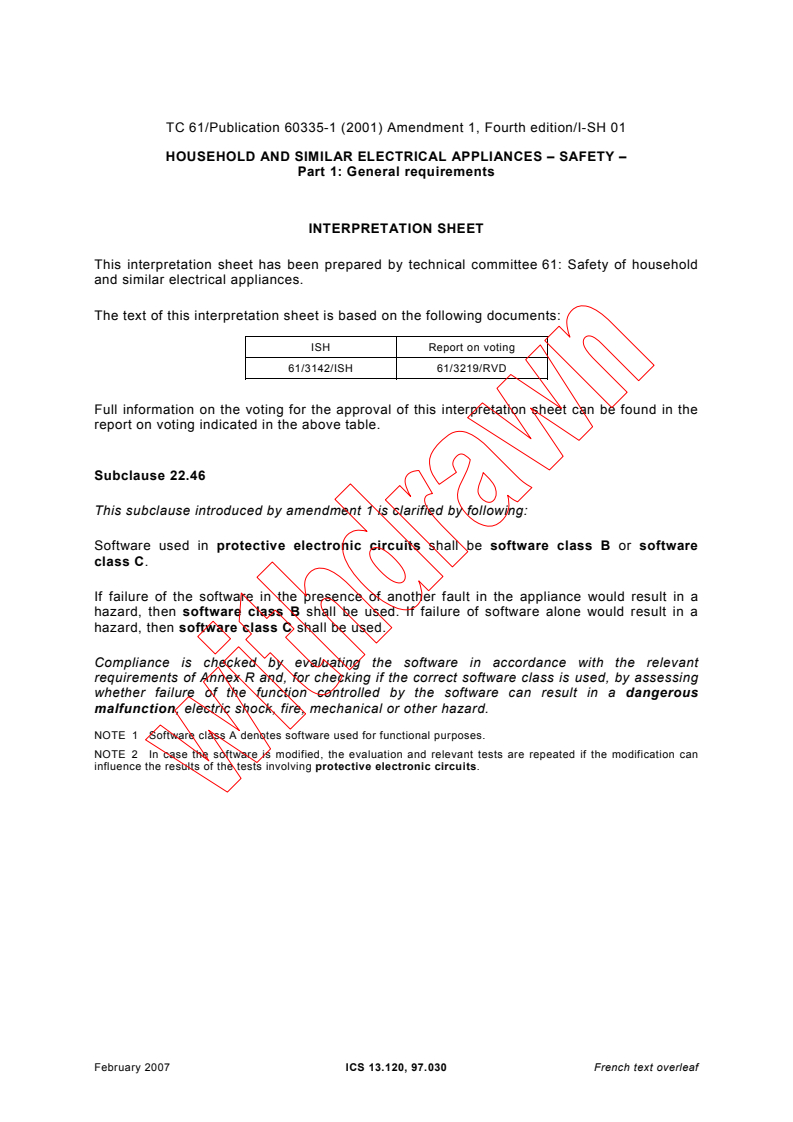
IEC 60335-1:2001/AMD1:2004/ISH1:2007 - Interpretation sheet 1 to amendment 1 - Household and similar electrical appliances - Safety - Part 1: General requirements Released:2/16/2007
IEC 60335-1:2001 - Household and similar electrical appliances - Safety - Part 1: General requirements Released:5/18/2001
IEC 60335-1:2001+AMD1:2004 CSV - Household and similar electrical appliances - Safety - Part 1: General requirements Released:7/7/2004
IEC 60335-1:2001+AMD1:2004+AMD2:2006 CSV - Household and similar electrical appliances - Safety - Part 1: General requirements Released:9/21/2006
Overview
IEC 60335-1:2001/A1:2004 (Edition 4.1) - "Household and similar electrical appliances – Safety – Part 1: General requirements" is the international general standard for the safety of electrical household and similar appliances. It addresses common hazards encountered by users in and around the home and covers appliances used by laymen in shops, light industry and on farms (e.g., catering and commercial cleaning equipment). The scope includes appliances with rated voltages up to 250 V for single‑phase and 480 V for other appliances. This part 1 sets the baseline safety requirements and is intended to be used together with the appliance‑specific Part 2 standards.
Keywords: IEC 60335-1, household appliances safety, electrical appliance standards, general requirements
Key Topics
This standard establishes general technical requirements, test methods and documentation expectations. Major topics include:
- Scope, definitions and classification of appliances and hazards
- Marking and instructions to ensure safe use, installation and servicing
- Protection against access to live parts and requirements for insulation/class II construction
- Electrical tests: leakage current, electric strength, transient overvoltages and endurance
- Motors and motor protection (starting, overload, temperature limits, ageing tests)
- Heating and thermal tests: normal and abnormal temperature rises, resistance to heat and fire
- Moisture resistance and corrosion tests for damp environments
- Mechanical safety: stability, mechanical strength and protection against moving parts
- Internal wiring, terminals and cords: sizing, anchorages, connections and earthing provisions
- Clearances and creepage distances plus solid insulation requirements
- Component and software evaluation (several normative annexes, e.g., capacitors, transformers, motors, software evaluation)
- Annexes: normative and informative annexes provide routine tests, battery‑powered appliances, needle‑flame and proof tracking tests, and guidance for measurement procedures.
Applications
Who uses IEC 60335-1:
- Manufacturers designing household and similar electrical appliances to meet international safety requirements
- Testing and certification laboratories performing type and routine tests for product approvals
- Compliance engineers and safety assessors preparing technical files and instructions for conformity assessment
- Regulators and procurement teams referencing internationally harmonized safety benchmarks
- Standards developers who apply Part 1 in conjunction with appliance‑specific Part 2 standards
Practical value: ensures consistent safety criteria across designs, reduces risk of electric shock, fire and mechanical injury, and supports market access through recognized testing and documentation.
Related standards
- IEC 60335 Part 2 series - appliance‑specific requirements (to be used together with Part 1)
- Other IEC publications referenced by Part 1 (normative references listed in clause 2) and consolidated IEC numbering (60000 series) guidance.
For product compliance, always check the latest edition/amendments and applicable Part 2 for the specific appliance type.
Relations
- Effective Date
- 05-Sep-2023
- Effective Date
- 05-Sep-2023
- Effective Date
- 05-Sep-2023
- Effective Date
- 05-Sep-2023
- Effective Date
- 05-Sep-2023
- Effective Date
- 05-Sep-2023
Buy Documents
IEC 60335-1:2001+AMD1:2004 CSV - Household and similar electrical appliances - Safety - Part 1: General requirements Released:7/7/2004
IEC 60335-1:2001+AMD1:2004 CSV - Appareils électrodomestiques et analogues - Sécurité - Partie 1: Prescriptions générales Released:7/7/2004
IEC 60335-1:2001+AMD1:2004 CSV/COR1:2005 - Corrigendum 1 - Household and similar electrical appliances - Safety - Part 1: General requirements Released:12/16/2005
IEC 60335-1:2001/AMD1:2004/ISH1:2007 - Interpretation sheet 1 to amendment 1 - Household and similar electrical appliances - Safety - Part 1: General requirements Released:2/16/2007
IEC 60335-1:2001 - Household and similar electrical appliances - Safety - Part 1: General requirements Released:5/18/2001
IEC 60335-1:2001+AMD1:2004 CSV - Household and similar electrical appliances - Safety - Part 1: General requirements Released:7/7/2004
IEC 60335-1:2001+AMD1:2004+AMD2:2006 CSV - Household and similar electrical appliances - Safety - Part 1: General requirements Released:9/21/2006
Get Certified
Connect with accredited certification bodies for this standard

CIS Institut d.o.o.
Personal Protective Equipment (PPE) certification body. Notified Body NB-2890 for EU Regulation 2016/425 PPE.

Kiwa BDA Testing
Building and construction product certification.
Kmetijski inštitut Slovenije
Agricultural Institute of Slovenia. Soil testing, plant health, agricultural product analysis.
Sponsored listings
Frequently Asked Questions
IEC 60335-1:2001 is a standard published by the International Electrotechnical Commission (IEC). Its full title is "Household and similar electrical appliances - Safety - Part 1: General requirements". This standard covers: Deals with the safety of electrical appliances for household and similar purposes. It deals with the common hazards presented by appliances that are encountered by all persons in and around the home. It also covers appliances used by laymen in shops, in light industry and on farms (such as catering equipment, and industrial and commercial cleaning appliances). The rated voltage of the appliances are not more than 250 V for single-phase appliances and 480 V for other appliances.
Deals with the safety of electrical appliances for household and similar purposes. It deals with the common hazards presented by appliances that are encountered by all persons in and around the home. It also covers appliances used by laymen in shops, in light industry and on farms (such as catering equipment, and industrial and commercial cleaning appliances). The rated voltage of the appliances are not more than 250 V for single-phase appliances and 480 V for other appliances.
IEC 60335-1:2001 is classified under the following ICS (International Classification for Standards) categories: 13.120 - Domestic safety; 97.030 - Domestic electrical appliances in general. The ICS classification helps identify the subject area and facilitates finding related standards.
IEC 60335-1:2001 has the following relationships with other standards: It is inter standard links to IEC 60335-1:2001/AMD1:2004, IEC 60335-1:2001/AMD2:2006, IEC 60335-1:2001/COR1:2002, IEC 60335-1:1991/AMD2:1999, IEC 60335-1:2010, IEC 60335-1:1991. Understanding these relationships helps ensure you are using the most current and applicable version of the standard.
IEC 60335-1:2001 is available in PDF format for immediate download after purchase. The document can be added to your cart and obtained through the secure checkout process. Digital delivery ensures instant access to the complete standard document.
Standards Content (Sample)
INTERNATIONAL IEC
STANDARD 60335-1
Edition 4.1
2004-07
Edition 4:2001 consolidated with amendment 1:2004
Household and similar electrical appliances –
Safety –
Part 1:
General requirements
This English-language version is derived from the original
bilingual publication by leaving out all French-language
pages. Missing page numbers correspond to the French-
language pages.
Reference number
Publication numbering
As from 1 January 1997 all IEC publications are issued with a designation in the
60000 series. For example, IEC 34-1 is now referred to as IEC 60034-1.
Consolidated editions
The IEC is now publishing consolidated versions of its publications. For example,
edition numbers 1.0, 1.1 and 1.2 refer, respectively, to the base publication, the
base publication incorporating amendment 1 and the base publication incorporating
amendments 1 and 2.
Further information on IEC publications
The technical content of IEC publications is kept under constant review by the IEC,
thus ensuring that the content reflects current technology. Information relating to
this publication, including its validity, is available in the IEC Catalogue of
publications (see below) in addition to new editions, amendments and corrigenda.
Information on the subjects under consideration and work in progress undertaken
by the technical committee which has prepared this publication, as well as the list
of publications issued, is also available from the following:
• IEC Web Site (www.iec.ch)
• Catalogue of IEC publications
The on-line catalogue on the IEC web site (http://www.iec.ch/searchpub/cur_fut.htm)
enables you to search by a variety of criteria including text searches, technical
committees and date of publication. On-line information is also available on
recently issued publications, withdrawn and replaced publications, as well as
corrigenda.
• IEC Just Published
This summary of recently issued publications (http://www.iec.ch/online_news/
justpub/jp_entry.htm) is also available by email. Please contact the Customer
Service Centre (see below) for further information.
• Customer Service Centre
If you have any questions regarding this publication or need further assistance,
please contact the Customer Service Centre:
Email: custserv@iec.ch
Tel: +41 22 919 02 11
Fax: +41 22 919 03 00
INTERNATIONAL IEC
STANDARD 60335-1
Edition 4.1
2004-07
Edition 4:2001 consolidated with amendment 1:2004
Household and similar electrical appliances –
Safety –
Part 1:
General requirements
IEC 2004 Copyright - all rights reserved
No part of this publication may be reproduced or utilized in any form or by any means, electronic or mechanical,
including photocopying and microfilm, without permission in writing from the publisher.
International Electrotechnical Commission, 3, rue de Varembé, PO Box 131, CH-1211 Geneva 20, Switzerland
Telephone: +41 22 919 02 11 Telefax: +41 22 919 03 00 E-mail: inmail@iec.ch Web: www.iec.ch
PRICE CODE
CU
Commission Electrotechnique Internationale
International Electrotechnical Commission
МеждународнаяЭлектротехническаяКомиссия
For price, see current catalogue
60335-1 IEC:2001+A1:2004 – 3 –
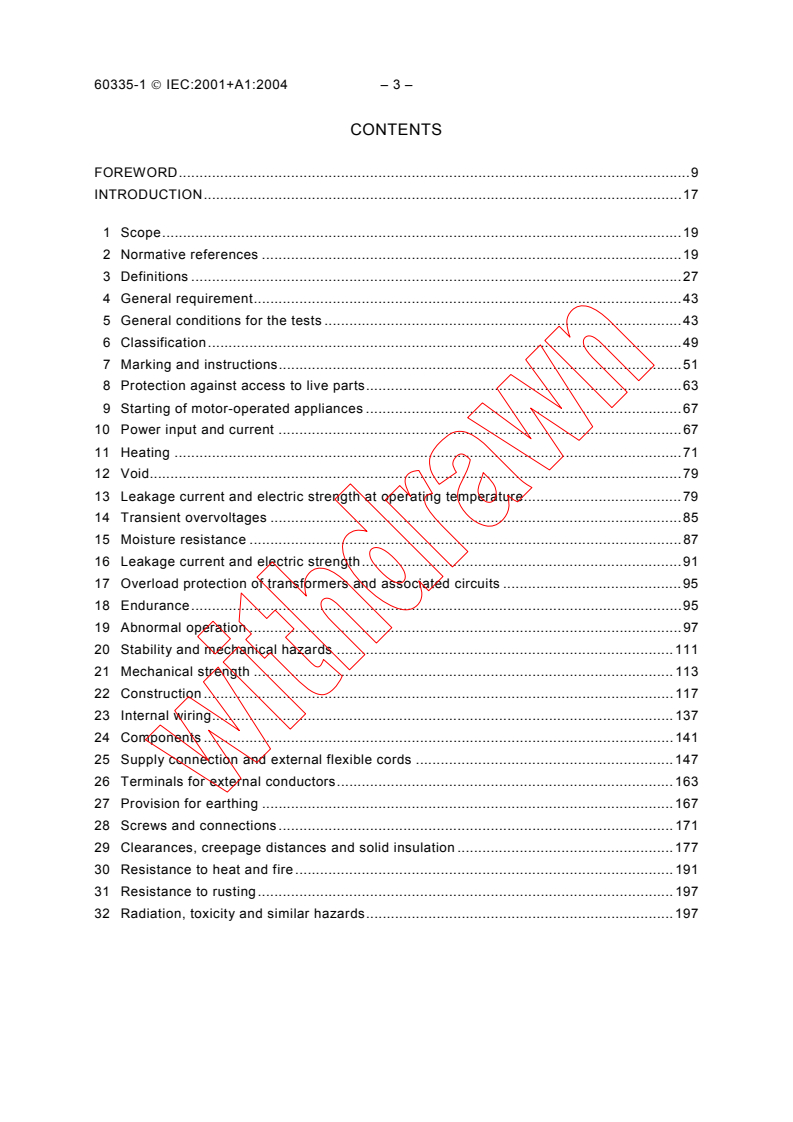
CONTENTS
FOREWORD.9
INTRODUCTION.17
1 Scope.19
2 Normative references .19
3 Definitions .27
4 General requirement.43
5 General conditions for the tests .43
6 Classification.49
7 Marking and instructions.51
8 Protection against access to live parts.63
9 Starting of motor-operated appliances .67
10 Power input and current .67
11 Heating .71
12 Void.79
13 Leakage current and electric strength at operating temperature.79
14 Transient overvoltages .85
15 Moisture resistance .87
16 Leakage current and electric strength.91
17 Overload protection of transformers and associated circuits .95
18 Endurance.95
19 Abnormal operation .97
20 Stability and mechanical hazards .111
21 Mechanical strength .113
22 Construction .117
23 Internal wiring.137
24 Components .141
25 Supply connection and external flexible cords .147
26 Terminals for external conductors.163
27 Provision for earthing .167
28 Screws and connections .171
29 Clearances, creepage distances and solid insulation .177
30 Resistance to heat and fire.191
31 Resistance to rusting.197
32 Radiation, toxicity and similar hazards.197
60335-1 IEC:2001+A1:2004 – 5 –
Annex A (informative) Routine tests.219
Annex B (normative) Appliances powered by rechargeable batteries .223
Annex C (normative) Ageing test on motors .229
Annex D (normative) Thermal motor protectors.233
Annex E (normative) Needle flame test.235
Annex F (normative) Capacitors.237
Annex G (normative) Safety isolating transformers .241
Annex H (normative) Switches .243
Annex I (normative) Motors having basic insulation that is inadequate
for the rated voltage of the appliance.247
Annex J (normative) Coated printed circuit boards.251
Annex K (normative) Overvoltage categories .253
Annex L (informative) Guidance for the measurement of clearances
and creepage distances .255
Annex M (normative) Pollution degree .259
Annex N (normative) Proof tracking test .261
Annex O (informative) Selection and sequence of the tests of clause 30.263
Annex P (informative) Guidance for the application of this standard
to appliances used in warm damp equable climates .267
Annex Q (informative) Sequence of tests for the evaluation of electronic circuits .271
Annex R (normative) Software evaluation .275
Bibliography.277
Index of defined words.281
Figure 1 – Circuit diagram for leakage current measurement at operating temperature
for single-phase connection of class II appliances.199
Figure 2 – Circuit diagram for leakage current measurement at operating temperature
for single-phase connection of appliances, other than those of class II .201
Figure 3 – Circuit diagram for leakage current measurement at operating temperature
for three-phase connection of class II appliances.203
Figure 4 – Circuit diagram for leakage current measurement at operating temperature
for three-phase connection of appliances other than those of class II.205
Figure 5 – Void .205
Figure 6 – Example of an electronic circuit with low-power points .207
Figure 7 – Test finger nail .209
Figure 8 – Flexing test apparatus.211
Figure 9 – Constructions of cord anchorages .213
Figure 10 – An example of parts of an earthing terminal .215
Figure 11 – Examples of clearances .217
Figure I.1 – Simulation of faults .249
Figure L.1 – Sequence for the determination of clearances.255
Figure L.2 – Sequence for the determination of creepage distances .257
Figure O.1 – Tests for resistance to heat .263
Figure O.2 – Tests for resistance to fire .265
60335-1 IEC:2001+A1:2004 – 7 –
Table 1 – Power input deviation .67
Table 2 – Current deviation.69
Table 3 – Maximum normal temperature rises.75
Table 4 – Voltage for electric strength test.83
Table 5 – Characteristics of high-voltage sources .85
Table 6 – Impulse test voltage .85
Table 7 – Test voltages.93
Table 8 – Maximum winding temperature .101
Table 9 – Maximum abnormal temperature rise.111
Table 10 – Dimensions of cables and conduits.149
Table 11 – Minimum cross-sectional area of conductors .151
Table 12 – Pull force and torque .157
Table 13 – Nominal cross-sectional area of conductors .165
Table 14 – Torque for testing screws and nuts.175
Table 15 – Rated impulse voltage .179
Table 16 – Minimum clearances.179
Table 17 – Minimum creepage distances for basic insulation .187
Table 18 – Minimum creepage distances for functional insulation .189
Table A.1 – Test voltages .221
Table C.1 – Test conditions .229
60335-1 IEC:2001+A1:2004 – 9 –
INTERNATIONAL ELECTROTECHNICAL COMMISSION
____________
HOUSEHOLD AND SIMILAR ELECTRICAL APPLIANCES –
SAFETY –
Part 1: General requirements
FOREWORD
1) The International Electrotechnical Commission (IEC) is a worldwide organization for standardization comprising
all national electrotechnical committees (IEC National Committees). The object of IEC is to promote
international co-operation on all questions concerning standardization in the electrical and electronic fields. To
this end and in addition to other activities, IEC publishes International Standards, Technical Specifications,
Technical Reports, Publicly Available Specifications (PAS) and Guides (hereafter referred to as “IEC
Publication(s)”). Their preparation is entrusted to technical committees; any IEC National Committee interested
in the subject dealt with may participate in this preparatory work. International, governmental and non-
governmental organizations liaising with the IEC also participate in this preparation. IEC collaborates closely
with the International Organization for Standardization (ISO) in accordance with conditions determined by
agreement between the two organizations.
2) The formal decisions or agreements of IEC on technical matters express, as nearly as possible, an international
consensus of opinion on the relevant subjects since each technical committee has representation from all
interested IEC National Committees.
3) IEC Publications have the form of recommendations for international use and are accepted by IEC National
Committees in that sense. While all reasonable efforts are made to ensure that the technical content of IEC
Publications is accurate, IEC cannot be held responsible for the way in which they are used or for any
misinterpretation by any end user.
4) In order to promote international uniformity, IEC National Committees undertake to apply IEC Publications
transparently to the maximum extent possible in their national and regional publications. Any divergence
between any IEC Publication and the corresponding national or regional publication shall be clearly indicated in
the latter.
5) IEC provides no marking procedure to indicate its approval and cannot be rendered responsible for any
equipment declared to be in conformity with an IEC Publication.
6) All users should ensure that they have the latest edition of this publication.
7) No liability shall attach to IEC or its directors, employees, servants or agents including individual experts and
members of its technical committees and IEC National Committees for any personal injury, property damage or
other damage of any nature whatsoever, whether direct or indirect, or for costs (including legal fees) and
expenses arising out of the publication, use of, or reliance upon, this IEC Publication or any other IEC
Publications.
8) Attention is drawn to the Normative references cited in this publication. Use of the referenced publications is
indispensable for the correct application of this publication.
9) Attention is drawn to the possibility that some of the elements of this IEC Publication may be the subject of
patent rights. IEC shall not be held responsible for identifying any or all such patent rights.
This part of international standard IEC 60335 has been prepared by IEC technical committee 61:
Safety of household and similar electrical appliances.
This consolidated version of IEC 60335-1 is based on the fourth edition (2001) [documents
61/1965/FDIS and 61/1998/RVD], its amendment 1 (2004) [documents 61/2569/FDIS and
61/2639/RVD] and its corrigendum 1 (2002).
It bears the edition number 4.1.
A vertical line in the margin shows where the base publication has been modified by
amendment 1.
This part is to be used in conjunction with the appropriate part 2 of IEC 60335. The parts 2
contain clauses to supplement or modify the corresponding clauses in this part to provide the
relevant requirements for each type of appliance.
60335-1 IEC:2001+A1:2004 – 11 –
Annexes B, C, D, E, F, G, H, I, J, K, M, N and R form an integral part of this standard.
Annexes A, L, O, P and Q are for information only.
The committee has decided that the contents of this publication will remain unchanged until
the maintenance result date indicated on the IEC web site under "http://webstore.iec.ch" in
the data related to the specific publication. At this date, the publication will be
• reconfirmed,
• withdrawn,
• replaced by a revised edition, or
• amended.
NOTE 1 The following annexes contain provisions suitably modified from other IEC standards:
– Annex E Needle flame test IEC 60695-2-2
– Annex F Capacitors IEC 60384-14
– Annex G Safety isolating transformers IEC 61558-1 and IEC 61558-2-6
– Annex H Switches IEC 61058-1
– Annex J Coated printed circuit boards IEC 60664-3
– Annex N Proof tracking test IEC 60112
– Annex R Software evaluation IEC 60730-1
NOTE 2 The following print types are used:
– requirements: in roman type;
– test specifications: in italic type;
– notes: in small roman type.
Words in bold in the text are defined in clause 3. When a definition concerns an adjective, the adjective and
associated noun are also in bold.
The following differences exist in the countries indicated below.
– Clause 3: Steady conditions are defined (Poland).
– 3.4.2: Safety extra-low voltage shall not exceed 30 V (42,4 V peak) (USA).
– 5.7: The ambient temperature is 25 °C ± 10 °C (China, Japan and USA).
– 5.14: Accessible metal parts that are not liable to become energized (such as metal nameplates or decorative
parts on a plastic enclosure) do not need to be earthed. Accessible non-metallic parts need only provide basic
insulation (USA).
– 6.1: Class 0 appliances and class 0I appliances are not allowed (Australia, Austria, Belgium, Czech Republic,
Finland, France, Germany, Greece, Hungary, India, Israel, Ireland, Italy, Netherlands, New Zealand, Norway,
Poland, Singapore, Slovakia, Sweden, Switzerland, United Kingdom, Yugoslavia).
– 6.2: Protection against harmful ingress of water is determined by methods other than those given in IEC 60529
(USA).
– 7.1: The IP number is not required to be marked (USA).
– 7.6: Some of these symbols are not used (USA).
– 7.8: Additional methods are permitted for identifying earthing terminals and terminals for neutral conductors
(USA).
– 7.12.2: The requirements for full disconnection do not apply (Japan, USA).
– 7.14: Different tests are used (USA).
– 8.1.1: The test is not necessarily repeated with the 20 N force (USA).
– 8.1.1: Protection against contact with live parts of the lamp cap is not required (USA).
– 8.1.2 and 8.1.3: The test probe 13 and test probe 41 are not used (USA).
– 8.1.5: Built-in appliances, fixed appliances and appliances delivered in separate units are not required to be
protected by at least basic insulation before installation (USA).
60335-1 IEC:2001+A1:2004 – 13 –
– Clause 9: The ability of a motor to start without blowing a quick-acting fuse is required (USA).
– 10.1 and 10.2: Positive limits of 5 % for heating appliances and 10 % for motor-operated appliances are
required and in general there are no negative deviations (USA).
– 11.4, 11.5 and 11.6: Heating appliances and heater circuits of combined appliances are operated at rated
power input or rated voltage, whichever is the more severe; all other appliances and circuits are operated at
rated voltage (USA).
– 11.8, table 3: Temperature rise limits for certain materials are different (USA).
– 13.2: The test circuit and some leakage current limits are different (India, USA).
– 13.3: The values of certain test voltages are different depending on the rated voltage (USA).
– 13.3: A 500 VA test transformer is used (USA).
– 15.1.1 and 15.1.2: The IP system is not used and the tests are different (USA).
– 15.3: The test is conducted with a relative humidity of (88 ± 2) % at a temperature of 32 °C ± 2 °C (USA).
– 16.2: The test is conducted at nominal supply voltage, and some of the leakage current values are different
(USA).
– 16.3: Some test voltages and methods are different (USA).
– 19.1: The circuit protection device is permitted to provide necessary protection (USA).
– 19.2 to 19.4: Generally the tests are conducted at nominal supply voltage or rated power input (USA).
– 19.11: Different tests are carried out to evaluate solid state devices used in protective electronic circuits (USA).
– 19.13: The temperature rise limits of table 9 are not applicable (USA).
– 20.1: A stability test at 15° is not conducted, and an appliance tested in an overturned position is judged under
abnormal test criteria (USA).
– 21.1: The impact force is applied by a falling steel ball instead of the spring hammer (USA).
– Clause 22: The d.c. component in the appliance neutral is limited (Australia).
– 22.1: The IP system is not used and the tests are different (USA).
– 22.2: The second paragraph of this subclause dealing with single-phase class I appliances with heating
elements cannot be complied with because of the supply system (France and Norway).
– 22.2: Double-pole switches or protective devices are required (Norway).
– 22.2: Disconnection of the neutral is not necessary for all stationary appliances (USA).
– 22.2: The supply cord is not required to be fitted with a plug (Ireland).
– 22.3: The test is different (USA).
– 22.6: This test is not conducted (USA).
– 22.11: Different criteria for snap-on constructions are required (USA).
– 22.12: Positive forms of securement are required (USA).
– 22.14: Sharp edges are evaluated by means of a sharp edge testing device (USA).
– 22.35 and 22.36: Metal parts are generally not required to be separated by double or reinforced insulation
(USA).
– 22.44: Appliances may be acceptable based on additional evaluation (USA).
– 22.46: The evaluation of software is different (USA).
– 23.5: Requirements for insulated internal wiring are different (USA).
– 23.7: The requirement only applies to wiring that is accessible when making supply connections (USA).
– 24.1.3: The number of cycles is different and the note does not apply (USA).
– 24.1.4: The number of cycles is different and note 1 does not apply (USA).
– 24.3: The requirement for full disconnection does not apply (USA).
– 25.1: The supply cord is not required to be fitted with a plug (Ireland).
– 25.3: A set of supply leads is not permitted (Norway, Sweden, Denmark, Finland, Netherlands).
– 25.3: The use of a set of terminals for connection of a flexible cord is not generally permitted (USA).
– 25.8: Conductor cross-sectional areas are different (Australia, New Zealand and USA).
60335-1 IEC:2001+A1:2004 – 15 –
– 25.8: 0,5 mm supply cords are not allowed for class I appliances (Australia and New Zealand).
– 25.10: Green insulation is also permitted (USA).
– 25.13: Only one separate insulation is required (USA).
– 25.16: A pull of 35 lbs is applied except for small appliances. Generally the torque test is not applied (USA).
– 26.3: The tests only apply to terminals for connection to fixed wiring (USA).
– 26.6: Cross-sectional areas are specified according to American Wire Gauge (AWG) (USA).
– 27.6: The requirement does not apply (USA).
– 28.1: Generally, tests of this type are not required (USA).
– Clause 29: The requirements for clearances and creepage distances are different (USA).
– 29.1 Different rated impulse voltages are used between 50 V and 150 V (Japan).
– 29.3 The third dashed item of the test specification does not apply (Germany).
– 30.1: The minimum value for the ball-pressure test for parts retaining live parts is 95 °C or 40 K higher than
the clause 11 temperature rise. For enclosures, the minimum value is 75 °C or a mould-stress test is
conducted at 10 K above the clause 11 temperature (USA).
– 30.2.1: An ignition test cannot be used to assure a slow burning rate (USA).
– Annex B, 7.12: Appliances having non-replaceable batteries shall be marked with an appropriate symbol when
the batteries have a content of mercury or cadmium exceeding 0,025 % by weight (Sweden and Switzerland).
– Annex B, 21.101: The requirement is different (USA).
– Annex I: The annex applies to motors having a working voltage not exceeding 30 V (USA).
60335-1 IEC:2001+A1:2004 – 17 –
INTRODUCTION
It has been assumed in the drafting of this international standard that the execution of its
provisions is entrusted to appropriately qualified and experienced persons.
This standard recognizes the internationally accepted level of protection against hazards such
as electrical, mechanical, thermal, fire and radiation of appliances when operated as in
normal use taking into account the manufacturer's instructions. It also covers abnormal
situations that can be expected in practice and takes into account the way in which
electromagnetic phenomena can affect the safe operation of appliances.
This standard takes into account the requirements of IEC 60364 as far as possible so that
there is compatibility with the wiring rules when the appliance is connected to the supply
mains. However, national wiring rules may differ.
If the functions of an appliance are covered by different parts 2 of IEC 60335, the relevant
part 2 is applied to each function separately, as far as is reasonable. If applicable, the
influence of one function on the other is taken into account.
NOTE 1 Throughout this publication, when “Part 2” is mentioned, it refers to the relevant part of IEC 60335.
This standard is a product family standard dealing with the safety of appliances and takes
precedence over horizontal and generic standards covering the same subject.
Individual countries may wish to consider the application of the standard, as far as is
reasonable, to appliances not mentioned in a part 2, and to appliances designed on new
principles.
An appliance that complies with the text of this standard will not necessarily be considered to
comply with the safety principles of the standard if, when examined and tested, it is found to
have other features which impair the level of safety covered by these requirements.
An appliance employing materials or having forms of construction differing from those detailed
in the requirements of this standard may be examined and tested according to the intent of
the requirements and, if found to be substantially equivalent, may be considered to comply
with the standard.
NOTE 2 Standards dealing with non-safety aspects of household appliances are
– IEC standards published by TC 59 concerning methods of measuring performance;
– CISPR 11, CISPR 14-1, IEC 61000-3-2 and IEC 61000-3-3 concerning electromagnetic emissions;
– CISPR 14-2 concerning electromagnetic immunity.
60335-1 IEC:2001+A1:2004 – 19 –
HOUSEHOLD AND SIMILAR ELECTRICAL APPLIANCES –
SAFETY –
Part 1: General requirements
1 Scope
This International Standard deals with the safety of electrical appliances for household and
similar purposes, their rated voltage being not more than 250 V for single-phase appliances
and 480 V for other appliances.
Appliances not intended for normal household use but which nevertheless may be a source of
danger to the public, such as appliances intended to be used by laymen in shops, in light
industry and on farms, are within the scope of this standard.
NOTE 1 Examples of such appliances are catering equipment, cleaning appliances for industrial and commercial
use, and appliances for hairdressers.
As far as is practicable, this standard deals with the common hazards presented by
appliances that are encountered by all persons in and around the home. However, in general,
it does not take into account
– the use of appliances by young children or infirm persons without supervision,
– playing with the appliance by young children.
NOTE 2 Attention is drawn to the fact that
– for appliances intended to be used in vehicles or on board ships or aircraft, additional requirements may be
necessary;
– in many countries additional requirements are specified by the national health authorities, the national
authorities responsible for the protection of labour, the national water supply authorities and similar authorities.
NOTE 3 This standard does not apply to
– appliances intended exclusively for industrial purposes;
– appliances intended to be used in locations where special conditions prevail, such as the presence of a
corrosive or explosive atmosphere (dust, vapour or gas);
– audio, video and similar electronic apparatus (IEC 60065);
– appliances for medical purposes (IEC 60601);
– hand-held motor-operated electric tools (IEC 60745);
– personal computers and similar equipment (IEC 60950);
– transportable motor-operated electric tools (IEC 61029).
2 Normative references
The following referenced documents are indispensable for the application of this document.
For dated references, only the edition cited applies. For undated references, the latest edition
of the referenced document (including any amendments) applies.
60335-1 IEC:2001+A1:2004 – 21 –
IEC 60061-1, Lamp caps and holders together with gauges for the control of
interchangeability and safety – Part 1: Lamp caps
IEC 60068-2-2, Environmental testing – Part 2 Tests. Tests B: Dry heat
IEC 60068-2-32, Environmental testing – Part 2: Tests – Test Ed: Free fall (Procedure 1)
IEC 60068-2-75, Environmental testing – Part 2-75: Tests – Test Eh: Hammer tests
IEC 60083, Plugs and socket-outlets for domestic and similar general use standardized in
member countries of IEC
IEC 60085, Thermal evaluation and classification of electrical insulation
IEC 60112:2003, Method for the determination of the proof and the comparative tracking
indices of solid insulating materials
IEC 60127 (all parts), Miniature fuses
IEC 60227 (all parts), Polyvinyl chloride insulated cables of rated voltages up to and including
450/750 V
IEC 60238, Edison screw lampholders
IEC 60245 (all parts), Rubber insulated cables – Rated voltages up to and including
450/750 V
IEC 60249-2-4:1987, Base materials for printed circuits – Part 2: Specifications – Specifi-
cation No. 4: Epoxide woven glass fabric copper-clad laminated sheet, general purpose grade
Amendment 1 (1989)
Amendment 2 (1992)
Amendment 3 (1993)
Amendment 4 (1994)
Amendment 5 (2000)
IEC 60249-2-5:1987, Base materials for printed circuits – Part 2: Specifications –
Specification No. 5: Epoxide woven glass fabric copper-clad laminated sheet of defined
flammability (vertical burning test)
Amendment 1 (1989)
Amendment 2 (1992)
Amendment 3 (1993)
Amendment 4 (1994)
Amendment 5 (2000)
IEC 60252, A.C. motor capacitors
IEC 60320-1, Appliance couplers for household and similar general purposes – Part 1:
General requirements
IEC 60320-2-2, Appliance couplers for household and similar general purposes – Part 2-2:
Interconnection couplers for household and similar equipment
IEC 60320-2-3, Appliance couplers for household and similar general purposes – Part 2-3:
Appliance coupler with a degree of protection higher than IPX0
IEC 60384-14:1993, Fixed capacitors for use in electronic equipment – Part 14: Sectional
specification: Fixed capacitors for electromagnetic interference suppression and connection to
the supply mains
60335-1 IEC:2001+A1:2004 – 23 –
)
IEC 60417-DB:2002 , Graphical symbols for use on equipment
IEC 60529, Degrees of protection provided by enclosures (IP Code)
IEC 60598-1:2003, Luminaires – Part 1: General requirements and tests
IEC 60664-1:1992, Insulation coordination for equipment within low-voltage systems – Part 1:
Principles, requirements and tests
Amendment 1 (2000)
Amendment 2 (2002)
IEC 60664-3:1992, Insulation coordination for equipment within low-voltage systems – Part 3:
Use of coatings to achieve insulation coordination of printed board assemblies
IEC 60695-2-2:1991, Fire hazard testing – Part 2: Test methods – Section 2: Needle-flame
test
IEC 60695-2-11, Fire Hazard testing – Part 2-11: Glowing/hot wire based test methods –
Glow-wire flammability test method for end-products
IEC 60695-2-12, Fire Hazard testing – Part 2-12: Glowing/hot wire based test methods –
Glow-wire flammability test method for materials
IEC 60695-2-13, Fire Hazard testing – Part 2-13: Glowing/hot wire based test methods –
Glow-wire ignitability test method for materials
IEC 60695-10-2, Fire hazard testing – Part 10: Guidance and test methods for the
minimization of the effects of abnormal heat on electrotechnical products involved in fires –
Section 2: Method for testing products made from non-metallic materials for resistance to heat
using the ball pressure test
IEC 60695-11-10, Fire hazard testing – Part 11-10: Test flames – 50 W horizontal and vertical
flame test methods
IEC 60730-1:1999, Automatic electrical controls for household and similar use – Part 1:
General requirements
IEC 60730-2-8:2000, Automatic electrical controls for household and similar use – Part 2-8:
Particular requirements for electrically operated water valves, including mechanical
requirements
IEC 60738-1, Thermistors – Directly heated positive step-function temperature coefficient –
Part 1: Generic specification
IEC 60906-1, IEC system of plugs and socket-outlets for household and similar purposes –
Part 1: Plugs and socket-outlets 16 A 250 V a.c.
IEC 60990:1999, Methods of measurement of touch-current and protective conductor current
IEC 60999-1:1999, Connecting devices – Electrical copper conductors – Safety requirements
for screw-type and screwless-type clamping units – Part 1: General requirements and
2 2
particular requirements for clamping units for conductors from 0,2 mm up to 35 mm
(included)
___________
DB refers to the IEC on-line database.
There exists a consolidated edition 1.2 (2002) that includes edition 1 and its amendments 1 and 2.
60335-1 IEC:2001+A1:2004 – 25 –
IEC 61000-4-2, Electromagnetic compatibility (EMC) – Part 4: Testing and measurement
techniques – Section 2: Electrostatic discharge immunity test
IEC 61000-4-3, Electromagnetic compatibility (EMC) – Part 4-3: Testing and measurement
techniques – Radiated, radio-frequency, electromagnetic field immunity test
IEC 61000-4-4, Electromagnetic compatibility (EMC) – Part 4: Testing and measurement
techniques – Section 4: Electrical fast transient/burst immunity test
IEC 61000-4-5, Electromagnetic compatibility (EMC) – Part 4: Testing and measurement
techniques – Section 5: Surge immunity test
IEC 61000-4-6, Electromagnetic compatibility (EMC) – Part 4-6: Testing and measurement
techniques – Immunity to conducted disturbances, induced by radio-frequency fields
IEC 61000-4-11:1994, Electromagnetic compatibility (EMC) – Part 4: Testing and
measurement techniques – Section 11: Voltage dips, short interruptions and voltage
variations immunity tests
Amendment 1 (2000)
IEC 61000-4-13, Electromagnetic compatibility (EMC) – Part 4-13: Testing and measurement
techniques – Harmonics and interharmonics including mains signalling at a.c. power port, low
frequency immunity tests
IEC 61032:1997, Protection of persons and equipment by enclosures – Probes for verification
IEC 61058-1:2000, Switches for appliances – Part 1: General requirements
Amendment 1 (2001)
IEC 61180-1, High-voltage test techniques for low-voltage equipment. Part 1: Definitions, test
and procedure requirements
IEC 61180-2, High-voltage techniques for low-voltage equipment – Part 2: Test equipment
IEC 61558-1:1997, Safety of power transformers, power supply units and similar – Part 1:
General requirements and tests
IEC 61558-2-6:1997, Safety of power transformers, power supply units and similar – Part 2:
Particular requirements for safety isolating transformers for general use
IEC 61770, Electric appliances connected to the water mains – Avoidance of backsiphonage
and failure of hose-sets
ISO 2768-1, General tolerances – Part 1: Tolerances for linear and angular dimensions
without individual tolerance indications
ISO 7000, Graphical symbols for use on equipment – Index and synopsis
ISO 9772:2001, Cellular plastics – Determination of horizontal burning characteristics of small
specimens subjected to a small flame
___________
There exists a consolidated edition 1.1 (2001) including Edition 1 and its Amendment 1.
There exists a consolidated edition 3.1 (2001) that includes edition 3 and its amendement 1.
60335-1 IEC:2001+A1:2004 – 27 –
3 Definitions
An Index of the defined terms is provided at the end of this publication.
3.1
When the terms “voltage” and “current” are used, they are r.m.s. values, unless otherwise
specified.
3.1.1
rated voltage
voltage assigned to the appliance by the manufacturer
3.1.2
rated voltage range
voltage range assigned to the appliance by the manufacturer, expressed by its lower and
upper limits
3.1.3
working voltage
maximum voltage to which the part under consideration is subjected when the appliance is
supplied at its rated voltage and operating under normal operation
NOTE 1 The different positions of controls and switching devices are taken into account.
NOTE 2 Working voltage takes into account resonant voltages.
NOTE 3 When deducing the working voltage, the effect of transient voltages is ignored.
3.1.4
rated power input
power input assigned to the appliance by the manufacturer
3.1.5
rated power input range
power input range assigned to the appliance by the manufacturer, expressed by its lower and
upper limits
3.1.6
rated current
current assigned to the appliance by the manufacturer
NOTE If no current is assigned to the appliance, the rated current is
– for heating appliances, the current calculated from the rated power input and the rated voltage;
– for motor-operated appliances and combined appliances, the current measured when the appliance is
supplied at rated voltage and operated under normal operation.
3.1.7
rated frequency
frequency assigned to the appliance by the manufacturer
3.1.8
rated frequency range
frequency range assigned to the appliance by the manufacturer, expressed by its lower and
upper limits
60335-1 IEC:2001+A1:2004 – 29 –
3.1.9
normal operation
conditions under which the appliance is operated in normal use when it is connected to the
supply mains
3.1.10
rated impulse voltage
voltage derived from the rated voltage and the overvoltage category of the appliance,
characterizing the specified withstand capability of its insulation against transient over-
voltages
3.1.11
dangerous malfunction
unintended operation of the appliance that may impair safety
3.2
3.2.1
detachable cord
flexible cord, for supply or interconnection, intended to be connected to the appliance by
means of a suitable appliance coupler
3.2.2
interconnection cord
external flexible cord provided as part of a complete appliance for purposes other than
connection to the supply mains
NOTE A remote hand-held switching device, an external interconnection between two parts of an appliance and a
cord connecting an accessory to the appliance or to a separate signalling circuit are examples of interconnection
cords.
3.2.3
supply cord
flexible cord, for supply purposes, that is fixed to the appliance
3.2.4
type X attachment
method of attachment of the supply cord such that it can easily be replaced
NOTE The supply cord may be specially prepared and only available from the manufacturer or its service agent.
A specially prepared cord may include a part of the appliance.
3.2.5
type Y attachment
method of attachment of the supply cord such that any replacement is intended to be made
by the manufacturer, its service agent or similar qualified person
3.2.6
type Z attachment
method of attachment of the supply cord such that it cannot be replaced without breaking or
destroying the appliance
3.2.7
supply leads
set of wires intended for connecting the appliance to fixed wiring and accommodated in a
compartment within or attached to the appliance
60335-1 IEC:2001+A1:2004 – 31 –
3.3
3.3.1
basic insulation
insulation applied to live parts to provide basic protection against electric shock
3.3.2
supplementary insulation
independent insulation applied in addition to basic insulation, in order to provide protection
against electric shock in the event of a failure of basic insulation
3.3.3
double insulation
insulation system comprising both basic
...
NORME CEI
INTERNATIONALE 60335-1
Edition 4.1
2004-07
Edition 4:2001 consolidée par l’amendement 1:2004
Appareils électrodomestiques et analogues –
Sécurité –
Partie 1:
Prescriptions générales
Cette version française découle de la publication d’origine
bilingue dont les pages anglaises ont été supprimées.
Les numéros de page manquants sont ceux des pages
supprimées.
Numéro de référence
CEI 60335-1:2001+A1:2004(F)
Numérotation des publications
Depuis le 1er janvier 1997, les publications de la CEI sont numérotées à partir de
60000. Ainsi, la CEI 34-1 devient la CEI 60034-1.
Editions consolidées
Les versions consolidées de certaines publications de la CEI incorporant les
amendements sont disponibles. Par exemple, les numéros d’édition 1.0, 1.1 et 1.2
indiquent respectivement la publication de base, la publication de base incorporant
l’amendement 1, et la publication de base incorporant les amendements 1 et 2
Informations supplémentaires sur les publications de la CEI
Le contenu technique des publications de la CEI est constamment revu par la CEI
afin qu'il reflète l'état actuel de la technique. Des renseignements relatifs à cette
publication, y compris sa validité, sont disponibles dans le Catalogue des
publications de la CEI (voir ci-dessous) en plus des nouvelles éditions, amende-
ments et corrigenda. Des informations sur les sujets à l’étude et l’avancement des
travaux entrepris par le comité d’études qui a élaboré cette publication, ainsi que la
liste des publications parues, sont également disponibles par l’intermédiaire de:
• Site web de la CEI (www.iec.ch)
• Catalogue des publications de la CEI
Le catalogue en ligne sur le site web de la CEI (www.iec.ch/searchpub) vous permet
de faire des recherches en utilisant de nombreux critères, comprenant des
recherches textuelles, par comité d’études ou date de publication. Des informations
en ligne sont également disponibles sur les nouvelles publications, les publications
remplacées ou retirées, ainsi que sur les corrigenda.
• IEC Just Published
Ce résumé des dernières publications parues (www.iec.ch/online_news/justpub)
est aussi disponible par courrier électronique. Veuillez prendre contact avec le
Service client (voir ci-dessous) pour plus d’informations.
• Service clients
Si vous avez des questions au sujet de cette publication ou avez besoin de
renseignements supplémentaires, prenez contact avec le Service clients:
Email: custserv@iec.ch
Tél: +41 22 919 02 11
Fax: +41 22 919 03 00
NORME CEI
INTERNATIONALE 60335-1
Edition 4.1
2004-07
Edition 4:2001 consolidée par l’amendement 1:2004
Appareils électrodomestiques et analogues –
Sécurité –
Partie 1:
Prescriptions générales
IEC 2004 Droits de reproduction réservés
Aucune partie de cette publication ne peut être reproduite ni utilisée sous quelque forme que ce soit et par aucun
procédé, électronique ou mécanique, y compris la photocopie et les microfilms, sans l'accord écrit de l'éditeur.
International Electrotechnical Commission, 3, rue de Varembé, PO Box 131, CH-1211 Geneva 20, Switzerland
Telephone: +41 22 919 02 11 Telefax: +41 22 919 03 00 E-mail: inmail@iec.ch Web: www.iec.ch
CODE PRIX
CU
Commission Electrotechnique Internationale
International Electrotechnical Commission
МеждународнаяЭлектротехническаяКомиссия
Pour prix, voir catalogue en vigueur
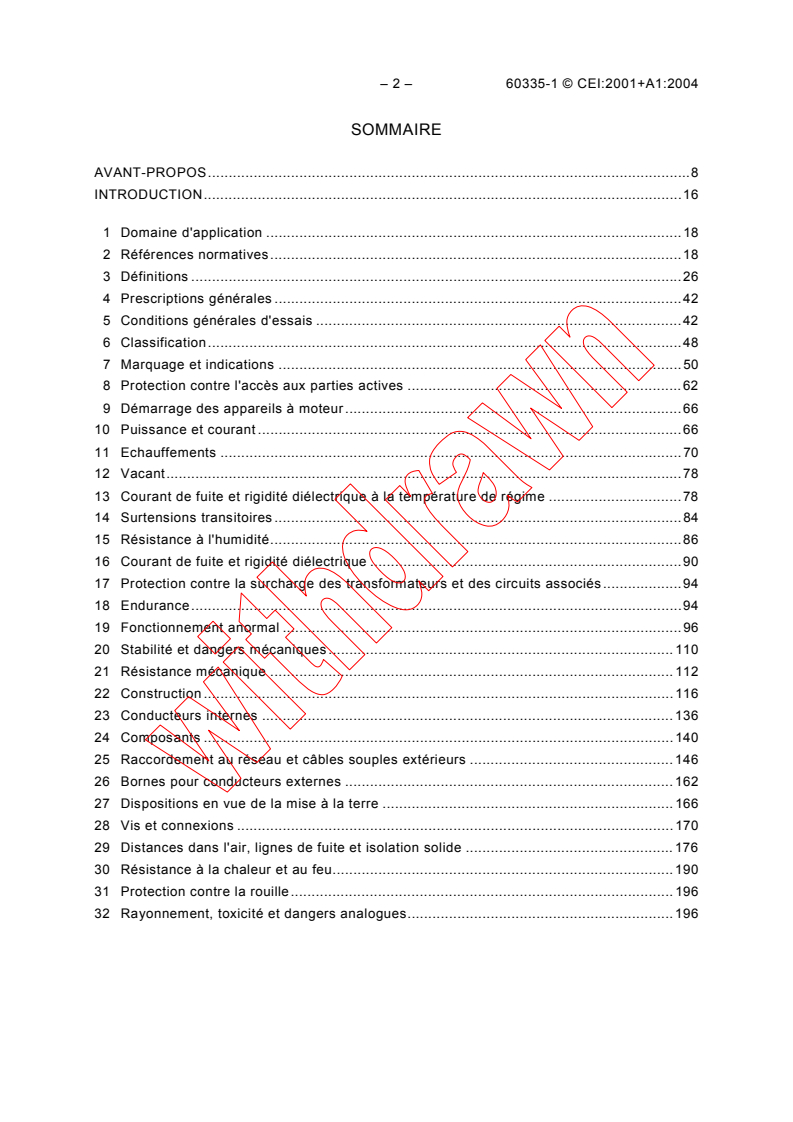
– 2 – 60335-1 © CEI:2001+A1:2004
SOMMAIRE
AVANT-PROPOS.8
INTRODUCTION.16
1 Domaine d'application .18
2 Références normatives.18
3 Définitions .26
4 Prescriptions générales .42
5 Conditions générales d'essais .42
6 Classification.48
7 Marquage et indications .50
8 Protection contre l'accès aux parties actives .62
9 Démarrage des appareils à moteur.66
10 Puissance et courant .66
11 Echauffements .70
12 Vacant.78
13 Courant de fuite et rigidité diélectrique à la température de régime .78
14 Surtensions transitoires.84
15 Résistance à l'humidité.86
16 Courant de fuite et rigidité diélectrique .90
17 Protection contre la surcharge des transformateurs et des circuits associés.94
18 Endurance.94
19 Fonctionnement anormal .96
20 Stabilité et dangers mécaniques .110
21 Résistance mécanique .112
22 Construction .116
23 Conducteurs internes .136
24 Composants .140
25 Raccordement au réseau et câbles souples extérieurs .146
26 Bornes pour conducteurs externes .162
27 Dispositions en vue de la mise à la terre .166
28 Vis et connexions .170
29 Distances dans l'air, lignes de fuite et isolation solide .176
30 Résistance à la chaleur et au feu.190
31 Protection contre la rouille.196
32 Rayonnement, toxicité et dangers analogues.196
– 4 – 60335-1 © CEI:2001+A1:2004
Annexe A (informative) Essais de série.218
Annexe B (normative) Appareils alimentés par batteries .222
Annexe C (normative) Essai de vieillissement des moteurs.228
Annexe D (normative) Protecteurs thermiques de moteur .232
Annexe E (normative) Essai au brûleur-aiguille.234
Annexe F (normative) Condensateurs.236
Annexe G (normative) Transformateurs de sécurité .240
Annexe H (normative) Interrupteurs .242
Annexe I (normative) Moteurs ayant une isolation principale inappropriée
pour la tension assignée de l’appareil .246
Annexe J (normative) Revêtements des cartes de circuits imprimés .250
Annexe K (normative) Catégories de surtension .252
Annexe L (informative) Guide pour la mesure des distances dans l’air
et des lignes de fuite.254
Annexe M (normative) Degrés de pollution .258
Annexe N (normative) Essai de tenue au cheminement .260
Annexe O (informative) Sélection et séquence des essais de l’article 30 .262
Annexe P (informative) Lignes directrices pour l’application de la présente norme
aux appareils utilisés en climat chaud et humide constant .266
Annexe Q (informative) Séquence des essais pour l’évaluation
des circuits électroniques .270
Annexe R (normative) Evaluation logicielle .274
Bibliographie.276
Index des termes définis .280
Figure 1 – Schéma pour la mesure du courant de fuite à la température de régime
pour connexion monophasée des appareils de la classe II .198
Figure 2 – Schéma pour la mesure du courant de fuite à la température de régime
pour connexion monophasée des appareils autres que les appareils de la classe II.200
Figure 3 – Schéma pour la mesure du courant de fuite à la température de régime
pour connexion triphasée des appareils de la classe II .202
Figure 4 – Schéma pour la mesure du courant de fuite à la température de régime
pour connexion triphasée des appareils autres que les appareils de la classe II .204
Figure 5 – Vacant .204
Figure 6 – Exemple d'un circuit électronique comportant des points à basse puissance.206
Figure 7 – Ongle d’essai .208
Figure 8 – Appareil pour l’essai de flexion .210
Figure 9 – Constructions de dispositifs d’arrêt de traction .212
Figure 10 – Exemple de parties d’une borne de terre .214
Figure 11 – Exemples de distances dans l’air .216
Figure I.1 – Simulation de défauts .248
Figure L.1 – Séquence pour la détermination des distances dans l’air .254
Figure L.2 – Séquence pour la détermination des lignes de fuite.256
Figure O.1 – Essais pour la résistance à la chaleur .262
Figure O.2 – Essais pour la résistance au feu.264
– 6 – 60335-1 © CEI:2001+A1:2004
Tableau 1 – Tolérance sur la puissance.66
Tableau 2 – Tolérance sur le courant.68
Tableau 3 – Echauffements normaux maximaux .74
Tableau 4 – Tension pour l'essai de rigidité diélectrique .82
Tableau 5 – Caractéristiques des sources à haute tension.84
Tableau 6 – Tension d'essai de choc .84
Tableau 7 – Tensions d'essai.92
Tableau 8 – Température maximale des enroulements .100
Tableau 9 – Echauffement anormal maximal.110
Tableau 10 – Dimensions des câbles et des conduits .148
Tableau 11 – Section minimale des conducteurs.150
Tableau 12 – Force de traction et couple de torsion.156
Tableau 13 – Section nominale des conducteurs .164
Tableau 14 – Couple pour l'essai des vis et des écrous .174
Tableau 15 – Tension assignée de tenue aux chocs .178
Tableau 16 – Distances dans l'air minimales.178
Tableau 17 – Lignes de fuite minimales pour l’isolation principale.186
Tableau 18 – Lignes de fuite minimales pour l’isolation fonctionnelle .188
Tableau A.1 – Tensions d’essai .220
Tableau C.1 – Conditions d’essai.228
– 8 – 60335-1 © CEI:2001+A1:2004
COMMISSION ÉLECTROTECHNIQUE INTERNATIONALE
____________
APPAREILS ÉLECTRODOMESTIQUES ET ANALOGUES –
SÉCURITÉ –
Partie 1: Prescriptions générales
AVANT-PROPOS
1) La Commission Electrotechnique Internationale (CEI) est une organisation mondiale de normalisation
composée de l'ensemble des comités électrotechniques nationaux (Comités nationaux de la CEI). La CEI a
pour objet de favoriser la coopération internationale pour toutes les questions de normalisation dans les
domaines de l'électricité et de l'électronique. A cet effet, la CEI – entre autres activités – publie des Normes
internationales, des Spécifications techniques, des Rapports techniques, des Spécifications accessibles au
public (PAS) et des Guides (ci-après dénommés "Publication(s) de la CEI"). Leur élaboration est confiée à des
comités d'études, aux travaux desquels tout Comité national intéressé par le sujet traité peut participer. Les
organisations internationales, gouvernementales et non gouvernementales, en liaison avec la CEI, participent
également aux travaux. La CEI collabore étroitement avec l'Organisation Internationale de Normalisation (ISO),
selon des conditions fixées par accord entre les deux organisations.
2) Les décisions ou accords officiels de la CEI concernant les questions techniques représentent, dans la mesure
du possible, un accord international sur les sujets étudiés, étant donné que les Comités nationaux de la CEI
intéressés sont représentés dans chaque comité d’études.
3) Les Publications de la CEI se présentent sous la forme de recommandations internationales et sont agréées
comme telles par les Comités nationaux de la CEI. Tous les efforts raisonnables sont entrepris afin que la CEI
s'assure de l'exactitude du contenu technique de ses publications; la CEI ne peut pas être tenue responsable
de l'éventuelle mauvaise utilisation ou interprétation qui en est faite par un quelconque utilisateur final.
4) Dans le but d'encourager l'uniformité internationale, les Comités nationaux de la CEI s'engagent, dans toute la
mesure possible, à appliquer de façon transparente les Publications de la CEI dans leurs publications
nationales et régionales. Toutes divergences entre toutes Publications de la CEI et toutes publications
nationales ou régionales correspondantes doivent être indiquées en termes clairs dans ces dernières.
5) La CEI n’a prévu aucune procédure de marquage valant indication d’approbation et n'engage pas sa
responsabilité pour les équipements déclarés conformes à une de ses Publications.
6) Tous les utilisateurs doivent s'assurer qu'ils sont en possession de la dernière édition de cette publication.
7) Aucune responsabilité ne doit être imputée à la CEI, à ses administrateurs, employés, auxiliaires ou
mandataires, y compris ses experts particuliers et les membres de ses comités d'études et des Comités
nationaux de la CEI, pour tout préjudice causé en cas de dommages corporels et matériels, ou de tout autre
dommage de quelque nature que ce soit, directe ou indirecte, ou pour supporter les coûts (y compris les frais
de justice) et les dépenses découlant de la publication ou de l'utilisation de cette Publication de la CEI ou de
toute autre Publication de la CEI, ou au crédit qui lui est accordé.
8) L'attention est attirée sur les références normatives citées dans cette publication. L'utilisation de publications
référencées est obligatoire pour une application correcte de la présente publication.
9) L’attention est attirée sur le fait que certains des éléments de la présente Publication de la CEI peuvent faire
l’objet de droits de propriété intellectuelle ou de droits analogues. La CEI ne saurait être tenue pour
responsable de ne pas avoir identifié de tels droits de propriété et de ne pas avoir signalé leur existence.
La présente partie de la norme internationale CEI 60335 a été établie par le comité d'études 61
de la CEI: Sécurité des appareils électrodomestiques et analogues.
La présente version consolidée de la CEI 60335-1 est issue de la quatrième édition (2001)
[documents 61/1965/FDIS et 61/1998/RVD] et de son amendement 1 (2004) [documents
61/2569/FDIS et 61/2639/RVD] et du corrigendum 1 (2002).
Elle porte le numéro d'édition 4.1.
Une ligne verticale dans la marge indique où la publication de base a été modifiée par
l'amendement 1.
Cette partie doit être utilisée conjointement avec la partie 2 de la CEI 60335 appropriée. Les
parties 2 contiennent des articles qui complètent ou modifient les articles correspondants de
la présente partie afin d’établir les prescriptions appropriées pour chaque type d’appareil.
– 10 – 60335-1 © CEI:2001+A1:2004
Les annexes B, C, D, E, F, G, H, I, J, K, M, N et R font partie intégrante de cette norme.
Les annexes A, L, O, P et Q sont données uniquement à titre d'information.
Le comité a décidé que le contenu de cette publication ne sera pas modifié avant la date de
maintenance indiquée sur le site web de la CEI sous "http://webstore.iec.ch" dans les
données relatives à la publication recherchée. A cette date, la publication sera
• reconduite,
• supprimée,
• remplacée par une édition révisée, ou
• amendée
NOTE 1 Les annexes suivantes contiennent des dispositions provenant d’autres normes CEI, modifiées de façon
appropriée.
− Annexe E Essai au brûleur-aiguille CEI 60695-2-2
− Annexe F Condensateurs CEI 60384-14
− Annexe G Transformateurs de sécurité CEI 61558-1 et CEI 61558-2-6
− Annexe H Interrupteurs CEI 61058-1
− Annexe J Revêtements des cartes de circuits imprimés CEI 60664-3
− Annexe N Essai de tenue au cheminement CEI 60112
– Annexe R Evaluation logicielle CEI 60730-1
NOTE 2 Les caractères d'imprimerie suivants sont utilisés:
– prescriptions: caractères romains;
– modalités d'essais: caractères italiques;
– notes: petits caractères romains.
Les mots en gras dans le texte sont définis à l'article 3. Lorsqu'une définition concerne un adjectif, l'adjectif et le
nom associé figurent également en gras.
Les différences suivantes existent dans les pays indiqués ci-après :
– Article 3: Les conditions de régime sont définies (Pologne).
– 3.4.2: La très basse tension de sécurité ne doit pas dépasser 30 V (42,4 V valeur crête) (USA).
– 5.7: La température ambiante est de 25 °C ± 10 °C (Chine, Japon et USA).
– 5.14: Il n’est pas nécessaire de relier à la terre les parties métalliques accessibles qui ne sont pas
susceptibles d’être mises sous tension (par exemple des plaques signalétiques en métal ou des parties
décoratives métalliques sur une enveloppe en plastique). Les parties accessibles non-métalliques ne doivent
assurer que l’isolation principale (USA).
– 6.1: Les appareils de la Classe 0 et les appareils de la classe 0I ne sont pas autorisés (Australie, Autriche,
Belgique, République Tchèque, Finlande, France, Allemagne, Grèce, Hongrie, Inde, Israël, Irlande, Italie,
Pays-Bas, Nouvelle-Zélande, Norvège, Pologne, Singapour, Slovaquie, Suède, Suisse, Royaume Uni,
Yougoslavie).
– 6.2: La protection contre les effets nuisibles dus à la pénétration de l’eau est déterminée par d’autres
méthodes que celles données dans la CEI 60529 (USA).
– 7.1: Il n’est pas exigé de marquer le nombre IP (USA).
– 7.6: Certains de ces symboles ne sont pas utilisés (USA).
– 7.8: Des méthodes supplémentaires sont autorisées pour identifier les bornes de terre et les bornes pour
conducteurs neutres (USA).
– 7.12.2: Les prescriptions pour la coupure complète ne s’appliquent pas (Japon, USA).
– 7.14: Des essais différents sont utilisés (USA).
– 8.1.1: L’essai n’est pas nécessairement répété avec la force de 20 N (USA).
– 8.1.1: La protection contre les contacts avec les parties actives du culot de lampe n’est pas exigée (USA).
– 8.1.2 et 8.1.3: Le calibre d’essai 13 et le calibre d’essai 41 ne sont pas utilisés (USA).
– 8.1.5: Il n’est pas exigé que les appareils à encastrer, les appareils installés à poste fixe et les appareils livrés
en unités séparées soient protégés par au moins une isolation principale avant installation (USA).
– 12 – 60335-1 © CEI:2001+A1:2004
– Article 9: L’aptitude d’un moteur à démarrer sans provoquer la fusion d’un fusible à action rapide est exigée
(USA).
– 10.1 et 10.2: Les limites positives de 5 % pour les appareils chauffants et de 10 % pour les appareils à moteur
sont exigées et, en général, il n’y a pas de tolérances négatives (USA).
– 11.4, 11.5 et 11.6: Les appareils chauffants et les circuits de chauffage des appareils combinés sont mis en
fonctionnement à la puissance assignée ou sous la tension assignée, selon la condition la plus sévère, tous
les autres appareils et circuits étant mis en fonctionnement sous la tension assignée (USA).
– 11.8, tableau 3: Les limites d’échauffement sont différentes pour certains matériaux (USA).
– 13.2: Le circuit d’essai et certaines limites de courant de fuite sont différents (Inde, USA).
– 13.3: Les valeurs de certaines tensions d’essai sont différentes en fonction de la tension assignée (USA).
– 13.3: Un transformateur d’essai de 500 VA est utilisé (USA).
– 15.1.1 et 15.1.2: Le système IP n’est pas utilisé et les essais sont différents (USA).
– 15.3: L’essai est effectué avec une humidité relative de (88 ± 2) % à une température de 32 °C ± 2 °C (USA).
– 16.2: L’essai est effectué à la tension nominale du réseau d’alimentation et certaines valeurs de courant de
fuite sont différentes (USA).
– 16.3: Certaines tensions et modalités d’essai sont différentes (USA).
– 19.1: Le dispositif de protection de l’installation peut assurer la protection requise (USA).
– 19.2 à 19.4: Les essais sont généralement effectués à la tension nominale du réseau d’alimentation ou à la
puissance assignée (USA).
– 19.11: Différents essais sont effectués pour évaluer les dispositifs à semi-conducteurs utilisés dans les circuits
électroniques de protection (USA).
– 19.13: Les limites des échauffements du tableau 9 ne sont pas applicables (USA).
– 20.1: Il n’est pas effectué d’essai de stabilité à 15° et un appareil essayé en position renversée est jugé selon
les critères des essais de fonctionnement anormal (USA).
– 21.1: Les coups sont appliqués avec une bille d’acier que l’on fait tomber et non avec le marteau à ressort (USA).
– Article 22: La composante continue dans le neutre des appareils est limitée (Australie).
– 22.1: Le système IP n’est pas utilisé et les essais sont différents (USA).
– 22.2: Il ne peut être satisfait au deuxième alinéa de ce paragraphe concernant les appareils de la classe I
monophasés comportant des éléments chauffants du fait du système d’alimentation (France et Norvège).
– 22.2: Des dispositifs de coupure bipolaire ou des dispositifs de protection sont exigés (Norvège).
– 22.2: La déconnexion du neutre n’est pas nécessaire pour tous les appareils fixes (USA).
– 22.2: Il n’est pas exigé que le câble d’alimentation soit muni d’une fiche de prise de courant (Irlande).
– 22.3: L’essai est différent (USA)
– 22.6: Cet essai n’est pas effectué (USA).
– 22.11: Des critères différents sont exigés pour les fixations par encliquetage (USA).
– 22.12: Des moyens de fixation positifs sont exigés (USA).
– 22.14: Les bords tranchants sont évalués au moyen d’un dispositif d’essai approprié (USA).
– 22.35 et 22.36: En général, il n’est pas exigé que des parties métalliques soient séparées par une double
isolation ou une isolation renforcée (USA).
– 22.44: Les appareils peuvent être acceptables sur la base d’une évaluation supplémentaire (USA).
– 22.46: L'évaluation des logiciels est différente (USA).
– 23.5: Les prescriptions relatives aux conducteurs internes isolés sont différentes (USA).
– 23.7: La prescription ne s’applique qu’aux conducteurs qui sont accessibles lors de la connexion à
l’alimentation (USA).
– 24.1.3: Le nombre de cycles est différent et la note ne s’applique pas (USA).
– 24.1.4: Le nombre de cycles est différent et la note 1 ne s’applique pas (USA).
– 24.3: La prescription de coupure complète ne s’applique pas (USA).
– 25.1: Il n’est pas exigé que le câble d’alimentation soit muni d’une fiche de prise de courant (Irlande).
– 25.3: L’emploi d’un ensemble de conducteurs d’alimentation n’est pas autorisé (Norvège, Suède, Danemark,
Finlande, Pays-Bas).
– 25.3: En général, l’emploi d’un ensemble de bornes pour le raccordement d’un câble souple n’est pas autorisé
(USA).
– 25.8: Les sections des conducteurs sont différentes (Australie, Nouvelle-Zélande et USA).
– 14 – 60335-1 © CEI:2001+A1:2004
– 25.8: L’utilisation de câbles d’alimentation de 0,5 mm n’est pas autorisée pour les appareils de la classe I
(Australie et Nouvelle-Zélande).
– 25.10: Une isolation de couleur verte est également autorisée (USA).
– 25.13: Une seule isolation séparée est exigée (USA).
– 25.16: Une traction de 35 lbs est appliquée sauf pour les petits appareils. En général, l’essai de couple n’est
pas appliqué (USA).
– 26.3: Les essais ne s’appliquent qu’aux bornes de raccordement aux canalisations fixes (USA).
– 26.6: Les sections sont prescrites conformément à l’« American Wire Gauge » (AWG) (USA).
– 27.6: La prescription ne s’applique pas (USA).
– 28.1: En général, ce type d’essai n’est pas exigé (USA).
– article 29: Les prescriptions pour les distances dans l’air et les lignes de fuite sont différentes (USA).
– 29.1: Différentes tensions assignées de tenue aux chocs sont utilisées entre 50 V et 150 V (Japon).
– 29.3: Le troisième tiret des modalités d'essai ne s'applique pas (Allemagne).
– 30.1: Pour l’essai à la bille sur les parties supportant des parties actives, la valeur minimale est de 95 °C ou
40 K au-dessus des échauffements indiqués à l’article 11. Pour les enveloppes, la valeur minimale est de
75 °C, ou un essai de déformation est effectué à 10 K au-dessus de la température indiquée à l’article 11
(USA).
– 30.2.1: Un essai d’inflammation ne peut pas être utilisé pour s’assurer d’une vitesse de combustion lente
(USA).
– Annexe B, 7.12: Les appareils ayant des piles non remplaçables doivent être marqués avec un symbole
approprié lorsque les piles contiennent une quantité de mercure ou de cadmium supérieure à 0,025 % de leur
poids (Suède et Suisse).
– Annexe B, 21.101: La prescription est différente (USA)
– Annexe I: Cette annexe s’applique aux moteurs dont la tension de service ne dépasse pas 30 V (USA).
– 16 – 60335-1 © CEI:2001+A1:2004
INTRODUCTION
Il a été considéré en établissant cette norme internationale que l'exécution de ses disposi-
tions était confiée à des personnes expérimentées et ayant une qualification appropriée.
La présente norme reconnaît le niveau de protection internationalement accepté contre les
risques électriques, mécaniques, thermiques, liés au feu et au rayonnement des appareils,
lorsqu'ils fonctionnent comme en usage normal en tenant compte des instructions du
fabricant. Elle couvre également les situations anormales auxquelles on peut s'attendre dans
la pratique et elle tient compte de la façon dont les phénomènes électromagnétiques peuvent
affecter le fonctionnement sûr des appareils.
Cette norme tient compte autant que possible des prescriptions de la CEI 60364, de façon à
rester compatible avec les règles d'installation quand l’appareil est raccordé au réseau
d’alimentation. Cependant, des règles nationales d'installation peuvent être différentes.
Si les fonctions d’un appareil sont couvertes par différentes parties 2 de la CEI 60335-1, la
partie 2 correspondante est appliquée à chaque fonction séparément, dans la limite du
raisonnable. Si cela est applicable, on tient compte de l’influence d’une fonction sur les autres
fonctions.
NOTE 1 Quand les termes « partie 2 » sont utilisés dans la présente norme, ils se réfèrent à la partie appropriée
de la CEI 60335.
Cette norme est une norme de famille de produits traitant de la sécurité d’appareils et a
préséance sur les normes horizontales et génériques couvrant le même sujet.
A titre individuel, certains pays peuvent envisager l’application de cette norme, dans la limite
du raisonnable, à des appareils qui ne sont mentionnés dans aucune des parties 2 et aux
appareils conçus selon des principes nouveaux.
Un appareil conforme au texte de la présente norme ne sera pas nécessairement jugé
conforme aux principes de sécurité de la norme si, lorsqu'il est examiné et soumis aux essais,
il apparaît qu'il présente d'autres caractéristiques qui compromettent le niveau de sécurité
visé par ces prescriptions.
Un appareil utilisant des matériaux ou présentant des modes de construction différents de
ceux décrits dans les prescriptions de cette norme peut être examiné et essayé en fonction
de l'objectif poursuivi par ces prescriptions et, s'il est jugé pratiquement équivalent, il peut
être estimé conforme aux principes de sécurité de la norme.
NOTE 2 Les normes traitant des aspects non relatifs à la sécurité des appareils électrodomestiques sont
– les normes CEI publiées par le comité d’études 59 concernant les méthodes de mesure de l’aptitude à la
fonction;
– les CISPR 11, CISPR 14-1, la CEI 61000-3-2 et la CEI 61000-3-3 concernant les émissions électro-
magnétiques;
– la CISPR 14-2 concernant l’immunité électromagnétique.
– 18 – 60335-1 © CEI:2001+A1:2004
APPAREILS ÉLECTRODOMESTIQUES ET ANALOGUES –
SÉCURITÉ –
Partie 1: Prescriptions générales
1 Domaine d'application
La Norme internationale traite de la sécurité des appareils électriques pour usages
domestiques et analogues dont la tension assignée n'est pas supérieure à 250 V pour les
appareils monophasés et à 480 V pour les autres appareils.
Les appareils non destinés à un usage domestique normal mais qui néanmoins peuvent
constituer une source de danger pour le public, tels que les appareils destinés à être utilisés
par des usagers non avertis dans des magasins, chez des artisans et dans des fermes, sont
compris dans le domaine d'application de la présente norme.
NOTE 1 Comme exemples de tels appareils, on peut citer le matériel de restauration, les appareils de nettoyage
à usage industriel et commercial et les appareils pour les coiffeurs.
Dans la mesure du possible, la présente norme traite des risques ordinaires présentés par les
appareils, encourus par tous les individus à l'intérieur et autour de l'habitation. Cependant,
cette norme ne tient pas compte en général
– de l'utilisation des appareils par des jeunes enfants ou des personnes handicapées sans
surveillance;
– de l'emploi de l'appareil comme jouet par des jeunes enfants.
NOTE 2 L'attention est attirée sur le fait que
– pour les appareils destinés à être utilisés dans des véhicules ou à bord de navires ou d'avions, des
prescriptions supplémentaires peuvent être nécessaires;
– dans de nombreux pays, des prescriptions supplémentaires sont spécifiées par les organismes nationaux de la
santé, par les organismes nationaux responsables de la protection des travailleurs, par les organismes
nationaux responsables de l'alimentation en eau et par des organismes similaires.
NOTE 3 La présente norme ne s'applique pas
– aux appareils prévus exclusivement pour des usages industriels,
– aux appareils destinés à être utilisés dans des locaux présentant des conditions particulières, telles que la
présence d'une atmosphère corrosive ou explosive (poussière, vapeur ou gaz);
– aux appareils audio, vidéo et appareils électroniques analogues (CEI 60065);
– aux appareils destinés à des usages médicaux (CEI 60601);
– aux outils électroportatifs à moteur (CEI 60745);
– aux ordinateurs domestiques et équipements analogues (CEI 60950);
– aux machines-outils électriques semi-fixes (CEI 61029).
2 Références normatives
Les documents de référence suivants sont indispensables pour l'application du présent
document. Pour les références datées, seule l'édition citée s'applique. Pour les références
non datées, la dernière édition du document de référence s'applique (y compris les éventuels
amendements).
– 20 – 60335-1 © CEI:2001+A1:2004
CEI 60061-1, Culots de lampes et douilles ainsi que calibres pour le contrôle de
l'interchangeabilité et de la sécurité. Première partie: Culots de lampes
CEI 60068-2-2, Essais d'environnement – Partie 2: Essais, Essais B: Chaleur sèche
CEI 60068-2-32, Essais d'environnement – Deuxième partie: Essais. Essais Ed: Chute libre
(méthode 1)
CEI 60068-2-75, Essais d'environnement – Partie 2-75: Essai Eh: Essais aux marteaux
CEI 60083, Prises de courant pour usages domestiques et analogues, normalisées par les
pays membres de la CEI
CEI 60085, Evaluation et classification thermiques de l'isolation électrique
CEI 60112:2003, Méthode de détermination des indices de résistance et de tenue au
cheminement des matériaux isolants solides
CEI 60127 (toutes les parties), Coupe-circuit miniatures
CEI 60227 (toutes les parties), Conducteurs et câbles isolés au polychlorure de vinyle, de
tension nominale au plus égale à 450/750 V
CEI 60238, Douilles à vis Edison pour lampes
CEI 60245 (toutes les parties), Conducteurs et câbles isolés au caoutchouc – Tension
assignée au plus égale à 450/750 V
CEI 60249-2-4,1987: Matériaux de base pour circuits imprimés. Deuxième partie:
Spécifications. Spécification n° 4: Feuille de tissu de verre époxyde recouverte de cuivre, de
qualité courante
Amendement 1 (1989)
Amendement 2 (1992)
Amendement 3 (1993)
Amendement 4 (1994)
Amendement 5 (2000)
CEI 60249-2-5:1987, Matériaux de base pour circuits imprimés. Deuxième partie:
Spécifications. Spécification n° 5: Feuille de tissu de verre époxyde recouverte de cuivre,
d'inflammabilité définie (essai de combustion verticale)
Amendement 1 (1989)
Amendement 2 (1992)
Amendement 3 (1993)
Amendement 4 (1994)
Amendement 5 (2000)
CEI 60252, Condensateurs des moteurs à courant alternatif
CEI 60320-1, Connecteurs pour usages domestiques et usages généraux analogues – Partie 1:
Prescriptions générales
CEI 60320-2-2, Connecteurs pour usages domestiques et usages généraux analogues –
Partie 2-2: Connecteurs d'interconnexion pour matériels électrodomestiques et analogues
CEI 60320-2-3, Connecteurs pour usages domestiques et usages généraux analogues –
Partie 2-3: Connecteurs avec degré de protection supérieur à IPX0
CEI 60384-14:1993, Condensateurs fixes utilisés dans les équipements électroniques –
Partie 14: Spécification intermédiaire: Condensateurs fixes d'antiparasitage et raccordement
à l'alimentation
– 22 – 60335-1 © CEI:2001+A1:2004
CEI 60417-DB:2002 , Symboles utilisables sur le matériel
CEI 60529, Degrés de protection procurés par les enveloppes (Code IP)
CEI 60598-1:2003, Luminaires – Partie 1: Prescriptions générales et essais
CEI 60664-1,1992: Coordination de l’isolement des matériels dans les systèmes (réseaux) à
basse tension – Partie 1: Principes, prescriptions et essais
Amendement 1 (2000)
Amendement 2 (2002)
CEI 60664-3:1992, Coordination de l’isolement des matériels dans les systèmes (réseaux) à
basse tension – Partie 3: Utilisation de revêtements pour réaliser la coordination de
l’isolement des cartes imprimées équipées
CEI 60695-2-2:1991, Essais relatifs aux risques du feu – Partie 2: Méthodes d’essai –
Section 2 – Essai au brûleur-aiguille
CEI 60695-2-11, Essais relatifs aux risques du feu – Partie 2-11: Essais au fil
incandescent/chauffant – Méthode d’essai d’inflammabilité pour produits finis
CEI 60695-2-12, Essais relatifs aux risques du feu – Partie 2-12: Essais au fil
incandescent/chauffant – Méthode d’essai d’inflammabilité sur matériaux
CEI 60695-2-13, Essais relatifs aux risques du feu – Partie 2-13: Essais au fil
incandescent/chauffant – Méthode d’essai d’allumabilité des matériaux
CEI 60695-10-2, Essais relatifs aux risques du feu – Partie 10: Guide et méthodes d’essai
pour la minimalisation des effets de chaleurs anormales sur des produits électrotechniques
impliqués dans des feux – Section 2: Méthode pour vérifier la résistance à la chaleur des
produits en matériaux non métalliques au moyen de l’essai à la bille
CEI 60695-11-10, Essais relatifs aux risques du feu – Partie 11-10: Flammes d’essai –
Méthodes d’essai horizontale et verticale à la flamme de 50 W
CEI 60730-1:1999, Dispositifs de commande électrique automatiques à usage domestique et
analogue – Partie 1: Règles générales
CEI 60730-2-8:2000, Dispositifs de commande électrique automatiques à usage domestique
et analogue – Partie 2-8: Règles particulières pour les électrovannes électriques, y compris
les prescriptions mécaniques
CEI 60738-1, Thermistances à basculement à coefficient de température positif à chauffage
direct – Partie 1: Spécification générique
CEI 60906-1, Système CEI de prises de courant pour usages domestiques et analogues –
Première partie: Prises de courant 16 A 250 V c.a.
CEI 60990:1999, Méthodes de mesure du courant de contact et du courant dans le
conducteur de protection
CEI 60999-1,1999: Dispositifs de connexion – Conducteurs électriques en cuivre –
Prescriptions de sécurité pour organes de serrage à vis et sans vis – Partie 1: Prescriptions
générales et particulières pour les organes de serrage pour les conducteurs de 0,2 mm à
35 mm (inclus)
———————
«DB» fait référence à la base de données en ligne de la CEI.
Il existe une édition consolidée 1.2 (2002) comprenant l’édition 1 et ses amendements 1 et 2.
– 24 – 60335-1 © CEI:2001+A1:2004
CEI 61000-4-2, Compatibilité électromagnétique (CEM) – Partie 4: Techniques d'essai et de
mesure – Essai d'immunité aux décharges électrostatiques
CEI 61000-4-3, Compatibilité électromagnétique (CEM) – Partie 4-3: Techniques d'essai et de
mesure – Essai d'immunité aux champs électromagnétiques rayonnés aux fréquences
radioélectriques
CEI 61000-4-4, Compatibilité électromagnétique (CEM) – Partie 4: Techniques d'essai et de
mesure – Section 4: Essais d'immunité aux transitoires électriques rapides en salves
CEI 61000-4-5, Compatibilité électromagnétique (CEM) – Partie 4: Techniques d'essai et de
mesure – Section 5: Essai d'immunité aux ondes de choc
CEI 61000-4-6, Compatibilité électromagnétique (CEM) – Partie 4-6: Techniques d'essai et de
mesure –Immunité aux perturbations conduites induites par les champs électromagnétiques
CEI 61000-4-11:1994, Compatibilité électromagnétique (CEM) – Partie 4: Techniques d'essai
et de mesure – Section 11: Essais d'immunité aux creux de tension, coupures brèves et
variations de tension
Amendement 1 (2000)
CEI 61000-4-13, Compatibilité électromagnétique (CEM) – Partie 4-13: Techniques d'essai et
de mesure – Essais d'immunité basse fréquence aux harmoniques et inter-harmoniques
incluant les signaux transmis sur le réseau électrique alternatif
CEI 61032:1997, Protection des personnes et des matériels par les enveloppes – Calibres
d’essai pour la vérification
CEI 61058-1:2000, Interrupteurs pour appareils – Partie 1: Règles générales
Amendement 1 (2001)
CEI 61180-1, Techniques des essais à haute tension pour matériels à basse tension –
Partie 1: Définitions, prescriptions et modalités relatives aux essais
CEI 61180-2, Techniques des essais à haute tension pour matériels à basse tension –
Partie 2: Matériel d’essai
CEI 61558-1:1997, Sécurité des transformateurs, blocs d’alimentation et analogues –
Partie 1: Règles générales et essais
CEI 61558-2-6:1997, Sécurité des transformateurs, blocs d’alimentation et analogues –
Partie 2: Règles particulières pour les transformateurs de sécurité pour usage général
CEI 61770, Appareils électriques raccordés au réseau d'alimentation en eau – Prescriptions
pour éviter le retour d'eau par siphonnage et la défaillance des ensembles de raccordement
ISO 2768-1, Tolérances générales – Partie 1: Tolérances pour dimensions linéaires et
angulaires non affectées de tolérances individuelles
ISO 7000, Symboles graphiques utilisables sur le matériel – Index et tableau synoptique
ISO 9772:2001, Plastiques alvéolaires – Détermination des caractéristiques de combustion de
petites éprouvettes en position horizontale, soumises à une petite flamme
———————
Il existe une édition consolidée 1.1 (2001) comprenant l’édition 1 et son amendement 1.
Il existe une édition consolidée 3.1 (2001) comprenant l’édition 3 et son amendement 1.
– 26 – 60335-1 © CEI:2001+A1:2004
3 Définitions
Un index des termes définis est fourni à la fin de la présente publication.
3.1
Lorsque les termes «tension» et «courant» sont employés, ils impliquent, sauf spécification
contraire, les valeurs efficaces.
3.1.1
tension assignée
tension attribuée à l'appareil par le fabricant
3.1.2
plage assignée de tensions
plage des tensions attribué
...
COPYRIGHT © IEC. ALL RIGHTS RESERVED. USE OF THIS PUBLICATION IS RESTRICTED. LICENCED TO SIEMENS AG, CT SR, D-81730 MUENCHEN
CEI 60335-1 IEC 60335-1
(Edition 4.1 – 2004) (Edition 4.1 – 2004)
Appareils électrodomestiques et analogues – Household and similar electrical appliances –
Sécurité – Safety –
Partie 1: Prescriptions générales Part 1: General requirements
CORRIGENDUM 1
Page 74 Page 75
Tableau 3 – Echauffements normaux maximaux Table 3 – Maximum normal temperature rises
ème
Troisième tiret de la 2 rangée «pour The third item in row 2 of column 2
conditions froides», colonne «Echauffements»
A la place de: This correction applies to the French text only.
Lire:
Page 176 Page 177
29 Distances dans l'air, lignes de fuite et 29 Clearances, creepage distances and
isolation solide solid insulation
Paragraphe 29.1, deuxième alinéa Subclause 29.1, second paragraph
A la place de: This correction applies to the French text only.
des appareils de la classe I
Lire:
des appareils de la classe 0I
Page 190 Page 191
30 Résistance à la chaleur et au feu 30 Resistance to heat and fire
Paragraphe 30.2.3.2 (page 196), avant-dernier Subclause 30.2.3.2 (page 197), penultimate
alinéa, première phrase paragraph, first sentence
A la place de: Instead of:
Les parties qui satisfont à l'essai au fil Parts that withstand the glow-wire test of
incandescent de la CEI 60695-2-11 mais qui, au IEC 60695-2-11, but which, during the test,
cours de l'essai, produisent une flamme qui dure produce a flame that persists for longer than 2 s,
plus de 2 s, sont soumises à l’essai suivant. are further tested as follows.
Lire: Read:
Si les parties satisfont à l'essai au fil incandescent If parts withstand the gl
...
TC 61/Publication 60335-1 (2001) Amendment 1, Fourth edition/I-SH 01
HOUSEHOLD AND SIMILAR ELECTRICAL APPLIANCES – SAFETY –
Part 1: General requirements
INTERPRETATION SHEET
This interpretation sheet has been prepared by technical committee 61: Safety of household
and similar electrical appliances.
The text of this interpretation sheet is based on the following documents:
ISH Report on voting
61/3142/ISH 61/3219/RVD
Full information on the voting for the approval of this interpretation sheet can be found in the
report on voting indicated in the above table.
Subclause 22.46
This subclause introduced by amendment 1 is clarified by following:
Software used in protective electronic circuits shall be software class B or software
class C.
If failure of the software in the presence of another fault in the appliance would result in a
hazard, then software class B shall be used. If failure of software alone would result in a
hazard, then software class C shall be used.
Compliance is checked by evaluating the software in accordance with the relevant
requirements of Annex R and, for checking if the correct software class is used, by assessing
whether failure of the function controlled by the software can result in a dangerous
malfunction, electric shock, fire, mechanical or other hazard.
NOTE 1 Software class A denotes software used for functional purposes.
NOTE 2 In case the software is modified, the evaluation and relevant tests are repeated if the modification can
influence the results of the tests involving protective electronic circuits.
February 2007 ICS 13.120, 97.030 French text overleaf
TC 61/Publication 60335-1 (2001) Amendement 1, Quatrième édition/I-SH 01
APPAREILS E
...
NORME CEI
INTERNATIONALE IEC
60335-1
INTERNATIONAL
Quatrième édition
STANDARD
Fourth edition
2001-05
Appareils électrodomestiques et analogues –
Sécurité –
Partie 1:
Prescriptions générales
Household and similar electrical appliances –
Safety –
Part 1:
General requirements
Numéro de référence
Reference number
CEI/IEC 60335-1:2001
Numérotation des publications Publication numbering
Depuis le 1er janvier 1997, les publications de la CEI As from 1 January 1997 all IEC publications are
sont numérotées à partir de 60000. Ainsi, la CEI 34-1 issued with a designation in the 60000 series. For
devient la CEI 60034-1. example, IEC 34-1 is now referred to as IEC 60034-1.
Editions consolidées Consolidated editions
Les versions consolidées de certaines publications de la The IEC is now publishing consolidated versions of its
CEI incorporant les amendements sont disponibles. Par publications. For example, edition numbers 1.0, 1.1
exemple, les numéros d’édition 1.0, 1.1 et 1.2 indiquent and 1.2 refer, respectively, to the base publication,
respectivement la publication de base, la publication de the base publication incorporating amendment 1 and
base incorporant l’amendement 1, et la publication de the base publication incorporating amendments 1
base incorporant les amendements 1 et 2. and 2.
Informations supplémentaires Further information on IEC publications
sur les publications de la CEI
Le contenu technique des publications de la CEI est The technical content of IEC publications is kept
constamment revu par la CEI afin qu'il reflète l'état under constant review by the IEC, thus ensuring that
actuel de la technique. Des renseignements relatifs à the content reflects current technology. Information
cette publication, y compris sa validité, sont dispo- relating to this publication, including its validity, is
nibles dans le Catalogue des publications de la CEI available in the IEC Catalogue of publications
(voir ci-dessous) en plus des nouvelles éditions, (see below) in addition to new editions, amendments
amendements et corrigenda. Des informations sur les and corrigenda. Information on the subjects under
sujets à l’étude et l’avancement des travaux entrepris consideration and work in progress undertaken by the
par le comité d’études qui a élaboré cette publication, technical committee which has prepared this
ainsi que la liste des publications parues, sont publication, as well as the list of publications issued,
également disponibles par l’intermédiaire de: is also available from the following:
• Site web de la CEI (www.iec.ch) • IEC Web Site (www.iec.ch)
• Catalogue des publications de la CEI • Catalogue of IEC publications
Le catalogue en ligne sur le site web de la CEI The on-line catalogue on the IEC web site
(www.iec.ch/catlg-f.htm) vous permet de faire des (www.iec.ch/catlg-e.htm) enables you to search
recherches en utilisant de nombreux critères, by a variety of criteria including text searches,
comprenant des recherches textuelles, par comité technical committees and date of publication. On-
d’études ou date de publication. Des informations line information is also available on recently
en ligne sont également disponibles sur les issued publications, withdrawn and replaced
nouvelles publications, les publications rempla- publications, as well as corrigenda.
cées ou retirées, ainsi que sur les corrigenda.
• IEC Just Published
• IEC Just Published
Ce résumé des dernières publications parues
This summary of recently issued publications
(www.iec.ch/JP.htm) est aussi disponible par
(www.iec.ch/JP.htm) is also available by email.
courrier électronique. Veuillez prendre contact
Please contact the Customer Service Centre (see
avec le Service client (voir ci-dessous) pour plus
below) for further information.
d’informations.
• Service clients
• Customer Service Centre
Si vous avez des questions au sujet de cette
If you have any questions regarding this
publication ou avez besoin de renseignements
publication or need further assistance, please
supplémentaires, prenez contact avec le Service
contact the Customer Service Centre:
clients:
Email: custserv@iec.ch
Email: custserv@iec.ch
Tél: +41 22 919 02 11
Tel: +41 22 919 02 11
Fax: +41 22 919 03 00
Fax: +41 22 919 03 00
.
NORME CEI
INTERNATIONALE IEC
60335-1
INTERNATIONAL
Quatrième édition
STANDARD
Fourth edition
2001-05
Appareils électrodomestiques et analogues –
Sécurité –
Partie 1:
Prescriptions générales
Household and similar electrical appliances –
Safety –
Part 1:
General requirements
IEC 2001 Droits de reproduction réservés Copyright - all rights reserved
Aucune partie de cette publication ne peut être reproduite ni No part of this publication may be reproduced or utilized in
utilisée sous quelque forme que ce soit et par aucun procédé, any form or by any means, electronic or mechanical,
électronique ou mécanique, y compris la photocopie et les including photocopying and microfilm, without permission in
microfilms, sans l'accord écrit de l'éditeur. writing from the publisher.
International Electrotechnical Commission 3, rue de Varembé Geneva, Switzerland
Telefax: +41 22 919 0300 e-mail: inmail@iec.ch IEC web site http://www.iec.ch
CODE PRIX
Commission Electrotechnique Internationale
XF
PRICE CODE
International Electrotechnical Commission
Pour prix, voir catalogue en vigueur
For price, see current catalogue
TC 61/Publication 60335-1 (2001) Amendement 1, Quatrième édition/I-SH 01
APPAREILS ELECTRODOMESTIQUES ET ANALOGUES – SECURITE –
Partie 1: Prescriptions générales
FEUILLE D'INTERPRÉTATION
Cette feuille d’interprétation a été établie par le comité 61: Sécurité des appareils
électrodomestiques et analogues.
Le texte de cette feuille d’interprétation est issue des documents suivants:
ISH Rapport de vote
61/3142/FDIS 61/3219/RVD
Le rapport de vote indiqué dans le tableau ci-dessus donne toute information sur le vote ayant
abouti à l'approbation de cette feuille d’interprétation.
Paragraphe 22.46
Le présent paragraphe introduit par l’amendement 1 est clarifié par ce qui suit:
Le logiciel utilisé dans les circuits électroniques de protection doit être un logiciel de classe B ou
un logiciel de classe C.
Si une défaillance du logiciel, en présence d'un autre défaut dans l'appareil, provoque un danger,
alors un logiciel de classe B doit être utilisé. Si une défaillance du logiciel seul provoque un danger,
alors un logiciel de classe C doit être utilisé.
La vérification est effectuée en évaluant le logiciel conformément aux exigences appropriées
de l'Annexe R et, pour contrôler que la bonne classe de logiciel est utilisée, en vérifiant si la
défaillance de la fonction commandée par le logiciel se traduit par un mauvais
fonctionnement dangereux, un choc électrique, un feu, des dangers mécaniques ou autres.
NOTE 1 La dénomination «logiciel de classe A» s’applique aux logiciels utilisés à des fins fonctionnelles.
NOTE 2 En cas de modification du logiciel, l'évaluation et les essais appropriés sont répétés si la modification
peut influencer les résultats des essais impliquant des circuits électroniques de protection.
Février 2007 ICS 13.120, 97.030 Texte anglais au verso
TC 61/Publication 60335-1 (2001) Amendment 1, Fourth edition/I-SH 01
HOUSEHOLD AND SIMILAR ELECTRICAL APPLIANCES – SAFETY –
Part 1: General requirements
INTERPRETATION SHEET
This interpretation sheet has been prepared by technical committee 61: Safety of household
and similar electrical appliances.
The text of this interpretation sheet is based on the following documents:
ISH Report on voting
61/3142/ISH 61/3219/RVD
Full information on the voting for the approval of this interpretation sheet can be found in the
report on voting indicated in the above table.
Subclause 22.46
This subclause introduced by amendment 1 is clarified by following:
Software used in protective electronic circuits shall be software class B or software
class C.
If failure of the software in the presence of another fault in the appliance would result in a
hazard, then software class B shall be used. If failure of software alone would result in a
hazard, then software class C shall be used.
Compliance is checked by evaluating the software in accordance with the relevant
requirements of Annex R and, for checking if the correct software class is used, by assessing
whether failure of the function controlled by the software can result in a dangerous
malfunction, electric shock, fire, mechanical or other hazard.
NOTE 1 Software class A denotes software used for functional purposes.
NOTE 2 In case the software is modified, the evaluation and relevant tests are repeated if the modification can
influence the results of the tests involving protective electronic circuits.
February 2007 ICS 13.120, 97.030 French text overleaf
– 2 – 60335-1 © CEI:2001
SOMMAIRE
AVANT-PROPOS . 8
INTRODUCTION . 16
1 Domaine d'application. 18
2 Références normatives . 18
3 Définitions. 24
4 Prescriptions générales . 38
5 Conditions générales d'essais. 40
6 Classification .46
7 Marquage et indications . 46
8 Protection contre l'accès aux parties actives . 56
9 Démarrage des appareils à moteur . 60
10 Puissance et courant . 60
11 Echauffements . 64
12 Vacant . 72
13 Courant de fuite et rigidité diélectrique à la température de régime. 72
14 Surtensions transitoires . 78
15 Résistance à l'humidité . 80
16 Courant de fuite et rigidité diélectrique. 84
17 Protection contre la surcharge des transformateurs et des circuits associés . 88
18 Endurance .88
19 Fonctionnement anormal. 88
20 Stabilité et dangers mécaniques . 100
21 Résistance mécanique . 102
22 Construction . 104
23 Conducteurs internes . 122
24 Composants. 126
25 Raccordement au réseau et câbles souples extérieurs. 132
26 Bornes pour conducteurs externes. 146
27 Dispositions en vue de la mise à la terre. 152
28 Vis et connexions. 156
29 Distances dans l'air, lignes de fuite et isolation solide . 160
30 Résistance à la chaleur et au feu . 174
31 Protection contre la rouille . 180
32 Rayonnement, toxicité et dangers analogues . 180
60335-1 IEC:2001 – 3 –
CONTENTS
FOREWORD . 9
INTRODUCTION . 17
1 Scope . 19
2 Normative references. 19
3 Definitions. 25
4 General requirement . 39
5 General conditions for the tests . 41
6 Classification .47
7 Marking and instructions . 47
8 Protection against access to live parts . 57
9 Starting of motor-operated appliances. 61
10 Power input and current . 61
11 Heating . 65
12 Void . 73
13 Leakage current and electric strength at operating temperature . 73
14 Transient overvoltages. 79
15 Moisture resistance. 81
16 Leakage current and electric strength . 85
17 Overload protection of transformers and associated circuits. 89
18 Endurance .89
19 Abnormal operation. 89
20 Stability and mechanical hazards . 101
21 Mechanical strength. 103
22 Construction . 105
23 Internal wiring . 123
24 Components . 127
25 Supply connection and external flexible cords. 133
26 Terminals for external conductors . 147
27 Provision for earthing. 153
28 Screws and connections . 157
29 Clearances, creepage distances and solid insulation . 161
30 Resistance to heat and fire . 175
31 Resistance to rusting . 181
32 Radiation, toxicity and similar hazards . 181
– 4 – 60335-1 © CEI:2001
Annexe A (informative) Essais de série . 204
Annexe B (normative) Appareils alimentés par batteries. 208
Annexe C (normative) Essai de vieillissement des moteurs . 214
Annexe D (normative) Variantes des prescriptions relatives aux moteurs protégés. 218
Annexe E (normative) Essai au brûleur-aiguille . 220
Annexe F (normative) Condensateurs . 222
Annexe G (normative) Transformateurs de sécurité. 226
Annexe H (normative) Interrupteurs. 228
Annexe I (normative) Moteurs ayant une isolation principale inappropriée pour la
tension assignée de l’appareil . 232
Annexe J (normative) Revêtements des cartes de circuits imprimés . 236
Annexe K (normative) Catégories de surtension . 238
Annexe L (informative) Guide pour la mesure des distances dans l’air et des lignes de
fuite. 240
Annexe M (normative) Degrés de pollution . 244
Annexe N (normative) Essai de tenue au cheminement . 246
Annexe O (informative) Sélection et séquence des essais de l’article 30 . 248
Bibliographie . 126
Figure 1 – Schéma pour la mesure du courant de fuite à la température de régime pour
connexion monophasée des appareils de la classe II . 182
Figure 2 – Schéma pour la mesure du courant de fuite à la température de régime pour
connexion monophasée des appareils autres que les appareils de la classe II . 184
Figure 3 – Schéma pour la mesure du courant de fuite à la température de régime pour
connexion triphasée des appareils de la classe II. 186
Figure 4 – Schéma pour la mesure du courant de fuite à la température de régime pour
connexion triphasée des appareils autres que les appareils de la classe II. 188
Figure 5 – Schéma pour l'essai de rigidité diélectrique à la température de régime . 190
Figure 6 – Exemple d'un circuit électronique comportant des points à basse puissance . 192
Figure 7 – Ongle d’essai . 194
Figure 8 – Appareil pour l’essai de flexion . 196
Figure 9 – Constructions de dispositifs d’arrêt de traction. 198
Figure 10 – Exemple de parties d’une borne de terre . 200
Figure 11 – Exemples de distances dans l’air. 202
Figure I.1 – Simulation de défauts . 234
Figure L.1 – Séquence pour la détermination des distances dans l’air . 240
Figure L.2 – Séquence pour la détermination des lignes de fuite . 242
Figure O.1 – Essais pour la résistance à la chaleur . 248
Figure O.2 – Essais pour la résistance au feu . 250
60335-1 IEC:2001 – 5 –
Annex A (informative) Routine tests . 205
Annex B (normative) Appliances powered by rechargeable batteries . 209
Annex C (normative) Ageing test on motors. 215
Annex D (normative) Alternative requirements for protected motors . 219
Annex E (normative) Needle flame test . 221
Annex F (normative) Capacitors . 223
Annex G (normative) Safety isolating transformers . 227
Annex H (normative) Switches. 229
Annex I (normative) Motors having basic insulation that is inadequate for the rated
voltage of the appliance . 233
Annex J (normative) Coated printed circuit boards . 237
Annex K (normative) Overvoltage categories. 239
Annex L (informative) Guidance for the measurement of clearances and creepage
distances. 241
Annex M (normative) Pollution degree. 245
Annex N (normative) Proof tracking test . 247
Annex O (informative) Selection and sequence of the tests of clause 30 . 249
Bibliography . 253
Figure 1 – Circuit diagram for leakage current measurement at operating temperature
for single-phase connection of class II appliances . 183
Figure 2 – Circuit diagram for leakage current measurement at operating temperature
for single-phase connection of appliances, other than those of class II. 185
Figure 3 – Circuit diagram for leakage current measurement at operating temperature
for three-phase connection of class II appliances . 187
Figure 4 – Circuit diagram for leakage current measurement at operating temperature
for three-phase connection of appliances other than those of class II . 189
Figure 5 – Circuit diagram for electric strength test at operating temperature . 191
Figure 6 – Example of an electronic circuit with low-power points. 193
Figure 7 – Test finger nail. 195
Figure 8 – Flexing test apparatus . 197
Figure 9 – Constructions of cord anchorages. 199
Figure 10 – An example of parts of an earthing terminal. 201
Figure 11 – Examples of clearances. 203
Figure I.1 – Simulation of faults. 235
Figure L.1 – Sequence for the determination of clearances . 241
Figure L.2 – Sequence for the determination of creepage distances . 243
Figure O.1 – Tests for resistance to heat. 249
Figure O.2 – Tests for resistance to fire . 251
– 6 – 60335-1 © CEI:2001
Tableau 1 – Tolérance sur la puissance . 60
Tableau 2 – Tolérance sur le courant . 62
Tableau 3 – Echauffements normaux maximaux. 68
Tableau 4 – Tension pour l’essai de rigidité diélectrique. 76
Tableau 5 – Caractéristiques des sources à haute tension . 78
Tableau 6 – Tension d’essai de choc. 78
Tableau 7 – Tensions d'essai . 86
Tableau 8 – Température maximale des enroulements. 92
Tableau 9 – Echauffement anormal maximal . 100
Tableau 10 – Diamètre des câbles et conduits . 134
Tableau 11 – Section minimale des conducteurs . 136
Tableau 12 – Force de traction et couple de torsion . 140
Tableau 13 – Section nominale des conducteurs . 150
Tableau 14 – Couple pour l'essai des vis et des écrous. 158
Tableau 15 – Tension assignée de tenue aux chocs. 162
Tableau 16 – Distances dans l’air minimales . 162
Tableau 17 – Lignes de fuite minimales pour l’isolation principale . 170
Tableau 18 – Lignes de fuite minimales pour l’isolation fonctionnelle . 172
Tableau A.1 – Tensions d’essai. 206
Tableau C.1 – Conditions d’essai . 214
60335-1 IEC:2001 – 7 –
Table 1 – Power input deviation . 61
Table 2 – Current deviation . 63
Table 3 – Maximum normal temperature rises . 69
Table 4 – Voltage for electric strength test . 77
Table 5 – Characteristics of high-voltage sources. 79
Table 6 – Impulse test voltage. 79
Table 7 – Test voltages . 87
Table 8 – Maximum winding temperature . 93
Table 9 – Maximum abnormal temperature rise . 101
Table 10 – Diameter of cables and conduits . 135
Table 11 – Minimum cross-sectional area of conductors. 137
Table 12 – Pull force and torque. 141
Table 13 – Nominal cross-sectional area of conductors . 151
Table 14 – Torque for testing screws and nuts . 159
Table 15 – Rated impulse voltage . 163
Table 16 – Minimum clearances . 163
Table 17 – Minimum creepage distances for basic insulation. 171
Table 18 – Minimum creepage distances for functional insulation. 173
Table A.1 – Test voltages. 207
Table C.1 – Test conditions. 215
– 8 – 60335-1 © CEI:2001
COMMISSION ÉLECTROTECHNIQUE INTERNATIONALE
____________
APPAREILS ÉLECTRODOMESTIQUES ET ANALOGUES –
SÉCURITÉ –
Partie 1: Prescriptions générales
AVANT-PROPOS
1) La CEI (Commission Électrotechnique Internationale) est une organisation mondiale de normalisation
composée de l'ensemble des comités électrotechniques nationaux (Comités nationaux de la CEI). La CEI a
pour objet de favoriser la coopération internationale pour toutes les questions de normalisation dans les
domaines de l'électricité et de l'électronique. A cet effet, la CEI, entre autres activités, publie des Normes
internationales. Leur élaboration est confiée à des comités d'études, aux travaux desquels tout Comité national
intéressé par le sujet traité peut participer. Les organisations internationales, gouvernementales et non
gouvernementales, en liaison avec la CEI, participent également aux travaux. La CEI collabore étroitement
avec l'Organisation Internationale de Normalisation (ISO), selon des conditions fixées par accord entre les
deux organisations.
2) Les décisions ou accords officiels de la CEI concernant les questions techniques représentent, dans la mesure
du possible, un accord international sur les sujets étudiés, étant donné que les Comités nationaux intéressés
sont représentés dans chaque comité d’études.
3) Les documents produits se présentent sous la forme de recommandations internationales. Ils sont publiés
comme normes, spécifications techniques, rapports techniques ou guides et agréés comme tels par les
Comités nationaux.
4) Dans le but d'encourager l'unification internationale, les Comités nationaux de la CEI s'engagent à appliquer de
façon transparente, dans toute la mesure possible, les Normes internationales de la CEI dans leurs normes
nationales et régionales. Toute divergence entre la norme de la CEI et la norme nationale ou régionale
correspondante doit être indiquée en termes clairs dans cette dernière.
5) La CEI n’a fixé aucune procédure concernant le marquage comme indication d’approbation et sa responsabilité
n’est pas engagée quand un matériel est déclaré conforme à l’une de ses normes.
6) L’attention est attirée sur le fait que certains des éléments de la présente Norme internationale peuvent faire
l’objet de droits de propriété intellectuelle ou de droits analogues. La CEI ne saurait être tenue pour
responsable de ne pas avoir identifié de tels droits de propriété et de ne pas avoir signalé leur existence.
La présente partie de la norme internationale CEI 60335 a été établie par le comité d'études 61
de la CEI: Sécurité des appareils électrodomestiques et analogues.
Cette quatrième édition annule et remplace la troisième édition parue en 1991 et ses
amendements 1 (1994) et 2 (1999) dont elle constitue une révision technique.
Le texte de cette partie de la CEI 60335 est issu des documents suivants:
FDIS Rapport de vote
61/1965/FDIS 61/1998/RVD
Le rapport de vote indiqué dans le tableau ci-dessus donne toute information sur le vote ayant
abouti à l'approbation de cette norme.
Cette partie doit être utilisée conjointement avec la partie 2 de la CEI 60335 appropriée. Les
parties 2 contiennent des articles qui complètent ou modifient les articles correspondants de
la présente partie afin d’établir les prescriptions appropriées pour chaque type d’appareil.
Les annexes B, C, D, E, F, G, H, I, J, K, M et N font partie intégrante de cette norme.
Les annexes A, L et O sont données uniquement à titre d’information.
60335-1 IEC:2001 – 9 –
INTERNATIONAL ELECTROTECHNICAL COMMISSION
___________
HOUSEHOLD AND SIMILAR ELECTRICAL APPLIANCES –
SAFETY –
Part 1: General requirements
FOREWORD
1) The IEC (International Electrotechnical Commission) is a worldwide organization for standardization comprising
all national electrotechnical committees (IEC National Committees). The object of the IEC is to promote
international co-operation on all questions concerning standardization in the electrical and electronic fields. To
this end and in addition to other activities, the IEC publishes International Standards. Their preparation is
entrusted to technical committees; any IEC National Committee interested in the subject dealt with may
participate in this preparatory work. International, governmental and non-governmental organizations liaising
with the IEC also participate in this preparation. The IEC collaborates closely with the International
Organization for Standardization (ISO) in accordance with conditions determined by agreement between the
two organizations.
2) The formal decisions or agreements of the IEC on technical matters express, as nearly as possible, an
international consensus of opinion on the relevant subjects since each technical committee has representation
from all interested National Committees.
3) The documents produced have the form of recommendations for international use and are published in the form
of standards, technical specifications, technical reports or guides and they are accepted by the National
Committees in that sense.
4) In order to promote international unification, IEC National Committees undertake to apply IEC International
Standards transparently to the maximum extent possible in their national and regional standards. Any
divergence between the IEC Standard and the corresponding national or regional standard shall be clearly
indicated in the latter.
5) The IEC provides no marking procedure to indicate its approval and cannot be rendered responsible for any
equipment declared to be in conformity with one of its standards.
6) Attention is drawn to the possibility that some of the elements of this International Standard may be the subject
of patent rights. The IEC shall not be held responsible for identifying any or all such patent rights.
This part of international standard IEC 60335 has been prepared by IEC technical committee 61:
Safety of household and similar electrical appliances.
This fourth edition cancels and replaces the third edition published in 1991 and its
amendments 1 (1994) and 2 (1999). It constitutes a technical revision.
The text of this part of IEC 60335 is based on the following documents:
FDIS Report on voting
61/1965/FDIS 61/1998/RVD
Full information on the voting for the approval of this standard can be found in the report on
voting indicated in the above table.
This part is to be used in conjunction with the appropriate part 2 of IEC 60335. The parts 2
contain clauses to supplement or modify the corresponding clauses in this part to provide the
relevant requirements for each type of appliance.
Annexes B, C, D, E, F, G, H, I, J, K, M and N form an integral part of this standard.
Annexes A, L and O are for information only.
– 10 – 60335-1 © CEI:2001
NOTE 1 Les annexes suivantes contiennent des dispositions provenant d’autres normes CEI, modifiées de façon
appropriée.
− Annexe E Essai au brûleur-aiguille CEI 60695-2-2
− Annexe F Condensateurs CEI 60384-14
− Annexe G Transformateurs de sécurité CEI 61558-1 et CEI 61558-2-6
− Annexe H Interrupteurs CEI 61058-1
− Annexe J Revêtements des cartes de circuits imprimés CEI 60664-3
− Annexe N Essai de tenue au cheminement CEI 60112
NOTE 2 Les caractères d'imprimerie suivants sont utilisés:
– prescriptions: caractères romains;
– modalités d'essais: caractères italiques;
– notes: petits caractères romains.
Les mots en gras dans le texte sont définis à l'article 3. Lorsqu'une définition concerne un adjectif, l'adjectif et le
nom associé figurent également en gras.
Les différences suivantes existent dans les pays indiqués ci-après :
– Article 3: Les conditions de régime sont définies (Pologne).
– 3.4.2: La très basse tension de sécurité ne doit pas dépasser 30 V (42,4 V valeur crête) (USA).
– 5.7: La température ambiante est de 25 °C ± 10 °C (Chine, Japon et USA).
– 5.14: Il n’est pas nécessaire de relier à la terre les parties métalliques accessibles qui ne sont pas
susceptibles d’être mises sous tension (par exemple des plaques signalétiques en métal ou des parties
décoratives métalliques sur une enveloppe en plastique). Les parties accessibles non-métalliques ne doivent
assurer que l’isolation principale (USA).
– 6.1: Les appareils de la Classe 0 et les appareils de la classe 0I ne sont pas autorisés (Australie, Autriche,
Belgique, République Tchèque, Finlande, France, Allemagne, Grèce, Hongrie, Inde, Israël, Irlande, Italie,
Pays-Bas, Nouvelle-Zélande, Norvège, Pologne, Singapour, Slovaquie, Suède, Suisse, Royaume Uni,
Yougoslavie).
– 6.2: La protection contre les effets nuisibles dus à la pénétration de l’eau est déterminée par d’autres
méthodes que celles données dans la CEI 60529 (USA).
– 7.1: Il n’est pas exigé de marquer le nombre IP (USA).
– 7.6: Certains de ces symboles ne sont pas utilisés (USA).
– 7.8: Des méthodes supplémentaires sont autorisées pour identifier les bornes de terre et les bornes pour
conducteurs neutres (USA).
– 7.12.2: Les prescriptions pour la coupure complète ne s’appliquent pas (Japon, USA).
– 7.14: Des essais différents sont utilisés (USA).
– 8.1.1: L’essai n’est pas nécessairement répété avec la force de 20 N (USA).
– 8.1.1: La protection contre les contacts avec les parties actives du culot de lampe n’est pas exigée (USA).
– 8.1.2 et 8.1.3: Le calibre d’essai 13 et le calibre d’essai 41 ne sont pas utilisés (USA).
– 8.1.5: Il n’est pas exigé que les appareils à encastrer, les appareils installés à poste fixe et les appareils livrés
en unités séparées soient protégés par au moins une isolation principale avant installation (USA).
– Article 9: L’aptitude d’un moteur à démarrer sans provoquer la fusion d’un fusible à action rapide est exigée
(USA).
– 10.1 et 10.2: Les limites positives de 5 % pour les appareils chauffants et de 10 % pour les appareils à moteur
sont exigées et, en général, il n’y a pas de tolérances négatives (USA).
– 11.4, 11.5 et 11.6: Les appareils chauffants et les circuits de chauffage des appareils combinés sont mis en
fonctionnement à la puissance assignée ou sous la tension assignée, selon la condition la plus sévère, tous
les autres appareils et circuits étant mis en fonctionnement sous la tension assignée (USA).
– 11.8, tableau 3: Les limites d’échauffement sont différentes pour certains matériaux (USA).
– 13.2: Le circuit d’essai et certaines limites de courant de fuite sont différents (Inde, USA).
– 13.3: Les valeurs de certaines tensions d’essai sont différentes en fonction de la tension assignée (USA).
– 13.3: Un transformateur d’essai de 500 VA est utilisé (USA).
– 15.1.1 et 15.1.2: Le système IP n’est pas utilisé et les essais sont différents (USA).
– 15.3: L’essai est effectué avec une humidité relative de (88 ± 2) % à une température de 32 °C ± 2 °C (USA).
60335-1 IEC:2001 – 11 –
NOTE 1 The following annexes contain provisions suitably modified from other IEC standards:
– Annex E Needle flame test IEC 60695-2-2
– Annex F Capacitors IEC 60384-14
Annex G Safety isolating transformers IEC 61558-1 and IEC 61558-2-6
–
– Annex H Switches IEC 61058-1
– Annex J Coated printed circuit boards IEC 60664-3
– Annex N Proof tracking tests IEC 60112
NOTE 2 The following print types are used:
– requirements: in roman type;
– test specifications: in italic type;
– notes: in small roman type.
Words in bold in the text are defined in clause 3. When a definition concerns an adjective, the adjective and
associated noun are also in bold.
The following differences exist in the countries indicated below.
– Clause 3: Steady conditions are defined (Poland).
– 3.4.2: Safety extra-low voltage shall not exceed 30 V (42,4 V peak) (USA).
– 5.7: The ambient temperature is 25 °C ± 10 °C (China, Japan and USA).
– 5.14: Accessible metal parts that are not liable to become energized (such as metal nameplates or decorative
parts on a plastic enclosure) do not need to be earthed. Accessible non-metallic parts need only provide basic
insulation (USA).
– 6.1: Class 0 appliances and class 0I appliances are not allowed (Australia, Austria, Belgium, Czech Republic,
Finland, France, Germany, Greece, Hungary, India, Israel, Ireland, Italy, Netherlands, New Zealand, Norway,
Poland, Singapore, Slovakia, Sweden, Switzerland, United Kingdom, Yugoslavia).
– 6.2: Protection against harmful ingress of water is determined by methods other than those given in IEC 60529
(USA).
– 7.1: The IP number is not required to be marked (USA).
– 7.6: Some of these symbols are not used (USA).
– 7.8: Additional methods are permitted for identifying earthing terminals and terminals for neutral conductors
(USA).
– 7.12.2: The requirements for full disconnection do not apply (Japan, USA).
– 7.14: Different tests are used (USA).
– 8.1.1: The test is not necessarily repeated with the 20 N force (USA).
– 8.1.1: Protection against contact with live parts of the lamp cap is not required (USA).
– 8.1.2 and 8.1.3: The test probe 13 and test probe 41 are not used (USA).
– 8.1.5: Built-in appliances, fixed appliances and appliances delivered in separate units are not required to be
protecte
...
NORME CEI
INTERNATIONALE
IEC
60335-1
INTERNATIONAL
Edition 4.1
STANDARD
2004-07
Edition 4:2001 consolidée par l'amendement 1:2004
Edition 4:2001 consolidated with amendment 1:2004
Appareils électrodomestiques et analogues –
Sécurité –
Partie 1:
Prescriptions générales
Household and similar electrical appliances –
Safety –
Part 1:
General requirements
Numéro de référence
Reference number
CEI/IEC 60335-1:2001+A1:2004
Numérotation des publications Publication numbering
Depuis le 1er janvier 1997, les publications de la CEI As from 1 January 1997 all IEC publications are
sont numérotées à partir de 60000. Ainsi, la CEI 34-1 issued with a designation in the 60000 series. For
devient la CEI 60034-1. example, IEC 34-1 is now referred to as IEC 60034-1.
Editions consolidées Consolidated editions
Les versions consolidées de certaines publications de la The IEC is now publishing consolidated versions of its
CEI incorporant les amendements sont disponibles. Par publications. For example, edition numbers 1.0, 1.1
exemple, les numéros d’édition 1.0, 1.1 et 1.2 indiquent and 1.2 refer, respectively, to the base publication,
respectivement la publication de base, la publication de the base publication incorporating amendment 1 and
base incorporant l’amendement 1, et la publication de the base publication incorporating amendments 1
base incorporant les amendements 1 et 2. and 2.
Informations supplémentaires Further information on IEC publications
sur les publications de la CEI
Le contenu technique des publications de la CEI est The technical content of IEC publications is kept
constamment revu par la CEI afin qu'il reflète l'état under constant review by the IEC, thus ensuring that
actuel de la technique. Des renseignements relatifs à the content reflects current technology. Information
cette publication, y compris sa validité, sont dispo- relating to this publication, including its validity, is
nibles dans le Catalogue des publications de la CEI available in the IEC Catalogue of publications
(voir ci-dessous) en plus des nouvelles éditions, (see below) in addition to new editions, amendments
amendements et corrigenda. Des informations sur les and corrigenda. Information on the subjects under
sujets à l’étude et l’avancement des travaux entrepris consideration and work in progress undertaken by the
par le comité d’études qui a élaboré cette publication, technical committee which has prepared this
ainsi que la liste des publications parues, sont publication, as well as the list of publications issued,
également disponibles par l’intermédiaire de: is also available from the following:
• Site web de la CEI (www.iec.ch) • IEC Web Site (www.iec.ch)
• Catalogue des publications de la CEI • Catalogue of IEC publications
Le catalogue en ligne sur le site web de la CEI The on-line catalogue on the IEC web site
(http://www.iec.ch/searchpub/cur_fut.htm) vous permet (http://www.iec.ch/searchpub/cur_fut.htm) enables
de faire des recherches en utilisant de nombreux you to search by a variety of criteria including text
critères, comprenant des recherches textuelles, par searches, technical committees and date of
comité d’études ou date de publication. Des publication. On-line information is also available
informations en ligne sont également disponibles sur on recently issued publications, withdrawn and
les nouvelles publications, les publications rempla- replaced publications, as well as corrigenda.
cées ou retirées, ainsi que sur les corrigenda.
• IEC Just Published • IEC Just Published
Ce résumé des dernières publications parues This summary of recently issued publications
(http://www.iec.ch/online_news/justpub/jp_entry.htm) (http://www.iec.ch/online_news/justpub/jp_entry.htm)
est aussi disponible par courrier électronique. is also available by email. Please contact the
Veuillez prendre contact avec le Service client Customer Service Centre (see below) for further
(voir ci-dessous) pour plus d’informations. information.
• Service clients • Customer Service Centre
Si vous avez des questions au sujet de cette If you have any questions regarding this
publication ou avez besoin de renseignements publication or need further assistance, please
supplémentaires, prenez contact avec le Service contact the Customer Service Centre:
clients:
Email: custserv@iec.ch Email: custserv@iec.ch
Tél: +41 22 919 02 11 Tel: +41 22 919 02 11
Fax: +41 22 919 03 00 Fax: +41 22 919 03 00
.
NORME CEI
INTERNATIONALE
IEC
60335-1
INTERNATIONAL
Edition 4.1
STANDARD
2004-07
Edition 4:2001 consolidée par l'amendement 1:2004
Edition 4:2001 consolidated with amendment 1:2004
Appareils électrodomestiques et analogues –
Sécurité –
Partie 1:
Prescriptions générales
Household and similar electrical appliances –
Safety –
Part 1:
General requirements
IEC 2004 Droits de reproduction réservés Copyright - all rights reserved
Aucune partie de cette publication ne peut être reproduite ni No part of this publication may be reproduced or utilized in any
utilisée sous quelque forme que ce soit et par aucun procédé, form or by any means, electronic or mechanical, including
électronique ou mécanique, y compris la photocopie et les photocopying and microfilm, without permission in writing from
microfilms, sans l'accord écrit de l'éditeur. the publisher.
International Electrotechnical Commission, 3, rue de Varembé, PO Box 131, CH-1211 Geneva 20, Switzerland
Telephone: +41 22 919 02 11 Telefax: +41 22 919 03 00 E-mail: inmail@iec.ch Web: www.iec.ch
CODE PRIX
CU
Commission Electrotechnique Internationale
PRICE CODE
International Electrotechnical Commission
МеждународнаяЭлектротехническаяКомиссия
Pour prix, voir catalogue en vigueur
For price, see current catalogue
– 2 – 60335-1 © CEI:2001+A1:2004
SOMMAIRE
AVANT-PROPOS.8
INTRODUCTION.16
1 Domaine d'application .18
2 Références normatives.18
3 Définitions .26
4 Prescriptions générales .42
5 Conditions générales d'essais .42
6 Classification.48
7 Marquage et indications .50
8 Protection contre l'accès aux parties actives .62
9 Démarrage des appareils à moteur.66
10 Puissance et courant .66
11 Echauffements .70
12 Vacant.78
13 Courant de fuite et rigidité diélectrique à la température de régime .78
14 Surtensions transitoires.84
15 Résistance à l'humidité.86
16 Courant de fuite et rigidité diélectrique .90
17 Protection contre la surcharge des transformateurs et des circuits associés.94
18 Endurance.94
19 Fonctionnement anormal .96
20 Stabilité et dangers mécaniques .110
21 Résistance mécanique .112
22 Construction .116
23 Conducteurs internes .136
24 Composants .140
25 Raccordement au réseau et câbles souples extérieurs .146
26 Bornes pour conducteurs externes .162
27 Dispositions en vue de la mise à la terre .166
28 Vis et connexions .170
29 Distances dans l'air, lignes de fuite et isolation solide .176
30 Résistance à la chaleur et au feu.190
31 Protection contre la rouille.196
32 Rayonnement, toxicité et dangers analogues.196
60335-1 IEC:2001+A1:2004 – 3 –
CONTENTS
FOREWORD.9
INTRODUCTION.17
1 Scope.19
2 Normative references .19
3 Definitions .27
4 General requirement.43
5 General conditions for the tests .43
6 Classification.49
7 Marking and instructions.51
8 Protection against access to live parts.63
9 Starting of motor-operated appliances .67
10 Power input and current .67
11 Heating .71
12 Void.79
13 Leakage current and electric strength at operating temperature.79
14 Transient overvoltages .85
15 Moisture resistance .87
16 Leakage current and electric strength.91
17 Overload protection of transformers and associated circuits .95
18 Endurance.95
19 Abnormal operation .97
20 Stability and mechanical hazards .111
21 Mechanical strength .113
22 Construction .117
23 Internal wiring.137
24 Components .141
25 Supply connection and external flexible cords .147
26 Terminals for external conductors.163
27 Provision for earthing .167
28 Screws and connections .171
29 Clearances, creepage distances and solid insulation .177
30 Resistance to heat and fire.191
31 Resistance to rusting.197
32 Radiation, toxicity and similar hazards.197
– 4 – 60335-1 © CEI:2001+A1:2004
Annexe A (informative) Essais de série.218
Annexe B (normative) Appareils alimentés par batteries .222
Annexe C (normative) Essai de vieillissement des moteurs.228
Annexe D (normative) Protecteurs thermiques de moteur .232
Annexe E (normative) Essai au brûleur-aiguille.234
Annexe F (normative) Condensateurs.236
Annexe G (normative) Transformateurs de sécurité .240
Annexe H (normative) Interrupteurs .242
Annexe I (normative) Moteurs ayant une isolation principale inappropriée
pour la tension assignée de l’appareil .246
Annexe J (normative) Revêtements des cartes de circuits imprimés .250
Annexe K (normative) Catégories de surtension .252
Annexe L (informative) Guide pour la mesure des distances dans l’air
et des lignes de fuite.254
Annexe M (normative) Degrés de pollution .258
Annexe N (normative) Essai de tenue au cheminement .260
Annexe O (informative) Sélection et séquence des essais de l’article 30 .262
Annexe P (informative) Lignes directrices pour l’application de la présente norme
aux appareils utilisés en climat chaud et humide constant .266
Annexe Q (informative) Séquence des essais pour l’évaluation
des circuits électroniques .270
Annexe R (normative) Evaluation logicielle .274
Bibliographie.276
Index des termes définis .280
Figure 1 – Schéma pour la mesure du courant de fuite à la température de régime
pour connexion monophasée des appareils de la classe II .198
Figure 2 – Schéma pour la mesure du courant de fuite à la température de régime
pour connexion monophasée des appareils autres que les appareils de la classe II.200
Figure 3 – Schéma pour la mesure du courant de fuite à la température de régime
pour connexion triphasée des appareils de la classe II .202
Figure 4 – Schéma pour la mesure du courant de fuite à la température de régime
pour connexion triphasée des appareils autres que les appareils de la classe II .204
Figure 5 – Vacant .204
Figure 6 – Exemple d'un circuit électronique comportant des points à basse puissance.206
Figure 7 – Ongle d’essai .208
Figure 8 – Appareil pour l’essai de flexion .210
Figure 9 – Constructions de dispositifs d’arrêt de traction .212
Figure 10 – Exemple de parties d’une borne de terre .214
Figure 11 – Exemples de distances dans l’air .216
Figure I.1 – Simulation de défauts .248
Figure L.1 – Séquence pour la détermination des distances dans l’air .254
Figure L.2 – Séquence pour la détermination des lignes de fuite.256
Figure O.1 – Essais pour la résistance à la chaleur .262
Figure O.2 – Essais pour la résistance au feu.264
60335-1 IEC:2001+A1:2004 – 5 –
Annex A (informative) Routine tests.219
Annex B (normative) Appliances powered by rechargeable batteries .223
Annex C (normative) Ageing test on motors .229
Annex D (normative) Thermal motor protectors.233
Annex E (normative) Needle flame test.235
Annex F (normative) Capacitors.237
Annex G (normative) Safety isolating transformers .241
Annex H (normative) Switches .243
Annex I (normative) Motors having basic insulation that is inadequate
for the rated voltage of the appliance.247
Annex J (normative) Coated printed circuit boards.251
Annex K (normative) Overvoltage categories .253
Annex L (informative) Guidance for the measurement of clearances
and creepage distances .255
Annex M (normative) Pollution degree .259
Annex N (normative) Proof tracking test .261
Annex O (informative) Selection and sequence of the tests of clause 30.263
Annex P (informative) Guidance for the application of this standard
to appliances used in warm damp equable climates .267
Annex Q (informative) Sequence of tests for the evaluation of electronic circuits .271
Annex R (normative) Software evaluation .275
Bibliography.277
Index of defined words.281
Figure 1 – Circuit diagram for leakage current measurement at operating temperature
for single-phase connection of class II appliances.199
Figure 2 – Circuit diagram for leakage current measurement at operating temperature
for single-phase connection of appliances, other than those of class II .201
Figure 3 – Circuit diagram for leakage current measurement at operating temperature
for three-phase connection of class II appliances.203
Figure 4 – Circuit diagram for leakage current measurement at operating temperature
for three-phase connection of appliances other than those of class II.205
Figure 5 – Void .205
Figure 6 – Example of an electronic circuit with low-power points .207
Figure 7 – Test finger nail .209
Figure 8 – Flexing test apparatus.211
Figure 9 – Constructions of cord anchorages .213
Figure 10 – An example of parts of an earthing terminal .215
Figure 11 – Examples of clearances .217
Figure I.1 – Simulation of faults .249
Figure L.1 – Sequence for the determination of clearances.255
Figure L.2 – Sequence for the determination of creepage distances .257
Figure O.1 – Tests for resistance to heat .263
Figure O.2 – Tests for resistance to fire .265
– 6 – 60335-1 © CEI:2001+A1:2004
Tableau 1 – Tolérance sur la puissance.66
Tableau 2 – Tolérance sur le courant.68
Tableau 3 – Echauffements normaux maximaux .74
Tableau 4 – Tension pour l'essai de rigidité diélectrique .82
Tableau 5 – Caractéristiques des sources à haute tension.84
Tableau 6 – Tension d'essai de choc .84
Tableau 7 – Tensions d'essai.92
Tableau 8 – Température maximale des enroulements .100
Tableau 9 – Echauffement anormal maximal.110
Tableau 10 – Dimensions des câbles et des conduits .148
Tableau 11 – Section minimale des conducteurs.150
Tableau 12 – Force de traction et couple de torsion.156
Tableau 13 – Section nominale des conducteurs .164
Tableau 14 – Couple pour l'essai des vis et des écrous .174
Tableau 15 – Tension assignée de tenue aux chocs .178
Tableau 16 – Distances dans l'air minimales.178
Tableau 17 – Lignes de fuite minimales pour l’isolation principale.186
Tableau 18 – Lignes de fuite minimales pour l’isolation fonctionnelle .188
Tableau A.1 – Tensions d’essai .220
Tableau C.1 – Conditions d’essai.228
60335-1 IEC:2001+A1:2004 – 7 –
Table 1 – Power input deviation .67
Table 2 – Current deviation.69
Table 3 – Maximum normal temperature rises.75
Table 4 – Voltage for electric strength test.83
Table 5 – Characteristics of high-voltage sources .85
Table 6 – Impulse test voltage .85
Table 7 – Test voltages.93
Table 8 – Maximum winding temperature .101
Table 9 – Maximum abnormal temperature rise.111
Table 10 – Dimensions of cables and conduits.149
Table 11 – Minimum cross-sectional area of conductors .151
Table 12 – Pull force and torque .157
Table 13 – Nominal cross-sectional area of conductors .165
Table 14 – Torque for testing screws and nuts.175
Table 15 – Rated impulse voltage .179
Table 16 – Minimum clearances.179
Table 17 – Minimum creepage distances for basic insulation .187
Table 18 – Minimum creepage distances for functional insulation .189
Table A.1 – Test voltages .221
Table C.1 – Test conditions .229
– 8 – 60335-1 © CEI:2001+A1:2004
COMMISSION ÉLECTROTECHNIQUE INTERNATIONALE
____________
APPAREILS ÉLECTRODOMESTIQUES ET ANALOGUES –
SÉCURITÉ –
Partie 1: Prescriptions générales
AVANT-PROPOS
1) La Commission Electrotechnique Internationale (CEI) est une organisation mondiale de normalisation
composée de l'ensemble des comités électrotechniques nationaux (Comités nationaux de la CEI). La CEI a
pour objet de favoriser la coopération internationale pour toutes les questions de normalisation dans les
domaines de l'électricité et de l'électronique. A cet effet, la CEI – entre autres activités – publie des Normes
internationales, des Spécifications techniques, des Rapports techniques, des Spécifications accessibles au
public (PAS) et des Guides (ci-après dénommés "Publication(s) de la CEI"). Leur élaboration est confiée à des
comités d'études, aux travaux desquels tout Comité national intéressé par le sujet traité peut participer. Les
organisations internationales, gouvernementales et non gouvernementales, en liaison avec la CEI, participent
également aux travaux. La CEI collabore étroitement avec l'Organisation Internationale de Normalisation (ISO),
selon des conditions fixées par accord entre les deux organisations.
2) Les décisions ou accords officiels de la CEI concernant les questions techniques représentent, dans la mesure
du possible, un accord international sur les sujets étudiés, étant donné que les Comités nationaux de la CEI
intéressés sont représentés dans chaque comité d’études.
3) Les Publications de la CEI se présentent sous la forme de recommandations internationales et sont agréées
comme telles par les Comités nationaux de la CEI. Tous les efforts raisonnables sont entrepris afin que la CEI
s'assure de l'exactitude du contenu technique de ses publications; la CEI ne peut pas être tenue responsable
de l'éventuelle mauvaise utilisation ou interprétation qui en est faite par un quelconque utilisateur final.
4) Dans le but d'encourager l'uniformité internationale, les Comités nationaux de la CEI s'engagent, dans toute la
mesure possible, à appliquer de façon transparente les Publications de la CEI dans leurs publications
nationales et régionales. Toutes divergences entre toutes Publications de la CEI et toutes publications
nationales ou régionales correspondantes doivent être indiquées en termes clairs dans ces dernières.
5) La CEI n’a prévu aucune procédure de marquage valant indication d’approbation et n'engage pas sa
responsabilité pour les équipements déclarés conformes à une de ses Publications.
6) Tous les utilisateurs doivent s'assurer qu'ils sont en possession de la dernière édition de cette publication.
7) Aucune responsabilité ne doit être imputée à la CEI, à ses administrateurs, employés, auxiliaires ou
mandataires, y compris ses experts particuliers et les membres de ses comités d'études et des Comités
nationaux de la CEI, pour tout préjudice causé en cas de dommages corporels et matériels, ou de tout autre
dommage de quelque nature que ce soit, directe ou indirecte, ou pour supporter les coûts (y compris les frais
de justice) et les dépenses découlant de la publication ou de l'utilisation de cette Publication de la CEI ou de
toute autre Publication de la CEI, ou au crédit qui lui est accordé.
8) L'attention est attirée sur les références normatives citées dans cette publication. L'utilisation de publications
référencées est obligatoire pour une application correcte de la présente publication.
9) L’attention est attirée sur le fait que certains des éléments de la présente Publication de la CEI peuvent faire
l’objet de droits de propriété intellectuelle ou de droits analogues. La CEI ne saurait être tenue pour
responsable de ne pas avoir identifié de tels droits de propriété et de ne pas avoir signalé leur existence.
La présente partie de la norme internationale CEI 60335 a été établie par le comité d'études 61
de la CEI: Sécurité des appareils électrodomestiques et analogues.
La présente version consolidée de la CEI 60335-1 est issue de la quatrième édition (2001)
[documents 61/1965/FDIS et 61/1998/RVD] et de son amendement 1 (2004) [documents
61/2569/FDIS et 61/2639/RVD] et du corrigendum 1 (2002).
Elle porte le numéro d'édition 4.1.
Une ligne verticale dans la marge indique où la publication de base a été modifiée par
l'amendement 1.
Cette partie doit être utilisée conjointement avec la partie 2 de la CEI 60335 appropriée. Les
parties 2 contiennent des articles qui complètent ou modifient les articles correspondants de
la présente partie afin d’établir les prescriptions appropriées pour chaque type d’appareil.
60335-1 IEC:2001+A1:2004 – 9 –
INTERNATIONAL ELECTROTECHNICAL COMMISSION
____________
HOUSEHOLD AND SIMILAR ELECTRICAL APPLIANCES –
SAFETY –
Part 1: General requirements
FOREWORD
1) The International Electrotechnical Commission (IEC) is a worldwide organization for standardization comprising
all national electrotechnical committees (IEC National Committees). The object of IEC is to promote
international co-operation on all questions concerning standardization in the electrical and electronic fields. To
this end and in addition to other activities, IEC publishes International Standards, Technical Specifications,
Technical Reports, Publicly Available Specifications (PAS) and Guides (hereafter referred to as “IEC
Publication(s)”). Their preparation is entrusted to technical committees; any IEC National Committee interested
in the subject dealt with may participate in this preparatory work. International, governmental and non-
governmental organizations liaising with the IEC also participate in this preparation. IEC collaborates closely
with the International Organization for Standardization (ISO) in accordance with conditions determined by
agreement between the two organizations.
2) The formal decisions or agreements of IEC on technical matters express, as nearly as possible, an international
consensus of opinion on the relevant subjects since each technical committee has representation from all
interested IEC National Committees.
3) IEC Publications have the form of recommendations for international use and are accepted by IEC National
Committees in that sense. While all reasonable efforts are made to ensure that the technical content of IEC
Publications is accurate, IEC cannot be held responsible for the way in which they are used or for any
misinterpretation by any end user.
4) In order to promote international uniformity, IEC National Committees undertake to apply IEC Publications
transparently to the maximum extent possible in their national and regional publications. Any divergence
between any IEC Publication and the corresponding national or regional publication shall be clearly indicated in
the latter.
5) IEC provides no marking procedure to indicate its approval and cannot be rendered responsible for any
equipment declared to be in conformity with an IEC Publication.
6) All users should ensure that they have the latest edition of this publication.
7) No liability shall attach to IEC or its directors, employees, servants or agents including individual experts and
members of its technical committees and IEC National Committees for any personal injury, property damage or
other damage of any nature whatsoever, whether direct or indirect, or for costs (including legal fees) and
expenses arising out of the publication, use of, or reliance upon, this IEC Publication or any other IEC
Publications.
8) Attention is drawn to the Normative references cited in this publication. Use of the referenced publications is
indispensable for the correct application of this publication.
9) Attention is drawn to the possibility that some of the elements of this IEC Publication may be the subject of
patent rights. IEC shall not be held responsible for identifying any or all such patent rights.
This part of international standard IEC 60335 has been prepared by IEC technical committee 61:
Safety of household and similar electrical appliances.
This consolidated version of IEC 60335-1 is based on the fourth edition (2001) [documents
61/1965/FDIS and 61/1998/RVD], its amendment 1 (2004) [documents 61/2569/FDIS and
61/2639/RVD] and its corrigendum 1 (2002).
It bears the edition number 4.1.
A vertical line in the margin shows where the base publication has been modified by
amendment 1.
This part is to be used in conjunction with the appropriate part 2 of IEC 60335. The parts 2
contain clauses to supplement or modify the corresponding clauses in this part to provide the
relevant requirements for each type of appliance.
– 10 – 60335-1 © CEI:2001+A1:2004
Les annexes B, C, D, E, F, G, H, I, J, K, M, N et R font partie intégrante de cette norme.
Les annexes A, L, O, P et Q sont données uniquement à titre d'information.
Le comité a décidé que le contenu de cette publication ne sera pas modifié avant la date de
maintenance indiquée sur le site web de la CEI sous "http://webstore.iec.ch" dans les
données relatives à la publication recherchée. A cette date, la publication sera
• reconduite,
• supprimée,
• remplacée par une édition révisée, ou
• amendée
NOTE 1 Les annexes suivantes contiennent des dispositions provenant d’autres normes CEI, modifiées de façon
appropriée.
− Annexe E Essai au brûleur-aiguille CEI 60695-2-2
− Annexe F Condensateurs CEI 60384-14
− Annexe G Transformateurs de sécurité CEI 61558-1 et CEI 61558-2-6
− Annexe H Interrupteurs CEI 61058-1
− Annexe J Revêtements des cartes de circuits imprimés CEI 60664-3
− Annexe N Essai de tenue au cheminement CEI 60112
– Annexe R Evaluation logicielle CEI 60730-1
NOTE 2 Les caractères d'imprimerie suivants sont utilisés:
– prescriptions: caractères romains;
– modalités d'essais: caractères italiques;
– notes: petits caractères romains.
Les mots en gras dans le texte sont définis à l'article 3. Lorsqu'une définition concerne un adjectif, l'adjectif et le
nom associé figurent également en gras.
Les différences suivantes existent dans les pays indiqués ci-après :
– Article 3: Les conditions de régime sont définies (Pologne).
– 3.4.2: La très basse tension de sécurité ne doit pas dépasser 30 V (42,4 V valeur crête) (USA).
– 5.7: La température ambiante est de 25 °C ± 10 °C (Chine, Japon et USA).
– 5.14: Il n’est pas nécessaire de relier à la terre les parties métalliques accessibles qui ne sont pas
susceptibles d’être mises sous tension (par exemple des plaques signalétiques en métal ou des parties
décoratives métalliques sur une enveloppe en plastique). Les parties accessibles non-métalliques ne doivent
assurer que l’isolation principale (USA).
– 6.1: Les appareils de la Classe 0 et les appareils de la classe 0I ne sont pas autorisés (Australie, Autriche,
Belgique, République Tchèque, Finlande, France, Allemagne, Grèce, Hongrie, Inde, Israël, Irlande, Italie,
Pays-Bas, Nouvelle-Zélande, Norvège, Pologne, Singapour, Slovaquie, Suède, Suisse, Royaume Uni,
Yougoslavie).
– 6.2: La protection contre les effets nuisibles dus à la pénétration de l’eau est déterminée par d’autres
méthodes que celles données dans la CEI 60529 (USA).
– 7.1: Il n’est pas exigé de marquer le nombre IP (USA).
– 7.6: Certains de ces symboles ne sont pas utilisés (USA).
– 7.8: Des méthodes supplémentaires sont autorisées pour identifier les bornes de terre et les bornes pour
conducteurs neutres (USA).
– 7.12.2: Les prescriptions pour la coupure complète ne s’appliquent pas (Japon, USA).
– 7.14: Des essais différents sont utilisés (USA).
– 8.1.1: L’essai n’est pas nécessairement répété avec la force de 20 N (USA).
– 8.1.1: La protection contre les contacts avec les parties actives du culot de lampe n’est pas exigée (USA).
– 8.1.2 et 8.1.3: Le calibre d’essai 13 et le calibre d’essai 41 ne sont pas utilisés (USA).
– 8.1.5: Il n’est pas exigé que les appareils à encastrer, les appareils installés à poste fixe et les appareils livrés
en unités séparées soient protégés par au moins une isolation principale avant installation (USA).
60335-1 IEC:2001+A1:2004 – 11 –
Annexes B, C, D, E, F, G, H, I, J, K, M, N and R form an integral part of this standard.
Annexes A, L, O, P and Q are for information only.
The committee has decided that the contents of this publication will remain unchanged until
the maintenance result date indicated on the IEC web site under "http://webstore.iec.ch" in
the data related to the specific publication. At this date, the publication will be
• reconfirmed,
• withdrawn,
• replaced by a revised edition, or
• amended.
NOTE 1 The following annexes contain provisions suitably modified from other IEC standards:
– Annex E Needle flame test IEC 60695-2-2
– Annex F Capacitors IEC 60384-14
– Annex G Safety isolating transformers IEC 61558-1 and IEC 61558-2-6
– Annex H Switches IEC 61058-1
– Annex J Coated printed circuit boards IEC 60664-3
– Annex N Proof tracking test IEC 60112
– Annex R Software evaluation IEC 60730-1
NOTE 2 The following print types are used:
– requirements: in roman type;
– test specifications: in italic type;
– notes: in small roman type.
Words in bold in the text are defined in clause 3. When a definition concerns an adjective, the adjective and
associated noun are also in bold.
The following differences exist in the countries indicated below.
– Clause 3: Steady conditions are defined (Poland).
– 3.4.2: Safety extra-low voltage shall not exceed 30 V (42,4 V peak) (USA).
– 5.7: The ambient temperature is 25 °C ± 10 °C (China, Japan and USA).
– 5.14: Accessible metal parts that are not liable to become energized (such as metal nameplates or decorative
parts on a plastic enclosure) do not need to be earthed. Accessible non-metallic parts need only provide basic
insulation (USA).
– 6.1: Class 0 appliances and class 0I appliances are not allowed (Australia, Austria, Belgium, Czech Republic,
Finland, France, Germany, Greece, Hungary, India, Israel, Ireland, Italy, Netherlands, New Zealand, Norway,
Poland, Singapore, Slovakia, Sweden, Switzerland, United Kingdom, Yugoslavia).
– 6.2: Protection against harmful ingress of water is determined by methods other than those given in IEC 60529
(USA).
– 7.1: The IP number is not required to be marked (USA).
– 7.6: Some of these symbols are not used (USA).
– 7.8: Additional methods are permitted for identifying earthing terminals and terminals for neutral conductors
(USA).
– 7.12.2: The requirements for full disconnection do not apply (Japan, USA).
– 7.14: Different tests are used (USA).
– 8.1.1: The test is not necessarily repeated with the 20 N force (USA).
– 8.1.1: Protection against contact with live parts of the lamp cap is not required (USA).
– 8.1.2 and 8.1.3: The test probe 13 and test probe
...
IEC 60335-1
Edition 4.2 2006-09
INTERNATIONAL
STANDARD
NORME
INTERNATIONALE
Household and similar electrical appliances – Safety –
Part 1: General requirements
Appareils électrodomestiques et analogues – Sécurité –
Partie 1: Prescriptions générales
All rights reserved. Unless otherwise specified, no part of this publication may be reproduced or utilized in any form or by
any means, electronic or mechanical, including photocopying and microfilm, without permission in writing from either IEC or
IEC's member National Committee in the country of the requester.
If you have any questions about IEC copyright or have an enquiry about obtaining additional rights to this publication,
please contact the address below or your local IEC member National Committee for further information.
Droits de reproduction réservés. Sauf indication contraire, aucune partie de cette publication ne peut être reproduite
ni utilisée sous quelque forme que ce soit et par aucun procédé, électronique ou mécanique, y compris la photocopie
et les microfilms, sans l'accord écrit de la CEI ou du Comité national de la CEI du pays du demandeur.
Si vous avez des questions sur le copyright de la CEI ou si vous désirez obtenir des droits supplémentaires sur cette
publication, utilisez les coordonnées ci-après ou contactez le Comité national de la CEI de votre pays de résidence.
IEC Central Office
3, rue de Varembé
CH-1211 Geneva 20
Switzerland
Email: inmail@iec.ch
Web: www.iec.ch
About the IEC
The International Electrotechnical Commission (IEC) is the leading global organization that prepares and publishes
International Standards for all electrical, electronic and related technologies.
About IEC publications
The technical content of IEC publications is kept under constant review by the IEC. Please make sure that you have the
latest edition, a corrigenda or an amendment might have been published.
ƒ Catalogue of IEC publications: www.iec.ch/searchpub
The IEC on-line Catalogue enables you to search by a variety of criteria (reference number, text, technical committee,…).
It also gives information on projects, withdrawn and replaced publications.
ƒ IEC Just Published: www.iec.ch/online_news/justpub
Stay up to date on all new IEC publications. Just Published details twice a month all new publications released. Available
on-line and also by email.
ƒ Electropedia: www.electropedia.org
The world's leading online dictionary of electronic and electrical terms containing more than 20 000 terms and definitions
in English and French, with equivalent terms in additional languages. Also known as the International Electrotechnical
Vocabulary online.
ƒ Customer Service Centre: www.iec.ch/webstore/custserv
If you wish to give us your feedback on this publication or need further assistance, please visit the Customer Service
Centre FAQ or contact us:
Email: csc@iec.ch
Tel.: +41 22 919 02 11
Fax: +41 22 919 03 00
A propos de la CEI
La Commission Electrotechnique Internationale (CEI) est la première organisation mondiale qui élabore et publie des
normes internationales pour tout ce qui a trait à l'électricité, à l'électronique et aux technologies apparentées.
A propos des publications CEI
Le contenu technique des publications de la CEI est constamment revu. Veuillez vous assurer que vous possédez
l’édition la plus récente, un corrigendum ou amendement peut avoir été publié.
ƒ Catalogue des publications de la CEI: www.iec.ch/searchpub/cur_fut-f.htm
Le Catalogue en-ligne de la CEI vous permet d’effectuer des recherches en utilisant différents critères (numéro de référence,
texte, comité d’études,…). Il donne aussi des informations sur les projets et les publications retirées ou remplacées.
ƒ Just Published CEI: www.iec.ch/online_news/justpub
Restez informé sur les nouvelles publications de la CEI. Just Published détaille deux fois par mois les nouvelles
publications parues. Disponible en-ligne et aussi par email.
ƒ Electropedia: www.electropedia.org
Le premier dictionnaire en ligne au monde de termes électroniques et électriques. Il contient plus de 20 000 termes et
définitions en anglais et en français, ainsi que les termes équivalents dans les langues additionnelles. Egalement appelé
Vocabulaire Electrotechnique International en ligne.
ƒ Service Clients: www.iec.ch/webstore/custserv/custserv_entry-f.htm
Si vous désirez nous donner des commentaires sur cette publication ou si vous avez des questions, visitez le FAQ du
Service clients ou contactez-nous:
Email: csc@iec.ch
Tél.: +41 22 919 02 11
Fax: +41 22 919 03 00
IEC 60335-1
Edition 4.2 2006-09
INTERNATIONAL
STANDARD
NORME
INTERNATIONALE
Household and similar electrical appliances – Safety –
Part 1: General requirements
Appareils électrodomestiques et analogues – Sécurité –
Partie 1: Prescriptions générales
INTERNATIONAL
ELECTROTECHNICAL
COMMISSION
COMMISSION
ELECTROTECHNIQUE
PRICE CODE
INTERNATIONALE
CV
CODE PRIX
ICS 97.030; 13.120 ISBN 2-8318-8732-1
TC 61/Publication 60335-1 (2001) Amendment 1, Fourth edition/I-SH 01
HOUSEHOLD AND SIMILAR ELECTRICAL APPLIANCES – SAFETY –
Part 1: General requirements
INTERPRETATION SHEET
This interpretation sheet has been prepared by technical committee 61: Safety of household
and similar electrical appliances.
The text of this interpretation sheet is based on the following documents:
ISH Report on voting
61/3142/ISH 61/3219/RVD
Full information on the voting for the approval of this interpretation sheet can be found in the
report on voting indicated in the above table.
Subclause 22.46
This subclause introduced by amendment 1 is clarified by following:
Software used in protective electronic circuits shall be software class B or software
class C.
If failure of the software in the presence of another fault in the appliance would result in a
hazard, then software class B shall be used. If failure of software alone would result in a
hazard, then software class C shall be used.
Compliance is checked by evaluating the software in accordance with the relevant
requirements of Annex R and, for checking if the correct software class is used, by assessing
whether failure of the function controlled by the software can result in a dangerous
malfunction, electric shock, fire, mechanical or other hazard.
NOTE 1 Software class A denotes software used for functional purposes.
NOTE 2 In case the software is modified, the evaluation and relevant tests are repeated if the modification can
influence the results of the tests involving protective electronic circuits.
February 2007 ICS 13.120, 97.030 French text overleaf
60335-1 IEC:2001+A1:2004+A2:2006 –– 2 – 3 – 60335-1 © IEC:2001+A1:2004+A2:2006
CONTENTS
FOREWORD.5
INTRODUCTION.9
1 Scope.10
2 Normative references .10
3 Definitions .14
4 General requirement.22
5 General conditions for the tests .22
6 Classification.25
7 Marking and instructions.26
8 Protection against access to live parts.32
9 Starting of motor-operated appliances .34
10 Power input and current .34
11 Heating .37
12 Void.41
13 Leakage current and electric strength at operating temperature.41
14 Transient overvoltages .44
15 Moisture resistance .45
16 Leakage current and electric strength.47
17 Overload protection of transformers and associated circuits .49
18 Endurance.49
19 Abnormal operation .50
20 Stability and mechanical hazards .59
21 Mechanical strength .60
22 Construction .6 1
23 Internal wiring.72
24 Components .74
25 Supply connection and external flexible cords .78
26 Terminals for external conductors.86
27 Provision for earthing .88
28 Screws and connections .90
29 Clearances, creepage distances and solid insulation .93
30 Resistance to heat and fire.100
31 Resistance to rusting.105
32 Radiation, toxicity and similar hazards.105
60335-1 © IEC:2001+A1:2004+A2:200660335-1 IEC:2001+A1:2004+A2:2006 –– 3 – 5 –
Annex A (informative) Routine tests.116
Annex B (normative) Appliances powered by rechargeable batteries .118
Annex C (normative) Ageing test on motors .121
Annex D (normative) Thermal motor protectors.123
Annex E (normative) Needle flame test.124
Annex F (normative) Capacitors.125
Annex G (normative) Safety isolating transformers .127
Annex H (normative) Switches .128
Annex I (normative) Motors having basic insulation that is inadequate
for the rated voltage of the appliance.130
Annex J (normative) Coated printed circuit boards.132
Annex K (normative) Overvoltage categories .133
Annex L (informative) Guidance for the measurement of clearances
and creepage distances .134
Annex M (normative) Pollution degree .136
Annex N (normative) Proof tracking test .137
Annex O (informative) Selection and sequence of the tests of clause 30.138
Annex P (informative) Guidance for the application of this standard
to appliances used in warm damp equable climates .140
Annex Q (informative) Sequence of tests for the evaluation of electronic circuits .142
Annex R (normative) Software evaluation .144
Bibliography.145
Index of defined words.147
Figure 1 – Circuit diagram for leakage current measurement at operating temperature
for single-phase connection of class II appliances.106
Figure 2 – Circuit diagram for leakage current measurement at operating temperature
for single-phase connection of appliances, other than those of class II .107
Figure 3 – Circuit diagram for leakage current measurement at operating temperature
for three-phase connection of class II appliances.108
Figure 4 – Circuit diagram for leakage current measurement at operating temperature
for three-phase connection of appliances other than those of class II.109
Figure 5 – Void .109
Figure 6 – Example of an electronic circuit with low-power points .110
Figure 7 – Test finger nail .111
Figure 8 – Flexing test apparatus.112
Figure 9 – Constructions of cord anchorages .113
Figure 10 – An example of parts of an earthing terminal .114
Figure 11 – Examples of clearances .115
Figure I.1 – Simulation of faults .131
Figure L.1 – Sequence for the determination of clearances.134
Figure L.2 – Sequence for the determination of creepage distances .135
Figure O.1 – Tests for resistance to heat .138
Figure O.2 – Tests for resistance to fire .139
60335-1 IEC:2001+A1:2004+A2:2006 –– 4 – 7 – 60335-1 © IEC:2001+A1:2004+A2:2006
Table 1 – Power input deviation .35
Table 2 – Current deviation.36
Table 3 – Maximum normal temperature rises.39
Table 4 – Voltage for electric strength test.43
Table 5 – Characteristics of high-voltage sources .44
Table 6 – Impulse test voltage .44
Table 7 – Test voltages.48
Table 8 – Maximum winding temperature .52
Table 9 – Maximum abnormal temperature rise.58
Table 10 – Dimensions of cables and conduits.79
Table 11 – Minimum cross-sectional area of conductors .80
Table 12 – Pull force and torque .83
Table 13 – Nominal cross-sectional area of conductors .87
Table 14 – Torque for testing screws and nuts.92
Table 15 – Rated impulse voltage .94
Table 16 – Minimum clearances.94
Table 17 – Minimum creepage distances for basic insulation .98
Table 18 – Minimum creepage distances for functional insulation .99
Table A.1 – Test voltages .117
Table C.1 – Test conditions .121
60335-1 © IEC:2001+A1:2004+A2:200660335-1 © IEC:2001+A1:2004+A2:2006 –– 5 – 9 –
INTERNATIONAL ELECTROTECHNICAL COMMISSION
____________
HOUSEHOLD AND SIMILAR ELECTRICAL APPLIANCES –
SAFETY –
Part 1: General requirements
FOREWORD
1) The International Electrotechnical Commission (IEC) is a worldwide organization for standardization comprising
all national electrotechnical committees (IEC National Committees). The object of IEC is to promote
international co-operation on all questions concerning standardization in the electrical and electronic fields. To
this end and in addition to other activities, IEC publishes International Standards, Technical Specifications,
Technical Reports, Publicly Available Specifications (PAS) and Guides (hereafter referred to as “IEC
Publication(s)”). Their preparation is entrusted to technical committees; any IEC National Committee interested
in the subject dealt with may participate in this preparatory work. International, governmental and non-
governmental organizations liaising with the IEC also participate in this preparation. IEC collaborates closely
with the International Organization for Standardization (ISO) in accordance with conditions determined by
agreement between the two organizations.
2) The formal decisions or agreements of IEC on technical matters express, as nearly as possible, an international
consensus of opinion on the relevant subjects since each technical committee has representation from all
interested IEC National Committees.
3) IEC Publications have the form of recommendations for international use and are accepted by IEC National
Committees in that sense. While all reasonable efforts are made to ensure that the technical content of IEC
Publications is accurate, IEC cannot be held responsible for the way in which they are used or for any
misinterpretation by any end user.
4) In order to promote international uniformity, IEC National Committees undertake to apply IEC Publications
transparently to the maximum extent possible in their national and regional publications. Any divergence
between any IEC Publication and the corresponding national or regional publication shall be clearly indicated in
the latter.
5) IEC provides no marking procedure to indicate its approval and cannot be rendered responsible for any
equipment declared to be in conformity with an IEC Publication.
6) All users should ensure that they have the latest edition of this publication.
7) No liability shall attach to IEC or its directors, employees, servants or agents including individual experts and
members of its technical committees and IEC National Committees for any personal injury, property damage or
other damage of any nature whatsoever, whether direct or indirect, or for costs (including legal fees) and
expenses arising out of the publication, use of, or reliance upon, this IEC Publication or any other IEC
Publications.
8) Attention is drawn to the Normative references cited in this publication. Use of the referenced publications is
indispensable for the correct application of this publication.
9) Attention is drawn to the possibility that some of the elements of this IEC Publication may be the subject of
patent rights. IEC shall not be held responsible for identifying any or all such patent rights.
This part of international standard IEC 60335 has been prepared by IEC technical committee 61:
Safety of household and similar electrical appliances.
This consolidated version of IEC 60335-1 consists of the fourth edition (2001) [documents
61/1965/FDIS and 61/1998/RVD], its amendment 1 (2004) [documents 61/2569/FDIS and
61/2639/RVD], its amendment 2 (2006) [documents 61/2996/FDIS and 61/3053/RVD] and its
corrigenda of January 2002 and of December 2005.
The technical content is therefore identical to the base edition and its amendments and has
been prepared for user convenience.
It bears the edition number 4.2.
A vertical line in the margin shows where the base publication has been modified by
amendments 1 and 2.
This part is to be used in conjunction with the appropriate part 2 of IEC 60335. The parts 2
contain clauses to supplement or modify the corresponding clauses in this part to provide the
relevant requirements for each type of appliance.
60335-1 IEC:2001+A1:2004+A2:2006 –– 6 – 11 – 60335-1 © IEC:2001+A1:2004+A2:2006
Annexes B, C, D, E, F, G, H, I, J, K, M, N and R form an integral part of this standard.
Annexes A, L, O, P and Q are for information only.
The committee has decided that the contents of this publication will remain unchanged until
the maintenance result date indicated on the IEC web site under "http://webstore.iec.ch" in
the data related to the specific publication. At this date, the publication will be
• reconfirmed,
• withdrawn,
• replaced by a revised edition, or
• amended.
NOTE 1 The following annexes contain provisions suitably modified from other IEC standards:
– Annex E Needle flame test IEC 60695-11-5
– Annex F Capacitors IEC 60384-14
– Annex G Safety isolating transformers IEC 61558-1 and IEC 61558-2-6
– Annex H Switches IEC 61058-1
– Annex J Coated printed circuit boards IEC 60664-3
– Annex N Proof tracking test IEC 60112
– Annex R Software evaluation IEC 60730-1
NOTE 2 The following print types are used:
– requirements: in roman type;
– test specifications: in italic type;
– notes: in small roman type.
Words in bold in the text are defined in clause 3. When a definition concerns an adjective, the adjective and
associated noun are also in bold.
The following differences exist in the countries indicated below.
– Clause 3: Steady conditions are defined (Poland).
– 3.4.2: Safety extra-low voltage shall not exceed 30 V (42,4 V peak) (USA).
– 5.7: The ambient temperature is 25 °C ± 10 °C (China, Japan and USA).
– 5.14: Accessible metal parts that are not liable to become energized (such as metal nameplates or decorative
parts on a plastic enclosure) do not need to be earthed. Accessible non-metallic parts need only provide basic
insulation (USA).
– 6.1: Class 0 appliances and class 0I appliances are not allowed (Australia, Austria, Belgium, Czech Republic,
Finland, France, Germany, Greece, Hungary, India, Israel, Ireland, Italy, Netherlands, New Zealand, Norway,
Poland, Singapore, Slovakia, Sweden, Switzerland, United Kingdom, Yugoslavia).
– 6.2: Protection against harmful ingress of water is determined by methods other than those given in IEC 60529
(USA).
– 7.1: The IP number is not required to be marked (USA).
– 7.6: Some of these symbols are not used (USA).
– 7.8: Additional methods are permitted for identifying earthing terminals and terminals for neutral conductors
(USA).
– 7.12.2: The requirements for full disconnection do not apply (Japan, USA).
– 7.14: Different tests are used (USA).
– 8.1.1: The test is not necessarily repeated with the 20 N force (USA).
– 8.1.1: Protection against contact with live parts of the lamp cap is not required (USA).
– 8.1.2 and 8.1.3: The test probe 13 and test probe 41 are not used (USA).
– 8.1.5: Built-in appliances, fixed appliances and appliances delivered in separate units are not required to be
protected by at least basic insulation before installation (USA).
60335-1 © IEC:2001+A1:2004+A2:200660335-1 IEC:2001+A1:2004+A2:2006 –– 7 – 13 –
– Clause 9: The ability of a motor to start without blowing a quick-acting fuse is required (USA).
– 10.1 and 10.2: Positive limits of 5 % for heating appliances and 10 % for motor-operated appliances are
required and in general there are no negative deviations (USA).
– 11.4, 11.5 and 11.6: Heating appliances and heater circuits of combined appliances are operated at rated
power input or rated voltage, whichever is the more severe; all other appliances and circuits are operated at
rated voltage (USA).
– 11.8, table 3: Temperature rise limits for certain materials are different (USA).
– 13.2: The test circuit and some leakage current limits are different (India, USA).
– 13.3: The values of certain test voltages are different depending on the rated voltage (USA).
– 13.3: A 500 VA test transformer is used (USA).
– 15.1.1 and 15.1.2: The IP system is not used and the tests are different (USA).
– 15.3: The test is conducted with a relative humidity of (88 ± 2) % at a temperature of 32 °C ± 2 °C (USA).
– 16.2: The test is conducted at nominal supply voltage, and some of the leakage current values are different
(USA).
– 16.3: Some test voltages and methods are different (USA).
– 19.1: The circuit protection device is permitted to provide necessary protection (USA).
– 19.2 to 19.4: Generally the tests are conducted at nominal supply voltage or rated power input (USA).
– 19.11: Different tests are carried out to evaluate solid state devices used in protective electronic circuits (USA).
– 19.13: The temperature rise limits of table 9 are not applicable (USA).
– 20.1: A stability test at 15° is not conducted, and an appliance tested in an overturned position is judged under
abnormal test criteria (USA).
– 21.1: The impact force is applied by a falling steel ball instead of the spring hammer (USA).
– Clause 22: The d.c. component in the appliance neutral is limited (Australia).
– 22.1: The IP system is not used and the tests are different (USA).
– 22.2: The second paragraph of this subclause dealing with single-phase class I appliances with heating
elements cannot be complied with because of the supply system (France and Norway).
– 22.2: Double-pole switches or protective devices are required (Norway).
– 22.2: Disconnection of the neutral is not necessary for all stationary appliances (USA).
– 22.2: The supply cord is not required to be fitted with a plug (Ireland).
– 22.3: The test is different (USA).
– 22.6: This test is not conducted (USA).
– 22.11: Different criteria for snap-on constructions are required (USA).
– 22.12: Positive forms of securement are required (USA).
– 22.14: Sharp edges are evaluated by means of a sharp edge testing device (USA).
– 22.35 and 22.36: Metal parts are generally not required to be separated by double or reinforced insulation
(USA).
– 22.44: Appliances may be acceptable based on additional evaluation (USA).
– 22.46: The evaluation of software is different (USA).
– 23.5: Requirements for insulated internal wiring are different (USA).
– 23.7: The requirement only applies to wiring that is accessible when making supply connections (USA).
– 24.1.3: The number of cycles is different and the note does not apply (USA).
– 24.1.4: The number of cycles is different and note 1 does not apply (USA).
– 24.3: The requirement for full disconnection does not apply (USA).
– 25.1: The supply cord is not required to be fitted with a plug (Ireland).
– 25.3: A set of supply leads is not permitted (Norway, Sweden, Denmark, Finland, Netherlands).
– 25.3: The use of a set of terminals for connection of a flexible cord is not generally permitted (USA).
– 25.8: Conductor cross-sectional areas are different (Australia, New Zealand and USA).
60335-1 IEC:2001+A1:2004+A2:2006 –– 8 – 15 – 60335-1 © IEC:2001+A1:2004+A2:2006
– 25.8: 0,5 mm supply cords are not allowed for class I appliances (Australia and New Zealand).
– 25.10: Green insulation is also permitted (USA).
– 25.13: Only one separate insulation is required (USA).
– 25.16: A pull of 35 lbs is applied except for small appliances. Generally the torque test is not applied (USA).
– 26.3: The tests only apply to terminals for connection to fixed wiring (USA).
– 26.6: Cross-sectional areas are specified according to American Wire Gauge (AWG) (USA).
– 27.6: The requirement does not apply (USA).
– 28.1: Generally, tests of this type are not required (USA).
– Clause 29: The requirements for clearances and creepage distances are different (USA).
– 29.1 Different rated impulse voltages are used between 50 V and 150 V (Japan).
– 29.3 The third dashed item of the test specification does not apply (Germany).
– 30.1: The minimum value for the ball-pressure test for parts retaining live parts is 95 °C or 40 K higher than
the clause 11 temperature rise. For enclosures, the minimum value is 75 °C or a mould-stress test is
conducted at 10 K above the clause 11 temperature (USA).
– 30.2.1: An ignition test cannot be used to assure a slow burning rate (USA).
– Annex B, 7.12: Appliances having non-replaceable batteries shall be marked with an appropriate symbol when
the batteries have a content of mercury or cadmium exceeding 0,025 % by weight (Sweden and Switzerland).
– Annex B, 21.101: The requirement is different (USA).
– Annex I: The annex applies to motors having a working voltage not exceeding 30 V (USA).
60335-1 © IEC:2001+A1:2004+A2:200660335-1 IEC:2001+A1:2004+A2:2006 –– 9 – 17 –
INTRODUCTION
It has been assumed in the drafting of this international standard that the execution of its
provisions is entrusted to appropriately qualified and experienced persons.
This standard recognizes the internationally accepted level of protection against hazards such
as electrical, mechanical, thermal, fire and radiation of appliances when operated as in
normal use taking into account the manufacturer's instructions. It also covers abnormal
situations that can be expected in practice and takes into account the way in which
electromagnetic phenomena can affect the safe operation of appliances.
This standard takes into account the requirements of IEC 60364 as far as possible so that
there is compatibility with the wiring rules when the appliance is connected to the supply
mains. However, national wiring rules may differ.
If the functions of an appliance are covered by different parts 2 of IEC 60335, the relevant
part 2 is applied to each function separately, as far as is reasonable. If applicable, the
influence of one function on the other is taken into account.
NOTE 1 Throughout this publication, when “Part 2” is mentioned, it refers to the relevant part of IEC 60335.
This standard is a product family standard dealing with the safety of appliances and takes
precedence over horizontal and generic standards covering the same subject.
Individual countries may wish to consider the application of the standard, as far as is
reasonable, to appliances not mentioned in a part 2, and to appliances designed on new
principles.
An appliance that complies with the text of this standard will not necessarily be considered to
comply with the safety principles of the standard if, when examined and tested, it is found to
have other features which impair the level of safety covered by these requirements.
An appliance employing materials or having forms of construction differing from those detailed
in the requirements of this standard may be examined and tested according to the intent of
the requirements and, if found to be substantially equivalent, may be considered to comply
with the standard.
NOTE 2 Standards dealing with non-safety aspects of household appliances are
– IEC standards published by TC 59 concerning methods of measuring performance;
– CISPR 11, CISPR 14-1, IEC 61000-3-2 and IEC 61000-3-3 concerning electromagnetic emissions;
– CISPR 14-2 concerning electromagnetic immunity.
60335-1 IEC:2001+A1:2004+A2:2006 –– 10 – 19 – 60335-1 © IEC:2001+A1:2004+A2:2006
HOUSEHOLD AND SIMILAR ELECTRICAL APPLIANCES –
SAFETY –
Part 1: General requirements
1 Scope
This International Standard deals with the safety of electrical appliances for household and
similar purposes, their rated voltage being not more than 250 V for single-phase appliances
and 480 V for other appliances.
Appliances not intended for normal household use but which nevertheless may be a source of
danger to the public, such as appliances intended to be used by laymen in shops, in light
industry and on farms, are within the scope of this standard.
NOTE 1 Examples of such appliances are catering equipment, cleaning appliances for industrial and commercial
use, and appliances for hairdressers.
As far as is practicable, this standard deals with the common hazards presented by
appliances that are encountered by all persons in and around the home. However, in general,
it does not take into account
– persons (including children) whose
• physical, sensory or mental capabilities; or
• lack of experience and knowledge
prevents them from using the appliance safely without supervision or instruction;
– children playing with the appliance.
NOTE 2 Attention is drawn to the fact that
– for appliances intended to be used in vehicles or on board ships or aircraft, additional requirements may be
necessary;
– in many countries additional requirements are specified by the national health authorities, the national
authorities responsible for the protection of labour, the national water supply authorities and similar authorities.
NOTE 3 This standard does not apply to
– appliances intended exclusively for industrial purposes;
– appliances intended to be used in locations where special conditions prevail, such as the presence of a
corrosive or explosive atmosphere (dust, vapour or gas);
– audio, video and similar electronic apparatus (IEC 60065);
– appliances for medical purposes (IEC 60601);
– hand-held motor-operated electric tools (IEC 60745);
– personal computers and similar equipment (IEC 60950);
– transportable motor-operated electric tools (IEC 61029).
2 Normative references
The following referenced documents are indispensable for the application of this document.
For dated references, only the edition cited applies. For undated references, the latest edition
of the referenced document (including any amendments) applies.
60335-1 © IEC:2001+A1:2004+A2:200660335-1 IEC:2001+A1:2004+A2:2006 –– 11 – 21 –
IEC 60061-1, Lamp caps and holders together with gauges for the control of
interchangeability and safety – Part 1: Lamp caps
IEC 60068-2-2, Environmental testing – Part 2 Tests. Tests B: Dry heat
IEC 60068-2-32, Environmental testing – Part 2: Tests – Test Ed: Free fall (Procedure 1)
IEC 60068-2-75, Environmental testing – Part 2-75: Tests – Test Eh: Hammer tests
IEC 60083, Plugs and socket-outlets for domestic and similar general use standardized in
member countries of IEC
IEC 60085:2004, Electrical insulation – Thermal classification
IEC 60112:2003, Method for the determination of the proof and the comparative tracking
indices of solid insulating materials
IEC 60127 (all parts), Miniature fuses
IEC 60227 (all parts), Polyvinyl chloride insulated cables of rated voltages up to and including
450/750 V
IEC 60238, Edison screw lampholders
IEC 60245 (all parts), Rubber insulated cables – Rated voltages up to and including
450/750 V
IEC 60252-1, AC motor capacitors – Part 1: General – Performance testing and rating –
Safety requirements – Guide for installation and operation
IEC 60320-1, Appliance couplers for household and similar general purposes – Part 1:
General requirements
IEC 60320-2-2, Appliance couplers for household and similar general purposes – Part 2-2:
Interconnection couplers for household and similar equipment
IEC 60320-2-3, Appliance couplers for household and similar general purposes – Part 2-3:
Appliance coupler with a degree of protection higher than IPX0
IEC 60384-14:2005, Fixed capacitors for use in electronic equipment – Part 14: Sectional
specification: Fixed capacitors for electromagnetic interference suppression and connection to
the supply mains
IEC 60417-DB:2002 , Graphical symbols for use on equipment
IEC 60529, Degrees of protection provided by enclosures (IP Code)
IEC 60598-1:2003, Luminaires – Part 1: General requirements and tests
IEC 60664-1:1992, Insulation coordination for equipment within low-voltage systems – Part 1:
Principles, requirements and tests
Amendment 1 (2000)
Amendment 2 (2002)
___________
DB refers to the IEC on-line database.
There exists a consolidated edition 1.2 (2002) that includes edition 1 and its amendments 1 and 2.
60335-1 IEC:2001+A1:2004+A2:2006 –– 12 – 23 – 60335-1 © IEC:2001+A1:2004+A2:2006
IEC 60664-3:2003, Insulation coordination for equipment within low-voltage systems – Part 3:
Use of coating, potting or moulding for protection against pollution
IEC 60691:2002, Thermal-links – Requirements and application guide
IEC 60695-2-11, Fire Hazard testing – Part 2-11: Glowing/hot wire based test methods –
Glow-wire flammability test method for end-products
IEC 60695-2-12, Fire Hazard testing – Part 2-12: Glowing/hot wire based test methods –
Glow-wire flammability test method for materials
IEC 60695-2-13, Fire Hazard testing – Part 2-13: Glowing/hot wire based test methods –
Glow-wire ignitability test method for materials
IEC 60695-10-2, Fire hazard testing – Part 10: Guidance and test methods for the
minimization of the effects of abnormal heat on electrotechnical products involved in fires –
Section 2: Method for testing products made from non-metallic materials for resistance to heat
using the ball pressure test
IEC 60695-11-5:2004, Fire hazard testing – Part 11-5: Test flames – Needle-flame test method –
Apparatus, confirmatory test arrangement and guidance
IEC 60695-11-10, Fire hazard testing – Part 11-10: Test flames – 50 W horizontal and vertical
flame test methods
IEC 60730-1:1999, Automatic electrical controls for household and similar use – Part 1:
General requirements
Amendment 1 (2003)
IEC 60730-2-8:2000, Automatic electrical controls for household and similar use – Part 2-8:
Particular requirements for electrically operated water valves, including mechanical
requirements
Amendment 1 (2002)
IEC 60738-1, Thermistors – Directly heated positive step-function temperature coefficient –
Part 1: Generic specification
IEC 60906-1, IEC system of plugs and socket-outlets for household and similar purposes –
Part 1: Plugs and socket-outlets 16 A 250 V a.c.
IEC 60990:1999, Methods of measurement of touch-current and protective conductor current
IEC 60999-1:1999, Connecting devices – Electrical copper conductors – Safety requirements
for screw-type and screwless-type clamping units – Part 1: General requirements and
2 2
particular requirements for clamping units for conductors from 0,2 mm up to 35 mm
(included)
IEC 61000-4-2, Electromagnetic compatibility (EMC) – Part 4: Testing and measurement
techniques – Section 2: Electrostatic discharge immunity test
IEC 61000-4-3, Electromagnetic compatibility (EMC) – Part 4-3: Testing and measurement
techniques – Radiated, radio-frequency, electromagnetic field immunity test
___________
There exists a consolidated edition 3.1 (2003) that includes edition 3 and its amendment 1.
There exists a consolidated edition 2.1 (2003) that includes edition 2 and its amendment 1.
60335-1 © IEC:2001+A1:2004+A2:200660335-1 IEC:2001+A1:2004+A2:2006 –– 13 – 25 –
IEC 61000-4-4, Electromagnetic compatibility (EMC) – Part 4: Testing and measurement
techniques – Section 4: Electrical fast transient/burst immunity test
IEC 61000-4-5, Electromagnetic compatibility (EMC) – Part 4: Testing and measurement
techniques – Section 5: Surge immunity test
IEC 61000-4-6, Electromagnetic compatibility (EMC) – Part 4-6: Testing and measurement
techniques – Immunity to conducted disturbances, induced by radio-frequency fields
IEC 61000-4-11:2004, Electromagnetic compatibility (EMC) – Part 4-11: Testing and measure-
ment techniques – Voltage dips, short interruptions and voltage variations immunity tests
IEC 61000-4-13, Electromagnetic compatibility (EMC) – Part 4-13: Testing and measurement
techniques – Harmonics and interharmonics including mains signalling at a.c. power port, low
frequency immunity tests
IEC 61032:1997, Protection of persons and equipment by enclosures – Probes for verification
IEC 61058-1:2000, Switches for appliances – Part 1: General requirements
Amendment 1 (2001)
IEC 61180-1, High-voltage test techniques for low-voltage equipment. Part 1: Definitions, test
and procedure requirements
IEC 61180-2, High-voltage techniques for low-voltage equipment – Part 2: Test equipment
IEC 61558-1:1997, Safety of power transformers, power supply units and similar – Part 1:
General requirements and tests
Amendment 1(1998)
IEC 61558-2-6:1997, Safety of power transformers, power supply units and similar – Part 2:
Particular requirements for safety isolating transformers for general use
IEC 61770, Electric appliances connected to the water mains – Avoidance of backsiphonage
and failure of hose-sets
IEC 62151, Safety of equipment electrically connected to a telecommunication network
ISO 2768-1, General tolerances – Part 1: Tolerances for linear and angular dimensions
without individual tolerance indications
ISO 7000-DB:2004
ISO 9772:2001, Cellular plastics – Determination of horizontal bu
...