

IEC TR 62362:2020
(Main)Selection of optical fibre cable specifications relative to mechanical, ingress, climatic or electromagnetic characteristics - Guidance
General Information
- Abstract
IEC/TR 62362: 2020 which is a technical report, provides information on the specification of optical fibre cables with respect to the mechanical, ingress, climatic and chemical or electromagnetic characteristics (MICE) as classified in ISO/IEC 11801-1. In this classification system, each letter of the four initials of the acronym are subscripted with a value from one to three to indicate different severities. The current attributes and severities are found in Annex A. This second edition cancels and replaces the first edition published in 2010. It constitutes a technical revision. This edition includes the following significant technical changes with respect to the previous edition:
- replacement of references and information from ISO/IEC 24702 and ISO/IEC 11801 with ISO/IEC 11801-1;
- update of the MICE table;
- update of the current optical fibre designations of IEC 60793-2-10 and IEC 60793-2-50.
- Status
- Published
- Publication Date
- 13-Sep-2020
- Technical Committee
- SC 86A - Fibres and cables
- Current Stage
- PPUB - Publication issued
- Start Date
- 14-Sep-2020
- Completion Date
- 29-Sep-2020
Buy Documents
IEC TR 62362:2020 - Selection of optical fibre cable specifications relative to mechanical, ingress, climatic or electromagnetic characteristics - Guidance Released:9/14/2020
IEC TR 62362:2020 RLV - Selection of optical fibre cable specifications relative to mechanical, ingress, climatic or electromagnetic characteristics - Guidance Released:9/14/2020
Overview
IEC TR 62362:2020 - "Selection of optical fibre cable specifications relative to mechanical, ingress, climatic or electromagnetic characteristics - Guidance" is a Technical Report from the IEC that provides practical guidance for specifying optical fibre cables using the MICE classification (Mechanical, Ingress, Climatic and Chemical or Electromagnetic). This second edition (2020) supersedes the 2010 edition and updates references to the current cabling framework and fibre designations.
Key updates include:
- Replacement of older references with ISO/IEC 11801-1 as the source for MICE classification.
- An updated MICE table (Annex A) describing attribute severities.
- Updated optical fibre designations per IEC 60793-2-10 and IEC 60793-2-50.
Key topics and technical content
IEC TR 62362:2020 focuses on matching cable performance to environmental and installation stresses. Major technical topics covered:
- MICE classification: severity levels (subscripts 1–3) for mechanical, ingress, climatic and electromagnetic risks.
- Mechanical attributes: shock/bump, vibration, tensile force, crush, impact, bending/flexing/torsion.
- Ingress attributes: particulate ingress, water immersion and related protection requirements.
- Climatic and chemical attributes: ambient temperature, temperature change rate, humidity, solar radiation, liquid and gaseous pollution.
- Electromagnetic considerations: guidance where EMI/RFI may affect cable installations.
- Standards mapping and hierarchy: relationship between generic, sectional, family and product specifications; references to IEC 60794 series (cable tests) and IEC 60793 series (fibre specifications).
- Annexes: Annex A (MICE details), Annex B (IEC optical fibre cable standards), Annex C (fibre specifications and tests).
Note: this TR provides guidance and explanation rather than prescriptive requirements - it helps interpret and apply the normative cable standards (e.g., IEC 60794 parts).
Practical applications and users
Who benefits from IEC TR 62362:2020:
- Cable designers and manufacturers selecting constructions and materials to meet environmental targets.
- Network planners, system integrators and installers specifying cables for premises, industrial, outdoor, overhead or microduct environments.
- Procurement and specification writers creating tender documents linked to MICE severity levels.
- Test laboratories and quality engineers aligning test programs with cable performance requirements.
- Architects, building services engineers and telecom operators assessing suitability of cabling for specific sites.
Typical applications:
- Premises cabling (indoor/outdoor) aligned to ISO/IEC 11801-1 MICE ratings.
- Industrial and harsh-environment installations requiring elevated mechanical or ingress protection.
- Outdoor trunk and aerial cables subjected to temperature extremes, UV, pollutants or mechanical loading.
Related standards
- IEC 60794 (optical fibre cable standards - tests and specifications)
- IEC 60793 (optical fibre specifications)
- ISO/IEC 11801-1 (MICE classification for generic cabling)
- IEC 61753 (performance of fibre optic components)
For implementation, consult the full IEC TR 62362:2020 document and referenced IEC/ISO standards available from the IEC Webstore.
Relations
- Effective Date
- 05-Sep-2023
Buy Documents
IEC TR 62362:2020 - Selection of optical fibre cable specifications relative to mechanical, ingress, climatic or electromagnetic characteristics - Guidance Released:9/14/2020
IEC TR 62362:2020 RLV - Selection of optical fibre cable specifications relative to mechanical, ingress, climatic or electromagnetic characteristics - Guidance Released:9/14/2020
Get Certified
Connect with accredited certification bodies for this standard

ANCE
Mexican certification and testing association.

Intertek Slovenia
Intertek testing, inspection, and certification services in Slovenia.

LNE (Laboratoire National de Métrologie et d'Essais)
French national laboratory for metrology and testing.
Sponsored listings
Frequently Asked Questions
IEC TR 62362:2020 is a technical report published by the International Electrotechnical Commission (IEC). Its full title is "Selection of optical fibre cable specifications relative to mechanical, ingress, climatic or electromagnetic characteristics - Guidance". This standard covers: IEC/TR 62362: 2020 which is a technical report, provides information on the specification of optical fibre cables with respect to the mechanical, ingress, climatic and chemical or electromagnetic characteristics (MICE) as classified in ISO/IEC 11801-1. In this classification system, each letter of the four initials of the acronym are subscripted with a value from one to three to indicate different severities. The current attributes and severities are found in Annex A. This second edition cancels and replaces the first edition published in 2010. It constitutes a technical revision. This edition includes the following significant technical changes with respect to the previous edition: - replacement of references and information from ISO/IEC 24702 and ISO/IEC 11801 with ISO/IEC 11801-1; - update of the MICE table; - update of the current optical fibre designations of IEC 60793-2-10 and IEC 60793-2-50.
IEC/TR 62362: 2020 which is a technical report, provides information on the specification of optical fibre cables with respect to the mechanical, ingress, climatic and chemical or electromagnetic characteristics (MICE) as classified in ISO/IEC 11801-1. In this classification system, each letter of the four initials of the acronym are subscripted with a value from one to three to indicate different severities. The current attributes and severities are found in Annex A. This second edition cancels and replaces the first edition published in 2010. It constitutes a technical revision. This edition includes the following significant technical changes with respect to the previous edition: - replacement of references and information from ISO/IEC 24702 and ISO/IEC 11801 with ISO/IEC 11801-1; - update of the MICE table; - update of the current optical fibre designations of IEC 60793-2-10 and IEC 60793-2-50.
IEC TR 62362:2020 is classified under the following ICS (International Classification for Standards) categories: 33.180.10 - Fibres and cables. The ICS classification helps identify the subject area and facilitates finding related standards.
IEC TR 62362:2020 has the following relationships with other standards: It is inter standard links to IEC TR 62362:2010. Understanding these relationships helps ensure you are using the most current and applicable version of the standard.
IEC TR 62362:2020 is available in PDF format for immediate download after purchase. The document can be added to your cart and obtained through the secure checkout process. Digital delivery ensures instant access to the complete standard document.
Standards Content (Sample)
IEC TR 62362 ®
Edition 2.0 2020-09
TECHNICAL
REPORT
Selection of optical fibre cable specifications relative to mechanical, ingress,
climatic or electromagnetic characteristics – Guidance
All rights reserved. Unless otherwise specified, no part of this publication may be reproduced or utilized in any form
or by any means, electronic or mechanical, including photocopying and microfilm, without permission in writing from
either IEC or IEC's member National Committee in the country of the requester. If you have any questions about IEC
copyright or have an enquiry about obtaining additional rights to this publication, please contact the address below or
your local IEC member National Committee for further information.
IEC Central Office Tel.: +41 22 919 02 11
3, rue de Varembé info@iec.ch
CH-1211 Geneva 20 www.iec.ch
Switzerland
About the IEC
The International Electrotechnical Commission (IEC) is the leading global organization that prepares and publishes
International Standards for all electrical, electronic and related technologies.
About IEC publications
The technical content of IEC publications is kept under constant review by the IEC. Please make sure that you have the
latest edition, a corrigendum or an amendment might have been published.
IEC publications search - webstore.iec.ch/advsearchform Electropedia - www.electropedia.org
The advanced search enables to find IEC publications by a The world's leading online dictionary on electrotechnology,
variety of criteria (reference number, text, technical containing more than 22 000 terminological entries in English
committee,…). It also gives information on projects, replaced and French, with equivalent terms in 16 additional languages.
and withdrawn publications. Also known as the International Electrotechnical Vocabulary
(IEV) online.
IEC Just Published - webstore.iec.ch/justpublished
Stay up to date on all new IEC publications. Just Published IEC Glossary - std.iec.ch/glossary
details all new publications released. Available online and once 67 000 electrotechnical terminology entries in English and
a month by email. French extracted from the Terms and Definitions clause of IEC
publications issued since 2002. Some entries have been
IEC Customer Service Centre - webstore.iec.ch/csc collected from earlier publications of IEC TC 37, 77, 86 and
If you wish to give us your feedback on this publication or need CISPR.
further assistance, please contact the Customer Service
Centre: sales@iec.ch.
IEC TR 62362 ®
Edition 2.0 2020-09
TECHNICAL
REPORT
Selection of optical fibre cable specifications relative to mechanical, ingress,
climatic or electromagnetic characteristics – Guidance
INTERNATIONAL
ELECTROTECHNICAL
COMMISSION
ICS 33.180.10 ISBN 978-2-8322-8818-4
– 2 – IEC TR 62362:2020 © IEC 2020
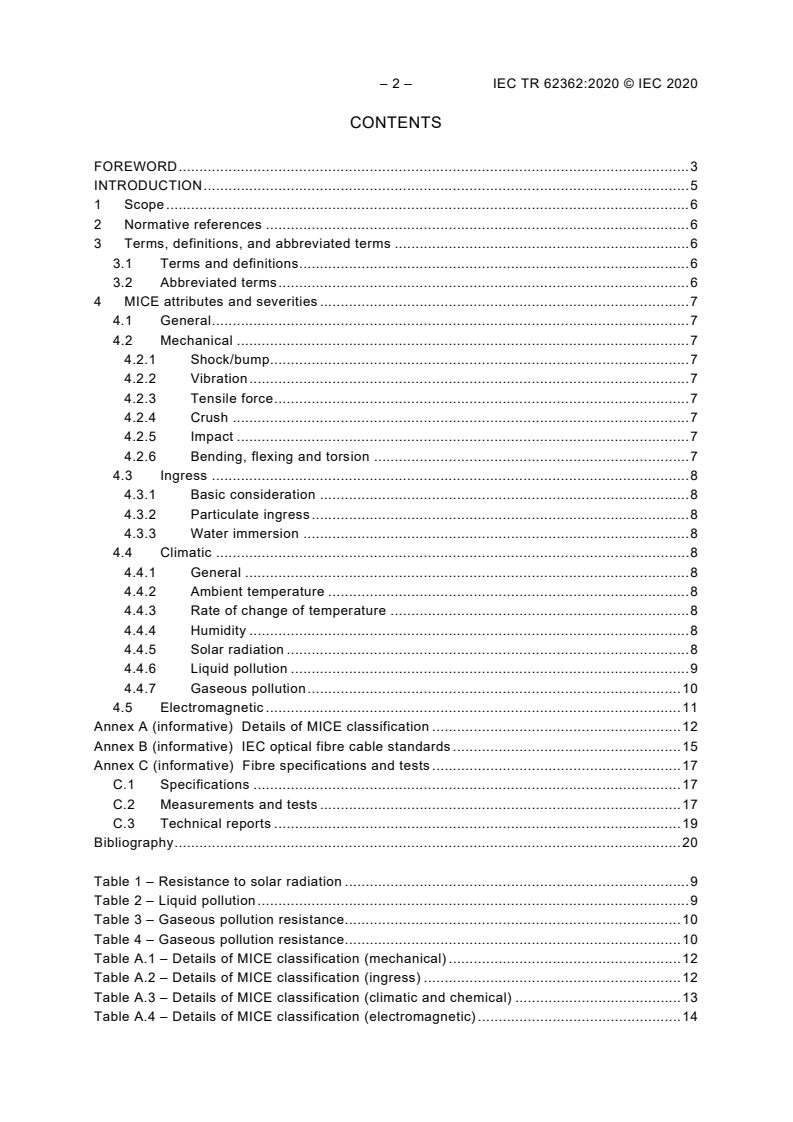
CONTENTS
FOREWORD . 3
INTRODUCTION . 5
1 Scope . 6
2 Normative references . 6
3 Terms, definitions, and abbreviated terms . 6
3.1 Terms and definitions . 6
3.2 Abbreviated terms . 6
4 MICE attributes and severities . 7
4.1 General . 7
4.2 Mechanical . 7
4.2.1 Shock/bump. 7
4.2.2 Vibration . 7
4.2.3 Tensile force . 7
4.2.4 Crush . 7
4.2.5 Impact . 7
4.2.6 Bending, flexing and torsion . 7
4.3 Ingress . 8
4.3.1 Basic consideration . 8
4.3.2 Particulate ingress . 8
4.3.3 Water immersion . 8
4.4 Climatic . 8
4.4.1 General . 8
4.4.2 Ambient temperature . 8
4.4.3 Rate of change of temperature . 8
4.4.4 Humidity . 8
4.4.5 Solar radiation . 8
4.4.6 Liquid pollution . 9
4.4.7 Gaseous pollution . 10
4.5 Electromagnetic . 11
Annex A (informative) Details of MICE classification . 12
Annex B (informative) IEC optical fibre cable standards . 15
Annex C (informative) Fibre specifications and tests . 17
C.1 Specifications . 17
C.2 Measurements and tests . 17
C.3 Technical reports . 19
Bibliography . 20
Table 1 – Resistance to solar radiation . 9
Table 2 – Liquid pollution . 9
Table 3 – Gaseous pollution resistance. 10
Table 4 – Gaseous pollution resistance. 10
Table A.1 – Details of MICE classification (mechanical) . 12
Table A.2 – Details of MICE classification (ingress) . 12
Table A.3 – Details of MICE classification (climatic and chemical) . 13
Table A.4 – Details of MICE classification (electromagnetic) . 14
INTERNATIONAL ELECTROTECHNICAL COMMISSION
____________
SELECTION OF OPTICAL FIBRE CABLE SPECIFICATIONS
RELATIVE TO MECHANICAL, INGRESS, CLIMATIC OR
ELECTROMAGNETIC CHARACTERISTICS – GUIDANCE
FOREWORD
1) The International Electrotechnical Commission (IEC) is a worldwide organization for standardization comprising
all national electrotechnical committees (IEC National Committees). The object of IEC is to promote
international co-operation on all questions concerning standardization in the electrical and electronic fields. To
this end and in addition to other activities, IEC publishes International Standards, Technical Specifications,
Technical Reports, Publicly Available Specifications (PAS) and Guides (hereafter referred to as “IEC
Publication(s)”). Their preparation is entrusted to technical committees; any IEC National Committee interested
in the subject dealt with may participate in this preparatory work. International, governmental and non-
governmental organizations liaising with the IEC also participate in this preparation. IEC collaborates closely
with the International Organization for Standardization (ISO) in accordance with conditions determined by
agreement between the two organizations.
2) The formal decisions or agreements of IEC on technical matters express, as nearly as possible, an international
consensus of opinion on the relevant subjects since each technical committee has representation from all
interested IEC National Committees.
3) IEC Publications have the form of recommendations for international use and are accepted by IEC National
Committees in that sense. While all reasonable efforts are made to ensure that the technical content of IEC
Publications is accurate, IEC cannot be held responsible for the way in which they are used or for any
misinterpretation by any end user.
4) In order to promote international uniformity, IEC National Committees undertake to apply IEC Publications
transparently to the maximum extent possible in their national and regional publications. Any divergence
between any IEC Publication and the corresponding national or regional publication shall be clearly indicated in
the latter.
5) IEC itself does not provide any attestation of conformity. Independent certification bodies provide conformity
assessment services and, in some areas, access to IEC marks of conformity. IEC is not responsible for any
services carried out by independent certification bodies.
6) All users should ensure that they have the latest edition of this publication.
7) No liability shall attach to IEC or its directors, employees, servants or agents including individual experts and
members of its technical committees and IEC National Committees for any personal injury, property damage or
other damage of any nature whatsoever, whether direct or indirect, or for costs (including legal fees) and
expenses arising out of the publication, use of, or reliance upon, this IEC Publication or any other IEC
Publications.
8) Attention is drawn to the Normative references cited in this publication. Use of the referenced publications is
indispensable for the correct application of this publication.
9) Attention is drawn to the possibility that some of the elements of this IEC Publication may be the subject of
patent rights. IEC shall not be held responsible for identifying any or all such patent rights.
The main task of IEC technical committees is to prepare International Standards. However, a
technical committee may propose the publication of a technical report when it has collected
data of a different kind from that which is normally published as an International Standard, for
example "state of the art".
IEC 62362 which is a Technical Report, has been prepared by subcommittee 86A: Fibres and
cables, of IEC technical committee 86: Fibre optics.
This second edition cancels and replaces the first edition published in 2010. It constitutes a
technical revision.
This edition includes the following significant technical changes with respect to the previous
edition:
a) replacement of references and information from ISO/IEC 24702 and ISO/IEC 11801 with
ISO/IEC 11801-1;
b) update of the MICE table;
– 4 – IEC TR 62362:2020 © IEC 2020
c) update of the current optical fibre designations of IEC 60793-2-10 and IEC 60793-2-50.
The text of this technical report is based on the following documents:
Enquiry draft Report on voting
86A/1987/DTR 86A/2029/RVDTR
Full information on the voting for the approval of this technical report can be found in the
report on voting indicated in the above table.
This document has been drafted in accordance with the ISO/IEC Directives, Part 2.
The committee has decided that the contents of this document will remain unchanged until the
stability date indicated on the IEC website under "http://webstore.iec.ch" in the data related to
the specific document. At this date, the document will be
• reconfirmed,
• withdrawn,
• replaced by a revised edition, or
• amended.
INTRODUCTION
Optical fibre cable specification standards are defined in IEC 60794 (all parts), which are
listed in Annex B. They are organized in a hierarchy similar to the IECQ system. They differ
from the IECQ system in that they are all performance standards. Optical fibre cable
standards specify the attributes and tests on cables intended to verify adequate protection of
fibres against external influences during the cabling process, cable installation handling and
from environmental effects during storage and operation. The attributes of the fibres within
the cable are defined by reference to optical fibre specification standards of the IEC 60793
series, which are listed in Annex C. A complete and up-to-date listing of standards in the
IEC 60793 and IEC 60794 series is available on the IEC website: http://www.iec.ch.
The different levels of hierarchy are: generic, sectional, family and product. The primary
distinction between these is the level of detail. Typically, more options or wider ranges are
present at the higher level. At a given level, the distinctions are with respect to application or
cable construction. Clause 2 of this document gives a more complete mapping. Parts of the
family specification include blank detail specifications for various attributes that do not have
normative requirements.
At the sectional specification level, the main categories are indoor cables, outdoor cables,
cables along overhead lines, microduct cabling and indoor/outdoor cables. Typically, the
outdoor cables have tougher tests than the indoor cables. At the product specification level,
there is a series of standards intended to support ISO/IEC 11801 (all parts) for premises
cabling, using both indoor and outdoor varieties.
It is not the intention of this document to reproduce the requirements of all relevant
specifications, but rather to discuss typical application situations and mention key options for
tests, while seeking to guarantee the performance of cables in operation.
– 6 – IEC TR 62362:2020 © IEC 2020
SELECTION OF OPTICAL FIBRE CABLE SPECIFICATIONS
RELATIVE TO MECHANICAL, INGRESS, CLIMATIC OR
ELECTROMAGNETIC CHARACTERISTICS – GUIDANCE
1 Scope
The purpose of this document is to provide information on the specification of optical fibre
cables with respect to the mechanical, ingress, climatic and chemical or electromagnetic
characteristics (MICE) as classified in ISO/IEC 11801-1.
In this classification system, each letter of the four initials of the acronym are subscripted with
a value from one to three to indicate different severities. The current attributes and severities
are found in Annex A.
2 Normative references
The following documents are referred to in the text in such a way that some or all of their
content constitutes requirements of this document. For dated references, only the edition
cited applies. For undated references, the latest edition of the referenced document (including
any amendments) applies.
IEC 60794-1-22, Optical fibre cables – Part 1-22: Generic specification – Basic optical cable
test procedures – Environmental test methods
IEC 60794-2 (all parts), Optical fibre cables – Part 2: Indoor cables
IEC 60794-3 (all parts), Optical fibre cables – Part 3: Outdoor cables
IEC 61753 (all parts), Fibre optic interconnecting devices and passive components –
Performance standard
ISO/IEC 11801 (all parts), Information technology – Generic cabling for customer premises
3 Terms, definitions, and abbreviated terms
3.1 Terms and definitions
No terms and definitions are listed in this document.
ISO and IEC maintain terminological databases for use in standardization at the following
addresses:
• IEC Electropedia: available at http://www.electropedia.org/
• ISO Online browsing platform: available at http://www.iso.org/obp
3.2 Abbreviated terms
MICE mechanical, ingress, climatic and chemical, electromagnetic
4 MICE attributes and severities
4.1 General
The MICE classification system has three levels of severity:
1) M I C E describes a typical environment such as that assumed in ISO/IEC 11801-2; (i.e.
1 1 1 1
office premises, etc.);
2) M I C E describes a light industrial environment;
2 2 2 2
3) M I C E describes a harsh industrial environment.
3 3 3 3
See Annex A for a more detailed description of the MICE severity levels.
4.2 Mechanical
4.2.1 Shock/bump
Shock and bump are not specified for optical fibre cables. They are inherently robust in this
respect.
4.2.2 Vibration
Vibration in the industrial premises (as opposed to wind induced vibration on aerially deployed
cables) is not specified for optical fibre cables. They are inherently robust in this respect.
4.2.3 Tensile force
For outdoor cables specified in IEC 60794-3 (all parts), manufacturers specify a rated tensile
force. The requirement is that the fibre shall not exceed a percentage of the proof test strain
(to be agreed between customer and supplier) when the cable is tested at the rated load.
For indoor cables, the different family specifications of IEC 60794-2 (all parts) have different
requirements on the tensile load ranging from 70 N to 400 N.
4.2.4 Crush
For optical fibre cables, the crushing force is applied in a plate to plate test.
For indoor cables, crush is specified at 500 N. For outdoor cables, different levels are
specified depending on whether the cable is armoured or not. For unarmoured cable, values
of between 750 N and 1 500 N are specified. For armoured cable, values between 1 100 N
and 2 200 N are specified.
4.2.5 Impact
For indoor cables, a value of 1 J and a hammer with a striking surface of 12,5 mm radius are
specified. For un-armoured outdoor cables, a value of 10 J and a hammer with a striking
surface of 300 mm radius are specified.
4.2.6 Bending, flexing and torsion
All the family specifications have requirements on these attributes.
For bending, there are multiple tests such as bending under tension, repeated bending and
simple bending. The bending diameter is typically 20 times the cable diameter.
For flexing, the bending diameter is typically 20 times the cable diameter, with 25 cycles
typically applied.
– 8 – IEC TR 62362:2020 © IEC 2020
For torsion, the test length, load, and number of turns varies depending on the family
specification. For indoor cables, the length is 125 x cable diameter or 250 mm, loaded at 20 N
with 10 or 20 cycles (per detailed specification) applied.
4.3 Ingress
4.3.1 Basic consideration
Optical fibre cables come in a variety of constructions. Some examples are slotted core, loose
tube, tight buffered. The slotted core and loose tube can be filled or unfilled. These different
constructions have different ingress characteristics.
4.3.2 Particulate ingress
Particulate ingress is not specified for optical fibre cables. They are inherently robust in this
respect.
4.3.3 Water immersion
On cables for which water immersion is specified, the test is different from that found in Annex
A. The requirement is that a pressure equivalent to 1 m of water is applied at or near one end
of a short (< 3 m) cable. After 24 h, no water shall be found at the other end.
It is expected that cables passing this test would pass both I and I severities.
2 3
4.4 Climatic
4.4.1 General
Terminations such as cable closures are generally considered separately from the cables and
are covered by standards from the IEC 61753 series prepared by IEC SC 86B.
NOTE The values that appear in T
...
IEC TR 62362 ®
Edition 2.0 2020-09
REDLINE VERSION
TECHNICAL
REPORT
colour
inside
Selection of optical fibre cable specifications relative to mechanical, ingress,
climatic or electromagnetic characteristics – Guidance
All rights reserved. Unless otherwise specified, no part of this publication may be reproduced or utilized in any form
or by any means, electronic or mechanical, including photocopying and microfilm, without permission in writing from
either IEC or IEC's member National Committee in the country of the requester. If you have any questions about IEC
copyright or have an enquiry about obtaining additional rights to this publication, please contact the address below or
your local IEC member National Committee for further information.
IEC Central Office Tel.: +41 22 919 02 11
3, rue de Varembé info@iec.ch
CH-1211 Geneva 20 www.iec.ch
Switzerland
About the IEC
The International Electrotechnical Commission (IEC) is the leading global organization that prepares and publishes
International Standards for all electrical, electronic and related technologies.
About IEC publications
The technical content of IEC publications is kept under constant review by the IEC. Please make sure that you have the
latest edition, a corrigendum or an amendment might have been published.
IEC publications search - webstore.iec.ch/advsearchform Electropedia - www.electropedia.org
The advanced search enables to find IEC publications by a The world's leading online dictionary on electrotechnology,
variety of criteria (reference number, text, technical containing more than 22 000 terminological entries in English
committee,…). It also gives information on projects, replaced and French, with equivalent terms in 16 additional languages.
and withdrawn publications. Also known as the International Electrotechnical Vocabulary
(IEV) online.
IEC Just Published - webstore.iec.ch/justpublished
Stay up to date on all new IEC publications. Just Published IEC Glossary - std.iec.ch/glossary
details all new publications released. Available online and 67 000 electrotechnical terminology entries in English and
once a month by email. French extracted from the Terms and Definitions clause of
IEC publications issued since 2002. Some entries have been
IEC Customer Service Centre - webstore.iec.ch/csc collected from earlier publications of IEC TC 37, 77, 86 and
If you wish to give us your feedback on this publication or CISPR.
need further assistance, please contact the Customer Service
Centre: sales@iec.ch.
IEC TR 62362 ®
Edition 2.0 2020-09
REDLINE VERSION
TECHNICAL
REPORT
colour
inside
Selection of optical fibre cable specifications relative to mechanical, ingress,
climatic or electromagnetic characteristics – Guidance
INTERNATIONAL
ELECTROTECHNICAL
COMMISSION
ICS 33.180.10 ISBN 978-2-8322-8883-2
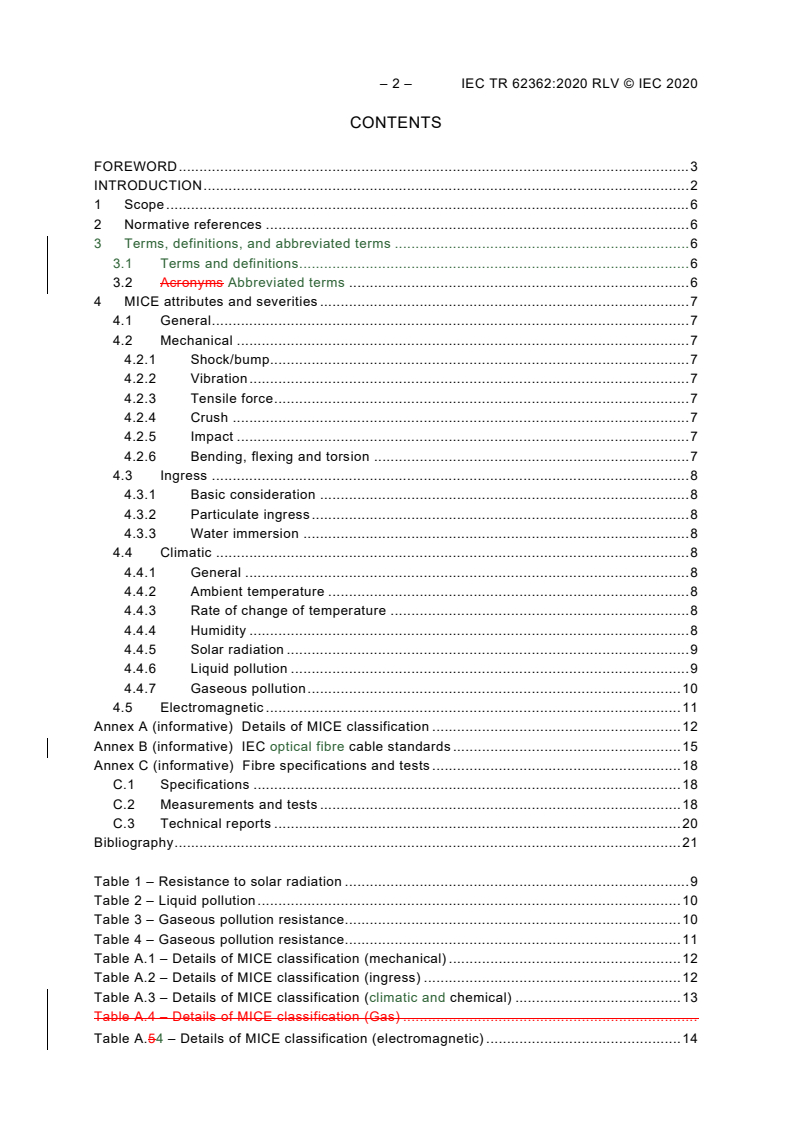
– 2 – IEC TR 62362:2020 RLV © IEC 2020
CONTENTS
FOREWORD . 3
INTRODUCTION . 2
1 Scope . 6
2 Normative references . 6
3 Terms, definitions, and abbreviated terms . 6
3.1 Terms and definitions . 6
3.2 Acronyms Abbreviated terms . 6
4 MICE attributes and severities . 7
4.1 General . 7
4.2 Mechanical . 7
4.2.1 Shock/bump. 7
4.2.2 Vibration . 7
4.2.3 Tensile force . 7
4.2.4 Crush . 7
4.2.5 Impact . 7
4.2.6 Bending, flexing and torsion . 7
4.3 Ingress . 8
4.3.1 Basic consideration . 8
4.3.2 Particulate ingress . 8
4.3.3 Water immersion . 8
4.4 Climatic . 8
4.4.1 General . 8
4.4.2 Ambient temperature . 8
4.4.3 Rate of change of temperature . 8
4.4.4 Humidity . 8
4.4.5 Solar radiation . 9
4.4.6 Liquid pollution . 9
4.4.7 Gaseous pollution . 10
4.5 Electromagnetic . 11
Annex A (informative) Details of MICE classification . 12
Annex B (informative) IEC optical fibre cable standards . 15
Annex C (informative) Fibre specifications and tests . 18
C.1 Specifications . 18
C.2 Measurements and tests . 18
C.3 Technical reports . 20
Bibliography . 21
Table 1 – Resistance to solar radiation . 9
Table 2 – Liquid pollution . 10
Table 3 – Gaseous pollution resistance. 10
Table 4 – Gaseous pollution resistance. 11
Table A.1 – Details of MICE classification (mechanical) . 12
Table A.2 – Details of MICE classification (ingress) . 12
Table A.3 – Details of MICE classification (climatic and chemical) . 13
Table A.4 – Details of MICE classification (Gas) .
Table A.54 – Details of MICE classification (electromagnetic) . 14
INTERNATIONAL ELECTROTECHNICAL COMMISSION
____________
SELECTION OF OPTICAL FIBRE CABLE SPECIFICATIONS
RELATIVE TO MECHANICAL, INGRESS, CLIMATIC OR
ELECTROMAGNETIC CHARACTERISTICS – GUIDANCE
FOREWORD
1) The International Electrotechnical Commission (IEC) is a worldwide organization for standardization comprising
all national electrotechnical committees (IEC National Committees). The object of IEC is to promote
international co-operation on all questions concerning standardization in the electrical and electronic fields. To
this end and in addition to other activities, IEC publishes International Standards, Technical Specifications,
Technical Reports, Publicly Available Specifications (PAS) and Guides (hereafter referred to as “IEC
Publication(s)”). Their preparation is entrusted to technical committees; any IEC National Committee interested
in the subject dealt with may participate in this preparatory work. International, governmental and non-
governmental organizations liaising with the IEC also participate in this preparation. IEC collaborates closely
with the International Organization for Standardization (ISO) in accordance with conditions determined by
agreement between the two organizations.
2) The formal decisions or agreements of IEC on technical matters express, as nearly as possible, an international
consensus of opinion on the relevant subjects since each technical committee has representation from all
interested IEC National Committees.
3) IEC Publications have the form of recommendations for international use and are accepted by IEC National
Committees in that sense. While all reasonable efforts are made to ensure that the technical content of IEC
Publications is accurate, IEC cannot be held responsible for the way in which they are used or for any
misinterpretation by any end user.
4) In order to promote international uniformity, IEC National Committees undertake to apply IEC Publications
transparently to the maximum extent possible in their national and regional publications. Any divergence
between any IEC Publication and the corresponding national or regional publication shall be clearly indicated in
the latter.
5) IEC itself does not provide any attestation of conformity. Independent certification bodies provide conformity
assessment services and, in some areas, access to IEC marks of conformity. IEC is not responsible for any
services carried out by independent certification bodies.
6) All users should ensure that they have the latest edition of this publication.
7) No liability shall attach to IEC or its directors, employees, servants or agents including individual experts and
members of its technical committees and IEC National Committees for any personal injury, property damage or
other damage of any nature whatsoever, whether direct or indirect, or for costs (including legal fees) and
expenses arising out of the publication, use of, or reliance upon, this IEC Publication or any other IEC
Publications.
8) Attention is drawn to the Normative references cited in this publication. Use of the referenced publications is
indispensable for the correct application of this publication.
9) Attention is drawn to the possibility that some of the elements of this IEC Publication may be the subject of
patent rights. IEC shall not be held responsible for identifying any or all such patent rights.
This redline version of the official IEC Standard allows the user to identify the changes
made to the previous edition. A vertical bar appears in the margin wherever a change
has been made. Additions are in green text, deletions are in strikethrough red text.
– 4 – IEC TR 62362:2020 RLV © IEC 2020
The main task of IEC technical committees is to prepare International Standards. However, a
technical committee may propose the publication of a technical report when it has collected
data of a different kind from that which is normally published as an International Standard, for
example "state of the art".
IEC 62362 which is a Technical Report, has been prepared by subcommittee 86A: Fibres and
cables, of IEC technical committee 86: Fibre optics.
This second edition cancels and replaces the first edition published in 2010. It constitutes a
technical revision.
This edition includes the following significant technical changes with respect to the previous
edition:
a) replacement of references and information from ISO/IEC 24702 and ISO/IEC 11801 with
ISO/IEC 11801-1;
b) update of the MICE table;
c) update of the current optical fibre designations of IEC 60793-2-10 and IEC 60793-2-50.
The text of this technical report is based on the following documents:
Enquiry draft Report on voting
86A/1987/DTR 86A/2029/RVDTR
Full information on the voting for the approval of this technical report can be found in the
report on voting indicated in the above table.
This document has been drafted in accordance with the ISO/IEC Directives, Part 2.
The committee has decided that the contents of this document will remain unchanged until the
stability date indicated on the IEC website under "http://webstore.iec.ch" in the data related to
the specific document. At this date, the document will be
• reconfirmed,
• withdrawn,
• replaced by a revised edition, or
• amended.
IMPORTANT – The 'colour inside' logo on the cover page of this publication indicates
that it contains colours which are considered to be useful for the correct
understanding of its contents. Users should therefore print this document using a
colour printer.
INTRODUCTION
Optical fibre cable specification standards are defined in IEC 60794 (all parts), which are
listed in Annex B. They are organized in a hierarchy similar to the IECQ system. They differ
from the IECQ system in that they are all performance standards. Optical fibre cable
standards mainly cover the attributes and tests that protect the fibre from the environment,
including installation, and the fibre attributes that may be affected by cabling. Optical fibre
cable standards specify the attributes and tests on cables intended to verify adequate
protection of fibres against external influences during the cabling process, cable installation
handling and from environmental effects during storage and operation. The attributes of the
fibres within the cable are defined by reference to optical fibre specification standards of the
IEC 60793 series, which are listed in Annex C. A complete and up-to-date listing of standards
in the IEC 60793 and IEC 60794 series is available on the IEC website: http://www.iec.ch.
The different levels of hierarchy are: general generic, sectional, family and product. The
primary distinction between these is the level of detail. Typically, more options or wider
ranges are present at the higher level. At a given level, the distinctions are with respect to
application or cable construction. The references section Clause 2 of this document gives a
more complete mapping. Parts of the family specification include blank detail specifications
for various attributes that do not have normative requirements.
At the sectional specification level, two main categories are indoor and outdoor cables.
Typically the outdoor cables have tougher tests than the indoor cables. At the product
specification level, there are series of standards intended to support ISO/IEC 11801 for
premises cabling, using both indoor and outdoor varieties.
This guidance will not attempt to reproduce the requirements of all the different specifications.
For each of the MICE attributes, it will discuss the situation and mention the key options.
At the sectional specification level, the main categories are indoor cables, outdoor cables,
cables along overhead lines, microduct cabling and indoor/outdoor cables. Typically, the
outdoor cables have tougher tests than the indoor cables. At the product specification level,
there is a series of standards intended to support ISO/IEC 11801 (all parts) for premises
cabling, using both indoor and outdoor varieties.
It is not the intention of this document to reproduce the requirements of all relevant
specifications, but rather to discuss typical application situations and mention key options for
tests, while seeking to guarantee the performance of cables in operation.
– 6 – IEC TR 62362:2020 RLV © IEC 2020
SELECTION OF OPTICAL FIBRE CABLE SPECIFICATIONS
RELATIVE TO MECHANICAL, INGRESS, CLIMATIC OR
ELECTROMAGNETIC CHARACTERISTICS – GUIDANCE
1 Scope
The purpose of this document is to provide information on the specification of optical fibre
cables with respect to the mechanical, ingress, climatic and chemical or electromagnetic
characteristics (MICE) as classified in ISO/IEC 24702 ISO/IEC 11801-1.
In this classification system, each letter of the four initials of the acronym are subscripted with
a value from one to three to indicate different severities. The current attributes and severities
are found in Annex A.
2 Normative references
The following documents are referred to in the text in such a way that some or all of their
content constitutes requirements of this document. For dated references, only the edition
cited applies. For undated references, the latest edition of the referenced document (including
any amendments) applies.
IEC 60794-1-22, Optical fibre cables – Part 1-22: Generic specification – Basic optical cable
test procedures – Environmental test methods
IEC 60794-2 (all parts), Optical fibre cables – Part 2: Indoor optical fibre cables
IEC 60794-3 (all parts), Optical fibre cables – Part 3: Outdoor cables
ISO/IEC 24702, Information technology – Generic cabling – Industrial premises
IEC 61753 (all parts), Fibre optic interconnecting devices and passive components –
Performance standard
ISO/IEC 11801 (all parts), Information technology – Generic cabling for customer premises
3 Terms, definitions, and abbreviated terms
3.1 Terms and definitions
No terms and definitions are listed in this document.
ISO and IEC maintain terminological databases for use in standardization at the following
addresses:
• IEC Electropedia: available at http://www.electropedia.org/
• ISO Online browsing platform: available at http://www.iso.org/obp
3.2 Acronyms Abbreviated terms
MICE mechanical, ingress, climatic and chemical, electromagnetic
4 MICE attributes and severities
4.1 General
The MICE classification system has three levels of severity:
1) M I C E describes a typical environment such as that assumed in ISO/IEC 11801-2; (i.e.
1 1 1 1
office premises, etc.);
2) M I C E describes a worst-case light industrial environment;
2 2 2 2
3) M I C E describes a worst-case harsh industrial environment.
3 3 3 3
See Annex A for a more detailed description of the MICE severity levels.
4.2 Mechanical
4.2.1 Shock/bump
Shock and bump are not specified for optical fibre cables. They are inherently robust in this
respect. A more important attribute is bending.
4.2.2 Vibration
Vibration in the industrial premises (as opposed to wind induced vibration on aerially deployed
cables) is not specified for optical fibre cables. They are inherently robust in this respect.
4.2.3 Tensile force
For outdoor premises cables specified in IEC 60794-3 (all parts), manufacturers specify a
rated tensile force. The requirement is that the fibre shall not exceed a percentage of the
proof test strain (to be agreed between customer and supplier) when the cable is tested at the
rated load.
For indoor cables, the different family specifications of IEC 60794-2 (all parts) have different
requirements on the tensile load ranging from 70 N to 400 N.
4.2.4 Crush
For optical fibre cables, the crushing force is applied in a plate to plate test.
For indoor cables, crush is specified at 500 N. For outdoor cables, different levels are
specified depending on whether the cable is armoured or not. For unarmoured cable, values
of between 1 500 N and 3 000 N may be specified. For armoured cable, values between
2 200 N and 10 000 N may be specified. For unarmoured cable, values of between 750 N and
1 500 N are specified. For armoured cable, values between 1 100 N and 2 200 N are
specified.
4.2.5 Impact
For indoor cables, a value of 1 J and a hammer with a striking surface of 12,5 mm radius is
are specified. For un-armoured outdoor cables, a value of either 10 J and a hammer with a
striking surface of 300 mm radius or 3 J with a 10 mm radius is are specified.
4.2.6 Bending, flexing and torsion
All the family specifications have requirements on these attributes.
For bending, there are multiple tests such as bending under tension, repeated bending and
simple bending. The bending diameter is typically 20 times the cable diameter.
– 8 – IEC TR 62362:2020 RLV © IEC 2020
For flexing, the bending diameter is typically 20 times the cable diameter, with 25 cycles
typically applied.
For torsion, the test length, load, and number of turns varies depending on the family
specification. For indoor cables, the length is from 250 mm to 1 000 mm, loaded at 20 N with
20 cycles applied 125 x cable diameter or 250 mm, loaded at 20 N with 10 or 20 cycles (per
detailed specification) applied.
4.3 Ingress
4.3.1 Basic consideration
Optical fibre cables come in a variety of constructions. Some examples are slotted core, loose
tube, tight buffered. The slotted core and loose tube can be filled or unfilled. These different
constructions have different ingress characteristics.
4.3.2 Particulate ingress
Particulate ingress is not specified for optical fibre cables. They are inherently robust in this
respect.
4.3.3 Water immersion
On cables for which water immersion is specified, the test is different from that found in Annex
A. The requirement is that a pressure equivalent to 1 m of water is applied at or near one end
of a short (< 3 m) cable. After 24 h, the requirement is: no water shall be found at the other
end.
It is expected that cables passing this test would pass both I and I severities.
2 3
4.4 Climatic
4.4.1 General
Terminations such as cable closures are generally considered separately from the cables and
are covered by standards from the IEC 61753 series prepared by IEC SC 86B.
NOTE The values that appear in Table 1 to Table 3 below indicate levels of resistance to climatic phenomena.
Values of 1 to 3 correspond to the relevant level of severity in the MICE classification system. A value of 0
indicates no effective resistance to the climatic phenomena described.
4.4.2 Ambient temperature
The different specifications allow different ranges of values to be specified by the customer,
depending on the climate in which the cable will be installed. For the detailed specifications
for premises cabling, –20 °C to +60 °C are specified. Other ranges and combinations from
–45 °C to +70 °C are also found as options in the family specifications.
4.4.3 Rate of change of temperature
This is not specified. All the cables that pass the other requirements will, however, have the
capability of 3 °C/min. The rate of change of temperature is not specified in the product
specifications of cables. IEC 60794-1-22, methods F1 and F12, specify a rate of heating that
shall not exceed 60 °C per hour. However, it is assumed that all the cables have the capability
of 3 °C/min.
4.4.4 Humidity
For further study.
4.4.5 Solar radiation
Resistance to solar radiation in the industrial premises environment is not specified in the
product specifications of cables. Resistance to solar radiation is a property of the sheath
material. The severities associated with some common generic materials are indicated in
Table 1.
A specific grade of the generic material may have a different performance to that identified in
Table 1.
Table 1 – Resistance to solar radiation
Material Climatic classification, C
Natural Stabilized With ~2,5 % of
active carbon
black content
Medium-density polyethylene 0 3 3
Track-resistant medium-density polyethylene 0 3 3
High-density polyethylene 0 3 3
Thermoplastic (co)polyester elastomer 0 3 3
Polyvinyl chloride 1 3 3
Polyvinylidene fluoride 1 3 3
Nylon 12 (polyamide) 1 3 3
Thermoplastic polyurethane (TPU) 1 3 3
NOTE The values in this table indicate levels of resistance to climatic phenomena. Values of 1 to 3 correspond
to the relevant level of severity in the MICE classification system. A value of 0 indicates no effective resistance
to the climatic phenomena described.
4.4.6 Liquid pollution
Resistance to liquid pollution is not specified in the product specifications of cables.
Resistance to liquid pollution is a property of the sheath material. The severities associated
with some common generic materials are indicated in Table 2.
A specific grade of the generic material may have a different performance to that identified in
Table 12.
– 10 – IEC TR 62362:2020 RLV © IEC 2020
Table 2 – Liquid pollution
Chemical classification, C Pollutant
Sodium Oil (dry-air Sodium Detergent Conductive
Material
chloride concentration) stearate materials in
(salt/sea (soap) solution
water)
Low-density polyethylene 3 3 3 3 3
Medium-density polyethylene 3 3 3 3 3
Track-resistant medium-density 3 3 3 3 3
polyethylene
High-density polyethylene 3 3 3 3 3
Thermoplastic (co)polyester 3 3 3 3 3
elastomer
Polyvinyl chloride 2 2 2 2 3
Polyvinylidene fluoride 3 3 3 3 3
Nylon (polyamid 12) 2 2 2 2 3
Thermoplastic polyurethane 3 3 3 3 3
(TPU)
NOTE The values in this table indicate levels of resistance to climatic phenomena. Values of 1 to 3 correspond to
the relevant level of severity in the MICE classification system. A value of 0 indicates no effective resistance to the
climatic phenomena described.
4.4.7 Gaseous pollution
Resistance to gaseous pollution is not specified in the product specifications of cables.
Resistance to gaseous pollution is a property of the sheath material. The severities
associated with some common generic materials are indicated in Table 3 and Table 4.
A specific grade of the generic material may have a different performance to that identified in
the Table 13 and Table 4.
Table 3 – Gaseous pollution resistance
Chemical classification, C, by pollutant
Hydrogen Sulphur Chlorine Chlorine Hydrogen
Material
sulphide dioxide wet dry chloride
10 %
Low-density polyethylene 2 2 0 0 2
Medium-density polyethylene 2 2 0 0 2
Track resistant medium-density 2 2 0 0 2
polyethylene
High-density polyethylene 2 2 0 0 2
Thermoplastic (co)polyester 2 2 1 1 0
elastomer
Polyvinyl chloride 3 3 1 0 3
Polyvinylidene fluoride 3 2 3 3 3
Nylon (polyamid 12) 3 1 0 0 0
Thermoplastic polyurethane 3 3 2 2 3
(TPU)
NOTE The values in this table indicate levels of resistance to climatic phenomena. Values of 1 to 3 correspond
to the relevant level of severity in the MICE classification system. A value of 0 indicates no effective resistance
to the climatic phenomena described.
Table 4 – Gaseous pollution resistance
Pollutant
Hydrogen Hydrogen Ammonia Oxides of Ozone
Material
chloride fluoride nitrogen 100 %
37 %
Low-density polyethylene 2 2 3 0 0
Medium-density polyethylene 2 0 3 0 0
Track tesistant medium-density 2 0 3 0 0
polyethylene
High-density polyethylene 2 0 3 0 0
Thermoplastic (co)polyester 0 0 0 0 0
elastomer
Polyvinyl chloride 3 2 3 1 1
Polyvinylidene fluoride 3 3 3 2 2
Nylon (polyamid 12) 0 0 3 1 1
Thermoplastic polyurethane (TPU) 3 2 3 3 3
4.5 Electromagnetic
Cables can be dielectric, or can contain metallic elements such as armour, strength members
or sheaths. With the exception of possible damage on cables with metallic sheathes due to
lightning strikes, optical fibre cables are immune to all of the attributes for this category.
– 12 – IEC TR 62362:2020 RLV © IEC 2020
Annex A
(informative)
Details of MICE classification
The details associated with ISO/IEC 24702 ISO/IEC 11801-1 are presented in the following
tables Table A.1 to Table A.4.
Table A.1 – Details of MICE classification (mechanical)
Mechanical M M M
1 2 3
a
Shock/bump
2 −2 2 −2 2 −2
Peak acceleration 40 ms ms 100 ms ms 250 ms ms
Vibration
Displacement amplitude 1,5 mm 7,0 mm 15,0 mm
(2 Hz to 9 Hz)
2 −2 2 −2 2 −2
Acceleration amplitude 5 ms ms 20 ms ms 50 ms ms
(9 Hz to 500 Hz)
b b b
Tensile force strength
Crush 45 N over 25 100 mm 1 100 N over 150 100 mm 2 200 N over 150 100 mm
(linear) min. (linear) min. (linear) min.
Per IEC 60794-1-2, Method
21, method E.3
180 N 735 N 1 470 N
Impact 1 J 10 J 30 J
b b b
Bending, flexing and torsion
a
Bump: the repetitive nature of the shock experienced by the channel shall be taken into account.
b
This aspect of environmental classification is installation-specific and should be considered in association with
IEC 61918 and the appropriate component specification.
Table A.2 – Details of MICE classification (ingress)
Ingress I I I
1 2 3
Particulate ingress (dia. max) 12,5 mm 50 µm 50 µm
Immersion None Intermittent liquid jet Intermittent liquid jet
≤ 12,5 l/min ≤ 12,5 l/min
≥ 6,3 mm jet ≥ 6,3 mm jet
> 2,5 m distance > 2,5 m distance
immersion ≤ 1 m for ≤ 30 min
Table A.3 – Details of MICE classification (climatic and chemical)
Climatic and chemical C C C
1 2 3
Ambient temperature –10° C to +60° C –25° C to +70° C –40° C to +70° C
Rate of change of
0,1° C per minute 1,0° C per minute 3,0° C per minute
temperature
Humidity 5 % to 85 % (non- 5 % to 95 % (condensing) 5 % to 95 % (condensing)
condensing)
2 −2 2 −2 2 −2
Solar radiation 700 Wm Wm 1 120 Wm Wm 1 120 Wm Wm
ca
–6 –6 –6
Liquid pollution
Concentration × 10 Concentration × 10 Concentration × 10
Contaminants
Sodium chloride (salt/sea 0 < 0,3 < 0,3
water)
Oil (dry-air concentration) 0 < 0,005 < 0,5
b
(for oil types see )
4 4
Sodium stearate (soap) None 5 × 10 aqueous non- > 5 × 10 aqueous gelling
gelling
Detergent None For further study ffs For further study ffs
Conductive materials None Temporary Present
Table A.4 – Details of MICE classification (Gas)
Gaseous pollution (see Mean/Peak Mean/peak Mean/peak
–6 –6 –6
Note 3) (concentration × 10 ) (concentration × 10 ) (concentration × 10 )
c
Contaminants
Hydrogen sulphide < 0,003 / < 0,01 < 0,05 / < 0,5 < 10 / < 50
Sulphur dioxide < 0,01 / < 0,03 < 0,1 / < 0,3 < 5 / < 15
Sulphur trioxide (ffs) < 0,01 / < 0,03 < 0,1 / < 0,3 < 5 / < 15
Chlorine wet (> 50 % < 0,000 5 / < 0,001 < 0,005 / < 0,03 < 0,05 / < 0,3
humidity)
Chlorine dry (< > 50 % < 0,002 / < 0,01 < 0,02 / < 0,1 < 0,2 / < 1,0
humidity)
Hydrogen chloride ≤ 0,06 < 0,06 / < 0,3 < 0,6 / < 3,0
Hydrogen fluoride < 0,001 / < 0,005 < 0,01 / < 0,05 < 0,1 / < 1,0
Ammonia < 1 / < 5 < 10 / < 50 < 50 / < 250
Oxides of nitrogen < 0,05 / < 0,1 < 0,5 / < 1 < 5 / < 10
Ozone < 0,002 / < 0,005 < 0,025 / < 0,05 < 0,1 / < 1
a –6
A single dimensional characteristic, i.e. concentration × 10 , was chosen to unify limits from different
standards.
– 14 – IEC TR 62362:2020 RLV © IEC 2020
Table A.54 – Details of MICE classification (electromagnetic)
Electromagnetic E1 E2 E3
Electrostatic discharge – Contact (0,667 µC) 4 kV 4 kV 4 kV
8 kV 8 kV 8 kV
Electrostatic discharge – Air (0,132 µC)
3 V/m at 80 MHz to 3 V/m at 80 MHz to 10 V/m at 80 MHz to
Radiated RF – AM
1 000 MHz 1 000 MHz 1 000 MHz
3 V/m at 1 400 MHz 3 V/m at 1 400 MHz 3 V/m at 1 400 MHz
to to to
2 000 MHz 2 000 MHz 2 000 MHz
1 V/m at 2 000 MHz 1 V/m at 2 000 MHz 1 V/m at 2 000 MHz
to to to
2 700 MHz 2 700 MHz 2 700 MHz
Conducted RF 3 V at 150 kHz to 3 V at 150 kHz to 10 V at 150 kHz to
80 MHz 80 MHz 80 MHz
EFT/B (comms) 500 V 1 000 V 1 000 V
500 V 1 000 V 1 000 V
Surge (transient ground potential difference) –
signal, line to earth
−1 −1 −1
Magnetic field (50 Hz to 60 Hz) 1 Am 3 Am 30 Am
Magnetic field (60 Hz to 20 000 Hz) For further study. ffs For further study. ffs For further study. ffs
a
Bump: the repetitive nature of the shock experienced by the channel shall be taken into account.
b
This aspect of environmental classification is installation-specific and should be considered in association with
IEC 61918 and the appropriate component specification.
c –6
A single dimensional characteristic, i.e. concentration × 10 , was chosen to unify limits from different
standards."
Annex B
(informative)
IEC optical fibre cable standards
The following is a list of existing IEC optical cable standards:
IEC 60794-1-1, Optical fibre cables – Part 1-1: Generic specification – General
IEC 60794-1-2, Optical fibre cables – Part 1-2: Generic specification – Basic optical cable test
procedures – General guidance
IEC 60794-1-3, Optical fibre cables – Part 1-3: Generic specification – Optical cable elements
IEC 60794-1-21, Optical fibre cables – Part 1-21: Generic specification – Basic optical cable
test procedures – Mechanical tests methods
IEC 60794-1-22, Optical fibre cables – Part 1-22: Generic specification – Basic optical cable
test procedures – Environmental test methods
IEC 60794-1-23, Optical fibre cables – Part 1-23: Generic specification – Basic optical cable
test procedures – Cable element test methods
IEC 60794-1-24, Optical fibre cables – Part 1-24: Generic specification – Basic optical cable
test procedures – Electrical test methods
IEC 60794-1-31, Optical fibre cables – Part 1-31: Generic specification – Optical cable
elements – Optical fibre ribbon
IEC 60794-2, Optical fibre cables – Part 2: Indoor cables – Sectional specification
IEC 60794-2-10, Optical fibre cables – Part 2-10: Indoor optical fibre cables – Family
specification for simplex and duplex cables
IEC 60794-2-11, Optical fibre cables – Part 2-11: Indoor optical fibre cables – Detailed
specification for simplex and duplex cables for use in premises cabling
IEC 60794-2-20, Optical fibre cables – Part 2-20: Indoor cables – Family specification for
multi-fibre optical distribution cables
IEC 60794-2-21, Optical fibre cables – Part 2-21: Indoor optical fibre cables – Detailed
specification for multi-fibre optical distribution cables for use in premises cabling
IEC 60794-2-22, Optical fibre cables – Part 2-22: Indoor cables – Detailed specification for
multi-simplex breakout optical cables to be terminated with connectors
IEC 60794-2-30, Optical fibre cables – Part 2-30: Indoor cables – Family specification for
optical fibre ribbon cables for use in premises cabling
IEC 60794-2-31, Optical fibre cables – Part 2-31: Indoor optical fibre cables – Detailed
specification for optical fibre ribbon cables for use in premises cabling
IEC 60794-2-40, Optical fibre cables – Part 2-40: Indoor optical fibre cables – Family
specification for A4 fibre cables with plastic optical fibres
– 16 – IEC TR 62362:2020 RLV © IEC 2020
IEC 60794-2-41, Optical fibre cables – Part 2-41: Indoor cables – Product specification for
simplex and duplex buffered A4 fibres
IEC 60794-2-42, Optical fibre cables – Part 2-42: Indoor optical fibre cables – Product
specification for simplex and duplex cables with A4 fibres
IEC 60794-2-50, Optical fibre cables – Part 2-50: Indoor optical fibre cables – Family
specification for simplex and duplex cables for use in terminated cable assemblies
IEC 60794-3, Optical fibre cables – Part 3: Outdoor cables – Sectional specification
IEC 60794-3-10, Optical fibre cables – Part 3-10: Outdoor cables – Family specification for
duct, directly buried and lashed aerial optical telecommunication cables
IEC 60794-3-11, Optical fibre cables – Part 3-11 Outdoor cables – Duct and Product
specification for duct, directly buried and lashed aerial single-mode optical fibre
telecommunication cables – Detailed specification
IEC 60794-3-12, Optical fibre cables – Part 3-12: Outdoor cables – Detailed specification for
duct and directly buried optical telecommunication cables for use in premises cabling
IEC 60794-3-20, Optical fibre cables – Part 3-20: Outdoor cables – Family specification for
optical self-supporting aerial telecommunication cables
IEC 60794-3-21, Optical fibre cables – Part 3-21: Outdoor cables – Detailed specification for
optical self-supporting aerial telecommunication cables for use in premises cabling
IEC 60794-3-30, Optical fibre cables – Part 3-30: Outdoor cables – Family specification for
optical telecommunication cables for lake, river crossings and coastal application
IEC 60794-3-40, Optical fibre cables – Part 3-40: Outdoor cables – Family specification for
sewer cables and conduits for installation by blowing and/or pulling in non-man accessible
storm and sanitary sewers
IEC 60794-3-70, Optical fibre cables – Part 3-70: Outdoor cables – Family specification for
outdoor optical fibre cables for rapid/multiple deployment
IEC 60794-4, Optical fibre cables – Part 4: Sectional specification – Aerial optical cables
along electrical power lines
IEC 60794-4-10, Optical fibre cables – Part 4-10: Aerial optical cables along electrical power
lines – Family specification for OPGW (Optical Ground Wire) Family specification – Optical
ground wires (OPGW) along electrical power lines
IEC 60794-4-20, Optical fibre cables – Part 4-20: Sectional specification – Aerial optical
cables along electrical power lines – Family specification for ADSS (all dielectric self-
supported) optical cables
IEC 60794-5, Optical fibre cables – Part 5: Sectional specification – Microduct cabling for
installation by blowing
IEC 60794-5-10, Optical fibre cables – Part 5-10: Family specification – Outdoor microduct
optical fibre cables, microducts and protected microducts for installation by blowing
IEC 60794-5-20, Optical fibre cables – Part 5-20: Family specification – Outdoor microduct
fibre units, microducts and protected microducts for installation by blowing
IEC 60794-2-41, Optical fibre cables – Part 2-41: Indoor cables – Product specification for
simplex and duplex buffered A4 fibres
IEC 60794-2-42, Optical fibre cables – Part 2-42: Indoor optical fibre cables – Product
specification for simplex and duplex cables with A4 fibres
IEC 60794-2-50, Optical fibre cables – Part 2-50: Indoor cables – Family specification for
simplex and duplex cables for use in terminated cable assemblies
– 18 – IEC TR 62362:2020 RLV © IEC 2020
Annex C
(informative)
Fibre specifications and tests
C.1 Specifications
The fibre specifications are organized as a series of sectional specification standards beneath
a general specification. Within each sectional specification, there is a series of normative
annexes that define the requirements for the different family specifications. Within the single-
mode fibre sectional specification, IEC 60793-2-50, for example, are the family specifications
for the B1.1, B1.2, B1.3, B2, B4, B5 and B6 B-652.B, B-652.D, B-653, B-654, B-655 and B-
657 fibre categories.
IEC 60793-2, Optical fibres – Part 2: Product specifications – General
IEC 60793-2-10, Optical fibres – Part 2-10: Product specifications – Sectional specification for
category A1 multimode fibres
IEC 60793-2-20, Optical fibres – Part 2-20: Product specifications – Sectional specification for
category A2 multimode fibres
IEC 60793-2-30, Optical fibres – Part 2-30: Product specifications – Sectional specification for
category A3 multimode fibres
IEC 60793-2-40, Optical fibres – Part 2-40: Product specifications – Sectional specification for
category A4 multimode fibres
IEC 60793-2-50, Optical fibres – Part 2-50: Product specifications – Sectional specification for
class B single-mode fibres
C.2 Measurements and tests
The fibre tests and measurements are under a general and guidance standard and organized
into groups relating to dimensional, mechanical, optical, and environmental attributes. When
multiple measurement methods are defined, they appear as different normative annexes of
these documents.
IEC 60793-1-1, Optical fibres – Part 1-1: Measurement methods and test procedures –
General and guidance
IEC 60793-1-20, Optical fibres – Part 1-20: Measurement methods and test procedures –
Fibre geometry
IEC 60793-1-21, Optical fibres – Part 1-21: Measurement methods and test procedures –
Coating geometry
IEC 60793-1-22, Optical fibres – Part 1-22: Measurement methods and test procedures –
Length measurement
IEC 60793-1-30, Optical fibres – Part 1-30: Measurement methods and test procedures –
Fibre proof test
IEC 60793-1-31, Optical fibres – Part 1-31: Measurement methods and test procedures –
Tensile strength
IEC 60793-1-32, Optical fibres – Part 1-32: Measurement methods and test procedures –
Coating strippability
IEC 60793-1-33, Optical fibres – Part 1-33: Measurement methods and test procedures –
Stress corrosion susceptibility
IEC 60793-1-34, Optical fibres – Part 1-34: Measurement methods and test procedures –
Fibre curl
IEC 60793-1-40, Optical fibres – Part 1-40: Attenuation measurement methods and test
procedures – Attenuation
IEC 60793-1-41, Optical fibres – Part 1-41: Measurement methods and test procedures –
Bandwidth
IEC 60793-1-42, Optical fibres – Part 1-42: Measurement methods and test procedures –
Chromatic dispersion
IEC 60793-1-43, Optical fibres – Part 1-43: Measurement methods and test procedures –
Numerical aperture
IEC 60793-1-44, Optical fibres – Part 1-44: Measurement methods and test procedures – Cut-
off wavelength
IEC 60793-1-45, Optical fibres – Part 1-45: Measurement methods and test procedures –
Mode field diameter
IEC 60793-1-46, Optical fibres – Part 1-46: Measurement methods and test procedures –
Monitoring of changes in optical transmittance
IEC 60793-1-47, Optical fibres – Part 1-47: Measurement methods and test procedures –
Macrobending loss
IEC 60793-1-48, Optical fibres – Part 1-48: Measurement methods and test procedures –
Polarization mode dispersion
IEC 60793-1-49, Optical fibres – Part 1-49: Measurement methods and test procedures –
Differential mode delay
IEC 60793-1-50, Optical fibres – Part 1-50: Measurement methods and test procedures –
Damp heat (steady state) tests
IEC 60793-1-51, Optical fibres – Part 1-51: Measurement methods and test procedures – Dry
heat (steady state) tests
IEC 60793-1-52, Optical fibres – Part 1-52: Measurement methods and test procedures –
Change of
...