

IEC TS 62993:2017
(Main)Guidance for determination of clearances, creepage distances and requirements for solid insulation for equipment with a rated voltage above 1 000 V AC and 1 500 V DC, and up to 2 000 V AC and 3 000 V DC
General Information
- Abstract
IEC TS 62993:2017 gives guidance to technical committees which deal with equipment having a rated voltage of more than 1 000 V AC and up to 2 000 V AC, or a rated voltage of more than 1 500 V DC and up to 3 000 V DC. Rated voltages up to 1 000 V AC and 1 500 V DC, as well as higher or lower internal voltages, are covered by IEC 60664-1.
This document applies to equipment for use up to 2 000 m above sea level, and provides guidance for use at higher altitudes.
This document gives guidance for clearances, creepage distances and solid insulation for equipment to achieve safety. It includes methods of electric testing.
The contents of the corrigendum of June 2018 have been included in this copy.
- Status
- Published
- Publication Date
- 11-Jul-2017
- Technical Committee
- TC 109 - Insulation co-ordination for low-voltage equipment
- Drafting Committee
- JWG 4 - TC 109/JWG 4
- Current Stage
- PPUB - Publication issued
- Start Date
- 12-Jul-2017
- Completion Date
- 26-Jul-2017
Buy Documents
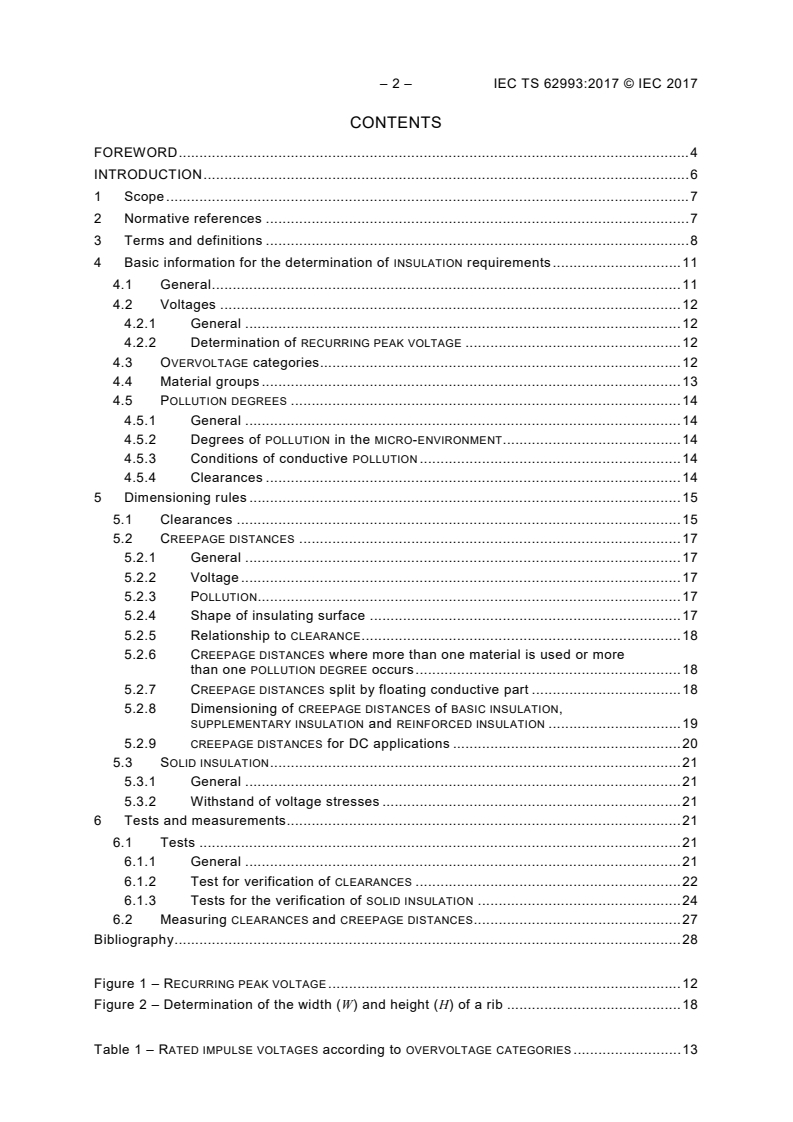
IEC TS 62993:2017 - Guidance for determination of clearances, creepage distances and requirements for solid insulation for equipment with a rated voltage above 1 000 V AC and 1 500 V DC, and up to 2 000 V AC and 3 000 V DC Released:7/12/2017
Overview
IEC TS 62993:2017 provides technical guidance for the determination of clearances, creepage distances and solid insulation requirements for equipment with rated voltages above 1 000 V AC / 1 500 V DC and up to 2 000 V AC / 3 000 V DC. Intended as a transition between low-voltage insulation rules (IEC 60664‑1) and high-voltage practice, this Technical Specification addresses safety-related insulation coordination, electric test methods and altitude considerations (applies up to 2 000 m and gives guidance for higher altitudes).
Key topics and requirements
- Scope and applicability: Guidance for equipment rated >1 000 V AC / >1 500 V DC up to 2 000 V AC / 3 000 V DC; excludes distances through liquids and gases other than air.
- Clearances: Principles for air distances between conductive parts, dimensioning rules, and tables for withstand to transient and recurring overvoltages.
- Creepage distances: Guidance on surface distances to avoid tracking and surface flashover, including treatment for multiple materials, ribs, floating conductive parts and DC-specific considerations.
- Solid insulation: Requirements for solid insulating materials, material group selection, conditioning severities and verification tests to withstand voltage stresses.
- Insulation coordination factors: Overvoltage categories, recurring peak voltage determination, pollution degrees, and material groups used to size insulation.
- Tests and measurements: Electric testing methods, test voltages (with altitude correction factors), procedures to verify clearances and solid insulation, and measurement practices for creepage/clearance.
- Tables and figures: The specification includes dimensioning tables, altitude correction factors, test voltage tables and illustrations for rib geometry and measurement rules.
Applications and who uses it
IEC TS 62993 is practical for:
- Design engineers and insulation coordinators specifying air and surface distances in medium‑high voltage equipment.
- Manufacturers of power converters, switchgear, high-voltage drives, DC systems and other equipment operating in the 1–3 kV range.
- Test laboratories and certification bodies applying electrical tests and altitude corrections.
- Standards and technical committees developing product standards that must bridge the gap between IEC 60664‑1 and higher‑voltage IEC standards.
Practical benefits include safer insulation design, clearer testing requirements, and consistent product safety criteria for equipment that falls between conventional low- and high-voltage standards.
Related standards
- IEC 60664‑1 (insulation coordination for low-voltage equipment up to 1 000 V AC / 1 500 V DC)
- IEC 60071‑1 (high-voltage insulation coordination; starts at higher voltages and does not provide creepage guidance)
- Other referenced test standards (e.g., IEC 60112, IEC 61180) for material tracking and high‑voltage test techniques.
Keywords: IEC TS 62993:2017, clearances, creepage distances, solid insulation, insulation coordination, 2 000 V AC, 3 000 V DC, pollution degree, overvoltage categories, electrical testing.
Relations
- Effective Date
- 05-Sep-2023
Buy Documents
IEC TS 62993:2017 - Guidance for determination of clearances, creepage distances and requirements for solid insulation for equipment with a rated voltage above 1 000 V AC and 1 500 V DC, and up to 2 000 V AC and 3 000 V DC Released:7/12/2017
Get Certified
Connect with accredited certification bodies for this standard

IMQ S.p.A. (Certification)
Italian electrical product certification.

SLG Prüf- und Zertifizierungs GmbH
German testing and certification body.

UL Solutions
Global safety science company with testing, inspection and certification.
Sponsored listings
Frequently Asked Questions
IEC TS 62993:2017 is a technical specification published by the International Electrotechnical Commission (IEC). Its full title is "Guidance for determination of clearances, creepage distances and requirements for solid insulation for equipment with a rated voltage above 1 000 V AC and 1 500 V DC, and up to 2 000 V AC and 3 000 V DC". This standard covers: IEC TS 62993:2017 gives guidance to technical committees which deal with equipment having a rated voltage of more than 1 000 V AC and up to 2 000 V AC, or a rated voltage of more than 1 500 V DC and up to 3 000 V DC. Rated voltages up to 1 000 V AC and 1 500 V DC, as well as higher or lower internal voltages, are covered by IEC 60664-1. This document applies to equipment for use up to 2 000 m above sea level, and provides guidance for use at higher altitudes. This document gives guidance for clearances, creepage distances and solid insulation for equipment to achieve safety. It includes methods of electric testing. The contents of the corrigendum of June 2018 have been included in this copy.
IEC TS 62993:2017 gives guidance to technical committees which deal with equipment having a rated voltage of more than 1 000 V AC and up to 2 000 V AC, or a rated voltage of more than 1 500 V DC and up to 3 000 V DC. Rated voltages up to 1 000 V AC and 1 500 V DC, as well as higher or lower internal voltages, are covered by IEC 60664-1. This document applies to equipment for use up to 2 000 m above sea level, and provides guidance for use at higher altitudes. This document gives guidance for clearances, creepage distances and solid insulation for equipment to achieve safety. It includes methods of electric testing. The contents of the corrigendum of June 2018 have been included in this copy.
IEC TS 62993:2017 is classified under the following ICS (International Classification for Standards) categories: 29.080.30 - Insulation systems. The ICS classification helps identify the subject area and facilitates finding related standards.
IEC TS 62993:2017 has the following relationships with other standards: It is inter standard links to IEC TS 62993:2017/COR1:2018. Understanding these relationships helps ensure you are using the most current and applicable version of the standard.
IEC TS 62993:2017 is available in PDF format for immediate download after purchase. The document can be added to your cart and obtained through the secure checkout process. Digital delivery ensures instant access to the complete standard document.
Standards Content (Sample)
IEC TS 62993 ®
Edition 1.0 2017-07
TECHNICAL
SPECIFICATION
Guidance for determination of clearances, creepage distances and requirements
for solid insulation for equipment with a rated voltage above 1 000 V AC and
1 500 V DC, and up to 2 000 V AC and 3 000 V DC
All rights reserved. Unless otherwise specified, no part of this publication may be reproduced or utilized in any form
or by any means, electronic or mechanical, including photocopying and microfilm, without permission in writing from
either IEC or IEC's member National Committee in the country of the requester. If you have any questions about IEC
copyright or have an enquiry about obtaining additional rights to this publication, please contact the address below or
your local IEC member National Committee for further information.
IEC Central Office Tel.: +41 22 919 02 11
3, rue de Varembé Fax: +41 22 919 03 00
CH-1211 Geneva 20 info@iec.ch
Switzerland www.iec.ch
About the IEC
The International Electrotechnical Commission (IEC) is the leading global organization that prepares and publishes
International Standards for all electrical, electronic and related technologies.
About IEC publications
The technical content of IEC publications is kept under constant review by the IEC. Please make sure that you have the
latest edition, a corrigenda or an amendment might have been published.
IEC Catalogue - webstore.iec.ch/catalogue Electropedia - www.electropedia.org
The stand-alone application for consulting the entire The world's leading online dictionary of electronic and
bibliographical information on IEC International Standards, electrical terms containing 20 000 terms and definitions in
Technical Specifications, Technical Reports and other English and French, with equivalent terms in 16 additional
documents. Available for PC, Mac OS, Android Tablets and languages. Also known as the International Electrotechnical
iPad. Vocabulary (IEV) online.
IEC publications search - www.iec.ch/searchpub IEC Glossary - std.iec.ch/glossary
The advanced search enables to find IEC publications by a 65 000 electrotechnical terminology entries in English and
variety of criteria (reference number, text, technical French extracted from the Terms and Definitions clause of
committee,…). It also gives information on projects, replaced IEC publications issued since 2002. Some entries have been
and withdrawn publications. collected from earlier publications of IEC TC 37, 77, 86 and
CISPR.
IEC Just Published - webstore.iec.ch/justpublished
Stay up to date on all new IEC publications. Just Published IEC Customer Service Centre - webstore.iec.ch/csc
details all new publications released. Available online and If you wish to give us your feedback on this publication or
also once a month by email. need further assistance, please contact the Customer Service
Centre: csc@iec.ch.
IEC TS 62993 ®
Edition 1.0 2017-07
TECHNICAL
SPECIFICATION
Guidance for determination of clearances, creepage distances and requirements
for solid insulation for equipment with a rated voltage above 1 000 V AC and
1 500 V DC, and up to 2 000 V AC and 3 000 V DC
INTERNATIONAL
ELECTROTECHNICAL
COMMISSION
ICS 29.080.30 ISBN 978-2-8322-4501-9
– 2 – IEC TS 62993:2017 © IEC 2017
CONTENTS
FOREWORD . 4
INTRODUCTION . 6
1 Scope . 7
2 Normative references . 7
3 Terms and definitions . 8
4 Basic information for the determination of INSULATION requirements . 11
4.1 General . 11
4.2 Voltages . 12
4.2.1 General . 12
4.2.2 Determination of RECURRING PEAK VOLTAGE . 12
4.3 OVERVOLTAGE categories. 12
4.4 Material groups . 13
4.5 POLLUTION DEGREES . 14
4.5.1 General . 14
4.5.2 Degrees of POLLUTION in the MICRO-ENVIRONMENT . 14
4.5.3 Conditions of conductive POLLUTION . 14
4.5.4 Clearances . 14
5 Dimensioning rules . 15
5.1 Clearances . 15
5.2 CREEPAGE DISTANCES . 17
5.2.1 General . 17
5.2.2 Voltage . 17
5.2.3 POLLUTION. 17
5.2.4 Shape of insulating surface . 17
5.2.5 Relationship to CLEARANCE . 18
5.2.6 CREEPAGE DISTANCES where more than one material is used or more
than one POLLUTION DEGREE occurs . 18
5.2.7 CREEPAGE DISTANCES split by floating conductive part . 18
5.2.8 Dimensioning of CREEPAGE DISTANCES of BASIC INSULATION,
SUPPLEMENTARY INSULATION and REINFORCED INSULATION . 19
5.2.9 CREEPAGE DISTANCES for DC applications . 20
5.3 SOLID INSULATION . 21
5.3.1 General . 21
5.3.2 Withstand of voltage stresses . 21
6 Tests and measurements . 21
6.1 Tests . 21
6.1.1 General . 21
6.1.2 Test for verification of CLEARANCES . 22
6.1.3 Tests for the verification of SOLID INSULATION . 24
6.2 Measuring CLEARANCES and CREEPAGE DISTANCES . 27
Bibliography . 28
Figure 1 – RECURRING PEAK VOLTAGE . 12
Figure 2 – Determination of the width (W) and height (H) of a rib . 18
Table 1 – RATED IMPULSE VOLTAGES according to OVERVOLTAGE CATEGORIES . 13
Table 2 – Clearances to withstand TRANSIENT OVERVOLTAGES . 15
Table 3 – Dimensioning of clearances to WORKING VOLTAGES, TEMPORARY
OVERVOLTAGES or RECURRING PEAK VOLTAGES . 16
Table 4 – Altitude correction factors . 17
Table 5 – CREEPAGE DISTANCES to avoid failure due to tracking . 20
Table 6 – Test voltages based on CLEARANCES and a test site altitude of 2 000 m
above sea level . 23
Table 7 – Correction factors according to test site altitude for test voltages for
CLEARANCES . 24
Table 8 – Severities for conditioning of SOLID INSULATION . 26
– 4 – IEC TS 62993:2017 © IEC 2017
INTERNATIONAL ELECTROTECHNICAL COMMISSION
____________
GUIDANCE FOR DETERMINATION OF CLEARANCES, CREEPAGE
DISTANCES AND REQUIREMENTS FOR SOLID INSULATION
FOR EQUIPMENT WITH A RATED VOLTAGE ABOVE 1 000 V AC
AND 1 500 V DC, AND UP TO 2 000 V AC AND 3 000 V DC
FOREWORD
1) The International Electrotechnical Commission (IEC) is a worldwide organization for standardization comprising
all national electrotechnical committees (IEC National Committees). The object of IEC is to promote
international co-operation on all questions concerning standardization in the electrical and electronic fields. To
this end and in addition to other activities, IEC publishes International Standards, Technical Specifications,
Technical Reports, Publicly Available Specifications (PAS) and Guides (hereafter referred to as “IEC
Publication(s)”). Their preparation is entrusted to technical committees; any IEC National Committee interested
in the subject dealt with may participate in this preparatory work. International, governmental and non-
governmental organizations liaising with the IEC also participate in this preparation. IEC collaborates closely
with the International Organization for Standardization (ISO) in accordance with conditions determined by
agreement between the two organizations.
2) The formal decisions or agreements of IEC on technical matters express, as nearly as possible, an international
consensus of opinion on the relevant subjects since each technical committee has representation from all
interested IEC National Committees.
3) IEC Publications have the form of recommendations for international use and are accepted by IEC National
Committees in that sense. While all reasonable efforts are made to ensure that the technical content of IEC
Publications is accurate, IEC cannot be held responsible for the way in which they are used or for any
misinterpretation by any end user.
4) In order to promote international uniformity, IEC National Committees undertake to apply IEC Publications
transparently to the maximum extent possible in their national and regional publications. Any divergence
between any IEC Publication and the corresponding national or regional publication shall be clearly indicated in
the latter.
5) IEC itself does not provide any attestation of conformity. Independent certification bodies provide conformity
assessment services and, in some areas, access to IEC marks of conformity. IEC is not responsible for any
services carried out by independent certification bodies.
6) All users should ensure that they have the latest edition of this publication.
7) No liability shall attach to IEC or its directors, employees, servants or agents including individual experts and
members of its technical committees and IEC National Committees for any personal injury, property damage or
other damage of any nature whatsoever, whether direct or indirect, or for costs (including legal fees) and
expenses arising out of the publication, use of, or reliance upon, this IEC Publication or any other IEC
Publications.
8) Attention is drawn to the Normative references cited in this publication. Use of the referenced publications is
indispensable for the correct application of this publication.
9) Attention is drawn to the possibility that some of the elements of this IEC Publication may be the subject of
patent rights. IEC shall not be held responsible for identifying any or all such patent rights.
The main task of IEC technical committees is to prepare International Standards. In
exceptional circumstances, a technical committee may propose the publication of a technical
specification when
• the required support cannot be obtained for the publication of an International Standard,
despite repeated efforts, or
• the subject is still under technical development or where, for any other reason, there is the
future but no immediate possibility of an agreement on an International Standard.
Technical specifications are subject to review within three years of publication to decide
whether they can be transformed into International Standards.
IEC TS 62993, which is a technical specification, has been prepared by IEC technical
committee 109: Insulation co-ordination for low-voltage equipment.
The text of this technical specification is based on the following documents:
Enquiry draft Report on voting
109/158A/DTS 109/162/RVDTS
Full information on the voting for the approval of this technical specification can be found in
the report on voting indicated in the above table.
This document has been drafted in accordance with the ISO/IEC Directives, Part 2.
In this standard, the following print types are used:
– requirements: in roman type;
– NOTES: in small roman type;
– conformity and tests: in italic type;
– terms used throughout this standard which have been defined in Clause 3: SMALL ROMAN
CAPITALS.
The committee has decided that the contents of this publication will remain unchanged until
the stability date indicated on the IEC website under "http://webstore.iec.ch" in the data
related to the specific publication. At this date, the publication will be
• transformed into an International standard,
• reconfirmed,
• withdrawn,
• replaced by a revised edition, or
• amended.
A bilingual version of this publication may be issued at a later date.
The contents of the corrigendum of June 2018 have been included in this copy.
– 6 – IEC TS 62993:2017 © IEC 2017
INTRODUCTION
IEC TS 62993 is developed in a JWG between several interested committees: TC 9, SC 22G,
TC 31, TC 66, TC 82, SC 121A, and ACOS under the leadership of TC 109.
This document provides additional steps for a smooth transition between the low voltage (up
to 1 000 V AC and 1 500 V DC) in IEC 60664 (all parts) and high voltage insulation
coordination (although IEC 60071-1 is applicable from above 1 000 V, it only gives values
starting at 3 600 V). IEC 60071-1 states that it does not cover the requirements for human
safety. Moreover IEC 60071-1 does not provide values for creepage distances.
This document has been requested by several TCs dealing with equipment with a rated
voltage above 1 000 V AC and 1 500 V DC up to 2 000 V AC and 3 000 VDC.
It is not the intention to extend the limit of low voltage range – having a conventionally
accepted limit of 1 000 V AC and 1 500 V DC – into the high voltage range.
GUIDANCE FOR DETERMINATION OF CLEARANCES, CREEPAGE
DISTANCES AND REQUIREMENTS FOR SOLID INSULATION
FOR EQUIPMENT WITH A RATED VOLTAGE ABOVE 1 000 V AC
AND 1 500 V DC, AND UP TO 2 000 V AC AND 3 000 V DC
1 Scope
IEC TS 62993, which is a Technical Specification, gives guidance to technical committees
which deal with equipment having a RATED VOLTAGE of more than 1 000 V AC and up to
2 000 V AC, or a RATED VOLTAGE of more than 1 500 V DC and up to 3 000 V DC. RATED
VOLTAGES up to 1 000 V AC and 1 500 V DC, as well as higher or lower internal voltages, are
covered by IEC 60664-1.
This document applies to equipment for use up to 2 000 m above sea level, and provides
guidance for use at higher altitudes.
This document gives guidance for CLEARANCES, CREEPAGE DISTANCES and SOLID INSULATION for
equipment to achieve safety. It includes methods of electric testing.
NOTE Requirements for functional insulation are not specified as they are not regarded as safety requirements.
This document does not deal with distances
• through liquid insulation,
• through gases other than air, and
• through compressed air.
2 Normative references
The following documents are referred to in the text in such a way that some or all of their
content constitutes requirements of this document. For dated references, only the edition
cited applies. For undated references, the latest edition of the referenced document (including
any amendments) applies.
IEC 60068-2-2, Environmental testing – Part 2-2: Tests – Test B: Dry heat
IEC 60068-2-14, Environmental testing – Part 2-14: Tests – Test N: Change of temperature
IEC 60068-2-78, Environmental testing – Part 2-78: Tests – Test Cab: Damp heat, steady
state
IEC 60112:2003, Method for the determination of the proof and the comparative tracking
indices of solid insulating materials
IEC 60112:2003/AMD1:2009
IEC 60664-1:2007, Insulation coordination for equipment within low-voltage systems – Part 1:
Principles, requirements and tests
IEC 61180:2016, High-voltage test techniques for low-voltage equipment – Definitions, test
and procedure requirements, test equipment
– 8 – IEC TS 62993:2017 © IEC 2017
3 Terms and definitions
For the purposes of this document, the following terms and definitions apply.
ISO and IEC maintain terminological databases for use in standardization at the following
addresses:
• IEC Electropedia: available at http://www.electropedia.org/
• ISO Online browsing platform: available at http://www.iso.org/obp
3.1
CLEARANCE
shortest distance in air between two conductive parts
[SOURCE: IEC 60050-581:2008, 581-27-76]
3.2
CREEPAGE DISTANCE
shortest distance along the surface of a solid insulating material between two conductive
parts
[SOURCE: IEC 60050-151:2001, 151-15-50]
3.3
SOLID INSULATION
solid insulating material, or a combination of solid insulating materials, placed between two
conductive parts or between a conductive part and a body part
[SOURCE: IEC 60050-903:2015, 903-04-14]
3.4
WORKING VOLTAGE
highest RMS value of the AC or DC voltage across any particular insulation which can occur
when the equipment is supplied at RATED VOLTAGE
[SOURCE: IEC 60050-581:2008, 581-21-19]
3.5
RECURRING PEAK VOLTAGE
maximum peak value of periodic excursions of the voltage waveform resulting from distortions
of an AC voltage or from AC components superimposed on a DC voltage
[SOURCE: IEC 60050-442:2014, 442-09-15, modified – The note to entry has been deleted.]
3.6
OVERVOLTAGE
voltage having a peak value exceeding the corresponding peak value of maximum steady-
state voltage at normal operating conditions
[SOURCE: IEC 60664-1:2007, 3.7]
3.7
TEMPORARY OVERVOLTAGE
power frequency OVERVOLTAGE of relatively long duration
[SOURCE: IEC 60050-614:2016, 614-03-13, modified – The note to entry has been deleted.]
3.8
TRANSIENT OVERVOLTAGE
OVERVOLTAGE with a duration of a few milliseconds or less, oscillatory or non-oscillatory,
usually highly damped
[SOURCE: IEC 60050-614:2016, 604-03-14]
3.9
WITHSTAND VOLTAGE
value of the test voltage to be applied under specified conditions in a withstand test, during
which disruptive discharges are not tolerated
3.10
IMPULSE WITHSTAND VOLTAGE
highest peak value of impulse voltage of prescribed form and polarity which does not cause
breakdown of insulation under specified conditions
[SOURCE: IEC 60050-442:2014, 442-09-18]
3.11
RATED VOLTAGE
rated value of voltage assigned by the manufacturer, to a component, device or equipment
and to which operation and performance characteristics are referred
Note 1 to entry Equipment may have more than one RATED VOLTAGE value or may have a RATED VOLTAGE range.
Note 2 to entry For three-phase power supply, the line-to-line voltage applies.
[SOURCE: IEC 60050-442:2014, 442-09-10]
3.12
RATED INSULATION VOLTAGE
rated value of the RMS WITHSTAND VOLTAGE assigned by the manufacturer to the equipment or
to a part of it, characterizing the specified (long-term) withstand capability of its insulation
Note 1 to entry The RATED INSULATION VOLTAGE is not necessarily equal to the RATED VOLTAGE of equipment which
is primarily related to functional performance.
[SOURCE: IEC 60050-312:2014, 312-06-02]
3.13
RATED IMPULSE VOLTAGE
IMPULSE WITHSTAND VOLTAGE value assigned by the manufacturer to the equipment or to a part
of it, characterizing the specified withstand capability of its insulation against TRANSIENT
OVERVOLTAGES
3.14
OVERVOLTAGE CATEGORY
numeral defining a TRANSIENT OVERVOLTAGE condition
[SOURCE: IEC 60050-581:2008, 581-21-02]
3.15
POLLUTION
any addition of foreign matter, solid, liquid, or gaseous that can produce a permanent
reduction of electric strength or surface resistivity of the insulation
[SOURCE: IEC 60050-442:1998, 442-01-28]
– 10 – IEC TS 62993:2017 © IEC 2017
3.16
POLLUTION DEGREE
numeral characterizing the expected POLLUTION of the MICRO-ENVIRONMENT
[SOURCE: IEC 60050-581:2008, 581-21-07, modified – The note to entry has been deleted.]
3.17
ENVIRONMENT
surroundings in which a product or system exists, including air, water, land, natural resources,
flora, fauna, humans and their interrelation
[SOURCE: IEC 60050-901:2013, 901-07-01]
3.18
MICRO-ENVIRONMENT
ambient conditions which immediately surround the CLEARANCE and CREEPAGE DISTANCE under
consideration excluding self-produced POLLUTION resulting from normal operation of the
accessory
Note 1 to entry The MICRO-ENVIRONMENT of the CREEPAGE DISTANCE or CLEARANCE and not the ENVIRONMENT of the
accessory determines the effect on the insulation. It might be better or worse than the ENVIRONMENT of the
accessory.
[SOURCE: IEC 60050-442:1998, 442-01-29]
3.19
HOMOGENEOUS ELECTRIC FIELD
electric field which has an essentially constant voltage gradient between electrodes (uniform
field), such as that between two spheres where the radius of each sphere is greater than the
distance between them
Note 1 to entry The HOMOGENEOUS ELECTRIC FIELD condition is referred to as case B.
[SOURCE: IEC 60050-442:2014, 442-09-02.]
3.20
INHOMOGENEOUS ELECTRIC FIELD
electric field which does not have an essentially constant voltage gradient between electrodes
(non-uniform field)
Note 1 to entry The INHOMOGENEOUS ELECTRIC FIELD condition of a point-plane electrode configuration is the worst
case with regard to voltage withstand capability and is referred to as case A. It is represented by a point electrode
having a 30 µm radius and a plane of 1 m x 1 m.
[SOURCE: IEC 60050-442:2014, 442-09-03,.]
3.21
INSULATION
part of an electrotechnical product which separates the conducting parts at different electrical
potentials
[SOURCE: IEC 60050-212:2010, 212-11-07,]
3.22
BASIC INSULATION
INSULATION of hazardous-live-parts which provides basic protection
Note 1 to entry The concept does not apply to insulation used exclusively for functional purposes.
[SOURCE: IEC 60050-826:2004, 826-12-14]
3.23
SUPPLEMENTARY INSULATION
independent INSULATION applied in addition to BASIC INSULATION for fault protection
[SOURCE: IEC 60050-826:2004, 826-12-15]
3.24
DOUBLE INSULATION
insulation comprising both BASIC INSULATION and SUPPLEMENTARY INSULATION
[SOURCE: IEC 60050-826:2004, 826-12-16]
3.25
REINFORCED INSULATION
INSULATION of hazardous-live-parts which provides a degree of protection against electric
DOUBLE INSULATION
shock equivalent to
Note 1 to entry REINFORCED INSULATION may comprise several layers which cannot be tested singly as BASIC
INSULATION or SUPPLEMENTARY INSULATION.
[SOURCE: IEC 60050-826:2004, 826-12-17]
3.26
PARTIAL DISCHARGE
electric discharge that partially bridges the INSULATION
[SOURCE: IEC 60050-442:2014, 442-09-05]
3.27
ROUTINE TEST
test to which each individual device is subjected during or after manufacture to ascertain
whether it complies with certain criteria
[SOURCE:IEC 60050-151:2001, 151-16-17]
3.28
TYPE TEST
test of one or more devices made to a certain design to show that the design meets certain
specifications
[SOURCE: IEC 60050-151:2011, 151-16-16]
4 Basic information for the determination of INSULATION requirements
4.1 General
To determine the requirements for INSULATION, several aspects need to be considered. These
aspects are
• voltages (see 4.2),
• OVERVOLTAGE CATEGORIES (see 4.3),
• material groups (see 4.4),
• POLLUTION DEGREES (see 4.5).
– 12 – IEC TS 62993:2017 © IEC 2017
4.2 Voltages
4.2.1 General
Consideration shall be given to the following voltages as applicable:
• the voltages which can appear within the system;
• the voltages generated by the equipment (which could adversely affect other equipment in
the system);
• RECURRING PEAK VOLTAGES (see 4.2.2);
• RATED VOLTAGES;
• RATED INSULATION VOLTAGES;
WORKING VOLTAGES;
•
• TRANSIENT OVERVOLTAGES;
• TEMPORARY OVERVOLTAGES.
For the mains voltages in the range of this document, there are no standard TEMPORARY
OVERVOLTAGES defined. Technical committees shall determine which TEMPORARY
OVERVOLTAGES will apply to their equipment.
4.2.2 Determination of RECURRING PEAK VOLTAGE
The wave shape of the voltage is measured by an oscilloscope of sufficient bandwidth, from
which the peak amplitude is determined according to Figure 1.
U
B
C
t
A
IEC
Key
A WORKING VOLTAGE value
B peak of working value
C RECURRING PEAK VOLTAGE
Figure 1 – RECURRING PEAK VOLTAGE
VERVOLTAGE categories
4.3 O
The concept of OVERVOLTAGE CATEGORIES is used for equipment energized directly from the
OVERVOLTAGE CATEGORY as based on the
mains. Technical committees shall specify the
following general explanation of OVERVOLTAGE CATEGORIES.
a) Equipment with a RATED IMPULSE VOLTAGE corresponding to OVERVOLTAGE CATEGORY IV is
suitable for use at, or in the proximity of, the origin of the installation, for example
upstream of the main distribution board. Equipment of category IV has a very high impulse
withstand capability providing the required high degree of reliability, and shall have a rated
IMPULSE WITHSTAND VOLTAGE not less than the value specified in Table 1.
NOTE 1 Examples of such equipment are electricity meters, primary overcurrent protective devices and ripple
control units.
b) Equipment with a RATED IMPULSE VOLTAGE corresponding to OVERVOLTAGE CATEGORY III is
suitable for use in the fixed installation downstream of and including the main distribution
board, providing a high degree of availability, and shall have a rated IMPULSE WITHSTAND
VOLTAGE not less than the value specified in Table 1.
NOTE 2 Examples of such equipment are distribution boards, circuit-breakers, wiring systems (see
IEC 60050-826:2004, 826-15-01), including cables, busbars, junction boxes, switches, socket-outlets) in the
fixed installation, and equipment for industrial use and some other equipment, for example stationary motors
with permanent connection to the fixed installation.
c) Equipment with a RATED IMPULSE VOLTAGE corresponding to OVERVOLTAGE CATEGORY II is
suitable for connection to the fixed installation, providing a degree of availability normally
required for current-using equipment, and shall have a rated IMPULSE WITHSTAND VOLTAGE
not less than the value specified in Table 1.
NOTE 3 Examples of such equipment are household appliances and similar loads.
d) Equipment with a RATED IMPULSE VOLTAGE corresponding to OVERVOLTAGE CATEGORY I is
only suitable for use in the fixed installation where surge protection devices are installed
outside the equipment to limit TRANSIENT OVERVOLTAGES to the specified level, and shall
have a rated IMPULSE WITHSTAND VOLTAGE not less than the value specified in Table 1.
Therefore, equipment with a rated IMPULSE WITHSTAND VOLTAGE corresponding to
OVERVOLTAGE CATEGORY I should preferably not be installed at or near the origin of
installation.
NOTE 4 Examples of such equipment are those containing electronic circuits like computers and home
electronics.
Table 1 – RATED IMPULSE VOLTAGES according to OVERVOLTAGE CATEGORIES
RATED IMPULSE VOLTAGE
V
Highest continuous voltage line to
OVERVOLTAGE CATEGORY
b
earth , AC or DC
V I II III IV
> 1 000 ≤ 1 250 4 000 6 000 8 000 12 000
> 1 250 ≤ 1 500 6 000 8 000 10 000 15 000
> 1 500 ≤ 2 000 8 000 12 000 15 000 18 000
a
> 2 000 ≤ 3 000 12 000 15 000 18 000 20 000
a
For DC only.
b
For unearthed or impedance-earthed three phase three wire systems and single phase two wire systems, use
the line-to-line voltage. For three phase four wire systems and for single phase three wire systems, use the
line-to-neutral voltage. For a product or an equipment, use the RATED INSULATION VOLTAGE when specified and
otherwise the highest RATED VOLTAGE. For an installation in a supply system, use the highest continuous
voltage. If the highest continuous voltage is not more than 10% higher than the nominal voltage, the nominal
voltage may be used.
4.4 Material groups
For the purposes of this document, materials are classified into four groups according to their
CTI (Comparative Tracking Indices) values. These values shall be determined in accordance
with IEC 60112 using solution A. The groups are as follows:
– 14 – IEC TS 62993:2017 © IEC 2017
• material group I: 600 ≤ CTI;
• material group II: 400 ≤ CTI < 600;
• material group IIIa: 175 ≤ CTI < 400;
• material group IIIb: 100 ≤ CTI < 175.
The CTI values have no relationship to the RATED VOLTAGE.
4.5 POLLUTION DEGREES
4.5.1 General
The MICRO-ENVIRONMENT determines the effect of POLLUTION on the INSULATION. The MACRO-
ENVIRONMENT, however, has to be taken into account when considering the MICRO-
ENVIRONMENT.
Means may be provided to reduce POLLUTION at the INSULATION under consideration by
effective use of enclosures, encapsulation or hermetic sealing. Such means to reduce
POLLUTION may not be effective when the equipment is subject to condensation or if, in normal
operation, it generates pollutants itself.
POLLUTION will beco
...