

IEC 62282-6-300:2009
(Main)Fuel cell technologies - Part 6-300: Micro fuel cell power systems - Fuel cartridge interchangeability
General Information
- Abstract
IEC 62282-6-300:2009 covers interchangeability of micro fuel cell (MFC) fuel cartridges to provide the cartridge compatibility for a variety of MFC power units while maintaining the safety and performance of MFC power systems. For this purpose, the standard covers fuel cartridges and their connector designs, fuel type, fuel concentration and fuel quality. Also provides for the means to avoid the miss-connection of an improper fuel cartridge. Test methods for verifying the compliance with the interchangeability requirements for fuel and fuel cartridges are also provided.
- Status
- Published
- Publication Date
- 04-Jun-2009
- Technical Committee
- TC 105 - Fuel cell technologies
- Drafting Committee
- MT 404 - TC 105/MT 404
- Current Stage
- DELPUB - Deleted Publication
- Start Date
- 13-Dec-2012
- Completion Date
- 28-Aug-2026
Overview
IEC 62282-6-300:2009 is an international standard developed by the International Electrotechnical Commission (IEC) that addresses fuel cartridge interchangeability in micro fuel cell (MFC) power systems. The standard outlines the fundamental requirements to ensure the safe and consistent compatibility of interchangeable fuel cartridges across diverse MFC power units. Its primary aim is to maintain high levels of safety and performance within micro fuel cell power systems by specifying protocols for fuel cartridge dimensions, connector designs, fuel types, fuel concentrations, and fuel quality. It also includes practical means to prevent the connection of incompatible cartridges and prescribes comprehensive test methods for verifying interchangeability compliance.
Key Topics
- Interchangeability and Compatibility: Ensures that fuel cartridges can be safely and reliably used with various MFC power units, enabling easier cartridge replacement and broader product compatibility.
- Fuel Cartridge Requirements: Specifies parameters for cartridge design, including size, shape, capacity, and pressurization, covering both pressurized and non-pressurized cartridges.
- Connector Design: Addresses mechanical interface standards, connector sealing, mechanical keying, retainer mechanisms, and tolerance requirements to prevent improper connections and enhance user and system safety.
- Fuel Type, Concentration, and Quality: Sets guidelines for allowable fuel types (primarily methanol and methanol/water solutions), fuel purity standards, and concentration specifications to ensure consistent energy output and protect fuel cell performance.
- Avoidance of Miss-connection: Defines mechanical key systems and labeling protocols to prevent the installation of incorrect or unsafe cartridges into MFC devices.
- Compliance and Testing: Establishes rigorous test methods and parameters, including performance, safety, mechanical strength, leakage, and vapor loss assessments, to validate interchangeability and system reliability.
- Marking and User Information: Requires standardized markings on cartridges and devices, and clearly defined user instructions, enhancing safe usage and maintenance practices.
Applications
IEC 62282-6-300:2009 is applicable to designers, manufacturers, and integrators of micro fuel cell power systems and cartridges, especially those intended for consumer and portable electronics. Its guidelines apply to:
- Wearable and Hand-Carried Devices: This standard is suited for devices providing up to 60 V DC and 240 VA output, which include portable and consumer electronics such as:
- Mobile phones and smartphones
- Portable music players and cameras
- Handheld gaming devices
- Personal digital assistants (PDAs)
- Mobile computing equipment
- Product Development and Manufacturing: Enables harmonized cartridge interchangeability and compatibility, reducing manufacturing complexity and supporting broader device ecosystems.
- Safety Compliance: Assists organizations in meeting international safety and quality assurance requirements for fuel cell technology, lowering the risk of hazardous incidents or warranty claims.
- Testing Laboratories: Provides test criteria for validating the mechanical and chemical compatibility of micro fuel cell cartridges and connectors.
Related Standards
For comprehensive quality management and system integration, IEC 62282-6-300:2009 should be used alongside related standards, including:
- IEC 62282-6-100: Fuel cell technologies – Micro fuel cell power systems – Safety
- IEC 62282-6-200: Fuel cell technologies – Micro fuel cell power systems – Performance test methods
- IEC 60950-1: Information technology equipment – Safety requirements
- ISO 1302: Geometrical product specifications – Surface texture indication
- Other parts of the IEC 62282 series: Covering general safety, terminology, and test procedures for fuel cell systems
By following IEC 62282-6-300:2009, industry stakeholders support device interoperability, enhance user safety, and advance the practical adoption of micro fuel cell technology in portable electronics. This contributes toward a more sustainable and user-friendly landscape for alternative energy-powered devices.
Relations
- Effective Date
- 05-Sep-2023
Get Certified
Connect with accredited certification bodies for this standard

DNV
DNV is an independent assurance and risk management provider.

Lloyd's Register
Lloyd's Register is a global professional services organisation specialising in engineering and technology.
DNV Energy Systems
Energy and renewable energy certification.
Sponsored listings
Frequently Asked Questions
IEC 62282-6-300:2009 is a standard published by the International Electrotechnical Commission (IEC). Its full title is "Fuel cell technologies - Part 6-300: Micro fuel cell power systems - Fuel cartridge interchangeability". This standard covers: IEC 62282-6-300:2009 covers interchangeability of micro fuel cell (MFC) fuel cartridges to provide the cartridge compatibility for a variety of MFC power units while maintaining the safety and performance of MFC power systems. For this purpose, the standard covers fuel cartridges and their connector designs, fuel type, fuel concentration and fuel quality. Also provides for the means to avoid the miss-connection of an improper fuel cartridge. Test methods for verifying the compliance with the interchangeability requirements for fuel and fuel cartridges are also provided.
IEC 62282-6-300:2009 covers interchangeability of micro fuel cell (MFC) fuel cartridges to provide the cartridge compatibility for a variety of MFC power units while maintaining the safety and performance of MFC power systems. For this purpose, the standard covers fuel cartridges and their connector designs, fuel type, fuel concentration and fuel quality. Also provides for the means to avoid the miss-connection of an improper fuel cartridge. Test methods for verifying the compliance with the interchangeability requirements for fuel and fuel cartridges are also provided.
IEC 62282-6-300:2009 is classified under the following ICS (International Classification for Standards) categories: 27.070 - Fuel cells. The ICS classification helps identify the subject area and facilitates finding related standards.
IEC 62282-6-300:2009 has the following relationships with other standards: It is inter standard links to IEC 62282-6-300:2012. Understanding these relationships helps ensure you are using the most current and applicable version of the standard.
IEC 62282-6-300:2009 is available in PDF format for immediate download after purchase. The document can be added to your cart and obtained through the secure checkout process. Digital delivery ensures instant access to the complete standard document.
Standards Content (Sample)
IEC 62282-6-300 ®
Edition 1.0 2009-06
INTERNATIONAL
STANDARD
NORME
INTERNATIONALE
Fuel cell technologies –
Part 6-300: Micro fuel cell power systems – Fuel cartridge interchangeability
Technologies des piles à combustible –
Partie 6-300: Systèmes à micro-piles à combustible – Interchangeabilité de la
cartouche de combustible
All rights reserved. Unless otherwise specified, no part of this publication may be reproduced or utilized in any form or by
any means, electronic or mechanical, including photocopying and microfilm, without permission in writing from either IEC or
IEC's member National Committee in the country of the requester.
If you have any questions about IEC copyright or have an enquiry about obtaining additional rights to this publication,
please contact the address below or your local IEC member National Committee for further information.
Droits de reproduction réservés. Sauf indication contraire, aucune partie de cette publication ne peut être reproduite
ni utilisée sous quelque forme que ce soit et par aucun procédé, électronique ou mécanique, y compris la photocopie
et les microfilms, sans l'accord écrit de la CEI ou du Comité national de la CEI du pays du demandeur.
Si vous avez des questions sur le copyright de la CEI ou si vous désirez obtenir des droits supplémentaires sur cette
publication, utilisez les coordonnées ci-après ou contactez le Comité national de la CEI de votre pays de résidence.
IEC Central Office
3, rue de Varembé
CH-1211 Geneva 20
Switzerland
Email: inmail@iec.ch
Web: www.iec.ch
About the IEC
The International Electrotechnical Commission (IEC) is the leading global organization that prepares and publishes
International Standards for all electrical, electronic and related technologies.
About IEC publications
The technical content of IEC publications is kept under constant review by the IEC. Please make sure that you have the
latest edition, a corrigenda or an amendment might have been published.
ƒ Catalogue of IEC publications: www.iec.ch/searchpub
The IEC on-line Catalogue enables you to search by a variety of criteria (reference number, text, technical committee,…).
It also gives information on projects, withdrawn and replaced publications.
ƒ IEC Just Published: www.iec.ch/online_news/justpub
Stay up to date on all new IEC publications. Just Published details twice a month all new publications released. Available
on-line and also by email.
ƒ Electropedia: www.electropedia.org
The world's leading online dictionary of electronic and electrical terms containing more than 20 000 terms and definitions
in English and French, with equivalent terms in additional languages. Also known as the International Electrotechnical
Vocabulary online.
ƒ Customer Service Centre: www.iec.ch/webstore/custserv
If you wish to give us your feedback on this publication or need further assistance, please visit the Customer Service
Centre FAQ or contact us:
Email: csc@iec.ch
Tel.: +41 22 919 02 11
Fax: +41 22 919 03 00
A propos de la CEI
La Commission Electrotechnique Internationale (CEI) est la première organisation mondiale qui élabore et publie des
normes internationales pour tout ce qui a trait à l'électricité, à l'électronique et aux technologies apparentées.
A propos des publications CEI
Le contenu technique des publications de la CEI est constamment revu. Veuillez vous assurer que vous possédez
l’édition la plus récente, un corrigendum ou amendement peut avoir été publié.
ƒ Catalogue des publications de la CEI: www.iec.ch/searchpub/cur_fut-f.htm
Le Catalogue en-ligne de la CEI vous permet d’effectuer des recherches en utilisant différents critères (numéro de référence,
texte, comité d’études,…). Il donne aussi des informations sur les projets et les publications retirées ou remplacées.
ƒ Just Published CEI: www.iec.ch/online_news/justpub
Restez informé sur les nouvelles publications de la CEI. Just Published détaille deux fois par mois les nouvelles
publications parues. Disponible en-ligne et aussi par email.
ƒ Electropedia: www.electropedia.org
Le premier dictionnaire en ligne au monde de termes électroniques et électriques. Il contient plus de 20 000 termes et
définitions en anglais et en français, ainsi que les termes équivalents dans les langues additionnelles. Egalement appelé
Vocabulaire Electrotechnique International en ligne.
ƒ Service Clients: www.iec.ch/webstore/custserv/custserv_entry-f.htm
Si vous désirez nous donner des commentaires sur cette publication ou si vous avez des questions, visitez le FAQ du
Service clients ou contactez-nous:
Email: csc@iec.ch
Tél.: +41 22 919 02 11
Fax: +41 22 919 03 00
IEC 62282-6-300 ®
Edition 1.0 2009-06
INTERNATIONAL
STANDARD
NORME
INTERNATIONALE
Fuel cell technologies –
Part 6-300: Micro fuel cell power systems – Fuel cartridge interchangeability
Technologies des piles à combustible –
Partie 6-300: Systèmes à micro-piles à combustible – Interchangeabilité de la
cartouche de combustible
INTERNATIONAL
ELECTROTECHNICAL
COMMISSION
COMMISSION
ELECTROTECHNIQUE
PRICE CODE
INTERNATIONALE
XD
CODE PRIX
ICS 27.070 ISBN 978-2-88910-663-9
– 2 – 62282-6-300 © IEC:2009
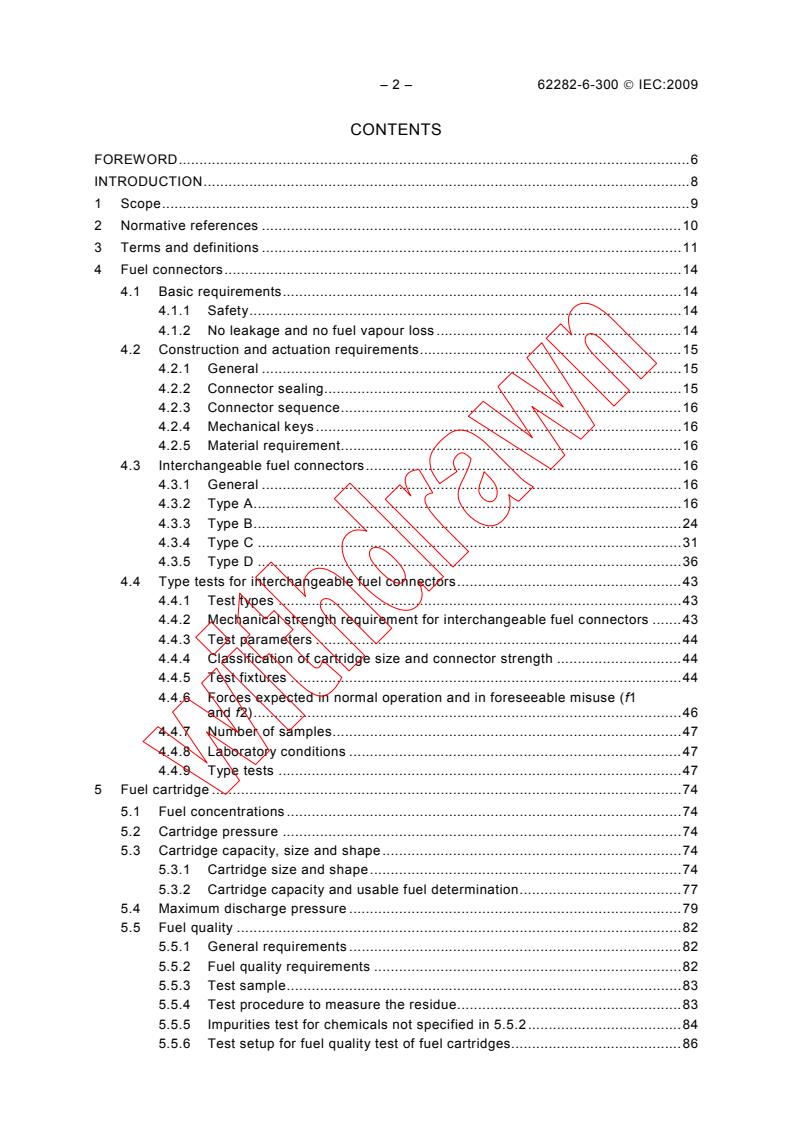
CONTENTS
FOREWORD.6
INTRODUCTION.8
1 Scope.9
2 Normative references .10
3 Terms and definitions .11
4 Fuel connectors.14
4.1 Basic requirements.14
4.1.1 Safety.14
4.1.2 No leakage and no fuel vapour loss .14
4.2 Construction and actuation requirements.15
4.2.1 General .15
4.2.2 Connector sealing.15
4.2.3 Connector sequence.16
4.2.4 Mechanical keys .16
4.2.5 Material requirement.16
4.3 Interchangeable fuel connectors.16
4.3.1 General .16
4.3.2 Type A.16
4.3.3 Type B.24
4.3.4 Type C .31
4.3.5 Type D .36
4.4 Type tests for interchangeable fuel connectors.43
4.4.1 Test types .43
4.4.2 Mechanical strength requirement for interchangeable fuel connectors .43
4.4.3 Test parameters .44
4.4.4 Classification of cartridge size and connector strength .44
4.4.5 Test fixtures .44
4.4.6 Forces expected in normal operation and in foreseeable misuse (f1
and f2).46
4.4.7 Number of samples.47
4.4.8 Laboratory conditions .47
4.4.9 Type tests .47
5 Fuel cartridge .74
5.1 Fuel concentrations .74
5.2 Cartridge pressure .74
5.3 Cartridge capacity, size and shape.74
5.3.1 Cartridge size and shape.74
5.3.2 Cartridge capacity and usable fuel determination.77
5.4 Maximum discharge pressure .79
5.5 Fuel quality .82
5.5.1 General requirements .82
5.5.2 Fuel quality requirements .82
5.5.3 Test sample.83
5.5.4 Test procedure to measure the residue.83
5.5.5 Impurities test for chemicals not specified in 5.5.2.84
5.5.6 Test setup for fuel quality test of fuel cartridges.86
62282-6-300 © IEC:2009 – 3 –
6 Marking .90
6.1 Cartridge marking.90
6.2 MFC power unit or electronic device marking .91
6.3 User information required in the manual or on the packaging .91
Annex A (informative) Calculations of f1, f2, and maximum discharge pressure .92
Annex B (informative) Test fixtures .95
Bibliography.98
Figure 1 – MFC power system block diagram.10
Figure 2 – Fuel cartridge types .13
Figure 3 – MFC power unit side connector design (cross-sectional view) .17
Figure 4 – MFC power unit side connector design (front-elevational view) .17
Figure 5 – Seal surface area design for MFC power unit side connector (cross-
sectional view).17
Figure 6 – Cartridge space for satellite cartridge (cross-sectional view) .18
Figure 7 – Cartridge space for insert cartridge (cross-sectional view) .19
Figure 8 – Mechanical key (cross-sectional view).20
Figure 9 – Mechanical key (front-elevational view).20
Figure 10 – Mechanical key variation with key number (front-elevational view) .20
Figure 11 – Connector retainer (cross-sectional view).22
Figure 12 – Connector retainer (front-elevational view) .22
Figure 13 – MFC power unit side connector design (cross-sectional view) .24
Figure 14 – MFC power unit side connector design (front-elevational view) .24
Figure 15 – Cartridge space (cross-sectional view) .25
Figure 16 – Mechanical keys.26
Figure 17 – Connector retainer (cross-sectional view before connection) .28
Figure 18 – Connector retainer (front-elevational view before connection) .28
Figure 19 – Connector retainer (cross-sectional view when retained).29
Figure 20 – Connector retainer (front-elevational view when retained) .29
Figure 21 – Connector retainer engaged (cross-sectional view) .29
Figure 22 – MFC power unit side connector design (cross-sectional view) .31
Figure 23 – MFC power unit side connector design (front-elevational view) .31
Figure 24 – Cartridge space (cross-sectional view) .32
Figure 25 – Mechanical key (cross-sectional view).33
Figure 26 – Mechanical key (front-elevational view) .33
Figure 27 – Mechanical key variation with key number.34
Figure 28 – Connector retainer (cross-sectional view).35
Figure 29 – MFC power unit side connector design (cross-sectional view) .37
Figure 30 – MFC power unit side connector design (front-elevational view).37
Figure 31 – Cartridge space for insert cartridge (cross-sectional view).38
Figure 32 – Mechanical key (cross-sectional view).39
Figure 33 – Mechanical key (front-elevational view) .39
Figure 34 – Mechanical key variation with key number.40
Figure 35 – Connector retainer (cross-sectional view).41
– 4 – 62282-6-300 © IEC:2009
Figure 36 – Connector retainer (front-elevational view) .41
Figure 37 – Flow chart for connector type tests: Compression test for proper
combination and correct orientation in normal operation on a manufacturer’s cartridge
or a manufacturer’s end use MFC device .48
Figure 38 – Flow chart for connector type tests for: Compression test for proper
combination and incorrect orientation in normal operation on a manufacturer’s
cartridge or a manufacturer’s end use MFC device .50
Figure 39 – Flow chart for connector type tests for: Compression test for proper
combination and incorrect orientation in foreseeable misuse on a manufacturer’s
cartridge or a manufacturer’s end use MFC device .52
Figure 40 – Flow chart for connector type tests for: Compression test for improper
mechanical key combination in normal operations on a manufacturer’s cartridge or a
manufacturer’s end use MFC device .54
Figure 41 – Flow chart for connector type tests for: Compression test for improper
mechanical key combination in foreseeable misuse on a manufacturer’s cartridge or a
manufacturer’s end use MFC device .56
Figure 42 – Flow chart for connector type tests for: Tensile test in normal operations
on a manufacturer’s cartridge or a manufacturer’s end use MFC device.58
Figure 43 – Flow chart for connector type tests for: Tensile test in foreseeable misuse
on a manufacturer’s cartridge or a manufacturer’s end use MFC device.60
Figure 44 – Flow chart for connector type tests for: Torsion test in normal operations
on a manufacturer’s cartridge or a manufacturer’s end use MFC device.62
Figure 45 – Flow chart for connector type tests for: Torsion test in foreseeable misuse
on a manufacturer’s cartridge or a manufacturer’s end use MFC device.64
Figure 46 – Flow chart for connector type tests for: Bending test in normal operations
on a manufacturer’s cartridge or a manufacturer’s end use MFC device.66
Figure 47 – Flow chart for connector type tests for: Bending test in foreseeable misuse
on a manufacturer’s cartridge or a manufacturer’s end use MFC device.68
Figure 48 – Flow chart for connector type tests for: Drop test in foreseeable misuse on
a manufacturer’s cartridge or a manufacturer’s end use MFC device .71
Figure 49 – Flow chart for connector type tests for: Vibration test in normal operations
on a manufacturer’s cartridge or a manufacturer’s end use MFC device.73
Figure 50 – Prismatic cartridge .74
Figure 51 – Cylindrical cartridge .76
Figure 52 – Test diagram: usable fuel measurement for pump-assisted discharging
cartridge (option 1) .78
Figure 53 – Test diagram: usable fuel measurement for pump-assisted discharging
cartridge (option 2) .78
Figure 54 – Test diagram: usable fuel measurement for non-pump assisted
discharging cartridge .79
Figure 55 – Test diagram: usable fuel measurement for pressurized cartridge .79
Figure 56 – Flow chart for maximum discharge pressure test.81
Figure 57 – Test apparatus .87
Figure 58 – Test cell construction drawing .87
Figure 59 – Exploded view of test cell.88
Figure 60 – Endplate and its flow channel design .88
Figure 61 – Types of fuel cartridges.90
Figure B.1 – Device test fixture for cartridge testing of 4.4.9 .95
Figure B.2 – Device test fixture for cartridge testing of 5.3.2 and 5.4 .96
62282-6-300 © IEC:2009 – 5 –
Figure B.3 – Cartridge test fixture for device testing of 4.4.9.97
Table 1 – Dimension with tolerance for MFC power unit side connector .17
Table 2 – Dimension of space for satellite cartridge in MFC power unit.19
Table 3 – Dimension for insert cartridge space in MFC power unit .19
Table 4 – Key location and dimension with tolerance for mechanical key .21
Table 5 – Dimension and tolerance for connector retainer on the MFC power unit side .22
Table 6 – Dimension with tolerance for MFC power unit side connector .25
Table 7 – Dimension and tolerance.26
Table 8 – Dimension and tolerance for connector retainer on the MFC power unit .30
Table 9 – Dimension with tolerance for MFC power unit side connector .32
Table 10 – Dimension with tolerance for cartridge space within MFC power unit .33
Table 11 – Key location and dimension with tolerance for mechanical key .34
Table 12 – Dimension and tolerance for the MFC power unit side connector retainer .35
Table 13 – Dimension with tolerance for MFC power unit side connector .37
Table 14 – Dimension with tolerance for the cartridge space in MFC power unit .38
Table 15 – Dimension with tolerance for mechanical key .39
Table 16 – Key location for mechanical key .40
Table 17 – Dimension and tolerance for the MFC power unit side retainer .42
Table 18 – Interchangeable fuel connector type tests .44
Table 19 – Classification of cartridge size and connector strength .44
Table 20 – Device test fixture for cartridge testing .45
Table 21 – Cartridge test fixture for device testing .45
Table 22 – External forces expected in normal operation and foreseeable misuse .46
Table 23 – Size and type of prismatic cartridge.75
Table 24 – Size and type of cylindrical cartridge .76
Table 25 – Test parameters for usable fuel determination.77
Table A.1 – Weight and size of typical cartridge.92
Table A.2 – Ergonomics data: force by human hand or finger .92
Table A.3 – Forces f1 and f2 for type tests.93
– 6 – 62282-6-300 © IEC:2009
INTERNATIONAL ELECTROTECHNICAL COMMISSION
____________
FUEL CELL TECHNOLOGIES –
Part 6-300: Micro fuel cell power systems –
Fuel cartridge interchangeability
FOREWORD
1) The International Electrotechnical Commission (IEC) is a worldwide organization for standardization comprising
all national electrotechnical committees (IEC National Committees). The objective of IEC is to promote
international cooperation on all questions concerning standardization in the electrical and electronic fields. To
this end and in addition to other activities, IEC publishes International Standards, Technical Specifications,
Technical Reports, Publicly Available Specifications (PAS) and Guides (hereafter referred to as “IEC
Publication(s)”). Their preparation is entrusted to technical committees; any IEC National Committee interested
in the subject dealt with may participate in this preparatory work. International, governmental and non-
governmental organizations liaising with the IEC also participate in this preparation. IEC collaborates closely
with the International Organization for Standardization (ISO) in accordance with conditions determined by
agreement between the two organizations.
2) The formal decisions or agreements of IEC on technical matters express, as nearly as possible, an international
consensus of opinion on the relevant subjects since each technical committee has representation from all
interested IEC National Committees.
3) IEC Publications have the form of recommendations for international use and are accepted by IEC National
Committees in that sense. While all reasonable efforts are made to ensure that the technical content of IEC
Publications is accurate, IEC cannot be held responsible for the way in which they are used or for any
misinterpretation by any end user.
4) In order to promote international uniformity, IEC National Committees undertake to apply IEC Publications
transparently to the maximum extent possible in their national and regional publications. Any divergence
between any IEC Publication and the corresponding national or regional publication shall be clearly indicated in
the latter.
5) IEC provides no marking procedure to indicate its approval and cannot be rendered responsible for any
equipment declared to be in conformity with an IEC Publication.
6) All users should ensure that they have the latest edition of this publication.
7) No liability shall attach to IEC or its directors, employees, servants or agents including individual experts and
members of its technical committees and IEC National Committees for any personal injury, property damage or
other damage of any nature whatsoever, whether direct or indirect, or for costs (including legal fees) and
expenses arising out of the publication, use of, or reliance upon, this IEC Publication or any other IEC
Publications.
8) Attention is drawn to the Normative references cited in this publication. Use of the referenced publications is
indispensable for the correct application of this publication.
International Standard IEC 62282-6-300 has been prepared by IEC technical committee 105:
Fuel cell technologies.
The text of this standard is based on the following documents:
FDIS Report on voting
105/214/FDIS 105/220/RVD
Full information on the voting for the approval of this standard can be found in the report on
voting indicated in the above table.
This publication has been drafted in accordance with the ISO/IEC Directives, Part 2.
A list of all parts of the IEC 62282 series, under the general title: Fuel cell technologies, can
be found on the IEC website.
62282-6-300 © IEC:2009 – 7 –
The committee has decided that the contents of this publication will remain unchanged until
the maintenance result date indicated on the IEC web site under "http://webstore.iec.ch" in
the data related to the specific publication. At this date, the publication will be
• reconfirmed,
• withdrawn,
• replaced by a revised edition, or
• amended.
– 8 – 62282-6-300 © IEC:2009
INTRODUCTION
The International Electrotechnical Commission (IEC) draws attention to the fact that it is
claimed that compliance with this document may involve the use of patents concerning fuel
connectors given in 4.3.1, 4.3.2, 4.3.3 and 4.3.4, patents concerning mechanical keys given in
4.2.3, and patents concerning fuel quality in 5.5.
IEC takes no position concerning the evidence, validity and scope of this patent right.
The holder of this patent right has assured the IEC that he is willing to negotiate licences
under reasonable and non-discriminatory terms and conditions with applicants throughout the
world. In this respect, the statement of the holder of this patent right is registered with IEC.
Information may be obtained from:
– Hitachi, Ltd., 1-1, Omika-cho 7-chome, Hitachi-shi, 319-1292 Japan
– Toyo Seikan Kaisha, Ltd., 3-1 Uchisaiwaicho 1-chome, Tokyo 100-8522 Japan
– Toshiba Corporation, 1-1, Shibaura 1-chome, Tokyo 1005-8001 Japan
– Tokai Corporation, 3-4, Shimohara, Subashiri, Oyama-cho, Sunto-Gun, Shisuoka, 410-
1431 Japan
– NEC Corporation, 7-1, Shiba 5-chome, Tokyo 108-8001 Japan
– Samsung SDI Co., Ltd., 575 Shin-dong, Yeongtong-gu, Suwan-si, Gyeonggi-do, 443-731,
Korea.
Attention is drawn to the possibility that some of the elements of this document may be the
subject of patent rights other than those identified above. IEC shall not be held responsible for
identifying any or all such patent rights.
62282-6-300 © IEC:2009 – 9 –
FUEL CELL TECHNOLOGIES –
Part 6-300: Micro fuel cell power systems –
Fuel cartridge interchangeability
1 Scope
This International Standard covers interchangeability of micro fuel cell (MFC) fuel cartridges
to provide the cartridge compatibility for a variety of MFC power units while maintaining the
safety and performance of MFC power systems. For this purpose, the standard covers fuel
cartridges and their connector designs. Fuel type, fuel concentration and fuel quality are also
covered. This standard also provides for the means to avoid the miss-connection of an
improper fuel cartridge. Test methods for verifying the compliance with the interchangeability
requirements for fuel and fuel cartridges are also provided in this standard.
IEC/PAS 62282-6-1 and IEC 62282-6-200 do not cover fuel cartridge or fuel from the cartridge.
IEC 62282-6-300 describes the performance test methods of fuel cartridges, the fuel from the
cartridge, and markings to realize the interchangeability of fuel cartridges. These include
performance effect of fuel cartridges, such as fuel quality which may affect the performance of
MFC power units and usable fuel volume from fuel cartridges.
A MFC power system block diagram is shown in Figure 1. MFC power systems and MFC
power units are defined as those wearable or easily carried by hand, providing d.c. outputs
that do not exceed 60 V d.c. and power outputs that do not exceed 240 VA. This standard
covers the fuel cartridge for MFC power units and the mechanical interface of connectors
between fuel cartridges and MFC power units. The main body of this standard includes
methanol liquid fuel cartridges, including methanol and water solution. Annex A shows the
background used to determine the forces expected in normal operation and in foreseeable
misuse. Annex B shows the example design for test fixtures for the fuel connector and fuel
cartridge type tests.
NOTE Liquid fuel means fuel transported from a cartridge to a MFC power unit in the liquid state, and gas fuel
means fuel transported from a cartridge to a power unit in the gaseous state.
– 10 – 62282-6-300 © IEC:2009
Waste
Thermal
heat
management
Water
cartridge Internal power needs
(optional) (optional)
Mechanical interface Primary battery
signal interface (optional)
Fuel
Fuel supply
Mechanical interface
Fuel
interface
management
Signal interface
cartridge
Fuel cell
or
or Power
micro fuel cell
Internal
conditioning
Power interface
Usable
module
reservoir
power
(optional)
Fuel cartridge
Air
Air
Rechargeable
management
battery or
capacitor
Waste
(optional)
Water and/or cartridge
Total control
Waste
(optional)
byproduct
system
products
management
and
unused
fuel
MFC power unit
MFC power system
IEC 704/09
Figure 1 – MFC power system block diagram
2 Normative references
The following referenced documents are indispensable for the application of this document.
For dated references, only the edition cited applies. For undated references, the latest edition
of the referenced document (including any amendments) applies.
IEC 60950-1:2005, Information technology equipment – Safety – Part 1: General requirements
IEC/PAS 62282-6-1:2006, Fuel cell technologies – Part 6-1: Micro fuel cell power systems
safety
NOTE IEC/PAS 62282-6-1 will be replaced with IEC 62282-6-100 when it is published as an International
Standard. References to IEC/PAS 62282-6-1 will be updated accordingly in subsequent editions of the present
standard.
IEC 62282-6-200:2007, Fuel cell technologies – Part 6-200: Micro fuel cell power systems –
Performance test methods
ISO 1302:2002, Geometrical Product Specifications (GPS) – Indication of surface texture in
technical product documentation
62282-6-300 © IEC:2009 – 11 –
3 Terms and definitions
For the purposes of this document, the following terms and definitions apply.
3.1
base level
reference plane on the MFC power unit side connector
All dimensions as shown in the connector figures (see 4.3) are relative to this reference plane.
See Figures 3, 4, and 5 in 4.3.2.2, Figures 13 and 14 in 4.3.3.2, Figures 22 and 23 in 4.3.4.2
and Figures 29 and 30 in 4.3.5.2.
3.2
base plane
surface of the power unit to which the cartridge mates
See Figures 6 and 7 in 4.3.2.3, Figure 15 in 4.3.3.3, Figures 24 in 4.3.4.3 and Figure 31 in
4.3.5.3.
3.3
connector retainer
mechanical means that secures the connection between the fuel cartridge side connector and
the MFC power unit connector
3.4
connector seal position
point where seal is established after the sealing section of the MFC power unit makes contact
with the sealing section of the cartridge (seal complete position)
3.5
distance to open valve
distance between the base level of the MFC power unit side connector and the point where
the valve starts to open during valve opening sequence
NOTE The distance to open valve is the same as the point where fluid stops flowing during the closing sequence.
3.6
distance to stop valve
distance between the base level of the MFC power unit side connector and the final position
of the end of the valve actuator during the valve opening sequence
The valve actuator is a component responsible for opening of the valve.
See Figures 3, 4, and 5 in 4.3.2.2, Figures 13 and 14 in 4.3.3.2, Figures 22 and 23 in 4.3.4.2
and Figures 29 and 30 in 4.3.5.2.
3.7
electronic device
any of such electronic devices as cellular phone, music player, digital camera, camcorder,
personal digital assistant (PDA), mobile game machine and mobile PC, which uses a MFC
power unit/system
3.8
force to open valve
force required to push the MFC power unit valve to the stop position (distance to stop valve)
– 12 – 62282-6-300 © IEC:2009
3.9
fractures
visually-detectable cracks or breaks in the exterior of the fuel connector, valve and all the
casings around the connector
3.10
fuel
liquid or gas substance, which is supplied from fuel cartridge to the MFC power unit and is
used to produce electricity in a MFC power system; liquid fuels of methanol and
methanol/water solutions are considered fuels in the main body of this standard
NOTE Liquid fuels such as ethanol, ethanol/water solution, formic acid and formic-acid/water solution will be
covered as per the supplement to this standard. Gaseous fuel, which shall use different types of fuel connectors,
will be covered as per the supplement to this standard.
3.11
fuel cartridge
removable article that contains and supplies fuel to the MFC power unit or internal reservoir,
not to be refilled by user. See Figure 2 for cartridge types:
– insert cartridge:
fuel cartridge which has its own enclosure and is installed within the enclosure of the
electronic device powered by the MFC power system
– exterior cartridge:
fuel cartridge which has its own enclosure that forms a portion of the enclosure of the
electronic device powered by the MFC power system
– attached cartridge:
fuel cartridge, which has its own enclosure that connects to the electronic device powered by
the MFC power system
– satellite cartridge:
fuel cartridge that is intended to be connected to and removed from the MFC power unit to
transfer fuel to the internal reservoir inside the MFC power unit
62282-6-300 © IEC:2009 – 13 –
Insert Exterior Attached Satellite
MFC
powered
device
Cartridge
IEC 705/09
Figure 2 – Fuel cartridge types
3.12
fuel cartridge, pressurized
fuel supply unit in which the internal pressure exceeds a gauge pressure of 34,5 kPa
measured at 24 °C without external forces
3.13
fuel cartridge, non-pressurized
fuel supply unit in which the internal pressure does not exceed a gauge pressure of 34,5 kPa
measured at 24 °C without external forces
3.14
fuel connector
attachment means between the fuel cartridge and MFC power unit that allows for the passage
of fuel from the cartridge to the power unit
3.15
internal reservoir
structure in a MFC power unit that stores fuel and cannot be removed
3.16
impurity
materials in any form of metal, inorganic material, organic material, molecule, ion, complex,
polymer and oligometer, which are contained in the fuel and may disturb the power generation
performance of MFC power unit
3.17
leakage
accessible hazardous liquid fuel outside the MFC power system or fuel cartridge
3.18
mechanical key
structure, installed around the fuel connector, that prevents the MFC power unit from being
connected to cartridges with improper properties (e.g. fuel type, fuel concentration, internal
pressure and connector strength)
– 14 – 62282-6-300 © IEC:2009
3.19
MFC power unit
electric generator as defined in Figure 1, providing direct current output that does not exceed
60 V d.c. and power output that does not exceed 240 VA
The MFC power unit does not include a fuel cartridge.
3.20
MFC power system
MFC power unit with associated cartridges that is wearable or easily carried by hand
3.21
no fuel vapour loss
fuel vapour escaping from the fuel cartridge or MFC power system or unit that is less than or
equal to 0,08 g/h
4 Fuel connectors
4.1 Basic requirements
4.1.1 Safety
Fuel connectors shall comply with the safety requirements in Subclause 4.10.3, Fuel valves,
Subclause 4.17, Fuel supply construction, and pass type tests described in Clause 7 in
IEC/PAS 62282-6-1.
4.1.2 No leakage and no fuel vapour loss
4.1.2.1 No leakage and no fuel vapour loss shall occur at fuel connectors in the process of
connecting, using and removing of cartridge. Requirements listed under 4.1.2.2 through
4.1.2.5 shall be applied to all fuel cartridge types.
4.1.2.2 The cartridge side connector shall have an orientation feature(s) and/or mechanical
feature(s) to ensure that the cartridge can only be connected in the proper orientation and
that a wrong cartridge is prevented from being connected to the MFC power unit. These
features ensure that the following conditions are met.
a) Improper connection of the cartridge by the user to the MFC power unit shall not damage
the cartridge side connector or MFC power unit side connector in any way that will result
in leakage or fuel vapour loss when they are subsequently connected together properly,
when the cartridge is subsequently connected properly to another MFC power unit, or
when the MFC power unit is subsequently connected properly to another fuel cartridge.
b) Attempting to connect the cartridge to a wrong MFC power unit shall not damage the
cartridge side connector or MFC power unit side connector in any way that will result in
leakage or fuel vapour loss when a correct cartridge is subsequently connected properly to
the MFC power unit or when the cartridge is subsequently connected properly to a correct
MFC unit.
c) Attempting to connect the cartridge to the MFC power unit with a force expected in normal
operation or foreseeable misuse shall not result in leakage or fuel vapour loss, or
otherwise result in subsequent leakage or fuel vapour loss if used properly in the future.
62282-6-300 © IEC:2009 – 15 –
4.1.2.3 If a force expected in normal operation or foreseeable misuse is applied to the
cartridge and/or MFC power unit while the cartridge is connected to the MFC power unit, there
shall be no leakage and no fuel vapour loss under the following conditions.
a) If a cartridge is connected to a MFC power unit and loading is applied to the cartridge or
MFC power unit, there shall be no leakage and no fuel vapour loss.
b) If the cartridge can be connected to the MFC power unit after unintentional loading, there
shall be no leakage and no fuel vapour loss. If another cartridge cannot be connected to
the MFC power unit, there shall be no leakage and no fuel vapour loss.
4.1.2.4 If a force expected in normal operation or foreseeable misuse is applied to the
cartridge side connector and/or MFC power unit side connector while the cartridge is being
removed from the MFC power unit, there shall be no leakage and no fuel vapour loss under
the following conditions.
a) Attempting to remove the cartridge from the MFC power unit with a force expected in
normal use shall not result in leakage or fuel vapour loss or otherwise result in
subsequent leakage or fuel vapour loss if used properly in the future.
b) Improper removal of the cartridge by the user from the MFC power unit shall not damage
the cartridge side connector or MFC power unit side connector such that: when another
cartridge is connected properly to the MFC power unit or when another MFC power unit is
connected properly to the cartridge, there shall be no leakage and no fuel vapour loss. If
the cartridge cannot be removed from the MFC power unit, there shall be no leakage and
no fuel vapour loss.
4.1.2.5 If the cartridge side connector is damaged while the cartridge is being connected,
used or removed by a force expected in foreseeable misuse, the following requirements shall
be met.
a) Leakage or fuel vapour loss shall not be detected even if the cartridge side fuel connector
is damaged.
b) When the cartridge side connector is damaged at its coupling part, no leakage and no fuel
vapour loss shall be caused if the MFC power unit side connector is connected, used, or
removed. This is not intended to include any damage to the MFC power unit caused by a
user with an obviously damaged cartridge.
c) If the cartridge side connector is damaged, it shall be easy for the user to remove the
damaged cartridge and/or any broken parts of the cartridge from the MFC power unit side
connector. The connection of a new cartridge to the MFC power unit shall not be affected.
d) The MFC power unit side connector shall not be damaged. The cartridge side connector
shall be designed with suitable connector material so as to cause the MFC power unit side
connector no damage.
4.2 Construction and actuation requirements
4.2.1 General
Fuel connectors of cartridges and MFC power units shall comply with the compatibility
requirements for construction and actuation as follows. The following requirements shall be
applied to all types of cartridges such as insert, exterior, attached and satellite types.
4.2.2 Connector sealing
For MFC power unit side connectors, the connection cycling durability test for
connect/disconnect (IEC/PAS 62282-6-1 requires 1 0
...