

IEC 61010-2-030:2010
(Main)Safety requirements for electrical equipment for measurement, control, and laboratory use - Part 2-030: Particular requirements for testing and measuring circuits
General Information
- Abstract
IEC 61010-2-030:2010 specifies safety requirements for testing and measuring circuits which are connected for test or measurement purposes to devices or circuits outside the measurement equipment itself. These include measurement circuits which are part of electrical test and measurement equipment, laboratory equipment, or process control equipment. The existence of these circuits in equipment requires additional protective means between the circuit and an OPERATOR. This Part 2-030 is to be used in conjunction with the latest edition of IEC 61010-1. It was established on the basis of the third edition (2010) of IEC 61010-1. Consideration may be given to future editions of, or amendments to, IEC 61010-1.
This publication is to be read in conjunction with IEC 61010-1:2010. The contents of the corrigendum of May 2011 have been included in this copy.
- Status
- Published
- Publication Date
- 09-Jun-2010
- Technical Committee
- TC 66 - Safety of measuring, control and laboratory equipment
- Drafting Committee
- WG 2 - TC 66/WG 2
- Current Stage
- DELPUB - Deleted Publication
- Start Date
- 12-Jan-2017
- Completion Date
- 28-Aug-2026
Buy Documents
IEC 61010-2-030:2010 - Safety requirements for electrical equipment for measurement, control, and laboratory use - Part 2-030: Particular requirements for testing and measuring circuits Released:6/10/2010
Overview
IEC 61010-2-030:2010 is an international standard from the International Electrotechnical Commission (IEC) that specifies the safety requirements for testing and measuring circuits connected for test or measurement purposes to devices or circuits outside the measurement equipment. It applies to electrical test and measurement equipment, laboratory equipment, and process control equipment that include such measuring circuits. This standard is designed to work in conjunction with IEC 61010-1:2010 and ensures comprehensive operator and equipment safety when dealing with potentially hazardous electrical environments.
Key Topics
Scope of Safety Requirements
IEC 61010-2-030:2010 addresses the unique hazards presented when measuring circuits are temporarily or permanently connected to external equipment and systems. It highlights additional protective measures needed beyond the base requirements specified in IEC 61010-1.Measurement Categories and Markings
The standard emphasizes classification by measurement categories (CAT II, CAT III, CAT IV), ensuring that markings on terminals clearly inform users of safe voltage levels and intended applications. It establishes requirements for clear labeling and documentation of rated voltages and currents at measurement terminals.Protection Against Hazards
Protection includes measures against electric shock, mechanical hazards, fire, excessive temperatures, and hazard from fluids or liberated gases. Specific attention is given to protective earth connections, transient overvoltage, and misuse scenarios-such as improper configuration or disconnection.Risk Assessment and Foreseeable Misuse
IEC 61010-2-030:2010 requires risk assessments for scenarios where misuse might cause hazards, for example, when equipment is operated with disconnected protective earth or when functional earth terminals are unintentionally connected to hazardous voltages.Marking, Documentation, and User Information
Comprehensive and clear markings are mandated next to terminals. Equipment documentation must specify measurement categories and any limitations, warning users where connections could result in risk. The standard also addresses requirements for over-range indications to prevent misinterpretation of measurement values.
Applications
Electrical Test and Measurement Equipment
Multimeters, oscilloscopes, power analyzers, and other diagnostic tools used in electrical maintenance or field troubleshooting are directly impacted. IEC 61010-2-030:2010 ensures operators' safety when these instruments interface with potentially hazardous live circuits.Laboratory Devices
Laboratory equipment that connects to external sensors, transducers, or other apparatus must comply to guarantee safe operation during experiments and testing.Process Control Systems
Automation and control devices that measure external electrical signals in industrial environments rely on the standard to safely interface with high-energy circuits, reducing risks to operators and installations.Design and Compliance Engineering
Manufacturers and compliance engineers refer to IEC 61010-2-030:2010 to ensure new equipment designs can be certified for global markets, facilitating international trade and regulatory approval.
Related Standards
IEC 61010-1:2010
General safety requirements for electrical equipment for measurement, control, and laboratory use. IEC 61010-2-030 must be used in conjunction with this foundational safety standard.IEC 61010 Series
Other parts of IEC 61010 deal with different specific requirements related to laboratory, industrial, and process control equipment.IEC 61180-1
Used for specific test methods, including those for impulse voltages mentioned in conformity assessment procedures.ISO/IEC Directives
Provide guidance on drafting standards and the application of conformity assessment.
Keywords: IEC 61010-2-030:2010, safety requirements, measurement circuits, test equipment, laboratory equipment, process control, measurement category, electric shock protection, equipment marking, risk assessment, international standard, IEC compliance.
Relations
- Effective Date
- 05-Sep-2023
- Effective Date
- 05-Sep-2023
Buy Documents
IEC 61010-2-030:2010 - Safety requirements for electrical equipment for measurement, control, and laboratory use - Part 2-030: Particular requirements for testing and measuring circuits Released:6/10/2010
Get Certified
Connect with accredited certification bodies for this standard

ECOCERT
Organic and sustainability certification.

Eurofins Food Testing Global
Global leader in food, environment, and pharmaceutical product testing.

IMP NDT d.o.o.
Non-destructive testing services. Radiography, ultrasonic, magnetic particle, penetrant, visual inspection.
Sponsored listings
Frequently Asked Questions
IEC 61010-2-030:2010 is a standard published by the International Electrotechnical Commission (IEC). Its full title is "Safety requirements for electrical equipment for measurement, control, and laboratory use - Part 2-030: Particular requirements for testing and measuring circuits". This standard covers: IEC 61010-2-030:2010 specifies safety requirements for testing and measuring circuits which are connected for test or measurement purposes to devices or circuits outside the measurement equipment itself. These include measurement circuits which are part of electrical test and measurement equipment, laboratory equipment, or process control equipment. The existence of these circuits in equipment requires additional protective means between the circuit and an OPERATOR. This Part 2-030 is to be used in conjunction with the latest edition of IEC 61010-1. It was established on the basis of the third edition (2010) of IEC 61010-1. Consideration may be given to future editions of, or amendments to, IEC 61010-1. This publication is to be read in conjunction with IEC 61010-1:2010. The contents of the corrigendum of May 2011 have been included in this copy.
IEC 61010-2-030:2010 specifies safety requirements for testing and measuring circuits which are connected for test or measurement purposes to devices or circuits outside the measurement equipment itself. These include measurement circuits which are part of electrical test and measurement equipment, laboratory equipment, or process control equipment. The existence of these circuits in equipment requires additional protective means between the circuit and an OPERATOR. This Part 2-030 is to be used in conjunction with the latest edition of IEC 61010-1. It was established on the basis of the third edition (2010) of IEC 61010-1. Consideration may be given to future editions of, or amendments to, IEC 61010-1. This publication is to be read in conjunction with IEC 61010-1:2010. The contents of the corrigendum of May 2011 have been included in this copy.
IEC 61010-2-030:2010 is classified under the following ICS (International Classification for Standards) categories: 19.080 - Electrical and electronic testing; 71.040.10 - Chemical laboratories. Laboratory equipment. The ICS classification helps identify the subject area and facilitates finding related standards.
IEC 61010-2-030:2010 has the following relationships with other standards: It is inter standard links to IEC 61010-2-030:2010/COR1:2011, IEC 61010-2-030:2017. Understanding these relationships helps ensure you are using the most current and applicable version of the standard.
IEC 61010-2-030:2010 is available in PDF format for immediate download after purchase. The document can be added to your cart and obtained through the secure checkout process. Digital delivery ensures instant access to the complete standard document.
Standards Content (Sample)
IEC 61010-2-030 ®
Edition 1.0 2010-06
INTERNATIONAL
STANDARD
NORME
INTERNATIONALE
Safety requirements for electrical equipment for measurement, control, and
laboratory use –
Part 2-030: Particular requirements for testing and measuring circuits
Règles de sécurité pour appareils électriques de mesurage, de régulation et
de laboratoire –
Partie 2-030: Exigences particulières pour les circuits de test et de mesure
All rights reserved. Unless otherwise specified, no part of this publication may be reproduced or utilized in any form or by
any means, electronic or mechanical, including photocopying and microfilm, without permission in writing from either IEC or
IEC's member National Committee in the country of the requester.
If you have any questions about IEC copyright or have an enquiry about obtaining additional rights to this publication,
please contact the address below or your local IEC member National Committee for further information.
Droits de reproduction réservés. Sauf indication contraire, aucune partie de cette publication ne peut être reproduite
ni utilisée sous quelque forme que ce soit et par aucun procédé, électronique ou mécanique, y compris la photocopie
et les microfilms, sans l'accord écrit de la CEI ou du Comité national de la CEI du pays du demandeur.
Si vous avez des questions sur le copyright de la CEI ou si vous désirez obtenir des droits supplémentaires sur cette
publication, utilisez les coordonnées ci-après ou contactez le Comité national de la CEI de votre pays de résidence.
IEC Central Office
3, rue de Varembé
CH-1211 Geneva 20
Switzerland
Email: inmail@iec.ch
Web: www.iec.ch
About the IEC
The International Electrotechnical Commission (IEC) is the leading global organization that prepares and publishes
International Standards for all electrical, electronic and related technologies.
About IEC publications
The technical content of IEC publications is kept under constant review by the IEC. Please make sure that you have the
latest edition, a corrigenda or an amendment might have been published.
ƒ Catalogue of IEC publications: www.iec.ch/searchpub
The IEC on-line Catalogue enables you to search by a variety of criteria (reference number, text, technical committee,…).
It also gives information on projects, withdrawn and replaced publications.
ƒ IEC Just Published: www.iec.ch/online_news/justpub
Stay up to date on all new IEC publications. Just Published details twice a month all new publications released. Available
on-line and also by email.
ƒ Electropedia: www.electropedia.org
The world's leading online dictionary of electronic and electrical terms containing more than 20 000 terms and definitions
in English and French, with equivalent terms in additional languages. Also known as the International Electrotechnical
Vocabulary online.
ƒ Customer Service Centre: www.iec.ch/webstore/custserv
If you wish to give us your feedback on this publication or need further assistance, please visit the Customer Service
Centre FAQ or contact us:
Email: csc@iec.ch
Tel.: +41 22 919 02 11
Fax: +41 22 919 03 00
A propos de la CEI
La Commission Electrotechnique Internationale (CEI) est la première organisation mondiale qui élabore et publie des
normes internationales pour tout ce qui a trait à l'électricité, à l'électronique et aux technologies apparentées.
A propos des publications CEI
Le contenu technique des publications de la CEI est constamment revu. Veuillez vous assurer que vous possédez
l’édition la plus récente, un corrigendum ou amendement peut avoir été publié.
ƒ Catalogue des publications de la CEI: www.iec.ch/searchpub/cur_fut-f.htm
Le Catalogue en-ligne de la CEI vous permet d’effectuer des recherches en utilisant différents critères (numéro de référence,
texte, comité d’études,…). Il donne aussi des informations sur les projets et les publications retirées ou remplacées.
ƒ Just Published CEI: www.iec.ch/online_news/justpub
Restez informé sur les nouvelles publications de la CEI. Just Published détaille deux fois par mois les nouvelles
publications parues. Disponible en-ligne et aussi par email.
ƒ Electropedia: www.electropedia.org
Le premier dictionnaire en ligne au monde de termes électroniques et électriques. Il contient plus de 20 000 termes et
définitions en anglais et en français, ainsi que les termes équivalents dans les langues additionnelles. Egalement appelé
Vocabulaire Electrotechnique International en ligne.
ƒ Service Clients: www.iec.ch/webstore/custserv/custserv_entry-f.htm
Si vous désirez nous donner des commentaires sur cette publication ou si vous avez des questions, visitez le FAQ du
Service clients ou contactez-nous:
Email: csc@iec.ch
Tél.: +41 22 919 02 11
Fax: +41 22 919 03 00
IEC 61010-2-030 ®
Edition 1.0 2010-06
INTERNATIONAL
STANDARD
NORME
INTERNATIONALE
Safety requirements for electrical equipment for measurement, control, and
laboratory use –
Part 2-030: Particular requirements for testing and measuring circuits
Règles de sécurité pour appareils électriques de mesurage, de régulation et
de laboratoire –
Partie 2-030: Exigences particulières pour les circuits de test et de mesure
INTERNATIONAL
ELECTROTECHNICAL
COMMISSION
COMMISSION
ELECTROTECHNIQUE
PRICE CODE
INTERNATIONALE
V
CODE PRIX
ICS 19.080; 71.040.10 ISBN 978-2-88910-988-3
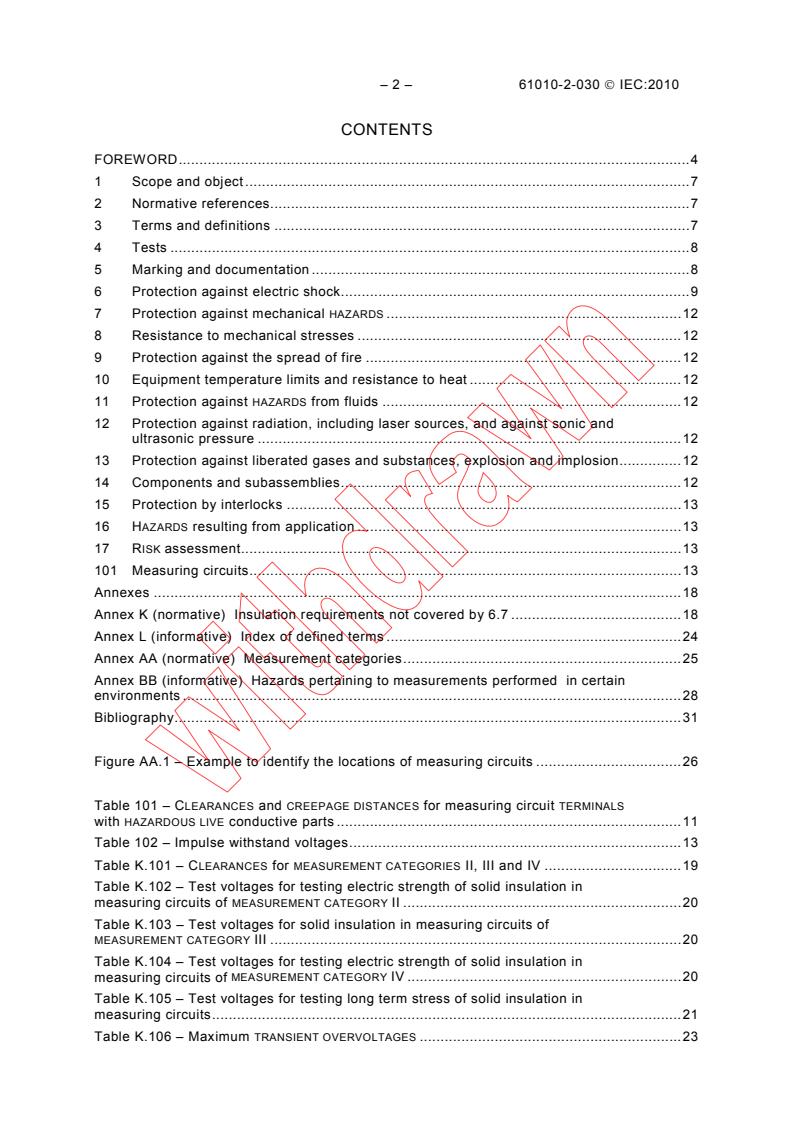
– 2 – 61010-2-030 © IEC:2010
CONTENTS
FOREWORD.4
1 Scope and object .7
2 Normative references.7
3 Terms and definitions .7
4 Tests .8
5 Marking and documentation .8
6 Protection against electric shock.9
7 Protection against mechanical HAZARDS .12
8 Resistance to mechanical stresses .12
9 Protection against the spread of fire .12
10 Equipment temperature limits and resistance to heat .12
11 Protection against HAZARDS from fluids .12
12 Protection against radiation, including laser sources, and against sonic and
ultrasonic pressure .12
13 Protection against liberated gases and substances, explosion and implosion.12
14 Components and subassemblies.12
15 Protection by interlocks .13
16 HAZARDS resulting from application .13
17 RISK assessment.13
101 Measuring circuits.13
Annexes .18
Annex K (normative) Insulation requirements not covered by 6.7 .18
Annex L (informative) Index of defined terms .24
Annex AA (normative) Measurement categories.25
Annex BB (informative) Hazards pertaining to measurements performed in certain
environments .28
Bibliography.31
Figure AA.1 – Example to identify the locations of measuring circuits .26
Table 101 – CLEARANCES and CREEPAGE DISTANCES for measuring circuit TERMINALS
with HAZARDOUS LIVE conductive parts .11
Table 102 – Impulse withstand voltages.13
Table K.101 – CLEARANCES for MEASUREMENT CATEGORIES II, III and IV .19
Table K.102 – Test voltages for testing electric strength of solid insulation in
measuring circuits of MEASUREMENT CATEGORY II .20
Table K.103 – Test voltages for solid insulation in measuring circuits of
MEASUREMENT CATEGORY III .20
Table K.104 – Test voltages for testing electric strength of solid insulation in
measuring circuits of MEASUREMENT CATEGORY IV .20
Table K.105 – Test voltages for testing long term stress of solid insulation in
measuring circuits.21
Table K.106 – Maximum TRANSIENT OVERVOLTAGES .23
61010-2-030 © IEC:2010 – 3 –
Table AA.1 – Characteristics of MEASUREMENT CATEGORIES .27
– 4 – 61010-2-030 © IEC:2010
INTERNATIONAL ELECTROTECHNICAL COMMISSION
____________
SAFETY REQUIREMENTS FOR ELECTRICAL EQUIPMENT
FOR MEASUREMENT, CONTROL, AND LABORATORY USE –
Part 2-030: Particular requirements for testing and measuring circuits
FOREWORD
1) The International Electrotechnical Commission (IEC) is a worldwide organization for standardization
comprising all national electrotechnical committees (IEC National Committees). The object of IEC is to
promote international co-operation on all questions concerning standardization in the electrical and
electronic fields. To this end and in addition to other activities, IEC publishes International Standards,
Technical Specifications, Technical Reports, Publicly Available Specifications (PAS) and Guides (hereafter
referred to as “IEC Publication(s)”). Their preparation is entrusted to technical committees; any IEC National
Committee interested in the subject dealt with may participate in this preparatory work. International,
governmental and non-governmental organizations liaising with the IEC also participate in this preparation.
IEC collaborates closely with the International Organization for Standardization (ISO) in accordance with
conditions determined by agreement between the two organizations.
2) The formal decisions or agreements of IEC on technical matters express, as nearly as possible, an
international consensus of opinion on the relevant subjects since each technical committee has
representation from all interested IEC National Committees.
3) IEC Publications have the form of recommendations for international use and are accepted by IEC National
Committees in that sense. While all reasonable efforts are made to ensure that the technical content of IEC
Publications is accurate, IEC cannot be held responsible for the way in which they are used or for any
misinterpretation by any end user.
4) In order to promote international uniformity, IEC National Committees undertake to apply IEC Publications
transparently to the maximum extent possible in their national and regional publications. Any divergence
between any IEC Publication and the corresponding national or regional publication shall be clearly
indicated in the latter.
5) IEC itself does not provide any attestation of conformity. Independent certification bodies provide conformity
assessment services and, in some areas, access to IEC marks of conformity. IEC is not responsible for any
services carried out by independent certification bodies.
6) All users should ensure that they have the latest edition of this publication.
7) No liability shall attach to IEC or its directors, employees, servants or agents including individual experts
and members of its technical committees and IEC National Committees for any personal injury, property
damage or other damage of any nature whatsoever, whether direct or indirect, or for costs (including legal
fees) and expenses arising out of the publication, use of, or reliance upon, this IEC Publication or any other
IEC Publications.
8) Attention is drawn to the Normative references cited in this publication. Use of the referenced publications
is indispensable for the correct application of this publication.
9) Attention is drawn to the possibility that some of the elements of this IEC Publication may be the subject of
patent rights. IEC shall not be held responsible for identifying any or all such patent rights.
International Standard IEC 61010-2-030 has been prepared by IEC technical committee
66: Safety of measuring, control and laboratory equipment.
The text of this standard is based on the following documents:
FDIS Report on voting
66/417/FDIS 66/427/RVD
Full information on the voting for the approval of this standard can be found in the report
on voting indicated in the above table.
This Part 2-030 is to be used in conjunction with the latest edition of IEC 61010-1. It was
established on the basis of the third edition (2010) of IEC 61010-1. Consideration may be
given to future editions of, or amendments to, IEC 61010-1.
61010-2-030 © IEC:2010 – 5 –
This Part 2-030 supplements or modifies the corresponding clauses in IEC 61010-1 so as
to convert that publication into the IEC standard: Particular requirements for testing and
measuring circuits.
Where a particular subclause of Part 1 is not mentioned in this part 2, that subclause
applies as far as is reasonable. Where this part states “addition”, “modification”,
“replacement”, or “deletion” the relevant requirement, test specification or note in Part 1
should be adapted accordingly.
In the second edition of IEC 61010-1, the requirements for testing and measuring circuits
were included in Part 1 itself. In the third edition of IEC 61010-1, these requirements have
been removed from Part 1 and have become the basis for the requirements in this Part 2.
In addition to the requirements removed from Part 1, the following major requirements
have been added to this standard. Numerous other changes have also been made.
MEASUREMENT CATEGORY I has changed. In this Part 2, it is termed
• The terminology for
“not rated for measurements within MEASUREMENT CATEGORIES II, III, or IV”.
• CLEARANCES and CREEPAGE DISTANCES have been added for unmated measuring circuit
TERMINALS.
• Requirements have been added for specialized measuring circuit TERMINALS.
• Requirements for TRANSIENT OVERVOLTAGE limiting devices have been revised.
• Requirements have been revised and added pertaining to REASONABLY FORESEEABLE
MISUSE of measuring circuits, including disconnection of the protective earth and usage
of the equipment in a manner that might cause arc flash.
• Insulation requirements for measuring circuits have been primarily located in Annex K.
• Annex AA has been added to describe the characteristics of MEASUREMENT CATEGORIES.
• Annex BB has been added to describe hazards that may be encountered when using
measuring circuits.
In this standard:
a) the following print types are used:
– requirements: in roman type;
– NOTES: in small roman type;
– conformity and test: in italic type;
– terms used throughout this standard which have been defined in Clause 3: SMALL
ROMAN CAPITALS;
b) subclauses, figures, tables and notes which are additional to those in Part 1 are
numbered starting from 101. Additional Annexes are numbered AA and BB.
This publication has been drafted in accordance with the ISO/IEC Directives, Part 2.
A list of all parts of the IEC 61010 series, under the general title Safety requirements for
electrical equipment for measurement, control, and laboratory use, can be found on the
IEC website.
– 6 – 61010-2-030 © IEC:2010
The committee has decided that the contents of this publication will remain unchanged until
the stability date indicated on the IEC web site under "http://webstore.iec.ch" in the data
related to the specific publication. At this date, the publication will be
• reconfirmed,
• withdrawn,
• replaced by a revised edition, or
• amended.
The contents of the corrigendum of May 2011 have been included in this copy.
61010-2-030 © IEC:2010 – 7 –
SAFETY REQUIREMENTS FOR ELECTRICAL EQUIPMENT
FOR MEASUREMENT, CONTROL, AND LABORATORY USE –
Part 2-030: Particular requirements for testing and measuring circuits
1 Scope and object
This clause of Part 1 is applicable except as follows:
1.1.1 Equipment included in scope
Replace the text with the following:
This part of IEC 61010 specifies safety requirements for testing and measuring circuits
which are connected for test or measurement purposes to devices or circuits outside the
measurement equipment itself.
These include measurement circuits which are part of electrical test and measurement
equipment, laboratory equipment, or process control equipment. The existence of these
circuits in equipment requires additional protective means between the circuit and an
OPERATOR.
NOTE 1 These testing and measuring circuits may, for example:
– measure voltages in circuits of other equipment,
– measure temperature of a separate device via a thermocouple,
– measure force on a separate device via a strain gauge,
– inject a voltage onto a circuit to analyze a new design.
NOTE 2 Testing and measuring circuits that are not within the scope of this Part 2 are considered to be
covered by the requirements of Part 1.
NOTE 3 Equipment containing these testing and measuring circuits may be intended for performing tests and
measurements on hazardous conductors, including MAINS conductors and telecommunication network
conductors. See Annex BB for considerations of HAZARDS involved in various tests and measurements.
2 Normative references
This clause of Part 1 is applicable.
3 Terms and definitions
This clause of Part 1 is applicable except as follows:
3.5 Safety terms
Add a new definition:
3.5.101
MEASUREMENT CATEGORY
classification of testing and measuring circuits according to the type of MAINS CIRCUITS to
which they are intended to be connected
– 8 – 61010-2-030 © IEC:2010
NOTE MEASUREMENT CATEGORIES take into account OVERVOLTAGE CATEGORIES, short-circuit current levels, the
location in the building installation at which the test or measurement is to be made, and some forms of energy
limitation or transient protection included in the building installation. See Annex AA for more information.
4 Tests
This clause of Part 1 is applicable.
5 Marking and documentation
This clause of Part 1 is applicable, except as follows:
5.1.5 TERMINALS, connections and operating devices
Add a new subclause:
5.1.5.101 Measuring circuit TERMINALS
5.1.5.101.1 General
Except as permitted in 5.1.5.101.4:
a) the RATED voltage to earth of measuring circuit TERMINALS shall be marked, and
b) the RATED voltage or the RATED current, as applicable, of each pair or set of measuring
circuit TERMINALS that are intended to be used together shall be marked, and
c) the pertinent MEASUREMENT CATEGORY for each pair or set of measuring circuit
TERMINALS or symbol 14 of Table 1 of Part 1 shall be marked as specified in
5.1.5.101.2 and 5.1.5.101.3, if applicable.
NOTE 1 Measuring circuit TERMINALS are usually supplied in pairs or sets. Each pair or set of TERMINALS may
have a RATED voltage or a RATED current, or both, within that set, and each individual TERMINAL may have a
RATED voltage to earth. Some instruments may have a measurement RATED voltage (between TERMINALS)
different from the RATED voltage to earth. Markings should be clear to avoid misunderstanding.
Symbol 14 of Table 1 shall be marked if current measuring TERMINALS are not intended for
connection to current transformers without internal protection (see 101.2).
Markings shall be placed adjacent to the TERMINALS. However, if there is insufficient space
RATING plate or scale plate, or the
(as in multi-input equipment), the marking may be on the
TERMINAL may be marked with symbol 14 of Table 1.
NOTE 2 For any set of measuring circuit TERMINALS, symbol 14 of Table 1 does not need to be marked more
than once, if it is close to the TERMINALS.
Conformity is checked by inspection and, if applicable, as specified in 5.1.5.101.2 and
5.1.5.101.3, taking into account the exceptions in 5.1.5.101.4.
5.1.5.101.2 Measuring circuit TERMINALS RATED for MEASUREMENT CATEGORIES II, III
or IV
The relevant MEASUREMENT CATEGORY shall be marked for measuring circuit TERMINALS
RATED for measurements within MEASUREMENT CATEGORIES II, III or IV. The MEASUREMENT
CATEGORY markings shall be “CAT II”, “CAT III” or “CAT IV” as applicable.
NOTE Marking more than one type of MEASUREMENT CATEGORY and its RATED voltage to earth is permissible
(see also 5.1.5.101.1, Note 1).
Conformity is checked by inspection.
61010-2-030 © IEC:2010 – 9 –
5.1.5.101.3 Measuring circuit TERMINALS RATED for connection to voltages above the
level of 6.3.1
Symbol 14 of Table 1 shall be marked for measuring circuit TERMINALS RATED for
connection to voltages above the levels of 6.3.1, but that are not RATED for measurements
within MEASUREMENT CATEGORIES II, III or IV (see also 5.4.1 bb)).
Conformity is checked by inspection.
5.1.5.101.4 Low voltage, permanently connected, or dedicated measuring circuit
TERMINALS
Measuring circuit TERMINALS do not need to be marked if
a) they are intended to be permanently connected and not ACCESSIBLE (see 5.4.3 aa) and
bb)), or
b) they are dedicated only for connection to specific TERMINALS of other equipment, or;
c) it is obvious from other indications that the RATED voltage is below the levels of 6.3.1.
NOTE Examples of acceptable indications that the inputs are intended to be less than the levels of 6.3.1
include:
– the full scale deflection marking of a single-range indicating voltmeter or ammeter or maximum
marking of a multi-range multimeter;
– the maximum range marking of a voltage selector switch;
– a marked voltage or power rating expressed in dB, mW or W, where the equivalent value, as explained
in the documentation, is below 33 V a.c.
5.4.1 General
Add new items to the list:
aa) information about each relevant MEASUREMENT CATEGORY if the measuring circuit has
a RATING for MEASUREMENT CATEGORY II, III or IV (see 5.1.5.101.2);
bb) for measuring circuits that do not have a RATING for MEASUREMENT CATEGORY II, III or
IV, but could be misused by connection to such circuits, a warning not to use the
equipment for measurements on MAINS CIRCUITS, and a detailed RATING including
TRANSIENT OVERVOLTAGES (see AA.2.4 for more information).
NOTE Some equipment may have multiple MEASUREMENT CATEGORY RATINGS for the same measuring circuit.
For such equipment, the documentation needs to clearly identify the MEASUREMENT CATEGORIES where the
equipment is intended to be used and where it must not be used.
5.4.3 Equipment installation
Add new items to the list:
aa) for permanently connected measuring circuit TERMINALS RATED for MEASUREMENT
CATEGORIES II, III or IV, information regarding the MEASUREMENT CATEGORY, RATED
maximum WORKING VOLTAGE, and RATED maximum current, as applicable (see
5.1.5.101);
bb) for permanently connected measuring circuit TERMINALS that are not RATED for
MEASUREMENT CATEGORIES II, III or IV, information regarding the RATED maximum
WORKING VOLTAGE, RATED maximum current, and RATED maximum TRANSIENT
OVERVOLTAGES as applicable (see 5.1.5.101).
6 Protection against electric shock
This clause of Part 1 is applicable except as follows:
– 10 – 61010-2-030 © IEC:2010
6.1.2 Exceptions
Add a new item to the list:
aa) locking or screw-held type measuring TERMINALS, including TERMINALS which do not
require the use of a TOOL.
6.5.2.1 General
Replace the conformity statement with the following:
Conformity is checked as specified in 6.5.2.2 to 6.5.2.6 and 6.5.2.101.
6.5.2.3 PROTECTIVE CONDUCTOR TERMINAL
Replace h) 2) with the following h) 2):
h) 2) the PROTECTIVE BONDING shall not be interrupted by any switching or interrupting
device. Devices used for indirect bonding in test and measurement circuits (see
6.5.2.101) are permitted to be part of the PROTECTIVE BONDING.
Add a new subclause:
6.5.2.101 Indirect bonding for testing and measuring circuits
Indirect bonding establishes a connection between the PROTECTIVE CONDUCTOR TERMINAL
and ACCESSIBLE conductive parts if these become HAZARDOUS LIVE as a result of a fault.
Devices to establish indirect bonding are:
a) voltage limiting devices which become conductive when the voltage across them
exceeds the relevant levels of 6.3.2 a), with overcurrent protection to prevent
breakdown of the device;
Conformity is checked by connecting the ACCESSIBLE conductive parts to the MAINS
supply TERMINALS while the equipment is connected to the MAINS supply as in NORMAL
USE. The voltage between the ACCESSIBLE conductive parts and the PROTECTIVE
CONDUCTOR TERMINAL shall not exceed the relevant levels of 6.3.2 a) for more than
0,2 s.
b) voltage-sensitive tripping devices which interrupt all poles of the MAINS supply, and
connect the ACCESSIBLE conductive parts to the PROTECTIVE CONDUCTOR TERMINAL
whenever the voltage across them reaches the relevant levels of 6.3.2 a).
Conformity is checked by applying the relevant voltage level of 6.3.2 a) between the
ACCESSIBLE conductive parts and the PROTECTIVE CONDUCTOR TERMINAL. The tripping
action shall take place within 0,2 s.
6.6 Connections to external circuits
Add new subclauses:
6.6.101 Measuring circuit TERMINALS
Conductive parts of each unmated measuring circuit TERMINAL which could become
HAZARDOUS LIVE when the maximum RATED voltage is applied to other measuring circuit
TERMINALS on the equipment shall be separated by at least the CLEARANCE and CREEPAGE
DISTANCE of Table 101 from the closest approach of the test finger touching the external
parts of the TERMINAL in the least favourable position. See Figure 1 of Part 1.
61010-2-030 © IEC:2010 – 11 –
Table 101 – CLEARANCES and CREEPAGE DISTANCES for measuring circuit TERMINALS with
HAZARDOUS LIVE conductive parts
CLEARANCE and
Voltage on conductive parts of TERMINAL
CREEPAGE DISTANCE
V a.c. r.m.s. V d.c. mm
0,8
≥33 ≤ 300 ≥70 ≤ 414
1,0
>300 ≤ 600 >414 ≤ 848
>600 ≤ 1 000 >848 ≤ 1 414 2,6
NOTE Values are determined by calculation for REINFORCED INSULATION. Transients are not taken into
account.
Conformity is checked by inspection and measurement.
6.6.102 Specialized measuring circuit TERMINALS
Components, sensors, and devices intended to be connected to specialized measuring
circuit TERMINALS shall not be both ACCESSIBLE and HAZARDOUS LIVE, in either NORMAL
CONDITION or SINGLE-FAULT CONDITION, even when the maximum RATED voltage is applied to
any other measuring circuit TERMINAL.
NOTE These specialized TERMINALS include, but are not limited to, TERMINALS for semiconductor measuring
functions, capacitance measurements, and thermocouple sockets.
Conformity is checked by inspection and measurement. Components, sensors, and devices
intended to be connected to specialized measuring circuit TERMINALS are connected. The
measurements of 6.3 are made to establish that the levels of 6.3.1 and 6.3.2 are not
exceeded when each of the following voltages is applied to each other measuring circuit
TERMINAL, if applicable:
RATED a.c. voltage at any RATED MAINS frequency;
a) maximum
b) maximum RATED d.c. voltage;
RATED a.c. voltage at the maximum RATED measurement frequency.
c) maximum
6.9 Constructional requirements for protection against electric shock
Add a new subclause:
6.9.101 Over-range indication
If a HAZARD could arise from an OPERATOR'S reliance on the value (for example, voltage)
displayed by the equipment, the display shall give an unambiguous indication whenever
the value is above the maximum positive value or below the minimum negative value of the
range to which the equipment is set.
NOTE Examples of ambiguous indications include the following, unless there is a separate unambiguous
indication of an over-range value:
a) analogue meters with stops at the exact ends of the range;
b) digital meters which show a low value when the true value is above the range maximum (for example
1 001,5 V displayed as 001,5 V);
c) chart recorders which print a trace at the edge of the chart, thus indicating a value at the range
maximum when the true value is higher.
Conformity is checked by inspection and by provoking an over-range value.
– 12 – 61010-2-030 © IEC:2010
7 Protection against mechanical HAZARDS
This clause of Part 1 is applicable.
8 Resistance to mechanical stresses
This clause of Part 1 is applicable.
9 Protection against the spread of fire
This clause of Part 1 is applicable.
10 Equipment temperature limits and resistance to heat
This clause of Part 1 is applicable.
11 Protection against HAZARDS from fluids
This clause of Part 1 is applicable.
12 Protection against radiation, including laser sources, and against sonic
and ultrasonic pressure
This clause of Part 1 is applicable.
13 Protection against liberated gases and substances, explosion and
implosion
This clause of Part 1 is applicable.
14 Components and subassemblies
This clause of Part 1 is applicable, except as follows:
Add a new subclause:
14.101 Circuits or components used as TRANSIENT OVERVOLTAGE limiting devices in
measuring circuits used to measure MAINS
If control of TRANSIENT OVERVOLTAGE is employed in a measuring circuit used to measure
MAINS, any overvoltage limiting component or circuit shall have adequate strength to limit
likely TRANSIENT OVERVOLTAGES.
Conformity is checked by applying 5 positive and 5 negative impulses with the applicable
impulse withstand voltage of Table 102, spaced up to 1 min apart, from a hybrid impulse
generator (see IEC 61180-1). The generator shall produce an open-circuit voltage
μs, a short-circuit current waveform of 8/20 μs, with an output
waveform of 1,2/50
impedance (peak open-circuit voltage divided by peak short-circuit current) of 2 Ω for
MEASUREMENT CATEGORIES III and IV or 12 Ω for MEASUREMENT CATEGORIES II. Resistance
may be added in series if needed to raise the impedance. The test impulse is applied while
61010-2-030 © IEC:2010 – 13 –
the circuit is working under conditions of NORMAL USE, in combination with the MAINS. The
voltage is the maximum RATED line-to-neutral voltage of the MAINS being measured.
The test voltage is applied between each pair of TERMINALS used to measure MAINS where
voltage-limiting devices are present.
No HAZARD shall arise in the event that the component ruptures or overheats during the
test. If a rupture occurs, no part of the component shall bridge safety-relevant insulation. If
the component overheats, it shall not heat other materials to their self-ignition points.
Tripping the circuit breaker of the MAINS installation is an indication of failure.
Table 102 – Impulse withstand voltages
Nominal a.c. or d.c.
Impulse withstand voltage
line-to-neutral
V
voltage of MAINS
being measured
MEASUREMENT MEASUREMENT MEASUREMENT
V
CATEGORY II CATEGORY III CATEGORY IV
≤50 500 800 1 500
>50 ≤ 100 800 1 500 2 500
1 500 2 500 4 000
>100 ≤ 150
2 500 4 000 6 000
>150 ≤ 300
>300 ≤ 600 4 000 6 000 8 000
6 000 8 000 12 000
>600 ≤ 1 000
15 Protection by interlocks
This clause of Part 1 is applicable.
16 HAZARDS resulting from application
This clause of Part 1 is applicable.
17 RISK assessment
This clause of Part 1 is applicable.
Add a new clause:
101 Measuring circuits
101.1 General
The equipment shall provide protection against HAZARDS resulting from NORMAL USE and
REASONABLY FORESEEABLE MISUSE of measuring circuits, as specified below.
a) If a HAZARD could result, a current measuring circuit shall not interrupt the circuit being
measured during range changing, or during the use of current transformers without
internal protection (see 101.2).
– 14 – 61010-2-030 © IEC:2010
b) An electrical quantity that is within specification for any TERMINAL shall not cause a
HAZARD when it is applied to that TERMINAL or any other compatible TERMINAL, with the
range and function settings set in any possible manner (see 101.3).
c) Any interconnection between the equipment and other devices or accessories shall not
cause a HAZARD even if the documentation or markings prohibit the interconnection
while the equipment is used for measurement purposes (see 6.6).
d) For measuring circuits that include one or more FUNCTIONAL EARTH TERMINALS, a RISK
assessment (see Clauses 16 and 17) shall address the HAZARDS that may result if the
equipment is operated with a disconnected PROTECTIVE CONDUCTOR TERMINAL and if the
operator unintentionally connects a FUNCTIONAL EARTH TERMINAL to any RATED voltage
for any other TERMINAL.
NOTE Oscilloscopes and spectrum analyzers are examples of equipment that often include FUNCTIONAL
EARTH TERMINALS in the measuring circuit. In many cases, the OPERATOR will disconnect the PROTECTIVE
CONDUCTOR TERMINAL so that the FUNCTIONAL EARTH TERMINAL can float above earth potential. This allows
the OPERATOR to make a floating measurement, but introduces a HAZARD. If the OPERATOR should
inadvertently connect the FUNCTIONAL EARTH TERMINAL to a HAZARDOUS LIVE voltage, then the chassis of the
measuring equipment may also be connected to the HAZARDOUS LIVE voltage, and the OPERATOR or a
bystander could receive an electric shock from the chassis.
e) Other HAZARDS that could result from REASONABLY FORESEEABLE MISUSE shall be
addressed by RISK assessment (see Clauses 16 and 17).
Conformity is checked as specified in 101.2, 101.3, 6.6, Clause 16 and Clause 17 as
applicable.
101.2 Current measuring circuits
Current measuring circuits shall be so designed that, when range changing takes place,
there shall be no interruption which could cause a HAZARD.
Conformity is checked by inspection, and, in case of doubt, by causing the device to switch
the maximum RATED current 6 000 times.
Current measuring circuits intended for connection to current transformers without internal
protection shall be adequately protected to prevent a HAZARD arising from interruption of
these circuits during operation.
Conformity is checked by inspection, by overload tests at a value of 10 times the maximum
RATED current for 1 s, and by causing the device to switch the maximum RATED current
6 000 times. No interruption which could cause a HAZARD shall occur during the tests.
101.3 Protection against mismatches of inputs and ranges
101.3.1 General
In NORMAL CONDITION and in cases of REASONABLY FORESEEABLE MISUSE, no HAZARD shall
arise when the maximum RATED voltage or current of a measuring TERMINAL is applied to
any other compatible TERMINAL, with any combination of function and range settings.
NOTE 1 Mismatches of inputs and ranges are examples of REASONABLY FORESEEABLE MISUSE, even if the
documentation or markings prohibit such mismatch. A typical example is inadvertent connection of a high
voltage to a measuring input intended for current or resistance. Possible HAZARDS include electric shock, burns,
fire, arcing and explosion.
NOTE 2 TERMINALS that are clearly not of similar types and that will not retain the TERMINALS of the probe or
accessory need not be tested.
61010-2-030 © IEC:2010 – 15 –
The equipment shall provide protection against these HAZARDS. One of these techniques
shall be used.
a) Use of a certified overcurrent protection device to interrupt short-circuit currents before
a HAZARD arises. In this case, the requirements of 101.3.2 apply.
b) Use an uncertified current limitation device, an impedance, or a combination of both to
prevent the HAZARD from arising. In this case, the requirements of 101.3.3 apply.
Conformity is checked by inspection, evaluation of the design of the equipment, and as
specified in 101.3.2 and 101.3.3, as applicable.
101.3.2 Protection by a certified overcurrent protection device
An overcurrent protection device is considered suitable if it is certified by an independent
laboratory to meet all of the following requirements.
a) The a.c. and d.c. RATED voltages of the overcurrent protection device shall be at least
as high as, respectively, the highest a.c. and d.c. RATED voltages of any measuring
TERMINAL on the equipment.
b) The RATED time-current characteristic (speed) of the overcurrent protection device shall
be such that no HAZARD will result from any possible combination of RATED input
voltages, TERMINALS, and range selection.
NOTE In practice, downstream circuit elements such as components and printed wiring board traces
should be selected to be able to withstand the energy that the overcurrent protection device will let
through.
c) The a.c. and d.c. RATED breaking capacities of the overcurrent protection device shall
exceed, respectively, the possible a.c. and d.c. short-circuit currents.
The possible a.c. and d.c. short-circuit currents shall be calculated as the maximum
RATED WORKING VOLTAGES for any TERMINAL divided by the impedance of the
overcurrent-protected measuring circuit, taking the impedance of the test leads
specified in 101.3.4 into account.
The possible a.c. short-circuit current need not exceed the applicable value in Table AA.1.
Additionally, spacings surrounding the overcurrent protection device in the equipment and
following the protection device in the measuring circuit shall be sufficiently large to prevent
arcing after the protection device opens.
Conformity is checked by inspection of the RATINGS of the overcurrent protection device
and by the following test:
If the protection device is a fuse, it is replaced with an open-circuited fuse. If the protection
device is a circuit breaker, it is set to its open position. A voltage of two times the
maximum RATED voltage for any TERMINAL is applied to the TERMINALS of the overcurrent-
protected measuring circuit for 1 min. The source of the test voltage shall be capable of
delivering 500 VA. During and after the test, no damage to the equipment shall occur.
101.3.3 Protection by uncertified current limitation devices or by impedances
Devices used for current limitation shall be capable of safely withstanding, dissipating, or
interrupting the energy that will be applied as a result of short-circuit current in the case of
REASONABLY FORESEEABLE MISUSE.
An impedance used for limitation of current shall be one or more of the following:
– 16 – 61010-2-030 © IEC:2010
a) An appropriate single component which is constructed, selected, and tested so that
safety and reliability for protection against relevant HAZARDS is assured. In particular,
the component shall:
1) be RATED for the maximum voltage that may be present during the REASONABLY
FORESEEABLE MISUSE event;
2) if a resistor, be RATED for twice the power dissipation that may result from the
REASONABLY FORESEEABLE MISUSE event;
3) meet the applicable CLEARANCE requirements of Annex K for REINFORCED INSULATION
between its terminations.
b) A combination of components which shall
1) withstand the maximum voltage that may be present during the REASONABLY
FORESEEABLE MISUSE event,
2) be able to dissipate the power that may result from the REASONABLY FORESEEABLE
MISUSE event,
3) meet the applicable CLEARANCE requirements of Annex K for REINFORCED INSULATION
between the terminations of the combination of components.
Conformity is checked by inspection and the following test, repeated three times on the
same unit of equipment. If the test results in heating of any component, the equipment is
allowed to cool before the test is repeated. If a device used for current limitation is
damaged, it is replaced before the test is repeated.
The possible a.c. and d.c. short-circuit currents are calculated as the maximum RATED
WORKING VOLTAGES for any TERMINAL divided by the impedance of the current-limited
measuring circuit, taking the impedance of the test leads specified in 101.3.4 into account.
The possible a.c. short-circuit current should not exceed the value in Table AA.1.
A voltage equal to the maximum RATED voltage for any TERMINAL is applied between the
TERMINALS of the measuring circuit for 1 min. The source of the test voltage shall be able to
deliver a current of at least the possible a.c. or d.c. short-circuit current as applicable. If
the function or range controls have any effect on the electrical characteristics of the input
circuit, the test is repeated with the function or range controls in every combination of
positions. During and after the test, no HAZARD shall arise, nor shall there be any evidence
of fire, arcing, explosion, or damage to impedance limitation devices or any component
intended to provide protection against electric shock, heat, arc or fire, including the
ENCLOSURE and traces on the printed wiring board. Any damage to a device used for
current limitation shall be ignored if other parts of the equipment were not affected during
the test.
During the test, the voltage output of the source is measured. If the source voltage
decreases by more than 20 % for more than 10 ms, the test is considered inconclusive and
is repeated with a lower impedance source.
NOTE This test can be extremely hazardous. Explosion shields and other provisions should be used to protect
personnel performing the test.
101.3.4 Test leads for the tests of 101.3.2 and 101.3.3
Test leads for the tests of 101.3.2 and 101.3.3 shall meet the following specifications:
a) length = 1 m;
b) cross section of the conductor = 1,5 mm², stranded copper wire;
NOTE 1 A conductor with 16 AWG (American Wire Gauge) cross section is acceptable.
c) equipment connector compatible with the measuring circuit TERMINALS;
61010-2-030 © IEC:2010 – 17 –
d) connection to the test voltage source via bare wire into suitable screw TERMINALS or
thimble connectors (twist-on wire connectors) or equivalent means of providing a low-
impedance connection;
e) arranged as straight as possible.
NOTE 2 Test leads built to these specifications will have a d.c. resistance of about 15 mΩ each, or 30 mΩ per
pair. For the purposes of calculation of possible short-circuit current in 101.3.2 and 101.3.3, the value of 30 mΩ
may be used for these
...