

IEC 62811:2015
(Main)AC and/or DC-supplied electronic controlgear for discharge lamps (excluding fluorescent lamps) - Performance requirements for low frequency square wave operation
General Information
- Abstract
IEC 62811:2015 specifies performance requirements for electronic controlgear for use on a.c. and/or d.c. supplies up to 1 000 V and/or a.c. supplies up to 1 000 V at 50 Hz or 60 Hz, associated with discharge lamps, as specified in IEC 61167, which have information for low frequency square wave operation, where the frequency range of the low frequency is from 70 Hz to 400 Hz.
- Status
- Published
- Publication Date
- 08-Apr-2015
- Technical Committee
- SC 34C - Auxiliaries for lamps
- Drafting Committee
- WG 1 - TC 34/SC 34C/WG 1
- Current Stage
- PPUB - Publication issued
- Start Date
- 09-Apr-2015
- Completion Date
- 30-Apr-2015
Buy Documents
IEC 62811:2015 - AC and/or DC-supplied electronic controlgear for discharge lamps (excluding fluorescent lamps) - Performance requirements for low frequency square wave operation Released:4/9/2015
Overview
IEC 62811:2015 is an international standard developed by the International Electrotechnical Commission (IEC) that outlines the performance requirements for electronic controlgear used with discharge lamps-excluding fluorescent lamps-operating on low frequency square wave supplies. This standard is applicable to controlgear powered by AC and/or DC supplies up to 1,000 V at 50 Hz or 60 Hz, with a frequency range for low frequency square wave operation specified between 70 Hz and 400 Hz. It emphasizes the need for precise, harmonized criteria to ensure optimal lamp performance, safety, and reliability in lighting systems that utilize metal halide and other non-fluorescent discharge lamps.
Key Topics
IEC 62811:2015 addresses several critical aspects related to the design and testing of electronic controlgear for discharge lamps:
- Performance Requirements: Specifies type tests to confirm the controlgear meets operational expectations under defined conditions.
- Low Frequency Square Wave Operation: Focuses on the specific behavior of discharge lamps powered by square wave signals, providing clearer measurement references and reducing variability in performance.
- Reference Ballasts and Lamps: Utilizes standardized reference ballasts (resistive for low frequency square wave) and lamps to create reproducible testing conditions.
- Marking and Product Information: Sets requirements for mandatory markings, such as displacement factor and life time at various ambient temperatures, for clarity in application and compliance.
- Operating Conditions: Defines acceptable ranges for supply voltage, current, frequency, and operational temperature to ensure safe and effective lamp ignition, run-up, and steady operation.
- Testing Methods: Outlines test setups and criteria for aspects such as commutation time, APCR (Average Peak Current Ratio), and endurance.
- Control Interfaces: Addresses control methods including voltage, pulse width modulation (PWM), and DALI (Digital Addressable Lighting Interface), to support varied dimming and control scenarios.
Applications
IEC 62811:2015 is essential for manufacturers, testing laboratories, and system integrators involved in the production or deployment of:
- Electronic Ballasts for Metal Halide Lamps: Ensures compatibility and performance of ballasts specifically designed for square wave operation, enhancing energy efficiency and lamp life.
- Architectural and Industrial Lighting: Enables reliable operation of high-intensity discharge (HID) lighting in commercial spaces, warehouses, sports facilities, and public infrastructure.
- Safety and Compliance Testing: Assists quality assurance teams in verifying that controlgear products meet global safety and performance benchmarks before market release.
- Lighting System Integration: Informs design engineers and installers in selecting suitable controlgear that meets strict performance and regulatory requirements.
By adhering to this standard, organizations can assure optimal lamp performance, improve system safety, and comply with both local and international trade regulations for electronic lighting equipment.
Related Standards
IEC 62811:2015 is part of a broader family of international standards relevant to the performance and safety of lamp controlgear and discharge lighting systems, including:
- IEC 61167: Performance specifications for metal halide lamps, providing the lamp-side reference for coordination with controlgear requirements.
- IEC 61347-1: General and safety requirements for lamp controlgear.
- IEC 61347-2-12: Particular requirements for electronic ballasts for discharge lamps (excluding fluorescent lamps).
- IEC 61000-4-14: Electromagnetic compatibility (EMC) testing methods, ensuring controlgear does not disrupt power quality.
- IEC 62386: All parts relating to Digital Addressable Lighting Interface (DALI), supporting advanced lighting control interoperability.
Compliance with IEC 62811:2015 helps facilitate interoperability, safety, and market access for electronic controlgear globally, supporting both manufacturers and end users in delivering reliable, high-performance lighting solutions.
Buy Documents
IEC 62811:2015 - AC and/or DC-supplied electronic controlgear for discharge lamps (excluding fluorescent lamps) - Performance requirements for low frequency square wave operation Released:4/9/2015
Get Certified
Connect with accredited certification bodies for this standard

IMQ S.p.A. (Certification)
Italian electrical product certification.

SLG Prüf- und Zertifizierungs GmbH
German testing and certification body.

UL Solutions
Global safety science company with testing, inspection and certification.
Sponsored listings
Frequently Asked Questions
IEC 62811:2015 is a standard published by the International Electrotechnical Commission (IEC). Its full title is "AC and/or DC-supplied electronic controlgear for discharge lamps (excluding fluorescent lamps) - Performance requirements for low frequency square wave operation". This standard covers: IEC 62811:2015 specifies performance requirements for electronic controlgear for use on a.c. and/or d.c. supplies up to 1 000 V and/or a.c. supplies up to 1 000 V at 50 Hz or 60 Hz, associated with discharge lamps, as specified in IEC 61167, which have information for low frequency square wave operation, where the frequency range of the low frequency is from 70 Hz to 400 Hz.
IEC 62811:2015 specifies performance requirements for electronic controlgear for use on a.c. and/or d.c. supplies up to 1 000 V and/or a.c. supplies up to 1 000 V at 50 Hz or 60 Hz, associated with discharge lamps, as specified in IEC 61167, which have information for low frequency square wave operation, where the frequency range of the low frequency is from 70 Hz to 400 Hz.
IEC 62811:2015 is classified under the following ICS (International Classification for Standards) categories: 29.140.99 - Other standards related to lamps. The ICS classification helps identify the subject area and facilitates finding related standards.
IEC 62811:2015 is available in PDF format for immediate download after purchase. The document can be added to your cart and obtained through the secure checkout process. Digital delivery ensures instant access to the complete standard document.
Standards Content (Sample)
IEC 62811 ®
Edition 1.0 2015-04
INTERNATIONAL
STANDARD
NORME
INTERNATIONALE
colour
inside
AC and/or DC-supplied electronic controlgear for discharge lamps (excluding
fluorescent lamps) – Performance requirements for low frequency square wave
operation
Appareillage électronique alimenté en courant alternatif et/ou continu pour
lampes à décharge (à l'exclusion des lampes fluorescentes) – Exigences de
performance pour le fonctionnement en onde carrée de basse fréquence
All rights reserved. Unless otherwise specified, no part of this publication may be reproduced or utilized in any form
or by any means, electronic or mechanical, including photocopying and microfilm, without permission in writing from
either IEC or IEC's member National Committee in the country of the requester. If you have any questions about IEC
copyright or have an enquiry about obtaining additional rights to this publication, please contact the address below or
your local IEC member National Committee for further information.
Droits de reproduction réservés. Sauf indication contraire, aucune partie de cette publication ne peut être reproduite
ni utilisée sous quelque forme que ce soit et par aucun procédé, électronique ou mécanique, y compris la photocopie
et les microfilms, sans l'accord écrit de l'IEC ou du Comité national de l'IEC du pays du demandeur. Si vous avez des
questions sur le copyright de l'IEC ou si vous désirez obtenir des droits supplémentaires sur cette publication, utilisez
les coordonnées ci-après ou contactez le Comité national de l'IEC de votre pays de résidence.
IEC Central Office Tel.: +41 22 919 02 11
3, rue de Varembé Fax: +41 22 919 03 00
CH-1211 Geneva 20 info@iec.ch
Switzerland www.iec.ch
About the IEC
The International Electrotechnical Commission (IEC) is the leading global organization that prepares and publishes
International Standards for all electrical, electronic and related technologies.
About IEC publications
The technical content of IEC publications is kept under constant review by the IEC. Please make sure that you have the
latest edition, a corrigenda or an amendment might have been published.
IEC Catalogue - webstore.iec.ch/catalogue Electropedia - www.electropedia.org
The stand-alone application for consulting the entire The world's leading online dictionary of electronic and
bibliographical information on IEC International Standards, electrical terms containing more than 30 000 terms and
Technical Specifications, Technical Reports and other definitions in English and French, with equivalent terms in 15
documents. Available for PC, Mac OS, Android Tablets and additional languages. Also known as the International
iPad. Electrotechnical Vocabulary (IEV) online.
IEC publications search - www.iec.ch/searchpub IEC Glossary - std.iec.ch/glossary
The advanced search enables to find IEC publications by a More than 60 000 electrotechnical terminology entries in
variety of criteria (reference number, text, technical English and French extracted from the Terms and Definitions
committee,…). It also gives information on projects, replaced clause of IEC publications issued since 2002. Some entries
and withdrawn publications. have been collected from earlier publications of IEC TC 37,
77, 86 and CISPR.
IEC Just Published - webstore.iec.ch/justpublished
Stay up to date on all new IEC publications. Just Published IEC Customer Service Centre - webstore.iec.ch/csc
details all new publications released. Available online and If you wish to give us your feedback on this publication or
also once a month by email. need further assistance, please contact the Customer Service
Centre: csc@iec.ch.
A propos de l'IEC
La Commission Electrotechnique Internationale (IEC) est la première organisation mondiale qui élabore et publie des
Normes internationales pour tout ce qui a trait à l'électricité, à l'électronique et aux technologies apparentées.
A propos des publications IEC
Le contenu technique des publications IEC est constamment revu. Veuillez vous assurer que vous possédez l’édition la
plus récente, un corrigendum ou amendement peut avoir été publié.
Catalogue IEC - webstore.iec.ch/catalogue Electropedia - www.electropedia.org
Application autonome pour consulter tous les renseignements
Le premier dictionnaire en ligne de termes électroniques et
bibliographiques sur les Normes internationales,
électriques. Il contient plus de 30 000 termes et définitions en
Spécifications techniques, Rapports techniques et autres
anglais et en français, ainsi que les termes équivalents dans
documents de l'IEC. Disponible pour PC, Mac OS, tablettes
15 langues additionnelles. Egalement appelé Vocabulaire
Android et iPad.
Electrotechnique International (IEV) en ligne.
Recherche de publications IEC - www.iec.ch/searchpub
Glossaire IEC - std.iec.ch/glossary
Plus de 60 000 entrées terminologiques électrotechniques, en
La recherche avancée permet de trouver des publications IEC
en utilisant différents critères (numéro de référence, texte, anglais et en français, extraites des articles Termes et
comité d’études,…). Elle donne aussi des informations sur les Définitions des publications IEC parues depuis 2002. Plus
projets et les publications remplacées ou retirées. certaines entrées antérieures extraites des publications des
CE 37, 77, 86 et CISPR de l'IEC.
IEC Just Published - webstore.iec.ch/justpublished
Service Clients - webstore.iec.ch/csc
Restez informé sur les nouvelles publications IEC. Just
Published détaille les nouvelles publications parues. Si vous désirez nous donner des commentaires sur cette
Disponible en ligne et aussi une fois par mois par email. publication ou si vous avez des questions contactez-nous:
csc@iec.ch.
IEC 62811 ®
Edition 1.0 2015-04
INTERNATIONAL
STANDARD
NORME
INTERNATIONALE
colour
inside
AC and/or DC-supplied electronic controlgear for discharge lamps (excluding
fluorescent lamps) – Performance requirements for low frequency square wave
operation
Appareillage électronique alimenté en courant alternatif et/ou continu pour
lampes à décharge (à l'exclusion des lampes fluorescentes) – Exigences de
performance pour le fonctionnement en onde carrée de basse fréquence
INTERNATIONAL
ELECTROTECHNICAL
COMMISSION
COMMISSION
ELECTROTECHNIQUE
INTERNATIONALE
ICS 29.140.99 ISBN 978-2-8322-2600-1
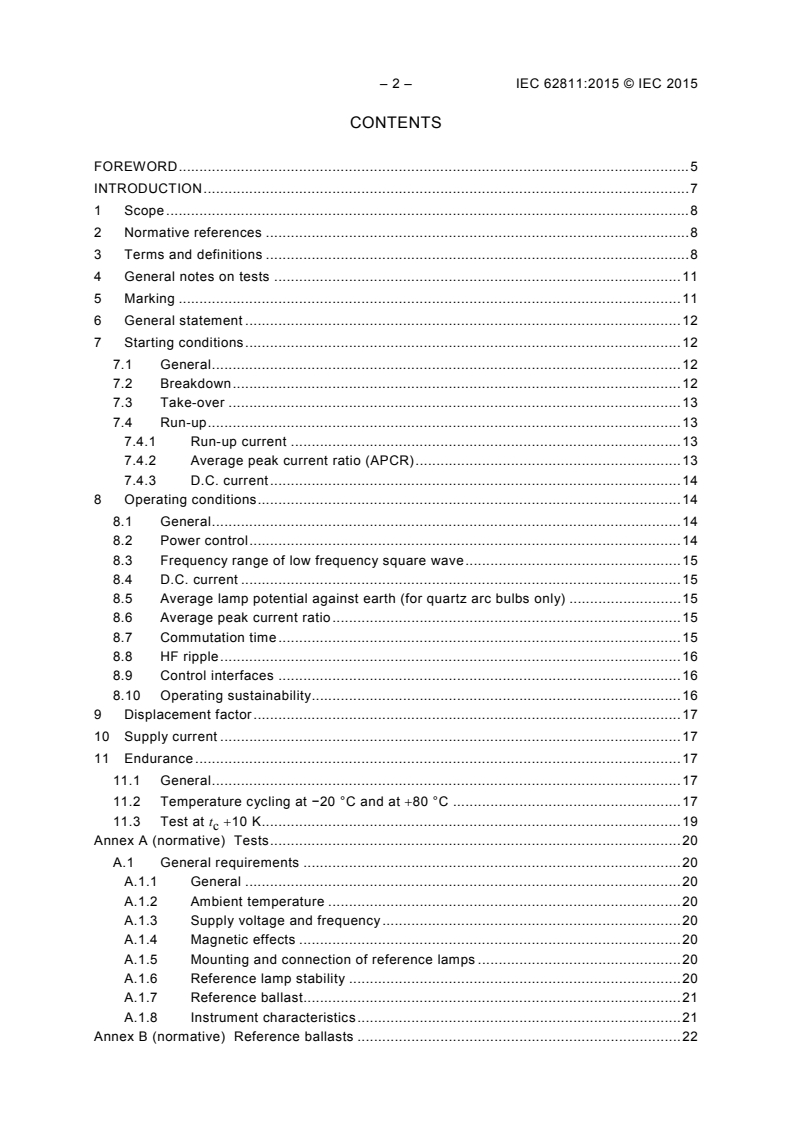
– 2 – IEC 62811:2015 © IEC 2015
CONTENTS
FOREWORD . 5
INTRODUCTION . 7
1 Scope . 8
2 Normative references . 8
3 Terms and definitions . 8
4 General notes on tests . 11
5 Marking . 11
6 General statement . 12
7 Starting conditions . 12
7.1 General . 12
7.2 Breakdown . 12
7.3 Take-over . 13
7.4 Run-up . 13
7.4.1 Run-up current . 13
7.4.2 Average peak current ratio (APCR) . 13
7.4.3 D.C. current . 14
8 Operating conditions . 14
8.1 General . 14
8.2 Power control . 14
8.3 Frequency range of low frequency square wave . 15
8.4 D.C. current . 15
8.5 Average lamp potential against earth (for quartz arc bulbs only) . 15
8.6 Average peak current ratio . 15
8.7 Commutation time . 15
8.8 HF ripple . 16
8.9 Control interfaces . 16
8.10 Operating sustainability. 16
9 Displacement factor . 17
10 Supply current . 17
11 Endurance . 17
11.1 General . 17
11.2 Temperature cycling at −20 °C and at +80 °C . 17
11.3 Test at t +10 K . 19
c
Annex A (normative) Tests . 20
A.1 General requirements . 20
A.1.1 General . 20
A.1.2 Ambient temperature . 20
A.1.3 Supply voltage and frequency . 20
A.1.4 Magnetic effects . 20
A.1.5 Mounting and connection of reference lamps . 20
A.1.6 Reference lamp stability . 20
A.1.7 Reference ballast. 21
A.1.8 Instrument characteristics . 21
Annex B (normative) Reference ballasts . 22
B.1 Marking . 22
B.2 Design characteristics . 22
B.2.1 Reference ballast for frequencies of 70 Hz to 400 Hz . 22
B.2.2 Protection . 22
B.3 Operating characteristics for low frequency square wave . 22
B.3.1 General . 22
B.3.2 Impedance . 22
B.3.3 Series inductance and parallel capacitance . 23
B.4 Circuit for frequencies of low frequency square wave (see Figure 5) . 23
B.4.1 Power supply . 23
B.4.2 Instruments . 23
B.4.3 Wiring . 23
Annex C (normative) Conditions for reference lamps . 24
Annex D (normative) Control interface for controllable controlgear . 25
D.1 Overview. 25
D.2 Control by d.c. voltage . 25
D.2.1 Circuit diagram – Functional specification for d.c. voltage control (see
Figure D.1) . 25
D.2.2 Connection diagram . 25
D.2.3 Electrical specifications . 26
D.3 Control by pulse width modulation (PWM) . 27
D.3.1 Circuit diagram – Functional specification for PWM control (see Figure
D.4) . 27
D.3.2 Connection diagram . 28
D.3.3 Electrical specifications . 28
D.4 Control by DALI . 28
Annex E (normative) Spectral analysis of power ripple: calculation procedure for
amplitude spectrum ratio and guidance . 29
E.1 General . 29
E.2 Mathematical background . 29
E.3 Description of the algorithm . 29
E.4 Measurement procedure . 30
E.5 Test signal . 30
E.5.1 General . 30
E.5.2 Description of the test signal. 31
E.5.3 Outcome of the test signal . 31
Annex F (normative) Open circuit voltage method of measurement for pulse ignition . 32
Bibliography . 33
Figure 1 – Measurement of APCR during run-up and steady state . 14
Figure 2 – Test set-up for measuring the lamp potential against earth . 15
Figure 3 – Commutation time, deviating waveform . 16
Figure 4 – Example of the cycling described under 11.2; Clause E.2. 18
Figure 5 – Low frequency square wave reference circuit . 19
Figure D.1 – Schematic representation of the interface for 1 V to 10 V . 25
Figure D.2 – Control device for multiple controlgear, for 1 V to 10 V . 26
Figure D.3 – Control device is a current source. 26
Figure D.4 – Schematic representation of the interface for PWM dimming. 27
– 4 – IEC 62811:2015 © IEC 2015
Figure D.5 – Some typically PWM signals . 27
Figure D.6 – Control device for multiple controlgear, for PWM . 28
Table 1 – Controlgear life time information . 12
Table 2 – Minimum OCV . 13
Table E.1 – Settings for the analysis . 30
INTERNATIONAL ELECTROTECHNICAL COMMISSION
____________
AC AND/OR DC-SUPPLIED ELECTRONIC CONTROLGEAR
FOR DISCHARGE LAMPS (EXCLUDING FLUORESCENT LAMPS) –
PERFORMANCE REQUIREMENTS FOR
LOW FREQUENCY SQUARE WAVE OPERATION
FOREWORD
1) The International Electrotechnical Commission (IEC) is a worldwide organization for standardization comprising
all national electrotechnical committees (IEC National Committees). The object of IEC is to promote
international co-operation on all questions concerning standardization in the electrical and electronic fields. To
this end and in addition to other activities, IEC publishes International Standards, Technical Specifications,
Technical Reports, Publicly Available Specifications (PAS) and Guides (hereafter referred to as “IEC
Publication(s)”). Their preparation is entrusted to technical committees; any IEC National Committee interested
in the subject dealt with may participate in this preparatory work. International, governmental and non-
governmental organizations liaising with the IEC also participate in this preparation. IEC collaborates closely
with the International Organization for Standardization (ISO) in accordance with conditions determined by
agreement between the two organizations.
2) The formal decisions or agreements of IEC on technical matters express, as nearly as possible, an international
consensus of opinion on the relevant subjects since each technical committee has representation from all
interested IEC National Committees.
3) IEC Publications have the form of recommendations for international use and are accepted by IEC National
Committees in that sense. While all reasonable efforts are made to ensure that the technical content of IEC
Publications is accurate, IEC cannot be held responsible for the way in which they are used or for any
misinterpretation by any end user.
4) In order to promote international uniformity, IEC National Committees undertake to apply IEC Publications
transparently to the maximum extent possible in their national and regional publications. Any divergence
between any IEC Publication and the corresponding national or regional publication shall be clearly indicated in
the latter.
5) IEC itself does not provide any attestation of conformity. Independent certification bodies provide conformity
assessment services and, in some areas, access to IEC marks of conformity. IEC is not responsible for any
services carried out by independent certification bodies.
6) All users should ensure that they have the latest edition of this publication.
7) No liability shall attach to IEC or its directors, employees, servants or agents including individual experts and
members of its technical committees and IEC National Committees for any personal injury, property damage or
other damage of any nature whatsoever, whether direct or indirect, or for costs (including legal fees) and
expenses arising out of the publication, use of, or reliance upon, this IEC Publication or any other IEC
Publications.
8) Attention is drawn to the Normative references cited in this publication. Use of the referenced publications is
indispensable for the correct application of this publication.
9) Attention is drawn to the possibility that some of the elements of this IEC Publication may be the subject of
patent rights. IEC shall not be held responsible for identifying any or all such patent rights.
International Standard IEC 62811 has been prepared by subcommittee 34C: Auxiliaries for
lamps, of IEC technical committee 34: Lamps and related equipment.
The text of this standard is based on the following documents:
FDIS Report on voting
34C/1132/FDIS 34C/1149/RVD
Full information on the voting for the approval of this standard can be found in the report on
voting indicated in the above table.
This publication has been drafted in accordance with the ISO/IEC Directives, Part 2.
– 6 – IEC 62811:2015 © IEC 2015
The committee has decided that the contents of this publication will remain unchanged until
the stability date indicated on the IEC website under "http://webstore.iec.ch" in the data
related to the specific publication. At this date, the publication will be
• reconfirmed,
• withdrawn,
• replaced by a revised edition, or
• amended.
IMPORTANT – The 'colour inside' logo on the cover page of this publication indicates
that it contains colours which are considered to be useful for the correct
understanding of its contents. Users should therefore print this document using a
colour printer.
INTRODUCTION
This International Standard covers performance requirements for electronic controlgear for
use on a.c., at 50 Hz or 60 Hz and/or d.c. supplies up to 1 000 V associated with discharge
lamps as specified in IEC 61167 for low frequency square wave operation.
In order to obtain satisfactory performance of discharge lamps and electronic controlgears, it
is necessary that certain features of their design be properly coordinated. It is essential,
therefore, that specifications for them be written in terms of measurement made against some
common baseline of reference, permanent and reproducible.
These conditions may be fulfilled by reference ballasts. Moreover, the testing of controlgear
for discharge lamps will, in general, be made with reference lamps and, in particular, by
comparing the results obtained using these lamps on the controlgear to be tested and on the
reference ballast. Whereas the reference ballast for frequencies of 50 Hz or 60 Hz is a self-
inductive coil, the low frequency square wave reference ballast is a resistor because of its
independence of frequency and the lack of influence of parasitic capacitance.
– 8 – IEC 62811:2015 © IEC 2015
AC AND/OR DC-SUPPLIED ELECTRONIC CONTROLGEAR
FOR DISCHARGE LAMPS (EXCLUDING FLUORESCENT LAMPS) –
PERFORMANCE REQUIREMENTS FOR
LOW FREQUENCY SQUARE WAVE OPERATION
1 Scope
This International Standard specifies performance requirements for electronic controlgear for
use on a.c. and/or d.c. supplies up to 1 000 V and/or a.c. supplies up to 1 000 V at 50 Hz or
60 Hz, associated with discharge lamps, as specified in IEC 61167, which have information
for low frequency square wave operation, where the frequency range of the low frequency is
from 70 Hz to 400 Hz.
Tests in this standard are type tests. Requirements for testing individual controlgear during
production are not included.
There are regional standards regarding the regulation of mains current harmonics and
immunity for end products like luminaires and independent controlgear. In a luminaire, the
controlgear is dominant in this respect. Controlgear, together with other components, should
comply with these standards.
2 Normative references
The following documents, in whole or in part, are normatively referenced in this document and
are indispensable for its application. For dated references, only the edition cited applies. For
undated references, the latest edition of the referenced document (including any
amendments) applies.
IEC 60050 (all parts), International Electrotechnical Vocabulary
IEC 61000-4-14:1999, Electromagnetic compatibility (EMC) – Part 4-14: Testing and
measurement techniques – Voltage fluctuation immunity test
IEC 61000-4-14:1999/AMD1:2001
IEC 61000-4-14:1999/AMD2:2009
IEC 61167, Metal Halide lamps – Performance specifications
IEC 61347-1, Lamp controlgear – Part 1: General and safety requirements
IEC 61347-2-12, Lamp controlgear – Part 2-12: Particular requirements for d.c. or a.c.
supplied electronic ballasts for discharge lamps (excluding fluorescent lamps)
IEC 62386 (all parts), Digital addressable lighting interface
3 Terms and definitions
For the purposes of this document, the terms and definitions given in IEC 60050-845 as well
as the following apply.
3.1
reference ballast
special resistive ballast for lamps, for operation on low frequency square wave designed for
the purpose of providing comparison standards for use in testing ballasts, for the selection of
reference lamps and for testing regular production lamps under standardized conditions
Note 1 to entry: It is essentially characterized by the fact that, at its rated frequency, it has a stable
voltage/current ratio which is relatively uninfluenced by variations in current, temperature and magnetic
surroundings, as outlined in this standard.
[SOURCE: IEC 60050:1987, 845-08-36, modified – Adapted for electronic operation of lamps.]
3.2
reference lamp
discharge lamp selected for the purpose of testing ballasts and which, when associated with a
reference ballast under specified conditions, has electrical values which are close to the
objective values given in a relevant specification
[SOURCE: IEC 60050:1987, 845-07-55]
3.3
calibration current of a reference ballast
value of the current on which are based the calibration and control of the reference ballast
Note 1 to entry: Such a current should preferably be approximately equal to the rated or typical current of the
lamps for which the reference ballast is suitable.
[SOURCE: IEC 61347-1:2007, 3.4, modified — In the note to entry the words "rated running"
are replaced by "rated or typical"]
3.4
total circuit power
total power dissipated by controlgear and lamp in combination, at rated voltage and frequency
of the controlgear
[SOURCE: IEC 60929:2011, 3.5]
3.5
displacement factor
cosφ
cosine of the phase difference between the fundamental of the mains voltage and the
fundamental of the mains current
3.6
run-up current
lamp current after take-over phase until the lower limit of the lamp voltage is reached
Note 1 to entry: Lower limit is given in Annex G of IEC 61167.
3.7
take-over
time between lamp being able to conduct current until electrodes are at thermionic emission
Note 1 to entry: At the end of the take-over phase, the lamp power factor is above 0,9 and the lamp voltage
stabilises and ramps up from about 20 V rms.
[SOURCE: IEC 61167:2011, 3.14]
– 10 – IEC 62811:2015 © IEC 2015
3.8
average peak current ratio
APCR
average of the absolute ratio between the peak current and the rms current
Note 1 to entry: For measurement procedure, see 7.4.2.
Note 2 to entry: This note applies to the French language only.
3.9
typical lamp voltage
steady state lamp voltage expected for a lamp operating on low frequency square wave
ballast
Note 1 to entry: Typical lamp current is derived from the lamp rated power and typical lamp voltage. In practice,
lamps for use on low frequency square wave ballasts may be targeted to a different voltage within the allowed
range for best performance, and the lamp current will be different accordingly. Typical lamp voltages and currents
have been used as a basis for assigning currents at take-over and run-up.
[SOURCE: IEC 61167:2011, 3.16, modified]
3.10
typical lamp current
steady state lamp current expected for a lamp operating on low frequency square wave
ballast
Note 1 to entry: Typical lamp current is derived from the lamp rated power and typical lamp voltage. In practice,
lamps for use on low frequency square wave ballasts may be targeted to a different voltage within the allowed
range for best performance, and the lamp current will be different accordingly. Typical lamp voltages and currents
have been used as a basis for assigning currents at take-over and run-up.
[SOURCE: IEC 61167:2011, 3.16, modified]
3.11
commutation time
fall and rise time
time which is the transition time of lamp current at half cycle polarity reversals
Note 1 to entry: It is measured using lamp current waveforms between 90 % of the rms value of one half cycle to
90 % of the rms value of the opposite half cycle.
3.12
electronic controlgear life time
declared average life time at which 90 % of the electronic controlgears are still operating
Note 1 to entry: In the context of life time, an electronic controlgear is “operating” if it still fulfils its intended
functions.
Note 2 to entry: The manufacturers apply suitable methods, e.g. statistical calculation and/or reliability testing.
3.13
failure rate of electronic controlgear
expected statistical failure during operation based on a MTTF calculation by manufacturer and
given in percentage per 1 000 h
Note 1 to entry: For the definition of MTTF, see IEC 60050-191:1990, 12.07.
3.14
ambient temperature range
t
a
temperature range of the air surrounding the electronic controlgear declared by the
manufacturer to indicate the normal operating temperature range for the electronic
controlgear
Note 1 to entry: The lifetime of the electronic controlgear is given at the ambient temperature t , for ease of
a
measurement also the corresponding temperature of the t point is given.
c
Note 2 to entry: The measurement test condition for the ambient temperature assigned to the DUT should be in
accordance to Annex D of IEC 61347-1 at the rated voltage.
4 General notes on tests
4.1 Tests according to this standard are type tests.
The requirements and tolerances permitted by this standard are based on the testing of a type
test sample submitted by the manufacturer for that purpose. In principle this type test sample
should consist of units having characteristics typical of the manufacturer’s production and be
as close to the production centre point values as possible.
4.2 The tests are carried out in the order of the clauses, unless otherwise specified.
4.3 One controlgear is submitted to all tests unless otherwise stated.
4.4 In general, all tests are made on each type of controlgear or where a power range of
similar controlgear is involved, for each rated power in the range or on a representative
selection from the range as agreed with the manufacturer.
4.5 The tests are made under the conditions specified in Annex A. Lamp data sheets not
published in an IEC publication shall be made available by the lamp manufacturer.
4.6 All controlgear specified in this standard shall comply with the requirements of
IEC 613472-12.
4.7 Attention is drawn to lamp performance standards which contain information for square
wave ballast design; this should be followed for proper lamp operation; however, this standard
does not require the testing of lamp performance as part of the type test approval for
controlgear.
5 Marking
5.1 Electronic controlgear shall be clearly marked with the following mandatory marking as
applicable:
a) displacement factor e.g. cosφ = 0,85.
If the displacement factor is less than cosφ = 0,95 capacitive, it shall be followed by the
letter C, e.g. cosφ = 0,85 C.
NOTE In Japan displacement factor will not be used, there power factor will be used. Power factor is power
divided by the product of voltage and current.
5.2 In addition to the above mandatory markings, the following information shall either be
given on the controlgear or be made available in the manufacturer’s catalogue or the like:
a) type of control interface, in case of dimmable ballast.(e.g. D.C. type or PWM type, DALI),;
b) lifetime of the controlgear linked to the ambient temperature and the measured
temperature on the reference point (t point).
c
For the information, the format of Table 1 has to be used. Corresponding to the fixed ambient
temperature values 40 °C, 50 °C and 60 °C, the values of the temperature measured on the
reference point (t point) and the declared life time have to be inserted by the manufacturer.
c
The value of the temperature of the t point given in the table shall never exceed the t
c c
(IEC 61347-1), therefore in that case the column, where the temperature of t point exceeds
c
t , will be left blank; but at least the column with ambient temperature 40 °C shall always be
c
– 12 – IEC 62811:2015 © IEC 2015
filled. The measurement setup for measuring the ambient temperature shall be in accordance
to Annex D of IEC 61347-1 at the rated voltage. After stabilisation of the ambient temperature
the temperature of t shall be measured.
c
Table 1 – Controlgear life time information
Ambient temperature 40°C 50°C 60°C
a a a
Temperature measured on the xx xx xx
reference point (t point) in °C
c
a a a
Lifetime in h xxxxx xxxxx xxxxx
a
Values declared by the controlgear manufacturer
Additional information from the controlgear manufacturer to the tabled ambient temperature
and life time are allowed.
5.3 Non-mandatory information which may be made available by the manufacturer are:
a) rated output frequency at rated voltage, with and without lamp operating;
b) limits of the ambient temperature range within which the controlgear will operate
satisfactorily at the declared voltage (range);
c) total circuit power.
6 General statement
It may be expected that controlgear complying with this standard, when associated with lamps
which comply with IEC 61167 for low frequency square wave operation, will provide
satisfactory starting of the lamp and operation at an ambient temperature range as given by
the controlgear manufacturer at voltages within 92 % and 106 % of the rated voltage.
NOTE 1 The electrical characteristics as given on the lamp data sheets of IEC 61167 and applying to operation
on a reference controlgear at rated voltage with a frequency of 50 Hz or 60 Hz, will deviate when operating on a
low frequency square wave controlgear and the conditions of item b) of 5.3 above.
NOTE 2 In some regions there are laws on EMC for luminaires. The controlgear is also contributing to this EMC
behavior. See Bibliography for reference.
7 Starting conditions
7.1 General
Control gear shall start lamps at any supply voltage between 92 % and 106 % of its rated
value or the rated voltage range. Compliance is checked by the tests according to 7.2 to 7.4,
as appropriate, with the control gear operating at supply voltage of 92 % and 106 % of the
rated value or in case of a rated voltage range at 92 % of the minimum value of the range and
106 % of the maximum value of the range.
7.2 Breakdown
The breakdown is the phase where the non-conducting gas is ignited and becomes
conducting plasma. This process needs a high voltage for a minimum time.
Measurement is made with an oscilloscope. The controlgear shall be measured without
connecting a lamp. Capacitance (simulating the parasitic capacitance of the wires and wires
towards earth) shall be added as specified by the controlgear manufacturer.
NOTE 1 Controlgear manufacturers can also define multiple capacitance values.
The absolute value of the ignition peak voltage shall comply with the value given on the
relevant lamp data sheet. The measuring procedure can be found in IEC 61167, Table G.1 the
section describing the breakdown.
NOTE 2 Values given in IEC 61167 are for pulse ignition, values for high frequency ignition are under
consideration.
7.3 Take-over
In the take-over phase the electrodes are heated towards thermionic emission.
The take-over is measured with resistors, unless stated otherwise.
During the take-over, the controlgear shall provide power and current according to the
information for ballast design of IEC 61167 (measurement method under consideration) the
minimum open circuit voltage (OCV), measured at ≥1 MΩ load shall be according the values
in Table 2.
Table 2 – Minimum OCV
Lamp type Square wave or Non-square wave
DC
RMS Peak
Ceramic and quartz arc tubes 280 V 235 V 332 V
Ceramic arc tubes only 250 V 235 V 332 V
These values are valid for metal halide lamps of 20 W, 35 W, 70 W and 150 W, for other lamps OCV values are
given on relevant lamp data sheets.
The time limit for the duration of the non-low frequency square wave current is maximum 10 s
(under consideration), this limit is not required if the controlgear is able to detect the end of
the takeover phase.
Open circuit voltage is measured according to the measuring method as described in
Annex F.
7.4 Run-up
7.4.1 Run-up current
The run-up current shall be between the values given on the relevant lamp data sheet
measured on resistances starting with resistance at run-up as given on the relevant lamp data
sheet up to a calculated resistance at which the lamp voltage is equal to lower voltage limit as
given in Annex G of IEC 61167.
7.4.2 Average peak current ratio (APCR)
The requirements of Annex G of IEC 61167 apply.
The APCR is determined by measuring the current wave form on a lamp substitution circuit
representing the lamp voltage range from 20 V (under consideration) to 75 V. The substitution
circuit is an ohmic variable resistor capable of regulation the lamp voltage in the required range.
Determine the maximum PCR value within the measured voltage range by applying a
smoothing window of 20 µs. Determine during 1 s, around the determined maximum PCR
value, the PCR values for all positive half periods and average the PCR values. Determine
during this same 1 s the PCR values for all negative half periods and average the PCR
values.
– 14 – IEC 62811:2015 © IEC 2015
The APCR then is the maximum absolute value of both averaged PCR values calculated
above.
The peak current ratio PCR (see Figure 1) is defined as the ratio between the peak current
and the rms current. The peak current is determined using the average value over a 20 µs
window. All values below the rms current in the window will be set to the rms current. The
window is slid across the wave shape and the maximum value is the peak current.
NOTE This averaging method will smooth out incidental peaks effectively.
Lamp current wave shape
RMS lamp current
Time
20 µs peak
averaging window
IEC
Figure 1 – Measurement of APCR during run-up and steady state
7.4.3 D.C. current
During the run-up the d.c. current shall be below 20 % of rms value. It is measured on a
resistance with which a lamp voltage is between 20 V and lower limit lamp voltage as given in
Annex G of IEC 61167. The d.c. current component is calculated according to equation:
T
d.c.absolute = idt T = 1 s
∫
T
8 Operating conditions
8.1 General
The tests of this clause will be done with a variable non inductive resistor or a lamp. Tests of
8.2, 8.4, 8.5, 8.6 are done with a resistor. The tests of 8.7, 8.8 and 8.10 are done with a lamp.
The test according 8.3 can be done either with a lamp or a resistor.
8.2 Power control
The lamp power shall be controlled by the controlgear within 5 % of the rated lamp power.
The compliance test will be done at rated supply voltage and at a temperature of 25 °C
(±5 °C).
The output power is measured with a resistive load achieving voltages between 75 V and
120 V with steps of 5 V. At each step, sufficient stabilization time is given before the
measurement.
If the lamp exceeds the 120 V, the power shall be regulated according the limits given in the
relevant data sheet for extended operation.
NOTE For possible future lamp designs with a different voltage range, the limits of 75 V and 120 V can be
replaced with lower limit and upper limit.
8.3 Frequency range of low frequency square wave
The frequency of the low frequency square wave voltage shall be in steady state between
70 Hz and 400 Hz.
8.4 D.C. current
The d.c. component of the current shall be less than 2,5 % of the rms value of the current.
See 7.4.3 for example on how to obtain the d.c. value. Use a lamp substitution resistor for the
measurement. The voltage at the resistor shall be the typical lamp voltage.
8.5 Average lamp potential against earth (for quartz arc bulbs only)
For lamps with a quartz arc tube, the average lamp potential against earth shall not exceed
200 V positive. The test setup is given in Figure 2. The voltage is measured with an
integration time of 0,5 s. Use a lamp substitution resistor for the measurement. The voltage at
the resistor shall be the typical lamp voltage.
V +V
mean1 mean2
The average lamp potential against earth: V =
earth
Supply
Nominal lamp
ECG
voltage (resistive
load possible)
V V
V V
mean1 mean2
IEC
Figure 2 – Test set-up for measuring the lamp potential against earth
8.6 Average peak current ratio
The peak current ratio is determined according to the way described in 7.4.2, in this case the
resistors will realize a lamp voltage of 75 V to 120 V. The APCR shall be lower than 1,5.
NOTE For possible future lamp designs with a different voltage range, the limits of 75 V and 120 V can be
replaced with “lower limit” and “upper limit”.
8.7 Commutation time
The commutation time shall be lower than the value given in IEC 61167, Annex G in the
section dealing with steady state operation. The commutation time is measured according the
schemes given in Figure 3. For square waves, the time between the 90 % levels is used. For
deviating waveforms, it is allowed to use the time between the 70 % levels, this value shall be
multiplied by 1,3.
– 16 – IEC 62811:2015 © IEC 2015
I
rms
+90
+70
– –
Commutation time
IEC
I is the rms value of the current and is used as reference for the percentage.
rms
Figure 3 – Commutation time, deviating waveform
8.8 HF ripple
The HF ripple is e
...