

IEC 60364-1:2005
(Main)Low-voltage electrical installations - Part 1: Fundamental principles, assessment of general characteristics, definitions
General Information
- Abstract
Gives the rules for the design, erection, and verification of electrical installations. The rules are intended to provide for the safety of persons, livestock and property against dangers and damage which may arise in the reasonable use of electrical installations and to provide for the proper functioning of those installations. IEC 60364-1 applies to the design, erection and verification of electrical installations such as those of a) residential premises; b) commercial premises; c) public premises; d) industrial premises; e) agricultural and horticultural premises; f) prefabricated buildings; g) caravans, caravan sites and similar sites; h) construction sites, exhibitions, fairs and other installations for temporary purposes; i) marinas; j) external lighting and similar installations; k) medical locations; l) mobile or transportable units; m) photovoltaic systems; n) low-voltage generating sets. IEC 60364-1 covers a) circuits supplied at nominal voltages up to and including 1 000 V a.c. or 1 500 V d.c.; b) circuits, other than the internal wiring of apparatus, operating at voltages exceeding 1 000 V and derived from an installation having a voltage not exceeding 1 000 V a.c., for example, discharge lighting, electrostatic precipitators; c) wiring systems and cables not specifically covered by the standards for appliances; d) all consumer installations external to buildings; e) fixed wiring for information and communication technology, signalling, control and the like (excluding internal wiring of apparatus); f) the extension or alteration of the installation and also parts of the existing installation affected by the extension or alteration. The contents of the corrigendum of August 2009 have been included in this copy.
- Status
- Published
- Publication Date
- 28-Nov-2005
- Technical Committee
- TC 64 - Electrical installations and protection against electric shock
- Drafting Committee
- WG 1 - TC 64/WG 1
Buy Documents
IEC 60364-1:2005 - Low-voltage electrical installations - Part 1: Fundamental principles, assessment of general characteristics, definitions Released:11/29/2005
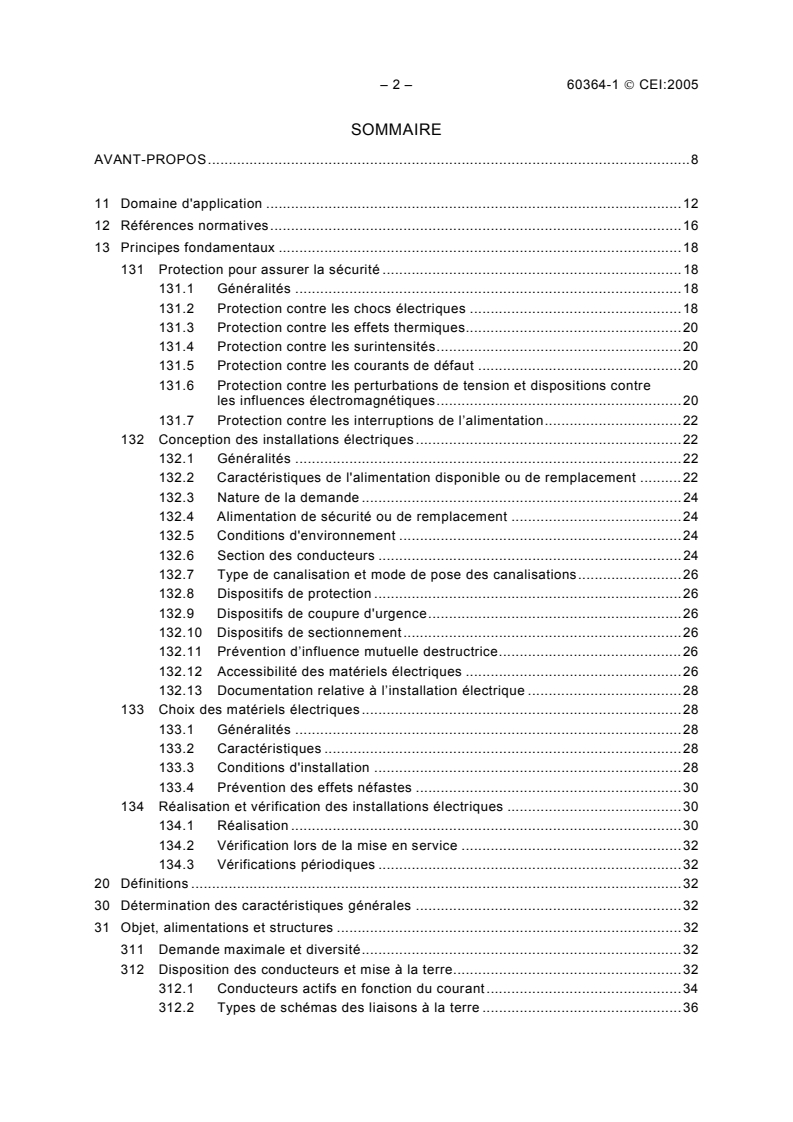
IEC 60364-1:2005 - Installations électriques a basse tension - Partie 1: Principes fondamentaux, détermination des caractéristiques générales, définitions Released:11/29/2005
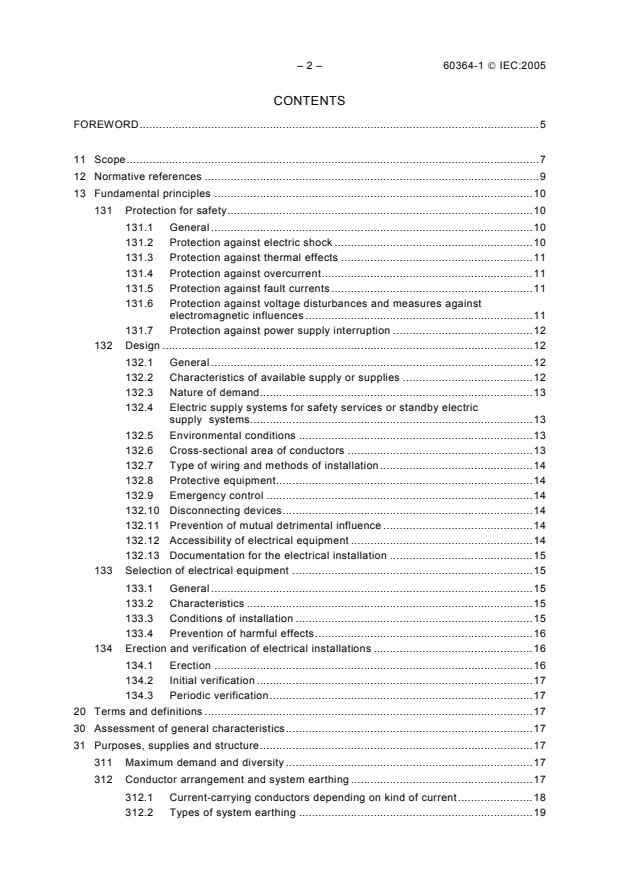
IEC 60364-1:2005 - Low-voltage electrical installations - Part 1: Fundamental principles, assessment of general characteristics, definitions Released:11/29/2005
Overview
IEC 60364-1:2005 - part of the IEC 60364 series - defines the fundamental principles, general characteristics assessment and definitions for low-voltage electrical installations. It gives rules for the design, erection and verification of installations to ensure the safety of persons, livestock and property and the proper functioning of electrical systems. The standard covers circuits up to 1 000 V a.c. and 1 500 V d.c., and includes the August 2009 corrigendum in this edition.
Key topics and requirements
- Protection for safety: requirements for protection against electric shock, thermal effects, overcurrent and fault currents.
- Protection against disturbances: measures for voltage disturbances and electromagnetic influences, and protection against power supply interruption.
- Design principles: characteristics of available supplies, demand assessment, environmental conditions, conductor cross-sections, wiring methods, accessibility and documentation for electrical installations.
- System earthing and conductor arrangements: assessment and classification of earthing systems (TN, TT, IT types) and conductor configurations relevant to safety and fault-clearing.
- Selection of equipment: criteria for choosing protective devices, wiring systems and components based on characteristics and installation conditions.
- Erection and verification: rules for installation practices, initial verification (testing on completion) and periodic verification (inspection and testing during service).
- Terminology and assessment: definitions, compatibility, maintainability, continuity of service and classification of safety services.
Applications & who uses this standard
IEC 60364-1 applies to a wide range of low-voltage installations, including:
- Residential, commercial, public and industrial premises
- Agricultural/horticultural buildings, prefabricated buildings, caravans and temporary sites
- Construction sites, exhibitions, marinas, external lighting
- Medical locations, mobile/transportable units, photovoltaic systems and low-voltage generating sets
Typical users:
- Electrical designers, consulting engineers and specifiers
- Installation contractors and electricians
- Inspection bodies and verification engineers
- Facility and safety managers, compliance officers
- System integrators for PV and standby power installations
Related standards
- Other parts of the IEC 60364 series for detailed rules on particular installation types and topics.
- IEC 60050-826 / IEV 826 referenced for electrical installation terminology and guidance.
Keywords: IEC 60364-1, low-voltage electrical installations, electrical safety, system earthing (TN/TT/IT), design and verification, initial verification, periodic verification, photovoltaic installations.
Relations
- Effective Date
- 25-Aug-2026
- Effective Date
- 25-Aug-2026
- Effective Date
- 25-Aug-2026
- Effective Date
- 25-Aug-2026
- Effective Date
- 25-Aug-2026
- Effective Date
- 08-Apr-2026
- Effective Date
- 10-Feb-2026
- Effective Date
- 05-Sep-2023
- Effective Date
- 05-Sep-2023
- Effective Date
- 05-Sep-2023
Buy Documents
IEC 60364-1:2005 - Low-voltage electrical installations - Part 1: Fundamental principles, assessment of general characteristics, definitions Released:11/29/2005
IEC 60364-1:2005 - Installations électriques a basse tension - Partie 1: Principes fondamentaux, détermination des caractéristiques générales, définitions Released:11/29/2005
IEC 60364-1:2005 - Low-voltage electrical installations - Part 1: Fundamental principles, assessment of general characteristics, definitions Released:11/29/2005
Get Certified
Connect with accredited certification bodies for this standard

DIBt (Deutsches Institut für Bautechnik)
German Institute for Building Technology.
DIN CERTCO
DIN Group product certification.

Aboma Certification B.V.
Specialized in construction, metal, and transport sectors.
Sponsored listings
Frequently Asked Questions
IEC 60364-1:2005 is a standard published by the International Electrotechnical Commission (IEC). Its full title is "Low-voltage electrical installations - Part 1: Fundamental principles, assessment of general characteristics, definitions". This standard covers: Gives the rules for the design, erection, and verification of electrical installations. The rules are intended to provide for the safety of persons, livestock and property against dangers and damage which may arise in the reasonable use of electrical installations and to provide for the proper functioning of those installations. IEC 60364-1 applies to the design, erection and verification of electrical installations such as those of a) residential premises; b) commercial premises; c) public premises; d) industrial premises; e) agricultural and horticultural premises; f) prefabricated buildings; g) caravans, caravan sites and similar sites; h) construction sites, exhibitions, fairs and other installations for temporary purposes; i) marinas; j) external lighting and similar installations; k) medical locations; l) mobile or transportable units; m) photovoltaic systems; n) low-voltage generating sets. IEC 60364-1 covers a) circuits supplied at nominal voltages up to and including 1 000 V a.c. or 1 500 V d.c.; b) circuits, other than the internal wiring of apparatus, operating at voltages exceeding 1 000 V and derived from an installation having a voltage not exceeding 1 000 V a.c., for example, discharge lighting, electrostatic precipitators; c) wiring systems and cables not specifically covered by the standards for appliances; d) all consumer installations external to buildings; e) fixed wiring for information and communication technology, signalling, control and the like (excluding internal wiring of apparatus); f) the extension or alteration of the installation and also parts of the existing installation affected by the extension or alteration. The contents of the corrigendum of August 2009 have been included in this copy.
Gives the rules for the design, erection, and verification of electrical installations. The rules are intended to provide for the safety of persons, livestock and property against dangers and damage which may arise in the reasonable use of electrical installations and to provide for the proper functioning of those installations. IEC 60364-1 applies to the design, erection and verification of electrical installations such as those of a) residential premises; b) commercial premises; c) public premises; d) industrial premises; e) agricultural and horticultural premises; f) prefabricated buildings; g) caravans, caravan sites and similar sites; h) construction sites, exhibitions, fairs and other installations for temporary purposes; i) marinas; j) external lighting and similar installations; k) medical locations; l) mobile or transportable units; m) photovoltaic systems; n) low-voltage generating sets. IEC 60364-1 covers a) circuits supplied at nominal voltages up to and including 1 000 V a.c. or 1 500 V d.c.; b) circuits, other than the internal wiring of apparatus, operating at voltages exceeding 1 000 V and derived from an installation having a voltage not exceeding 1 000 V a.c., for example, discharge lighting, electrostatic precipitators; c) wiring systems and cables not specifically covered by the standards for appliances; d) all consumer installations external to buildings; e) fixed wiring for information and communication technology, signalling, control and the like (excluding internal wiring of apparatus); f) the extension or alteration of the installation and also parts of the existing installation affected by the extension or alteration. The contents of the corrigendum of August 2009 have been included in this copy.
IEC 60364-1:2005 is classified under the following ICS (International Classification for Standards) categories: 91.140.50 - Electricity supply systems. The ICS classification helps identify the subject area and facilitates finding related standards.
IEC 60364-1:2005 has the following relationships with other standards: It is inter standard links to EN 12255-12:2024, EN 378-3:2008+A1:2012, EN 378-3:2016, EN ISO 10931:2005, EN 378-3:2016+A1:2020, EN ISO 8528-13:2016, EN 60728-11:2010, IEC 60364-1:2005/COR1:2009, IEC 60364-1:2025, IEC 60364-1:2001. Understanding these relationships helps ensure you are using the most current and applicable version of the standard.
IEC 60364-1:2005 is available in PDF format for immediate download after purchase. The document can be added to your cart and obtained through the secure checkout process. Digital delivery ensures instant access to the complete standard document.
Standards Content (Sample)
INTERNATIONAL IEC
STANDARD 60364-1
Fifth edition
2005-11
Low-voltage electrical installations –
Part 1:
Fundamental principles, assessment
of general characteristics, definitions
This English-language version is derived from the original
bilingual publication by leaving out all French-language
pages. Missing page numbers correspond to the French-
language pages.
Reference number
Publication numbering
As from 1 January 1997 all IEC publications are issued with a designation in the
60000 series. For example, IEC 34-1 is now referred to as IEC 60034-1.
Consolidated editions
The IEC is now publishing consolidated versions of its publications. For example,
edition numbers 1.0, 1.1 and 1.2 refer, respectively, to the base publication, the
base publication incorporating amendment 1 and the base publication incorporating
amendments 1 and 2.
Further information on IEC publications
The technical content of IEC publications is kept under constant review by the IEC,
thus ensuring that the content reflects current technology. Information relating to
this publication, including its validity, is available in the IEC Catalogue of
publications (see below) in addition to new editions, amendments and corrigenda.
Information on the subjects under consideration and work in progress undertaken
by the technical committee which has prepared this publication, as well as the list
of publications issued, is also available from the following:
• IEC Web Site (www.iec.ch)
• Catalogue of IEC publications
The on-line catalogue on the IEC web site (www.iec.ch/searchpub) enables you to
search by a variety of criteria including text searches, technical committees
and date of publication. On-line information is also available on recently issued
publications, withdrawn and replaced publications, as well as corrigenda.
• IEC Just Published
This summary of recently issued publications (www.iec.ch/online_news/ justpub)
is also available by email. Please contact the Customer Service Centre (see
below) for further information.
• Customer Service Centre
If you have any questions regarding this publication or need further assistance,
please contact the Customer Service Centre:
Email: custserv@iec.ch
Tel: +41 22 919 02 11
Fax: +41 22 919 03 00
INTERNATIONAL IEC
STANDARD 60364-1
Fifth edition
2005-11
Low-voltage electrical installations –
Part 1:
Fundamental principles, assessment
of general characteristics, definitions
IEC 2005 Copyright - all rights reserved
No part of this publication may be reproduced or utilized in any form or by any means, electronic or mechanical,
including photocopying and microfilm, without permission in writing from the publisher.
International Electrotechnical Commission, 3, rue de Varembé, PO Box 131, CH-1211 Geneva 20, Switzerland
Telephone: +41 22 919 02 11 Telefax: +41 22 919 03 00 E-mail: inmail@iec.ch Web: www.iec.ch
PRICE CODE
X
Commission Electrotechnique Internationale
International Electrotechnical Commission
МеждународнаяЭлектротехническаяКомиссия
For price, see current catalogue
60364-1 IEC:2005 – 3 –
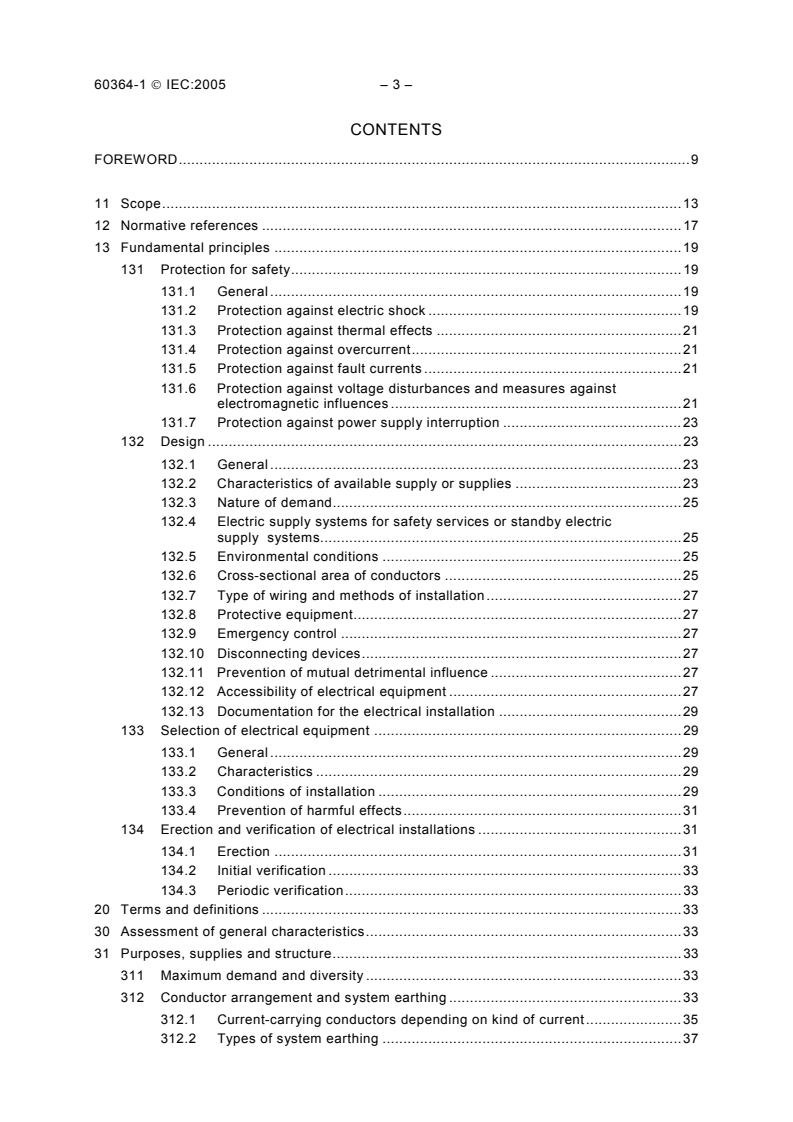
CONTENTS
FOREWORD.9
11 Scope.13
12 Normative references.17
13 Fundamental principles.19
131 Protection for safety.19
131.1 General.19
131.2 Protection against electric shock .19
131.3 Protection against thermal effects .21
131.4 Protection against overcurrent.21
131.5 Protection against fault currents .21
131.6 Protection against voltage disturbances and measures against
electromagnetic influences .21
131.7 Protection against power supply interruption .23
132 Design.23
132.1 General.23
132.2 Characteristics of available supply or supplies .23
132.3 Nature of demand.25
132.4 Electric supply systems for safety services or standby electric
supply systems.25
132.5 Environmental conditions.25
132.6 Cross-sectional area of conductors .25
132.7 Type of wiring and methods of installation.27
132.8 Protective equipment.27
132.9 Emergency control.27
132.10 Disconnecting devices.27
132.11 Prevention of mutual detrimental influence .27
132.12 Accessibility of electrical equipment .27
132.13 Documentation for the electrical installation .29
133 Selection of electrical equipment .29
133.1 General.29
133.2 Characteristics.29
133.3 Conditions of installation .29
133.4 Prevention of harmful effects.31
134 Erection and verification of electrical installations .31
134.1 Erection.31
134.2 Initial verification.33
134.3 Periodic verification.33
20 Terms and definitions .33
30 Assessment of general characteristics.33
31 Purposes, supplies and structure.33
311 Maximum demand and diversity .33
312 Conductor arrangement and system earthing .33
312.1 Current-carrying conductors depending on kind of current.35
312.2 Types of system earthing .37
60364-1 IEC:2005 – 5 –
313 Supplies.71
313.1 General.71
313.2 Supplies for safety services and standby systems .71
314 Division of installation.71
32 Classification of external influences.73
33 Compatibility.73
33.1 Compatibility of characteristics .73
33.2 Electromagnetic compatibility.73
34 Maintainability.73
35 Safety services.75
35.1 General .75
35.2 Classification .75
36 Continuity of service.75
Annex A (informative) Numbering system and plan of IEC 60364 series.77
Annex B (informative) Definitions – Application guide and explanations to selected
terms of IEC 60050-826 (IEV 826 – Electrical Installations) .83
Annex C (informative) Comparison of the structure of IEC 60364-1 fourth edition 2001
and IEC 60364-1 fifth edition 2005.89
Bibliography.93
Figure 1 – Single-phase 2-wire .35
Figure 2 – Single-phase 3-wire .35
Figure 3 – Two-phase 3-wire.35
Figure 4 – Three-phase 3-wire .35
Figure 5 – Three-phase 4-wire .37
Figure 6 – 2-wire.37
Figure 7 – 3-wire.37
Figure 31A1 – TN-S system with separate neutral conductor and protective conductor
throughout the system .39
Figure 31A2 – TN-S system with separate earthed line conductor and protective
conductor throughout the system .41
Figure 31A3 – TN-S system with earthed protective conductor and no distributed
neutral conductor throughout the system .41
Figure 31B1 – TN-C-S system 3-phase, 4-wire, where the PEN is separated into PE
and N elsewhere in the installation .43
Figure 31B2 – TN-C-S system 3-phase, 4-wire where the PEN is separated into PE
and N at the origin of the installation.45
Figure 31B3 – TN-C-S system – Single-phase, 2-wire where the PEN is separated into
PE and N at the origin of the installation .45
Figure 31C – TN-C system with neutral and protective conductor functions combined in
a single conductor throughout the system .47
Figure 31D – TN-C-S multiple source system with separate protective conductor and
neutral conductor to current using equipment.49
Figure 31E – TN multiple source system with protective conductor and no neutral
conductor throughout the system for 2- or 3-phase load.51
60364-1 IEC:2005 – 7 –
Figure 31F1 – TT system with separate neutral conductor and protective conductor
throughout the installation.53
Figure 31F2 – TT system with earthed protective conductor and no distributed neutral
conductor throughout the installation .55
Figure 31G1 – IT system with all exposed-conductive-parts interconnected by a
protective conductor which is collectively earthed .57
Figure 31G2 – IT system with exposed-conductive-parts earthed in groups or
individually.59
Figure 31H – TN-S d.c. system .61
Figure 31J – TN-C d.c. system.63
Figure 31K – TN-C-S d.c. system.65
Figure 31L – TT d.c. system .67
Figure 31M – IT d.c. system.69
Figure B.1 – Zone of arm’s reach.85
Table A.1 – Numbering system of IEC 60364 series.77
Table A.2 – Plan of IEC 60364 series: Electrical installations of buildings .79
60364-1 IEC:2005 – 9 –
INTERNATIONAL ELECTROTECHNICAL COMMISSION
____________
LOW-VOLTAGE ELECTRICAL INSTALLATIONS –
Part 1: Fundamental principles, assessment of
general characteristics, definitions
FOREWORD
1) The International Electrotechnical Commission (IEC) is a worldwide organization for standardization comprising
all national electrotechnical committees (IEC National Committees). The object of IEC is to promote
international co-operation on all questions concerning standardization in the electrical and electronic fields. To
this end and in addition to other activities, IEC publishes International Standards, Technical Specifications,
Technical Reports, Publicly Available Specifications (PAS) and Guides (hereafter referred to as “IEC
Publication(s)”). Their preparation is entrusted to technical committees; any IEC National Committee interested
in the subject dealt with may participate in this preparatory work. International, governmental and non-
governmental organizations liaising with the IEC also participate in this preparation. IEC collaborates closely
with the International Organization for Standardization (ISO) in accordance with conditions determined by
agreement between the two organizations.
2) The formal decisions or agreements of IEC on technical matters express, as nearly as possible, an international
consensus of opinion on the relevant subjects since each technical committee has representation from all
interested IEC National Committees.
3) IEC Publications have the form of recommendations for international use and are accepted by IEC National
Committees in that sense. While all reasonable efforts are made to ensure that the technical content of IEC
Publications is accurate, IEC cannot be held responsible for the way in which they are used or for any
misinterpretation by any end user.
4) In order to promote international uniformity, IEC National Committees undertake to apply IEC Publications
transparently to the maximum extent possible in their national and regional publications. Any divergence
between any IEC Publication and the corresponding national or regional publication shall be clearly indicated in
the latter.
5) IEC provides no marking procedure to indicate its approval and cannot be rendered responsible for any
equipment declared to be in conformity with an IEC Publication.
6) All users should ensure that they have the latest edition of this publication.
7) No liability shall attach to IEC or its directors, employees, servants or agents including individual experts and
members of its technical committees and IEC National Committees for any personal injury, property damage or
other damage of any nature whatsoever, whether direct or indirect, or for costs (including legal fees) and
expenses arising out of the publication, use of, or reliance upon, this IEC Publication or any other IEC
Publications.
8) Attention is drawn to the Normative references cited in this publication. Use of the referenced publications is
indispensable for the correct application of this publication.
9) Attention is drawn to the possibility that some of the elements of this IEC Publication may be the subject of
patent rights. IEC shall not be held responsible for identifying any or all such patent rights.
International Standard IEC 60364-1 has been prepared by IEC Technical Committee 64:
Electrical installations and protection against electric shock.
This fifth edition cancels and replaces the fourth edition, published in 2001. It constitutes a
technical revision.
The main changes with respect to the previous edition are:
– in order to complete the scope, the new items external lighting and similar installations,
medical locations, mobile or transportable units, photovoltaic power supply units and low-
voltage generating sets are added;
– in Clause 131, "Fundamental principles", the list of hazards which may arise in electrical
installations is completed; furthermore, a new subclause dealing with protection against
voltage disturbances and measures against electromagnetic influences and a new
subclause dealing with protection against power supply interruption are added;
60364-1 IEC:2005 – 11 –
– in Clause 132, "Design", the new subclause "Documentation for the electrical installation"
is added;
– in Clause 134, "Erection and verification of electrical installations", the new subclause "
periodic verification" is added;
– the former Clause 312, "Types of distribution system" is renamed "Conductor arrangement
and system earthing" and, in the relevant subclauses, several new figures are included for
better understanding of the different kind of a.c. and d.c. circuits and types of systems and
their earthing being applied nowadays in IEC member countries;
– in 33.1, "Compatibility of characteristics", a new item for excessive PE conductor currents
is added;
– a new Clause 36, "Continuity of service", is included;
– Annex B is aligned with the second edition of IEC 60050-826:2004.
The text of this standard is based on the following documents:
FDIS Report on voting
64/1488/FDIS 64/1499/RVD
Full information on the voting for the approval of this standard can be found in the report on
voting indicated in the above table.
This publication has been drafted in accordance with the ISO/IEC Directives, Part 2.
IEC 60364 consists of the following parts, under the general title Low-voltage electrical
installations:
Part 1: Fundamental principles, assessment of general characteristics, definitions
Part 4: Protection for safety
Part 5: Selection and erection of electrical equipment
Part 6: Verification
Part 7: Requirements for special installations or locations
The committee has decided that the contents of this publication will remain unchanged until
the maintenance result date indicated on the IEC web site under "http://webstore.iec.ch" in
the data related to the specific publication. At this date, the publication will be
• reconfirmed;
• withdrawn;
• replaced by a revised edition, or
• amended.
60364-1 IEC:2005 – 13 –
LOW-VOLTAGE ELECTRICAL INSTALLATIONS –
Part 1: Fundamental principles, assessment of
general characteristics, definitions
11 Scope
IEC 60364-1 gives the rules for the design, erection, and verification of electrical installations.
The rules are intended to provide for the safety of persons, livestock and property against
dangers and damage which may arise in the reasonable use of electrical installations and to
provide for the proper functioning of those installations.
11.1 IEC 60364-1 applies to the design, erection and verification of electrical installations
such as those of
a) residential premises;
b) commercial premises;
c) public premises;
d) industrial premises;
e) agricultural and horticultural premises;
f) prefabricated buildings;
g) caravans, caravan sites and similar sites;
h) construction sites, exhibitions, fairs and other installations for temporary purposes;
i) marinas;
j) external lighting and similar installations (see, however ,11.3e));
k) medical locations;
l) mobile or transportable units;
m) photovoltaic systems;
n) low-voltage generating sets.
NOTE “Premises” covers the land and all facilities including buildings belonging to it.
11.2 IEC 60364-1 covers
a) circuits supplied at nominal voltages up to and including 1 000 V a.c. or 1 500 V d.c.;
For a.c., the preferred frequencies which are taken into account in this standard are
50 Hz, 60 Hz and 400 Hz. The use of other frequencies for special purposes is not
excluded.
b) circuits, other than the internal wiring of apparatus, operating at voltages exceeding 1 000 V
and derived from an installation having a voltage not exceeding 1 000 V a.c., for example,
discharge lighting, electrostatic precipitators;
—————————
The numbering system is explained in Annex A.
60364-1 IEC:2005 – 15 –
c) wiring systems and cables not specifically covered by the standards for appliances;
d) all consumer installations external to buildings;
e) fixed wiring for information and communication technology, signalling, control and the like
(excluding internal wiring of apparatus);
f) the extension or alteration of the installation and also parts of the existing installation
affected by the extension or alteration.
NOTE The rules of IEC 60364-1 are intended to apply to electrical installations generally but, in certain cases,
they may need to be supplemented by the requirements or recommendations of other IEC standards (for example,
for installations in explosive gas atmospheres).
11.3 IEC 60364-1 does not apply to
a) electric traction equipment, including rolling stock and signaling equipment;
b) electrical equipment of motor vehicles, except those covered in Part 7;
c) electrical installations on board ships and mobile and fixed offshore platforms;
d) electrical installations in aircraft;
e) public street-lighting installations which are part of the public power grid;
f) installations in mines and quarries;
g) radio interference suppression equipment, except where it affects the safety of the
installation;
h) electric fences;
i) external lightning protection systems for buildings (LPS);
NOTE Atmospheric phenomena are covered in IEC 60364-1 but only insofar as effects on the electrical
installations are concerned (for example, with respect to selection of surge protective devices).
j) certain aspects of lift installations;
k) electrical equipment of machines.
11.4 IEC 60364-1 is not intended to apply to
– systems for distribution of energy to the public, or
– power generation and transmission for such systems.
NOTE 1 Countries wishing to do so may, however, use this standard in whole or in part for that purpose.
NOTE 2 According to IEC 61936 which provides common rules for the design and the erection of electrical power
installations in systems with nominal voltages above 1kV a.c. and nominal frequency up to and including 60 Hz,
low- voltage a.c. and d.c. protection and monitoring systems should be in accordance with IEC 60364 series.
11.5 Electrical equipment is dealt with only so far as its selection and application in the
installation are concerned.
This applies also to assemblies of electrical equipment complying with the relevant standards.
60364-1 IEC:2005 – 17 –
12 Normative references
The following referenced documents are indispensable for the application of this document.
For dated references, only the edition cited applies. For undated references, the latest edition
of the referenced document (including any amendments) applies.
IEC 60038, IEC standard voltages
IEC 60050(691), International Electrotechnical Vocabulary (IEV) – Chapter 691: Tariffs for
electricity
IEC 60050-826, International Electrotechnical Vocabulary (IEV) – Part 826: Electrical
installations
IEC 60364-4-41, Electrical installations of buildings – Part 4-41: Protection for safety –
Protection against electric shock
IEC 60364-4-42, Electrical installations of buildings – Part 4-42: Protection for safety –
Protection against thermal effects
IEC 60364-4-43, Electrical installations of buildings – Part 4-43: Protection for safety –
Protection against overcurrent
IEC 60364-4-44, Electrical installations of buildings – Part 4-44: Protection for safety –
Protection against voltage disturbances and electromagnetic disturbances
IEC 60364-5-51, Electrical installations of buildings – Part 5-51: Selection and erection of
electrical equipment – Common rules
IEC 60364-5-52, Electrical installations of buildings – Part 5-52: Selection and erection of
electrical equipment – Wiring systems
IEC 60364-5-53:2001, Electrical installations of buildings – Part 5-53: Selection and erection
of electrical equipment – Isolation, switching and control
IEC 60364-5-54, Electrical installations of buildings – Part 5-54: Selection and erection of
electrical equipment – Earthing arrangements, protective conductors and protective bonding
conductors
IEC 60364-5-55:2001, Electrical installations of buildings – Part 5-55: Selection and erection
of electrical equipment – Other equipment
IEC 60445, Basic and safety principles for man-machine interface, marking and identification -
Identification of equipment terminals and of terminations of certain designated conductors,
including general rules for an alphanumeric system
IEC 60446, Basic and safety principles for man-machine interface, marking and identification
– Identification of conductors by colours or numerals
IEC 60617-DB:2001 , Graphical symbols for diagrams
IEC 60721 (all parts), Classification of environmental conditions
—————————
″DB″ refers to the IEC on-line database.
60364-1 IEC:2005 – 19 –
13 Fundamental principles
NOTE 1 Where countries not yet having national regulations for electrical installations deem it necessary to
establish legal requirements for this purpose, it is recommended that such requirements be limited to fundamental
principles which are not subject to frequent modification on account of technical development. The contents of
Clause 13 may be used as a basis for such legislation.
NOTE 2 This clause contains basic requirements. In other parts of this standard (see Table A.2), more detailed
requirements may be given.
131 Protection for safety
131.1 General
The requirements stated in 131.2 to 131.7 are intended to provide for the safety of persons,
livestock and property against dangers and damage which may arise in the reasonable use of
electrical installations. The requirements to provide for the safety of livestock are applicable in
locations intended for them.
NOTE In electrical installations, the following hazards may arise:
– shock currents;
– excessive temperatures likely to cause burns, fires and other injurious effects;
– ignition of a potentially explosive atmosphere;
– undervoltages, overvoltages and electromagnetic influences likely to cause or result in injury or
damage;
– power supply interruptions and/or interruption of safety services;
– arcing, likely to cause blinding effects, excessive pressure, and/or toxic gases;
– mechanical movement of electrically activated equipment.
131.2 Protection against electric shock
131.2.1 Basic protection (protection against direct contact)
NOTE For low-voltage installations, systems and equipment, basic protection generally corresponds to protection
against direct contact.
Protection shall be provided against dangers that may arise from contact with live parts of the
installation by persons or livestock.
This protection can be achieved by one of the following methods:
– preventing a current from passing through the body of any person or any livestock;
– limiting the current which can pass through a body to a non-hazardous value.
131.2.2 Fault protection (protection against indirect contact)
NOTE For low-voltage installations, systems and equipment, fault protection generally corresponds to protection
against indirect contact, mainly with regard to failure of basic insulation.
Protection shall be provided against dangers that may arise from contact with exposed-
conductive-parts of the installation by persons or livestock.
60364-1 IEC:2005 – 21 –
This protection can be achieved by one of the following methods:
– preventing a current resulting from a fault from passing through the body of any person or
any livestock;
– limiting the magnitude of a current resulting from a fault, which can pass through a body,
to a non-hazardous value;
– limiting the duration of a current resulting from a fault, which can pass through a body, to
a non-hazardous time period.
131.3 Protection against thermal effects
The electrical installation shall be so arranged to minimize the risk of damage or ignition of
flammable materials due to high temperature or electric arc. In addition, during normal
operation of the electrical equipment, there shall be no risk of persons or livestock suffering
burns.
131.4 Protection against overcurrent
Persons and livestock shall be protected against injury and property shall be protected
against damage due to excessive temperatures or electromechanical stresses caused by any
overcurrents likely to arise in conductors.
Protection can be achieved by limiting the overcurrent to a safe value or duration.
131.5 Protection against fault currents
Conductors, other than live conductors, and any other parts intended to carry a fault current
shall be capable of carrying that current without attaining an excessive temperature.
Electrical equipment, including conductors shall be provided with mechanical protection
against electromechanical stresses of fault currents as necessary to prevent injury or damage
to persons, livestock or property.
Live conductors shall be protected against overcurrents arising from faults by the methods in
131.4.
NOTE Particular attention should be given to PE conductor and earthing conductor currents.
131.6 Protection against voltage disturbances and measures against
electromagnetic influences
131.6.1 Persons and livestock shall be protected against injury and property shall be
protected against any harmful effects as a consequence of a fault between live parts of
circuits supplied at different voltages.
131.6.2 Persons and livestock shall be protected against injury and property shall be
protected against damage as a consequence of overvoltages such as those originating from
atmospheric events or from switching.
NOTE For protection against direct lightning strikes, see IEC 62305 series.
131.6.3 Persons and livestock shall be protected against injury and property shall be
protected against damage as a consequence of undervoltage and any subsequent voltage
recovery.
60364-1 IEC:2005 – 23 –
131.6.4 The installation shall have an adequate level of immunity against electromagnetic
disturbances so as to function correctly in the specified environment. The installation design
shall take into consideration the anticipated electromagnetic emissions, generated by the
installation or the installed equipment, which shall be suitable for the current-using equipment
used with, or connected to, the installation.
131.7 Protection against power supply interruption
Where danger or damage is expected to arise due to an interruption of supply, suitable
provisions shall be made in the installation or installed equipment.
132 Design
132.1 General
For the design of the electrical installation, the following factors shall be taken into account to
provide
– the protection of persons, livestock and property in accordance with Clause 131;
– the proper functioning of the electrical installation for the intended use.
The information required as a basis for design is listed in 132.2 to 132.5. The requirements
with which the design shall comply are stated in 132.6 to 132.12.
132.2 Characteristics of available supply or supplies
When designing electrical installations in accordance with IEC 60364 series it is necessary to
know the characteristics of the supply. Relevant information from the network operator is
necessary to design a safe installation according to IEC 60364 series. The characteristics of
the power supply should be included in the documentation to show conformity with IEC 60364
series. If the network operator changes the characteristics of the power supply this may affect
the safety of the installation.
132.2.1 Nature of current: a.c. and/or d.c.
132.2.2 Function of conductors:
– for a.c.: line conductor(s);
neutral conductor;
protective conductor.
– for d.c.: line conductor(s);
midpoint conductor;
protective conductor.
NOTE The function of some conductors may be combined in a single conductor.
132.2.3 Values and tolerances:
– voltage and voltage tolerances;
– voltage interruptions, voltage fluctuations and voltage dips;
– frequency and frequency tolerances;
60364-1 IEC:2005 – 25 –
– maximum current allowable;
– earth fault loop impedance upstream of the origin of the installation;
– prospective short-circuit currents.
For standard voltages and frequencies, see IEC 60038.
132.2.4 Protective provisions inherent in the supply, for example, system earthing or mid-
point earthing.
132.2.5 Particular requirements of the supply undertaking.
132.3 Nature of demand
The number and type of circuits required for lighting, heating, power, control, signalling,
information and communication technology, etc. shall be determined by
– location of points of power demand;
– loads to be expected on the various circuits;
– daily and yearly variation of demand;
– any special conditions such as harmonics;
– requirements for control, signalling, information and communication technology, etc;
– anticipated future demand if specified.
132.4 Electric supply systems for safety services or standby electric supply
systems
– Source of supply (nature, characteristics).
– Circuits to be supplied by the electric source for safety services or the standby electrical
source.
132.5 Environmental conditions
The design of the electrical installation shall take into account the environmental conditions to
which it will be subjected, see IEC 60364-5-51 and IEC 60721.
132.6 Cross-sectional area of conductors
The cross-sectional area of conductors shall be determined for both normal operating
conditions and for fault conditions according to
a) their admissible maximum temperature;
b) the admissible voltage drop;
c) the electromechanical stresses likely to occur due to earth fault and short-circuit currents;
d) other mechanical stresses to which the conductors can be subjected;
e) the maximum impedance with respect to the functioning of the protection against fault
currents;
f) the method of installation.
NOTE The items listed above concern primarily the safety of electrical installations. Cross-sectional areas greater
than those required for safety may be desirable for economic operation.
60364-1 IEC:2005 – 27 –
132.7 Type of wiring and methods of installation
For the choice of the type of wiring and the methods of installation the following shall be taken
into account:
– the nature of the locations;
– the nature of the walls or other parts of the building supporting the wiring;
– accessibility of wiring to persons and livestock;
– voltage;
– the electromagnetic stresses likely to occur due to earth fault and short-circuit currents;
– electromagnetic interference;
– other stresses to which the wiring can be subjected during the erection of the electrical
installation or in service.
132.8 Protective equipment
The characteristics of protective equipment shall be determined with respect to their function
which may be, for example, protection against the effects of
– overcurrent (overload, short-circuit);
– earth fault current;
– overvoltage;
– undervoltage and no voltage.
The protective devices shall operate at values of current, voltage and time which are suitably
related to the characteristics of the circuits and to the possibilities of danger.
132.9 Emergency control
Where, in case of danger, there is the necessity for the immediate interruption of supply, an
interrupting device shall be installed in such a way that it can be easily recognized and
effectively and rapidly operated.
132.10 Disconnecting devices
Disconnecting devices shall be provided so as to permit switching and/or isolation of the
electrical installation, circuits or individual items of apparatus as required for operation,
inspection and fault detection, testing, maintenance and repair.
132.11 Prevention of mutual detrimental influence
The electrical installation shall be arranged in such a way that no mutual detrimental influence
will occur between electrical installations and non-electrical installations.
132.12 Accessibility of electrical equipment
The electrical equipment shall be arranged so as to afford as may be necessary:
– sufficient space for the initial installation and later replacement of individual items of
electrical equipment;
– accessibility for operation, inspection and fault detection, testing, maintenance and repair.
60364-1 IEC:2005 – 29 –
132.13 Documentation for the electrical installation
Every electrical installation shall be provided with appropriate documentation.
133 Selection of electrical equipment
133.1 General
Every item of electrical equipment used in electrical installations shall comply with such
IEC standards as are appropriate. In the absence of an IEC standard the equipment shall
comply with the appropriate national standards. Where there are no applicable standards, the
item of equipment concerned shall be selected by special agreement between the person
specifying the installation and the installer.
133.2 Characteristics
Every item of electrical equipment selected shall have suitable characteristics appropriate to
the values and conditions on which the design of the electrical installation (see Clause 132) is
based and shall, in particular, fulfil the following requirements.
133.2.1 Voltage
Electrical equipment shall be suitable with respect to the maximum steady-state voltage
(r.m.s. value for a.c.) likely to be applied, as well as overvoltages likely to occur.
NOTE For certain equipment, it may be necessary to take account of the lowest voltage likely to occur.
133.2.2 Current
All electrical equipment shall be selected with respect to the maximum steady-state current
(r.m.s. value for a.c.) which it has to carry in normal service, and with respect to the current
likely to be carried in abnormal conditions and the period (for example, operating time of
protective devices, if any) during which it may be expected to flow.
133.2.3 Frequency
If frequency has an influence on the characteristics of electrical equipment, the rated
frequency of the equipment shall correspond to the frequency likely to occur in the circuit.
133.2.4 Load factor
All electrical equipment which is selected on the basis of its power characteristics shall be
suitable for the duty demanded of the equipment taking into account the design service
conditions, see IEV 691-10-02.
133.3 Conditions of installation
All electrical equipment shall be selected so as to withstand safely the stresses and the
environmental conditions (see 132.5) characteristic of its location and to which it may be
subjected. If, however, an item of equipment does not have by design the properties
corresponding to its location, it may be used on condition that adequate additional protection
is provided as part of the completed electrical installation.
60364-1 IEC:2005 – 31 –
133.4 Prevention of harmful effects
All electrical equipment shall be selected so that it will not cause harmful effects on other
equipment or impair the supply during normal service including switching operations. In this
context, the factors which can have an influence include, for example:
– power factor;
– inrush current;
– asymmetrical load;
– harmonics;
– transient overvoltages generated by equipment in the installation.
134 Erection and verification of electrical installations
134.1 Erection
134.1.1 Good workmanship by competent persons and proper materials shall be used in the
erection of the electrical installation. Electrical equipment shall be installed in accordance with
the instructions provided by the manufacturer of the equipment.
134.1.2 The characteristics of the electrical equipment, as determined in accordance with
Clause 133, shall not be impaired during erection.
134.1.3 Conductors shall be identified in accordance with IEC 60446. Where identification of
terminals is necessary, they shall be identified in accordance with IEC 60445.
134.1.4 Connections between conductors and between conductors and other electrical
equipment shall be made in such a way that safe and reliable contact is ensured.
134.1.5 All electrical equipment shall be installed in such a manner that the designed heat
dissipation conditions are not impaired.
134.1.6 All electrical equipment likely to cause high temperatures or electric arcs shall be
placed or guarded so as to minimize the risk of ignition of flammable materials. Where the
temperature of any exposed parts of electrical equipment is likely to cause injury to persons,
those parts shall be so located or guarded a
...
NORME CEI
INTERNATIONALE 60364-1
Cinquième édition
2005-11
Installations électriques à basse tension –
Partie 1:
Principes fondamentaux, détermination
des caractéristiques générales, définitions
Cette version française découle de la publication d’origine
bilingue dont les pages anglaises ont été supprimées.
Les numéros de page manquants sont ceux des pages
supprimées.
Numéro de référence
CEI 60364-1:2005(F)
Numérotation des publications
Depuis le 1er janvier 1997, les publications de la CEI sont numérotées à partir de
60000. Ainsi, la CEI 34-1 devient la CEI 60034-1.
Editions consolidées
Les versions consolidées de certaines publications de la CEI incorporant les
amendements sont disponibles. Par exemple, les numéros d’édition 1.0, 1.1 et 1.2
indiquent respectivement la publication de base, la publication de base incorporant
l’amendement 1, et la publication de base incorporant les amendements 1 et 2
Informations supplémentaires sur les publications de la CEI
Le contenu technique des publications de la CEI est constamment revu par la CEI
afin qu'il reflète l'état actuel de la technique. Des renseignements relatifs à cette
publication, y compris sa validité, sont disponibles dans le Catalogue des
publications de la CEI (voir ci-dessous) en plus des nouvelles éditions, amende-
ments et corrigenda. Des informations sur les sujets à l’étude et l’avancement des
travaux entrepris par le comité d’études qui a élaboré cette publication, ainsi que la
liste des publications parues, sont également disponibles par l’intermédiaire de:
• Site web de la CEI (www.iec.ch)
• Catalogue des publications de la CEI
Le catalogue en ligne sur le site web de la CEI (www.iec.ch/searchpub) vous permet
de faire des recherches en utilisant de nombreux critères, comprenant des
recherches textuelles, par comité d’études ou date de publication. Des informations
en ligne sont également disponibles sur les nouvelles publications, les publications
remplacées ou retirées, ainsi que sur les corrigenda.
• IEC Just Published
Ce résumé des dernières publications parues (www.iec.ch/online_news/justpub)
est aussi disponible par courrier électronique. Veuillez prendre contact avec le
Service client (voir ci-dessous) pour plus d’informations.
• Service clients
Si vous avez des questions au sujet de cette publication ou avez besoin de
renseignements supplémentaires, prenez contact avec le Service clients:
Email: custserv@iec.ch
Tél: +41 22 919 02 11
Fax: +41 22 919 03 00
NORME CEI
INTERNATIONALE 60364-1
Cinquième édition
2005-11
Installations électriques à basse tension –
Partie 1:
Principes fondamentaux, détermination
des caractéristiques générales, définitions
IEC 2005 Droits de reproduction réservés
Aucune partie de cette publication ne peut être reproduite ni utilisée sous quelque forme que ce soit et par aucun
procédé, électronique ou mécanique, y compris la photocopie et les microfilms, sans l'accord écrit de l'éditeur.
International Electrotechnical Commission, 3, rue de Varembé, PO Box 131, CH-1211 Geneva 20, Switzerland
Telephone: +41 22 919 02 11 Telefax: +41 22 919 03 00 E-mail: inmail@iec.ch Web: www.iec.ch
CODE PRIX
X
Commission Electrotechnique Internationale
International Electrotechnical Commission
МеждународнаяЭлектротехническаяКомиссия
Pour prix, voir catalogue en vigueur
– 2 – 60364-1 CEI:2005
SOMMAIRE
AVANT-PROPOS.8
11 Domaine d'application.12
12 Références normatives.16
13 Principes fondamentaux .18
131 Protection pour assurer la sécurité .18
131.1 Généralités.18
131.2 Protection contre les chocs électriques .18
131.3 Protection contre les effets thermiques.20
131.4 Protection contre les surintensités.20
131.5 Protection contre les courants de défaut .20
131.6 Protection contre les perturbations de tension et dispositions contre
les influences électromagnétiques.20
131.7 Protection contre les interruptions de l’alimentation.22
132 Conception des installations électriques.22
132.1 Généralités.22
132.2 Caractéristiques de l'alimentation disponible ou de remplacement .22
132.3 Nature de la demande .24
132.4 Alimentation de sécurité ou de remplacement .24
132.5 Conditions d'environnement .24
132.6 Section des conducteurs .24
132.7 Type de canalisation et mode de pose des canalisations.26
132.8 Dispositifs de protection .26
132.9 Dispositifs de coupure d'urgence.26
132.10 Dispositifs de sectionnement.26
132.11 Prévention d’influence mutuelle destructrice.26
132.12 Accessibilité des matériels électriques .26
132.13 Documentation relative à l’installation électrique .28
133 Choix des matériels électriques.28
133.1 Généralités.28
133.2 Caractéristiques.28
133.3 Conditions d'installation.28
133.4 Prévention des effets néfastes .30
134 Réalisation et vérification des installations électriques .30
134.1 Réalisation.30
134.2 Vérification lors de la mise en service .32
134.3 Vérifications périodiques.32
20 Définitions.32
30 Détermination des caractéristiques générales .32
31 Objet, alimentations et structures .32
311 Demande maximale et diversité.32
312 Disposition des conducteurs et mise à la terre.32
312.1 Conducteurs actifs en fonction du courant.34
312.2 Types de schémas des liaisons à la terre .36
– 4 – 60364-1 CEI:2005
313 Alimentations .70
313.1 Généralités.70
313.2 Alimentations pour services de sécurité et alimentations de
remplacement .70
314 Division des installations .70
32 Classification des influences externes .72
33 Compatibilité.72
33.1 Compatibilité des caractéristiques .72
33.2 Compatibilité électromagnétique.72
34 Maintenabilité.72
35 Installations de sécurité .74
35.1 Généralités.74
35.2 Classification.74
36 Continuité de service.74
Annexe A (informative) Système de numérotage de la série CEI 60364 .76
Annexe B (informative) Définitions – Guide d’application et explications des termes
choisis dans la CEI 60050-826 (VEI 826 – Installations électriques) .82
Annexe C (informative) Comparaison entre la structure de la CEI 60364-1: quatrième
édition (2001) et celle de la CEI 60364-1: cinquième édition (2005) .88
Bibliographie.92
Figure 1 – Monophasé 2 conducteurs .34
Figure 2 – Monophasé 3 conducteurs .34
Figure 3 – Biphasé 3 conducteurs.34
Figure 4 – Triphasé 3 conducteurs.34
Figure 5 – Triphasé 4 conducteurs.36
Figure 6 – 2 conducteurs .36
Figure 7 – 3 conducteurs .36
Figure 31A1 – Schéma TN-S avec conducteur neutre et conducteur de protection
distincts dans l’ensemble du schéma .38
Figure 31A2 – Schéma TN-S avec conducteur de phase mis à la terre et conducteur
de protection distincts dans l’ensemble du schéma.40
Figure 31A3 – Schéma TN-S avec conducteur de protection mis à la terre et pas de
distribution du conducteur neutre dans l’ensemble du schéma .40
Figure 31B1 – Schéma TN-C-S – Triphasé 4 conducteurs avec PEN séparé en PE et N
en un point de l’installation .42
Figure 31B2 – Schéma TN-C-S – Triphasé 4 conducteurs avec PEN séparé en PE et N
à l’origine de l’installation .44
Figure 31B3 – Schéma TN-C-S – Monophasé 2 conducteurs avec PEN séparé en PE
et N à l’origine de l’installation .44
Figure 31C – Schéma TN-C avec fonctions de neutre et de protection confondues en
un seul conducteur dans l’ensemble du schéma .46
Figure 31D – Schéma TN-C-S à sources multiples avec conducteur de protection et
conducteur de neutre séparés dans l’ensemble du schéma.48
Figure 31E –Schéma TN à sources multiples avec conducteur de protection et
absence de conducteur neutre dans l’ensemble du schéma. .50
– 6 – 60364-1 CEI:2005
Figure 31F1 – Schéma TT avec conducteur de protection et conducteur de neutre
séparés dans l’ensemble du schéma. .52
Figure 31F2 – Schéma TT avec conducteur de protection et absence de conducteur
neutre dans l’ensemble du schéma .54
Figure 31G1 – Schéma IT avec toutes les masses interconnectées par un conducteur
de protection mis collectivement à la terre .56
Figure 31G2 – Schéma IT avec toutes les masses mises à la terre en groupes ou
individuellement.58
Figure 31H – Schéma TN-S en courant continu (d.c.) .60
Figure 31J – Schéma TN-C en courant continu (d.c.) .62
Figure 31K – Schéma TN-C-S en courant continu (d.c.) .64
Figure 31L – Schéma TT en courant continu (d.c.).66
Figure 31M – Schéma IT en courant continu (d.c.) .68
Figure B.1 (21a) – Volume d’accessibilité .84
Tableau A.1 – Système de numérotage de la série CEI 60364 .76
Tableau A.2 – Plan de la série CEI 60364: Installations électriques des bâtiments .78
– 8 – 60364-1 CEI:2005
COMMISSION ÉLECTROTECHNIQUE INTERNATIONALE
___________
INSTALLATIONS ÉLECTRIQUES À BASSE TENSION –
Partie 1: Principes fondamentaux, détermination
des caractéristiques générales, définitions
AVANT-PROPOS
1) La Commission Electrotechnique Internationale (CEI) est une organisation mondiale de normalisation
composée de l'ensemble des comités électrotechniques nationaux (Comités nationaux de la CEI). La CEI a
pour objet de favoriser la coopération internationale pour toutes les questions de normalisation dans les
domaines de l'électricité et de l'électronique. A cet effet, la CEI – entre autres activités – publie des Normes
internationales, des Spécifications techniques, des Rapports techniques, des Spécifications accessibles au
public (PAS) et des Guides (ci-après dénommés "Publication(s) de la CEI"). Leur élaboration est confiée à des
comités d'études, aux travaux desquels tout Comité national intéressé par le sujet traité peut participer. Les
organisations internationales, gouvernementales et non gouvernementales, en liaison avec la CEI, participent
également aux travaux. La CEI collabore étroitement avec l'Organisation Internationale de Normalisation (ISO),
selon des conditions fixées par accord entre les deux organisations.
2) Les décisions ou accords officiels de la CEI concernant les questions techniques représentent, dans la mesure
du possible, un accord international sur les sujets étudiés, étant donné que les Comités nationaux de la CEI
intéressés sont représentés dans chaque comité d’études.
3) Les Publications de la CEI se présentent sous la forme de recommandations internationales et sont agréées
comme telles par les Comités nationaux de la CEI. Tous les efforts raisonnables sont entrepris afin que la CEI
s'assure de l'exactitude du contenu technique de ses publications; la CEI ne peut pas être tenue responsable
de l'éventuelle mauvaise utilisation ou interprétation qui en est faite par un quelconque utilisateur final.
4) Dans le but d'encourager l'uniformité internationale, les Comités nationaux de la CEI s'engagent, dans toute la
mesure possible, à appliquer de façon transparente les Publications de la CEI dans leurs publications
nationales et régionales. Toutes divergences entre toutes Publications de la CEI et toutes publications
nationales ou régionales correspondantes doivent être indiquées en termes clairs dans ces dernières.
5) La CEI n’a prévu aucune procédure de marquage valant indication d’approbation et n'engage pas sa
responsabilité pour les équipements déclarés conformes à une de ses Publications.
6) Tous les utilisateurs doivent s'assurer qu'ils sont en possession de la dernière édition de cette publication.
7) Aucune responsabilité ne doit être imputée à la CEI, à ses administrateurs, employés, auxiliaires ou
mandataires, y compris ses experts particuliers et les membres de ses comités d'études et des Comités
nationaux de la CEI, pour tout préjudice causé en cas de dommages corporels et matériels, ou de tout autre
dommage de quelque nature que ce soit, directe ou indirecte, ou pour supporter les coûts (y compris les frais
de justice) et les dépenses découlant de la publication ou de l'utilisation de cette Publication de la CEI ou de
toute autre Publication de la CEI, ou au crédit qui lui est accordé.
8) L'attention est attirée sur les références normatives citées dans cette publication. L'utilisation de publications
référencées est obligatoire pour une application correcte de la présente publication.
9) L’attention est attirée sur le fait que certains des éléments de la présente Publication de la CEI peuvent faire
l’objet de droits de propriété intellectuelle ou de droits analogues. La CEI ne saurait être tenue pour
responsable de ne pas avoir identifié de tels droits de propriété et de ne pas avoir signalé leur existence.
La Norme internationale CEI 60364-1 a été établie par le comité d'études 64 de la CEI:
Installations électriques et protection contre les chocs électriques.
Cette cinquième édition annule et remplace la quatrième édition publiée en 2001. Cette
édition constitue une révision technique.
Les principaux changements par rapport à l’édition précédente sont les suivants:
– les nouveaux matériels d’éclairage extérieur et d’installations analogues, les emplace-
ments à usages médicaux, les unités mobiles et transportables, les alimentations photo-
voltaïques et les générateurs à basse tension ont été ajoutés au domaine d’application;
– dans l’Article 131 «Principes fondamentaux», la liste des dangers pouvant survenir dans
les installations électriques est complétée par un nouveau paragraphe traitant de la
protection contre les influences électromagnétiques et d’un autre traitant de la protection
contre les coupures de l’alimentation;
– 10 – 60364-1 CEI:2005
– dans l’Article 132 «Conception», un nouveau paragraphe «Documentation relative aux
installations électriques» a été ajouté;
– dans l’Article 134 «Mise en œuvre et vérification des installations électriques», un
nouveau paragraphe «Vérifications périodiques» a été ajouté;
– l’ancien Article 312 «Types de schémas de distribution» est renommé en «Disposition des
conducteurs et mise à la terre» et, dans les paragraphes appropriés, des nouvelles figures
ont été ajoutées pour une meilleure compréhension des schémas en courant alternatif et
en courant continu et leurs mises à la terre telles qu’appliquées par les pays membres de
la CEI;
– dans le Paragraphe 33.1 «Compatibilité des caractéristiques», un point relatif aux
courants importants dans le PE a été ajouté;
– un nouvel Article 36 «Continuité de service» a été ajouté;
– l’Annexe B a été alignée avec la seconde édition de la CEI 60050-826: 2004.
Le texte de cette norme est issu des documents suivants:
FDIS Rapport de vote
64/1488/FDIS 64/1499/RVD
Le rapport de vote indiqué dans le tableau ci-dessus donne toute information sur le vote ayant
abouti à l'approbation de cette norme.
Cette publication a été rédigée selon les Directives ISO/CEI, Partie 2.
La CEI 60364 comprend les parties suivantes, sous le titre général Installations électriques à
basse tension:
Partie 1: Principes fondamentaux, détermination des caractéristiques générales, définitions
Partie 4: Protection pour assurer la sécurité
Partie 5: Choix et mise en oeuvre des matériels électriques
Partie 6: Vérification
Partie 7: Règles pour les installations et emplacements spéciaux
Le comité a décidé que le contenu de cette publication ne sera pas modifié avant la date de
maintenance indiquée sur le site web de la CEI sous «http://webstore.iec.ch» dans les
données relatives à la publication recherchée. A cette date, la publication sera
• reconduite;
• supprimée;
• remplacée par une édition révisée, ou
• amendée.
– 12 – 60364-1 CEI:2005
INSTALLATIONS ÉLECTRIQUES À BASSE TENSION –
Partie 1: Principes fondamentaux, détermination
des caractéristiques générales, définitions
11 Domaine d’application
La CEI 60364-1 donne des règles pour la conception, la mise en œuvre et la vérification des
installations électriques. Ces règles sont destinées à assurer la sécurité des personnes, des
animaux et des biens contre les dangers et les dommages susceptibles de se produire lors
d’une utilisation raisonnable des installations électriques et à assurer le fonctionnement
correct de ces installations.
11.1 La CEI 60364-1 s'applique à la conception, à la mise en œuvre et aux vérifications
des installations électriques telles que celles des:
a) bâtiments à usage d'habitation;
b) bâtiments à usage commercial;
c) établissements recevant du public;
d) établissements industriels;
e) établissements agricoles et horticoles;
f) bâtiments préfabriqués;
g) caravanes, terrains de campement et installations analogues;
h) chantiers, fêtes foraines, foires, expositions et autres installations temporaires;
i) marinas;
j) éclairages extérieurs et analogues (voir, néanmoins 11.3 e));
k) locaux médicaux;
l) unités mobiles ou transportables;
m) réseaux photovoltaïques;
n) groupes générateurs à basse tension.
NOTE Les établissements comprennent les surfaces et les accès aux bâtiments leur appartenant.
11.2 La CEI 60364-1 est applicable:
a) aux circuits alimentés sous une tension nominale au plus égale à 1 000 V en courant
alternatif et à 1 500 V en courant continu;
En courant alternatif, les fréquences préférentielles prises en compte dans cette norme
sont 50 Hz, 60 Hz et 400 Hz. L'utilisation d'autres fréquences pour des applications
particulières n'est pas exclue.
b) aux circuits, autres que les circuits internes des appareils, fonctionnant sous une tension
supérieure à 1 000 V à partir d'une installation de tension au plus égale à 1 000 V en
courant alternatif, par exemple: circuits de lampes à décharge, dépoussiéreurs
électrostatiques;
———————
Le système de numérotation est donné à l’Annexe A.
– 14 – 60364-1 CEI:2005
c) à tout câblage et à toute canalisation qui ne font pas l'objet des normes relatives aux
appareils d'utilisation;
d) à toutes les installations d'utilisateur situées à l'extérieur des bâtiments;
e) aux canalisations fixes de communication, de signalisation ou de commande (à l'exception
de circuits internes des appareils);
f) aux extensions ou modifications d'installations ainsi qu'aux parties des installations
existantes affectées par ces extensions ou modifications.
NOTE Les exigences de la CEI 60364-1 sont destinées aux installations électriques, en général, mais dans
certains cas, elles peuvent être complétées par des exigences ou recommandations d’autres normes de la CEI (par
exemple pour des installations dans des atmosphères explosives gazeuses).
11.3 La CEI 60364-1 ne s'applique pas aux:
a) matériels de traction électrique, y compris les gares de stockage et les matériels de
signalisation;
b) équipements électriques des automobiles, à l’exception de ceux traités en Partie 7;
c) installations électriques à bord des navires et des plates-formes fixes ou mobiles en mer;
d) installations électriques à bord des aéronefs;
e) installations d'éclairage public faisant partie du domaine public;
f) installations dans les mines et les carrières;
g) matériels de réduction des perturbations radioélectriques, sauf dans la mesure où ils
compromettent la sécurité des installations;
h) clôtures électriques;
i) installations de parafoudre (SPF) sur des bâtiments.
NOTE Les phénomènes atmosphériques sont couverts par la CEI 60364-1, mais seulement en ce qui concerne
les conséquences sur les installations électriques (par exemple: choix des parafoudres).
j) certains aspects des installations d’ascenseurs;
k) équipements électriques des machines.
11.4 La CEI 60364-1 n'est pas prévue pour être applicable:
– aux réseaux de distribution d'énergie au public, ou
– aux installations de production et de transport pour ces réseaux.
NOTE 1 Les pays qui le désirent peuvent néanmoins employer cette norme en tout ou en partie pour ces
applications.
NOTE 2 Conformément à la CEI 61936 donnant des règles communes pour la conception et la mise en œuvre
d’installations électriques pour des réseaux de tension supérieure à 1 kV en courant alternatif et de fréquence
nominale jusques et y compris 60 Hz, il convient que les dispositifs de protection et de surveillance c.a. et c.c.
soient conçus conformément à la série CEI 60364.
11.5 Les matériels électriques ne sont considérés qu'en ce qui concerne leur choix et leurs
conditions d'installation.
Cela concerne également les ensembles de matériels électriques conformes aux normes qui
leur sont applicables.
– 16 – 60364-1 CEI:2005
12 Références normatives
Les documents de référence suivants sont indispensables pour l'application du présent
document. Pour les références datées, seule l'édition citée s'applique. Pour les références
non datées, la dernière édition du document de référence s'applique (y compris les éventuels
amendements).
CEI 60038, Tensions normales de la CEI
CEI 60050(691), Vocabulaire Electrotechnique International (VEI) – Chapitre 691: Tarification
de l’électricité
CEI 60050-826, Vocabulaire Electrotechnique International (VEI) – Partie 826: Installations
électriques
CEI 60364-4-41, Installations électriques des bâtiments – Partie 4-41: Protection pour assurer
la sécurité – Protection contre les chocs électriques
CEI 60364-4-42, Installations électriques des bâtiments – Partie 4-42: Protection pour assurer
la sécurité – Protection contre les effets thermiques
CEI 60364-4-43, Installations électriques des bâtiments – Partie 4-43: Protection pour assurer
la sécurité – Protection contre les surintensités
CEI 60364-4-44, Installations électriques des bâtiments – Partie 4-44: Protection pour assurer
la sécurité – Protection contre les perturbations de tension et les perturbations électro-
magnétiques
CEI 60364-5-51, Installations électriques des bâtiments – Partie 5-51: Choix et mise en
œuvre des matériels électriques – Règles communes
CEI 60364-5-52, Installations électriques des bâtiments – Partie 5-52: Choix et mise en
œuvre des matériels électriques – Canalisations
CEI 60364-5-53:2001, Installations électriques des bâtiments – Partie 5-53: Choix et mise en
œuvre des matériels électriques – Sectionnement, coupure et commande
CEI 60364-5-54, Installations électriques des bâtiments – Partie 5-54: Choix et mise en
œuvre des matériels électriques – Mise à la terre, conducteurs de protection et conducteurs
d’équipotentialité de protection
CEI 60364-5-55:2001, Installations électriques des bâtiments – Partie 5-55: Choix et mise en
œuvre des matériels électriques – Autres matériels
CEI 60445, Principes fondamentaux et de sécurité pour les interfaces homme-machines, le
marquage et l'identification – Identification des bornes de matériels et des extrémités de
certains conducteurs désignés et règles générales pour un système alphanumérique
CEI 60446, Principes fondamentaux et de sécurité pour les interfaces homme-machines, le
marquage et l’identification – Identification des conducteurs par des couleurs ou par des
repères numériques
CEI 60617-DB:2001 , Symboles graphiques pour schémas
CEI 60721 (toutes les parties), Classification des conditions d'environnement
———————
«DB» se réfère à la base de données « on-line » de la CEI.
– 18 – 60364-1 CEI:2005
13 Principes fondamentaux
NOTE 1 Lorsque des pays, ne possédant pas encore de réglementation nationale concernant les installations
électriques estiment nécessaire d'établir à cet effet des exigences légales, il est recommandé de limiter de telles
exigences aux principes fondamentaux qui ne sont pas susceptibles de modifications fréquentes dues, notamment,
à l'évolution des techniques. Le contenu de cet Article 13 peut être utilisé pour l'établissement de telles
réglementations.
NOTE 2 Le présent article contient des exigences fondamentales. Dans d’autres parties de la norme (voir
Tableau A.2), des exigences plus détaillées peuvent être données.
131 Protection pour assurer la sécurité
131.1 Généralités
Les exigences énoncées de 131.2 à 131.7 sont destinées à assurer la sécurité des personnes
et des biens contre les dangers et les dommages pouvant résulter de l'utilisation normale de
ces installations. Les exigences relatives à la protection des animaux domestiques sont
applicables aux locaux qui leur sont destinés.
NOTE Les principaux dangers à craindre dans les installations électriques sont:
– les courants de choc;
– les températures trop élevées susceptibles de provoquer des brûlures, des incendies ou d'autres effets
dangereux;
– l’inflammation d’atmosphères potentiellement explosives;
– des baisses de tension, des surtensions et des perturbations électromagnétiques susceptibles d’entraîner des
blessures ou des dommages;
– des interruptions de la tension d’alimentation et/ou des installations de sécurité;
– des arcs susceptibles d’aveugler, de produire des pressions excessives et/ou des gaz toxiques;
– des mouvements mécaniques de matériels actionnés par l’électricité.
131.2 Protection contre les chocs électriques
131.2.1 Protection principale (protection contre les contacts directs)
NOTE Pour les installations à basse tension, les réseaux et les matériels, la protection principale correspond
généralement à la protection contre les contacts directs.
Les personnes et les animaux domestiques doivent être protégés contre les dangers pouvant
résulter d'un contact avec les parties actives de l'installation.
Cette protection peut être assurée selon l'une des méthodes énumérées ci-après:
– disposition empêchant un courant de traverser le corps humain ou le corps d'un animal
domestique;
– limitation du courant pouvant traverser le corps à une intensité inférieure à celle du
courant de choc.
131.2.2 Protection en cas de défaut (protection contre les contacts indirects)
NOTE Pour les installations à basse tension, les réseaux et les matériels, la protection en cas de défaut
correspond généralement à la protection contre les contacts indirects dus essentiellement à une défaillance de
l’isolation.
Les personnes et les animaux domestiques doivent être protégés contre les dangers pouvant
résulter d'un contact avec des masses en cas de défaut.
– 20 – 60364-1 CEI:2005
Cette protection peut être assurée selon l'une des méthodes énumérées ci-après:
– disposition empêchant un courant de défaut de traverser le corps humain ou le corps d'un
animal domestique;
– limitation du courant de défaut pouvant traverser le corps à une intensité inférieure à celle
du courant de choc;
– limitation de la durée d’un courant dû à un défaut pouvant passer à travers le corps, à une
valeur non dangereuse.
131.3 Protection contre les effets thermiques
L'installation électrique doit être disposée de manière à minimiser tout risque
d’endommagement ou d'inflammation de matières inflammables dû à des températures
élevées ou à des arcs électriques. En outre, en service normal, les personnes et les animaux
domestiques ne doivent encourir aucun risque de brûlure.
131.4 Protection contre les surintensités
Les personnes et les animaux domestiques doivent être protégés contre les dommages, et les
biens doivent être protégés contre les températures trop élevées ou de contraintes
mécaniques dues à des surintensités susceptibles de se produire dans les conducteurs actifs.
La protection peut être assurée par la limitation de la surintensité à une valeur ou une durée
sûre.
131.5 Protection contre les courants de défaut
Les conducteurs, autres que les conducteurs actifs, et les autres parties destinées à
l'écoulement des courants de défaut doivent pouvoir supporter ces courants sans atteindre
des températures trop élevées. Pour empêcher les contraintes électromécaniques des
courants de défaut, les matériels électriques, y compris les conducteurs et les appareillages,
doivent présenter une protection mécanique pour empêcher des blessures et des dommages
pour les personnes, les animaux domestiques et les biens.
Les conducteurs actifs doivent être protégés contre les surintensités selon les méthodes
données en 131.4.
NOTE Il convient d'accorder une attention particulière aux courants dans les conducteurs de protection.
131.6 Protection contre les perturbations de tension et dispositions contre les
influences électromagnétiques
131.6.1 Les personnes et les animaux domestiques doivent être protégés contre les
dommages, et les biens doivent être protégés contre les conséquences néfastes d'un défaut
entre les parties actives des circuits alimentés à des tensions différentes.
131.6.2 Les personnes et les animaux domestiques doivent être protégés contre les
dommages, et les biens doivent être protégés contre les conséquences néfastes de
surtensions dues à d'autres causes lorsque de telles surtensions sont susceptibles de se
produire, telles que phénomènes atmosphériques ou surtensions de manœuvre.
NOTE Pour la protection contre les coups de foudre directs, voir la série CEI 62305.
131.6.3 Les personnes et les animaux domestiques doivent être protégés contre les
dommages, et les biens doivent être protégés contre les conséquences des baisses de
tension et de toute tension de rétablissement ultérieure.
– 22 – 60364-1 CEI:2005
131.6.4 L’installation doit présenter un niveau approprié d’immunité contre les perturbations
électromagnétiques afin de fonctionner correctement dans un environnement donné. La
conception d’une installation doit prendre en compte toute émission électromagnétique
anticipée, générée par l’installation ou le matériel installé qui doivent être appropriés aux
matériels d’utilisation ou connectés à l’installation.
131.7 Protection contre les interruptions de l’alimentation
Si un danger ou un dommage est susceptible d’apparaître en raison d’une interruption de
l’alimentation, des dispositions appropriées doivent être prises dans l’installation ou dans les
matériels.
132 Conception
132.1 Généralités
Pour la conception des installations électriques, les paramètres suivants doivent être pris en
compte afin d'assurer:
– la protection des personnes, des animaux domestiques et des biens conformément à
l'Article 131;
– le fonctionnement satisfaisant de l'installation électrique en fonction de l'utilisation prévue.
Les indications nécessaires pour la conception de l'installation électrique sont énumérées de
132.2 à 132.5. Les exigences auxquelles doit répondre la conception de l'installation
électrique font l'objet des Paragraphes 132.6 à 132.12.
132.2 Caractéristiques de l'alimentation disponible ou de remplacement
Lors de la conception d’installations électriques conformément à la série CEI 60364, il est
nécessaire de connaître les caractéristiques de l’alimentation. Des informations du gérant du
réseau de distribution sont nécessaires pour la conception d’une installation sûre conforme à
la série CEI 60364. Il convient que les caractéristiques du réseau soient incorporées dans la
documentation pour démontrer la conformité à la série CEI 60364. Si l’opérateur modifie les
caractéristiques de la source d’alimentation, cela peut affecter la sécurité de l’installation.
132.2.1 Nature du courant: courant alternatif et/ou courant continu
132.2.2 Fonctions des conducteurs:
– Courant alternatif: conducteur(s) de phase;
conducteur neutre;
conducteur de protection;
– Courant continu: conducteur(s) de phase
conducteur médian;
conducteur de protection.
NOTE La fonction de certains conducteurs peut être associée dans un seul conducteur.
132.2.3 Valeurs et tolérances:
– tensions et tolérances de tension;
– interruptions, fluctuations et creux de tensions;
– fréquences et tolérances de fréquence;
– 24 – 60364-1 CEI:2005
– courant maximal admissible;
– impédance de boucle en amont de l’origine de l’installation;
– courant présumé de court-circuit;
Pour les tensions et fréquences normalisées, voir la CEI 60038.
132.2.4 Mesures de protection inhérentes à l'alimentation, par exemple mise à la terre du
neutre ou du point milieu.
132.2.5 Exigences particulières du distributeur d'énergie électrique.
132.3 Nature de la demande
Le nombre et les types de circuits nécessaires pour l'éclairage, le chauffage, la force motrice,
la commande, la signalisation, les télécommunications, etc., doivent être déterminés sur la
base des indications suivantes:
– points de consommation de la demande d'énergie électrique;
– charge prévisible dans les différents circuits;
– variation journalière et annuelle de la demande;
– conditions particulières telles qu’harmoniques;
– exigences des installations de commande, de signalisation, de télécommunications, etc.;
– anticipation des demandes futures.
132.4 Alimentations des installations de sécurité ou de remplacement
– Sources d’alimentation (nature, caractéristiques).
– Circuits alimentés par la source de l’installation de sécurité ou de remplacement.
132.5 Conditions d'environnement
La conception d’une installation électrique doit prendre en compte les conditions d’environ-
nement où elle sera mise en œuvre, voir la CEI 60364-5-51 et la CEI 60721.
132.6 Section des conducteurs
La section des conducteurs doit être déterminée en fonctionnement normal ou en condition de
défaut en fonction:
a) de leur température maximale admissible;
b) de la chute de tension admissible;
c) des contraintes électromécaniques susceptibles de se produire en cas de défaut et de
court-circuit;
d) des autres contraintes mécaniques auxquelles les conducteurs peuvent être soumis;
e) de la valeur maximale de l'impédance permettant d'assurer le fonctionnement de la
protection contre les courts-circuits;
f) du mode de pose.
NOTE Les points énumérés ci-dessus concernent, en premier lieu, la sécurité des installations électriques. Des
valeurs de section plus grandes que celles qui sont exigées par la sécurité peuvent être souhaitables pour une
exploitation économique.
– 26 – 60364-1 CEI:2005
132.7 Type de canalisation et mode de pose des canalisations
Le choix du type de canalisation et du mode de pose des canalisations dépend:
– de la nature des emplacements;
– de la nature des parois et des autres éléments de construction supportant les
canalisations;
– de l'accessibilité des canalisations aux personnes et aux animaux domestiques;
– de la tension;
– des contraintes électromécaniques susceptibles de se produire en cas de défaut et de
court-circuit;
– des interférence électromagnétiques;
– des autres contraintes auxquelles les canalisations peuvent être soumises pendant la
réalisation de l'installation électrique ou en service.
132.8 Dispositifs de protection
Les caractéristiques des dispositifs de protection doivent être déterminées d'après leur
fonction qui peut être, par exemple, la protection contre les effets:
– des surintensités (surcharges, courts-circuits);
– des courants de défaut à la terre;
– des surtensions;
– des baisses ou de l'absence de tension.
Les dispositifs de protection doivent fonctionner à des valeurs de courant, de tension et de
temps adaptées aux caractéristiques des circuits et aux dangers possibles.
132.9 Dispositifs de coupure d'urgence
S'il est nécessaire, en cas de danger, de mettre immédiatement un circuit hors tension, un
dispositif de coupure doit être installé de manière à être facilement reconnaissable et
rapidement manoeuvrable.
132.10 Dispositifs de sectionnement
Des dispositifs de sectionnement doivent être prévus pour permettre la connexion et/ou le
sectionnement de l'installation électrique, des circuits ou des appareils individuels, afin de
permettre le service, la vérification et la localisation des défauts, le contrôle, l’entretien et les
réparations.
132.11 Prévention d’influence mutuelle destructrice
L'installation électrique doit être disposée de façon à exclure toute influence mutuelle
dommageable entre l'installation électrique et les installations non électriques du bâtiment.
132.12 Accessibilité des matériels électriques
Les matériels électriques doivent être disposés de façon à permettre dans la mesure
nécessaire:
– de laisser un espace suffisant pour réaliser l'installation initiale et le remplacement
ultérieur des matériels individuels;
– l'accessibilité aux fins de service, de vérification et localisation des défauts, le contrôle,
l'entretien et les réparations.
– 28 – 60364-1 CEI:2005
132.13 Documentation relative à l’installation électrique
Chaque installation électrique doit être fournie avec une documentation appropriée.
133 Choix des matériels électriques
133.1 Généralités
Chaque éléments du matériel électrique employé dans les installations électriques doit être
conformes aux normes de la CEI qui leur sont applicables. En l’absence de norme CEI, les
matériels doivent être conformes aux normes nationales appropriées. Si aucune norme
n’existe, les éléments du matériel considéré doivent être choisis selon un accord particulier
entre le concepteur et l’installateur.
133.2 Caractéristiques
Chaque élément du matériel électrique choisi doit avoir les caractéristiques correspondant
aux valeurs et aux conditions pour lesquelles l'installation électrique a été conçue (voir
l’Article 132); ces caractéristiques doivent en particulier satisfaire aux exigences qui suivent.
133.2.1 Tension
Les matériels électriques doivent être adaptés à la valeur maximale de la tension (valeur
efficace en courant alternatif) sous laquelle ils sont alimentés en régime normal, ainsi qu'aux
surtensions susceptibles de se produire.
NOTE Pour cer
...
IEC 60364-1
Edition 5.0 2005-11
INTERNATIONAL
STANDARD
NORME
INTERNATIONALE
Low-voltage electrical installations –
Part 1: Fundamental principles, assessment of general characteristics,
definitions
Installations électriques à basse tension –
Partie 1: Principes fondamentaux, détermination des caractéristiques générales,
définitions
All rights reserved. Unless otherwise specified, no part of this publication may be reproduced or utilized in any form or by
any means, electronic or mechanical, including photocopying and microfilm, without permission in writing from either IEC or
IEC's member National Committee in the country of the requester.
If you have any questions about IEC copyright or have an enquiry about obtaining additional rights to this publication,
please contact the address below or your local IEC member National Committee for further information.
Droits de reproduction réservés. Sauf indication contraire, aucune partie de cette publication ne peut être reproduite
ni utilisée sous quelque forme que ce soit et par aucun procédé, électronique ou mécanique, y compris la photocopie
et les microfilms, sans l'accord écrit de la CEI ou du Comité national de la CEI du pays du demandeur.
Si vous avez des questions sur le copyright de la CEI ou si vous désirez obtenir des droits supplémentaires sur cette
publication, utilisez les coordonnées ci-après ou contactez le Comité national de la CEI de votre pays de résidence.
IEC Central Office
3, rue de Varembé
CH-1211 Geneva 20
Switzerland
Email: inmail@iec.ch
Web: www.iec.ch
About the IEC
The International Electrotechnical Commission (IEC) is the leading global organization that prepares and publishes
International Standards for all electrical, electronic and related technologies.
About IEC publications
The technical content of IEC publications is kept under constant review by the IEC. Please make sure that you have the
latest edition, a corrigenda or an amendment might have been published.
ƒ Catalogue of IEC publications: www.iec.ch/searchpub
The IEC on-line Catalogue enables you to search by a variety of criteria (reference number, text, technical committee,…).
It also gives information on projects, withdrawn and replaced publications.
ƒ IEC Just Published: www.iec.ch/online_news/justpub
Stay up to date on all new IEC publications. Just Published details twice a month all new publications released. Available
on-line and also by email.
ƒ Electropedia: www.electropedia.org
The world's leading online dictionary of electronic and electrical terms containing more than 20 000 terms and definitions
in English and French, with equivalent terms in additional languages. Also known as the International Electrotechnical
Vocabulary online.
ƒ Customer Service Centre: www.iec.ch/webstore/custserv
If you wish to give us your feedback on this publication or need further assistance, please visit the Customer Service
Centre FAQ or contact us:
Email: csc@iec.ch
Tel.: +41 22 919 02 11
Fax: +41 22 919 03 00
A propos de la CEI
La Commission Electrotechnique Internationale (CEI) est la première organisation mondiale qui élabore et publie des
normes internationales pour tout ce qui a trait à l'électricité, à l'électronique et aux technologies apparentées.
A propos des publications CEI
Le contenu technique des publications de la CEI est constamment revu. Veuillez vous assurer que vous possédez
l’édition la plus récente, un corrigendum ou amendement peut avoir été publié.
ƒ Catalogue des publications de la CEI: www.iec.ch/searchpub/cur_fut-f.htm
Le Catalogue en-ligne de la CEI vous permet d’effectuer des recherches en utilisant différents critères (numéro de référence,
texte, comité d’études,…). Il donne aussi des informations sur les projets et les publications retirées ou remplacées.
ƒ Just Published CEI: www.iec.ch/online_news/justpub
Restez informé sur les nouvelles publications de la CEI. Just Published détaille deux fois par mois les nouvelles
publications parues. Disponible en-ligne et aussi par email.
ƒ Electropedia: www.electropedia.org
Le premier dictionnaire en ligne au monde de termes électroniques et électriques. Il contient plus de 20 000 termes et
définitions en anglais et en français, ainsi que les termes équivalents dans les langues additionnelles. Egalement appelé
Vocabulaire Electrotechnique International en ligne.
ƒ Service Clients: www.iec.ch/webstore/custserv/custserv_entry-f.htm
Si vous désirez nous donner des commentaires sur cette publication ou si vous avez des questions, visitez le FAQ du
Service clients ou contactez-nous:
Email: csc@iec.ch
Tél.: +41 22 919 02 11
Fax: +41 22 919 03 00
IEC 60364-1
Edition 5.0 2005-11
INTERNATIONAL
STANDARD
NORME
INTERNATIONALE
Low-voltage electrical installations –
Part 1: Fundamental principles, assessment of general characteristics,
definitions
Installations électriques à basse tension –
Partie 1: Principes fondamentaux, détermination des caractéristiques générales,
définitions
INTERNATIONAL
ELECTROTECHNICAL
COMMISSION
COMMISSION
ELECTROTECHNIQUE
PRICE CODE
INTERNATIONALE
X
CODE PRIX
ICS 91.140.50 ISBN 2-8318-8354-7
– 2 – 60364-1 © IEC:2005
CONTENTS
FOREWORD.5
11 Scope.7
12 Normative references.9
13 Fundamental principles.10
131 Protection for safety.10
131.1 General.10
131.2 Protection against electric shock .10
131.3 Protection against thermal effects .11
131.4 Protection against overcurrent.11
131.5 Protection against fault currents .11
131.6 Protection against voltage disturbances and measures against
electromagnetic influences .11
131.7 Protection against power supply interruption .12
132 Design.12
132.1 General.12
132.2 Characteristics of available supply or supplies .12
132.3 Nature of demand.13
132.4 Electric supply systems for safety services or standby electric
supply systems.13
132.5 Environmental conditions.13
132.6 Cross-sectional area of conductors .13
132.7 Type of wiring and methods of installation.14
132.8 Protective equipment.14
132.9 Emergency control.14
132.10 Disconnecting devices.14
132.11 Prevention of mutual detrimental influence .14
132.12 Accessibility of electrical equipment .14
132.13 Documentation for the electrical installation .15
133 Selection of electrical equipment .15
133.1 General.15
133.2 Characteristics.15
133.3 Conditions of installation .
133.4 Prevention of harmful effects.16
134 Erection and verification of electrical installations .16
134.1 Erection.16
134.2 Initial verification.
134.3 Periodic verification.17
20 Terms and definitions .17
30 Assessment of general characteristics.17
31 Purposes, supplies and structure.17
311 Maximum demand and diversity .17
312 Conductor arrangement and system earthing .17
312.1 Current-carrying conductors depending on kind of current.18
312.2 Types of system earthing .
60364-1 © IEC:2005 – 3 –
313 Supplies.36
313.1 General.36
313.2 Supplies for safety services and standby systems .36
314 Division of installation.36
32 Classification of external influences.37
33 Compatibility.37
33.1 Compatibility of characteristics .37
33.2 Electromagnetic compatibility.37
34 Maintainability.37
35 Safety services.38
35.1 General .38
35.2 Classification .38
36 Continuity of service.38
Annex A (informative) Numbering system and plan of IEC 60364 series.39
Annex B (informative) Definitions – Application guide and explanations to selected
terms of IEC 60050-826 (IEV 826 – Electrical Installations) .42
Annex C (informative) Comparison of the structure of IEC 60364-1 fourth edition 2001
and IEC 60364-1 fifth edition 2005.45
Bibliography.47
Figure 1 – Single-phase 2-wire .18
Figure 2 – Single-phase 3-wire .18
Figure 3 – Two-phase 3-wire.18
Figure 4 – Three-phase 3-wire .18
Figure 5 – Three-phase 4-wire .19
Figure 6 – 2-wire.19
Figure 7 – 3-wire.19
Figure 31A1 – TN-S system with separate neutral conductor and protective conductor
throughout the system .20
Figure 31A2 – TN-S system with separate earthed line conductor and protective
conductor throughout the system .21
Figure 31A3 – TN-S system with earthed protective conductor and no distributed
neutral conductor throughout the system .21
Figure 31B1 – TN-C-S system 3-phase, 4-wire, where the PEN is separated into PE
and N elsewhere in the installation .22
Figure 31B2 – TN-C-S system 3-phase, 4-wire where the PEN is separated into PE
and N at the origin of the installation.23
Figure 31B3 – TN-C-S system – Single-phase, 2-wire where the PEN is separated into
PE and N at the origin of the installation .23
Figure 31C – TN-C system with neutral and protective conductor functions combined in
a single conductor throughout the system .24
Figure 31D – TN-C-S multiple source system with separate protective conductor and
neutral conductor to current using equipment.25
Figure 31E – TN multiple source system with protective conductor and no neutral
conductor throughout the system for 2- or 3-phase load.26
– 4 – 60364-1 © IEC:2005
Figure 31F1 – TT system with separate neutral conductor and protective conductor
throughout the installation.27
Figure 31F2 – TT system with earthed protective conductor and no distributed neutral
conductor throughout the installation .28
Figure 31G1 – IT system with all exposed-conductive-parts interconnected by a
protective conductor which is collectively earthed .29
Figure 31G2 – IT system with exposed-conductive-parts earthed in groups or
individually.30
Figure 31H – TN-S d.c. system .31
Figure 31J – TN-C d.c. system.32
Figure 31K – TN-C-S d.c. system.33
Figure 31L – TT d.c. system .34
Figure 31M – IT d.c. system.35
Figure B.1 – Zone of arm’s reach.43
Table A.1 – Numbering system of IEC 60364 series.39
Table A.2 – Plan of IEC 60364 series: Electrical installations of buildings .40
60364-1 © IEC:2005 – 5 –
INTERNATIONAL ELECTROTECHNICAL COMMISSION
____________
LOW-VOLTAGE ELECTRICAL INSTALLATIONS –
Part 1: Fundamental principles, assessment of
general characteristics, definitions
FOREWORD
1) The International Electrotechnical Commission (IEC) is a worldwide organization for standardization comprising
all national electrotechnical committees (IEC National Committees). The object of IEC is to promote
international co-operation on all questions concerning standardization in the electrical and electronic fields. To
this end and in addition to other activities, IEC publishes International Standards, Technical Specifications,
Technical Reports, Publicly Available Specifications (PAS) and Guides (hereafter referred to as “IEC
Publication(s)”). Their preparation is entrusted to technical committees; any IEC National Committee interested
in the subject dealt with may participate in this preparatory work. International, governmental and non-
governmental organizations liaising with the IEC also participate in this preparation. IEC collaborates closely
with the International Organization for Standardization (ISO) in accordance with conditions determined by
agreement between the two organizations.
2) The formal decisions or agreements of IEC on technical matters express, as nearly as possible, an international
consensus of opinion on the relevant subjects since each technical committee has representation from all
interested IEC National Committees.
3) IEC Publications have the form of recommendations for international use and are accepted by IEC National
Committees in that sense. While all reasonable efforts are made to ensure that the technical content of IEC
Publications is accurate, IEC cannot be held responsible for the way in which they are used or for any
misinterpretation by any end user.
4) In order to promote international uniformity, IEC National Committees undertake to apply IEC Publications
transparently to the maximum extent possible in their national and regional publications. Any divergence
between any IEC Publication and the corresponding national or regional publication shall be clearly indicated in
the latter.
5) IEC provides no marking procedure to indicate its approval and cannot be rendered responsible for any
equipment declared to be in conformity with an IEC Publication.
6) All users should ensure that they have the latest edition of this publication.
7) No liability shall attach to IEC or its directors, employees, servants or agents including individual experts and
members of its technical committees and IEC National Committees for any personal injury, property damage or
other damage of any nature whatsoever, whether direct or indirect, or for costs (including legal fees) and
expenses arising out of the publication, use of, or reliance upon, this IEC Publication or any other IEC
Publications.
8) Attention is drawn to the Normative references cited in this publication. Use of the referenced publications is
indispensable for the correct application of this publication.
9) Attention is drawn to the possibility that some of the elements of this IEC Publication may be the subject of
patent rights. IEC shall not be held responsible for identifying any or all such patent rights.
International Standard IEC 60364-1 has been prepared by IEC Technical Committee 64:
Electrical installations and protection against electric shock.
This fifth edition cancels and replaces the fourth edition, published in 2001. It constitutes a
technical revision.
The main changes with respect to the previous edition are:
– in order to complete the scope, the new items external lighting and similar installations,
medical locations, mobile or transportable units, photovoltaic power supply units and low-
voltage generating sets are added;
– in Clause 131, "Fundamental principles", the list of hazards which may arise in electrical
installations is completed; furthermore, a new subclause dealing with protection against
voltage disturbances and measures against electromagnetic influences and a new
subclause dealing with protection against power supply interruption are added;
– 6 – 60364-1 © IEC:2005
– in Clause 132, "Design", the new subclause "Documentation for the electrical installation"
is added;
– in Clause 134, "Erection and verification of electrical installations", the new subclause "
periodic verification" is added;
– the former Clause 312, "Types of distribution system" is renamed "Conductor arrangement
and system earthing" and, in the relevant subclauses, several new figures are included for
better understanding of the different kind of a.c. and d.c. circuits and types of systems and
their earthing being applied nowadays in IEC member countries;
– in 33.1, "Compatibility of characteristics", a new item for excessive PE conductor currents
is added;
– a new Clause 36, "Continuity of service", is included;
– Annex B is aligned with the second edition of IEC 60050-826:2004.
The text of this standard is based on the following documents:
FDIS Report on voting
64/1488/FDIS 64/1499/RVD
Full information on the voting for the approval of this standard can be found in the report on
voting indicated in the above table.
This publication has been drafted in accordance with the ISO/IEC Directives, Part 2.
IEC 60364 consists of the following parts, under the general title Low-voltage electrical
installations:
Part 1: Fundamental principles, assessment of general characteristics, definitions
Part 4: Protection for safety
Part 5: Selection and erection of electrical equipment
Part 6: Verification
Part 7: Requirements for special installations or locations
The committee has decided that the contents of this publication will remain unchanged until
the maintenance result date indicated on the IEC web site under "http://webstore.iec.ch" in
the data related to the specific publication. At this date, the publication will be
• reconfirmed;
• withdrawn;
• replaced by a revised edition, or
• amended.
The contents of the corrigendum of August 2009 have been included in this copy.
60364-1 © IEC:2005 – 7 –
LOW-VOLTAGE ELECTRICAL INSTALLATIONS –
Part 1: Fundamental principles, assessment of
general characteristics, definitions
11 Scope
IEC 60364-1 gives the rules for the design, erection, and verification of electrical installations.
The rules are intended to provide for the safety of persons, livestock and property against
dangers and damage which may arise in the reasonable use of electrical installations and to
provide for the proper functioning of those installations.
11.1 IEC 60364-1 applies to the design, erection and verification of electrical installations
such as those of
a) residential premises;
b) commercial premises;
c) public premises;
d) industrial premises;
e) agricultural and horticultural premises;
f) prefabricated buildings;
g) caravans, caravan sites and similar sites;
h) construction sites, exhibitions, fairs and other installations for temporary purposes;
i) marinas;
j) external lighting and similar installations (see, however ,11.3e));
k) medical locations;
l) mobile or transportable units;
m) photovoltaic systems;
n) low-voltage generating sets.
NOTE “Premises” covers the land and all facilities including buildings belonging to it.
11.2 IEC 60364-1 covers
a) circuits supplied at nominal voltages up to and including 1 000 V a.c. or 1 500 V d.c.;
For a.c., the preferred frequencies which are taken into account in this standard are
50 Hz, 60 Hz and 400 Hz. The use of other frequencies for special purposes is not
excluded.
b) circuits, other than the internal wiring of apparatus, operating at voltages exceeding 1 000 V
and derived from an installation having a voltage not exceeding 1 000 V a.c., for example,
discharge lighting, electrostatic precipitators;
—————————
The numbering system is explained in Annex A.
– 8 – 60364-1 © IEC:2005
c) wiring systems and cables not specifically covered by the standards for appliances;
d) all consumer installations external to buildings;
e) fixed wiring for information and communication technology, signalling, control and the like
(excluding internal wiring of apparatus);
f) the extension or alteration of the installation and also parts of the existing installation
affected by the extension or alteration.
NOTE The rules of IEC 60364-1 are intended to apply to electrical installations generally but, in certain cases,
they may need to be supplemented by the requirements or recommendations of other IEC standards (for example,
for installations in explosive gas atmospheres).
11.3 IEC 60364-1 does not apply to
a) electric traction equipment, including rolling stock and signaling equipment;
b) electrical equipment of motor vehicles, except those covered in Part 7;
c) electrical installations on board ships and mobile and fixed offshore platforms;
d) electrical installations in aircraft;
e) public street-lighting installations which are part of the public power grid;
f) installations in mines and quarries;
g) radio interference suppression equipment, except where it affects the safety of the
installation;
h) electric fences;
i) external lightning protection systems for buildings (LPS);
NOTE Atmospheric phenomena are covered in IEC 60364-1 but only insofar as effects on the electrical
installations are concerned (for example, with respect to selection of surge protective devices).
j) certain aspects of lift installations;
k) electrical equipment of machines.
11.4 IEC 60364-1 is not intended to apply to
– systems for distribution of energy to the public, or
– power generation and transmission for such systems.
NOTE 1 Countries wishing to do so may, however, use this standard in whole or in part for that purpose.
NOTE 2 According to IEC 61936 which provides common rules for the design and the erection of electrical power
installations in systems with nominal voltages above 1kV a.c. and nominal frequency up to and including 60 Hz,
low- voltage a.c. and d.c. protection and monitoring systems should be in accordance with IEC 60364 series.
11.5 Electrical equipment is dealt with only so far as its selection and application in the
installation are concerned.
This applies also to assemblies of electrical equipment complying with the relevant standards.
60364-1 © IEC:2005 – 9 –
12 Normative references
The following referenced documents are indispensable for the application of this document.
For dated references, only the edition cited applies. For undated references, the latest edition
of the referenced document (including any amendments) applies.
IEC 60038, IEC standard voltages
IEC 60050(691), International Electrotechnical Vocabulary (IEV) – Chapter 691: Tariffs for
electricity
IEC 60050-826, International Electrotechnical Vocabulary (IEV) – Part 826: Electrical
installations
IEC 60364-4-41:2005, Low-voltage electrical installations – Part 4-41: Protection for safety –
Protection against electric shock
IEC 60364-4-42, Electrical installations of buildings – Part 4-42: Protection for safety –
Protection against thermal effects
IEC 60364-4-43, Electrical installations of buildings – Part 4-43: Protection for safety –
Protection against overcurrent
IEC 60364-4-44, Electrical installations of buildings – Part 4-44: Protection for safety –
Protection against voltage disturbances and electromagnetic disturbances
IEC 60364-5-51, Electrical installations of buildings – Part 5-51: Selection and erection of
electrical equipment – Common rules
IEC 60364-5-52, Electrical installations of buildings – Part 5-52: Selection and erection of
electrical equipment – Wiring systems
IEC 60364-5-53:2001, Electrical installations of buildings – Part 5-53: Selection and erection
of electrical equipment – Isolation, switching and control
IEC 60364-5-54, Electrical installations of buildings – Part 5-54: Selection and erection of
electrical equipment – Earthing arrangements, protective conductors and protective bonding
conductors
IEC 60364-5-55:2001, Electrical installations of buildings – Part 5-55: Selection and erection
of electrical equipment – Other equipment
IEC 60445, Basic and safety principles for man-machine interface, marking and identification -
Identification of equipment terminals and of terminations of certain designated conductors,
including general rules for an alphanumeric system
IEC 60446, Basic and safety principles for man-machine interface, marking and identification –
Identification of conductors by colours or numerals
, Graphical symbols for diagrams
IEC 60617-DB:2001
IEC 60721 (all parts), Classification of environmental conditions
—————————
″DB″ refers to the IEC on-line database.
– 10 – 60364-1 © IEC:2005
13 Fundamental principles
NOTE 1 Where countries not yet having national regulations for electrical installations deem it necessary to
establish legal requirements for this purpose, it is recommended that such requirements be limited to fundamental
principles which are not subject to frequent modification on account of technical development. The contents of
Clause 13 may be used as a basis for such legislation.
NOTE 2 This clause contains basic requirements. In other parts of this standard (see Table A.2), more detailed
requirements may be given.
131 Protection for safety
131.1 General
The requirements stated in 131.2 to 131.7 are intended to provide for the safety of persons,
livestock and property against dangers and damage which may arise in the reasonable use of
electrical installations. The requirements to provide for the safety of livestock are applicable in
locations intended for them.
NOTE In electrical installations, the following hazards may arise:
– shock currents;
– excessive temperatures likely to cause burns, fires and other injurious effects;
– ignition of a potentially explosive atmosphere;
– undervoltages, overvoltages and electromagnetic influences likely to cause or result in injury or
damage;
– power supply interruptions and/or interruption of safety services;
– arcing, likely to cause blinding effects, excessive pressure, and/or toxic gases;
– mechanical movement of electrically activated equipment.
131.2 Protection against electric shock
131.2.1 Basic protection (protection against direct contact)
NOTE For low-voltage installations, systems and equipment, basic protection generally corresponds to protection
against direct contact.
Protection shall be provided against dangers that may arise from contact with live parts of the
installation by persons or livestock.
This protection can be achieved by one of the following methods:
– preventing a current from passing through the body of any person or any livestock;
– limiting the current which can pass through a body to a non-hazardous value.
131.2.2 Fault protection (protection against indirect contact)
NOTE For low-voltage installations, systems and equipment, fault protection generally corresponds to protection
against indirect contact, mainly with regard to failure of basic insulation.
Protection shall be provided against dangers that may arise from contact with exposed-
conductive-parts of the installation by persons or livestock.
60364-1 © IEC:2005 – 11 –
This protection can be achieved by one of the following methods:
– preventing a current resulting from a fault from passing through the body of any person or
any livestock;
– limiting the magnitude of a current resulting from a fault, which can pass through a body,
to a non-hazardous value;
– limiting the duration of a current resulting from a fault, which can pass through a body, to
a non-hazardous time period.
131.3 Protection against thermal effects
The electrical installation shall be so arranged to minimize the risk of damage or ignition of
flammable materials due to high temperature or electric arc. In addition, during normal
operation of the electrical equipment, there shall be no risk of persons or livestock suffering
burns.
131.4 Protection against overcurrent
Persons and livestock shall be protected against injury and property shall be protected
against damage due to excessive temperatures or electromechanical stresses caused by any
overcurrents likely to arise in conductors.
Protection can be achieved by limiting the overcurrent to a safe value or duration.
131.5 Protection against fault currents
Conductors, other than live conductors, and any other parts intended to carry a fault current
shall be capable of carrying that current without attaining an excessive temperature.
Electrical equipment, including conductors shall be provided with mechanical protection
against electromechanical stresses of fault currents as necessary to prevent injury or damage
to persons, livestock or property.
Live conductors shall be protected against overcurrents arising from faults by the methods in
131.4.
NOTE Particular attention should be given to PE conductor and earthing conductor currents.
131.6 Protection against voltage disturbances and measures against
electromagnetic influences
131.6.1 Persons and livestock shall be protected against injury and property shall be
protected against any harmful effects as a consequence of a fault between live parts of
circuits supplied at different voltages.
131.6.2 Persons and livestock shall be protected against injury and property shall be
protected against damage as a consequence of overvoltages such as those originating from
atmospheric events or from switching.
NOTE For protection against direct lightning strikes, see IEC 62305 series.
131.6.3 Persons and livestock shall be protected against injury and property shall be
protected against damage as a consequence of undervoltage and any subsequent voltage
recovery.
– 12 – 60364-1 © IEC:2005
131.6.4 The installation shall have an adequate level of immunity against electromagnetic
disturbances so as to function correctly in the specified environment. The installation design
shall take into consideration the anticipated electromagnetic emissions, generated by the
installation or the installed equipment, which shall be suitable for the current-using equipment
used with, or connected to, the installation.
131.7 Protection against power supply interruption
Where danger or damage is expected to arise due to an interruption of supply, suitable
provisions shall be made in the installation or installed equipment.
132 Design
132.1 General
For the design of the electrical installation, the following factors shall be taken into account to
provide
– the protection of persons, livestock and property in accordance with Clause 131;
– the proper functioning of the electrical installation for the intended use.
The information required as a basis for design is listed in 132.2 to 132.5. The requirements
with which the design shall comply are stated in 132.6 to 132.12.
132.2 Characteristics of available supply or supplies
When designing electrical installations in accordance with IEC 60364 series it is necessary to
know the characteristics of the supply. Relevant information from the network operator is
necessary to design a safe installation according to IEC 60364 series. The characteristics of
the power supply should be included in the documentation to show conformity with IEC 60364
series. If the network operator changes the characteristics of the power supply this may affect
the safety of the installation.
132.2.1 Nature of current: a.c. and/or d.c.
132.2.2 Function of conductors:
– for a.c.: line conductor(s);
neutral conductor;
protective conductor.
– for d.c.: line conductor(s);
midpoint conductor;
protective conductor.
NOTE The function of some conductors may be combined in a single conductor.
132.2.3 Values and tolerances:
– voltage and voltage tolerances;
– voltage interruptions, voltage fluctuations and voltage dips;
– frequency and frequency tolerances;
60364-1 © IEC:2005 – 13 –
– maximum current allowable;
– earth fault loop impedance upstream of the origin of the installation;
– prospective short-circuit currents.
For standard voltages and frequencies, see IEC 60038.
132.2.4 Protective provisions inherent in the supply, for example, system earthing or mid-
point earthing.
132.2.5 Particular requirements of the supply undertaking.
132.3 Nature of demand
The number and type of circuits required for lighting, heating, power, control, signalling,
information and communication technology, etc. shall be determined by
– location of points of power demand;
– loads to be expected on the various circuits;
– daily and yearly variation of demand;
– any special conditions such as harmonics;
– requirements for control, signalling, information and communication technology, etc;
– anticipated future demand if specified.
132.4 Electric supply systems for safety services or standby electric supply
systems
– Source of supply (nature, characteristics).
– Circuits to be supplied by the electric source for safety services or the standby electrical
source.
132.5 Environmental conditions
The design of the electrical installation shall take into account the environmental conditions to
which it will be subjected, see IEC 60364-5-51 and IEC 60721.
132.6 Cross-sectional area of conductors
The cross-sectional area of conductors shall be determined for both normal operating
conditions and for fault conditions according to
a) their admissible maximum temperature;
b) the admissible voltage drop;
c) the electromechanical stresses likely to occur due to earth fault and short-circuit currents;
d) other mechanical stresses to which the conductors can be subjected;
e) the maximum impedance with respect to the functioning of the protection against fault
currents;
f) the method of installation.
NOTE The items listed above concern primarily the safety of electrical installations. Cross-sectional areas greater
than those required for safety may be desirable for economic operation.
– 14 – 60364-1 © IEC:2005
132.7 Type of wiring and methods of installation
For the choice of the type of wiring and the methods of installation the following shall be taken
into account:
– the nature of the locations;
– the nature of the walls or other parts of the building supporting the wiring;
– accessibility of wiring to persons and livestock;
– voltage;
– the electromagnetic stresses likely to occur due to earth fault and short-circuit currents;
– electromagnetic interference;
– other stresses to which the wiring can be subjected during the erection of the electrical
installation or in service.
132.8 Protective equipment
The characteristics of protective equipment shall be determined with respect to their function
which may be, for example, protection against the effects of
– overcurrent (overload, short-circuit);
– earth fault current;
– overvoltage;
– undervoltage and no voltage.
The protective devices shall operate at values of current, voltage and time which are suitably
related to the characteristics of the circuits and to the possibilities of danger.
132.9 Emergency control
Where, in case of danger, there is the necessity for the immediate interruption of supply, an
interrupting device shall be installed in such a way that it can be easily recognized and
effectively and rapidly operated.
132.10 Disconnecting devices
Disconnecting devices shall be provided so as to permit switching and/or isolation of the
electrical installation, circuits or individual items of apparatus as required for operation,
inspection and fault detection, testing, maintenance and repair.
132.11 Prevention of mutual detrimental influence
The electrical installation shall be arranged in such a way that no mutual detrimental influence
will occur between electrical installations and non-electrical installations.
132.12 Accessibility of electrical equipment
The electrical equipment shall be arranged so as to afford as may be necessary:
– sufficient space for the initial installation and later replacement of individual items of
electrical equipment;
– accessibility for operation, inspection and fault detection, testing, maintenance and repair.
60364-1 © IEC:2005 – 15 –
132.13 Documentation for the electrical installation
Every electrical installation shall be provided with appropriate documentation.
133 Selection of electrical equipment
133.1 General
Every item of electrical equipment used in electrical installations shall comply with such
IEC standards as are appropriate. In the absence of an IEC standard the equipment shall
comply with the appropriate national standards. Where there are no applicable standards, the
item of equipment concerned shall be selected by special agreement between the person
specifying the installation and the installer.
133.2 Characteristics
Every item of electrical equipment selected shall have suitable characteristics appropriate to
the values and conditions on which the design of the electrical installation (see Clause 132) is
based and shall, in particular, fulfil the following requirements.
133.2.1 Voltage
Electrical equipment shall be suitable with respect to the maximum steady-state voltage
(r.m.s. value for a.c.) likely to be applied, as well as overvoltages likely to occur.
NOTE For certain equipment, it may be necessary to take account of the lowest voltage likely to occur.
133.2.2 Current
All electrical equipment shall be selected with respect to the maximum steady-state current
(r.m.s. value for a.c.) which it has to carry in normal service, and with respect to the current
likely to be carried in abnormal conditions and the period (for example, operating time of
protective devices, if any) during which it may be expected to flow.
133.2.3 Frequency
If frequency has an influence on the characteristics of electrical equipment, the rated
frequency of the equipment shall correspond to the frequency likely to occur in the circuit.
133.2.4 Load factor
All electrical equipment which is selected on the basis of its power characteristics shall be
suitable for the duty demanded of the equipment taking into account the design service
conditions, see IEV 691-10-02.
133.3 Conditions of installation
All electrical equipment shall be selected so as to withstand safely the stresses and the
environmental conditions (see 132.5) characteristic of its location and to which it may be
subjected. If, however, an item of equipment does not have by design the properties
corresponding to its location, it may be used on condition that adequate additional protection
is provided as part of the completed electrical installation.
...