

IEC 60825-12:2019
(Main)Safety of laser products - Part 12: Safety of free space optical communication systems used for transmission of information
General Information
- Abstract
IEC 60825-12:2019 provides requirements and specific guidance for the manufacture and safe use of laser products and systems used for point-to-point or point-to-multipoint free space optical data transmission in the wavelength range from 180 nm to 1 mm. This document only addresses the open beam portion of the system. If portions of the equipment or system incorporate optical fibre that extends from the confinements of the enclosure(s), the manufacturing and safety requirements in IEC 60825-2 apply to those portions only. This document does not apply to systems designed for the purposes of transmitting optical power for applications such as material processing or medical treatment. This document also does not apply to the use of systems in explosive atmospheres (see IEC 60079-0). Light-emitting diodes (LEDs) employed by free space optical communication systems (FSOCSs), used for the purpose of free space optical data transmission, do not fall into the scope of this document. This document covers lasers employed by FSOCSs used for the purpose of free space optical data transmission. This document:
• provides information to protect people from potentially hazardous optical radiation produced by FSOCSs by specifying engineering controls and requirements, administrative controls and work practices according to the degree of the hazard; and
• specifies requirements for manufacturing, installation, service and operating organizations in order to establish procedures and provide written information so that proper precautions can be adopted.
Because of the nature of FSOCSs, also known as optical wireless or free-air information transmission systems, care is taken in their manufacture as well as their installation, operation, maintenance and service to assure the safe deployment and use of these systems. This document places the responsibility for certain product safety requirements, as well as requirements for providing appropriate information on how to use these systems safely, on the manufacturer of the system and/or transmitters. It places the responsibility for the safe deployment and use of these systems on the installer and/or operating organization. It places the responsibility for adherence to safety instructions during installation and service operations on the installation and service organizations as appropriate, and during operation and maintenance functions on the operating organization. It is recognized that the user of this document may fall into one or more of the categories of manufacturer, installer, service organization and/or operating organization as mentioned above. This document does not apply to a laser product if classification by the manufacturer according to IEC 60825-1 shows that the emission level does not exceed the accessible emission limit (AEL) of Class 1 under all conditions of operation, maintenance, service and reasonably foreseeable failure.
Key words: Laser products, Free space optical data, Free space optical communication.
- Status
- Published
- Publication Date
- 07-Feb-2019
- Technical Committee
- TC 76 - Optical radiation safety and laser equipment
- Drafting Committee
- WG 5 - TC 76/WG 5
- Current Stage
- DELPUB - Deleted Publication
- Start Date
- 20-Dec-2022
- Completion Date
- 30-Jun-2020
Buy Documents
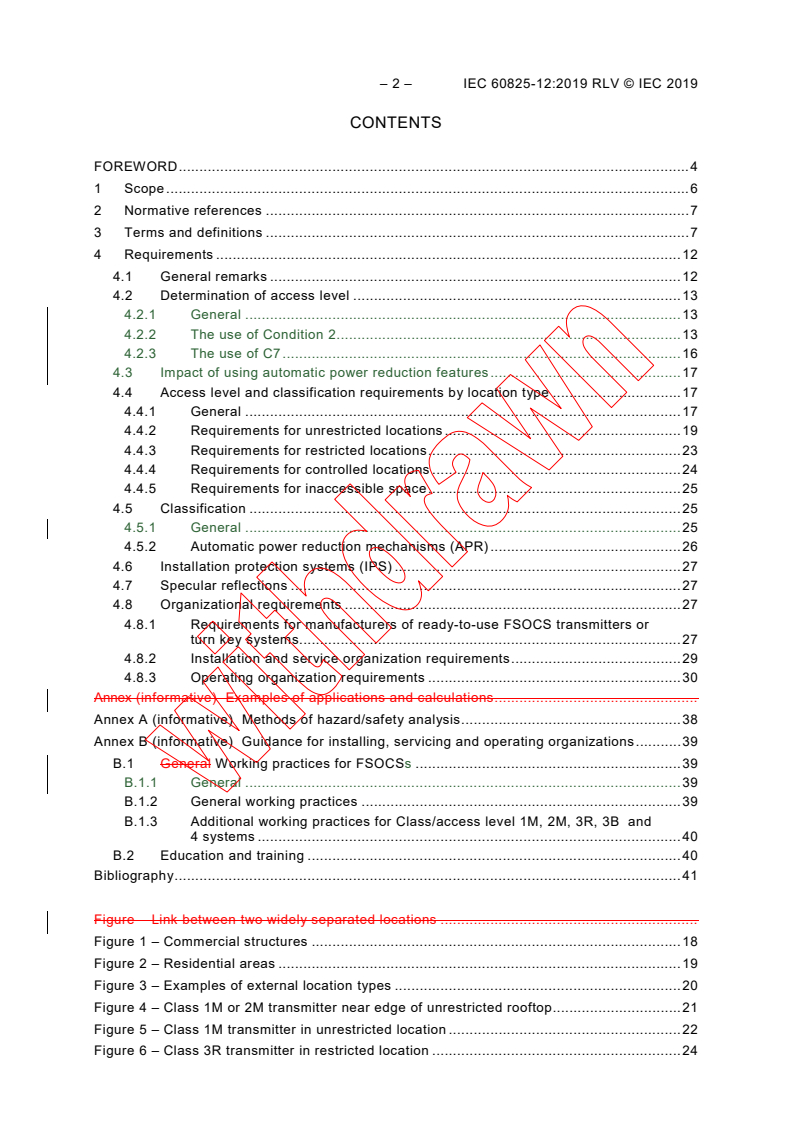
IEC 60825-12:2019 RLV - Safety of laser products - Part 12: Safety of free space optical communication systems used for transmission of information Released:2/8/2019
IEC 60825-12:2019 - Safety of laser products - Part 12: Safety of free space optical communication systems used for transmission of information Released:2/8/2019
Overview
IEC 60825-12:2019 - "Safety of laser products - Part 12" provides requirements and guidance for the manufacture, installation, operation and servicing of free space optical communication systems (FSOCSs) used for point‑to‑point or point‑to‑multipoint free‑air data transmission. The standard covers the open‑beam portion of laser transmitters operating in the wavelength range 180 nm to 1 mm. LEDs used for FSOCSs have been removed from the scope of this edition; the document addresses lasers only. Systems designed to transmit optical power (e.g., for material processing or medical use) and use in explosive atmospheres are excluded.
Key Topics and Requirements
- Scope limits: Open‑beam emissions only; portions involving optical fibre fall under IEC 60825‑2. Class 1 devices (per IEC 60825‑1) that cannot exceed Class 1 AEL under all foreseeable conditions are exempt from further requirements in this part.
- Access level and classification: Defines how to determine the potential hazard at accessible positions (access levels) and links these to laser product classes (e.g., 1M, 2M, 3R, 3B, 4). Includes methods such as Condition 2 and references to C7 for specific measurement/determination.
- Engineering and administrative controls: Specifies required engineering controls (beam containment, automatic power reduction - APR, installation protection systems - IPS), administrative controls, signage and work practices tailored to the degree of hazard.
- Installation, service and operation: Responsibilities assigned to manufacturers (product safety and user information), installers/service organizations (safe deployment and maintenance), and operating organizations (day‑to‑day safe use and adherence to instructions).
- Additional technical topics: Impact of APR features, specular reflections, inaccessible spaces, location‑based requirements (unrestricted, restricted, controlled), and the need for education and training.
- Informative annexes: Examples, hazard/safety analysis methods, and guidance for installing/servicing/operating organizations.
Practical Applications and Who Uses It
- Manufacturers of FSOCS transmitters and turnkey systems - to design products that meet international laser‑safety requirements and supply required user information.
- System installers and integrators - for safe site surveys, installation practices, rooftop and link alignments, and implementation of IPS/APR measures.
- Service organizations and maintenance teams - for safe servicing, inspection, and verification of control systems and signage.
- Operating organizations and safety officers - for operational procedures, training, risk assessments and compliance.
- Common applications: optical wireless backhaul (telecommunications), last‑mile free‑space data links, campus links and other non‑fiber information transmission uses.
Related Standards
- IEC 60825‑1 - Equipment classification and user requirements (laser classes, AELs).
- IEC 60825‑2 - Safety of optical fibre communication systems (for fibre‑related portions).
- IEC 60079‑0 - Explosive atmospheres (systems intended for such environments are excluded).
Keywords: IEC 60825-12:2019, laser products, free space optical communication, FSOCS, optical wireless, safety of laser products, free space optical data.
Relations
- Effective Date
- 05-Sep-2023
- Effective Date
- 05-Sep-2023
Buy Documents
IEC 60825-12:2019 RLV - Safety of laser products - Part 12: Safety of free space optical communication systems used for transmission of information Released:2/8/2019
IEC 60825-12:2019 - Safety of laser products - Part 12: Safety of free space optical communication systems used for transmission of information Released:2/8/2019
Frequently Asked Questions
IEC 60825-12:2019 is a standard published by the International Electrotechnical Commission (IEC). Its full title is "Safety of laser products - Part 12: Safety of free space optical communication systems used for transmission of information". This standard covers: IEC 60825-12:2019 provides requirements and specific guidance for the manufacture and safe use of laser products and systems used for point-to-point or point-to-multipoint free space optical data transmission in the wavelength range from 180 nm to 1 mm. This document only addresses the open beam portion of the system. If portions of the equipment or system incorporate optical fibre that extends from the confinements of the enclosure(s), the manufacturing and safety requirements in IEC 60825-2 apply to those portions only. This document does not apply to systems designed for the purposes of transmitting optical power for applications such as material processing or medical treatment. This document also does not apply to the use of systems in explosive atmospheres (see IEC 60079-0). Light-emitting diodes (LEDs) employed by free space optical communication systems (FSOCSs), used for the purpose of free space optical data transmission, do not fall into the scope of this document. This document covers lasers employed by FSOCSs used for the purpose of free space optical data transmission. This document: • provides information to protect people from potentially hazardous optical radiation produced by FSOCSs by specifying engineering controls and requirements, administrative controls and work practices according to the degree of the hazard; and • specifies requirements for manufacturing, installation, service and operating organizations in order to establish procedures and provide written information so that proper precautions can be adopted. Because of the nature of FSOCSs, also known as optical wireless or free-air information transmission systems, care is taken in their manufacture as well as their installation, operation, maintenance and service to assure the safe deployment and use of these systems. This document places the responsibility for certain product safety requirements, as well as requirements for providing appropriate information on how to use these systems safely, on the manufacturer of the system and/or transmitters. It places the responsibility for the safe deployment and use of these systems on the installer and/or operating organization. It places the responsibility for adherence to safety instructions during installation and service operations on the installation and service organizations as appropriate, and during operation and maintenance functions on the operating organization. It is recognized that the user of this document may fall into one or more of the categories of manufacturer, installer, service organization and/or operating organization as mentioned above. This document does not apply to a laser product if classification by the manufacturer according to IEC 60825-1 shows that the emission level does not exceed the accessible emission limit (AEL) of Class 1 under all conditions of operation, maintenance, service and reasonably foreseeable failure. Key words: Laser products, Free space optical data, Free space optical communication.
IEC 60825-12:2019 provides requirements and specific guidance for the manufacture and safe use of laser products and systems used for point-to-point or point-to-multipoint free space optical data transmission in the wavelength range from 180 nm to 1 mm. This document only addresses the open beam portion of the system. If portions of the equipment or system incorporate optical fibre that extends from the confinements of the enclosure(s), the manufacturing and safety requirements in IEC 60825-2 apply to those portions only. This document does not apply to systems designed for the purposes of transmitting optical power for applications such as material processing or medical treatment. This document also does not apply to the use of systems in explosive atmospheres (see IEC 60079-0). Light-emitting diodes (LEDs) employed by free space optical communication systems (FSOCSs), used for the purpose of free space optical data transmission, do not fall into the scope of this document. This document covers lasers employed by FSOCSs used for the purpose of free space optical data transmission. This document: • provides information to protect people from potentially hazardous optical radiation produced by FSOCSs by specifying engineering controls and requirements, administrative controls and work practices according to the degree of the hazard; and • specifies requirements for manufacturing, installation, service and operating organizations in order to establish procedures and provide written information so that proper precautions can be adopted. Because of the nature of FSOCSs, also known as optical wireless or free-air information transmission systems, care is taken in their manufacture as well as their installation, operation, maintenance and service to assure the safe deployment and use of these systems. This document places the responsibility for certain product safety requirements, as well as requirements for providing appropriate information on how to use these systems safely, on the manufacturer of the system and/or transmitters. It places the responsibility for the safe deployment and use of these systems on the installer and/or operating organization. It places the responsibility for adherence to safety instructions during installation and service operations on the installation and service organizations as appropriate, and during operation and maintenance functions on the operating organization. It is recognized that the user of this document may fall into one or more of the categories of manufacturer, installer, service organization and/or operating organization as mentioned above. This document does not apply to a laser product if classification by the manufacturer according to IEC 60825-1 shows that the emission level does not exceed the accessible emission limit (AEL) of Class 1 under all conditions of operation, maintenance, service and reasonably foreseeable failure. Key words: Laser products, Free space optical data, Free space optical communication.
IEC 60825-12:2019 is classified under the following ICS (International Classification for Standards) categories: 31.260 - Optoelectronics. Laser equipment. The ICS classification helps identify the subject area and facilitates finding related standards.
IEC 60825-12:2019 has the following relationships with other standards: It is inter standard links to IEC 60825-12:2004, IEC 60825-12:2022. Understanding these relationships helps ensure you are using the most current and applicable version of the standard.
IEC 60825-12:2019 is available in PDF format for immediate download after purchase. The document can be added to your cart and obtained through the secure checkout process. Digital delivery ensures instant access to the complete standard document.
Standards Content (Sample)
IEC 60825-12 ®
Edition 2.0 2019-02
REDLINE VERSION
INTERNATIONAL
STANDARD
colour
inside
Safety of laser products –
Part 12: Safety of free space optical communication systems used for
transmission of information
All rights reserved. Unless otherwise specified, no part of this publication may be reproduced or utilized in any form
or by any means, electronic or mechanical, including photocopying and microfilm, without permission in writing from
either IEC or IEC's member National Committee in the country of the requester. If you have any questions about IEC
copyright or have an enquiry about obtaining additional rights to this publication, please contact the address below or
your local IEC member National Committee for further information.
IEC Central Office Tel.: +41 22 919 02 11
3, rue de Varembé info@iec.ch
CH-1211 Geneva 20 www.iec.ch
Switzerland
About the IEC
The International Electrotechnical Commission (IEC) is the leading global organization that prepares and publishes
International Standards for all electrical, electronic and related technologies.
About IEC publications
The technical content of IEC publications is kept under constant review by the IEC. Please make sure that you have the
latest edition, a corrigendum or an amendment might have been published.
IEC publications search - webstore.iec.ch/advsearchform Electropedia - www.electropedia.org
The advanced search enables to find IEC publications by a The world's leading online dictionary on electrotechnology,
variety of criteria (reference number, text, technical containing more than 22 000 terminological entries in English
committee,…). It also gives information on projects, replaced and French, with equivalent terms in 16 additional languages.
and withdrawn publications. Also known as the International Electrotechnical Vocabulary
(IEV) online.
IEC Just Published - webstore.iec.ch/justpublished
Stay up to date on all new IEC publications. Just Published IEC Glossary - std.iec.ch/glossary
details all new publications released. Available online and 67 000 electrotechnical terminology entries in English and
once a month by email. French extracted from the Terms and Definitions clause of
IEC publications issued since 2002. Some entries have been
IEC Customer Service Centre - webstore.iec.ch/csc collected from earlier publications of IEC TC 37, 77, 86 and
If you wish to give us your feedback on this publication or CISPR.
need further assistance, please contact the Customer Service
Centre: sales@iec.ch.
IEC 60825-12 ®
Edition 2.0 2019-02
REDLINE VERSION
INTERNATIONAL
STANDARD
colour
inside
Safety of laser products –
Part 12: Safety of free space optical communication systems used for
transmission of information
INTERNATIONAL
ELECTROTECHNICAL
COMMISSION
ICS 31.260 ISBN 978-2-8322-6559-8
– 2 – IEC 60825-12:2019 RLV © IEC 2019
CONTENTS
FOREWORD . 4
1 Scope . 6
2 Normative references . 7
3 Terms and definitions . 7
4 Requirements . 12
4.1 General remarks . 12
4.2 Determination of access level . 13
4.2.1 General . 13
4.2.2 The use of Condition 2 . 13
4.2.3 The use of C7 . 16
4.3 Impact of using automatic power reduction features . 17
4.4 Access level and classification requirements by location type . 17
4.4.1 General . 17
4.4.2 Requirements for unrestricted locations . 19
4.4.3 Requirements for restricted locations . 23
4.4.4 Requirements for controlled locations . 24
4.4.5 Requirements for inaccessible space . 25
4.5 Classification . 25
4.5.1 General . 25
4.5.2 Automatic power reduction mechanisms (APR) . 26
4.6 Installation protection systems (IPS) . 27
4.7 Specular reflections . 27
4.8 Organizational requirements . 27
4.8.1 Requirements for manufacturers of ready-to-use FSOCS transmitters or
turn key systems. 27
4.8.2 Installation and service organization requirements . 29
4.8.3 Operating organization requirements . 30
Annex (informative) Examples of applications and calculations .
Annex A (informative) Methods of hazard/safety analysis . 38
Annex B (informative) Guidance for installing, servicing and operating organizations . 39
B.1 General Working practices for FSOCSs . 39
B.1.1 General . 39
B.1.2 General working practices . 39
B.1.3 Additional working practices for Class/access level 1M, 2M, 3R, 3B and
4 systems . 40
B.2 Education and training . 40
Bibliography . 41
Figure – Link between two widely separated locations .
Figure 1 – Commercial structures . 18
Figure 2 – Residential areas . 19
Figure 3 – Examples of external location types . 20
Figure 4 – Class 1M or 2M transmitter near edge of unrestricted rooftop . 21
Figure 5 – Class 1M transmitter in unrestricted location . 22
Figure 6 – Class 3R transmitter in restricted location . 24
Table 1 – Restrictions for product classes and access levels . 13
Table 2 – Measurement aperture diameters and distances for the default (simplified)
evaluation . 14
Table 3 – Requirements for warning signs . 30
– 4 – IEC 60825-12:2019 RLV © IEC 2019
INTERNATIONAL ELECTROTECHNICAL COMMISSION
____________
SAFETY OF LASER PRODUCTS –
Part 12: Safety of free space optical communication
systems used for transmission of information
FOREWORD
1) The International Electrotechnical Commission (IEC) is a worldwide organization for standardization comprising
all national electrotechnical committees (IEC National Committees). The object of IEC is to promote
international co-operation on all questions concerning standardization in the electrical and electronic fields. To
this end and in addition to other activities, IEC publishes International Standards, Technical Specifications,
Technical Reports, Publicly Available Specifications (PAS) and Guides (hereafter referred to as “IEC
Publication(s)”). Their preparation is entrusted to technical committees; any IEC National Committee interested
in the subject dealt with may participate in this preparatory work. International, governmental and non-
governmental organizations liaising with the IEC also participate in this preparation. IEC collaborates closely
with the International Organization for Standardization (ISO) in accordance with conditions determined by
agreement between the two organizations.
2) The formal decisions or agreements of IEC on technical matters express, as nearly as possible, an international
consensus of opinion on the relevant subjects since each technical committee has representation from all
interested IEC National Committees.
3) IEC Publications have the form of recommendations for international use and are accepted by IEC National
Committees in that sense. While all reasonable efforts are made to ensure that the technical content of IEC
Publications is accurate, IEC cannot be held responsible for the way in which they are used or for any
misinterpretation by any end user.
4) In order to promote international uniformity, IEC National Committees undertake to apply IEC Publications
transparently to the maximum extent possible in their national and regional publications. Any divergence
between any IEC Publication and the corresponding national or regional publication shall be clearly indicated in
the latter.
5) IEC itself does not provide any attestation of conformity. Independent certification bodies provide conformity
assessment services and, in some areas, access to IEC marks of conformity. IEC is not responsible for any
services carried out by independent certification bodies.
6) All users should ensure that they have the latest edition of this publication.
7) No liability shall attach to IEC or its directors, employees, servants or agents including individual experts and
members of its technical committees and IEC National Committees for any personal injury, property damage or
other damage of any nature whatsoever, whether direct or indirect, or for costs (including legal fees) and
expenses arising out of the publication, use of, or reliance upon, this IEC Publication or any other IEC
Publications.
8) Attention is drawn to the Normative references cited in this publication. Use of the referenced publications is
indispensable for the correct application of this publication.
9) Attention is drawn to the possibility that some of the elements of this IEC Publication may be the subject of
patent rights. IEC shall not be held responsible for identifying any or all such patent rights.
This redline version of the official IEC Standard allows the user to identify the changes
made to the previous edition. A vertical bar appears in the margin wherever a change
has been made. Additions are in green text, deletions are in strikethrough red text.
International Standard IEC 60825-12 has been prepared by IEC technical committee 76:
Optical radiation safety and laser equipment.
This second edition cancels and replaces the first edition published in 2004. This edition
constitutes a technical revision.
This edition includes the following significant technical changes with respect to the previous
edition:
a) LEDs have been removed from the scope.
b) Normative references have been changed to refer the latest edition of the standards.
c) A description of the Condition 2 measurement and determination method for access level
has been added.
The text of this standard is based on the following documents:
FDIS Report on voting
76/616/FDIS 76/617/RVD
Full information on the voting for the approval of this International Standard can be found in
the report on voting indicated in the above table.
This document has been drafted in accordance with the ISO/IEC Directives, Part 2.
The list of all parts of the IEC 60825 series, published under the general title Safety of laser
products, can be found on the IEC website.
The committee has decided that the contents of this document will remain unchanged until the
stability date indicated on the IEC website under "http://webstore.iec.ch" in the data related to
the specific document. At this date, the document will be
• reconfirmed,
• withdrawn,
• replaced by a revised edition, or
• amended.
IMPORTANT – The “colour inside” logo on the cover page of this publication indicates
that it contains colours which are considered to be useful for the correct understanding
of its contents. Users should therefore print this publication using a colour printer.
– 6 – IEC 60825-12:2019 RLV © IEC 2019
SAFETY OF LASER PRODUCTS –
Part 12: Safety of free space optical communication
systems used for transmission of information
1 Scope
This part of IEC 60825 provides requirements and specific guidance for the manufacture and
safe use of laser products and systems used for point-to-point or point-to-multipoint free
space optical data transmission in the wavelength range from 180 nm to 1 mm. This document
only addresses the open beam portion of the system. If portions of the equipment or system
incorporate optical fibre that extends from the confinements of the enclosure(s), the
manufacturing and safety requirements in IEC 60825-12 apply to those portions only. This
document does not apply to systems designed for the purposes of transmitting optical power
for applications such as material processing or medical treatment. This document also does
not apply to the use of systems in explosive atmospheres (see IEC 60079-0).
Throughout this part of IEC 60825, light-emitting diodes (LEDs) are included whenever the
word “laser” is used.
Light-emitting diodes (LEDs) employed by free space optical communication systems
(FSOCSs), used for the purpose of free space optical data transmission, do not fall into the
scope of this document. This document covers lasers employed by FSOCSs used for the
purpose of free space optical data transmission.
The objective of this part of IEC 60825 is to This document:
• provides information to protect people from potentially hazardous optical radiation
produced by free space optical communication systems (FSOCSs) by specifying
engineering controls and requirements, administrative controls and work practices
according to the degree of the hazard; and
• specifyies requirements for manufacturing, installation, service and operating
organizations in order to establish procedures and provide written information so that
proper precautions can be adopted.
Because of the nature of FSOCSs, also known as optical wireless or free-air information
transmission systems, care must be is taken in their manufacture as well as their installation,
operation, maintenance and service to assure the safe deployment and use of these systems.
This document places the responsibility for certain product safety requirements, as well as
requirements for providing appropriate information on how to use these systems safely, on the
manufacturer of the system and/or transmitters. It places the responsibility for the safe
deployment and use of these systems on the installer and/or operating organization. It places
the responsibility for adherence to safety instructions during installation and service
operations on the installation and service organizations as appropriate, and during operation
and maintenance functions on the operating organization. It is recognized that the user of this
document may fall into one or more of the categories of manufacturer, installer, service
organization and/or operating organization as mentioned above.
Any laser product is exempt from all further requirements of this part of IEC 60825 This
document does not apply to a laser product if classification by the manufacturer according to
IEC 60825-1 shows that the emission level does not exceed the accessible emission limit
(AEL) of Class 1 under all conditions of operation, maintenance, service, and reasonably
foreseeable failure, and it does not contain an embedded laser product.
2 Normative references
The following documents are referred to in the text in such a way that some or all of their
content constitutes requirements of this document. For dated references, only the edition
cited applies. For undated references, the latest edition of the referenced document (including
any amendments) applies.
IEC 60825-1:1993, Safety of laser products – Part 1: Equipment classification and
1)
requirements and user’s guide
Amendment 1 (1997)
Amendment 2 (2001)
IEC 60825-2, Safety of laser products – Part 2: Safety of optical fibre communication systems
3 Terms and definitions
For the purposes of this document, the following terms and definitions apply.
ISO and IEC maintain terminological databases for use in standardization at the following
addresses:
• IEC Electropedia: available at http://www.electropedia.org/
• ISO Online browsing platform: available at http://www.iso.org/obp
3.1
access level
potential hazard at any accessible position associated with a free space optical
communication system (FSOCS) installation
Note 1 to entry: The access level is based on the level of optical radiation which could become accessible in
reasonably foreseeable circumstances, e.g. walking into an open beam path. It is closely related to the laser
classification procedure in IEC 60825-1.
Note 2 to entry: Practically speaking, it takes two or more seconds to fully align an optical aid with a beam (which
might occur in an unrestricted location), and this delay is incorporated into the method for determining access level.
3.2
access level 1
level for which, under reasonably foreseeable circumstances, human access to laser radiation
in excess of the accessible emission limits (AEL) of Class 1 for the applicable wavelengths
and emission duration will not occur
Note 1 to entry: The level of radiation is measured with the conditions for Class 1 laser products
(see IEC 60825-1), but with Condition 2 and C being as defined in 4.2.3 of this document (IEC 60825-12).
3.3
access level 1M
level for which, under reasonably foreseeable circumstances, human access to laser radiation
in excess of the accessible emission limits (AEL) of Class 1M for the applicable wavelengths
and emission duration will not occur
1)
A consolidated edition (1.2) exists comprising IEC 60825-1 (1993) and its Amendments 1 (1997) and 2 (2001).
– 8 – IEC 60825-12:2019 RLV © IEC 2019
Note 1 to entry: The level of radiation is measured with the conditions for Class 1M laser products
(see IEC 60825-1), but with Condition 2 and C being as defined in 4.2.3 of this document (IEC 60825-12).
Note 2 to entry: If the applicable limit of access level 1M is larger than the limit of 3R and less than the limit of 3B,
access level 1M is allocated.
3.4
access level 2
level for which, under reasonably foreseeable circumstances, human access to laser radiation
in excess of the accessible emission limits of Class 2 for the applicable wavelengths and
emission duration will not occur
Note 1 to entry: The level of radiation is measured with the conditions for Class 2 laser products
(see IEC 60825-1), but with Condition 2 and C being as defined in 4.2.3 of this document (IEC 60825-12).
3.5
access level 2M
level for which, under reasonably foreseeable circumstances, human access to laser radiation
in excess of the accessible emission limits of Class 2M for the applicable wavelengths and
emission duration will not occur
Note 1 to entry: The level of radiation is measured with the conditions for Class 2M laser products
(see IEC 60825-1), but with Condition 2 and C being as defined in 4.2.3 of this document (IEC 60825-12).
Note 2 to entry: If the applicable limit of access level 2M is larger than the limit of 3R and less than the limit of 3B,
access level 2M is allocated.
3.6
access level 3R
level for which, under reasonably foreseeable circumstances, human access to laser radiation
in excess of the accessible emission limits of Class 3R for the applicable wavelengths and
emission duration will not occur
Note 1 to entry: The level of radiation is measured with the conditions for Class 3R laser products
(see IEC 60825-1), but with Condition 2 and C being as defined in 4.2.3 of this document (IEC 60825-12).
Note 2 to entry: If the applicable limit of access level 1M or 2M is larger than the limit of 3R and less than the limit
of 3B, access level 1M or 2M is allocated.
3.7
access level 3B
level for which, under reasonably foreseeable circumstances, human access to laser radiation
in excess of the accessible emission limits of Class 3B for the applicable wavelengths and
emission duration will not occur
Note 1 to entry: The level of radiation is measured with the conditions for Class 3B laser products
(see IEC 60825-1), but with Condition 2 and C being as defined in 4.2.3 of this document (IEC 60825-12).
3.8
access level 4
level for which, under reasonably foreseeable circumstances, it is possible that human access
to laser radiation in excess of the accessible emission limits of Class 3B for the applicable
wavelengths and emission duration could occur
Note 1 to entry: The level of radiation is measured with the conditions for Class 4 laser products
(see IEC 60825-1), but with Condition 2 and C being as defined in 4.2.3 of this document (IEC 60825-12).
3.9
automatic power reduction
APR
feature of a transmitter of an FSOCS, provided by the system equipment manufacturer, by
which the accessible power in the nominal hazard zone (NHZ) or NHZ-Aided extended
nominal hazard zone (ENHZ) is reduced to a specified value within a specified time
Note 1 to entry: The term “automatic power reduction” (APR) used in this document encompasses the following
terms used in recommendations of the International Telecommunication Union ITU:
• automatic laser shutdown (ALS);
• automatic power reduction (APR);
• automatic power shutdown (APSD).
Note 2 to entry: The accessible power in the NHZ or ENHZ is reduced to a specified value within a specified time,
whenever there is an event which could result in human exposure to optical radiation above the maximum
permissible exposure (MPE), e.g. by a person entering the NHZ or NHZ-Aided ENHZ, as applicable. In an FSOCS,
this feature may be used by the transmitter manufacturer to determine the classification.
3.10
beacon
optical source whose function is to aid in pointing or alignment of an optical system
3.11
embedded laser product
See definition 3.29 in IEC 60825-1.
3.11
end-to-end system
FSOCS that is comprised of at least one transmitter, one receiver, and any peripheral
hardware necessary for the effective transfer of data along the transmission path from one
position in space to another
3.12
extended nominal hazard zone
ENHZ
volume within which, when optical aids are used, the level of the direct, reflected or scattered
radiation exceeds the applicable maximum permissible exposure (MPE) (under measurement
conditions indicated in IEC 60825-1)
Note 1 to entry: Exposure levels outside the boundary of the ENHZ are below the applicable MPE when optical
aids are used.
Note 2 to entry: This volume is determined prior to activation of any IPS or APR systems unless the APR is used
for classification under the conditions of 4.5 of this document.
3.13
free space optical communication system
FSOCS
installed, portable, or temporarily mounted, through-the-air system typically used, intended or
promoted for voice, data or multimedia communications and/or control purposes via the use of
modulated optical radiation produced by a laser or LED
Note 1 to entry: “Free space” means indoor and outdoor optical wireless applications with both non-directed and
directed transmission.
Note 2 to entry: Emitting and detecting assemblies may or may not be separated.
Note 3 to entry: Refer to the conditions within Clause 1, by which Class 1 FSOCS products are exempt from all
requirements of this document.
3.14
FSOCS transmitter
transmitter
optical transmitter emitting radiation through the air and used in an FSOCS
3.15
installation organization
installer
organization or individual who is responsible for the installation of an FSOCS
– 10 – IEC 60825-12:2019 RLV © IEC 2019
3.16
installation protection system
IPS
feature of an installation site, provided by the installer or operating organization, that has two
functions: (1) it detects human entry into the accessible volume of either the NHZ for
restricted or controlled locations or the NHZ-Aided ENHZ for an unrestricted location, and; (2)
once such entry is detected, causes reduction of the accessible power of the laser to a
specified level within a specified time
3.17
interlock
means either of preventing access to a hazardous location until the hazard is removed, or of
automatically removing the hazardous condition when access is gained
3.18
location
position or site occupied or available for occupancy
Note 1 to entry: Other standards may use the same terms for location types (3.19 to 3.22) with somewhat
different definitions.
3.19
location of inaccessible space
inaccessible space
volume where a person cannot normally be located, i.e. the space that has a horizontal
spacing more than 2,5 m from any unrestricted location and is both greater than 6 m above a
surface in any unrestricted location, and more than 3 m above a surface in any restricted
location
Note 1 to entry: Inaccessible space may be entered by, for example, aircraft.
Note 2 to entry: All open space that is neither an unrestricted, restricted nor controlled location.
3.20
location with controlled access
controlled location
location where an engineering or administrative control measure is present to make it
inaccessible except to authorized personnel with appropriate laser safety training
3.21
location with restricted access
restricted location
location that is normally inaccessible by to the general public (including workers, visitors, and
residents in the immediate vicinity) by means of any administrative or engineering control
measure but that is accessible to authorized personnel (e.g. maintenance or service
personnel including window cleaners in exterior locations) who may not have laser safety
training
3.22
location with unrestricted access
unrestricted location
location where access to the transmission/receiver equipment and open beam is not limited
(accessible to the general public)
3.23
manufacturer
organization or individual who makes or assembles optical devices and other components for
the construction or modification of an FSOCS
3.23
nominal hazard zone (NHZ) and NHZ-Aided
a) NHZ: the volume within which the level of the direct, reflected or scattered radiation
exceeds the applicable MPE (under measurement conditions indicated in IEC 60825-1).
Exposure levels outside the boundary of the NHZ are below the applicable MPE
b) NHZ-Aided: the volume within which, when optical aids are used, the level of the direct,
reflected or scattered radiation exceeds the applicable MPE. Exposure levels outside the
boundary of the NHZ-Aided are below the applicable MPE when optical aids are used
NOTE 1 These volumes are determined prior to activation of any IPS or APR systems unless the APR is used for
classification under the conditions of 4.3 of this standard.
NOTE 2 Examples of NHZ and NHZ-Aided are provided in Clause A.2.
3.24
nominal hazard zone
NHZ
volume within which the level of the direct, reflected or scattered radiation exceeds the
applicable maximum permissible exposure (MPE) (under measurement conditions indicated in
IEC 60825-1)
Note 1 to entry: Exposure levels outside the boundary of the NHZ are below the applicable MPE.
Note 2 to entry: This volume is determined prior to activation of any IPS or APR systems unless the APR is used
for classification under the conditions of 4.5 of this document.
3.25
operating organization
operator
organization or individual who is responsible for the operation and maintenance of an FSOCS
3.26
optically-aided viewing
use of optical aids (for example, binoculars or magnifiers) to view an emitting source from
within the emitted beam
Note 1 to entry: It is possible that telescopic optics, including binoculars, could increase the hazard to the eye by
intrabeam viewing of a collimated beam when viewed at a distance.
NOTE 2 It is possible that hand magnifiers or eye-loupes could increase the hazard to the eye from viewing a
close, but highly divergent, source.
3.27
removable laser system
laser system that can be removed from its protective housing and operated by simply plugging
into electrical mains or a battery
3.28
primary beam
beam that transmits the modulated data signal
3.29
reasonably foreseeable event
event (or condition) that is credible and whose likelihood of occurrence (or existence) cannot
be disregarded
3.30
service organization
organization or individual who is responsible for the service of an FSOCS
– 12 – IEC 60825-12:2019 RLV © IEC 2019
3.31
special tool
tool that is not readily available at retail consumer hardware stores
Note 1 to entry: Typical tools in this category are intended for use with tamper-resistant fasteners.
3.32
spillover
beam radiant energy that propagates past the receiving terminal
3.31
unaided viewing; without optical aids
viewing an emitting source from within the emitted beam without using magnifiers or other
optical aids, as with the naked eye (prescription eyeglasses and contact lenses are not
considered optical aids)
3.33
optically unaided
without optical aids
without using magnifiers or other optical aids, as with the naked eye
Note 1 to entry: Prescription eyeglasses and contact lenses are not considered optical aids.
4 Requirements
4.1 General remarks
For FSOCSs employing lasers for the purpose of free space optical data transmission, all
classification shall be made in accordance with IEC 60825-1.
If an FSOCS incorporates a removable laser system, that removable laser system shall
comply with the applicable requirements of IEC 60825-1.
FSOCSs have limitations imposed by this document that are dependent on the location type(s)
in which they are installed. Product classification and access level restrictions by location type
are summarized in Table 1.
In each location where emission is transmitted, crosses or is received, respective exposure
conditions must shall be individually evaluated. Furthermore, potentially occupied locations
along the beam path, within the NHZ or NHZ-Aided ENHZ, must shall also be evaluated for
acceptable access levels (Table 1) and for appropriate controls applied. Locations traversed
by partial reflections from windows within the beam path must shall also be evaluated if the
emission could exceed access level 1 or 2. At a given location, the installation and operational
constraints applied from 4.4 shall be determined by whichever is the more hazardous: the
transmitted or the received optical radiation.
Example 1: In the case of a location that receives access level 1 or 2 radiation but uses a
Class 1M transmitter in the opposite direction, these combined conditions are acceptable for
restricted locations but not for an unrestricted location unless the transmission equipment is
installed as described in 4.4.2.2 to reduce the transmitter access level to 1 or 2.
Example 2: For links with spillover beyond the receiver, but within the NHZ-Aided ENHZ that
is of access level 1M or 2M, the spillover (and any accessible radiation otherwise outside of
the receiver path, e.g. in front of it) must shall be contained within a restricted or controlled
location, an unrestricted location compliant with 4.4.2.2, or inaccessible space.
For Class 3B and Class 4 transmitters in controlled locations, the entire beam path that
potentially passes through other location types, including inaccessible space, must shall
comply with the access level restrictions of Table 1. This may be satisfied in some
applications by continually monitoring the entire NHZ to ensure rapid automatic power
reduction in the event of human interception of the beam path. Any spillover beyond the
receiver, (and any accessible radiation otherwise outside of the receiver path – e.g. in front of
it), within the NHZ, must shall also be contained in a controlled location or inaccessible space.
Any additional spillover within the NHZ-Aided ENHZ must shall be contained within a
restricted or controlled location, an unrestricted location compliant with 4.4.2.2, or
inaccessible space.
The following ranking of the access levels (in increasing order of hazard) shall apply in this
part of IEC 60825: 1, 2, 1M, 2M, 3R, 3B, 4.
NOTE Because of the application, this is not the same as the ranking used in IEC 60825-1.
Table 1 – Restrictions for product classes and access levels
Location type Permissible product classes Permissible access levels
and installation conditions
Unrestricted Class 1 or 2 – No conditions 1 or 2
Class 1M or 2M – See 4.4.2.2
Class 3R – See 4.4.2.3
Restricted Class 1, 2, 1M or 2M – No conditions 1, 2, 1M or 2M
Class 3R – See 4.4.3.2
Controlled Class 1, 2, 1M, 2M, or 3R – No conditions 1, 2, 1M, 2M, or 3R
Class 3B or 4 – See 4.4.4.2 3B or 4 – See 4.4.3.1
Inaccessible space Not applicable 1, 2, 1M, 2M or 3R 1, 2, 1M, 2M or 3R
The operating organization has the ultimate responsibility for the installation, maintenance,
service and safe use of the end-to-end system including engineering and administrative
controls. This includes, especially
• identification of the location type at all portions of the entire transmission path, including
beam spillover outside the receiver collection area and partial reflections from
intermediate windows, where people may have access;
• ensuring that the product classification, access level requirements, and installation
conditions from Table 1 are satisfied for those location types;
• ensuring that installation, maintenance and service are performed only by organizations
with the capability of satisfying the requirements of 4.4.
Requirements for transmitter manufacturers, installers and service organizations are also
included in this document.
IEC 60825-1 and IEC 60825-2 shall apply for classification and hazard level evaluations of
FSOCSs employing lasers intended for transmission of data over fibre optic cable.
4.2 Determination of access level
4.2.1 General
Determination of access levels is the ultimate responsibility of the operating organization.
However, they may be determined by the maintenance, installation or service organization.
The methods for determining compliance with an access level are the same as those
described for classification in IEC 60825-1 except for the following.
a) The access level within a designated location shall be determined at any position relative
to an FSOCS transmitter where the access level is maximized, and could depend on
intermediate system elements such as windows.
– 14 – IEC 60825-12:2019 RLV © IEC 2019
b) The access level may depend on the activation of an IPS or APR system.
c) If an IPS or APR system is monitoring the location in question, during the 2 s immediately
following any human interception, the accessible emission shall not exceed the MPE.
Otherwise, the same method used for classification is also used for determination of
access level. For viewing conditions without optical aids refer to Table 7 the tables of
MPEs in IEC 60825-1.
NOTE Rationale for 2 s: Because of the difficulty of a person with binoculars or other optical aid to fully align with
the beam, it is unlikely not reasonably foreseeable that a person could intercept the beam’s full power within 2 s.
During the 2-s period following exposure, no part of the body would be exposed above the optically unaided MPE
for access levels of 1, 2, 1M, 2M or 3R.
Verification testing of access levels shall be carried out under reasonably foreseeable single
fault conditions to ensure that the APR and/or IPS, if used, is operating properly. In
circumstances where it is difficult to carry out direct measurements, an assessment of the
access level based on calculations may be acceptable. Faults which result in the emission of
radiation in excess of the applicable AEL for a limited period only and for which it is not
reasonably foreseeable that human access to the radiation will occur before the product is
taken out of service or adjusted down below the AEL, need not be considered.
4.2.2 The use of Condition 2
4.2.2.1 General
The access level is determined by the measurement of the optical radiation that could become
accessible following any reasonably foreseeable event during operation and maintenance.
All three conditions shall be tested. Condition 1 and Condition 3 shall be tested according to
IEC 60825-1.
For all wavelengths, Condition 2 measurements to establish access levels shall be made with
a 7 mm aperture at a distance of 70 mm from the end of the FSOCS transmitter (this
simulates a ×7 magnifier).
In addition to the above, and for all wavelengths, the total emission from the FSOCS
transmitter for access level 3B systems shall not exceed the AEL of Class 3B.
In circumstances where it is difficult to carry out direct measurements, an assessment of
access level based on calculations is acceptable.
For an FSOCS with automatic power reduction, the access level will be determined by the
accessible emission (pulse or continuous wave) after the time interval of 2 s. Additionally the
MPE requirement in 4.3 shall be satisfied.
Table 2 – Measurement aperture diameters and distances
for the default (simplified) evaluation
a a
Condition 1 Condition 2 Condition 3
Applied to collimated beam Applicable to optical fibre Applied to determine
where, for example, telescope communication systems, see irradiation relevant for the
or binoculars may increase the IEC 60825-2 optically unaided eye, for low
hazard power magnifiers and for
Applicable to free space
scanning beams
optical communication
systems
Wavelength Aperture stop Distance Aperture stop Distance Aperture stop/ Distance
limiting
aperture
nm mm mm mm mm mm mm
< 302,5 – – 1 0
≥ 302,5 to < 400 7 2 000 7 70 1 100
50 2 000 7 70 7 100
≥ 400 to < 1 400
≥ 1 400 to < 4 000 7 × Condition 3 2 000 7 70 1 for t ≤ 0,35 s 100
3/8
1,5 t for
0,35 s < t < 10 s
3,5 for t ≥ 10 s (t
in s)
≥ 4 000 to < 10 – – 1 for t ≤ 0,35 s 0
3/8
1,5 t for
0,35 s < t < 10 s
3,5 for t ≥ 10 s (t
in s)
5 6
– – 11 0
≥ 10 to < 10
NOTE 1 The descriptions below the “Condition” headings are typical cases for information only and are not
intended to be exclusive.
NOTE 2 Limitations of the classification scheme are discussed in IEC 60825-1:2014, Clause C.3, suggesting
cases where additional risk analysis and warnings might be appropriate. Condition 2 was used in previous editions
of IEC 60825-1 as the “magnifying glass” condition.
a
When IEC 60825-1 is updated, the latest edition shall apply to Condition 1 and Condition 3.
4.2.2.2 Access levels 1 and 1M
For wavelengths less than 302,5 nm and greater than 4 000 nm, if the accessible emission is
less than the AEL of Class 1 for Condition 3, then the FSOCS is assigned to access level 1.
For wavelengths between 302,5 nm and 4 000 nm, if the accessible emission is:
• less than the AEL of Class 1 for Condition 1, and Condition 2 and Condition 3,
then the FSOCS is assigned to access level 1.
If the accessible emission is:
• greater than the AEL of Class 1 for Condition 1 or Condition 2, and
• less than the AEL of Class 3B for Condition 1 and Condition 2, and
• less than the AEL of Class 1 for Condition 3,
then the laser product is assigned to access level 1M.
NOTE 1 Typically, the accessible emission of a Class 1M product exceeds the Class 1 AEL for either Condition 1
or Condition 2. However, it is also classified as Class 1M when it exceeds that AEL for both Condition 1 and
Condition 2.
NOTE 2 The reason for verifying the AEL of Class 3B is to limit the maximum power passing through an optical
instrument.
If the accessible emission exceeds the AEL of Class 3B as determined with a 3,5 mm
diameter aperture placed at the closest point of human access, an additional warning
regarding a potential skin hazard shall be given.
NOTE 3 It is possible that a Class 1M laser product with a highly diverging beam can produce high enough
irradiance levels near to or in contact with the source (for instance a fibre tip) so that skin injury is possible.
4.2.2.3 Access levels 2 and 2M
Access levels 2 and 2M are applicable to the wavelength range of 400 nm to 700 nm. If the
accessible emission exceeds the limits as required for Class 1 and for Class 1M, and is:
– 16 – IEC 60825-12:2019 RLV © IEC 2019
• less than the AEL of Class 2 for Condition 1, and Condition 2 and Condition 3,
then the FSOCS is assigned to access level 2.
If the accessible emission exceeds the limits as required for Class 1 and for Class 1M and is:
• greater than the AEL of Class 2 for Condition 1 or Condition 2, and
• less than the AEL of Class 3B for Condition 1 and Condition 2, and
...
IEC 60825-12 ®
Edition 2.0 2019-02
INTERNATIONAL
STANDARD
NORME
INTERNATIONALE
Safety of laser products –
Part 12: Safety of free space optical communication systems used for
transmission of information
Sécurité des appareils à laser –
Partie 12: Sécurité des systèmes de communication optiques en espace libre
utilisés pour la transmission d'informations
All rights reserved. Unless otherwise specified, no part of this publication may be reproduced or utilized in any form
or by any means, electronic or mechanical, including photocopying and microfilm, without permission in writing from
either IEC or IEC's member National Committee in the country of the requester. If you have any questions about IEC
copyright or have an enquiry about obtaining additional rights to this publication, please contact the address below or
your local IEC member National Committee for further information.
Droits de reproduction réservés. Sauf indication contraire, aucune partie de cette publication ne peut être reproduite
ni utilisée sous quelque forme que ce soit et par aucun procédé, électronique ou mécanique, y compris la photocopie
et les microfilms, sans l'accord écrit de l'IEC ou du Comité national de l'IEC du pays du demandeur. Si vous avez des
questions sur le copyright de l'IEC ou si vous désirez obtenir des droits supplémentaires sur cette publication, utilisez
les coordonnées ci-après ou contactez le Comité national de l'IEC de votre pays de résidence.
IEC Central Office Tel.: +41 22 919 02 11
3, rue de Varembé info@iec.ch
CH-1211 Geneva 20 www.iec.ch
Switzerland
About the IEC
The International Electrotechnical Commission (IEC) is the leading global organization that prepares and publishes
International Standards for all electrical, electronic and related technologies.
About IEC publications
The technical content of IEC publications is kept under constant review by the IEC. Please make sure that you have the
latest edition, a corrigendum or an amendment might have been published.
IEC publications search - webstore.iec.ch/advsearchform Electropedia - www.electropedia.org
The advanced search enables to find IEC publications by a The world's leading online dictionary on electrotechnology,
variety of criteria (reference number, text, technical containing more than 22 000 terminological entries in English
committee,…). It also gives information on projects, replaced and French, with equivalent terms in 16 additional languages.
and withdrawn publications. Also known as the International Electrotechnical Vocabulary
(IEV) online.
IEC Just Published - webstore.iec.ch/justpublished
Stay up to date on all new IEC publications. Just Published IEC Glossary - std.iec.ch/glossary
details all new publications released. Available online and 67 000 electrotechnical terminology entries in English and
once a month by email. French extracted from the Terms and Definitions clause of
IEC publications issued since 2002. Some entries have been
IEC Customer Service Centre - webstore.iec.ch/csc collected from earlier publications of IEC TC 37, 77, 86 and
If you wish to give us your feedback on this publication or CISPR.
need further assistance, please contact the Customer Service
Centre: sales@iec.ch.
A propos de l'IEC
La Commission Electrotechnique Internationale (IEC) est la première organisation mondiale qui élabore et publie des
Normes internationales pour tout ce qui a trait à l'électricité, à l'électronique et aux technologies apparentées.
A propos des publications IEC
Le contenu technique des publications IEC est constamment revu. Veuillez vous assurer que vous possédez l’édition la
plus récente, un corrigendum ou amendement peut avoir été publié.
Electropedia - www.electropedia.org
Recherche de publications IEC -
webstore.iec.ch/advsearchform Le premier dictionnaire d'électrotechnologie en ligne au
La recherche avancée permet de trouver des publications IEC monde, avec plus de 22 000 articles terminologiques en
en utilisant différents critères (numéro de référence, texte, anglais et en français, ainsi que les termes équivalents dans
comité d’études,…). Elle donne aussi des informations sur les 16 langues additionnelles. Egalement appelé Vocabulaire
projets et les publications remplacées ou retirées. Electrotechnique International (IEV) en ligne.
IEC Just Published - webstore.iec.ch/justpublished Glossaire IEC - std.iec.ch/glossary
Restez informé sur les nouvelles publications IEC. Just 67 000 entrées terminologiques électrotechniques, en anglais
Published détaille les nouvelles publications parues. et en français, extraites des articles Termes et Définitions des
Disponible en ligne et une fois par mois par email. publications IEC parues depuis 2002. Plus certaines entrées
antérieures extraites des publications des CE 37, 77, 86 et
Service Clients - webstore.iec.ch/csc CISPR de l'IEC.
Si vous désirez nous donner des commentaires sur cette
publication ou si vous avez des questions contactez-nous:
sales@iec.ch.
IEC 60825-12 ®
Edition 2.0 2019-02
INTERNATIONAL
STANDARD
NORME
INTERNATIONALE
Safety of laser products –
Part 12: Safety of free space optical communication systems used for
transmission of information
Sécurité des appareils à laser –
Partie 12: Sécurité des systèmes de communication optiques en espace libre
utilisés pour la transmission d'informations
INTERNATIONAL
ELECTROTECHNICAL
COMMISSION
COMMISSION
ELECTROTECHNIQUE
INTERNATIONALE
ICS 31.260 ISBN 978-2-8322-6458-4
– 2 – IEC 60825-12:2019 © IEC 2019
CONTENTS
FOREWORD . 4
1 Scope . 6
2 Normative references . 6
3 Terms and definitions . 7
4 Requirements . 11
4.1 General remarks . 11
4.2 Determination of access level . 13
4.2.1 General . 13
4.2.2 The use of Condition 2 . 13
4.2.3 The use of C7 . 16
4.3 Impact of using automatic power reduction features . 16
4.4 Access level and classification requirements by location type . 16
4.4.1 General . 16
4.4.2 Requirements for unrestricted locations . 18
4.4.3 Requirements for restricted locations . 22
4.4.4 Requirements for controlled locations . 23
4.4.5 Requirements for inaccessible space . 24
4.5 Classification . 24
4.5.1 General . 24
4.5.2 Automatic power reduction mechanisms (APR) . 25
4.6 Installation protection systems (IPS) . 26
4.7 Specular reflections . 26
4.8 Organizational requirements . 26
4.8.1 Requirements for manufacturers of ready-to-use FSOCS transmitters or
turn key systems. 26
4.8.2 Installation and service organization requirements . 28
4.8.3 Operating organization requirements . 29
Annex A (informative) Methods of hazard/safety analysis . 30
Annex B (informative) Guidance for installing, servicing and operating organizations . 31
B.1 Working practices for FSOCSs . 31
B.1.1 General . 31
B.1.2 General working practices . 31
B.1.3 Additional working practices for Class/access level 1M, 2M, 3R, 3B and
4 systems . 32
B.2 Education and training . 32
Bibliography . 33
Figure 1 – Commercial structures . 17
Figure 2 – Residential areas . 18
Figure 3 – Examples of external location types . 19
Figure 4 – Class 1M or 2M transmitter near edge of unrestricted rooftop . 20
Figure 5 – Class 1M transmitter in unrestricted location . 21
Figure 6 – Class 3R transmitter in restricted location . 23
Table 1 – Restrictions for product classes and access levels . 12
Table 2 – Measurement aperture diameters and distances for the default (simplified)
evaluation . 14
Table 3 – Requirements for warning signs . 29
– 4 – IEC 60825-12:2019 © IEC 2019
INTERNATIONAL ELECTROTECHNICAL COMMISSION
____________
SAFETY OF LASER PRODUCTS –
Part 12: Safety of free space optical communication
systems used for transmission of information
FOREWORD
1) The International Electrotechnical Commission (IEC) is a worldwide organization for standardization comprising
all national electrotechnical committees (IEC National Committees). The object of IEC is to promote
international co-operation on all questions concerning standardization in the electrical and electronic fields. To
this end and in addition to other activities, IEC publishes International Standards, Technical Specifications,
Technical Reports, Publicly Available Specifications (PAS) and Guides (hereafter referred to as “IEC
Publication(s)”). Their preparation is entrusted to technical committees; any IEC National Committee interested
in the subject dealt with may participate in this preparatory work. International, governmental and non-
governmental organizations liaising with the IEC also participate in this preparation. IEC collaborates closely
with the International Organization for Standardization (ISO) in accordance with conditions determined by
agreement between the two organizations.
2) The formal decisions or agreements of IEC on technical matters express, as nearly as possible, an international
consensus of opinion on the relevant subjects since each technical committee has representation from all
interested IEC National Committees.
3) IEC Publications have the form of recommendations for international use and are accepted by IEC National
Committees in that sense. While all reasonable efforts are made to ensure that the technical content of IEC
Publications is accurate, IEC cannot be held responsible for the way in which they are used or for any
misinterpretation by any end user.
4) In order to promote international uniformity, IEC National Committees undertake to apply IEC Publications
transparently to the maximum extent possible in their national and regional publications. Any divergence
between any IEC Publication and the corresponding national or regional publication shall be clearly indicated in
the latter.
5) IEC itself does not provide any attestation of conformity. Independent certification bodies provide conformity
assessment services and, in some areas, access to IEC marks of conformity. IEC is not responsible for any
services carried out by independent certification bodies.
6) All users should ensure that they have the latest edition of this publication.
7) No liability shall attach to IEC or its directors, employees, servants or agents including individual experts and
members of its technical committees and IEC National Committees for any personal injury, property damage or
other damage of any nature whatsoever, whether direct or indirect, or for costs (including legal fees) and
expenses arising out of the publication, use of, or reliance upon, this IEC Publication or any other IEC
Publications.
8) Attention is drawn to the Normative references cited in this publication. Use of the referenced publications is
indispensable for the correct application of this publication.
9) Attention is drawn to the possibility that some of the elements of this IEC Publication may be the subject of
patent rights. IEC shall not be held responsible for identifying any or all such patent rights.
International Standard IEC 60825-12 has been prepared by IEC technical committee 76:
Optical radiation safety and laser equipment.
This second edition cancels and replaces the first edition published in 2004. This edition
constitutes a technical revision.
This edition includes the following significant technical changes with respect to the previous
edition:
a) LEDs have been removed from the scope.
b) Normative references have been changed to refer the latest edition of the standards.
c) A description of the Condition 2 measurement and determination method for access level
has been added.
The text of this standard is based on the following documents:
FDIS Report on voting
76/616/FDIS 76/617/RVD
Full information on the voting for the approval of this International Standard can be found in
the report on voting indicated in the above table.
This document has been drafted in accordance with the ISO/IEC Directives, Part 2.
The list of all parts of the IEC 60825 series, published under the general title Safety of laser
products, can be found on the IEC website.
The committee has decided that the contents of this document will remain unchanged until the
stability date indicated on the IEC website under "http://webstore.iec.ch" in the data related to
the specific document. At this date, the document will be
• reconfirmed,
• withdrawn,
• replaced by a revised edition, or
• amended.
– 6 – IEC 60825-12:2019 © IEC 2019
SAFETY OF LASER PRODUCTS –
Part 12: Safety of free space optical communication
systems used for transmission of information
1 Scope
This part of IEC 60825 provides requirements and specific guidance for the manufacture and
safe use of laser products and systems used for point-to-point or point-to-multipoint free
space optical data transmission in the wavelength range from 180 nm to 1 mm. This document
only addresses the open beam portion of the system. If portions of the equipment or system
incorporate optical fibre that extends from the confinements of the enclosure(s), the
manufacturing and safety requirements in IEC 60825-2 apply to those portions only. This
document does not apply to systems designed for the purposes of transmitting optical power
for applications such as material processing or medical treatment. This document also does
not apply to the use of systems in explosive atmospheres (see IEC 60079-0).
Light-emitting diodes (LEDs) employed by free space optical communication systems
(FSOCSs), used for the purpose of free space optical data transmission, do not fall into the
scope of this document. This document covers lasers employed by FSOCSs used for the
purpose of free space optical data transmission.
This document:
• provides information to protect people from potentially hazardous optical radiation
produced by FSOCSs by specifying engineering controls and requirements, administrative
controls and work practices according to the degree of the hazard; and
• specifies requirements for manufacturing, installation, service and operating organizations
in order to establish procedures and provide written information so that proper precautions
can be adopted.
Because of the nature of FSOCSs, also known as optical wireless or free-air information
transmission systems, care is taken in their manufacture as well as their installation,
operation, maintenance and service to assure the safe deployment and use of these systems.
This document places the responsibility for certain product safety requirements, as well as
requirements for providing appropriate information on how to use these systems safely, on the
manufacturer of the system and/or transmitters. It places the responsibility for the safe
deployment and use of these systems on the installer and/or operating organization. It places
the responsibility for adherence to safety instructions during installation and service
operations on the installation and service organizations as appropriate, and during operation
and maintenance functions on the operating organization. It is recognized that the user of this
document may fall into one or more of the categories of manufacturer, installer, service
organization and/or operating organization as mentioned above.
This document does not apply to a laser product if classification by the manufacturer
according to IEC 60825-1 shows that the emission level does not exceed the accessible
emission limit (AEL) of Class 1 under all conditions of operation, maintenance, service and
reasonably foreseeable failure.
2 Normative references
The following documents are referred to in the text in such a way that some or all of their
content constitutes requirements of this document. For dated references, only the edition
cited applies. For undated references, the latest edition of the referenced document (including
any amendments) applies.
IEC 60825-1, Safety of laser products – Part 1: Equipment classification and requirements
IEC 60825-2, Safety of laser products – Part 2: Safety of optical fibre communication systems
3 Terms and definitions
For the purposes of this document, the following terms and definitions apply.
ISO and IEC maintain terminological databases for use in standardization at the following
addresses:
• IEC Electropedia: available at http://www.electropedia.org/
• ISO Online browsing platform: available at http://www.iso.org/obp
3.1
access level
potential hazard at any accessible position associated with a free space optical
communication system (FSOCS) installation
Note 1 to entry: The access level is based on the level of optical radiation which could become accessible in
reasonably foreseeable circumstances, e.g. walking into an open beam path. It is closely related to the laser
classification procedure in IEC 60825-1.
Note 2 to entry: Practically speaking, it takes two or more seconds to fully align an optical aid with a beam (which
might occur in an unrestricted location), and this delay is incorporated into the method for determining access level.
3.2
access level 1
level for which, under reasonably foreseeable circumstances, human access to laser radiation
in excess of the accessible emission limits (AEL) of Class 1 for the applicable wavelengths
and emission duration will not occur
Note 1 to entry: The level of radiation is measured with the conditions for Class 1 laser products
(see IEC 60825-1), but with Condition 2 and C being as defined in 4.2.3 of this document (IEC 60825-12).
3.3
access level 1M
level for which, under reasonably foreseeable circumstances, human access to laser radiation
in excess of the accessible emission limits (AEL) of Class 1M for the applicable wavelengths
and emission duration will not occur
Note 1 to entry: The level of radiation is measured with the conditions for Class 1M laser products
(see IEC 60825-1), but with Condition 2 and C being as defined in 4.2.3 of this document (IEC 60825-12).
Note 2 to entry: If the applicable limit of access level 1M is larger than the limit of 3R and less than the limit of 3B,
access level 1M is allocated.
3.4
access level 2
level for which, under reasonably foreseeable circumstances, human access to laser radiation
in excess of the accessible emission limits of Class 2 for the applicable wavelengths and
emission duration will not occur
Note 1 to entry: The level of radiation is measured with the conditions for Class 2 laser products
(see IEC 60825-1), but with Condition 2 and C being as defined in 4.2.3 of this document (IEC 60825-12).
3.5
access level 2M
level for which, under reasonably foreseeable circumstances, human access to laser radiation
in excess of the accessible emission limits of Class 2M for the applicable wavelengths and
emission duration will not occur
– 8 – IEC 60825-12:2019 © IEC 2019
Note 1 to entry: The level of radiation is measured with the conditions for Class 2M laser products
(see IEC 60825-1), but with Condition 2 and C being as defined in 4.2.3 of this document (IEC 60825-12).
Note 2 to entry: If the applicable limit of access level 2M is larger than the limit of 3R and less than the limit of 3B,
access level 2M is allocated.
3.6
access level 3R
level for which, under reasonably foreseeable circumstances, human access to laser radiation
in excess of the accessible emission limits of Class 3R for the applicable wavelengths and
emission duration will not occur
Note 1 to entry: The level of radiation is measured with the conditions for Class 3R laser products
(see IEC 60825-1), but with Condition 2 and C being as defined in 4.2.3 of this document (IEC 60825-12).
Note 2 to entry: If the applicable limit of access level 1M or 2M is larger than the limit of 3R and less than the limit
of 3B, access level 1M or 2M is allocated.
3.7
access level 3B
level for which, under reasonably foreseeable circumstances, human access to laser radiation
in excess of the accessible emission limits of Class 3B for the applicable wavelengths and
emission duration will not occur
Note 1 to entry: The level of radiation is measured with the conditions for Class 3B laser products
(see IEC 60825-1), but with Condition 2 and C being as defined in 4.2.3 of this document (IEC 60825-12).
3.8
access level 4
level for which, under reasonably foreseeable circumstances, it is possible that human access
to laser radiation in excess of the accessible emission limits of Class 3B for the applicable
wavelengths and emission duration could occur
Note 1 to entry: The level of radiation is measured with the conditions for Class 4 laser products
(see IEC 60825-1), but with Condition 2 and C being as defined in 4.2.3 of this document (IEC 60825-12).
3.9
automatic power reduction
APR
feature of a transmitter of an FSOCS, provided by the system equipment manufacturer, by
which the accessible power in the nominal hazard zone (NHZ) or extended nominal hazard
zone (ENHZ) is reduced to a specified value within a specified time
Note 1 to entry: The term “automatic power reduction” (APR) used in this document encompasses the following
terms used in recommendations of the International Telecommunication Union ITU:
• automatic laser shutdown (ALS);
• automatic power reduction (APR);
• automatic power shutdown (APSD).
Note 2 to entry: The accessible power in the NHZ or ENHZ is reduced to a specified value within a specified time,
whenever there is an event which could result in human exposure to optical radiation above the maximum
permissible exposure (MPE), e.g. by a person entering the NHZ or ENHZ, as applicable. In an FSOCS, this feature
may be used by the transmitter manufacturer to determine the classification.
3.10
beacon
optical source whose function is to aid in pointing or alignment of an optical system
3.11
end-to-end system
FSOCS that is comprised of at least one transmitter, one receiver, and any peripheral
hardware necessary for the effective transfer of data along the transmission path from one
position in space to another
3.12
extended nominal hazard zone
ENHZ
volume within which, when optical aids are used, the level of the direct, reflected or scattered
radiation exceeds the applicable maximum permissible exposure (MPE) (under measurement
conditions indicated in IEC 60825-1)
Note 1 to entry: Exposure levels outside the boundary of the ENHZ are below the applicable MPE when optical
aids are used.
Note 2 to entry: This volume is determined prior to activation of any IPS or APR systems unless the APR is used
for classification under the conditions of 4.5 of this document.
3.13
free space optical communication system
FSOCS
installed, portable, or temporarily mounted, through-the-air system typically used, intended or
promoted for voice, data or multimedia communications and/or control purposes via the use of
modulated optical radiation produced by a laser
Note 1 to entry: “Free space” means indoor and outdoor optical wireless applications with both non-directed and
directed transmission.
Note 2 to entry: Emitting and detecting assemblies may or may not be separated.
Note 3 to entry: Refer to the conditions within Clause 1, by which Class 1 FSOCS products are exempt from all
requirements of this document.
3.14
FSOCS transmitter
transmitter
optical transmitter emitting radiation through the air and used in an FSOCS
3.15
installation organization
installer
organization or individual who is responsible for the installation of an FSOCS
3.16
installation protection system
IPS
feature of an installation site, provided by the installer or operating organization, that has two
functions: (1) it detects human entry into the accessible volume of either the NHZ for
restricted or controlled locations or the ENHZ for an unrestricted location, and (2) once such
entry is detected, causes reduction of the accessible power of the laser to a specified level
within a specified time
3.17
interlock
means either of preventing access to a hazardous location until the hazard is removed, or of
automatically removing the hazardous condition when access is gained
3.18
location
position or site occupied or available for occupancy
Note 1 to entry: Other standards may use the same terms for location types (3.19 to 3.22) with somewhat
different definitions.
– 10 – IEC 60825-12:2019 © IEC 2019
3.19
location of inaccessible space
inaccessible space
volume where a person cannot normally be located, i.e. the space that has a horizontal
spacing more than 2,5 m from any unrestricted location and is both greater than 6 m above a
surface in any unrestricted location, and more than 3 m above a surface in any restricted
location
Note 1 to entry: Inaccessible space may be entered by, for example, aircraft.
Note 2 to entry: All open space that is neither an unrestricted, restricted nor controlled location.
3.20
location with controlled access
controlled location
location where an engineering or administrative control measure is present to make it
inaccessible except to authorized personnel with appropriate laser safety training
3.21
location with restricted access
restricted location
location that is normally inaccessible to the general public (including workers, visitors, and
residents in the immediate vicinity) by means of any administrative or engineering control
measure but that is accessible to authorized personnel (e.g. maintenance or service
personnel including window cleaners in exterior locations) who may not have laser safety
training
3.22
location with unrestricted access
unrestricted location
location where access to the transmission/receiver equipment and open beam is not limited
(accessible to the general public)
3.23
manufacturer
organization or individual who makes or assembles optical devices and other components for
the construction or modification of an FSOCS
3.24
nominal hazard zone
NHZ
volume within which the level of the direct, reflected or scattered radiation exceeds the
applicable maximum permissible exposure (MPE) (under measurement conditions indicated in
IEC 60825-1)
Note 1 to entry: Exposure levels outside the boundary of the NHZ are below the applicable MPE.
Note 2 to entry: This volume is determined prior to activation of any IPS or APR systems unless the APR is used
for classification under the conditions of 4.5 of this document.
3.25
operating organization
operator
organization or individual who is responsible for the operation and maintenance of an FSOCS
3.26
optically-aided viewing
use of optical aids (for example, binoculars or magnifiers) to view an emitting source from
within the emitted beam
Note 1 to entry: It is possible that telescopic optics, including binoculars, could increase the hazard to the eye by
intrabeam viewing of a collimated beam when viewed at a distance.
3.27
removable laser system
laser system that can be removed from its protective housing and operated by simply plugging
into electrical mains or a battery
3.28
primary beam
beam that transmits the modulated data signal
3.29
reasonably foreseeable event
event (or condition) that is credible and whose likelihood of occurrence (or existence) cannot
be disregarded
3.30
service organization
organization or individual who is responsible for the service of an FSOCS
3.31
special tool
tool that is not readily available at retail consumer hardware stores
Note 1 to entry: Typical tools in this category are intended for use with tamper-resistant fasteners.
3.32
spillover
beam radiant energy that propagates past the receiving terminal
3.33
optically unaided
without optical aids
without using magnifiers or other optical aids, as with the naked eye
Note 1 to entry: Prescription eyeglasses and contact lenses are not considered optical aids.
4 Requirements
4.1 General remarks
For FSOCSs employing lasers for the purpose of free space optical data transmission, all
classification shall be made in accordance with IEC 60825-1.
If an FSOCS incorporates a removable laser system, that removable laser system shall
comply with the applicable requirements of IEC 60825-1.
FSOCSs have limitations imposed by this document that are dependent on the location type(s)
in which they are installed. Product classification and access level restrictions by location type
are summarized in Table 1.
In each location where emission is transmitted, crosses or is received, respective exposure
conditions shall be individually evaluated. Furthermore, potentially occupied locations along
the beam path, within the NHZ or ENHZ, shall also be evaluated for acceptable access levels
(Table 1) and for appropriate controls applied. Locations traversed by partial reflections from
windows within the beam path shall also be evaluated if the emission could exceed access
level 1 or 2. At a given location, the installation and operational constraints applied from 4.4
– 12 – IEC 60825-12:2019 © IEC 2019
shall be determined by whichever is the more hazardous: the transmitted or the received
optical radiation.
In the case of a location that receives access level 1 or 2 radiation but uses a Class 1M
transmitter in the opposite direction, these combined conditions are acceptable for restricted
locations but not for an unrestricted location unless the transmission equipment is installed as
described in 4.4.2.2 to reduce the transmitter access level to 1 or 2.
For links with spillover beyond the receiver, but within the ENHZ that is of access level 1M or
2M, the spillover (and any accessible radiation otherwise outside of the receiver path, e.g. in
front of it) shall be contained within a restricted or controlled location, an unrestricted location
compliant with 4.4.2.2, or inaccessible space.
For Class 3B and Class 4 transmitters in controlled locations, the entire beam path that
potentially passes through other location types, including inaccessible space, shall comply
with the access level restrictions of Table 1. This may be satisfied in some applications by
continually monitoring the entire NHZ to ensure rapid automatic power reduction in the event
of human interception of the beam path. Any spillover beyond the receiver, (and any
accessible radiation otherwise outside of the receiver path – e.g. in front of it), within the NHZ,
shall also be contained in a controlled location or inaccessible space. Any additional spillover
within the ENHZ shall be contained within a restricted or controlled location, an unrestricted
location compliant with 4.4.2.2, or inaccessible space.
Table 1 – Restrictions for product classes and access levels
Location type Permissible product classes Permissible access levels
and installation conditions
Unrestricted Class 1 or 2 – No conditions 1 or 2
Class 1M or 2M – See 4.4.2.2
Class 3R – See 4.4.2.3
Restricted Class 1, 2, 1M or 2M – No conditions 1, 2, 1M or 2M
Class 3R – See 4.4.3.2
Controlled Class 1, 2, 1M, 2M, or 3R – No conditions 1, 2, 1M, 2M, or 3R
Class 3B or 4 – See 4.4.4.2 3B or 4 – See 4.4.3.1
Inaccessible space 1, 2, 1M, 2M or 3R 1, 2, 1M, 2M or 3R
The operating organization has the ultimate responsibility for the installation, maintenance,
service and safe use of the end-to-end system including engineering and administrative
controls. This includes, especially
• identification of the location type at all portions of the entire transmission path, including
beam spillover outside the receiver collection area and partial reflections from
intermediate windows, where people may have access;
• ensuring that the product classification, access level requirements, and installation
conditions from Table 1 are satisfied for those location types;
• ensuring that installation, maintenance and service are performed only by organizations
with the capability of satisfying the requirements of 4.4.
Requirements for transmitter manufacturers, installers and service organizations are also
included in this document.
IEC 60825-1 and IEC 60825-2 shall apply for classification and hazard level evaluations of
FSOCSs employing lasers intended for transmission of data over fibre optic cable.
4.2 Determination of access level
4.2.1 General
Determination of access levels is the ultimate responsibility of the operating organization.
However, they may be determined by the maintenance, installation or service organization.
The methods for determining compliance with an access level are the same as those
described for classification in IEC 60825-1 except for the following.
a) The access level within a designated location shall be determined at any position relative
to an FSOCS transmitter where the access level is maximized, and could depend on
intermediate system elements such as windows.
b) The access level may depend on the activation of an IPS or APR system.
c) If an IPS or APR system is monitoring the location in question, during the 2 s immediately
following any human interception, the accessible emission shall not exceed the MPE.
Otherwise, the same method used for classification is also used for determination of
access level. For viewing conditions without optical aids refer to the tables of MPEs in
IEC 60825-1.
NOTE Rationale for 2 s: Because of the difficulty of a person with binoculars or other optical aid to fully align with
the beam, it is not reasonably foreseeable that a person could intercept the beam’s full power within 2 s. During the
2-s period following exposure, no part of the body would be exposed above the optically unaided MPE for access
levels of 1, 2, 1M, 2M or 3R.
Verification testing of access levels shall be carried out under reasonably foreseeable single
fault conditions to ensure that the APR and/or IPS, if used, is operating properly. In
circumstances where it is difficult to carry out direct measurements, an assessment of the
access level based on calculations may be acceptable. Faults which result in the emission of
radiation in excess of the applicable AEL for a limited period only and for which it is not
reasonably foreseeable that human access to the radiation will occur before the product is
taken out of service or adjusted down below the AEL, need not be considered.
4.2.2 The use of Condition 2
4.2.2.1 General
The access level is determined by the measurement of the optical radiation that could become
accessible following any reasonably foreseeable event during operation and maintenance.
All three conditions shall be tested. Condition 1 and Condition 3 shall be tested according to
IEC 60825-1.
For all wavelengths, Condition 2 measurements to establish access levels shall be made with
a 7 mm aperture at a distance of 70 mm from the end of the FSOCS transmitter (this
simulates a ×7 magnifier).
In addition to the above, and for all wavelengths, the total emission from the FSOCS
transmitter for access level 3B systems shall not exceed the AEL of Class 3B.
In circumstances where it is difficult to carry out direct measurements, an assessment of
access level based on calculations is acceptable.
For an FSOCS with automatic power reduction, the access level will be determined by the
accessible emission (pulse or continuous wave) after the time interval of 2 s. Additionally the
MPE requirement in 4.3 shall be satisfied.
– 14 – IEC 60825-12:2019 © IEC 2019
Table 2 – Measurement aperture diameters and distances
for the default (simplified) evaluation
a a
Condition 1 Condition 2 Condition 3
Applied to collimated beam Applicable to optical fibre Applied to determine
where, for example, telescope communication systems, see irradiation relevant for the
or binoculars may increase the IEC 60825-2 optically unaided eye, for low
hazard power magnifiers and for
Applicable to free space
scanning beams
optical communication
systems
Wavelength Aperture stop Distance Aperture stop Distance Aperture stop/ Distance
limiting
aperture
nm mm mm mm mm mm mm
< 302,5 – – 1 0
7 2 000 7 70 1 100
≥ 302,5 to < 400
≥ 400 to < 1 400 50 2 000 7 70 7 100
2 000 7 70 100
≥ 1 400 to < 4 000 7 × Condition 3 1 for t ≤ 0,35 s
3/8
1,5 t for
0,35 s < t < 10 s
3,5 for t ≥ 10 s (t
in s)
≥ 4 000 to < 10 – – 1 for t ≤ 0,35 s 0
3/8
1,5 t for
0,35 s < t < 10 s
3,5 for t ≥ 10 s (t
in s)
5 6
– – 11 0
≥ 10 to < 10
NOTE 1 The descriptions below the “Condition” headings are typical cases for information only and are not
intended to be exclusive.
NOTE 2 Limitations of the classification scheme are discussed in IEC 60825-1:2014, Clause C.3, suggesting
cases where additional risk analysis and warnings might be appropriate. Condition 2 was used in previous editions
of IEC 60825-1 as the “magnifying glass” condition.
a
When IEC 60825-1 is updated, the latest edition shall apply to Condition 1 and Condition 3.
4.2.2.2 Access levels 1 and 1M
For wavelengths less than 302,5 nm and greater than 4 000 nm, if the accessible emission is
less than the AEL of Class 1 for Condition 3, then the FSOCS is assigned to access level 1.
For wavelengths between 302,5 nm and 4 000 nm, if the accessible emission is:
• less than the AEL of Class 1 for Condition 1, and Condition 2 and Condition 3,
then the FSOCS is assigned to access level 1.
If the accessible emission is:
• greater than the AEL of Class 1 for Condition 1 or Condition 2, and
• less than the AEL of Class 3B for Condition 1 and Condition 2, and
• less than the AEL of Class 1 for Condition 3,
then the laser product is assigned to access level 1M.
NOTE 1 Typically, the accessible emission of a Class 1M product exceeds the Class 1 AEL for either Condition 1
or Condition 2. However, it is also classified as Class 1M when it exceeds that AEL for both Condition 1 and
Condition 2.
NOTE 2 The reason for verifying the AEL of Class 3B is to limit the maximum power passing through an optical
instrument.
If the accessible emission exceeds the AEL of Class 3B as determined with a 3,5 mm
diameter aperture placed at the closest point of human access, an additional warning
regarding a potential skin hazard shall be given.
NOTE 3 It is possible that a Class 1M laser product with a highly diverging beam can produce high enough
irradiance levels near to or in contact with the source (for instance a fibre tip) so that skin injury is possible.
4.2.2.3 Access levels 2 and 2M
Access levels 2 and 2M are applicable to the wavelength range of 400 nm to 700 nm. If the
accessible emission exceeds the limits as required for Class 1 and for Class 1M, and is:
• less than the AEL of Class 2 for Condition 1, and Condition 2 and Condition 3,
then the FSOCS is assigned to access level 2.
If the accessible emission exceeds the limits as required for Class 1 and for Class 1M and is:
• greater than the AEL of Class 2 for Condition 1 or Condition 2, and
• less than the AEL of Class 3B for Condition 1 and Condition 2, and
• less than the AEL of Class 2 for Condition 3,
then the FSOCS is assigned to Class 2M.
NOTE 1 The reason for verifying the AEL of Class 3B is to limit the maximum power passing through an optical
instrument, and to preclude high irradiance levels near to or in contact with diverging sources which may lead to
skin injury.
NOTE 2 Typically, the accessible emission of a Class 2M product exceeds the AEL of Class 2 for either Condition
1 or Condition 2. However, it is also classified as Class 2M when it exceeds the AEL of Class 2 for both Conditions
1 and Condition 2.
If the accessible emission exceeds the AEL of Class 3B as determined with a 3,5 mm
diameter aperture placed at the closest point of human access, an additional warning
regarding a potential skin hazard shall be given.
NOTE 3 It is possible that a Class 2M laser product with a highly diverging beam can produce high enough
irradiance levels near to or in contact wit
...