

IEC TS 60680:2008
(Main)Test methods of plasma equipment for electroheat and electrochemical applications
General Information
- Abstract
IEC/TS 60680 specifies test methods for thermal plasma torch systems and installations using thermal plasma torch systems. Standardizes the test methods and conditions for determining the main parameters and technical characteristics. Safety requirements for these systems and installations or equipment are given in IEC/TS 60519-5.
- Status
- Published
- Publication Date
- 11-Mar-2008
- Technical Committee
- TC 27 - Industrial electroheating and electromagnetic processing
- Drafting Committee
- MT 25 - TC 27/MT 25
- Current Stage
- PPUB - Publication issued
- Start Date
- 12-Mar-2008
- Completion Date
- 30-Jun-2008
Overview
IEC TS 60680:2008 provides a standardized set of test methods for thermal plasma torch systems and installations used in electroheat and electrochemical applications. Issued by the International Electrotechnical Commission (IEC), this technical specification ensures consistent testing and reliable evaluation of main parameters and technical characteristics for plasma equipment. The document covers both arc and inductive plasma systems, as well as installations such as spraying, charge heating, and electrochemical processing units. Safety requirements for such systems are addressed separately, under IEC/TS 60519-5.
Key Topics
- Thermal Plasma Torch Systems: Test methods for both arc plasma and inductive plasma torch systems, focusing on their main operational parameters.
- Plasma Spraying and Heating Equipment: Includes testing installations like spraying equipment and charge heating units using plasma technologies.
- Parameters and Characteristics: Standardized approach to determine electrical, thermal, mechanical, and deposition efficiencies.
- System Components and Circuits:
- Verification of equipotential bonding
- Insulation resistance and dielectric testing
- Cooling and gas circuit measurements
- Operational and Safety Testing:
- Ignition capability and electromagnetic emissions
- Measurement of acoustic levels and temperature at accessible surfaces
- Evaluation of electrodes' erosion and energy efficiency
- Terminology and Definitions: Updated vocabulary based on IEC 60050-841 for professionalism and global interoperability.
Applications
IEC TS 60680:2008 is highly relevant for the following practical applications in industries and engineering:
- Materials Processing: Standardizes the performance assessment of plasma torches used in melting, smelting, and refining materials at high temperatures.
- Coatings and Spraying: Provides guidelines for evaluating plasma spraying equipment where powders, wires, or liquids are thermally applied onto surfaces.
- Electrochemical Installations: Supports safe and reliable operation of plasma-based systems in chemical industries, including reactors and furnaces.
- Equipment Manufacturing and Quality Assurance: Manufacturers and end-users use these test methods to certify new plasma equipment and to benchmark their performance.
- Research and Development: Offers a dependable framework for laboratories to compare results and innovatively develop new plasma systems.
Related Standards
For comprehensive coverage of plasma equipment test and safety requirements, refer to the following standards:
- IEC/TS 60519-5 - Safety requirements for plasma systems and installations.
- IEC 60974-7 - Test methods for plasma torches used specifically in welding, cutting, and related processes.
- IEC 60050-841 - Industrial electroheat terminology, foundational for terms and definitions.
- IEC 60398 - General test methods for industrial electroheating installations.
Practical Value
Implementing IEC TS 60680:2008 helps ensure the effectiveness, reliability, and safety of thermal plasma torch systems in demanding industrial environments. By following these standardized test methods, companies can:
- Optimize equipment design for energy efficiency and operational stability
- Achieve higher product quality and process consistency in thermal processing and coatings
- Ensure regulatory compliance and international compatibility
- Enhance workplace safety by identifying and mitigating operational hazards
Adoption of this IEC standard supports global trade and technological collaboration, fostering credible benchmarking and innovation in the fields of plasma electroheat and electrochemistry.
Get Certified
Connect with accredited certification bodies for this standard

DVS-ZERT GmbH
German welding certification society.
CARES (UK Certification Authority for Reinforcing Steels)
UK certification for reinforcing steels and construction.
EWF/IIW (European/International Welding Federation)
International welding personnel certification.
Sponsored listings
Frequently Asked Questions
IEC TS 60680:2008 is a technical specification published by the International Electrotechnical Commission (IEC). Its full title is "Test methods of plasma equipment for electroheat and electrochemical applications". This standard covers: IEC/TS 60680 specifies test methods for thermal plasma torch systems and installations using thermal plasma torch systems. Standardizes the test methods and conditions for determining the main parameters and technical characteristics. Safety requirements for these systems and installations or equipment are given in IEC/TS 60519-5.
IEC/TS 60680 specifies test methods for thermal plasma torch systems and installations using thermal plasma torch systems. Standardizes the test methods and conditions for determining the main parameters and technical characteristics. Safety requirements for these systems and installations or equipment are given in IEC/TS 60519-5.
IEC TS 60680:2008 is classified under the following ICS (International Classification for Standards) categories: 01 - GENERALITIES. TERMINOLOGY. STANDARDIZATION. DOCUMENTATION; 25.180.10 - Electric furnaces. The ICS classification helps identify the subject area and facilitates finding related standards.
IEC TS 60680:2008 is available in PDF format for immediate download after purchase. The document can be added to your cart and obtained through the secure checkout process. Digital delivery ensures instant access to the complete standard document.
Standards Content (Sample)
IEC/TS 60680
Edition 1.0 2008-03
TECHNICAL
SPECIFICATION
SPÉCIFICATION
TECHNIQUE
Test methods of plasma equipment for electroheat and electrochemical
applications
Méthodes d'essai des équipements plasma pour applications électrothermiques
et électrochimiques
IEC/TS 60680:2008
All rights reserved. Unless otherwise specified, no part of this publication may be reproduced or utilized in any form or by
any means, electronic or mechanical, including photocopying and microfilm, without permission in writing from either IEC or
IEC's member National Committee in the country of the requester.
If you have any questions about IEC copyright or have an enquiry about obtaining additional rights to this publication,
please contact the address below or your local IEC member National Committee for further information.
Droits de reproduction réservés. Sauf indication contraire, aucune partie de cette publication ne peut être reproduite
ni utilisée sous quelque forme que ce soit et par aucun procédé, électronique ou mécanique, y compris la photocopie
et les microfilms, sans l'accord écrit de la CEI ou du Comité national de la CEI du pays du demandeur.
Si vous avez des questions sur le copyright de la CEI ou si vous désirez obtenir des droits supplémentaires sur cette
publication, utilisez les coordonnées ci-après ou contactez le Comité national de la CEI de votre pays de résidence.
IEC Central Office
3, rue de Varembé
CH-1211 Geneva 20
Switzerland
Email: inmail@iec.ch
Web: www.iec.ch
About the IEC
The International Electrotechnical Commission (IEC) is the leading global organization that prepares and publishes
International Standards for all electrical, electronic and related technologies.
About IEC publications
The technical content of IEC publications is kept under constant review by the IEC. Please make sure that you have the
latest edition, a corrigenda or an amendment might have been published.
ƒ Catalogue of IEC publications: www.iec.ch/searchpub
The IEC on-line Catalogue enables you to search by a variety of criteria (reference number, text, technical committee,…).
It also gives information on projects, withdrawn and replaced publications.
ƒ IEC Just Published: www.iec.ch/online_news/justpub
Stay up to date on all new IEC publications. Just Published details twice a month all new publications released. Available
on-line and also by email.
ƒ Electropedia: www.electropedia.org
The world's leading online dictionary of electronic and electrical terms containing more than 20 000 terms and definitions
in English and French, with equivalent terms in additional languages. Also known as the International Electrotechnical
Vocabulary online.
ƒ Customer Service Centre: www.iec.ch/webstore/custserv
If you wish to give us your feedback on this publication or need further assistance, please visit the Customer Service
Centre FAQ or contact us:
Email: csc@iec.ch
Tel.: +41 22 919 02 11
Fax: +41 22 919 03 00
A propos de la CEI
La Commission Electrotechnique Internationale (CEI) est la première organisation mondiale qui élabore et publie des
normes internationales pour tout ce qui a trait à l'électricité, à l'électronique et aux technologies apparentées.
A propos des publications CEI
Le contenu technique des publications de la CEI est constamment revu. Veuillez vous assurer que vous possédez
l’édition la plus récente, un corrigendum ou amendement peut avoir été publié.
ƒ Catalogue des publications de la CEI: www.iec.ch/searchpub/cur_fut-f.htm
Le Catalogue en-ligne de la CEI vous permet d’effectuer des recherches en utilisant différents critères (numéro de référence,
texte, comité d’études,…). Il donne aussi des informations sur les projets et les publications retirées ou remplacées.
ƒ Just Published CEI: www.iec.ch/online_news/justpub
Restez informé sur les nouvelles publications de la CEI. Just Published détaille deux fois par mois les nouvelles
publications parues. Disponible en-ligne et aussi par email.
ƒ Electropedia: www.electropedia.org
Le premier dictionnaire en ligne au monde de termes électroniques et électriques. Il contient plus de 20 000 termes et
définitions en anglais et en français, ainsi que les termes équivalents dans les langues additionnelles. Egalement appelé
Vocabulaire Electrotechnique International en ligne.
ƒ Service Clients: www.iec.ch/webstore/custserv/custserv_entry-f.htm
Si vous désirez nous donner des commentaires sur cette publication ou si vous avez des questions, visitez le FAQ du
Service clients ou contactez-nous:
Email: csc@iec.ch
Tél.: +41 22 919 02 11
Fax: +41 22 919 03 00
IEC/TS 60680
Edition 1.0 2008-03
TECHNICAL
SPECIFICATION
SPÉCIFICATION
TECHNIQUE
Test methods of plasma equipment for electroheat and electrochemical
applications
Méthodes d'essai des équipements plasma pour applications électrothermiques
et électrochimiques
INTERNATIONAL
ELECTROTECHNICAL
COMMISSION
COMMISSION
ELECTROTECHNIQUE
PRICE CODE
INTERNATIONALE
U
CODE PRIX
ICS 25.180.10 ISBN 2-8318-9656-8
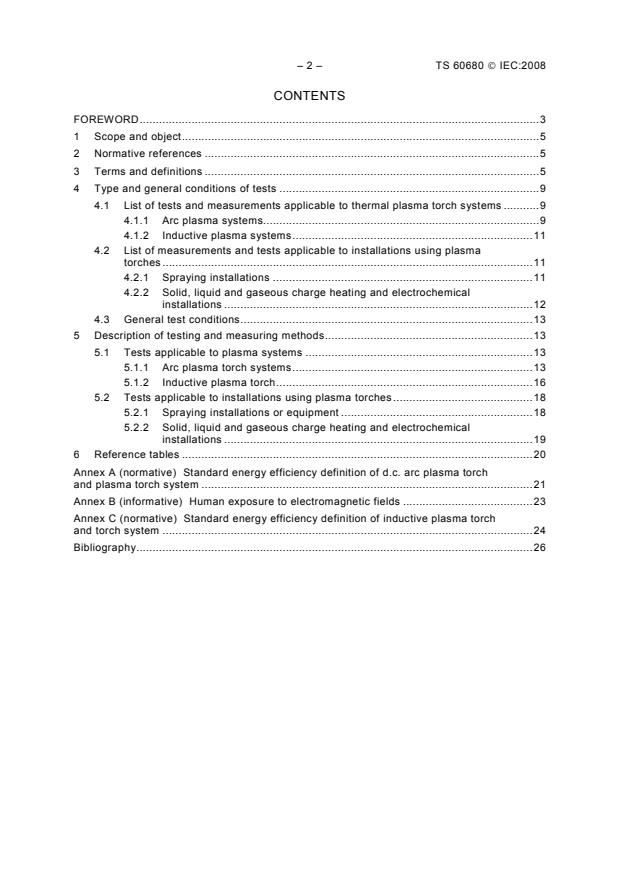
– 2 – TS 60680 © IEC:2008
CONTENTS
FOREWORD.3
1 Scope and object.5
2 Normative references .5
3 Terms and definitions .5
4 Type and general conditions of tests .9
4.1 List of tests and measurements applicable to thermal plasma torch systems .9
4.1.1 Arc plasma systems.9
4.1.2 Inductive plasma systems.11
4.2 List of measurements and tests applicable to installations using plasma
torches .11
4.2.1 Spraying installations .11
4.2.2 Solid, liquid and gaseous charge heating and electrochemical
installations .12
4.3 General test conditions.13
5 Description of testing and measuring methods.13
5.1 Tests applicable to plasma systems .13
5.1.1 Arc plasma torch systems.13
5.1.2 Inductive plasma torch.16
5.2 Tests applicable to installations using plasma torches .18
5.2.1 Spraying installations or equipment .18
5.2.2 Solid, liquid and gaseous charge heating and electrochemical
installations .19
6 Reference tables .20
Annex A (normative) Standard energy efficiency definition of d.c. arc plasma torch
and plasma torch system .21
Annex B (informative) Human exposure to electromagnetic fields .23
Annex C (normative) Standard energy efficiency definition of inductive plasma torch
and torch system .24
Bibliography.26
TS 60680 © IEC:2008 – 3 –
INTERNATIONAL ELECTROTECHNICAL COMMISSION
____________
TEST METHODS OF PLASMA EQUIPMENT FOR ELECTROHEAT
AND ELECTROCHEMICAL APPLICATIONS
FOREWORD
1) The International Electrotechnical Commission (IEC) is a worldwide organization for standardization comprising
all national electrotechnical committees (IEC National Committees). The object of IEC is to promote
international co-operation on all questions concerning standardization in the electrical and electronic fields. To
this end and in addition to other activities, IEC publishes International Standards, Technical Specifications,
Technical Reports, Publicly Available Specifications (PAS) and Guides (hereafter referred to as “IEC
Publication(s)”). Their preparation is entrusted to technical committees; any IEC National Committee interested
in the subject dealt with may participate in this preparatory work. International, governmental and non-
governmental organizations liaising with the IEC also participate in this preparation. IEC collaborates closely
with the International Organization for Standardization (ISO) in accordance with conditions determined by
agreement between the two organizations.
2) The formal decisions or agreements of IEC on technical matters express, as nearly as possible, an international
consensus of opinion on the relevant subjects since each technical committee has representation from all
interested IEC National Committees.
3) IEC Publications have the form of recommendations for international use and are accepted by IEC National
Committees in that sense. While all reasonable efforts are made to ensure that the technical content of IEC
Publications is accurate, IEC cannot be held responsible for the way in which they are used or for any
misinterpretation by any end user.
4) In order to promote international uniformity, IEC National Committees undertake to apply IEC Publications
transparently to the maximum extent possible in their national and regional publications. Any divergence
between any IEC Publication and the corresponding national or regional publication shall be clearly indicated in
the latter.
5) IEC provides no marking procedure to indicate its approval and cannot be rendered responsible for any
equipment declared to be in conformity with an IEC Publication.
6) All users should ensure that they have the latest edition of this publication.
7) No liability shall attach to IEC or its directors, employees, servants or agents including individual experts and
members of its technical committees and IEC National Committees for any personal injury, property damage or
other damage of any nature whatsoever, whether direct or indirect, or for costs (including legal fees) and
expenses arising out of the publication, use of, or reliance upon, this IEC Publication or any other IEC
Publications.
8) Attention is drawn to the Normative references cited in this publication. Use of the referenced publications is
indispensable for the correct application of this publication.
9) Attention is drawn to the possibility that some of the elements of this IEC Publication may be the subject of
patent rights. IEC shall not be held responsible for identifying any or all such patent rights.
The main task of IEC technical committees is to prepare International Standards. In
exceptional circumstances, a technical committee may propose the publication of a technical
specification when
• the required support cannot be obtained for the publication of an International Standard,
despite repeated efforts, or
• the subject is still under technical development or where, for any other reason, there is the
future but no immediate possibility of an agreement on an International Standard.
Technical specifications are subject to review within three years of publication to decide
whether they can be transformed into International Standards.
IEC 60680, which is a technical specification, has been prepared by IEC technical
committee 27: Industrial electroheating equipment.
This first edition of IEC 60680/TS cancels and replaces the first edition of International
Standard IEC 60680 published in 1980. It constitutes a technical revision.
The significant changes with respect to the previous edition are as follows:
– 4 – TS 60680 © IEC:2008
• the previous edition focused on arc heating means and on spraying applications – this TS
applies to all means of production of thermal plasma, i.e. arc and induction heating, and to
the equipment directly coupled to these means;
• new items/issues have been added:
– test methods for inductive plasma torch systems and for thermochemical treatment
equipment (4.1.2, 5.1.2, 4.2.2, 5.2.2);
– new test methods for spraying applications (4.2.1.3, 5.2.1.2);
– protection against electromagnetic emissions (including Annex B);
– detailed efficiency definitions, for both arc and inductive heating torch and system
(Annex A and Annex C);
• terms and definitions have been updated according to the second edition of
IEC 60050-841.
The text of this technical specification is based on the following documents:
Enquiry draft Report on voting
27/581/DTS 27/605A/RVC
Full information on the voting for the approval of this technical specification can be found in
the report on voting indicated in the above table.
This publication has been drafted in accordance with the ISO/IEC Directives, Part 2.
The committee has decided that the contents of this publication will remain unchanged until
the maintenance result date indicated on the IEC web site under "http://webstore.iec.ch" in
the data related to the specific publication. At this date, the publication will be
• transformed into an International standard,
• reconfirmed,
• withdrawn,
• replaced by a revised edition, or
• amended.
TS 60680 © IEC:2008 – 5 –
TEST METHODS OF PLASMA EQUIPMENT FOR ELECTROHEAT
AND ELECTROCHEMICAL APPLICATIONS
1 Scope and object
This Technical Specification specifies test methods for
a) thermal plasma torch systems:
– arc plasma systems;
– inductive plasma systems;
b) installation using thermal plasma torch systems:
– spraying equipment;
– solid, liquid and gaseous charge heating and thermochemical treatment equipment.
Test methods for plasma torches for welding, cutting and allied processes are specified in
IEC 60974-7.
The object of this specification is to standardize the test methods and conditions for
determining the main parameters and technical characteristics of thermal plasma torch
systems and of installations (or equipment) using one or more plasma torch systems.
Not all the tests specified are applicable to every type of equipment, covered by this
specification. It is necessary to select those tests which are applicable to a specified plasma
torch system or installation. This selection is effective in the specification.
Safety requirements for systems and installations or equipment specified in a) and b) are
given in IEC/TS 60519-5.
2 Normative references
The following referenced documents are indispensable for the application of this document.
For dated references, only the edition cited applies. For undated references, the latest edition
of the referenced document (including any amendments) applies.
IEC 60050-841:2004, International Electrotechnical Vocabulary – Part 841: Industrial
electroheat
IEC 60398:1999, Industrial electroheating installations – General test methods
3 Terms and definitions
For the purposes of this document, the terms and definitions given in IEC 60050-841 and the
following apply.
3.1
plasma
any ionized gas consisting of free electrons, ions and neutral particles (atoms and/or
molecules and/or radicals), electrically neutral on a macroscopic scale and electrically
conductive
[IEV 841-31-01, modified]
– 6 – TS 60680 © IEC:2008
3.2
thermal plasma
plasma in local thermodynamic equilibrium, at around atmospheric pressure or above
NOTE In IEC standards, related to equipment or installations, the use of the plain word "plasma" for "thermal
plasma" is tolerated.
[IEV 841-31-07]
3.3
plasma heating
method of heating using thermal plasma as a heat source
[IEV 841-31-02]
3.4
arc plasma
arc thermal plasma
thermal plasma generated by an electric discharge between electrodes in a fluid
NOTE The plasma arc column is characterized by high current density, up to 100 A/mm , at pressures of the
same order as atmospheric pressure.
[IEV 841-31-10]
3.5
inductive plasma
thermal plasma in which ionization is obtained by excitation of a gas in a high-frequency
electromagnetic field
[IEV 841-31-12, modified]
3.6
plasma gas
any gas, vapour or fluid to be brought to the state of plasma
[IEV 841-31-14]
3.7
plasma torch
electroheat equipment in which an inlet gas stream is converted by electric energy supplied to
a plasma flow prior to its ejection
[IEV 841-31-29]
3.8
arc plasma torch
electroheat equipment in which an inlet gas stream is converted to a plasma flow by electric
energy supplied from an arc discharge prior to its ejection
NOTE Arc plasma torches can be supplied either by AC or DC current.
[IEV 841-31-30]
3.9
transferred arc plasma torch
arc plasma torch in which the main arc is maintained between an internal electrode (contained
within the torch) and a liquid or solid medium (or a solid workpiece), electrically conductive,
constituting or including an external electrode for current return
[IEV 841-31-32]
TS 60680 © IEC:2008 – 7 –
3.10
non-transferred arc plasma torch
arc plasma torch in which the main arc is maintained between two or more electrodes
regarded as torch components
[IEV 841-31-31]
3.11
plasma jet
high velocity plasma flow supplied by a non-transferred arc plasma torch or by an inductive
plasma torch
[IEV 841-31-18]
3.12
non-electrode plasma torch
plasma torch with no electrode, supplied by high frequency source of inductive or capacitive
type
[IEV 841-31-36)
3.13
induction plasma torch
plasma torch in which the plasma flow is generated by an a.c. high-frequency magnetic field
produced by a high-frequency current established in a coil
[IEV 841-31-38, modified]
3.14
ignition of a plasma torch
initiation of the transition from non-ionized plasma gas to plasma state, carried into effect by a
starting-up equipment
[IEV 841-31-15, modified]
3.15
high-frequency ignition device (of a plasma torch)
device used in an arc plasma torch to ignite the arc by a high voltage and high-frequency
electric discharge between the electrodes
[IEV 841-31-16, modified]
3.16
short-circuit ignition device (of a plasma torch)
device used in an arc plasma torch to ignite the arc by creating a short circuit between the
electrodes
[IEV 841-31-17]
3.17
nozzle (of a plasma torch)
part of a plasma torch allowing shaping the plasma flow prior to its ejection in order to
increase its speed and/or its energy density
[IEV 841-31-40, modified]
3.18
cathode (of a non-transferred or transferred plasma torch)
negative electrode of a d.c. arc plasma torch
– 8 – TS 60680 © IEC:2008
NOTE 1 The cathode may be made of a high electrical and thermal conductivity material, such as copper(water
cooled) or of a refractory metal, such as wolfram, or of graphite, water cooled if necessary.
NOTE 2 The return current electrode of a transferred plasma torch serves sometimes as the cathode.
[IEV 841-31-42, modified]
3.19
anode (of a non-transferred or transferred plasma torch)
positive electrode of a d.c. arc plasma torch
NOTE 1 The anode is usually made of a high electrical and thermal conductivity material, such as copper, and
water cooled.
NOTE 2 The return current electrode of a transferred plasma torch serves in most cases as the anode.
NOTE 3 In a non-transferred plasma torch, the anode is often the torch nozzle.
[IEV 841-31-41]
3.20
normal operation of a plasma torch
operation characterized by reproducible working conditions defined by the type and
composition of the gas, its mass flow rate and the arc current
3.21
specified current of a plasma torch
maximum current which can be used (for a given plasma gas) by a plasma torch
3.22
specified power of a plasma torch
maximum power which can be used (for a given plasma gas) by a plasma torch
3.23
thermal power of a plasma torch
thermal power delivered by the torch, defined as the gas mass flow rate multiplied by its
average enthalpy
3.24
energy efficiency of a plasma torch
ratio of delivered thermal power to the active input power
3.25
plasma temperature
instantaneous local temperature within a plasma
[IEV 841-31-45]
3.26
plasma average enthalpy
plasma mean enthalpy
quotient of the power delivered by the plasma torch by the plasma gas mass flow rate
[IEV 841-31-44]
3.27
plasma system
equipment for the production of thermal plasma, consisting of the plasma torch, its power
supply, gas and cooling utilities and a control unit
TS 60680 © IEC:2008 – 9 –
3.28
plasma furnace
electroheat equipment comprising a refractory lined chamber in which a charge is heated by
one or more plasma torches and generally used to melt or to smelt materials at high
temperatures
[IEV 841-31-25]
3.29
plasma reactor
electroheat equipment comprising a chamber for a thermochemical processing of material by
plasma torches
[IEV 841-31-27]
3.30
plasma installation
installation to carry on the plasma process, consisting of a plasma system and, in most cases
of a plasma furnace or reactor, including all necessary auxiliary equipment for heating or
thermally treating materials
3.31
plasma spraying
coating in which material introduced in the form of powder or wire and melted in a plasma jet
is sprayed onto a surface
[IEV 841-31-24]
3.32
powder deposition efficiency
ratio of the mass flow rate of powder consolidated on a substrate to the mass flow rate of
powder fed to the torch
4 Type and general conditions of tests
4.1 List of tests and measurements applicable to thermal plasma torch systems
4.1.1 Arc plasma systems
Arc plasma systems shall be subjected to the following tests and measurements.
4.1.1.1 Arc power supply tests
Power supplies used for arc plasma generation are generally either a.c. of 50 Hz or 60 Hz, or
d.c., obtained by using semiconductor devices, for example thyristors, IGBT (Insulated Gate
Bipolar Transistor) or IGCT (Integrated Gate Commutated Thyristor).
For a.c. and d.c. type supply, the following tests are applicable:
a) verification of equipotential bonding by measurement;
b) measurement of insulation resistance;
c) dielectric test;
d) regulation mode test:
– off-load test,
– on-load test;
e) determination of energy efficiency;
– 10 – TS 60680 © IEC:2008
For d.c. type supply only:
f) measurement of ripple factor.
4.1.1.2 Gas circuit tests
The flow/pressure characteristics of the gas circuit shall be determined.
4.1.1.3 Cooling circuit tests
The following measurements and tests are applicable:
a) determination of the flow/pressure characteristics;
b) measurement of cooling liquid inlet and outlet temperature as a function of the mass flow
rate at maximum steady-state power of the plasma system;
c) measurement of the cooling liquid electrical resistivity.
4.1.1.4 Ignition test
For plasma systems ignited by a high frequency device, measurements of electromagnetic
emissions around the ignition device shall be made according to the regulations in force in the
country in which the plasma system is to be used. They shall comply with local regulations.
4.1.1.5 Plasma torch tests
The followings standard tests are performed assuming that the torch operates at external
atmospheric conditions:
a) static sealing test under cooling liquid filling;
b) verification of equipotential bonding by measurement;
c) measurement of insulation resistance;
d) dielectric test;
e) ignition test:
• high frequency ignition device:
– check of ignition capability for the plasma gas(es) to be used,
• short-circuit ignition device:
– electrical continuity,
– check of ignition capability for the plasma gas(es) to be used;
f) determination of the voltage/current characteristics at several plasma gas mass flow rates,
for each specified plasma gas;
g) determination of the thermal power and electrical power under different operating
conditions;
h) determination of the average enthalpy under different operating conditions;
i) determination of energy efficiency;
j) temperature measurement of accessible parts of the torch;
k) acoustic level measurement under different operating conditions;
l) electromagnetic emissions measurement under different operating conditions, according
to appropriate standards;
m) for arc transferred plasma torch, thermal radiation measurement under different operating
conditions;
n) electrodes erosion measurement.
NOTE This type of measurement is not obligatory and results from an agreement between the manufacturer
and the user.
TS 60680 © IEC:2008 – 11 –
4.1.2 Inductive plasma systems
Inductive plasma systems shall be subjected to the following measurements and tests.
4.1.2.1 Inductive power supply tests
Power supplies used for RF inductive plasma generation are generally operated in the radio
frequency MHz range (typically between 2 MHz and 27,6 MHz). Exceptionally, this range is
extended downwards to the 200 kHz to 300 kHz range and upwards up to 40 MHz. Power
supplies operating with frequencies in the MHz range at power levels of tens to hundreds kW
are generally of the triode type oscillators.
The following tests are applicable:
a) verification of equipotential bonding by measurement;
b) measurement of insulation resistance;
c) circuit protection test;
d) determination of energy efficiency.
4.1.2.2 Gas circuit tests
See 4.1.1.2.
4.1.2.3 Cooling circuit tests
See 4.1.1.3.
4.1.2.4 Ignition test
See 4.1.1.4.
4.1.2.5 Plasma torch tests
Apply 4.1.1.5, except item n) (non-electrode torch).
4.2 List of measurements and tests applicable to installations using plasma torches
4.2.1 Spraying installations
Spraying installations shall be subjected to the following measurements and tests.
4.2.1.1 Arc plasma torch systems
See 4.1.1 for arc plasma systems.
4.2.1.2 Inductive plasma systems
See 4.1.2 for inductive plasma systems.
4.2.1.3 Plasma spraying equipment measurements and tests
In spraying applications, the material to be treated is a powder, wire or liquid. The following
measurements and tests are applicable:
a) powder used for operation:
1) determination of range of particle size,
2) determination of the fluidity of the feeding particles flow,
3) determination of the carrier gas circuit mass flow rate/pressure characteristics,
– 12 – TS 60680 © IEC:2008
4) determination of maximum feed rate as a function of the maximum power of the
equipment,
5) determination of the powder deposition efficiency (3.32);
b) wire used for operation:
1) determination of the wire diameter,
2) determination of maximum feed rate as a function of the maximum power of the
equipment;
c) liquid used for operation:
1) injection system:
– characterization of the gas atomization,
– characterization of the mechanical injection (drops or jets);
2) solutions:
– concentration of the precursor and composition,
– solvent used;
3) suspension:
– solvent used,
– dispersant used,
– determination of the particle size and morphology,
– determination of the particle weight percentage.
The workpiece shall be grounded, when using plasma transferred arc reclamation.
4.2.2 Solid, liquid and gaseous charge heating and electrochemical installations
Solid, liquid and gaseous charge heating and electrochemical installations shall be subjected
to the following measurements and tests.
4.2.2.1 Thermal plasma torch systems
See 4.1.1 and 4.1.2.
Item b) of 4.1.1.3 shall take into account the extra losses in the plasma torch cooling circuit
due to the location, partial or total, of the torch in the high temperature atmosphere of the
furnace or reactor.
4.2.2.2 Heating and thermochemical treatment equipment
The following measurements and tests are applicable:
a) determination of the gas circuit pressure/temperature characteristics, including gas(es)
used for the torch, for different operating conditions;
b) verification of equipotential bonding by measurement;
c) acoustic level measurement;
d) temperature measurement of accessible parts of the equipment (in particular the furnace
and/or the reactor);
e) identification of risks linked to the production of toxic products;
f) identification of the explosion hazard situations;
g) measurement of cooling liquid inlet and outlet temperatures as a function of the mass flow
rate at maximum continuous power of the equipment;
h) determination of the cooling circuit mass flow rate/pressure characteristics.
TS 60680 © IEC:2008 – 13 –
4.3 General test conditions
General test conditions according to IEC 60398 apply.
5 Description of testing and measuring methods
5.1 Tests applicable to plasma systems
5.1.1 Arc plasma torch systems
5.1.1.1 Arc power supply tests
For a.c. and d.c. type systems the following measurements and tests apply:
a) verification of equipotential bonding by measurement:
a current of 10 A shall be applied to measure the mass continuity, in mΩ;
b) measurement of insulation resistance:
a voltage of 500 V d.c. shall be applied for 1 min without breakdown for low voltage
circuits;
a voltage of 1 000 V d.c. shall be applied for 1 min without breakdown for high voltage
circuits;
for low voltage circuits, the insulation resistance shall be not less than 3 MΩ;
for high voltage circuits, the insulation resistance shall be not less than 100 MΩ;
c) dielectric test:
a practically sinusoidal voltage of mains frequency 50 Hz or 60 Hz, the value of which is
specified below, is applied for 1 min;
at the beginning of the test, the voltage applied is less than half of the prescribed value,
and is then rapidly raised to the test value.
The specified values are as follows:
– installation with a rated voltage lower than or equal to 50 V; test voltage: 500 V;
– installation with a rated voltage U above 50 V; test voltage 2U + 1 000 V (minimum
1 500 V);
d) regulation mode tests:
• measurement of the open-circuit voltage;
• on-load tests:
– short-circuit tests,
– resistive load tests (resistance value lower than 1 Ω) to determine the current
accuracy;
e) determination of energy efficiency:
measurement of the energy losses, at low voltage and operating currents, to determine the
energy efficiency, by measuring the input and output power at rated conditions as
specified.
For d.c. type systems the following measurement applies:
f) measurement of ripple factor:
measurement of the current ripple at specified power (agreed between the manufacturer
and the user) with resistive load.
NOTE The ripple factor is defined as the ratio of the root mean square value of the ripple to the mean d.c.
value of the measured current.
– 14 – TS 60680 © IEC:2008
5.1.1.2 Gas circuit tests
The flow/pressure characteristics of the gas circuit shall be determined in the pressure range
specified by the manufacturer.
The gas flow rate is generally expressed in Nm /h or in Nl/min. The gas pressure, ahead from
the gas circuit distribution to the torch, shall be measured by means of a pressure gauge. The
flow shall be measured by means of a flowmeter to get the mass flow rate of the specified
plasma gas, ahead the torch.
5.1.1.3 Cooling circuit tests
The following measurements and tests are applicable:
a) determination of the flow/pressure characteristics;
The cooling liquid mass flow rate, mostly water, is given in m /h. The flow/pressure
characteristics will be measured by simulating the torch pressure drop, using a flowmeter
at the outlet of the pressure drop device and two pressure gauges located on both sides of
this device, including all pipes.
b) measurement of cooling liquid inlet and outlet temperature as a function of its mass flow
rate at maximum steady-state power of the plasma system;
The cooling water temperature difference shall be measured at the terminals of the torch,
including all the hoses. If thermoelectric sensors such as thermistors are used, they shall
be electrically insulated from the cooling liquid. The measurements shall be made at the
mass flow rate and pressure recommended by the torch manufacturer. With the
measurements of temperatures and mass flow rate, the torch losses can be calculated.
c) measurement of the cooling liquid resistivity;
/cm. The resistivity shall be
The resistivity of the cooling liquid is generally given in Ω.cm
measured ahead of the pressurized cooling circuit at the maximum temperature. Deionised
water should be used when appropriate.
5.1.1.4 High frequency ignition circuit measurements
Measurements of electromagnetic emissions apply for the protection of personnel.
The measurements are performed according to the regulations in force in the country in which
the plasma system is to be used. They shall comply with local regulations.
5.1.1.5 Plasma torch characteristics
The following measurements and tests are applicable:
a) static sealing test under cooling liquid filling;
The torch, with all orifices capped, shall be pressurized under the cooling liquid at a static
pressure specified by the manufacturer, during 5 min. No leakage shall occur.
b) verification of equipotential bonding by measurement;
See 5.1.1.1, a).
c) measurement of insulation resistance;
See 5.1.1.1, b).
d) dielectric test;
See 5.1.1.1, c).
e) ignition test;
The ignition conditions, depending on the type of ignition device shall be determined
according to the following measurements and tests:
TS 60680 © IEC:2008 – 15 –
– for high-frequency ignition device
• control of ignition capability
After connecting the ignition circuit to the plasma torch, in compliance with the
manufacturer specifications, the (selected) plasma gas mass flow rate is adjusted
to produce the high frequency spark necessary to ignite the main arc, then supplied
by the main current.
NOTE In particular torches, the electrode gap is also adjustable, providing another means to adjust
the starting conditions.
– for short-circuit ignition device
• measurement of electrical continuity
The arc is ignited by an initial short-circuit between the main electrodes, either
through an auxiliary movable device or through the movable main electrodes; this
short-circuit is checked with an ohmmeter.
• control of ignition capability
The main arc current, at low value specified by the torch manufacturer, is supplied
to the main electrodes through the short-circuit for a very short time (less than 1 s);
then, either the auxiliary device or the main electrodes are moved to their nominal
position for the development of the main arc within the (selected) plasma gas
stream, which mass flow rate is adjusted to maintain the arc.
f) determination of the arc voltage/current characteristics under different operating
conditions, for each specified plasma gas;
The arc voltage/current characteristics are measured for several plasma gas mass flow
rates, each characteristic being drawn for a constant mass flow rate, in the whole range of
values as specified by the manufacturer.
NOTE For transferred arc, characteristics are determined for a given distance between the torch and the
workpiece.
g) determination of the thermal power and electrical power;
The electrical power is the active power supplied to the torch, in kW, measured at the
power supply(ies) terminals through appropriate meters supplied by the manufacturer. The
thermal power is the power delivered by the torch, in kW, basically regarded as the
difference between electrical power and losses in the cooling circuit; a more accurate
definition is provided in Annex A, with the calculations regarding the energy efficiency of
the torch.
h) determination of the average enthalpy under different operating conditions;
The average enthalpy, in joules/kg of gas, is determined as the ratio of the thermal power
to the plasma gas mass flow rate. However, this measurement is generally not obligatory
for spraying applications.
i) determination of energy efficiency;
The energy efficiency is the ratio of the thermal power delivered by the torch to the active
electrical power supplied to the torch; for more accurate description, see Annex A.
j) measurement of temperature of accessible parts of the plasma torch;
The surface temperature at different points of accessible parts of the torch shall be
measured when conditions of steady state at the maximum continuous power of the torch
have been obtained during operation, by any conventional method.
k) acoustic level measurement;
The measurement shall comply with the safety regulations in force in the country in which
the equipment is to be used.
l) electromagnetic emissions measurement under different operating conditions, according
to relevant standards, for examples see Annex B;
m) thermal radiation measurement under different operating conditions;
– 16 – TS 60680 © IEC:2008
The transferred arc torch radiate energy coming from the hot arc. The heat flux shall be
measured by a radiometer.
n) electrodes erosion measurement.
Electrode (and nozzle when used as an electrode) wear may be expressed by metal
weight loss (gram) per unit time (hour) under conditions agreed between the manufacturer
and the user. It shall be determined by weighing the electrodes and measuring the
corresponding operating time. For spraying applications, the compensation of the
electrode erosion is important for the quality of the coating.
5.1.2 Inductive plasma torch
5.1.2.1 Inductive power supply tests
The following measurements and tests are applicable:
a) verification of equipotential bonding by measurement:
– a current of 10 A shall be applied to measure the mass continuity in mΩ;
b) measurement of insulation resistance:
– a voltage of 500 V d.c. shall be applied for 1 min without breakdown for low voltage
circuits;
– a voltage of 1000 V d.c. shall be applied for 1 min without breakdown for high voltage
circuits;
– for low voltage circuits, the insulation resistance shall be not less than 3 MΩ;
– for high voltage circuits, the insulation resistance shall be not less than 100 MΩ;
c) circuit protection tests:
– overload trip plate and grid current overload measured and tested;
– door switch and torch enclosure (Faraday cage) interlock shall disconnect the main
power supply breaker;
d) determination of energy efficiency:
– measurement of the power supply losses at low, medium, and high power conditions
under calorimeter load and plasma conditions.
5.1.2.2 Gas circuit tests
The flow/pressure characteristics of the gas circuit shall be determined.
The gas flow rate is generally expressed in Nm /h or Nl/min. The ratio of gas pressure and
flow shall be determined by means of a pressure gauge placed at the inlet of the torch, pipes
included, and a flowmeter inserted in the circuit ahead of the pressure gauge. The
measurements shall preferably be taken on a torch operating with the gas flows
recommended by the manufacturer.
5.1.2.3 Cooling circuit characteristics
The following measurements and tests are applicable:
a) determination of the flow/pressure characteristics:
– the cooling liquid mass flow rate, generally water, is given in m /h or l/min. The
pressure gauge shall be placed at the inlet of the cooling circuit pipeline of the torch,
including all pipes. The flow shall be measured either volumetrically or by means of a
flow meter inserted in the cooling circuit downstream of the torch;
b) measurement of cooling liquid inlet and outlet temperatures as a function of its mass flow
rate at maximum steady-state power of the plasma system:
TS 60680 © IEC:2008 – 17 –
– the cooling water temperature difference shall be measured as close as possible to the
torch, including the hoses. If thermoelectric sensors such as thermocouples or
thermistors are used, they shall be insulated from the cooling liquid. The
measurements shall be made at the mass flow rate and pressure recommended by the
torch manufacturer;
– with the measurements of temperatures and mass flow rate, the torch losses can be
calculated, in kW;
c) measurement of the cooling liquid resistivity:
– the resistivity of the cooling liquid is given in Ωcm /cm;
d) ignition test:
See 5.1.1.4.
5.1.2.4 Plasma torch measurements and tests
The following measurements and tests are applicable:
a) static sealing test under cooling liquid filling:
– the torch, with all orifices capped, shall be pressurized under the cooling liquid at a
specified (by the manufacturer) static pressure for 5 min. No leakage shall occur;
b) verification of equipotential bonding by measurement;
See 5.1.2.1, a).
c) measurement of insulation resistance;
See 5.1.2.1, b).
d) ignition test:
• check of ignition capability of high frequency ignition device
after connecting the ignition circuit to the plasma torch, in compliance with the
manufacturer specifications, the (selected) plasma gas mass flow rate and pressure
are adjusted to produce the high frequency spark necessary to ignite the plasma
discharge, which will be maintained by the magnetic flux;
• discharge rod igniter device
the discharge rod shall be properly insulated from ground or from the operator.
Measurement of electrical insulation from earth shall be done with an ohmmeter;
• self-ignition under vacuum pressure
measurement of plate voltage, frequency, and pressure necessary for proper plasma
ignition under argon atmosphere;
the voltage, frequency and pressure shall be within the value range specified by the
manufacturer;
e) determination of the plate voltage/current characteristics under different operating
conditions
the plate voltage/current characteristics are measured for several plasma gas mass flow
rates and pressure, each characteristic being drawn for a constant mass flow rate, in the
whole range of values as specified by the manufacturer;
f) determination of the thermal power and electrical power
the electrical power is the d.c. plate power supplied to the tube oscillator, in kW, measured
before the RF triode inside the power supply(ies) through appropriate meters supplied by
the RF power supply manufacturer. This plate power includes the power delivered to the
torch terminals and the losses inside the triode and the circuit of the RF generator;
the thermal power is the power delivered by the torch, in kW, basically regarded as the
difference between plate electrical power and losses in the cooling circuit of the torch and
the RF generator triode and the resonance circuit; a more accurate definition is provided
Annex C, with the calculations regarding the energy efficiency of the torch;
in
– 18 – TS 60680 © IEC:2008
g) determination of the average enthalpy under different operating conditions
the average enthalpy, in joules/kg of gas, is determined as the ratio of the thermal power
to the plasma gas mass flow rate;
h) determination of energy efficiency
the energy efficiency is the ratio of the thermal power delivere
...