

IEC 62228-7:2022
(Main)Integrated circuits - EMC evaluation of transceivers - Part 7: CXPI transceivers
General Information
- Abstract
IEC 62228-7:2022 specifies test and measurement methods for the EMC evaluation of CXPI transceiver ICs under network condition. It defines test configurations, test conditions, test signals, failure criteria, test procedures, test setups and test boards. This specification is applicable for standard CXPI transceiver ICs and ICs with embedded CXPI transceiver and covers
the emission of RF disturbances,
the immunity against RF disturbances,
the immunity against impulses and
the immunity against electrostatic discharges (ESD).
- Status
- Published
- Publication Date
- 21-Feb-2022
- Technical Committee
- SC 47A - Integrated circuits
- Drafting Committee
- WG 9 - TC 47/SC 47A/WG 9
Overview
IEC 62228-7:2022 is an international standard published by the International Electrotechnical Commission (IEC) that specifies comprehensive methods for the electromagnetic compatibility (EMC) evaluation of CXPI transceiver integrated circuits (ICs). This standard focuses on test and measurement procedures under realistic network conditions, ensuring reliable EMC performance for CXPI transceivers used in automotive communication networks. It covers critical EMC aspects including radio frequency (RF) emissions, immunity to RF disturbances, impulse immunity, and electrostatic discharge (ESD) resilience.
The standard is applicable to standard CXPI transceiver ICs as well as ICs with embedded CXPI transceivers, defining precise test configurations, test signals, failure criteria, and test setups to standardize evaluation methods. The aim is to harmonize EMC testing across manufacturers, improve interoperability, and enhance robustness in automotive electronic systems.
Key Topics
Test Configurations and Conditions
IEC 62228-7 defines general and specific test configurations for both powered and unpowered operation modes, including detailed setups for functional mode testing and unpowered ESD tests. It specifies coupling ports and networks used to inject disturbances during testing.Test Signals and Modes
The standard details communication test signals used to simulate normal and wake-up operation modes of CXPI transceivers. This includes test signals TX1, TX2, TX3 for normal operation and TX4 for wake-up from sleep mode to replicate real network behavior during EMC testing.Emission Testing
Procedures to measure RF disturbance emissions from CXPI transceivers are specified to verify compliance with regulatory limits and ensure that devices do not interfere with other electronic systems.Immunity Testing
The standard sets forth rigorous methods to assess immunity of CXPI transceivers against:- RF disturbances using direct power injection (DPI) techniques.
- Impulse disturbances that could occur in automotive environments.
- Electrostatic discharges (ESD) under powered and unpowered conditions.
Failure and Evaluation Criteria
Clear criteria are provided to evaluate the performance of ICs during and after disturbance exposure. This helps classify device status to ensure robustness under EMC stress.Test Reporting and Documentation
IEC 62228-7 includes guidelines for comprehensive test reports documenting the conditions, procedures, and outcomes of EMC evaluations for transparency and traceability.
Practical Applications
Automotive Electronics Design
The standard is crucial for manufacturers developing CXPI transceivers for automotive network communication, enabling the design of devices that meet EMC regulatory requirements and function reliably in harsh electromagnetic environments common in vehicles.Quality Assurance and Compliance Testing
EMC test labs utilize IEC 62228-7 to perform standardized verification and certification of CXPI transceivers, supporting conformity to international automotive EMC standards.Embedded Systems Reliability
ICs with embedded CXPI transceivers are evaluated to ensure integration does not compromise EMC performance, fostering safer and more resilient in-vehicle networking solutions.Research and Development
Engineers reference the specified test signals, disturbance injection methods, and evaluation criteria to optimize transceiver designs and improve immunity against automotive EMC challenges.
Related Standards
IEC 62228 Series
This standard is Part 7 of IEC 62228, which broadly addresses EMC evaluation of integrated circuit transceivers. Other parts cover different transceiver technologies and communication protocols.ISO 7637
Provides pulse testing methodologies for electrical disturbance immunity testing in automotive environments, relevant for impulse immunity evaluations in IEC 62228-7.IEC 61000 Series
Governs general EMC test methods including ESD, RF immunity, and emission tests, complementing the specific CXPI transceiver evaluations established in IEC 62228-7.AUTOSAR and Automotive Network Standards
While IEC 62228-7 focuses on EMC test methods, it supports compliance with higher-level automotive network standards used in vehicle communication architecture.
Keywords: IEC 62228-7, EMC evaluation, CXPI transceivers, integrated circuits, automotive communication network, RF emission testing, immunity testing, impulse immunity, electrostatic discharge, ESD, EM compatibility, automotive electronics, test configurations, disturbance injection, standardized test methods, compliance testing, IC transceiver EMC, automotive EMC standards.
Relations
- Revised
IEC 62228-7:2026 - Integrated circuits - EMC evaluation of transceivers - Part 7: CXPI transceivers - Effective Date
- 06-Sep-2024
Frequently Asked Questions
IEC 62228-7:2022 is a standard published by the International Electrotechnical Commission (IEC). Its full title is "Integrated circuits - EMC evaluation of transceivers - Part 7: CXPI transceivers". This standard covers: IEC 62228-7:2022 specifies test and measurement methods for the EMC evaluation of CXPI transceiver ICs under network condition. It defines test configurations, test conditions, test signals, failure criteria, test procedures, test setups and test boards. This specification is applicable for standard CXPI transceiver ICs and ICs with embedded CXPI transceiver and covers the emission of RF disturbances, the immunity against RF disturbances, the immunity against impulses and the immunity against electrostatic discharges (ESD).
IEC 62228-7:2022 specifies test and measurement methods for the EMC evaluation of CXPI transceiver ICs under network condition. It defines test configurations, test conditions, test signals, failure criteria, test procedures, test setups and test boards. This specification is applicable for standard CXPI transceiver ICs and ICs with embedded CXPI transceiver and covers the emission of RF disturbances, the immunity against RF disturbances, the immunity against impulses and the immunity against electrostatic discharges (ESD).
IEC 62228-7:2022 is classified under the following ICS (International Classification for Standards) categories: 31.200 - Integrated circuits. Microelectronics. The ICS classification helps identify the subject area and facilitates finding related standards.
IEC 62228-7:2022 has the following relationships with other standards: It is inter standard links to IEC 62228-7:2026. Understanding these relationships helps ensure you are using the most current and applicable version of the standard.
IEC 62228-7:2022 is available in PDF format for immediate download after purchase. The document can be added to your cart and obtained through the secure checkout process. Digital delivery ensures instant access to the complete standard document.
Standards Content (Sample)
IEC 62228-7 ®
Edition 1.0 2022-02
INTERNATIONAL
STANDARD
NORME
INTERNATIONALE
colour
inside
Integrated circuits – EMC evaluation of transceivers –
Part 7: CXPI transceivers
Circuits intégrés – Évaluation de la CEM des émetteurs-récepteurs –
Partie 7: Émetteurs-récepteurs CXPI
All rights reserved. Unless otherwise specified, no part of this publication may be reproduced or utilized in any form
or by any means, electronic or mechanical, including photocopying and microfilm, without permission in writing from
either IEC or IEC's member National Committee in the country of the requester. If you have any questions about IEC
copyright or have an enquiry about obtaining additional rights to this publication, please contact the address below or
your local IEC member National Committee for further information.
Droits de reproduction réservés. Sauf indication contraire, aucune partie de cette publication ne peut être reproduite
ni utilisée sous quelque forme que ce soit et par aucun procédé, électronique ou mécanique, y compris la photocopie
et les microfilms, sans l'accord écrit de l'IEC ou du Comité national de l'IEC du pays du demandeur. Si vous avez des
questions sur le copyright de l'IEC ou si vous désirez obtenir des droits supplémentaires sur cette publication, utilisez
les coordonnées ci-après ou contactez le Comité national de l'IEC de votre pays de résidence.
IEC Secretariat Tel.: +41 22 919 02 11
3, rue de Varembé info@iec.ch
CH-1211 Geneva 20 www.iec.ch
Switzerland
About the IEC
The International Electrotechnical Commission (IEC) is the leading global organization that prepares and publishes
International Standards for all electrical, electronic and related technologies.
About IEC publications
The technical content of IEC publications is kept under constant review by the IEC. Please make sure that you have the
latest edition, a corrigendum or an amendment might have been published.
IEC publications search - webstore.iec.ch/advsearchform IEC Products & Services Portal - products.iec.ch
The advanced search enables to find IEC publications by a Discover our powerful search engine and read freely all the
variety of criteria (reference number, text, technical publications previews. With a subscription you will always
committee, …). It also gives information on projects, replaced have access to up to date content tailored to your needs.
and withdrawn publications.
Electropedia - www.electropedia.org
IEC Just Published - webstore.iec.ch/justpublished
The world's leading online dictionary on electrotechnology,
Stay up to date on all new IEC publications. Just Published
containing more than 22 300 terminological entries in English
details all new publications released. Available online and
and French, with equivalent terms in 19 additional languages.
once a month by email.
Also known as the International Electrotechnical Vocabulary
(IEV) online.
IEC Customer Service Centre - webstore.iec.ch/csc
If you wish to give us your feedback on this publication or
need further assistance, please contact the Customer Service
Centre: sales@iec.ch.
A propos de l'IEC
La Commission Electrotechnique Internationale (IEC) est la première organisation mondiale qui élabore et publie des
Normes internationales pour tout ce qui a trait à l'électricité, à l'électronique et aux technologies apparentées.
A propos des publications IEC
Le contenu technique des publications IEC est constamment revu. Veuillez vous assurer que vous possédez l’édition la
plus récente, un corrigendum ou amendement peut avoir été publié.
Recherche de publications IEC - IEC Products & Services Portal - products.iec.ch
webstore.iec.ch/advsearchform Découvrez notre puissant moteur de recherche et consultez
La recherche avancée permet de trouver des publications IEC gratuitement tous les aperçus des publications. Avec un
en utilisant différents critères (numéro de référence, texte, abonnement, vous aurez toujours accès à un contenu à jour
comité d’études, …). Elle donne aussi des informations sur adapté à vos besoins.
les projets et les publications remplacées ou retirées.
Electropedia - www.electropedia.org
IEC Just Published - webstore.iec.ch/justpublished
Le premier dictionnaire d'électrotechnologie en ligne au
Restez informé sur les nouvelles publications IEC. Just
monde, avec plus de 22 300 articles terminologiques en
Published détaille les nouvelles publications parues.
anglais et en français, ainsi que les termes équivalents dans
Disponible en ligne et une fois par mois par email.
19 langues additionnelles. Egalement appelé Vocabulaire
Electrotechnique International (IEV) en ligne.
Service Clients - webstore.iec.ch/csc
Si vous désirez nous donner des commentaires sur cette
publication ou si vous avez des questions contactez-nous:
sales@iec.ch.
IEC 62228-7 ®
Edition 1.0 2022-02
INTERNATIONAL
STANDARD
NORME
INTERNATIONALE
colour
inside
Integrated circuits – EMC evaluation of transceivers –
Part 7: CXPI transceivers
Circuits intégrés – Évaluation de la CEM des émetteurs-récepteurs –
Partie 7: Émetteurs-récepteurs CXPI
INTERNATIONAL
ELECTROTECHNICAL
COMMISSION
COMMISSION
ELECTROTECHNIQUE
INTERNATIONALE
ICS 31.200 ISBN 978-2-8322-1083-2
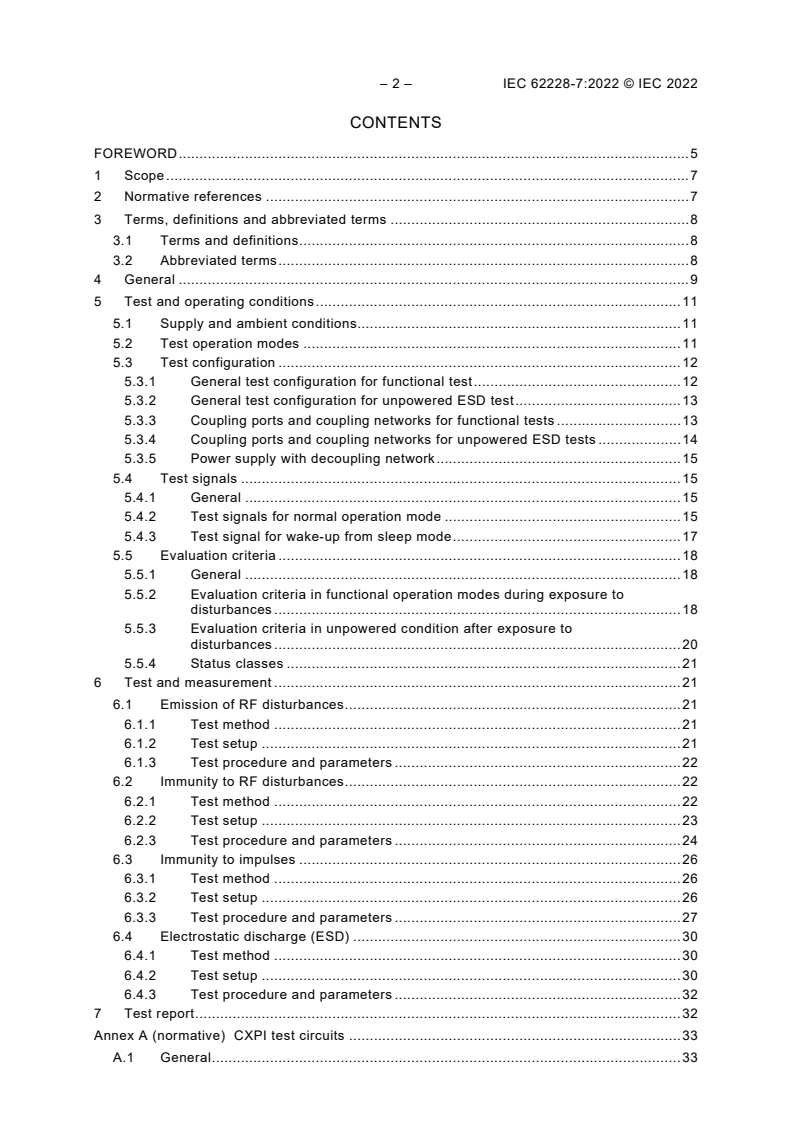
– 2 – IEC 62228-7:2022 © IEC 2022
CONTENTS
FOREWORD . 5
1 Scope . 7
2 Normative references . 7
3 Terms, definitions and abbreviated terms . 8
3.1 Terms and definitions . 8
3.2 Abbreviated terms . 8
4 General . 9
5 Test and operating conditions . 11
5.1 Supply and ambient conditions. 11
5.2 Test operation modes . 11
5.3 Test configuration . 12
5.3.1 General test configuration for functional test . 12
5.3.2 General test configuration for unpowered ESD test . 13
5.3.3 Coupling ports and coupling networks for functional tests . 13
5.3.4 Coupling ports and coupling networks for unpowered ESD tests . 14
5.3.5 Power supply with decoupling network . 15
5.4 Test signals . 15
5.4.1 General . 15
5.4.2 Test signals for normal operation mode . 15
5.4.3 Test signal for wake-up from sleep mode . 17
5.5 Evaluation criteria . 18
5.5.1 General . 18
5.5.2 Evaluation criteria in functional operation modes during exposure to
disturbances . 18
5.5.3 Evaluation criteria in unpowered condition after exposure to
disturbances . 20
5.5.4 Status classes . 21
6 Test and measurement . 21
6.1 Emission of RF disturbances . 21
6.1.1 Test method . 21
6.1.2 Test setup . 21
6.1.3 Test procedure and parameters . 22
6.2 Immunity to RF disturbances . 22
6.2.1 Test method . 22
6.2.2 Test setup . 23
6.2.3 Test procedure and parameters . 24
6.3 Immunity to impulses . 26
6.3.1 Test method . 26
6.3.2 Test setup . 26
6.3.3 Test procedure and parameters . 27
6.4 Electrostatic discharge (ESD) . 30
6.4.1 Test method . 30
6.4.2 Test setup . 30
6.4.3 Test procedure and parameters . 32
7 Test report . 32
Annex A (normative) CXPI test circuits . 33
A.1 General . 33
A.2 CXPI test circuit for functional tests on standard type-A CXPI transceiver ICs . 33
A.3 CXPI test circuit for functional tests on standard type-B CXPI transceiver ICs . 36
A.4 CXPI test circuit for functional tests on ICs with embedded CXPI transceiver . 38
A.5 CXPI test circuit for unpowered ESD test on a standard type-A CXPI
transceiver IC . 39
A.6 CXPI test circuit for unpowered ESD test on a standard type-B CXPI
transceiver IC . 40
Annex B (normative) Test circuit boards. 42
B.1 Test circuit board for functional tests . 42
B.2 ESD test . 43
Annex C (informative) Examples for test limits for CXPI transceiver in automotive
application . 44
C.1 General . 44
C.2 Emission of RF disturbances . 44
C.3 Immunity to RF disturbances . 44
C.4 Immunity to impulse . 44
C.5 Electrostatic discharge (ESD) . 44
Annex D (informative) Example of setting for test signals . 45
Annex E (informative) Points to note for impulse immunity measurement for functional
status class A . 47
IC
E.1 General . 47
E.2 Points to note when testing Pulse 1 . 47
Bibliography . 49
Figure 1 – PHY sub-layers overview and CXPI transceiver types . 10
Figure 2 – General test configuration for tests in functional operation modes . 12
Figure 3 – General test configuration for unpowered ESD test . 13
Figure 4 – Coupling ports and networks for functional tests . 13
Figure 5 – Coupling ports and networks for unpowered ESD tests . 14
Figure 6 – Principal drawing of the maximum deviation in the I-V characteristic . 20
Figure 7 – Test setup for measurement of RF disturbances . 21
Figure 8 – Test setup for DPI tests. 23
Figure 9 – Test setup for impulse immunity tests . 27
Figure 10 – Test setup for direct ESD tests . 31
Figure A.1 – General drawing of the circuit diagram of the test network for standard
type-A CXPI transceiver ICs for functional tests . 35
Figure A.2 – General drawing of the circuit diagram of the test network for standard
type-B CXPI transceiver ICs for functional tests . 37
Figure A.3 – General drawing of the circuit diagram of the test network for ICs with
embedded CXPI transceiver for functional tests . 39
Figure A.4 – A general drawing of the test circuit diagram for testing direct ESD of
CXPI transceiver in unpowered mode . 40
Figure A.5 – A general drawing of the test circuit diagram for testing direct ESD of
CXPI standard Type-B transceiver in unpowered mode . 41
Figure B.1 – Example of IC interconnections of CXPI signal . 42
Figure B.2 – Example of ESD test board for CXPI transceiver ICs . 43
Figure D.1 – Example of signal setting for standard type-A in 2 transceiver
configuration . 45
– 4 – IEC 62228-7:2022 © IEC 2022
Figure D.2 – Example of signal setting for standard type-B in 2 transceiver
configuration . 46
Figure E.1 – Relationship between ISO 7637-2 Pulse 1 and transceiver VBAT supply . 47
Figure E.2 – Transceiver VBAT supply image when t time is shortened . 48
Table 1 – Types for CXPI transceiver . 9
Table 2 – Overview of required measurement and tests . 10
Table 3 – Supply and ambient conditions for functional operation . 11
Table 4 – Definition of coupling ports and coupling network components for functional
tests . 14
Table 5 – Definitions of coupling ports for unpowered ESD tests . 15
Table 6 – Communication test signal TX1 . 16
Table 7 – Communication test signal TX2 . 17
Table 8 – Communication test signal TX3 . 17
Table 9 – Wake-up test signal TX4 . 18
Table 10 – Evaluation criteria for standard type-A in functional operation modes . 19
Table 11 – Evaluation criteria for standard type-B in functional operation modes . 19
Table 12 – Evaluation criteria for ICs with embedded CXPI transceiver in functional
operation modes . 20
Table 13 – Parameters for emission measurements . 22
Table 14 – Settings for the RF measurement equipment . 22
Table 15 – Specifications for DPI tests . 24
Table 16 – Required DPI tests for functional status class AIC evaluation of standard
type-A . 25
Table 17 – Required DPI tests for functional status class AIC evaluation of standard
type-B . 25
Table 18 – Required DPI tests for functional status class AIC evaluation of ICs with
embedded CXPI transceiver. 25
Table 19 – Required DPI tests for functional status class CIC, D1IC or D2IC evaluation
of standard CXPI transceiver ICs and ICs with embedded CXPI transceiver . 26
Table 20 – Specifications for impulse immunity tests . 28
Table 21 – Parameters for impulse immunity tests . 28
Table 22 – Required impulse immunity tests for functional status class AIC evaluation
of standard type-A . 29
Table 23 – Required impulse immunity tests for functional status class AIC evaluation
of standard type-B . 29
Table 24 – Required impulse immunity tests for functional status class AIC evaluation
of ICs with embedded CXPI transceiver . 29
Table 25 – Required impulse immunity tests for functional status class CIC, D1IC or
D2IC evaluation of standard CXPI transceiver ICs and ICs with embedded CXPI
transceiver . 30
Table 26 – Specifications for direct ESD tests . 32
Table B.1 – Parameter ESD test circuit board . 43
Table C.1 – Example of limits for impulse immunity for functional status
class C or D . 44
IC IC
INTERNATIONAL ELECTROTECHNICAL COMMISSION
____________
INTEGRATED CIRCUITS –
EMC EVALUATION OF TRANSCEIVERS –
Part 7: CXPI transceivers
FOREWORD
1) The International Electrotechnical Commission (IEC) is a worldwide organization for standardization comprising
all national electrotechnical committees (IEC National Committees). The object of IEC is to promote international
co-operation on all questions concerning standardization in the electrical and electronic fields. To this end and
in addition to other activities, IEC publishes International Standards, Technical Specifications, Technical Reports,
Publicly Available Specifications (PAS) and Guides (hereafter referred to as “IEC Publication(s)”). Their
preparation is entrusted to technical committees; any IEC National Committee interested in the subject dealt with
may participate in this preparatory work. International, governmental and non-governmental organizations liaising
with the IEC also participate in this preparation. IEC collaborates closely with the International Organization for
Standardization (ISO) in accordance with conditions determined by agreement between the two organizations.
2) The formal decisions or agreements of IEC on technical matters express, as nearly as possible, an international
consensus of opinion on the relevant subjects since each technical committee has representation from all
interested IEC National Committees.
3) IEC Publications have the form of recommendations for international use and are accepted by IEC National
Committees in that sense. While all reasonable efforts are made to ensure that the technical content of IEC
Publications is accurate, IEC cannot be held responsible for the way in which they are used or for any
misinterpretation by any end user.
4) In order to promote international uniformity, IEC National Committees undertake to apply IEC Publications
transparently to the maximum extent possible in their national and regional publications. Any divergence between
any IEC Publication and the corresponding national or regional publication shall be clearly indicated in the latter.
5) IEC itself does not provide any attestation of conformity. Independent certification bodies provide conformity
assessment services and, in some areas, access to IEC marks of conformity. IEC is not responsible for any
services carried out by independent certification bodies.
6) All users should ensure that they have the latest edition of this publication.
7) No liability shall attach to IEC or its directors, employees, servants or agents including individual experts and
members of its technical committees and IEC National Committees for any personal injury, property damage or
other damage of any nature whatsoever, whether direct or indirect, or for costs (including legal fees) and
expenses arising out of the publication, use of, or reliance upon, this IEC Publication or any other IEC
Publications.
8) Attention is drawn to the Normative references cited in this publication. Use of the referenced publications is
indispensable for the correct application of this publication.
9) Attention is drawn to the possibility that some of the elements of this IEC Publication may be the subject of patent
rights. IEC shall not be held responsible for identifying any or all such patent rights.
IEC 62228-7 has been prepared by subcommittee 47A: Integrated circuits, of IEC technical
committee 47: Semiconductor devices. It is an International Standard.
The text of this International Standard is based on the following documents:
Draft Report on voting
47A/1130/FDIS 47A/1133/RVD
Full information on the voting for its approval can be found in the report on voting indicated in
the above table.
The language used for the development of this International Standard is English.
– 6 – IEC 62228-7:2022 © IEC 2022
This document was drafted in accordance with ISO/IEC Directives, Part 2, and developed in
accordance with ISO/IEC Directives, Part 1 and ISO/IEC Directives, IEC Supplement, available
at www.iec.ch/members_experts/refdocs. The main document types developed by IEC are
described in greater detail at www.iec.ch/standardsdev/publications.
A list of all parts in the IEC 62228 series, published under the general title Integrated circuits –
EMC evaluation of transceivers, can be found on the IEC website.
The committee has decided that the contents of this document will remain unchanged until the
stability date indicated on the IEC website under webstore.iec.ch in the data related to the
specific document. At this date, the document will be
• reconfirmed,
• withdrawn,
• replaced by a revised edition, or
• amended.
IMPORTANT – The "colour inside" logo on the cover page of this document indicates that it
contains colours which are considered to be useful for the correct understanding of its
contents. Users should therefore print this document using a colour printer.
INTEGRATED CIRCUITS –
EMC EVALUATION OF TRANSCEIVERS –
Part 7: CXPI transceivers
1 Scope
This part of IEC 62228 specifies test and measurement methods for the EMC evaluation of
CXPI transceiver ICs under network condition. It defines test configurations, test conditions,
test signals, failure criteria, test procedures, test setups and test boards. This specification is
applicable for standard CXPI transceiver ICs and ICs with embedded CXPI transceiver and
covers
• the emission of RF disturbances,
• the immunity against RF disturbances,
• the immunity against impulses and
• the immunity against electrostatic discharges (ESD).
2 Normative references
The following documents are referred to in the text in such a way that some or all of their content
constitutes requirements of this document. For dated references, only the edition cited applies.
For undated references, the latest edition of the referenced document (including any
amendments) applies.
IEC 61967-1, Integrated circuits – Measurement of electromagnetic emissions – Part 1: General
conditions and definitions
IEC 61967-4, Integrated circuits – Measurement of electromagnetic emissions – Part 4:
Measurement of conducted emissions – 1 Ω/150 Ω direct coupling method
IEC 62132-1, Integrated circuits – Measurement of electromagnetic immunity – Part 1: General
conditions and definitions
IEC 62132-4:2006, Integrated circuits – Measurement of electromagnetic immunity 150 kHz to
1 GHz – Part 4: Direct RF power injection method
IEC 62215-3, Integrated circuits – Measurement of impulse immunity – Part 3:
Non-synchronous transient injection method
IEC 62228-1, Integrated circuits – EMC evaluation of transceivers – Part 1: General conditions
and definitions
ISO 7637-2, Road vehicles – Electrical disturbances from conduction and coupling – Part 2:
Electrical transient conduction along supply lines only
ISO 10605, Road vehicles – Test methods for electrical disturbances from electrostatic
discharge
ISO 20794-4, Road vehicles – Clock extension peripheral interface (CXPI) – Part 4: Data link
layer and physical layer
– 8 – IEC 62228-7:2022 © IEC 2022
ISO 20794-7:2020, Road vehicles – Clock extension peripheral interface (CXPI) – Part 7: Data
link and physical layer conformance test plan
3 Terms, definitions and abbreviated terms
For the purposes of this document, the terms and definitions given in IEC 62228-1, IEC 61967-1
and IEC 62132-1, as well as the following apply.
ISO and IEC maintain terminological databases for use in standardization at the following
addresses:
• IEC Electropedia: available at http://www.electropedia.org/
• ISO Online browsing platform: available at http://www.iso.org/obp
3.1 Terms and definitions
3.1.1
global pin
pin that carries a signal or power, which enters or leaves the application board without any
active component in between
3.1.2
standard CXPI transceiver IC
standalone CXPI transceiver according to ISO 20794-4 or IC with integrated CXPI transceiver
cell with access to CXPI RXD and TXD signal
3.1.3
IC with embedded CXPI transceiver
IC with integrated CXPI transceiver cell and CXPI protocol handler but without access to CXPI
RXD or TXD signal
3.1.4
mandatory components, pl
components needed for proper function of IC as specified by the IC manufacturer
3.2 Abbreviated terms
ASSP application specific standard product
CRC cyclic redundancy check
CXPI Clock Extension Peripheral Interface
DLL data link layer
EN enable
FI frame information
IBS inter byte space
NRZ non-return to zero
PCB printed circuit board
PID protected identifier
PMA physical media attachment
PS physical signalling
PWM pulse width modulation
RX output signal for receiver in CXPI bus-line driver
PWM
RXD output signal for receiver in CXPI codec circuit
NRZ
TX input signal for transmitter in CXPI bus-line driver
PWM
TXD input signal for transmitter in CXPI codec circuit
NRZ
UART universal asynchronous receiver / transmitter
4 General
The intention of this document is to evaluate the EMC performance of CXPI transceiver ICs
under application conditions in a minimal network. CXPI Transceiver ICs are generally classified
into three types, as listed in Table 1.
Figure 1 shows a sample configuration of each type of CXPI transceiver IC. The overview of
the PHY sublayers is following ISO 20794-4. Standard type-A comprises a CXPI transceiver IC
that contains the PS sublayer and the PMA sublayer. Standard type-B contains only the PMA
sublayer. The Embedded type includes a microcontroller or ASSP function, in addition to the
functions of Standard type-A. The PMA sublayer transmits and receives communication data
on the bus line in the PWM signal format. The PS sublayer has the clock generation function,
the encoding and decoding of CXPI frames and the bit-wise collision resolution logic. The
microcontroller or ASSP transmits and receives the communication data in the NRZ signal
format according to the specifications of the application.
Table 1 – Types for CXPI transceiver
Communication sublayer
Transceiver classification CXPI transceiver type
implementation
Standard type-A with PMA and PS sublayer
Standard CXPI transceiver IC
Standard type-B with PMA sublayer only
IC with embedded CXPI transceiver Embedded type with PMA, PS sublayer and DLL
– 10 – IEC 62228-7:2022 © IEC 2022
Key
1 TXD
NRZ
2 RXD
NRZ
3 TX
PWM
4 RX
PWM
5 CXPI network
6 Clock (master node only, provided externally or from micro controller)
7 Standard type-A
8 Standard type-B
9 Embedded type
10 PMA
11 PS
12 Microcontroller or ASSP etc. including DLL
Figure 1 – PHY sub-layers overview and CXPI transceiver types
The evaluation of the EMC characteristics of CXPI transceivers shall be performed in functional
operation modes under network conditions for RF emission, RF immunity and impulse immunity
tests, and on a single unpowered transceiver IC for electrostatic discharge tests.
The aim of these tests is to determine the EMC performance of the CXPI transceiver on
dedicated global pins, which are considered as EMC relevant in the application. For a standard
CXPI transceiver IC and an IC with an embedded CXPI transceiver, these pins are VBAT and
CXPI.
The test methods used for EMC characterization are based on the international standards for
IC EMC tests and are described in Table 2.
Table 2 – Overview of required measurement and tests
Functional
Transceiver mode Required test Test method Evaluation
operation mode
150 Ω direct
coupling
RF emission Spectrum Normal
(IEC 61967-4)
DPI Normal
Functional
RF immunity Function
(powered)
(IEC 62132-4) Sleep
Non-synchronous Normal
transient injection
Impulse immunity Function
Sleep
(IEC 62215-3)
Contact discharge
Passive
ESD Damage Unpowered
(unpowered)
(ISO 10605)
The RF emission, RF immunity and impulse immunity test methods are selected for the
evaluation of EMC characteristic of transceivers in functional (powered) modes. These three
test methods are based on the same approach using conductive coupling. Therefore, it is
possible to use the same test board for all tests in functional operation mode, which reduces
the effort required and increases the reproducibility and comparability of test results.
The ESD test is performed on passive (unpowered) transceiver IC on a separate test board.
All measurements and tests should be done with soldered transceivers on test boards as
described in Annex B, to ensure application like conditions and avoid setup effects by sockets.
Annex C provides example test limits and levels for CXPI transceivers in automotive application.
In general, the test definition is done for standard CXPI transceiver ICs. For ICs with embedded
CXPI transceivers some adaptations are necessary which are described in this document.
Specific adaptations shall be done individually for the dedicated IC but shall follow the general
definitions identified.
5 Test and operating conditions
5.1 Supply and ambient conditions
For all tests and measurements under operating conditions, the settings are based on systems
with a 12 V power supply, which is the main application for CXPI transceivers. If a transceiver
is designed or targeted for a higher power supply voltage, the test conditions and test targets
shall be adapted and documented accordingly. The defined supply and ambient conditions for
functional operation are given in Table 3. Although the standard voltage of VCC is 5 V, other
ext
voltages such as 3,3 V may be supplied depending on the product.
Table 3 – Supply and ambient conditions for functional operation
Parameter Value
Voltage supply VBAT (14 ± 0,2) V (default)
ext
Voltage supply VCC (5 ± 0,1) V (default), (3,3 ± 0,1) V
ext
Test temperature (23 ± 5) °C
For RF emission measurements, the ambient noise floor shall be at least 6 dB below the applied
target limit and documented in the test report.
Unpowered ESD tests shall be carried out without any supply voltage, and the requirements of
ISO 10605 climatic environmental conditions shall be applied.
5.2 Test operation modes
The CXPI transceiver ICs shall be tested in powered functional operation modes and in the
unpowered mode. The functional operation modes are normal mode and sleep mode.
– 12 – IEC 62228-7:2022 © IEC 2022
5.3 Test configuration
5.3.1 General test configuration for functional test
The test configuration in general consists of CXPI transceivers with mandatory external
node) in a minimal test
components and components for filtering and decoupling (CXPI
ext
network, where filtered power supplies, signals, monitoring probes and coupling networks are
connected as shown in Figure 2. Node 1 is defined as the master node, and Node 2 is defined
as the slave node.
Figure 2 – General test configuration for tests in functional operation modes
For evaluation of RF emission, RF immunity and the impulse immunity characteristics of a CXPI
transceiver in functional operation mode, a minimal CXPI test network consisting of two CXPI
transceiver ICs shall be used. Depending on the type of transceiver the following network
configurations are defined:
• two transceivers of same type in case of standard CXPI transceiver IC (DUT), or
• one IC with embedded CXPI transceiver (DUT) and one standard CXPI transceiver IC.
NOTE In specific cases or for analyses, a deviation from this setup can be agreed between the users of this
document and will be noted in the test report.
The CXPI network termination and bus filter including ESD suppression devices (e.g. zener
diode) if used, shall comply with the time constant defined in ISO 20794-4. If an optional ESD
suppression device is used (e.g. to achieve a certain ESD or impulse immunity level) it shall be
used for all other tests of this document and documented in the test report.
A general drawing of a schematic with more details of the CXPI transceiver test network is given
in Annex A.
5.3.2 General test configuration for unpowered ESD test
The general test configuration for unpowered ESD test of CXPI transceiver ICs consists of a
single CXPI transceiver IC with mandatory external components and components for filtering
on a test board with discharge coupling networks as shown in Figure 3.
Figure 3 – General test configuration for unpowered ESD test
5.3.3 Coupling ports and coupling networks for functional tests
The coupling ports and coupling networks are used to transfer disturbances to or from the test
network with a defined transfer characteristic. The schematic of the coupling ports, networks
and pins are shown in Figure 4. The values of the components depend on the test method and
are defined in Table 4. The tolerance of the components should be 1 % or less.
Key
1 Coupling ports
2 Coupling networks
3 Pin networks (including all external mandatory components for the respective pin)
4 RF connector
Figure 4 – Coupling ports and networks for functional tests
– 14 – IEC 62228-7:2022 © IEC 2022
Table 4 – Definition of coupling ports and coupling
network components for functional tests
Port Type Purpose Component
R , R C , C R , R
CP1 CP2 CP1 CP2 CP1t CP2t
EMI1 RF emission measurement on CXPI 120 Ω 4,7 nF 51 Ω
CP1 RF1 RF coupling for test on CXPI 0 Ω 4,7 nF not used
IMP1 Impulse coupling on CXPI 0 Ω 1,0 nF not used
EMI2 RF emission measurement on VBAT 120 Ω 6,8 nF 51 Ω
CP2 RF2 RF coupling for test on VBAT 0 Ω 6,8 nF not used
IMP2 Impulse coupling on VBAT 0 Ω Shorted not used
The test configurations with coupling ports and coupling networks connected to the CXPI test
network are given in the general drawing of schematics in Figure A.1 for standard type-A CXPI
transceiver ICs, in Figure A.2 for standard type-B CXPI transceiver ICs and in Figure A.3 for
ICs with embedded CXPI transceiver.
The characterization of the coupling ports and coupling networks is carried out as follows:
The magnitude of insertion losses (S21 measurement) between the ports CP1, CP2 and the
respective transceiver signal pads on the test board shall be measured and documented in the
test report. For this characterization, the coupling port shall be configured for the RF immunity
or emission test and the CXPI transceiver ICs shall be removed. All other components which
are directly connected to the coupling port (e.g. filter to power supply or loads) remain on the
test board.
5.3.4 Coupling ports and coupling networks for unpowered ESD tests
The coupling ports and coupling networks used for unpowered direct ESD tests connect the
discharge points to the CXPI transceiver IC test circuitry. The schematic and definitions of the
coupling ports, networks and pins are given in Figure 5 and Table 5.
Key
1 Coupling ports
2 Coupling networks
3 Pin networks (including all external mandatory components for the respective pin)
4 Discharge point
Figure 5 – Coupling ports and networks for unpowered ESD tests
Table 5 – Definitions of coupling ports for unpowered ESD tests
Port Type Purpose Component
a
CP1 ESD1 ESD coupling on CXPI
Metal trace for galvanic connection
a
CP2 ESD2 ESD coupling on VBAT
Metal trace for galvanic connection
a
The optional resistors R1 and R2 with R ≥ 200 kΩ are used to avoid static pre-charge at the discharge point
caused by the ESD generator. Sparking over at these resistors at high test levels shall be avoided. If a static
pre-charge is prevented by the ESD generator construction, these resistors are not needed. Alternatively, an
external resistor can be used to remove the pre-charge on each discharge point before each single test.
5.3.5 Power supply with decoupling network
In the general test configurations, decoupling circuits shall be added to the supply lines such
as VBAT and VCC.
See Annex A for an example of decoupling circuits on a test configuration with two CXPI
transceiver ICs.
5.4 Test signals
5.4.1 General
Depending on the transceiver type, different test signals are defined for communication in
normal operation mode and wake-up from sleep mode.
5.4.2 Test signals for normal operation mode
The communication test signal TX1 shall be used for testing standard type-A CXPI transceiver
ICs in normal operation mode. The communication test signal TX2 shall be used for testing
standard type-B CXPI transceiver ICs in normal operation mode. The parameters of these
periodical signals are defined in Table 6 and Table 7. An example of setting for test signals is
given in Annex D.
– 16 – IEC 62228-7:2022 © IEC 2022
Table 6 – Communication test signal TX1
a
Test signal
TX1
Signal type
Frequency TXD : 10 kHz
NRZ
Clock: 20 kHz
Bit rate 20 kbps
Amplitude VCC ± 0,1 V
Key
t1 Pulse width of logical value ‘1’ = 50 μs
t0 Pulse width of logical value ‘0’ = 50 μs
a
The TXD of TX1 is input to the transmission data input pin of Node 2 (CXPI slave) and the clock of TX1 is
NRZ
input to the clock signal input pin of Node 1 (CXPI master).
b
Default value = 100 μs. Details are described in ISO 20794-4 and product specifications.
c
The clock signal is a square waveform with 50 % duty cycle (default).
d
The phase difference between TXD and Clock is defined for the test purpose. The recommended default
NRZ
value for the timing difference between the falling edge of TXD and the falling edge of Clock is 0 μs.
NRZ
Table 7 – Communication test signal TX2
a
Test signal
TX2
Signal type
Frequency 20 kHz
Bit rate 20 kbps
Amplitude VCC ± 0,1 V
Key
t1 Pulse width of logical value ‘1’ = 50 μs
t0 Pulse width of logical value ‘0’ = 50 μs
t1d Dominant time of logical value ‘1’ = 12,5 μs
t0d Dominant time of logical value ‘0’ = 35 μs
a
The TX2 is input to the transmission data input pin of Node 1 (CXPI master).
b
Default value = 100 μs. Details are described in ISO 20794-4 and product specifications.
The communication test signal TX3 shall be used for tests of ICs with embedded CXPI
transceiver in normal mode
...