

IEC 60034-33:2022
(Main)Rotating electrical machines - Part 33: Synchronous hydrogenerators including motor-generators - Specific requirements
General Information
- Abstract
IEC 60034-33:2022 applies to three-phase salient-pole synchronous generators and synchronous motor-generators for hydraulic turbine and pump-turbine applications, that have rated frequency of 50 Hz or 60 Hz, rated output of 10 MVA and above, pole pair number 3 and above, and rated voltage of 6 kV and above. This document supplements basic requirements for rotating machines given in IEC 60034-1.
- Status
- Published
- Publication Date
- 27-Jan-2022
- Technical Committee
- TC 2 - Rotating machinery
- Drafting Committee
- WG 33 - TC 2/WG 33
- Current Stage
- PPUB - Publication issued
- Start Date
- 28-Jan-2022
- Completion Date
- 25-Feb-2022
Overview
IEC 60034-33:2022 is the international standard specifying specific requirements for synchronous hydrogenerators and motor-generators used in hydraulic turbine and pump-turbine applications. This standard applies to three-phase salient-pole synchronous machines with a rated frequency of 50 Hz or 60 Hz, rated output of 10 MVA and above, pole pair number 3 and above, and rated voltage of 6 kV and above. It supplements the general standards for rotating electrical machines outlined in IEC 60034-1.
Developed by the International Electrotechnical Commission (IEC), IEC 60034-33 focuses on machine design, ratings, operational limits, insulation performance, mechanical integrity, and cooling systems tailored to hydrogenerators and synchronous motor-generators operating in hydroelectric power plants.
Key Topics
Ratings and Performance: Detailed guidelines on output ratings for hydrogenerators and motor-generators, including operating voltage, speed, power factor, and capability diagrams. It addresses conditions such as under-excited operation and overload capacities for both stator and rotor.
Temperature and Cooling: Specifications for permissible temperature rises across stator windings, stator cores, and bearings. Cooling system designs for air, water, and evaporative cooling are covered, with an emphasis on redundancy and structural considerations to ensure reliability in hydraulic environments.
Electrical Parameters and Insulation: Covers electrical characteristics including short-circuit ratio, reactance tolerances, harmonics limits (THD), and torque parameters. It mandates rigorous insulation testing procedures such as voltage withstand, partial discharge, dielectric measurements, and thermal cycling to ensure operational safety and longevity.
Mechanical Design and Structural Integrity: Highlights requirements for mechanical performances such as mass moment of inertia, maximum and critical speeds, fatigue verification, shaft design, bearing materials and lubrication, as well as vibration and noise control to maintain machine stability during operation.
Operational Conditions: Provides protocols for site operation conditions, grid synchronization, neutral point earthing, and handling unbalanced or overload conditions. It also covers starting and stopping procedures for motor-generators and hydrogenerators to mitigate mechanical and electrical stresses.
Applications
IEC 60034-33:2022 is essential for manufacturers, designers, and operators involved with:
Hydroelectric Power Plants: Ensuring that synchronous hydrogenerators and motor-generators meet rigorous operational, safety, and reliability standards.
Pump-Turbine Installations: Defining specific performance and mechanical requirements for machines used in reversible hydraulic applications, crucial in pumped-storage hydroelectric systems.
Large Electrical Machines (10 MVA and above): Guiding the design and certification of high-capacity synchronous machines operating at industrial voltages (6 kV and above) and typical power grid frequencies.
Maintenance and Testing Teams: Offering standardized procedures for temperature measurements, insulation testing, vibration monitoring, and performance assessment to optimize machine lifecycle and minimize downtime.
Related Standards
This standard complements and builds upon the IEC 60034 series, particularly:
IEC 60034-1: General requirements for rotating electrical machines, providing the fundamental principles which IEC 60034-33 expands with application-specific details.
IEC 60034-18-41: Insulation systems of rotating electrical machines - Particularly concerning temperature limits for hydrogenerator windings.
IEC 60034-6: Methods of cooling for electrical machines, offering broader guidance on cooling approaches applicable to hydrogenerators.
IEC 60034-9: Mechanical vibration of rotating electrical machines, relevant for compliance with vibration limits reported in IEC 60034-33.
Relevant Hydroelectric and Electrical Grid Standards: Including synchronization and protection norms, which align with operational and connection protocols in IEC 60034-33.
Implementing IEC 60034-33:2022 ensures hydrogenerators and synchronous motor-generators are designed and operated to meet international safety, efficiency, and reliability benchmarks, fostering sustainable and robust hydroelectric power generation.
Get Certified
Connect with accredited certification bodies for this standard

IMQ S.p.A. (Certification)
Italian electrical product certification.

SLG Prüf- und Zertifizierungs GmbH
German testing and certification body.

UL Solutions
Global safety science company with testing, inspection and certification.
Sponsored listings
Frequently Asked Questions
IEC 60034-33:2022 is a standard published by the International Electrotechnical Commission (IEC). Its full title is "Rotating electrical machines - Part 33: Synchronous hydrogenerators including motor-generators - Specific requirements". This standard covers: IEC 60034-33:2022 applies to three-phase salient-pole synchronous generators and synchronous motor-generators for hydraulic turbine and pump-turbine applications, that have rated frequency of 50 Hz or 60 Hz, rated output of 10 MVA and above, pole pair number 3 and above, and rated voltage of 6 kV and above. This document supplements basic requirements for rotating machines given in IEC 60034-1.
IEC 60034-33:2022 applies to three-phase salient-pole synchronous generators and synchronous motor-generators for hydraulic turbine and pump-turbine applications, that have rated frequency of 50 Hz or 60 Hz, rated output of 10 MVA and above, pole pair number 3 and above, and rated voltage of 6 kV and above. This document supplements basic requirements for rotating machines given in IEC 60034-1.
IEC 60034-33:2022 is classified under the following ICS (International Classification for Standards) categories: 29.160.01 - Rotating machinery in general; 29.160.20 - Generators. The ICS classification helps identify the subject area and facilitates finding related standards.
IEC 60034-33:2022 is available in PDF format for immediate download after purchase. The document can be added to your cart and obtained through the secure checkout process. Digital delivery ensures instant access to the complete standard document.
Standards Content (Sample)
IEC 60034-33 ®
Edition 1.0 2022-01
INTERNATIONAL
STANDARD
NORME
INTERNATIONALE
Rotating electrical machines –
Part 33: Synchronous hydrogenerators including motor-generators – Specific
requirements
Machines électriques tournantes –
Partie 33: Hydro-génératrices synchrones y compris les groupes moteur-
générateurs – Exigences spécifiques
All rights reserved. Unless otherwise specified, no part of this publication may be reproduced or utilized in any form
or by any means, electronic or mechanical, including photocopying and microfilm, without permission in writing from
either IEC or IEC's member National Committee in the country of the requester. If you have any questions about IEC
copyright or have an enquiry about obtaining additional rights to this publication, please contact the address below or
your local IEC member National Committee for further information.
Droits de reproduction réservés. Sauf indication contraire, aucune partie de cette publication ne peut être reproduite
ni utilisée sous quelque forme que ce soit et par aucun procédé, électronique ou mécanique, y compris la photocopie
et les microfilms, sans l'accord écrit de l'IEC ou du Comité national de l'IEC du pays du demandeur. Si vous avez des
questions sur le copyright de l'IEC ou si vous désirez obtenir des droits supplémentaires sur cette publication, utilisez
les coordonnées ci-après ou contactez le Comité national de l'IEC de votre pays de résidence.
IEC Secretariat Tel.: +41 22 919 02 11
3, rue de Varembé info@iec.ch
CH-1211 Geneva 20 www.iec.ch
Switzerland
About the IEC
The International Electrotechnical Commission (IEC) is the leading global organization that prepares and publishes
International Standards for all electrical, electronic and related technologies.
About IEC publications
The technical content of IEC publications is kept under constant review by the IEC. Please make sure that you have the
latest edition, a corrigendum or an amendment might have been published.
IEC publications search - webstore.iec.ch/advsearchform IEC Products & Services Portal - products.iec.ch
The advanced search enables to find IEC publications by a Discover our powerful search engine and read freely all the
variety of criteria (reference number, text, technical publications previews. With a subscription you will always
committee, …). It also gives information on projects, replaced have access to up to date content tailored to your needs.
and withdrawn publications.
Electropedia - www.electropedia.org
IEC Just Published - webstore.iec.ch/justpublished
The world's leading online dictionary on electrotechnology,
Stay up to date on all new IEC publications. Just Published
containing more than 22 300 terminological entries in English
details all new publications released. Available online and
and French, with equivalent terms in 19 additional languages.
once a month by email.
Also known as the International Electrotechnical Vocabulary
(IEV) online.
IEC Customer Service Centre - webstore.iec.ch/csc
If you wish to give us your feedback on this publication or
need further assistance, please contact the Customer Service
Centre: sales@iec.ch.
A propos de l'IEC
La Commission Electrotechnique Internationale (IEC) est la première organisation mondiale qui élabore et publie des
Normes internationales pour tout ce qui a trait à l'électricité, à l'électronique et aux technologies apparentées.
A propos des publications IEC
Le contenu technique des publications IEC est constamment revu. Veuillez vous assurer que vous possédez l’édition la
plus récente, un corrigendum ou amendement peut avoir été publié.
Recherche de publications IEC - IEC Products & Services Portal - products.iec.ch
webstore.iec.ch/advsearchform Découvrez notre puissant moteur de recherche et consultez
La recherche avancée permet de trouver des publications IEC gratuitement tous les aperçus des publications. Avec un
en utilisant différents critères (numéro de référence, texte, abonnement, vous aurez toujours accès à un contenu à jour
comité d’études, …). Elle donne aussi des informations sur adapté à vos besoins.
les projets et les publications remplacées ou retirées.
Electropedia - www.electropedia.org
IEC Just Published - webstore.iec.ch/justpublished
Le premier dictionnaire d'électrotechnologie en ligne au
Restez informé sur les nouvelles publications IEC. Just
monde, avec plus de 22 300 articles terminologiques en
Published détaille les nouvelles publications parues.
anglais et en français, ainsi que les termes équivalents dans
Disponible en ligne et une fois par mois par email.
19 langues additionnelles. Egalement appelé Vocabulaire
Electrotechnique International (IEV) en ligne.
Service Clients - webstore.iec.ch/csc
Si vous désirez nous donner des commentaires sur cette
publication ou si vous avez des questions contactez-nous:
sales@iec.ch.
IEC 60034-33 ®
Edition 1.0 2022-01
INTERNATIONAL
STANDARD
NORME
INTERNATIONALE
Rotating electrical machines –
Part 33: Synchronous hydrogenerators including motor-generators – Specific
requirements
Machines électriques tournantes –
Partie 33: Hydro-génératrices synchrones y compris les groupes moteur-
générateurs – Exigences spécifiques
INTERNATIONAL
ELECTROTECHNICAL
COMMISSION
COMMISSION
ELECTROTECHNIQUE
INTERNATIONALE
ICS 29.160.01; 29.160.20 ISBN 978-2-8322-1071-2
– 2 – IEC 60034-33:2022 © IEC 2022
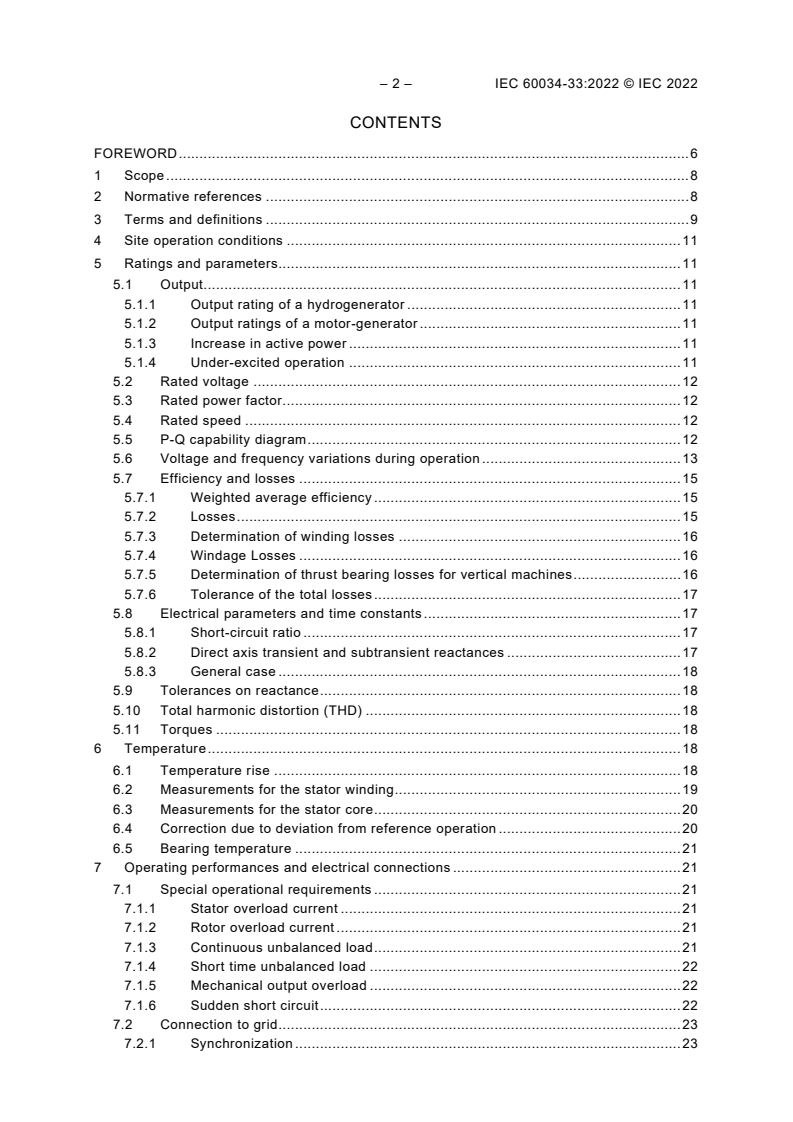
CONTENTS
FOREWORD . 6
1 Scope . 8
2 Normative references . 8
3 Terms and definitions . 9
4 Site operation conditions . 11
5 Ratings and parameters. 11
5.1 Output. 11
5.1.1 Output rating of a hydrogenerator . 11
5.1.2 Output ratings of a motor-generator . 11
5.1.3 Increase in active power . 11
5.1.4 Under-excited operation . 11
5.2 Rated voltage . 12
5.3 Rated power factor. 12
5.4 Rated speed . 12
5.5 P-Q capability diagram . 12
5.6 Voltage and frequency variations during operation . 13
5.7 Efficiency and losses . 15
5.7.1 Weighted average efficiency . 15
5.7.2 Losses . 15
5.7.3 Determination of winding losses . 16
5.7.4 Windage Losses . 16
5.7.5 Determination of thrust bearing losses for vertical machines . 16
5.7.6 Tolerance of the total losses . 17
5.8 Electrical parameters and time constants . 17
5.8.1 Short-circuit ratio . 17
5.8.2 Direct axis transient and subtransient reactances . 17
5.8.3 General case . 18
5.9 Tolerances on reactance . 18
5.10 Total harmonic distortion (THD) . 18
5.11 Torques . 18
6 Temperature . 18
6.1 Temperature rise . 18
6.2 Measurements for the stator winding . 19
6.3 Measurements for the stator core . 20
6.4 Correction due to deviation from reference operation . 20
6.5 Bearing temperature . 21
7 Operating performances and electrical connections . 21
7.1 Special operational requirements . 21
7.1.1 Stator overload current . 21
7.1.2 Rotor overload current . 21
7.1.3 Continuous unbalanced load . 21
7.1.4 Short time unbalanced load . 22
7.1.5 Mechanical output overload . 22
7.1.6 Sudden short circuit . 22
7.2 Connection to grid . 23
7.2.1 Synchronization . 23
7.2.2 Application of load . 23
7.3 Starting of motor-generator . 23
7.4 System earthing . 24
7.5 Neutral point leads . 25
7.6 Rotating direction and phase sequence . 25
7.7 Stator winding . 25
8 Winding insulation . 25
8.1 Winding insulation performance . 25
8.1.1 General . 25
8.1.2 Winding insulation resistance . 25
8.1.3 Dielectric dissipation factor measurements on new stator bars or coils . 26
8.1.4 Partial discharge measurements for stator winding . 27
8.1.5 Voltage withstand test for turn insulation of multi-turn coil for stator. 27
8.2 Voltage withstand tests . 27
8.2.1 Stator bars/coils . 27
8.2.2 Inserted stator bars/coils . 27
8.2.3 Stator winding completed before rotor inserted . 27
8.2.4 Field winding before delivery . 27
8.2.5 Field winding completed . 28
8.2.6 Stator winding for completed machine . 28
8.2.7 Field winding for completed machine . 28
8.2.8 DC alternative tests . 28
8.2.9 Global VPI stators . 28
8.3 Breakdown test for insulation . 28
8.4 Voltage endurance test for insulation . 29
8.5 Thermal cycle test . 30
8.6 Stator winding terminals . 30
9 Mechanical performances and design . 30
9.1 Rotating part mass moment of inertia . 30
9.2 Maximum speed . 30
9.3 Structural strength . 30
9.4 Critical bending speed . 31
9.5 Start and stop of motor-generators . 31
9.6 Start and stop of hydrogenerators . 31
9.7 Over speed . 31
9.8 Fatigue verification . 32
10 Core vibration . 32
11 Noise . 32
12 Basic structural requirements . 34
12.1 General layout . 34
12.1.1 Structure and general layout of the machines . 34
12.1.2 Machine components . 34
12.1.3 Hydraulic or pneumatic braking system . 34
12.1.4 Hydraulic jacking system . 34
12.1.5 Dynamical (electrical) braking . 34
12.2 Stator . 34
12.2.1 Frame and core structure . 34
12.2.2 Stator frame connecting structure . 35
– 4 – IEC 60034-33:2022 © IEC 2022
12.2.3 Stator end winding . 35
12.3 Rotor . 35
12.3.1 Damper winding . 35
12.3.2 Structure with one shaft or segmented shafts . 35
12.4 Structure tolerance . 35
12.5 Bearings . 35
12.5.1 Bearing alloy . 35
12.5.2 Bearing lubricant . 35
12.5.3 Shaft currents . 35
12.5.4 Bearing insulation resistance . 36
13 Ventilation and cooling system . 36
13.1 Cooling scheme . 36
13.1.1 General . 36
13.1.2 Air cooling system . 36
13.1.3 Evaporative cooling system . 36
13.1.4 Water cooling system . 36
13.2 Redundancy on the design of coolers and motor fans . 37
13.3 Cooling structure . 37
13.3.1 Materials . 37
13.3.2 Water supply and drainage . 37
13.3.3 Cooling water pressure . 37
14 Instrumentation required for protection and control . 37
14.1 General . 37
14.2 Stator and bearing temperature. 37
14.3 Bearing vibration and shaft displacement . 38
15 Condition monitoring of machines . 38
15.1 General . 38
15.2 Instrumentation required for condition monitoring . 39
16 Marking . 39
16.1 Information to be marked on machine nameplate: . 39
16.2 Repaired or refurbished machines. 40
17 Factory and site tests . 40
Annex A (informative) Special tools . 41
Annex B (informative) Correction of measured windage losses on the machines . 42
Annex C (informative) Correction of measured bearing losses for different oil bath
temperatures . 45
Annex D (informative) Scope of supply . 47
Annex E (informative) Test run and guaranteed period . 48
E.1 72 h test run . 48
E.2 15~30-day examination test run for motor-generators . 48
E.3 Handover and guarantee period . 48
Annex F (informative) Test items . 49
F.1 Inspection test for hydrogenerator and motor-generator in factory . 49
F.2 Site routine test of hydrogenerator and motor-generator . 49
F.3 Startup test run of hydrogenerator and motor-generator . 50
F.4 Performance test of hydrogenerator . 50
Annex G (informative) Condition monitoring . 51
G.1 Air gap distance . 51
G.2 Core and frame vibration . 51
G.3 Stator end winding vibration . 51
G.4 Partial discharge . 51
G.5 Air gap magnetic flux . 52
G.6 Others. 52
Bibliography . 53
Figure 1 – P-Q capability in p.u. . 13
Figure 2 – Voltage and frequency limits for hydro machines . 14
Figure 3 – Location of measuring points in the horizontal plane . 33
Table 1 – Preferred speed for 50 Hz machines . 12
Table 2 – Preferred speed for 60 Hz machines . 12
Table 3 – Reference temperature . 16
Table 4 – Temperature rise limits . 19
Table 5 – Permitted overload current multiple vs. time duration . 21
Table 6 – Permitted negative phase sequence current for the machines . 22
Table 7 – Permitted negative phase sequence current for the machines . 22
Table 8 – Material properties for grounding connectors . 24
Table 9 – Test voltage for insulating resistance measurement . 26
Table 10 – Dielectric dissipation factor. 26
Table 11 – Testing values for voltage withstand test of field winding . 28
Table 12 – Test voltage and time limits . 29
Table 13 – Limits for vibration in the core . 32
Table 14 – Temperature sensor locations . 38
Table A.1 – Special tools . 41
– 6 – IEC 60034-33:2022 © IEC 2022
INTERNATIONAL ELECTROTECHNICAL COMMISSION
____________
ROTATING ELECTRICAL MACHINES –
Part 33: Synchronous hydrogenerators including motor-generators –
Specific requirements
FOREWORD
1) The International Electrotechnical Commission (IEC) is a worldwide organization for standardization comprising
all national electrotechnical committees (IEC National Committees). The object of IEC is to promote international
co-operation on all questions concerning standardization in the electrical and electronic fields. To this end and
in addition to other activities, IEC publishes International Standards, Technical Specifications, Technical Reports,
Publicly Available Specifications (PAS) and Guides (hereafter referred to as “IEC Publication(s)”). Their
preparation is entrusted to technical committees; any IEC National Committee interested in the subject dealt with
may participate in this preparatory work. International, governmental and non-governmental organizations liaising
with the IEC also participate in this preparation. IEC collaborates closely with the International Organization for
Standardization (ISO) in accordance with conditions determined by agreement between the two organizations.
2) The formal decisions or agreements of IEC on technical matters express, as nearly as possible, an international
consensus of opinion on the relevant subjects since each technical committee has representation from all
interested IEC National Committees.
3) IEC Publications have the form of recommendations for international use and are accepted by IEC National
Committees in that sense. While all reasonable efforts are made to ensure that the technical content of IEC
Publications is accurate, IEC cannot be held responsible for the way in which they are used or for any
misinterpretation by any end user.
4) In order to promote international uniformity, IEC National Committees undertake to apply IEC Publications
transparently to the maximum extent possible in their national and regional publications. Any divergence between
any IEC Publication and the corresponding national or regional publication shall be clearly indicated in the latter.
5) IEC itself does not provide any attestation of conformity. Independent certification bodies provide conformity
assessment services and, in some areas, access to IEC marks of conformity. IEC is not responsible for any
services carried out by independent certification bodies.
6) All users should ensure that they have the latest edition of this publication.
7) No liability shall attach to IEC or its directors, employees, servants or agents including individual experts and
members of its technical committees and IEC National Committees for any personal injury, property damage or
other damage of any nature whatsoever, whether direct or indirect, or for costs (including legal fees) and
expenses arising out of the publication, use of, or reliance upon, this IEC Publication or any other IEC
Publications.
8) Attention is drawn to the Normative references cited in this publication. Use of the referenced publications is
indispensable for the correct application of this publication.
9) Attention is drawn to the possibility that some of the elements of this IEC Publication may be the subject of patent
rights. IEC shall not be held responsible for identifying any or all such patent rights.
IEC 60034-33 has been prepared by IEC technical committee 2: Rotating machinery. It is an
International Standard.
The text of this International Standard is based on the following documents:
Draft Report on voting
2/2081/FDIS 2/2088/RVD
Full information on the voting for its approval can be found in the report on voting indicated in
the above table.
The language used for the development of this International Standard is English.
This document was drafted in accordance with ISO/IEC Directives, Part 2, and developed in
accordance with ISO/IEC Directives, Part 1 and ISO/IEC Directives, IEC Supplement, available
at www.iec.ch/members_experts/refdocs. The main document types developed by IEC are
described in greater detail at www.iec.ch/standardsdev/publications.
A list of all parts in the IEC 60034 series, published under the general title Rotating electrical
machines, can be found on the IEC website.
The committee has decided that the contents of this document will remain unchanged until the
stability date indicated on the IEC website under webstore.iec.ch in the data related to the
specific document. At this date, the document will be
• reconfirmed,
• withdrawn,
• replaced by a revised edition, or
• amended.
– 8 – IEC 60034-33:2022 © IEC 2022
ROTATING ELECTRICAL MACHINES –
Part 33: Synchronous hydrogenerators including motor-generators –
Specific requirements
1 Scope
This part of IEC 60034 applies to three-phase salient-pole synchronous generators and
synchronous motor-generators for hydraulic turbine and pump-turbine applications, that have
rated frequency of 50 Hz or 60 Hz, rated output of 10 MVA and above, pole pair number 3 and
above, and rated voltage of 6 kV and above.
This document supplements basic requirements for rotating machines given in IEC 60034-1.
2 Normative references
The following documents are referred to in the text in such a way that some or all of their content
constitutes requirements of this document. For dated references, only the edition cited applies.
For undated references, the latest edition of the referenced document (including any
amendments) applies.
IEC 60034-1, Rotating electrical machines – Part 1: Rating and performance
IEC 60034-2-1, Rotating electrical machines – Part 2-1: Standard methods for determining
losses and efficiency from tests (excluding machines for traction vehicles)
IEC 60034-2-2, Rotating electrical machines – Part 2-2: Specific methods for determining
separate losses of large machines from tests – Supplement to IEC 60034-2-1
IEC 60034-4-1, Rotating electrical machines – Part 4-1: Methods for determining electrically
excited synchronous machine quantities from tests
IEC 60034-15, Rotating electrical machines – Part 15: Impulse voltage withstand levels of form-
wound stator coils for rotating a.c. machines
IEC 60034-18-1, Rotating electrical machines – Part 18-1: Functional evaluation of insulation
systems – General guidelines
IEC 60034-18-32, Rotating electrical machines – Part 18-32: Functional evaluation of insulation
systems – Test procedures for form-wound windings – Evaluation by electrical endurance
IEC TS 60034-18-33, Rotating electrical machines – Part 18-33: Functional evaluation of
insulation systems – Test procedures for form-wound windings – Multifactor evaluation by
endurance under simultaneous thermal and electrical stresses
IEC 60034-27-1, Rotating electrical machines – Part 27-1: Off-line partial discharge
measurements on the winding insulation
IEC 60034-27-3, Rotating electrical machines – Part 27-3: Dielectric dissipation factor
measurement on stator winding insulation of rotating electrical machines
IEC 60034-27-4, Rotating electrical machines – Part 27-4: Measurement of insulation
resistance and polarization index of winding insulation of rotating electrical machines
IEC 60050-411, International Electrotechnical Vocabulary (IEV) – Part 411: Rotating machinery
IEC 60060-1, High-voltage test techniques – Part 1: General definitions and test requirements
IEC 60085, Electrical insulation – Thermal evaluation and designation
IEC 60287-3-1, Electric cables – Calculation of the current rating – Part 3-1: Operating
conditions – Site reference conditions
IEC 60417:2002, Graphical symbols for use on equipment – 12-month subscription to regularly
updated online database comprising all graphical symbols published in IEC 60417
IEC 60445, Basic and safety principles for man-machine interface, marking and identification –
Identification of equipment terminals, conductor terminations and conductors
IEC 63132-1, Guidance for installation procedures and tolerances of hydroelectric machines –
Part 1: General aspects
IEC 63132-2, Guidance for installation procedures and tolerances of hydroelectric machines –
Part 2: Vertical generators
ISO 20816-1, Mechanical vibration – Measurement and evaluation of machine vibration – Part 1:
General guidelines
ISO 20816-5, Mechanical vibration – Measurement and evaluation of machine vibration – Part 5:
Machine sets in hydraulic power generating and pump-storage plants
EN 50522:2010, Earthing of power installations exceeding 1 kV a.c.
IEEE Std 1043™:1996, IEEE Recommended practice for voltage-endurance testing of form-
wound bars and coils
IEEE Std 1310™:2012, IEEE Recommended practice for thermal cycle for voltage-endurance
testing of form-wound bars and coils for large rotating machines
IEEE Std 1553™:2002, IEEE Trial-use standard for voltage-endurance testing of form-wound
coils and bars for hydrogenerators
3 Terms and definitions
For the purposes of this document, the terms and definitions given in IEC 60034-1,
IEC 60034‑2-1, IEC 60034-2-2, IEC 60050-411 and IEC 63132-1, as well as the following apply.
3.1
hydrogenerator
synchronous machine operated as generator and driven by a hydraulic turbine
3.2
motor-generator
synchronous machine which can operate in motor mode and generator mode, generally used in
pumped-storage power plant
– 10 – IEC 60034-33:2022 © IEC 2022
3.3
stator concentricity
radial distance from the reference centre to the best centre of stator bore
3.4
rotor concentricity
radial distance from the reference centre to the best centre of rotor outer circle
3.5
stator circularity
difference between the maximum and minimum radii, measured from the best centre of stator
bore
3.6
rotor circularity
difference between the maximum and minimum radii, measured from the best centre of rotor
outer circle
3.7
Air gap
3.7.1
nominal air gap
design air gap value between stator inner surface and rotor at the centre of poleshoe at rated
conditions
3.7.2
static air gap
air gap at standstill and in cold condition after full load rejection
Note 1 to entry: This value is used for the purposes of IEC 63132-1 and IEC 63132-2.
3.8
stress control coating
paint or tape on the surface of the main insulation that extends beyond the conductive slot
portion coating in high-voltage stator bars and coils
3.9
condenser
heat exchanger device by which cooling medium is changed to liquid phase from vapour in
evaporative cooling circulation system
3.10
grid
public electrical network or a local (e.g. industrial) network which is connected to the machine
either directly or through a transformer
3.11
SFC starting
operating mode in which synchronous machine is started in motor mode by the method of
regulating power frequency, using static frequency converter (SFC) as variable-frequency
power supply
3.12
back to back starting
synchronous starting method in which one machine is started in motor mode, driven by the
other electric connected machine that is started in generator mode
4 Site operation conditions
The machines shall be able to operate continuously at rated conditions (MVA, MW, voltage,
frequency and power factor) at the following site operation conditions:
a) The altitude does not exceed 1 000 m above sea level (based on coupling elevation for
vertical machine, centre line of shaft for horizontal machine);
b) The cooling air temperature (primary coolant) does not exceed 40 °C;
c) The inlet water temperature (secondary coolant) of air coolers, oil coolers and heat
exchangers (e.g. of direct water cooled stator windings) is not higher than 25 °C and not
less than 5 °C;
d) The inlet water temperature (primary coolant) of direct water cooled stator windings shall be
30 °C to 40 °C, the water conductivity is in the range of 0,4 μS/cm to 2,0 μS/cm, the pH
value is 6,5 to 9,0, and the hardness is less than 2 μmol/l, at 25 °C of water temperature;
e) Relative humidity in powerhouse (generator floor) does not exceed 85 %;
f) Installed in covered powerhouse on proper foundation;
g) Structural strength of machine shall meet the requirement of seismic accelerations at the
location. Appropriate design measures shall be taken to prevent harmful damage to the
machine. The acceleration value may be different for different regions due to the local
geographical condition. The acceleration values in horizontal direction and vertical direction
shall be defined as a technical condition according to the seismic grade at the location by
the purchaser.
Site conditions different from the above shall be agreed between purchaser and manufacturer.
5 Ratings and parameters
5.1 Output
5.1.1 Output rating of a hydrogenerator
The output rating of a hydrogenerator is the apparent power (in MVA) or the active power (in
MW), available continuously at the stator terminals (main leads) at rated frequency, voltage and
power factor.
5.1.2 Output ratings of a motor-generator
The output ratings of a motor-generator include two parts:
a) The apparent power (in MVA) or the active power (in MW), available continuously at the
stator terminals (main leads) at rated frequency, voltage and power factor during generator
mode;
b) Mechanical output power (in MW) available continuously at the shaft during motor mode.
5.1.3 Increase in active power
By agreement between purchaser and manufacturer, it is allowed to increase active power of
hydrogenerators to rated output (apparent power) by increasing power factor up to 1,0.
5.1.4 Under-excited operation
Hydrogenerators and motor-generators when operating in generator mode shall be able to
operate continuously in under-excited mode at power factor 0,9 with rated active power at rated
voltage.
– 12 – IEC 60034-33:2022 © IEC 2022
5.2 Rated voltage
The rated voltage (line to line voltage U at stator terminals) of the machine shall be defined
N
by purchaser and manufacturer according to rated output, rated speed of machine, as well as
other conditions in the system.
5.3 Rated power factor
The power factor shall be agreed upon between purchaser and manufacturer. Preferred rated
power factors at generator terminals are 0,85; 0,875; 0,9; 0,925 or 0,95 overexcited.
Rated power factor of motor-generators in motor mode shall be defined as a design condition
by purchaser.
5.4 Rated speed
The rated speed (1/min) shall be:
for 50 Hz machines;
3000 p
for 60 Hz machines.
3600 p
where p is the number of pole pairs.
NOTE The preferred speeds in Table 1 and Table 2 are convenient to design electrical symmetric and balanced
windings for the machines.
Table 1 – Preferred speed for 50 Hz machines
Unit: 1/min
1 000 750 600 500 428,6 375 333,3 300 250
214,3 200 187,5 166,7 150 142,9 136,4 125 115,4
107,1 100 93,8 88,2 83,3 75 71,4 68,2 62,5
Table 2 – Preferred speed for 60 Hz machines
Unit: 1/min
1 200 900 720 600 514,3 450 400 360 300
257,1 240 225 200 180 171,5 163,7 150 138,5
128,5 120 112,6 105,8 100 90 85,7 81,8 75
5.5 P-Q capability diagram
The manufacturer shall supply a P-Q capability diagram indicating the limits of operation as
shown in Figure 1, where:
– Curve A represents operation limits with rated stator current and constant apparent power
output, which is restricted by temperature rise of the stator winding;
– Curve B represents operation limits with rated field current, which is restricted by
temperature rise of the field winding;
– Curve C1 and C2 indicate the theoretical and practical limits set by the effects of end region
heating, steady-state stability, etc.
– Curve D indicates the limits of minimum excitation current to prevent instability issues
(usually defined by a minimum excitation current of 10 % of the no-load excitation current);
– Curve E indicates the reluctance circle. Although possible, the operation within the
reluctance circle needs special care and a special design of the excitation and control
systems.
Figure 1 – P-Q capability in p.u.
NOTE Figure 1 shows the limitation of the electrical machine only and does not consider operational limitation of
the hydraulic machine.
5.6 Voltage and frequency variations during operation
For generators and motor-generators, combinations of steady state voltage variation and
frequency variation are classified as being either zone A or zone B (maximum case outside of
zone A), in accordance with Figure 2.
Synchronous hydrogenerators and synchronous motor-generators shall be capable of delivering
continuous rated output at the rated power factor, over the ranges of ±5 % in voltage and ±2 %
in frequency, as defined by the shaded area of Figure 2 (zone A), but need not fully comply with
its performance at rated voltage and frequency (see rated point in Figure 2), and may exhibit
some deviations. Temperature rises may be higher than the condition for rated voltage and
frequency.
The temperature rise or temperature limits in accordance with this document, such as Table 4,
apply at the rated point only and may progressively be exceeded as the operating point moves
away from the rated point. For conditions at the extreme boundaries of zone A, the temperature
rises and temperature typically exceed the limits specified in this document.
A machine shall be capable of operation within zone B, and reaching the rated output, but will
exhibit greater deviations from its performance at rated voltage and frequency than in zone A.
Temperature rises will be higher than at rated voltage and frequency and most likely will be
higher than those in zone A. Temperature limits for insulation systems may be exceeded.
Extended operation at the perimeter of zone B is not recommended at all.
– 14 – IEC 60034-33:2022 © IEC 2022
Excursions into zone B shall be limited in value, duration no longer than 10 min, recurrence not
below 6 h and fr
...