

IEC 61851-21-2:2018
(Main)Electric vehicle conductive charging system - Part 21-2: Electric vehicle requirements for conductive connection to an AC/DC supply - EMC requirements for off board electric vehicle charging systems
General Information
- Abstract
IEC 61851-21-2:2018 defines the EMC requirements for any off-board components or equipment of such systems used to supply or charge electric vehicles with electric power by conductive power transfer (CPT), with a rated input voltage, according to IEC 60038:2009, up to 1 000 V AC or 1 500 V DC and an output voltage up to 1 000 V AC or 1 500 V DC.
This document covers off-board charging equipment for mode 1, mode 2, mode 3 and mode 4 charging as defined in IEC 61851-1:2017.
This first edition, together with IEC 61851-21-1, cancels and replaces IEC 61851-21:2001. It constitutes a technical revision.
This edition includes the following significant technical changes with respect to IEC 61851‑21:2001:
a) this document addresses now only EMC related tests instead of other electrical tests;
b) Clauses 2 and 3 have been updated;
c) the port definition, the test-setups and their corresponding limits as well as the operation modes are defined more precisely;
d) Annexes A to F have been added.
- Status
- Published
- Publication Date
- 17-Apr-2018
- Technical Committee
- TC 69 - Electrical power/energy transfer systems for electrically propelled road vehicles and industrial trucks
- Drafting Committee
- WG 4 - TC 69/WG 4
- Current Stage
- PPUB - Publication issued
- Start Date
- 18-Apr-2018
- Completion Date
- 05-Jan-2018
Buy Documents
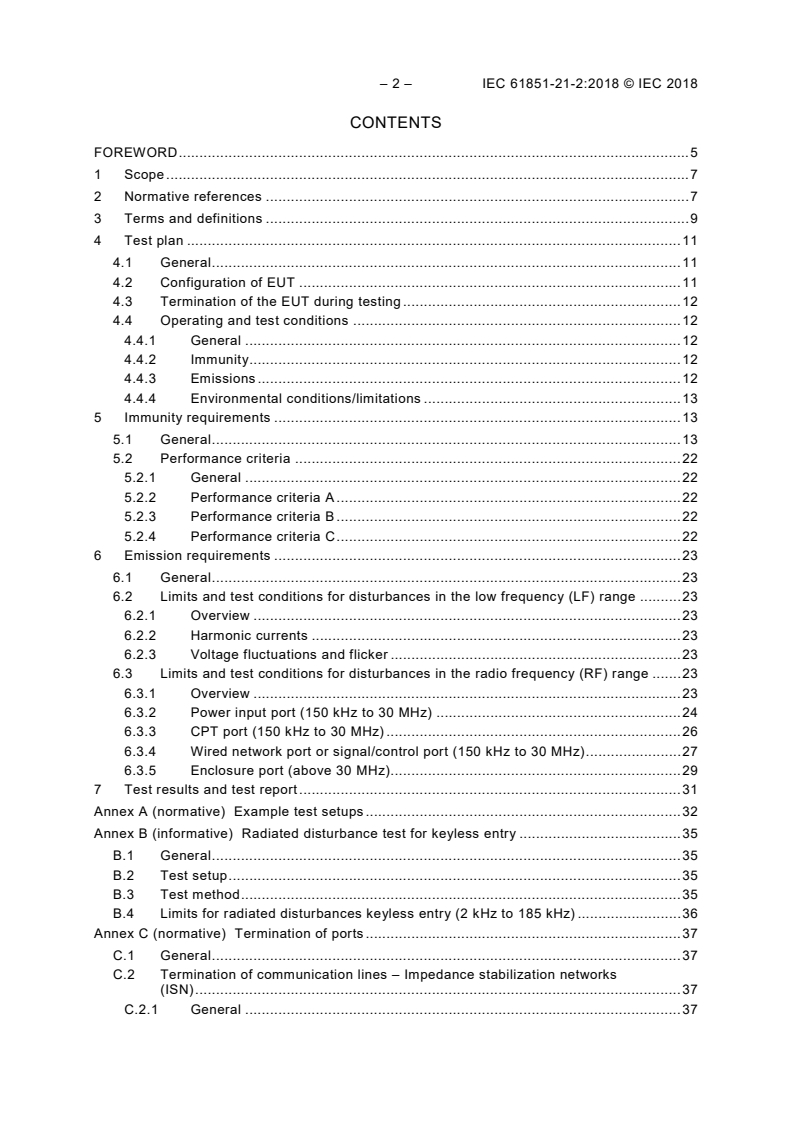
IEC 61851-21-2:2018 - Electric vehicle conductive charging system - Part 21-2: Electric vehicle requirements for conductive connection to an AC/DC supply - EMC requirements for off board electric vehicle charging systems Released:4/18/2018
IEC 61851-21-2:2018 - Electric vehicle conductive charging system - Part 21-2: Electric vehicle requirements for conductive connection to an AC/DC supply - EMC requirements for off board electric vehicle charging systems Released:1/30/2019
Overview
IEC 61851-21-2:2018 is an international standard published by the International Electrotechnical Commission (IEC) that specifies electromagnetic compatibility (EMC) requirements for off-board equipment used in the conductive charging of electric vehicles (EVs). The standard applies to charging equipment supplied by an AC or DC supply, operating at input voltages up to 1,000 V AC or 1,500 V DC, covering all currently defined charging modes (mode 1 to mode 4) as outlined in IEC 61851-1:2017. The focus is strictly on off-board charging systems, ensuring they meet essential EMC emission and immunity criteria to minimize electromagnetic interference (EMI) and maintain the safety and functionality of both the charging infrastructure and nearby electronic systems.
Key Topics
- Scope of EMC Testing: The standard specifies requirements only for off-board (external to the vehicle) EV charging equipment involved in conductive power transfer (CPT). On-board vehicle equipment is covered by a separate standard (IEC 61851-21-1).
- EMC Requirements: Addresses both emission (outward electromagnetic energy) and immunity (resilience to external disturbances), tailored for different environmental settings (residential, commercial/industrial).
- Testing Procedures:
- Defines test setups, operating modes, and conditions for accurate EMC assessment.
- Requires tests in both “waiting mode” (system powered, not charging) and “charge mode” (active charging) at specified power levels.
- Port Definitions: Clear specification of equipment ports (power input, CPT port, signal/control port, wired network port, and enclosure port), ensuring comprehensive EMC coverage.
- Annexes: Provides practical examples of test setups, handling of communication and termination devices, and specific EMC considerations for DC charging and keyless entry systems.
- Technical Revision: Supersedes IEC 61851-21:2001, focusing exclusively on EMC aspects and clarifying port/test definitions.
Applications
Implementing IEC 61851-21-2:2018 brings significant value to various stakeholders in the electric vehicle ecosystem:
- Manufacturers of EV Charging Equipment: Ensures products meet the latest international EMC standards, required for European and global market entry.
- System Integrators and Installers: Provides clarity on installation practices to avoid EMC-related faults and ensures reliable, uninterrupted charging operations in all settings (home, commercial, public, industrial).
- Testing Laboratories: Supplies detailed guidance on test procedures, setups, and criteria for type testing and certification.
- Urban Planners and Utilities: Facilitates the deployment of charging infrastructure with minimal impact on local environments, reducing the risk of interference with grid operations or nearby residential electronics.
- Regulatory Bodies and Inspectors: Establishes a clear benchmark for compliance audits and market surveillance.
By adhering to IEC 61851-21-2:2018, the industry guarantees that off-board EV charging stations operate safely, efficiently, and compatibly with existing electronic environments, reducing EMI-related risks for end users and neighboring devices.
Related Standards
Several standards interconnect to ensure a comprehensive framework for electric vehicle charging systems:
- IEC 61851-1:2017 - General requirements for electric vehicle conductive charging systems.
- IEC 61851-21-1 - EMC requirements for on-board charging equipment.
- IEC 61851-23 - DC charging stations for electric vehicles.
- IEC 60038:2009 - Standard voltages.
- IEC 61000 series - Core EMC standards specifying generic and specific emission/immunity requirements and test methodologies.
- CISPR 16 series - Radio disturbance and immunity measuring apparatus and methods.
- IEC 61980 (all parts) - Wireless power transfer (WPT) systems for electric vehicles (when dealing with inductive or wireless charging).
Together, these standards ensure the safe, reliable, and harmonized roll-out of electric vehicle charging infrastructure worldwide, covering both product-level requirements and system integration needs.
Keywords: IEC 61851-21-2, electric vehicle charging, EMC requirements, off-board charging, conductive charging, emission limits, immunity testing, charging infrastructure, international standards, electric vehicle supply equipment (EVSE).
Relations
- Effective Date
- 05-Sep-2023
Buy Documents
IEC 61851-21-2:2018 - Electric vehicle conductive charging system - Part 21-2: Electric vehicle requirements for conductive connection to an AC/DC supply - EMC requirements for off board electric vehicle charging systems Released:4/18/2018
IEC 61851-21-2:2018 - Electric vehicle conductive charging system - Part 21-2: Electric vehicle requirements for conductive connection to an AC/DC supply - EMC requirements for off board electric vehicle charging systems Released:1/30/2019
Get Certified
Connect with accredited certification bodies for this standard

TÜV Rheinland
TÜV Rheinland is a leading international provider of technical services.

TÜV SÜD
TÜV SÜD is a trusted partner of choice for safety, security and sustainability solutions.

DEKRA Certification Inc.
DEKRA US certification services.
Sponsored listings
Frequently Asked Questions
IEC 61851-21-2:2018 is a standard published by the International Electrotechnical Commission (IEC). Its full title is "Electric vehicle conductive charging system - Part 21-2: Electric vehicle requirements for conductive connection to an AC/DC supply - EMC requirements for off board electric vehicle charging systems". This standard covers: IEC 61851-21-2:2018 defines the EMC requirements for any off-board components or equipment of such systems used to supply or charge electric vehicles with electric power by conductive power transfer (CPT), with a rated input voltage, according to IEC 60038:2009, up to 1 000 V AC or 1 500 V DC and an output voltage up to 1 000 V AC or 1 500 V DC. This document covers off-board charging equipment for mode 1, mode 2, mode 3 and mode 4 charging as defined in IEC 61851-1:2017. This first edition, together with IEC 61851-21-1, cancels and replaces IEC 61851-21:2001. It constitutes a technical revision. This edition includes the following significant technical changes with respect to IEC 61851‑21:2001: a) this document addresses now only EMC related tests instead of other electrical tests; b) Clauses 2 and 3 have been updated; c) the port definition, the test-setups and their corresponding limits as well as the operation modes are defined more precisely; d) Annexes A to F have been added.
IEC 61851-21-2:2018 defines the EMC requirements for any off-board components or equipment of such systems used to supply or charge electric vehicles with electric power by conductive power transfer (CPT), with a rated input voltage, according to IEC 60038:2009, up to 1 000 V AC or 1 500 V DC and an output voltage up to 1 000 V AC or 1 500 V DC. This document covers off-board charging equipment for mode 1, mode 2, mode 3 and mode 4 charging as defined in IEC 61851-1:2017. This first edition, together with IEC 61851-21-1, cancels and replaces IEC 61851-21:2001. It constitutes a technical revision. This edition includes the following significant technical changes with respect to IEC 61851‑21:2001: a) this document addresses now only EMC related tests instead of other electrical tests; b) Clauses 2 and 3 have been updated; c) the port definition, the test-setups and their corresponding limits as well as the operation modes are defined more precisely; d) Annexes A to F have been added.
IEC 61851-21-2:2018 is classified under the following ICS (International Classification for Standards) categories: 33.100.10 - Emission; 43.120 - Electric road vehicles. The ICS classification helps identify the subject area and facilitates finding related standards.
IEC 61851-21-2:2018 has the following relationships with other standards: It is inter standard links to IEC 61851-21:2001. Understanding these relationships helps ensure you are using the most current and applicable version of the standard.
IEC 61851-21-2:2018 is available in PDF format for immediate download after purchase. The document can be added to your cart and obtained through the secure checkout process. Digital delivery ensures instant access to the complete standard document.
Standards Content (Sample)
IEC 61851-21-2 ®
Edition 1.0 2018-04
INTERNATIONAL
STANDARD
Electric vehicle conductive charging system –
Part 21-2: Electric vehicle requirements for conductive connection to an AC/DC
supply – EMC requirements for off-board electric vehicle charging systems
All rights reserved. Unless otherwise specified, no part of this publication may be reproduced or utilized in any form
or by any means, electronic or mechanical, including photocopying and microfilm, without permission in writing from
either IEC or IEC's member National Committee in the country of the requester. If you have any questions about IEC
copyright or have an enquiry about obtaining additional rights to this publication, please contact the address below or
your local IEC member National Committee for further information.
IEC Central Office Tel.: +41 22 919 02 11
3, rue de Varembé Fax: +41 22 919 03 00
CH-1211 Geneva 20 info@iec.ch
Switzerland www.iec.ch
About the IEC
The International Electrotechnical Commission (IEC) is the leading global organization that prepares and publishes
International Standards for all electrical, electronic and related technologies.
About IEC publications
The technical content of IEC publications is kept under constant review by the IEC. Please make sure that you have the
latest edition, a corrigenda or an amendment might have been published.
IEC Catalogue - webstore.iec.ch/catalogue Electropedia - www.electropedia.org
The stand-alone application for consulting the entire The world's leading online dictionary of electronic and
bibliographical information on IEC International Standards, electrical terms containing 20 000 terms and definitions in
Technical Specifications, Technical Reports and other English and French, with equivalent terms in 16 additional
documents. Available for PC, Mac OS, Android Tablets and languages. Also known as the International Electrotechnical
iPad. Vocabulary (IEV) online.
IEC publications search - www.iec.ch/searchpub IEC Glossary - std.iec.ch/glossary
The advanced search enables to find IEC publications by a 65 000 electrotechnical terminology entries in English and
variety of criteria (reference number, text, technical French extracted from the Terms and Definitions clause of
committee,…). It also gives information on projects, replaced IEC publications issued since 2002. Some entries have been
and withdrawn publications. collected from earlier publications of IEC TC 37, 77, 86 and
CISPR.
IEC Just Published - webstore.iec.ch/justpublished
Stay up to date on all new IEC publications. Just Published IEC Customer Service Centre - webstore.iec.ch/csc
details all new publications released. Available online and If you wish to give us your feedback on this publication or
also once a month by email. need further assistance, please contact the Customer Service
Centre: csc@iec.ch.
IEC 61851-21-2 ®
Edition 1.0 2018-04
INTERNATIONAL
STANDARD
Electric vehicle conductive charging system –
Part 21-2: Electric vehicle requirements for conductive connection to an AC/DC
supply – EMC requirements for off-board electric vehicle charging systems
INTERNATIONAL
ELECTROTECHNICAL
COMMISSION
ICS 33.100.10; 43.120 ISBN 978-2-8322-5123-2
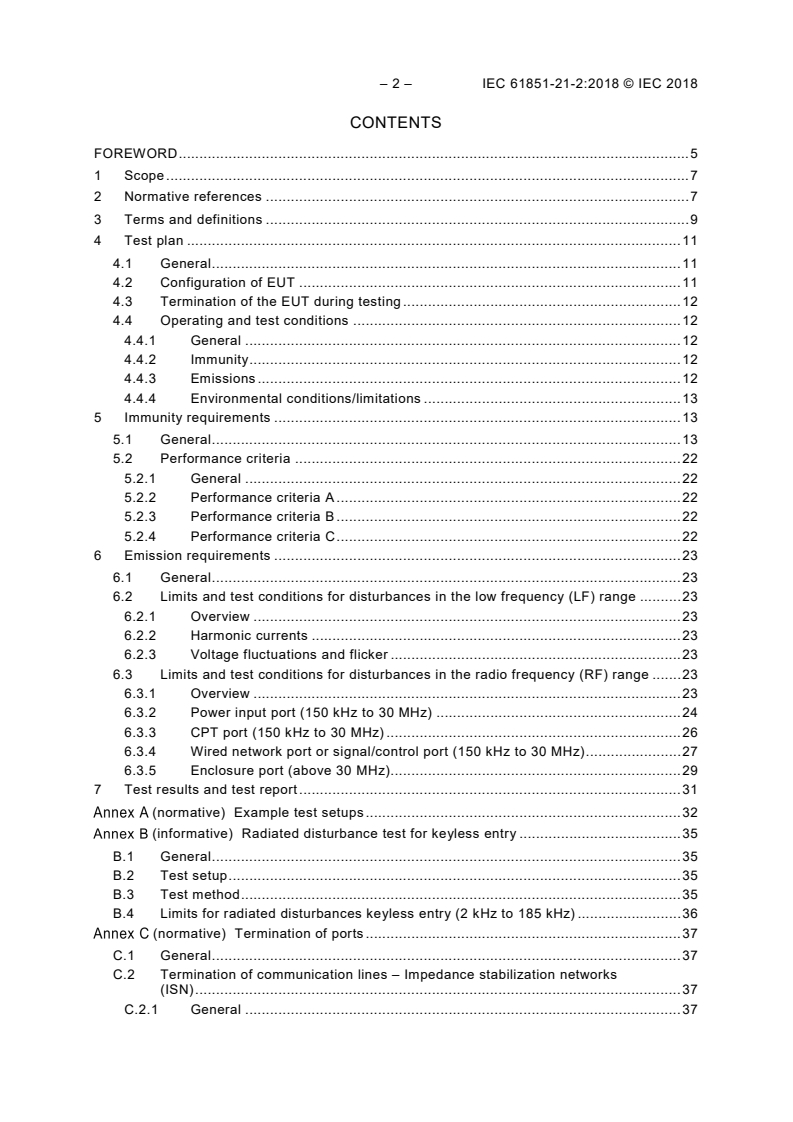
– 2 – IEC 61851-21-2:2018 © IEC 2018
CONTENTS
FOREWORD . 5
1 Scope . 7
2 Normative references . 7
3 Terms and definitions . 9
4 Test plan . 11
4.1 General . 11
4.2 Configuration of EUT . 11
4.3 Termination of the EUT during testing . 12
4.4 Operating and test conditions . 12
4.4.1 General . 12
4.4.2 Immunity . 12
4.4.3 Emissions . 12
4.4.4 Environmental conditions/limitations . 13
5 Immunity requirements . 13
5.1 General . 13
5.2 Performance criteria . 22
5.2.1 General . 22
5.2.2 Performance criteria A . 22
5.2.3 Performance criteria B . 22
5.2.4 Performance criteria C . 22
6 Emission requirements . 23
6.1 General . 23
6.2 Limits and test conditions for disturbances in the low frequency (LF) range . 23
6.2.1 Overview . 23
6.2.2 Harmonic currents . 23
6.2.3 Voltage fluctuations and flicker . 23
6.3 Limits and test conditions for disturbances in the radio frequency (RF) range . 23
6.3.1 Overview . 23
6.3.2 Power input port (150 kHz to 30 MHz) . 24
6.3.3 CPT port (150 kHz to 30 MHz) . 26
6.3.4 Wired network port or signal/control port (150 kHz to 30 MHz) . 27
6.3.5 Enclosure port (above 30 MHz) . 29
7 Test results and test report . 31
Annex A (normative) Example test setups . 32
Annex B (informative) Radiated disturbance test for keyless entry . 35
B.1 General . 35
B.2 Test setup . 35
B.3 Test method . 35
B.4 Limits for radiated disturbances keyless entry (2 kHz to 185 kHz) . 36
Annex C (normative) Termination of ports . 37
C.1 General . 37
C.2 Termination of communication lines – Impedance stabilization networks
(ISN) . 37
C.2.1 General . 37
C.2.2 Symmetric communication lines (e.g. CAN) . 37
C.2.3 Coupling devices for PLC on power lines . 39
C.2.4 PLC (technology) on control pilot . 40
C.3 Coupling and termination devices for other communication and signalling
lines . 41
Annex D (normative) Voltage transient disturbances from DC charging equipment . 42
Annex E (normative) Voltage surge test setup for DC charging EUT . 44
Annex F (informative) Transient immunity test for DC charging EUT . 46
Bibliography . 47
Figure 1 – Examples of ports of off- board charging equipment . 10
Figure A.1 – Example test setup for floor standing equipment for radiated and
conducted emission and immunity . 33
Figure A.2 – Example test setup for table top and wall mounted equipment for emission
and immunity . 34
Figure B.1 – Example of a test setup for measurement of radiated disturbances to
keyless entry (layout and spacing for the loop sensor) . 36
Figure C.1 – Example of an impedance stabilization network for symmetric
communication lines . 38
Figure C.2 – Example of a circuit for emission tests of PLC on AC or DC power lines . 39
Figure C.3 – Example of a circuit for immunity tests of PLC on AC or DC power lines . 39
Figure C.4 – Example of a circuit for emission tests of PLC on control pilot line . 40
Figure C.5 – Example of a circuit for immunity tests of PLC on control pilot line . 41
Figure C.6 – Example of a termination circuit for testing of system A . 41
Figure D.1 – Voltage transient of DC charging EUT . 42
Figure D.2 – Voltage transient measurement equipment . 43
Figure E.1 – Example of transient test setup . 45
Table 1 – AC charging immunity requirements – Environments other than residential . 14
Table 2 – AC charging immunity requirements – Residential environments . 16
Table 3 – DC charging immunity requirements – Environments other than residential . 18
Table 4 – DC charging immunity requirements – Residential environments . 20
Table 5 – References for evaluation of low frequency (LF) phenomena . 23
Table 6 – References for evaluation of disturbances appearing in the radio frequency
(RF) range . 24
Table 7 – Disturbance voltage limits for class A equipment for AC power input port . 25
Table 8 – Disturbance voltage limits for class B equipment for AC power input port . 25
Table 9 – Disturbance voltage limits for DC power input port . 26
Table 10 – Disturbance voltage limits for class A equipment for AC CPT port . 26
Table 11 – Disturbance voltage limits for class B equipment for AC CPT port . 26
Table 12 – Disturbance voltage limits for DC CPT port . 27
Table 13 – Requirements for asymmetric mode conducted emissions from Class A
equipment . 28
Table 14 – Requirements for asymmetric mode conducted emissions from Class B
equipment . 29
Table 15 – Required highest frequency for radiated measurement . 29
– 4 – IEC 61851-21-2:2018 © IEC 2018
Table 16 – Requirements for radiated emissions at frequencies up to 1 GHz for Class
A equipment . 30
Table 17 – Requirements for radiated emissions at frequencies above 1 GHz for Class
A equipment . 30
Table 18 – Requirements for radiated emissions at frequencies up to 1 GHz for Class
B equipment . 31
Table 19 – Requirements for radiated emissions at frequencies above 1 GHz for Class
B equipment . 31
Table B.1 – Limit values of radiated disturbances (2 kHz to 185 kHz) . 36
Table C.1 – Termination of ports . 37
Table D.1 – Voltage transient limit of EUT . 42
Table E.1 – Maximum voltage to be measured on the CPT . 44
INTERNATIONAL ELECTROTECHNICAL COMMISSION
____________
ELECTRIC VEHICLE CONDUCTIVE CHARGING SYSTEM –
Part 21-2: Electric vehicle requirements for conductive connection to
an AC/DC supply – EMC requirements for off-board electric
vehicle charging systems
FOREWORD
1) The International Electrotechnical Commission (IEC) is a worldwide organization for standardization comprising
all national electrotechnical committees (IEC National Committees). The object of IEC is to promote
international co-operation on all questions concerning standardization in the electrical and electronic fields. To
this end and in addition to other activities, IEC publishes International Standards, Technical Specifications,
Technical Reports, Publicly Available Specifications (PAS) and Guides (hereafter referred to as "IEC
Publication(s)"). Their preparation is entrusted to technical committees; any IEC National Committee interested
in the subject dealt with may participate in this preparatory work. International, governmental and non-
governmental organizations liaising with the IEC also participate in this preparation. IEC collaborates closely
with the International Organization for Standardization (ISO) in accordance with conditions determined by
agreement between the two organizations.
2) The formal decisions or agreements of IEC on technical matters express, as nearly as possible, an international
consensus of opinion on the relevant subjects since each technical committee has representation from all
interested IEC National Committees.
3) IEC Publications have the form of recommendations for international use and are accepted by IEC National
Committees in that sense. While all reasonable efforts are made to ensure that the technical content of IEC
Publications is accurate, IEC cannot be held responsible for the way in which they are used or for any
misinterpretation by any end user.
4) In order to promote international uniformity, IEC National Committees undertake to apply IEC Publications
transparently to the maximum extent possible in their national and regional publications. Any divergence
between any IEC Publication and the corresponding national or regional publication shall be clearly indicated in
the latter.
5) IEC itself does not provide any attestation of conformity. Independent certification bodies provide conformity
assessment services and, in some areas, access to IEC marks of conformity. IEC is not responsible for any
services carried out by independent certification bodies.
6) All users should ensure that they have the latest edition of this publication.
7) No liability shall attach to IEC or its directors, employees, servants or agents including individual experts and
members of its technical committees and IEC National Committees for any personal injury, property damage or
other damage of any nature whatsoever, whether direct or indirect, or for costs (including legal fees) and
expenses arising out of the publication, use of, or reliance upon, this IEC Publication or any other IEC
Publications.
8) Attention is drawn to the Normative references cited in this publication. Use of the referenced publications is
indispensable for the correct application of this publication.
9) Attention is drawn to the possibility that some of the elements of this IEC Publication may be the subject of
patent rights. IEC shall not be held responsible for identifying any or all such patent rights.
International Standard IEC 61851-21-2 has been prepared by IEC technical committee 69:
Electric road vehicles and electric industrial trucks.
This first edition, together with IEC 61851-21-1, cancels and replaces IEC 61851-21:2001. It
constitutes a technical revision.
This edition includes the following significant technical changes with respect to
IEC 61851-21:2001:
a) this document addresses now only EMC related tests instead of other electrical tests;
b) Clauses 2 and 3 have been updated;
c) the port definition, the test-setups and their corresponding limits as well as the operation
modes are defined more precisely;
– 6 – IEC 61851-21-2:2018 © IEC 2018
d) Annexes A to F have been added.
The text of this International Standard is based on the following documents:
FDIS Report on voting
69/531/FDIS 69/545/RVD
Full information on the voting for the approval of this International Standard can be found in
the report on voting indicated in the above table.
This document has been drafted in accordance with the ISO/IEC Directives, Part 2.
A list of all parts of the IEC 61851 series, published under the general title Electric vehicle
conductive charging system, can be found on the IEC website.
The committee has decided that the contents of this document will remain unchanged until the
stability date indicated on the IEC website under "http://webstore.iec.ch" in the data related to
the specific document. At this date, the document will be
• reconfirmed,
• withdrawn,
• replaced by a revised edition, or
• amended.
A bilingual version of this publication may be issued at a later date.
ELECTRIC VEHICLE CONDUCTIVE CHARGING SYSTEM –
Part 21-2: Electric vehicle requirements for conductive connection to
an AC/DC supply – EMC requirements for off-board electric
vehicle charging systems
1 Scope
This part of IEC 61851 defines the EMC requirements for any off-board components or
equipment of such systems used to supply or charge electric vehicles with electric power by
conductive power transfer (CPT), with a rated input voltage, according to IEC 60038:2009, up
to 1 000 V AC or 1 500 V DC and an output voltage up to 1 000 V AC or 1 500 V DC.
This document covers off-board charging equipment for mode 1, mode 2, mode 3 and mode 4
charging as defined in IEC 61851-1:2017.
Cables where there is no electronics or no electric/electronic switching are considered as
passive (benign) and are deemed to comply with the emission and immunity requirements of
this document without any need for testing.
This document does not apply to any on-board components or equipment of charging or
power supply systems being part of the vehicles. The EMC requirements for such equipment
are covered by IEC 61851-21-1: 2017.
Compliance with the emission and immunity requirements of this document is verified where it
can be demonstrated that the equipment under test (EUT) meets the respective limits, during
type tests in the measuring arrangement of this document.
Requirements for electric vehicle wireless power transfer (WPT) systems are covered in
IEC 61980 (all parts).
2 Normative references
The following documents are referred to in the text in such a way that some or all of their
content constitutes requirements of this document. For dated references, only the edition
cited applies. For undated references, the latest edition of the referenced document (including
any amendments) applies.
IEC 61851-1:2017, Electric vehicle conductive charging system – Part 1: General
requirements
IEC 61851-23:2014, Electric vehicle conductive charging system – Part 23: DC electric
vehicle charging station
IEC 60038:2009, IEC standard voltages
IEC 62053-21:2003, Electricity metering equipment (a.c.) – Particular requirements – Part 21:
Static meters for active energy (classes 1 and 2)
IEC 61000-3-2:2014, Electromagnetic compatibility (EMC) – Part 3-2: Limits – Limits for
harmonic current emissions (equipment input current ≤ 16 A per phase)
– 8 – IEC 61851-21-2:2018 © IEC 2018
IEC 61000-3-3:2013, Electromagnetic compatibility (EMC) – Part 3-3: Limits – Limitation of
voltage changes, voltage fluctuations and flicker in public low-voltage supply systems, for
equipment with rated current ≤ 16 A per phase and not subject to conditional connexion
IEC 61000-3-11:2017, Electromagnetic compatibility (EMC) – Part 3-11 – Limits – Limitation
of voltage changes, voltage fluctuations and flicker in public low-voltage supply systems –
Equipment with rated current ≤ 75 A and subject to conditional connection
IEC 61000-3-12:2011, Electromagnetic compatibility (EMC) – Part 3-12 – Limits – Limits for
harmonic currents produced by equipment connected to public low-voltage systems with input
current > 16 A and ≤ 75 A per phase
IEC 61000-4-2:2008, Electromagnetic compatibility (EMC) – Part 4-2: Testing and
measurement techniques – Electrostatic discharge immunity test
IEC 61000-4-3:2006, Electromagnetic compatibility (EMC) – Part 4-3: Testing and
measurement techniques – Radiated, radio-frequency, electromagnetic field immunity test
IEC 61000-4-3:2006/AMD1:2007
IEC 61000-4-3:2006/AMD2:2010
IEC 61000-4-4:2012, Electromagnetic compatibility (EMC) – Part 4-4: Testing and
measurement techniques – Electrical fast transient/burst immunity test
IEC 61000-4-5:2014, Electromagnetic compatibility (EMC) – Part 4-5: Testing and
measurement techniques – Surge immunity test
IEC 61000-4-5:2014/AMD1:2017
IEC 61000-4-6:2013, Electromagnetic compatibility (EMC) – Part 4-6: Testing and
measurement techniques – Immunity to conducted disturbances, induced by radio-frequency
fields
IEC 61000-4-8:2009, Electromagnetic compatibility (EMC) – Part 4-8: Testing and
measurement techniques – Power frequency magnetic field immunity test
IEC 61000-4-11:2004, Electromagnetic compatibility (EMC) – Part 4-11: Testing and
measurement techniques – Voltage dips, short interruptions and voltage variations immunity
tests
IEC 61000-4-11:2004/AMD1:2017
IEC 61000-4-34:2005, Electromagnetic compatibility (EMC) – Part 4-34: Testing and
measurement techniques – Voltage dips, short interruptions and voltage variations immunity
tests for equipment with input current more than 16 A per phase
IEC 61000-4-34:2005/AMD1:2009
IEC 61000-6-1:2016, Electromagnetic compatibility (EMC) – Part 6-1: Generic standards –
Immunity standard for residential, commercial and light-industrial environments
IEC 61000-6-2:2016, Electromagnetic compatibility (EMC) – Part 6-2: Generic standards –
Immunity standard for industrial environments
IEC 61000-6-3:2006, Electromagnetic compatibility (EMC) – Part 6-3: Generic standards –
Emission standard for residential, commercial and light-industrial environments
IEC 61000-6-3:2006/AMD1:2010
IEC 61000-6-4:2006, Electromagnetic compatibility (EMC) – Part 6-4: Generic standards –
Emission standard for industrial environments
IEC 61000-6-4:2006/AMD1:2010
CISPR 16-1-2:2014, Specification for radio disturbance and immunity measuring apparatus
and methods – Part 1-2: Radio disturbance and immunity measuring apparatus – Coupling
devices for conducted disturbance measurements
CISPR 16-1-4:2010, Specification for radio disturbance and immunity measuring apparatus
and methods – Part 1-4: Radio disturbance and immunity measuring apparatus – Antennas
and test sites for radiated disturbance measurements
CISPR 16-1-4:2010/AMD1:2012
CISPR 16-1-4:2010/AMD2:2017
CISPR 25:2008, Vehicles, boats and internal combustion engines – Radio disturbance
characteristics – Limits and methods of measurement for the protection of on-board
receivers
CISPR 32:2015, Electromagnetic compatibility of multimedia equipment – Emission
requirements
MIL-STD-461F:2007, Department of Defense interface standard requirements for the control
of electromagnetic interference characteristics of subsystems and equipment
3 Terms and definitions
For the purposes of this document, the terms and definitions given in IEC 61851-1 and the
following apply.
ISO and IEC maintain terminological databases for use in standardization at the following
addresses:
• IEC Electropedia: available at http://www.electropedia.org/
• ISO Online browsing platform: available at http://www.iso.org/obp
3.1
associated equipment
AE
equipment needed to exercise and/or monitor the operation of the EUT
3.2
port
particular interface of the specified apparatus with external electromagnetic environment
Note 1 to entry: See Figure 1.
____________
rd rd th
3 edition (2008). This 3 edition has been replaced in 2016 by a 4 edition CISPR 25:2016, Vehicles, boats
and internal combustion engines - Radio disturbance characteristics - Limits and methods of measurement for
the protection of on-board receivers.
– 10 – IEC 61851-21-2:2018 © IEC 2018
Enclosure port
Power input port
AE
EUT
Signal/control port ISN, AN or
CPT port
vehicle
off board
simulators
charging
and/or
Wired network port
equipment
appropriate
resistive loads
IEC
Figure 1 – Examples of ports of off- board charging equipment
3.3
enclosure port
physical boundary of the apparatus through which electromagnetic fields may radiate or
impinge on
[SOURCE: IEC 60050-445:2010, 445-07-04, modified – The words "time relay" have been
replaced by "apparatus".]
3.4
power input port
input port at which a conductor or cable carrying the electrical power needed for the operation
(functioning) of an apparatus or associated apparatus is connected to the apparatus
Note 1 to entry: A power input port can be AC or DC.
3.5
wired network port
port of connection for voice, data and signaling transfers intended to interconnect widely
dispersed systems by direct connection to a single-user or multi-user communication network
Note 1 to entry: Examples of these include CATV, PSTN, ISDN, xDSL, LAN and similar networks.
Note 2 to entry: These ports can support screened or unscreened cables and can also carry AC or DC power
where this is an integral part of the telecommunication specification.
[SOURCE: CISPR 32:2015, 3.1.32]
3.6
signal/control port
port at which a cable or conductor is connected for the purpose of transmission of signals
excluding wired network and CPT ports
Note 1 to entry: Examples include RS-232, Universal Serial Bus (USB), High-Definition Multimedia Interface
(HDMI), IEEE Standard 1394 ("Fire Wire"), analogue/digital input/outputs.
Note 2 to entry: An example of a control port is a port used to start the charging operation when a signal indicates
that the energy tariff is lower and/or charging is delayed for energy management purposes.
3.7
conductive power transfer port
CPT port
power output port of charging equipment for electric vehicles serving conductive power
transfer (CPT) of LV AC or DC electrical energy to the secondary device of the charging
system (i.e. to the load to be charged or supplied with power) and also providing all required
signaling/controlling and/or communication functions, for example control pilot, CAN and
private PLC/T
3.8
equipment under test
EUT
off-board components or equipment of systems that are used to supply or charge electric
vehicles with electric power by conductive power transfer (CPT) which are covered by the
scope of this document
3.9
powerline telecommunication
PLT
powerline communication
PLC
signal transmission technology used for connection to a wire-line PSTN (public switched
telephone network) via the LV AC (or DC) mains grid
Note 1 to entry: PLT/C is a transmission technology used for communications, data transfer, signaling/controlling
and similar purposes in private and/or local area networks via a variety of types of power lines such as charger
cables of off-board charging equipment for electric vehicles.
3.10
portable equipment
cord and plug connected equipment, cable assembly, adaptors or other accessories that are
capable to be carried by one person and designed and intended to be carried within the EV
[SOURCE: IEC 61851-1:2017, 3.6.5]
3.11
high voltage
HV
operating voltage between 60 V to 1 000 V
Note 1 to entry: The term "high voltage" may be defined with a different voltage range in other standards.
3.12
low voltage
LV
operating DC voltage below 60 V, for example nominal voltages of 12 V, 24 V or 48 V
Note 1 to entry: The term "low voltage" may be defined with a different voltage range in other standards.
4 Test plan
4.1 General
An EMC test plan shall be established prior to testing. It shall contain, as a minimum, the
elements given in Clause 4.
4.2 Configuration of EUT
All tests shall be carried out using a representative EUT and charge cable (at the conductive
power transfer port – CPT port) to the AE/vehicle simulator as supplied by the manufacturer.
Where the charge cable is not provided with the EUT (e.g. case B according to
IEC 61851-1:2017), tests shall be performed with a typical length and geometry of the charge
cable.
The contents of the standards referenced in this document are not repeated here; however
modifications or additional information needed for practical application of the measurements
of EUT’s is given in this document.
– 12 – IEC 61851-21-2:2018 © IEC 2018
The tests shall be carried out within the specified operating range of the EUT and at its rated
supply voltage.
Test setups according to Annex A shall be used for the immunity and emission tests above
150 kHz.
In-cable control and protection devices (IC-CPDs), other portable equipment and mode 2
equipment shall be tested as per table top equipment.
4.3 Termination of the EUT during testing
All ports of the EUT shall be terminated with ANs/ISN or respectively CDNs as appropriate.
The power input port, signal control port and wired network port shall be terminated according
to Annex C.
The CPT port of the EUT shall be connected to the associated equipment (AE) covering the
artificial networks (ANs) and/or impedance stabilization networks (ISNs) according to Annex C
forming the vehicle simulator and connecting to an appropriate load.
The signalling/control lines of the CPT port shall be terminated according to Annex C and
provide communication by respective simulation and fed in via suitable coupling devices.
4.4 Operating and test conditions
4.4.1 General
The following measurements and assessments may be performed in any order.
4.4.2 Immunity
The immunity requirements are specified in Table 1, Table 2, Table 3 and Table 4 according
to the type of power input (AC or DC) and environmental classification (residential or non-
residential) of the EUT to be tested.
Testing shall be performed in the following two operating modes:
• waiting mode: to simulate when the EUT is fully powered up and connected to a vehicle
but not charging (for example, when the batteries are fully charged or if waiting for the
power grid to decide when to charge);
• charge mode: during testing, the EUT shall be operated at 20 % of the maximum rated
power ±10 %. If this is not possible according to IEC 61851-1:2017, the percentage may
be raised.
It has been considered that no assessment is required when no load is connected since
waiting mode adequately addresses this mode of operation.
In-cable control and protection devices (IC-CPD) shall be tested as off-board AC charging
equipment.
The mode of operation shall be specified and the actual conditions, during the tests, shall be
precisely noted in the test report.
4.4.3 Emissions
Emission requirements are specified in Table 7 to Table 14 and Table 16 to Table 19.
Testing shall be performed in the following operating modes:
• 20 % of maximum rated power ±10 % (if this is not possible according to
IEC 61851-1:2017 the percentage may be raised); and
• 80 % of maximum rated power ±10 %; or
• with any load allowing the operation of the electrical vehicle supply equipment (EVSE), if
the power input and output are directly connected in charge mode (mode 2 and mode 3
EVSE using mechanical switching devices). In this special case, testing with 20 % and
80 % is not necessary.
For low frequency phenomena (Table 5), tests shall be performed in accordance with the
applicable product family standards (IEC 61000-3-X series).
The operating mode for testing according to 6.2.3 shall be one complete charge cycle with all
outlets.
During the test time, all power output ports (CPT ports) shall be controlled according to the
procedure described here:
• the single outlets/CPT ports shall be started/set in charge mode one by one (sequentially);
• all outlets/CPT ports shall be operated in charge mode simultaneously;
• the single outlets/CPT ports shall be stopped one by one (sequentially).
If parallel operation is not possible the power outputs shall be operated one by one
(sequentially) in the test time. The power output (CPT port) shall operate with a constant load,
and the power input of the EUT shall reach at least 80 % of maximum rated power ±10 %
during testing.
If communication over control pilot circuits or other signal lines (e.g. powerline communication
– PLC) is used between the EUT and the vehicle, for example to control the charging, tests
shall be performed with the worst case communication signals, for example with (highest)
data rates according to the manufacturer’s specification.
If the data rate is limited by the EUT, this maximum data rate shall be used for testing.
4.4.4 Environmental conditions/limitations
This document has been prepared taking into account the normal EMC environments for all
types of EUTs. By their very nature however, EUTs can be used and installed in a variety of
locations. This document covers all residential, commercial, light industrial (see
IEC 61000-6-1:2016, and IEC 61000-6-3:2006 and IEC 61000-6-3:2006/AMD1:2010) and
industrial environments (see IEC 61000-6-2:2005, and IEC 61000-6-4:2006 and
IEC 61000-6-4:2006/AMD1:2010) irrespective of whether the equipment is located indoor or
outdoor. Where the EUT manufacturer does not define the environment in which the EUT is
intended to be used, the most stringent emission and immunity tests shall be performed (i.e.
the lowest emission limits and highest immunity test levels shall be applied).
5 Immunity requirements
5.1 General
In addition to the normal EMC environments for all types of EUTs in the scope of the generic
EMC standards of IEC 61000-6 (all parts), the specific EUTs in the scope of this document
have a dedicated port (CPT port) to connect to electric vehicles (see Figure 1).
Testing shall be performed against one of the tables (Table 1, Table 2, Table 3 and Table 4)
as appropriate, based on the type of EUT and environment in which it is intended to be
operated (see also 4.4.4).
– 14 – IEC 61851-21-2:2018 © IEC 2018
All in-cable control and protection devices (IC-CPD) and other portable equipment shall meet
the immunity requirements for environments other than residential defined in Table 1 or
Table 3.
Table 1 – AC charging immunity requirements –
Environments other than residential
Port Test Phenomenon Basic standard Test Units Performance
applicability specification criteria
Enclosure Waiting and Electrostatic IEC 61000-4- ±4 (contact) kV B
charge mode discharge (ESD) 2:2008
±8 (Air) kV
c)
Radiated RF IEC 61000-4- 10 V/m A
fields 3:2006 and
80 to 1000 MHz
IEC 61000-4-
3:2006/AMD1:2007
80 % AM (1 kHz)
and IEC 61000-4-
3:2006/AMD2:2010
c)
IEC 61000-4- 3 V/m A
3:2006 and
1,4 to 2 GHz
IEC 61000-4-
3:2006/AMD1:2007
80 % AM (1 kHz)
and IEC 61000-4-
3:2006/AMD2:2010
c)
IEC 61000-4- 3 V/m A
3:2006 and
2 to 2,7 GHz
IEC 61000-4-
3:2006/AMD1:2007
80 % AM (1 kHz)
and IEC 61000-4-
3:2006/AMD2:2010
j)
Magnetic fields IEC 61000-4- 50, 60 Hz A
8:2009
30 (for A/m
systems ≤ 32 A)
A/m
100 (for
systems > 32 A)
Power Waiting and Electrical fast IEC 61000-4- ±4 kV B
input charge mode transients/ 4:2012
i) l)
5/50 Tr/Th, ns
(AC) bursts
repetition
frequency, kHz
j)
Voltage surges IEC 61000-4- 1,2/50 (8/20) µs B
l)
5:2014
a)
±4 kV
b)
±2 kV
c)
Conducted RF IEC 61000-4- 10 V (RMS) A
fields 6:2013
0,15 to 80 MHz
80 % AM (1 kHz)
e)
Voltage dips and IEC 61000-4- 40 % residual for 10/12 cycles B
interruptions 11:2004 (≤ 16 A) voltage at 50/60 Hz
e)
B
IEC 61000-4- 70 % residual for 25/30 cycles
e)
B
34:2005 and voltage at 50/60 Hz
IEC 61000-4-
C
0 % residual for 1 cycle at
34:2005/AMD1:200
voltage 50/60 Hz
9 (> 16 A)
0 % residual for 250/300
voltage cycles at 50/60
Hz
Wired Waiting and Electrical fast IEC 61000-4- ±2 kV B
network charge mode transients/ 4:2012
g) h)
5/50 Tr/Th, ns
and bursts
signal/
5 repetition
control
frequency, kHz
f)
Voltage surges IEC 61000-4- 1,2/50 (8/20) µs B
l)
5:2014
±1 kV
c)
Conducted RF IEC 61000-4- 10 V (RMS) A
g)
fields 6:2013
0,15 to 80 MHz
80 % AM (1 kHz)
Port Test Phenomenon Basic standard Test Units Performance
applicability specification criteria
CPT Waiting and Electrical fast IEC 61000-4- ±2 kV B
charge mode transients/bursts 4:2012
d) h)
5/50 Tr/Th ns
5 repetition
frequency, kHz
Voltage surges IEC 61000-4- 1,2/50 (8/20) µs B
d) f) j) m)
5:2014
a)
±2 kV
b)
±1 kV
c)
Conducted RF IEC 61000-4- 10 V (RMS) A
k)
fields 6:2013
0,15 to 80 MHz
80 % AM (1 kHz)
a)
Line to earth (ground), applicable to power lines only.
b)
Line to line, applicable to power lines only.
c)
The test level specified is the RMS value of the unmodulated carrier.
d)
Tests are not required if the power input and output are directly connected in charge mode using a mechanical switching
device.
e)
Primary functions may degrade during the test but shall resume to the original condition after the test.
f)
Applicable only to ports interfacing with cables whose total length according to the manufacturer’s functional specification
is greater than 30 m.
g)
Applicable only to ports interfacing with cables whose total length according to the manufacturer’s functional specification
is greater than 3 m.
h)
Tested using the capacitive coupling clamp defined in IEC 61000-4-4:2012; at the CPT port, the clamp shall be over the
whole charging cable.
i)
Test also applies to signal/control ports where they are directly connected to the power port (e.g. open relay contacts that
can be directly connected to the AC mains).
j)
Tests shall be done only in charge mode (surge: since surge protection devices wear out; magnetic field: charge current
has influence).
k)
Tested using the EM coupling clamp defined in IEC 61000-4-6:2013; at the CPT port, the clamp shall be over the whole
charging cable.
l)
For surge/burst testing, use a capable CDN.
m)
For surge on power lines of CPT port, use a capable CDN.
– 16 – IEC 61851-21-2:2018 © IEC 2018
Table 2 – AC charging immunity requirements –
Residential environments
Port Test Phenomenon Basic standard Test Units Performance
applicability specification criteria
Enclosure Waiting and Electrostatic IEC 61000-4- ±4 (contact) kV B
charge mode discharge (ESD) 2:2008
±8 (air) kV
c)
Radiated RF IEC 61000-4- 3 V/m A
fields 3:2006 and
80 to 1000 MHz
IEC 61000-4-
3:2006/AMD1:2007
80 % AM (1 kHz)
and IEC 61000-4-
3:2006/AMD2:2010
c)
IEC 61000-4- 3 V/m A
3:2006 and
1,4 to 2 GHz
IEC 61000-4-
3:2006/AMD1:2007
80 % AM (1 kHz)
and IEC 61000-4-
3:2006/AMD2:2010
c)
IEC 61000-4- 3 V/m A
3:2006 and
2 to 2,7 GHz
IEC 61000-4-
3:2006/AMD1:2007
80 % AM (1 kHz)
and IEC 61000-4-
3:2006/AMD2:2010
j)
Magnetic fields IEC 61000-4- 50, 60 Hz A
8:2009
30 (for A/m
systems ≤ 32 A)
A/m
100 (for
systems > 32 A)
Power Waiting and Electrical fast IEC 61000-4- ±2 kV B
input charge mode transients/bursts 4:2012
l)
i)
5/50 Tr/Th, ns
(AC)
5 repetition
frequency, kHz
j)
Voltage Surges IEC 61000-4- 1,2/50 (8/20) µs B
l)
5:2014
a)
±2 kV
b)
±1 kV
c)
Conducted RF IEC 61000-4- 3 V (RMS) A
fields 6:2013
0,15 to 80 MHz
80 % AM (1 kHz)
e)
Voltage dips and IEC 61000-4- 40 % residual for 10/12 B
interruptions 11:2004 (≤ 16 A) voltage cycles at
e)
B
50/60 Hz
IEC 61000-4- 70 % residual
e)
B
34:2005 and voltage for 25/30
IEC 61000-4- cycles at
C
0 % residual
34:2005/AMD1:200 50/60 Hz
voltage
9 (> 16 A)
for 1 cycle at
0 % residual
50/60 Hz
voltage
for 250/300
cycles at
50/60 Hz
Wired Waiting and Electrical fast IEC 61000-4- ±1 kV B
network charge mode transients/bursts 4:2012
g) h)
5/50 Tr/Th, ns
and
signal/co
5 repetition
ntrol
frequency, kHz
f)
Voltage surges IEC 61000-4- 1,2/50 (8/20) B
l) µs
5:2014
±1
kV
Conducted RF IEC 61000-4- 3 V (RMS) A
g)
fields 6:2013
0,15 to 80 MHz
80 % AM (1kHz)
CPT Waiting and Electrical fast IEC 61000-4- ±2 kV B
charge mode transients/bursts 4:2012
d) h)
5/50 Tr/Th ns
Port Test Phenomenon Basic standard Test Units Performance
applicability specif
...
IEC 61851-21-2 ®
Edition 1.0 2018-04
INTERNATIONAL
STANDARD
NORME
INTERNATIONALE
Electric vehicle conductive charging system –
Part 21-2: Electric vehicle requirements for conductive connection to an AC/DC
supply – EMC requirements for off-board electric vehicle charging systems
Système de charge par conduction pour véhicules électriques –
Partie 21-2: Exigences applicables aux véhicules électriques pour connexion par
conduction à une alimentation en courant alternatif ou courant continu –
Exigences CEM concernant les systèmes de charge non embarqués pour
véhicules électriques
All rights reserved. Unless otherwise specified, no part of this publication may be reproduced or utilized in any form
or by any means, electronic or mechanical, including photocopying and microfilm, without permission in writing from
either IEC or IEC's member National Committee in the country of the requester. If you have any questions about IEC
copyright or have an enquiry about obtaining additional rights to this publication, please contact the address below or
your local IEC member National Committee for further information.
Droits de reproduction réservés. Sauf indication contraire, aucune partie de cette publication ne peut être reproduite
ni utilisée sous quelque forme que ce soit et par aucun procédé, électronique ou mécanique, y compris la photocopie
et les microfilms, sans l'accord écrit de l'IEC ou du Comité national de l'IEC du pays du demandeur. Si vous avez des
questions sur le copyright de l'IEC ou si vous désirez obtenir des droits supplémentaires sur cette publication, utilisez
les coordonnées ci-après ou contactez le Comité national de l'IEC de votre pays de résidence.
IEC Central Office Tel.: +41 22 919 02 11
3, rue de Varembé info@iec.ch
CH-1211 Geneva 20 www.iec.ch
Switzerland
About the IEC
The International Electrotechnical Commission (IEC) is the leading global organization that prepares and publishes
International Standards for all electrical, electronic and related technologies.
About IEC publications
The technical content of IEC publications is kept under constant review by the IEC. Please make sure that you have the
latest edition, a corrigendum or an amendment might have been published.
IEC publications search - webstore.iec.ch/advsearchform Electropedia - www.electropedia.org
The advanced search enables to find IEC publications by a The world's leading online dictionary on electrotechnology,
variety of criteria (reference number, text, technical containing more than 22 000 terminological entries in English
committee,…). It also gives information on projects, replaced and French, with equivalent terms in 16 additional languages.
and withdrawn publications. Also known as the International Electrotechnical Vocabulary
(IEV) online.
IEC Just Published - webstore.iec.ch/justpublished
Stay up to date on all new IEC publications. Just Published IEC Glossary - std.iec.ch/glossary
details all new publications released. Available online and 67 000 electrotechnical terminology entries in English and
once a month by email. French extracted from the Terms and Definitions clause of
IEC publications issued since 2002. Some entries have been
IEC Customer Service Centre - webstore.iec.ch/csc collected from earlier publications of IEC TC 37, 77, 86 and
If you wish to give us your feedback on this publication or CISPR.
need further assistance, please contact the Customer Service
Centre: sales@iec.ch.
A propos de l'IEC
La Commission Electrotechnique Internationale (IEC) est la première organisation mondiale qui élabore et publie des
Normes internationales pour tout ce qui a trait à l'électricité, à l'électronique et aux technologies apparentées.
A propos des publications IEC
Le contenu technique des publications IEC est constamment revu. Veuillez vous assurer que vous possédez l’édition la
plus récente, un corrigendum ou amendement peut avoir été publié.
Recherche de publications IEC - Electropedia - www.electropedia.org
webstore.iec.ch/advsearchform Le premier dictionnaire d'électrotechnologie en ligne au
La recherche avancée permet de trouver des publications IEC monde, avec plus de 22 000 articles terminologiques en
en utilisant différents critères (numéro de référence, texte, anglais et en français, ainsi que les termes équivalents dans
comité d’études,…). Elle donne aussi des informations sur les 16 langues additionnelles. Egalement appelé Vocabulaire
projets et les publications remplacées ou retirées. Electrotechnique International (IEV) en ligne.
IEC Just Published - webstore.iec.ch/justpublished Glossaire IEC - std.iec.ch/glossary
Restez informé sur les nouvelles publications IEC. Just 67 000 entrées terminologiques électrotechniques, en anglais
Published détaille les nouvelles publications parues. et en français, extraites des articles Termes et Définitions des
Disponible en ligne et une fois par mois par email. publications IEC parues depuis 2002. Plus certaines entrées
antérieures extraites des publications des CE 37, 77, 86 et
Service Clients - webstore.iec.ch/csc CISPR de l'IEC.
Si vous désirez nous donner des commentaires sur cette
publication ou si vous avez des questions contactez-nous:
sales@iec.ch.
IEC 61851-21-2 ®
Edition 1.0 2018-04
INTERNATIONAL
STANDARD
NORME
INTERNATIONALE
Electric vehicle conductive charging system –
Part 21-2: Electric vehicle requirements for conductive connection to an AC/DC
supply – EMC requirements for off-board electric vehicle charging systems
Système de charge par conduction pour véhicules électriques –
Partie 21-2: Exigences applicables aux véhicules électriques pour connexion
par conduction à une alimentation en courant alternatif ou courant continu –
Exigences CEM concernant les systèmes de charge non embarqués pour
véhicules électriques
INTERNATIONAL
ELECTROTECHNICAL
COMMISSION
COMMISSION
ELECTROTECHNIQUE
INTERNATIONALE
ICS 33.100.10; 43.120 ISBN 978-2-8322-6521-5
– 2 – IEC 61851-21-2:2018 © IEC 2018
CONTENTS
FOREWORD . 5
1 Scope . 7
2 Normative references . 7
3 Terms and definitions . 9
4 Test plan . 11
4.1 General . 11
4.2 Configuration of EUT . 11
4.3 Termination of the EUT during testing . 12
4.4 Operating and test conditions . 12
4.4.1 General . 12
4.4.2 Immunity . 12
4.4.3 Emissions . 12
4.4.4 Environmental conditions/limitations . 13
5 Immunity requirements . 13
5.1 General . 13
5.2 Performance criteria . 22
5.2.1 General . 22
5.2.2 Performance criteria A . 22
5.2.3 Performance criteria B . 22
5.2.4 Performance criteria C . 22
6 Emission requirements . 23
6.1 General . 23
6.2 Limits and test conditions for disturbances in the low frequency (LF) range . 23
6.2.1 Overview . 23
6.2.2 Harmonic currents . 23
6.2.3 Voltage fluctuations and flicker . 23
6.3 Limits and test conditions for disturbances in the radio frequency (RF) range . 23
6.3.1 Overview . 23
6.3.2 Power input port (150 kHz to 30 MHz) . 24
6.3.3 CPT port (150 kHz to 30 MHz) . 26
6.3.4 Wired network port or signal/control port (150 kHz to 30 MHz) . 27
6.3.5 Enclosure port (above 30 MHz) . 29
7 Test results and test report . 31
(normative) Example test setups . 32
(informative) Radiated disturbance test for keyless entry . 35
B.1 General . 35
B.2 Test setup . 35
B.3 Test method . 35
B.4 Limits for radiated disturbances keyless entry (2 kHz to 185 kHz) . 36
(normative) Termination of ports . 37
C.1 General . 37
C.2 Termination of communication lines – Impedance stabilization networks
(ISN) . 37
C.2.1 General . 37
C.2.2 Symmetric communication lines (e.g. CAN) . 37
C.2.3 Coupling devices for PLC on power lines . 39
C.2.4 PLC (technology) on control pilot . 40
C.3 Coupling and termination devices for other communication and signalling
lines . 41
(normative) Voltage transient disturbances from DC charging equipment . 42
(normative) Voltage surge test setup for DC charging EUT . 44
(informative) Transient immunity test for DC charging EUT . 46
Bibliography . 47
Figure 1 – Examples of ports of off- board charging equipment . 10
Figure A.1 – Example test setup for floor standing equipment for radiated and
conducted emission and immunity . 33
Figure A.2 – Example test setup for table top and wall mounted equipment for emission
and immunity . 34
Figure B.1 – Example of a test setup for measurement of radiated disturbances to
keyless entry (layout and spacing for the loop sensor) . 36
Figure C.1 – Example of an impedance stabilization network for symmetric
communication lines . 38
Figure C.2 – Example of a circuit for emission tests of PLC on AC or DC power lines . 39
Figure C.3 – Example of a circuit for immunity tests of PLC on AC or DC power lines . 39
Figure C.4 – Example of a circuit for emission tests of PLC on control pilot line . 40
Figure C.5 – Example of a circuit for immunity tests of PLC on control pilot line . 41
Figure C.6 – Example of a termination circuit for testing of system A . 41
Figure D.1 – Voltage transient of DC charging EUT . 42
Figure D.2 – Voltage transient measurement equipment . 43
Figure E.1 – Example of transient test setup . 45
Table 1 – AC charging immunity requirements – Environments other than residential . 14
Table 2 – AC charging immunity requirements – Residential environments . 16
Table 3 – DC charging immunity requirements – Environments other than residential . 18
Table 4 – DC charging immunity requirements – Residential environments . 20
Table 5 – References for evaluation of low frequency (LF) phenomena . 23
Table 6 – References for evaluation of disturbances appearing in the radio frequency
(RF) range . 24
Table 7 – Disturbance voltage limits for class A equipment for AC power input port . 25
Table 8 – Disturbance voltage limits for class B equipment for AC power input port . 25
Table 9 – Disturbance voltage limits for DC power input port . 26
Table 10 – Disturbance voltage limits for class A equipment for AC CPT port . 26
Table 11 – Disturbance voltage limits for class B equipment for AC CPT port . 26
Table 12 – Disturbance voltage limits for DC CPT port . 27
Table 13 – Requirements for asymmetric mode conducted emissions from Class A
equipment . 28
Table 14 – Requirements for asymmetric mode conducted emissions from Class B
equipment . 29
Table 15 – Required highest frequency for radiated measurement . 29
– 4 – IEC 61851-21-2:2018 © IEC 2018
Table 16 – Requirements for radiated emissions at frequencies up to 1 GHz for Class
A equipment . 30
Table 17 – Requirements for radiated emissions at frequencies above 1 GHz for Class
A equipment . 30
Table 18 – Requirements for radiated emissions at frequencies up to 1 GHz for Class
B equipment . 31
Table 19 – Requirements for radiated emissions at frequencies above 1 GHz for Class
B equipment . 31
Table B.1 – Limit values of radiated disturbances (2 kHz to 185 kHz) . 36
Table C.1 – Termination of ports . 37
Table D.1 – Voltage transient limit of EUT . 42
Table E.1 – Maximum voltage to be measured on the CPT . 44
INTERNATIONAL ELECTROTECHNICAL COMMISSION
____________
ELECTRIC VEHICLE CONDUCTIVE CHARGING SYSTEM –
Part 21-2: Electric vehicle requirements for conductive connection to
an AC/DC supply – EMC requirements for off-board electric
vehicle charging systems
FOREWORD
1) The International Electrotechnical Commission (IEC) is a worldwide organization for standardization comprising
all national electrotechnical committees (IEC National Committees). The object of IEC is to promote
international co-operation on all questions concerning standardization in the electrical and electronic fields. To
this end and in addition to other activities, IEC publishes International Standards, Technical Specifications,
Technical Reports, Publicly Available Specifications (PAS) and Guides (hereafter referred to as "IEC
Publication(s)"). Their preparation is entrusted to technical committees; any IEC National Committee interested
in the subject dealt with may participate in this preparatory work. International, governmental and non-
governmental organizations liaising with the IEC also participate in this preparation. IEC collaborates closely
with the International Organization for Standardization (ISO) in accordance with conditions determined by
agreement between the two organizations.
2) The formal decisions or agreements of IEC on technical matters express, as nearly as possible, an international
consensus of opinion on the relevant subjects since each technical committee has representation from all
interested IEC National Committees.
3) IEC Publications have the form of recommendations for international use and are accepted by IEC National
Committees in that sense. While all reasonable efforts are made to ensure that the technical content of IEC
Publications is accurate, IEC cannot be held responsible for the way in which they are used or for any
misinterpretation by any end user.
4) In order to promote international uniformity, IEC National Committees undertake to apply IEC Publications
transparently to the maximum extent possible in their national and regional publications. Any divergence
between any IEC Publication and the corresponding national or regional publication shall be clearly indicated in
the latter.
5) IEC itself does not provide any attestation of conformity. Independent certification bodies provide conformity
assessment services and, in some areas, access to IEC marks of conformity. IEC is not responsible for any
services carried out by independent certification bodies.
6) All users should ensure that they have the latest edition of this publication.
7) No liability shall attach to IEC or its directors, employees, servants or agents including individual experts and
members of its technical committees and IEC National Committees for any personal injury, property damage or
other damage of any nature whatsoever, whether direct or indirect, or for costs (including legal fees) and
expenses arising out of the publication, use of, or reliance upon, this IEC Publication or any other IEC
Publications.
8) Attention is drawn to the Normative references cited in this publication. Use of the referenced publications is
indispensable for the correct application of this publication.
9) Attention is drawn to the possibility that some of the elements of this IEC Publication may be the subject of
patent rights. IEC shall not be held responsible for identifying any or all such patent rights.
International Standard IEC 61851-21-2 has been prepared by IEC technical committee 69:
Electric road vehicles and electric industrial trucks.
This bilingual version (2019-01) corresponds to the monolingual English version, published in
2018-04.
This first edition, together with IEC 61851-21-1, cancels and replaces IEC 61851-21:2001. It
constitutes a technical revision.
This edition includes the following significant technical changes with respect to
IEC 61851-21:2001:
a) this document addresses now only EMC related tests instead of other electrical tests;
b) Clauses 2 and 3 have been updated;
– 6 – IEC 61851-21-2:2018 © IEC 2018
c) the port definition, the test-setups and their corresponding limits as well as the operation
modes are defined more precisely;
d) Annexes A to F have been added.
The text of this International Standard is based on the following documents:
FDIS Report on voting
69/531/FDIS 69/545/RVD
Full information on the voting for the approval of this International Standard can be found in
the report on voting indicated in the above table.
The French version of this standard has not been voted upon.
This document has been drafted in accordance with the ISO/IEC Directives, Part 2.
A list of all parts of the IEC 61851 series, published under the general title Electric vehicle
conductive charging system, can be found on the IEC website.
The committee has decided that the contents of this document will remain unchanged until the
stability date indicated on the IEC website under "http://webstore.iec.ch" in the data related to
the specific document. At this date, the document will be
• reconfirmed,
• withdrawn,
• replaced by a revised edition, or
• amended.
ELECTRIC VEHICLE CONDUCTIVE CHARGING SYSTEM –
Part 21-2: Electric vehicle requirements for conductive connection to
an AC/DC supply – EMC requirements for off-board electric
vehicle charging systems
1 Scope
This part of IEC 61851 defines the EMC requirements for any off-board components or
equipment of such systems used to supply or charge electric vehicles with electric power by
conductive power transfer (CPT), with a rated input voltage, according to IEC 60038:2009, up
to 1 000 V AC or 1 500 V DC and an output voltage up to 1 000 V AC or 1 500 V DC.
This document covers off-board charging equipment for mode 1, mode 2, mode 3 and mode 4
charging as defined in IEC 61851-1:2017.
Cables where there is no electronics or no electric/electronic switching are considered as
passive (benign) and are deemed to comply with the emission and immunity requirements of
this document without any need for testing.
This document does not apply to any on-board components or equipment of charging or
power supply systems being part of the vehicles. The EMC requirements for such equipment
are covered by IEC 61851-21-1: 2017.
Compliance with the emission and immunity requirements of this document is verified where it
can be demonstrated that the equipment under test (EUT) meets the respective limits, during
type tests in the measuring arrangement of this document.
Requirements for electric vehicle wireless power transfer (WPT) systems are covered in
IEC 61980 (all parts).
2 Normative references
The following documents are referred to in the text in such a way that some or all of their
content constitutes requirements of this document. For dated references, only the edition
cited applies. For undated references, the latest edition of the referenced document (including
any amendments) applies.
IEC 61851-1:2017, Electric vehicle conductive charging system – Part 1: General
requirements
IEC 61851-23:2014, Electric vehicle conductive charging system – Part 23: DC electric
vehicle charging station
IEC 60038:2009, IEC standard voltages
IEC 62053-21:2003, Electricity metering equipment (a.c.) – Particular requirements – Part 21:
Static meters for active energy (classes 1 and 2)
IEC 61000-3-2:2014, Electromagnetic compatibility (EMC) – Part 3-2: Limits – Limits for
harmonic current emissions (equipment input current ≤ 16 A per phase)
– 8 – IEC 61851-21-2:2018 © IEC 2018
IEC 61000-3-3:2013, Electromagnetic compatibility (EMC) – Part 3-3: Limits – Limitation of
voltage changes, voltage fluctuations and flicker in public low-voltage supply systems, for
equipment with rated current ≤ 16 A per phase and not subject to conditional connexion
IEC 61000-3-11:2017, Electromagnetic compatibility (EMC) – Part 3-11 – Limits – Limitation
of voltage changes, voltage fluctuations and flicker in public low-voltage supply systems –
Equipment with rated current ≤ 75 A and subject to conditional connection
IEC 61000-3-12:2011, Electromagnetic compatibility (EMC) – Part 3-12 – Limits – Limits for
harmonic currents produced by equipment connected to public low-voltage systems with input
current > 16 A and ≤ 75 A per phase
IEC 61000-4-2:2008, Electromagnetic compatibility (EMC) – Part 4-2: Testing and
measurement techniques – Electrostatic discharge immunity test
IEC 61000-4-3:2006, Electromagnetic compatibility (EMC) – Part 4-3: Testing and
measurement techniques – Radiated, radio-frequency, electromagnetic field immunity test
IEC 61000-4-3:2006/AMD1:2007
IEC 61000-4-3:2006/AMD2:2010
IEC 61000-4-4:2012, Electromagnetic compatibility (EMC) – Part 4-4: Testing and
measurement techniques – Electrical fast transient/burst immunity test
IEC 61000-4-5:2014, Electromagnetic compatibility (EMC) – Part 4-5: Testing and
measurement techniques – Surge immunity test
IEC 61000-4-5:2014/AMD1:2017
IEC 61000-4-6:2013, Electromagnetic compatibility (EMC) – Part 4-6: Testing and
measurement techniques – Immunity to conducted disturbances, induced by radio-frequency
fields
IEC 61000-4-8:2009, Electromagnetic compatibility (EMC) – Part 4-8: Testing and
measurement techniques – Power frequency magnetic field immunity test
IEC 61000-4-11:2004, Electromagnetic compatibility (EMC) – Part 4-11: Testing and
measurement techniques – Voltage dips, short interruptions and voltage variations immunity
tests
IEC 61000-4-11:2004/AMD1:2017
IEC 61000-4-34:2005, Electromagnetic compatibility (EMC) – Part 4-34: Testing and
measurement techniques – Voltage dips, short interruptions and voltage variations immunity
tests for equipment with input current more than 16 A per phase
IEC 61000-4-34:2005/AMD1:2009
IEC 61000-6-1:2016, Electromagnetic compatibility (EMC) – Part 6-1: Generic standards –
Immunity standard for residential, commercial and light-industrial environments
IEC 61000-6-2:2016, Electromagnetic compatibility (EMC) – Part 6-2: Generic standards –
Immunity standard for industrial environments
IEC 61000-6-3:2006, Electromagnetic compatibility (EMC) – Part 6-3: Generic standards –
Emission standard for residential, commercial and light-industrial environments
IEC 61000-6-3:2006/AMD1:2010
IEC 61000-6-4:2006, Electromagnetic compatibility (EMC) – Part 6-4: Generic standards –
Emission standard for industrial environments
IEC 61000-6-4:2006/AMD1:2010
CISPR 16-1-2:2014, Specification for radio disturbance and immunity measuring apparatus
and methods – Part 1-2: Radio disturbance and immunity measuring apparatus – Coupling
devices for conducted disturbance measurements
CISPR 16-1-4:2010, Specification for radio disturbance and immunity measuring apparatus
and methods – Part 1-4: Radio disturbance and immunity measuring apparatus – Antennas
and test sites for radiated disturbance measurements
CISPR 16-1-4:2010/AMD1:2012
CISPR 16-1-4:2010/AMD2:2017
CISPR 25:2008, Vehicles, boats and internal combustion engines – Radio disturbance
characteristics – Limits and methods of measurement for the protection of on-board
receivers
CISPR 32:2015, Electromagnetic compatibility of multimedia equipment – Emission
requirements
MIL-STD-461F:2007, Department of Defense interface standard requirements for the control
of electromagnetic interference characteristics of subsystems and equipment
3 Terms and definitions
For the purposes of this document, the terms and definitions given in IEC 61851-1 and the
following apply.
ISO and IEC maintain terminological databases for use in standardization at the following
addresses:
• IEC Electropedia: available at http://www.electropedia.org/
• ISO Online browsing platform: available at http://www.iso.org/obp
3.1
associated equipment
AE
equipment needed to exercise and/or monitor the operation of the EUT
3.2
port
particular interface of the specified apparatus with external electromagnetic environment
Note 1 to entry: See Figure 1.
____________
rd rd th
3 edition (2008). This 3 edition has been replaced in 2016 by a 4 edition CISPR 25:2016, Vehicles, boats
and internal combustion engines - Radio disturbance characteristics - Limits and methods of measurement for
the protection of on-board receivers.
– 10 – IEC 61851-21-2:2018 © IEC 2018
Enclosure port
Power input port
AE
EUT
Signal/control port ISN, AN or
CPT port
vehicle
off board
simulators
charging
and/or
Wired network port
equipment
appropriate
resistive loads
IEC
Figure 1 – Examples of ports of off- board charging equipment
3.3
enclosure port
physical boundary of the apparatus through which electromagnetic fields may radiate or
impinge on
[SOURCE: IEC 60050-445:2010, 445-07-04, modified – The words "time relay" have been
replaced by "apparatus".]
3.4
power input port
input port at which a conductor or cable carrying the electrical power needed for the operation
(functioning) of an apparatus or associated apparatus is connected to the apparatus
Note 1 to entry: A power input port can be AC or DC.
3.5
wired network port
port of connection for voice, data and signaling transfers intended to interconnect widely
dispersed systems by direct connection to a single-user or multi-user communication network
Note 1 to entry: Examples of these include CATV, PSTN, ISDN, xDSL, LAN and similar networks.
Note 2 to entry: These ports can support screened or unscreened cables and can also carry AC or DC power
where this is an integral part of the telecommunication specification.
[SOURCE: CISPR 32:2015, 3.1.32]
3.6
signal/control port
port at which a cable or conductor is connected for the purpose of transmission of signals
excluding wired network and CPT ports
Note 1 to entry: Examples include RS-232, Universal Serial Bus (USB), High-Definition Multimedia Interface
(HDMI), IEEE Standard 1394 ("Fire Wire"), analogue/digital input/outputs.
Note 2 to entry: An example of a control port is a port used to start the charging operation when a signal indicates
that the energy tariff is lower and/or charging is delayed for energy management purposes.
3.7
conductive power transfer port
CPT port
power output port of charging equipment for electric vehicles serving conductive power
transfer (CPT) of LV AC or DC electrical energy to the secondary device of the charging
system (i.e. to the load to be charged or supplied with power) and also providing all required
signaling/controlling and/or communication functions, for example control pilot, CAN and
private PLC/T
3.8
equipment under test
EUT
off-board components or equipment of systems that are used to supply or charge electric
vehicles with electric power by conductive power transfer (CPT) which are covered by the
scope of this document
3.9
powerline telecommunication
PLT
powerline communication
PLC
signal transmission technology used for connection to a wire-line PSTN (public switched
telephone network) via the LV AC (or DC) mains grid
Note 1 to entry: PLT/C is a transmission technology used for communications, data transfer, signaling/controlling
and similar purposes in private and/or local area networks via a variety of types of power lines such as charger
cables of off-board charging equipment for electric vehicles.
3.10
portable equipment
cord and plug connected equipment, cable assembly, adaptors or other accessories that are
capable to be carried by one person and designed and intended to be carried within the EV
[SOURCE: IEC 61851-1:2017, 3.6.5]
3.11
high voltage
HV
operating voltage between 60 V to 1 000 V
Note 1 to entry: The term "high voltage" may be defined with a different voltage range in other standards.
3.12
low voltage
LV
operating DC voltage below 60 V, for example nominal voltages of 12 V, 24 V or 48 V
Note 1 to entry: The term "low voltage" may be defined with a different voltage range in other standards.
4 Test plan
4.1 General
An EMC test plan shall be established prior to testing. It shall contain, as a minimum, the
elements given in Clause 4.
4.2 Configuration of EUT
All tests shall be carried out using a representative EUT and charge cable (at the conductive
power transfer port – CPT port) to the AE/vehicle simulator as supplied by the manufacturer.
Where the charge cable is not provided with the EUT (e.g. case B according to
IEC 61851-1:2017), tests shall be performed with a typical length and geometry of the charge
cable.
The contents of the standards referenced in this document are not repeated here; however
modifications or additional information needed for practical application of the measurements
of EUT’s is given in this document.
– 12 – IEC 61851-21-2:2018 © IEC 2018
The tests shall be carried out within the specified operating range of the EUT and at its rated
supply voltage.
Test setups according to Annex A shall be used for the immunity and emission tests above
150 kHz.
In-cable control and protection devices (IC-CPDs), other portable equipment and mode 2
equipment shall be tested as per table top equipment.
4.3 Termination of the EUT during testing
All ports of the EUT shall be terminated with ANs/ISN or respectively CDNs as appropriate.
The power input port, signal control port and wired network port shall be terminated according
to Annex C.
The CPT port of the EUT shall be connected to the associated equipment (AE) covering the
artificial networks (ANs) and/or impedance stabilization networks (ISNs) according to Annex C
forming the vehicle simulator and connecting to an appropriate load.
The signalling/control lines of the CPT port shall be terminated according to Annex C and
provide communication by respective simulation and fed in via suitable coupling devices.
4.4 Operating and test conditions
4.4.1 General
The following measurements and assessments may be performed in any order.
4.4.2 Immunity
The immunity requirements are specified in Table 1, Table 2, Table 3 and Table 4 according
to the type of power input (AC or DC) and environmental classification (residential or non-
residential) of the EUT to be tested.
Testing shall be performed in the following two operating modes:
• waiting mode: to simulate when the EUT is fully powered up and connected to a vehicle
but not charging (for example, when the batteries are fully charged or if waiting for the
power grid to decide when to charge);
• charge mode: during testing, the EUT shall be operated at 20 % of the maximum rated
power ±10 %. If this is not possible according to IEC 61851-1:2017, the percentage may
be raised.
It has been considered that no assessment is required when no load is connected since
waiting mode adequately addresses this mode of operation.
In-cable control and protection devices (IC-CPD) shall be tested as off-board AC charging
equipment.
The mode of operation shall be specified and the actual conditions, during the tests, shall be
precisely noted in the test report.
4.4.3 Emissions
Emission requirements are specified in Table 7 to Table 14 and Table 16 to Table 19.
Testing shall be performed in the following operating modes:
• 20 % of maximum rated power ±10 % (if this is not possible according to
IEC 61851-1:2017 the percentage may be raised); and
• 80 % of maximum rated power ±10 %; or
• with any load allowing the operation of the electrical vehicle supply equipment (EVSE), if
the power input and output are directly connected in charge mode (mode 2 and mode 3
EVSE using mechanical switching devices). In this special case, testing with 20 % and
80 % is not necessary.
For low frequency phenomena (Table 5), tests shall be performed in accordance with the
applicable product family standards (IEC 61000-3-X series).
The operating mode for testing according to 6.2.3 shall be one complete charge cycle with all
outlets.
During the test time, all power output ports (CPT ports) shall be controlled according to the
procedure described here:
• the single outlets/CPT ports shall be started/set in charge mode one by one (sequentially);
• all outlets/CPT ports shall be operated in charge mode simultaneously;
• the single outlets/CPT ports shall be stopped one by one (sequentially).
If parallel operation is not possible the power outputs shall be operated one by one
(sequentially) in the test time. The power output (CPT port) shall operate with a constant load,
and the power input of the EUT shall reach at least 80 % of maximum rated power ±10 %
during testing.
If communication over control pilot circuits or other signal lines (e.g. powerline communication
– PLC) is used between the EUT and the vehicle, for example to control the charging, tests
shall be performed with the worst case communication signals, for example with (highest)
data rates according to the manufacturer’s specification.
If the data rate is limited by the EUT, this maximum data rate shall be used for testing.
4.4.4 Environmental conditions/limitations
This document has been prepared taking into account the normal EMC environments for all
types of EUTs. By their very nature however, EUTs can be used and installed in a variety of
locations. This document covers all residential, commercial, light industrial (see
IEC 61000-6-1:2016, and IEC 61000-6-3:2006 and IEC 61000-6-3:2006/AMD1:2010) and
industrial environments (see IEC 61000-6-2:2005, and IEC 61000-6-4:2006 and
IEC 61000-6-4:2006/AMD1:2010) irrespective of whether the equipment is located indoor or
outdoor. Where the EUT manufacturer does not define the environment in which the EUT is
intended to be used, the most stringent emission and immunity tests shall be performed (i.e.
the lowest emission limits and highest immunity test levels shall be applied).
5 Immunity requirements
5.1 General
In addition to the normal EMC environments for all types of EUTs in the scope of the generic
EMC standards of IEC 61000-6 (all parts), the specific EUTs in the scope of this document
have a dedicated port (CPT port) to connect to electric vehicles (see Figure 1).
Testing shall be performed against one of the tables (Table 1, Table 2, Table 3 and Table 4)
as appropriate, based on the type of EUT and environment in which it is intended to be
operated (see also 4.4.4).
– 14 – IEC 61851-21-2:2018 © IEC 2018
All in-cable control and protection devices (IC-CPD) and other portable equipment shall meet
the immunity requirements for environments other than residential defined in Table 1 or
Table 3.
Table 1 – AC charging immunity requirements –
Environments other than residential
Port Test Phenomenon Basic standard Test Units Performance
applicabilit specification criteria
y
Enclosure Waiting and Electrostatic IEC 61000-4- ±4 (contact) kV B
charge discharge (ESD) 2:2008
±8 (Air) kV
mode
c)
Radiated RF fields IEC 61000-4- 10 V/m A
3:2006 and
80 to 1000 MHz
IEC 61000-4-
3:2006/AMD1:20
80 % AM (1 kHz)
07 and
IEC 61000-4-
3:2006/AMD2:20
c)
IEC 61000-4- 3 V/m A
3:2006 and
1,4 to 2 GHz
IEC 61000-4-
3:2006/AMD1:20
80 % AM (1 kHz)
07 and
IEC 61000-4-
3:2006/AMD2:20
c)
IEC 61000-4- 3 V/m A
3:2006 and
2 to 2,7 GHz
IEC 61000-4-
3:2006/AMD1:20
80 % AM (1 kHz)
07 and
IEC 61000-4-
3:2006/AMD2:20
j)
Magnetic fields IEC 61000-4- 50, 60 Hz A
8:2009
30 (for A/m
systems ≤ 32 A)
A/m
100 (for
systems > 32 A)
Power Waiting and Electrical fast IEC 61000-4- ±4 kV B
input charge transients/ 4:2012
i) l)
5/50 Tr/Th, ns
(AC) mode bursts
repetition
frequency, kHz
j) l)
Voltage surges IEC 61000-4- 1,2/50 (8/20) µs B
5:2014
a)
±4 kV
b)
±2 kV
c)
Conducted RF fields IEC 61000-4- 10 V (RMS) A
6:2013
0,15 to 80 MHz
80 % AM (1 kHz)
e)
Voltage dips and IEC 61000-4- 40 % residual for 10/12 cycles B
interruptions 11:2004 (≤ 16 A) voltage at 50/60 Hz
e)
B
IEC 61000-4- 70 % residual for 25/30 cycles
e)
B
34:2005 and voltage at 50/60 Hz
IEC 61000-4-
C
0 % residual for 1 cycle at
34:2005/AMD1:2
voltage 50/60 Hz
009 (> 16 A)
0 % residual for 250/300
voltage cycles at 50/60
Hz
Wired Waiting and Electrical fast IEC 61000-4- ±2 kV B
network charge transients/ 4:2012
g) h)
5/50 Tr/Th, ns
and mode bursts
signal/
5 repetition
control
frequency, kHz
f) l)
Voltage surges IEC 61000-4- 1,2/50 (8/20) µs B
Port Test Phenomenon Basic standard Test Units Performance
applicabilit specification criteria
y
5:2014
±1 kV
c)
Conducted RF fields IEC 61000-4- 10 V (RMS) A
g)
6:2013
0,15 to 80 MHz
80 % AM (1 kHz)
CPT Waiting and Electrical fast IEC 61000-4- ±2 kV B
charge transients/bursts 4:2012
d) h)
5/50 Tr/Th ns
mode
5 repetition
frequency, kHz
d) f) j)
Voltage surges IEC 61000-4- 1,2/50 (8/20) µs B
m)
5:2014
a)
±2 kV
b)
±1 kV
c)
Conducted RF fields IEC 61000-4- 10 V (RMS) A
k)
6:2013
0,15 to 80 MHz
80 % AM (1 kHz)
a)
Line to earth (ground), applicable to power lines only.
b)
Line to line, applicable to power lines only.
c)
The test level specified is the RMS value of the unmodulated carrier.
d)
Tests are not required if the power input and output are directly connected in charge mode using a mechanical switching
device.
e)
Primary functions may degrade during the test but shall resume to the original condition after the test.
f)
Applicable only to ports interfacing with cables whose total length according to the manufacturer’s functional specification
is greater than 30 m.
g)
Applicable only to ports interfacing with cables whose total length according to the manufacturer’s functional specification
is greater than 3
...