

IEC 62430:2009
(Main)Environmentally conscious design for electrical and electronic products
General Information
- Abstract
IEC 62430:2009 specifies requirements and procedures to integrate environmental aspects into design and development processes of electrical and electronic products, including combination of products, and the materials and components of which they are composed. It has the status of a horizontal standard in accordance with IEC Guide 108.
- Status
- Published
- Publication Date
- 22-Feb-2009
- Technical Committee
- TC 111 - Environmental standardization for electrical and electronic products and systems
- Drafting Committee
- WG 2 - TC 111/WG 2
- Current Stage
- DELPUB - Deleted Publication
- Start Date
- 22-Oct-2019
- Completion Date
- 28-Aug-2026
Overview
IEC 62430:2009, titled Environmentally Conscious Design for Electrical and Electronic Products, is an international standard developed by the International Electrotechnical Commission (IEC). This standard specifies requirements and procedures for integrating environmental considerations into the design and development processes of electrical and electronic products. It addresses products themselves, their components, materials, and combinations, with a focus on minimizing environmental impacts throughout the entire product life cycle.
As a horizontal standard, IEC 62430:2009 guides organizations in adopting a systematic and consistent approach to eco-design, promoting sustainable product development in the electrotechnical sector globally.
Key Topics
Environmentally Conscious Design (ECD): A structured method to consider environmental aspects during product design to reduce adverse environmental impacts while balancing performance, cost, and quality.
Life Cycle Thinking: The standard emphasizes assessing environmental impacts at each stage of the product life cycle-from raw material sourcing, manufacturing, use, maintenance, to end-of-life disposal or recycling.
Regulatory and Stakeholder Requirements: Incorporates analysis of relevant environmental laws, regulations, and stakeholder expectations, ensuring compliance and market readiness.
Integration with Management Systems: Encourages embedding environmental design principles within organizational management practices to promote continual improvement and responsibility.
ECD Process Steps:
- Analysis of environmental requirements
- Identification and evaluation of environmental aspects and impacts
- Design and development incorporating eco-friendly measures
- Review and continual improvement of environmental performance
- Sharing information along the supply chain to enhance sustainability collaboration
Environmentally Conscious Design Tools: The standard provides examples and guidance on tools and methods to support qualitative and quantitative environmental analysis, aiding designers in decision-making.
Applications
IEC 62430:2009 is intended for use by all stakeholders involved in the design and development of electrical and electronic products, regardless of organization size, type, or geographic location. Practical applications include:
Product Development Teams: Integrating environmental aspects early in the design phase to reduce use of hazardous substances, improve energy efficiency, and enhance recyclability.
Supply Chain Coordination: Sharing information about environmental requirements and improvements among suppliers, manufacturers, and distributors to foster sustainable product systems.
Quality and Compliance Management: Ensuring new and modified products meet evolving environmental regulations and market demands for eco-friendly design.
Corporate Sustainability Programs: Aligning product design with broader environmental goals and management standards like ISO 14001, contributing to enhanced corporate social responsibility.
Industries producing electrical and electronic products can leverage IEC 62430:2009 to reduce ecological footprints, achieve regulatory compliance, improve resource efficiency, and increase market competitiveness through sustainable innovation.
Related Standards
IEC 62430:2009 complements and aligns with several key international standards and guides in environmental and quality management, including:
IEC Guide 108: Provides guidance on horizontal standardization, under which IEC 62430 holds its status.
IEC Guide 114: Supports environmental labeling and related design considerations.
ISO 14001: Environmental management systems framework, often integrated with ECD processes.
ISO/TR 14062: Offers technical guidance on integrating environmental aspects into product design and development, closely related to IEC 62430’s approach.
ISO 14040 Series: Life cycle assessment methodologies used to quantify product system environmental impacts, fundamental to life cycle thinking promoted by this standard.
By referencing and aligning with these standards, IEC 62430:2009 ensures a comprehensive framework supporting sustainable electrical and electronic product design across the global market.
Keywords: environmentally conscious design, IEC 62430, electrical products eco-design, electronic product sustainability, life cycle thinking, environmental impact assessment, eco-friendly product development, electrical and electronic standards, product life cycle management, sustainable design process
Relations
- Effective Date
- 05-Sep-2023
- Revised
IEC 62430:2019 - Environmentally conscious design (ECD) - Principles, requirements and guidance - Effective Date
- 05-Sep-2023
Get Certified
Connect with accredited certification bodies for this standard

TÜV Rheinland
TÜV Rheinland is a leading international provider of technical services.

TÜV SÜD
TÜV SÜD is a trusted partner of choice for safety, security and sustainability solutions.

BSI Group
BSI (British Standards Institution) is the business standards company that helps organizations make excellence a habit.
Sponsored listings
Frequently Asked Questions
IEC 62430:2009 is a standard published by the International Electrotechnical Commission (IEC). Its full title is "Environmentally conscious design for electrical and electronic products". This standard covers: IEC 62430:2009 specifies requirements and procedures to integrate environmental aspects into design and development processes of electrical and electronic products, including combination of products, and the materials and components of which they are composed. It has the status of a horizontal standard in accordance with IEC Guide 108.
IEC 62430:2009 specifies requirements and procedures to integrate environmental aspects into design and development processes of electrical and electronic products, including combination of products, and the materials and components of which they are composed. It has the status of a horizontal standard in accordance with IEC Guide 108.
IEC 62430:2009 is classified under the following ICS (International Classification for Standards) categories: 13.020.01 - Environment and environmental protection in general; 43.040.10 - Electrical and electronic equipment. The ICS classification helps identify the subject area and facilitates finding related standards.
IEC 62430:2009 has the following relationships with other standards: It is inter standard links to IEC GUIDE 114:2005, IEC 62430:2019. Understanding these relationships helps ensure you are using the most current and applicable version of the standard.
IEC 62430:2009 is available in PDF format for immediate download after purchase. The document can be added to your cart and obtained through the secure checkout process. Digital delivery ensures instant access to the complete standard document.
Standards Content (Sample)
IEC 62430 ®
Edition 1.0 2009-02
INTERNATIONAL
STANDARD
NORME
INTERNATIONALE
Environmentally conscious design for electrical and electronic products
Eco-conception pour les produits électriques et électroniques
All rights reserved. Unless otherwise specified, no part of this publication may be reproduced or utilized in any form or by
any means, electronic or mechanical, including photocopying and microfilm, without permission in writing from either IEC or
IEC's member National Committee in the country of the requester.
If you have any questions about IEC copyright or have an enquiry about obtaining additional rights to this publication,
please contact the address below or your local IEC member National Committee for further information.
Droits de reproduction réservés. Sauf indication contraire, aucune partie de cette publication ne peut être reproduite
ni utilisée sous quelque forme que ce soit et par aucun procédé, électronique ou mécanique, y compris la photocopie
et les microfilms, sans l'accord écrit de la CEI ou du Comité national de la CEI du pays du demandeur.
Si vous avez des questions sur le copyright de la CEI ou si vous désirez obtenir des droits supplémentaires sur cette
publication, utilisez les coordonnées ci-après ou contactez le Comité national de la CEI de votre pays de résidence.
IEC Central Office
3, rue de Varembé
CH-1211 Geneva 20
Switzerland
Email: inmail@iec.ch
Web: www.iec.ch
About the IEC
The International Electrotechnical Commission (IEC) is the leading global organization that prepares and publishes
International Standards for all electrical, electronic and related technologies.
About IEC publications
The technical content of IEC publications is kept under constant review by the IEC. Please make sure that you have the
latest edition, a corrigenda or an amendment might have been published.
ƒ Catalogue of IEC publications: www.iec.ch/searchpub
The IEC on-line Catalogue enables you to search by a variety of criteria (reference number, text, technical committee,…).
It also gives information on projects, withdrawn and replaced publications.
ƒ IEC Just Published: www.iec.ch/online_news/justpub
Stay up to date on all new IEC publications. Just Published details twice a month all new publications released. Available
on-line and also by email.
ƒ Electropedia: www.electropedia.org
The world's leading online dictionary of electronic and electrical terms containing more than 20 000 terms and definitions
in English and French, with equivalent terms in additional languages. Also known as the International Electrotechnical
Vocabulary online.
ƒ Customer Service Centre: www.iec.ch/webstore/custserv
If you wish to give us your feedback on this publication or need further assistance, please visit the Customer Service
Centre FAQ or contact us:
Email: csc@iec.ch
Tel.: +41 22 919 02 11
Fax: +41 22 919 03 00
A propos de la CEI
La Commission Electrotechnique Internationale (CEI) est la première organisation mondiale qui élabore et publie des
normes internationales pour tout ce qui a trait à l'électricité, à l'électronique et aux technologies apparentées.
A propos des publications CEI
Le contenu technique des publications de la CEI est constamment revu. Veuillez vous assurer que vous possédez
l’édition la plus récente, un corrigendum ou amendement peut avoir été publié.
ƒ Catalogue des publications de la CEI: www.iec.ch/searchpub/cur_fut-f.htm
Le Catalogue en-ligne de la CEI vous permet d’effectuer des recherches en utilisant différents critères (numéro de référence,
texte, comité d’études,…). Il donne aussi des informations sur les projets et les publications retirées ou remplacées.
ƒ Just Published CEI: www.iec.ch/online_news/justpub
Restez informé sur les nouvelles publications de la CEI. Just Published détaille deux fois par mois les nouvelles
publications parues. Disponible en-ligne et aussi par email.
ƒ Electropedia: www.electropedia.org
Le premier dictionnaire en ligne au monde de termes électroniques et électriques. Il contient plus de 20 000 termes et
définitions en anglais et en français, ainsi que les termes équivalents dans les langues additionnelles. Egalement appelé
Vocabulaire Electrotechnique International en ligne.
ƒ Service Clients: www.iec.ch/webstore/custserv/custserv_entry-f.htm
Si vous désirez nous donner des commentaires sur cette publication ou si vous avez des questions, visitez le FAQ du
Service clients ou contactez-nous:
Email: csc@iec.ch
Tél.: +41 22 919 02 11
Fax: +41 22 919 03 00
IEC 62430 ®
Edition 1.0 2009-02
INTERNATIONAL
STANDARD
NORME
INTERNATIONALE
Environmentally conscious design for electrical and electronic products
Eco-conception pour les produits électriques et électroniques
INTERNATIONAL
ELECTROTECHNICAL
COMMISSION
COMMISSION
ELECTROTECHNIQUE
PRICE CODE
INTERNATIONALE
U
CODE PRIX
ICS 13.020; 43.040.10 ISBN 978-2-88910-701-8
– 2 – 62430 © IEC:2009
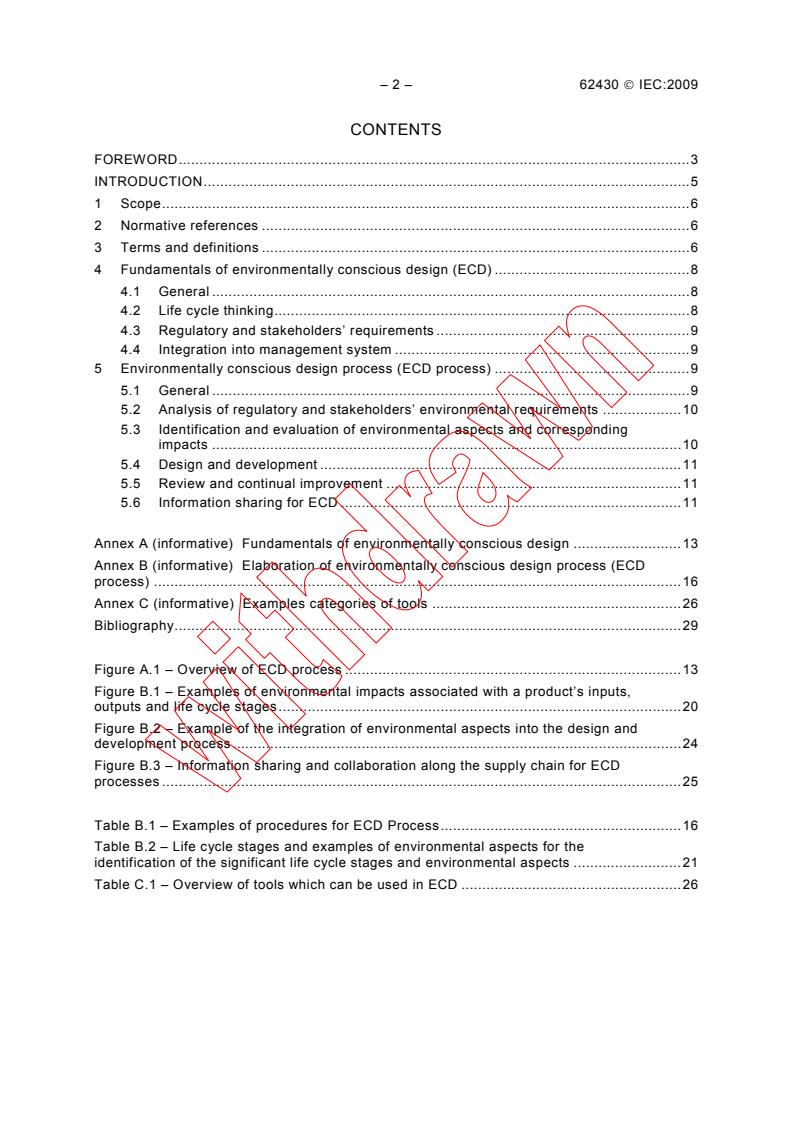
CONTENTS
FOREWORD.3
INTRODUCTION.5
1 Scope.6
2 Normative references .6
3 Terms and definitions .6
4 Fundamentals of environmentally conscious design (ECD) .8
4.1 General .8
4.2 Life cycle thinking.8
4.3 Regulatory and stakeholders’ requirements .9
4.4 Integration into management system .9
5 Environmentally conscious design process (ECD process) .9
5.1 General .9
5.2 Analysis of regulatory and stakeholders’ environmental requirements .10
5.3 Identification and evaluation of environmental aspects and corresponding
impacts .10
5.4 Design and development .11
5.5 Review and continual improvement .11
5.6 Information sharing for ECD .11
Annex A (informative) Fundamentals of environmentally conscious design .13
Annex B (informative) Elaboration of environmentally conscious design process (ECD
process) .16
Annex C (informative) Examples categories of tools .26
Bibliography.29
Figure A.1 – Overview of ECD process .13
Figure B.1 – Examples of environmental impacts associated with a product’s inputs,
outputs and life cycle stages.20
Figure B.2 – Example of the integration of environmental aspects into the design and
development process .24
Figure B.3 – Information sharing and collaboration along the supply chain for ECD
processes .25
Table B.1 – Examples of procedures for ECD Process.16
Table B.2 – Life cycle stages and examples of environmental aspects for the
identification of the significant life cycle stages and environmental aspects .21
Table C.1 – Overview of tools which can be used in ECD .26
62430 © IEC:2009 – 3 –
INTERNATIONAL ELECTROTECHNICAL COMMISSION
____________
ENVIRONMENTALLY CONSCIOUS DESIGN FOR
ELECTRICAL AND ELECTRONIC PRODUCTS
FOREWORD
1) The International Electrotechnical Commission (IEC) is a worldwide organization for standardization comprising
all national electrotechnical committees (IEC National Committees). The object of IEC is to promote
international co-operation on all questions concerning standardization in the electrical and electronic fields. To
this end and in addition to other activities, IEC publishes International Standards, Technical Specifications,
Technical Reports, Publicly Available Specifications (PAS) and Guides (hereafter referred to as “IEC
Publication(s)”). Their preparation is entrusted to technical committees; any IEC National Committee interested
in the subject dealt with may participate in this preparatory work. International, governmental and non-
governmental organizations liaising with the IEC also participate in this preparation. IEC collaborates closely
with the International Organization for Standardization (ISO) in accordance with conditions determined by
agreement between the two organizations.
2) The formal decisions or agreements of IEC on technical matters express, as nearly as possible, an international
consensus of opinion on the relevant subjects since each technical committee has representation from all
interested IEC National Committees.
3) IEC Publications have the form of recommendations for international use and are accepted by IEC National
Committees in that sense. While all reasonable efforts are made to ensure that the technical content of IEC
Publications is accurate, IEC cannot be held responsible for the way in which they are used or for any
misinterpretation by any end user.
4) In order to promote international uniformity, IEC National Committees undertake to apply IEC Publications
transparently to the maximum extent possible in their national and regional publications. Any divergence
between any IEC Publication and the corresponding national or regional publication shall be clearly indicated in
the latter.
5) IEC provides no marking procedure to indicate its approval and cannot be rendered responsible for any
equipment declared to be in conformity with an IEC Publication.
6) All users should ensure that they have the latest edition of this publication.
7) No liability shall attach to IEC or its directors, employees, servants or agents including individual experts and
members of its technical committees and IEC National Committees for any personal injury, property damage or
other damage of any nature whatsoever, whether direct or indirect, or for costs (including legal fees) and
expenses arising out of the publication, use of, or reliance upon, this IEC Publication or any other IEC
Publications.
8) Attention is drawn to the Normative references cited in this publication. Use of the referenced publications is
indispensable for the correct application of this publication.
9) Attention is drawn to the possibility that some of the elements of this IEC Publication may be the subject of
patent rights. IEC shall not be held responsible for identifying any or all such patent rights.
International Standard IEC 62430 has been prepared by IEC technical committee 111:
Environmental standardization for electrical and electronic products and systems.
It has the status of a horizontal standard in accordance with IEC Guide 108.
The text of this standard is based on the following documents:
CDV Report on voting
111/104/CDV 111/124/RVC
Full information on the voting for the approval of this standard can be found in the report on
voting indicated in the above table.
This publication has been drafted in accordance with the ISO/IEC Directives, Part 2.
– 4 – 62430 © IEC:2009
The committee has decided that the contents of this publication will remain unchanged until
the maintenance result date indicated on the IEC web site under "http://webstore.iec.ch" in
the data related to the specific publication. At this date, the publication will be
• reconfirmed,
• withdrawn,
• replaced by a revised edition, or
• amended.
62430 © IEC:2009 – 5 –
INTRODUCTION
Every product has an effect on the environment, which may occur at any or all stages of its
life cycle – raw-material acquisition, manufacture, distribution, use, maintenance, re-use and
end of life. These effects may range from slight to significant; they may be short-term or long-
term; and they may occur at the local, national, regional or global level (or a combination
thereof).
The widespread use of electrical and electronic products has drawn increased awareness to
their environmental impacts. As a result, legislation, as well as market-driven requirements for
environmentally conscious design, are emerging.
The goal of environmentally conscious design is the reduction of adverse environmental
impacts of a product throughout its entire life cycle. This can involve balancing the
environmental aspects of the product with other factors, such as its intended use,
performance, cost, marketability and quality, and choosing methods to meet legal and
regulatory requirements in the most environmentally friendly way. In striving for this goal,
multiple benefits can be achieved for the organization, its customers and other stakeholders.
Environmentally conscious design is not a separate design activity; rather, it is an integral
part of the existing design process. The "design" in this context includes the activities
associated with the processes of product planning, development and decision-making as well
as the creation of policies within the organization.
The impetus to create an International Standard was triggered by common circumstances
impacting many industries in the global marketplace, since the compositional elements of a
product (such as materials, components and services) are provided across national borders.
The existence of an International Standard provides for a consistent approach to life cycle
management.
This International Standard is intended for use by all those involved in the design and
development of electrical and electronic products. This includes all parties in the supply chain
regardless of organization type, size, location and complexity. It is applicable for all types of
products, new as well as modified. Sector-specific documents may be developed to address
needs not covered in this standard. The use of this standard as a base reference is
encouraged so as to ensure consistency throughout the electrotechnical sector.
This International Standard provides a set of requirements for the process of environmentally
conscious design reflecting the contents of IEC Guide 114 and ISO/TR 14062.
– 6 – 62430 © IEC:2009
ENVIRONMENTALLY CONSCIOUS DESIGN FOR
ELECTRICAL AND ELECTRONIC PRODUCTS
1 Scope
This International Standard specifies requirements and procedures to integrate environmental
aspects into design and development processes of electrical and electronic products,
including combination of products, and the materials and components of which they are
composed (hereafter referred to as products).
NOTE The existence of this standard does not preclude particular sectors from generating their own, more
specific, standards or guidelines. Where such documents are produced it is recommended that they use this
standard as the reference in order to ensure consistency throughout the electrotechnical sector.
2 Normative references
No normative references are cited. Informative references are noted in the bibliography.
NOTE This clause is included in order to retain typical clause numbering.
3 Terms and definitions
For the purposes of this document, the following terms and definitions apply.
3.1
design and development
activities that take an idea or requirement and transform these into a product
NOTE The process of design and development usually follows a series of defined steps starting with an initial
idea, transforming that into a formal specification, and resulting in the creation of a working prototype and whatever
documentation is required to support production of the goods or provision of the service.
3.2
environment
surroundings in which an organization operates, including air, water, land, natural resources,
flora, fauna, humans and their interrelation
NOTE Surroundings in this context extend from within an organization to the global system.
[ISO 14001: 2004, definition 3.5]
3.3
environmental aspect
element of an organization's activities or products that can interact with the environment
NOTE A significant environmental aspect has or can have a significant environmental impact.
[ISO 14001:2004, definition 3.6, modified]
3.4
environmental impact
any change to the environment, whether adverse or beneficial, wholly or partly resulting from
an organization's environmental aspects
[ISO 14001:2004, definition 3.7]
62430 © IEC:2009 – 7 –
3.5
environmental parameter
quantifiable attribute of an environmental aspect
EXAMPLE Environmental parameters include the type and quantity of materials used (weight, volume), power
consumption, emissions, rate of recyclability, etc.
3.6
environmentally conscious design
ECD
systematic approach which takes into account environmental aspects in the design and
development process with the aim to reduce adverse environmental impacts
3.7
environmentally conscious design tool
formalized method which facilitates qualitative or quantitative analysis, comparison and/or
solution finding during the ECD process
3.8
life cycle
consecutive and interlinked stages of a product system, from raw material acquisition or
generation from natural resources to the final disposal
[ISO 14040:2006, definition 3.1]
3.9
life cycle assessment
LCA
compilation and evaluation of the inputs, outputs and the potential environmental impacts of a
product system throughout its life cycle
[ISO 14040:2006, definition 3.2]
3.10
life cycle stage
element of a life cycle
NOTE 1 The phrase ’life cycle phase’ is sometimes used interchangeably with ‘life cycle stage’.
NOTE 2 Examples of life cycle stages are: raw material acquisition and production; manufacturing; packaging and
distribution; installation and use, maintenance and upgrading and end of life.
3.11
life cycle thinking
LCT
consideration of all relevant environmental aspects during the entire life cycle of products
[IEC Guide 109:2003, modified]
3.12
organization
group of people and facilities with an arrangement of responsibilities, authorities and
relationships
[ISO 9000:2005, definition 3.3.1,modified]
3.13
process
set of interrelated or interacting activities which transform inputs into outputs
NOTE 1 Inputs to a process are generally outputs of other processes.
– 8 – 62430 © IEC:2009
NOTE 2 Processes in an organization are generally planned and carried out under controlled conditions to add
value.
[ISO 9000:2005, definition 3.4.1, modified]
3.14
product
any goods or service
NOTE This includes interconnected and/or interrelated goods or services.
[ISO 14040:2006, definition 3.9, modified]
3.15
product category
group of technologically or functionally similar products where the environmental aspects can
reasonably be expected to be similar
3.16
stakeholder
individual, group or organization that has an interest in an organization or activity
NOTE Usually a stakeholder can affect or is affected by the organization or the activity.
[ISO 14050, definition 3.5, modified]
4 Fundamentals of environmentally conscious design (ECD)
NOTE More detailed information relating to Clause 4 is provided in Annex A.
4.1 General
Clause 4 describes the fundamental requirements of ECD to be implemented by the
organization. Clause 5 describes the ECD process to be implemented on an operational basis.
4.2 Life cycle thinking
Environmentally conscious design shall be based on the concept of life cycle thinking (LCT),
which requires consideration during the design and development process of the significant
environmental aspects of a product in all life cycle stages.
Key elements of life cycle thinking are as follows:
a) having an objective to minimize the overall adverse environmental impact of the product;
b) identifying, qualifying and where feasible, quantifying the significant environmental
aspects of the product;
c) considering the trade-offs between environmental aspects and life cycle stages.
The above shall be initiated as early as possible in the design and development process,
when most opportunities exist to make changes and improvements to the product affecting its
overall environmental performance throughout its life cycle.
NOTE 1 As a first step in LCT, the intended function of the product should be determined. In subsequent design
and development stages the influence of any applied business model should be recognized.
NOTE 2 The life cycle stages of any product under control of the organization usually include the processing of
materials, manufacturing, distribution, use, maintenance and end-of-life management (including reuse, recycling,
recovery and final disposal).
NOTE 3 When a product is part of a system, the environmental performance of one product during one or more
life cycle stages can be altered by other products in that system.
NOTE 4 ECD requires collaboration and contributions of all stakeholders along the supply chain.
62430 © IEC:2009 – 9 –
4.3 Regulatory and stakeholders’ requirements
Environmentally conscious design is performed within the boundaries set by regulatory and
stakeholders’ requirements. Such requirements shall be regularly reviewed so that relevant
changes are understood by the organization undertaking the ECD.
Regulatory and stakeholders’ requirements may include:
a) restrictions and obligations resulting from national and international regulations;
b) technical standards and voluntary agreements;
c) market or customers’ needs, trends and expectations;
d) societal and investors’ expectations, e.g. advances in technology.
4.4 Integration into management system
Environmentally conscious design and its objective of minimizing the overall adverse impact
of the product shall be reflected in the policies and strategies of the organization. If an
organization has a management system which includes the product design and development
function, the ECD process shall be an integral part of that documented system.
Environmental considerations could be one element of the overall risk management process
of the organization.
NOTE 1 "Risk management" is defined in ISO/IEC Guide 73.
In line with the procedures of the management system of the organization, the ECD process
shall be reviewed when required and at planned intervals to ensure its continuing suitability,
adequacy and effectiveness. This review shall include assessing opportunities for
improvement and the need for changes to the ECD process and the related policies and
strategies of the organization.
NOTE 2 The iterative process of continual improvement in product design and development can also be described
by the PDCA (Plan, Do, Check, Act) cycle. This approach also provides means for managing the changing legal,
technological, organizational, economic and environmental requirements.
NOTE 3 Communication regarding the ECD process and its objectives is performed within an organization so that
the affected departments understand the rationale for the initiative, leading to their cooperation and collaboration.
NOTE 4 Management systems are described, for example, in ISO 9001 and ISO 14001.
5 Environmentally conscious design process (ECD process)
NOTE More detailed information relating to Clause 5 is provided in Annex B.
5.1 General
Organizations performing environmentally conscious design (ECD) shall establish, document,
implement and maintain an ECD process as an integral part of the product design and
development process. This ECD process includes the following steps, which are further
described in 5.2 to 5.5:
a) analysis of the regulatory and stakeholders’ environmental requirements;
b) identification and evaluation of environmental aspects and corresponding impacts;
c) design and development;
d) review and continual improvement.
The organization shall, while following the above steps, document the relevant results and the
subsequent conclusions and responsibilities assigned.
NOTE The above process a) to d) corresponds to the PDCA cycle as follows:
– 10 – 62430 © IEC:2009
− steps a) and b) correspond to Plan,
− step c) corresponds to Do, and
− step d) corresponds to Check and Act.
5.2 Analysis of regulatory and stakeholders’ environmental requirements
As an initial step of ECD, to be carried out in conjunction with the identification of
environmental aspects (see 5.3), the organization shall understand the relevant regulatory
and stakeholders’ requirements, both at horizontal and sector specific level. These
requirements set the basic framework within which a product is developed.
The organization shall ensure, as appropriate, that:
a) relevant environmental requirements from applicable regulatory authorities and
stakeholders are identified, covering
– relevant product functions,
– relevant life cycle stages,
– relevant environmental aspects of the product,
– geographical scope of the intended market, and
– related activities of the organization;
b) both current and new requirements are regularly reviewed and identified;
c) a systematic analysis of these requirements is performed and documented, identifying the
affected product function(s) and life cycle stage(s), related activities of and responsibilities
in the organization, and resulting action(s) to be taken;
d) new or changed requirements, which appear during the design phase are evaluated as to
their effect on the product and necessary modifications are made.
NOTE 1 Horizontal requirements are generally applicable to electrotechnical and electronic products.
NOTE 2 Sector specific requirements address a certain product group.
5.3 Identification and evaluation of environmental aspects and corresponding
impacts
The organization shall establish a procedure to identify environmental aspects and
corresponding impacts. It shall comprise the following steps:
a) Identification of relevant environmental aspects and corresponding impacts.
For each relevant life cycle stage, identify inputs such as materials, energy and other
resources used, as well as outputs (examples are provided in Figure B.3), all of which
cause environmental impacts. Examples of outputs include the product itself, semi-
finished products, rejects, production wastes, and emissions.
It is permitted to use qualitative or quantitative environmental information associated with
the identified processes, materials, parts or components. Where feasible, the quantitative
approach is encouraged.
NOTE Identification of environmental aspects can also be made for a product category.
b) Evaluation of environmental impacts related to the identified relevant environmental
aspects.
c) Determination of significant environmental aspects.
After all relevant environmental aspects have been identified, significant environmental
aspects are determined by evaluation and prioritization, based on their contribution to
overall environmental impact. The organization should then address, in the subsequent
ECD process steps, these significant environmental aspects identified for a product or
product category. An arbitrary emphasis on a single environmental aspect or a single life
cycle stage should be avoided.
62430 © IEC:2009 – 11 –
It is permitted to use qualitative or quantitative evaluation and prioritization of the
environmental aspects. Where feasible, the quantitative approach is encouraged.
5.4 Design and development
The choice of a design solution should achieve a balance between the various environmental
aspects and other relevant considerations, such as function, technical requirements, quality,
performance, business risks and economic aspects. Where certain attributes are required for
compliance with regulations (e.g. health and safety, electromagnetic compatibility) these shall
be met in a manner that is least damaging to the environment. These considerations also
apply to research and development of new technologies.
The following steps shall be carried out during design and development:
a) specify the functions of the product;
b) define significant environmental parameters from the analysis of regulatory and
stakeholder requirements and evaluation of the environmental aspects;
c) identify relevant environmental improvement strategies for these parameters;
d) develop environmental targets based on the improvement strategies;
e) develop a product specification addressing the environmental targets (environmental
product specification); and
f) develop technical solutions to meet the environmental targets while taking into account
other design considerations.
NOTE The use of ECD tools (described in Annex C) and other standards may be helpful.
5.5 Review and continual improvement
A procedure for review and continual improvement of the significant environmental aspects of
products throughout the entire life cycle shall be established, implemented and maintained.
The organization shall conduct design reviews to evaluate that the product design has met the
targets defined in the environmental product specification whenever significant environmental
aspects are affected or a major design phase is completed. When the product environmental
targets are not met, improvement actions shall be assigned and implemented for the current
or future design.
NOTE The organization could conduct further product reviews after market launch to consider feedback from
users and other stakeholders as well as additional environment-related knowledge. The results could then be
incorporated into the ECD process supporting continual product improvement and the revision of policies and
procedures of the organization setting the basis for product specifications for future product development.
Records of the design reviews, including the assigned actions arising from the review, shall
be maintained and serve as a reference for future product development and continual
improvement activities.
5.6 Information sharing for ECD
As part of the ECD process, organizations in the supply chain shall disclose information of
their product or product category to organizations involved in design and development to
enable them to achieve ECD objectives.
Examples of information to be exchanged include:
a) relevant resources used in the product, in the manufacturing processes and for the
operation of the product;
EXAMPLE Resource usage includes water, energy and materials.
b) relevant emissions generated by the product;
– 12 – 62430 © IEC:2009
c) guidance to improve environmental performance;
d) end-of-life treatment;
e) self-declaration indicating conformance with regulatory and customer requirements.
62430 © IEC:2009 – 13 –
Annex A
(informative)
Fundamentals of environmentally conscious design
NOTE Annex A provides information relating to Clause 4 of this standard.
A.1 General (4.1)
ECD is based on life cycle thinking (LCT) and should be part of the organization’s design and
development processes (see 4.2). Figure A.1 illustrates how ECD could be incorporated into
the (existing) management system of the organization (see 4.4).
Check and act
Review,
continual
improvement
Design and
Do
development
Identification and evaluation
of environmental aspects
Plan Plan
Analysis of stakeholder/Regulatory
requirements
Management commitment/Policy
Quality/Environmental management system
Life cycle thinking
IEC 356/09
Figure A.1 – Overview of ECD process
As indicated in Figure A.1, the ECD process is consistent with the approach of Plan, Do,
Check and Act.
A.2 Life cycle thinking (4.2)
Life cycle thinking is essential for performing ECD. The elements listed below can be included
in life cycle thinking.
a) Comprehensive view: rather than arbitrarily focusing on one life cycle stage or aspect of
the product, all such stages are considered during the design and development process
from the environmental as well as from other business perspectives, maintaining the goal
of overall improvement of the environmental performance.
ECD process elements
Foundation
– 14 – 62430 © IEC:2009
b) Business strategy: when looking at ways to reduce environmental impact consider what
changes can be made to the wider business model (product service systems, end-of-life
options, etc.) rather than focusing solely on improvements to the product itself.
c) Consider end of life: when considering the life cycle it is necessary to include end-of-life
aspects (e.g. life time, disposal reasons, collection rate and critical components to be
disposed of) and (secondary) raw materials potentially to be recovered (‘cradle to cradle’).
d) Future developments: as far as feasible, take into account the effects of impending
regulatory requirements, changes to related product families and advances in technology
or the projected availability of devices with competing functionality (e.g. the replacement
of cathode ray tubes (CRTs) by liquid crystal displays (LCDs).
e) Strategy for implementation: balance environmentally adverse effects with other relevant
factors like health, safety, function, performance, marketability and cost. Define goals to
be realised by ECD at the applicable life cycle stages (including maintenance, upgrading
and management options at end of life).
A.3 Regulatory and stakeholders’ requirements (4.3)
Environmentally conscious design is performed based on regulatory and stakeholder
requirements, changes in technology, market trends as well as the policies and procedures of
the organization.
These requirements may address parts of the supply chain not directly under control of the
specifying organization but still affecting the product and should be considered.
The organization should regularly review the internal and external requirements and
incorporate those that are relevant into the ECD process.
A.4 Integration into management system (4.4)
The decisions made by management determine the framework and targets of the ECD
programme, the level of support the work will receive (including financial and human
resources and time allocated for the tasks) and the degree of success at minimizing adverse
environmental aspects the programme will achieve. Top management support addressed to
all involved internal and external stakeholders is needed to achieve a significant effect on an
organization’s product design and development activities.
For effective implementation and use of ECD processes and procedures, it may be best to
integrate ECD in an existing management system of the organization such as a quality or
environmental management system. If an organization has a management system which
includes the product design and development function, 4.4 requires that the ECD process be
integral to that management system. Integration of the ECD process into a management
system would:
– leverage the general elements of an existing management system (e.g. system review,
communication);
– ensure consistency with the basic framework of the organization, including high-level
policies and targets.
The success of integrating environmental aspects into product design and development in an
organization is enhanced by involvement of all relevant disciplines and competencies rather
than limiting the task to design and development. The aim should be to ensure that all
relevant business functions contribute and commit to environmental improvement in the
earliest stages of the design and development process and remain involved throughout the
process, up to and including market launch and product review.
Risk assessment may be helpful to identify stages during a product’s life cycle that can result
in adverse environmental effects or in a potential non-conformity with specific regulatory or
62430 © IEC:2009 – 15 –
stakeholder requirements. Such an input can also lead to improvements of the ECD process.
An example of a risk assessment activity could be failure modes and effects analysis (FMEA)
focusing on environmental aspects. Environmental risks that exceed a level defined by the
organization would trigger action, which could typically either be a risk management
assignment in the organization or a design improvement task.
1. Product planning
– 16 – 62430 © IEC:2009
Annex B
(informative)
Elaboration of environmentally conscious design process (ECD process)
NOTE Annex B provides information relating to Clause 5 of this standard.
B.1 Outline of ECD process (5.1)
B.1.1 Integrating environmental aspects into the design and development process
Table B.1 provides examples of general steps for integrating environmental aspects into the
design and development process.
Table B.1 – Examples of procedures for ECD process
Examples of
(a )- (d) Leading
ECD tools
Phase General tasks
in 5.1 questions
(see Annex C)
What are the
significant
Identify and list the various environmental
environmental impacts
a) parameters associated with each life
across the relevant life
cycle stage of the product
cycle stages of the
product?
Identify the regulatory and market
Who are the
requirements, the needs of customers
stakeholders and what
and other stakeholders and relate these
a) do they expect from ECD check-list
to the environmental aspects to be
the environmental
achieved throughout the life cycle of the
attributes of products?
product
What are the ECD
environmental benchmarking
Benchmark against the competitor's or
a) strengths and
predecessor product(s)
weaknesses of these Environmental
products? QFD
What information on
relevant life cycle
Acquire information from the supply stages and
chain. In case of confidential information, environmental aspects
b)
organizations may agree on terms of is needed (e.g.
confidentiality materials content and
energy consumption of
components)?
What opportunities are
Identify significant environmental aspects
there to improve
and relevant parameters.
environmental
ECD
• Map out the product life cycle stages
attributes of the
benchmarking
and what significant environmental
product?
aspects apply to each.
Environmental
How to translate
b)
• Analyse and evaluate the impacts on
QFD
customer's needs,
the environment, taking into account
benchmarking results
the foreseeable product life cycle
LCT assessment
and environmental
Compile the result of the environ- tools
assessment results
mental analysis and stakeholders’
into common
requirements
improvement tasks?
3. Release for production
2. Product design
62430 © IEC:2009 – 17 –
Examples of
(a )- (d) Leading
ECD tools
Phase General tasks
in 5.1 questions
(see Annex C)
What should be the
Establish the environmental targets target specifications
(performance objectives) and for fulfilling the
c)
requirements for the product in the environmental
design specification performance
objectives?
What are the core
functions of the
Analysis of the product’s intended
product?
functions so that these can be modified, if
Conceptual
c)
required, to achieve the environmental
design What are the possible
targets for the product
new functions of the
(identifying
product?
product's
functions
Assemble solutions (including new How to generate
and the
c) technologies) to achieve each required product concept
solutions)
function within the designed product variants?
Evaluate variants against criteria, such as
How to select the best
Environmental
economic, technical, social and
product concept
QFD
environmental ones
variant?
c) ECD check-lists
Are the environmental
Select and evaluate a model solution
LCT assessment
performances
against the environmental performance
tools
objectives met?
objectives
Detailed
Detail and optimize the product’s design
Design
design c) so as to satisfy environmental and
supporting tools
performance requirements
(Identifying
product
Optimize the product’s design in detail by
structure,
taking various life cycle processes into
components
c)
account (e.g. packaging and
and
transportation)
materials)
ECD
benchmarking
Evaluation
Does the product
satisfy the specified ECD check-lists,
(Ensuring
Conduct an assessment of environmental
d) environmental Environmental
that the
impacts over the entire product life cycle
performance QFD
product
objective?
satisfies
LCT assessment
environment
tools
al and other
specification
Evaluate and test the prototype against
s)
d) criteria such as economic, technical,
social, and environmental ones
What accompanying
documents and
instructions will be
prepared that are
relevant for ECD?
(Examples include
user manuals,
Prepare the product information for
disassembly
d) stakeholders to cover the entire life cycle,
instructions and
including end-of-life treatment
environmental product
declarations).
What are the relevant
environmental data to
include in
accompanying
documents?
Has the environmental
Review and check the results and
d) target of the product
feedback if necessary
been achieved?
– 18 – 62430 © IEC:2009
B.1.2 ECD process documentation – Knowledge management
Procedures and records used to ensure conformity of the product to specified requirements:
– identification of standards and guidelines applied, requirements of regulations;
– details of the significant design and development elements adopted to reduce adverse
environmental impacts and of the procedures used to control variations in the production
process;
– results of product assessment (assess environmental parameters)
...