

IEC 60127-9:2025
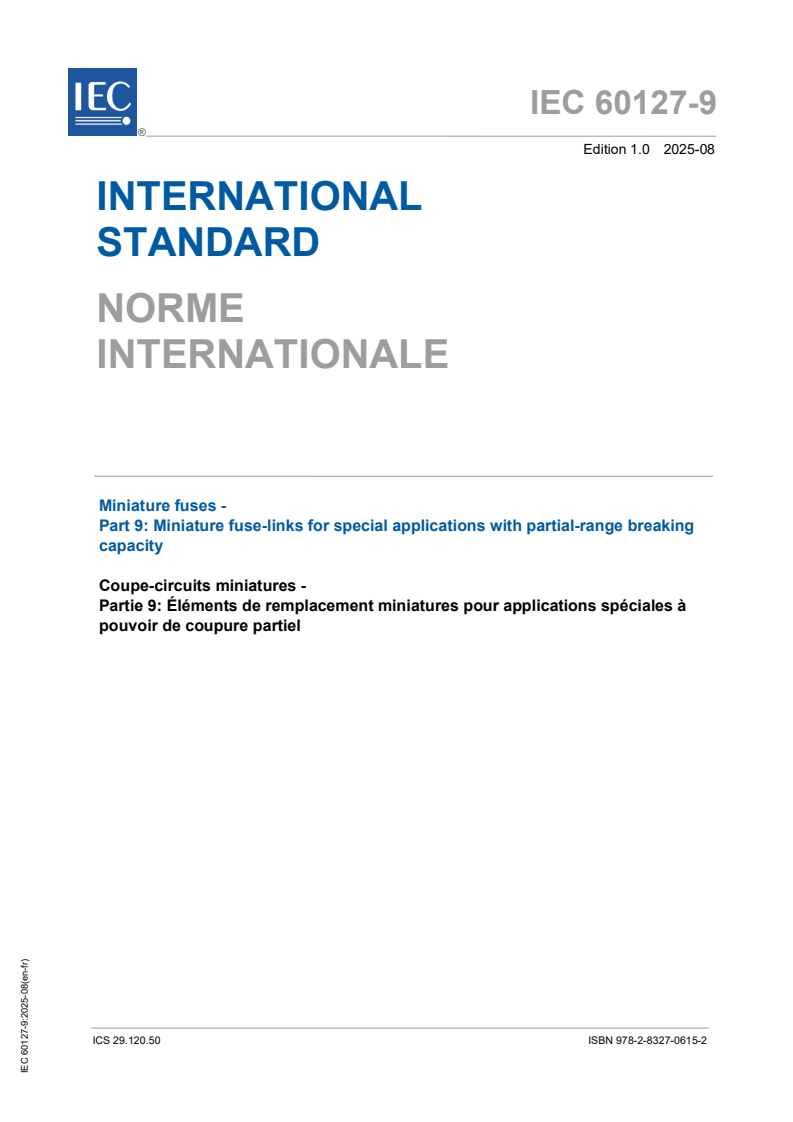
(Main)Miniature fuses - Part 9: Miniature fuse-links for special applications with partial-range breaking capacity
General Information
- Abstract
IEC 60127-9:2025 This part covers requirements for miniature fuse-links for special applications with partial-range breaking capacity. This document is applicable to fuse-links with a rated voltage not exceeding 1 000 V, a rated current not exceeding 150 A and a rated breaking capacity not exceeding 50 kA.
- Status
- Published
- Publication Date
- 05-Aug-2025
- Technical Committee
- SC 32C - Miniature fuses
- Drafting Committee
- WG 15 - TC 32/SC 32C/WG 15
- Current Stage
- PPUB - Publication issued
- Start Date
- 06-Aug-2025
- Completion Date
- 22-Aug-2025
Buy Documents
IEC 60127-9:2025 - Miniature fuses - Part 9: Miniature fuse-links for special applications with partial-range breaking capacity Released:8/6/2025
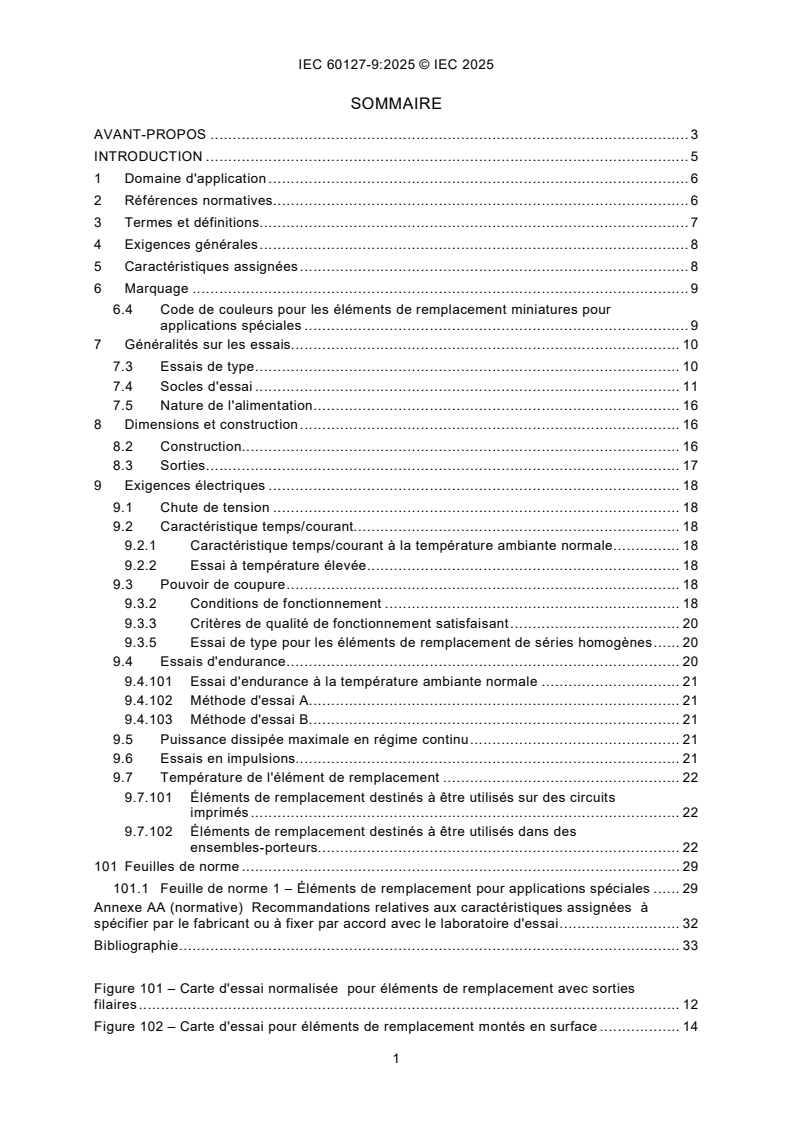
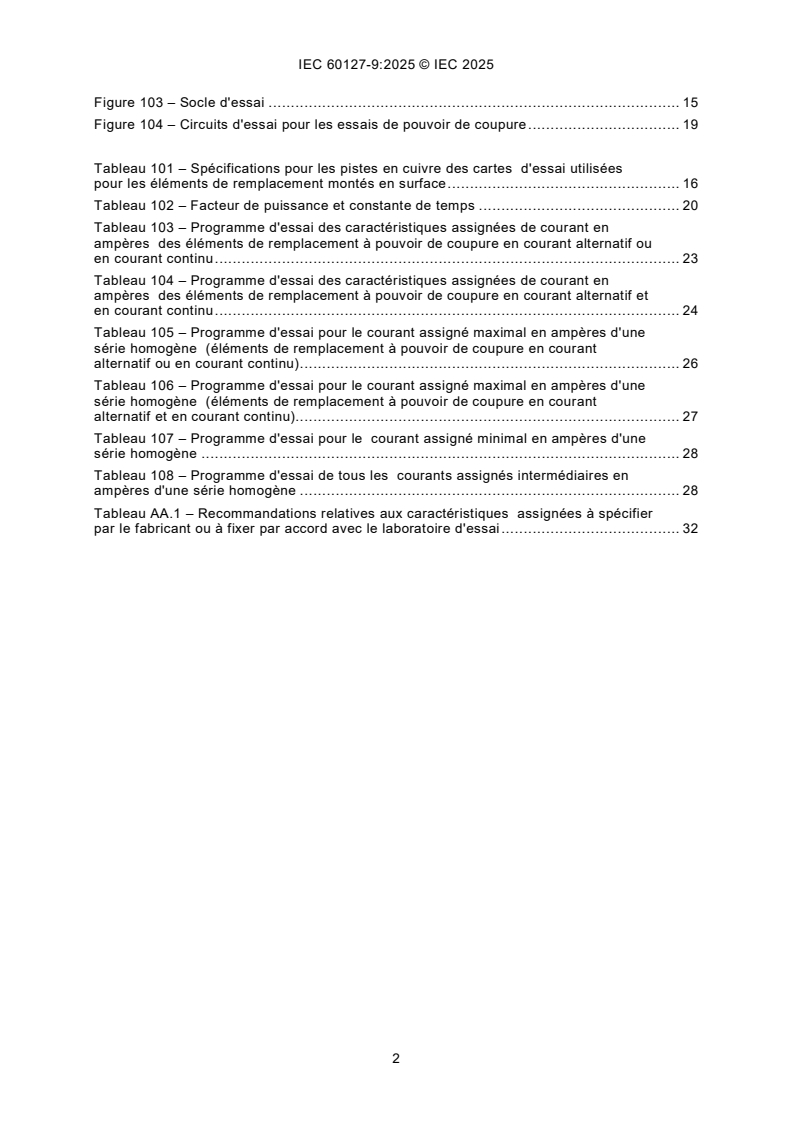
IEC 60127-9:2025 - <p>Coupe-circuits miniatures - Partie 9: Éléments de remplacement miniatures pour applications spéciales a pouvoir de coupure partiel</p> Released:8/6/2025
IEC 60127-9:2025 - Miniature fuses - Part 9: Miniature fuse-links for special applications with partial-range breaking capacity Released:8/6/2025
Overview
IEC 60127-9:2025 - "Miniature fuses - Part 9: Miniature fuse-links for special applications with partial-range breaking capacity" specifies requirements and test methods for a class of miniature fuse-links intended to operate only under short‑circuit conditions. This part supplements IEC 60127-1 and applies to fuse‑links with rated voltage ≤ 1 000 V, rated current ≤ 150 A and rated breaking capacity ≤ 50 kA. These fuse-links are designed for special applications where overload currents in the partial‑range are prevented by additional system protection.
Key Topics
- Scope and limitations: Clarifies that partial‑range breaking capacity fuse‑links must not be used for overload protection; designers must ensure overloads cannot occur. They are not intended for end‑user replacement.
- Ratings and marking: Requirements for standard ratings, marking and colour coding specific to special‑application fuse‑links so values are traceable and unambiguous.
- Dimensions & construction: Rules for physical design, terminations, PCB and wire mounting to ensure compatibility with fuse‑holders and assembly processes.
- Electrical requirements and tests:
- Time/current characteristic and melting time measurement (normal and elevated temperatures).
- Breaking capacity tests with defined operating conditions and pass/fail criteria.
- Endurance tests, voltage drop, pulse tests and maximum sustained dissipation.
- Type testing and test boards: Procedures for type tests, including test boards for wire and surface‑mount fuse‑links and schedules for testing homogeneous series.
- Environmental and safety references: Calls out relevant normative references for robustness of terminations, insulation coordination and flammability (e.g., IEC 60068‑2‑21, IEC 60664‑1, IEC 60695‑2‑12).
Applications
IEC 60127-9 is used where compact fuse protection is required for specialized electronic and electrical assemblies that rely on upstream protection against overloads. Typical stakeholders:
- Design engineers specifying protective devices for power supplies, control modules or assemblies with dedicated upstream breakers.
- Manufacturers of miniature fuse‑links seeking type approval and standardized testing.
- Test houses and certification bodies performing breaking‑capacity, time/current and endurance verification.
- Procurement and compliance teams ensuring components meet internationally accepted test methods and marking rules.
Related Standards
- IEC 60127-1 (definitions & general requirements) - to be used in conjunction with Part 9
- IEC 60127-6 (fuse‑holders)
- IEC 60068-2-21 (robustness of terminations)
- IEC 60664-1 (insulation coordination)
- IEC 60695-2-12 (glow‑wire flammability)
Keywords: IEC 60127-9, miniature fuses, partial-range breaking capacity, miniature fuse-links, breaking capacity testing, time/current characteristic, fuse standards, fuse marking, fuse dimensions.
Buy Documents
IEC 60127-9:2025 - Miniature fuses - Part 9: Miniature fuse-links for special applications with partial-range breaking capacity Released:8/6/2025
IEC 60127-9:2025 - <p>Coupe-circuits miniatures - Partie 9: Éléments de remplacement miniatures pour applications spéciales a pouvoir de coupure partiel</p> Released:8/6/2025
IEC 60127-9:2025 - Miniature fuses - Part 9: Miniature fuse-links for special applications with partial-range breaking capacity Released:8/6/2025
Get Certified
Connect with accredited certification bodies for this standard

IMQ S.p.A. (Certification)
Italian electrical product certification.

SLG Prüf- und Zertifizierungs GmbH
German testing and certification body.

UL Solutions
Global safety science company with testing, inspection and certification.
Sponsored listings
Frequently Asked Questions
IEC 60127-9:2025 is a standard published by the International Electrotechnical Commission (IEC). Its full title is "Miniature fuses - Part 9: Miniature fuse-links for special applications with partial-range breaking capacity". This standard covers: IEC 60127-9:2025 This part covers requirements for miniature fuse-links for special applications with partial-range breaking capacity. This document is applicable to fuse-links with a rated voltage not exceeding 1 000 V, a rated current not exceeding 150 A and a rated breaking capacity not exceeding 50 kA.
IEC 60127-9:2025 This part covers requirements for miniature fuse-links for special applications with partial-range breaking capacity. This document is applicable to fuse-links with a rated voltage not exceeding 1 000 V, a rated current not exceeding 150 A and a rated breaking capacity not exceeding 50 kA.
IEC 60127-9:2025 is classified under the following ICS (International Classification for Standards) categories: 29.120.50 - Fuses and other overcurrent protection devices. The ICS classification helps identify the subject area and facilitates finding related standards.
IEC 60127-9:2025 is available in PDF format for immediate download after purchase. The document can be added to your cart and obtained through the secure checkout process. Digital delivery ensures instant access to the complete standard document.
Standards Content (Sample)
IEC 60127-9 ®
Edition 1.0 2025-08
INTERNATIONAL
STANDARD
Miniature fuses -
Part 9: Miniature fuse-links for special applications with partial-range breaking
capacity
ICS 29.120.50 ISBN 978-2-8327-0615-2
All rights reserved. Unless otherwise specified, no part of this publication may be reproduced or utilized in any form or
by any means, electronic or mechanical, including photocopying and microfilm, without permission in writing from either
IEC or IEC's member National Committee in the country of the requester. If you have any questions about IEC copyright
or have an enquiry about obtaining additional rights to this publication, please contact the address below or your local
IEC member National Committee for further information.
IEC Secretariat Tel.: +41 22 919 02 11
3, rue de Varembé info@iec.ch
CH-1211 Geneva 20 www.iec.ch
Switzerland
About the IEC
The International Electrotechnical Commission (IEC) is the leading global organization that prepares and publishes
International Standards for all electrical, electronic and related technologies.
About IEC publications
The technical content of IEC publications is kept under constant review by the IEC. Please make sure that you have the
latest edition, a corrigendum or an amendment might have been published.
IEC publications search - IEC Products & Services Portal - products.iec.ch
webstore.iec.ch/advsearchform Discover our powerful search engine and read freely all the
The advanced search enables to find IEC publications by a
publications previews, graphical symbols and the glossary.
variety of criteria (reference number, text, technical With a subscription you will always have access to up to date
committee, …). It also gives information on projects, content tailored to your needs.
replaced and withdrawn publications.
Electropedia - www.electropedia.org
IEC Just Published - webstore.iec.ch/justpublished The world's leading online dictionary on electrotechnology,
Stay up to date on all new IEC publications. Just Published containing more than 22 500 terminological entries in English
details all new publications released. Available online and and French, with equivalent terms in 25 additional languages.
once a month by email. Also known as the International Electrotechnical Vocabulary
(IEV) online.
IEC Customer Service Centre - webstore.iec.ch/csc
If you wish to give us your feedback on this publication or
need further assistance, please contact the Customer
Service Centre: sales@iec.ch.
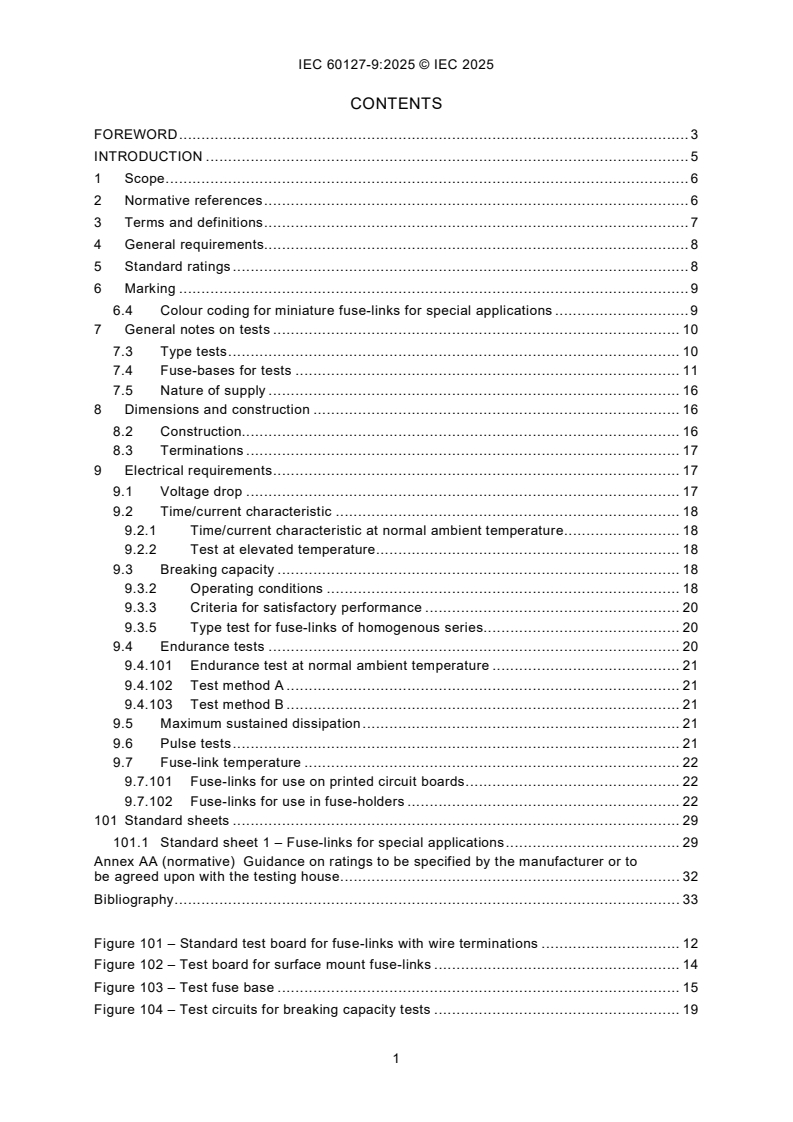
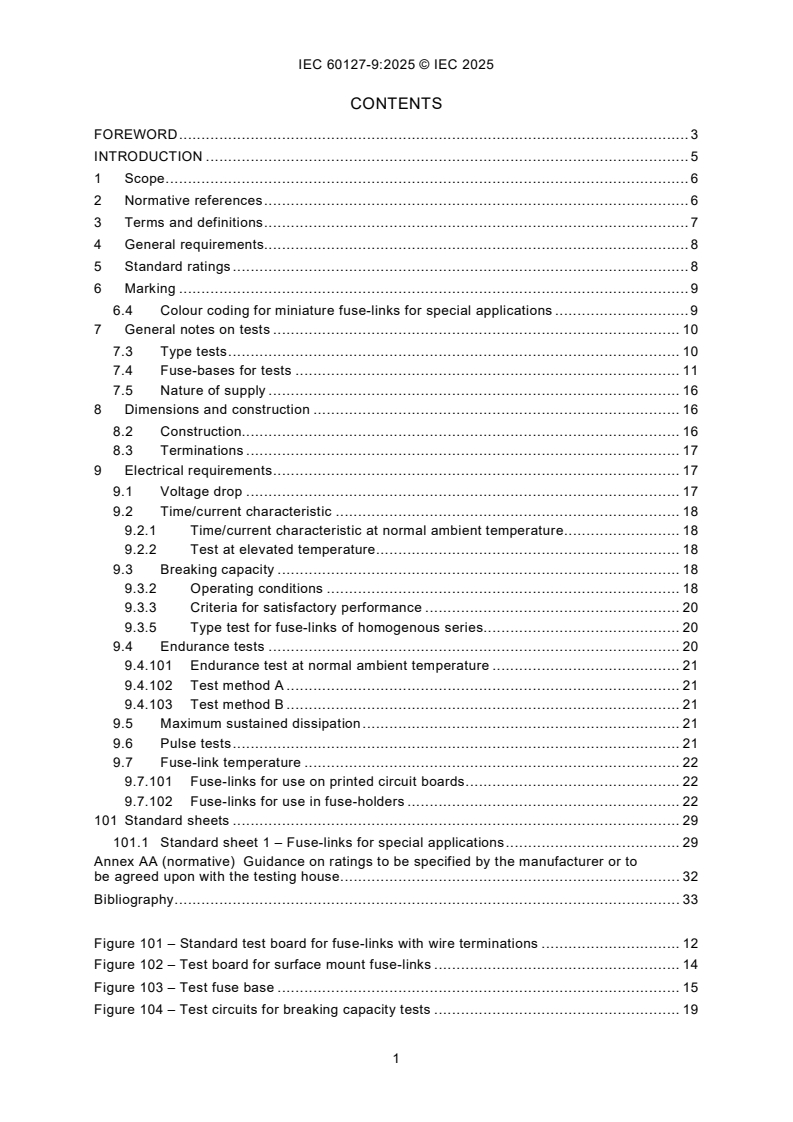
CONTENTS
FOREWORD . 3
INTRODUCTION . 5
1 Scope . 6
2 Normative references . 6
3 Terms and definitions . 7
4 General requirements. 8
5 Standard ratings . 8
6 Marking . 9
6.4 Colour coding for miniature fuse-links for special applications . 9
7 General notes on tests . 10
7.3 Type tests . 10
7.4 Fuse-bases for tests . 11
7.5 Nature of supply . 16
8 Dimensions and construction . 16
8.2 Construction. 16
8.3 Terminations . 17
9 Electrical requirements . 17
9.1 Voltage drop . 17
9.2 Time/current characteristic . 18
9.2.1 Time/current characteristic at normal ambient temperature . 18
9.2.2 Test at elevated temperature . 18
9.3 Breaking capacity . 18
9.3.2 Operating conditions . 18
9.3.3 Criteria for satisfactory performance . 20
9.3.5 Type test for fuse-links of homogenous series. 20
9.4 Endurance tests . 20
9.4.101 Endurance test at normal ambient temperature . 21
9.4.102 Test method A . 21
9.4.103 Test method B . 21
9.5 Maximum sustained dissipation . 21
9.6 Pulse tests . 21
9.7 Fuse-link temperature . 22
9.7.101 Fuse-links for use on printed circuit boards . 22
9.7.102 Fuse-links for use in fuse-holders . 22
101 Standard sheets . 29
101.1 Standard sheet 1 – Fuse-links for special applications . 29
Annex AA (normative) Guidance on ratings to be specified by the manufacturer or to
be agreed upon with the testing house . 32
Bibliography . 33
Figure 101 – Standard test board for fuse-links with wire terminations . 12
Figure 102 – Test board for surface mount fuse-links . 14
Figure 103 – Test fuse base . 15
Figure 104 – Test circuits for breaking capacity tests . 19
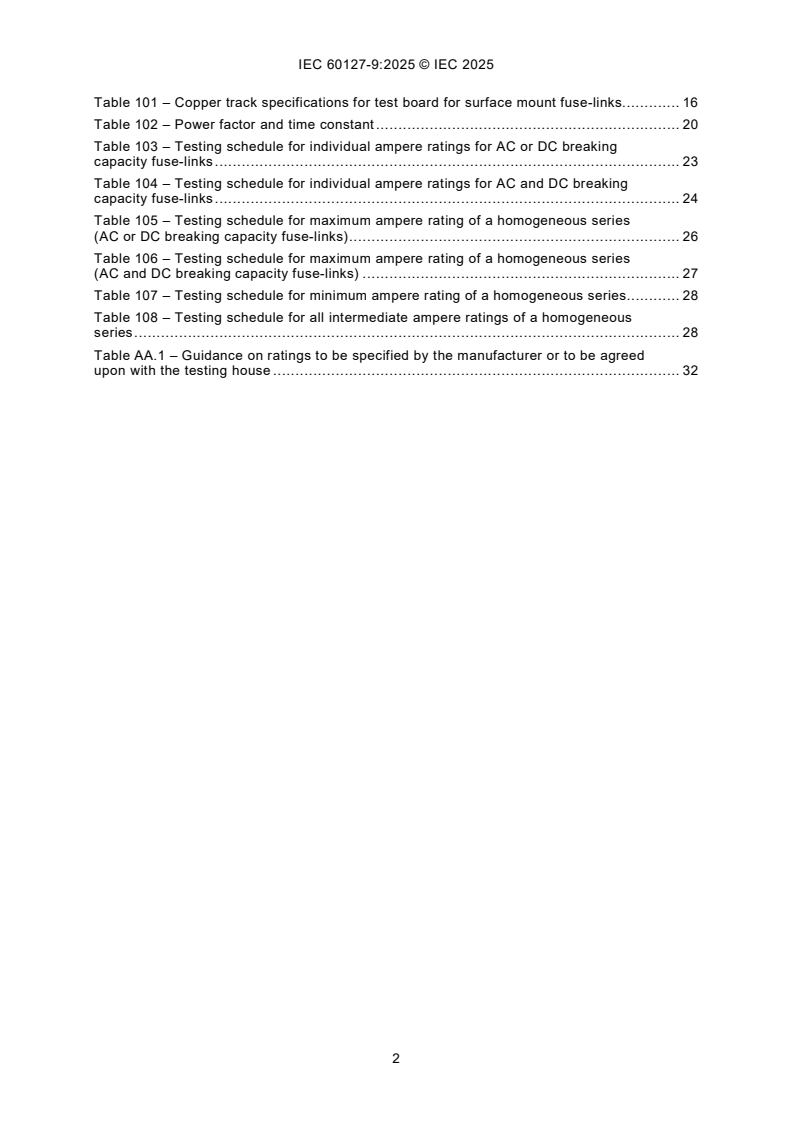
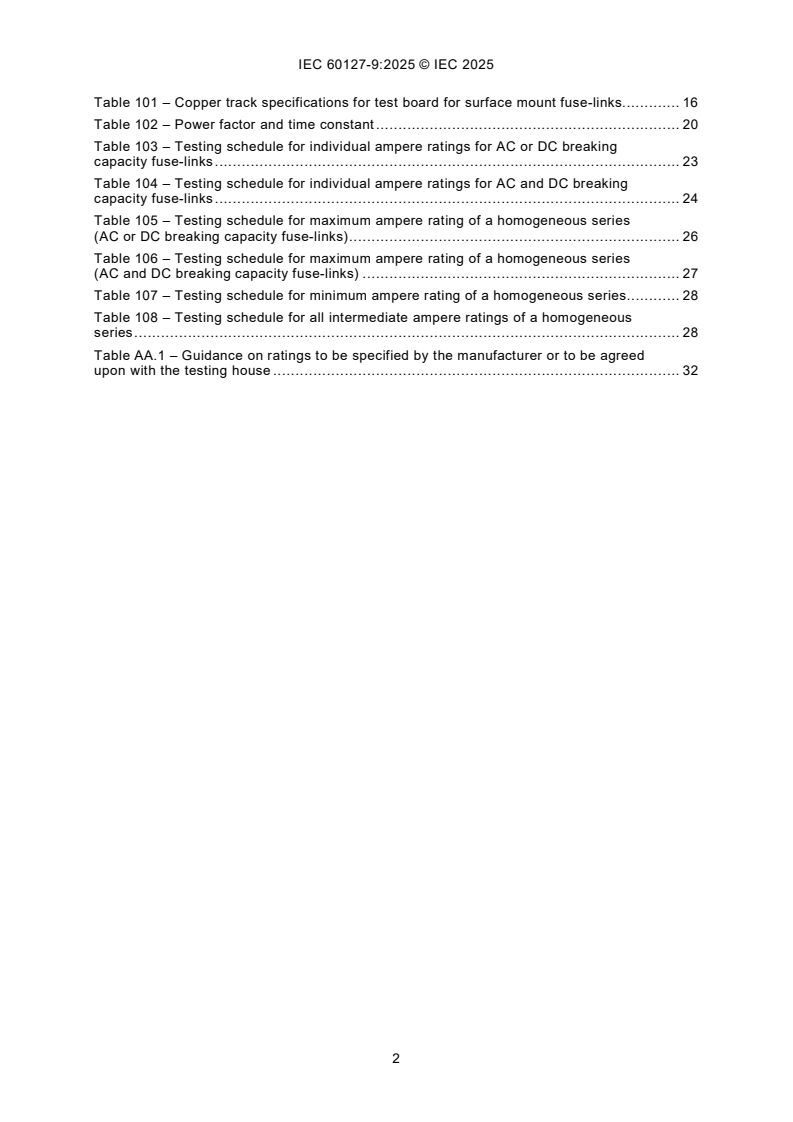
Table 101 – Copper track specifications for test board for surface mount fuse-links. 16
Table 102 – Power factor and time constant . 20
Table 103 – Testing schedule for individual ampere ratings for AC or DC breaking
capacity fuse-links . 23
Table 104 – Testing schedule for individual ampere ratings for AC and DC breaking
capacity fuse-links . 24
Table 105 – Testing schedule for maximum ampere rating of a homogeneous series
(AC or DC breaking capacity fuse-links) . 26
Table 106 – Testing schedule for maximum ampere rating of a homogeneous series
(AC and DC breaking capacity fuse-links) . 27
Table 107 – Testing schedule for minimum ampere rating of a homogeneous series. 28
Table 108 – Testing schedule for all intermediate ampere ratings of a homogeneous
series . 28
Table AA.1 – Guidance on ratings to be specified by the manufacturer or to be agreed
upon with the testing house . 32
INTERNATIONAL ELECTROTECHNICAL COMMISSION
____________
Miniature fuses -
Part 9: Miniature fuse-links for special applications
with partial-range breaking capacity
FOREWORD
1) The International Electrotechnical Commission (IEC) is a worldwide organization for standardization comprising
all national electrotechnical committees (IEC National Committees). The object of IEC is to promote international
co-operation on all questions concerning standardization in the electrical and electronic fields. To this end and
in addition to other activities, IEC publishes International Standards, Technical Specifications, Technical Reports,
Publicly Available Specifications (PAS) and Guides (hereafter referred to as “IEC Publication(s)”). Their
preparation is entrusted to technical committees; any IEC National Committee interested in the subject dealt with
may participate in this preparatory work. International, governmental and non-governmental organizations liaising
with the IEC also participate in this preparation. IEC collaborates closely with the International Organization for
Standardization (ISO) in accordance with conditions determined by agreement between the two organizations.
2) The formal decisions or agreements of IEC on technical matters express, as nearly as possible, an international
consensus of opinion on the relevant subjects since each technical committee has representation from all
interested IEC National Committees.
3) IEC Publications have the form of recommendations for international use and are accepted by IEC National
Committees in that sense. While all reasonable efforts are made to ensure that the technical content of IEC
Publications is accurate, IEC cannot be held responsible for the way in which they are used or for any
misinterpretation by any end user.
4) In order to promote international uniformity, IEC National Committees undertake to apply IEC Publications
transparently to the maximum extent possible in their national and regional publications. Any divergence between
any IEC Publication and the corresponding national or regional publication shall be clearly indicated in the latter.
5) IEC itself does not provide any attestation of conformity. Independent certification bodies provide conformity
assessment services and, in some areas, access to IEC marks of conformity. IEC is not responsible for any
services carried out by independent certification bodies.
6) All users should ensure that they have the latest edition of this publication.
7) No liability shall attach to IEC or its directors, employees, servants or agents including individual experts and
members of its technical committees and IEC National Committees for any personal injury, property damage or
other damage of any nature whatsoever, whether direct or indirect, or for costs (including legal fees) and
expenses arising out of the publication, use of, or reliance upon, this IEC Publication or any other IEC
Publications.
8) Attention is drawn to the Normative references cited in this publication. Use of the referenced publications is
indispensable for the correct application of this publication.
9) IEC draws attention to the possibility that the implementation of this document may involve the use of (a)
patent(s). IEC takes no position concerning the evidence, validity or applicability of any claimed patent rights in
respect thereof. As of the date of publication of this document, IEC had not received notice of (a) patent(s), which
may be required to implement this document. However, implementers are cautioned that this may not represent
the latest information, which may be obtained from the patent database available at https://patents.iec.ch. IEC
shall not be held responsible for identifying any or all such patent rights.
IEC 60127-9 has been prepared by subcommittee 32C: Miniature Fuses, of IEC technical
committee 32: Fuses. It is an International Standard.
This International Standard is to be used in conjunction with IEC 60127-1:2023.
This part of IEC 60127 is to be read in conjunction with Part 1. It supplements or modifies the
corresponding clauses of Part 1. Where the text indicates an "addition" to or a "replacement"
of the relevant provision of Part 1, these changes are made to the relevant text of Part 1. When
a particular subclause of Part 1 is not mentioned in this part, that subclause applies as far as
is reasonable.
Additional specific provisions to those in Part 1, given as individual clauses or subclauses, are
numbered starting from 101.
NOTE The following numbering system is used:
– subclauses, tables and figures that are numbered starting from 101 are additional to those in Part 1;
– unless notes are in a new subclause or involve notes in Part 1, they are numbered starting from 101, including
those in a replaced clause or subclause;
– additional annexes are lettered AA, BB, etc.
The text of this International Standard is based on the following documents:
Draft Report on voting
32C/667/FDIS 32C/670/RVD
Full information on the voting for its approval can be found in the report on voting indicated in
the above table.
The language used for the development of this International Standard is English.
This document was drafted in accordance with ISO/IEC Directives, Part 2, and developed in
accordance with ISO/IEC Directives, Part 1 and ISO/IEC Directives, IEC Supplement, available
at www.iec.ch/members_experts/refdocs. The main document types developed by IEC are
described in greater detail at www.iec.ch/publications.
A list of all parts in the IEC 60127 series, published under the general title Miniature fuses, can
be found on the IEC website.
The committee has decided that the contents of this document will remain unchanged until the
stability date indicated on the IEC website under webstore.iec.ch in the data related to the
specific document. At this date, the document will be
• reconfirmed,
• withdrawn, or
• revised.
INTRODUCTION
According to the wish expressed by the users of miniature fuses, all standards,
recommendations and other documents relating to miniature fuses have the same publication
number in order to facilitate reference to fuses in other specifications, for example, equipment
specifications.
Furthermore, a single publication number and subdivision into parts would facilitate the
establishment of new standards, because clauses containing general requirements need not be
repeated.
The IEC 60127 series, under the general heading Miniature fuses, is thus subdivided as follows:
IEC 60127-1, Miniature fuses - Part 1: Definitions for miniature fuses and general requirements
for miniature fuse-links
IEC 60127-2, Miniature fuses - Part 2: Cartridge fuse-links
IEC 60127-3, Miniature fuses - Part 3: Sub-miniature fuse-links
IEC 60127-4, Miniature fuses - Part 4: Universal modular fuse-links (UMF) - Through-hole and
surface mount types
IEC 60127-5, Miniature fuses - Part 5: Guidelines for quality assessment of miniature fuse-links
IEC 60127-6, Miniature fuses - Part 6: Fuse-holders for miniature fuse-links
IEC 60127-7, Miniature fuses - Part 7: Miniature fuse-links for special applications
IEC 60127-8, Miniature fuses - Part 8: Fuse resistors with particular overcurrent protection
IEC 60127-9, Miniature fuses - Part 9: Miniature fuse-links for special applications with partial-
range breaking capacity
1 Scope
This part of IEC 60127 covers requirements for miniature fuse-links for special applications with
partial-range breaking capacity.
This document is applicable to fuse-links with a rated voltage not exceeding 1 000 V, a rated
current not exceeding 150 A and a rated breaking capacity not exceeding 50 kA.
Miniature fuse-links with partial-range breaking capacity are used only to operate under short
circuit conditions. They cannot be applied under overload conditions.
The design engineer needs to ensure no overload conditions can be seen by the fuse approved
under this document.
This document does not apply to fuses completely covered by IEC 60127-7 or the subsequent
parts of IEC 60269-1.
It does not apply to miniature fuse-links for appliances intended to be used under special
conditions, such as in corrosive or explosive atmospheres.
This part of IEC 60127 applies in addition to the requirements of IEC 60127-1.
Miniature fuse-links for special applications with partial-range breaking capacity are not
intended to be replaced by the end-user of an electrical / electronic appliance.
The object of this document is to establish uniform test methods for miniature fuse-links for
special applications with partial-range breaking capacity, so as to allow verification of the values
(for example melting time and breaking capacity values) specified by the manufacturer.
WARNING – If this fuse is used without additional protection in the forbidden overload
partial current range it will catch fire, explode and will not interrupt the current. As a
user of this product, you must ensure this scenario can be excluded in all cases.
2 Normative references
The following documents are referred to in the text in such a way that some or all of their content
constitutes requirements of this document. For dated references, only the edition cited applies.
For undated references, the latest edition of the referenced document (including any
amendments) applies.
IEC 60068-2-21:2021, Environmental testing - Part 2-21: Tests - Test U: Robustness of
terminations and integral mounting devices
IEC 60127-1:2023, Miniature fuses - Part 1: Definitions for miniature fuses and general
requirements for miniature fuse-links
IEC 60127-6:2023, Miniature fuses - Part 6: Fuse-holders for miniature fuse-links
IEC 60664-1:2020, Insulation coordination for equipment within low-voltage systems - Part 1:
Principles, requirements and tests
IEC 60695-2-12:2021, Fire hazard testing - Part 2-12: Glowing/hot-wire based test methods -
Glow-wire flammability index (GWFI) test method for materials
IEC 60695-2-12:2010/AMD1:2014
IEC 60695-2-13:2021, Fire hazard testing - Part 2-13: Glowing/hot-wire based test methods -
Glow-wire ignition temperature (GWIT) test method for materials
IEC 60695-2-13:2010/AMD1:2014
IEC 60695-4:2021, Fire hazard testing - Part 4: Terminology concerning fire tests for
electrotechnical products
IEC 61249-2-7:2002, Materials for printed boards and other interconnecting structures - Part 2-
7: Reinforced base materials clad and unclad - Epoxide woven E-glass laminated sheet of
defined flammability (vertical burning test), copper-clad
ISO 3:1973, Preferred numbers - Series of preferred numbers
3 Terms and definitions
For the purposes of this document, the terms and definitions given in Clause 3 of
IEC 60127-1:2023, except 3.5, and the following apply.
ISO and IEC maintain terminology databases for use in standardization at the following
addresses:
• IEC Electropedia: available at https://www.electropedia.org/
• ISO Online browsing platform: available at https://www.iso.org/obp
3.1
miniature fuse-link for special applications with partial-range breaking capacity
enclosed fuse-link which is not covered in IEC 60127-2, IEC 60127-3, IEC 60127-4 or
IEC60127-7 and of rated breaking capacity not exceeding 50 kA, with a width and height or
diameter not exceeding 12 mm and a length not exceeding 50 mm
Note 1 to entry: Special precautions may be necessary to ensure that the fuse-links will be replaced by a fuse-link
with the same technical parameters.
Note 2 to entry: For fuse-links having a metallic cap at each end, any member of terminals or terminations other
than the metallic cap such as wire terminations, pins and bolt-in contacts may not be included in the total length of
50 mm and the width and height or diameter not exceeding 12 mm.
3.2
t to t
1 6
limit values for time/current characteristic
3.3
I
test current for testing at elevated temperature of 70 °C
Note 1 to entry: Preferred values are 0,8 I or 1,0 I or 1,1 I .
N N N
3.4
I (A)
test
test current for endurance testing according to method A
Note 1 to entry: Preferred values are 1,0 I or 1,05 I or 1,2 I .
N N N
3.5
I (B)
test
test current for endurance testing according to method B
Note 1 to entry: Preferred values are 0,8 I or 1,0 I .
N N
3.6
I (A)
OVL
test current for measuring the maximum sustained dissipation according to method A
Note 1 to entry: Preferred values are 1,25 I or 1,35 I or 1,5 I .
N N N
3.7
I (B)
OVL
test current for measuring the maximum sustained dissipation according to method B
Note 1 to entry: Preferred values are 1,0 I or 1,25 I .
N N
3.8
minimum breaking current I
min
minimum value of prospective current that a fuse-link is capable of breaking at a stated voltage
under prescribed conditions of use and behaviour and that is defined as:
2,1 I < I ≤ 4 I
N min N
Note 1 to entry: The value of I is defined by the manufacturer.
min
Note 2 to entry: If a current below this threshold and above the nominal current is flowing through the device it may
catch fire, desolder, overheat or plainly explode. This region of current is forbidden for the user application and is
avoided in all cases.
4 General requirements
Clause 4 of IEC 60127-1:2023 applies.
5 Standard ratings
Clause 5 of IEC 60127-1:2023 does not apply.
Replacement:
The following ratings shall be agreed upon between the testing house and the manufacturer
(see Annex AA):
– rated voltage;
– rated current (see standard sheet 1 for preferred ratings);
– rated breaking capacity (AC and/or DC);
– minimum breaking current I (AC and/or DC);
min
– time/current characteristic.
The following may be agreed upon on an optional basis:
– test at elevated temperature;
– time/current characteristic (additional optional currents not required or defined by this
standard).
Any additional specified values are given in standard sheet 1.
6 Marking
Clause 6 of IEC 60127-1:2023 applies except as follows.
6.1
Replacement:
d) Not applicable.
NOTE A symbol denoting the time/current characteristic cannot be stated, because this part of IEC 60127 does not
specify any values for this parameter.
Addition:
e) Type designation.
f) Rated breaking capacity in amperes (A) or in kilo amperes (kA).
g) minimum breaking current.
6.2
Deletion of NOTE 2.
6.3
Addition after first paragraph:
Furthermore the rated breaking capacity in amperes (A) or in kilo amperes (kA) shall be marked
on the package label as well as the minimum breaking current (I ).
min
6.4
Addition of heading title and replacement of text:
6.4 Colour coding for miniature fuse-links for special applications
Marking of fuse-links by means of colour bands according to IEC 60127-1:2023, Annex A, is
not permitted. It is, however, possible to use colour markings that clearly differ from this colour
band system. In this case, the manufacturer shall provide the relevant information, for example
colour key.
Additional subclause:
6.101 Where marking is impracticable due to space limitations, the relevant information should
appear on the smallest package and in the manufacturer’s technical literature.
7 General notes on tests
Clause 7 of IEC 60127-1:2023 applies except as follows.
7.3 Type tests
7.3.1
Replacement:
For testing the individual current ratings of fuses with AC or DC breaking capacity, the number
of fuse-links required is 48, of which 12 are kept as spares. For fuse-links with wire terminations
six extra samples (E1 to E6) shall be taken by random and not sorted according to voltage drop.
If necessary, these samples can be used as additional spares after performing the tests
according to 8.3.
The testing schedule is shown in Table 103.
For testing the individual current ratings of fuses with AC and DC breaking capacity, the number
of fuse-links required is 60, of which 9 are kept as spares. For fuse-links with wire terminations
six extra samples (E1 to E6) shall be taken by random and not sorted according to voltage drop.
If necessary, these samples can be used as additional spares after performing the tests
according to 8.3.
The testing schedule is shown in Table 104.
For testing the maximum ampere rating of a homogenous series with AC or DC breaking
capacity the number of fuse-links required is 48, of which 22 are kept as spares. For fuse-links
with wire terminations six extra samples (E1 to E6) shall be taken by random and not sorted
according to voltage drop. If necessary, these samples can be used as additional spares after
performing the tests according to 8.3.
The testing schedule is shown in Table 105.
For testing the maximum ampere rating of a homogenous series with AC and DC breaking
capacity the number of fuse-links required is 63, of which 32 are kept as spares. For fuse-links
with wire terminations six extra samples (E1 to E6) shall be taken by random and not sorted
according to voltage drop. If necessary, these samples can be used as additional spares after
performing the tests according to 8.3.
The testing schedule is shown in Table 106.
For testing the minimum ampere rating of a homogenous series with AC and / or DC breaking
capacity the number of fuse-links required is 38, of which 16 are kept as spares.
The testing schedule is shown in Table 107.
For testing all of the intermediate ampere rating of a homogenous series with AC and / or DC
breaking capacity the number of fuse-links required is 38, of which 16 are kept as spares.
The testing schedule is shown in Table 108.
7.4 Fuse-bases for tests
Addition:
For fuse-links designed for use in a special type of fuse-holder, testing shall be performed in
that fuse-holder.
For tests that require a printed circuit board for mounting and connection of the fuse-links, a
test board according to Figure 101 or Figure 102 shall be used.
The test board according to Figure 101 shall be used for fuse links with wire terminations
intended for insertion in suitably designed holes or sockets.
The test board according to Figure 102 shall be used for surface mount fuse-links.
When two or more fuse-links are tested in series, the fuse-bases shall be located so that there
will be a spacing of not less than 50 mm between any two fuse-links under testing. The
conductor connecting the fuse-bases together, and connecting the fuse-bases to the ammeter
and the source of supply shall be insulated copper wire. The length of each conductor shall be
500 mm and the cross-sectional area of the wire shall be approximately 1 mm for fuse-links
with rated currents up to and including 6,3 A, and 6 mm for rated currents exceeding 6,3 A to
25 A and 1 mm for rated currents exceeding 25 A.
Dimensions in millimetres
Key
O copper layer thickness, refer to Table 101
U connection for voltage drop measurement
D diameter of 1 mm for rated currents up to and including 6,3 A;
diameter of 1,5 mm for rated currents above 6,3 A to not exceeding 20 A;
diameter of 2 mm for rated currents above 20 A to not exceeding 30 A;
diameter of 2,5 mm for rated currents above 30 A to not exceeding 40 A.
e 2,5 mm
n 1, 2, 3, 4, 5, 6 (for e
...
IEC 60127-9 ®
Edition 1.0 2025-08
NORME
INTERNATIONALE
Coupe-circuits miniatures -
Partie 9: Éléments de remplacement miniatures pour applications spéciales à
pouvoir de coupure partiel
ICS 29.120.50 ISBN 978-2-8327-0615-2
Droits de reproduction réservés. Sauf indication contraire, aucune partie de cette publication ne peut être reproduite ni
utilisée sous quelque forme que ce soit et par aucun procédé, électronique ou mécanique, y compris la photocopie et
les microfilms, sans l'accord écrit de l'IEC ou du Comité national de l'IEC du pays du demandeur. Si vous avez des
questions sur le copyright de l'IEC ou si vous désirez obtenir des droits supplémentaires sur cette publication, utilisez
les coordonnées ci-après ou contactez le Comité national de l'IEC de votre pays de résidence.
IEC Secretariat Tel.: +41 22 919 02 11
3, rue de Varembé info@iec.ch
CH-1211 Geneva 20 www.iec.ch
Switzerland
A propos de l'IEC
La Commission Electrotechnique Internationale (IEC) est la première organisation mondiale qui élabore et publie des
Normes internationales pour tout ce qui a trait à l'électricité, à l'électronique et aux technologies apparentées.
A propos des publications IEC
Le contenu technique des publications IEC est constamment revu. Veuillez vous assurer que vous possédez l’édition la
plus récente, un corrigendum ou amendement peut avoir été publié.
Recherche de publications IEC - IEC Products & Services Portal - products.iec.ch
webstore.iec.ch/advsearchform Découvrez notre puissant moteur de recherche et consultez
La recherche avancée permet de trouver des publications gratuitement tous les aperçus des publications, symboles
IEC en utilisant différents critères (numéro de référence, graphiques et le glossaire. Avec un abonnement, vous aurez
texte, comité d’études, …). Elle donne aussi des toujours accès à un contenu à jour adapté à vos besoins.
informations sur les projets et les publications remplacées
ou retirées. Electropedia - www.electropedia.org
Le premier dictionnaire d'électrotechnologie en ligne au
IEC Just Published - webstore.iec.ch/justpublished monde, avec plus de 22 500 articles terminologiques en
Restez informé sur les nouvelles publications IEC. Just anglais et en français, ainsi que les termes équivalents
Published détaille les nouvelles publications parues. dans 25 langues additionnelles. Egalement appelé
Disponible en ligne et une fois par mois par email. Vocabulaire Electrotechnique International (IEV) en ligne.
Service Clients - webstore.iec.ch/csc
Si vous désirez nous donner des commentaires sur cette
publication ou si vous avez des questions contactez-
nous: sales@iec.ch.
SOMMAIRE
AVANT-PROPOS . 3
INTRODUCTION . 5
1 Domaine d'application . 6
2 Références normatives . 6
3 Termes et définitions. 7
4 Exigences générales . 8
5 Caractéristiques assignées . 8
6 Marquage . 9
6.4 Code de couleurs pour les éléments de remplacement miniatures pour
applications spéciales . 9
7 Généralités sur les essais. 10
7.3 Essais de type . 10
7.4 Socles d'essai . 11
7.5 Nature de l'alimentation . 16
8 Dimensions et construction . 16
8.2 Construction. 16
8.3 Sorties . 17
9 Exigences électriques . 18
9.1 Chute de tension . 18
9.2 Caractéristique temps/courant. 18
9.2.1 Caractéristique temps/courant à la température ambiante normale . 18
9.2.2 Essai à température élevée . 18
9.3 Pouvoir de coupure . 18
9.3.2 Conditions de fonctionnement . 18
9.3.3 Critères de qualité de fonctionnement satisfaisant . 20
9.3.5 Essai de type pour les éléments de remplacement de séries homogènes . 20
9.4 Essais d'endurance . 20
9.4.101 Essai d'endurance à la température ambiante normale . 21
9.4.102 Méthode d'essai A. 21
9.4.103 Méthode d'essai B. 21
9.5 Puissance dissipée maximale en régime continu . 21
9.6 Essais en impulsions. 21
9.7 Température de l'élément de remplacement . 22
9.7.101 Éléments de remplacement destinés à être utilisés sur des circuits
imprimés . 22
9.7.102 Éléments de remplacement destinés à être utilisés dans des
ensembles-porteurs. 22
101 Feuilles de norme . 29
101.1 Feuille de norme 1 – Éléments de remplacement pour applications spéciales . 29
Annexe AA (normative) Recommandations relatives aux caractéristiques assignées à
spécifier par le fabricant ou à fixer par accord avec le laboratoire d'essai . 32
Bibliographie . 33
Figure 101 – Carte d'essai normalisée pour éléments de remplacement avec sorties
filaires . 12
Figure 102 – Carte d'essai pour éléments de remplacement montés en surface . 14
Figure 103 – Socle d'essai . 15
Figure 104 – Circuits d'essai pour les essais de pouvoir de coupure . 19
Tableau 101 – Spécifications pour les pistes en cuivre des cartes d'essai utilisées
pour les éléments de remplacement montés en surface . 16
Tableau 102 – Facteur de puissance et constante de temps . 20
Tableau 103 – Programme d'essai des caractéristiques assignées de courant en
ampères des éléments de remplacement à pouvoir de coupure en courant alternatif ou
en courant continu . 23
Tableau 104 – Programme d'essai des caractéristiques assignées de courant en
ampères des éléments de remplacement à pouvoir de coupure en courant alternatif et
en courant continu . 24
Tableau 105 – Programme d'essai pour le courant assigné maximal en ampères d'une
série homogène (éléments de remplacement à pouvoir de coupure en courant
alternatif ou en courant continu) . 26
Tableau 106 – Programme d'essai pour le courant assigné maximal en ampères d'une
série homogène (éléments de remplacement à pouvoir de coupure en courant
alternatif et en courant continu). 27
Tableau 107 – Programme d'essai pour le courant assigné minimal en ampères d'une
série homogène . 28
Tableau 108 – Programme d'essai de tous les courants assignés intermédiaires en
ampères d'une série homogène . 28
Tableau AA.1 – Recommandations relatives aux caractéristiques assignées à spécifier
par le fabricant ou à fixer par accord avec le laboratoire d'essai . 32
COMMISSION ÉLECTROTECHNIQUE INTERNATIONALE
____________
Coupe-circuits miniatures -
Partie 9: Éléments de remplacement miniatures
pour applications spéciales à pouvoir de coupure partiel
AVANT-PROPOS
1) La Commission Électrotechnique Internationale (IEC) est une organisation mondiale de normalisation composée
de l'ensemble des comités électrotechniques nationaux (Comités nationaux de l'IEC). L'IEC a pour objet de
favoriser la coopération internationale pour toutes les questions de normalisation dans les domaines de
l'électricité et de l'électronique. À cet effet, l'IEC – entre autres activités – publie des Normes internationales,
des Spécifications techniques, des Rapports techniques, des Spécifications accessibles au public (PAS) et des
Guides (ci-après dénommés "Publication(s) de l'IEC"). Leur élaboration est confiée à des comités d'études, aux
travaux desquels tout Comité national intéressé par le sujet traité peut participer. Les organisations
internationales, gouvernementales et non gouvernementales, en liaison avec l'IEC, participent également aux
travaux. L'IEC collabore étroitement avec l'Organisation Internationale de Normalisation (ISO), selon des
conditions fixées par accord entre les deux organisations.
2) Les décisions ou accords officiels de l'IEC concernant les questions techniques représentent, dans la mesure du
possible, un accord international sur les sujets étudiés, étant donné que les Comités nationaux de l'IEC intéressés
sont représentés dans chaque comité d'études.
3) Les Publications de l'IEC se présentent sous la forme de recommandations internationales et sont agréées
comme telles par les Comités nationaux de l'IEC. Tous les efforts raisonnables sont entrepris afin que l'IEC
s'assure de l'exactitude du contenu technique de ses publications; l'IEC ne peut pas être tenue responsable de
l'éventuelle mauvaise utilisation ou interprétation qui en est faite par un quelconque utilisateur final.
4) Dans le but d'encourager l'uniformité internationale, les Comités nationaux de l'IEC s'engagent, dans toute la
mesure possible, à appliquer de façon transparente les Publications de l'IEC dans leurs publications nationales
et régionales. Toutes divergences entre toutes Publications de l'IEC et toutes publications nationales ou
régionales correspondantes doivent être indiquées en termes clairs dans ces dernières.
5) L'IEC elle-même ne fournit aucune attestation de conformité. Des organismes de certification indépendants
fournissent des services d'évaluation de conformité et, dans certains secteurs, accèdent aux marques de
conformité de l'IEC. L'IEC n'est responsable d'aucun des services effectués par les organismes de certification
indépendants.
6) Tous les utilisateurs doivent s'assurer qu'ils sont en possession de la dernière édition de cette publication.
7) Aucune responsabilité ne doit être imputée à l'IEC, à ses administrateurs, employés, auxiliaires ou mandataires,
y compris ses experts particuliers et les membres de ses comités d'études et des Comités nationaux de l'IEC,
pour tout préjudice causé en cas de dommages corporels et matériels, ou de tout autre dommage de quelque
nature que ce soit, directe ou indirecte, ou pour supporter les coûts (y compris les frais de justice) et les dépenses
découlant de la publication ou de l'utilisation de cette Publication de l'IEC ou de toute autre Publication de l'IEC,
ou au crédit qui lui est accordé.
8) L'attention est attirée sur les références normatives citées dans cette publication. L'utilisation de publications
référencées est obligatoire pour une application correcte de la présente publication.
9) L'IEC attire l'attention sur le fait que la mise en application du présent document peut entraîner l'utilisation d'un
ou de plusieurs brevets. L'IEC ne prend pas position quant à la preuve, à la validité et à l'applicabilité de tout
droit de brevet revendiqué à cet égard. À la date de publication du présent document, l'IEC n'avait pas reçu
notification qu'un ou plusieurs brevets pouvaient être nécessaires à sa mise en application. Toutefois, il y a lieu
d'avertir les responsables de la mise en application du présent document que des informations plus récentes
sont susceptibles de figurer dans la base de données de brevets, disponible à l'adresse https://patents.iec.ch.
L'IEC ne saurait être tenue pour responsable de ne pas avoir identifié de tels droits de brevets.
L'IEC 60127-9 a été établie par le sous-comité 32C: Coupe-circuits à fusibles miniatures, du
comité d'études 32 de l'IEC: Coupe-circuits à fusibles. Il s'agit d'une Norme internationale.
La présente Norme internationale doit être utilisée conjointement avec l'IEC 60127-1:2023.
La présente partie de l'IEC 60127 doit être lue conjointement avec la Partie 1. Elle complète ou
modifie les articles correspondants de la Partie 1. Lorsque le présent document mentionne
"addition" ou "remplacement" par rapport à une disposition de la Partie 1, le texte correspondant
de la Partie 1 est adapté en conséquence. Lorsqu'un paragraphe particulier de la Partie 1 n'est
pas mentionné dans cette partie, ce paragraphe s'applique pour autant que cela soit
raisonnable.
Les dispositions spécifiques qui s'ajoutent à celles de la Partie 1 sont introduites sous forme
d'articles ou de paragraphes, et sont numérotées à partir de 101.
NOTE Le système de numérotation suivant est utilisé:
– les paragraphes, tableaux et figures qui s'ajoutent à ceux de la Partie 1 sont numérotés à partir de 101;
– à l'exception de celles qui sont dans un nouveau paragraphe ou de celles qui concernent des notes de la Partie 1,
les notes sont numérotées à partir de 101, y compris celles des articles ou paragraphes qui sont remplacés;
– les annexes qui sont ajoutées sont désignées AA, BB, etc.
Le texte de cette Norme internationale est issu des documents suivants:
Projet Rapport de vote
32C/667/FDIS 32C/670/RVD
Le rapport de vote indiqué dans le tableau ci-dessus donne toute information sur le vote ayant
abouti à son approbation.
La langue employée pour l'élaboration de cette Norme internationale est l'anglais.
Ce document a été rédigé selon les Directives ISO/IEC, Partie 2, il a été développé selon les
Directives ISO/IEC, Partie 1 et les Directives ISO/IEC, Supplément IEC, disponibles sous
www.iec.ch/members_experts/refdocs. Les principaux types de documents développés par
l'IEC sont décrits plus en détail sous www.iec.ch/publications.
Une liste de toutes les parties de la série IEC 60127, publiées sous le titre général
Coupe-circuits miniatures, se trouve sur le site web de l'IEC.
Le comité a décidé que le contenu de ce document ne sera pas modifié avant la date de stabilité
indiquée sur le site web de l'IEC sous webstore.iec.ch dans les données relatives au document
recherché. À cette date, le document sera
• reconduit,
• supprimé, ou
• révisé.
INTRODUCTION
Conformément au souhait exprimé par les utilisateurs de coupe-circuits miniatures, l'ensemble
des normes, recommandations et autres documents relatifs aux coupe-circuits miniatures
utilisent le même numéro de publication afin de faciliter les renvois aux coupe-circuits dans
d'autres spécifications, par exemple dans les spécifications pour les matériels.
En outre, un numéro de publication unique et une subdivision en parties faciliteraient
l'établissement de nouvelles normes, car il n'est pas nécessaire de répéter les articles
contenant les exigences générales.
La série IEC 60127, publiée sous le titre général Coupe-circuits miniatures, a ainsi été
subdivisée comme suit:
IEC 60127-1, Coupe-circuits miniatures - Partie 1: Définitions pour coupe-circuits miniatures et
exigences générales pour éléments de remplacement miniatures
IEC 60127-2, Coupe-circuit miniatures - Partie 2: Cartouches
IEC 60127-3, Coupe-circuit miniatures - Partie 3: Éléments de remplacement subminiatures
IEC 60127-4, Coupe-circuit miniatures - Partie 4: Éléments de remplacement modulaires
universels (UMF) - Types de montage en surface et montage par trous
IEC 60127-5, Coupe-circuit miniatures - Partie 5: Lignes directrices pour l'évaluation de la
qualité des éléments de remplacement miniatures
IEC 60127-6, Coupe-circuit miniatures - Partie 6: Ensembles-porteurs pour cartouches de
coupe-circuits miniatures
IEC 60127-7, Coupe-circuit miniatures - Partie 7: Éléments de remplacement miniatures pour
applications spéciales
IEC 60127-8, Coupe-circuit miniatures - Partie 8: Résistances de protection avec protection
particulière contre les surintensités
IEC 60127-9, Coupe-circuits miniatures - Partie 9: Éléments de remplacement miniatures pour
applications spéciales à pouvoir de coupure partiel
1 Domaine d'application
La présente partie de l'IEC 60127 traite des exigences relatives aux éléments de remplacement
miniatures pour applications spéciales à pouvoir de coupure partiel.
Le présent document s'applique aux éléments de remplacement avec une tension assignée qui
ne dépasse pas 1 000 V, un courant assigné qui ne dépasse pas 150 A et un pouvoir de
coupure assigné qui ne dépasse pas 50 kA.
Les éléments de remplacement miniatures à pouvoir de coupure partiel sont utilisés uniquement
pour fonctionner dans des conditions de court-circuit. Ils ne peuvent pas être appliqués dans
des conditions de surcharge.
Il est nécessaire que l'ingénieur responsable de la conception s'assure qu'un coupe-circuit
homologué selon le présent document ne puisse être exposé à aucune condition de surcharge.
Le présent document ne s'applique pas aux coupe-circuits totalement couverts par
l'IEC 60127-7 ou les parties suivantes de l'IEC 60269-1.
Elle ne s'applique pas aux éléments de remplacement miniatures placés dans des appareils
destinés à être utilisés dans des conditions particulières, comme des atmosphères corrosives
ou explosives.
La présente partie de l'IEC 60127 s'applique, en plus des exigences de l'IEC 60127-1.
Les éléments de remplacement miniatures pour applications spéciales à pouvoir de coupure
partiel ne sont pas destinés à être remplacés par l'utilisateur final d'un appareil
électrique/électronique.
Le présent document a pour objet d'établir des méthodes d'essai uniformes pour les éléments
de remplacement miniatures pour applications spéciales à pouvoir de coupure partiel, de
manière à permettre la vérification des valeurs spécifiées par le fabricant (par exemple, temps
de fusion et pouvoir de coupure).
AVERTISSEMENT – Si ce coupe-circuit est utilisé sans protection supplémentaire
dans la plage interdite des surintensités par surcharge partielles, le coupe-circuit
risque de prendre feu, d'exploser et de ne pas interrompre le passage du courant. En
tant qu'utilisateur de ce produit, vous devez vous assurer que ce scénario ne puisse
pas se produire en toutes circonstances.
2 Références normatives
Les documents suivants sont cités dans le texte de sorte qu'ils constituent, pour tout ou partie
de leur contenu, des exigences du présent document. Pour les références datées, seule
l'édition citée s'applique. Pour les références non datées, la dernière édition du document de
référence s'applique (y compris les éventuels amendements).
IEC 60068-2-21:2021, Essais d’environnement - Partie 2-21: Essais - Essai U: Robustesse des
sorties et des dispositifs de montage incorporés
IEC 60127-1:2023, Coupe-circuits miniatures - Partie 1: Définitions pour coupe-circuits
miniatures et exigences générales pour éléments de remplacement miniatures
IEC 60127-6:2023, Coupe-circuit miniatures - Partie 6: Ensembles-porteurs pour cartouches de
coupe-circuits miniatures
IEC 60664-1:2020, Coordination de l’isolement des matériels dans les réseaux d’énergie
électrique à basse tension - Partie 1: Principes, exigences et essais
IEC 60695-2-12:2021, Essais relatifs aux risques du feu - Partie 2-12: Essais au fil
incandescent/chauffant - Méthode d'essai d'indice d’inflammabilité au fil incandescent (GWFI)
pour matériaux
IEC 60695-2-12:2010/AMD1:2014
IEC 60695-2-13:2021, Essais relatifs aux risques du feu - Partie 2-13: Essais au fil
incandescent/chauffant - Méthode d’essai de température d’allumage au fil incandescent (GWIT)
pour matériaux
IEC 60695-2-13:2010/AMD1:2014
IEC 60695-4:2021, Essais relatifs aux risques du feu - Partie 4: Terminologie relative aux
essais au feu pour les produits électrotechniques
IEC 61249-2-7:2002, Matériaux pour circuits imprimés et autres structures d'interconnexion -
Partie 2-7: Matériaux de base renforcés, plaqués et non plaqués - Feuille stratifiée tissée de
verre E avec de la résine époxyde, d'inflammabilité définie (essai de combustion verticale),
plaquée cuivre
ISO 3:1973, Nombres normaux - Séries de nombres normaux
3 Termes et définitions
Pour les besoins du présent document, les termes et les définitions de l'Article 3 de
l'IEC 60127-1:2023, à l'exception du 3.5, ainsi que les suivants s'appliquent.
L'ISO et l'IEC tiennent à jour des bases de données terminologiques destinées à être utilisées
en normalisation, consultables aux adresses suivantes:
• IEC Electropedia: disponible à l'adresse https://www.electropedia.org/
• ISO Online browsing platform: disponible à l'adresse https://www.iso.org/obp
3.1
élément de remplacement miniature pour applications spéciales à pouvoir de coupure
partiel
élément de remplacement enfermé non couvert par l'IEC 60127-2, l'IEC 60127-3, l'IEC 60127-4
ou l'IEC 60127-7 et dont le pouvoir de coupure assigné ne dépasse pas 50 kA, dont la largeur,
la hauteur ou le diamètre ne dépassent pas 12 mm et dont la longueur ne dépasse pas 50 mm
Note 1 à l'article: Des précautions particulières peuvent être nécessaires pour s'assurer que les éléments de
remplacement sont remplacés par un élément de remplacement possédant des paramètres techniques identiques.
Note 2 à l'article: Pour les éléments de remplacement comportant un capuchon métallique à chaque extrémité, les
éléments de bornes ou de sorties autres que le capuchon métallique, par exemple les sorties filaires, les broches et
les contacts à boulonner, peuvent ne pas être inclus dans la longueur totale de 50 mm, ni dans la largeur, la hauteur
ou le diamètre n'excédant pas 12 mm.
3.2
t à t
1 6
valeurs limites des caractéristiques temps/courant
3.3
I
courant d'essai pour l'essai à température élevée de 70 °C
Note 1 à l'article: Les valeurs préférentielles sont 0,8 I ou 1,0 I ou 1,1 I .
N N N
3.4
I (A)
test
courant d'essai pour l'essai d'endurance selon la méthode A
Note 1 à l'article: Les valeurs préférentielles sont 1,0 I ou 1,05 I ou 1,2 I .
N N N
3.5
I (B)
test
courant d'essai pour l'essai d'endurance selon la méthode B
Note 1 à l'article: Les valeurs préférentielles sont 0,8 I ou 1,0 I .
N N
3.6
I (A)
OVL
courant d'essai pour mesurer la puissance dissipée maximale en régime continu selon
la méthode A
Note 1 à l'article: Les valeurs préférentielles sont 1,25 I ou 1,35 I ou 1,5 I .
N N N
3.7
I (B)
OVL
courant d'essai pour mesurer la puissance dissipée maximale en régime continu selon
la méthode B
Note 1 à l'article: Les valeurs préférentielles sont 1,0 I ou 1,25 I .
N N
3.8
courant de coupure minimal I
min
valeur minimale du courant présumé qu'un élément de remplacement est capable d'interrompre
sous la tension indiquée dans des conditions prescrites d'utilisation et de comportement,
exprimée par:
2,1 I < I ≤ 4 I
N min N
Note 1 à l'article: La valeur de I est définie par le fabricant.
min
Note 2 à l'article: Si ce dispositif est traversé par un courant d'intensité inférieure à ce seuil et supérieure au courant
nominal, le dispositif peut prendre feu, se désolidariser, surchauffer voire exploser. Cette région de courant est
interdite à l'utilisateur et exclue dans tous les cas.
4 Exigences générales
L'Article 4 de l'IEC 60127-1:2023 s'applique.
5 Caractéristiques assignées
L'Article 5 de l'IEC 60127-1:2023 ne s'applique pas.
Remplacement:
Les caractéristiques assignées suivantes doivent faire l'objet d'un accord entre le laboratoire
d'essai et le fabricant (voir Annexe AA):
– tension assignée;
– courant assigné (voir les caractéristiques assignées préférentielles indiquées dans la feuille
de norme 1);
– pouvoir de coupure assigné (courant alternatif et/ou courant continu);
– courant de coupure minimal I (courant alternatif et/ou courant continu);
min
– caractéristique temps/courant.
Les points suivants peuvent faire l'objet d'un accord facultatif:
– essai à température élevée;
– caractéristique temps/courant (courants facultatifs supplémentaires non exigés ou définis
par la présente norme).
Toutes les valeurs spécifiées supplémentaires sont données dans la feuille de norme 1.
6 Marquage
L'Article 6 de l'IEC 60127-1:2023 s'applique, avec les exceptions suivantes.
6.1
Remplacement:
d) ne s'applique pas.
NOTE Un symbole désignant la caractéristique temps/courant ne peut pas être établi, car la présente partie
de l'IEC 60127 ne spécifie aucune valeur pour ce paramètre.
Addition:
e) désignation du type;
f) pouvoir de coupure assigné en ampères (A) ou en kiloampères (kA);
g) courant de coupure minimal.
6.2
Suppression de la NOTE 2.
6.3
Ajout après le premier alinéa:
En outre, le pouvoir de coupure assigné en ampères (A) ou en kiloampères (kA) doit être
marqué sur l'étiquette d'emballage, ainsi que le courant de coupure minimal (I ).
min
6.4
Ajout du titre et remplacement du texte:
6.4 Code de couleurs pour les éléments de remplacement miniatures pour
applications spéciales
Le marquage des éléments de remplacement par des bandes de couleurs conformément
à l'IEC 60127-1:2023, Annexe A, n'est pas admis. Il est cependant possible d'utiliser des
marquages de couleurs sensiblement différents de ce système de bandes de couleurs. Dans
ce cas, le fabricant doit fournir les informations pertinentes, par exemple la légende des
couleurs.
Paragraphe supplémentaire:
6.101 Lorsque le marquage ne peut être réalisé du fait de contraintes d'espace, il convient
d'apposer les informations pertinentes sur le plus petit emballage et dans la documentation
technique du fabricant.
7 Généralités sur les essais
L'Article 7 de l'IEC 60127-1:2023 s'applique, avec les exceptions suivantes.
7.3 Essais de type
7.3.1
Remplacement:
Pour les essais des caractéristiques assignées de courant des coupe-circuits à pouvoir de
coupure en courant alternatif ou en courant continu, le nombre d'éléments de remplacement
exigés est 48, dont 12 sont conservés comme pièces de rechange. Pour les éléments de
remplacement avec sorties filaires, six échantillons supplémentaires (E1 à E6) doivent être
prélevés de manière aléatoire et ne pas être triés en fonction de la chute de tension. Si cela
est nécessaire, ces échantillons peuvent être utilisés comme pièces de rechange
supplémentaires après l'exécution des essais conformément au 8.3.
Le Tableau 103 décrit le programme d'essai.
Pour les essais des caractéristiques assignées de courant des coupe-circuits à pouvoir de
coupure en courant alternatif et en courant continu, le nombre d'éléments de remplacement
exigés est 60, dont 9 sont conservés comme pièces de rechange. Pour les éléments de
remplacement avec sorties filaires, six échantillons supplémentaires (E1 à E6) doivent être
prélevés de manière aléatoire et ne pas être triés en fonction de la chute de tension. Si cela
est nécessaire, ces échantillons peuvent être utilisés comme pièces de rechange
supplémentaires après l'exécution des essais conformément au 8.3.
Le Tableau 104 décrit le programme d'essai.
Pour les essais de courant assigné maximal en ampères sur une série homogène à pouvoir de
coupure en courant alternatif ou en courant continu, le nombre d'éléments de remplacement
exigés est 48, dont 22 sont conservés comme pièces de rechange. Pour les éléments de
remplacement avec sorties filaires, six échantillons supplémentaires (E1 à E6) doivent être
prélevés de manière aléatoire et ne pas être triés en fonction de la chute de tension. Si cela
est nécessaire, ces échantillons peuvent être utilisés comme pièces de rechange
supplémentaires après l'exécution des essais conformément au 8.3.
Le Tableau 105 décrit le programme d'essai.
Pour les essais de courant assigné maximal en ampères sur une série homogène à pouvoir de
coupure en courant alternatif et en courant continu, le nombre d'éléments de remplacement
exigés est 63, dont 32 sont conservés comme pièces de rechange. Pour les éléments de
remplacement avec sorties filaires, six échantillons supplémentaires (E1 à E6) doivent être
prélevés de manière aléatoire et ne pas être triés en fonction de la chute de tension. Si cela
est nécessaire, ces échantillons peuvent être utilisés comme pièces de rechange
supplémentaires après l'exécution des essais conformément au 8.3.
Le Tableau 106 décrit le programme d'essai.
Pour les essais de courant assigné minimal en ampères sur une série homogène à pouvoir de
coupure en courant alternatif et/ou en courant continu, le nombre d'éléments de remplacement
exigés est 38, dont 16 sont conservés comme pièces de rechange.
Le Tableau 107 décrit le programme d'essai.
Pour tous les essais de courants assignés intermédiaires en ampères sur une série homogène
à pouvoir de coupure en courant alternatif et/ou en courant continu, le nombre d'éléments de
remplacement exigés est 38, dont 16 sont conservés comme pièces de rechange.
Le Tableau 108 décrit le programme d'essai.
7.4 Socles d'essai
Addition:
Pour les éléments de remplacement conçus pour être utilisés dans un type spécial d'ensemble-
porteur, les essais doivent être réalisés dans cet ensemble-porteur.
Pour les essais qui exigent le montage et la connexion des éléments de remplacement sur un
circuit imprimé, une carte d'essai conforme à la Figure 101 ou à la Figure 102 doit être utilisée.
La carte d'essai de la Figure 101 doit être utilisée pour les éléments de remplacement avec
sorties filaires, destinés à être insérés dans des trous ou dans des socles de conception
appropriée.
La carte d'essai de la Figure 102 doit être utilisée pour les éléments de remplacement montés
en surface.
Lorsque deux éléments de remplacement ou plus sont soumis à l'essai en série, les socles
doivent être situés de manière à laisser un espacement d'au moins 50 mm entre deux éléments
de remplacement en essai. Le conducteur qui relie les socles ensemble et qui relie les socles
à l'ampèremètre et à la source d'alimentation doit être un fil de cuivre isolé. La longueur de
chaque conducteur doit être de 500 mm et la section du fil doit être d'environ 1 mm pour les
éléments de remplacement dont les courants assignés sont inférieurs ou égaux à 6,3 A, 6 mm
pour les courants assignés compris entre 6,3 A et 25 A, et 1 mm pour les courants assignés
supérieurs à 25 A.
Dimensions en millimètres
Légende
O épaisseur de la couche de cuivre, voir Tableau 101
U connexion pour le mesurage de la chute de tension
D diamètre de 1 mm pour les courants assignés inférieurs ou égaux à 6,3 A;
diamètre de 1,5 mm pour les courants assignés compris entre 6,3 A et 20 A;
diamètre de 2 mm pour les courants assignés compris entre 20 A et 30 A;
diamètre de 2,5 mm pour les courants assignés compris entre 30 A et 40 A.
e 2,5 mm
n 1, 2, 3, 4, 5, 6 (par exemple, n1 passe à "1" pour les courants assignés inférieurs à 5 A.)
n 1, 2, 3 … (à adapter en fonction de la longueur de l'élément de remplacement)
Figure 101 – Carte d'essai normalisée
pour éléments de remplacement avec sorties filaires
Cette carte d'essai doit être montée sur le socle conformément à la Figure 103 a).
Dimensions en millimètres
Légende
O épaisseur de la couche de cuivre, voir Tableau 101.
U connexion pour le mesurage de la chute de tension. Les pistes de connexion sont couvertes par l'épargne de
soudure. Il convient de placer ces pistes de connexion de manière à réduire le plus possible les chutes de tension
pendant le fonctionnement tout en assurant une séparation minimale de 1 mm pour l'isolation galvanique (L).
W largeur de la piste, voir Tableau 101. Pour les dispositifs de petites dimensions, il peut être nécessaire d'utiliser
des largeurs de pistes réduites qui représentent l'utilisation normale de tels dispositifs.
NOTE 1 L'épargne de soudure doit être appliquée dans les zones hachurées. La surface est entièrement
recouverte, seuls les coussinets de soudure et les connecteurs sont exposés.
NOTE 2 Il convient de préparer les zones des pastilles de manière appropriée pour le soudage.
NOTE 3 Un dispositif mécanique peut être utilisé à condition de démontrer que les résultats sont identiques (ne
s'applique pas au 9.7).
NOTE 4 Des épaisseurs de cuivre O > 70 µm sont admises si plusieurs couches sont connectées par des trous de
liaison.
NOTE 5 Les tailles de pastilles des cartes d'essai sont calculées selon le document IPC-7351B:2010, 3.1.5.
2 2 2
Z = L + 2J +sqrt(C +F +P )
max min T L
2 2 2
G = S -2J -sqrt(C +F +P )
min max H S
2 2 2
X = W +2J +sqrt(C +F +P )
max min S W
Z est la longueur hors tout de la zone de report;
G est la distance entre les pastilles de la zone;
X est la largeur de la zone de report;
L est la longueur hors tout du composant (à ne pas confondre avec l'espacement L des lignes de mesure de la
chute de tension);
S est la distance entre les sorties des composants;
W est la largeur du conducteur ou de la sortie;
J est la dimension souhaitée pour le cordon de soudure ou la saillie de la pastille;
J est le cordon de soudure ou la saillie de la pastille au bord extérieur (généralement 0 mm pour les coupe-circuits);
T
J est le cordon de soudure ou la saillie de la pastille au bord intérieur (généralement 0 mm pour les coupe-circuits);
H
J est le cordon de soudure ou la saillie de la pastille sur le côté (généralement 0,1 mm pour les coupe-circuits);
S
C représente les tolérances pour les composants:
C est la tolérance sur la longueur des composants;
L
C est la tolérance sur la distance entre les sorties des composants;
S
C est la tolérance sur la largeur du conducteur;
W
F représente les tolérances de fabrication pour les circuits imprimés (forme géométrique de la zone de report);
P est la tolérance de positionnement de la pièce (exactitude de l'équipement de positionnement).
Figure 102 – Carte d'essai pour éléments de remplacement montés en surface
Cette carte d'essai doit être montée sur le socle conformément à la Figure 103 b).
Il convient de préparer les zones des pastilles de manière appropriée pour le soudage.
Un dispositif mécanique peut être utilisé à condition de démontrer que les résultats sont
identiques (ne s'applique pas au 9.7).
Dimensions en millimètres
a) Élément de remplacement avec sorties filaires (piste du circuit imprimé située au-dessous)
b) Élément de remplacement monté en surface (piste du circuit imprimé située au-dessus)
c) Socle d'essai
A socle en matériau à faible transfert de chaleur, F circuit imprimé (voir Figure 101 et Figure 102)
épaisseur de 10 mm
B électrodes en laiton de 10 mm × 10 mm G espace entre le corps du coupe-circuit et la carte
(0,5 ± 0,25) mm
C élément de remplacement soudé en place H socle avec électrodes en laiton (vue de dessus)
D vis de fixation J rondelle en laiton plaqué argent (deux
emplacements)
E vis de contact qui maintiennent en place la borne K vis en laiton plaqué argent pour établir le contact
à souder avec la surface conductrice sur le dessus du
circuit imprimé (deux emplacements)
Figure 103 – Socle d'essai
La carte d'essai doit être constituée d'une feuille stratifiée tissée de verre avec de la résine
époxyde plaquée cuivre, selon la définition de l'IEC 61249-2-7.
L'épaisseur nominale de la feuille doit être de 1,6 mm.
L'épaisseur nominale de la couche de cuivre peut être choisie parmi les valeurs ci-dessous.
Tableau 101 – Spécifications pour les pistes en cuivre des cartes
d'essai utilisées pour les éléments de remplacement montés en surface
Courant assigné Épaisseur de cuivre Largeur de la piste Section en cuivre
A O W
mm
µm mm
+/- 15 %
≤ 5 35 5 0,18
6,3 à 8 70 7,5 0,53
10 à 12,5 140 7,5 1,05
16 à 20 140 10 1,40
25 à 30 140 15 2,10
40 à 50 210 20 4,20
60 à 100 280 22 6,20
NOTE La largeur de la piste est identique à W.
La largeur nominale de la couche de cuivre peut être de 2,5 mm, 5 mm, 7,5 mm, 10 mm,
12,5 mm ou 15 mm.
L'épaisseur nominale et la largeur nominale de la couche de cuivre appliquée doivent être
indiquées dans le rapport d'essai.
Les parties métalliques du socle doivent être en laiton d'une teneur en cuivre comprise entre 58 %
et 70 %. Les pièces de contact doivent être plaquées argent.
7.5 Nature de l'alimentation
Addition:
Programmer un essai des éléments de remplacement à pouvoir de coupure en courant alternatif
ou en courant continu, conformément à la Feuille de norme 1, voir Tableau 103.
Programmer un essai des éléments de remplacement à pouvoir de coupure en courant alternatif
et en courant continu, conformément à la Feuille de norme 1, voir Tableau 104.
8 Dimensions et construction
L'Article 8 de l'IEC 60127-1:2023 s'applique, avec les exceptions suivantes.
8.2 Construction
Remplacement:
L'élément fusible doit être complètement enfermé.
Les éléments de remplacement doivent résister à la chaleur conformément au 9.7 et au feu
conformément à l'IEC 60695-2-12 et à l'IEC 60695-2-13.
Cela ne s'applique pas aux éléments de remplacement qui représentent de petites pièces
conformément à l'IEC 60695-4:2021, 3.2.18.
Si le corps du coupe-circuit est constitué de matière plastique ou d'une matière contenant des
substances organiques, les exigences minimales suivantes s'appliquent:
– Température d'allumabilité au fil incandescent (GWIT) = 775 °C
– Indice d'inflammabilité au fil incandescent (GWFI) = 850 °C
NOTE 1 Les dimensions des plaques de matériau pour les essais au fil incandescent sont données
dans l'IEC 60695-2-12:2021, 4.2 ou dans l'IEC 60695-2-13:2021, 4.2.
NOTE 2 Pour les matériaux comme le verre et la céramique dont la GWIT et le GWFI sont réputés supérieurs
à 775 °C et à 850 °C respectivement, les essais au fil incandescent ne s'appliquent pas.
8.3 Sorties
Remplacement:
Le 8.3 s'applique uniquement aux éléments de remplacement avec sorties filaires.
Les contacts de l'élément de remplacement doivent être réalisés dans une matière qui ne se
corrode pas ou dans une matière convenablement protégée contre la corrosion. Aucun
décapant ni aucune substance isolante ne doivent recouvrir les surfaces extérieures des sorties.
Un dépôt de nickel, d'argent ou d'or est considéré comme une protection suffisante pour les
capsules en laiton et pour les sorties filaires.
Les sorties des éléments de remplacement doivent être solidement fixées.
Les échantillons doivent être immergés dans l'eau pendant 24 h à une température comprise
entre 15 °C et 35 °C.
Les sorties doivent résister aux forces mécaniques susceptibles d'être rencontrées en
utilisation normale. L'élément de remplacement étant immobilisé, chaque borne est
successivement soumise, à température ambiante, aux forces définies dans la présente norme.
Les échantillons d'essai doivent être répartis équitablement entre les essais de sorties
spécifiques.
Les méthodes d'essai actuelles doivent être exécutées conformément à l'IEC 60068-2-21.
– Pour l'essai d'effort de traction (Ua ), la force appliquée doit être de 10 N.
– Pour l'essai d'effort de poussée (Ua ), la force appliquée doit être de 2 N.
– Pour l'essai de torsion (Ub), le cas échéant, la force appliquée doit être de 5 N et le nombre
de torsions doit être de 1.
À l'issue de l'essai, les sorties des éléments de remplacement doivent rester solidement fixées
et la chute de tension ne doit pas dépasser la valeur maximale admise dans la Feuille de
norme 1.
9 Exigences électriques
L'Article 9 de l'IEC 60127-1:2023 s'applique, avec les exceptions suivantes.
9.1 Chute de tension
Addition:
L'utilisation d'un voltmètre à haute impédance est recommandée pour mesurer la chute de
tension. La chute de tension doit être mesurée directement aux bornes des sorties de l'élément
de remplacement ou, si cela n'est pas possible, à proximité immédiate du corps de l'élément
de remplacement.
Si une carte d'essai conforme à la Figure 101 ou à la Figure 102 est utilisée, la chute de tension
peut être mesurée aux points marqués U.
9.2 Caractéristique temps/courant
9.2.1 Caractéristique temps/courant à la température ambiante normale
Addition:
Les valeurs limites t à t indiquées dans le Tableau AA.1 doivent être définies par le fabricant.
1 6
Les valeurs limites t (valeur maximale à I ), t (valeur maximale à 2 I ) et t (valeur
2 min 4 min 6
maximale à 10 I ) doivent être spécifiées. Les valeurs limites t , t et t sont facultatives.
N 1 3 5
La valeur t ne doit pas être supérieure à 120 s.
La valeur t ne doit pas être supérieure à 1 s.
9.2.2 Essai à température élevée
Rempla
...
IEC 60127-9 ®
Edition 1.0 2025-08
INTERNATIONAL
STANDARD
NORME
INTERNATIONALE
Miniature fuses -
Part 9: Miniature fuse-links for special applications with partial-range breaking
capacity
Coupe-circuits miniatures -
Partie 9: Éléments de remplacement miniatures pour applications spéciales à
pouvoir de coupure partiel
ICS 29.120.50 ISBN 978-2-8327-0615-2
All rights reserved. Unless otherwise specified, no part of this publication may be reproduced or utilized in any form or
by any means, electronic or mechanical, including photocopying and microfilm, without permission in writing from either
IEC or IEC's member National Committee in the country of the requester. If you have any questions about IEC copyright
or have an enquiry about obtaining additional rights to this publication, please contact the address below or your local
IEC member National Committee for further information.
Droits de reproduction réservés. Sauf indication contraire, aucune partie de cette publication ne peut être reproduite ni
utilisée sous quelque forme que ce soit et par aucun procédé, électronique ou mécanique, y compris la photocopie et
les microfilms, sans l'accord écrit de l'IEC ou du Comité national de l'IEC du pays du demandeur. Si vous avez des
questions sur le copyright de l'IEC ou si vous désirez obtenir des droits supplémentaires sur cette publication, utilisez
les coordonnées ci-après ou contactez le Comité national de l'IEC de votre pays de résidence.
IEC Secretariat Tel.: +41 22 919 02 11
3, rue de Varembé info@iec.ch
CH-1211 Geneva 20 www.iec.ch
Switzerland
About the IEC
The International Electrotechnical Commission (IEC) is the leading global organization that prepares and publishes
International Standards for all electrical, electronic and related technologies.
About IEC publications
The technical content of IEC publications is kept under constant review by the IEC. Please make sure that you have the
latest edition, a corrigendum or an amendment might have been published.
IEC publications search - IEC Products & Services Portal - products.iec.ch
webstore.iec.ch/advsearchform Discover our powerful search engine and read freely all the
The advanced search enables to find IEC publications by a publications previews, graphical symbols and the glossary.
variety of criteria (reference number, text, technical With a subscription you will always have access to up to date
committee, …). It also gives information on projects, content tailored to your needs.
replaced and withdrawn publications.
Electropedia - www.electropedia.org
IEC Just Published - webstore.iec.ch/justpublished The world's leading online dictionary on electrotechnology,
Stay up to date on all new IEC publications. Just Published containing more than 22 500 terminological entries in English
details all new publications released. Available online and and French, with equivalent terms in 25 additional languages.
once a month by email. Also known as the International Electrotechnical Vocabulary
(IEV) online.
IEC Customer Service Centre - webstore.iec.ch/csc
If you wish to give us your feedback on this publication or
need further assistance, please contact the Customer
Service Centre: sales@iec.ch.
A propos de l'IEC
La Commission Electrotechnique Internationale (IEC) est la première organisation mondiale qui élabore et publie des
Normes internationales pour tout ce qui a trait à l'électricité, à l'électronique et aux technologies apparentées.
A propos des publications IEC
Le contenu technique des publications IEC est constamment revu. Veuillez vous assurer que vous possédez l’édition la
plus récente, un corrigendum ou amendement peut avoir été publié.
Recherche de publications IEC - IEC Products & Services Portal - products.iec.ch
webstore.iec.ch/advsearchform Découvrez notre puissant moteur de recherche et consultez
La recherche avancée permet de trouver des publications gratuitement tous les aperçus des publications, symboles
IEC en utilisant différents critères (numéro de référence, graphiques et le glossaire. Avec un abonnement, vous aurez
texte, comité d’études, …). Elle donne aussi des toujours accès à un contenu à jour adapté à vos besoins.
informations sur les projets et les publications remplacées
ou retirées. Electropedia - www.electropedia.org
Le premier dictionnaire d'électrotechnologie en ligne au
IEC Just Published - webstore.iec.ch/justpublished monde, avec plus de 22 500 articles terminologiques en
Restez informé sur les nouvelles publications IEC. Just anglais et en français, ainsi que les termes équivalents
Published détaille les nouvelles publications parues. dans 25 langues additionnelles. Egalement appelé
Disponible en ligne et une fois par mois par email. Vocabulaire Electrotechnique International (IEV) en ligne.
Service Clients - webstore.iec.ch/csc
Si vous désirez nous donner des commentaires sur cette
publication ou si vous avez des questions contactez-
nous: sales@iec.ch.
CONTENTS
FOREWORD . 3
INTRODUCTION . 5
1 Scope . 6
2 Normative references . 6
3 Terms and definitions . 7
4 General requirements. 8
5 Standard ratings . 8
6 Marking . 9
6.4 Colour coding for miniature fuse-links for special applications . 9
7 General notes on tests . 10
7.3 Type tests . 10
7.4 Fuse-bases for tests . 11
7.5 Nature of supply . 16
8 Dimensions and construction . 16
8.2 Construction. 16
8.3 Terminations . 17
9 Electrical requirements . 17
9.1 Voltage drop . 17
9.2 Time/current characteristic . 18
9.2.1 Time/current characteristic at normal ambient temperature . 18
9.2.2 Test at elevated temperature . 18
9.3 Breaking capacity . 18
9.3.2 Operating conditions . 18
9.3.3 Criteria for satisfactory performance . 20
9.3.5 Type test for fuse-links of homogenous series. 20
9.4 Endurance tests . 20
9.4.101 Endurance test at normal ambient temperature . 21
9.4.102 Test method A . 21
9.4.103 Test method B . 21
9.5 Maximum sustained dissipation . 21
9.6 Pulse tests . 21
9.7 Fuse-link temperature . 22
9.7.101 Fuse-links for use on printed circuit boards . 22
9.7.102 Fuse-links for use in fuse-holders . 22
101 Standard sheets . 29
101.1 Standard sheet 1 – Fuse-links for special applications . 29
Annex AA (normative) Guidance on ratings to be specified by the manufacturer or to
be agreed upon with the testing house . 32
Bibliography . 33
Figure 101 – Standard test board for fuse-links with wire terminations . 12
Figure 102 – Test board for surface mount fuse-links . 14
Figure 103 – Test fuse base . 15
Figure 104 – Test circuits for breaking capacity tests . 19
Table 101 – Copper track specifications for test board for surface mount fuse-links. 16
Table 102 – Power factor and time constant . 20
Table 103 – Testing schedule for individual ampere ratings for AC or DC breaking
capacity fuse-links . 23
Table 104 – Testing schedule for individual ampere ratings for AC and DC breaking
capacity fuse-links . 24
Table 105 – Testing schedule for maximum ampere rating of a homogeneous series
(AC or DC breaking capacity fuse-links) . 26
Table 106 – Testing schedule for maximum ampere rating of a homogeneous series
(AC and DC breaking capacity fuse-links) . 27
Table 107 – Testing schedule for minimum ampere rating of a homogeneous series. 28
Table 108 – Testing schedule for all intermediate ampere ratings of a homogeneous
series . 28
Table AA.1 – Guidance on ratings to be specified by the manufacturer or to be agreed
upon with the testing house . 32
INTERNATIONAL ELECTROTECHNICAL COMMISSION
____________
Miniature fuses -
Part 9: Miniature fuse-links for special applications
with partial-range breaking capacity
FOREWORD
1) The International Electrotechnical Commission (IEC) is a worldwide organization for standardization comprising
all national electrotechnical committees (IEC National Committees). The object of IEC is to promote international
co-operation on all questions concerning standardization in the electrical and electronic fields. To this end and
in addition to other activities, IEC publishes International Standards, Technical Specifications, Technical Reports,
Publicly Available Specifications (PAS) and Guides (hereafter referred to as “IEC Publication(s)”). Their
preparation is entrusted to technical committees; any IEC National Committee interested in the subject dealt with
may participate in this preparatory work. International, governmental and non-governmental organizations liaising
with the IEC also participate in this preparation. IEC collaborates closely with the International Organization for
Standardization (ISO) in accordance with conditions determined by agreement between the two organizations.
2) The formal decisions or agreements of IEC on technical matters express, as nearly as possible, an international
consensus of opinion on the relevant subjects since each technical committee has representation from all
interested IEC National Committees.
3) IEC Publications have the form of recommendations for international use and are accepted by IEC National
Committees in that sense. While all reasonable efforts are made to ensure that the technical content of IEC
Publications is accurate, IEC cannot be held responsible for the way in which they are used or for any
misinterpretation by any end user.
4) In order to promote international uniformity, IEC National Committees undertake to apply IEC Publications
transparently to the maximum extent possible in their national and regional publications. Any divergence between
any IEC Publication and the corresponding national or regional publication shall be clearly indicated in the latter.
5) IEC itself does not provide any attestation of conformity. Independent certification bodies provide conformity
assessment services and, in some areas, access to IEC marks of conformity. IEC is not responsible for any
services carried out by independent certification bodies.
6) All users should ensure that they have the latest edition of this publication.
7) No liability shall attach to IEC or its directors, employees, servants or agents including individual experts and
members of its technical committees and IEC National Committees for any personal injury, property damage or
other damage of any nature whatsoever, whether direct or indirect, or for costs (including legal fees) and
expenses arising out of the publication, use of, or reliance upon, this IEC Publication or any other IEC
Publications.
8) Attention is drawn to the Normative references cited in this publication. Use of the referenced publications is
indispensable for the correct application of this publication.
9) IEC draws attention to the possibility that the implementation of this document may involve the use of (a)
patent(s). IEC takes no position concerning the evidence, validity or applicability of any claimed patent rights in
respect thereof. As of the date of publication of this document, IEC had not received notice of (a) patent(s), which
may be required to implement this document. However, implementers are cautioned that this may not represent
the latest information, which may be obtained from the patent database available at https://patents.iec.ch. IEC
shall not be held responsible for identifying any or all such patent rights.
IEC 60127-9 has been prepared by subcommittee 32C: Miniature Fuses, of IEC technical
committee 32: Fuses. It is an International Standard.
This International Standard is to be used in conjunction with IEC 60127-1:2023.
This part of IEC 60127 is to be read in conjunction with Part 1. It supplements or modifies the
corresponding clauses of Part 1. Where the text indicates an "addition" to or a "replacement"
of the relevant provision of Part 1, these changes are made to the relevant text of Part 1. When
a particular subclause of Part 1 is not mentioned in this part, that subclause applies as far as
is reasonable.
Additional specific provisions to those in Part 1, given as individual clauses or subclauses, are
numbered starting from 101.
NOTE The following numbering system is used:
– subclauses, tables and figures that are numbered starting from 101 are additional to those in Part 1;
– unless notes are in a new subclause or involve notes in Part 1, they are numbered starting from 101, including
those in a replaced clause or subclause;
– additional annexes are lettered AA, BB, etc.
The text of this International Standard is based on the following documents:
Draft Report on voting
32C/667/FDIS 32C/670/RVD
Full information on the voting for its approval can be found in the report on voting indicated in
the above table.
The language used for the development of this International Standard is English.
This document was drafted in accordance with ISO/IEC Directives, Part 2, and developed in
accordance with ISO/IEC Directives, Part 1 and ISO/IEC Directives, IEC Supplement, available
at www.iec.ch/members_experts/refdocs. The main document types developed by IEC are
described in greater detail at www.iec.ch/publications.
A list of all parts in the IEC 60127 series, published under the general title Miniature fuses, can
be found on the IEC website.
The committee has decided that the contents of this document will remain unchanged until the
stability date indicated on the IEC website under webstore.iec.ch in the data related to the
specific document. At this date, the document will be
• reconfirmed,
• withdrawn, or
• revised.
INTRODUCTION
According to the wish expressed by the users of miniature fuses, all standards,
recommendations and other documents relating to miniature fuses have the same publication
number in order to facilitate reference to fuses in other specifications, for example, equipment
specifications.
Furthermore, a single publication number and subdivision into parts would facilitate the
establishment of new standards, because clauses containing general requirements need not be
repeated.
The IEC 60127 series, under the general heading Miniature fuses, is thus subdivided as follows:
IEC 60127-1, Miniature fuses - Part 1: Definitions for miniature fuses and general requirements
for miniature fuse-links
IEC 60127-2, Miniature fuses - Part 2: Cartridge fuse-links
IEC 60127-3, Miniature fuses - Part 3: Sub-miniature fuse-links
IEC 60127-4, Miniature fuses - Part 4: Universal modular fuse-links (UMF) - Through-hole and
surface mount types
IEC 60127-5, Miniature fuses - Part 5: Guidelines for quality assessment of miniature fuse-links
IEC 60127-6, Miniature fuses - Part 6: Fuse-holders for miniature fuse-links
IEC 60127-7, Miniature fuses - Part 7: Miniature fuse-links for special applications
IEC 60127-8, Miniature fuses - Part 8: Fuse resistors with particular overcurrent protection
IEC 60127-9, Miniature fuses - Part 9: Miniature fuse-links for special applications with partial-
range breaking capacity
1 Scope
This part of IEC 60127 covers requirements for miniature fuse-links for special applications with
partial-range breaking capacity.
This document is applicable to fuse-links with a rated voltage not exceeding 1 000 V, a rated
current not exceeding 150 A and a rated breaking capacity not exceeding 50 kA.
Miniature fuse-links with partial-range breaking capacity are used only to operate under short
circuit conditions. They cannot be applied under overload conditions.
The design engineer needs to ensure no overload conditions can be seen by the fuse approved
under this document.
This document does not apply to fuses completely covered by IEC 60127-7 or the subsequent
parts of IEC 60269-1.
It does not apply to miniature fuse-links for appliances intended to be used under special
conditions, such as in corrosive or explosive atmospheres.
This part of IEC 60127 applies in addition to the requirements of IEC 60127-1.
Miniature fuse-links for special applications with partial-range breaking capacity are not
intended to be replaced by the end-user of an electrical / electronic appliance.
The object of this document is to establish uniform test methods for miniature fuse-links for
special applications with partial-range breaking capacity, so as to allow verification of the values
(for example melting time and breaking capacity values) specified by the manufacturer.
WARNING – If this fuse is used without additional protection in the forbidden overload
partial current range it will catch fire, explode and will not interrupt the current. As a
user of this product, you must ensure this scenario can be excluded in all cases.
2 Normative references
The following documents are referred to in the text in such a way that some or all of their content
constitutes requirements of this document. For dated references, only the edition cited applies.
For undated references, the latest edition of the referenced document (including any
amendments) applies.
IEC 60068-2-21:2021, Environmental testing - Part 2-21: Tests - Test U: Robustness of
terminations and integral mounting devices
IEC 60127-1:2023, Miniature fuses - Part 1: Definitions for miniature fuses and general
requirements for miniature fuse-links
IEC 60127-6:2023, Miniature fuses - Part 6: Fuse-holders for miniature fuse-links
IEC 60664-1:2020, Insulation coordination for equipment within low-voltage systems - Part 1:
Principles, requirements and tests
IEC 60695-2-12:2021, Fire hazard testing - Part 2-12: Glowing/hot-wire based test methods -
Glow-wire flammability index (GWFI) test method for materials
IEC 60695-2-12:2010/AMD1:2014
IEC 60695-2-13:2021, Fire hazard testing - Part 2-13: Glowing/hot-wire based test methods -
Glow-wire ignition temperature (GWIT) test method for materials
IEC 60695-2-13:2010/AMD1:2014
IEC 60695-4:2021, Fire hazard testing - Part 4: Terminology concerning fire tests for
electrotechnical products
IEC 61249-2-7:2002, Materials for printed boards and other interconnecting structures - Part 2-
7: Reinforced base materials clad and unclad - Epoxide woven E-glass laminated sheet of
defined flammability (vertical burning test), copper-clad
ISO 3:1973, Preferred numbers - Series of preferred numbers
3 Terms and definitions
For the purposes of this document, the terms and definitions given in Clause 3 of
IEC 60127-1:2023, except 3.5, and the following apply.
ISO and IEC maintain terminology databases for use in standardization at the following
addresses:
• IEC Electropedia: available at https://www.electropedia.org/
• ISO Online browsing platform: available at https://www.iso.org/obp
3.1
miniature fuse-link for special applications with partial-range breaking capacity
enclosed fuse-link which is not covered in IEC 60127-2, IEC 60127-3, IEC 60127-4 or
IEC60127-7 and of rated breaking capacity not exceeding 50 kA, with a width and height or
diameter not exceeding 12 mm and a length not exceeding 50 mm
Note 1 to entry: Special precautions may be necessary to ensure that the fuse-links will be replaced by a fuse-link
with the same technical parameters.
Note 2 to entry: For fuse-links having a metallic cap at each end, any member of terminals or terminations other
than the metallic cap such as wire terminations, pins and bolt-in contacts may not be included in the total length of
50 mm and the width and height or diameter not exceeding 12 mm.
3.2
t to t
1 6
limit values for time/current characteristic
3.3
I
test current for testing at elevated temperature of 70 °C
Note 1 to entry: Preferred values are 0,8 I or 1,0 I or 1,1 I .
N N N
3.4
I (A)
test
test current for endurance testing according to method A
Note 1 to entry: Preferred values are 1,0 I or 1,05 I or 1,2 I .
N N N
3.5
I (B)
test
test current for endurance testing according to method B
Note 1 to entry: Preferred values are 0,8 I or 1,0 I .
N N
3.6
I (A)
OVL
test current for measuring the maximum sustained dissipation according to method A
Note 1 to entry: Preferred values are 1,25 I or 1,35 I or 1,5 I .
N N N
3.7
I (B)
OVL
test current for measuring the maximum sustained dissipation according to method B
Note 1 to entry: Preferred values are 1,0 I or 1,25 I .
N N
3.8
minimum breaking current I
min
minimum value of prospective current that a fuse-link is capable of breaking at a stated voltage
under prescribed conditions of use and behaviour and that is defined as:
2,1 I < I ≤ 4 I
N min N
Note 1 to entry: The value of I is defined by the manufacturer.
min
Note 2 to entry: If a current below this threshold and above the nominal current is flowing through the device it may
catch fire, desolder, overheat or plainly explode. This region of current is forbidden for the user application and is
avoided in all cases.
4 General requirements
Clause 4 of IEC 60127-1:2023 applies.
5 Standard ratings
Clause 5 of IEC 60127-1:2023 does not apply.
Replacement:
The following ratings shall be agreed upon between the testing house and the manufacturer
(see Annex AA):
– rated voltage;
– rated current (see standard sheet 1 for preferred ratings);
– rated breaking capacity (AC and/or DC);
– minimum breaking current I (AC and/or DC);
min
– time/current characteristic.
The following may be agreed upon on an optional basis:
– test at elevated temperature;
– time/current characteristic (additional optional currents not required or defined by this
standard).
Any additional specified values are given in standard sheet 1.
6 Marking
Clause 6 of IEC 60127-1:2023 applies except as follows.
6.1
Replacement:
d) Not applicable.
NOTE A symbol denoting the time/current characteristic cannot be stated, because this part of IEC 60127 does not
specify any values for this parameter.
Addition:
e) Type designation.
f) Rated breaking capacity in amperes (A) or in kilo amperes (kA).
g) minimum breaking current.
6.2
Deletion of NOTE 2.
6.3
Addition after first paragraph:
Furthermore the rated breaking capacity in amperes (A) or in kilo amperes (kA) shall be marked
on the package label as well as the minimum breaking current (I ).
min
6.4
Addition of heading title and replacement of text:
6.4 Colour coding for miniature fuse-links for special applications
Marking of fuse-links by means of colour bands according to IEC 60127-1:2023, Annex A, is
not permitted. It is, however, possible to use colour markings that clearly differ from this colour
band system. In this case, the manufacturer shall provide the relevant information, for example
colour key.
Additional subclause:
6.101 Where marking is impracticable due to space limitations, the relevant information should
appear on the smallest package and in the manufacturer’s technical literature.
7 General notes on tests
Clause 7 of IEC 60127-1:2023 applies except as follows.
7.3 Type tests
7.3.1
Replacement:
For testing the individual current ratings of fuses with AC or DC breaking capacity, the number
of fuse-links required is 48, of which 12 are kept as spares. For fuse-links with wire terminations
six extra samples (E1 to E6) shall be taken by random and not sorted according to voltage drop.
If necessary, these samples can be used as additional spares after performing the tests
according to 8.3.
The testing schedule is shown in Table 103.
For testing the individual current ratings of fuses with AC and DC breaking capacity, the number
of fuse-links required is 60, of which 9 are kept as spares. For fuse-links with wire terminations
six extra samples (E1 to E6) shall be taken by random and not sorted according to voltage drop.
If necessary, these samples can be used as additional spares after performing the tests
according to 8.3.
The testing schedule is shown in Table 104.
For testing the maximum ampere rating of a homogenous series with AC or DC breaking
capacity the number of fuse-links required is 48, of which 22 are kept as spares. For fuse-links
with wire terminations six extra samples (E1 to E6) shall be taken by random and not sorted
according to voltage drop. If necessary, these samples can be used as additional spares after
performing the tests according to 8.3.
The testing schedule is shown in Table 105.
For testing the maximum ampere rating of a homogenous series with AC and DC breaking
capacity the number of fuse-links required is 63, of which 32 are kept as spares. For fuse-links
with wire terminations six extra samples (E1 to E6) shall be taken by random and not sorted
according to voltage drop. If necessary, these samples can be used as additional spares after
performing the tests according to 8.3.
The testing schedule is shown in Table 106.
For testing the minimum ampere rating of a homogenous series with AC and / or DC breaking
capacity the number of fuse-links required is 38, of which 16 are kept as spares.
The testing schedule is shown in Table 107.
For testing all of the intermediate ampere rating of a homogenous series with AC and / or DC
breaking capacity the number of fuse-links required is 38, of which 16 are kept as spares.
The testing schedule is shown in Table 108.
7.4 Fuse-bases for tests
Addition:
For fuse-links designed for use in a special type of fuse-holder, testing shall be performed in
that fuse-holder.
For tests that require a printed circuit board for mounting and connection of the fuse-links, a
test board according to Figure 101 or Figure 102 shall be used.
The test board according to Figure 101 shall be used for fuse links with wire terminations
intended for insertion in suitably designed holes or sockets.
The test board according to Figure 102 shall be used for surface mount fuse-links.
When two or more fuse-links are tested in series, the fuse-bases shall be located so that there
will be a spacing of not less than 50 mm between any two fuse-links under testing. The
conductor connecting the fuse-bases together, and connecting the fuse-bases to the ammeter
and the source of supply shall be insulated copper wire. The length of each conductor shall be
500 mm and the cross-sectional area of the wire shall be approximately 1 mm for fuse-links
with rated currents up to and including 6,3 A, and 6 mm for rated currents exceeding 6,3 A to
25 A and 1 mm for rated currents exceeding 25 A.
Dimensions in millimetres
Key
O copper layer thickness, refer to Table 101
U connection for voltage drop measurement
D diameter of 1 mm for rated currents up to and including 6,3 A;
diameter of 1,5 mm for rated currents above 6,3 A to not exceeding 20 A;
diameter of 2 mm for rated currents above 20 A to not exceeding 30 A;
diameter of 2,5 mm for rated currents above 30 A to not exceeding 40 A.
e 2,5 mm
n 1, 2, 3, 4, 5, 6 (for example, n1 goes to “1” for rated currents under 5 A.)
n 1, 2, 3 … (to be adapted depending on the length of the fuse-link)
Figure 101 – Standard test board for fuse-links with wire terminations
This test board shall be mounted on the fuse-base according to Figure 103a).
Dimensions in millimetres
Key
O copper layer thickness, refer to Table 101.
U connection for voltage drop measurement. The connection tracks are covered by the solder resist and should be
placed as to minimize the voltage drop during operation while ensuring a minimum separation of 1 mm for galvanic
insulation (L).
W Track width, refer to Table 101. For small devices, it may be necessary to use reduced track widths, representing
normal use of these devices.
NOTE 1 Solder resist to be applied in hatched areas. The whole surface is covered, only soldering pads and
connectors are exposed.
NOTE 2 The land areas should be suitably prepared for soldering.
NOTE 3 A mechanical device may be used as long as it is demonstrated that the results are the same (not applicable
to 9.7).
NOTE 4 Copper thickness O > 70 µm are allowed to be on multiple layers connected by VIAs
NOTE 5 Land sizes of the test boards are calculated following IPC-7351B:2010, Clause 3.1.5.
2 2 2
Z = L + 2J +sqrt(C +F +P )
max min T L
2 2 2
G = S -2J -sqrt(C +F +P )
min max H S
2 2 2
X = W +2J +sqrt(C +F +P )
max min S W
Z is the overall length of land pattern,
G is the distance between lands of the pattern,
X is the width of land pattern,
L is the overall length of component (not to be confused with the spacing L of the voltage drop measurement lines),
S is the distance between component terminations,
W is the width of the lead or termination,
J is the desired dimension of solder fillet or land protrusion:
J is the solder fillet or land protrusion at toe (typically 0 mm for fuses),
T
J is the solder fillet or land protrusion at heel (typically 0 mm for fuses),
H
J is the solder fillet or land protrusion at side (typically 0.1 mm for fuses),
S
C is the component tolerances:
C is the tolerance on component length
L
C is the tolerance on distance between component terminations
S
C is the tolerance on the lead width
W
F is the printed board fabrication (land pattern geometric) tolerances,
P is the part placement tolerance (placement equipment accuracy)
Figure 102 – Test board for surface mount fuse-links
This test board shall be mounted on the fuse-base according to Figure 103b).
The land areas should be suitably prepared for soldering.
A mechanical device may be used as long as it is demonstrated that the results are the same
(not applicable to 9.7).
Dimensions in millimetres
a) Fuse-links with wire terminations (printed circuit track underneath)
b) Surface mount fuse-link (printed circuit track on top)
c) Test base
A base of low heat conducting material, thickness F printed circuit board (see Figure 101 and
10 mm Figure 102)
B brass electrodes 10 mm × 10 mm G space between fuse body and board equals
(0,5 ± 0,25) mm
C Fuse-link soldered in place H top view of base with brass electrodes
D fixing screws J silver-plated brass washer (two places)
E contact screws holding solder terminal K silver-plated brass screw to make contact with
the conducting surface on top of the printed
circuit board (two places)
Figure 103 – Test fuse base
The test board shall be made of epoxide woven glass fabric copper-clad laminated sheet, as
defined in IEC 61249-2-7.
The nominal sheet thickness shall be 1,6 mm.
The nominal thickness of copper layer may be as follows.
Table 101 – Copper track specifications for test board for surface mount fuse-links
Rated current Copper thickness Track width Copper cross section
A O W
mm
µm mm
+/- 15%
≤ 5 35 5 0,18
6,3 to 8 70 7,5 0,53
10 to 12,5 140 7,5 1.05
16 to 20 140 10 1,40
25 to 30 140 15 2,10
40 to 50 210 20 4,20
60 to 100 280 22 6,20
NOTE The track width is identical to W.
The nominal width of copper layer may be 2,5 mm, 5 mm, 7,5 mm, 10 mm, 12,5 mm or 15 mm.
The nominal thickness and nominal width of applied copper layer shall be stated in the test
report.
Metal parts of the fuse-base shall be made of brass with a copper content between 58 % and
70 %. Contact parts shall be silver-plated.
7.5 Nature of supply
Addition:
Schedule for testing fuse-links with AC or DC breaking capacity according to Standard Sheet 1,
see Table 103.
Schedule for testing fuse-links with AC and DC breaking capacity according to Standard Sheet 1,
see Table 104.
8 Dimensions and construction
Clause 8 of IEC 60127-1:2023 applies except as follows.
8.2 Construction
Replacement:
The fuse-element shall be completely enclosed.
The fuse-links shall be resistant to heat according to 9.7, and to fire according to
IEC 60695-2-12 and IEC 60695-2-13.
This is not applicable for fuse-links which represent small parts according to IEC 60695-4:2021,
3.2.18.
For fuse bodies made of plastic material or of material containing organic substances the
following minimum requirements apply:
– Glow-wire ignition temperature (GWIT) = 775 °C
– Glow-wire flammability index (GWFI) = 850 °C
NOTE 1 Dimensions for the material plates for the glow wire tests are given in IEC 60695-2-12:2021, 4.2 or in
IEC 60695-2-13:2021, 4.2.
NOTE 2 For materials such as glass and ceramic whose GWIT and GWFI are thought to be higher than 775 °C and
respectively 850 °C the glow-wire tests do not apply.
8.3 Terminations
Replacement:
Subclause 8.3 applies only to fuse-links with wire terminations.
Fuse-link contacts shall be made of non-corroding material or of material suitably protected
against corrosion, and shall be effectively free from flux or other non-conducting substance on
their outer surfaces.
Nickel, silver or gold plating is deemed to be adequate protection for brass end caps and wire-
terminations.
The fuse-link terminations shall be reliably attached.
The samples shall be immersed in water for 24 h at a temperature of between 15 °C and 35 °C.
Terminations shall withstand the mechanical forces likely to be encountered during normal use.
With the fuse-link held in a fixed position, each terminal in turn is subjected at ambient
temperature to the forces laid down in this standard. The test samples shall be equally divided
among the specific termination tests.
Present test methods shall be performed in accordance with IEC 60068-2-21.
– For the tensile test (Ua ), the force applied shall be 10 N.
– For the thrust test (Ua ), the force applied shall be 2 N.
– For the bending test (Ub), if applicable, the force applied shall be 5 N and the number of
bends shall be one.
After the conclusion of testing, the fuse-link terminations shall remain firmly attached and the
voltage drop shall not exceed the maximum allowed value in Standard Sheet 1.
9 Electrical requirements
Clause 9 of IEC 60127-1:2023 applies except as follows.
9.1 Voltage drop
Addition:
The use of a high impedance voltmeter is recommended for measuring the voltage drop. The
voltage drop shall be measured directly at the fuse-link terminations or, where this is not
possible, in the immediate vicinity of the fuse body.
If the test board according to Figure 101 or Figure 102 is used, the voltage drop may be
measured at the points marked with U.
9.2 Time/current characteristic
9.2.1 Time/current characteristic at normal ambient temperature
Addition:
Limit values t to t given in Table AA.1 shall be defined by the manufacturer.
1 6
Limit values t (maximum value at I ), t (maximum value at 2 I ) and t (maximum value at
2 min 4 min 6
10 I ) are required to be specified. Limit values t , t , t are optional.
N 1 3 5
The value t shall be not more than 120 s.
The value t shall be not more than 1 s.
9.2.2 Test at elevated temperature
Replacement:
If declared by the manufacturer, this test shall be carried out according to IEC 60127-1:2023,
9.2.2, using the test current (I ) specified by the manufacturer.
9.3 Breaking capacity
9.3.2 Operating conditions
Addition:
In the case of fuse-links in which any component is organic (such as with a moulded body), the
recovery voltage shall be maintained for 5 min after the fuse has operated.
Typical test circuits for AC and DC are given in Figure 104.
a) Typical test circuit for breaking capacity tests for fuse-links
with breaking capacity greater than 100 A
b) Typical test circuit for breaking capacity tests for fuse-links
with breaking capacity less than or equal to 100 A
Components
A removable link used for calibration S source of supply, impedance less than 10 % of the
total impedance of the circuit
C contactor that makes the circuit L air-cored inductance
D switch to disconnect the source of supply R series resistor, adjusted to obtain correct prospective
current
F fuse-link under test
Figure 104 – Test circuits for breaking capacity tests
In principle, the rated breaking capacity (AC and/or DC) and associated power factor or time
constant, respectively, shall be specified by the manufacturer. The values given in the table
below are reference values only.
The specified rated breaking capacity shall not be less than 35 A or 10 times the rated current,
whichever is greater.
Unless otherwise stated by the manufacturer, the power factor and time constant of the test
circuit shall be chosen from Table 102.
Table 102 – Power factor and time constant
Prospective current Power factor Time constant
up to 100 A > 0,95 < 1 ms
above 100 A up to 500 A 0,8 to 0,9 1 ms to 1,7 ms
above 500 A up to 1 500 A 0,7 to 0,8 2 ms to 2,5 ms
above 1 500 A up to 10 000 A 0,5 to 0,6 4,5 ms to 5 ms
above 10 000 A up to 25 000 A 0,3 to 0,4 9 ms to 10 ms
above 25 000 A up to 50 000 A 0,2 to 0,3 12,5 ms to 15 ms
For tests at lower prospective currents (5 I , 10 I , 50 I , 250 I ), the inductance of the circuit
N N N N
shall remain constant and the current shall be adjusted by changing the resistance only.
9.3.3 Criteria for satisfactory performance
Addition, after third paragraph:
In addition to the failure criteria described in IEC 60127-1, the fuse-link shall operate
satisfactorily in all tests without any of the following phenomena:
– fusing together of the contacts;
– illegibility of marking after test;
– piercing of end caps (if applicable), visible to the naked eye;
– piercing of the external surfaces, visible to the naked eye;
– scorching or melting of organic substances on the external surfaces.
The following phenomena are neglected:
– black spots or other marks on the fuse-link terminations;
– small deformations of the fuse-link;
– cracking of the fuse-link, unless it causes the fuse-link to fall apart during replacement.
9.3.5 Type test for fuse-links of homogenous series
Addition, after second paragraph:
Fuse-links having an intermediate rated current shall be tested according to the relevant testing
schedule for intermediate ampere ratings of a homogenous series given in Table 108.
9.4 Endurance tests
a) Replacement of the first sentence as follows:
The test current I (A) is passed through the fuse-link for a period of 1 h. The minimum
test
value for I (A) is 1,0 I . 1,0 I is allowable only for currents above 20 A.
test N N
b) Replacement of the first sentence as follows:
The test current I (A) is then passed through the fuse-link for a period of 1 h.
OVL
The minimum value for I (A) is I (A). 1,0 I is allowable only for currents above 20 A.
OVL test N
c) Addition:
The voltage drop shall not exceed the maximum value specified in standard sheet 1.
Additional subclauses:
9.4.101 Endurance test at normal ambient temperature
Compliance is checked by subjecting the fuse-links to test method A or test method B.
Choice of either method A or method B shall be as agreed upon with the manufacturer. Th
...