

IEC 80369-5:2016
(Main)Small-bore connectors for liquids and gases in healthcare applications - Part 5: Connectors for limb cuff inflation applications
General Information
- Abstract
IEC 80369-5:2016 specifies dimensions and requirements for the design and functional performance of small-bore connectors intended to be used for connections in limb cuff inflation applications of medical devices and accessoires. Limb cuff inflation applications include connections between a sphygmomanometer and its cuff. The contents of the corrigenda 1 (2017) and 2 (2021) have been included in this copy.
- Status
- Published
- Publication Date
- 03-Mar-2016
- Technical Committee
- SC 62D - Particular medical equipment, software, and systems
- Drafting Committee
- JWG 10 - TC 62/SC 62D/JWG 10
- Current Stage
- PPUB - Publication issued
- Start Date
- 04-Mar-2016
- Completion Date
- 31-Mar-2016
Overview
IEC 80369-5:2016 is an international standard established by the International Electrotechnical Commission (IEC) that specifies the design, dimensional requirements, and functional performance criteria for small-bore connectors used in limb cuff inflation applications within healthcare. This crucial part of the IEC 80369 series focuses specifically on connectors intended for use between sphygmomanometers (blood pressure measurement devices) and their cuffs.
By defining standardized connector dimensions and functionality, IEC 80369-5:2016 aims to enhance safety, reduce the risk of misconnections, and ensure reliable operation in medical devices handling gases and liquids for limb cuff inflation. The standard integrates updates from corrigenda issued in 2017 and 2021, reinforcing its relevance and applicability in current medical device manufacturing and usage.
Key Topics
- Small-bore connectors: The document outlines precise dimensions and mechanical characteristics for connectors designed to inflate limb cuffs, ensuring compatibility and secure connections between sphygmomanometers and cuffs.
- Design and performance requirements: IEC 80369-5 defines general requirements such as materials used, design safety, resistance to axial loads, and leakage limits to guarantee optimal functionality and patient safety.
- Test methods: The standard includes normative test procedures for air leakage and resistance to separation, making sure connectors meet stringent operational reliability standards.
- Usability and safety considerations: Informative annexes provide guidance on user profiles, environmental conditions, and design validation to enhance connector usability for medical professionals.
- Non-interconnectability: The standard emphasizes preventing improper connections with connectors from other medical applications through unique design features that avoid cross-compatibility.
- Reference connectors and obsolete designs: Detailed dimensional drawings and specifications support manufacturers, alongside notices on obsolete connector designs to encourage phase-out and safer alternatives.
Applications
IEC 80369-5:2016 applies mainly to medical devices and accessories employing limb cuff inflation for blood pressure monitoring or other medical procedures requiring precise inflation control. The small-bore connectors standardized here are fundamental components in:
- Sphygmomanometers and cuffs: Standardized connectors enable secure, leak-free connection ensuring accurate, safe blood pressure measurement in adults, pediatrics, and neonatal patients.
- Healthcare facilities and ambulatory settings: Hospitals, clinics, and outpatient care environments benefit from standardized connectors reducing risks of misconnections and minimizing infection hazards.
- Medical device manufacturers: Producing compliant connectors aligned with IEC 80369-5 improves product interoperability, regulatory acceptance, and patient safety.
- Device maintenance and clinical engineering: Facilitates easy replacement of connectors and accessories while meeting safety standards.
Using standardized connectors enhances patient safety by minimizing the risk of misconnections with other medical devices handling incompatible fluids or gases, thus protecting patients from potential harm.
Related Standards
IEC 80369-5 is part of the broader IEC 80369 series on small-bore connectors used in healthcare:
- IEC 80369-1: General requirements applicable to small-bore connectors for liquids and gases in healthcare.
- IEC 80369-2: Connectors for intravascular or hypodermic applications.
- IEC 80369-3: Connectors for neuraxial applications.
- IEC 80369-4: Connectors for enteral applications.
- ISO 21001: Quality management systems for educational organizations, relevant due to collaboration on medical device quality.
- ISO and CEN/CENELEC collaboration documents: Providing complementary guidelines on connector standardization and risk mitigation.
Manufacturers and healthcare professionals should consult these associated documents along with IEC 80369-5 to ensure comprehensive compliance and safety in medical device design and application.
Keywords: IEC 80369-5, small-bore connectors, limb cuff inflation, medical device connectors, sphygmomanometer connectors, healthcare applications, connector standardization, patient safety, misconnection prevention, medical device performance testing, IEC medical standards.
Relations
- Effective Date
- 05-Sep-2023
- Effective Date
- 05-Sep-2023
Get Certified
Connect with accredited certification bodies for this standard

BSI Group
BSI (British Standards Institution) is the business standards company that helps organizations make excellence a habit.

TÜV Rheinland
TÜV Rheinland is a leading international provider of technical services.

TÜV SÜD
TÜV SÜD is a trusted partner of choice for safety, security and sustainability solutions.
Sponsored listings
Frequently Asked Questions
IEC 80369-5:2016 is a standard published by the International Electrotechnical Commission (IEC). Its full title is "Small-bore connectors for liquids and gases in healthcare applications - Part 5: Connectors for limb cuff inflation applications". This standard covers: IEC 80369-5:2016 specifies dimensions and requirements for the design and functional performance of small-bore connectors intended to be used for connections in limb cuff inflation applications of medical devices and accessoires. Limb cuff inflation applications include connections between a sphygmomanometer and its cuff. The contents of the corrigenda 1 (2017) and 2 (2021) have been included in this copy.
IEC 80369-5:2016 specifies dimensions and requirements for the design and functional performance of small-bore connectors intended to be used for connections in limb cuff inflation applications of medical devices and accessoires. Limb cuff inflation applications include connections between a sphygmomanometer and its cuff. The contents of the corrigenda 1 (2017) and 2 (2021) have been included in this copy.
IEC 80369-5:2016 is classified under the following ICS (International Classification for Standards) categories: 11.040.20 - Transfusion, infusion and injection equipment. The ICS classification helps identify the subject area and facilitates finding related standards.
IEC 80369-5:2016 has the following relationships with other standards: It is inter standard links to IEC 80369-5:2016/COR2:2021, IEC 80369-5:2016/COR1:2017. Understanding these relationships helps ensure you are using the most current and applicable version of the standard.
IEC 80369-5:2016 is available in PDF format for immediate download after purchase. The document can be added to your cart and obtained through the secure checkout process. Digital delivery ensures instant access to the complete standard document.
Standards Content (Sample)
IEC 80369-5
Edition 1.0 2016-03
INTERNATIONAL
STANDARD
NORME
INTERNATIONALE
Small-bore connectors for liquids and gases in healthcare applications –
Part 5: Connectors for limb cuff inflation applications
Raccords de petite taille pour liquides et gaz utilisés dans le domaine de la
santé –
Partie 5: Raccords destinés à des applications au gonflage de brassard
All rights reserved. Unless otherwise specified, no part of this publication may be reproduced or utilized in any form
or by any means, electronic or mechanical, including photocopying and microfilm, without permission in writing from
either IEC or IEC's member National Committee in the country of the requester. If you have any questions about IEC
copyright or have an enquiry about obtaining additional rights to this publication, please contact the address below or
your local IEC member National Committee for further information.
Droits de reproduction réservés. Sauf indication contraire, aucune partie de cette publication ne peut être reproduite
ni utilisée sous quelque forme que ce soit et par aucun procédé, électronique ou mécanique, y compris la photocopie
et les microfilms, sans l'accord écrit de l'IEC ou du Comité national de l'IEC du pays du demandeur. Si vous avez des
questions sur le copyright de l'IEC ou si vous désirez obtenir des droits supplémentaires sur cette publication, utilisez
les coordonnées ci-après ou contactez le Comité national de l'IEC de votre pays de résidence.
IEC Central Office Tel.: +41 22 919 02 11
3, rue de Varembé Fax: +41 22 919 03 00
CH-1211 Geneva 20 info@iec.ch
Switzerland www.iec.ch
About the IEC
The International Electrotechnical Commission (IEC) is the leading global organization that prepares and publishes
International Standards for all electrical, electronic and related technologies.
About IEC publications
The technical content of IEC publications is kept under constant review by the IEC. Please make sure that you have the
latest edition, a corrigenda or an amendment might have been published.
IEC Catalogue - webstore.iec.ch/catalogue Electropedia - www.electropedia.org
The stand-alone application for consulting the entire The world's leading online dictionary of electronic and
bibliographical information on IEC International Standards, electrical terms containing more than 30 000 terms and
Technical Specifications, Technical Reports and other definitions in English and French, with equivalent terms in 15
documents. Available for PC, Mac OS, Android Tablets and additional languages. Also known as the International
iPad. Electrotechnical Vocabulary (IEV) online.
IEC publications search - www.iec.ch/searchpub IEC Glossary - std.iec.ch/glossary
The advanced search enables to find IEC publications by a More than 60 000 electrotechnical terminology entries in
variety of criteria (reference number, text, technical English and French extracted from the Terms and Definitions
committee,…). It also gives information on projects, replaced clause of IEC publications issued since 2002. Some entries
and withdrawn publications. have been collected from earlier publications of IEC TC 37,
77, 86 and CISPR.
IEC Just Published - webstore.iec.ch/justpublished
Stay up to date on all new IEC publications. Just Published IEC Customer Service Centre - webstore.iec.ch/csc
details all new publications released. Available online and If you wish to give us your feedback on this publication or
also once a month by email. need further assistance, please contact the Customer Service
Centre: csc@iec.ch.
A propos de l'IEC
La Commission Electrotechnique Internationale (IEC) est la première organisation mondiale qui élabore et publie des
Normes internationales pour tout ce qui a trait à l'électricité, à l'électronique et aux technologies apparentées.
A propos des publications IEC
Le contenu technique des publications IEC est constamment revu. Veuillez vous assurer que vous possédez l’édition la
plus récente, un corrigendum ou amendement peut avoir été publié.
Catalogue IEC - webstore.iec.ch/catalogue Electropedia - www.electropedia.org
Application autonome pour consulter tous les renseignements
Le premier dictionnaire en ligne de termes électroniques et
bibliographiques sur les Normes internationales,
électriques. Il contient plus de 30 000 termes et définitions en
Spécifications techniques, Rapports techniques et autres
anglais et en français, ainsi que les termes équivalents dans
documents de l'IEC. Disponible pour PC, Mac OS, tablettes
15 langues additionnelles. Egalement appelé Vocabulaire
Android et iPad.
Electrotechnique International (IEV) en ligne.
Recherche de publications IEC - www.iec.ch/searchpub
Glossaire IEC - std.iec.ch/glossary
La recherche avancée permet de trouver des publications IEC Plus de 60 000 entrées terminologiques électrotechniques, en
en utilisant différents critères (numéro de référence, texte, anglais et en français, extraites des articles Termes et
comité d’études,…). Elle donne aussi des informations sur les Définitions des publications IEC parues depuis 2002. Plus
projets et les publications remplacées ou retirées. certaines entrées antérieures extraites des publications des
CE 37, 77, 86 et CISPR de l'IEC.
IEC Just Published - webstore.iec.ch/justpublished
Service Clients - webstore.iec.ch/csc
Restez informé sur les nouvelles publications IEC. Just
Published détaille les nouvelles publications parues. Si vous désirez nous donner des commentaires sur cette
Disponible en ligne et aussi une fois par mois par email. publication ou si vous avez des questions contactez-nous:
csc@iec.ch.
IEC 80369-5
Edition 1.0 2016-03
INTERNATIONAL
STANDARD
NORME
INTERNATIONALE
Small-bore connectors for liquids and gases in healthcare applications –
Part 5: Connectors for limb cuff inflation applications
Raccords de petite taille pour liquides et gaz utilisés dans le domaine de la
santé –
Partie 5: Raccords destinés à des applications au gonflage de brassard
INTERNATIONAL
ELECTROTECHNICAL
COMMISSION
COMMISSION
ELECTROTECHNIQUE
INTERNATIONALE
ICS 11.040.20 ISBN 978-2-8322-3211-8
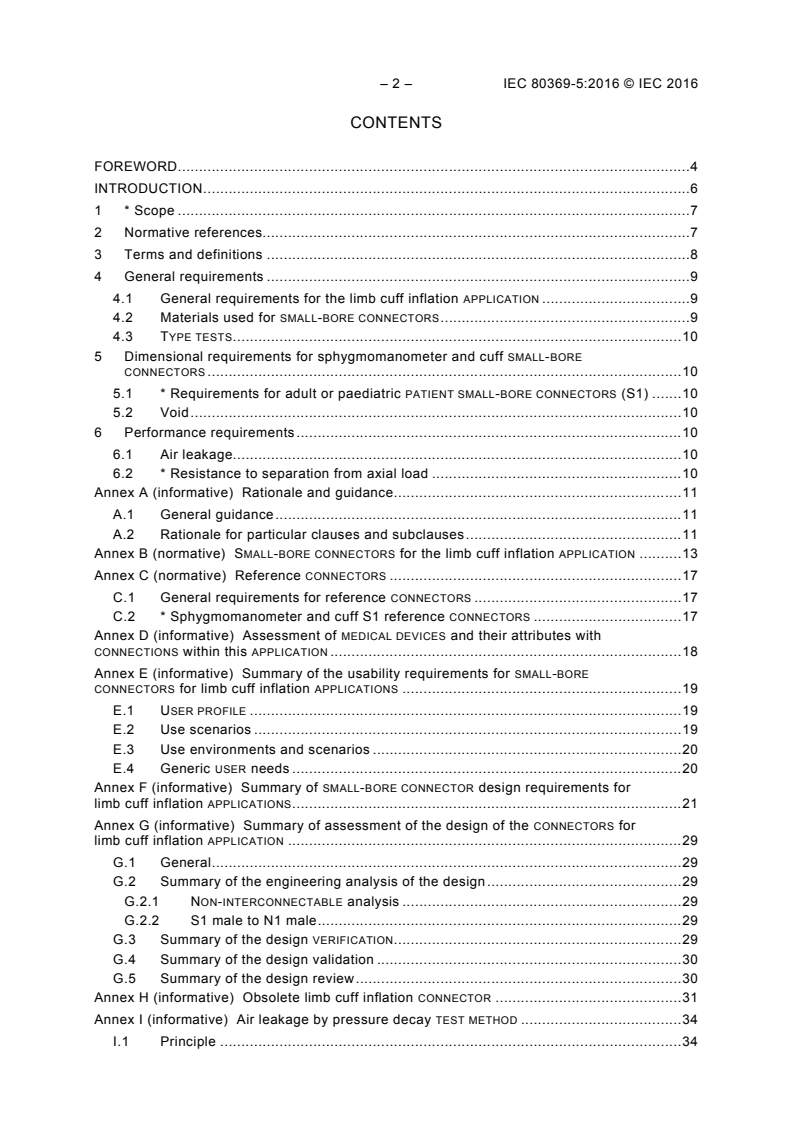
– 2 – IEC 80369-5:2016 © IEC 2016
CONTENTS
FOREWORD . 4
INTRODUCTION . 6
1 * Scope . 7
2 Normative references. 7
3 Terms and definitions . 8
4 General requirements . 9
4.1 General requirements for the limb cuff inflation APPLICATION . 9
4.2 Materials used for SMALL-BORE CONNECTORS . 9
4.3 TYPE TESTS . 10
5 Dimensional requirements for sphygmomanometer and cuff SMALL-BORE
CONNECTORS . 10
5.1 * Requirements for adult or paediatric PATIENT SMALL-BORE CONNECTORS (S1) . 10
5.2 Void . 10
6 Performance requirements . 10
6.1 Air leakage. 10
6.2 * Resistance to separation from axial load . 10
Annex A (informative) Rationale and guidance . 11
A.1 General guidance . 11
A.2 Rationale for particular clauses and subclauses . 11
Annex B (normative) SMALL-BORE CONNECTORS for the limb cuff inflation APPLICATION . 13
Annex C (normative) Reference CONNECTORS . 17
C.1 General requirements for reference CONNECTORS . 17
C.2 * Sphygmomanometer and cuff S1 reference CONNECTORS . 17
Annex D (informative) Assessment of MEDICAL DEVICES and their attributes with
CONNECTIONS within this APPLICATION . 18
Annex E (informative) Summary of the usability requirements for SMALL-BORE
CONNECTORS for limb cuff inflation APPLICATIONS . 19
E.1 USER PROFILE . 19
E.2 Use scenarios . 19
E.3 Use environments and scenarios . 20
E.4 Generic USER needs . 20
Annex F (informative) Summary of SMALL-BORE CONNECTOR design requirements for
limb cuff inflation APPLICATIONS . 21
Annex G (informative) Summary of assessment of the design of the CONNECTORS for
limb cuff inflation APPLICATION . 29
G.1 General . 29
G.2 Summary of the engineering analysis of the design . 29
G.2.1 NON-INTERCONNECTABLE analysis . 29
G.2.2 S1 male to N1 male . 29
G.3 Summary of the design VERIFICATION . 29
G.4 Summary of the design validation . 30
G.5 Summary of the design review . 30
Annex H (informative) Obsolete limb cuff inflation CONNECTOR . 31
Annex I (informative) Air leakage by pressure decay TEST METHOD . 34
I.1 Principle . 34
I.2 * Test conditions . 34
I.2.1 Test sample preconditioning . 34
I.2.2 Environmental test conditions . 34
I.3 Apparatus . 34
I.4 PROCEDURE . 34
I.5 Test report . 35
Annex J (informative) Resistance to separation from axial load TEST METHOD . 36
J.1 Principle . 36
J.2 * Test conditions . 36
J.2.1 Test sample preconditioning . 36
J.2.2 Environmental test conditions . 36
J.3 Apparatus . 36
J.4 PROCEDURE . 36
J.5 Test report . 36
Annex K (informative) Reference to the essential principles . 37
Index of defined terms . 39
Bibliography . 40
Figure B.1 – Male cuff S1 SMALL-BORE CONNECTOR . 13
Figure B.2 – Female sphygmomanometer S1 SMALL-BORE CONNECTOR . 15
Figure B.3 – Sphygmomanometer and cuff SMALL-BORE CONNECTOR (S1) assembly . 15
Figure H.1 – Obsolete sphygmomanometer and cuff SMALL-BORE CONNECTOR . 32
Table B.1 – Male cuff S1 SMALL-BORE CONNECTOR dimensions . 14
Table B.2 – Female sphygmomanometer S1 SMALL-BORE CONNECTOR dimensions . 16
Table E.1 – USER PROFILE . 19
Table F.1 – Adult or paediatric PATIENT sphygmomanometer and cuff S1 CONNECTOR-
specific design requirements (1 of 4) . 21
Table F.2 – Neonatal sphygmomanometer and cuff CONNECTOR-specific design
requirements (1 of 4) . 25
Table G.1 – Summary of possible misconnection from CAD analysis . 29
Table H.1 – Obsolete male sphygmomanometer and cuff SMALL-BORE CONNECTOR
dimensions . 33
Table H.2 – Obsolete female sphygmomanometer and cuff SMALL-BORE CONNECTOR
dimensions . 33
Table K.1 – Correspondence between this document and the essential principles
(1 of 2) . 37
– 4 – IEC 80369-5:2016 © IEC 2016
INTERNATIONAL ELECTROTECHNICAL COMMISSION
____________
SMALL-BORE CONNECTORS FOR LIQUIDS
AND GASES IN HEALTHCARE APPLICATIONS –
Part 5: Connectors for limb cuff inflation applications
FOREWORD
1) The International Electrotechnical Commission (IEC) is a worldwide organization for standardization comprising
all national electrotechnical committees (IEC National Committees). The object of IEC is to promote
international co-operation on all questions concerning standardization in the electrical and electronic fields. To
this end and in addition to other activities, IEC publishes International Standards, Technical Specifications,
Technical Reports, Publicly Available Specifications (PAS) and Guides (hereafter referred to as “IEC
Publication(s)”). Their preparation is entrusted to technical committees; any IEC National Committee interested
in the subject dealt with may participate in this preparatory work. International, governmental and non-
governmental organizations liaising with the IEC also participate in this preparation. IEC collaborates closely
with the International Organization for Standardization (ISO) in accordance with conditions determined by
agreement between the two organizations.
2) The formal decisions or agreements of IEC on technical matters express, as nearly as possible, an international
consensus of opinion on the relevant subjects since each technical committee has representation from all
interested IEC National Committees.
3) IEC Publications have the form of recommendations for international use and are accepted by IEC National
Committees in that sense. While all reasonable efforts are made to ensure that the technical content of IEC
Publications is accurate, IEC cannot be held responsible for the way in which they are used or for any
misinterpretation by any end user.
4) In order to promote international uniformity, IEC National Committees undertake to apply IEC Publications
transparently to the maximum extent possible in their national and regional publications. Any divergence
between any IEC Publication and the corresponding national or regional publication shall be clearly indicated in
the latter.
5) IEC itself does not provide any attestation of conformity. Independent certification bodies provide conformity
assessment services and, in some areas, access to IEC marks of conformity. IEC is not responsible for any
services carried out by independent certification bodies.
6) All users should ensure that they have the latest edition of this publication.
7) No liability shall attach to IEC or its directors, employees, servants or agents including individual experts and
members of its technical committees and IEC National Committees for any personal injury, property damage or
other damage of any nature whatsoever, whether direct or indirect, or for costs (including legal fees) and
expenses arising out of the publication, use of, or reliance upon, this IEC Publication or any other IEC
Publications.
8) Attention is drawn to the Normative references cited in this publication. Use of the referenced publications is
indispensable for the correct application of this publication.
9) Attention is drawn to the possibility that some of the elements of this IEC Publication may be the subject of
patent rights. IEC shall not be held responsible for identifying any or all such patent rights.
International Standard IEC 80369-5 has been prepared by a Joint Working Group of
subcommittee 62D: Electromedical equipment of IEC technical committee 62: Electrical
equipment in medical practice, ISO technical committee 210, Quality management and
corresponding general aspects for medical devices and CEN/CENELEC TC3/WG 2, Small-
bore connectors.
The text of this standard is based on the following documents:
FDIS Report on voting
62D/1306/FDIS 62D/1329/RVD
Full information on the voting for the approval of this standard can be found in the report on
voting indicated in the above table. In ISO, the standard has been approved by 23 P members
out of 23 having cast a vote.
This publication has been drafted in accordance with the ISO/IEC Directives, Part 2.
A list of all parts in the International Standard 80369 series, published under the general title
Small-bore connectors for liquids and gases in healthcare applications, can be found on the
IEC and ISO websites.
In this standard, the following print types are used:
– Requirements and definitions: roman type.
– Informative material appearing outside of tables, such as notes, examples and references: in smaller type.
Normative text of tables is also in a smaller type.
– TERMS DEFINED IN CLAUSE 3 OF THIS STANDARD OR AS NOTED IN THE INDEX OF DEFINED TERMS:
SMALL CAPITALS.
In this standard, the conjunctive “or” is used as an “inclusive or” so a statement is true if any
combination of the conditions is true.
The verbal forms used in this standard conform to usage described in Annex H of the
ISO/IEC Directives, Part 2. For the purposes of this standard, the auxiliary verb:
– “shall” means that compliance with a requirement or a test is mandatory for compliance
with this standard;
– “should” means that compliance with a requirement or a test is recommended but is not
mandatory for compliance with this standard;
– “may” is used to describe a permissible way to achieve compliance with a requirement or
test.
An asterisk (*) as the first character of a title or at the beginning of a paragraph or table title
indicates that there is guidance or rationale related to that item in Annex A.
NOTE The attention of Member Bodies and National Committees is drawn to the fact that equipment manufacturers
and testing organizations may need a transitional period following publication of a new, amended or revised ISO or
IEC publication in which to make products in accordance with the new requirements and to equip themselves for
conducting new or revised tests. It is the recommendation of the committees that the content of this publication be
adopted for implementation nationally not earlier than 3 years from the date of publication.
The committee has decided that the contents of this publication will remain unchanged until
the stability date indicated on the IEC website under "http://webstore.iec.ch" in the data
related to the specific publication. At this date, the publication will be
• reconfirmed,
• withdrawn,
• replaced by a revised edition, or
• amended.
The contents of the corrigendum of February 2017 have been included in this copy.
– 6 – IEC 80369-5:2016 © IEC 2016
INTRODUCTION
This International Standard was developed because of several incidents, with catastrophic
consequences, resultant from inappropriate medication, liquid nutritional formula or air being
administered intravenously. Many incidents have been reported, leading to international
recognition of the importance of these issues, and a need has been identified to develop
specific CONNECTORS for MEDICAL DEVICES and their ACCESSORIES used to deliver fluids in other
APPLICATIONS.
The International Standard 80369 series was developed to prevent misconnection between
SMALL-BORE CONNECTORS used in different APPLICATIONS. Part 1 specifies the requirements
necessary to verify the designs and dimensions of SMALL-BORE CONNECTORS to ensure that:
a) they do not misconnect with other SMALL-BORE CONNECTORS; and
b) they safely and securely connect with their mating half.
Part 20 contains the common TEST METHODS to support the performance requirements for
SMALL-BORE CONNECTORS. The other parts specify the designs of SMALL-BORE CONNECTORS for
the various APPLICATIONS.
This part of International Standard 80369 specifies the design and the dimensions and
drawings of SMALL-BORE CONNECTORS intended for use in limb cuff inflation APPLICATIONS. The
informative Annex D through Annex G describe the methods by which this design has been
assessed. Other parts of International Standard 80369 include requirements for SMALL-BORE
CONNECTORS used in different APPLICATION categories.
CONNECTORS manufactured to the dimensions set out within this International Standard are
therefore dimensionally incompatible with the SMALL-BORE CONNECTORS used in other
APPLICATIONS specified by the standards in this series, unless otherwise indicated. If fitted to
the relevant MEDICAL DEVICES and ACCESSORIES, these CONNECTORS should be able to prevent
air being delivered intravenously. CONNECTORS manufactured to the dimensions specified in
this standard are also NON-INTERCONNECTABLE with any of the other CONNECTORS identified in
the International Standard 80369 series of standards for SMALL-BORE CONNECTORS, unless
otherwise indicated.
SMALL-BORE CONNECTORS FOR LIQUIDS
AND GASES IN HEALTHCARE APPLICATIONS –
Part 5: Connectors for limb cuff inflation applications
1 * Scope
This part of International Standard 80369 specifies dimensions and requirements for the
design and functional performance of SMALL-BORE CONNECTORS intended to be used for
CONNECTIONS in limb cuff inflation APPLICATIONS of MEDICAL DEVICES and ACCESSORIES. Limb
cuff inflation APPLICATIONS include CONNECTIONS between a sphygmomanometer and its cuff.
[3] [7]
This part of International Standard 80369 does not specify requirements for the MEDICAL
DEVICES or ACCESSORIES that use these CONNECTORS. Such requirements are given in
particular International Standards for specific MEDICAL DEVICES or ACCESSORIES.
This part of International Standard 80369 does not specify requirements for pressurizing and
depressurizing the retention mechanism (e.g. balloon) used to hold invasive MEDICAL DEVICES
in place.
NOTE 1 MANUFACTURERS are encouraged to incorporate the SMALL-BORE CONNECTORS specified in this part of
International Standard 80369 into MEDICAL DEVICES, medical systems or ACCESSORIES, even if currently not required
by the relevant particular MEDICAL DEVICE standards. It is expected that when the relevant particular MEDICAL DEVICE
standards are revised, requirements for SMALL-BORE CONNECTORS, as specified in this part of International Standard
80369, will be included.
NOTE 2 The requirements for SMALL-BORE CONNECTORS intended to be used with neonatal PATIENTS to connect a
cuff to a sphygmomanometer are intended to be added to this standard by an amendment or new edition.
IEC 80601-2-30 [7] defines the age range for neonatal mode usage of sphygmomanometers.
NOTE 3 The requirements for SMALL-BORE CONNECTORS intended to be used to connect a tourniquet to its
inflating equipment are intended to be added to this standard by an amendment or new edition.
NOTE 4 ISO 80369-1:2010, 5.8, specifies alternative methods of compliance with ISO 80369-1:2010, for SMALL-
BORE CONNECTORS intended for limb cuff inflation APPLICATIONS of MEDICAL DEVICES or ACCESSORIES which do not
comply with this part of ISO 80369.
2 Normative references
The following documents, in whole or in part, are normatively referenced in this document and
are indispensable for its application. For dated references, only the edition cited applies. For
undated references, the latest edition of the referenced document (including any
amendments) applies.
NOTE 1 The way in which these referenced documents are cited in normative requirements determines the
extent (in whole or in part) to which they apply.
NOTE 2 Informative references are listed in the bibliography on page 40.
ISO 5356-1:2004, Anaesthetic and respiratory equipment – Conical connectors – Part 1:
Cones and sockets
ISO 5356-1:2015 , Anaesthetic and respiratory equipment – Conical connectors – Part 1:
Cones and sockets
ISO 5356-2:2006 , Anaesthetic and respiratory equipment – Conical connectors – Part 2:
Screw-threaded weight-bearing connectors
______________
Figures in square brackets refer to the Bibliography.
Both the current and previous versions of this standard are normatively referenced.
Both the current and previous versions of this standard are normatively referenced.
– 8 – IEC 80369-5:2016 © IEC 2016
ISO 5356-2:2012, Anaesthetic and respiratory equipment – Conical connectors – Part 2:
Screw-threaded weight-bearing connectors
ISO 8185:2007, Respiratory tract humidifiers for medical use – Particular requirements for
respiratory humidification systems
ISO 14971:2007, Medical devices – Application of risk management to medical devices
ISO 80369-1:2010, Small-bore connectors for liquids and gases in healthcare applications –
Part 1: General requirements
EN 13544-2:2002, Respiratory therapy equipment – Part 2: Tubing and connectors
EN 13544-2:2002:AMD 1:2009
ASTM D638-14, Standard test method for tensile properties of plastics
ASTM D790-10, Standard test methods for flexural properties of unreinforced and reinforced
plastics and electrical insulating materials
3 Terms and definitions
For the purposes of this document, the terms and definitions specified in ISO 80369-1:2010,
ISO 14971:2007 and the following apply.
NOTE For convenience, the sources of all defined terms used in this document are given in the Index of defined
terms.
3.1
NORMAL USE
operation, including routine inspection and adjustments by any USER, and stand-by, according
to the instructions for use
Note 1 to entry: NORMAL USE should not be confused with INTENDED USE. While both include the concept of use as
intended by the MANUFACTURER, INTENDED USE focuses on the medical purpose while NORMAL USE incorporates not
only the medical purpose, but maintenance, transport, etc. as well.
[SOURCE: IEC 60601-1:2005+IEC 60601-1:2005/AMD1:2012, definition 3.71, modified,
replaced ‘OPERATOR’ with ‘USER’.]
3.2
RATED
term referring to a value assigned by the MANUFACTURER for a specified operating condition
[SOURCE: IEC 60601-1:2005, definition 3.97]
3.3
TEST METHOD
definitive PROCEDURE for evaluating CONNECTORS that produces a test result
[SOURCE: ISO 80369-20:2015, definition 3.1]
3.4
TYPE TEST
test on a representative sample with the objective of determining if the CONNECTOR, as
designed and manufactured, can meet the requirements of this standard
[SOURCE: IEC 60601-1:2005, definition 3.135, modified: replaced ‘equipment’ with
‘CONNECTOR’.]
3.5
USER
person interacting with (i.e. operating or handling) the MEDICAL DEVICE
Note 1 to entry: There can be more than one USER of a MEDICAL DEVICE.
Note 2 to entry: Common USERS include clinicians, PATIENTS, cleaners and maintenance and service personnel.
[SOURCE: IEC 62366-1:2015, definition 3.24]
3.6
USER PROFILE
summary of the mental, physical and demographic traits of an intended USER group, as well
as any special characteristics, such as occupational skills, job requirements and working
conditions, which can have a bearing on design decisions
[SOURCE: IEC 62366-1:2015, definition 3.29]
4 General requirements
4.1 General requirements for the limb cuff inflation APPLICATION
SMALL-BORE CONNECTORS of MEDICAL DEVICES or ACCESSORIES intended for use in limb cuff
inflation APPLICATIONS made in compliance with this standard shall comply with ISO 80369-
1:2010 unless otherwise indicated in this standard.
Because the following CONNECTORS are inadequately specified, SMALL-BORE CONNECTORS for
use in limb cuff inflation APPLICATIONS should not, but may connect with:
– the cones and sockets of ISO 5356-1:2004, ISO 5356-1:2015, ISO 5356-2:2006 and
ISO 5356-2:2012;
– the temperature sensor CONNECTOR and mating ports made in compliance with Annex DD
of ISO 8185:2007; and
– the nipples of EN 13544-2:2002 and EN 13544-2:2002+EN 13544-2:2002/AMD1:2009.
The reference CONNECTORS for evaluation of the NON-INTERCONNECTABLE characteristics are
described in Annex C.
Where the design of the SMALL-BORE CONNECTOR of this standard relies on dimensions or
features of the MEDICAL DEVICE or ACCESSORY to ensure NON-INTERCONNECTABLE
characteristics, the NON-INTERCONNECTABLE characteristics shall be VERIFIED.
Check compliance by applying the tests of ISO 80369-1:2010, 5.1, and ISO 80369-1:2010,
Annex B. Compliance also may be shown by applying a computer aided design (CAD)
SMALL-BORE
analysis of the dimensions of all of the International Standard 80369 series
CONNECTORS and the SMALL-BORE CONNECTOR under test, in conjunction with physical testing
of the SMALL-BORE CONNECTOR per Annex B of ISO 80369-1:2010, where the CAD analysis
does not demonstrate the NON-INTERCONNECTABLE characteristics. When necessary, the
SMALL-BORE CONNECTOR may be installed on the MEDICAL DEVICE or ACCESSORY to demonstrate
compliance with the NON-INTERCONNECTABLE characteristics test requirements of ISO 80369-
1:2010, Annex B.
NOTE 1 MEDICAL DEVICES using the SMALL-BORE CONNECTORS of this standard that do not rely on the dimensions
or features of the MEDICAL DEVICE or ACCESSORY to ensure NON-INTERCONNECTABLE characteristics are presumed to
comply with the NON-INTERCONNECTABLE characteristics test requirements of this standard.
NOTE 2 The summary of MEDICAL DEVICES and their attributes with CONNECTIONS within this APPLICATION is
provided in informative Annex D.
NOTE 3 The summary of the usability requirements for these SMALL-BORE CONNECTORS is provided in informative
Annex E.
NOTE 4 The summary of these SMALL-BORE CONNECTORS criteria and requirements is provided in informative
Annex F.
NOTE 5 The summary of assessment of the design of these SMALL-BORE CONNECTORS according to
ISO 80369-1:2010, Clause 7, is contained in informative Annex G.
4.2 Materials used for SMALL-BORE CONNECTORS
In addition to the requirements of ISO 80369-1:2010, Clause 4, SMALL-BORE CONNECTORS for
this APPLICATION shall be made of materials with a nominal modulus of elasticity either in
flexure or in tension greater than 700 MPa.
Check compliance by applying the tests of ASTM D638-14 or ASTM D790-10.
– 10 – IEC 80369-5:2016 © IEC 2016
4.3 TYPE TESTS
Compliance with the requirements of this International Standard shall be determined by TYPE
TESTS.
5 Dimensional requirements for sphygmomanometer and cuff SMALL-BORE
CONNECTORS
5.1 * Requirements for adult or paediatric PATIENT SMALL-BORE CONNECTORS (S1)
SMALL-BORE CONNECTORS intended to be used with adult or paediatric PATIENTS to connect a
cuff to a sphygmomanometer shall comply with the relevant dimensions and tolerances as
given in
– Figure B.1 and Table B.1 for the male S1 CONNECTOR.
– Figure B.2 and Table B.2 for the female S1 CONNECTOR.
The male CONNECTOR shall be used for the cuff CONNECTOR.
NOTE Annex H describes an obsolete CONNECTOR that has been used to connect a cuff and sphygmomanometer
and that does not comply with this standard.
Check compliance by confirming the relevant dimensions and tolerances specified in Annex B.
5.2 Void
6 Performance requirements
6.1 Air leakage
The engaged SMALL-BORE CONNECTORS for limb cuff inflation APPLICATIONS shall be evaluated
for air leakage. The leakage flowrate of paediatric and adult SMALL-BORE CONNECTORS for limb
3 3
cuff inflation APPLICATIONS shall not exceed 80 Pa•cm /s (0,60 mmHg•cm /s) while being
subjected to an applied pressure of between 50 kPa (375,0 mmHg) and 55 kPa (412,5 mmHg)
for a hold period of 95 s to 100 s. MANUFACTURERS may use a greater applied pressure or a
longer hold period.
Check compliance by applying the tests of Annex I, while using the leakage reference
CONNECTOR specified in Annex C.
6.2 * Resistance to separation from axial load
SMALL-BORE CONNECTORS for limb cuff inflation APPLICATIONS shall be evaluated for separation
from axial load. Paediatric and adult CONNECTORS shall not separate from the reference
CONNECTOR over the hold period while being subjected to a disconnection applied axial force
between 2 N and 3 N for use in the home healthcare environment or for a CONNECTOR on a
sphygmomanometer and 32 N and 35 N, otherwise. MANUFACTURERS may use a greater
disconnection applied axial force or a longer hold period.
Check compliance by applying the tests of Annex J, while using the separation from axial load
reference CONNECTOR specified in Annex C.
Annex A
(informative)
Rationale and guidance
A.1 General guidance
This annex provides a rationale for some requirements of IEC 80369-5 and is intended for
those who are familiar with the subject of IEC 80369-5 but who have not participated in its
development. An understanding of the rationale underlying these requirements is considered
to be essential for their proper application. Furthermore, as clinical practice and technology
change, it is believed that a rationale will facilitate any revision of this part of International
Standard 80369 necessitated by those developments.
A.2 Rationale for particular clauses and subclauses
The clauses and subclauses in this annex have been numbered to correspond to the
numbering of the clauses and subclauses of this document to which they refer. The
numbering is, therefore, not consecutive.
Clause 1 Scope
In 2000, a task group of the European standards organisation CEN proposed a strategy to
reduce incidents of accidental misconnection of PATIENT therapy tubing by the use of a series
of NON-INTERCONNECTABLE CONNECTORS, differentiated by design, for use in different medical
APPLICATIONS. The strategy reserves the use of LUER CONNECTORS solely for use in MEDICAL
DEVICES used to access the vascular system or for hypodermic syringes so that they can
achieve their intended function. [4]
MANUFACTURERS and RESPONSIBLE ORGANIZATIONS are encouraged to report their experience
with the SMALL-BORE CONNECTORS specified in this part of International Standard 80369 to the
Secretariat of ISO/TC 210, so that it can consider this feedback during the revision of the
relevant part of this series of International Standards.
PATIENT SMALL-BORE CONNECTORS
Subclause 5.1 Requirements for adult or paediatric
(S1)
The SMALL-BORE CONNECTORS specified for use with adult and paediatric cuffs and
sphygmomanometers are readily available from many sources. These CONNECTORS fully
meet all the technical requirements of this International Standard, are widely available
throughout the world, have been accepted by the marketplace and are familiar to the USERS
and MANUFACTURERS alike. These CONNECTORS are NON-INTERCONNECTABLE with all of the
other CONNECTORS specified in the International Standard 80369 series, except as noted.
Details of the locking and closure mechanisms indicated in NOTE 2 of Figure B.2 are not
specified, as there are several different, MANUFACTURER-specific, variations in the
marketplace. As a result, fully-detailed engineering drawings of the locking and closure
mechanisms are not available. It is possible that these unspecified dimensions could increase
the RISK of misconnection with other CONNECTORS in this series.
Subclause 6.2 Resistance to separation from axial load
The CONNECTORS specified in this part of International Standard 80369 for CONNECTORS
intended to be used for CONNECTIONS in limb cuff inflation APPLICATIONS utilize pressures that
are required to be held for a period of time when used in healthcare facilities. As a result,
______________
Figures in square brackets refer to the Bibliography.
Compliant connectors are commercially available from sources including: the BC series from Colder Products,
http://www.colder.com/; the 20KA series from Parker Rectus, http://www.rectus.de/; and the BPF series from
Value Plastics, http://www.valueplastics.com/. This information is given for the convenience of users of this
document and does not constitute an endorsement by ISO or IEC of these products.
– 12 – IEC 80369-5:2016 © IEC 2016
these CONNECTIONS are expected to have a means to ensure the security of the CONNECTION
(i.e. more than just a force fit like the LUER SLIP CONNECTOR of ISO 594-1). The exception to
this requirement is for home healthcare environment sphygmomanometers where the PATIENT
is the USER. In this case, the locking groove is not needed.
Clause C.2 Sphygmomanometer and cuff S1 reference CONNECTORS
The specified reference CONNECTORS are the CONNECTOR designs originally used by
MANUFACTURERS for S1 in this APPLICATION. As such, it is appropriate that all other S1
CONNECTORS are designed and tested to interoperate with them.
Clause I.2 Test conditions
and
Clause J.2 Test conditions
Each TEST METHOD includes preconditioning and environmental test requirements
Temperature and humidity preconditioning requirements from ISO 594-1 and ISO 594-2 also
have been added in the TEST METHODS for hygroscopic materials, as these materials are
known to absorb moisture from surrounding gases and liquids, which can alter physical
characteristics, dimensions and performance of CONNECTORS.
The temperature range specified for testing is identical to that specified in ISO 594-1 and
ISO 594-2.
Annex B
(normative)
SMALL-BORE CONNECTORS for the limb cuff inflation APPLICATION
Figures B.1 and B.2 illustrate a male cuff S1 SMALL-BORE CONNECTOR and a female
sphygmomanometer S1 SMALL-BORE CONNECTOR respectively. Tables B.1 and B.2 indicate the
respective dimensions of these CONNECTORS.
e
A
g5 k5
R2
R1
b5
A
IEC
Table B.1 contains the dimensions for this figure.
The extent of the flange (Øw) need not be round.
NOTE The sealing surface is represented by dimension Øh5 of the male CONNECTOR that mates to the sealing
surface of ØS5 of the female CONNECTOR.
Figure B.1 – Male cuff S1 SMALL-BORE CONNECTOR
øw
øu
øf
øj5
øh5
– 14 – IEC 80369-5:2016 © IEC 2016
Table B.1 – Male cuff S1 SMALL-BORE CONNECTOR dimensions
Dimensions in mm unless otherwise indicated
Male S1 SMALL-BORE CONNECTOR
Dimension
Reference Designation
Minimum Nominal Maximum
a
b5 Angle of the latch groove side (degrees) 44,0° 45,0° 46,0°
e Length of male bayonet 8,400 8,500 8,600
Øf Inside diameter at the tip of the male bayonet 2,450 2,675 2,900
a
Width of the latch groove base 0,910 1,060 1,210
g5
Øh5 Outside diameter of the male bayonet 4,880 4,930 4,980
a
Diameter of latch groove base 3,810 3,940 4,070
Øj5
k5
Length from the male bayonet tip to latch groove 2,880 3,010 3,140
(L) Length of engagement (reference) (see Figure B.3) (1,510) (1,610) (1,710)
Radius or chamfer at the outside tip of the male
r1 0,200 0,510 0,820
bayonet tip
Radius or chamfer at the inside tip of the male
r2 0,000 0,050 0,100
bayonet tip
Øu Inside diameter of the fluid lumen 2,450 2,675 —
Outside diameter of the minimum tangential circle of
Øw 6,400 9,000 11,600
the male lock connector flange
a
The locking groove detailed by b5, Øj5 and g5 may be omitted.
E
B
M5
B
IEC
Table B.2 contains the dimensions for this figure.
The sealing surface of ØH of the female CONNECTOR need not comply with 4.2 (e.g. be elastomeric).
The outer diameter of the female CONNECTOR (ØW) need not be round.
NOTE 1 The sealing surface is represented by dimension Øh5 of the male CONNECTOR that mates to the sealing
surface of ØS5 of the female CONNECTOR.
NOTE 2 The details of the locking mechanism using the groove of the male CONNECTOR are MANUFACTURER-
specific.
Figure B.2 – Female sphygmomanometer S1 SMALL-BORE CONNECTOR
(L)
IEC
Table B.1 and Table B.2 contain the dimensions for this figure.
Figure B.3 – Sphygmomanometer and cuff SMALL-BORE CONNECTOR (S1) assembly
øH5
øS5
øU
øW
– 16 – IEC 80369-5:2016 © IEC 2016
Table B.2 – Female sphygmomanometer S1 SMALL-BORE CONNECTOR dimensions
Dimensions in mm unless otherwise indicated
Female S1 SMALL-BORE CONNECTOR
Dimension
Reference Designation
Minimum Nominal Maximum
E Depth of female CONNECTOR (to fluid lumen) 8,600 8,600 —
ØH5 Inside diameter of the female CONNECTOR 5,060 5,105 5,150
(L) Length of engagemen
...