

IEC 60613:2010
(Main)Electrical and loading characteristics of X-ray tube assemblies for medical diagnosis
General Information
- Abstract
IEC 60613:2010 applies to X-ray tube assemblies either with a rotating anode X-ray tube or a stationary anode X-ray tube, intended for use in medical diagnosis. For an X-ray tube head, its X-ray tube assembly aspects are also within the scope. IEC 60613:2010 covers performance-related definitions and conditions of electrical and loading characteristics of X-ray tube assemblies in relation to their behaviour during and after energization and, where appropriate, methods of presentation and measurement of these characteristics. This International Standard is therefore relevant for the manufacturer and the responsible organization. This third edition cancels and replaces the second edition of IEC 60613, published in 1989. It constitutes a technical revision. This third edition has been adapted to apply to the present technology.
- Status
- Published
- Publication Date
- 26-Jan-2010
- Technical Committee
- SC 62B - Medical imaging equipment, software, and systems
- Drafting Committee
- MT 32 - TC 62/SC 62B/MT 32
- Current Stage
- PPUB - Publication issued
- Start Date
- 27-Jan-2010
- Completion Date
- 28-Feb-2010
Overview
IEC 60613:2010 is an international standard issued by the International Electrotechnical Commission (IEC). It specifies the electrical and loading characteristics of X-ray tube assemblies used in medical diagnosis. The standard applies to assemblies with either rotating or stationary anode X-ray tubes, as well as the relevant characteristics of X-ray tube heads. IEC 60613:2010 defines key performance parameters, measurement conditions, and how these characteristics should be presented, supporting both manufacturers and responsible organizations in ensuring safety, performance, and compatibility.
Adopted as the third edition, this standard incorporates technological advancements in medical X-ray tube design and replaces prior editions to better serve contemporary diagnostic imaging requirements.
Key Topics
IEC 60613:2010 addresses a comprehensive range of requirements and definitions for X-ray tube assemblies, including:
Electrical Characteristics
- X-ray tube voltage and current (peak and mean values)
- Cathode emission characteristics and relationships with filament current
Loading Characteristics
- Definitions of loading time, cycle time, and loading factors
- Methods of measurement that reflect typical clinical use
Input Power Specifications
- Anode input power under specified operating conditions
- Nominal radiographic and CT anode input power ratings
- Continuous input power and its importance for safe operation
Presentation of Data
- Standardized methods for presenting ratings (tables, graphs, numerical values)
- Guidance on referencing IEC 60613:2010 for compliance
Terms and Definitions
- Key terms such as envelope current/voltage, CT scan power index (CTSPI), single and serial load ratings
Applications
IEC 60613:2010 is vital for a range of stakeholders and scenarios in the field of medical diagnostic imaging:
Manufacturers of Medical X-ray Equipment
- Provides clear criteria and standard definitions for designing and manufacturing X-ray tube assemblies and tube heads
- Facilitates accurate and standardized performance data for product labeling and documentation
Healthcare Facilities and Clinical Users
- Ensures selection of X-ray systems that meet defined safety and performance thresholds
- Supports preventive maintenance, performance assessments, and decision-making about equipment procurement
Compliance, Testing, and Quality Assurance
- Provides a basis for regulatory conformity assessment and certification
- Enables effective equipment comparison, performance verification, and routine compliance checks
Product Communication
- Standardized terminology assists in clear communication between suppliers, clinicians, and maintenance personnel
IEC 60613:2010 supports contemporary applications, such as advanced computed tomography (CT), general radiography, mammography, and dental imaging. Its focus on clinically relevant measurement and presentation ensures the standard aligns closely with routine diagnostic practice.
Related Standards
IEC 60613:2010 is part of a broader framework of international standards for medical electrical equipment and diagnostic imaging:
IEC 60601-1:2005
Medical electrical equipment - Part 1: General requirements for basic safety and essential performanceIEC 60601-1-3:2008
Medical electrical equipment - Part 1-3: Collateral Standard: Radiation protection in diagnostic X-ray equipmentIEC/TR 60788:2004
Medical electrical equipment – Glossary of defined terms
These related standards provide background and supporting definitions, enhance compatibility, and ensure that all essential requirements for safety, performance, and terminology are consistently addressed in medical imaging equipment.
Keywords: IEC 60613:2010, X-ray tube assembly, medical diagnostics, electrical characteristics, loading characteristics, anode input power, radiographic ratings, CT scan power index, medical imaging standards, healthcare equipment compliance, IEC standards.
Get Certified
Connect with accredited certification bodies for this standard

BSI Group
BSI (British Standards Institution) is the business standards company that helps organizations make excellence a habit.

TÜV Rheinland
TÜV Rheinland is a leading international provider of technical services.

TÜV SÜD
TÜV SÜD is a trusted partner of choice for safety, security and sustainability solutions.
Sponsored listings
Frequently Asked Questions
IEC 60613:2010 is a standard published by the International Electrotechnical Commission (IEC). Its full title is "Electrical and loading characteristics of X-ray tube assemblies for medical diagnosis". This standard covers: IEC 60613:2010 applies to X-ray tube assemblies either with a rotating anode X-ray tube or a stationary anode X-ray tube, intended for use in medical diagnosis. For an X-ray tube head, its X-ray tube assembly aspects are also within the scope. IEC 60613:2010 covers performance-related definitions and conditions of electrical and loading characteristics of X-ray tube assemblies in relation to their behaviour during and after energization and, where appropriate, methods of presentation and measurement of these characteristics. This International Standard is therefore relevant for the manufacturer and the responsible organization. This third edition cancels and replaces the second edition of IEC 60613, published in 1989. It constitutes a technical revision. This third edition has been adapted to apply to the present technology.
IEC 60613:2010 applies to X-ray tube assemblies either with a rotating anode X-ray tube or a stationary anode X-ray tube, intended for use in medical diagnosis. For an X-ray tube head, its X-ray tube assembly aspects are also within the scope. IEC 60613:2010 covers performance-related definitions and conditions of electrical and loading characteristics of X-ray tube assemblies in relation to their behaviour during and after energization and, where appropriate, methods of presentation and measurement of these characteristics. This International Standard is therefore relevant for the manufacturer and the responsible organization. This third edition cancels and replaces the second edition of IEC 60613, published in 1989. It constitutes a technical revision. This third edition has been adapted to apply to the present technology.
IEC 60613:2010 is classified under the following ICS (International Classification for Standards) categories: 11.040.50 - Radiographic equipment; 11.040.60 - Therapy equipment. The ICS classification helps identify the subject area and facilitates finding related standards.
IEC 60613:2010 is available in PDF format for immediate download after purchase. The document can be added to your cart and obtained through the secure checkout process. Digital delivery ensures instant access to the complete standard document.
Standards Content (Sample)
IEC 60613 ®
Edition 3.0 2010-01
INTERNATIONAL
STANDARD
NORME
INTERNATIONALE
colour
inside
Electrical and loading characteristics of X-ray tube assemblies for medical
diagnosis
Caractéristiques électriques et de charge des gaines équipées pour diagnostic
médical
All rights reserved. Unless otherwise specified, no part of this publication may be reproduced or utilized in any form or by
any means, electronic or mechanical, including photocopying and microfilm, without permission in writing from either IEC or
IEC's member National Committee in the country of the requester.
If you have any questions about IEC copyright or have an enquiry about obtaining additional rights to this publication,
please contact the address below or your local IEC member National Committee for further information.
Droits de reproduction réservés. Sauf indication contraire, aucune partie de cette publication ne peut être reproduite
ni utilisée sous quelque forme que ce soit et par aucun procédé, électronique ou mécanique, y compris la photocopie
et les microfilms, sans l'accord écrit de la CEI ou du Comité national de la CEI du pays du demandeur.
Si vous avez des questions sur le copyright de la CEI ou si vous désirez obtenir des droits supplémentaires sur cette
publication, utilisez les coordonnées ci-après ou contactez le Comité national de la CEI de votre pays de résidence.
IEC Central Office
3, rue de Varembé
CH-1211 Geneva 20
Switzerland
Email: inmail@iec.ch
Web: www.iec.ch
About the IEC
The International Electrotechnical Commission (IEC) is the leading global organization that prepares and publishes
International Standards for all electrical, electronic and related technologies.
About IEC publications
The technical content of IEC publications is kept under constant review by the IEC. Please make sure that you have the
latest edition, a corrigenda or an amendment might have been published.
ƒ Catalogue of IEC publications: www.iec.ch/searchpub
The IEC on-line Catalogue enables you to search by a variety of criteria (reference number, text, technical committee,…).
It also gives information on projects, withdrawn and replaced publications.
ƒ IEC Just Published: www.iec.ch/online_news/justpub
Stay up to date on all new IEC publications. Just Published details twice a month all new publications released. Available
on-line and also by email.
ƒ Electropedia: www.electropedia.org
The world's leading online dictionary of electronic and electrical terms containing more than 20 000 terms and definitions
in English and French, with equivalent terms in additional languages. Also known as the International Electrotechnical
Vocabulary online.
ƒ Customer Service Centre: www.iec.ch/webstore/custserv
If you wish to give us your feedback on this publication or need further assistance, please visit the Customer Service
Centre FAQ or contact us:
Email: csc@iec.ch
Tel.: +41 22 919 02 11
Fax: +41 22 919 03 00
A propos de la CEI
La Commission Electrotechnique Internationale (CEI) est la première organisation mondiale qui élabore et publie des
normes internationales pour tout ce qui a trait à l'électricité, à l'électronique et aux technologies apparentées.
A propos des publications CEI
Le contenu technique des publications de la CEI est constamment revu. Veuillez vous assurer que vous possédez
l’édition la plus récente, un corrigendum ou amendement peut avoir été publié.
ƒ Catalogue des publications de la CEI: www.iec.ch/searchpub/cur_fut-f.htm
Le Catalogue en-ligne de la CEI vous permet d’effectuer des recherches en utilisant différents critères (numéro de référence,
texte, comité d’études,…). Il donne aussi des informations sur les projets et les publications retirées ou remplacées.
ƒ Just Published CEI: www.iec.ch/online_news/justpub
Restez informé sur les nouvelles publications de la CEI. Just Published détaille deux fois par mois les nouvelles
publications parues. Disponible en-ligne et aussi par email.
ƒ Electropedia: www.electropedia.org
Le premier dictionnaire en ligne au monde de termes électroniques et électriques. Il contient plus de 20 000 termes et
définitions en anglais et en français, ainsi que les termes équivalents dans les langues additionnelles. Egalement appelé
Vocabulaire Electrotechnique International en ligne.
ƒ Service Clients: www.iec.ch/webstore/custserv/custserv_entry-f.htm
Si vous désirez nous donner des commentaires sur cette publication ou si vous avez des questions, visitez le FAQ du
Service clients ou contactez-nous:
Email: csc@iec.ch
Tél.: +41 22 919 02 11
Fax: +41 22 919 03 00
IEC 60613 ®
Edition 3.0 2010-01
INTERNATIONAL
STANDARD
NORME
INTERNATIONALE
colour
inside
Electrical and loading characteristics of X-ray tube assemblies for medical
diagnosis
Caractéristiques électriques et de charge des gaines équipées pour diagnostic
médical
INTERNATIONAL
ELECTROTECHNICAL
COMMISSION
COMMISSION
ELECTROTECHNIQUE
PRICE CODE
INTERNATIONALE
S
CODE PRIX
ICS 11.040.50 ISBN 978-2-88910-235-8
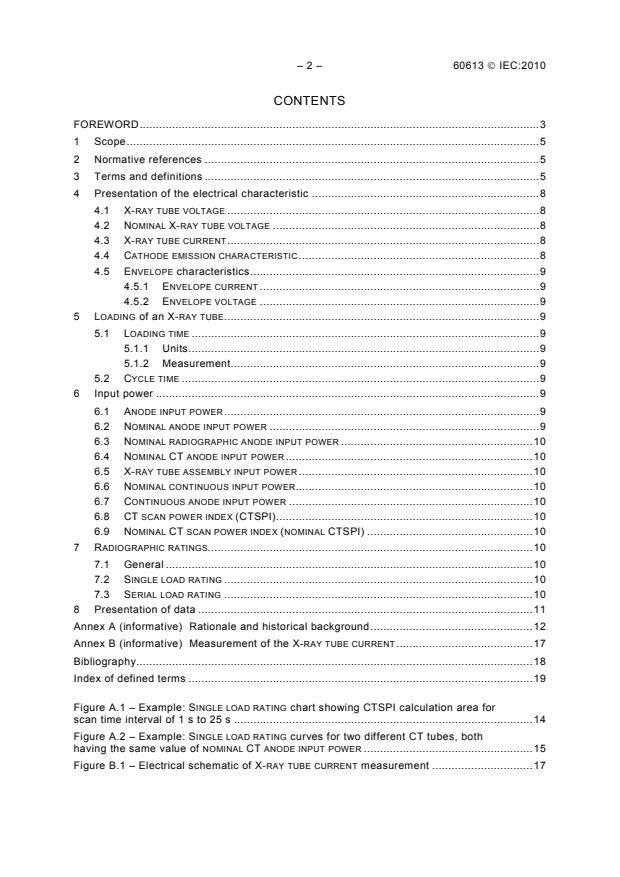
– 2 – 60613 © IEC:2010
CONTENTS
FOREWORD.3
1 Scope.5
2 Normative references .5
3 Terms and definitions .5
4 Presentation of the electrical characteristic .8
4.1 X-RAY TUBE VOLTAGE .8
4.2 NOMINAL X-RAY TUBE VOLTAGE .8
4.3 X-RAY TUBE CURRENT.8
4.4 CATHODE EMISSION CHARACTERISTIC.8
4.5 ENVELOPE characteristics.9
4.5.1 ENVELOPE CURRENT .9
4.5.2 ENVELOPE VOLTAGE .9
5 LOADING of an X-RAY TUBE.9
5.1 LOADING TIME .9
5.1.1 Units.9
5.1.2 Measurement.9
5.2 CYCLE TIME .9
6 Input power .9
6.1 ANODE INPUT POWER.9
6.2 NOMINAL ANODE INPUT POWER .9
6.3 NOMINAL RADIOGRAPHIC ANODE INPUT POWER .10
6.4 NOMINAL CT ANODE INPUT POWER .10
6.5 X-RAY TUBE ASSEMBLY INPUT POWER .10
6.6 NOMINAL CONTINUOUS INPUT POWER.10
6.7 CONTINUOUS ANODE INPUT POWER .10
6.8 CT SCAN POWER INDEX (CTSPI).10
6.9 NOMINAL CT SCAN POWER INDEX (NOMINAL CTSPI) .10
7 RADIOGRAPHIC RATINGS.10
7.1 General .10
7.2 SINGLE LOAD RATING .10
7.3 SERIAL LOAD RATING .10
8 Presentation of data .11
Annex A (informative) Rationale and historical background.12
Annex B (informative) Measurement of the X-RAY TUBE CURRENT.17
Bibliography.18
Index of defined terms .19
Figure A.1 – Example: SINGLE LOAD RATING chart showing CTSPI calculation area for
scan time interval of 1 s to 25 s .14
Figure A.2 – Example: SINGLE LOAD RATING curves for two different CT tubes, both
having the same value of NOMINAL CT ANODE INPUT POWER .15
Figure B.1 – Electrical schematic of X-RAY TUBE CURRENT measurement .17
60613 © IEC:2010 – 3 –
INTERNATIONAL ELECTROTECHNICAL COMMISSION
____________
ELECTRICAL AND LOADING CHARACTERISTICS
OF X-RAY TUBE ASSEMBLIES FOR MEDICAL DIAGNOSIS
FOREWORD
1) The International Electrotechnical Commission (IEC) is a worldwide organization for standardization comprising
all national electrotechnical committees (IEC National Committees). The object of IEC is to promote
international co-operation on all questions concerning standardization in the electrical and electronic fields. To
this end and in addition to other activities, IEC publishes International Standards, Technical Specifications,
Technical Reports, Publicly Available Specifications (PAS) and Guides (hereafter referred to as “IEC
Publication(s)”). Their preparation is entrusted to technical committees; any IEC National Committee interested
in the subject dealt with may participate in this preparatory work. International, governmental and non-
governmental organizations liaising with the IEC also participate in this preparation. IEC collaborates closely
with the International Organization for Standardization (ISO) in accordance with conditions determined by
agreement between the two organizations.
2) The formal decisions or agreements of IEC on technical matters express, as nearly as possible, an international
consensus of opinion on the relevant subjects since each technical committee has representation from all
interested IEC National Committees.
3) IEC Publications have the form of recommendations for international use and are accepted by IEC National
Committees in that sense. While all reasonable efforts are made to ensure that the technical content of IEC
Publications is accurate, IEC cannot be held responsible for the way in which they are used or for any
misinterpretation by any end user.
4) In order to promote international uniformity, IEC National Committees undertake to apply IEC Publications
transparently to the maximum extent possible in their national and regional publications. Any divergence
between any IEC Publication and the corresponding national or regional publication shall be clearly indicated in
the latter.
5) IEC itself does not provide any attestation of conformity. Independent certification bodies provide conformity
assessment services and, in some areas, access to IEC marks of conformity. IEC is not responsible for any
services carried out by independent certification bodies.
6) All users should ensure that they have the latest edition of this publication.
7) No liability shall attach to IEC or its directors, employees, servants or agents including individual experts and
members of its technical committees and IEC National Committees for any personal injury, property damage or
other damage of any nature whatsoever, whether direct or indirect, or for costs (including legal fees) and
expenses arising out of the publication, use of, or reliance upon, this IEC Publication or any other IEC
Publications.
8) Attention is drawn to the Normative references cited in this publication. Use of the referenced publications is
indispensable for the correct application of this publication.
9) Attention is drawn to the possibility that some of the elements of this IEC Publication may be the subject of
patent rights. IEC shall not be held responsible for identifying any or all such patent rights.
International Standard IEC 60613 has been prepared by subcommittee 62B: Diagnostic
imaging equipment, of IEC technical committee TC 62: Electrical equipment in medical
practice.
This third edition cancels and replaces the second edition of IEC 60613, published in 1989. It
constitutes a technical revision. This third edition has been adapted to apply to the
present technology.
The text of this standard is based on the following documents:
FDIS Report on voting
62B/774/FDIS 62B/780/RVD
Full information on the voting for the approval of this standard can be found in the report on
voting indicated in the above table.
This publication has been drafted in accordance with the ISO/IEC Directives, Part 2.
– 4 – 60613 © IEC:2010
In this standard, the following print types are used:
– requirements and definitions: roman type.
– informative material appearing outside of tables, such as notes, examples and references: in smaller type.
Normative text of tables is also in a smaller type;
– TERMS DEFINED IN CLAUSE 3 OF THIS STANDARD OR AS NOTED: SMALL CAPS.
The committee has decided that the contents of this publication will remain unchanged until
the maintenance result date indicated on the IEC web site under "http://webstore.iec.ch" in
the data related to the specific publication. At this date, the publication will be
• reconfirmed,
• withdrawn,
• replaced by a revised edition, or
• amended.
IMPORTANT – The 'colour inside' logo on the cover page of this publication indicates
that it contains colours which are considered to be useful for the correct
understanding of its contents. Users should therefore print this document using a
colour printer.
60613 © IEC:2010 – 5 –
ELECTRICAL AND LOADING CHARACTERISTICS
OF X-RAY TUBE ASSEMBLIES FOR MEDICAL DIAGNOSIS
1 Scope
This International Standard applies to X-RAY TUBE ASSEMBLIES either with a rotating ANODE X-
RAY TUBE or a stationary ANODE X-RAY TUBE, intended for use in medical diagnosis.
For an X-RAY TUBE HEAD, its X-RAY TUBE ASSEMBLY aspects are also within the scope.
This International Standard covers performance-related definitions and conditions of electrical
and LOADING characteristics of X-RAY TUBE ASSEMBLIES in relation to their behaviour during and
after energization and, where appropriate, methods of presentation and measurement of
these characteristics. This International Standard is therefore relevant for the MANUFACTURER
and the RESPONSIBLE ORGANIZATION.
NOTE “Measurement" in this standard is always related to practical use. Consequently, “measurement" is meant
to consume only a negligible part of the life of the X-RAY TUBE ASSEMBLY.
2 Normative references
The following referenced documents are indispensable for the application of this document.
For dated references, only the edition cited applies. For undated references, the latest edition
of the referenced document (including any amendments) applies.
IEC 60601-1:2005, Medical electrical equipment – Part 1: General requirements for basic
safety and essential performance
IEC 60601-1-3:2008, Medical electrical equipment – Part 1-3: General requirements for basic
safety and essential performance – Collateral Standard: Radiation protection in diagnostic X-
ray equipment
IEC/TR 60788:2004, Medical electrical equipment – Glossary of defined terms (available only
in English)
3 Terms and definitions
For the purposes of this document, the terms and definitions given in IEC/TR 60788:2004,
IEC 60601-1:2005 and IEC 60601-1-3:2008 and the following apply.
3.1
X-RAY TUBE VOLTAGE
potential difference applied to an X-RAY TUBE between the ANODE and the CATHODE. Usually X-
RAY TUBE VOLTAGE is expressed by its peak value in kilovolts (kV)
[IEC 60601-1-3:2008, 3.88]
3.2
NOMINAL X-RAY TUBE VOLTAGE
highest permitted X-RAY TUBE VOLTAGE for SPECIFIC operating conditions
[IEC 60601-1-3:2008, 3.42]
– 6 – 60613 © IEC:2010
NOTE 1 For different operating conditions of the X-RAY TUBE, for example continuous operation, intermittent
operation, short-time operation, different types of X-RAY TUBE HOUSINGS, there may be different values of the above
NOMINAL X-RAY TUBE VOLTAGE.
NOTE 2 Additionally, values may be given for the highest permitted potential difference between ANODE and earth
and between CATHODE and earth.
3.3
X-RAY TUBE CURRENT
electric current of the ELECTRON beam incident on the TARGET of an X-RAY TUBE. Usually, the
X-RAY TUBE CURRENT is expressed by its mean value in milliamperes (mA)
[IEC 60601-1-3:2008, 3.85]
NOTE See Annex B for further considerations.
3.4
CATHODE EMISSION CHARACTERISTIC
dependence of the X-RAY TUBE CURRENT on variables, for example FILAMENT CURRENT, X-RAY
TUBE VOLTAGE
3.5
ENVELOPE
vacuum-wall of the X-RAY TUBE
3.6
ENVELOPE CURRENT
electric current, flowing via a conducting part of an ENVELOPE
3.7
ENVELOPE VOLTAGE
potential difference between an X-RAY TUBE-conducting ENVELOPE part and earth
3.8
LOADING
in an X-RAY GENERATOR, act of supplying electrical energy to the ANODE of an X-RAY TUBE
[IEC 60601-1-3:2008, 3.34]
3.9
X-RAY TUBE LOAD
electrical energy supplied to an X-RAY TUBE expressed by a combination of values of LOADING
FACTORS
3.10
LOADING FACTOR
factor influencing by its value the X-RAY TUBE LOAD, for example X-RAY TUBE CURRENT, LOADING
TIME, CONTINUOUS ANODE INPUT POWER, X-RAY TUBE VOLTAGE and PERCENTAGE RIPPLE
[IEC 60601-1-3:2008, 3.35]
3.11
LOADING TIME
time determined according to a SPECIFIC method, during which the ANODE INPUT POWER is
applied to the X-RAY TUBE
[IEC 60601-1-3:2008, 3.37]
60613 © IEC:2010 – 7 –
3.12
CYCLE TIME
for a series of single LOADINGS: time interval from the beginning of a LOADING to the beginning
of the next, identical LOADING
for a series of serial LOADINGS: time interval from the beginning of a serial LOADING to the
beginning of the next, identical serial LOADING
3.13
ANODE INPUT POWER
power applied to the ANODE of an X-RAY TUBE to produce X-RADIATION
3.14
NOMINAL ANODE INPUT POWER
highest constant ANODE INPUT POWER that can be applied for a single X-RAY TUBE LOAD in a
SPECIFIC LOADING TIME and under SPECIFIED conditions
3.15
NOMINAL RADIOGRAPHIC ANODE INPUT POWER
NOMINAL ANODE INPUT POWER which can be applied for a single X-RAY TUBE LOAD with a
LOADING TIME of 0,1 s and a CYCLE TIME of 1,0 min, for an indefinite number of cycles
NOTE 1 In this application, RADIOSCOPY is not applied.
NOTE 2 With this definition mammographic and dental X-ray are included, see A.3.3 in Annex A.
3.16
NOMINAL CT ANODE INPUT POWER
NOMINAL ANODE INPUT POWER which can be applied for a single X-RAY TUBE LOAD with a
LOADING TIME of 4 s and a CYCLE TIME of 10 min, for an indefinite number of cycles
3.17
X-RAY TUBE ASSEMBLY INPUT POWER
mean power applied to an X-RAY TUBE ASSEMBLY for all purposes before, during and after
LOADING, including power applied to the stator of a rotating ANODE X-RAY TUBE, to the filament
and to any other device included in the X-RAY TUBE ASSEMBLY
3.18
NOMINAL CONTINUOUS INPUT POWER
SPECIFIED highest X-RAY TUBE ASSEMBLY INPUT POWER, which can be applied to an X-RAY TUBE
ASSEMBLY continuously
3.19
CONTINUOUS ANODE INPUT POWER
SPECIFIED highest ANODE INPUT POWER, which can be applied to the ANODE continuously
NOTE 1 CONTINUOUS ANODE INPUT POWER may be determined by subtracting all power other than the ELECTRON
beam power, such as filament heating, ANODE drive, from the NOMINAL CONTINUOUS INPUT POWER.
NOTE 2 If not SPECIFIED otherwise, CONTINUOUS ANODE INPUT POWER is the referenced LOADING FACTOR for
determining the LEAKAGE RADIATION.
3.20
CT SCAN POWER INDEX
CTSPI
characteristic of an X-RAY TUBE ASSEMBLY intended for use in COMPUTED TOMOGRAPHY for a
SPECIFIED range of LOADING TIMES for single LOADINGS, for a given CYCLE TIME, as follows
t
max
CTSPI = P()t dt
∫
(t −t )
max min
t
min
– 8 – 60613 © IEC:2010
where
t is the upper limit of the LOADING TIME in seconds,
max
t is the lower limit of the LOADING TIME in seconds, and
min
P(t) is the function representing the SINGLE LOAD RATING in kilowatts
NOTE The CTSPI represents the effective power for PATIENT throughput in CT scanning.
3.21
NOMINAL CT SCAN POWER INDEX
NOMINAL CTSPI
CTSPI, calculated for a lower limit of the LOADING TIME of 1 s, an upper of the LOADING TIME of
25 s and a CYCLE TIME of 10 min
3.22
RADIOGRAPHIC RATINGS
for the operation of an X-RAY TUBE, SPECIFIED combinations of conditions and LOADING
FACTORS, under which the SPECIFIED limits of loadability of the X-RAY TUBE are attained
3.23
SINGLE LOAD RATING
highest permitted X-RAY TUBE LOAD given by a relationship between constant ANODE INPUT
POWER and LOADING TIME for one LOADING under SPECIFIED conditions
3.24
SERIAL LOAD RATING
highest permitted X-RAY TUBE LOAD given by the relationship between ANODE INPUT POWER and
LOADING TIME for the total of a SPECIFIED series of individual X-RAY TUBE LOADS with SPECIFIED
LOADING FACTORS under SPECIFIED conditions
4 Presentation of the electrical characteristic
4.1 X-RAY TUBE VOLTAGE
The X-RAY TUBE VOLTAGE shall be given as the peak value, in kilovolts.
4.2 NOMINAL X-RAY TUBE VOLTAGE
The NOMINAL X-RAY TUBE VOLTAGE shall be given as the peak value, in kilovolts.
4.3 X-RAY TUBE CURRENT
The X-RAY TUBE CURRENT shall be given as the average value in milliamperes.
4.4 CATHODE EMISSION CHARACTERISTIC
CATHODE EMISSION CHARACTERISTICS are given as a family of curves in which the X-RAY TUBE
CURRENT is shown as a function of the FILAMENT CURRENT and, if appropriate, of further
characteristics of the CATHODE, each curve corresponding to an X-RAY TUBE VOLTAGE while
specifying its waveform, and other factors as appropriate. If appropriate, the relationship
between FILAMENT CURRENT and filament voltage shall be indicated and also its dependence
on other characteristics of the CATHODE.
60613 © IEC:2010 – 9 –
4.5 ENVELOPE characteristics
4.5.1 ENVELOPE CURRENT
If the ENVELOPE CURRENT is to be stated, it shall be given as the percentage value of X-RAY
TUBE CURRENT under SPECIFIED conditions.
4.5.2 ENVELOPE VOLTAGE
If the ENVELOPE VOLTAGE is to be stated, it shall be given in kilovolts with respect to earth.
5 LOADING of an X-RAY TUBE
5.1 LOADING TIME
5.1.1 Units
The LOADING TIME shall be given in seconds.
5.1.2 Measurement
LOADING TIME is measured as the time interval between:
– the instant that the X-RAY TUBE VOLTAGE has risen for the first time to a value of 75 % of
the peak value; and
– the instant at which it finally drops below the same value.
If LOADING is controlled by electronic switching of the HIGH VOLTAGE, using a grid in an
electronic tube or in the X-RAY TUBE, the LOADING TIME may be determined as the time interval
between the instant when the TIMING DEVICE generates the signal to start the IRRADIATION and
the instant when it generates the signal to terminate the IRRADIATION.
If LOADING is controlled by simultaneous switching in the primaries of both the high-voltage
circuit and the heating supply for the filament of the X-RAY TUBE, the LOADING TIME shall be
determined as the time interval between the instant when the X-RAY TUBE CURRENT first rises
above 25 % of its maximum value and the instant when it finally falls below the same value.
NOTE 1 See also definition 3.11.
NOTE 2 The LOADING TIME is preferably measured at the tube input to minimise the influence of HV-cable-
capacitance.
NOTE 3 For field-testing, a reasonable approximation of the LOADING TIME can be obtained by measuring the
IRRADIATION TIME, for which the SPECIFIC method according to the definition in IEC 60601-1-3:2008 is chosen in this
International Standard as the time period during which the AIR KERMA RATE exceeds 50 % of its peak value.
5.2 CYCLE TIME
The CYCLE TIME shall be given in minutes or seconds, as appropriate.
6 Input power
6.1 ANODE INPUT POWER
The ANODE INPUT POWER shall be given in kilowatts for SPECIFIED conditions of LOADING.
6.2 NOMINAL ANODE INPUT POWER
The NOMINAL ANODE INPUT POWER shall be given in kilowatts.
– 10 – 60613 © IEC:2010
6.3 NOMINAL RADIOGRAPHIC ANODE INPUT POWER
The NOMINAL RADIOGRAPHIC ANODE INPUT POWER shall be given in kilowatts.
6.4 NOMINAL CT ANODE INPUT POWER
The NOMINAL CT ANODE INPUT POWER shall be given in kilowatts.
6.5 X-RAY TUBE ASSEMBLY INPUT POWER
The X-RAY TUBE ASSEMBLY INPUT POWER shall be given in watts.
6.6 NOMINAL CONTINUOUS INPUT POWER
The NOMINAL CONTINUOUS INPUT POWER shall be given in watts.
Unless otherwise SPECIFIED, the ambient temperature shall be between 20 °C and 25 °C.
6.7 CONTINUOUS ANODE INPUT POWER
The CONTINUOUS ANODE INPUT POWER shall be given in watts.
6.8 CT SCAN POWER INDEX (CTSPI)
The CT SCAN POWER INDEX shall be given in kilowatts.
6.9 NOMINAL CT SCAN POWER INDEX (NOMINAL CTSPI)
The NOMINAL CT SCAN POWER INDEX shall be given in kilowatts.
7 RADIOGRAPHIC RATINGS
7.1 General
RADIOGRAPHIC RATINGS shall provide application-relevant parametric information on LOADING
FACTORS, in any form of presentation (tables, graphs .) which is supporting the application. If
a NOMINAL ANODE INPUT POWER is SPECIFIED, the RADIOGRAPHIC RATINGS shall at least
encompass the set of LOADING FACTORS pertinent to the SPECIFIED NOMINAL ANODE INPUT
POWER.
7.2 SINGLE LOAD RATING
The SINGLE LOAD RATING shall be presented as curves or as a table of numerical values
showing constant ANODE INPUT POWER as a function of LOADING TIME and CYCLE TIME for
appropriate LOADING FACTORS, for example NOMINAL FOCAL SPOT VALUE, ANODE SPEED and
others.
7.3 SERIAL LOAD RATING
SERIAL LOAD RATINGS shall be presented as curves or as a table of numerical values with
values of the CYCLE TIME and the appropriate LOADING FACTORS, for example, ANODE INPUT
POWER for an individual X-RAY TUBE LOAD, LOADING TIME of an individual X-RAY TUBE LOAD, total
number of LOADINGS or the duration of a series of LOADINGS, number of individual X-RAY TUBE
LOADS per second.
60613 © IEC:2010 – 11 –
8 Presentation of data
If single data values are presented in compliance with this International Standard, such values
shall be designated as follows:
IEC 60613:2010
If graphs or tables are presented in compliance with this International Standard, a reference
to IEC 60613:2010 shall be given.
– 12 – 60613 © IEC:2010
Annex A
(informative)
Rationale and historical background
A.1 Overview
The purpose of this annex is to state the general objectives and approach used in creating the
rd
3 edition of this standard, and to clarify the inclusion of those items which are substantially
new to this edition, as well as to clarify why some items are no longer described.
st nd
A.2 History: basis of 1 and 2 editions
The subject matter of these earlier editions was the electrical and thermal ratings of medical
X-RAY TUBE ASSEMBLIES and their LOADING characteristics. Therefore, the thermal/electrical
construction and operating mechanisms of X-RAY TUBES existing at the time of the earlier
editions of the standard had a significant impact on the content of those early versions.
Historically, medical X-RAY TUBES have been primarily constructed with glass ENVELOPES
which act as the insulating support between the electrically charged ANODE and CATHODE
electrodes. As such, it was not necessary or practical to define the electrical potential of this
insulating ENVELOPE, which takes on an ambiguous charge state at any particular point of its
surface. It was sufficient to state the potential difference between the ANODE and the
CATHODE, or the potential of these electrodes relative to earth. Regarding the thermal/LOADING
characteristics, most medical rotating ANODE X-RAY TUBES were constructed in such a way as
to temporarily store the heat generated in the bremsstrahlung process and then dissipate it
through the very non-linear thermal RADIATION process. Further, at the time of the earlier
editions, applications were primarily directed at RADIOGRAPHY. In the meantime, vascular and
CT applications, implying different LOADING conditions (relatively long exposures, heavy
PATIENT throughput) have to be considered.
rd
A.3 Problems and solutions: objectives of the 3 edition
A.3.1 General
Technical advancements in X-RAY TUBE design have lead to improvements, particularly in the
thermal operation of X-RAY TUBES that have made the application of the previous edition of the
standard inadequate. The main advancements and their impacts on the application of the
standard are described below.
A.3.2 Advent of metal/ceramic ENVELOPE construction
One of the advancements that have been widely adopted in the industry, especially for high-
power X-RAY TUBES, is the use of metallic ENVELOPES, often with ceramic, i.e. non-glass
insulators. These ENVELOPES can carry a substantial fraction of the overall X-RAY TUBE
CURRENT during operation as backscattered ELECTRONS from the TARGET are collected on the
inner surfaces of the metallic ENVELOPE and conducted back through to the HIGH-VOLTAGE
GENERATOR. Because it is important to know what the intended electrical connection scheme
is between the tube and generator, this edition of the standard has added a section of terms
and definitions specifically related to the ENVELOPE’S electrical configuration.
A.3.3 Thermal ratings definitions moved away from heat-content based definitions
The older editions of the standard described the tube’s thermal performance in terms of
characteristics such as the heat storage content, the heat dissipation rate, heating curves and
cooling curves. Before the widespread availability of computers integrated into X-ray imaging
systems, this data was intended to be used by the technologist to calculate the X-RAY TUBE’S
60613 © IEC:2010 – 13 –
thermal state prior to applying a given LOADING or load sequence. In modern X-RAY
EQUIPMENT, feedback algorithms track the tube’s thermal state and prevent accidental
overloading of the tube’s thermal limits, making the need for such detailed thermal information
obsolete.
At the same time, changes in tube design made these defined characteristics less useful for
estimating the thermal performance of a given X-RAY TUBE. First, rotating ANODE heat storage
ratings increased rapidly with the advent of high-throughput CT systems (and to some degree
with certain cardio-vascular X-ray applications). The nature of the construction of high storage
ANODES is such that thermal time lags within the TARGET disk are often significant and cannot
be adequately modelled by the simple heating/cooling assumptions rooted in the previous
versions of the standard. Second, in more recent years, innovations in the cooling of rotating
ANODES has lead to cooling behaviours that are quite different from those of the assumed
radiation-dominated models of the older versions of the standard. With these advancements
and others on the horizon, it became apparent that the usefulness of the older definitions was
diminished and that a new approach was called for.
Foremost, the new standard should better enable the description and comparison of the
“clinically relevant” performance of the X-RAY TUBE, as a service to the PATIENT and customer
community. With this approach in mind along with a few other “clean-up” objectives, the
rd
changes to the 3 edition of the standard were made based on the following list of goals:
• Wherever possible, eliminate definitions that take special laboratory conditions to verify,
such as heat content, and replace them with definitions that are verifiable by an end-user,
such as power and time. An example of the application of this goal is to specify the initial
thermal state of an ANODE in terms of a steady-state CYCLE TIME, which can be reproduced
in a clinical setting, instead of a thermal storage state (HU or joules), which can only be
directly verified in a laboratory setting. Heat units (HU) had been introduced in the past to
compare multipulse X-RAY GENERATORS to single or 2-pulse X-RAY GENERATORS.
• Apply definitions that represent clinically relevant conditions. Thus, for example, move
away from defining the NOMINAL ANODE INPUT POWER for a CT tube at the traditional
exposure time of 0,1 s, since this is not a common technique for typical clinical scan
sequences (hence, leading to the new definition of NOMINAL CT ANODE INPUT POWER).
Further, as “PATIENT throughput” is highly relevant for both clinical applications and for the
thermal characteristics of the X-RAY TUBE, the new term “CYCLE TIME” has been introduced.
The notion of CYCLE TIME is the new approach for defining the NOMINAL ANODE INPUT
POWER, namely defining that power for an indefinite series of PATIENTS/such LOADINGS,
hereby simulating daily practice.
• Strive for a minimum set of power-definitions, although there are many different “clinically
relevant conditions” which each could lead to a thermal rating definition tuned to the
particular condition. Ultimately, one NOMINAL radiographic rating and one NOMINAL CT-
rating appears to cover the clinical conditions sufficiently. For the radiographic rating, the
traditional exposure time of 0,1 s covers also the traditional reference exposure time of
1,0 s for certain applications, such as mammography and dental X-ray because the
loadability at 1,0 s exposure is not much different from the loadability at 0,1 s exposure for
these applications.
• Choose SPECIFIED conditions for the definitions that are clinically aggressive, but realistic.
Since the clinical usage parameters of a given type of X-RAY TUBE are wide-ranging, what
should we choose for an exposure technique to represent a particular rating? The
guidance here was to choose something that definitely falls within accepted clinical
practice, but was on the aggressive side of the distribution of clinical techniques (from the
standpoint of LOADING techniques) in order that the clinically relevant performance of
various X-RAY TUBES are better delineated.
A.3.4 CTSPI definition
ANODE HEAT CONTENT was eliminated from the standard. It has been widely used to estimate
the power-throughput capability of an imaging system, in particular of a CT system. As stated
above, ANODE HEAT CONTENT was becoming less and less useful in accurately fulfilling this
estimate. It was desirable to replace this role by defining a new characteristic which was
– 14 – 60613 © IEC:2010
based solely on clinical performance per the above-stated goals. It was also desirable that
this new defined characteristic be based on parameters which were already defined under the
rd
new 3 edition. Thus, the new term for CT, CT SCAN POWER INDEX (CTSPI), has the following
features:
rd
• is based on the SINGLE LOAD RATING curve as it is defined in the 3 edition of this standard;
• involves a “black box” approach that specifies performance which is not tied to the design
technology inside the tube itself. This approach can be used to make performance
assessments independent of how the tube is constructed, and can be verified by the end
user;
• provides a more accurate representation of the power-throughput capability of the CT tube
than the storage-based definition of the prior editions of the standard;
rd
• has units of kW in line with the overall stated goals for the 3 edition.
rd
Under the 3 edition, the NOMINAL CT ANODE INPUT POWER gives the maximum load capability
of the tube at a particular scan time (4 s) which can be repeated indefinitely during a cycle of
10 min. The CTSPI broadens this to include the tube’s load capability over a wider range of
clinically relevant scan times. It is in fact the area under the SINGLE LOAD RATING curve
normalized over the range of scan times (Figure 1). It can be considered as a single-number
representation of the SINGLE LOAD RATING curve for the purpose of estimating power
throughput under clinically relevant conditions (scan times and PATIENT CYCLE TIMES).
P (kW)
5 10 15 20 25 30 t (s)
IEC 123/10
P(kW): power
t(s): scan time
Figure A.1 – Example: SINGLE LOAD RATING chart showing CTSPI calculation area
for scan time interval of 1 s to 25 s
The CTSPI gives the advantage of capturing the essential information from the SINGLE LOAD
RATING curve and representing it as a single value. It is possible for two different CT tubes to
have the same value for the NOMINAL CT ANODE INPUT POWER while having significantly
different CTSPI values (Figure 2), so NOMINAL CT ANODE INPUT POWER alone is not sufficient to
rd
characterize the power-throughput performance of the tube. In the 3 edition, the NOMINAL CT
ANODE INPUT POWER replaces the NOMINAL ANODE INPUT POWER as a single-value estimate of
loadability of CT tubes. Likewise, the CTSPI replaces the ANODE HEAT CONTENT as a single-
value estimate of PATIENT throughput.
60613 © IEC:2010 – 15 –
P (kW)
t (s)
1 4 25
IEC 124/10
P(kW): power
t(s): scan time
The areas under each curve (representing the performance over a wide range of scan times) are different, which
would be borne out in a CTSPI calculation.
Figure A.2 – Example: SINGLE LOAD RATING curves for two different CT tubes, both having
the same value of NOMINAL CT ANODE INPUT POWER
It is noted that the definition of CTSPI was purposely kept simple by basing it upon the
defined SINGLE LOAD RATING curve for a given tube as opposed to other possibilities of using
more complex SERIAL LOAD RATING curves (this SINGLE LOAD RATING curve is the same curve
rd
from which the NOMINAL CT ANODE INPUT POWER is derived). The 3 edition standardizes the
values to be used in the calculation of CTSPI and calls this value the NOMINAL CT SCAN POWER
INDEX. The normalization conditions are: 10 min CYCLE TIME (per definition of the SINGLE LOAD
RATING curve), and lower and upper values of the scan time range of 1 s and 25 s
respectively. These were chosen using the guideline of considering clinically relevant but
aggressive scan techniques. The 10 min CYCLE TIME represents a PATIENT throughput of 6
PATIENTS per hour; the scan times of 1 s and 25 s represent realistic boundaries for scan
times on modern CT scanners, making CTSPI a simple and straightforward way of
representing the PATIENT throughput of the CT tube.
1)
For details see [1 ] .
A.3.5 MAXIMUM CONTINUOUS HEAT DISSIPATION changed names
As mentioned before, definitions will no longer be based on “heat content” and the like. In this
line of thinking, the MAXIMUM CONTINUOUS HEAT DISSIPATION is re-named into NOMINAL
CONTINUOUS INPUT POWER, thereby logically connected to the term defined in 3.17: X-RAY TUBE
ASSEMBLY INPUT POWER. The same logic for name-giving has been applied to the two terms
ANODE INPUT POWER and CONTINUOUS ANODE INPUT POWER (see A.3.6).
A.3.6 Specification of power for measurement of LEAKAGE RADIATION
The definition of NOMINAL CONTINUOUS INPUT POWER contains energy sources which are not
related to X-RADIATION, such as the stator power and the filament power, and therefore is not
precise enough for the purpose of specifying a technique for LEAKAGE RADIATION. Therefore, a
new term, the CONTINUOUS ANODE INPUT POWER, was established for this purpose. This new
—————————
1)
Figures in square brackets refer to the Bibliography.
– 16 – 60613 © IEC:2010
term represents only the power supplied to the X-RAY TUBE which goes into the production of
X-rays, and is therefore the correct one to associate with LEAKAGE RADIATION.
60613 © IEC:2010 – 17 –
Annex B
(informative)
Measurement of the X-RAY TUBE CURRENT
A
I
I a
C c
–
+
I
e
E
I
e
I
I a
c
– –
+ +
IEC 125/10
A ANODE
C CATHODE
E ENVELOPE
I ANODE current
a
I CATHODE emission current
c
I ENVELOPE CURRENT
e
Figure B.1 – Electrical schematic of X-RAY TUBE CURRENT measurement
The X-RAY TUBE CURRENT is not necessarily equivalent to the ANODE current, (Figure B.1,
current I ) due to the effects of e.g. ENVELOPE CURRENT (Figure B.1, current I ).
a e
In the case of a non-conducting ENVELOPE, e.g. glass, the ENVELOPE CURRENT is zero, and the
X-RAY TUBE CURRENT equals both I and I .
c a
– 18 – 60613 © IEC:2010
Bibliography
[1] LOUNSBERRY, Brian D.; UNGER, Christopher D. “New CT tube performance
specifications”, in Medical Imaging 2004: Physics of Medical Imaging. Edited by Yaffe,
Martin J.; Flynn, Michael J. Proceedings of the SPIE, 2004,Volume 5368, pp. 621-632
(only available in English)
60613 © IEC:2010 – 19 –
Index of defined terms
NOTE In this International Standard only terms defined either in IEC 60601-1:2005, its collateral standards, in
IEC/TR 60788:2004 or in this International Standard have been used. These defined terms can be found at the IEC
website http://std.iec.ch/glossary .
AIR KERMA RATE . IEC/TR 60788:2004, 3.15
ANODE. IEC/TR 60788:2004, 3.16
ANODE HEAT CONTENT . IEC/TR 60788:2004, 3.19
ANODE INPUT POWER . 3. 13
ANODE SPEED . IEC/TR 60788:2004, 3.22
CATHODE . IEC/TR 60788:2004, 3.57
CATHODE EMISSION CHARACTERISTIC . 3. 4
COMPUTED TOMOGRAPHY (CT) . IEC/TR 60788:2004, 3.66
CONTINUOUS ANODE INPUT POWER. 3. 19
CT SCAN POWER INDEX (CTSPI). 3. 20
CYCLE TIME.
...