

IEC 63044-5-1:2017
(Main)Home and Building Electronic Systems (HBES) and Building Automation and Control Systems (BACS) - Part 5-1: EMC requirements, conditions and test set-up
General Information
- Abstract
IEC 63044-5-1:2017 is a product family standard that sets the minimum level of EMC performance for the HBES/BACS network in addition to the product EMC standards for HBES/BACS devices. It also applies to devices used within an HBES/BACS network for which no specific HBES/BACS product EMC standard exists. In addition, it defines EMC requirements for the interface of equipment intended to be connected to an HBES/BACS network. It does not apply to interfaces to other networks.
NOTE An example of other networks is a dedicated ICT network covered by CISPR 22 and 23.
This document provides general performance requirements and test set-ups. This document is applicable (but not limited) to
operator stations and other human–system interface devices,
devices for management functions,
control devices, automation stations and application-specific controllers,
field devices and their interfaces,
cabling and interconnection of devices,
used within a dedicated HBES/BACS network.
- Status
- Published
- Publication Date
- 15-Jun-2022
- Technical Committee
- TC 23 - Electrical accessories
- Drafting Committee
- WG 12 - TC 23/WG 12
- Current Stage
- PPUB - Publication issued
- Start Date
- 27-Jan-2017
- Completion Date
- 28-Feb-2017
Buy Documents
IEC 63044-5-1:2017 - Home and Building Electronic Systems (HBES) and Building Automation and Control Systems (BACS) - Part 5-1: EMC requirements, conditions and test set-up Released:1/27/2017

IEC 63044-5-1:2017+AMD1:2022 CSV - Home and Building Electronic Systems (HBES) and Building Automation and Control Systems (BACS) - Part 5-1: EMC requirements, conditions and test set-up Released:6/16/2022
Overview
IEC 63044-5-1:2017 specifies the essential Electromagnetic Compatibility (EMC) requirements for Home and Building Electronic Systems (HBES) and Building Automation and Control Systems (BACS). Published by the International Electrotechnical Commission (IEC), this standard defines minimum performance levels, general test setups, and conditions for devices within HBES/BACS networks. It applies not only to products with specific EMC standards but also to devices lacking dedicated HBES/BACS EMC standards, ensuring uniformity and reliability across networked building automation components.
By providing a harmonized approach to EMC in home and building automation, IEC 63044-5-1:2017 helps manufacturers, system integrators, and facility managers ensure consistent operation and safety of electronic control systems in both residential and commercial buildings.
Key Topics
- Scope of EMC Requirements: Defines EMC performance for devices and interfaces within HBES/BACS networks, covering all critical system components.
- Applicability: Relevant for operator stations, human-system interface devices, management function devices, control and automation units, field devices, and cabling/interconnects used within HBES/BACS networks.
- Performance Criteria: Sets out detailed functional criteria during and after EMC testing, specifying the permissible level of performance degradation, and when restoration of normal function is required.
- Test Set-up and Conditions: Describes the required test environments and minimum configurations necessary for valid EMC testing, referencing best practices for configuration documentation and auxiliary equipment management.
- Testing Methodology:
- Immunity tests such as electrostatic discharge, RF fields, fast transients (bursts), surges, RF voltage, power frequency magnetic fields, and voltage dips/interruptions.
- Emission tests, including conducted, radiated, and low-frequency emissions, referencing established international EMC test methods and conditions.
- Documentation and Reporting: Emphasizes accurate reporting of test configurations, cable specifications, operating modes, and environmental conditions to ensure reproducibility and compliance validation.
Applications
IEC 63044-5-1:2017 contributes greatly to the development, assessment, and maintenance of the following:
- Building Automation Systems: Ensures reliable operation of lighting, HVAC, and security controls by minimizing electromagnetic disturbances within networked environments.
- Smart Homes: Protects interactive devices, sensors, and networked appliances from mutual interference, improving user experience and safety.
- Commercial and Industrial Installations: Supports robust operation in environments with complex electrical systems and higher potential for EMC issues.
- Product Development and Certification: Assists manufacturers in verifying EMC compliance for new devices, particularly those lacking a product-specific EMC standard.
- System Integration and Upgrades: Offers guidance for integrating diverse devices into cohesive, interoperable HBES/BACS networks while maintaining EMC compliance.
Related Standards
For comprehensive EMC assessment and conformity, IEC 63044-5-1:2017 should be used alongside related standards, including:
- IEC 61000-3-2, IEC 61000-3-3: Governing limits for harmonic current emissions and voltage fluctuations.
- IEC 61000-4 Series: Detailing immunity test methods (electrostatic discharge, RF field, fast transients, surges, etc.).
- CISPR 22, CISPR 32: Outlining emission requirements for IT and multimedia equipment.
- IEC 63044-1 and IEC 63044-3: General and electrical safety requirements for HBES/BACS.
- ISO Electropedia and IEC Electropedia: For up-to-date terminology definitions relevant to electrotechnical standards.
By adopting IEC 63044-5-1:2017 in conjunction with these references, stakeholders can ensure a comprehensive approach to EMC in building and home electronic systems, leading to safer, more reliable automation infrastructures.
Relations
- Effective Date
- 05-Sep-2023
Buy Documents
IEC 63044-5-1:2017 - Home and Building Electronic Systems (HBES) and Building Automation and Control Systems (BACS) - Part 5-1: EMC requirements, conditions and test set-up Released:1/27/2017
IEC 63044-5-1:2017+AMD1:2022 CSV - Home and Building Electronic Systems (HBES) and Building Automation and Control Systems (BACS) - Part 5-1: EMC requirements, conditions and test set-up Released:6/16/2022
Get Certified
Connect with accredited certification bodies for this standard

IMQ S.p.A. (Certification)
Italian electrical product certification.

SLG Prüf- und Zertifizierungs GmbH
German testing and certification body.

UL Solutions
Global safety science company with testing, inspection and certification.
Sponsored listings
Frequently Asked Questions
IEC 63044-5-1:2017 is a standard published by the International Electrotechnical Commission (IEC). Its full title is "Home and Building Electronic Systems (HBES) and Building Automation and Control Systems (BACS) - Part 5-1: EMC requirements, conditions and test set-up". This standard covers: IEC 63044-5-1:2017 is a product family standard that sets the minimum level of EMC performance for the HBES/BACS network in addition to the product EMC standards for HBES/BACS devices. It also applies to devices used within an HBES/BACS network for which no specific HBES/BACS product EMC standard exists. In addition, it defines EMC requirements for the interface of equipment intended to be connected to an HBES/BACS network. It does not apply to interfaces to other networks. NOTE An example of other networks is a dedicated ICT network covered by CISPR 22 and 23. This document provides general performance requirements and test set-ups. This document is applicable (but not limited) to operator stations and other human–system interface devices, devices for management functions, control devices, automation stations and application-specific controllers, field devices and their interfaces, cabling and interconnection of devices, used within a dedicated HBES/BACS network.
IEC 63044-5-1:2017 is a product family standard that sets the minimum level of EMC performance for the HBES/BACS network in addition to the product EMC standards for HBES/BACS devices. It also applies to devices used within an HBES/BACS network for which no specific HBES/BACS product EMC standard exists. In addition, it defines EMC requirements for the interface of equipment intended to be connected to an HBES/BACS network. It does not apply to interfaces to other networks. NOTE An example of other networks is a dedicated ICT network covered by CISPR 22 and 23. This document provides general performance requirements and test set-ups. This document is applicable (but not limited) to operator stations and other human–system interface devices, devices for management functions, control devices, automation stations and application-specific controllers, field devices and their interfaces, cabling and interconnection of devices, used within a dedicated HBES/BACS network.
IEC 63044-5-1:2017 is classified under the following ICS (International Classification for Standards) categories: 29.120.01 - Electrical accessories in general; 29.120.99 - Other electrical accessories. The ICS classification helps identify the subject area and facilitates finding related standards.
IEC 63044-5-1:2017 has the following relationships with other standards: It is inter standard links to IEC 63044-5-1:2017/AMD1:2022. Understanding these relationships helps ensure you are using the most current and applicable version of the standard.
IEC 63044-5-1:2017 is available in PDF format for immediate download after purchase. The document can be added to your cart and obtained through the secure checkout process. Digital delivery ensures instant access to the complete standard document.
Standards Content (Sample)
IEC 63044-5-1 ®
Edition 1.0 2017-01
INTERNATIONAL
STANDARD
NORME
INTERNATIONALE
colour
inside
Home and Building Electronic Systems (HBES) and Building Automation and
Control Systems (BACS) –
Part 5-1: EMC requirements, conditions and test set-up
Systèmes Electroniques pour les Foyers Domestiques et les Bâtiments (HBES)
et Systèmes de Gestion Technique du Bâtiment (SGTB) –
Partie 5-1: CEM Exigences générales, condition et montage d’essais
All rights reserved. Unless otherwise specified, no part of this publication may be reproduced or utilized in any form
or by any means, electronic or mechanical, including photocopying and microfilm, without permission in writing from
either IEC or IEC's member National Committee in the country of the requester. If you have any questions about IEC
copyright or have an enquiry about obtaining additional rights to this publication, please contact the address below or
your local IEC member National Committee for further information.
Droits de reproduction réservés. Sauf indication contraire, aucune partie de cette publication ne peut être reproduite
ni utilisée sous quelque forme que ce soit et par aucun procédé, électronique ou mécanique, y compris la photocopie
et les microfilms, sans l'accord écrit de l'IEC ou du Comité national de l'IEC du pays du demandeur. Si vous avez des
questions sur le copyright de l'IEC ou si vous désirez obtenir des droits supplémentaires sur cette publication, utilisez
les coordonnées ci-après ou contactez le Comité national de l'IEC de votre pays de résidence.
IEC Central Office Tel.: +41 22 919 02 11
3, rue de Varembé Fax: +41 22 919 03 00
CH-1211 Geneva 20 info@iec.ch
Switzerland www.iec.ch
About the IEC
The International Electrotechnical Commission (IEC) is the leading global organization that prepares and publishes
International Standards for all electrical, electronic and related technologies.
About IEC publications
The technical content of IEC publications is kept under constant review by the IEC. Please make sure that you have the
latest edition, a corrigenda or an amendment might have been published.
IEC Catalogue - webstore.iec.ch/catalogue Electropedia - www.electropedia.org
The stand-alone application for consulting the entire The world's leading online dictionary of electronic and
bibliographical information on IEC International Standards, electrical terms containing 20 000 terms and definitions in
Technical Specifications, Technical Reports and other English and French, with equivalent terms in 16 additional
documents. Available for PC, Mac OS, Android Tablets and languages. Also known as the International Electrotechnical
iPad. Vocabulary (IEV) online.
IEC publications search - www.iec.ch/searchpub IEC Glossary - std.iec.ch/glossary
The advanced search enables to find IEC publications by a 65 000 electrotechnical terminology entries in English and
variety of criteria (reference number, text, technical French extracted from the Terms and Definitions clause of
committee,…). It also gives information on projects, replaced IEC publications issued since 2002. Some entries have been
and withdrawn publications. collected from earlier publications of IEC TC 37, 77, 86 and
CISPR.
IEC Just Published - webstore.iec.ch/justpublished
Stay up to date on all new IEC publications. Just Published IEC Customer Service Centre - webstore.iec.ch/csc
details all new publications released. Available online and If you wish to give us your feedback on this publication or
also once a month by email. need further assistance, please contact the Customer Service
Centre: csc@iec.ch.
A propos de l'IEC
La Commission Electrotechnique Internationale (IEC) est la première organisation mondiale qui élabore et publie des
Normes internationales pour tout ce qui a trait à l'électricité, à l'électronique et aux technologies apparentées.
A propos des publications IEC
Le contenu technique des publications IEC est constamment revu. Veuillez vous assurer que vous possédez l’édition la
plus récente, un corrigendum ou amendement peut avoir été publié.
Catalogue IEC - webstore.iec.ch/catalogue Electropedia - www.electropedia.org
Application autonome pour consulter tous les renseignements
Le premier dictionnaire en ligne de termes électroniques et
bibliographiques sur les Normes internationales,
électriques. Il contient 20 000 termes et définitions en anglais
Spécifications techniques, Rapports techniques et autres
et en français, ainsi que les termes équivalents dans 16
documents de l'IEC. Disponible pour PC, Mac OS, tablettes
langues additionnelles. Egalement appelé Vocabulaire
Android et iPad.
Electrotechnique International (IEV) en ligne.
Recherche de publications IEC - www.iec.ch/searchpub
Glossaire IEC - std.iec.ch/glossary
65 000 entrées terminologiques électrotechniques, en anglais
La recherche avancée permet de trouver des publications IEC
en utilisant différents critères (numéro de référence, texte, et en français, extraites des articles Termes et Définitions des
comité d’études,…). Elle donne aussi des informations sur les publications IEC parues depuis 2002. Plus certaines entrées
projets et les publications remplacées ou retirées. antérieures extraites des publications des CE 37, 77, 86 et
CISPR de l'IEC.
IEC Just Published - webstore.iec.ch/justpublished
Service Clients - webstore.iec.ch/csc
Restez informé sur les nouvelles publications IEC. Just
Published détaille les nouvelles publications parues. Si vous désirez nous donner des commentaires sur cette
Disponible en ligne et aussi une fois par mois par email. publication ou si vous avez des questions contactez-nous:
csc@iec.ch.
IEC 63044-5-1 ®
Edition 1.0 2017-01
INTERNATIONAL
STANDARD
NORME
INTERNATIONALE
colour
inside
Home and Building Electronic Systems (HBES) and Building Automation and
Control Systems (BACS) –
Part 5-1: EMC requirements, conditions and test set-up
Systèmes Electroniques pour les Foyers Domestiques et les Bâtiments (HBES)
et Systèmes de Gestion Technique du Bâtiment (SGTB) –
Partie 5-1: CEM Exigences générales, condition et montage d’essais
INTERNATIONAL
ELECTROTECHNICAL
COMMISSION
COMMISSION
ELECTROTECHNIQUE
INTERNATIONALE
ICS 29.120.01; 29.120.99 ISBN 978-2-8322-3900-1
– 2 – IEC 63044-5-1:2017 © IEC 2017
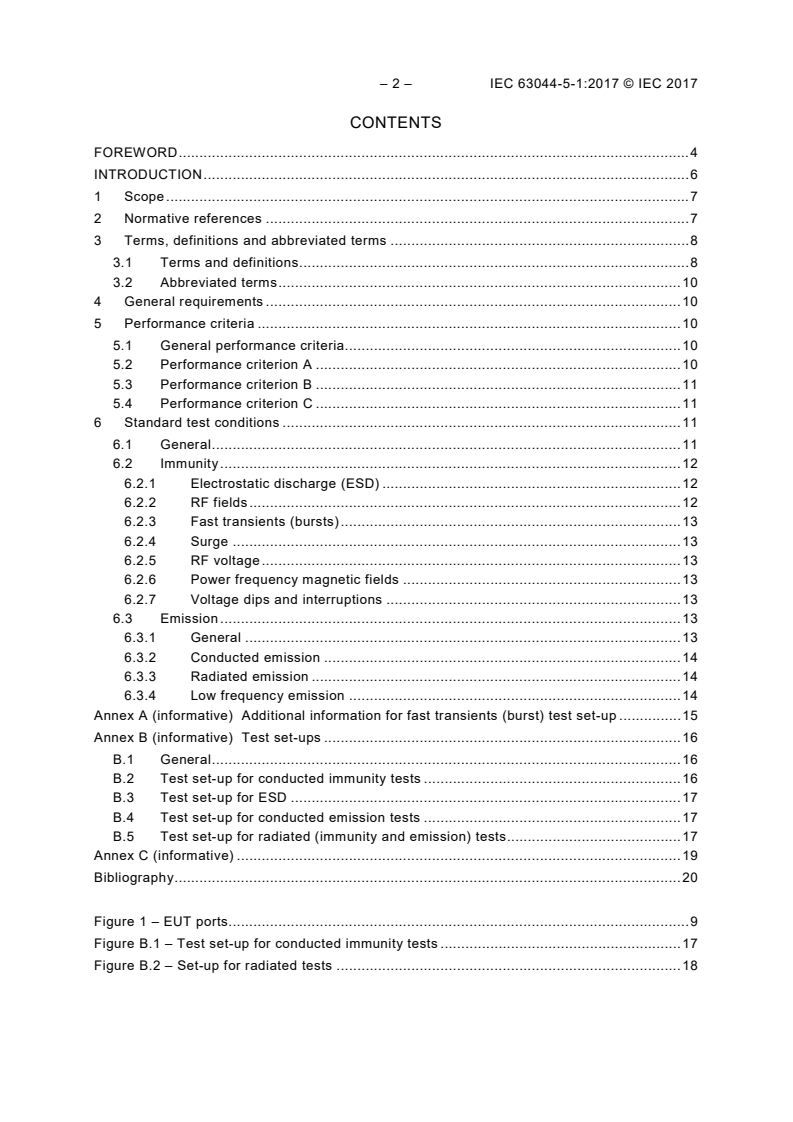
CONTENTS
FOREWORD . 4
INTRODUCTION . 6
1 Scope . 7
2 Normative references . 7
3 Terms, definitions and abbreviated terms . 8
3.1 Terms and definitions . 8
3.2 Abbreviated terms . 10
4 General requirements . 10
5 Performance criteria . 10
5.1 General performance criteria. 10
5.2 Performance criterion A . 10
5.3 Performance criterion B . 11
5.4 Performance criterion C . 11
6 Standard test conditions . 11
6.1 General . 11
6.2 Immunity . 12
6.2.1 Electrostatic discharge (ESD) . 12
6.2.2 RF fields . 12
6.2.3 Fast transients (bursts) . 13
6.2.4 Surge . 13
6.2.5 RF voltage . 13
6.2.6 Power frequency magnetic fields . 13
6.2.7 Voltage dips and interruptions . 13
6.3 Emission . 13
6.3.1 General . 13
6.3.2 Conducted emission . 14
6.3.3 Radiated emission . 14
6.3.4 Low frequency emission . 14
Annex A (informative) Additional information for fast transients (burst) test set-up . 15
Annex B (informative) Test set-ups . 16
B.1 General . 16
B.2 Test set-up for conducted immunity tests . 16
B.3 Test set-up for ESD . 17
B.4 Test set-up for conducted emission tests . 17
B.5 Test set-up for radiated (immunity and emission) tests . 17
Annex C (informative) . 19
Bibliography . 20
Figure 1 – EUT ports. 9
Figure B.1 – Test set-up for conducted immunity tests . 17
Figure B.2 – Set-up for radiated tests . 18
Table C.1 – Examples of product standards with an EMC part . 19
Table C.2 – Examples of stand alone EMC product standards . 19
– 4 – IEC 63044-5-1:2017 © IEC 2017
INTERNATIONAL ELECTROTECHNICAL COMMISSION
____________
HOME AND BUILDING ELECTRONIC SYSTEMS (HBES) AND
BUILDING AUTOMATION AND CONTROL SYSTEMS (BACS) –
Part 5-1: EMC requirements, conditions and test set-up
FOREWORD
1) The International Electrotechnical Commission (IEC) is a worldwide organization for standardization comprising
all national electrotechnical committees (IEC National Committees). The object of IEC is to promote
international co-operation on all questions concerning standardization in the electrical and electronic fields. To
this end and in addition to other activities, IEC publishes International Standards, Technical Specifications,
Technical Reports, Publicly Available Specifications (PAS) and Guides (hereafter referred to as “IEC
Publication(s)”). Their preparation is entrusted to technical committees; any IEC National Committee interested
in the subject dealt with may participate in this preparatory work. International, governmental and non-
governmental organizations liaising with the IEC also participate in this preparation. IEC collaborates closely
with the International Organization for Standardization (ISO) in accordance with conditions determined by
agreement between the two organizations.
2) The formal decisions or agreements of IEC on technical matters express, as nearly as possible, an international
consensus of opinion on the relevant subjects since each technical committee has representation from all
interested IEC National Committees.
3) IEC Publications have the form of recommendations for international use and are accepted by IEC National
Committees in that sense. While all reasonable efforts are made to ensure that the technical content of IEC
Publications is accurate, IEC cannot be held responsible for the way in which they are used or for any
misinterpretation by any end user.
4) In order to promote international uniformity, IEC National Committees undertake to apply IEC Publications
transparently to the maximum extent possible in their national and regional publications. Any divergence
between any IEC Publication and the corresponding national or regional publication shall be clearly indicated in
the latter.
5) IEC itself does not provide any attestation of conformity. Independent certification bodies provide conformity
assessment services and, in some areas, access to IEC marks of conformity. IEC is not responsible for any
services carried out by independent certification bodies.
6) All users should ensure that they have the latest edition of this publication.
7) No liability shall attach to IEC or its directors, employees, servants or agents including individual experts and
members of its technical committees and IEC National Committees for any personal injury, property damage or
other damage of any nature whatsoever, whether direct or indirect, or for costs (including legal fees) and
expenses arising out of the publication, use of, or reliance upon, this IEC Publication or any other IEC
Publications.
8) Attention is drawn to the Normative references cited in this publication. Use of the referenced publications is
indispensable for the correct application of this publication.
9) Attention is drawn to the possibility that some of the elements of this IEC Publication may be the subject of
patent rights. IEC shall not be held responsible for identifying any or all such patent rights.
International Standard IEC 63044-5-1 has been prepared by IEC technical committee 23:
Electrical accessories.
The text of this standard is based on the following documents:
CDV Report on voting
23/736/CDV 23/748/RVC
Full information on the voting for the approval of this standard can be found in the report on
voting indicated in the above table.
This publication has been drafted in accordance with the ISO/IEC Directives, Part 2.
A list of all parts in the IEC 63044 series, published under the general title Home and Building
Electronic Systems (HBES) and Building Automation and Control Systems (BACS), can be
found on the IEC website.
The committee has decided that the contents of this publication will remain unchanged until
the stability date indicated on the IEC website under "http://webstore.iec.ch" in the data
related to the specific publication. At this date, the publication will be
• reconfirmed,
• withdrawn,
• replaced by a revised edition, or
• amended.
IMPORTANT – The 'colour inside' logo on the cover page of this publication indicates
that it contains colours which are considered to be useful for the correct
understanding of its contents. Users should therefore print this document using a
colour printer.
– 6 – IEC 63044-5-1:2017 © IEC 2017
INTRODUCTION
The IEC 63044 series deals with developing and testing Home and Building Electronic
Systems (HBES) and Building Automation and Control Systems (BACS).
The IEC 63044-5 series ensures a common level of EMC requirements for HBES/BACS
devices.
HOME AND BUILDING ELECTRONIC SYSTEMS (HBES) AND
BUILDING AUTOMATION AND CONTROL SYSTEMS (BACS) –
Part 5-1: EMC requirements, conditions and test set-up
1 Scope
This part of IEC 63044 is a product family standard that sets the minimum level of EMC
performance for the HBES/BACS network in addition to the product EMC standards for
HBES/BACS devices.
It also applies to devices used within an HBES/BACS network for which no specific
HBES/BACS product EMC standard exists.
In addition, it defines EMC requirements for the interface of equipment intended to be
connected to an HBES/BACS network. It does not apply to interfaces to other networks.
NOTE An example of other networks is a dedicated ICT network covered by CISPR 22 and 23.
This document provides general performance requirements and test set-ups.
This document is applicable (but not limited) to
– operator stations and other human–system interface devices,
– devices for management functions,
– control devices, automation stations and application-specific controllers,
– field devices and their interfaces,
– cabling and interconnection of devices,
used within a dedicated HBES/BACS network.
2 Normative references
The following documents are referred to in the text in such a way that some or all of their
content constitutes requirements of this document. For dated references, only the edition
cited applies. For undated references, the latest edition of the referenced document (including
any amendments) applies.
IEC 61000-3-2, Electromagnetic compatibility (EMC) – Part 3-2: Limits – Limits for harmonic
current emissions (equipment input current ≤ 16 A per phase)
IEC 61000-3-3, Electromagnetic compatibility (EMC) – Part 3-3: Limits – Limitation of voltage
changes, voltage fluctuations and flicker in public low-voltage supply systems, for equipment
with rated current ≤16 A per phase and not subject to conditional connection
IEC 61000-4-2, Electromagnetic compatibility (EMC) – Part 4-2: Testing and measurement
techniques – Electrostatic discharge immunity test
IEC 61000-4-3, Electromagnetic compatibility (EMC) – Part 4-3 : Testing and measurement
techniques – Radiated, radio-frequency, electromagnetic field immunity test
– 8 – IEC 63044-5-1:2017 © IEC 2017
IEC 61000-4-4, Electromagnetic compatibility (EMC) – Part 4-4: Testing and measurement
techniques – Electrical fast transient/burst immunity test
IEC 61000-4-5, Electromagnetic compatibility (EMC) – Part 4-5: Testing and measurement
techniques – Surge immunity test
IEC 61000-4-6, Electromagnetic compatibility (EMC) – Part 4-6: Testing and measurement
techniques – Immunity to conducted disturbances, induced by radio-frequency fields
IEC 61000-4-8, Electromagnetic compatibility (EMC) – Part 4-8: Testing and measurement
techniques – Power frequency magnetic field immunity test
IEC 61000-4-11, Electromagnetic compatibility (EMC) – Part 4-11: Testing and measurement
techniques – Voltage dips, short interruptions and voltage variations immunity tests
IEC 63044-1, General requirements for Home and Building Electronic Systems (HBES) and
Building Automation and Control Systems (BACS) – Part 1: General requirements
IEC 63044-3, General requirements for Home and Building Electronic Systems (HBES) and
Building Automation and Control Systems (BACS) – Part 3: Electrical safety requirements
CISPR 22, Information technology equipment – Radio disturbance characteristics – Limits and
methods of measurement
CISPR 32, Electromagnetic compatibility of multimedia equipment – Emission requirements
3 Terms, definitions and abbreviated terms
3.1 Terms and definitions
For the purposes of this document, the terms and definitions given in IEC 63044-1 and
IEC 63044-3 and the following apply.
ISO and IEC maintain terminological databases for use in standardization at the following
addresses:
• IEC Electropedia: available at http://www.electropedia.org/
• ISO Online browsing platform: available at http://www.iso.org/obp
3.1.1
port
particular interface of the specified device with the external electromagnetic environment
Note 1 to entry: See Figure 1.
Power
EUT ports
Communication HBES /
Interface A Processing Interface B
Other networks
BACS
IO Interface
Enclosure port
IEC 63044 applicable
IEC
Figure 1 – EUT ports
3.1.2
enclosure port
physical boundary of the apparatus which electromagnetic fields may radiate through or
impinge on
3.1.3
I/O signal port
port at which a conductor or cable intended to carry auxiliary signals, excluding network
signals according to 3.1.4, is connected to the apparatus
EXAMPLES Analogue inputs, outputs and control lines.
3.1.4
power port
port at which a conductor or cable carrying the primary electrical power (AC or DC) needed
for the operation (functioning) of an apparatus or associated apparatus is connected to the
apparatus
3.1.5
HBES/BACS network port
port at which a conductor or cable intended to carry communication signals between the
different devices of the HBES/BACS network is connected to the apparatus
Note 1 to entry: For test purposes, the HBES/BACS network port is equivalent to the telecommunications/network
port according to IEC 61000-6-3.
IO
– 10 – IEC 63044-5-1:2017 © IEC 2017
3.2 Abbreviated terms
AE auxiliary equipment
BACS building automation and control systems
CDN coupling de-coupling network
EMC electromagnetic compatibility
ESD electrostatic discharge
EUT equipment under test
HBES home and building electronic systems
HCP horizontal coupling plane
RF radio-frequency
4 General requirements
This document applies in the following way.
– If no applicable EMC product standard exists, the test set-up, test levels and performance
criteria of the IEC 63044 series apply.
– If an applicable EMC product standard does not specify requirements for HBES
applications, the test set-up, test levels and general performance criteria of the IEC 63044
series apply. The specific performance criteria of the product standard apply.
– If a product standard specifies requirements for HBES (see Annex C for examples), the
test levels and general performance criteria of the IEC 63044 series shall be adopted as
the minimum level.
5 Performance criteria
5.1 General performance criteria
During and after all tests, independent of the performance criteria, the device shall not block
the communication among the other HBES devices or send unintended telegrams.
A functional description and a definition of performance criteria, during or as a consequence
of the EMC testing, shall be provided by the manufacturer and noted in the test report, based
on the following criteria.
– Many devices operate using sophisticated protocol services which permit the recovery of
data corrupted by interference or cause re-transmission of data in the event of corruption.
Transmission errors caused by the application of the tests in this document and which are
subsequently corrected by the protocol services are regarded as normal and the
equipment is regarded as operating as intended in such circumstances;
– Changes in stored data, such as communication error logs, and which are not directly
related to the intended function of the equipment shall be ignored, or recorded on request
by the manufacturer.
5.2 Performance criterion A
In addition to the general performance criteria in 5.1, the device shall continue to operate
according to its product documentation as intended during and after the test. No unintended
change of state, stored data directly related to the intended function, unintended or loss of
function is allowed.
During the test, audio and/or video signals may be corrupted during the test, providing the
information is kept intelligible to a qualitative evaluation.
5.3 Performance criterion B
In addition to the general performance criteria in 5.1, the device shall continue to operate
according to its product documentation as intended after the test. Unintended change of state,
stored data directly related to the intended function, unintended function or loss of function is
not allowed after the test.
The measurement conditions shall be defined by the manufacturer. During the test,
degradation of performance is allowed as follows.
– For analogue I/O signal ports, degradation up to 10 times the tolerance specified in
product documentation, with a maximum value of 50 % of full scale, is allowed.
– For digital I/O signal ports, no unexpected change of state or stored data related to the
intended function is allowed.
– For HBES/BACS network port, degradation of performance is allowed, but not loss of
communication for longer than 1 min.
5.4 Performance criterion C
In addition to the general performance criteria in 5.1, temporary loss of function is allowed,
provided the function is self-recoverable or can be restored by the operation of the controls.
6 Standard test conditions
6.1 General
EMC tests are carried out on a single device (EUT).
All tests shall be done with a minimum test configuration. A minimum test configuration is a
set of devices to exercise the fundamental functions of the EUT.
The minimum test configuration adopted for the EUT shall be recorded on the test report.
Examples of test set ups are provided in Annex B.
The minimum test configuration may be different for each test.
Precautions should be taken to prevent auxiliary devices from being disturbed by tests.
In addition:
– Where a relevant International product Standard (IEC) exists, which defines suitable
operating condition(s) during EMC tests, the operating condition(s) of the EUT, during the
test conditioning, shall be as defined in that Standard.
– Where no relevant International product Standard (IEC) exists, the operating condition(s)
of the EUT, during the test conditioning, shall include at least that (those) corresponding
to the main functional mode (appropriate to the test being undertaken) of the system which
it forms part of.
The configuration and mode(s) of operation during the tests shall be precisely noted in the
test report.
– The use of dedicated software for testing purposes is allowed, providing that all significant
functions are exercised.
– All I/O signal and HBES/BACS network ports shall be tested, with cables attached. If the
EUT has more than five identical ports then at least 10 % of them, with a minimum of five,
shall be tested with cables attached.
NOTE The term “identical” means same hardware and software characteristics.
– 12 – IEC 63044-5-1:2017 © IEC 2017
– Ports (e.g. test and service ports) to which cables are normally not attached need no
cables attached and need not be tested.
– Cable types (e.g. screened, unscreened, twisted pair) shall be those specified by the
manufacturer. If the manufacturer does not specify the cable types in product
documentation, unshielded non-twisted cables shall be used.
– Extensible cables (such as handset cable) shall not be intentionally stretched during the
test. For such cables, the reference length refers to unstretched conditions.
– If the device is required to be installed in a specific case or cabinet according to
manufacturer’s product documentation, all tests on the EUT shall be carried out using
such an enclosure.
– If the device can be installed in different kinds of cabinets available on the market, tests
shall be carried out on the EUT without the cabinet to allow repeatability.
– EUT, auxiliary equipment and cables shall be kept in fixed positions (e.g. by means of
mechanical constraints) during the test.
– A description of the test set-up shall be contained in the test report.
– The cable type shall be referenced in the test report.
6.2 Immunity
6.2.1 Electrostatic discharge (ESD)
This test shall be performed according to the test set-up and test procedures defined in
IEC 61000-4-2, taking into account the general standard test conditions defined in 6.1, by
applying 10 positive and 10 negative discharges in the following manner:
– contact discharge to the conductive surfaces and to coupling planes;
– air discharge at insulating surfaces, if applicable.
Test points shall include hand commands (push buttons, keyboards, etc.), display, touch
screen, slits.
The static electricity discharges shall be applied only to such points and surfaces of the EUT
which are accessible in normal use.
A clear identification of the tested points shall be included in the test report.
Wall-mounted equipment shall be treated as table-top equipment. In order to perform the test,
the wall side of the EUT is turned towards the HCP.
The cable length between the components of the minimum configuration should be 1 m unless
otherwise specified by the manufacturer.
6.2.2 RF fields
The test shall be performed according to IEC 61000-4-3, taking into account the general
standard test conditions defined in 6.1.
Wall-mounted equipment shall be treated as table-top equipment.
EUT with each side dimension below 5 cm shall be tested on front face only with vertical and
horizontal polarization.
Cables shall run either vertically or horizontally in the field uniform area, for at least 1 m.
Connection with AE outside the chamber shall be released through a bypass filter with no
effects on signal transmission.
6.2.3 Fast transients (bursts)
This test shall be performed according to IEC 61000-4-4, taking into account the general
standard test conditions defined in 6.1.
Additional information on test set up is given in Annex A
For tests with the EMC coupling clamp, multiconductor cables shall be tested as a single
cable.
6.2.4 Surge
This test shall be performed according to IEC 61000-4-5, taking into account the general
standard test conditions defined in 6.1.
Number of pulses: 2 positive + 2 negative at each of the following angles: 0°, 90°, 270°.
Time between pulses: 1 min or less.
For communication systems with floating (not connected to ground) devices of small sizes, it
is important to consider the return path for the surge current to the test equipment.
In order to specify a reproducible return path to ground, an impedance Z (R = 50 Ω,
C = 0,47 µF) or that specified by the manufacturer shall be connected from ground to each
wire of a communication cable. For devices with only point-to-point communication (i.e. only
direct communication between two units), this impedance can be omitted during the test. The
impedance used shall be recorded in the test report.
6.2.5 RF voltage
This test shall be performed according to IEC 61000-4-6, taking into account the general
standard test conditions defined in 6.1.
For tests with the EMC coupling clamp, multiconductor cables shall be tested as a single
cable.
6.2.6 Power frequency magnetic fields
This test shall be performed according to IEC 61000-4-8, taking into account the general
standard test conditions defined in 6.1.
6.2.7 Voltage dips and interruptions
This test shall be performed according to IEC 61000-4-11, taking into account the general
standard test conditions defined in 6.1.
The test shall be done both with a minimum configuration and a fully loaded EUT from the
power supply point of view.
6.3 Emission
6.3.1 General
The configuration of the test sample shall be varied to maximize the emission consistent with
the typical applications."
The EUT shall be tested after the thermal steady-state condition is reached.
– 14 – IEC 63044-5-1:2017 © IEC 2017
6.3.2 Conducted emission
This test shall be performed according to CISPR 22 and CISPR 32, taking into account the
general standard test conditions defined in 6.1.
The EUT shall be tested after the thermal steady-state condition is reached.
6.3.3 Radiated emission
This test shall be performed according to CISPR 22 and CISPR 32, taking into account the
general standard test conditions defined in 6.1.
Cables shall run either vertically or horizontally for at least 1 m. Connection with AE outside
the chamber shall be released through a bypass filter with no effects on signal transmission.
6.3.4 Low frequency emission
This test shall be performed according to IEC 61000-3-2 and IEC 61000-3-3, taking into
account the general standard test conditions defined in 6.1.
Annex A
(informative)
Additional information for fast transients (burst) test set-up
For communication systems with floating devices of small sizes (e.g. sensors or push-buttons)
without connection to earth and supplied via the communication wires or by batteries, it is
important to consider the return path for the burst current to ground plane of the test
equipment.
The basic standard IEC 61000-4-4 specifies the EUT to be placed 10 cm over the ground
plane. However, when mounting the device direct on a wall, this capacity to ground can be
increased because of the smaller coupling distance. This can influence the immunity to the
burst impact. Therefore, an additional test shall be done with the EUT placed directly on the
ground plane.
In cases where the EUT has an accessible metal surface or shielding, the test shall be done
with and without connection of this metal surface or shielding to earth.
– 16 – IEC 63044-5-1:2017 © IEC 2017
Annex B
(informative)
Test set-ups
B.1 General
Annex B gives examples of test set-ups for EMC tests. Real test set-ups should be created
accordingly and described in the test report (see 6.1). These test set-ups are based on
twisted-pair cabled systems. To create test set-ups for power line system and wireless
system, make reference to the relevant product standards.
B.2 Test set-up for conducted immunity tests
The following test set-up is applicable to
– fast transients/burst (IEC 61000-4-4),
– surge (IEC 61000-4-5),
– RF conducted disturbances (IEC 61000-4-6).
The separation between the EUT and the rest of the system (minimum test configuration,
according to 6.1) is normally obtained with a minimum cable length of 3 m. The cable may be
twisted to save space.
To improve separation, a CDN or filter may be used, providing it will not affect the system
communication. If required, this device is connected as reported in Figure B.1, l being the
total length of the cable and the device.
Filter or CDN (optional)
Cable length >3m
AE AE
EUT
230 V
CDN
AE AE
l
l
l …l : See relevant basic standard Minimum
1 6
system
Ground plane
Insulating support
Filter or CDN (optional)
l
GEN
230 V EUT
CDN
Cable length > 3m
IEC
Figure B.1 – Test set-up for conducted immunity tests
B.3 Test set-up for ESD
See IEC 61000-4-2.
B.4 Test set-up for conducted emission tests
See CISPR 16
B.5 Test set-up for radiated (immunity and emission) tests
The test set-up in Figure B.2 applies to radiated immunity test according to IEC 61000-4-3.
l l
5 6
l
l
– 18 – IEC 63044-5-1:2017 © IEC 2017
Uniform field area
l
Insulating support
EUT
Turntable
IEC
I Minimum distance between the insulating support and the absorbers.
lm Length of the exposed cable connecting the EUT with the HBES (Im>= 1m).
Figure B.2 – Set-up for radiated tests
The EUT is fixed on an insulating support, placed at the centre of the uniform field area
(reference volume for emission). At least 1 m of cable is fixed in vertical position in proximity
to the axis of the turntable. The auxiliary part of the system is placed outside the chamber and
connected through a filter. When filtering is not possible (loss of communication), precautions
may be taken to keep the shielding attenuation of the chamber when creating the connection
with the outside.
The horizontal path of the cable is laid on the floor to minimize its influence on both immunity
and emission.
The final path from the floor to the chamber outlet is kept as short as possible, vertical and
close to the wall absorbers.
Precautions may be taken to prevent any movement of the cable when the EUT turns.
lm
Annex C
(informative)
Examples of product standards
Examples of product standards with an EMC part are given in Table C.1.
Examples of standalone EMC product standards are given in Table C.2.
Table C.1 – Examples of product standards with an EMC part
Automatic electrical controls for household and similar use IEC 60730 series
Electronic switches and associated electronic extension units for household IEC 60669-2-1
and similar fixed electrical installations
Switches for household and similar fixed electrical installation – IEC 60669-2-5
collateral standard – switches and related accessories for use in home and
building electronic systems (HBES)
Radiofrequency ETSI EN 301 489 series
Signalling on low voltage electrical installations EN 50065 series
Table C.2 – Examples of stand alone EMC product standards
Power supply units IEC 62041
– 20 – IEC 63044-5-1:2017 © IEC 2017
Bibliography
IEC 60669-2-1, Switches for household and similar fixed electrical installations – Part 2-1:
Particular requirements – Electronic switches
IEC 60730 series, Automatic electrical controls for household and similar use
IEC 62041, Safety of transformers, reactors, power supply units and combinations thereof –
EMC requirements
IEC 60669-2-5, Switches for household and similar fixed electrical installations – Part 2-5:
Particular requirements – Switches and related accessories for use in home and building
electronic systems (HBES)
CISPR 16 (all parts), Specification for radio disturbance and immunity measuring apparatus
and methods
ETSI EN 301 489 series, Electromagnetic compatibility and Radio spectrum Matters (ERM);
ElectroMagnetic Compatibility (EMC) standard for radio equipment and services
EN 50065 (series), Signalling on low-voltage electrical installations in the frequency range
3 kHz to 148,5 kHz and 1,6 MHz to 30 MHz
___________
– 22 – IEC 63044-5-1:2017 © IEC 2017
SOMMAIRE
AVANT-PROPOS . 24
INTRODUCTION . 26
1 Domaine d’application . 27
2 Références normatives . 27
3 Termes, définitions et termes abrégés . 28
3.1 Termes et définitions . 28
3.2 Termes abrégés . 30
4 Exigences générales . 30
5 Critères de performance . 30
5.1 Critères généraux de performance . 30
5.2 Critère de performance A . 30
5.3 Critère de performance B . 31
5.4 Critère de performance C . 31
6 Conditions d’essai normalisées. 31
6.1 Généralités . 31
6.2 Immunité . 32
6.2.1 Décharge électrostatique (DES). 32
6.2.2 Champs radioélectriques . 33
6.2.3 Transitoires rapides (salves) . 33
6.2.4 Onde de choc . 33
6.2.5 Tension radioélectrique . 33
6.2.6 Champs magnétiques à la fréquence du réseau . 33
6.2.7 Creux de tension et coupures de tension . 34
6.3 Émission . 34
6.3.1 Généralités . 34
6.3.2 Émission conduite . 34
6.3.3 Émission rayonnée . 34
6.3.4 Émission basse fréquence . 34
Annexe A (informative) Informations complémentaires relatives au montage d’essai
pour les transitoires rapides (salves) . 35
Annexe B (informative) Montages d'essai . 36
B.1 Généralités . 36
B.2 Montage d’essai pour les essais d'immunité aux perturbations conduites . 36
B.3 Montage d’essai relatif aux DES . 37
B.4 Montage d’essai pour les essais d’émission conduite . 37
B.5 Montage d’essai pour les essais d’immunité et d’émission rayonnée . 37
Annexe C (informative) .
...
IEC 63044-5-1 ®
Edition 1.1 2022-06
CONSOLIDATED VERSION
INTERNATIONAL
STANDARD
NORME
INTERNATIONALE
colour
inside
Home and building electronic systems (HBES) and building automation and
control systems (BACS) –
Part 5-1: EMC requirements, conditions and test set-up
Systèmes électroniques pour les foyers domestiques et les bâtiments (HBES) et
systèmes de gestion technique du bâtiment (SGTB) –
Partie 5-1: CEM Exigences générales, condition et montage d’essais
All rights reserved. Unless otherwise specified, no part of this publication may be reproduced or utilized in any form
or by any means, electronic or mechanical, including photocopying and microfilm, without permission in writing from
either IEC or IEC's member National Committee in the country of the requester. If you have any questions about IEC
copyright or have an enquiry about obtaining additional rights to this publication, please contact the address below or
your local IEC member National Committee for further information.
Droits de reproduction réservés. Sauf indication contraire, aucune partie de cette publication ne peut être reproduite
ni utilisée sous quelque forme que ce soit et par aucun procédé, électronique ou mécanique, y compris la photocopie
et les microfilms, sans l'accord écrit de l'IEC ou du Comité national de l'IEC du pays du demandeur. Si vous avez des
questions sur le copyright de l'IEC ou si vous désirez obtenir des droits supplémentaires sur cette publication, utilisez
les coordonnées ci-après ou contactez le Comité national de l'IEC de votre pays de résidence.
IEC Secretariat Tel.: +41 22 919 02 11
3, rue de Varembé info@iec.ch
CH-1211 Geneva 20 www.iec.ch
Switzerland
About the IEC
The International Electrotechnical Commission (IEC) is the leading global organization that prepares and publishes
International Standards for all electrical, electronic and related technologies.
About IEC publications
The technical content of IEC publications is kept under constant review by the IEC. Please make sure that you have the
latest edition, a corrigendum or an amendment might have been published.
IEC publications search - webstore.iec.ch/advsearchform IEC Products & Services Portal - products.iec.ch
The advanced search enables to find IEC publications by a Discover our powerful search engine and read freely all the
variety of criteria (reference number, text, technical publications previews. With a subscription you will always
committee, …). It also gives information on projects, replaced have access to up to date content tailored to your needs.
and withdrawn publications.
Electropedia - www.electropedia.org
IEC Just Published - webstore.iec.ch/justpublished
The world's leading online dictionary on electrotechnology,
Stay up to date on all new IEC publications. Just Published
containing more than 22 300 terminological entries in English
details all new publications released. Available online and
and French, with equivalent terms in 19 additional languages.
once a month by email.
Also known as the International Electrotechnical Vocabulary
(IEV) online.
IEC Customer Service Centre - webstore.iec.ch/csc
If you wish to give us your feedback on this publication or
need further assistance, please contact the Customer Service
Centre: sales@iec.ch.
A propos de l'IEC
La Commission Electrotechnique Internationale (IEC) est la première organisation mondiale qui élabore et publie des
Normes internationales pour tout ce qui a trait à l'électricité, à l'électronique et aux technologies apparentées.
A propos des publications IEC
Le contenu technique des publications IEC est constamment revu. Veuillez vous assurer que vous possédez l’édition la
plus récente, un corrigendum ou amendement peut avoir été publié.
Recherche de publications IEC - IEC Products & Services Portal - products.iec.ch
webstore.iec.ch/advsearchform Découvrez notre puissant moteur de recherche et consultez
La recherche avancée permet de trouver des publications IEC gratuitement tous les aperçus des publications. Avec un
en utilisant différents critères (numéro de référence, texte, abonnement, vous aurez toujours accès à un contenu à jour
comité d’études, …). Elle donne aussi des informations sur adapté à vos besoins.
les projets et les publications remplacées ou retirées.
Electropedia - www.electropedia.org
IEC Just Published - webstore.iec.ch/justpublished
Le premier dictionnaire d'électrotechnologie en ligne au
Restez informé sur les nouvelles publications IEC. Just
monde, avec plus de 22 300 articles terminologiques en
Published détaille les nouvelles publications parues.
anglais et en français, ainsi que les termes équivalents dans
Disponible en ligne et une fois par mois par email.
19 langues additionnelles. Egalement appelé Vocabulaire
Electrotechnique International (IEV) en ligne.
Service Clients - webstore.iec.ch/csc
Si vous désirez nous donner des commentaires sur cette
publication ou si vous avez des questions contactez-nous:
sales@iec.ch.
IEC 63044-5-1 ®
Edition 1.1 2022-06
CONSOLIDATED VERSION
INTERNATIONAL
STANDARD
NORME
INTERNATIONALE
colour
inside
Home and building electronic systems (HBES) and building automation and
control systems (BACS) –
Part 5-1: EMC requirements, conditions and test set-up
Systèmes électroniques pour les foyers domestiques et les bâtiments (HBES) et
systèmes de gestion technique du bâtiment (SGTB) –
Partie 5-1: CEM Exigences générales, condition et montage d’essais
INTERNATIONAL
ELECTROTECHNICAL
COMMISSION
COMMISSION
ELECTROTECHNIQUE
INTERNATIONALE
ICS 29.120.01; 29.120.99 ISBN 978-2-8322-3932-2
IEC 63044-5-1 ®
Edition 1.1 2022-06
CONSOLIDATED VERSION
REDLINE VERSION
VERSION REDLINE
colour
inside
Home and building electronic systems (HBES) and building automation and
control systems (BACS) –
Part 5-1: EMC requirements, conditions and test set-up
Systèmes électroniques pour les foyers domestiques et les bâtiments (HBES) et
systèmes de gestion technique du bâtiment (SGTB) –
Partie 5-1: CEM Exigences générales, condition et montage d’essais
– 2 – IEC 63044-5-1:2017+AMD1:2022 CSV
© IEC 2022
CONTENTS
FOREWORD . 4
INTRODUCTION . 6
1 Scope . 7
2 Normative references . 7
3 Terms, definitions and abbreviated terms . 8
3.1 Terms and definitions . 8
3.2 Abbreviated terms . 10
4 General requirements . 10
5 Performance criteria . 11
5.1 General performance criteria. 11
5.2 Specific performance criteria . 11
5.2.1 Performance criterion A . 11
5.2.2 Performance criterion B . 11
5.2.3 Performance criterion C . 11
6 Standard test conditions . 12
6.1 General . 12
6.2 Immunity . 13
6.2.1 Electrostatic discharge (ESD) . 13
6.2.2 RF fields . 13
6.2.3 Fast transients (bursts) . 13
6.2.4 Surge . 13
6.2.5 RF voltage . 14
6.2.6 Power frequency magnetic fields . 14
6.2.7 Voltage dips and interruptions . 14
6.3 Emission . 14
6.3.1 General . 14
6.3.2 Conducted emission . 14
6.3.3 Radiated emission . 14
6.3.4 Low frequency emission .
Annex A (informative) Additional information for fast transients (burst) test set-up . 16
Annex B (informative) Test set-ups . 17
B.1 General . 17
B.2 Test set-up for conducted immunity tests . 17
B.3 Test set-up for ESD . 18
B.4 Test set-up for conducted emission tests . 18
B.5 Test set-up for radiated (immunity and emission) tests . 18
Annex C (informative) Examples of product standards .
Bibliography . 21
Figure 1 – EUT ports. 9
Figure B.1 – Test set-up for conducted immunity tests . 18
Figure B.2 – Set-up for radiated tests . 19
© IEC 2022
Table C.1 – Examples of product standards with an EMC part .
Table C.2 – Examples of stand alone EMC product standards .
– 4 – IEC 63044-5-1:2017+AMD1:2022 CSV
© IEC 2022
INTERNATIONAL ELECTROTECHNICAL COMMISSION
____________
HOME AND BUILDING ELECTRONIC SYSTEMS (HBES) AND
BUILDING AUTOMATION AND CONTROL SYSTEMS (BACS) –
Part 5-1: EMC requirements, conditions and test set-up
FOREWORD
1) The International Electrotechnical Commission (IEC) is a worldwide organization for standardization comprising
all national electrotechnical committees (IEC National Committees). The object of IEC is to promote
international co-operation on all questions concerning standardization in the electrical and electronic fields. To
this end and in addition to other activities, IEC publishes International Standards, Technical Specifications,
Technical Reports, Publicly Available Specifications (PAS) and Guides (hereafter referred to as “IEC
Publication(s)”). Their preparation is entrusted to technical committees; any IEC National Committee interested
in the subject dealt with may participate in this preparatory work. International, governmental and non-
governmental organizations liaising with the IEC also participate in this preparation. IEC collaborates closely
with the International Organization for Standardization (ISO) in accordance with conditions determined by
agreement between the two organizations.
2) The formal decisions or agreements of IEC on technical matters express, as nearly as possible, an international
consensus of opinion on the relevant subjects since each technical committee has representation from all
interested IEC National Committees.
3) IEC Publications have the form of recommendations for international use and are accepted by IEC National
Committees in that sense. While all reasonable efforts are made to ensure that the technical content of IEC
Publications is accurate, IEC cannot be held responsible for the way in which they are used or for any
misinterpretation by any end user.
4) In order to promote international uniformity, IEC National Committees undertake to apply IEC Publications
transparently to the maximum extent possible in their national and regional publications. Any divergence
between any IEC Publication and the corresponding national or regional publication shall be clearly indicated in
the latter.
5) IEC itself does not provide any attestation of conformity. Independent certification bodies provide conformity
assessment services and, in some areas, access to IEC marks of conformity. IEC is not responsible for any
services carried out by independent certification bodies.
6) All users should ensure that they have the latest edition of this publication.
7) No liability shall attach to IEC or its directors, employees, servants or agents including individual experts and
members of its technical committees and IEC National Committees for any personal injury, property damage or
other damage of any nature whatsoever, whether direct or indirect, or for costs (including legal fees) and
expenses arising out of the publication, use of, or reliance upon, this IEC Publication or any other IEC
Publications.
8) Attention is drawn to the Normative references cited in this publication. Use of the referenced publications is
indispensable for the correct application of this publication.
9) Attention is drawn to the possibility that some of the elements of this IEC Publication may be the subject of
patent rights. IEC shall not be held responsible for identifying any or all such patent rights.
This consolidated version of the official IEC Standard and its amendment has been
prepared for user convenience.
IEC 63044-5-1 edition 1.1 contains the first edition (2017-01) [documents 23/736/CDV
and 23/748/RVC] and its amendment 1 (2022-06) [documents 23/1001/FDIS and
23/1007/RVD].
In this Redline version, a vertical line in the margin shows where the technical content
is modified by amendment 1. Additions are in green text, deletions are in strikethrough
red text. A separate Final version with all changes accepted is available in this
publication.
© IEC 2022
International Standard IEC 63044-5-1 has been prepared by IEC technical committee 23:
Electrical accessories.
This publication has been drafted in accordance with the ISO/IEC Directives, Part 2.
A list of all parts in the IEC 63044 series, published under the general title Home and Building
Electronic Systems (HBES) and Building Automation and Control Systems (BACS), can be
found on the IEC website.
The committee has decided that the contents of the base publication and its amendment will
remain unchanged until the stability date indicated on the IEC web site under webstore.iec.ch
in the data related to the specific publication. At this date, the publication will be
• reconfirmed,
• withdrawn,
• replaced by a revised edition, or
• amended.
IMPORTANT – The 'colour inside' logo on the cover page of this publication indicates
that it contains colours which are considered to be useful for the correct
understanding of its contents. Users should therefore print this document using a
colour printer.
– 6 – IEC 63044-5-1:2017+AMD1:2022 CSV
© IEC 2022
INTRODUCTION
The IEC 63044 series deals with developing and testing Home and Building Electronic
Systems (HBES) and Building Automation and Control Systems (BACS).
The IEC 63044-5 series ensures a common level of EMC requirements for HBES/BACS
devices.
© IEC 2022
HOME AND BUILDING ELECTRONIC SYSTEMS (HBES) AND
BUILDING AUTOMATION AND CONTROL SYSTEMS (BACS) –
Part 5-1: EMC requirements, conditions and test set-up
1 Scope
This part of IEC 63044 is a product family standard that sets the minimum level of EMC
performance for the HBES/BACS network in addition to the product EMC standards for
HBES/BACS devices.
It also applies to devices used within an HBES/BACS network for which no specific
HBES/BACS product EMC standard exists.
This product family standard specifies the EMC requirements for HBES/BACS devices.
In addition, it defines EMC requirements for the interface of equipment intended to be
connected to an HBES/BACS network. It does not apply to interfaces to other networks.
NOTE An example of other networks is a dedicated ICT network covered by CISPR 22 and 23 CISPR 32.
This document provides general performance requirements, standard test conditions and test
set-ups.
This document is applicable (but not limited) to
– operator stations and other human–system interface devices,
– devices for management functions,
– control devices, automation stations and application-specific controllers,
– field devices and their interfaces,
– cabling and interconnection of devices,
used within a dedicated HBES/BACS network.
2 Normative references
The following documents are referred to in the text in such a way that some or all of their
content constitutes requirements of this document. For dated references, only the edition
cited applies. For undated references, the latest edition of the referenced document (including
any amendments) applies.
IEC 61000-3-2, Electromagnetic compatibility (EMC) – Part 3-2: Limits – Limits for harmonic
current emissions (equipment input current ≤ 16 A per phase)
IEC 61000-3-3, Electromagnetic compatibility (EMC) – Part 3-3: Limits – Limitation of voltage
changes, voltage fluctuations and flicker in public low-voltage supply systems, for equipment
with rated current ≤16 A per phase and not subject to conditional connection
IEC 61000-4-2, Electromagnetic compatibility (EMC) – Part 4-2: Testing and measurement
techniques – Electrostatic discharge immunity test
– 8 – IEC 63044-5-1:2017+AMD1:2022 CSV
© IEC 2022
IEC 61000-4-3, Electromagnetic compatibility (EMC) – Part 4-3 : Testing and measurement
techniques – Radiated, radio-frequency, electromagnetic field immunity test
IEC 61000-4-4, Electromagnetic compatibility (EMC) – Part 4-4: Testing and measurement
techniques – Electrical fast transient/burst immunity test
IEC 61000-4-5, Electromagnetic compatibility (EMC) – Part 4-5: Testing and measurement
techniques – Surge immunity test
IEC 61000-4-6, Electromagnetic compatibility (EMC) – Part 4-6: Testing and measurement
techniques – Immunity to conducted disturbances, induced by radio-frequency fields
IEC 61000-4-8, Electromagnetic compatibility (EMC) – Part 4-8: Testing and measurement
techniques – Power frequency magnetic field immunity test
IEC 61000-4-11, Electromagnetic compatibility (EMC) – Part 4-11: Testing and measurement
techniques – Voltage dips, short interruptions and voltage variations immunity tests
IEC 63044-1, General requirements for Home and Building Electronic Systems (HBES) and
Building Automation and Control Systems (BACS) – Part 1: General requirements
IEC 63044-3, General requirements for Home and Building Electronic Systems (HBES) and
Building Automation and Control Systems (BACS) – Part 3: Electrical safety requirements
CISPR 22, Information technology equipment – Radio disturbance characteristics – Limits and
methods of measurement
CISPR 32, Electromagnetic compatibility of multimedia equipment – Emission requirements
3 Terms, definitions and abbreviated terms
3.1 Terms and definitions
For the purposes of this document, the terms and definitions given in IEC 63044-1 and
IEC 63044-3 and the following apply.
ISO and IEC maintain terminological databases for use in standardization at the following
addresses:
• IEC Electropedia: available at http://www.electropedia.org/
• ISO Online browsing platform: available at http://www.iso.org/obp
3.1.1
port
particular interface of the specified device with the external electromagnetic environment
Note 1 to entry: See Figure 1.
Power
© IEC 2022
EUT ports
Communication HBES /
Interface A Processing Interface B
Other networks
BACS
IO Interface
Enclosure port
IEC 63044 applicable
IEC
Figure 1 – EUT ports
IO
– 10 – IEC 63044-5-1:2017+AMD1:2022 CSV
© IEC 2022
3.1.2
enclosure port
physical boundary of the apparatus which electromagnetic fields may radiate through or
impinge on
3.1.3
I/O signal port
port at which a conductor or cable intended to carry auxiliary signals, excluding network
signals according to 3.1.4, is connected to the apparatus
EXAMPLES Analogue inputs, outputs and control lines.
3.1.4
power port
port at which a conductor or cable carrying the primary electrical power (AC or DC) needed
for the operation (functioning) of an apparatus or associated apparatus is connected to the
apparatus
3.1.5
HBES/BACS network port
port at which a conductor or cable intended to carry communication signals between the
different devices of the HBES/BACS network is connected to the apparatus
Note 1 to entry: For test purposes, the HBES/BACS network port is equivalent to the telecommunications/network
port according to IEC 61000-6-3.
3.2 Abbreviated terms
AE auxiliary equipment
BACS building automation and control systems
CDN coupling de-coupling network
EMC electromagnetic compatibility
ESD electrostatic discharge
EUT equipment under test
HBES home and building electronic systems
HCP horizontal coupling plane
RF radio-frequency
4 General requirements
This document applies in the following way.
– If no applicable EMC product standard exists, the test set-up, test levels and performance
criteria of the IEC 63044 series apply.
– If an applicable EMC product standard does not specify requirements for HBES
applications, the test set-up, test levels and general performance criteria of the IEC 63044
series apply. The specific performance criteria of the product standard apply.
– If a product standard specifies requirements for HBES (see Annex C for examples), the
test levels and general performance criteria of the IEC 63044 series shall be adopted as
the minimum level.
© IEC 2022
5 Performance criteria
5.1 General performance criteria
During and after all tests, independent of the performance criteria, the device shall not block
the communication among the other HBES devices or send unintended telegrams.
A functional description and a definition of performance criteria, during or as a consequence
of the EMC testing, shall be provided by the manufacturer based on intended use and noted
in the test report, based on the following criteria.
– Many devices operate using sophisticated protocol services which permit the recovery of
data corrupted by interference or cause re-transmission of data in the event of corruption.
Transmission errors caused by the application of the tests in this document and which are
subsequently corrected by the protocol services are regarded as normal and the
equipment is regarded as operating as intended in such circumstances;
– Changes in stored data, such as communication error logs, and which are not directly
related to the intended function of the equipment shall be ignored, or recorded on request
by the manufacturer.
5.2 Specific performance criteria
5.25.2.1 Performance criterion A
In addition to the general performance criteria in 5.1, the device shall continue to operate
according to its product documentation as intended during and after the test. No unintended
change of state, stored data directly related to the intended function, unintended or loss of
function is allowed.
During the test, audio and/or video signals may be corrupted during the test, providing the
information is kept intelligible to a qualitative evaluation.
5.35.2.2 Performance criterion B
In addition to the general performance criteria in 5.1, the device shall continue to operate
according to its product documentation as intended after the test. Unintended change of state,
stored data directly related to the intended function, unintended function or loss of function is
not allowed after the test.
The measurement conditions shall be defined by the manufacturer. During the test,
degradation of performance is allowed as follows.
– For analogue I/O signal ports, degradation up to 10 times the tolerance specified in
product documentation, with a maximum value of 50 % of full scale, is allowed.
– For digital I/O signal ports, no unexpected change of state or stored data related to the
intended function is allowed.
– For HBES/BACS network port, degradation of performance is allowed, but not loss of
communication for longer than 1 min. Loss of communication is allowed during the
application time of the disturbance but the communication shall be restored after
application of the disturbance has stopped.
5.45.2.3 Performance criterion C
In addition to the general performance criteria in 5.1, temporary loss of function is allowed,
provided the function is self-recoverable or can be restored by the operation of the controls.
– 12 – IEC 63044-5-1:2017+AMD1:2022 CSV
© IEC 2022
6 Standard test conditions
6.1 General
EMC tests are carried out on a one single device (EUT).
All tests shall be done with a minimum test configuration. A minimum test configuration is a
set of devices to exercise the fundamental functions of the EUT.
The minimum test configuration adopted for the EUT shall be recorded on the test report.
Examples of test set ups are provided in Annex B.
The minimum test configuration may be different for each test.
Precautions should be taken to prevent auxiliary devices from being disturbed by tests.
In addition:
– Where a relevant International product Standard (IEC) exists, which defines suitable
operating condition(s) during EMC tests, the operating condition(s) of the EUT, during the
test conditioning, shall be as defined in that Standard.
– Where no relevant International product Standard (IEC) exists, the operating condition(s)
of the EUT, during the test conditioning, shall include at least that (those) corresponding
to the main functional mode (appropriate to the test being undertaken) of the system which
it forms part of.
The configuration and mode(s) of operation during the tests shall be precisely noted in the
test report.
– The use of dedicated software for testing purposes is allowed, providing that all significant
functions are exercised.
– All I/O signal and HBES/BACS network ports shall be tested, with cables attached. If the
EUT has more than five identical ports then at least 10 % of them, with a minimum of five,
shall be tested with cables attached.
NOTE The term “identical” means same hardware and software characteristics.
– Ports (e.g. test and service ports) to which cables are normally not attached need no
cables attached and need not be tested.
– Cable types (e.g. screened, unscreened, twisted pair) shall be those specified by the
manufacturer. If the manufacturer does not specify the cable types in product
documentation, unshielded non-twisted cables shall be used.
– Extensible cables (such as handset cable) shall not be intentionally stretched during the
test. For such cables, the reference length refers to unstretched conditions.
– If the device is required to be installed in a specific case or cabinet according to
manufacturer’s product documentation, all tests on the EUT shall be carried out using
such an enclosure.
– If the device can be installed in different kinds of cabinets available on the market, tests
shall be carried out on the EUT without the cabinet to allow repeatability.
– EUT, auxiliary equipment and cables shall be kept in fixed positions (e.g. by means of
mechanical constraints) during the test.
– A description of the test set-up shall be contained in the test report.
– The cable type shall be referenced in the test report.
© IEC 2022
6.2 Immunity
6.2.1 Electrostatic discharge (ESD)
This test shall be performed according to the test set-up and test procedures defined in
IEC 61000-4-2, taking into account the general standard test conditions defined in 6.1, by
applying 10 positive and 10 negative discharges in the following manner:
– contact discharge to the conductive surfaces and to coupling planes;
– air discharge at insulating surfaces, if applicable.
Test points shall include hand commands (push buttons, keyboards, etc.), display, touch
screen, slits.
The static electricity discharges shall be applied only to such points and surfaces of the EUT
which are accessible in normal use.
A clear identification of the tested points shall be included in the test report.
Wall-mounted equipment shall be treated as table-top equipment. In order to perform the test,
the wall side of the EUT is turned towards the HCP.
The cable length between the components of the minimum configuration should be 1 m unless
otherwise specified by the manufacturer.
6.2.2 RF fields
The test shall be performed according to IEC 61000-4-3, taking into account the general
standard test conditions defined in 6.1.
Wall-mounted equipment shall be treated as table-top equipment.
EUT with each side dimension below 5 cm shall be tested on front face only with vertical and
horizontal polarization.
Cables shall run either vertically or horizontally in the field uniform area, for at least 1 m.
Connection with AE outside the chamber shall be released through a bypass filter with no
effects on signal transmission.
6.2.3 Fast transients (bursts)
This test shall be performed according to IEC 61000-4-4, taking into account the general
standard test conditions defined in 6.1.
Additional information on test set up is given in Annex A
For tests with the EMC coupling clamp, multiconductor cables shall be tested as a single
cable.
6.2.4 Surge
This test shall be performed according to IEC 61000-4-5, taking into account the general
standard test conditions defined in 6.1.
Number of pulses: 2 positive + 2 negative at each of the following angles: 0°, 90°, 180°,
270°.
– 14 – IEC 63044-5-1:2017+AMD1:2022 CSV
© IEC 2022
Time between pulses: 1 min or less.
For communication systems with floating (not connected to ground) devices of small sizes, it
is important to consider the return path for the surge current to the test equipment.
In order to specify a reproducible return path to ground, an impedance Z (R = 50 Ω,
C = 0,47 µF) or that specified by the manufacturer shall be connected from ground to each
wire of a communication cable. For devices with only point-to-point communication (i.e. only
direct communication between two units), this impedance can be omitted during the test. The
impedance used shall be recorded in the test report.
6.2.5 RF voltage
This test shall be performed according to IEC 61000-4-6, taking into account the general
standard test conditions defined in 6.1.
For tests with the EMC coupling clamp, multiconductor cables shall be tested as a single
cable.
6.2.6 Power frequency magnetic fields
This test shall be performed according to IEC 61000-4-8, taking into account the general
standard test conditions defined in 6.1.
6.2.7 Voltage dips and interruptions
This test shall be performed according to IEC 61000-4-11, taking into account the general
standard test conditions defined in 6.1.
The test shall be done both with a minimum configuration and a fully loaded EUT from the
power supply point of view.
6.3 Emission
6.3.1 General
The configuration of the test sample shall be varied to maximize the emission consistent with
the typical applications."
The EUT shall be tested after the thermal steady-state condition is reached.
6.3.2 Conducted emission
This test shall be performed according to CISPR 22 and CISPR 32, taking into account the
general standard test conditions defined in 6.1.
The EUT shall be tested after the thermal steady-state condition is reached.
6.3.3 Radiated emission
This test shall be performed according to CISPR 22 and CISPR 32, taking into account the
general standard test conditions defined in 6.1.
Cables shall run either vertically or horizontally for at least 1 m. Connection with AE outside
the chamber shall be released through a bypass filter with no effects on signal transmission.
© IEC 2022
6.3.4 Low frequency emission
This test shall be performed according to IEC 61000-3-2 and IEC 61000-3-3, taking into
account the general standard test conditions defined in 6.1.
– 16 – IEC 63044-5-1:2017+AMD1:2022 CSV
© IEC 2022
Annex A
(informative)
Additional information for fast transients (burst) test set-up
For communication systems with floating devices of small sizes (e.g. sensors or push-buttons)
without connection to earth and supplied via the communication wires or by batteries, it is
important to consider the return path for the burst current to ground plane of the test
equipment.
The basic standard IEC 61000-4-4 specifies the EUT to be placed 10 cm over the ground
plane. However, when mounting the device direct on a wall, this capacity to ground can be
increased because of the smaller coupling distance. This can influence the immunity to the
burst impact. Therefore, an additional test shall be done with the EUT placed directly on the
ground plane.
In cases where the EUT has an accessible metal surface or shielding, the test shall be done
with and without connection of this metal surface or shielding to earth.
© IEC 2022
Annex B
(informative)
Test set-ups
B.1 General
Annex B gives examples of test set-ups for EMC tests. Real test set-ups should be created
accordingly and described in the test report (see 6.1). These test set-ups are based on
twisted-pair cabled systems. To create test set-ups for power line system and wireless
system, make reference to the relevant product standards.
B.2 Test set-up for conducted immunity tests
The following test set-up is applicable to
– fast transients/burst (IEC 61000-4-4),
– surge (IEC 61000-4-5),
– RF conducted disturbances (IEC 61000-4-6).
The separation between the EUT and the rest of the system (minimum test configuration,
according to 6.1) is normally obtained with a minimum cable length of 3 m. The cable may be
twisted to save space.
To improve separation, a CDN or filter may be used, providing it will not affect the system
communication. If required, this device is connected as reported in Figure B.1, l being the
total length of the cable and the device.
– 18 – IEC 63044-5-1:2017+AMD1:2022 CSV
© IEC 2022
Filter or CDN (optional)
Cable length >3m
AE AE
EUT
230 V
CDN
AE AE
l
l
l …l : See relevant basic standard Minimum
1 6
system
Ground plane
Insulating support
Filter or CDN (optional)
l
GEN
230 V EUT
CDN
Cable length > 3m
IEC
Figure B.1 – Test set-up for conducted immunity tests
B.3 Test set-up for ESD
See IEC 61000-4-2.
B.4 Test set-up for conducted emission tests
See CISPR 16 CISPR 32.
B.5 Test set-up for radiated (immunity and emission) tests
The test set-up in Figure B.2 applies to radiated immunity test according to IEC 61000-4-3.
l l
5 6
l
l
© IEC 2022
Uniform field area
l
Insulating support
EUT
Turntable
IEC
I Minimum distance between the insulating support and the absorbers.
lm Length of the exposed cable connecting the EUT with the HBES (Im>= 1m).
Figure B.2 – Set-up for radiated tests
The EUT is fixed on an insulating support, placed at the centre of the uniform field area
(reference volume for emission). At least 1 m of cable is fixed in vertical position in proximity
to the axis of the turntable. The auxiliary part of the system is placed outside the chamber and
connected through a filter. When filtering is not possible (loss of communication), precautions
may be taken to keep the shielding attenuation of the chamber when creating the connection
with the outside.
The horizontal path of the cable is laid on the floor to minimize its influence on both immunity
and emission.
The final path from the floor to the chamber outlet is kept as short as possible, vertical and
close to the wall absorbers.
Precautions may be taken to prevent any movement of the cable when the EUT turns.
lm
– 20 – IEC 63044-5-1:2017+AMD1:2022 CSV
© IEC 2022
Annex C
(informative)
Examples of product standards
Examples of product standards with an EMC part are given in Table C.1.
Examples of standalone EMC product standards are given in Table C.2.
Table C.1 – Examples of product standards with an EMC part
Automatic electrical controls for household and similar use IEC 60730 series
Electronic switches and associated electronic extension units for household IEC 60669-2-1
and similar fixed electrical installations
Switches for household and similar fixed electrical installation – IEC 60669-2-5
collateral standard – switches and related accessories for use in home and
building electronic systems (HBES)
Radiofrequency ETSI EN 301 489 series
Signalling on low voltage electrical installations EN 50065 series
Table C.2 – Examples of stand alone EMC product standards
Power supply units IEC 62041
© IEC 2022
Bibliography
IEC 60669-2-1, Switches for household and similar fixed electrical installations – Part 2-1:
Particular requirements – Electronic switches
IEC 60730 series, Automatic electrical controls for household and similar use
IEC 62041, Safety of transformers, reactors, power supply units and combinations thereof –
EMC requirements
IEC 60669-2-5, Switches for household and similar fixed electrical installations – Part 2-5:
Particular requirements – Switches and related accessories for use in home and building
electronic systems (HBES)
CISPR 16 (all parts), Specification for radio disturbance and immunity measuring apparatus
and methods
ETSI EN 301 489 series, Electromagnetic compatibility and Radio spectrum Matters (ERM);
ElectroMagnetic Compatibility (EMC) standard for radio equipment and services
EN 50065 (series), Signalling on low-voltage electrical installations in the frequency range
3 kHz to 148,5 kHz and 1,6 MHz to 30 MHz
___________
– 22 – IEC 63044-5-1:2017+AMD1:2022 CSV
© IEC 2022
SOMMAIRE
AVANT-PROPOS . 24
INTRODUCTION . 26
1 Domaine d’application . 27
2 Références normatives . 27
3 Termes, définitions et termes abrégés . 28
3.1 Termes et définitions . 28
3.2 Termes abrégés . 30
4 Exigences générales . 30
5 Critères de performance . 30
5.1 Critères généraux de performance . 30
5.2 Critères de performance spécifiques . 31
5.2.1 Critère de performance A . 31
5.2.2 Critère de performance B . 31
5.2.3 Critère de performance C . 31
6 Conditions d’essai normalisées. 31
6.1 Généralités . 31
6.2 Immunité . 33
6.2.1 Décharge électrostatique (DES). 33
6.2.2 Champs radioélectriques . 33
6.2.3 Transitoires rapides (salves) . 33
6.2.4 Onde de choc . 33
6.2.5 Tension radioélectrique . 34
6.2.6 Champs magnétiques à la fréquence du réseau . 34
6.2.7 Creux de tension et coupures de tension . 34
6.3 Émission . 34
6.3.1 Généralités . 34
6.3.2 Émission conduite .
...