

IEC 61992-1:2006
(Main)Railway applications - Fixed installations - DC switchgear - Part 1: General
General Information
- Abstract
IEC 61992 series specifies requirements for d.c. switchgear and controlgear and is intended to be used in fixed electrical installations with nominal voltage not exceeding 3 000 V d.c., which supply electrical power to vehicles for public guided transport, i.e. railway vehicles, tramway vehicles, underground vehicles and trolley-buses. Part 1 specifies general requirements.
- Status
- Published
- Publication Date
- 28-Apr-2014
- Technical Committee
- TC 9 - Electrical equipment and systems for railways
- Current Stage
- PPUB - Publication issued
- Start Date
- 07-Feb-2006
- Completion Date
- 31-Mar-2006
Buy Documents
IEC 61992-1:2006 - Railway applications - Fixed installations - DC switchgear - Part 1: General Released:2/7/2006

IEC 61992-1:2006+AMD1:2014 CSV - Railway applications - Fixed installations - DC switchgear - Part 1:General Released:4/29/2014
Overview
IEC 61992-1:2006, titled "Railway applications - Fixed installations - DC switchgear - Part 1: General," is an essential international standard published by the International Electrotechnical Commission (IEC). This standard sets forth the general requirements for direct current (d.c.) switchgear and controlgear used in fixed electrical installations with nominal voltages up to 3,000 V d.c. It primarily applies to installations supplying electrical power to various types of public guided transport vehicles, including railway vehicles, tramways, underground metros, and trolleybuses.
This standard provides a foundation for the design, performance, and testing of d.c. switchgear equipment crucial in ensuring the safety, reliability, and efficiency of electrical railway infrastructure.
Key Topics
IEC 61992-1 covers a wide range of technical and practical aspects relevant to d.c. switchgear in railway fixed installations. Key topics include:
- Scope and Definitions: Establishes the scope of fixed installations using d.c. switchgear and presents standardized terminology, aiding clear communication across international stakeholders.
- Service Conditions: Details environmental and operational conditions such as temperature, humidity, and vibration, ensuring equipment suitability for indoor and outdoor installations.
- Insulation Levels: Specifies insulation coordination parameters to guarantee electrical safety and prevent breakdowns.
- Standard Features: Outlines default parameters for main circuits, auxiliary systems, and control circuits, facilitating uniform design and integration.
- Temperature-Rise Limits: Defines maximum allowable temperature rises for various components to maintain reliability and prevent overheating.
- Testing Procedures: Provides comprehensive test methods including dielectric tests, temperature-rise tests, short-circuit and load-switching tests, and manual control device sturdiness verification.
- Performance Verification: Includes guidelines for verifying switchgear behavior under short-time withstand currents and during fault conditions.
- Annexes and Diagrams: Supplies normative and informative annexes with test circuit diagrams, recommended creepage distances, and environmental conditions to assist in compliance and design best practices.
Applications
IEC 61992-1 is critical for manufacturers, designers, and operators of railway electrical systems, particularly for the following applications:
- Railway Fixed Installations: Ensures that d.c. switchgear equipment installed in stationary electrical substations meets safety and performance standards.
- Public Guided Transport: Applies to electrical equipment supplying power to rail vehicles, including trams, metros, and trolleybuses, supporting urban and inter-city transit systems.
- Infrastructure Maintenance and Upgrades: Provides guidelines for testing and validating d.c. switchgear during maintenance or modernization projects, helping maintain operational continuity and safety.
- Safety and Compliance Audits: Assists national and international regulatory bodies in enforcing standards to improve system safety and interoperability.
- Component Design: Helps manufacturers structure switchgear products to meet international expectations for temperature control, electrical insulation, and mechanical robustness.
Related Standards
IEC 61992-1 is part of the broader IEC 61992 series addressing d.c. switchgear systems for railways and public transport. Key related parts include:
- IEC 61992-2: DC circuit-breakers - specific requirements for circuit-breaking devices.
- IEC 61992-3 and IEC 61992-4: Indoor and outdoor d.c. disconnectors, switch-disconnectors, and earthing switches.
- IEC 61992-5: Surge arresters and low-voltage limiters for d.c. traction systems.
- IEC 61992-6: DC switchgear assemblies.
- IEC 61992-7-x: Measurement, control, and protection devices designed for d.c. traction systems, including current and voltage transducers.
Compliance with IEC 61992-1 alongside related parts ensures comprehensive standardization and harmonization in railway electrical installations.
Keywords: IEC 61992-1, d.c. switchgear, railway applications, fixed installations, railway electrical equipment, railway standards, electrical safety, traction power supply, switchgear testing, direct current railway systems, IEC standards, railway infrastructure electric controlgear.
Relations
- Effective Date
- 10-Feb-2026
- Effective Date
- 05-Sep-2023
- Revises
IEC 61992-1:2001 - Railway applications - Fixed installations DC switchgear - Part 1: General - Effective Date
- 05-Sep-2023
Buy Documents
IEC 61992-1:2006 - Railway applications - Fixed installations - DC switchgear - Part 1: General Released:2/7/2006
IEC 61992-1:2006+AMD1:2014 CSV - Railway applications - Fixed installations - DC switchgear - Part 1:General Released:4/29/2014
Get Certified
Connect with accredited certification bodies for this standard

IRIS Certification (UNIFE)
International Railway Industry Standard certification.

TÜV SÜD Rail GmbH
TÜV SÜD railway certification services.

Bureau Veritas Railway Certification
Railway and transportation certification.
Sponsored listings
Frequently Asked Questions
IEC 61992-1:2006 is a standard published by the International Electrotechnical Commission (IEC). Its full title is "Railway applications - Fixed installations - DC switchgear - Part 1: General". This standard covers: IEC 61992 series specifies requirements for d.c. switchgear and controlgear and is intended to be used in fixed electrical installations with nominal voltage not exceeding 3 000 V d.c., which supply electrical power to vehicles for public guided transport, i.e. railway vehicles, tramway vehicles, underground vehicles and trolley-buses. Part 1 specifies general requirements.
IEC 61992 series specifies requirements for d.c. switchgear and controlgear and is intended to be used in fixed electrical installations with nominal voltage not exceeding 3 000 V d.c., which supply electrical power to vehicles for public guided transport, i.e. railway vehicles, tramway vehicles, underground vehicles and trolley-buses. Part 1 specifies general requirements.
IEC 61992-1:2006 is classified under the following ICS (International Classification for Standards) categories: 45.060.01 - Railway rolling stock in general. The ICS classification helps identify the subject area and facilitates finding related standards.
IEC 61992-1:2006 has the following relationships with other standards: It is inter standard links to EN 60077-1:2017, IEC 61992-1:2006/AMD1:2014, IEC 61992-1:2001. Understanding these relationships helps ensure you are using the most current and applicable version of the standard.
IEC 61992-1:2006 is available in PDF format for immediate download after purchase. The document can be added to your cart and obtained through the secure checkout process. Digital delivery ensures instant access to the complete standard document.
Standards Content (Sample)
NORME CEI
INTERNATIONALE
IEC
61992-1
INTERNATIONAL
Deuxième édition
STANDARD
Second edition
2006-02
Applications ferroviaires –
Installations fixes –
Appareillage à courant continu –
Partie 1:
Généralités
Railway applications –
Fixed installations –
DC switchgear –
Part 1:
General
Numéro de référence
Reference number
CEI/IEC 61992-1:2006
Numérotation des publications Publication numbering
Depuis le 1er janvier 1997, les publications de la CEI As from 1 January 1997 all IEC publications are
sont numérotées à partir de 60000. Ainsi, la CEI 34-1 issued with a designation in the 60000 series. For
devient la CEI 60034-1. example, IEC 34-1 is now referred to as IEC 60034-1.
Editions consolidées Consolidated editions
Les versions consolidées de certaines publications de la The IEC is now publishing consolidated versions of its
CEI incorporant les amendements sont disponibles. Par publications. For example, edition numbers 1.0, 1.1
exemple, les numéros d’édition 1.0, 1.1 et 1.2 indiquent and 1.2 refer, respectively, to the base publication,
respectivement la publication de base, la publication de the base publication incorporating amendment 1 and
base incorporant l’amendement 1, et la publication de the base publication incorporating amendments 1
base incorporant les amendements 1 et 2. and 2.
Informations supplémentaires Further information on IEC publications
sur les publications de la CEI
Le contenu technique des publications de la CEI est The technical content of IEC publications is kept
constamment revu par la CEI afin qu'il reflète l'état under constant review by the IEC, thus ensuring that
actuel de la technique. Des renseignements relatifs à the content reflects current technology. Information
cette publication, y compris sa validité, sont dispo- relating to this publication, including its validity, is
nibles dans le Catalogue des publications de la CEI available in the IEC Catalogue of publications
(voir ci-dessous) en plus des nouvelles éditions, (see below) in addition to new editions, amendments
amendements et corrigenda. Des informations sur les and corrigenda. Information on the subjects under
sujets à l’étude et l’avancement des travaux entrepris consideration and work in progress undertaken by the
par le comité d’études qui a élaboré cette publication, technical committee which has prepared this
ainsi que la liste des publications parues, sont publication, as well as the list of publications issued,
également disponibles par l’intermédiaire de: is also available from the following:
• Site web de la CEI (www.iec.ch) • IEC Web Site (www.iec.ch)
• Catalogue des publications de la CEI • Catalogue of IEC publications
Le catalogue en ligne sur le site web de la CEI The on-line catalogue on the IEC web site
(www.iec.ch/searchpub) vous permet de faire des (www.iec.ch/searchpub) enables you to search by a
recherches en utilisant de nombreux critères, variety of criteria including text searches,
comprenant des recherches textuelles, par comité technical committees and date of publication. On-
d’études ou date de publication. Des informations en line information is also available on recently
ligne sont également disponibles sur les nouvelles issued publications, withdrawn and replaced
publications, les publications remplacées ou retirées, publications, as well as corrigenda.
ainsi que sur les corrigenda.
• IEC Just Published • IEC Just Published
Ce résumé des dernières publications parues This summary of recently issued publications
(www.iec.ch/online_news/justpub) est aussi dispo- (www.iec.ch/online_news/justpub) is also available
nible par courrier électronique. Veuillez prendre by email. Please contact the Customer Service
contact avec le Service client (voir ci-dessous) Centre (see below) for further information.
pour plus d’informations.
• Service clients • Customer Service Centre
Si vous avez des questions au sujet de cette If you have any questions regarding this
publication ou avez besoin de renseignements publication or need further assistance, please
supplémentaires, prenez contact avec le Service contact the Customer Service Centre:
clients:
Email: custserv@iec.ch Email: custserv@iec.ch
Tél: +41 22 919 02 11 Tel: +41 22 919 02 11
Fax: +41 22 919 03 00 Fax: +41 22 919 03 00
.
NORME CEI
INTERNATIONALE
IEC
61992-1
INTERNATIONAL
Deuxième édition
STANDARD
Second edition
2006-02
Applications ferroviaires –
Installations fixes –
Appareillage à courant continu –
Partie 1:
Généralités
Railway applications –
Fixed installations –
DC switchgear –
Part 1:
General
IEC 2006 Droits de reproduction réservés Copyright - all rights reserved
Aucune partie de cette publication ne peut être reproduite ni No part of this publication may be reproduced or utilized in any
utilisée sous quelque forme que ce soit et par aucun procédé, form or by any means, electronic or mechanical, including
électronique ou mécanique, y compris la photocopie et les photocopying and microfilm, without permission in writing from
microfilms, sans l'accord écrit de l'éditeur. the publisher.
International Electrotechnical Commission, 3, rue de Varembé, PO Box 131, CH-1211 Geneva 20, Switzerland
Telephone: +41 22 919 02 11 Telefax: +41 22 919 03 00 E-mail: inmail@iec.ch Web: www.iec.ch
CODE PRIX
X
PRICE CODE
Commission Electrotechnique Internationale
International Electrotechnical Commission
МеждународнаяЭлектротехническаяКомиссия
Pour prix, voir catalogue en vigueur
For price, see current catalogue
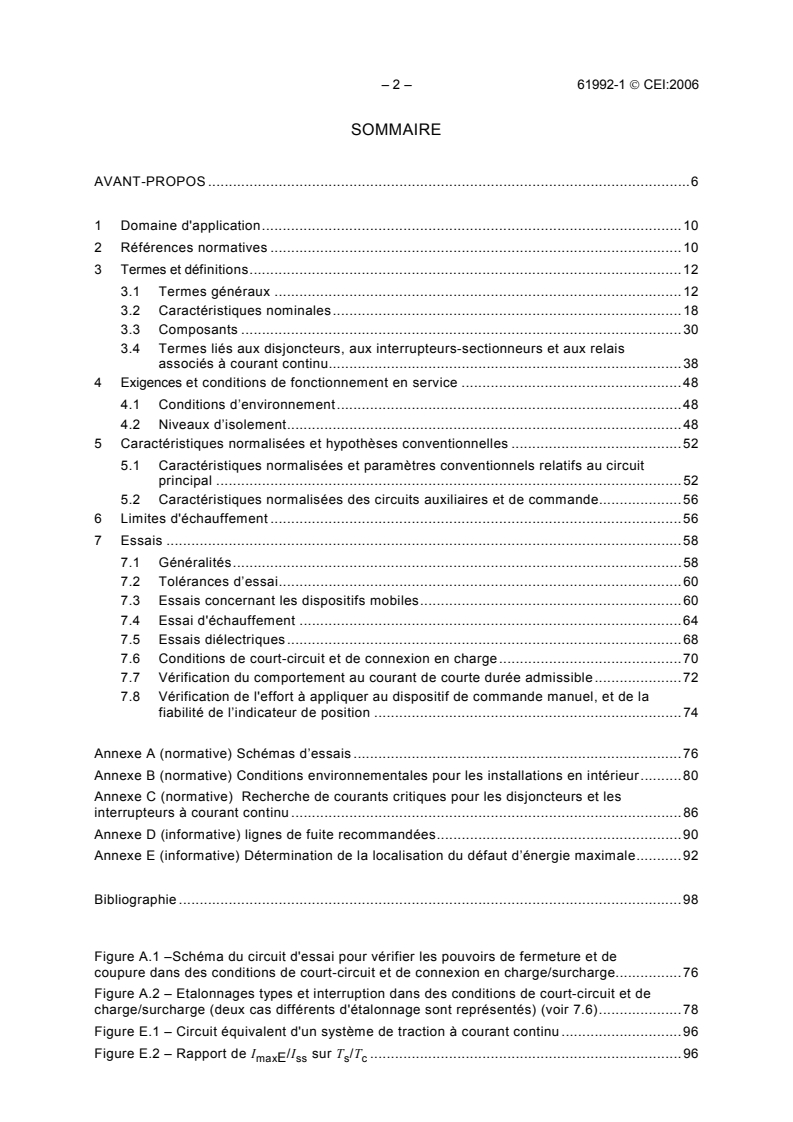
– 2 – 61992-1 CEI:2006
SOMMAIRE
AVANT-PROPOS .6
1 Domaine d'application.10
2 Références normatives .10
3 Termes et définitions.12
3.1 Termes généraux .12
3.2 Caractéristiques nominales.18
3.3 Composants .30
3.4 Termes liés aux disjoncteurs, aux interrupteurs-sectionneurs et aux relais
associés à courant continu.38
4 Exigences et conditions de fonctionnement en service .48
4.1 Conditions d’environnement.48
4.2 Niveaux d’isolement.48
5 Caractéristiques normalisées et hypothèses conventionnelles .52
5.1 Caractéristiques normalisées et paramètres conventionnels relatifs au circuit
principal .52
5.2 Caractéristiques normalisées des circuits auxiliaires et de commande.56
6 Limites d'échauffement .56
7 Essais .58
7.1 Généralités.58
7.2 Tolérances d’essai.60
7.3 Essais concernant les dispositifs mobiles.60
7.4 Essai d'échauffement .64
7.5 Essais diélectriques.68
7.6 Conditions de court-circuit et de connexion en charge.70
7.7 Vérification du comportement au courant de courte durée admissible.72
7.8 Vérification de l'effort à appliquer au dispositif de commande manuel, et de la
fiabilité de l’indicateur de position .74
Annexe A (normative) Schémas d’essais .76
Annexe B (normative) Conditions environnementales pour les installations en intérieur.80
Annexe C (normative) Recherche de courants critiques pour les disjoncteurs et les
interrupteurs à courant continu .86
Annexe D (informative) lignes de fuite recommandées.90
Annexe E (informative) Détermination de la localisation du défaut d’énergie maximale.92
Bibliographie .98
Figure A.1 –Schéma du circuit d'essai pour vérifier les pouvoirs de fermeture et de
coupure dans des conditions de court-circuit et de connexion en charge/surcharge.76
Figure A.2 – Etalonnages types et interruption dans des conditions de court-circuit et de
charge/surcharge (deux cas différents d'étalonnage sont représentés) (voir 7.6).78
Figure E.1 – Circuit équivalent d'un système de traction à courant continu .96
Figure E.2 – Rapport de I /I sur T /T .96
maxE ss s c
61992-1 IEC:2006 – 3 –
CONTENTS
FOREWORD.7
1 Scope.11
2 Normative references.11
3 Terms and definitions .13
3.1 General terms.13
3.2 Performance characteristics .19
3.3 Components .31
3.4 Terms relating to d.c. circuit-breakers, switch-disconnectors and associated
relays .39
4 Service conditions and requirements.49
4.1 Environmental conditions .49
4.2 Insulation levels.49
5 Standard features and conventional assumptions .53
5.1 Standard features and conventional parameters for the main circuit .53
5.2 Standard features for auxiliary and control circuits .57
6 Temperature-rise limits .57
7 Tests .59
7.1 General .59
7.2 Test tolerances.61
7.3 Tests on movable devices.61
7.4 Temperature-rise test .65
7.5 Dielectric tests.69
7.6 Short-circuit and load-switching conditions.71
7.7 Verification of the behaviour during short-time withstand current test.73
7.8 Verification of the manual control device for sturdiness and position indicator
reliability.75
Annex A (normative) Diagrams for tests .77
Annex B (normative) Environmental conditions for indoor installations .81
Annex C (normative) Search of critical currents for d.c. circuit-breakers and switches.87
Annex D (informative) Recommended creepage distances.91
Annex E (informative) Determination of maximum energy fault location.93
Bibliography .99
Figure A.1 – Diagram of the test circuit for checking the making and breaking capacities
in short-circuit and load/overload switching conditions .77
Figure A.2 – Typical calibrations and interruption under short-circuit and load/overload
switching conditions (two different cases of calibration are represented) (see 7.6) .79
Figure E.1 – Equivalent circuit of a d.c. traction system .97
Figure E.2 – Ratio of I /I to T /T .97
maxE ss s c
– 4 – 61992-1 CEI:2006
Tableau 1 – Niveaux d’isolement .50
Tableau 2 – Paramètres du circuit d'essai pour une énergie de circuit maximale.52
Tableau 3 – Tensions préférentielles des circuits auxiliaires et de commande [V] .56
Tableau 4 – Limites d'échauffement des bobines isolées .56
Tableau 5 – Limites d'échauffement des différents éléments constitutifs .58
Tableau 6 – Tolérances d’essai .60
Tableau 7 – Grandeurs et dimensions recommandées des barres en cuivre.66
Tableau 8 – Forces et couples pour les essais .74
Tableau B.1 – Limites des vibrations sinusoïdales .82
Tableau D.1 – Identification du groupe de matériau .90
Tableau D.2 – Lignes de fuite recommandées en mm/kV (base U ) .90
Nm
61992-1 IEC:2006 – 5 –
Table 1 – Insulation levels.51
Table 2 – Test circuit parameters for maximum circuit energy.53
Table 3 – Preferred voltages for auxiliary and control circuits [V] .57
Table 4 – Temperature-rise limits for insulated coils .57
Table 5 – Temperature-rise limits for various components .59
Table 6 – Test tolerances.61
Table 7 – Recommended quantities and dimensions of copper bars.67
Table 8 – Values of forces or torques for the tests.75
Table B.1 – Limits of sinusoidal vibrations .83
Table D.1 – Material group identification.91
Table D.2 – Recommended creepage distances, in mm/kV (base U ) .91
Nm
– 6 – 61992-1 CEI:2006
COMMISSION ÉLECTROTECHNIQUE INTERNATIONALE
____________
APPLICATIONS FERROVIAIRES –
INSTALLATIONS FIXES –
APPAREILLAGE À COURANT CONTINU –
Partie 1: Généralités
AVANT-PROPOS
1) La Commission Électrotechnique Internationale (CEI) est une organisation mondiale de normalisation composée
de l'ensemble des comités électrotechniques nationaux (Comités nationaux de la CEI). La CEI a pour objet de
favoriser la coopération internationale pour toutes les questions de normalisation dans les domaines de
l'électricité et de l'électronique. A cet effet, la CEI – entre autres activités – publie des Normes internationales,
des Spécifications techniques, des Rapports techniques, des Spécifications accessibles au public (PAS) et des
Guides (ci-après dénommés "Publication(s) de la CEI"). Leur élaboration est confiée à des comités d'études,
aux travaux desquels tout Comité national intéressé par le sujet traité peut participer. Les organisations
internationales, gouvernementales et non gouvernementales, en liaison avec la CEI, participent également aux
travaux. La CEI collabore étroitement avec l'Organisation Internationale de Normalisation (ISO), selon des
conditions fixées par accord entre les deux organisations.
2) Les décisions ou accords officiels de la CEI concernant les questions techniques représentent, dans la mesure
du possible, un accord international sur les sujets étudiés, étant donné que les Comités nationaux intéressés
sont représentés dans chaque comité d’études.
3) Les publications de la CEI se présentent sous la forme de recommandations internationales et sont agréées
comme tels par les Comités nationaux de la CEI. Tous les efforts raisonnables sont entrepris afin que la CEI
s'assure de l'exactitude du contenu technique de ses publications; la CEI ne peut pas être tenue responsable
de l'éventuelle mauvaise utilisation ou interprétation qui en est faite par un quelconque utilisateur final
4) Dans le but d'encourager l'uniformité internationale, les Comités nationaux de la CEI s'engagent, dans toute la
mesure possible, à appliquer de façon transparente les Publications de la CEI dans leurs publications
nationales et régionales. Toute divergence entre la norme de la CEI et la norme nationale ou régionale
correspondante doit être indiquée en termes clairs dans cette dernière.
5) La CEI n’a fixé aucune procédure concernant le marquage comme indication d’approbation et sa responsabilité
n’est pas engagée quand un matériel est déclaré conforme à l’une de ses normes.
6) Tous les utilisateurs doivent s'assurer qu'ils sont en possession de la dernière édition de cette publication.
7) Aucune responsabilité ne doit être imputée à la CEI, à ses administrateurs, employés, auxiliaires ou
mandataires, y compris ses experts particuliers et les membres de ses comités d'études et des Comités
nationaux de la CEI, pour tout préjudice causé en cas de dommages corporels et matériels, ou de tout autre
dommage de quelque nature que ce soit, directe ou indirecte, ou pour supporter les coûts (y compris les frais
de justice) et les dépenses découlant de la publication ou de l'utilisation de cette Publication de la CEI ou de
toute autre Publication de la CEI, ou au crédit qui lui est accordé.
8) L'attention est attirée sur les références normatives citées dans cette publication. L'utilisation de publications
référencées est indispensable pour une application correcte de la présente publication.
9) L’attention est attirée sur le fait que certains des éléments de la présente Publication de la CEI peuvent faire
l’objet de droits de propriété intellectuelle ou de droits analogues. La CEI ne saurait être tenue pour
responsable de ne pas avoir identifié de tels droits de propriété et de ne pas avoir signalé leur existence.
La Norme internationale CEI 61992-1 a été établie par le comité d’études 9 de la CEI:
Matériels et systèmes électriques ferroviaires.
Cette seconde édition annule et remplace la première édition publiée en 2001. Cette édition
constitue une révision technique.
Cette édition comprend les modifications techniques majeures suivantes par rapport à l'édition
précédente de la norme:
– toutes les exigences et procédures qui s’appliquent à plus d’une partie de la série
CEI 61992 sont maintenant regroupées dans la présente partie;
61992-1 IEC:2006 – 7 –
INTERNATIONAL ELECTROTECHNICAL COMMISSION
____________
RAILWAY APPLICATIONS –
FIXED INSTALLATIONS –
DC SWITCHGEAR –
Part 1: General
FOREWORD
1) The International Electrotechnical Commission (IEC) is a worldwide organization for standardization comprising
all national electrotechnical committees (IEC National Committees). The object of IEC is to promote
international co-operation on all questions concerning standardization in the electrical and electronic fields. To
this end and in addition to other activities, IEC publishes International Standards, Technical Specifications,
Technical Reports, Publicly Available Specifications (PAS) and Guides (hereafter referred to as “IEC
Publication(s)”). Their preparation is entrusted to technical committees; any IEC National Committee interested
in the subject dealt with may participate in this preparatory work. International, governmental and non-
governmental organizations liaising with the IEC also participate in this preparation. IEC collaborates closely
with the International Organization for Standardization (ISO) in accordance with conditions determined by
agreement between the two organizations.
2) The formal decisions or agreements of IEC on technical matters express, as nearly as possible, an international
consensus of opinion on the relevant subjects since each technical committee has representation from all
interested IEC National Committees.
3) IEC Publications have the form of recommendations for international use and are accepted by IEC National
Committees in that sense. While all reasonable efforts are made to ensure that the technical content of IEC
Publications is accurate, IEC cannot be held responsible for the way in which they are used or for any
misinterpretation by any end user.
4) In order to promote international uniformity, IEC National Committees undertake to apply IEC Publications
transparently to the maximum extent possible in their national and regional publications. Any divergence
between any IEC Publication and the corresponding national or regional publication shall be clearly indicated in
the latter.
5) IEC provides no marking procedure to indicate its approval and cannot be rendered responsible for any
equipment declared to be in conformity with an IEC Publication.
6) All users should ensure that they have the latest edition of this publication.
7) No liability shall attach to IEC or its directors, employees, servants or agents including individual experts and
members of its technical committees and IEC National Committees for any personal injury, property damage or
other damage of any nature whatsoever, whether direct or indirect, or for costs (including legal fees) and
expenses arising out of the publication, use of, or reliance upon, this IEC Publication or any other IEC
Publications.
8) Attention is drawn to the Normative references cited in this publication. Use of the referenced publications is
indispensable for the correct application of this publication.
9) Attention is drawn to the possibility that some of the elements of this IEC Publication may be the subject of
patent rights. IEC shall not be held responsible for identifying any or all such patent rights.
International Standard IEC 61992-1 has been prepared by IEC technical committee 9:
Electrical equipment and systems for railways.
This second edition cancels and replaces the first edition published in 2001. This edition
constitutes a technical revision.
This edition includes the following significant technical changes with respect to the previous
edition:
– all requirements or procedures applying to more than one part of the IEC 61992 series are
now grouped in this part;
– 8 – 61992-1 CEI:2006
– on y a ajouté de nouvelles définitions visant les Parties 4, 5, 6 et 7 ainsi que de nouvelles
spécifications concernant la vérification du comportement durant l’essai de courant de
tenue de courte durée et la vérification du dispositif de commande manuel;
– les spécifications des essais de court-circuit et de commutation de charge on été
améliorées.
Le texte de la présente norme est issu de l'EN 60123-1 ainsi que des documents suivants:
FDIS Rapport de vote
9/886/FDIS 9/908/RVD
Le rapport de vote indiqué dans le tableau ci-dessus donne toute information sur le vote ayant
abouti à l'approbation de la présente Norme.
Cette publication a été rédigée selon les Directives ISO/CEI, Partie 2.
La CEI 61992 comprend les parties suivantes, présentées sous le titre général Applications
ferroviaires – Installations fixes – Appareillage à courant continu:
Partie 1: Généralités
Partie 2: Disjoncteurs en courant continu
Partie 3: Interrupteurs-sectionneurs, sectionneurs et sectionneurs de terre à courant
continu, pour l'intérieur
Partie 4: Interrupteurs-sectionneurs, sectionneurs et sectionneurs de terre à courant
continu, pour usage extérieur
Partie 5: Parafoudres et limiteurs de tension pour usage spécifique dans les systèmes de
traction à courant continu
Partie 6: Ensembles d’appareillage à courant continu
Partie 7-1: Appareils de mesure, de contrôle et de protection pour usage spécifique dans les
systèmes de traction à courant continu – Guide d'application;
Partie 7-2: Appareils de mesure, de contrôle et de protection pour usage spécifique dans les
systèmes de traction à courant continu – Transducteurs de courant d’isolement et
autres appareils de mesure du courant
Partie 7-3: Appareils de mesure, de contrôle et de protection pour usage spécifique dans les
systèmes de traction à courant continu – Transducteurs de tension d’isolement et
autres appareils de mesure de la tension
Le comité a décidé que le contenu de cette publication ne sera pas modifié avant la date de
maintenance indiquée sur le site web de la CEI sous «http://webstore.iec.ch» dans les données
relatives à la publication recherchée. A cette date, la publication sera
• reconduite;
• supprimée;
• remplacée par une édition révisée, ou
• amendée.
61992-1 IEC:2006 – 9 –
– there have been new definitions added for Parts 4, 5, 6 and 7 and also new specifications
concerning verification of the behaviour during short-time withstand current test and
verification of the manual control device;
– specifications of short-circuit and load-switching tests have been improved.
The text of this standard is based on EN 60123-1 and on the following documents:
FDIS Report on voting
9/886/FDIS 9/908/RVD
Full information on the voting for the approval of this standard can be found in the report on
voting indicated in the above table.
This publication has been drafted in accordance with the ISO/IEC Directives, Part 2.
IEC 61992 consists of the following parts, under the general title Railway applications – Fixed
installations – DC switchgear:
Part 1: General
Part 2: DC circuit-breakers
Part 3: Indoor d.c. disconnectors, switch-disconnectors and earthing switches
Part 4: Outdoor d.c. disconnectors, switch-disconnectors and earthing switches
Part 5: Surge arresters and low-voltage limiters for specific use in d.c. systems
Part 6: DC switchgear assemblies
Part 7-1: Measurement, control and protection devices for specific use in d.c. traction
systems – Application guide
Part 7-2: Measurement, control and protection devices for specific use in d.c. traction
systems – Isolating current transducers and other current measuring devices
Part 7-3: Measurement, control and protection devices for specific use in d.c. traction
systems – Isolating voltage transducers and other voltage measuring devices
The committee has decided that the contents of this publication will remain unchanged until the
maintenance result date indicated on the IEC web site under "http://webstore.iec.ch" in the data
related to the specific publication. At this date, the publication will be
• reconfirmed,
• withdrawn,
• replaced by a revised edition, or
• amended.
– 10 – 61992-1 CEI:2006
APPLICATIONS FERROVIAIRES –
INSTALLATIONS FIXES –
APPAREILLAGE À COURANT CONTINU –
Partie 1: Généralités
1 Domaine d'application
La série CEI 61992 spécifie les exigences relatives aux appareillages et aux appareils de
commande à courant continu et est conçue pour être utilisée dans des installations électriques
fixes dont la tension nominale ne dépasse pas 3 000 V en courant continu, qui alimentent en
courant électrique les véhicules destinés au transport public guidé, comme les véhicules
ferroviaires, les véhicules de tramways, les véhicules de métro et les trolleybus.
La présente partie 1 spécifie les exigences générales.
2 Références normatives
Les documents de référence suivants sont indispensables pour l'application du présent
document. Pour les références datées, seule l'édition citée s'applique. Pour les références non
datées, la dernière édition du document de référence s'applique (y compris les éventuels
amendements).
CEI 60050-441:1984, Vocabulaire Electrotechnique International (VEI) – Chapitre 441:
Appareillage et fusibles
CEI 60050-446:1983, Vocabulaire Electrotechnique International (VEI) – Chapitre 446: Relais
électriques
CEI 60050-605:1983, Vocabulaire Electrotechnique International (VEI) – Chapitre 605:
Production, transport et distribution de l'énergie – Postes
CEI 60050-811:1991, Vocabulaire Electrotechnique International (VEI) – Chapitre 811: Traction
électrique
CEI 60060-1:1989, Techniques des essais à haute tension – Partie 1: Définitions et prescrip-
tions générales relatives aux essais
CEI 60099-1:1999, Parafoudres – Partie 1: Parafoudres à résistance variable avec éclateurs
pour réseaux à courant alternatif
CEI 60099-4:2004, Parafoudres – Partie 4: Parafoudres à oxyde métallique sans éclateur pour
réseaux à courant alternatif
CEI 60269-1:1998, Fusibles basse tension – Première partie: Règles générales
CEI 60721 (toutes les parties), Classification des conditions d'environnement
CEI 60850:2000, Applications ferroviaires – Tensions d'alimentation des systèmes de traction
CEI 60913:1988, Lignes aériennes de traction électrique
61992-1 IEC:2006 – 11 –
RAILWAY APPLICATIONS –
FIXED INSTALLATIONS –
DC SWITCHGEAR –
Part 1: General
1 Scope
The IEC 61992 series specifies requirements for d.c. switchgear and controlgear and is
intended to be used in fixed electrical installations with nominal voltage not exceeding 3 000 V
d.c., which supply electrical power to vehicles for public guided transport, i.e. railway vehicles,
tramway vehicles, underground vehicles and trolley-buses.
This Part 1 specifies general requirements.
2 Normative references
The following referenced documents are indispensable for the application of this document. For
dated references, only the edition cited applies. For undated references, the latest edition of
the referenced document (including any amendments) applies.
IEC 60050-441:1984, International Electrotechnical Vocabulary (IEV) – Chapter 441:
Switchgear, controlgear and fuses
IEC 60050-446:1983, International Electrotechnical Vocabulary (IEV) – Chapter 446: Electrical
relays
IEC 60050-605:1983, International Electrotechnical Vocabulary (IEV) – Chapter 605: Generation,
transmission and distribution of electricity – Substations
IEC 60050-811:1991, International Electrotechnical Vocabulary (IEV) – Chapter 811: Electric
traction
IEC 60060-1:1989, High-voltage test techniques – Part 1: General definitions and test
requirements
IEC 60099-1:1999, Surge arresters – Part 1: Non-linear resistor type gapped surge arresters
for a.c. systems
IEC 60099-4:2004, Surge arresters – Part 4: Metal-oxide surge arresters without gaps for a.c.
systems
IEC 60269-1:1998, Low-voltage fuses – Part 1:General requirements
IEC 60721 (all parts), Classification of environmental conditions
IEC 60850:2000, Railway applications – Supply voltage of traction systems
IEC 60913:1988, Electric traction overhead lines
– 12 – 61992-1 CEI:2006
CEI 60947 (toutes les parties), Appareillage à basse tension
CEI 62271-200:2003, Appareillage à haute tension – Partie 200: Appareillage sous enveloppe
métallique pour courant alternatif de tensions assignées supérieures à 1 kV et inférieures ou
égales à 52 kV
EN 50124-1:2001, Applications ferroviaires – Coordination de l’isolement – Partie 1:
Prescriptions fondamentales – Distances d'isolement dans l'air et lignes de fuite pour tout
matériel électrique et électronique
3 Termes et définitions
Pour les besoins du présent document, les termes et définitions donnés dans les CEI 60050-
441, CEI 60050-446, CEI 60050-605, CEI 60050-811, CEI 60099-1, CEI 60099-4, CEI 60947,
CEI 62271-200 et l’ EN 50124-1 ainsi que les suivants s'appliquent.
3.1 Termes généraux
3.1.1
appareillage de connexion
terme général applicable aux appareils de connexion et à leur combinaison avec des appareils
de commande, de mesure, de protection et de réglage qui leur sont associés. Il couvre
également les ensembles de tels appareils avec les connexions, les accessoires, les
enveloppes et les charpentes correspondants
NOTE Dans un souci de simplicité, dans la présente norme, le terme «appareillage» est employé pour
«appareillage de connexion et de commande».
3.1.2
ensemble d'appareillage à courant continu
combinaison d'un ou plusieurs appareils de connexion à courant continu et d'appareils de
commande, de mesure, de signalisation, de protection, de réglage, etc. associés, complète-
ment assemblés sous la responsabilité du fournisseur, avec l'ensemble des connexions
électriques et mécaniques internes et les pièces formant la structure
NOTE 1 Dans toute la série CEI 61992, le terme «ensemble d'appareillage» est utilisé dans le sens «d'ensemble
d'appareillage de connexion et de commande en courant continu ».
NOTE 2 Les éléments qui composent l'ensemble d'appareillage peuvent être électromécaniques ou électroniques.
NOTE 3 Une enveloppe, mais pas une enveloppe intégrale, qui renferme un appareillage de connexion et des
appareillages de commande associés peut être considérée comme un ensemble d'appareillage.
3.1.3
appareil de connexion
appareil destiné à établir ou à interrompre le courant dans un ou plusieurs circuits électriques
[VEI 441-14-01]
3.1.4
disjoncteur à courant continu
appareil de connexion capable d'établir, de supporter et d'interrompre des courants continus
dans les conditions normales du circuit ainsi que d'établir, de supporter (jusqu'à une limite
spécifiée et pendant une durée spécifiée) et d'interrompre des courants dans des conditions
anormales spécifiées du circuit, telles que celles du court-circuit
61992-1 IEC:2006 – 13 –
IEC 60947 (all parts), Low-voltage switchgear and controlgear
IEC 62271-200: 2003, High-voltage switchgear and controlgear – Part 200: AC metal-enclosed
switchgear and controlgear for rated voltages above 1 kV and up to and including 52 kV
EN 50124-1:2001, Railway applications – Insulation coordination – Part 1: Basic requirements
– Clearances and creepage distances for electrical and electronic equipment
3 Terms and definitions
For the purposes of this document, the terms and definitions given in IEC 60050-441,
IEC 60050-446, IEC 60050-605, IEC 60050-811, IEC 60099-1, IEC 60099-4, IEC 60947,
IEC 62271-200, and EN 50124-1 as well as the following apply.
3.1 General terms
3.1.1
switchgear
general term covering switching devices and their combination with associated control,
measuring, protective and regulating equipment; it covers also assemblies of such devices and
equipment with associated interconnections, accessories, enclosures and supporting structures
NOTE For the sake of simplicity, in this standard the term “switchgear” means “switchgear and controlgear”.
3.1.2
d.c. switchgear and controlgear assembly
combination of one or more d.c. switching devices together with associated control, measuring,
signalling, protective, regulating equipment, etc. completely assembled under the responsibility
of the supplier, with all the internal electrical and mechanical interconnections and structural
parts
NOTE 1 Throughout the IEC 61992 series, the abbreviation switchgear assembly is used for a d.c. switchgear and
controlgear assembly.
NOTE 2 The components of the switchgear assembly may be electromechanical or electronic.
NOTE 3 An enclosure, but not an integral enclosure, when housing a switching device and some associated
controlgear, may be considered as a switchgear assembly.
3.1.3
switching device
device designed to make or break the current in one or more electric circuits
[IEV 441-14-01]
3.1.4
d.c. circuit-breaker
switching device capable of making, carrying and breaking direct currents under normal circuit
conditions and also making, carrying (up to a specified limit and for a specified time) and
breaking currents under specified abnormal conditions, such as those of short-circuit
– 14 – 61992-1 CEI:2006
3.1.5
sectionneur à courant continu
appareil mécanique de connexion qui fournit, en position d'ouverture et pour des raisons de
sécurité, une distance d'isolement selon des exigences spécifiées
NOTE 1 Le sectionneur est capable d'ouvrir et de fermer un circuit soit lorsqu'un courant continu négligeable est
interrompu ou établi, soit lorsque aucun changement de tension significatif ne se produit aux bornes du
sectionneur. Cet appareil est également capable de supporter des courants continus dans les conditions normales
du circuit et de supporter, pendant une durée spécifiée, des courants dans des conditions anormales du circuit
telles que celles du court-circuit.
NOTE 2 Un sectionneur n'est pas approprié pour établir ou interrompre un courant de charge, un courant de
défaut ou un autre courant suscité par les effets de la foudre ou de phénomènes transitoires.
NOTE 3 Un sectionneur est uniquement capable d'établir ou d'interrompre des courants d'une amplitude très
limitée comme ceux suscités par une charge électrostatique ou des décharges dans un isolement non endommagé.
L'aptitude à établir ou à interrompre des courants minimaux en raison de conditions transitoires marginales
éventuelles du réseau fait l'objet d'un accord entre l'acheteur et le fournisseur.
3.1.6
interrupteur-sectionneur
appareil mécanique de connexion capable d'établir, de supporter et d'interrompre des courants
dans les conditions normales du circuit et, lorsque cela est spécifié, dans des conditions
données de surcharge de fonctionnement. En outre, ce dispositif est capable de supporter,
pendant une durée spécifiée, des courants dans les conditions anormales spécifiées du circuit
telles que celles du court-circuit. Par ailleurs, ledit appareil satisfait aux exigences imposées à
un sectionneur (voir 3.1.5)
NOTE 1 Si cela est spécifié, un interrupteur-sectionneur peut être conçu pour établir des courants de court-circuit,
mais non pour les interrompre.
NOTE 2 Dans certaines conditions spéciales, les interrupteurs-sectionneurs pour l'extérieur peuvent devoir être
capables d'interrompre des courants de surcharge d'une amplitude spécifiée.
3.1.7
sectionneur de terre
appareil mécanique de connexion utilisé pour mettre à la terre des parties d'un circuit, capable
de supporter pendant une durée spécifiée des courants dans des conditions anormales du
circuit telles que celles du court-circuit, mais non prévu pour supporter du courant dans les
conditions normales du circuit
NOTE Un sectionneur de terre peut avoir un pouvoir de fermeture en court-circuit (voir 3.2.23).
[VEI 441-14-11]
3.1.8
limiteur à basse tension
appareil destiné à être en parallèle dans les parties d’un système de traction où des
surtensions risquent d’apparaître et dont la fonction consiste à les maintenir dans des limites
de valeur prédéterminées
3.1.9
capteur à courant continu
appareil utilisé pour détecter un courant ou une tension dans un circuit principal en courant
continu produisant un signal de sortie proportionnel à la valeur d’entée primaire et linéaire par
rapport à celle-ci (sur une plage donnée), destiné à être connecté à un dispositif secondaire,
lequel agit en fonction de ce signal
3.1.10
shunt à courant continu
appareil connecté au circuit primaire, généralement composé de grilles métalliques fournissant
un signal de sortie en millivolts proportionnel au courant circulant dans le circuit primaire
61992-1 IEC:2006 – 15 –
3.1.5
d.c. disconnector
mechanical switching device, which provides, in the open position, for safety reasons, an
isolating distance in accordance with specified requirements
NOTE 1 The disconnector is capable of opening and closing a circuit when either negligible d.c. current is broken
or made, or when no significant change in the voltage across the terminals of the disconnector occurs. It is also
capable of carrying d.c. currents under normal circuit conditions and carrying, for a specified time, currents under
abnormal conditions such as those of short-circuit.
NOTE 2 A disconnector is not suitable for making or breaking load current, fault current or other current arising
from the effects of lightning or transient phenomena.
NOTE 3 A disconnector is only able to make or break current of very limited magnitude such as those arising from
electrostatic charging or discharges across undamaged insulation. The ability to make or break minimum currents
due to eventual marginal transient conditions of the network is subject to agreement between purchaser and
supplier.
3.1.6
switch-disconnector
mechanical switching device capable of making, carrying and breaking currents in normal
circuit conditions and, when specified, in given operating overload conditions. In addition, it is
able to carry, for a specified time, currents under specified abnormal circuit conditions, such as
short-circuit conditions. Moreover, it complies with the requirements for a disconnector (see
3.1.5)
NOTE 1 When specified, a switch-disconnector may be designed for making short-circuit currents, but not for
breaking the same.
NOTE 2 Outdoor switch-disconnectors, in given special conditions, may be required to be suitable for breaking
overload currents of specified amplitude.
3.1.7
earthing switch
mechanical switching device for earthing parts of the circuit, capable of with
...
IEC 61992-1 ®
Edition 2.1 2014-04
CONSOLIDATED VERSION
INTERNATIONAL
STANDARD
NORME
INTERNATIONALE
colour
inside
Railway applications – Fixed installations – DC switchgear –
Part 1: General
Applications ferroviaires – Installations fixes – Appareillage à courant continu –
Partie 1: Généralités
All rights reserved. Unless otherwise specified, no part of this publication may be reproduced or utilized in any form
or by any means, electronic or mechanical, including photocopying and microfilm, without permission in writing from
either IEC or IEC's member National Committee in the country of the requester. If you have any questions about IEC
copyright or have an enquiry about obtaining additional rights to this publication, please contact the address below or
your local IEC member National Committee for further information.
Droits de reproduction réservés. Sauf indication contraire, aucune partie de cette publication ne peut être reproduite
ni utilisée sous quelque forme que ce soit et par aucun procédé, électronique ou mécanique, y compris la photocopie
et les microfilms, sans l'accord écrit de l'IEC ou du Comité national de l'IEC du pays du demandeur. Si vous avez des
questions sur le copyright de l'IEC ou si vous désirez obtenir des droits supplémentaires sur cette publication, utilisez
les coordonnées ci-après ou contactez le Comité national de l'IEC de votre pays de résidence.
IEC Central Office Tel.: +41 22 919 02 11
3, rue de Varembé Fax: +41 22 919 03 00
CH-1211 Geneva 20 info@iec.ch
Switzerland www.iec.ch
About the IEC
The International Electrotechnical Commission (IEC) is the leading global organization that prepares and publishes
International Standards for all electrical, electronic and related technologies.
About IEC publications
The technical content of IEC publications is kept under constant review by the IEC. Please make sure that you have the
latest edition, a corrigenda or an amendment might have been published.
IEC Catalogue - webstore.iec.ch/catalogue Electropedia - www.electropedia.org
The stand-alone application for consulting the entire The world's leading online dictionary of electronic and
bibliographical information on IEC International Standards, electrical terms containing more than 30 000 terms and
Technical Specifications, Technical Reports and other definitions in English and French, with equivalent terms in 14
documents. Available for PC, Mac OS, Android Tablets and additional languages. Also known as the International
iPad. Electrotechnical Vocabulary (IEV) online.
IEC publications search - www.iec.ch/searchpub IEC Glossary - std.iec.ch/glossary
The advanced search enables to find IEC publications by a More than 55 000 electrotechnical terminology entries in
variety of criteria (reference number, text, technical English and French extracted from the Terms and Definitions
committee,…). It also gives information on projects, replaced clause of IEC publications issued since 2002. Some entries
and withdrawn publications. have been collected from earlier publications of IEC TC 37,
77, 86 and CISPR.
IEC Just Published - webstore.iec.ch/justpublished
Stay up to date on all new IEC publications. Just Published IEC Customer Service Centre - webstore.iec.ch/csc
details all new publications released. Available online and If you wish to give us your feedback on this publication or
also once a month by email. need further assistance, please contact the Customer Service
Centre: csc@iec.ch.
A propos de l'IEC
La Commission Electrotechnique Internationale (IEC) est la première organisation mondiale qui élabore et publie des
Normes internationales pour tout ce qui a trait à l'électricité, à l'électronique et aux technologies apparentées.
A propos des publications IEC
Le contenu technique des publications IEC est constamment revu. Veuillez vous assurer que vous possédez l’édition la
plus récente, un corrigendum ou amendement peut avoir été publié.
Catalogue IEC - webstore.iec.ch/catalogue Electropedia - www.electropedia.org
Application autonome pour consulter tous les renseignements
Le premier dictionnaire en ligne de termes électroniques et
bibliographiques sur les Normes internationales,
électriques. Il contient plus de 30 000 termes et définitions en
Spécifications techniques, Rapports techniques et autres
anglais et en français, ainsi que les termes équivalents dans
documents de l'IEC. Disponible pour PC, Mac OS, tablettes
14 langues additionnelles. Egalement appelé Vocabulaire
Android et iPad.
Electrotechnique International (IEV) en ligne.
Recherche de publications IEC - www.iec.ch/searchpub
Glossaire IEC - std.iec.ch/glossary
La recherche avancée permet de trouver des publications IEC Plus de 55 000 entrées terminologiques électrotechniques, en
en utilisant différents critères (numéro de référence, texte, anglais et en français, extraites des articles Termes et
comité d’études,…). Elle donne aussi des informations sur les Définitions des publications IEC parues depuis 2002. Plus
projets et les publications remplacées ou retirées. certaines entrées antérieures extraites des publications des
CE 37, 77, 86 et CISPR de l'IEC.
IEC Just Published - webstore.iec.ch/justpublished
Service Clients - webstore.iec.ch/csc
Restez informé sur les nouvelles publications IEC. Just
Published détaille les nouvelles publications parues. Si vous désirez nous donner des commentaires sur cette
Disponible en ligne et aussi une fois par mois par email. publication ou si vous avez des questions contactez-nous:
csc@iec.ch.
IEC 61992-1 ®
Edition 2.1 2014-04
CONSOLIDATED VERSION
INTERNATIONAL
STANDARD
NORME
INTERNATIONALE
colour
inside
Railway applications – Fixed installations – DC switchgear –
Part 1: General
Applications ferroviaires – Installations fixes – Appareillage à courant continu –
Partie 1: Généralités
INTERNATIONAL
ELECTROTECHNICAL
COMMISSION
COMMISSION
ELECTROTECHNIQUE
INTERNATIONALE
ICS 45.060 ISBN 978-2-8322-1552-4
IEC 61992-1 ®
Edition 2.1 2014-04
CONSOLIDATED VERSION
REDLINE VERSION
VERSION REDLINE
colour
inside
Railway applications – Fixed installations – DC switchgear –
Part 1: General
Applications ferroviaires – Installations fixes – Appareillage à courant continu –
Partie 1: Généralités
– 2 – IEC 61992-1:2006
+AMD 1:2014 CSV IEC 2014
CONTENTS
FOREWORD . 4
1 Scope . 6
2 Normative references. 6
3 Terms and definitions . 7
3.1 General terms. 7
3.2 Performance characteristics . 10
3.3 Components . 15
3.4 Terms relating to d.c. circuit-breakers, switch-disconnectors and associated
relays . 20
4 Service conditions and requirements . 24
4.1 Environmental conditions . 24
4.2 Insulation levels . 24
5 Standard features and conventional assumptions . 26
5.1 Standard features and conventional parameters for the main circuit . 26
5.2 Standard features for auxiliary and control circuits . 27
6 Temperature-rise limits . 28
7 Tests . 29
7.1 General . 29
7.2 Test tolerances . 30
7.3 Tests on movable devices . 30
7.4 Temperature-rise test . 32
7.5 Dielectric tests . 33
7.6 Short-circuit and load-switching conditions . 34
7.7 Verification of the behaviour during short-time withstand current test . 36
7.8 Verification of the manual control device for sturdiness and position indicator
reliability . 36
Annex A (normative) Diagrams for tests . 38
Annex B (normative) Environmental conditions for indoor installations . 40
Annex C (normative) Search of critical currents for d.c. circuit-breakers and switches . 43
Annex D (informative) Recommended creepage distances . 45
Annex E (informative) Determination of maximum energy fault location . 46
Bibliography . 49
Figure A.1 – Diagram of the test circuit for checking the making and breaking capacities
in short-circuit and load/overload switching conditions . 38
Figure A.2 – Typical calibrations and interruption under short-circuit and load/overload
switching conditions (two different cases of calibration are represented) (see 7.6) . 39
Figure E.1 – Equivalent circuit of a d.c. traction system . 48
Figure E.2 – Ratio of I /I to T /T . 48
maxE ss s c
+AMD 1:2014 CSV IEC 2014
Table 1 – Insulation levels . 25
Table 2 – Test circuit parameters for maximum circuit energy . 26
Table 3 – Preferred voltages for auxiliary and control circuits [V] . 27
Table 4 – Temperature-rise limits for insulated coils . 28
Table 5 – Temperature-rise limits for various components . 29
Table 6 – Test tolerances . 30
Table 7 – Recommended quantities and dimensions of copper bars . 33
Table 8 – Values of forces or torques for the tests . 37
Table B.1 – Limits of sinusoidal vibrations . 41
Table D.1 – Material group identification . 45
Table D.2 – Recommended creepage distances, in mm/kV (base U ) . 45
Nm
– 4 – IEC 61992-1:2006
+AMD 1:2014 CSV IEC 2014
INTERNATIONAL ELECTROTECHNICAL COMMISSION
____________
RAILWAY APPLICATIONS –
FIXED INSTALLATIONS –
DC SWITCHGEAR –
Part 1: General
FOREWORD
1) The International Electrotechnical Commission (IEC) is a worldwide organization for standardization comprising
all national electrotechnical committees (IEC National Committees). The object of IEC is to promote
international co-operation on all questions concerning standardization in the electrical and electronic fields. To
this end and in addition to other activities, IEC publishes International Standards, Technical Specifications,
Technical Reports, Publicly Available Specifications (PAS) and Guides (hereafter referred to as “IEC
Publication(s)”). Their preparation is entrusted to technical committees; any IEC National Committee interested
in the subject dealt with may participate in this preparatory work. International, governmental and non-
governmental organizations liaising with the IEC also participate in this preparation. IEC collaborates closely
with the International Organization for Standardization (ISO) in accordance with conditions determined by
agreement between the two organizations.
2) The formal decisions or agreements of IEC on technical matters express, as nearly as possible, an international
consensus of opinion on the relevant subjects since each technical committee has representation from all
interested IEC National Committees.
3) IEC Publications have the form of recommendations for international use and are accepted by IEC National
Committees in that sense. While all reasonable efforts are made to ensure that the technical content of IEC
Publications is accurate, IEC cannot be held responsible for the way in which they are used or for any
misinterpretation by any end user.
4) In order to promote international uniformity, IEC National Committees undertake to apply IEC Publications
transparently to the maximum extent possible in their national and regional publications. Any divergence
between any IEC Publication and the corresponding national or regional publication shall be clearly indicated in
the latter.
5) IEC itself does not provide any attestation of conformity. Independent certification bodies provide conformity
assessment services and, in some areas, access to IEC marks of conformity. IEC is not responsible for any
services carried out by independent certification bodies.
6) All users should ensure that they have the latest edition of this publication.
7) No liability shall attach to IEC or its directors, employees, servants or agents including individual experts and
members of its technical committees and IEC National Committees for any personal injury, property damage or
other damage of any nature whatsoever, whether direct or indirect, or for costs (including legal fees) and
expenses arising out of the publication, use of, or reliance upon, this IEC Publication or any other IEC
Publications.
8) Attention is drawn to the Normative references cited in this publication. Use of the referenced publications is
indispensable for the correct application of this publication.
9) Attention is drawn to the possibility that some of the elements of this IEC Publication may be the subject of
patent rights. IEC shall not be held responsible for identifying any or all such patent rights.
This consolidated version of the official IEC Standard and its amendment has been
prepared for user convenience.
IEC 61992-1 edition 2.1 contains the second edition (2006-02) [documents 9/886/FDIS
and 9/908/RVD] and its amendment 1 (2014-04) [documents 9/1790/CDV and 9/1850/RVC].
In this Redline version, a vertical line in the margin shows where the technical content
is modified by amendment 1. Additions and deletions are displayed in red, with
deletions being struck through. A separate Final version with all changes accepted is
available in this publication.
+AMD 1:2014 CSV IEC 2014
International Standard IEC 61992-1 has been prepared by IEC technical committee 9:
Electrical equipment and systems for railways.
This edition includes the following significant technical changes with respect to the previous
edition:
– all requirements or procedures applying to more than one part of the IEC 61992 series are
now grouped in this part;
– there have been new definitions added for Parts 4, 5, 6 and 7 and also new specifications
concerning verification of the behaviour during short-time withstand current test and
verification of the manual control device;
– specifications of short-circuit and load-switching tests have been improved.
This publication has been drafted in accordance with the ISO/IEC Directives, Part 2.
IEC 61992 consists of the following parts, under the general title Railway applications – Fixed
installations – DC switchgear:
Part 1: General
Part 2: DC circuit-breakers
Part 3: Indoor d.c. disconnectors, switch-disconnectors and earthing switches
Part 4: Outdoor d.c. disconnectors, switch-disconnectors and earthing switches
Part 5: Surge arresters and low-voltage limiters for specific use in d.c. systems
Part 6: DC switchgear assemblies
Part 7-1: Measurement, control and protection devices for specific use in d.c. traction
systems – Application guide
Part 7-2: Measurement, control and protection devices for specific use in d.c. traction
systems – Isolating current transducers and other current measuring devices
Part 7-3: Measurement, control and protection devices for specific use in d.c. traction
systems – Isolating voltage transducers and other voltage measuring devices
The committee has decided that the contents of the base publication and its amendment will
remain unchanged until the stability date indicated on the IEC web site under
"http://webstore.iec.ch" in the data related to the specific publication. At this date, the
publication will be
• reconfirmed,
• withdrawn,
• replaced by a revised edition, or
• amended.
IMPORTANT – The “colour inside” logo on the cover page of this publication indicates
that it contains colours which are considered to be useful for the correct understanding
of its contents. Users should therefore print this publication using a colour printer.
– 6 – IEC 61992-1:2006
+AMD 1:2014 CSV IEC 2014
RAILWAY APPLICATIONS –
FIXED INSTALLATIONS –
DC SWITCHGEAR –
Part 1: General
1 Scope
The IEC 61992 series specifies requirements for d.c. switchgear and controlgear and is
intended to be used in fixed electrical installations with nominal voltage not exceeding 3 000 V
d.c., which supply electrical power to vehicles for public guided transport, i.e. railway vehicles,
tramway vehicles, underground vehicles and trolley-buses.
This Part 1 specifies general requirements.
2 Normative references
The following referenced documents are indispensable for the application of this document. For
dated references, only the edition cited applies. For undated references, the latest edition of
the referenced document (including any amendments) applies.
IEC 60050-441:1984, International Electrotechnical Vocabulary (IEV) – Chapter 441:
Switchgear, controlgear and fuses
IEC 60050-446:1983, International Electrotechnical Vocabulary (IEV) – Chapter 446: Electrical
relays
IEC 60050-605:1983, International Electrotechnical Vocabulary (IEV) – Chapter 605: Generation,
transmission and distribution of electricity – Substations
IEC 60050-811:1991, International Electrotechnical Vocabulary (IEV) – Chapter 811: Electric
traction
IEC 60060-1:1989, High-voltage test techniques – Part 1: General definitions and test
requirements
IEC 60099-1:1999, Surge arresters – Part 1: Non-linear resistor type gapped surge arresters
for a.c. systems
IEC 60099-4:2004, Surge arresters – Part 4: Metal-oxide surge arresters without gaps for a.c.
systems
IEC 60269-1:1998, Low-voltage fuses – Part 1:General requirements
IEC 60721 (all parts), Classification of environmental conditions
IEC 60850:2000, Railway applications – Supply voltage of traction systems
IEC 60913:1988, Electric traction overhead lines
IEC 60947 (all parts), Low-voltage switchgear and controlgear
+AMD 1:2014 CSV IEC 2014
IEC 62271-200: 2003, High-voltage switchgear and controlgear – Part 200: AC metal-enclosed
switchgear and controlgear for rated voltages above 1 kV and up to and including 52 kV
EN 50124-1:2001, Railway applications – Insulation coordination – Part 1: Basic requirements
– Clearances and creepage distances for electrical and electronic equipment
3 Terms and definitions
For the purposes of this document, the terms and definitions given in IEC 60050-441,
IEC 60050-446, IEC 60050-605, IEC 60050-811, IEC 60099-1, IEC 60099-4, IEC 60947,
IEC 62271-200, and EN 50124-1 as well as the following apply.
3.1 General terms
3.1.1
switchgear
general term covering switching devices and their combination with associated control,
measuring, protective and regulating equipment; it covers also assemblies of such devices and
equipment with associated interconnections, accessories, enclosures and supporting structures
NOTE For the sake of simplicity, in this standard the term “switchgear” means “switchgear and controlgear”.
3.1.2
d.c. switchgear and controlgear assembly
combination of one or more d.c. switching devices together with associated control, measuring,
signalling, protective, regulating equipment, etc. completely assembled under the responsibility
of the supplier, with all the internal electrical and mechanical interconnections and structural
parts
NOTE 1 Throughout the IEC 61992 series, the abbreviation switchgear assembly is used for a d.c. switchgear and
controlgear assembly.
NOTE 2 The components of the switchgear assembly may be electromechanical or electronic.
NOTE 3 An enclosure, but not an integral enclosure, when housing a switching device and some associated
controlgear, may be considered as a switchgear assembly.
3.1.3
switching device
device designed to make or break the current in one or more electric circuits
[IEV 441-14-01]
3.1.4
d.c. circuit-breaker
switching device capable of making, carrying and breaking direct currents under normal circuit
conditions and also making, carrying (up to a specified limit and for a specified time) and
breaking currents under specified abnormal conditions, such as those of short-circuit
3.1.5
d.c. disconnector
mechanical switching device, which provides, in the open position, for safety reasons, an
isolating distance in accordance with specified requirements
NOTE 1 The disconnector is capable of opening and closing a circuit when either negligible d.c. current is broken
or made, or when no significant change in the voltage across the terminals of the disconnector occurs. It is also
capable of carrying d.c. currents under normal circuit conditions and carrying, for a specified time, currents under
abnormal conditions such as those of short-circuit.
NOTE 2 A disconnector is not suitable for making or breaking load current, fault current or other current arising
from the effects of lightning or transient phenomena.
NOTE 3 A disconnector is only able to make or break current of very limited magnitude such as those arising from
electrostatic charging or discharges across undamaged insulation. The ability to make or break minimum currents
– 8 – IEC 61992-1:2006
+AMD 1:2014 CSV IEC 2014
due to eventual marginal transient conditions of the network is subject to agreement between purchaser and
supplier.
3.1.6
switch-disconnector
mechanical switching device capable of making, carrying and breaking currents in normal
circuit conditions and, when specified, in given operating overload conditions. In addition, it is
able to carry, for a specified time, currents under specified abnormal circuit conditions, such as
short-circuit conditions. Moreover, it complies with the requirements for a disconnector (see
3.1.5)
NOTE 1 When specified, a switch-disconnector may be designed for making short-circuit currents, but not for
breaking the same.
NOTE 2 Outdoor switch-disconnectors, in given special conditions, may be required to be suitable for breaking
overload currents of specified amplitude.
3.1.7
earthing switch
mechanical switching device for earthing parts of the circuit, capable of withstanding for a
specified time, currents under abnormal conditions such as those of short circuit, but not
required to carry current under normal conditions of the circuit
NOTE An earthing switch may have a short-circuit making capacity (see 3.2.23).
[IEV 441-14-11]
3.1.8
low-voltage limiter
device intended to be in parallel in those parts of a traction system where overvoltages are
expected having the function of limiting the voltage to predetermined values
3.1.9
d.c. sensor
device used for detecting a current or a voltage in a d.c. main circuit, which produces an output
signal, proportional to and linear (over a range) with the primary input, for connection to a
secondary device which acts on the signal
3.1.10
d.c. shunt
device connected in the primary circuit, usually composed of metal grids, that provides a
millivolt output proportional to the current following in the primary circuit
3.1.11
isolating transducer
device which is interposed between the output of a sensor in the main circuit and the input of a
secondary device used for measurement or protection, and used to provide an output isolated
from the main circuit and, usually, at lower voltage
3.1.12
Hall effect sensor
type of sensor which fits around the main circuit current carrying conductor and uses a single
or multiple Hall effect cells situated in the magnetic field of an iron circuit and which is
energised by the current in the main conductor
3.1.13
divider
bank of resistors connected across the main supply with a footing resistor used as the output,
which gives a voltage proportional to the main supply. This output is connected either directly
or indirectly through an isolation transducer to the voltage terminals of the secondary device
+AMD 1:2014 CSV IEC 2014
3.1.14
operation
motion of the moving contact(s) from one position to another position, for example open to
close or open to earth
NOTE 1 This may be a closing operation or an opening operation.
NOTE 2 If a distinction is necessary, the terms "electrical operation" (for example make and break) and
"mechanical operation" (for example closing and opening) should be used.
NOTE 3 The position of a switching device where the continuity of the main circuit is assured is indicated as
"close" position.
NOTE 4 The position of a switching device where the prescribed distance between the contacts of the switching
device is assured is indicated as "open" position.
3.1.15
operating cycle (of a mechanical switching device)
succession of operations from one position to another and back to the first position through all
other positions, if any
[IEV 441-16-02]
3.1.16
dependent manual operation (of a mechanical switching device)
operation solely by means of directly applied manual energy, such that the speed and force of
the operation are dependent upon the action of the operator
[IEV 441-16-13]
3.1.17
stored energy operation (of a mechanical switching device)
operation by means of energy stored in the device itself prior to the completion of the operation
and sufficient to complete it under predetermined conditions
NOTE This kind of operation may be subdivided according to
a) the energy storage mode (spring, weight, etc.);
b) the origin of the energy (manual, electric, etc.);
c) the energy releasing mode (manual, electric, etc.).
[IEV 441-16-15]
3.1.18
independent manual operation (of a mechanical switching device)
stored-energy operation where the energy originates from manual power, stored and released
in one continuous operation, in such a way that the speed and force of the operation are
independent from the action of the operator
[IEV 441-16-16]
3.1.19
independent power operation
operation by means of energy where the energy originates from an external power source and
is released in a single continuous operation, in such a way that the speed and force of the
operation are independent from the action of the operator
3.1.20
switching device with interlock preventing opening and/or closing operations
switching device in which an operation (closing and/or opening) is prevented by interlocking
means reflecting given system conditions
– 10 – IEC 61992-1:2006
+AMD 1:2014 CSV IEC 2014
3.1.21
utilisation category (of a switching device)
combination of specified requirements related to the condition in which the switching device
fulfils its purpose, selected to represent a characteristic group of practical applications
[IEV 441-17-19, modified]
NOTE The specified requirements may concern, for example the values of the making capacities, if applicable,
breaking capacities and other characteristics, the associated circuits and the relevant conditions of use and
behaviour. The term "duty" used elsewhere in the standard corresponds to a particular aspect of the utilisation
category.
3.1.22
unidirectional switching device
switching device (for example a circuit-breaker), the purpose of which is to interrupt d.c.
current which is flowing in a prescribed direction through that device, and which is identified
accordingly
3.1.23
bidirectional switching device
switching device (for example a circuit-breaker), the purpose of which is to interrupt d.c.
current which flows in either direction through that device, and which is identified accordingly
NOTE Proof of bidirectional ability is included in the interrupting type tests.
3.2 Performance characteristics
3.2.1
Voltages
3.2.1.1
nominal voltage
U
n
voltage by which an installation or part of an installation is designated
3.2.1.2
Limits of system voltages
3.2.1.2.1
highest system voltage
U
max
highest value given for the voltage in the continuous operating conditions U specified in
max1
IEC 60850
3.2.1.2.2
lowest system voltage
U
min
lowest value given for the voltage in the continuous operating conditions U specified in
min1
IEC 60850
3.2.1.3
rated insulation voltage
U
Nm
maximum value of the d.c. voltage for which the equipment is designed in respect to its
insulation
3.2.1.4
rated voltage
U
Ne
voltage value, given by the manufacturer, which, combined with rated service current,
determines the utilisation of the equipment and to which the corresponding tests and utilisation
categories, if any, relate
+AMD 1:2014 CSV IEC 2014
NOTE The rated voltage may differ from the nominal voltage by a quantity within permitted tolerances.
3.2.1.5
rated auxiliary and control supply voltage
voltage measured at the circuit terminals of the apparatus during its operation, including, if
necessary, the auxiliary resistors or accessories supplied or required by the manufacturer to be
installed in series with it, but not including the conductors to the electrical supply
3.2.1.6
Voltages of surge arresters and low voltage limiters
3.2.1.6.1
rated voltage of a gapped arrester
U
r
maximum d.c. voltage value between terminals at which the surge arrester is designed to
withstand continuously
3.2.1.6.2
rated voltage of a gapless arrester
U
r
maximum d.c. voltage value between terminals at which the surge arrester is designed to
operate correctly under temporary overvoltage conditions as established in the operating duty
tests (see 4.7.5 of IEC 61992-5). The rated voltage is used as a reference parameter for the
specification of the operating characteristics
3.2.1.6.3
rated voltage of a low-voltage limiter
U
r
the maximum d.c. voltage value between terminals which the low-voltage limiter is designed to
withstand continuously
3.2.1.6.4
maximum continuous operating voltage of a gapless arrester
U
c
voltage which corresponds to U defined in 3.2.1.2.1
max
3.2.1.6.5
protective voltage level of a gapped arrester
U
p
crest value, declared by the supplier, higher than the maximum of the three voltage values
between the surge arrester terminals: residual voltage at I , maximum standard lightning
n
impulse sparkover voltage, maximum front of wave impulse sparkover voltage, the latter
divided by 1,15
3.2.1.6.6
protective voltage level for gapless arrester
U
p
impulse protection level of the arrester covering the maximum residual voltage for the nominal
discharge current I
n
3.2.1.6.7
maximum withstand voltage of a low-voltage limiter
U
w
maximum peak voltage value between terminals at which the current in the voltage limiter is
zero or limited to specified values (leakage current)
– 12 – IEC 61992-1:2006
+AMD 1:2014 CSV IEC 2014
3.2.1.6.8
maximum sparkover voltage of a low-voltage limiter
U
s
maximum voltage value between terminals at which a gapped voltage limiter is designed to
make a connection between terminals such as to limit the difference of potential between the
same to a safe value
3.2.1.7
rated impulse withstand voltage
U
Ni
peak value of an impulse voltage of prescribed form and polarity which the equipment is
capable of withstanding to, without failure, under the specified test conditions
3.2.1.8
power-frequency voltage withstand level (dry and wet)
U
a
power-frequency test voltage level which, when withstood by the equipment, proves the
integrity of its insulation in operating conditions
3.2.1.9
recovery voltage
voltage which appears across the terminals of a switching device after the breaking of the
current
[IEV 441-17-25, modified]
3.2.1.10
maximum arc voltage
Û
arc
maximum voltage appearing across the switching device during arcing
3.2.2
prospective current
current that would flow in the circuit if the device was replaced by a conductor of negligible
impedance
[IEV 441-17-01, modified]
NOTE The prospective current may be qualified in the same way as a real current: prospective broken current,
peak value of the prospective current, etc.
3.2.3
conventional free-air thermal current
I
th
current which may be used for the temperature-rise test of an equipment in free-air (see notes
1 and 2). This value is equal to or greater than the maximum value of the rated service current
I of the equipment
Ne
NOTE 1 Free-air is the indoor air existing in normal conditions, reasonably free from dust and external radiations.
NOTE 2 A free-air device is a device supplied by the manufacturer without an enclosure (see 3.3.16) or a device
supplied by the manufacturer with an integral enclosure (see 3.3.17).
3.2.4
conventional enclosed thermal current
I
the
current stated by the manufacturer which may be used for the temperature-rise tests of the
equipment when mounted in a specified enclosure
This value is equal to or greater than the maximum value of the rated service current I of the
Ne
enclosed equipment
+AMD 1:2014 CSV IEC 2014
3.2.5
rated service current
I
Ne
value of current stated by the manufacturer taking into account the rated voltage (see 3.2.1.4),
the continuous duty and the utilisation category (see 3.1.21) and the protective enclosure type,
if any
NOTE 1 Any current exceeding I is an overload condition.
Ne
NOTE 2 If a load cycle is specified by the purchaser, it should define the steady-state currents before and after
the load cycle. If the temperature-rises resulting from the load cycle exceed the temperature-rise limits, then a
higher rated service current needs to be used.
3.2.6
Currents of surge arresters and low voltage limiters
3.2.6.1
nominal discharge current of a gapped arrester
I
n
peak value of discharge current, having an 8/20 wave-shape, which is used to classify an
arrester. It is also the discharge current which is used to initiate follow-through current in the
operating duty test
3.2.6.2
nominal discharge current of a gapless arrester
I
n
peak value of lightning current impulse (see IEC 60099-4) which is used to classify an arrester
3.2.6.3
long term withstand current of a low-voltage limiter
I
w
current that a low-voltage limiter is able to withstand for 1 800 s in specified conditions
3.2.6.4
leakage current of a low-voltage limiter
current which flows between terminals of a low-voltage limiter when U is applied under nominal
service conditions
3.2.7
rated short-time withstand current
I
Ncw
current that a circuit or a switching device in the closed position can carry, during a specified
short time under prescribed conditions of use and behaviour
3.2.8
rated earth fault current (of a switchgear assembly)
I
Ncwe
maximum short-time withstand current which can be carried in the earthing circuit
3.2.9
short-circuit current
I
ss
prospective sustained current resulting from a short circuit due to a fault or an incorrect
connection in an electric circuit
3.2.10
rated short-circuit current
I
Nss
maximum value of the prospective sustained short-circuit current that the device will carry
– 14 – IEC 61992-1:2006
+AMD 1:2014 CSV IEC 2014
3.2.11
peak of the short-circuit current
Î
ss
peak prospective value of the short-circuit current under transient conditions
3.2.12
cut-off current
maximum instantaneous value of current attained during the breaking operation of a switching
device
[IEV 441-17-12, modified]
3.2.13
circuit time constant
t
c
value of the ratio of inductance over resistance of the circuit
3.2.14
track time constant (of a line)
T
c
time constant of the track itself plus all parts on the load side of a switching device, including
the contact line (overhead contact line or third rail), the return circuit and any low-frequency or
high-frequency impedance bonds
3.2.15
rated track time constant (of a switching device)
T
Nc
conventional value assigned to a switching device describing the capability of the device to
break inductive short-circuit currents under specified conditions
3.2.16
source time constant
T
s
time constant of the d.c. source on the incoming supply side of a switching device, including
the a.c. supply network, the rectifier conversion equipment, smoothing reactors, the d.c.
connections in the substation and the feeder and return connections between substation and
track
3.2.17
breaking current
current of a switching device at the instant of initiation of the contact separation during a
breaking process
3.2.18
breaking capacity
value of the prospective breaking current that a switching device is capable of breaking at a
stated voltage and under prescribed conditions of use and behaviour
[IEV 441-17-08, modified]
3.2.19
rated short-circuit breaking capacity
breaking capacity for which prescribed conditions include a short circuit at the load terminals of
the switching device
+AMD 1:2014 CSV IEC 2014
3.2.20
critical current
I
c
value of breaking current, less than the rated short-circuit breaking current, at which the arcing
time is a maximum and is significantly longer than at the rated short-circuit breaking current
NOTE It can be a current or a range of currents which produce this effect. See Annex C.
3.2.21
maximum circuit-energy short circuit
I
max E
short circuit having the maximum possible value of circuit energy, which normally occurs at a
short distance along the track from the substation
3.2.22
making capacity
value of the prospective making current that a switching device is capable of making at a
stated voltage, under prescribed conditions of use and behaviour
[IEV 441-17-09]
3.2.23
rated short-circuit making capacity
making capacity for which the prescribed conditions include a short circuit at the load side
terminals of the switching device
3.2.24
distant fault short-circuit
short circuit at a position remote from the switching device interrupting the fault
3.2.25
disruptive discharge
phenomenon associated with the failure of insulation, under electrical stress, in which the
discharge completely bridges the insulation under test, reducing the voltage between the
electrodes to zero or nearly to zero
NOTE 1 The term applies to discharges in solid, liquid and gaseous dielectrics and to combination of these.
NOTE 2 A disruptive discharge in a solid dielectric produces permanent loss of dielectric strength (non-self
restoring insulation).
NOTE 3 The term “sparkover” is used when a discharge occurs in a gaseous or liquid dielectric.
NOTE 4 The term “flashover” is used when a disruptive discharge occurs over the surface of a solid dielectric in
gaseous or liquid medium.
NOTE 5 The term “puncture” is used when a disruptive discharge occurs through a solid dielectric.
3.2.26
ambient air temperature (of a switchgear)
temperature, determined under prescribed conditions, of the air surrounding the enclosure or
switchgear
3.2.27
initial rate of rise
rate of rise at the beginning of the current flow
3.3 Components
3.3.1
component
essential part of the switchgear which serves a specific function (for example, circuit-breaker,
disconnector, switch, fuse, shunt, voltage and current transducers, bushing, busbar, etc.)
– 16 – IEC 61992-1:2006
+AMD 1:2014 CSV IEC 2014
3.3.2
conductive part
part which is capable of conducting current, although it may not necessarily be used for
carrying service current
[IEV 441-11-09]
3.3.3
exposed conductive part
conductive part which can readily be touched and which is not normally live, but which may
become live under fault conditions
[IEV 441-11-10]
NOTE 1 A conductive part of electrical equipment which can only become live under fault conditions through an
exposed conductive part is not considered to be an exposed conductive part.
NOTE 2 Typical exposed conductive parts are enclosure walls, etc.
3.3.4
live part
conductor or conductive part intended to be energised in normal use, including, if applicable,
the return conductor
NOTE The return circuit of the switchgear may be considered as either a live or an earthed part. The rated
insulation voltage of the return circuit is stated by the purchaser.
3.3.5
clearance
distance between two conductive parts along a string stretched along the shortest distance
between these conductive parts
3.3.6
clearance to earth
distance between any conductive part and any part earthed or intended to be earthed
3.3.7
Clearances between the main contacts
3.3.7.1
clearance between open contacts
distance between the contacts, or any conductive part connected to the contacts, of a
mechanical switching device in the open position
3.3.7.2
isolating distance
clearance between open contacts satisfying the safety requirements specifi
...