

IEC 60300-3-10:2025
(Main)Dependability management - Part 3-10: Application guide - Maintainability and maintenance
General Information
- Abstract
IEC 60300-3-10:2025 gives guidance to managers and technical and financial personnel on the basic principles of maintainability and maintenance activities that are applicable to any organization.
This document describes:
- the value and nature of maintainability and maintenance characteristics;
- the interfaces between maintainability and related dependability attributes of reliability, availability and supportability, as well as potential trade-offs that can be made through the interfaces during the life cycle of an item;
- the elements of maintainability and maintenance programmes;
- the application of maintainability and maintenance programmes throughout the life cycle;
- techniques to ensure maintainability and maintenance requirements are met;
- maintainability and maintenance data and information management.
This document is applicable to equipment, software, services, or structures, and gives guidance on matters of common interest to any business supplying, purchasing or sustaining products, services, or structures.
This second edition cancels and replaces the first edition published in 2001. This edition constitutes a technical revision.
This edition includes the following significant technical changes with respect to the previous edition:
- more guidance is included on establishing a maintenance programme;
- some guidance on support and supportability has been removed and has been moved to IEC 60300-3-14.
- Status
- Published
- Publication Date
- 15-Jul-2025
- Technical Committee
- TC 56 - Dependability
- Drafting Committee
- MT 14 - TC 56/MT 14
- Current Stage
- PPUB - Publication issued
- Start Date
- 16-Jul-2025
- Completion Date
- 01-Aug-2025
Buy Documents
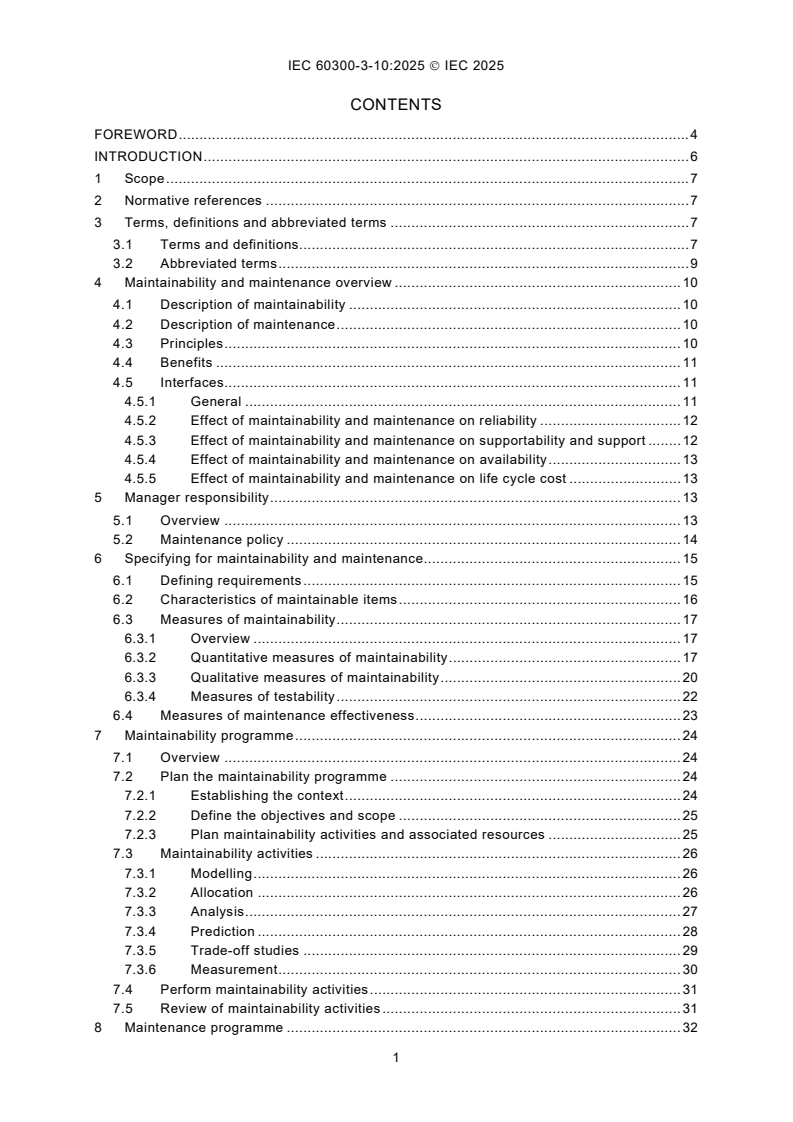
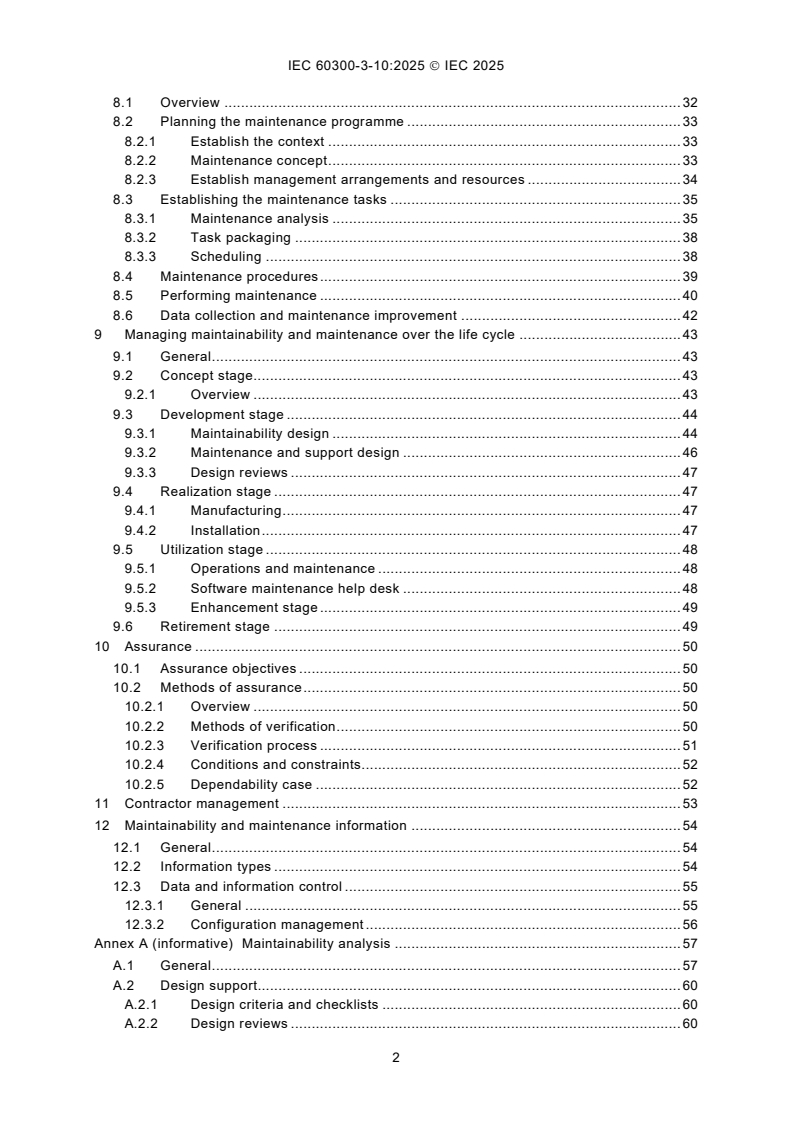
IEC 60300-3-10:2025 - Dependability management - Part 3-10: Application guide - Maintainability and maintenance Released:7/16/2025
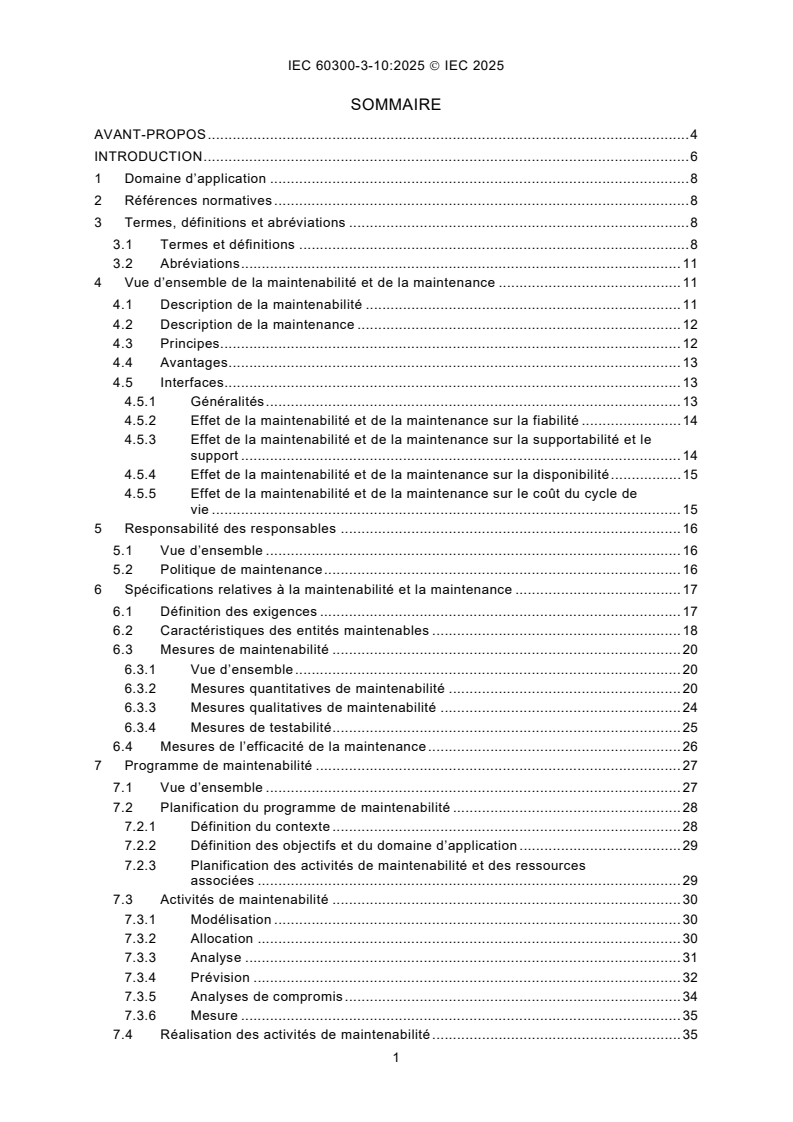
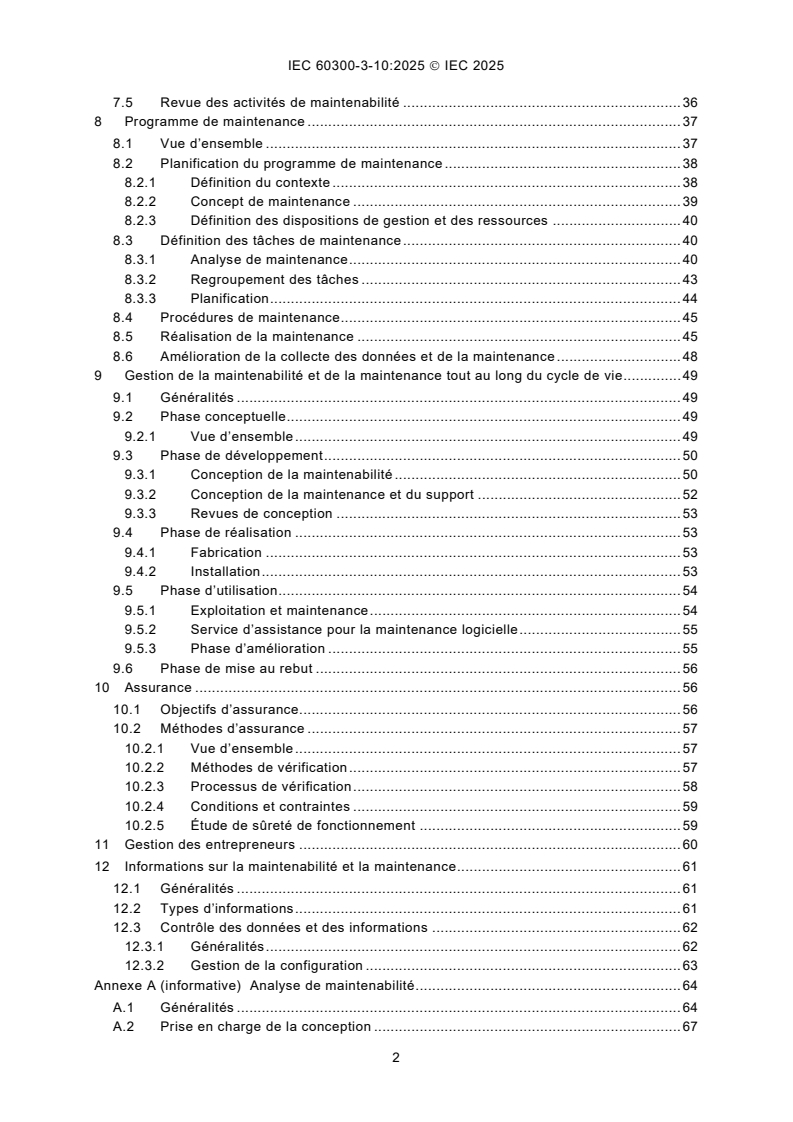
IEC 60300-3-10:2025 - Gestion de la sureté de fonctionnement - Partie 3-10: Guide d’application - Maintenabilité et maintenance Released:7/16/2025
IEC 60300-3-10:2025 - Dependability management - Part 3-10: Application guide - Maintainability and maintenance Released:7/16/2025
Overview
IEC 60300-3-10:2025 - Dependability management - Part 3-10: Application guide - Maintainability and maintenance - is an international guidance standard for managers, technical staff and financial personnel on the principles of maintainability and maintenance across the life cycle of equipment, software, services and structures. This second edition (2025) replaces the 2001 edition and provides a technical revision, with expanded guidance on establishing maintenance programmes and relocation of some supportability content to IEC 60300-3-14.
Key topics and requirements
The standard describes the value, nature and interfaces of maintainability and maintenance with related dependability attributes. Major technical topics include:
- Maintainability characteristics - definitions and desirable traits of maintainable items (hardware, software, systems).
- Interfaces with dependability attributes - interactions and trade-offs between maintainability, reliability, availability and supportability.
- Maintainability and maintenance programmes - elements, planning, execution and review of programmes and activities.
- Life cycle application - how to integrate maintainability and maintenance from concept through retirement.
- Techniques and analyses - modelling, prediction, allocation, FMEA/FTA, LORA, RCM, testability and human factors (informative annexes detail analysis techniques).
- Measures and data management - quantitative and qualitative measures (e.g., mean time to repair concepts, testability metrics), maintenance effectiveness metrics, and data/information control including configuration management.
- Assurance and contractor management - verification methods, dependability cases and management of suppliers or contractors delivering maintenance-related work.
The document sets out processes for planning, establishing objectives, specifying requirements and verifying that maintainability requirements are met, but does not substitute for project-specific technical specifications.
Practical applications
IEC 60300-3-10:2025 is practical guidance for:
- Asset owners and operators developing maintenance policies and programmes.
- Systems engineers and designers incorporating maintainability into design reviews and specifications.
- Maintenance managers and planners creating task packages, schedules and procedures.
- Procurement and finance teams assessing life-cycle cost impacts and trade-offs.
- Contractors and service providers aligning maintenance delivery with client dependability objectives.
Use cases include establishing maintenance concepts, performing maintainability analyses, defining maintenance tasks and measuring maintenance effectiveness to improve availability and reduce life-cycle cost.
Related standards
- IEC 60300 series (Dependability management) - overall framework.
- IEC 60300-3-14 - guidance on support and supportability (content moved from this edition).
Keywords: IEC 60300-3-10, maintainability, maintenance, dependability management, maintenance programme, life cycle maintenance, reliability, availability, supportability.
Relations
- Revises
IEC 60300-3-10:2001 - Dependability management - Part 3-10: Application guide - Maintainability - Effective Date
- 05-Sep-2023
Buy Documents
IEC 60300-3-10:2025 - Dependability management - Part 3-10: Application guide - Maintainability and maintenance Released:7/16/2025
IEC 60300-3-10:2025 - Gestion de la sureté de fonctionnement - Partie 3-10: Guide d’application - Maintenabilité et maintenance Released:7/16/2025
IEC 60300-3-10:2025 - Dependability management - Part 3-10: Application guide - Maintainability and maintenance Released:7/16/2025
Get Certified
Connect with accredited certification bodies for this standard

BSI Group
BSI (British Standards Institution) is the business standards company that helps organizations make excellence a habit.

Bureau Veritas
Bureau Veritas is a world leader in laboratory testing, inspection and certification services.

DNV
DNV is an independent assurance and risk management provider.
Sponsored listings
Frequently Asked Questions
IEC 60300-3-10:2025 is a standard published by the International Electrotechnical Commission (IEC). Its full title is "Dependability management - Part 3-10: Application guide - Maintainability and maintenance". This standard covers: IEC 60300-3-10:2025 gives guidance to managers and technical and financial personnel on the basic principles of maintainability and maintenance activities that are applicable to any organization. This document describes: - the value and nature of maintainability and maintenance characteristics; - the interfaces between maintainability and related dependability attributes of reliability, availability and supportability, as well as potential trade-offs that can be made through the interfaces during the life cycle of an item; - the elements of maintainability and maintenance programmes; - the application of maintainability and maintenance programmes throughout the life cycle; - techniques to ensure maintainability and maintenance requirements are met; - maintainability and maintenance data and information management. This document is applicable to equipment, software, services, or structures, and gives guidance on matters of common interest to any business supplying, purchasing or sustaining products, services, or structures. This second edition cancels and replaces the first edition published in 2001. This edition constitutes a technical revision. This edition includes the following significant technical changes with respect to the previous edition: - more guidance is included on establishing a maintenance programme; - some guidance on support and supportability has been removed and has been moved to IEC 60300-3-14.
IEC 60300-3-10:2025 gives guidance to managers and technical and financial personnel on the basic principles of maintainability and maintenance activities that are applicable to any organization. This document describes: - the value and nature of maintainability and maintenance characteristics; - the interfaces between maintainability and related dependability attributes of reliability, availability and supportability, as well as potential trade-offs that can be made through the interfaces during the life cycle of an item; - the elements of maintainability and maintenance programmes; - the application of maintainability and maintenance programmes throughout the life cycle; - techniques to ensure maintainability and maintenance requirements are met; - maintainability and maintenance data and information management. This document is applicable to equipment, software, services, or structures, and gives guidance on matters of common interest to any business supplying, purchasing or sustaining products, services, or structures. This second edition cancels and replaces the first edition published in 2001. This edition constitutes a technical revision. This edition includes the following significant technical changes with respect to the previous edition: - more guidance is included on establishing a maintenance programme; - some guidance on support and supportability has been removed and has been moved to IEC 60300-3-14.
IEC 60300-3-10:2025 is classified under the following ICS (International Classification for Standards) categories: 03.100.40 - Research and development; 03.120.01 - Quality in general. The ICS classification helps identify the subject area and facilitates finding related standards.
IEC 60300-3-10:2025 has the following relationships with other standards: It is inter standard links to IEC 60300-3-10:2001. Understanding these relationships helps ensure you are using the most current and applicable version of the standard.
IEC 60300-3-10:2025 is available in PDF format for immediate download after purchase. The document can be added to your cart and obtained through the secure checkout process. Digital delivery ensures instant access to the complete standard document.
Standards Content (Sample)
IEC 60300-3-10 ®
Edition 2.0 2025-07
INTERNATIONAL
STANDARD
Dependability management -
Part 3-10: Application guide - Maintainability and maintenance
ICS 03.100.40; 03.120.01 ISBN 978-2-8327-0569-8
All rights reserved. Unless otherwise specified, no part of this publication may be reproduced or utilized in any form or
by any means, electronic or mechanical, including photocopying and microfilm, without permission in writing from either
IEC or IEC's member National Committee in the country of the requester. If you have any questions about IEC copyright
or have an enquiry about obtaining additional rights to this publication, please contact the address below or your local
IEC member National Committee for further information.
IEC Secretariat Tel.: +41 22 919 02 11
3, rue de Varembé info@iec.ch
CH-1211 Geneva 20 www.iec.ch
Switzerland
About the IEC
The International Electrotechnical Commission (IEC) is the leading global organization that prepares and publishes
International Standards for all electrical, electronic and related technologies.
About IEC publications
The technical content of IEC publications is kept under constant review by the IEC. Please make sure that you have the
latest edition, a corrigendum or an amendment might have been published.
IEC publications search - IEC Products & Services Portal - products.iec.ch
webstore.iec.ch/advsearchform Discover our powerful search engine and read freely all the
The advanced search enables to find IEC publications by a publications previews, graphical symbols and the glossary.
variety of criteria (reference number, text, technical With a subscription you will always have access to up to date
committee, …). It also gives information on projects, content tailored to your needs.
replaced and withdrawn publications.
Electropedia - www.electropedia.org
The world's leading online dictionary on electrotechnology,
IEC Just Published - webstore.iec.ch/justpublished
Stay up to date on all new IEC publications. Just Published containing more than 22 500 terminological entries in English
details all new publications released. Available online and and French, with equivalent terms in 25 additional languages.
once a month by email. Also known as the International Electrotechnical Vocabulary
(IEV) online.
IEC Customer Service Centre - webstore.iec.ch/csc
If you wish to give us your feedback on this publication or
need further assistance, please contact the Customer
Service Centre: sales@iec.ch.
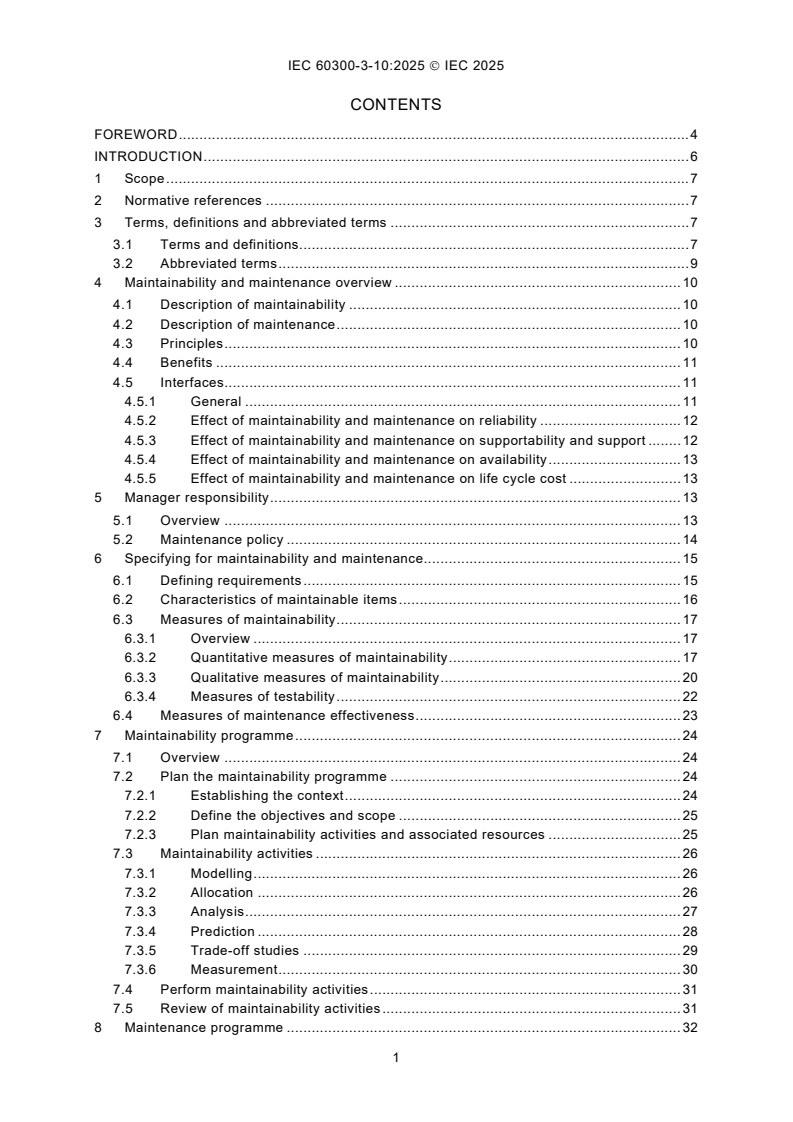
CONTENTS
FOREWORD . 4
INTRODUCTION . 6
1 Scope . 7
2 Normative references . 7
3 Terms, definitions and abbreviated terms . 7
3.1 Terms and definitions. 7
3.2 Abbreviated terms . 9
4 Maintainability and maintenance overview . 10
4.1 Description of maintainability . 10
4.2 Description of maintenance . 10
4.3 Principles . 10
4.4 Benefits . 11
4.5 Interfaces. 11
4.5.1 General . 11
4.5.2 Effect of maintainability and maintenance on reliability . 12
4.5.3 Effect of maintainability and maintenance on supportability and support . 12
4.5.4 Effect of maintainability and maintenance on availability . 13
4.5.5 Effect of maintainability and maintenance on life cycle cost . 13
5 Manager responsibility . 13
5.1 Overview . 13
5.2 Maintenance policy . 14
6 Specifying for maintainability and maintenance. 15
6.1 Defining requirements . 15
6.2 Characteristics of maintainable items . 16
6.3 Measures of maintainability . 17
6.3.1 Overview . 17
6.3.2 Quantitative measures of maintainability . 17
6.3.3 Qualitative measures of maintainability . 20
6.3.4 Measures of testability . 22
6.4 Measures of maintenance effectiveness . 23
7 Maintainability programme . 24
7.1 Overview . 24
7.2 Plan the maintainability programme . 24
7.2.1 Establishing the context . 24
7.2.2 Define the objectives and scope . 25
7.2.3 Plan maintainability activities and associated resources . 25
7.3 Maintainability activities . 26
7.3.1 Modelling . 26
7.3.2 Allocation . 26
7.3.3 Analysis . 27
7.3.4 Prediction . 28
7.3.5 Trade-off studies . 29
7.3.6 Measurement . 30
7.4 Perform maintainability activities . 31
7.5 Review of maintainability activities . 31
8 Maintenance programme . 32
8.1 Overview . 32
8.2 Planning the maintenance programme . 33
8.2.1 Establish the context . 33
8.2.2 Maintenance concept . 33
8.2.3 Establish management arrangements and resources . 34
8.3 Establishing the maintenance tasks . 35
8.3.1 Maintenance analysis . 35
8.3.2 Task packaging . 38
8.3.3 Scheduling . 38
8.4 Maintenance procedures . 39
8.5 Performing maintenance . 40
8.6 Data collection and maintenance improvement . 42
9 Managing maintainability and maintenance over the life cycle . 43
9.1 General . 43
9.2 Concept stage. 43
9.2.1 Overview . 43
9.3 Development stage . 44
9.3.1 Maintainability design . 44
9.3.2 Maintenance and support design . 46
9.3.3 Design reviews . 47
9.4 Realization stage . 47
9.4.1 Manufacturing . 47
9.4.2 Installation . 47
9.5 Utilization stage . 48
9.5.1 Operations and maintenance . 48
9.5.2 Software maintenance help desk . 48
9.5.3 Enhancement stage . 49
9.6 Retirement stage . 49
10 Assurance . 50
10.1 Assurance objectives . 50
10.2 Methods of assurance . 50
10.2.1 Overview . 50
10.2.2 Methods of verification . 50
10.2.3 Verification process . 51
10.2.4 Conditions and constraints. 52
10.2.5 Dependability case . 52
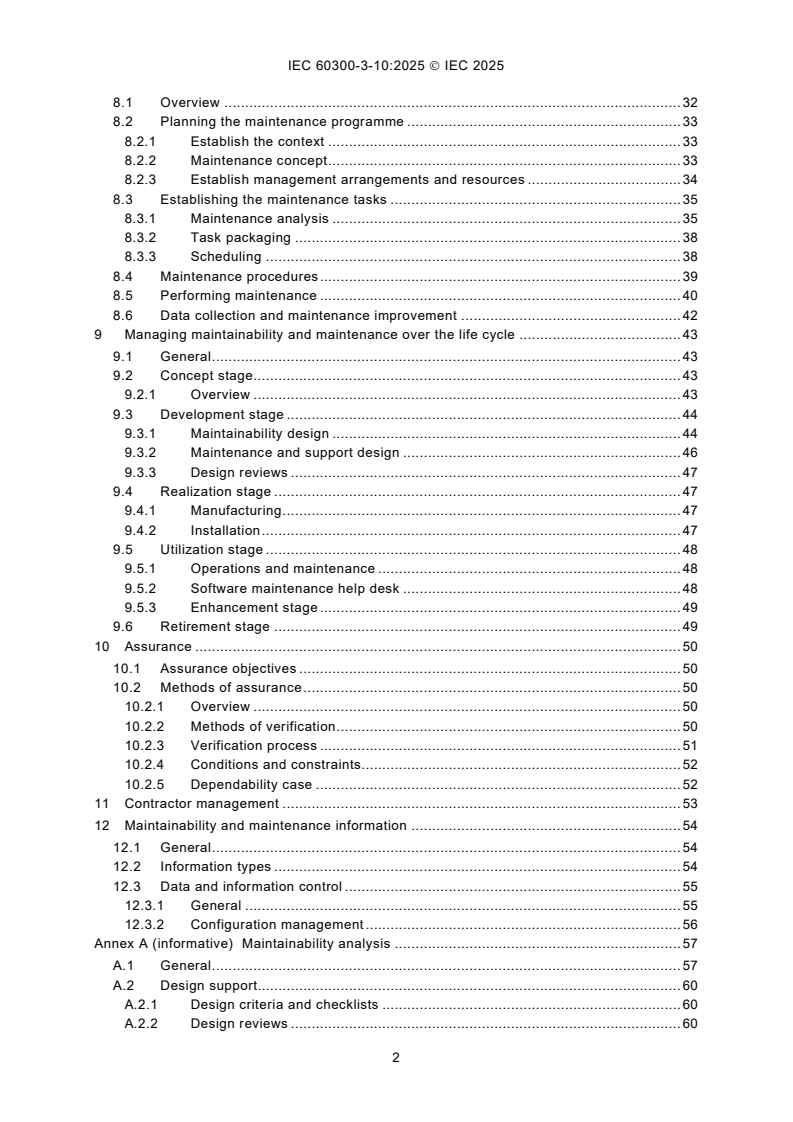
11 Contractor management . 53
12 Maintainability and maintenance information . 54
12.1 General . 54
12.2 Information types . 54
12.3 Data and information control . 55
12.3.1 General . 55
12.3.2 Configuration management . 56
Annex A (informative) Maintainability analysis . 57
A.1 General . 57
A.2 Design support. 60
A.2.1 Design criteria and checklists . 60
A.2.2 Design reviews . 60
A.3 Maintainability and maintenance activities, tools and procedures . 61
A.3.1 Block diagrams . 61
A.3.2 Failure mode and effects analysis (FMEA) . 63
A.3.3 Fault tree analysis (FTA) . 63
A.3.4 Reliability centred maintenance (RCM) . 63
A.3.5 Task analysis. 64
A.3.6 Level of repair analysis (LORA) . 64
A.3.7 Testability analysis . 64
A.3.8 Human factors analysis . 65
A.3.9 Maintainability index analysis . 65
A.3.10 Maintainability demonstration . 65
A.3.11 Root cause analysis . 66
Annex B (informative) Maintenance execution . 67
B.1 General . 67
B.2 Interrelationship of maintenance terms . 67
B.3 Maintenance model . 68
B.3.1 General . 68
B.3.2 Process model sub-elements . 68
Bibliography . 70
Figure 1 – Basic steps in maintainability prediction . 29
Figure 2 – Maintenance and maintenance support planning process . 37
Figure 3 – Types of maintenance tasks . 40
Figure 4 – Maintainability and maintenance planning process . 46
Figure A.1 – Maintainability analysis in the design process . 59
Figure A.2 – Hardware level maintainability block diagram . 62
Figure B.1 – Interrelationship of maintenance terms . 67
Figure B.2 – Maintenance management model . 68
Table 1 – Examples of quantitative maintainability measures (hardware) . 18
Table 2 – Examples of quantitative maintainability measures (software) . 20
Table 3 – Examples of qualitative maintainability measures . 21
Table 4 – Examples of testability measures . 22
Table 5 – Qualitative and quantitative maintainability verification procedures. 51
Table A.1 – Detailed tasks in maintainability analysis . 57
INTERNATIONAL ELECTROTECHNICAL COMMISSION
____________
Dependability management -
Part 3-10: Application guide - Maintainability and maintenance
FOREWORD
1) The International Electrotechnical Commission (IEC) is a worldwide organization for standardization comprising
all national electrotechnical committees (IEC National Committees). The object of IEC is to promote international
co-operation on all questions concerning standardization in the electrical and electronic fields. To this end and
in addition to other activities, IEC publishes International Standards, Technical Specifications, Technical Reports,
Publicly Available Specifications (PAS) and Guides (hereafter referred to as “IEC Publication(s)”). Their
preparation is entrusted to technical committees; any IEC National Committee interested in the subject dealt with
may participate in this preparatory work. International, governmental and non-governmental organizations liaising
with the IEC also participate in this preparation. IEC collaborates closely with the International Organization for
Standardization (ISO) in accordance with conditions determined by agreement between the two organizations.
2) The formal decisions or agreements of IEC on technical matters express, as nearly as possible, an international
consensus of opinion on the relevant subjects since each technical committee has representation from all
interested IEC National Committees.
3) IEC Publications have the form of recommendations for international use and are accepted by IEC National
Committees in that sense. While all reasonable efforts are made to ensure that the technical content of IEC
Publications is accurate, IEC cannot be held responsible for the way in which they are used or for any
misinterpretation by any end user.
4) In order to promote international uniformity, IEC National Committees undertake to apply IEC Publications
transparently to the maximum extent possible in their national and regional publications. Any divergence between
any IEC Publication and the corresponding national or regional publication shall be clearly indicated in the latter.
5) IEC itself does not provide any attestation of conformity. Independent certification bodies provide conformity
assessment services and, in some areas, access to IEC marks of conformity. IEC is not responsible for any
services carried out by independent certification bodies.
6) All users should ensure that they have the latest edition of this publication.
7) No liability shall attach to IEC or its directors, employees, servants or agents including individual experts and
members of its technical committees and IEC National Committees for any personal injury, property damage or
other damage of any nature whatsoever, whether direct or indirect, or for costs (including legal fees) and
expenses arising out of the publication, use of, or reliance upon, this IEC Publication or any other IEC
Publications.
8) Attention is drawn to the Normative references cited in this publication. Use of the referenced publications is
indispensable for the correct application of this publication.
9) IEC draws attention to the possibility that the implementation of this document may involve the use of (a)
patent(s). IEC takes no position concerning the evidence, validity or applicability of any claimed patent rights in
respect thereof. As of the date of publication of this document, IEC had not received notice of (a) patent(s), which
may be required to implement this document. However, implementers are cautioned that this may not represent
the latest information, which may be obtained from the patent database available at https://patents.iec.ch. IEC
shall not be held responsible for identifying any or all such patent rights.
IEC 60300-3-10 has been prepared by IEC technical committee 56: Dependability. It is an
International Standard.
This second edition cancels and replaces the first edition published in 2001. This edition
constitutes a technical revision.
This edition includes the following significant technical changes with respect to the previous
edition:
a) more guidance is included on establishing a maintenance programme;
b) some guidance on support and supportability has been removed and has been moved to
IEC 60300-3-14.
The text of this International Standard is based on the following documents:
Draft Report on voting
56/2059/FDIS 56/2097/RVD
Full information on the voting for its approval can be found in the report on voting indicated in
the above table.
The language used for the development of this International Standard is English.
This document was drafted in accordance with ISO/IEC Directives, Part 2, and developed in
accordance with ISO/IEC Directives, Part 1 and ISO/IEC Directives, IEC Supplement, available
at www.iec.ch/members_experts/refdocs. The main document types developed by IEC are
described in greater detail at www.iec.ch/publications.
A list of all parts in the IEC 60300 series, published under the general title Dependability
management, can be found on the IEC website.
The committee has decided that the contents of this document will remain unchanged until the
stability date indicated on the IEC website under webstore.iec.ch in the data related to the
specific document. At this date, the document will be
• reconfirmed,
• withdrawn, or
• revised.
INTRODUCTION
This document provides guidance on how to identify and apply appropriate analysis and
assurance techniques for maintainability and maintenance.
Maintainability relates to the ease and speed with which an item can be retained in, or restored
to, a state to perform as required. Maintainability relates to the time and resources to undertake
maintenance in a defined context.
For software, maintainability is the ease with which the software can be modified without major
reverse engineering or redesign to address faults and changing needs. The purpose of software
maintenance is to retain the functionality of software over time.
Maintenance actions are those necessary to retain or restore an item to a state to perform as
required. The relative ease and economy of maintenance actions relates to the total impact
resulting from the actions’ frequency, timing, and duration. The impact can include economic,
availability and performance impacts.
An important part of the cost of an item over its life is the total resources spent on the tasks
necessary to maintain it in a satisfactory condition. This is influenced by the number of required
tasks, their complexity, and duration. An item that can be maintained easily and is supported
by a competent and efficient maintenance organization generally has a greater availability and
a reduced life cycle cost compared to one that does not have these attributes.
This document provides managers and technical professionals involved in specification, design,
development, manufacture, acceptance and use of products and services with guidance on how
to achieve, analyse and ensure maintainability and maintenance effectiveness.
Guidance in this document can be used at any time during the life cycle of an item or project
for the planning and implementation of a maintainability or maintenance programme.
The activities described within this document can form part of an organization’s asset
management or quality management strategy and can therefore be aligned to, and consistent
with, the organizational objectives.
The maintainability and maintenance programme content described in this document can be
tailored to suit the needs of the application. Maintainability and maintenance programmes can
be conducted independently or as one integrated programme.
This document is one of the ‘top level’ interrelated dependability standards that provides
managers and technical personnel with guidance on how to effectively plan and implement
dependability activities. Other documents in the suite are:
– IEC 60300-1 which highlights the importance and benefits of managing dependability. It
gives guidance on dependability activities and how to integrate them into an existing
management system and life cycle processes;
– IEC 60300-3-4 which provides guidance for writing dependability requirements in
specifications together with a means of assuring the achievement of those requirements;
– IEC 60300-3-14 which provides guidance on how to identify and apply appropriate analysis
and assurance techniques for supportability (and support);
– Standards to cover reliability and availability, which are planned.
1 Scope
This part of IEC 60300 gives guidance to managers and technical and financial personnel on
the basic principles of maintainability and maintenance activities that are applicable to any
organization.
This document describes:
– the value and nature of maintainability and maintenance characteristics;
– the interfaces between maintainability and related dependability attributes of reliability,
availability and supportability, as well as potential trade-offs that can be made through the
interfaces during the life cycle of an item;
– the elements of maintainability and maintenance programmes;
– the application of maintainability and maintenance programmes throughout the life cycle;
– techniques to ensure maintainability and maintenance requirements are met;
– maintainability and maintenance data and information management.
This document is applicable to equipment, software, services, or structures, and gives guidance
on matters of common interest to any business supplying, purchasing or sustaining products,
services, or structures.
2 Normative references
The following documents are referred to in the text in such a way that some or all of their content
constitutes requirements of this document. For dated references, only the edition cited applies.
For undated references, the latest edition of the referenced document (including any
amendments) applies.
IEC 60050-192, International Electrotechnical Vocabulary (IEV) - Part 192: Dependability,
available at https://www.electropedia.org/
3 Terms, definitions and abbreviated terms
3.1 Terms and definitions
For the purposes of this document, the terms and definitions given in IEC 60050-192 and the
following apply.
ISO and IEC maintain terminology databases for use in standardization at the following
addresses:
• IEC Electropedia: available at https://www.electropedia.org/
• ISO Online browsing platform: available at https://www.iso.org/obp
3.1.1
item
subject being considered
Note 1 to entry: The item can be an individual part, component, device, functional unit, equipment, subsystem,
system, service or process.
Note 2 to entry: The item can consist of hardware, software, people or any combination thereof.
Note 3 to entry: The item is often comprised of elements that can each be individually considered.
[SOURCE: IEC 60050-192:2024, 192-01-01]
3.1.2
off-the-shelf
OTS
item commercially available for purchase and use without the need to conduct development
activities
Note 1 to entry: OTS is sometimes referred to as COTS (commercial off-the-shelf) or MOTS (modified off-the-shelf).
3.1.3
indenture level
level of sub-division within a system hierarchy
EXAMPLE System, subsystem, assembly and component.
Note 1 to entry: From the maintenance perspective, the indenture level depends upon various factors, including the
complexity of the item’s construction, the accessibility of sub-items, skill level of maintenance personnel, test
equipment facilities, and safety considerations.
[SOURCE: IEC 60050-192:2015, 192-01-05]
3.1.4
maintenance
combination of all technical and management actions intended to retain an item in, or restore it
to, a state in which it can perform as required
Note 1 to entry: Management is assumed to include supervision activities.
[SOURCE: IEC 60050-192:2015, 192-06-01]
3.1.5
maintainability
ability to be retained in, or restored to, a state to perform as required, under given conditions
Note 1 to entry: Conditions of use and maintenance impact maintainability. These include conditions such as:
location for maintenance, accessibility, maintenance procedures and maintenance resources.
Note 2 to entry: Maintainability can be quantified using appropriate measures.
[SOURCE: IEC 60050-192:2024, 192-01-27, modified – Note 1 to entry has been replaced]
3.1.6
maintenance support
provision of resources to maintain an item
Note 1 to entry: Resources include human resources, support equipment, materials and spare parts, maintenance
facilities, documentation and information, and maintenance information systems.
[SOURCE: IEC 60050-192:2015, 192-01-28]
3.1.7
line of maintenance
position in an organization where specified levels of maintenance are to be carried out
st nd rd
EXAMPLE 1 line – field; 2 line – repair shop; 3 line – manufacturer’s facility.
Note 1 to entry: The line of maintenance is characterized by the level of skill of the personnel, the facilities provided,
the location, etc.
[SOURCE: IEC 60050-192:2015, 192-06-03]
3.1.8
maintenance concept
definition of the maintenance objectives, line of maintenance, indenture levels, maintenance
levels, maintenance support, and their interrelationships
Note 1 to entry: The maintenance concept of an item provides the basis for maintenance planning, determining
supportability requirements, and developing logistic support.
[SOURCE: IEC 60050-192:2015, 192-06-02, modified – The first preferred term “maintenance
policy” has been omitted and in Note 1 to entry, it has been replaced with “maintenance
concept”.]
3.1.9
maintenance policy
maintenance philosophy
intentions and direction of an organization as formally expressed by its top management (as
related to maintenance)
[SOURCE: ISO 55000:2024, 3.3.6, modified – In the first preferred term "maintenance" has
been added, the second preferred term "maintenance philosophy" has been added and in the
definition "(as related to maintenance)" has been added.]
3.1.10
testability
degree to which an item can be tested
[SOURCE: IEC 60050-192:2015, 192-09-20, modified – The domain "" has been
deleted.]
3.2 Abbreviated terms
BIT built-in test
BITE built-in test equipment
OTS off-the-shelf
FMEA failure modes and effects analysis
FMECA failure modes, effects and criticality analysis
ILS integrated logistic support
ILSP integrated logistic support plan
IPS integrated project support
LCC life cycle cost
LORA level of repair analysis
LRU line replaceable unit
MLDT mean logistic delay time
MTTM mean time to maintain (preventive tasks)
MTTR mean time to restoration (or repair or recovery)
OEM original equipment manufacturer
RAM random access memory
RCM reliability centred maintenance
ROM read-only memory
4 Maintainability and maintenance overview
4.1 Description of maintainability
Maintainability relates to the ease and speed with which an item can be retained in, or restored
to, a state to perform as required. It is a characteristic of the item design, construction,
installation, and commissioning. Maintainability is designed into an item for defined user
requirements, including the use environment. Improved maintainability can reduce life cycle
cost and support preservation of the item’s inherent reliability.
Maintainability can be measured as the probability that a given maintenance action, performed
under stated conditions, using specified procedures and with defined support, can be completed
within a specific time period. This defined support can include personnel with defined
competencies, spares, tools, information, facilities, and logistics applied within a defined
organizational context.
Software differs from hardware in that it does not wear out and faults originate in the
specification, design logic or coding process and they can lie hidden until specific input
conditions occur. For software, maintainability relates to the ease and speed with which
software can be modified to change or add capabilities, to correct faults, improve performance
or other attributes, or to adapt it to a different environment. From a system perspective, the
time to restore a system following a software crash can be an important parameter as this has
an immediate impact on operations and user experience.
4.2 Description of maintenance
Maintenance is described as the combination of all technical and administrative actions,
including supervisory actions, intended to retain an item in, or restore it to, a state in which it
can perform as required when required. Maintenance covers preventive and corrective
maintenance. Preventive maintenance is the maintenance carried out to mitigate degradation
and reduce the probability of failure and corrective maintenance is the maintenance carried out
after fault detection to effect restoration.
It is necessary to identify the maintenance tasks that are required to achieve the desired
availability of an item before the maintainability can be fully defined. It is not feasible or cost-
effective to maintain some items. Some equipment is designed to run to failure because
maintenance is ineffective in reducing the probability of failure modes or the maintenance costs
are not justified by the cost of failure.
Maintenance does not include maintenance support. Maintenance is the action required to
maintain, whereas maintenance support is all the resources required to maintain the item
(see IEC 60300-3-14).
Clause 6 to Clause 8 detail the specifications and the programmes for maintenance.
4.3 Principles
Evaluation and control of maintainability and maintenance is founded on a set of principles.
These principles should directly influence the intent of, design for, and delivery of an
organization’s maintenance activity.
These principles are as follows:
1) Maintenance exists to provide value.
Maintenance tasks, and the associated maintainability characteristics of an item, exist to
provide value to stakeholders. Value is what is important to the business, reflected in
organizational objectives. Value can be tangible, such as increased volume of product, or
intangible, such as improved consumer confidence. It can be financial, such as reduced cost
to repair an item, or non-financial, such as improved safety.
2) Maintainability and maintenance tasks are inherent to a design solution.
Maintainability is an inherent characteristic of a design solution. This means that it is a
permanent attribute of that design which cannot be improved without a change to the design
solution, the operating environment or both. Maintainability levels and maintenance tasks
are inextricably linked such that maintenance tasks become a consequence of the design
solution.
3) Maintainability can be balanced against other dependability attributes and stakeholder
requirements to achieve organizational objectives.
Maintainability, reliability, and supportability can be balanced and traded-off to achieve
availability, a measure commonly aligned with business success. Dependability attributes
can also be balanced and traded-off with other organizational considerations such as cost
and assurance level required.
4) Maintainability and maintenance activities continue in-service to continuously improve and
ensure that the item continues to meet stakeholder requirements.
During the in-service phase of the item, the environment, stakeholder requirements and
other factors can change and, thus, the continued evaluation of the achievement of
maintainability and maintenance effectiveness is necessary.
When applying these principles to develop a maintainability or maintenance programme,
activities should be tailored considering market conditions, item complexity and stakeholder
definition and requirements together with the size and experience of the organization.
4.4 Benefits
Benefits of controlling maintainability and maintenance include:
– establishing an appropriate and cost-effective maintenance schedule;
– providing justified confidence that the dependability of items will be as required, when
required;
– understanding and managing the risks of failure or degraded performance in an effective
way to achieve a balance of cost, risk, and performance;
– enabling maintainability design weaknesses to be identified and improved with consideration
for performance, risk and life cycle cost;
– providing information and data that enable continual improvement;
– preserving inherent levels of reliability and safety designed into the item;
– reducing item down time resulting in improved availability;
– reducing maintenance effort and related support resources resulting in reduced life cycle
cost;
– improving timeliness of maintenance delivery;
– improving quality of maintenance resulting in higher realized levels of reliability;
– improving safety of maintenance personnel through improved access and ergonomics;
– improving sustainability by preserving the inherent characteristics of the item and increasing
the life and possibility of re-use.
4.5 Interfaces
4.5.1 General
Dependability is the ability to perform as and when required. Dependability has many attributes
but is usually characterized in terms of reliability, maintainability, supportability, and the
resulting availability. In some cases, other characteristics such as durability and integrity are
also included under the umbrella of dependability. Managing maintainability can improve
dependability by reducing downtime and the level of resources necessary to ensure the item
can perform as required, when required.
4.5.2 Effect of maintainability and maintenance on reliability
Reliability is the ability of an item to provide a required function, without failure, for a given
interval (e.g. time, operating cycles, distance, etc.).
The maintainability of an item does not affect its inherent reliability. In practice, the ease and
speed of maintenance of an item has no effect on its reliability. In practice however, it can affect
the quality of maintenance, and, in turn, poor quality of maintenance can reduce reliability below
its inherent value. For example, a difficult-to-perform maintenance task with an unrealistic
maintainability target can force hasty maintenance which can reduce reliability.
It is possible that additional maintenance can improve reliability. However, this can increase
maintenance time thus changing the optimal balance of maintenance downtime and availability
intended by the original design.
Where maintainers identify potential improvements in the design of the item or in the
maintenance process, this should be fed back to developers so improvements can be made to
the design to increase the reliability.
For software, maintenance includes the evolution of the software program and, therefore,
maintenance can result in the improvement or degradation of both the item’s inherent reliability
and maintainability. This can affect the ongoing maintenance needs. If the item is highly
maintainable, the probability of inducing faults through the software evolution is minimized,
resulting in software which meets the reliability requirements with a reduced ongoing need for
further evolution.
4.5.3 Effect of maintainability and maintenance on supportability and support
Support is the integrated set of resources, such as personnel, spares, information, training,
tools, test equipment, facilities, communication systems, and transport logistics that are
necessary for the item to perform as required, when required. Support includes those resources
specific to maintenance but is not limited to them. Supportability is the ability to sustain the
required operational capability with a defined use profile and given logistic and maintenance
resources.
Improved maintainability can improve supportability by:
– reducing the number of personnel and associated competencies required to maintain the
item due to decreased complexity of preventive actions, fault finding and repair processes;
– minimizing the sparing, transport logistics, supply management and information
requirements, for example by arranging commonality in components and tooling;
– optimizing the requirements for the facilities, their locations and associated supporting
elements by simplifying the maintenance requirements. For example, designing modular
systems can allow items to be easily and effectively replaced on site, with failed modules
transported to a central facility for repair.
These elements can affect the timeliness and cost of maintenance support.
Timeliness of maintenance support delivery refers to the time delay between the identification
of the requirement for support and the completion of all preparatory activity necessary before
conduct of the maintenance task. For unplanned repair tasks this period can include:
– notification of task;
– permit to work;
– assembly of material, spares, tools, and task information;
– travel to site;
– unloading and transport to work position of any required support equipment.
Cost of maintenance support delivery refers to the cost-effectiveness of all actions required for
maintenance support. Excessive cost of ownership can result in future costs of maintenance
being unaffordable and, hence, threaten achievement of inherent characteristics of reliability
and maintainability, as well as the intended useful life.
4.5.4 Effect of maintainability and maintenance on availability
Availability is the ability to be in a state to perform when called upon to do so. It is often
quantified as a ratio of up time to total time. It is a key performance metric that reflects the
readiness and operational efficiency of an item over time.
Maintainability di
...
IEC 60300-3-10 ®
Edition 2.0 2025-07
NORME
INTERNATIONALE
Gestion de la sûreté de fonctionnement -
Partie 3-10: Guide d’application - Maintenabilité et maintenance
ICS 03.100.40; 03.120.01 ISBN 978-2-8327-0569-8
Droits de reproduction réservés. Sauf indication contraire, aucune partie de cette publication ne peut être reproduite ni
utilisée sous quelque forme que ce soit et par aucun procédé, électronique ou mécanique, y compris la photocopie et
les microfilms, sans l'accord écrit de l'IEC ou du Comité national de l'IEC du pays du demandeur. Si vous avez des
questions sur le copyright de l'IEC ou si vous désirez obtenir des droits supplémentaires sur cette publication, utilisez
les coordonnées ci-après ou contactez le Comité national de l'IEC de votre pays de résidence.
IEC Secretariat Tel.: +41 22 919 02 11
3, rue de Varembé info@iec.ch
CH-1211 Geneva 20 www.iec.ch
Switzerland
A propos de l'IEC
La Commission Electrotechnique Internationale (IEC) est la première organisation mondiale qui élabore et publie des
Normes internationales pour tout ce qui a trait à l'électricité, à l'électronique et aux technologies apparentées.
A propos des publications IEC
Le contenu technique des publications IEC est constamment revu. Veuillez vous assurer que vous possédez l’édition la
plus récente, un corrigendum ou amendement peut avoir été publié.
Recherche de publications IEC - IEC Products & Services Portal - products.iec.ch
webstore.iec.ch/advsearchform Découvrez notre puissant moteur de recherche et consultez
La recherche avancée permet de trouver des publications gratuitement tous les aperçus des publications, symboles
IEC en utilisant différents critères (numéro de référence, graphiques et le glossaire. Avec un abonnement, vous aurez
texte, comité d’études, …). Elle donne aussi des toujours accès à un contenu à jour adapté à vos besoins.
informations sur les projets et les publications remplacées
ou retirées. Electropedia - www.electropedia.org
Le premier dictionnaire d'électrotechnologie en ligne au
IEC Just Published - webstore.iec.ch/justpublished monde, avec plus de 22 500 articles terminologiques en
Restez informé sur les nouvelles publications IEC. Just anglais et en français, ainsi que les termes équivalents
dans 25 langues additionnelles. Egalement appelé
Published détaille les nouvelles publications parues.
Disponible en ligne et une fois par mois par email. Vocabulaire Electrotechnique International (IEV) en ligne.
Service Clients - webstore.iec.ch/csc
Si vous désirez nous donner des commentaires sur cette
publication ou si vous avez des questions contactez-
nous: sales@iec.ch.
SOMMAIRE
AVANT-PROPOS . 4
INTRODUCTION . 6
1 Domaine d’application . 8
2 Références normatives . 8
3 Termes, définitions et abréviations . 8
3.1 Termes et définitions . 8
3.2 Abréviations . 11
4 Vue d’ensemble de la maintenabilité et de la maintenance . 11
4.1 Description de la maintenabilité . 11
4.2 Description de la maintenance . 12
4.3 Principes. 12
4.4 Avantages . 13
4.5 Interfaces. 13
4.5.1 Généralités . 13
4.5.2 Effet de la maintenabilité et de la maintenance sur la fiabilité . 14
4.5.3 Effet de la maintenabilité et de la maintenance sur la supportabilité et le
support . 14
4.5.4 Effet de la maintenabilité et de la maintenance sur la disponibilité . 15
4.5.5 Effet de la maintenabilité et de la maintenance sur le coût du cycle de
vie . 15
5 Responsabilité des responsables . 16
5.1 Vue d’ensemble . 16
5.2 Politique de maintenance . 16
6 Spécifications relatives à la maintenabilité et la maintenance . 17
6.1 Définition des exigences . 17
6.2 Caractéristiques des entités maintenables . 18
6.3 Mesures de maintenabilité . 20
6.3.1 Vue d’ensemble . 20
6.3.2 Mesures quantitatives de maintenabilité . 20
6.3.3 Mesures qualitatives de maintenabilité . 24
6.3.4 Mesures de testabilité . 25
6.4 Mesures de l’efficacité de la maintenance . 26
7 Programme de maintenabilité . 27
7.1 Vue d’ensemble . 27
7.2 Planification du programme de maintenabilité . 28
7.2.1 Définition du contexte . 28
7.2.2 Définition des objectifs et du domaine d’application . 29
7.2.3 Planification des activités de maintenabilité et des ressources
associées . 29
7.3 Activités de maintenabilité . 30
7.3.1 Modélisation . 30
7.3.2 Allocation . 30
7.3.3 Analyse . 31
7.3.4 Prévision . 32
7.3.5 Analyses de compromis . 34
7.3.6 Mesure . 35
7.4 Réalisation des activités de maintenabilité . 35
7.5 Revue des activités de maintenabilité . 36
8 Programme de maintenance . 37
8.1 Vue d’ensemble . 37
8.2 Planification du programme de maintenance . 38
8.2.1 Définition du contexte . 38
8.2.2 Concept de maintenance . 39
8.2.3 Définition des dispositions de gestion et des ressources . 40
8.3 Définition des tâches de maintenance . 40
8.3.1 Analyse de maintenance . 40
8.3.2 Regroupement des tâches . 43
8.3.3 Planification . 44
8.4 Procédures de maintenance . 45
8.5 Réalisation de la maintenance . 45
8.6 Amélioration de la collecte des données et de la maintenance . 48
9 Gestion de la maintenabilité et de la maintenance tout au long du cycle de vie . 49
9.1 Généralités . 49
9.2 Phase conceptuelle . 49
9.2.1 Vue d’ensemble . 49
9.3 Phase de développement . 50
9.3.1 Conception de la maintenabilité . 50
9.3.2 Conception de la maintenance et du support . 52
9.3.3 Revues de conception . 53
9.4 Phase de réalisation . 53
9.4.1 Fabrication . 53
9.4.2 Installation . 53
9.5 Phase d’utilisation . 54
9.5.1 Exploitation et maintenance . 54
9.5.2 Service d’assistance pour la maintenance logicielle . 55
9.5.3 Phase d’amélioration . 55
9.6 Phase de mise au rebut . 56
10 Assurance . 56
10.1 Objectifs d’assurance. 56
10.2 Méthodes d’assurance . 57
10.2.1 Vue d’ensemble . 57
10.2.2 Méthodes de vérification . 57
10.2.3 Processus de vérification . 58
10.2.4 Conditions et contraintes . 59
10.2.5 Étude de sûreté de fonctionnement . 59
11 Gestion des entrepreneurs . 60
12 Informations sur la maintenabilité et la maintenance . 61
12.1 Généralités . 61
12.2 Types d’informations . 61
12.3 Contrôle des données et des informations . 62
12.3.1 Généralités . 62
12.3.2 Gestion de la configuration . 63
Annexe A (informative) Analyse de maintenabilité . 64
A.1 Généralités . 64
A.2 Prise en charge de la conception . 67
A.2.1 Critères de conception et listes de contrôle . 67
A.2.2 Revues de conception . 67
A.3 Activités, outils et procédures de maintenabilité et de maintenance . 68
A.3.1 Diagrammes . 68
A.3.2 Analyse des modes de défaillance et de leurs effets (AMDE) . 70
A.3.3 Analyse par arbre de panne (AAP) . 70
A.3.4 Maintenance basée sur la fiabilité (MBF) . 71
A.3.5 Analyse des tâches . 71
A.3.6 Analyse du niveau de réparation (ANR) . 71
A.3.7 Analyse de testabilité . 72
A.3.8 Analyse des facteurs humains . 72
A.3.9 Analyse de l’indice de maintenabilité . 72
A.3.10 Démonstration de maintenabilité . 73
A.3.11 Analyse de cause initiale . 73
Annexe B (informative) Exécution de la maintenance . 74
B.1 Généralités . 74
B.2 Relations entre les termes de maintenance . 74
B.3 Modèle de maintenance . 75
B.3.1 Généralités . 75
B.3.2 Sous-éléments du modèle de processus . 75
Bibliographie . 77
Figure 1 – Étapes de base de la prévision de maintenabilité . 34
Figure 2 – Processus de planification de la maintenance et de la logistique de
maintenance . 42
Figure 3 – Types de tâches de maintenance . 46
Figure 4 – Processus de planification de la maintenabilité et de la maintenance . 52
Figure A.1 – Analyse de maintenabilité dans le cadre du processus de conception . 66
Figure A.2 – Diagramme de maintenabilité au niveau matériel . 69
Figure B.1 – Relations entre les termes de maintenance . 74
Figure B.2 – Modèle de gestion de la maintenance . 75
Tableau 1 – Exemples de mesures quantitatives de maintenabilité (matérielle) . 21
Tableau 2 – Exemples de mesures quantitatives de maintenabilité (logicielle) . 23
Tableau 3 – Exemples de mesures qualitatives de maintenabilité . 24
Tableau 4 – Exemples de mesures de testabilité . 26
Tableau 5 – Procédures de vérification qualitative et quantitative de la maintenabilité . 58
Tableau A.1 – Tâches détaillées de l’analyse de maintenabilité . 64
COMMISSION ÉLECTROTECHNIQUE INTERNATIONALE
____________
Gestion de la sûreté de fonctionnement -
Partie 3-10: Guide d’application - Maintenabilité et maintenance
AVANT-PROPOS
1) La Commission Électrotechnique Internationale (IEC) est une organisation mondiale de normalisation composée
de l’ensemble des comités électrotechniques nationaux (Comités nationaux de l’IEC). L’IEC a pour objet de
favoriser la coopération internationale pour toutes les questions de normalisation dans les domaines de
l’électricité et de l’électronique. À cet effet, l’IEC – entre autres activités – publie des Normes internationales,
des Spécifications techniques, des Rapports techniques, des Spécifications accessibles au public (PAS) et des
Guides (ci-après dénommés "Publication(s) de l’IEC"). Leur élaboration est confiée à des comités d’études, aux
travaux desquels tout Comité national intéressé par le sujet traité peut participer. Les organisations
internationales, gouvernementales et non gouvernementales, en liaison avec l’IEC, participent également aux
travaux. L’IEC collabore étroitement avec l’Organisation Internationale de Normalisation (ISO), selon des
conditions fixées par accord entre les deux organisations.
2) Les décisions ou accords officiels de l’IEC concernant les questions techniques représentent, dans la mesure du
possible, un accord international sur les sujets étudiés, étant donné que les Comités nationaux de l’IEC intéressés
sont représentés dans chaque comité d’études.
3) Les Publications de l’IEC se présentent sous la forme de recommandations internationales et sont agréées
comme telles par les Comités nationaux de l’IEC. Tous les efforts raisonnables sont entrepris afin que l’IEC
s’assure de l’exactitude du contenu technique de ses publications; l’IEC ne peut pas être tenue responsable de
l’éventuelle mauvaise utilisation ou interprétation qui en est faite par un quelconque utilisateur final.
4) Dans le but d’encourager l’uniformité internationale, les Comités nationaux de l’IEC s’engagent, dans toute la
mesure possible, à appliquer de façon transparente les Publications de l’IEC dans leurs publications nationales
et régionales. Toutes divergences entre toutes Publications de l’IEC et toutes publications nationales ou
régionales correspondantes doivent être indiquées en termes clairs dans ces dernières.
5) L’IEC elle-même ne fournit aucune attestation de conformité. Des organismes de certification indépendants
fournissent des services d’évaluation de conformité et, dans certains secteurs, accèdent aux marques de
conformité de l’IEC. L’IEC n’est responsable d’aucun des services effectués par les organismes de certification
indépendants.
6) Tous les utilisateurs doivent s’assurer qu’ils sont en possession de la dernière édition de cette publication.
7) Aucune responsabilité ne doit être imputée à l’IEC, à ses administrateurs, employés, auxiliaires ou mandataires,
y compris ses experts particuliers et les membres de ses comités d’études et des Comités nationaux de l’IEC,
pour tout préjudice causé en cas de dommages corporels et matériels, ou de tout autre dommage de quelque
nature que ce soit, directe ou indirecte, ou pour supporter les coûts (y compris les frais de justice) et les dépenses
découlant de la publication ou de l’utilisation de cette Publication de l’IEC ou de toute autre Publication de l’IEC,
ou au crédit qui lui est accordé.
8) L’attention est attirée sur les références normatives citées dans cette publication. L’utilisation de publications
référencées est obligatoire pour une application correcte de la présente publication.
9) L’IEC attire l’attention sur le fait que la mise en application du présent document peut entraîner l’utilisation d’un
ou de plusieurs brevets. L’IEC ne prend pas position quant à la preuve, à la validité et à l’applicabilité de tout
droit de propriété revendiqué à cet égard. À la date de publication du présent document, l’IEC n’avait pas reçu
notification qu’un ou plusieurs brevets pouvaient être nécessaires à sa mise en application. Toutefois, il y a lieu
d’avertir les responsables de la mise en application du présent document que des informations plus récentes
sont susceptibles de figurer dans la base de données de brevets, disponible à l’adresse https://patents.iec.ch.
L’IEC ne saurait être tenue pour responsable de ne pas avoir identifié de tels droits de brevet.
L’IEC 60300-3-10 a été établie par le comité d’études 56 de l’IEC: Sûreté de fonctionnement. Il
s’agit d’une Norme internationale.
Cette deuxième édition annule et remplace la première édition parue en 2001. Cette édition
constitue une révision technique.
Cette édition inclut les modifications techniques majeures suivantes par rapport à l’édition
précédente:
a) ajout de recommandations supplémentaires concernant l’établissement d’un programme de
maintenance;
b) suppression et déplacement de certaines recommandations concernant le support et la
supportabilité vers l’IEC 60300-3-14.
Le texte de cette Norme internationale est issu des documents suivants:
Projet Rapport de vote
56/2059/FDIS 56/2097/RVD
Le rapport de vote indiqué dans le tableau ci-dessus donne toute information sur le vote ayant
abouti à son approbation.
La langue employée pour l’élaboration de cette Norme internationale est l’anglais.
Ce document a été rédigé selon les Directives ISO/IEC, Partie 2, il a été développé selon les
Directives ISO/IEC, Partie 1 et les Directives ISO/IEC, Supplément IEC, disponibles sous
www.iec.ch/members_experts/refdocs. Les principaux types de documents développés par
l’IEC sont décrits plus en détail sous www.iec.ch/publications.
Une liste de toutes les parties de la série IEC 60300, publiées sous le titre général Gestion de
la sûreté de fonctionnement, se trouve sur le site web de l’IEC.
Le comité a décidé que le contenu de ce document ne sera pas modifié avant la date de stabilité
indiquée sur le site web de l’IEC sous webstore.iec.ch dans les données relatives au document
recherché. À cette date, le document sera
• reconduit,
• supprimé, ou
• révisé.
INTRODUCTION
Le présent document fournit des recommandations sur la manière d’identifier et d’appliquer les
techniques d’analyse et d’assurance appropriées pour la maintenabilité et la maintenance.
La maintenabilité se rapporte à la facilité et à la rapidité avec lesquelles une entité peut être
maintenue ou rétablie dans un état permettant de fonctionner tel qu’exigé. La maintenabilité
est liée au temps et aux ressources nécessaires pour entreprendre des actions de maintenance
dans un contexte défini.
Pour les logiciels, la maintenabilité est la facilité avec laquelle un logiciel peut être modifié sans
rétro-ingénierie ou reconception majeure pour remédier aux pannes et à l’évolution des
besoins. L’objectif de la maintenance logicielle est de conserver la fonctionnalité du logiciel au
fil du temps.
Les actions de maintenance sont celles qui sont nécessaires pour maintenir ou rétablir une
entité dans un état lui permettant de fonctionner tel qu’exigé. La facilité relative et l’économie
des actions de maintenance sont liées à l’impact total résultant de la fréquence, du calendrier
et de la durée des actions. L’impact peut inclure des impacts économiques ainsi que des
impacts en matière de disponibilité et de performance.
Les ressources totales consacrées aux tâches nécessaires au maintien d’une entité dans un
état satisfaisant constituent une part importante du coût de cette entité pendant sa durée de
vie. Elles dépendent du nombre de tâches exigées, ainsi que de leur complexité et de leur
durée. Une entité dont la maintenance peut être effectuée facilement et qui est soutenue par
une organisation de maintenance compétente et efficace a généralement une plus grande
disponibilité et un coût de cycle de vie réduit par rapport à une entité qui n’a pas ces attributs.
Dans le présent document, des recommandations sur la manière d’atteindre, d’analyser et
d’assurer la maintenabilité et l’efficacité de maintenance sont fournies aux responsables et aux
professionnels techniques impliqués dans la spécification, la conception, le développement, la
fabrication, la réception et l’utilisation de produits et de services.
Les recommandations contenues dans le présent document peuvent être utilisées à tout
moment du cycle de vie d’une entité ou d’un projet pour la planification et la mise en œuvre
d’un programme de maintenabilité ou de maintenance.
Les activités décrites dans le présent document peuvent faire partie de la stratégie de gestion
d’actifs ou de gestion de la qualité d’une organisation et peuvent donc être alignées sur, et
cohérentes avec, les objectifs organisationnels.
Le contenu du programme de maintenabilité et de maintenance décrit dans le présent document
peut être adapté aux besoins de l’application. Les programmes de maintenabilité et de
maintenance peuvent être menés indépendamment ou sous la forme d’un programme intégré.
Le présent document constitue l’une des principales normes de sûreté de fonctionnement
corrélatives qui fournissent aux responsables et au personnel technique des recommandations
relatives à la planification et la mise en œuvre efficaces des activités de sûreté de
fonctionnement. Les autres documents de la série sont:
– l’IEC 60300-1 qui souligne l’importance et les avantages de la gestion de la sûreté de
fonctionnement. Elle fournit des recommandations sur les activités de sûreté de
fonctionnement et la façon de les intégrer dans un système de gestion existant, et sur les
processus de cycle de vie;
– l’IEC 60300-3-4 qui fournit des recommandations pour l’élaboration d’exigences de sûreté
de fonctionnement dans les spécifications, ainsi que sur les moyens d’assurer la réalisation
de ces exigences;
– l’IEC 60300-3-14 qui fournit des recommandations sur l’identification et l’application de
techniques d’analyse et d’assurance appropriées pour la supportabilité (et le support);
– des normes couvrant la fiabilité et la disponibilité, qui sont prévues.
1 Domaine d’application
La présente partie de l’IEC 60300 fournit des recommandations aux responsables ainsi qu’au
personnel technique et financier sur les principes de base de la maintenabilité et des activités
de maintenance qui sont applicables à toute organisation.
Le présent document décrit:
– la valeur et la nature des caractéristiques de maintenabilité et de maintenance;
– les interfaces entre la maintenabilité et les attributs de fiabilité, de disponibilité et de
supportabilité associés à la sûreté de fonctionnement, ainsi que les compromis qui peuvent
être faits au niveau des interfaces au cours du cycle de vie d’une entité;
– les éléments des programmes de maintenabilité et de maintenance;
– l’application de programmes de maintenabilité et de maintenance tout au long du cycle de
vie;
– les techniques pour s’assurer que les exigences de maintenabilité et de maintenance sont
respectées;
– la gestion des données et des informations relatives à la maintenabilité et la maintenance.
Le présent document s’applique aux équipements, logiciels, services ou structures et fournit
des recommandations sur des questions d’intérêt commun à toute entreprise qui fournit, achète
ou maintient des produits, des services ou des structures.
2 Références normatives
Les documents suivants sont cités dans le texte de sorte qu’ils constituent, pour tout ou partie
de leur contenu, des exigences du présent document. Pour les références datées, seule
l’édition citée s’applique. Pour les références non datées, la dernière édition du document de
référence s’applique (y compris les éventuels amendements).
IEC 60050-192, Vocabulaire électrotechnique international - Partie 192: Sûreté de
fonctionnement, disponible à l’adresse https://www.electropedia.org/
3 Termes, définitions et abréviations
3.1 Termes et définitions
Pour les besoins du présent document, les termes et les définitions de l’IEC 60050-192 ainsi
que les suivants s’appliquent.
L’ISO et l’IEC tiennent à jour des bases de données terminologiques destinées à être utilisées
en normalisation, consultables aux adresses suivantes:
• IEC Electropedia: disponible à l’adresse https://www.electropedia.org/
• ISO Online browsing platform: disponible à l’adresse https://www.iso.org/obp
3.1.1
entité
sujet que l’on considère
Note 1 à l’article: L’entité peut être une pièce isolée, un composant, un dispositif, une unité fonctionnelle, un
équipement, un sous-système ou un système, ou encore un service ou un processus.
Note 2 à l’article: L’entité peut être composée de matériel, de logiciel, de personnel ou d’une quelconque de leurs
combinaisons.
Note 3 à l’article: L’entité est souvent composée d’éléments dont chacun peut être considéré individuellement.
[SOURCE: IEC 60050-192:2024, 192-01-01]
3.1.2
disponible
OTS
entité disponible sur le marché, à l’achat et à l’utilisation, sans qu’il soit nécessaire de mener
des activités de développement
Note 1 à l’article: Parfois appelé COTS (commercial off-the-shelf, en français: disponible dans le commerce) ou
MOTS (modified off-the-shelf, en français: disponible avec modification).
Note 2 à l'article: L’abréviation "OTS" est dérivée du terme anglais développé correspondant "off-the-shelf".
3.1.3
niveau dans l’arborescence
niveau de subdivision à l’intérieur de la hiérarchie d’un système
EXEMPLE Système, sous-système, assemblage et composant.
Note 1 à l’article: Du point de vue de la maintenance, le niveau dans l’arborescence dépend de divers facteurs dont
la complexité de la structure de l’entité, l’accessibilité aux sous-entités, le niveau de compétence du personnel de
maintenance, les moyens de mesure et d’essai, et des considérations de sécurité.
[SOURCE: IEC 60050-192:2015, 192-01-05]
3.1.4
maintenance
combinaison de toutes les actions techniques et de gestion destinées à maintenir ou à remettre
une entité dans un état lui permettant de fonctionner tel que requis
Note 1 à l’article: La gestion est supposée inclure les activités de supervision.
[SOURCE: IEC 60050-192:2015, 192-06-01]
3.1.5
maintenabilité
aptitude à être maintenu ou rétabli dans un état permettant de fonctionner tel que requis, dans
des conditions données
Note 1 à l’article: Les conditions d’utilisation et de maintenance affectent la maintenabilité. Ces dernières incluent
des conditions telles que l’emplacement de la maintenance, l’accessibilité, les procédures de maintenance et les
ressources de maintenance.
Note 2 à l’article: La maintenabilité peut être quantifiée à l’aide de mesures appropriées.
[SOURCE: IEC 60050-192:2024, 192-01-27 modifié – La Note 1 à l’article a été remplacé]
3.1.6
logistique de maintenance
mise à disposition des ressources permettant la maintenance d’une entité
Note 1 à l’article: Les ressources incluent les ressources humaines, les équipements logistiques, les matériels et
pièces détachées, les installations de maintenance, la documentation et les informations, et les systèmes
d’information de maintenance.
[SOURCE: IEC 60050-192:2015, 192-01-28]
3.1.7
échelon de maintenance
position au sein d’une organisation où des niveaux de maintenance spécifiés doivent être
effectués
er ème ème
EXEMPLE 1 échelon – sur site, 2 échelon – atelier de réparation, 3 échelon – chez le constructeur.
Note 1 à l’article: L’échelon de maintenance est caractérisé par le niveau de compétence du personnel, les moyens
disponibles, l’emplacement, etc.
[SOURCE: IEC 60050-192:2015, 192-06-03]
3.1.8
concept de maintenance
définition des objectifs de la maintenance, des échelons de maintenance, des niveaux dans
l’arborescence, de la logistique de maintenance et de leurs relations
Note 1 à l’article: Le concept de maintenance d’une entité fournit les bases pour planifier la maintenance,
déterminer les exigences de capacité de soutien et développer le support logistique.
[SOURCE: IEC 60050-192:2015, 192-06-02, modifié – Le premier terme privilégié "politique de
maintenance" a été omis et dans la Note 1 à l’article, il a été remplacé par "concept de
maintenance".]
3.1.9
politique de maintenance
philosophie de maintenance
intentions et orientations d’un organisme, telles qu’elles sont officiellement formulées par sa
direction (en matière de maintenance)
[SOURCE: ISO 55000:2014, 3.1.18, modifié – Dans le premier terme privilégié "de
maintenance" a été ajouté, le second terme privilégié "philosophie de maintenance" a été ajouté
et dans la définition "(en matière de maintenance)" a été ajouté.]
3.1.10
testabilité
degré de facilité avec lequel une entité peut être testée
[SOURCE: IEC 60050-192:2015, 192-09-20, modifié – Le domaine "" a été
supprimé]
3.2 Abréviations
EI essai intégré
BITE équipement d’essai intégré
OTS disponible
AMDE analyse des modes de défaillance et de leurs effets
AMDEC analyse des modes de défaillance, de leurs effets et de leur criticité
SLI soutien logistique intégré
PSLI plan de soutien logistique intégré
SPI soutien de projet intégré
CCV coût du cycle de vie
ANR analyse du niveau de réparation
URL unité remplaçable en ligne
MTTL moyenne des temps des tâches logistiques
MTTM moyenne des temps des tâches de maintenance (tâches préventives)
MTTR moyenne des temps des tâches de réparation
FEO fabricant de l’équipement d’origine
RAM random access memory (mémoire vive)
MBF maintenance basée sur la fiabilité
ROM read-only memory (mémoire morte)
4 Vue d’ensemble de la maintenabilité et de la maintenance
4.1 Description de la maintenabilité
La maintenabilité se rapporte à la facilité et à la rapidité avec lesquelles une entité peut être
maintenue ou rétablie dans un état permettant de fonctionner tel qu’exigé. C’est une
caractéristique de la conception, de la construction, de l’installation et de la mise en service
d’une entité. La maintenabilité est conçue spécifiquement pour l’entité afin de satisfaire aux
exigences définies de l’utilisateur, y compris l’environnement d’utilisation. Une maintenabilité
améliorée peut réduire le coût du cycle de vie et aider à préserver la fiabilité inhérente à l’entité.
La maintenabilité peut être mesurée comme la probabilité qu’une action de maintenance
donnée, réalisée dans des conditions déclarées, à l’aide de procédures spécifiées et d’un
support défini, puisse être accomplie dans un délai spécifié. Ce support défini peut inclure du
personnel possédant des compétences définies, des pièces détachées, des outils, des
informations, des installations et la logistique, le tout appliqué dans un contexte organisationnel
défini.
Le logiciel diffère du matériel en ce sens qu’il ne s’use pas et que les pannes proviennent de
la spécification, de la logique de conception ou du processus de codage et peuvent être
cachées jusqu’à ce que des conditions d’entrée spécifiques se produisent. Pour un logiciel, la
maintenabilité se rapporte à la facilité et à la rapidité avec lesquelles un logiciel peut être
modifié pour changer ou ajouter des capacités en vue de corriger des pannes, d’améliorer les
performances ou d’autres attributs, ou d’adapter le logiciel à un environnement différent. Du
point de vue du système, le temps nécessaire pour rétablir un système à la suite d’un plantage
logiciel peut être un paramètre important, car cela a un impact immédiat sur les opérations et
l’expérience utilisateur.
4.2 Description de la maintenance
La maintenance est décrite comme étant la combinaison de toutes les actions techniques et
administratives, y compris les opérations de surveillance, destinées à maintenir ou à rétablir
une entité dans un état lui permettant de fonctionner quand et tel qu’exigé. La maintenance
couvre la maintenance préventive et corrective. La maintenance préventive est la maintenance
effectuée pour atténuer la dégradation et réduire la probabilité de défaillance, tandis que la
maintenance corrective est la maintenance réalisée après la détection d’une panne pour la
réparer.
Il est nécessaire d’identifier les tâches de maintenance qui sont exigées pour obtenir la
disponibilité souhaitée d’une entité avant de pouvoir définir intégralement la maintenabilité. La
maintenance de certaines entités n’est ni réalisable ni rentable. Certains équipements sont
conçus pour fonctionner jusqu’à ce qu’ils tombent en panne parce que la maintenance ne
permet pas de réduire efficacement la probabilité des modes de défaillance ou que les coûts
de maintenance ne sont pas justifiés au regard du coût de la panne.
La maintenance n’inclut pas la logistique de maintenance. La maintenance est l’action exigée
pour maintenir l’entité dans un état, tandis que la logistique de maintenance est l’ensemble des
ressources exigées pour maintenir ladite entité dans un état (voir IEC 60300-3-14).
Les Articles 6 à 8 détaillent les spécifications et les programmes de maintenance.
4.3 Principes
L’évaluation et le contrôle de la maintenabilité et de la maintenance sont fondés sur un
ensemble de principes. Il convient que ces principes influencent directement l’objectif, la
conception et l’exécution de l’activité de maintenance d’une organisation.
Ces principes sont les suivants:
1) la maintenance existe pour apporter de la valeur.
Les tâches de maintenance et les caractéristiques de maintenabilité associées d’une entité
existent pour apporter de la valeur aux parties prenantes. La valeur est importante pour
l’entreprise et se reflète dans les objectifs organisationnels. La valeur peut être tangible,
comme une augmentation du volume de produit, ou intangible, comme une amélioration de
la confiance des consommateurs. Elle peut être financière, comme une réduction du coût
de réparation d’une entité, ou non financière, comme une amélioration de la sécurité;
2) les tâches de maintenabilité et de maintenance sont inhérentes à une solution de
conception.
La maintenabilité est une caractéristique inhérente à une solution de conception. En
d’autres termes, il s’agit d’un attribut permanent de cette conception qui ne peut pas être
amélioré sans modifier la solution de conception, l’environnement de fonctionnement, ou
les deux. Les niveaux de maintenabilité et les tâches de maintenance sont inextricablement
liés de sorte que les tâches de maintenance deviennent une conséquence de la solution de
conception;
3) la maintenabilité peut être mise en balance avec d’autres attributs de sûreté de
fonctionnement et les exigences des parties prenantes pour atteindre les objectifs
organisationnels.
La maintenabilité, la fiabilité et la supportabilité peuvent être équilibrées et faire l’objet de
compromis pour assurer la disponibilité, qui est une mesure généralement alignée sur le
succès commercial. Les attributs de sûreté de fonctionnement peuvent également être
équilibrés et compensés par d’autres considérations organisationnelles telles que le coût et
le niveau d’assurance exigé;
4) les activités de maintenabilité et de maintenance se poursuivent en service dans un souci
d’amélioration continue et pour s’assurer que l’entité continue de satisfaire aux exigences
des parties prenantes.
Pendant la phase en service de l’entité, l’environnement, les exigences des parties
prenantes et d’autres facteurs peuvent évoluer et, par conséquent, l’évaluation continue de
la maintenabilité et de l’efficacité de la maintenance est nécessaire.
Lors de l’application de ces principes pour développer un programme de maintenabilité ou de
maintenance, il convient d’adapter les activités en tenant compte des conditions du marché, de
la complexité de l’entité, de la définition et des exigences des parties prenantes, ainsi que de
la taille et de l’expérience de l’organisation.
4.4 Avantages
Le contrôle de la maintenabilité et de la maintenance offre, entre autres, les avantages suivants:
– établir un planning de maintenance approprié et rentable;
– s’assurer que la sûreté de fonctionnement des entités est telle qu’exigée, au moment voulu;
– comprendre et gérer les risques de défaillance ou de dégradation des performances de
manière à obtenir un équilibre entre coût, risque et performance;
– permettre d’identifier et d’améliorer les faiblesses de la conception de la maintenabilité en
tenant compte de la performance, du risque et du coût du cycle de vie;
– fournir des informations et des données permettant une amélioration continue;
– préserver les niveaux inhérents de fiabilité et de sécurité conçus spécifiquement pour
l’entité;
– réduire la durée d’indisponibilité des entités, ce qui permet d’améliorer la disponibilité;
– réduire les efforts de maintenance et les ressources de support associées, ce qui permet
de réduire le coût du cycle de vie;
– améliorer les délais d’exécution de la maintenance;
– améliorer la qualité de maintenance et ainsi améliorer les niveaux de fiabilité;
– renforcer la sécurité du personnel de maintenance par le biais d’un accès et d’une
ergonomie améliorés;
– améliorer la durabilité en préservant les caractéristiques intrinsèques de l’entité et en
augmentant la durée de vie et la possibilité de réutilisation.
4.5 Interfaces
4.5.1 Généralités
La sûreté de fonctionnement est l’aptitude à fonctionner quand et tel qu’exigé. La sûreté de
fonctionnement comporte de nombreux attributs, mais elle est généralement caractérisée en
matière de fiabilité, de maintenabilité, de supportabilité et de disponibilité qui en résulte. Dans
certains cas, d’autres caractéristiques telles que la durabi
...
IEC 60300-3-10 ®
Edition 2.0 2025-07
INTERNATIONAL
STANDARD
NORME
INTERNATIONALE
Dependability management -
Part 3-10: Application guide - Maintainability and maintenance
Gestion de la sûreté de fonctionnement -
Partie 3-10: Guide d’application - Maintenabilité et maintenance
ICS 03.100.40, 03.120.01 ISBN 978-2-8327-0569-8
All rights reserved. Unless otherwise specified, no part of this publication may be reproduced or utilized in any form or
by any means, electronic or mechanical, including photocopying and microfilm, without permission in writing from either
IEC or IEC's member National Committee in the country of the requester. If you have any questions about IEC copyright
or have an enquiry about obtaining additional rights to this publication, please contact the address below or your local
IEC member National Committee for further information.
Droits de reproduction réservés. Sauf indication contraire, aucune partie de cette publication ne peut être reproduite ni
utilisée sous quelque forme que ce soit et par aucun procédé, électronique ou mécanique, y compris la photocopie et
les microfilms, sans l'accord écrit de l'IEC ou du Comité national de l'IEC du pays du demandeur. Si vous avez des
questions sur le copyright de l'IEC ou si vous désirez obtenir des droits supplémentaires sur cette publication, utilisez
les coordonnées ci-après ou contactez le Comité national de l'IEC de votre pays de résidence.
IEC Secretariat Tel.: +41 22 919 02 11
3, rue de Varembé info@iec.ch
CH-1211 Geneva 20 www.iec.ch
Switzerland
About the IEC
The International Electrotechnical Commission (IEC) is the leading global organization that prepares and publishes
International Standards for all electrical, electronic and related technologies.
About IEC publications
The technical content of IEC publications is kept under constant review by the IEC. Please make sure that you have the
latest edition, a corrigendum or an amendment might have been published.
IEC publications search - IEC Products & Services Portal - products.iec.ch
webstore.iec.ch/advsearchform Discover our powerful search engine and read freely all the
The advanced search enables to find IEC publications by a publications previews, graphical symbols and the glossary.
variety of criteria (reference number, text, technical With a subscription you will always have access to up to date
committee, …). It also gives information on projects, content tailored to your needs.
replaced and withdrawn publications.
Electropedia - www.electropedia.org
IEC Just Published - webstore.iec.ch/justpublished The world's leading online dictionary on electrotechnology,
Stay up to date on all new IEC publications. Just Published containing more than 22 500 terminological entries in English
details all new publications released. Available online and and French, with equivalent terms in 25 additional languages.
once a month by email. Also known as the International Electrotechnical Vocabulary
(IEV) online.
IEC Customer Service Centre - webstore.iec.ch/csc
If you wish to give us your feedback on this publication or
need further assistance, please contact the Customer
Service Centre: sales@iec.ch.
A propos de l'IEC
La Commission Electrotechnique Internationale (IEC) est la première organisation mondiale qui élabore et publie des
Normes internationales pour tout ce qui a trait à l'électricité, à l'électronique et aux technologies apparentées.
A propos des publications IEC
Le contenu technique des publications IEC est constamment revu. Veuillez vous assurer que vous possédez l’édition la
plus récente, un corrigendum ou amendement peut avoir été publié.
Recherche de publications IEC - IEC Products & Services Portal - products.iec.ch
webstore.iec.ch/advsearchform Découvrez notre puissant moteur de recherche et consultez
La recherche avancée permet de trouver des publications gratuitement tous les aperçus des publications, symboles
IEC en utilisant différents critères (numéro de référence, graphiques et le glossaire. Avec un abonnement, vous aurez
texte, comité d’études, …). Elle donne aussi des toujours accès à un contenu à jour adapté à vos besoins.
informations sur les projets et les publications remplacées
ou retirées. Electropedia - www.electropedia.org
Le premier dictionnaire d'électrotechnologie en ligne au
IEC Just Published - webstore.iec.ch/justpublished monde, avec plus de 22 500 articles terminologiques en
Restez informé sur les nouvelles publications IEC. Just anglais et en français, ainsi que les termes équivalents
Published détaille les nouvelles publications parues. dans 25 langues additionnelles. Egalement appelé
Disponible en ligne et une fois par mois par email. Vocabulaire Electrotechnique International (IEV) en ligne.
Service Clients - webstore.iec.ch/csc
Si vous désirez nous donner des commentaires sur cette
publication ou si vous avez des questions contactez-
nous: sales@iec.ch.
CONTENTS
FOREWORD . 4
INTRODUCTION . 6
1 Scope . 7
2 Normative references . 7
3 Terms, definitions and abbreviated terms . 7
3.1 Terms and definitions. 7
3.2 Abbreviated terms . 9
4 Maintainability and maintenance overview . 10
4.1 Description of maintainability . 10
4.2 Description of maintenance . 10
4.3 Principles . 10
4.4 Benefits . 11
4.5 Interfaces. 11
4.5.1 General . 11
4.5.2 Effect of maintainability and maintenance on reliability . 12
4.5.3 Effect of maintainability and maintenance on supportability and support . 12
4.5.4 Effect of maintainability and maintenance on availability . 13
4.5.5 Effect of maintainability and maintenance on life cycle cost . 13
5 Manager responsibility . 13
5.1 Overview . 13
5.2 Maintenance policy . 14
6 Specifying for maintainability and maintenance. 15
6.1 Defining requirements . 15
6.2 Characteristics of maintainable items . 16
6.3 Measures of maintainability . 17
6.3.1 Overview . 17
6.3.2 Quantitative measures of maintainability . 17
6.3.3 Qualitative measures of maintainability . 20
6.3.4 Measures of testability . 22
6.4 Measures of maintenance effectiveness . 23
7 Maintainability programme . 24
7.1 Overview . 24
7.2 Plan the maintainability programme . 24
7.2.1 Establishing the context . 24
7.2.2 Define the objectives and scope . 25
7.2.3 Plan maintainability activities and associated resources . 25
7.3 Maintainability activities . 26
7.3.1 Modelling . 26
7.3.2 Allocation . 26
7.3.3 Analysis . 27
7.3.4 Prediction . 28
7.3.5 Trade-off studies . 29
7.3.6 Measurement . 30
7.4 Perform maintainability activities . 31
7.5 Review of maintainability activities . 31
8 Maintenance programme . 32
8.1 Overview . 32
8.2 Planning the maintenance programme . 33
8.2.1 Establish the context . 33
8.2.2 Maintenance concept . 33
8.2.3 Establish management arrangements and resources . 34
8.3 Establishing the maintenance tasks . 35
8.3.1 Maintenance analysis . 35
8.3.2 Task packaging . 38
8.3.3 Scheduling . 38
8.4 Maintenance procedures . 39
8.5 Performing maintenance . 40
8.6 Data collection and maintenance improvement . 42
9 Managing maintainability and maintenance over the life cycle . 43
9.1 General . 43
9.2 Concept stage. 43
9.2.1 Overview . 43
9.3 Development stage . 44
9.3.1 Maintainability design . 44
9.3.2 Maintenance and support design . 46
9.3.3 Design reviews . 47
9.4 Realization stage . 47
9.4.1 Manufacturing . 47
9.4.2 Installation . 47
9.5 Utilization stage . 48
9.5.1 Operations and maintenance . 48
9.5.2 Software maintenance help desk . 48
9.5.3 Enhancement stage . 49
9.6 Retirement stage . 49
10 Assurance . 50
10.1 Assurance objectives . 50
10.2 Methods of assurance . 50
10.2.1 Overview . 50
10.2.2 Methods of verification . 50
10.2.3 Verification process . 51
10.2.4 Conditions and constraints. 52
10.2.5 Dependability case . 52
11 Contractor management . 53
12 Maintainability and maintenance information . 54
12.1 General . 54
12.2 Information types . 54
12.3 Data and information control . 55
12.3.1 General . 55
12.3.2 Configuration management . 56
Annex A (informative) Maintainability analysis . 57
A.1 General . 57
A.2 Design support. 60
A.2.1 Design criteria and checklists . 60
A.2.2 Design reviews . 60
A.3 Maintainability and maintenance activities, tools and procedures . 61
A.3.1 Block diagrams . 61
A.3.2 Failure mode and effects analysis (FMEA) . 63
A.3.3 Fault tree analysis (FTA) . 63
A.3.4 Reliability centred maintenance (RCM) . 63
A.3.5 Task analysis. 64
A.3.6 Level of repair analysis (LORA) . 64
A.3.7 Testability analysis . 64
A.3.8 Human factors analysis . 65
A.3.9 Maintainability index analysis . 65
A.3.10 Maintainability demonstration . 65
A.3.11 Root cause analysis . 66
Annex B (informative) Maintenance execution . 67
B.1 General . 67
B.2 Interrelationship of maintenance terms . 67
B.3 Maintenance model . 68
B.3.1 General . 68
B.3.2 Process model sub-elements . 68
Bibliography . 70
Figure 1 – Basic steps in maintainability prediction . 29
Figure 2 – Maintenance and maintenance support planning process . 37
Figure 3 – Types of maintenance tasks . 40
Figure 4 – Maintainability and maintenance planning process . 46
Figure A.1 – Maintainability analysis in the design process . 59
Figure A.2 – Hardware level maintainability block diagram . 62
Figure B.1 – Interrelationship of maintenance terms . 67
Figure B.2 – Maintenance management model . 68
Table 1 – Examples of quantitative maintainability measures (hardware) . 18
Table 2 – Examples of quantitative maintainability measures (software) . 20
Table 3 – Examples of qualitative maintainability measures . 21
Table 4 – Examples of testability measures . 22
Table 5 – Qualitative and quantitative maintainability verification procedures. 51
Table A.1 – Detailed tasks in maintainability analysis . 57
INTERNATIONAL ELECTROTECHNICAL COMMISSION
____________
Dependability management -
Part 3-10: Application guide - Maintainability and maintenance
FOREWORD
1) The International Electrotechnical Commission (IEC) is a worldwide organization for standardization comprising
all national electrotechnical committees (IEC National Committees). The object of IEC is to promote international
co-operation on all questions concerning standardization in the electrical and electronic fields. To this end and
in addition to other activities, IEC publishes International Standards, Technical Specifications, Technical Reports,
Publicly Available Specifications (PAS) and Guides (hereafter referred to as “IEC Publication(s)”). Their
preparation is entrusted to technical committees; any IEC National Committee interested in the subject dealt with
may participate in this preparatory work. International, governmental and non-governmental organizations liaising
with the IEC also participate in this preparation. IEC collaborates closely with the International Organization for
Standardization (ISO) in accordance with conditions determined by agreement between the two organizations.
2) The formal decisions or agreements of IEC on technical matters express, as nearly as possible, an international
consensus of opinion on the relevant subjects since each technical committee has representation from all
interested IEC National Committees.
3) IEC Publications have the form of recommendations for international use and are accepted by IEC National
Committees in that sense. While all reasonable efforts are made to ensure that the technical content of IEC
Publications is accurate, IEC cannot be held responsible for the way in which they are used or for any
misinterpretation by any end user.
4) In order to promote international uniformity, IEC National Committees undertake to apply IEC Publications
transparently to the maximum extent possible in their national and regional publications. Any divergence between
any IEC Publication and the corresponding national or regional publication shall be clearly indicated in the latter.
5) IEC itself does not provide any attestation of conformity. Independent certification bodies provide conformity
assessment services and, in some areas, access to IEC marks of conformity. IEC is not responsible for any
services carried out by independent certification bodies.
6) All users should ensure that they have the latest edition of this publication.
7) No liability shall attach to IEC or its directors, employees, servants or agents including individual experts and
members of its technical committees and IEC National Committees for any personal injury, property damage or
other damage of any nature whatsoever, whether direct or indirect, or for costs (including legal fees) and
expenses arising out of the publication, use of, or reliance upon, this IEC Publication or any other IEC
Publications.
8) Attention is drawn to the Normative references cited in this publication. Use of the referenced publications is
indispensable for the correct application of this publication.
9) IEC draws attention to the possibility that the implementation of this document may involve the use of (a)
patent(s). IEC takes no position concerning the evidence, validity or applicability of any claimed patent rights in
respect thereof. As of the date of publication of this document, IEC had not received notice of (a) patent(s), which
may be required to implement this document. However, implementers are cautioned that this may not represent
the latest information, which may be obtained from the patent database available at https://patents.iec.ch. IEC
shall not be held responsible for identifying any or all such patent rights.
IEC 60300-3-10 has been prepared by IEC technical committee 56: Dependability. It is an
International Standard.
This second edition cancels and replaces the first edition published in 2001. This edition
constitutes a technical revision.
This edition includes the following significant technical changes with respect to the previous
edition:
a) more guidance is included on establishing a maintenance programme;
b) some guidance on support and supportability has been removed and has been moved to
IEC 60300-3-14.
The text of this International Standard is based on the following documents:
Draft Report on voting
56/2059/FDIS 56/2097/RVD
Full information on the voting for its approval can be found in the report on voting indicated in
the above table.
The language used for the development of this International Standard is English.
This document was drafted in accordance with ISO/IEC Directives, Part 2, and developed in
accordance with ISO/IEC Directives, Part 1 and ISO/IEC Directives, IEC Supplement, available
at www.iec.ch/members_experts/refdocs. The main document types developed by IEC are
described in greater detail at www.iec.ch/publications.
A list of all parts in the IEC 60300 series, published under the general title Dependability
management, can be found on the IEC website.
The committee has decided that the contents of this document will remain unchanged until the
stability date indicated on the IEC website under webstore.iec.ch in the data related to the
specific document. At this date, the document will be
• reconfirmed,
• withdrawn, or
• revised.
INTRODUCTION
This document provides guidance on how to identify and apply appropriate analysis and
assurance techniques for maintainability and maintenance.
Maintainability relates to the ease and speed with which an item can be retained in, or restored
to, a state to perform as required. Maintainability relates to the time and resources to undertake
maintenance in a defined context.
For software, maintainability is the ease with which the software can be modified without major
reverse engineering or redesign to address faults and changing needs. The purpose of software
maintenance is to retain the functionality of software over time.
Maintenance actions are those necessary to retain or restore an item to a state to perform as
required. The relative ease and economy of maintenance actions relates to the total impact
resulting from the actions’ frequency, timing, and duration. The impact can include economic,
availability and performance impacts.
An important part of the cost of an item over its life is the total resources spent on the tasks
necessary to maintain it in a satisfactory condition. This is influenced by the number of required
tasks, their complexity, and duration. An item that can be maintained easily and is supported
by a competent and efficient maintenance organization generally has a greater availability and
a reduced life cycle cost compared to one that does not have these attributes.
This document provides managers and technical professionals involved in specification, design,
development, manufacture, acceptance and use of products and services with guidance on how
to achieve, analyse and ensure maintainability and maintenance effectiveness.
Guidance in this document can be used at any time during the life cycle of an item or project
for the planning and implementation of a maintainability or maintenance programme.
The activities described within this document can form part of an organization’s asset
management or quality management strategy and can therefore be aligned to, and consistent
with, the organizational objectives.
The maintainability and maintenance programme content described in this document can be
tailored to suit the needs of the application. Maintainability and maintenance programmes can
be conducted independently or as one integrated programme.
This document is one of the ‘top level’ interrelated dependability standards that provides
managers and technical personnel with guidance on how to effectively plan and implement
dependability activities. Other documents in the suite are:
– IEC 60300-1 which highlights the importance and benefits of managing dependability. It
gives guidance on dependability activities and how to integrate them into an existing
management system and life cycle processes;
– IEC 60300-3-4 which provides guidance for writing dependability requirements in
specifications together with a means of assuring the achievement of those requirements;
– IEC 60300-3-14 which provides guidance on how to identify and apply appropriate analysis
and assurance techniques for supportability (and support);
– Standards to cover reliability and availability, which are planned.
1 Scope
This part of IEC 60300 gives guidance to managers and technical and financial personnel on
the basic principles of maintainability and maintenance activities that are applicable to any
organization.
This document describes:
– the value and nature of maintainability and maintenance characteristics;
– the interfaces between maintainability and related dependability attributes of reliability,
availability and supportability, as well as potential trade-offs that can be made through the
interfaces during the life cycle of an item;
– the elements of maintainability and maintenance programmes;
– the application of maintainability and maintenance programmes throughout the life cycle;
– techniques to ensure maintainability and maintenance requirements are met;
– maintainability and maintenance data and information management.
This document is applicable to equipment, software, services, or structures, and gives guidance
on matters of common interest to any business supplying, purchasing or sustaining products,
services, or structures.
2 Normative references
The following documents are referred to in the text in such a way that some or all of their content
constitutes requirements of this document. For dated references, only the edition cited applies.
For undated references, the latest edition of the referenced document (including any
amendments) applies.
IEC 60050-192, International Electrotechnical Vocabulary (IEV) - Part 192: Dependability,
available at https://www.electropedia.org/
3 Terms, definitions and abbreviated terms
3.1 Terms and definitions
For the purposes of this document, the terms and definitions given in IEC 60050-192 and the
following apply.
ISO and IEC maintain terminology databases for use in standardization at the following
addresses:
• IEC Electropedia: available at https://www.electropedia.org/
• ISO Online browsing platform: available at https://www.iso.org/obp
3.1.1
item
subject being considered
Note 1 to entry: The item can be an individual part, component, device, functional unit, equipment, subsystem,
system, service or process.
Note 2 to entry: The item can consist of hardware, software, people or any combination thereof.
Note 3 to entry: The item is often comprised of elements that can each be individually considered.
[SOURCE: IEC 60050-192:2024, 192-01-01]
3.1.2
off-the-shelf
OTS
item commercially available for purchase and use without the need to conduct development
activities
Note 1 to entry: OTS is sometimes referred to as COTS (commercial off-the-shelf) or MOTS (modified off-the-shelf).
3.1.3
indenture level
level of sub-division within a system hierarchy
EXAMPLE System, subsystem, assembly and component.
Note 1 to entry: From the maintenance perspective, the indenture level depends upon various factors, including the
complexity of the item’s construction, the accessibility of sub-items, skill level of maintenance personnel, test
equipment facilities, and safety considerations.
[SOURCE: IEC 60050-192:2015, 192-01-05]
3.1.4
maintenance
combination of all technical and management actions intended to retain an item in, or restore it
to, a state in which it can perform as required
Note 1 to entry: Management is assumed to include supervision activities.
[SOURCE: IEC 60050-192:2015, 192-06-01]
3.1.5
maintainability
ability to be retained in, or restored to, a state to perform as required, under given conditions
Note 1 to entry: Conditions of use and maintenance impact maintainability. These include conditions such as:
location for maintenance, accessibility, maintenance procedures and maintenance resources.
Note 2 to entry: Maintainability can be quantified using appropriate measures.
[SOURCE: IEC 60050-192:2024, 192-01-27, modified – Note 1 to entry has been replaced]
3.1.6
maintenance support
provision of resources to maintain an item
Note 1 to entry: Resources include human resources, support equipment, materials and spare parts, maintenance
facilities, documentation and information, and maintenance information systems.
[SOURCE: IEC 60050-192:2015, 192-01-28]
3.1.7
line of maintenance
position in an organization where specified levels of maintenance are to be carried out
st nd rd
EXAMPLE 1 line – field; 2 line – repair shop; 3 line – manufacturer’s facility.
Note 1 to entry: The line of maintenance is characterized by the level of skill of the personnel, the facilities provided,
the location, etc.
[SOURCE: IEC 60050-192:2015, 192-06-03]
3.1.8
maintenance concept
definition of the maintenance objectives, line of maintenance, indenture levels, maintenance
levels, maintenance support, and their interrelationships
Note 1 to entry: The maintenance concept of an item provides the basis for maintenance planning, determining
supportability requirements, and developing logistic support.
[SOURCE: IEC 60050-192:2015, 192-06-02, modified – The first preferred term “maintenance
policy” has been omitted and in Note 1 to entry, it has been replaced with “maintenance
concept”.]
3.1.9
maintenance policy
maintenance philosophy
intentions and direction of an organization as formally expressed by its top management (as
related to maintenance)
[SOURCE: ISO 55000:2024, 3.3.6, modified – In the first preferred term "maintenance" has
been added, the second preferred term "maintenance philosophy" has been added and in the
definition "(as related to maintenance)" has been added.]
3.1.10
testability
degree to which an item can be tested
[SOURCE: IEC 60050-192:2015, 192-09-20, modified – The domain "" has been
deleted.]
3.2 Abbreviated terms
BIT built-in test
BITE built-in test equipment
OTS off-the-shelf
FMEA failure modes and effects analysis
FMECA failure modes, effects and criticality analysis
ILS integrated logistic support
ILSP integrated logistic support plan
IPS integrated project support
LCC life cycle cost
LORA level of repair analysis
LRU line replaceable unit
MLDT mean logistic delay time
MTTM mean time to maintain (preventive tasks)
MTTR mean time to restoration (or repair or recovery)
OEM original equipment manufacturer
RAM random access memory
RCM reliability centred maintenance
ROM read-only memory
4 Maintainability and maintenance overview
4.1 Description of maintainability
Maintainability relates to the ease and speed with which an item can be retained in, or restored
to, a state to perform as required. It is a characteristic of the item design, construction,
installation, and commissioning. Maintainability is designed into an item for defined user
requirements, including the use environment. Improved maintainability can reduce life cycle
cost and support preservation of the item’s inherent reliability.
Maintainability can be measured as the probability that a given maintenance action, performed
under stated conditions, using specified procedures and with defined support, can be completed
within a specific time period. This defined support can include personnel with defined
competencies, spares, tools, information, facilities, and logistics applied within a defined
organizational context.
Software differs from hardware in that it does not wear out and faults originate in the
specification, design logic or coding process and they can lie hidden until specific input
conditions occur. For software, maintainability relates to the ease and speed with which
software can be modified to change or add capabilities, to correct faults, improve performance
or other attributes, or to adapt it to a different environment. From a system perspective, the
time to restore a system following a software crash can be an important parameter as this has
an immediate impact on operations and user experience.
4.2 Description of maintenance
Maintenance is described as the combination of all technical and administrative actions,
including supervisory actions, intended to retain an item in, or restore it to, a state in which it
can perform as required when required. Maintenance covers preventive and corrective
maintenance. Preventive maintenance is the maintenance carried out to mitigate degradation
and reduce the probability of failure and corrective maintenance is the maintenance carried out
after fault detection to effect restoration.
It is necessary to identify the maintenance tasks that are required to achieve the desired
availability of an item before the maintainability can be fully defined. It is not feasible or cost-
effective to maintain some items. Some equipment is designed to run to failure because
maintenance is ineffective in reducing the probability of failure modes or the maintenance costs
are not justified by the cost of failure.
Maintenance does not include maintenance support. Maintenance is the action required to
maintain, whereas maintenance support is all the resources required to maintain the item
(see IEC 60300-3-14).
Clause 6 to Clause 8 detail the specifications and the programmes for maintenance.
4.3 Principles
Evaluation and control of maintainability and maintenance is founded on a set of principles.
These principles should directly influence the intent of, design for, and delivery of an
organization’s maintenance activity.
These principles are as follows:
1) Maintenance exists to provide value.
Maintenance tasks, and the associated maintainability characteristics of an item, exist to
provide value to stakeholders. Value is what is important to the business, reflected in
organizational objectives. Value can be tangible, such as increased volume of product, or
intangible, such as improved consumer confidence. It can be financial, such as reduced cost
to repair an item, or non-financial, such as improved safety.
2) Maintainability and maintenance tasks are inherent to a design solution.
Maintainability is an inherent characteristic of a design solution. This means that it is a
permanent attribute of that design which cannot be improved without a change to the design
solution, the operating environment or both. Maintainability levels and maintenance tasks
are inextricably linked such that maintenance tasks become a consequence of the design
solution.
3) Maintainability can be balanced against other dependability attributes and stakeholder
requirements to achieve organizational objectives.
Maintainability, reliability, and supportability can be balanced and traded-off to achieve
availability, a measure commonly aligned with business success. Dependability attributes
can also be balanced and traded-off with other organizational considerations such as cost
and assurance level required.
4) Maintainability and maintenance activities continue in-service to continuously improve and
ensure that the item continues to meet stakeholder requirements.
During the in-service phase of the item, the environment, stakeholder requirements and
other factors can change and, thus, the continued evaluation of the achievement of
maintainability and maintenance effectiveness is necessary.
When applying these principles to develop a maintainability or maintenance programme,
activities should be tailored considering market conditions, item complexity and stakeholder
definition and requirements together with the size and experience of the organization.
4.4 Benefits
Benefits of controlling maintainability and maintenance include:
– establishing an appropriate and cost-effective maintenance schedule;
– providing justified confidence that the dependability of items will be as required, when
required;
– understanding and managing the risks of failure or degraded performance in an effective
way to achieve a balance of cost, risk, and performance;
– enabling maintainability design weaknesses to be identified and improved with consideration
for performance, risk and life cycle cost;
– providing information and data that enable continual improvement;
– preserving inherent levels of reliability and safety designed into the item;
– reducing item down time resulting in improved availability;
– reducing maintenance effort and related support resources resulting in reduced life cycle
cost;
– improving timeliness of maintenance delivery;
– improving quality of maintenance resulting in higher realized levels of reliability;
– improving safety of maintenance personnel through improved access and ergonomics;
– improving sustainability by preserving the inherent characteristics of the item and increasing
the life and possibility of re-use.
4.5 Interfaces
4.5.1 General
Dependability is the ability to perform as and when required. Dependability has many attributes
but is usually characterized in terms of reliability, maintainability, supportability, and the
resulting availability. In some cases, other characteristics such as durability and integrity are
also included under the umbrella of dependability. Managing maintainability can improve
dependability by reducing downtime and the level of resources necessary to ensure the item
can perform as required, when required.
4.5.2 Effect of maintainability and maintenance on reliability
Reliability is the ability of an item to provide a required function, without failure, for a given
interval (e.g. time, operating cycles, distance, etc.).
The maintainability of an item does not affect its inherent reliability. In practice, the ease and
speed of maintenance of an item has no effect on its reliability. In practice however, it can affect
the quality of maintenance, and, in turn, poor quality of maintenance can reduce reliability below
its inherent value. For example, a difficult-to-perform maintenance task with an unrealistic
maintainability target can force hasty maintenance which can reduce reliability.
It is possible that additional maintenance can improve reliability. However, this can increase
maintenance time thus changing the optimal balance of maintenance downtime and availability
intended by the original design.
Where maintainers identify potential improvements in the design of the item or in the
maintenance process, this should be fed back to developers so improvements can be made to
the design to increase the reliability.
For software, maintenance includes the evolution of the software program and, therefore,
maintenance can result in the improvement or degradation of both the item’s inherent reliability
and maintainability. This can affect the ongoing maintenance needs. If the item is highly
maintainable, the probability of inducing faults through the software evolution is minimized,
resulting in software which meets the reliability requirements with a reduced ongoing need for
further evolution.
4.5.3 Effect of maintainability and maintenan
...