

IEC/IEEE 60079-30-1:2025
(Main)Explosive atmospheres - Part 30-1: Electrical resistance trace heating - General and testing requirements
General Information
- Abstract
IEC/IEEE 60079-30-1:2025 is available as IEC/IEEE 60079-30-1:2025 RLV which contains the International Standard and its Redline version, showing all changes of the technical content compared to the previous edition.IEC/IEEE 60079-30-1:2025 specifies general and testing requirements for electrical resistance trace heaters for application in explosive atmospheres with the exclusion of those for Equipment Protection Levels (EPL) Ga, Da, Ma and Mb equipment. This document covers trace heaters that comprise either factory or field (worksite) assembled units, and which can be series trace heaters, parallel trace heaters, trace heater pads, or trace heater panels that have been assembled and/or terminated in accordance with the manufacturer's instructions.
This document also includes requirements for termination assemblies and control methods used with trace heating systems. The explosive atmospheres referred to in this document are those defined in IEC 60079-10-1 and IEC 60079-10-2.
Annex F and Annex G outline the application of this document for those users applying the Division method of area classification
This second edition of IEC/IEEE 60079-30-1 cancels and replaces the first edition of IEC/IEEE 60079-30-1 published in 2015. This edition constitutes a technical revision.
The significant technical changes with respect to the previous edition can be found n the foreword of this publication.
- Status
- Published
- Publication Date
- 14-Sep-2025
- Technical Committee
- TC 31 - Equipment for explosive atmospheres
- Drafting Committee
- MT 60079-30 - TC 31/MT 60079-30
- Current Stage
- PPUB - Publication issued
- Start Date
- 15-Sep-2025
- Completion Date
- 05-Sep-2025
Buy Documents
IEC/IEEE 60079-30-1:2025 - Explosive atmospheres - Part 30-1: Electrical resistance trace heating - General and testing requirements/15/2025
IEC/IEEE 60079-30-1:2025 RLV - Explosive atmospheres - Part 30-1: Electrical resistance trace heating - General and testing requirements Released:9/15/2025
Overview
IEC/IEEE 60079-30-1:2025 - Edition 2.0 (Redline version available) is the updated international standard for electrical resistance trace heating intended for use in explosive atmospheres. It specifies general and testing requirements for trace heaters (factory or field assembled) including series and parallel trace heaters, trace heater pads and panels, plus associated termination assemblies and control methods. The standard excludes equipment intended for EPL Ga, Da, Ma and Mb. This second edition cancels and replaces the 2015 edition and contains technical revisions (see the foreword and redline for change details).
Key topics and requirements
- Scope and applicability: Defines covered trace heating products and exclusions; links area-classification to IEC 60079‑10‑1 and IEC 60079‑10‑2.
- Product types: Series trace heaters, parallel trace heaters, trace heater pads and panels - factory or field assembled.
- Design approaches: Requirements for stabilized design and controlled design methods for sheath temperature and safety.
- Testing regime: Extensive type tests and routine tests, including dielectric, insulation resistance, flammability, impact, deformation, cold-bend, water resistance, thermal stability, thermal performance, maximum sheath temperature verification, start-up current verification, and UV/condensation exposure.
- Termination and connection rules: Requirements and tests for integrity of terminations, splices, and integral components.
- Marking and documentation: Product marking, field-assembly marking, and comprehensive documentation and instruction requirements for installation, commissioning, maintenance and circuit design.
- Annexes for special methods: Normative annexes provide design verification, heat-loss calculations, electrically conductive covering, empty conduit use, and Division (Division 1/2) method application (Annex F and G).
Applications
- Freeze protection and process temperature maintenance on pipes, vessels and instrumentation in hazardous areas.
- Industrial heating systems in petrochemical, oil & gas, chemical plants, and other facilities with explosive atmospheres.
- Systems requiring certified trace heating components, verified sheath temperatures, and documented installation/maintenance instructions.
Who should use this standard
- Manufacturers of trace heaters, pads and panels for hazardous areas.
- Test laboratories performing type and routine testing to IEC/IEEE 60079‑30‑1 requirements.
- Design and safety engineers, electrical contractors and installers working on trace heating in classified areas.
- Asset owners, inspectors and regulators ensuring compliance and safe operation of trace heating systems.
Related standards
- IEC 60079‑0 (general requirements for explosive atmosphere equipment) - applicability table included.
- IEC 60079‑10‑1 / IEC 60079‑10‑2 (area classification - gas and dust).
- IEC 60079‑14 (referenced for EPL/Zone relationships in Annex A).
Keywords: IEC/IEEE 60079-30-1:2025, explosive atmospheres, electrical resistance trace heating, trace heaters, trace heater pads, testing requirements, sheath temperature, termination assemblies, Division method.
Relations
- Effective Date
- 05-Sep-2023
Buy Documents
IEC/IEEE 60079-30-1:2025 - Explosive atmospheres - Part 30-1: Electrical resistance trace heating - General and testing requirements/15/2025
IEC/IEEE 60079-30-1:2025 RLV - Explosive atmospheres - Part 30-1: Electrical resistance trace heating - General and testing requirements Released:9/15/2025
Get Certified
Connect with accredited certification bodies for this standard

IMQ S.p.A. (Certification)
Italian electrical product certification.

SLG Prüf- und Zertifizierungs GmbH
German testing and certification body.

UL Solutions
Global safety science company with testing, inspection and certification.
Sponsored listings
Frequently Asked Questions
IEC/IEEE 60079-30-1:2025 is a standard published by the International Electrotechnical Commission (IEC). Its full title is "Explosive atmospheres - Part 30-1: Electrical resistance trace heating - General and testing requirements". This standard covers: IEC/IEEE 60079-30-1:2025 is available as IEC/IEEE 60079-30-1:2025 RLV which contains the International Standard and its Redline version, showing all changes of the technical content compared to the previous edition.IEC/IEEE 60079-30-1:2025 specifies general and testing requirements for electrical resistance trace heaters for application in explosive atmospheres with the exclusion of those for Equipment Protection Levels (EPL) Ga, Da, Ma and Mb equipment. This document covers trace heaters that comprise either factory or field (worksite) assembled units, and which can be series trace heaters, parallel trace heaters, trace heater pads, or trace heater panels that have been assembled and/or terminated in accordance with the manufacturer's instructions. This document also includes requirements for termination assemblies and control methods used with trace heating systems. The explosive atmospheres referred to in this document are those defined in IEC 60079-10-1 and IEC 60079-10-2. Annex F and Annex G outline the application of this document for those users applying the Division method of area classification This second edition of IEC/IEEE 60079-30-1 cancels and replaces the first edition of IEC/IEEE 60079-30-1 published in 2015. This edition constitutes a technical revision. The significant technical changes with respect to the previous edition can be found n the foreword of this publication.
IEC/IEEE 60079-30-1:2025 is available as IEC/IEEE 60079-30-1:2025 RLV which contains the International Standard and its Redline version, showing all changes of the technical content compared to the previous edition.IEC/IEEE 60079-30-1:2025 specifies general and testing requirements for electrical resistance trace heaters for application in explosive atmospheres with the exclusion of those for Equipment Protection Levels (EPL) Ga, Da, Ma and Mb equipment. This document covers trace heaters that comprise either factory or field (worksite) assembled units, and which can be series trace heaters, parallel trace heaters, trace heater pads, or trace heater panels that have been assembled and/or terminated in accordance with the manufacturer's instructions. This document also includes requirements for termination assemblies and control methods used with trace heating systems. The explosive atmospheres referred to in this document are those defined in IEC 60079-10-1 and IEC 60079-10-2. Annex F and Annex G outline the application of this document for those users applying the Division method of area classification This second edition of IEC/IEEE 60079-30-1 cancels and replaces the first edition of IEC/IEEE 60079-30-1 published in 2015. This edition constitutes a technical revision. The significant technical changes with respect to the previous edition can be found n the foreword of this publication.
IEC/IEEE 60079-30-1:2025 is classified under the following ICS (International Classification for Standards) categories: 29.260.20 - Electrical apparatus for explosive atmospheres. The ICS classification helps identify the subject area and facilitates finding related standards.
IEC/IEEE 60079-30-1:2025 has the following relationships with other standards: It is inter standard links to IEC/IEEE 60079-30-1:2015. Understanding these relationships helps ensure you are using the most current and applicable version of the standard.
IEC/IEEE 60079-30-1:2025 is available in PDF format for immediate download after purchase. The document can be added to your cart and obtained through the secure checkout process. Digital delivery ensures instant access to the complete standard document.
Standards Content (Sample)
IEC/IEEE 60079-30-1 ®
Edition 2.0 2025-09
INTERNATIONAL
STANDARD
Explosive atmospheres -
Part 30-1: Electrical resistance trace heating - General and testing requirements
ICS 29.260.20 ISBN 978-2-8327-0629-9
All rights reserved. Unless otherwise specified, no part of this publication may be reproduced or utilized in any form or
by any means, electronic or mechanical, including photocopying and microfilm, without permission in writing being
secured. Requests for permission to reproduce should be addressed to either IEC at the address below or IEC’s
member Natio nal Committee in the country of the requester or from IEEE.
IEC Secretariat Institute of Electrical and Electronics Engineers, Inc.
3, rue de Varembé 3 Park Avenue
CH-1211 Geneva 20 New York, NY 10016-5997
Switzerland United States of America
Tel.: +41 22 919 02 11 stds.ipr@ieee.org
info@iec.ch www.ieee.org
www.iec.ch
About the IEC
The International Electrotechnical Commission (IEC) is the leading global organization that prepares and publishes
International Standards for all electrical, electronic and related technologies.
About the IEEE
IEEE is the world’s largest professional association dedicated to advancing technological innovation and excellence for the
benefit of humanity. IEEE and its members inspire a global community through its highly cited publications, conferences,
technology standards, and professional and educational activities.
About IEC/IEEE publications
The technical content of IEC/IEEE publications is kept under constant review by the IEC and IEEE. Please make sure that
you have the latest edition, a corrigendum or an amendment might have been published.
IEC publications search - webstore.iec.ch/advsearchform IEC Products & Services Portal - products.iec.ch
The advanced search enables to find IEC publications by a Discover our powerful search engine and read freely all the
variety of criteria (reference number, text, technical publications previews, graphical symbols and the glossary. With a
committee, …). It also gives information on projects, replaced subscription you will always have access to up to date content
and withdrawn publications. tailored to your needs.
IEC Just Published - webstore.iec.ch/justpublished
Electropedia - www.electropedia.org
Stay up to date on all new IEC publications. Just Published
The world's leading online dictionary on electrotechnology,
details all new publications released. Available online and
containing more than 22 500 terminological entries in English and
once a month by email.
French, with equivalent terms in 25 additional languages. Also
known as the International Electrotechnical Vocabulary (IEV)
IEC Customer Service Centre - webstore.iec.ch/csc
online.
If you wish to give us your feedback on this publication or need
further assistance, please contact the Customer Service
Centre: sales@iec.ch.
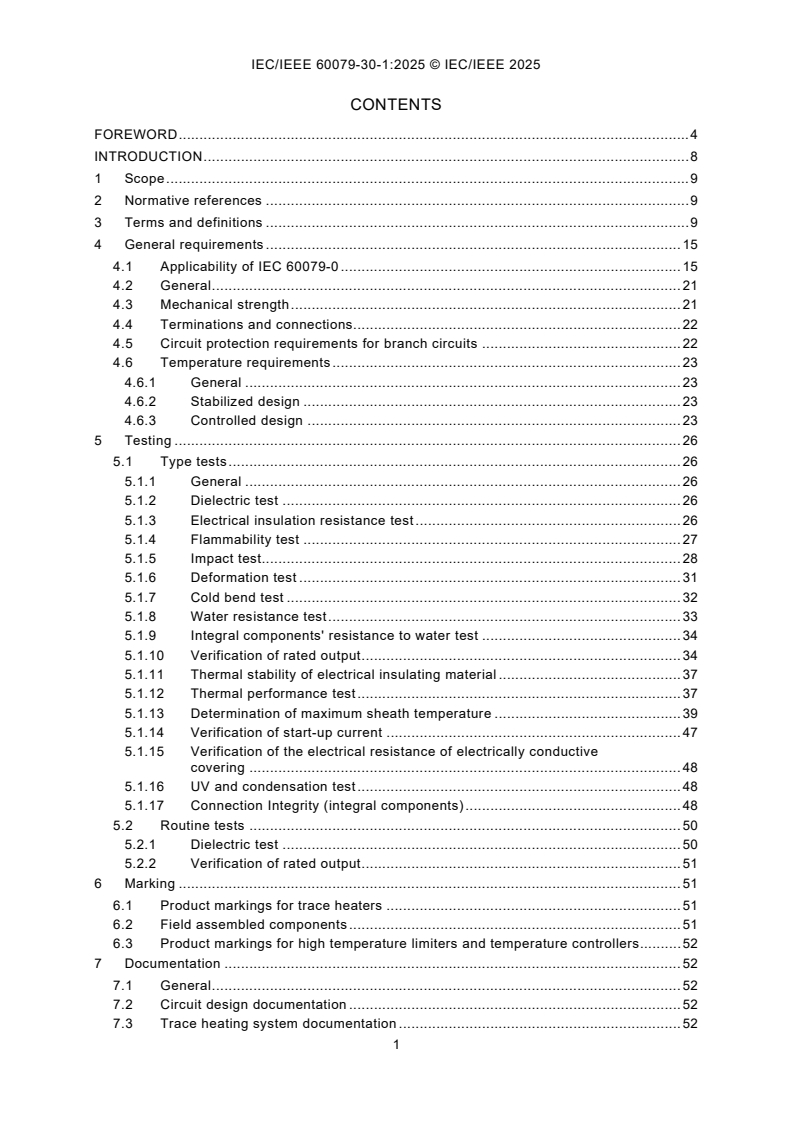
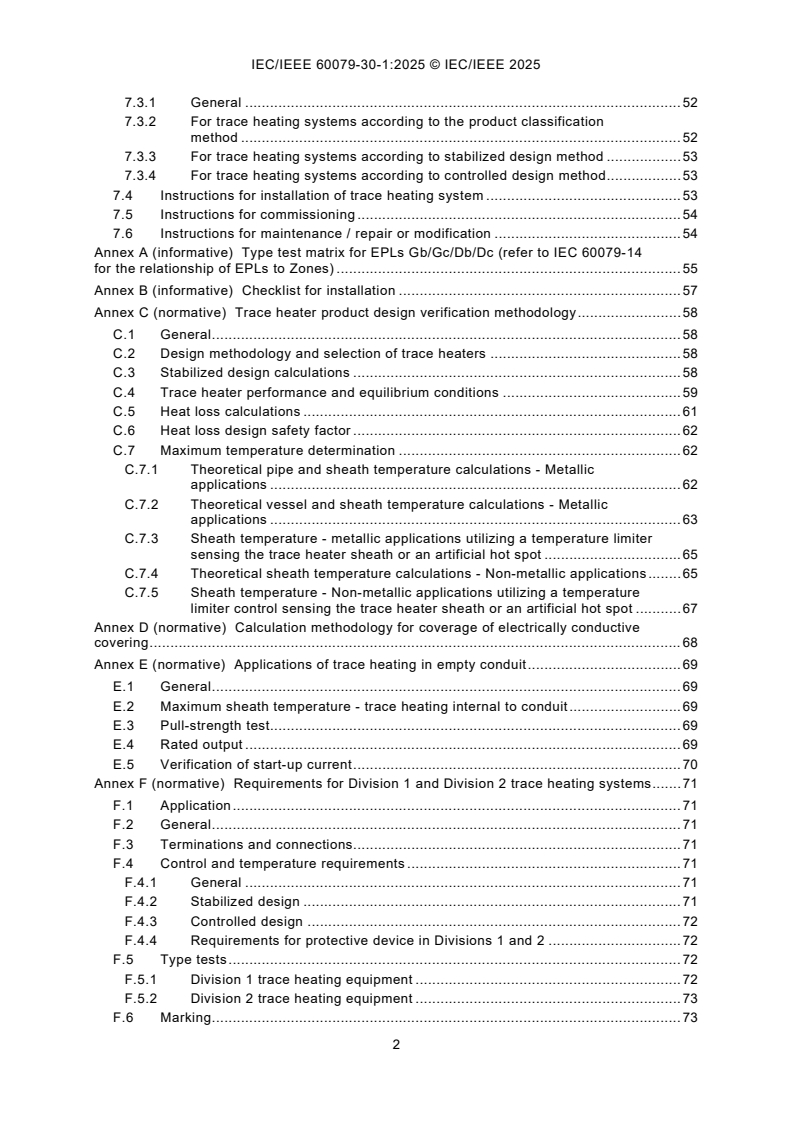
CONTENTS
FOREWORD . 4
INTRODUCTION . 8
1 Scope . 9
2 Normative references . 9
3 Terms and definitions . 9
4 General requirements . 15
4.1 Applicability of IEC 60079-0 . 15
4.2 General . 21
4.3 Mechanical strength . 21
4.4 Terminations and connections. 22
4.5 Circuit protection requirements for branch circuits . 22
4.6 Temperature requirements . 23
4.6.1 General . 23
4.6.2 Stabilized design . 23
4.6.3 Controlled design . 23
5 Testing . 26
5.1 Type tests . 26
5.1.1 General . 26
5.1.2 Dielectric test . 26
5.1.3 Electrical insulation resistance test . 26
5.1.4 Flammability test . 27
5.1.5 Impact test. 28
5.1.6 Deformation test . 31
5.1.7 Cold bend test . 32
5.1.8 Water resistance test . 33
5.1.9 Integral components' resistance to water test . 34
5.1.10 Verification of rated output . 34
5.1.11 Thermal stability of electrical insulating material . 37
5.1.12 Thermal performance test . 37
5.1.13 Determination of maximum sheath temperature . 39
5.1.14 Verification of start-up current . 47
5.1.15 Verification of the electrical resistance of electrically conductive
covering . 48
5.1.16 UV and condensation test . 48
5.1.17 Connection Integrity (integral components) . 48
5.2 Routine tests . 50
5.2.1 Dielectric test . 50
5.2.2 Verification of rated output . 51
6 Marking . 51
6.1 Product markings for trace heaters . 51
6.2 Field assembled components . 51
6.3 Product markings for high temperature limiters and temperature controllers . 52
7 Documentation . 52
7.1 General . 52
7.2 Circuit design documentation . 52
7.3 Trace heating system documentation . 52
7.3.1 General . 52
7.3.2 For trace heating systems according to the product classification
method . 52
7.3.3 For trace heating systems according to stabilized design method . 53
7.3.4 For trace heating systems according to controlled design method . 53
7.4 Instructions for installation of trace heating system . 53
7.5 Instructions for commissioning . 54
7.6 Instructions for maintenance / repair or modification . 54
Annex A (informative) Type test matrix for EPLs Gb/Gc/Db/Dc (refer to IEC 60079-14
for the relationship of EPLs to Zones) . 55
Annex B (informative) Checklist for installation . 57
Annex C (normative) Trace heater product design verification methodology . 58
C.1 General . 58
C.2 Design methodology and selection of trace heaters . 58
C.3 Stabilized design calculations . 58
C.4 Trace heater performance and equilibrium conditions . 59
C.5 Heat loss calculations . 61
C.6 Heat loss design safety factor . 62
C.7 Maximum temperature determination . 62
C.7.1 Theoretical pipe and sheath temperature calculations - Metallic
applications . 62
C.7.2 Theoretical vessel and sheath temperature calculations - Metallic
applications . 63
C.7.3 Sheath temperature - metallic applications utilizing a temperature limiter
sensing the trace heater sheath or an artificial hot spot . 65
C.7.4 Theoretical sheath temperature calculations - Non-metallic applications . 65
C.7.5 Sheath temperature - Non-metallic applications utilizing a temperature
limiter control sensing the trace heater sheath or an artificial hot spot . 67
Annex D (normative) Calculation methodology for coverage of electrically conductive
covering . 68
Annex E (normative) Applications of trace heating in empty conduit . 69
E.1 General . 69
E.2 Maximum sheath temperature - trace heating internal to conduit . 69
E.3 Pull-strength test. 69
E.4 Rated output . 69
E.5 Verification of start-up current . 70
Annex F (normative) Requirements for Division 1 and Division 2 trace heating systems . 71
F.1 Application . 71
F.2 General . 71
F.3 Terminations and connections. 71
F.4 Control and temperature requirements . 71
F.4.1 General . 71
F.4.2 Stabilized design . 71
F.4.3 Controlled design . 72
F.4.4 Requirements for protective device in Divisions 1 and 2 . 72
F.5 Type tests . 72
F.5.1 Division 1 trace heating equipment . 72
F.5.2 Division 2 trace heating equipment . 73
F.6 Marking . 73
F.7 Instructions - Installation requirements . 73
Annex G (normative) Type test matrix for Division 1 and 2 explosive atmospheres . 75
Bibliography . 77
Figure 1 – Flammability test . 28
Figure 2 – Example of room temperature impact test . 30
Figure 3 – Example of minimum temperature impact test . 31
Figure 4 – Cold bend test . 33
Figure 5 – Integral components resistance to water test. 34
Figure 6 – Verification of rated output . 36
Figure 7 – Product classification approach . 40
Figure 8 – Verification of sheath temperatures using pipe sculpture . 42
Figure 9 – Verification of sheath temperature, plate test . 45
Figure 10 – Verification of sheath temperature - plate test with serpentined sample . 45
Figure 11 – Plate test with two samples crossed over . 46
Figure 12 – Plate test with a single sample crossed over . 47
Figure 13 – Typical splice firm attachment apparatus . 49
Figure C.1 – Equilibrium conditions for workpiece maintenance . 59
Figure C.2 – Equilibrium conditions for upper limit evaluation . 60
Table 1 – Application or exclusion of specific clauses of IEC 60079-0 . 15
Table 2 – Sheath temperature design conditions based on Equipment Protection
Levels (EPLs) - Stabilized design approach . 23
Table 3 – Sheath temperature design conditions based on Equipment Protection
Levels - Controlled design approach . 24
Table 4 – Test voltages for the dielectric test . 26
Table A.1 – Determination of test samples . 55
Table B.1 – Trace heater installation record - Example . 57
Table F.1 – Division trace heating systems . 71
Table F.2 - Sheath temperature design conditions - Stabilized design approach . 72
Table F.3 – Sheath temperature design conditions - With temperature controller and/or
high temperature limiter . 72
Table G.1 – Applicable trace heater and trace heater pads and panels tests by
installation location . 75
Table G.2 – Applicable tests for integral components with trace heaters and trace
heater pads and panels . 76
Explosive atmospheres -
Part 30-1: Electrical resistance trace heating -
General and testing requirements
FOREWORD
1) The International Electrotechnical Commission (IEC) is a worldwide organization for standardization comprising
all national electrotechnical committees (IEC National Committees). The object of IEC is to promote international
co-operation on all questions concerning standardization in the electrical and electronic fields. To this end and
in addition to other activities, IEC publishes International Standards, Technical Specifications, Technical Reports,
Publicly Available Specifications (PAS) and Guides (hereafter referred to as "IEC document(s)"). Their
preparation is entrusted to technical committees; any IEC National Committee interested in the subject dealt with
may participate in this preparatory work. International, governmental and non-governmental organizations liaising
with the IEC also participate in this preparation.
IEEE Standards documents are developed within IEEE Societies and Standards Coordinating Committees of the
IEEE Standards Association (IEEE SA) Standards Board. IEEE develops its standards through a consensus
development process, approved by the American National Standards Institute, which brings together volunteers
representing varied viewpoints and interests to achieve the final product. Volunteers are not necessarily members
of IEEE and serve without compensation. While IEEE administers the process and establishes rules to promote
fairness in the consensus development process, IEEE does not independently evaluate, test, or verify the
accuracy of any of the information contained in its standards. Use of IEEE Standards documents is wholly
voluntary. IEEE documents are made available for use subject to important notices and legal disclaimers (see
https://standards.ieee.org/ipr/disclaimers.html for more information).
IEC collaborates closely with IEEE in accordance with conditions determined by agreement between the two
organizations. This Dual Logo International Standard was jointly developed by the IEC and IEEE under the terms
of that agreement.
2) The formal decisions of IEC on technical matters express, as nearly as possible, an international consensus of
opinion on the relevant subjects since each technical committee has representation from all interested IEC
National Committees. The formal decisions of IEEE on technical matters, once consensus within IEEE Societies
and Standards Coordinating Committees has been reached, is determined by a balanced ballot of materially
interested parties who indicate interest in reviewing the proposed standard. Final approval of the IEEE standards
document is given by the IEEE Standards Association (IEEE SA) Standards Board.
3) IEC/IEEE Publications have the form of recommendations for international use and are accepted by IEC National
Committees/IEEE Societies in that sense. While all reasonable efforts are made to ensure that the technical
content of IEC/IEEE Publications is accurate, IEC or IEEE cannot be held responsible for the way in which they
are used or for any misinterpretation by any end user.
4) In order to promote international uniformity, IEC National Committees undertake to apply IEC Publications
(including IEC/IEEE Publications) transparently to the maximum extent possible in their national and regional
publications. Any divergence between any IEC/IEEE Publication and the corresponding national or regional
publication shall be clearly indicated in the latter.
5) IEC and IEEE do not provide any attestation of conformity. Independent certification bodies provide conformity
assessment services and, in some areas, access to IEC marks of conformity. IEC and IEEE are not responsible
for any services carried out by independent certification bodies.
6) All users should ensure that they have the latest edition of this publication.
7) No liability shall attach to IEC or IEEE or their directors, employees, servants or agents including individual
experts and members of technical committees and IEC National Committees, or volunteers of IEEE Societies and
the Standards Coordinating Committees of the IEEE Standards Association (IEEE SA) Standards Board, for any
personal injury, property damage or other damage of any nature whatsoever, whether direct or indirect, or for
costs (including legal fees) and expenses arising out of the publication, use of, or reliance upon, this IEC/IEEE
Publication or any other IEC or IEEE Publications.
8) Attention is drawn to the normative references cited in this publication. Use of the referenced publications is
indispensable for the correct application of this publication.
9) Attention is drawn to the possibility that implementation of this IEC/IEEE Publication may require use of material
covered by patent rights. By publication of this standard, no position is taken with respect to the existence or
validity of any patent rights in connection therewith. IEC or IEEE shall not be held responsible for identifying
Essential Patent Claims for which a license may be required, for conducting inquiries into the legal validity or
scope of Patent Claims or determining whether any licensing terms or conditions provided in connection with
submission of a Letter of Assurance, if any, or in any licensing agreements are reasonable or non-discriminatory.
Users of this standard are expressly advised that determination of the validity of any patent rights, and the risk
of infringement of such rights, is entirely their own responsibility.
IEC/IEEE 60079-30-1 has been prepared by IEC technical committee 31: Equipment for
explosive atmospheres, in cooperation with the Petroleum & Chemical Industry Committee of
the IEEE Industrial Applications Society under the IEC/IEEE Dual Logo Agreement.
This publication is published as an IEC/IEEE Dual Logo standard.
This second edition of IEC/IEEE 60079-30-1 cancels and replaces the first edition of
IEC/IEEE 60079-30-1 published in 2015. This edition constitutes a technical revision.
Users of this document are advised that interpretation sheets clarifying the interpretation of this
document can be published. Interpretation sheets are available from the IEC webstore and can
be found in the "history" tab of the page for each document.
This edition includes the following significant technical changes with respect to the previous
edition:
The significance of changes between IEC/IEEE 60079-30-1, Edition 1.0 (2015) and
IEC/IEEE 60079-30-1, Edition 2.0 (this document) is as listed below:
Type
Minor and Major
Changes Clause Extension
editorial technical
changes changes
Redefined Maximum withstand temperature as it
X
3.20
applies to the performance benchmark test.
Separated maximum maintain temperature and
maximum continuous operating temperature to X
3.15 and 3.16
clarify the meaning of both terms.
Addition of requirements for controllers and high
C1
temperature limiters, added specific reference
4.6.3
standards.
Rewrite of the requirements for controlled design as
C2
it applies to the application of controllers and high
4.6.3
temperature limiters as for use in EPL's.
Addition of requirement for specifying various
C3
temperatures defined by the standard and including
4.2 and 7
them in user documentation.
Connection Integrity (integral components) X
5.1.17
Applications of Trace Heating in empty conduit X
Annex E
NOTE The technical changes referred to include the significance of technical changes in the revised IEC Standard,
but they do not form an exhaustive list of all modifications from the previous version.
Explanations:
A) Definitions
Minor and editorial changes
clarification
decrease of technical requirements
minor technical change
editorial corrections
These are changes which modify requirements in an editorial or a minor technical way. They
include changes of the wording to clarify technical requirements without any technical change,
or a reduction in level of existing requirement.
Extension addition of technical options
These are changes which add new or modify existing technical requirements, in a way that new
options are given, but without increasing requirements for equipment that was fully compliant
with the previous standard. Therefore, these will not have to be considered for products in
conformity with the preceding edition.
Major technical changes
addition of technical requirements
increase of technical requirements
These are changes to technical requirements (addition, increase of the level or removal) made
in a way that a product in conformity with the preceding edition will not always be able to fulfil
the requirements given in the later edition. These changes have to be considered for products
in conformity with the preceding edition. For these changes additional information is provided
in clause B) below.
NOTE 1 These changes represent current technological knowledge. However, these changes should not normally
have an influence on equipment already placed on the market.
B) Information about the background of 'Major technical changes'
C1 There are no additional requirements for temperature controllers and high temperature
limiters beyond those of the general industrial standards.
C2 The application of temperature controllers and high temperature limiters shall be as
specified.
C3 The documentation shall include the various temperatures specified in the standard.
The text of this International Standard is based on the following IEC documents:
Draft Report on voting
31/1867/FDIS 31/1893/RVD
Full information on the voting for its approval can be found in the report on voting indicated in
the above table.
The language used for the development of this International Standard is English.
This document was drafted in accordance with the rules given in the ISO/IEC Directives, Part 2,
available at www.iec.ch/members_experts/refdocs. The main document types developed by IEC
are described in greater detail at www.iec.ch/publications/.
This document is to be used in conjunction with IEC 60079-0, Explosive atmospheres - Part 0:
Equipment - General requirements and IEC/IEEE 60079-30-2, Explosive atmospheres -
Part 30-2: Electrical resistance trace heating - Guidance on application for design, installation
and maintenance.
A list of all parts of IEC 60079 series, under the general title Explosive atmospheres, can be
found on the IEC website.
The IEC Technical Committee and IEEE Technical Committee have decided that the contents
of this document will remain unchanged until the stability date indicated on the IEC website
under webstore.iec.ch in the data related to the specific document. At this date, the document
will be
– reconfirmed,
– withdrawn, or
– revised.
INTRODUCTION
IEC/IEEE 60079-30-1 is intended to provide a comprehensive overview of the essential
requirements and testing appropriate to electric surface heating equipment used in explosive
atmospheres. The requirements of this part of IEC 60079 are considered to be the minimum
requirements for Equipment Protection Levels (EPLs) Gb, Gc, Db, and Dc in explosive
atmospheres for gases, dusts, and fibres/flyings. While some of this work already exists in
national standards or international standards, this document has collated much of this existing
work and added to it. This document also contains the minimum requirements for users applying
the Division method of area classification.
1 Scope
This part of IEC 60079 specifies general and testing requirements for electrical resistance trace
heaters for application in explosive atmospheres with the exclusion of those for Equipment
Protection Levels (EPL) Ga, Da, Ma and Mb equipment. This document covers trace heaters
that comprise either factory or field (worksite) assembled units, and which can be series trace
heaters, parallel trace heaters, trace heater pads, or trace heater panels that have been
assembled and/or terminated in accordance with the manufacturer's instructions.
This document also includes requirements for termination assemblies and control methods used
with trace heating systems. The explosive atmospheres referred to in this document are those
defined in IEC 60079-10-1 and IEC 60079-10-2.
Annex F and Annex G outline the application of this document for those users applying the
Division method of area classification.
2 Normative references
The following documents are referred to in the text in such a way that some or all of their content
constitutes requirements of this document. For dated references, only the edition cited applies.
For undated references, the latest edition of the referenced document (including any
amendments) applies.
IEC 60050-151, International Electrotechnical Vocabulary (IEV) - Part 151: Electrical and
magnetic devices
IEC 60079-0, Explosive atmospheres - Part 0: Equipment - General requirements
IEC 60079-7, Explosive atmospheres - Part 7: Equipment protection by increased safety "e"
IEC/IEEE 60079-30-2, Explosive atmospheres - Part 30-2: Electrical resistance trace heating -
Guidance on application for design, installation and maintenance
IEC 60695-11-3, Fire hazard testing - Part 11-3: Test flames - 500 W flames - Apparatus and
confirmational test methods
ISO 4892-2, Plastics - Methods of exposure to laboratory light sources - Part 2: Xenon-arc
lamps
ASTM G155, Standard practice for operating xenon arc light apparatus for exposure of non-
metallic materials
3 Terms and definitions
For the purposes of this document, the terms and definitions given in IEC 60079-0,
IEC 60079-7, IEC 60050-151 (except as modified by this clause) and the following apply.
ISO and IEC maintain terminology databases for use in standardization at the following
addresses:
– IEC Electropedia: available at https://www.electropedia.org/
– ISO Online browsing platform: available at https://www.iso.org/obp
3.1
ambient temperature
temperature surrounding the object under consideration
Note 1 to entry: Where a trace heater or surface heater is enclosed in thermal insulation, the ambient temperature
is the temperature external to the thermal insulation.
3.1.1
maximum ambient temperature
highest specified ambient temperature
3.2
branch circuit
portion of the wiring installation between the overcurrent device protecting the
circuit and the trace heater unit(s)
3.3
connection
termination
termination or splice used to attach trace heaters or surface heaters to power wiring or to
connect sections of these devices
3.3.1
cold lead
electrically insulated conductor or conductors that do not produce significant
heat and are used to connect a trace heater to a branch circuit
3.3.2
end termination
termination, which can be heat producing, applied to a trace heater at the end
opposite to that where the power is supplied
3.3.3
power termination
termination applied to the end of a trace heater at which the power is supplied
3.3.4
tee
electrical connection of trace heaters, in series or in parallel, to accommodate
a branch of a trace heater
3.4
controlled design
design where the applicable temperature controller and/or high temperature limiter is used in
establishing/limiting the maximum sheath temperature
3.5
electrically conductive covering
metallic braid, metallic sheath, or alternative covering with sufficient conductivity so that, when
bonded to ground, it will allow a ground fault protective device to operate under a fault condition
3.6
factory fabricated
trace heater unit or set, including the necessary terminations and connections,
assembled by the manufacturer
3.7
field assembled
trace heaters supplied unterminated with terminating components to be
assembled at the work site
3.8
heat loss
energy flow from a workpiece, pipe, or vessel or equipment to its surroundings
3.9
heat sink
part that conducts and dissipates heat away from a workpiece
Note 1 to entry: Typical heat sinks are pipe shoes, pipe supports and items of large mass such as valve actuators
or pump bodies.
3.10
heat transfer aid
thermally conductive material, such as metallic foil or heat transfer compound
used to increase the heat transfer efficiency from trace heaters to the workpiece
3.11
high limit temperature
maximum allowable temperature of the system, including piping, fluid and trace
heating system
3.12
high temperature limiter
safety device, or combination of safety devices, incorporating a means of sensing temperature
and a means of switching power to the trace heater before the maximum surface temperature
is exceeded
3.13
integral components
component such as a heat shrink termination, a cold lead connection, a molded end seal, or a
splice, which conforms to the general shape of the trace heater and is exposed to the same
environment as the trace heater, which can be factory fabricated or field assembled, and is not
intended to be re-used in the event of a repair or modification
3.14
maximum continuous exposure temperature
highest allowable continuous temperature to which the trace heating system
can be exposed while de-energized as declared by the manufacturer
3.15
maximum maintain temperature
specified maximum workpiece or process temperature that the trace heater is
able to maintain as declared by the manufacturer
3.16
maximum continuous operating temperature
specified maximum workpiece temperature; at which, the trace heater, can operate continuously
when energized as declared by the manufacturer
3.17
maximum intermittent exposure temperature
highest allowable intermittent temperature to which a trace heater can be
exposed, as declared by the manufacturer
3.18
maintain temperature
specified temperature of a workpiece or process that the trace heaters shall be
able to maintain continuously when energized as declared by the manufacturer
3.19
maximum sheath temperature
maximum temperature of the outermost continuous covering of a trace heater
3.20
maximum withstand temperature
maximum continuous exposure temperature or the maximum intermittent
exposure temperature (energized or de-energized) whichever is higher, as declared by the
manufacturer
3.21
minimum installation temperature
minimum temperature at which the trace heating system can be handled and
installed
3.22
MI trace heater
mineral insulated metal sheathed trace heater typically containing one or more
heating conductors
3.23
operating voltage
actual voltage applied to the trace heater when in service
3.24
outdoor exposure
exposure to outdoor conditions of ultraviolet light and moisture
3.25
overjacket
continuous layer of non-metallic material applied outside the metallic sheath or
screen to protect against corrosion
3.26
parallel trace heater
heating element that is electrically connected in parallel with another parallel
trace heater, either continuously or in zones, so that the power output per lineal length is
maintained, irrespective of any change in length for the continuous type or for any number of
discrete zones
3.27
rated output
total power or power per unit length or unit surface area of a trace heater, at
rated voltage, temperature and length or area
3.28
rated voltage
rated value of the voltage assigned by the manufacturer to which operating and
performance characteristics of trace heaters are referred
3.29
routine test
test that is carried out by the manufacturer of the trace heater on all trace heaters during or
after the production process
3.30
series trace heater
heating element electrically connected in series with another series trace
heater with a single current path and with a specific resistance at a given temperature for a
given length
3.31
sheath
uniform and continuous metallic or non-metallic outer covering enclosing the
trace heater used to provide protection against influence from the surroundings (corrosion,
moisture, abrasion etc.)
Note 1 to entry: See overjacket (3.25)
3.32
sheath temperature
temperature of the outermost continuous covering (braid, sheath, or overjacket)
that can be exposed to the surrounding atmosphere
3.33
stabilized design
design where the temperature of the trace heater, by design and use, stabilizes
below the high limit temperature, under the most unfavourable conditions
3.34
start-up current
current response of a trace heater following energization
3.35
surface heater
trace heater pad or trace heater panel
3.36
system documentation
information prepared by the manufacturer to allow satisfactory understanding,
installation and safe use of the trace heating system
3.37
temperature controller
device or combination of devices incorporating a means of sensing temperature
and of controlling the energy to the trace heater
3.38
temperature sensor
device designed to respond to temperature providing an electrical signal or mechanical
operation
3.39
thermal insulation
material having air- or gas-filled pockets, voids, or heat reflecting surfaces that,
when properly applied, retards the transfer of heat
3.40
trace heater
device of linear geometry designed for the purpose of producing heat on the principle of
electrical resistance and typically composed of one or more metallic conductors and/or an
electrically conductive material, suitably electrically insulated and protected
3.41
trace heater pad
trace heater comprising series or parallel connected elements having sufficient flexibility to
conform to the shape of the surface to be heated
3.42
trace heater panel
non-flexible trace heater comprising series or parallel connected elements fabricated to conform
to the general shape of the surface to be heated
3.43
trace heater unit
trace heater set
series trace heater, parallel trace heater, trace heater pad or trace heater panel suitably
terminated in conformity with the manufacturer's instructions
3.44
trace heating
utilization of electric trace heaters, trace heater pads, trace heater panels and support
components, used to maintain or to raise the temperature of contents in piping, tanks and
associated equipment
3.45
trace heating system
usage of trace heating including all necessary design and installation
documentation
3.46
trace ratio
ratio of trace heater length to pipe length
3.47
type test
conformity test made on one or more items representative of the production
3.48
weather barrier
material that, when installed on the outer surface of thermal insulation, protects
the thermal insulation from water or other liquids, from physical damage caused by ice pellets,
wind or mechanical abuse and from deterioration caused by solar radiation or atmospheric
contamination
3.49
workpiece
object to which a trace heater is applied
Note 1 to entry: Examples include process equipment such as piping, vessels, tanks, valves, instruments and
similar equipment.
4 General requirements
4.1 Applicability of IEC 60079-0
This document supplements and modifies the general requirements of IEC 60079-0, except as
indicated in Table 1. Where a requirement of this document conflicts with a requirement of
IEC 60079-0, the requirement of this document takes precedence.
Table 1 – Application or exclusion of specific clauses of IEC 60079-0
Electrical resistance trace heaters and
IEC 60079-0
integral components
Terminations
as separate
Ed. 7.0 Clause / Subclause title
Group II Group III
components
(2017) (normative)
(informative)
1 Scope Applies Applies Applies
2 Normative references Applies Applies Applies
3 Terms and definitions Applies, Applies, Applies,
except ambient except ambient except ambient
temperature, see 3.1 temperature, temperature,
see 3.1 see 3.1
4 Equipment grouping
4.1 General Applies Applies Applies
4.2 Group I Excluded Excluded Excluded
4.3 Group II Applies Excluded Applies
4.4 Group III Excluded Applies Applies
4.5 Equipment for a particular Applies Excluded Applies
explosive gas atmosphere
5 Temperatures
5.1 Environmental influences
5.1.1 Ambient temperature Replaced by 4.6 and Replaced by 4.6 Applies, see 3.1
6.1e) and 6.1e)
5.1.2 External source of heating or Applies Applies Applies
cooling
5.2 Service temperature Modified Modified Applies, special
consideration is
required in case
of glands
intended for
direct entry of
continuous type
parallel trace
heaters with
regards to
service
temperature
5.3 Maximum surface temperature
5.3.1 Determination of maximum Replaced by 4.6 in Replaced by 4.6 in Applies
surface temperature conjunction with conjunction with
5.1.13 5.1.13 only when
tested in
accordance with
5.1.13.3.
5.3.2 Limitation of max
...
IEC/IEEE 60079-30-1 ®
Edition 2.0 2025-09
INTERNATIONAL
STANDARD
REDLINE VERSION
Explosive atmospheres -
Part 30-1: Electrical resistance trace heating - General and testing requirements
ICS 29.260.20 ISBN 978-2-8327-0727-2
All rights reserved. Unless otherwise specified, no part of this publication may be reproduced or utilized in any form or
by any means, electronic or mechanical, including photocopying and microfilm, without permission in writing being
secured. Requests for permission to reproduce should be addressed to either IEC at the address below or IEC’s
member Natio nal Committee in the country of the requester or from IEEE.
IEC Secretariat Institute of Electrical and Electronics Engineers, Inc.
3, rue de Varembé 3 Park Avenue
CH-1211 Geneva 20 New York, NY 10016-5997
Switzerland United States of America
Tel.: +41 22 919 02 11 stds.ipr@ieee.org
info@iec.ch www.ieee.org
www.iec.ch
About the IEC
The International Electrotechnical Commission (IEC) is the leading global organization that prepares and publishes
International Standards for all electrical, electronic and related technologies.
About the IEEE
IEEE is the world’s largest professional association dedicated to advancing technological innovation and excellence for the
benefit of humanity. IEEE and its members inspire a global community through its highly cited publications, conferences,
technology standards, and professional and educational activities.
About IEC/IEEE publications
The technical content of IEC/IEEE publications is kept under constant review by the IEC and IEEE. Please make sure that
you have the latest edition, a corrigendum or an amendment might have been published.
IEC publications search - webstore.iec.ch/advsearchform IEC Products & Services Portal - products.iec.ch
The advanced search enables to find IEC publications by a Discover our powerful search engine and read freely all the
variety of criteria (reference number, text, technical publications previews, graphical symbols and the glossary. With a
committee, …). It also gives information on projects, replaced subscription you will always have access to up to date content
and withdrawn publications. tailored to your needs.
IEC Just Published - webstore.iec.ch/justpublished
Electropedia - www.electropedia.org
Stay up to date on all new IEC publications. Just Published
The world's leading online dictionary on electrotechnology,
details all new publications released. Available online and
containing more than 22 500 terminological entries in English and
once a month by email.
French, with equivalent terms in 25 additional languages. Also
known as the International Electrotechnical Vocabulary (IEV)
IEC Customer Service Centre - webstore.iec.ch/csc
online.
If you wish to give us your feedback on this publication or need
further assistance, please contact the Customer Service
Centre: sales@iec.ch.
CONTENTS
FOREWORD . 4
INTRODUCTION . 1
1 Scope . 9
2 Normative references . 9
3 Terms and definitions . 10
4 General requirements . 14
4.1 Applicability of IEC 60079-0 . 17
4.2 General . 27
4.3 Mechanical strength . 28
4.4 Terminations and connections. 28
4.5 Circuit protection requirements for branch circuits . 28
4.6 Temperature requirements . 29
4.6.1 General . 29
4.6.2 Stabilized design . 29
4.6.3 Controlled design . 30
5 Testing . 31
5.1 Type tests . 33
5.1.1 General . 33
5.1.2 Dielectric test . 33
5.1.3 Electrical insulation resistance test . 34
5.1.4 Flammability test . 34
5.1.5 Impact test. 36
5.1.6 Deformation test . 39
5.1.7 Cold bend test . 40
5.1.8 Water resistance test . 42
5.1.9 Integral components' resistance to water test . 43
5.1.10 Verification of rated output . 43
5.1.11 Thermal stability of electrical insulating material . 46
5.1.12 Thermal performance test . 46
5.1.13 Determination of maximum sheath temperature . 48
5.1.14 Verification of start-up current . 54
5.1.15 Verification of the electrical resistance of electrically conductive
covering . 58
5.1.16 Outdoor exposureUV and condensation test . 58
5.1.17 Connection Integrity (integral components) . 59
5.2 Routine tests . 61
5.2.1 Dielectric test . 61
5.2.2 Verification of rated output . 61
6 Marking . 61
6.1 Product markings for trace heaters . 61
6.2 Markings for Field assembled components . 62
6.3 Product markings for high temperature limiters and temperature controllers . 62
7 Documentation requirements . 62
7.1 General . 62
7.2 Circuit design documentation . 63
7.3 Trace heating system documentation . 63
7.3.1 General . 63
7.3.2 For trace heating systems according to the product classification
method . 63
7.3.3 For trace heating systems according to stabilized design method . 63
7.3.4 For trace heating systems according to controlled design method . 63
7.4 Instructions for installation of trace heating system . 64
7.5 Instructions for commissioning . 65
7.6 Instructions for maintenance / repair or modification . 65
Annex A (informative) Type test matrix for EPLs Gb/Gc/Db/Dc (refer to IEC 60079-14
for the relationship of EPLs to Zones) . 66
Annex B (informative) Checklist for installation . 68
Annex C (normative) Trace heater product design verification methodology . 69
C.1 General . 69
C.2 Design methodology and selection of trace heaters . 69
C.3 Stabilized design calculations . 69
C.4 Trace heater performance and equilibrium conditions . 70
C.5 Heat loss calculations . 72
C.6 Heat loss design safety factor . 73
C.7 Maximum temperature determination . 73
C.7.1 Theoretical pipe and sheath temperature calculations - Metallic
applications . 73
C.7.2 Theoretical vessel and sheath temperature calculations - Metallic
applications . 74
C.7.3 Sheath temperature - metallic applications utilizing a temperature limiter
control sensing the trace heater sheath or an artificial hot spot . 76
C.7.4 Theoretical sheath temperature calculations - Non-metallic applications . 76
C.7.5 Sheath temperature - Non-metallic applications utilizing a temperature
limiter control sensing the trace heater sheath or an artificial hot spot . 78
Annex D (normative) Calculation methodology for coverage of electrically conductive
covering . 79
Annex E (normative) Applications of trace heating in empty conduit . 80
E.1 General . 80
E.2 Maximum sheath temperature - trace heating internal to conduit . 80
E.3 Pull-strength test. 80
E.4 Rated output . 80
E.5 Verification of start-up current . 81
Annex F (normative) Requirements for Division 1 and Division 2 trace heating systems . 82
F.1 Application . 82
F.2 General . 82
F.3 Terminations and connections. 82
F.4 Control and temperature requirements . 82
F.4.1 General . 82
F.4.2 Stabilized design . 82
F.4.3 Controlled design . 83
F.4.4 Requirements for protective device in Divisions 1 and 2 . 83
F.5 Type tests . 83
F.5.1 Division 1 trace heating equipment . 83
F.5.2 Division 2 trace heating equipment . 84
F.6 Marking . 84
F.7 Instructions - Installation requirements . 84
Annex G (normative) Type test matrix for Division 1 and 2 explosive atmospheres . 86
Bibliography . 89
Figure 1 – Flammability test . 36
Figure 2 – Example of room temperature impact test . 38
Figure 3 – Example of minimum temperature impact test . 39
Figure 4 – Cold bend test . 42
Figure 5 – Integral components resistance to water test. 43
Figure 6 – Verification of rated output . 45
Figure 7 – Maximum sheath temperature using Product classification approach. 49
Figure 8 – Verification of sheath temperatures using pipe sculpture . 51
Figure 9 – Verification of sheath temperature, plate test . 54
Figure 10 – Verification of sheath temperature - plate test with serpentined sample . 55
Figure 11 – Plate test with two samples crossed over . 56
Figure 12 – Plate test with a single sample crossed over . 57
Figure 13 – Typical splice firm attachment apparatus . 60
Figure C.1 – Equilibrium conditions for workpiece maintenance . 70
Figure C.2 – Equilibrium conditions for upper limit evaluation . 71
Table 1 – Application or exclusion of specific clauses of IEC 60079-0 . 17
Table 2 – Sheath temperature design conditions based on Equipment Protection
Levels (EPLs) - Stabilized design approach . 29
Table 3 – Sheath temperature design conditions based on Equipment Protection
Levels - Controlled design approach . 31
Table 4 – Test voltages for the dielectric test . 33
Table A.1 – Determination of test samples . 66
Table B.1 – Trace heater installation record - Example . 68
Table F.1 – Division trace heating systems . 82
Table F.2 - Sheath temperature design conditions - Stabilized design approach . 83
Table F.3 – Sheath temperature design conditions - With temperature control device
controller and/or high temperature limiter . 83
Table G.1 – Applicable trace heater and trace heater pads and panels tests by
installation location . 86
Table G.2 – Applicable tests for integral components with trace heaters and trace
heater pads and panels . 87
Explosive atmospheres -
Part 30-1: Electrical resistance trace heating -
General and testing requirements
FOREWORD
1) The International Electrotechnical Commission (IEC) is a worldwide organization for standardization comprising
all national electrotechnical committees (IEC National Committees). The object of IEC is to promote international
co-operation on all questions concerning standardization in the electrical and electronic fields. To this end and
in addition to other activities, IEC publishes International Standards, Technical Specifications, Technical Reports,
Publicly Available Specifications (PAS) and Guides (hereafter referred to as "IEC document(s)"). Their
preparation is entrusted to technical committees; any IEC National Committee interested in the subject dealt with
may participate in this preparatory work. International, governmental and non-governmental organizations liaising
with the IEC also participate in this preparation.
IEEE Standards documents are developed within IEEE Societies and Standards Coordinating Committees of the
IEEE Standards Association (IEEE SA) Standards Board. IEEE develops its standards through a consensus
development process, approved by the American National Standards Institute, which brings together volunteers
representing varied viewpoints and interests to achieve the final product. Volunteers are not necessarily members
of IEEE and serve without compensation. While IEEE administers the process and establishes rules to promote
fairness in the consensus development process, IEEE does not independently evaluate, test, or verify the
accuracy of any of the information contained in its standards. Use of IEEE Standards documents is wholly
voluntary. IEEE documents are made available for use subject to important notices and legal disclaimers (see
https://standards.ieee.org/ipr/disclaimers.html for more information).
IEC collaborates closely with IEEE in accordance with conditions determined by agreement between the two
organizations. This Dual Logo International Standard was jointly developed by the IEC and IEEE under the terms
of that agreement.
2) The formal decisions of IEC on technical matters express, as nearly as possible, an international consensus of
opinion on the relevant subjects since each technical committee has representation from all interested IEC
National Committees. The formal decisions of IEEE on technical matters, once consensus within IEEE Societies
and Standards Coordinating Committees has been reached, is determined by a balanced ballot of materially
interested parties who indicate interest in reviewing the proposed standard. Final approval of the IEEE standards
document is given by the IEEE Standards Association (IEEE SA) Standards Board.
3) IEC/IEEE Publications have the form of recommendations for international use and are accepted by IEC National
Committees/IEEE Societies in that sense. While all reasonable efforts are made to ensure that the technical
content of IEC/IEEE Publications is accurate, IEC or IEEE cannot be held responsible for the way in which they
are used or for any misinterpretation by any end user.
4) In order to promote international uniformity, IEC National Committees undertake to apply IEC Publications
(including IEC/IEEE Publications) transparently to the maximum extent possible in their national and regional
publications. Any divergence between any IEC/IEEE Publication and the corresponding national or regional
publication shall be clearly indicated in the latter.
5) IEC and IEEE do not provide any attestation of conformity. Independent certification bodies provide conformity
assessment services and, in some areas, access to IEC marks of conformity. IEC and IEEE are not responsible
for any services carried out by independent certification bodies.
6) All users should ensure that they have the latest edition of this publication.
7) No liability shall attach to IEC or IEEE or their directors, employees, servants or agents including individual
experts and members of technical committees and IEC National Committees, or volunteers of IEEE Societies and
the Standards Coordinating Committees of the IEEE Standards Association (IEEE SA) Standards Board, for any
personal injury, property damage or other damage of any nature whatsoever, whether direct or indirect, or for
costs (including legal fees) and expenses arising out of the publication, use of, or reliance upon, this IEC/IEEE
Publication or any other IEC or IEEE Publications.
8) Attention is drawn to the normative references cited in this publication. Use of the referenced publications is
indispensable for the correct application of this publication.
9) Attention is drawn to the possibility that implementation of this IEC/IEEE Publication may require use of material
covered by patent rights. By publication of this standard, no position is taken with respect to the existence or
validity of any patent rights in connection therewith. IEC or IEEE shall not be held responsible for identifying
Essential Patent Claims for which a license may be required, for conducting inquiries into the legal validity or
scope of Patent Claims or determining whether any licensing terms or conditions provided in connection with
submission of a Letter of Assurance, if any, or in any licensing agreements are reasonable or non-discriminatory.
Users of this standard are expressly advised that determination of the validity of any patent rights, and the risk
of infringement of such rights, is entirely their own responsibility.
This redline version of the official IEC Standard allows the user to identify the changes made
to the previous edition IEC/IEEE 60079-30-1:2015. A vertical bar appears in the margin
wherever a change has been made. Additions are in green text, deletions are in strikethrough
red text.
IEC/IEEE 60079-30-1 has been prepared by IEC technical committee 31: Equipment for
explosive atmospheres, in cooperation with the Petroleum & Chemical Industry Committee of
the IEEE Industrial Applications Society under the IEC/IEEE Dual Logo Agreement.
This publication is published as an IEC/IEEE Dual Logo standard.
This second edition of IEC/IEEE 60079-30-1 cancels and replaces the first edition of
IEC/IEEE 60079-30-1 published in 2015. This edition constitutes a technical revision.
Users of this document are advised that interpretation sheets clarifying the interpretation of this
document can be published. Interpretation sheets are available from the IEC webstore and can
be found in the "history" tab of the page for each document.
This edition includes the following significant technical changes with respect to the previous
edition:
The significance of changes between IEC/IEEE 60079-30-1, Edition 1.0 (2015) and
IEC/IEEE 60079-30-1, Edition 2.0 (this document) is as listed below:
Type
Changes Clause Minor and Extension Major
editorial technical
changes changes
Redefined Maximum withstand temperature as it
X
3.20
applies to the performance benchmark test.
Separated maximum maintain temperature and
maximum continuous operating temperature to X
3.15 and 3.16
clarify the meaning of both terms.
Addition of requirements for controllers and high
C1
temperature limiters, added specific reference
4.6.3
standards.
Rewrite of the requirements for controlled design as
C2
it applies to the application of controllers and high
4.6.3
temperature limiters as for use in EPL's.
Addition of requirement for specifying various
C3
temperatures defined by the standard and including
4.2 and 7
them in user documentation.
Connection Integrity (integral components) X
5.1.17
Applications of Trace Heating in empty conduit X
Annex E
NOTE The technical changes referred to include the significance of technical changes in the revised IEC Standard,
but they do not form an exhaustive list of all modifications from the previous version.
Explanations:
A) Definitions
Minor and editorial changes
clarification
decrease of technical requirements
minor technical change
editorial corrections
These are changes which modify requirements in an editorial or a minor technical way. They
include changes of the wording to clarify technical requirements without any technical change,
or a reduction in level of existing requirement.
Extension addition of technical options
These are changes which add new or modify existing technical requirements, in a way that new
options are given, but without increasing requirements for equipment that was fully compliant
with the previous standard. Therefore, these will not have to be considered for products in
conformity with the preceding edition.
Major technical changes
addition of technical requirements
increase of technical requirements
These are changes to technical requirements (addition, increase of the level or removal) made
in a way that a product in conformity with the preceding edition will not always be able to fulfil
the requirements given in the later edition. These changes have to be considered for products
in conformity with the preceding edition. For these changes additional information is provided
in clause B) below.
NOTE 1 These changes represent current technological knowledge. However, these changes should not normally
have an influence on equipment already placed on the market.
B) Information about the background of 'Major technical changes'
C1 There are no additional requirements for temperature controllers and high temperature
limiters beyond those of the general industrial standards.
C2 The application of temperature controllers and high temperature limiters shall be as
specified.
C3 The documentation shall include the various temperatures specified in the standard.
The text of this International Standard is based on the following IEC documents:
Draft Report on voting
31/1867/FDIS 31/1893/RVD
Full information on the voting for its approval can be found in the report on voting indicated in
the above table.
The language used for the development of this International Standard is English.
This document was drafted in accordance with the rules given in the ISO/IEC Directives, Part 2,
available at www.iec.ch/members_experts/refdocs. The main document types developed by IEC
are described in greater detail at www.iec.ch/publications/.
This document is to be used in conjunction with IEC 60079-0, Explosive atmospheres - Part 0:
Equipment - General requirements and IEC/IEEE 60079-30-2, Explosive atmospheres -
Part 30-2: Electrical resistance trace heating - Guidance on application for design, installation
and maintenance.
A list of all parts of IEC 60079 series, under the general title Explosive atmospheres, can be
found on the IEC website.
The IEC Technical Committee and IEEE Technical Committee have decided that the contents
of this document will remain unchanged until the stability date indicated on the IEC website
under webstore.iec.ch in the data related to the specific document. At this date, the document
will be
– reconfirmed,
– withdrawn, or
– revised.
INTRODUCTION
IEC/IEEE 60079-30-1 is intended to provide a comprehensive overview of the essential
requirements and testing appropriate to electric surface heating equipment used in explosive
atmospheres. The requirements of this part of IEC 60079 are considered to be the minimum
requirements for Equipment Protection Levels (EPLs) Gb, Gc, Db, and Dc in explosive
atmospheres for gases, dusts, and fibres/flyings. While some of this work already exists in
national standards or international standards, this document has collated much of this existing
work and considerably added to it. This document also contains the minimum requirements for
users applying the Division method of area classification.
1 Scope
This part of IEC 60079 specifies general and testing requirements for electrical resistance trace
heaters for application in explosive atmospheres with the exclusion of those for Equipment
Protection Levels (EPL) Ga, Da, Ma and Mb equipment. This document covers trace heaters
that comprise either factory or field (worksite) assembled units, and which may can be series
trace heaters, parallel trace heaters, trace heater pads, or trace heater panels that have been
assembled and/or terminated in accordance with the manufacturer's instructions.
This document also includes requirements for termination assemblies and control methods used
with trace heating systems. The explosive atmospheres referred to in this document are those
defined in IEC 60079-10-1 and IEC 60079-10-2.
Annex F and Annex G outline the application of this document for those users applying the
Division method of area classification.
This standard supplements and modifies the general requirements of IEC 60079-0, except as
indicated in Table 1. Where a requirement of this standard conflicts with a requirement of
IEC 60079-0, the requirement of this standard takes precedence.
2 Normative references
The following documents are referred to in the text in such a way that some or all of their content
constitutes requirements of this document. For dated references, only the edition cited applies.
For undated references, the latest edition of the referenced document (including any
amendments) applies.
IEC 60050-151:2001, International Electrotechnical Vocabulary (IEV) - Part 151: Electrical and
magnetic devices
IEC 60050-426:2008, International Electrotechnical Vocabulary – Part 426: Equipment for
explosive atmospheres
IEC 60079-0:2011, Explosive atmospheres - Part 0: Equipment - General requirements
IEC 60079-7, Explosive atmospheres - Part 7: Equipment protection by increased safety "e"
IEC/IEEE 60079-30-2, Explosive atmospheres - Part 30-2: Electrical resistance trace heating -
Guidance on application for design, installation and maintenance
IEC 60695-11-3, Fire hazard testing - Part 11-3: Test flames - 500 W flames - Apparatus and
confirmational test methods
ISO 4582, Plastics – Determination of changes in colour and variations in properties after
exposure to daylight under glass, natural weathering or laboratory light sources
ISO 4892-1, Plastics – Methods of exposure to laboratory light sources – Part 1: General
guidance
ISO 4892-2, Plastics - Methods of exposure to laboratory light sources - Part 2: Xenon-arc
lamps
ASTM D5025, Standard specification for laboratory burner used for small-scale burning tests
on plastic materials
ASTM G155, Standard practice for operating xenon arc light apparatus for exposure of non-
metallic materials
3 Terms and definitions
For the purposes of this document, the terms and definitions given in IEC 60079-0,
IEC 60079-7, IEC 60050-151 and IEC 60050-426 (except as modified by this clause) and the
following apply.
NOTE Definition 3.40 is identical to definition 3.16 of IEC 60079-7: 2006.
ISO and IEC maintain terminology databases for use in standardization at the following
addresses:
– IEC Electropedia: available at https://www.electropedia.org/
– ISO Online browsing platform: available at https://www.iso.org/obp
3.1
ambient temperature
temperature surrounding the workpiece including the trace heater and any
thermal insulation or weather barrier that may be applied the object under consideration
Note 1 to entry: Where a trace heater or surface heater is enclosed in thermal insulation, the ambient temperature
is the temperature external to the thermal insulation.
3.1.1
maximum ambient temperature
highest specified ambient temperature
3.1.2
minimum ambient temperature
lowest ambient temperature specified at which trace heating is operable and performs according
to specified requirements (and on which heat-loss calculations are based)
[SOURCE: IEC 60050-426:2008, 426-20-20]
3.2
branch circuit
portion of the wiring installation between the overcurrent device protecting the
circuit and the trace heater unit(s)
[SOURCE: IEC 60050-426:2008, 426-20-02]
3.3
connection
termination
termination or splice used to attach trace heaters or surface heaters to power wiring or to
connect sections of these devices
3.3.1
cold lead
electrically insulated conductor or conductors that do not produce significant
heat and are used to connect a trace heater to a branch circuit and designed so that it does not
produce significant heat
[SOURCE: IEC 60050-426:2008, 426-20-03]
3.3.2
end termination
termination, which may can be heat producing, applied to a trace heater at the
end opposite to that where the power is supplied
[SOURCE: IEC 60050-426:2008, 426-20-04]
3.3.3
power termination
termination applied to the end of a trace heater at which the power is supplied
[SOURCE: IEC 60050-426:2008, 426-20-05]
3.3.4
tee
electrical connection of trace heaters, in series or in parallel, to accommodate
a branch or a branch circuit of a trace heater
[SOURCE: IEC 60050-426:2008, 426-20-06, modified ("tee or branch" replaced by "branch or
a branch circuit")]
3.4
controlled design
design where the set point of the applicable temperature controller and/or high-limit device
temperature limiter is used in establishing/limiting the maximum sheath temperature
3.5
dead leg
segment of process piping segregated from the normal flow pattern for the purpose of providing
a heat loss reference
[SOURCE: IEC 60050-426:2008, 426-20-07]
3.6
design loading
minimum power that meets the design requirements, in the specified adverse conditions
(minimum ambient and maximum wind velocity), after voltage and resistance tolerances and
appropriate safety factors have been considered
[SOURCE: IEC 60050-426:2008, 426-20-08]
3.5
electrically conductive covering
metallic sheath, metallic braid or other conductive material
metallic braid, metallic sheath, or alternative covering with sufficient conductivity so that, when
bonded to ground, it will allow a ground fault protective device to operate under a fault condition
3.6
factory fabricated
assembled into units or sets, including the necessary terminations and
connections trace heater unit or set, including the necessary terminations and connections,
assembled by the manufacturer
[SOURCE: IEC 60050-426:2008, 426-20-09]
3.7
field assembled
trace heaters supplied in bulk unterminated with terminating components to be
assembled at the work site
[SOURCE: IEC 60050-426:2008, 426-20-10]
3.8
heat loss
energy flow from a workpiece, pipe, or vessel or equipment to its surroundings
[SOURCE: IEC 60050-426:2008, 426-20-11]
3.9
heat sink
part that conducts and dissipates heat away from a workpiece
Note 1 to entry: Typical heat sinks are pipe shoes, pipe supports and items of large mass such as valve actuators
or pump bodies.
[SOURCE: IEC 60050-426:2008, 426-20-12]
3.10
heat transfer aid
thermally conductive material, such as metallic foil or heat transfer compound
used to increase the heat transfer efficiency from trace heaters to the workpiece
[SOURCE: IEC 60050-426:2008, 426-20-13]
3.11
high limit temperature
maximum allowable temperature of the system, including piping, fluid and trace
heating system
[SOURCE: IEC 60050-426:2008, 426-20-16, modified (addition of "trace")]
3.12
high temperature limiter
safety device, or combination of safety devices, incorporating a means of sensing temperature
and a means of switching power to the trace heater before the maximum surface temperature
is exceeded
3.13
integral components
components such as heat shrink terminations, cold lead connections, moulded end seals, or
splices, which may conform to the general shape of the trace heater and are exposed to the
same environments (such as under the thermal insulation) as the trace heater, that are not
intended to be re-used in the event of a repair or modification, which may be factory fabricated
or field assembled
component such as a heat shrink termination, a cold lead connection, a molded end seal, or a
splice, which conforms to the general shape of the trace heater and is exposed to the same
environment as the trace heater, which can be factory fabricated or field assembled, and is not
intended to be re-used in the event of a repair or modification
3.14
maximum continuous exposure temperature (trace heater de-energized)
highest allowable continuous temperature to which the trace heating system
may can be exposed while de-energized as declared by the manufacturer
3.15
maximum maintain temperature / maximum continuous operating temperature (trace
heater energized)
specified maximum workpiece or process temperature that the trace heater
operates at continuously is able to maintain as declared by the manufacturer
3.16
maximum continuous operating temperature
specified maximum workpiece temperature; at which, the trace heater, can operate continuously
when energized as declared by the manufacturer
3.17
maximum intermittent exposure temperature (trace heater energized or de-energized)
highest allowable intermittent temperature to which a trace heater may can be
exposed, as declared by the manufacturer
3.18
maintain temperature
specified temperature of a workpiece or process that the trace heaters shall be
able to maintain continuously when energized as declared by the manufacturer
3.19
maximum sheath temperature
maximum temperature of the outermost continuous covering of a trace heater
3.20
maximum withstand temperature
maximum operating or exposure temperature that will not adversely affect the thermal stability
of the trace heater and its component parts
[SOURCE: IEC 60050-426:2008, 426-20-18]
maximum continuous exposure temperature or the maximum intermittent
exposure temperature (energized or de-energized) whichever is higher, as declared by the
manufacturer
3.21
minimum installation temperature
minimum temperature at which the trace heating system may can be handled
and installed
3.22
MI trace heater
mineral insulated metal sheathed trace heater typically containing one or more
heating conductors
3.23
operating voltage
actual voltage applied to the trace heater when in service
[SOURCE: IEC 60050-426:2008, 426-20-21]
3.24
outdoor exposure
exposure to outdoor conditions of ultraviolet light and moisture
3.25
overjacket
continuous layer of non-metallic material applied outside the electrically
conductive covering metallic sheath or screen to protect against corrosion
3.26
parallel trace heater
heating element that is electrically connected in parallel with another parallel
trace heater, either continuously or in zones, so that the watt density power output per lineal
length is maintained, irrespective of any change in length for the continuous type or for any
number of discrete zones
3.27
power density
power output for a trace heater expressed in watts per linear length or in watts per unit surface
area
3.27
rated output
total power or power per unit length or unit surface area of a trace heater, at
rated voltage, temperature and length or area
[SOURCE: IEC 60050-426:2008, 426-20-24, modified (removal of "which is normally expressed
in watts, watts per metre or watts per square metre")]
3.28
rated voltage
rated value of the voltage assigned by the manufacturer to which operating and
performance characteristics of trace heaters are referred
[SOURCE: IEC 60050-426:2008, 426-20-25, modified (addition of "assigned by the
manufacturer")]
3.29
routine test
test that is carried out by the manufacturer of the trace heater on all trace heaters during or
after the production process
3.30
series trace heater
heating element electrically connected in series with another series trace heater
with a single current path and with a specific resistance at a given temperature for a given
length
[SOURCE: IEC 60050-426:2008, 426-20-26]
3.31
sheath
uniform and continuous metallic or non-metallic outer covering enclosing the
trace heater used to provide protection against influence from the surroundings (corrosion,
moisture, abrasion etc.)
Note 1 to entry: See overjacket (3.25)
[SOURCE: IEC 60050-426:2008, 426-20-26, modified (addition of Note 1 to entry)]
3.32
sheath temperature
temperature of the outermost continuous covering (braid, sheath, or overjacket)
that may can be exposed to the surrounding atmosphere
[SOURCE: IEC 60050-426:2008, 426-20-28]
3.33
stabilized design
design where the temperature of the trace heater, by design and use, stabilizes
below the high limit temperature, under the most unfavourable conditions, without the need for
a protective system to limit the temperature
[SOURCE: IEC 60050-426:2008, 426-20-29]
3.34
start-up current
current response of a trace heater following energization
[SOURCE: IEC 60050-426:2008, 426-20-30, modi
...